EP0593313A1 - Verfahren zur Deodorisierung von einer Mercaptosäure durch Extraktion von übelriechenden Verbindungen sowie damit erhältliches, deodoriertes Produkt - Google Patents
Verfahren zur Deodorisierung von einer Mercaptosäure durch Extraktion von übelriechenden Verbindungen sowie damit erhältliches, deodoriertes Produkt Download PDFInfo
- Publication number
- EP0593313A1 EP0593313A1 EP93400881A EP93400881A EP0593313A1 EP 0593313 A1 EP0593313 A1 EP 0593313A1 EP 93400881 A EP93400881 A EP 93400881A EP 93400881 A EP93400881 A EP 93400881A EP 0593313 A1 EP0593313 A1 EP 0593313A1
- Authority
- EP
- European Patent Office
- Prior art keywords
- extraction
- mercaptoacid
- carbon dioxide
- deodorized
- acid
- Prior art date
- Legal status (The legal status is an assumption and is not a legal conclusion. Google has not performed a legal analysis and makes no representation as to the accuracy of the status listed.)
- Granted
Links
Images
Classifications
-
- C—CHEMISTRY; METALLURGY
- C07—ORGANIC CHEMISTRY
- C07C—ACYCLIC OR CARBOCYCLIC COMPOUNDS
- C07C319/00—Preparation of thiols, sulfides, hydropolysulfides or polysulfides
- C07C319/26—Separation; Purification; Stabilisation; Use of additives
- C07C319/28—Separation; Purification
Definitions
- the present invention relates to a process for the deodorization of a mercaptoacid by extraction of the smelly compounds and the deodorized product thus obtained.
- Mercaptoacids are well-known compounds which have a thiol function (-SH) and an acid function (- COOH). They have many applications.
- Thioglycolic (or mercaptoacetic) acid for example, can be used, in its acid form, as an intermediate in the synthesis of many pesticides and pharmaceutical products, or, in its acid or salified form (in particular, ammonium salt, amine, sodium, potassium or calcium), for the pickling of metal surfaces, the treatment of sulphide ores, and the treatment of hides and skins; in the cosmetic industry, it is also the most used reducing agent for permanent deformation of the hair (crimping or straightening) and the main active ingredient in depilatory milks and creams.
- thiolactic acid (2-mercaptopropionic acid) is used as a reducing agent for permanent deformation of the hair or as a constituent of depilatory milks and creams.
- Pure mercaptoacids have a slight pungent odor that is not really unpleasant. But they still contain sulfur compounds, such as hydrogen sulfide and low molecular weight mercaptans, especially methanethiol or ethanethiol, which have a particularly unpleasant foul odor. Very small quantities of these sulfur compounds are sufficient for one to perceive their presence by smell, the nose being in this case the best detection instrument.
- smelly compounds are linked to various processes of decomposition of mercaptoacids, processes which are still very little known but are, no doubt, due to both ionic and radical mechanisms which can occur in the absence of air. .
- This decomposition and the resulting formation of smelly compounds can, moreover, be followed over time by various analytical techniques, in particular by the so-called "head space” method in gas chromatography.
- the invention relates to a process for extracting smelly compounds from mercapto acids, which makes it possible to obtain a deodorized mercapto acid, the deodorizing effect being lasting.
- the mercaptoacid treated is preferably thioglycolic acid or thiolactic acid; mention may, however, also be made of 4-mercapto butyric acid, 3-mercapto propionic acid and dimercaptosuccinic acid.
- the carbon dioxide is charged with smelly compounds and one obtains, as liquid extraction residue, the deodorized mercaptoacid.
- the mercaptoacid obtained is entirely deodorized: in fact, it only has its own slightly spicy odor; in addition, an assay of hydrogen sulfide and methanethiol by gas chromatography called "head space" shows that these compounds have been completely eliminated.
- head space an assay of hydrogen sulfide and methanethiol by gas chromatography
- the extraction is carried out by contact of the mercaptoacid, optionally in solution, with carbon dioxide gas, liquid or solid.
- the solid carbon dioxide is, in particular, in the form of "CARBOGLACE". It should be noted that part of this carbon dioxide may possibly be, at a given time, in the supercritical state during the extraction process.
- the extraction temperatures and pressures used are chosen so as to keep all or part of the carbon dioxide outside the supercritical range bounded by the critical temperature point which is 31 ° C and the critical pressure point which is 73.8 x 10⁵ pascals
- Mercaptoacids being, in general, liquid products at room temperature, extraction can be carried out by direct contact of the acid with CO2. However, a solution of mercaptoacid in a solvent, in particular a polar solvent, can be used.
- the polar solvent is preferably chosen from the group formed by water, linear or branched C1 - C5 monoalcohols, C2 - C6 diols, C3 - C6 polyols and their mixtures. Water is the preferred solvent because, in most applications, its subsequent removal is not necessary.
- the monoalcohol can be chosen from the group formed by methanol, ethanol, 1-propanol, 2-propanol, 1-butanol, 2-butanol, 2-methyl propanol or 1-pentanol.
- the diol is advantageously chosen from the group formed by ethylene glycol, 1,2-propane diol, 1,3-propanediol, 1,3-butanediol, 2,3-butanediol and 1,6-hexanediol.
- the polyol can advantageously be glycerol.
- the solvent can be used in amounts of between 1 and 99% by weight relative to the mercaptoacid.
- aqueous, alcoholic or hydroalcoholic solutions are used having a mercaptoacid concentration of between 0.1 mole / liter and 14 moles / liter and, preferably, between 1 mole / liter and 10 moles / liter.
- the extraction can be carried out in the presence of an inert gaseous compound such as helium, nitrogen or argon. This improves the extraction yield compared to the amount of CO2 used.
- an inert gaseous compound such as helium, nitrogen or argon. This improves the extraction yield compared to the amount of CO2 used.
- the extraction can be carried out both continuously and semi-continuously and batchwise.
- the operation is preferably carried out batchwise.
- mercaptoacid When operating batchwise, mercaptoacid, optionally a solvent, carbon dioxide in gaseous, liquid or solid form, and, optionally, an inert gas are introduced into a reactor; it is ensured that the pressure and temperature conditions desired for the extraction are obtained. The whole is left in contact for 5 to 30 minutes and then the dioxide is drawn off. carbon. Two or more extraction cycles are optionally carried out by reintroducing carbon dioxide, restoring the temperature and pressure conditions desired for the extraction, leaving the assembly in contact and removing the CO2. At the end of the last cycle, the deodorized mercapto acid or a deodorized mercapto acid solution is collected.
- the mercaptoacid and, optionally, the solvent are introduced into a reactor, the reactor is filled with carbon dioxide and it is ensured that the desired pressure and temperature conditions are obtained for the 'extraction.
- a washing flow rate is then ensured by gaseous or liquid carbon dioxide for a determined duration, a flow rate which can be constant or variable, this flow rate depending on the installation.
- This flow rate is generally between 0.5 and 3 kg / h. It is often preferable to relate this flow rate to the quantity of product treated: it is generally between 1 and 30 kg / h per kg of mixture subjected to extraction.
- draw off the carbon dioxide and collect the deodorized mercapto acid or a deodorized mercapto acid solution.
- the mercaptoacid When operating continuously, the mercaptoacid is extracted with carbon dioxide in liquid or gaseous form with parallel or countercurrent flows on a separation column. It ensures both a continuous flow of the mixture to be extracted and carbon dioxide. The ratio of the two flow rates is fixed so as to obtain the best possible extraction yield.
- the deodorized product collected consists of the mercaptoacid and, optionally, the major part of the solvent; it probably contains small amounts of residual CO2. It should be noted that it can contain, without drawbacks, non-odorous impurities.
- the deodorized product obtained is preferably carefully packed away from oxygen in the air in a container known for its chemical compatibility with the mercaptoacid without eliminating the residual carbon dioxide. Under these conditions, it can be stored for months without the unpleasant odor due to hydrogen sulfide or decomposition thiols reappearing detectable by smell.
- the solvent in particular the alcoholic solvent, can optionally be removed, at least partially, from the deodorized product, by any known process, before storage.
- carbon dioxide can be recycled after being freed from the unpleasant compounds extracted according to known methods such as passage over activated carbon.
- the present invention also relates to the deodorized product obtained by the process defined above.
- the deodorized mercapto acids of formula (I) or deodorized solutions of mercapto acid of formula (I) can be used in all known industrial applications for these products.
- Mercaptoacid is generally associated with other ingredients in a composition whose formulation varies depending on the application.
- the effectiveness of the deodorization makes it possible to use them, without giving an unpleasant odor, in any composition which must not have an unpleasant odor and whose other ingredients do not have an unpleasant odor.
- composition used contains ingredients capable of losing the benefit of deodorization by causing the formation of malodorous compounds
- Examples 1 to 3 are examples of deodorization.
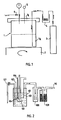
- the installation comprises a reactor 1 having a capacity of 100 ml consisting of a pressure-resistant steel casing 1 a and a cover 1 b .
- Reactor 1 is equipped with a stirring system and heating diagrammed in 2.
- the carbon dioxide is stored in liquid form under pressure in a tank 3 which is connected to the reactor via a condenser 4 which makes it possible to liquefy the carbon dioxide.
- the reactor 1 is provided with a safety valve 5; it is connected via a valve 6 to a restrictor (not shown in the figure) constituted by a silica tube 30 cm long and 50 microns in internal diameter which ensures the slow decompression of the reactor.
- the thioglycolic acid obtained no longer has the unpleasant odor which it exhibited before treatment.
- This installation comprises a 0.5 liter reactor 101 equipped with a magnetic or mechanical stirrer 102 and heating by immersion heater 103.
- a thermocouple 104 connected to a temperature measurement device 105, allows regulation of temperature.
- a conduit 106 makes it possible to introduce carbon dioxide CO2 coming from a source not shown.
- On the upper part of the reactor 101 is disposed a pipe for withdrawing the gas contained in the reactor which allows the passage of the gas in a static trap 108.
- the trap 108 is itself connected in the upper part to an activated carbon trap 109 for capture the smelly compounds.
- the gaseous effluents are withdrawn in the upper part of the trap 109 by a conduit 110.
- the liquid contained in the reactor 101 is withdrawn from the reactor 101 by a tube 107 which plunges into said reactor and which is provided with a tap.
- 250 ml of an aqueous thioglycolic acid solution at 368 g / l (4M) are introduced into the reactor 101 and, after starting the stirring, the temperature is brought to 40 ° C.
- Carbon dioxide is then injected into the solution under a pressure of 250 x 105 pascals and with a flow rate of 3 ml / minute.
- the gaseous effluent containing practically no more smelly compounds is withdrawn.
- the reactor is cooled to 20 ° C. and the aqueous solution of deodorized acid is drawn off via line 107.
- the thioglycolic acid obtained no longer exhibits the unpleasant odor which it exhibited before treatment.
- Examples 4 to 11 are examples of the use of an aqueous solution of a deodorized mercapto acid of formula I.
- This preparation is made from two solutions stored in different bottles.
- This reducing composition is applied to wet hair, previously wound on curlers, then the hair is covered with a plastic cap and left to act for 15 minutes at room temperature. The hair is then thoroughly rinsed with water and the oxidizing composition defined in B is then applied.
- the oxidizing composition is left to act for 5 minutes, then the hair is rolled out and left to act for 3 minutes. Finally, rinse thoroughly with water.
- a composition having a pH of 7.8 is obtained by mixing.
- a composition having a pH of 8.2 is obtained by mixing.
- a composition having a pH of 8.8 is obtained by mixing.
- a composition having a pH of 7.8 is obtained by mixing.
- This reducing composition is applied to wet hair, previously wound on curlers, then the hair is covered with a plastic cap and then left to act for 15 minutes at room temperature. The hair is then thoroughly rinsed with water and the following oxidizing composition is applied:
- This composition is applied to wet hair, initially curly, and the hair is smoothed, so as to make it straight, using a comb. After an exposure time of 10 minutes, rinse the hair thoroughly with water and apply the following oxidizing composition:
- the oxidizing composition is left to act for 5 minutes and then rinsed thoroughly with water.
- a depilatory composition is prepared from two solutions stored in different bottles:
- Solution (a) is mixed with solution (b), and the pH is adjusted to 11.2 by adding calcium hydroxide.
- This composition is applied to the skin and left to act for 10 minutes, then rinsed with copious amounts of water.
Landscapes
- Chemical & Material Sciences (AREA)
- Organic Chemistry (AREA)
- Cosmetics (AREA)
- Organic Low-Molecular-Weight Compounds And Preparation Thereof (AREA)
- Treating Waste Gases (AREA)
- Disinfection, Sterilisation Or Deodorisation Of Air (AREA)
- Agricultural Chemicals And Associated Chemicals (AREA)
Applications Claiming Priority (2)
| Application Number | Priority Date | Filing Date | Title |
|---|---|---|---|
| FR9212345A FR2697020B1 (fr) | 1992-10-15 | 1992-10-15 | Procédé de désodorisation d'un mercaptoacide par extraction des composés malodorants et produit désodorisé ainsi obtenu. |
| FR9212345 | 1992-10-15 |
Publications (2)
| Publication Number | Publication Date |
|---|---|
| EP0593313A1 true EP0593313A1 (de) | 1994-04-20 |
| EP0593313B1 EP0593313B1 (de) | 1997-01-15 |
Family
ID=9434572
Family Applications (1)
| Application Number | Title | Priority Date | Filing Date |
|---|---|---|---|
| EP93400881A Expired - Lifetime EP0593313B1 (de) | 1992-10-15 | 1993-04-05 | Verfahren zur Deodorisierung von einer Mercaptosäure durch Extraktion von übelriechenden Verbindungen sowie damit erhältliches, deodoriertes Produkt |
Country Status (8)
| Country | Link |
|---|---|
| US (1) | US5329045A (de) |
| EP (1) | EP0593313B1 (de) |
| JP (1) | JP2657455B2 (de) |
| AT (1) | ATE147727T1 (de) |
| CA (1) | CA2096399C (de) |
| DE (1) | DE69307450T2 (de) |
| ES (1) | ES2096877T3 (de) |
| FR (1) | FR2697020B1 (de) |
Families Citing this family (6)
| Publication number | Priority date | Publication date | Assignee | Title |
|---|---|---|---|---|
| FR2708602B1 (fr) * | 1993-08-02 | 1995-10-06 | Oreal | Procédé d'extraction des composés malodorants présents dans une formulation contenant au moins un composé comportant un groupe thiol et compositions désodorisées ainsi obtenues. |
| US6562327B1 (en) * | 2000-03-01 | 2003-05-13 | L'oreal S.A. | Hair relaxer compositions utilizing complexing agent activators |
| JP5323500B2 (ja) * | 2007-01-31 | 2013-10-23 | 一般財団法人電力中央研究所 | 下水汚泥の脱臭方法 |
| US8961780B1 (en) * | 2013-12-16 | 2015-02-24 | Saudi Arabian Oil Company | Methods for recovering organic heteroatom compounds from hydrocarbon feedstocks |
| US9169446B2 (en) | 2013-12-30 | 2015-10-27 | Saudi Arabian Oil Company | Demulsification of emulsified petroleum using carbon dioxide and resin supplement without precipitation of asphaltenes |
| US9688923B2 (en) | 2014-06-10 | 2017-06-27 | Saudi Arabian Oil Company | Integrated methods for separation and extraction of polynuclear aromatic hydrocarbons, heterocyclic compounds, and organometallic compounds from hydrocarbon feedstocks |
Family Cites Families (15)
| Publication number | Priority date | Publication date | Assignee | Title |
|---|---|---|---|---|
| CA464215A (en) * | 1950-04-04 | B. Wilson Norman | Purification of dicarboxylic acids | |
| US2398485A (en) * | 1943-05-03 | 1946-04-16 | Shell Dev | Purification of dicarboxylic acids |
| US2402825A (en) * | 1943-06-23 | 1946-06-25 | Shell Dev | Method of preparing and purifying dicarboxylic acids |
| US2425226A (en) * | 1947-03-17 | 1947-08-05 | Cp Hall Co | Process of obtaining thiodiglycolic acid |
| US2824135A (en) * | 1955-05-24 | 1958-02-18 | C P Hall Co Of Illinois | Purification of dicarboxylic acids |
| US2837565A (en) * | 1956-10-29 | 1958-06-03 | Nat Distillers Chem Corp | Chemical process for recovery of acids |
| NL289024A (de) * | 1962-02-19 | |||
| US3320230A (en) * | 1963-04-26 | 1967-05-16 | Du Pont | Process for separating carboxylic acids |
| GB1276642A (en) * | 1970-01-20 | 1972-06-07 | Bp Chem Int Ltd | Purification of di-neo acids |
| US4014903A (en) * | 1975-08-11 | 1977-03-29 | Allied Chemical Corporation | Recovery of dicarboxylic acids from aqueous solution containing nitric acid |
| JPS5927866A (ja) * | 1982-08-06 | 1984-02-14 | Lion Corp | チオグリコ−ル酸又はその塩の脱臭方法 |
| FI67229C (fi) * | 1982-08-17 | 1985-02-11 | Oulu Oy | Foerfarande foer att foerbaettra faergen och faergstabilitetenhos en karboxylsyra eller dess blandning |
| DE3334863A1 (de) * | 1983-09-27 | 1985-04-11 | Basf Ag, 6700 Ludwigshafen | Verfahren zur gewinnung von waessrigen glyoxylsaeureloesungen |
| US4902829A (en) * | 1988-11-16 | 1990-02-20 | Uop | Process for the adsorptive separation of hydroxy paraffinic dicarboxylic acids from olefinic dicarboxylic acids |
| JPH04255799A (ja) * | 1991-02-07 | 1992-09-10 | P C C Technol:Kk | 揮発性有効成分の抽出方法 |
-
1992
- 1992-10-15 FR FR9212345A patent/FR2697020B1/fr not_active Expired - Fee Related
-
1993
- 1993-04-05 AT AT93400881T patent/ATE147727T1/de not_active IP Right Cessation
- 1993-04-05 ES ES93400881T patent/ES2096877T3/es not_active Expired - Lifetime
- 1993-04-05 EP EP93400881A patent/EP0593313B1/de not_active Expired - Lifetime
- 1993-04-05 DE DE69307450T patent/DE69307450T2/de not_active Expired - Fee Related
- 1993-04-12 US US08/045,140 patent/US5329045A/en not_active Expired - Fee Related
- 1993-05-17 CA CA002096399A patent/CA2096399C/fr not_active Expired - Fee Related
- 1993-06-25 JP JP5177603A patent/JP2657455B2/ja not_active Expired - Lifetime
Also Published As
| Publication number | Publication date |
|---|---|
| CA2096399C (fr) | 1999-08-17 |
| US5329045A (en) | 1994-07-12 |
| ES2096877T3 (es) | 1997-03-16 |
| FR2697020A1 (fr) | 1994-04-22 |
| JP2657455B2 (ja) | 1997-09-24 |
| ATE147727T1 (de) | 1997-02-15 |
| EP0593313B1 (de) | 1997-01-15 |
| CA2096399A1 (fr) | 1994-04-16 |
| DE69307450T2 (de) | 1997-05-28 |
| FR2697020B1 (fr) | 1994-12-09 |
| DE69307450D1 (de) | 1997-02-27 |
| JPH06128220A (ja) | 1994-05-10 |
Similar Documents
| Publication | Publication Date | Title |
|---|---|---|
| EP0368763B1 (de) | 4-Mercapto-Butyramide-N-mono- oder N,N-disubstituiert durch ein Mono- oder Polyhydroxyalkyl-Radikal und ihre Verwendung als Reduktionsmittel zur dauernden Verformung von Haaren | |
| EP0354835B1 (de) | N-(mercaptoalkyl)-omega-hydroxyalkylamide und ihre Verwendung als Reduktionsmittel in einem Verfahren zur bleibenden Gestaltung von Haaren | |
| EP0514282B1 (de) | Alkylaminomerkaptoalkylamide, für Kosmetika akzeptabele Salze davon, ihre Verwendung als Reduktionsmittel sowie Verfahren zur dauerhaften Verformung von Haaren | |
| EP0653202B1 (de) | Kosmetische Zusammensetzung, enthaltend als Reduktionsmittel ein N-Mercaptoalkylalkandiamid oder eines seiner kosmetisch verträglichen Salze | |
| EP0432000B1 (de) | Reduzierende Zusammensetzung zur dauerhaften Haarverformung, die als reduzierendes Agens ein Aminomercaptoalkylamid oder eines seiner Salze enthält sowie ihre Verwendung in einem Verfahren zur dauerhaften Haarverformung | |
| WO1993001791A1 (fr) | Melange azeotrope de thioglycolate d'hydroxy-2 propyle et de thioglycolate d'hydroxy-2 methyl-1 ethyle, son procede d'obtention et son utilisation dans un procede de deformation permanente des cheveux | |
| CA2122211C (fr) | Procede de desodorisation d'une formulation contenant au moins un compose porteur d'un groupe thiol et formulation desodorisee ainsi obtenue | |
| EP0638550B1 (de) | Verfahren zur Entfernung von übelriechenden Verbindungen aus einer Formulierung, die mindestens eine Verbindung mit einer Thiolgruppe enthält sowie sie enthaltende deodorisierte Zusammensetzungen | |
| EP0577473B1 (de) | Reduzierende kosmetische Zusammensetzung zur Haardauerwellung auf Basis eines Mercaptoalkylamino-Amids und Haardauerwellverfahren | |
| EP0593314B1 (de) | Verfahren zur Deodorisierung von einer Mercaptosäure sowie damit erhältliches Produkt | |
| EP0593313B1 (de) | Verfahren zur Deodorisierung von einer Mercaptosäure durch Extraktion von übelriechenden Verbindungen sowie damit erhältliches, deodoriertes Produkt | |
| EP0568695B1 (de) | Kosmetische Zusammensetzung zur Haarbehandlung | |
| EP1570835B1 (de) | Zusammensetzung zur dauerhaften Verformung der Haare enthaltend mindestens ein Carboxydithiol | |
| EP1570834A1 (de) | Zusammensetzung zur dauerhaften Verformung der Haare enthaltend mindestens ein dicarboxydithiol | |
| EP1032554A1 (de) | Citronnellyl- und/oder dihydrocitronellyllactate, ihre herstellung und ihre anwendung | |
| FR2668929A1 (fr) | Composition cosmetique reductrice pour la deformation permanente des cheveux a base d'un amino-mercaptoalkylamide et procede de deformation permanente des cheveux. | |
| FR2669332A1 (fr) | Nouveaux thioesters, leur procede de preparation et leur utilisation dans la synthese d'amino-mercapto-alkylamides. | |
| FR2669329A1 (fr) | Amino-mercapto-alkylamides, leur procede de preparation et leur utilisation dans une composition cosmetique reductrice dans la deformation permanente des cheveux. |
Legal Events
| Date | Code | Title | Description |
|---|---|---|---|
| PUAI | Public reference made under article 153(3) epc to a published international application that has entered the european phase |
Free format text: ORIGINAL CODE: 0009012 |
|
| 17P | Request for examination filed |
Effective date: 19930406 |
|
| AK | Designated contracting states |
Kind code of ref document: A1 Designated state(s): AT BE CH DE DK ES FR GB GR IE IT LI NL PT SE |
|
| GRAG | Despatch of communication of intention to grant |
Free format text: ORIGINAL CODE: EPIDOS AGRA |
|
| 17Q | First examination report despatched |
Effective date: 19960513 |
|
| GRAH | Despatch of communication of intention to grant a patent |
Free format text: ORIGINAL CODE: EPIDOS IGRA |
|
| GRAH | Despatch of communication of intention to grant a patent |
Free format text: ORIGINAL CODE: EPIDOS IGRA |
|
| GRAA | (expected) grant |
Free format text: ORIGINAL CODE: 0009210 |
|
| AK | Designated contracting states |
Kind code of ref document: B1 Designated state(s): AT BE CH DE DK ES FR GB GR IE IT LI NL PT SE |
|
| PG25 | Lapsed in a contracting state [announced via postgrant information from national office to epo] |
Ref country code: NL Free format text: LAPSE BECAUSE OF FAILURE TO SUBMIT A TRANSLATION OF THE DESCRIPTION OR TO PAY THE FEE WITHIN THE PRESCRIBED TIME-LIMIT Effective date: 19970115 Ref country code: GR Free format text: LAPSE BECAUSE OF FAILURE TO SUBMIT A TRANSLATION OF THE DESCRIPTION OR TO PAY THE FEE WITHIN THE PRESCRIBED TIME-LIMIT Effective date: 19970115 Ref country code: DK Effective date: 19970115 Ref country code: AT Effective date: 19970115 |
|
| REF | Corresponds to: |
Ref document number: 147727 Country of ref document: AT Date of ref document: 19970215 Kind code of ref document: T |
|
| REG | Reference to a national code |
Ref country code: CH Ref legal event code: EP |
|
| ITF | It: translation for a ep patent filed | ||
| GBT | Gb: translation of ep patent filed (gb section 77(6)(a)/1977) |
Effective date: 19970205 |
|
| REF | Corresponds to: |
Ref document number: 69307450 Country of ref document: DE Date of ref document: 19970227 |
|
| REG | Reference to a national code |
Ref country code: IE Ref legal event code: FG4D Free format text: 71562 |
|
| REG | Reference to a national code |
Ref country code: ES Ref legal event code: FG2A Ref document number: 2096877 Country of ref document: ES Kind code of ref document: T3 |
|
| PG25 | Lapsed in a contracting state [announced via postgrant information from national office to epo] |
Ref country code: IE Free format text: LAPSE BECAUSE OF NON-PAYMENT OF DUE FEES Effective date: 19970405 |
|
| PG25 | Lapsed in a contracting state [announced via postgrant information from national office to epo] |
Ref country code: SE Effective date: 19970415 Ref country code: PT Effective date: 19970415 |
|
| PG25 | Lapsed in a contracting state [announced via postgrant information from national office to epo] |
Ref country code: LI Free format text: LAPSE BECAUSE OF NON-PAYMENT OF DUE FEES Effective date: 19970430 Ref country code: CH Free format text: LAPSE BECAUSE OF NON-PAYMENT OF DUE FEES Effective date: 19970430 Ref country code: BE Effective date: 19970430 |
|
| NLV1 | Nl: lapsed or annulled due to failure to fulfill the requirements of art. 29p and 29m of the patents act | ||
| BERE | Be: lapsed |
Owner name: L' OREAL Effective date: 19970430 |
|
| PLBE | No opposition filed within time limit |
Free format text: ORIGINAL CODE: 0009261 |
|
| STAA | Information on the status of an ep patent application or granted ep patent |
Free format text: STATUS: NO OPPOSITION FILED WITHIN TIME LIMIT |
|
| REG | Reference to a national code |
Ref country code: CH Ref legal event code: PL |
|
| 26N | No opposition filed | ||
| PGFP | Annual fee paid to national office [announced via postgrant information from national office to epo] |
Ref country code: DE Payment date: 20000403 Year of fee payment: 8 |
|
| PGFP | Annual fee paid to national office [announced via postgrant information from national office to epo] |
Ref country code: GB Payment date: 20000405 Year of fee payment: 8 |
|
| PGFP | Annual fee paid to national office [announced via postgrant information from national office to epo] |
Ref country code: FR Payment date: 20000411 Year of fee payment: 8 |
|
| PGFP | Annual fee paid to national office [announced via postgrant information from national office to epo] |
Ref country code: ES Payment date: 20000419 Year of fee payment: 8 |
|
| PG25 | Lapsed in a contracting state [announced via postgrant information from national office to epo] |
Ref country code: GB Free format text: LAPSE BECAUSE OF NON-PAYMENT OF DUE FEES Effective date: 20010405 |
|
| PG25 | Lapsed in a contracting state [announced via postgrant information from national office to epo] |
Ref country code: ES Free format text: LAPSE BECAUSE OF NON-PAYMENT OF DUE FEES Effective date: 20010406 |
|
| PG25 | Lapsed in a contracting state [announced via postgrant information from national office to epo] |
Ref country code: FR Free format text: THE PATENT HAS BEEN ANNULLED BY A DECISION OF A NATIONAL AUTHORITY Effective date: 20010430 |
|
| GBPC | Gb: european patent ceased through non-payment of renewal fee |
Effective date: 20010405 |
|
| PG25 | Lapsed in a contracting state [announced via postgrant information from national office to epo] |
Ref country code: DE Free format text: LAPSE BECAUSE OF NON-PAYMENT OF DUE FEES Effective date: 20020201 |
|
| REG | Reference to a national code |
Ref country code: FR Ref legal event code: ST |
|
| REG | Reference to a national code |
Ref country code: ES Ref legal event code: FD2A Effective date: 20030203 |
|
| PG25 | Lapsed in a contracting state [announced via postgrant information from national office to epo] |
Ref country code: IT Free format text: LAPSE BECAUSE OF NON-PAYMENT OF DUE FEES;WARNING: LAPSES OF ITALIAN PATENTS WITH EFFECTIVE DATE BEFORE 2007 MAY HAVE OCCURRED AT ANY TIME BEFORE 2007. THE CORRECT EFFECTIVE DATE MAY BE DIFFERENT FROM THE ONE RECORDED. Effective date: 20050405 |