EP0593320A1 - Verfahren zur Übertragung einer Zeitverschiebungsnachricht an ein Fahrzeug das sich in einem zellularen Funkfernsprechnetz bewegt sowie Fahrzeug, Steuerungsvorrichtung, und Nachrichtaustauschanordnung die dieses Verfahren verwenden - Google Patents
Verfahren zur Übertragung einer Zeitverschiebungsnachricht an ein Fahrzeug das sich in einem zellularen Funkfernsprechnetz bewegt sowie Fahrzeug, Steuerungsvorrichtung, und Nachrichtaustauschanordnung die dieses Verfahren verwenden Download PDFInfo
- Publication number
- EP0593320A1 EP0593320A1 EP93402232A EP93402232A EP0593320A1 EP 0593320 A1 EP0593320 A1 EP 0593320A1 EP 93402232 A EP93402232 A EP 93402232A EP 93402232 A EP93402232 A EP 93402232A EP 0593320 A1 EP0593320 A1 EP 0593320A1
- Authority
- EP
- European Patent Office
- Prior art keywords
- station
- mobile
- bts2
- bts1
- controller
- Prior art date
- Legal status (The legal status is an assumption and is not a legal conclusion. Google has not performed a legal analysis and makes no representation as to the accuracy of the status listed.)
- Granted
Links
- 238000000034 method Methods 0.000 title claims abstract description 56
- 230000005540 biological transmission Effects 0.000 title claims abstract description 34
- 230000001413 cellular effect Effects 0.000 title claims abstract description 27
- 238000004891 communication Methods 0.000 claims abstract description 39
- 238000001514 detection method Methods 0.000 claims description 20
- 108091006621 SLC12A1 Proteins 0.000 claims description 16
- 108091006620 SLC12A2 Proteins 0.000 claims description 16
- 230000008569 process Effects 0.000 claims description 6
- 238000004364 calculation method Methods 0.000 claims description 3
- 230000002123 temporal effect Effects 0.000 claims description 3
- 102000047724 Member 2 Solute Carrier Family 12 Human genes 0.000 claims 9
- 101150080339 BTS1 gene Proteins 0.000 description 36
- 102100034243 Solute carrier family 12 member 2 Human genes 0.000 description 32
- 230000001360 synchronised effect Effects 0.000 description 8
- 230000008901 benefit Effects 0.000 description 4
- 230000008859 change Effects 0.000 description 2
- 238000010586 diagram Methods 0.000 description 2
- 230000010363 phase shift Effects 0.000 description 2
- 230000011664 signaling Effects 0.000 description 2
- 230000003321 amplification Effects 0.000 description 1
- 238000013459 approach Methods 0.000 description 1
- 239000000470 constituent Substances 0.000 description 1
- 230000001934 delay Effects 0.000 description 1
- 238000000605 extraction Methods 0.000 description 1
- 230000006870 function Effects 0.000 description 1
- 238000010295 mobile communication Methods 0.000 description 1
- 238000012986 modification Methods 0.000 description 1
- 230000004048 modification Effects 0.000 description 1
- 238000003199 nucleic acid amplification method Methods 0.000 description 1
- 239000013307 optical fiber Substances 0.000 description 1
- 238000012545 processing Methods 0.000 description 1
- 238000012552 review Methods 0.000 description 1
- 230000008054 signal transmission Effects 0.000 description 1
Images




Classifications
-
- H—ELECTRICITY
- H04—ELECTRIC COMMUNICATION TECHNIQUE
- H04W—WIRELESS COMMUNICATION NETWORKS
- H04W36/00—Hand-off or reselection arrangements
- H04W36/0005—Control or signalling for completing the hand-off
- H04W36/0055—Transmission or use of information for re-establishing the radio link
- H04W36/0072—Transmission or use of information for re-establishing the radio link of resource information of target access point
-
- H—ELECTRICITY
- H04—ELECTRIC COMMUNICATION TECHNIQUE
- H04W—WIRELESS COMMUNICATION NETWORKS
- H04W36/00—Hand-off or reselection arrangements
- H04W36/0005—Control or signalling for completing the hand-off
- H04W36/0083—Determination of parameters used for hand-off, e.g. generation or modification of neighbour cell lists
- H04W36/00837—Determination of triggering parameters for hand-off
-
- H—ELECTRICITY
- H04—ELECTRIC COMMUNICATION TECHNIQUE
- H04W—WIRELESS COMMUNICATION NETWORKS
- H04W56/00—Synchronisation arrangements
- H04W56/004—Synchronisation arrangements compensating for timing error of reception due to propagation delay
- H04W56/0045—Synchronisation arrangements compensating for timing error of reception due to propagation delay compensating for timing error by altering transmission time
-
- H—ELECTRICITY
- H04—ELECTRIC COMMUNICATION TECHNIQUE
- H04W—WIRELESS COMMUNICATION NETWORKS
- H04W56/00—Synchronisation arrangements
Definitions
- the field of the invention is that of the transmission of temporal information to mobiles moving in a cellular radiotelephony network, such as for example a GSM network (Special Mobile Group), when these mobiles move from one cell to another.
- a cellular radiotelephony network such as for example a GSM network (Special Mobile Group)
- the mobiles are for example made up of radiotelephones on board vehicles and the temporal information transmitted must allow a mobile which passes from one cell to another, to temporally advance the emission of the digital information which it must transmit, in order to '' be in synchronism with the transceiver station of the new cell.
- GSM Global System for Mobile Communications
- FIG. 1 represents the structure of a cellular radiotelephony network, such as a GSM type network.
- a mobile operates in a cell C1 constituted by the geographic coverage of a base transceiver station, denoted BTS1.
- Other cells C2, C3 each include a base transceiver station BTS2, BTS3.
- Each of these stations BTS1 to BTS3 constitutes one of the components of the GSM network and comprises one or more transceivers, each associated with an antenna and with processing equipment. The cells partially overlap so that there is no shadow area.
- the stations BTS1 to BTS3 are managed by a base station controller, rated BSC.
- the function of the BSC controller is in particular to manage the frequency channels of the BTS stations.
- a BSC controller associated with a certain number of BTS stations constitutes a base station system, denoted BSS.
- BSS base station system
- Other controllers can also be provided, each controlling a predetermined number of BTS stations, and each being connected to a switching center, denoted MSC, which is the master structure of a GSM network.
- MSC switching center
- a given MSC can therefore control the operation of several BSS systems constituting a public field mobile network, commonly called PLMN.
- the mobile MS sends digital data streams in the form of packets to the station BTS1 as long as it is in cell C1 and the station BTS1 retransmits these trains to the controller BSC which transmits them to their recipient via the MSC switch.
- the recipient can be constituted by a mobile or fixed station.
- Each data packet constituting for example speech data
- Eight MS mobile stations can therefore communicate on the same radio channel, ie with the same carrier frequency, thanks to multiple time-division access (TDMA or English).
- TDMA time-division access
- two to four channels are assigned to each BTS station and 16 to 32 radio channels are therefore available for transmission (as for reception) at each cell.
- One of the problems of the GSM system is the synchronization of the time intervals allocated to a mobile MS with the master clock located at the BTS station. Indeed, it is necessary to take into account the propagation time of radio waves between a mobile MS and its base station BTS since the mobiles and the BTS station on which they depend each have their own internal bit clock. As a time interval lasts 577 ⁇ s, and knowing that a radio wave travels 300 m in 1 ⁇ s (3x10⁸ m / s), the time base of the mobile MS must take account of this time difference, of 1 ⁇ s per 300 m of distance separating the mobile MS from its BTS station, so as not to transmit data during the time interval allocated to another mobile.
- FIG. 2 is a correlative timing diagram of signals transmitted by the station BTS1 and by the mobile MS and shows how the appropriate time offset is communicated to the mobile.
- the station BTS1 which manages the cell in which the mobile MS is located, transmits regularly, at times referenced T0, T1, T2, T3 and T4, and on a synchronization channel SCH (Synchronization CHannel) belonging to a specific common channel called BCCH (Broadcast Common CHannel) intended generally to transmit synchronization information to mobiles, a clock signal H0, H1, H2, H3, H4.
- SCH Synchronization CHannel
- BCCH Broadcast Common CHannel
- This signal is used when the mobile MS must be attached to a cell in the GSM network, for example when it is powered up or, as will be explained below, in the event of a handover.
- the mobile MS connects to the network for the first time after being powered up, it can only receive the clock signal from the moment, noted MS ON , when it is powered up.
- the first clock signal which it receives after the instant MS ON is offset by time noted ⁇ with respect to its time of transmission T1 by the base station BTS1.
- the signal H1 is therefore received by the mobile at the instant T1 + ⁇ .
- the mobile MS which wishes to connect to the station BTS1 sends to the latter, on a signaling channel, an access message called Random Access and constituted by an Access Burst.
- this message is called Handover Access and noted HA.
- Each Handover Access has a duration shorter than that of a burst constituting a normal signal (called Normal Burst) containing for example speech data, so that it cannot interfere with the signals emitted by another mobile in another time interval.
- the station BTS1 can determine the time TA (for Timing Advance or in French time advance) separating this reception from the transmission of the clock signal H1.
- This time TA corresponds to twice the time of transmission of a signal between the mobile MS and the station BTS1, that is to say twice the time ⁇ .
- the station BTS1 then sends, on a signaling channel called AGCH (Access Grant CHannel), a message to the mobile MS to indicate that it must transmit its signals with an advance of TA compared to its clock signal: the mobile can then send normal signals without risk of overlapping with those sent by other mobiles. As a result, it is ensured that the signals transmitted by the various mobiles on a given transmission channel arrive very successively at the station BTS1.
- AGCH Access Grant CHannel
- a known problem is that of managing the passage of the mobile MS from one cell to another.
- the mobile MS receives not only signals from BTS1, but also from BTS2 and from BTS3, and, when the power of the signals received from BTS1 becomes lower than that of the signals received for example from BTS2, the BSC connects the MS mobile station BTS2 which will ensure the continuation of the transmission.
- This situation is typical when the mobile MS moves away from BTS1 and approaches BTS2. It is then necessary to modify the time advance information TA, so that the mobile synchronizes with the BTS2 station of the new cell C2.
- Synchronous handover consists in controlling the clocks of the different BTS stations of a given GSM system so that their clock signals are synchronous.
- Synchronous handover consists in controlling the clocks of the different BTS stations of a given GSM system so that their clock signals are synchronous.
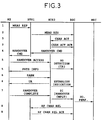
- step 1 the mobile MS sends a MEAS REP message to the station BTS1.
- This message can be compared to a request from cell change, is normalized and occurs every 0.5 seconds.
- step 2 the station BTS1 transmits this information (message MEAS RES) to the controller BSC which decides to carry out a handover procedure. This decision is taken in particular when the message MEAS REP indicates that the mobile MS is no longer receiving under the best conditions and that for example the mobile receives better the signals transmitted periodically by the station BTS2 than those transmitted by the station BTS1.
- the BSC controller and the MSC switching center can also decide for themselves whether a handover is necessary, taking into account other decision criteria.
- step 3 the controller BSC activates a channel of the station BTS2 (message CHAN ACT) and the station BTS2 acknowledges the allocation (message CHAN ACT ACK).
- step 4 the controller BSC sends a handover command (HANDOVER message CMD) to the station BTS1 which immediately transmits it to the mobile MS in a transparent manner. Then begins the handover procedure at the mobile MS (step 5) which sends successive synchronization HA messages (HANDOVER ACCESS) to BTS2 with zero time advance, that is to say without taking distance into account. This step was previously illustrated in FIG. 2.
- the new time advance information that the mobile MS must use is in fact not known to it and it is the station BTS2 which supplies it after having calculated it (message PHYS INFO containing among other things the indication TA).
- the BTS2 station also sends a HO DETECTION (TA) message to the BSC controller.
- TA HO DETECTION
- the mobile MS sends a SABM connection message to the station BTS2, taking note of the new synchronization.
- the station BTS2 informs the controller BSC (message ESTABLISH INDICATION) and signals to the mobile MS (message UA) that it has been heard.
- step 7 the mobile MS sends a HANDOVER COMPLT message to the station BTS2 to inform it that the handover procedure has ended and this station immediately retransmits this message to the controller BSC.
- the BSC controller then informs the MSC switching center (HANDOVER message PERFORMED).
- step 8 the controller BSC addresses the station BTS1 (RF CHAN REL message) to make available the time interval previously allocated to the mobile MS and the latter responds to it (RF CHAN REL ACK message).
- the mobile MS dialogues with the station BTS2 which has allocated to it a time interval in a frame carried by a given carrier, as well as time advance information TA.
- the main drawback of the asynchronous handover is that sending the TA time advance information to the mobile is long and requires approximately 40 ms, to which must be added approximately 10 ms of TA calculation and the mobile cannot continue to transmit data during this time.
- the transmission of HA synchronization signals is imposed by the GSM and requires 5 ms per synchronization signal.
- Other delays contribute to delaying the handover and it is frequent that the communication is cut for more than 100 ms.
- the present invention aims in particular to overcome these drawbacks.
- one of the objectives of the invention is to provide a handover method which can be applied to a cellular radiotelephone network where the stations are not synchronized, for example to an asynchronous type network, the least expensive and the most widespread. , making it possible to reduce the time during which communication is cut off when a handover is performed.
- Another objective is to provide a mobile, a station, a controller, as well as an information exchange system implementing such a handover method.
- This method therefore makes it possible to limit the interruption in communication between the mobile and the first station to a time corresponding to the emission of the first sequence of the synchronization signals.
- This cutoff lasts approximately 25 to 30 ms and causes a speech interruption of 60 to 80 ms which can be masked by speech extrapolation software.
- the method consists in transmitting from the mobile to the second station a second sequence of synchronization signals after having received the calculated time advance information.
- This last step is identical to that which is implemented in a cellular radiotelephony network with synchronous base stations, which has the advantage of allowing the mobile to use a known procedure and therefore of not complicating the implementation of the invention within the mobile.
- the calculated time advance information is transmitted from the second station to the controller to which it is attached in a synchronization detection information.
- the calculated time advance information is also advantageously transmitted from the second controller to the switch and from the switch to the first controller in synchronization detection information.
- the invention preferably applies to cellular radiotelephony networks comprising BTS stations asynchronous with one another, the phase difference between their clock signals being unknown.
- the mobile can also include means for deciding the transmission of a second sequence of synchronization signals to the attention of the second station when it receives the control signal comprising the time advance information.
- This controller advantageously also comprises means for transmitting information comprising the time advance information calculated for the attention of a switch, the information transmitted to the switch being transmitted on receipt of the message transmitted by the second station. .
- the invention also relates to an information exchange system between a mobile, at least two transceiver stations and a controller of these stations (internal handover), the exchange of information between the mobile and the stations being of the multiple access with distribution in time, the mobile comprising means of detection of an instruction indicating to him, when it passes from a first cell, corresponding to the geographical coverage of a first of the stations with which the mobile is in communication , to a second cell, corresponding to the geographical coverage of a second of the stations, that it must transmit to the attention of the second station a sequence of synchronization signals, the second station comprising means for calculating information time advance to be provided to the mobile, this system being characterized in that the mobile continues to communicate with the first station immediately after having transmitted the sequence of synchronization signals to the attention of the second station, in that the second station includes means for transmitting the time advance information calculated for the attention of the controller, in that the controller comprises means for transmitting the time advance information calculated for the attention of the first station and in that the first station comprises means for retransmission of
- the information exchange system in a cellular radiotelephony network between a mobile, a first station attached to a first controller and a second station attached to a second controller, the controllers being controlled by the same switch, the exchanges of information between the mobile and the stations being of the time division multiple access type
- the mobile comprising means for detecting an instruction indicating, when it passes from a first cell, corresponding to the geographic coverage of the first station with which the mobile is in communication, to a second cell, corresponding to the geographic coverage of the second station, which it must transmit to the attention of the second station a sequence of synchronization signals
- the second station comprising means for calculating time advance information to be supplied to the mobile
- the system is characterized in that the mobile continues to communicate with the first station immediately after having transmitted the sequence of synchronization signals to the attention of the second station, in that the second station comprises means for transmitting the time advance information calculated for the switch via the second controller, in that the switch comprises means for transmitting the information time advance calculated for the attention
- FIG. 4 represents an internal handover procedure according to the invention, that is to say that the station with which the mobile communicates and that with which this mobile wishes to establish a communication belong to the same BSS system.
- the steps 1 to 3 previously described with reference to FIG. 3 are identical in the context of the invention, that is to say that the BSC controller considers that it is necessary to carry out a handover procedure because the mobile MS could communicate better with the BTS2 station than with the BTS1 station with which it currently communicates.
- the BSC controller activates a channel of the BTS2 station and this BTS2 station acknowledges the allocation, the BSC controller having fixed the characteristics.
- the present invention differs from the prior art in that, in step 4, the BSC controller sends an instruction, called Handover Channel (HO CHN), indicating on the one hand to the mobile MS that it must interrupt its communication with the first BTS1 station to send to the second BTS2 station a (first) sequence of HO ACCESS signals (step 5) of synchronization allowing the second BTS2 station to measure the transit time of the synchronization signals, this transit time corresponding to half the value of the time advance information TA, and on the other hand that the mobile MS must continue to communicate with the first station BTS1 immediately after having sent this first sequence of synchronization HO ACCESS signals.
- HO CHN Handover Channel
- This new HO CHN message therefore differs from the HANDOVER CMD signal of the state of the art in that the mobile MS continues to communicate with the first station BTS1 after sending the synchronization messages HO ACCESS, and the communication with BTS1 n 'was therefore only cut for approximately 25 to 30 ms (sending of four successive messages). Of course, the number of successive synchronization messages is not necessarily four and can be reduced.
- the instruction HO CHN is retransmitted transparently by the station BTS1 to the mobile MS.
- the station BTS2 When the station BTS2 receives one of these synchronization messages, it calculates the value of the time advance information TA and supplies it to the controller BSC in a HO DETECTION (TA) message for synchronization detection.
- the controller BSC then sends to the mobile, via the station BTS1, a control signal HO CMD (TA) (step 6) comprising the time advance information TA.
- TA HO DETECTION
- the mobile MS then knows the time advance which it must use to communicate with the station BTS2.
- the mobile On receipt of TA, the mobile can send a second sequence of HO ACCESS synchronization signals (step 7).
- the operation is then identical to that implemented in a synchronous cellular radio telephone network, which has the advantage of allowing the mobile to use a known procedure and therefore not to complicate the implementation of the invention in within the mobile.
- Steps 8 to 10 are identical to steps 6 to 8 of FIG. 3, that is to say that the procedure ends by informing the switch MSC of the success of the handover procedure.
- the mobile MS is then in communication with the station BTS2.
- the present invention also applies to external handover procedures, that is to say that the stations BTS1 and BTS2 can belong to different BSS systems.
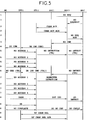
- Such a procedure is shown in FIG. 5 and the configuration envisaged is that the mobile MS is in communication with the station BTS1 controlled by the controller BSC1, and must connect to the station BTS2 controlled by the controller BSC2.
- step 1 the controller BSC1 transmits to the switch MSC a message HO REQ indicating that the mobile MS wishes to enter into communication with the station BTS2.
- step 2 the MSC transmits this request to BSC2 (message HO REQUEST) which interrogates the station BTS2 (message CHAN ACT) to activate one of its channels.
- BTS2 acknowledges the allocation with a CHAN ACT ACK message and BSC2 transmits a HO REQ ACK message to the MSC switch.
- step 3 the switch generates a handover message (HO CMD message) intended for BSC1, indicating that this new type of handover must be used.
- HO CMD message handover message
- step 4 BSC1 sends an instruction HO CHN to the mobile MS indicating to it which frequency channel it must use to come into contact with BTS2.
- the mobile MS interrupts its communication in progress and generates four successive HO ACCESSs (step 5) and immediately resumes its transmission of voice type data.
- the station BTS2 here detects the first HO ACCESS 1 message and calculates the time advance TA before retransmitting it to BSC2 (HO DETECTION (TA) message).
- the BSC2 controller transmits this information to MSC (HO DETECT (TA) message).
- step 6 the switch MSC returns this order to BSC1 which generates a handover command order (HO CMD message (TA)) for the attention of the mobile MS, via the station BTS1.
- the mobile therefore knows TA time advance information to be used to communicate with the station BTS2.
- the mobile MS can then send four successive HO ACCESSs to BTS2 which generates a HANDOVER DETECTION message at attention of BSC2.
- the rest of the procedure is identical to that of FIG. 4, except for the transmission of an information message HO DETECT from BSC2 to the switch MSC.
- the handover procedure according to the invention makes it possible to limit the break in communication between a mobile and its transceiver station to approximately 60 to 80 ms, and the mobile does not wait to have received the time advance information TA from BTS2 station. This brief cut in communication can easily be masked by speech extrapolation software.
- the invention applies in particular to cellular radiotelephony networks of the GSM type, and in particular to such networks where the stations are asynchronous with one another and where the phase shift between the clocks of these stations is not known.
- the invention applies to all cellular radiotelephony networks where time advance information must be provided to a mobile when it changes cells.
- FIG. 6 represents a simplified structure of a mobile MS adapted to implement the method of the present invention.
- the mobile MS for example constituted by a radiotelephone, comprises in known manner a transmit-receive antenna 65 connected to means for transmitting and receiving 60 of signals.
- the means 60 include in particular a modulator, a demodulator and amplification and gain control stages. They are connected to management means 64 which ensure the operation of the mobile MS.
- the mobile MS further comprises means 61 for detecting the instruction HO CHN which is transmitted by the station with which it communicates (station BTS1 in the previous examples). Upon detection of this instruction, the mobile MS sends the first sequence of HO ACCESS signals to the attention of the station with which it will have to communicate (station BTS2).
- the mobile MS also includes means 62 for detecting the control signal HO CMD (TA) which in particular ensure the extraction of the time advance information TA. This information TA is transmitted to the management means 64 which advance the transmission of the signals intended for the station BTS2.
- TA control signal HO CMD
- the mobile MS may include means 63 for deciding to transmit a second sequence of synchronization signals (steps 7 in FIGS. 4 and 5) to the attention of the station BTS2, when the control signal HO CMD (TA) is detected.
- TA control signal HO CMD
- FIG. 7 shows a simplified structure of a BTS transceiver station.
- the BTS station shown is for example the BTS2 station, and communicates with the mobile MS using an antenna 73 connected to means 70 for transmitting and receiving signals.
- Each station BTS comprises means 71 for calculating the time advance information TA to be communicated to the mobile.
- the calculation means 71 (connected to a time base not shown) measure the time between the emission of a clock top and the reception of a HO ACCESS since this time corresponds to a round trip of signals between the station and the MS mobile.
- management means 72 control the transmission of the HO DETECTION (TA) message to the attention of the controller to which this station BTS is attached. This transmission can be carried out using an antenna 75 connected to transmission-reception means 74 (radio transmission) or else using a physical link (cable, optical fiber, etc.).
- the transmission-reception means 70 and 74 can be considered as signal retransmission means when they only serve as transmission relays.
- FIG. 8 represents a simplified structure of a BSC controller of transceiver stations adapted to implement the method of the present invention.
- the BSC controller shown comprises transmission-reception means 80 connected to an antenna 82 (or to a physical link capable of communicating with a BTS station as shown in FIG. 7), management means 81 and means of transmission-reception 83 connected to an antenna 84 (or to a physical link capable of communicating with an MSC switch as shown in FIG. 9).
- the means 80 ensure on the one hand the reception of the time advance information TA which is transmitted in the HO DETECTION message (TA) sent by the station with which the mobile MS must communicate (station BTS2) and on the other hand transmission of the HO CMD (TA) control signal to the station with which the mobile communicates (station BTS1).
- TA HO DETECTION message
- TA HO CMD
- the means 83 ensure communications with the switch controlling this controller BSC and in particular, in the case of an external handover, the transmission of HO DETECT (TA) signals.
- TA HO DETECT
- FIG. 9 shows a simplified structure of an MSC switch suitable for implementing the method of the present invention.
- This MSC switch is used in the case of an external handover since the time advance information calculated by the target station (station BTS2) is transmitted to the mobile via the MSC switch enabling the controllers of two stations to be linked. Different BSS.
- the MSC switch comprises an antenna 92 for transmission-reception connected to means 90 for transmitting and receiving signals controlled by management means 91.
- the reception means are used to receive the HO DETECT (TA) message from the the station (BTS2) with which the mobile MS must communicate and the transmission means for the transmission of this same message to the controller of the station (BTS1) with which the mobile MS is being communication.
- TA HO DETECT
- the transmission-reception means 90 and the antenna 92 can be adapted for communication by physical link with the controllers of stations BTS1 and BTS2.
- the invention applies preferably to a cellular radiotelephony network of the GSM type and is of particular interest when the stations which make up this network are asynchronous with one another.
Landscapes
- Engineering & Computer Science (AREA)
- Computer Networks & Wireless Communication (AREA)
- Signal Processing (AREA)
- Mobile Radio Communication Systems (AREA)
- Time-Division Multiplex Systems (AREA)
- Small-Scale Networks (AREA)
- Data Exchanges In Wide-Area Networks (AREA)
- Two-Way Televisions, Distribution Of Moving Picture Or The Like (AREA)
- Arrangements For Transmission Of Measured Signals (AREA)
Applications Claiming Priority (2)
| Application Number | Priority Date | Filing Date | Title |
|---|---|---|---|
| FR9210996A FR2695777B1 (fr) | 1992-09-15 | 1992-09-15 | Procédé de transmission d'une information d'avance temporelle à un mobile évoluant dans des cellules d'un réseau GSM à BTS asynchrones. |
| FR9210996 | 1992-09-15 |
Publications (2)
| Publication Number | Publication Date |
|---|---|
| EP0593320A1 true EP0593320A1 (de) | 1994-04-20 |
| EP0593320B1 EP0593320B1 (de) | 1998-05-20 |
Family
ID=9433528
Family Applications (1)
| Application Number | Title | Priority Date | Filing Date |
|---|---|---|---|
| EP93402232A Expired - Lifetime EP0593320B1 (de) | 1992-09-15 | 1993-09-14 | Verfahren zur Übertragung einer Zeitverschiebungsnachricht an ein Fahrzeug das sich in einem zellularen Funkfernsprechnetz bewegt sowie Fahrzeug, Steuerungsvorrichtung, und Nachrichtenaustauschanordnung die dieses Verfahren verwenden |
Country Status (10)
| Country | Link |
|---|---|
| US (1) | US5479409A (de) |
| EP (1) | EP0593320B1 (de) |
| AT (1) | ATE166516T1 (de) |
| AU (1) | AU662241B2 (de) |
| DE (1) | DE69318667T2 (de) |
| DK (1) | DK0593320T3 (de) |
| ES (1) | ES2117113T3 (de) |
| FI (1) | FI934009A7 (de) |
| FR (1) | FR2695777B1 (de) |
| NO (1) | NO306009B1 (de) |
Cited By (1)
| Publication number | Priority date | Publication date | Assignee | Title |
|---|---|---|---|---|
| GB2290926A (en) * | 1994-06-30 | 1996-01-10 | Nec Corp | Sychronization of base stations in a cellular mobile radio system |
Families Citing this family (44)
| Publication number | Priority date | Publication date | Assignee | Title |
|---|---|---|---|---|
| US5504803A (en) * | 1991-11-25 | 1996-04-02 | Matsushita Electric Industrial Co., Ltd. | Method for automatic mode selection for a dual-mode telephone handset for use in a cellular mobile telephone system and in a wireless telephone system |
| GB9418749D0 (en) * | 1994-09-16 | 1994-11-02 | Ionica L3 Limited | Digital telephony |
| US5659545A (en) * | 1994-11-15 | 1997-08-19 | Motorola, Inc. | Apparatus for mobile unit acquisition in a satellite communication system and method therefor |
| US5822311A (en) * | 1996-03-05 | 1998-10-13 | Ericsson Inc. | Random access scheme for mobile satellite communications |
| US6073020A (en) * | 1996-04-01 | 2000-06-06 | Motorola, Inc. | Method and apparatus for inter-node handoff of a radio frequency communication unit |
| US5761608A (en) * | 1996-04-01 | 1998-06-02 | Motorola, Inc. | Method and apparatus for inter-node handoff of a radio frequency communication unit |
| SE518132C2 (sv) * | 1996-06-07 | 2002-08-27 | Ericsson Telefon Ab L M | Metod och anordning för synkronisering av kombinerade mottagare och sändare i ett cellulärt system |
| FI104680B (fi) * | 1997-01-09 | 2000-04-14 | Nokia Mobile Phones Ltd | Menetelmä naapurisolutiedon määrittämiseksi solukkoverkossa ja matkaviestin |
| US6519457B1 (en) | 1997-04-09 | 2003-02-11 | Nortel Networks Limited | Methods and systems for standardizing interbase station communications |
| FI109513B (fi) * | 1997-05-13 | 2002-08-15 | Nokia Corp | Solun kuormitukseen perustuva kanavanvaihto matkaviestinjärjestelmässä |
| FR2765763B1 (fr) * | 1997-07-07 | 1999-09-24 | Alsthom Cge Alcatel | Procede de determination d'une information d'avance temporelle dans un systeme de radiocommunication cellulaire, procede de transfert intercellulaire et procede de localisation correspondants |
| DE19730159B4 (de) * | 1997-07-14 | 2006-01-19 | Telefonaktiebolaget Lm Ericsson (Publ) | Kommunikationsverfahren und System |
| US6069871A (en) * | 1997-07-21 | 2000-05-30 | Nortel Networks Corporation | Traffic allocation and dynamic load balancing in a multiple carrier cellular wireless communication system |
| US6002678A (en) * | 1997-10-31 | 1999-12-14 | Motorola, Inc. | Method of handing-off a remote unit based on overhead information start times |
| JPH11146444A (ja) * | 1997-11-11 | 1999-05-28 | Nec Corp | 移動通信基地局網の同期確立システム |
| KR100319122B1 (ko) * | 1998-08-27 | 2002-04-22 | 윤종용 | 셀룰러시스템에서이동교환국간소프트핸드오프이후의위치등록방법 |
| USRE47895E1 (en) | 1999-03-08 | 2020-03-03 | Ipcom Gmbh & Co. Kg | Method of allocating access rights to a telecommunications channel to subscriber stations of a telecommunications network and subscriber station |
| FI112841B (fi) * | 1999-06-01 | 2004-01-15 | Nokia Corp | Menetelmä ja järjestely yhteyden muodostamiseksi tukiaseman ja matkaviestimen välille sekä matkaviestin |
| DE10009401C2 (de) * | 2000-02-28 | 2003-07-24 | Siemens Ag | Verfahren, Mobilfunksystem und Station zur Ermittlung einer Vorhaltezeit für eine Verbindung zwischen zwei Stationen |
| AU4985701A (en) * | 2000-04-06 | 2001-10-23 | Interdigital Tech Corp | Synchronization of timing advance and deviation |
| FR2807589B1 (fr) * | 2000-04-07 | 2003-08-29 | Cit Alcatel | Procede d'ajustement des instants d'emission dans un systeme de radiocommunications mobiles |
| US7344769B1 (en) | 2000-07-24 | 2008-03-18 | High Voltage Graphics, Inc. | Flocked transfer and article of manufacture including the flocked transfer |
| DE10039967B4 (de) * | 2000-08-16 | 2004-11-18 | Siemens Ag | Anpassung des Timing Advance beim synchronen Handover |
| FR2846183B1 (fr) * | 2002-10-21 | 2005-01-14 | Evolium Sas | Procede et dispositif de gestion de changements de ressources dans un reseau de communications |
| DE60319503T2 (de) * | 2003-04-11 | 2009-05-28 | Telefonaktiebolaget Lm Ericsson (Publ) | Verfahren zur Synchronisierung in einem mobilen Funkendgerät |
| US7483436B2 (en) * | 2003-10-28 | 2009-01-27 | Samsung Electronics Co., Ltd. | System and method for establishing mobile station-to-mobile station packet data calls directly between base stations of a wireless network |
| US8339317B2 (en) * | 2005-06-28 | 2012-12-25 | Sony Ericsson Mobile Communications Ab | Methods, systems and devices for determining the location of a mobile device based on simulcast communication signals |
| US20070070973A1 (en) * | 2005-09-29 | 2007-03-29 | Kazmi Zaigham A | Method and system for achieving alignment between a centralized base station controller (CBSC) and a base transceiver site (BTS) in a network |
| JPWO2007052527A1 (ja) * | 2005-10-31 | 2009-04-30 | パナソニック株式会社 | 無線通信システム、通信装置、及び中継装置 |
| EP1892977A1 (de) * | 2006-08-21 | 2008-02-27 | Nokia Siemens Networks Gmbh & Co. Kg | Verfahren zur Steuerung einer Weiterreichung in einem Funkkommunikationssystem |
| US20090097452A1 (en) * | 2007-10-12 | 2009-04-16 | Qualcomm Incorporated | Femto cell synchronization and pilot search methodology |
| US8411664B2 (en) * | 2007-11-05 | 2013-04-02 | Telefonaktiebolaget Lm Ericsson (Publ) | Random access preamble collision detection |
| WO2009061255A1 (en) * | 2007-11-05 | 2009-05-14 | Telefonaktiebolaget L M Ericsson (Publ) | Random access preamble collision detection |
| JP4870838B2 (ja) * | 2007-11-05 | 2012-02-08 | テレフオンアクチーボラゲット エル エム エリクソン(パブル) | Lteシステムにおける改善したタイミング調整 |
| BRPI0819196A2 (pt) | 2007-11-06 | 2015-05-05 | Ericsson Telefon Ab L M | Métodos em um nó de rede, e em um nó de controle de rede via rádio, e, nós de rede, e de controle de rede via rádio |
| US8855036B2 (en) * | 2007-12-21 | 2014-10-07 | Powerwave Technologies S.A.R.L. | Digital distributed antenna system |
| US8165100B2 (en) * | 2007-12-21 | 2012-04-24 | Powerwave Technologies, Inc. | Time division duplexed digital distributed antenna system |
| US8204029B2 (en) * | 2008-11-10 | 2012-06-19 | Cisco Technology, Inc. | Mobile intelligent roaming using multi-modal access point devices |
| US9474081B2 (en) * | 2011-07-26 | 2016-10-18 | Broadcom Corporation | Method for obtaining a timing advance value |
| WO2013024997A2 (ko) * | 2011-08-16 | 2013-02-21 | 엘지전자 주식회사 | 기지국 협력 무선 통신 시스템에서 상향링크 송신 타이밍을 조절하는 방법 및 이를 위한 장치 |
| CN106105103B (zh) * | 2014-03-05 | 2020-09-18 | 华为技术有限公司 | 时钟同步方法、设备及通信系统 |
| US11451975B2 (en) * | 2018-12-31 | 2022-09-20 | Fiplex Communications, Inc. | Signal distribution system with integrated base transceiver station |
| CN115211058A (zh) * | 2020-01-27 | 2022-10-18 | 瑞典爱立信有限公司 | 用于微波无线电收发机控制的装置和方法 |
| CN113518418B (zh) * | 2020-04-09 | 2024-12-03 | 华为技术有限公司 | 一种通信方法和装置 |
Citations (3)
| Publication number | Priority date | Publication date | Assignee | Title |
|---|---|---|---|---|
| EP0210396A2 (de) * | 1985-08-02 | 1987-02-04 | ANT Nachrichtentechnik GmbH | Verfahren zur Ortsbestimmung von Mobilstationen |
| EP0241565A1 (de) * | 1986-04-11 | 1987-10-21 | ANT Nachrichtentechnik GmbH | Verfahren zum Ermitteln der Aufenthaltsfunkzelle einer Mobilstation innerhalb eines Mobilfunknetzes |
| EP0398773A1 (de) * | 1989-04-25 | 1990-11-22 | Matra Communication | Pseudo-Synchronisierungsverfahren für ein Zeitmultiplexiertes Übertragungsnetz und Verwendungen |
Family Cites Families (4)
| Publication number | Priority date | Publication date | Assignee | Title |
|---|---|---|---|---|
| US3713025A (en) * | 1969-12-04 | 1973-01-23 | Avco Corp | Phase slip corrector means and method for synchronization of pseudorandom generating means in multistation networks |
| US4494211A (en) * | 1982-11-24 | 1985-01-15 | The United States Of America As Represented By The Secretary Of The Navy | Balanced system for ranging and synchronization between satellite pairs |
| US5293380A (en) * | 1989-12-27 | 1994-03-08 | Nec Corporation | Frame synchronization system among multiple radio base stations for TDMA digital mobile communications system |
| GB2269966B (en) * | 1991-04-01 | 1995-08-02 | Motorola Inc | Target channel verification in a radiotelephone system |
-
1992
- 1992-09-15 FR FR9210996A patent/FR2695777B1/fr not_active Expired - Fee Related
-
1993
- 1993-09-03 AU AU46073/93A patent/AU662241B2/en not_active Ceased
- 1993-09-14 NO NO933267A patent/NO306009B1/no not_active IP Right Cessation
- 1993-09-14 DK DK93402232T patent/DK0593320T3/da active
- 1993-09-14 DE DE69318667T patent/DE69318667T2/de not_active Expired - Fee Related
- 1993-09-14 AT AT93402232T patent/ATE166516T1/de not_active IP Right Cessation
- 1993-09-14 FI FI934009A patent/FI934009A7/fi unknown
- 1993-09-14 EP EP93402232A patent/EP0593320B1/de not_active Expired - Lifetime
- 1993-09-14 US US08/120,465 patent/US5479409A/en not_active Expired - Fee Related
- 1993-09-14 ES ES93402232T patent/ES2117113T3/es not_active Expired - Lifetime
Patent Citations (3)
| Publication number | Priority date | Publication date | Assignee | Title |
|---|---|---|---|---|
| EP0210396A2 (de) * | 1985-08-02 | 1987-02-04 | ANT Nachrichtentechnik GmbH | Verfahren zur Ortsbestimmung von Mobilstationen |
| EP0241565A1 (de) * | 1986-04-11 | 1987-10-21 | ANT Nachrichtentechnik GmbH | Verfahren zum Ermitteln der Aufenthaltsfunkzelle einer Mobilstation innerhalb eines Mobilfunknetzes |
| EP0398773A1 (de) * | 1989-04-25 | 1990-11-22 | Matra Communication | Pseudo-Synchronisierungsverfahren für ein Zeitmultiplexiertes Übertragungsnetz und Verwendungen |
Cited By (3)
| Publication number | Priority date | Publication date | Assignee | Title |
|---|---|---|---|---|
| GB2290926A (en) * | 1994-06-30 | 1996-01-10 | Nec Corp | Sychronization of base stations in a cellular mobile radio system |
| US5722080A (en) * | 1994-06-30 | 1998-02-24 | Nec Corporation | Inter-station synchronization method |
| GB2290926B (en) * | 1994-06-30 | 1998-04-08 | Nec Corp | Inter-station synchronization method |
Also Published As
| Publication number | Publication date |
|---|---|
| FI934009A7 (fi) | 1994-03-16 |
| FR2695777A1 (fr) | 1994-03-18 |
| AU4607393A (en) | 1994-03-24 |
| DK0593320T3 (da) | 1998-10-12 |
| ES2117113T3 (es) | 1998-08-01 |
| FI934009A0 (fi) | 1993-09-14 |
| NO933267L (no) | 1994-03-16 |
| AU662241B2 (en) | 1995-08-24 |
| NO933267D0 (no) | 1993-09-14 |
| EP0593320B1 (de) | 1998-05-20 |
| DE69318667D1 (de) | 1998-06-25 |
| DE69318667T2 (de) | 1998-11-26 |
| NO306009B1 (no) | 1999-08-30 |
| US5479409A (en) | 1995-12-26 |
| FR2695777B1 (fr) | 1994-10-14 |
| ATE166516T1 (de) | 1998-06-15 |
Similar Documents
| Publication | Publication Date | Title |
|---|---|---|
| EP0593320B1 (de) | Verfahren zur Übertragung einer Zeitverschiebungsnachricht an ein Fahrzeug das sich in einem zellularen Funkfernsprechnetz bewegt sowie Fahrzeug, Steuerungsvorrichtung, und Nachrichtenaustauschanordnung die dieses Verfahren verwenden | |
| EP0589753B1 (de) | Verfahren um zusammen mit einen Befehl zum Wechsel der Basisstation in einem zellularen System ein Laufzeitkorrektursignal an eine Mobilstation auszusenden | |
| EP0698318B1 (de) | Verfahren zum interzellularen umlegen oder weiterreichen zwischen zwei zellen eines zellenmobilfunknetzwerkes | |
| EP0095959B1 (de) | Funkverbindungssystem nach dem Frequenzsprungverfahren | |
| EP0955784B1 (de) | Verfahren zum Weiterreichen zwischen zwei Relays einer Zelle eines digitalen zellularen Funkkommunikationssystems mittels eines gemeinsamen Übergangskanals. | |
| EP0627828B1 (de) | Verfahren zum Datenaustausch zwischen Basisstation eines Mobilfunkkommunikationsnetzes und Mobilstation dieses Netzes | |
| FR2766996A1 (fr) | Procede et dispositif permettant de reduire le blocage de signaux dans un systeme de telecommunications par satellites | |
| FR2725086A1 (fr) | Procede et appareil pour augmenter l'efficacite du spectre | |
| EP0893931A1 (de) | Verfahren zur Bestimmung der Laufzeitkorrektur in einem zellularen funkkommunikationssystem | |
| FR2720887A1 (fr) | Procédé d'exécution d'un transfert d'une cellule à un autre dans un système de télécommunications cellulaires par satellites. | |
| EP0918404A1 (de) | Basisstation für mobile zellulare Funkkommunikationsanordnung und Synchronisation für diese Basisstationen | |
| CA2439566C (fr) | Procede de transfert intercellulaire dans un systeme de radiocommunications avec les mobiles | |
| EP0651587A1 (de) | Verfahren zur Weiterreichen in einem TDMA zellularen Funkkommunikationssystem | |
| FR2770731A1 (fr) | Procede de transfert d'une unite eloignee fonde sur les heures de debut des informations de tete | |
| EP1315392A1 (de) | Verfahren für Zellenwechsel in einem Paketvermittelten zellularen Funksystem | |
| EP2262314A2 (de) | Messungsverfahren während einer Weiterreichungsprozedur in einem mobilen Kommunikationssystem | |
| EP1449315B1 (de) | Synchronisationsverfahren in einem zellularen kommunikationssystem, übergabeverfahren und endgerät | |
| EP1201046B1 (de) | Kommunikationssystem und verfahren für satelliten mit niedriger umlaufbahn mit weiterreichen einer kommunikation zwischen satelliten | |
| EP0903950A1 (de) | Weiterreichenverfahren zwischen zwei Zellen eines digitalen zellularen Funkübertragungsnetzwerkes | |
| EP2190131B1 (de) | Verfahren zur antennensteuerung für ein dect-funkübertragungssystem und das entsprechende system | |
| FR2724085A1 (fr) | Procede et dispositif de telecommunications assurant un positionnement temporel adaptatif d'emission de salves | |
| EP0702498A1 (de) | Mehrschichtiges zellulares Funkkommunikationsnetz mit Zelle ohne Bakenfrequenz | |
| EP0700228B1 (de) | Verfahren und Einrichtung zur Erfassung der Frequenzdrift eines Basisstationoszillators für zellulares Funknetz | |
| HK1007260B (en) | Method of transmitting, together with a handover command in a cellular system, a timing advance signal to a mobile |
Legal Events
| Date | Code | Title | Description |
|---|---|---|---|
| PUAI | Public reference made under article 153(3) epc to a published international application that has entered the european phase |
Free format text: ORIGINAL CODE: 0009012 |
|
| AK | Designated contracting states |
Kind code of ref document: A1 Designated state(s): AT BE CH DE DK ES FR GB GR IE IT LI LU MC NL PT SE |
|
| 17P | Request for examination filed |
Effective date: 19940701 |
|
| RBV | Designated contracting states (corrected) |
Designated state(s): AT BE CH DE DK ES FR GB IT LI NL SE |
|
| RAP1 | Party data changed (applicant data changed or rights of an application transferred) |
Owner name: ALCATEL MOBILE COMMUNICATION FRANCE |
|
| GRAG | Despatch of communication of intention to grant |
Free format text: ORIGINAL CODE: EPIDOS AGRA |
|
| GRAG | Despatch of communication of intention to grant |
Free format text: ORIGINAL CODE: EPIDOS AGRA |
|
| GRAH | Despatch of communication of intention to grant a patent |
Free format text: ORIGINAL CODE: EPIDOS IGRA |
|
| 17Q | First examination report despatched |
Effective date: 19971021 |
|
| GRAH | Despatch of communication of intention to grant a patent |
Free format text: ORIGINAL CODE: EPIDOS IGRA |
|
| RAP1 | Party data changed (applicant data changed or rights of an application transferred) |
Owner name: ALCATEL ALSTHOM COMPAGNIE GENERALE D'ELECTRICITE |
|
| GRAA | (expected) grant |
Free format text: ORIGINAL CODE: 0009210 |
|
| AK | Designated contracting states |
Kind code of ref document: B1 Designated state(s): AT BE CH DE DK ES FR GB IT LI NL SE |
|
| REF | Corresponds to: |
Ref document number: 166516 Country of ref document: AT Date of ref document: 19980615 Kind code of ref document: T |
|
| REG | Reference to a national code |
Ref country code: CH Ref legal event code: EP |
|
| REF | Corresponds to: |
Ref document number: 69318667 Country of ref document: DE Date of ref document: 19980625 |
|
| ITF | It: translation for a ep patent filed | ||
| REG | Reference to a national code |
Ref country code: CH Ref legal event code: NV Representative=s name: CABINET ROLAND NITHARDT CONSEILS EN PROPRIETE INDU |
|
| REG | Reference to a national code |
Ref country code: ES Ref legal event code: FG2A Ref document number: 2117113 Country of ref document: ES Kind code of ref document: T3 |
|
| GBT | Gb: translation of ep patent filed (gb section 77(6)(a)/1977) |
Effective date: 19980722 |
|
| REG | Reference to a national code |
Ref country code: DK Ref legal event code: T3 |
|
| RAP4 | Party data changed (patent owner data changed or rights of a patent transferred) |
Owner name: ALCATEL |
|
| PLBE | No opposition filed within time limit |
Free format text: ORIGINAL CODE: 0009261 |
|
| STAA | Information on the status of an ep patent application or granted ep patent |
Free format text: STATUS: NO OPPOSITION FILED WITHIN TIME LIMIT |
|
| RAP4 | Party data changed (patent owner data changed or rights of a patent transferred) |
Owner name: ALCATEL |
|
| 26N | No opposition filed | ||
| REG | Reference to a national code |
Ref country code: CH Ref legal event code: PFA Free format text: ALCATEL ALSTHOM COMPAGNIE GENERALE D'ELECTRICITE TRANSFER- ALCATEL SOCIETE ANONYME |
|
| REG | Reference to a national code |
Ref country code: FR Ref legal event code: CD |
|
| PGFP | Annual fee paid to national office [announced via postgrant information from national office to epo] |
Ref country code: GB Payment date: 20000814 Year of fee payment: 8 |
|
| PGFP | Annual fee paid to national office [announced via postgrant information from national office to epo] |
Ref country code: CH Payment date: 20000816 Year of fee payment: 8 |
|
| PGFP | Annual fee paid to national office [announced via postgrant information from national office to epo] |
Ref country code: NL Payment date: 20000824 Year of fee payment: 8 Ref country code: AT Payment date: 20000824 Year of fee payment: 8 |
|
| PGFP | Annual fee paid to national office [announced via postgrant information from national office to epo] |
Ref country code: SE Payment date: 20000825 Year of fee payment: 8 Ref country code: DK Payment date: 20000825 Year of fee payment: 8 |
|
| PGFP | Annual fee paid to national office [announced via postgrant information from national office to epo] |
Ref country code: DE Payment date: 20000830 Year of fee payment: 8 |
|
| PGFP | Annual fee paid to national office [announced via postgrant information from national office to epo] |
Ref country code: FR Payment date: 20000831 Year of fee payment: 8 |
|
| PGFP | Annual fee paid to national office [announced via postgrant information from national office to epo] |
Ref country code: BE Payment date: 20000911 Year of fee payment: 8 |
|
| PGFP | Annual fee paid to national office [announced via postgrant information from national office to epo] |
Ref country code: ES Payment date: 20000922 Year of fee payment: 8 |
|
| PG25 | Lapsed in a contracting state [announced via postgrant information from national office to epo] |
Ref country code: GB Free format text: LAPSE BECAUSE OF NON-PAYMENT OF DUE FEES Effective date: 20010914 Ref country code: DK Free format text: LAPSE BECAUSE OF NON-PAYMENT OF DUE FEES Effective date: 20010914 Ref country code: AT Free format text: LAPSE BECAUSE OF NON-PAYMENT OF DUE FEES Effective date: 20010914 |
|
| PG25 | Lapsed in a contracting state [announced via postgrant information from national office to epo] |
Ref country code: SE Free format text: LAPSE BECAUSE OF NON-PAYMENT OF DUE FEES Effective date: 20010915 Ref country code: ES Free format text: LAPSE BECAUSE OF NON-PAYMENT OF DUE FEES Effective date: 20010915 |
|
| PG25 | Lapsed in a contracting state [announced via postgrant information from national office to epo] |
Ref country code: LI Free format text: LAPSE BECAUSE OF NON-PAYMENT OF DUE FEES Effective date: 20010930 Ref country code: CH Free format text: LAPSE BECAUSE OF NON-PAYMENT OF DUE FEES Effective date: 20010930 Ref country code: BE Free format text: LAPSE BECAUSE OF NON-PAYMENT OF DUE FEES Effective date: 20010930 |
|
| REG | Reference to a national code |
Ref country code: GB Ref legal event code: IF02 |
|
| BERE | Be: lapsed |
Owner name: ALCATEL ALSTHOM CIE GENERALE D'ELECTRICITE Effective date: 20010930 |
|
| PG25 | Lapsed in a contracting state [announced via postgrant information from national office to epo] |
Ref country code: NL Free format text: LAPSE BECAUSE OF NON-PAYMENT OF DUE FEES Effective date: 20020401 |
|
| GBPC | Gb: european patent ceased through non-payment of renewal fee |
Effective date: 20010914 |
|
| PG25 | Lapsed in a contracting state [announced via postgrant information from national office to epo] |
Ref country code: DE Free format text: LAPSE BECAUSE OF NON-PAYMENT OF DUE FEES Effective date: 20020501 |
|
| EUG | Se: european patent has lapsed |
Ref document number: 93402232.8 |
|
| REG | Reference to a national code |
Ref country code: CH Ref legal event code: PL |
|
| PG25 | Lapsed in a contracting state [announced via postgrant information from national office to epo] |
Ref country code: FR Free format text: LAPSE BECAUSE OF NON-PAYMENT OF DUE FEES Effective date: 20020531 |
|
| NLV4 | Nl: lapsed or anulled due to non-payment of the annual fee |
Effective date: 20020401 |
|
| REG | Reference to a national code |
Ref country code: DK Ref legal event code: EBP |
|
| REG | Reference to a national code |
Ref country code: FR Ref legal event code: ST |
|
| NLV4 | Nl: lapsed or anulled due to non-payment of the annual fee |
Effective date: 20020401 |
|
| REG | Reference to a national code |
Ref country code: ES Ref legal event code: FD2A Effective date: 20021011 |
|
| PG25 | Lapsed in a contracting state [announced via postgrant information from national office to epo] |
Ref country code: IT Free format text: LAPSE BECAUSE OF NON-PAYMENT OF DUE FEES Effective date: 20050914 |