EP0593392B1 - Procédé de teinture de fibres polyamides naturelles et synthétiques avec des mélanges de colorants - Google Patents
Procédé de teinture de fibres polyamides naturelles et synthétiques avec des mélanges de colorants Download PDFInfo
- Publication number
- EP0593392B1 EP0593392B1 EP93810669A EP93810669A EP0593392B1 EP 0593392 B1 EP0593392 B1 EP 0593392B1 EP 93810669 A EP93810669 A EP 93810669A EP 93810669 A EP93810669 A EP 93810669A EP 0593392 B1 EP0593392 B1 EP 0593392B1
- Authority
- EP
- European Patent Office
- Prior art keywords
- formula
- dye
- dyeing
- mixture
- formulae
- Prior art date
- Legal status (The legal status is an assumption and is not a legal conclusion. Google has not performed a legal analysis and makes no representation as to the accuracy of the status listed.)
- Expired - Lifetime
Links
- 239000000203 mixture Substances 0.000 title claims description 63
- 238000004043 dyeing Methods 0.000 title claims description 35
- 238000000034 method Methods 0.000 title claims description 35
- 239000004952 Polyamide Substances 0.000 title claims description 16
- 229920002647 polyamide Polymers 0.000 title claims description 16
- 239000000835 fiber Substances 0.000 title claims description 13
- 239000000975 dye Substances 0.000 claims description 84
- 150000001875 compounds Chemical class 0.000 claims description 32
- 210000002268 wool Anatomy 0.000 claims description 14
- -1 ammonium fluorosilicate Chemical compound 0.000 claims description 11
- 125000000217 alkyl group Chemical group 0.000 claims description 9
- 125000004432 carbon atom Chemical group C* 0.000 claims description 9
- 239000000463 material Substances 0.000 claims description 8
- 229910052783 alkali metal Inorganic materials 0.000 claims description 7
- 150000001340 alkali metals Chemical class 0.000 claims description 7
- IAYPIBMASNFSPL-UHFFFAOYSA-N Ethylene oxide Chemical compound C1CO1 IAYPIBMASNFSPL-UHFFFAOYSA-N 0.000 claims description 6
- 229910052739 hydrogen Inorganic materials 0.000 claims description 6
- 239000001257 hydrogen Substances 0.000 claims description 6
- 150000001450 anions Chemical class 0.000 claims description 3
- 125000004435 hydrogen atom Chemical group [H]* 0.000 claims description 3
- QGZKDVFQNNGYKY-UHFFFAOYSA-O Ammonium Chemical group [NH4+] QGZKDVFQNNGYKY-UHFFFAOYSA-O 0.000 claims description 2
- AWMVMTVKBNGEAK-UHFFFAOYSA-N Styrene oxide Chemical compound C1OC1C1=CC=CC=C1 AWMVMTVKBNGEAK-UHFFFAOYSA-N 0.000 claims description 2
- 125000003342 alkenyl group Chemical group 0.000 claims description 2
- 229940104869 fluorosilicate Drugs 0.000 claims 2
- 239000004744 fabric Substances 0.000 description 11
- 239000002253 acid Substances 0.000 description 10
- WSFSSNUMVMOOMR-UHFFFAOYSA-N Formaldehyde Chemical compound O=C WSFSSNUMVMOOMR-UHFFFAOYSA-N 0.000 description 6
- 238000004040 coloring Methods 0.000 description 6
- 239000002657 fibrous material Substances 0.000 description 6
- NAWXUBYGYWOOIX-SFHVURJKSA-N (2s)-2-[[4-[2-(2,4-diaminoquinazolin-6-yl)ethyl]benzoyl]amino]-4-methylidenepentanedioic acid Chemical compound C1=CC2=NC(N)=NC(N)=C2C=C1CCC1=CC=C(C(=O)N[C@@H](CC(=C)C(O)=O)C(O)=O)C=C1 NAWXUBYGYWOOIX-SFHVURJKSA-N 0.000 description 5
- 239000003795 chemical substances by application Substances 0.000 description 4
- 125000002496 methyl group Chemical group [H]C([H])([H])* 0.000 description 4
- 150000003839 salts Chemical class 0.000 description 4
- 0 CC(C)(c1ccc(*C2C=CC=C[C@]2N=Nc(c(c(O)c2)c(cc3)cc2S(O)(=O)=O)c3N)cc1)c1ccc(*C2C=CC=C[C@@]2N=Nc(c(c(O)c2)c(cc3)cc2S(O)(=O)=O)c3N)cc1 Chemical compound CC(C)(c1ccc(*C2C=CC=C[C@]2N=Nc(c(c(O)c2)c(cc3)cc2S(O)(=O)=O)c3N)cc1)c1ccc(*C2C=CC=C[C@@]2N=Nc(c(c(O)c2)c(cc3)cc2S(O)(=O)=O)c3N)cc1 0.000 description 3
- 229920002292 Nylon 6 Polymers 0.000 description 3
- 239000003513 alkali Substances 0.000 description 3
- 150000003863 ammonium salts Chemical class 0.000 description 3
- 239000001045 blue dye Substances 0.000 description 3
- 125000001183 hydrocarbyl group Chemical group 0.000 description 3
- 238000010521 absorption reaction Methods 0.000 description 2
- 239000000654 additive Substances 0.000 description 2
- 150000002431 hydrogen Chemical group 0.000 description 2
- BDAGIHXWWSANSR-UHFFFAOYSA-N methanoic acid Natural products OC=O BDAGIHXWWSANSR-UHFFFAOYSA-N 0.000 description 2
- 239000011814 protection agent Substances 0.000 description 2
- 239000001044 red dye Substances 0.000 description 2
- 239000011734 sodium Substances 0.000 description 2
- XLYOFNOQVPJJNP-UHFFFAOYSA-N water Substances O XLYOFNOQVPJJNP-UHFFFAOYSA-N 0.000 description 2
- AZUYLZMQTIKGSC-UHFFFAOYSA-N 1-[6-[4-(5-chloro-6-methyl-1H-indazol-4-yl)-5-methyl-3-(1-methylindazol-5-yl)pyrazol-1-yl]-2-azaspiro[3.3]heptan-2-yl]prop-2-en-1-one Chemical compound ClC=1C(=C2C=NNC2=CC=1C)C=1C(=NN(C=1C)C1CC2(CN(C2)C(C=C)=O)C1)C=1C=C2C=NN(C2=CC=1)C AZUYLZMQTIKGSC-UHFFFAOYSA-N 0.000 description 1
- LDLCZOVUSADOIV-UHFFFAOYSA-N 2-bromoethanol Chemical compound OCCBr LDLCZOVUSADOIV-UHFFFAOYSA-N 0.000 description 1
- SZIFAVKTNFCBPC-UHFFFAOYSA-N 2-chloroethanol Chemical compound OCCCl SZIFAVKTNFCBPC-UHFFFAOYSA-N 0.000 description 1
- OSWFIVFLDKOXQC-UHFFFAOYSA-N 4-(3-methoxyphenyl)aniline Chemical compound COC1=CC=CC(C=2C=CC(N)=CC=2)=C1 OSWFIVFLDKOXQC-UHFFFAOYSA-N 0.000 description 1
- LSNNMFCWUKXFEE-UHFFFAOYSA-M Bisulfite Chemical compound OS([O-])=O LSNNMFCWUKXFEE-UHFFFAOYSA-M 0.000 description 1
- 239000004215 Carbon black (E152) Substances 0.000 description 1
- KVGGUZVBYLSEFY-RQZHXJHFSA-N Cc(c(/N=N\c(cc(cc1)Cl)c1Oc1ccccc1Cl)c1O)n[n]1-c1cc(S(O)(=O)=O)ccc1Cl Chemical compound Cc(c(/N=N\c(cc(cc1)Cl)c1Oc1ccccc1Cl)c1O)n[n]1-c1cc(S(O)(=O)=O)ccc1Cl KVGGUZVBYLSEFY-RQZHXJHFSA-N 0.000 description 1
- BRLQWZUYTZBJKN-UHFFFAOYSA-N Epichlorohydrin Chemical compound ClCC1CO1 BRLQWZUYTZBJKN-UHFFFAOYSA-N 0.000 description 1
- UFHFLCQGNIYNRP-UHFFFAOYSA-N Hydrogen Chemical compound [H][H] UFHFLCQGNIYNRP-UHFFFAOYSA-N 0.000 description 1
- DGAQECJNVWCQMB-PUAWFVPOSA-M Ilexoside XXIX Chemical compound C[C@@H]1CC[C@@]2(CC[C@@]3(C(=CC[C@H]4[C@]3(CC[C@@H]5[C@@]4(CC[C@@H](C5(C)C)OS(=O)(=O)[O-])C)C)[C@@H]2[C@]1(C)O)C)C(=O)O[C@H]6[C@@H]([C@H]([C@@H]([C@H](O6)CO)O)O)O.[Na+] DGAQECJNVWCQMB-PUAWFVPOSA-M 0.000 description 1
- WHXSMMKQMYFTQS-UHFFFAOYSA-N Lithium Chemical compound [Li] WHXSMMKQMYFTQS-UHFFFAOYSA-N 0.000 description 1
- PMZURENOXWZQFD-UHFFFAOYSA-L Sodium Sulfate Chemical compound [Na+].[Na+].[O-]S([O-])(=O)=O PMZURENOXWZQFD-UHFFFAOYSA-L 0.000 description 1
- GSEJCLTVZPLZKY-UHFFFAOYSA-N Triethanolamine Chemical compound OCCN(CCO)CCO GSEJCLTVZPLZKY-UHFFFAOYSA-N 0.000 description 1
- FXXACINHVKSMDR-UHFFFAOYSA-N acetyl bromide Chemical compound CC(Br)=O FXXACINHVKSMDR-UHFFFAOYSA-N 0.000 description 1
- 230000000996 additive effect Effects 0.000 description 1
- 150000001447 alkali salts Chemical class 0.000 description 1
- 150000001412 amines Chemical class 0.000 description 1
- 150000001449 anionic compounds Chemical class 0.000 description 1
- 239000002518 antifoaming agent Substances 0.000 description 1
- RDHPKYGYEGBMSE-UHFFFAOYSA-N bromoethane Chemical compound CCBr RDHPKYGYEGBMSE-UHFFFAOYSA-N 0.000 description 1
- VXIVSQZSERGHQP-UHFFFAOYSA-N chloroacetamide Chemical compound NC(=O)CCl VXIVSQZSERGHQP-UHFFFAOYSA-N 0.000 description 1
- 239000003086 colorant Substances 0.000 description 1
- 239000007859 condensation product Substances 0.000 description 1
- DENRZWYUOJLTMF-UHFFFAOYSA-N diethyl sulfate Chemical compound CCOS(=O)(=O)OCC DENRZWYUOJLTMF-UHFFFAOYSA-N 0.000 description 1
- 229940008406 diethyl sulfate Drugs 0.000 description 1
- VAYGXNSJCAHWJZ-UHFFFAOYSA-N dimethyl sulfate Chemical compound COS(=O)(=O)OC VAYGXNSJCAHWJZ-UHFFFAOYSA-N 0.000 description 1
- GKIPXFAANLTWBM-UHFFFAOYSA-N epibromohydrin Chemical compound BrCC1CO1 GKIPXFAANLTWBM-UHFFFAOYSA-N 0.000 description 1
- 125000001495 ethyl group Chemical group [H]C([H])([H])C([H])([H])* 0.000 description 1
- 235000019253 formic acid Nutrition 0.000 description 1
- 238000010438 heat treatment Methods 0.000 description 1
- 229930195733 hydrocarbon Natural products 0.000 description 1
- 125000000959 isobutyl group Chemical group [H]C([H])([H])C([H])(C([H])([H])[H])C([H])([H])* 0.000 description 1
- 125000001449 isopropyl group Chemical group [H]C([H])([H])C([H])(*)C([H])([H])[H] 0.000 description 1
- 229910052744 lithium Inorganic materials 0.000 description 1
- 125000004108 n-butyl group Chemical group [H]C([H])([H])C([H])([H])C([H])([H])C([H])([H])* 0.000 description 1
- 125000004123 n-propyl group Chemical group [H]C([H])([H])C([H])([H])C([H])([H])* 0.000 description 1
- 125000002914 sec-butyl group Chemical group [H]C([H])([H])C([H])([H])C([H])(*)C([H])([H])[H] 0.000 description 1
- 229910052708 sodium Inorganic materials 0.000 description 1
- 229910052938 sodium sulfate Inorganic materials 0.000 description 1
- 235000011152 sodium sulphate Nutrition 0.000 description 1
- 125000000999 tert-butyl group Chemical group [H]C([H])([H])C(*)(C([H])([H])[H])C([H])([H])[H] 0.000 description 1
- 239000004753 textile Substances 0.000 description 1
- 238000009736 wetting Methods 0.000 description 1
- 239000000080 wetting agent Substances 0.000 description 1
- 239000001043 yellow dye Substances 0.000 description 1
- 238000004383 yellowing Methods 0.000 description 1
Classifications
-
- D—TEXTILES; PAPER
- D06—TREATMENT OF TEXTILES OR THE LIKE; LAUNDERING; FLEXIBLE MATERIALS NOT OTHERWISE PROVIDED FOR
- D06P—DYEING OR PRINTING TEXTILES; DYEING LEATHER, FURS OR SOLID MACROMOLECULAR SUBSTANCES IN ANY FORM
- D06P1/00—General processes of dyeing or printing textiles, or general processes of dyeing leather, furs, or solid macromolecular substances in any form, classified according to the dyes, pigments, or auxiliary substances employed
- D06P1/44—General processes of dyeing or printing textiles, or general processes of dyeing leather, furs, or solid macromolecular substances in any form, classified according to the dyes, pigments, or auxiliary substances employed using insoluble pigments or auxiliary substances, e.g. binders
- D06P1/60—General processes of dyeing or printing textiles, or general processes of dyeing leather, furs, or solid macromolecular substances in any form, classified according to the dyes, pigments, or auxiliary substances employed using insoluble pigments or auxiliary substances, e.g. binders using compositions containing polyethers
- D06P1/607—Nitrogen-containing polyethers or their quaternary derivatives
-
- C—CHEMISTRY; METALLURGY
- C09—DYES; PAINTS; POLISHES; NATURAL RESINS; ADHESIVES; COMPOSITIONS NOT OTHERWISE PROVIDED FOR; APPLICATIONS OF MATERIALS NOT OTHERWISE PROVIDED FOR
- C09B—ORGANIC DYES OR CLOSELY-RELATED COMPOUNDS FOR PRODUCING DYES, e.g. PIGMENTS; MORDANTS; LAKES
- C09B67/00—Influencing the physical, e.g. the dyeing or printing properties of dyestuffs without chemical reactions, e.g. by treating with solvents grinding or grinding assistants, coating of pigments or dyes; Process features in the making of dyestuff preparations; Dyestuff preparations of a special physical nature, e.g. tablets, films
- C09B67/0033—Blends of pigments; Mixtured crystals; Solid solutions
- C09B67/0034—Mixtures of two or more pigments or dyes of the same type
- C09B67/0038—Mixtures of anthraquinones
-
- C—CHEMISTRY; METALLURGY
- C09—DYES; PAINTS; POLISHES; NATURAL RESINS; ADHESIVES; COMPOSITIONS NOT OTHERWISE PROVIDED FOR; APPLICATIONS OF MATERIALS NOT OTHERWISE PROVIDED FOR
- C09B—ORGANIC DYES OR CLOSELY-RELATED COMPOUNDS FOR PRODUCING DYES, e.g. PIGMENTS; MORDANTS; LAKES
- C09B67/00—Influencing the physical, e.g. the dyeing or printing properties of dyestuffs without chemical reactions, e.g. by treating with solvents grinding or grinding assistants, coating of pigments or dyes; Process features in the making of dyestuff preparations; Dyestuff preparations of a special physical nature, e.g. tablets, films
- C09B67/0033—Blends of pigments; Mixtured crystals; Solid solutions
- C09B67/0046—Mixtures of two or more azo dyes
-
- D—TEXTILES; PAPER
- D06—TREATMENT OF TEXTILES OR THE LIKE; LAUNDERING; FLEXIBLE MATERIALS NOT OTHERWISE PROVIDED FOR
- D06P—DYEING OR PRINTING TEXTILES; DYEING LEATHER, FURS OR SOLID MACROMOLECULAR SUBSTANCES IN ANY FORM
- D06P3/00—Special processes of dyeing or printing textiles, or dyeing leather, furs, or solid macromolecular substances in any form, classified according to the material treated
- D06P3/82—Textiles which contain different kinds of fibres
- D06P3/8204—Textiles which contain different kinds of fibres fibres of different chemical nature
- D06P3/8209—Textiles which contain different kinds of fibres fibres of different chemical nature mixtures of fibres containing amide groups
-
- Y—GENERAL TAGGING OF NEW TECHNOLOGICAL DEVELOPMENTS; GENERAL TAGGING OF CROSS-SECTIONAL TECHNOLOGIES SPANNING OVER SEVERAL SECTIONS OF THE IPC; TECHNICAL SUBJECTS COVERED BY FORMER USPC CROSS-REFERENCE ART COLLECTIONS [XRACs] AND DIGESTS
- Y10—TECHNICAL SUBJECTS COVERED BY FORMER USPC
- Y10S—TECHNICAL SUBJECTS COVERED BY FORMER USPC CROSS-REFERENCE ART COLLECTIONS [XRACs] AND DIGESTS
- Y10S8/00—Bleaching and dyeing; fluid treatment and chemical modification of textiles and fibers
- Y10S8/903—Triple mixture of anionic, cationic, and nonionic emulsifiers for dyeing
-
- Y—GENERAL TAGGING OF NEW TECHNOLOGICAL DEVELOPMENTS; GENERAL TAGGING OF CROSS-SECTIONAL TECHNOLOGIES SPANNING OVER SEVERAL SECTIONS OF THE IPC; TECHNICAL SUBJECTS COVERED BY FORMER USPC CROSS-REFERENCE ART COLLECTIONS [XRACs] AND DIGESTS
- Y10—TECHNICAL SUBJECTS COVERED BY FORMER USPC
- Y10S—TECHNICAL SUBJECTS COVERED BY FORMER USPC CROSS-REFERENCE ART COLLECTIONS [XRACs] AND DIGESTS
- Y10S8/00—Bleaching and dyeing; fluid treatment and chemical modification of textiles and fibers
- Y10S8/907—Nonionic emulsifiers for dyeing
-
- Y—GENERAL TAGGING OF NEW TECHNOLOGICAL DEVELOPMENTS; GENERAL TAGGING OF CROSS-SECTIONAL TECHNOLOGIES SPANNING OVER SEVERAL SECTIONS OF THE IPC; TECHNICAL SUBJECTS COVERED BY FORMER USPC CROSS-REFERENCE ART COLLECTIONS [XRACs] AND DIGESTS
- Y10—TECHNICAL SUBJECTS COVERED BY FORMER USPC
- Y10S—TECHNICAL SUBJECTS COVERED BY FORMER USPC CROSS-REFERENCE ART COLLECTIONS [XRACs] AND DIGESTS
- Y10S8/00—Bleaching and dyeing; fluid treatment and chemical modification of textiles and fibers
- Y10S8/916—Natural fiber dyeing
- Y10S8/917—Wool or silk
-
- Y—GENERAL TAGGING OF NEW TECHNOLOGICAL DEVELOPMENTS; GENERAL TAGGING OF CROSS-SECTIONAL TECHNOLOGIES SPANNING OVER SEVERAL SECTIONS OF THE IPC; TECHNICAL SUBJECTS COVERED BY FORMER USPC CROSS-REFERENCE ART COLLECTIONS [XRACs] AND DIGESTS
- Y10—TECHNICAL SUBJECTS COVERED BY FORMER USPC
- Y10S—TECHNICAL SUBJECTS COVERED BY FORMER USPC CROSS-REFERENCE ART COLLECTIONS [XRACs] AND DIGESTS
- Y10S8/00—Bleaching and dyeing; fluid treatment and chemical modification of textiles and fibers
- Y10S8/92—Synthetic fiber dyeing
- Y10S8/924—Polyamide fiber
Definitions
- the object underlying the present invention was to find a process for dyeing natural and synthetic polyamide fiber materials which provides dyeings of good levelness with good fastness properties and with which both types of fibers of wool / polyamide blended fabrics can be dyed tone-on-tone.
- the process should also be suitable for trichromatic dyeing.
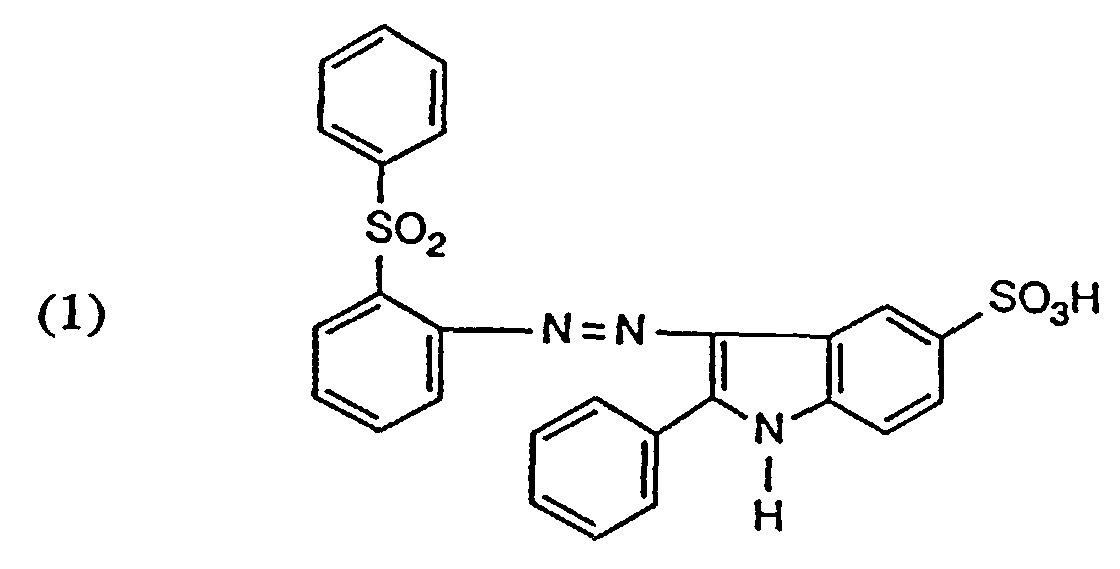
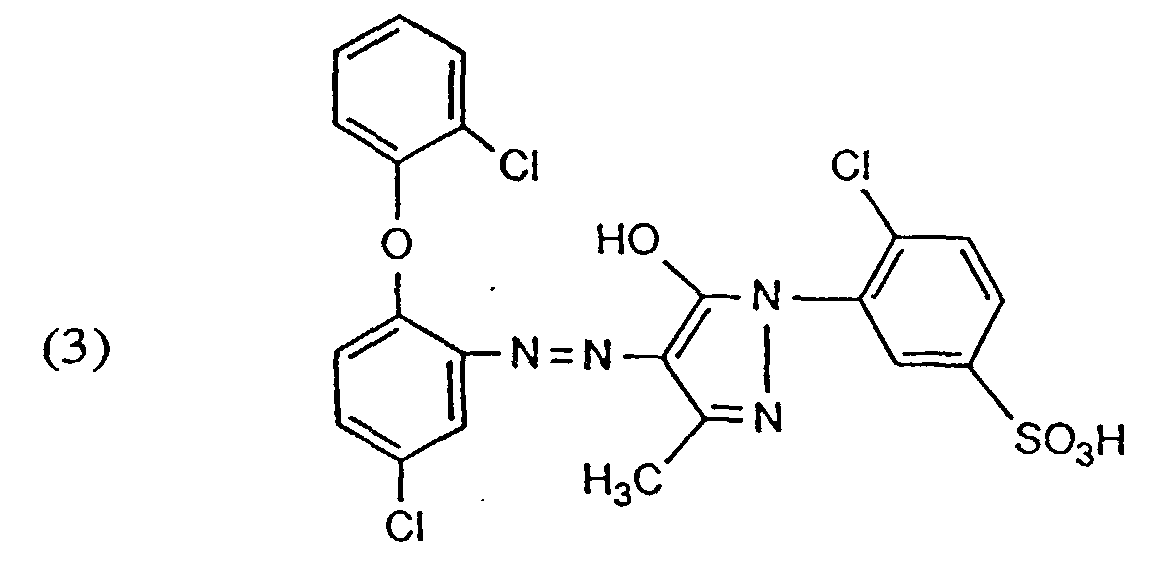
- the present invention thus relates to a process for dyeing fiber materials made of natural or synthetic polyamide from an aqueous liquor, in the presence of a leveling aid and, if appropriate, in the presence of an alkali metal or ammonium fluorosilicate, which is characterized in that a mixture of the dyes of the formulas (1 ), (2) and (3) or a mixture of the dyes of the formulas (4) and (5) or a mixture which contains a dye of the formula (6) together with at least one dye of the formulas (7), (8) and (9) contains, used.
- X is hydrogen or a radical of the formula -SO 3 M
- R is an alkyl or alkenyl radical having 12 to 24 carbon atoms
- M is hydrogen, alkali metal or ammonium
- m and n are integers, the sum of m and n being 2 to 20
- R 'independently of R has the meaning given for R
- A is an anion
- Q is an optionally substituted alkyl radical and p and q are integers, the sum of p and q being 2 to 50
- R "independently of R has the meaning given for R and x and y are integers, the sum of x and y being 80 to 140; or which is a compound of the formula wherein R "" is C 12 -C 30 alkyl or C 12 -C 30 alkenyl, YC 2 -C 3 alkylene, A 1 , A 2 and A 3 are each the remainder of an
- Hydrogen is preferably suitable for X in the compound of the formula (10).
- R, R ', R' 'and R' '' are, independently of one another, preferably an alkyl or alkenyl radical having 16 to 22 carbon atoms.
- n and m in the compound of formula (10) is preferably 6 to 16.
- the sum of p and q in the compound of formula (11) is preferably 6 to 40.
- the sum of x and y in the compound of formula (12) is preferably 100 to 110.
- C 1 -C 4 alkyl such as methyl, ethyl, n-propyl, isopropyl, n-butyl, isobutyl, sec-butyl and tert-butyl, and -CH 2 -CO-NH 2 , - CH 2 -CH (OH) -CH 2 Cl or -CH 2 -CH (OH) Cl, preferably methyl or -CH 2 -CO-NH 2 , into consideration.
- Anions A - are, for example, those which are derived from quaternizing agents, such as, for example, acetyl bromide, ethyl bromide, ethylene chlorohydrin, ethylene bromohydrin, epichlorohydrin, epibromohydrin, dimethyl sulfate, diethyl sulfate or chloroacetamide.
- quaternizing agents such as, for example, acetyl bromide, ethyl bromide, ethylene chlorohydrin, ethylene bromohydrin, epichlorohydrin, epibromohydrin, dimethyl sulfate, diethyl sulfate or chloroacetamide.
- the compounds of formula (10) used are preferably those in which X is hydrogen, the sum of n and m is 10 to 16 and R is an alkyl or alkenyl radical having 16 to 22 carbon atoms.
- the compounds of the formula (11) used are preferably those in which Q is methyl, the sum of p and q is 30 to 40 and R 'is an alkyl or alkenyl radical having 16 to 22 carbon atoms, or in which Q is the radical --CH 2 - CO-NH 2 means the sum of p and q is 5 to 10 and R 'is an alkyl or alkenyl radical having 16 to 22 carbon atoms.
- the compounds of formula (12) used are preferably those in which the sum of x and y is 100 to 110 and R ′′ is an alkyl or alkenyl radical having 16 to 22 carbon atoms.
- leveling aids are used containing 5 to 70 parts by weight of the compound of formula (10), 15 to 60 parts by weight of the compound of formula (11) and 5 to 60 parts by weight of the compound of formula (12), based on 100 parts by weight of the leveling agent mixture.
- a compound of the formula (10) is particularly preferably used together with a compound of the formula (11) in which Q is methyl, a compound of the formula (11) in which Q is -CH 2 -CO-NH 2 and one Compound of the formula (12), the abovementioned preferences applying to the compounds of the formulas (10), (11) and (12).
- a 1 , A 2 and A 3 in the compound of formula (13) are preferably ethyleneoxy radicals.
- Y in the compound of formula (13) is preferably n-propylene.
- the number 1 is preferred for r in the compound of the formula (13).
- R '' 'in the compound of formula (13) is preferably an alkyl or alkenyl radical having 16 to 22 carbon atoms, in particular 22 carbon atoms.
- Particularly preferred compounds of the formula (13) are those of the formula in which the meanings and preferences given above apply to A 1 , A 2 and A 3 , Y and R ′′ ′′.
- the amounts in which the leveling aid is used in the dye baths can be in wide limits vary, in general an amount of 0.3 to 5 percent by weight, in particular 0.5 to 4 percent by weight and preferably 1 to 2 percent by weight, based on the fiber material, has proven advantageous.
- Alkali or ammonium fluorosilicates which can be used in the process according to the invention are, for example, alkali or ammonium salts of hexafluorosilicic acid or mixtures thereof.
- Preferred salts are Na 2 SiF 6 or in particular (NH 4 ) 2 SiF 6 .
- the amounts in which the alkali metal or ammonium fluorosilicates are used in the dyebaths are preferably 5 to 100 percent by weight, based on the amount of leveling aid used, and preferably 5 to 40%.
- the dyeing is preferably carried out without the presence of an alkali metal or ammonium fluorosilicate.
- a mixture of the dye of the formula (6) with a dye of the formula (7) is preferably used as the mixture which contains a dye of the formula (6) together with at least one dye of the formulas (7), (8) and (9) ), or a mixture of the dye of formula (6) with a dye of formula (8) and a dye of formula (9).
- the individual components of the dye mixtures are each preferably present in an amount of 1 to 95 parts, based on 100 parts of the dye mixture.
- the mixture of the dyes of the formulas (1), (2) and (3) preferably contains 1 to 20 parts of the dye of the formula (1), 5 to 50 parts of the dye of the formula (2) and 40 to 90 parts of the dye of the Formula (3), based on 100 parts of the dye mixture.
- the mixture of the dyes of the formulas (4) and (5) preferably contains 10 to 90 parts of the dye of the formula (4) and 10 to 90 parts of the dye of the formula (5), based on 100 parts of the dye mixture.
- the mixture of the dyes of the formulas (6) and (7) preferably contains 5 to 40 parts of the dye of the formula (6) and 60 to 95 parts of the dye of the formula (7), based on 100 parts of the dye mixture.
- the mixture of the dyes of the formulas (6), (8) and (9) preferably contains 5 to 50 parts of the dye of the formula (6), 10 to 70 parts of the dye of the formula (8) and 5 to 50 parts of the dye of Formula (9).
- the dyes of the formulas (1) to (9) are either in the form of their free sulfonic acid or, preferably, as their salts, e.g. the alkali, alkaline earth or ammonium salts or as salts of an organic amine.
- their salts e.g. the alkali, alkaline earth or ammonium salts or as salts of an organic amine. Examples include the sodium, lithium or ammonium salts or the salt of triethanolamine.
- the dyes of the formulas (1) to (9) and the leveling aids of the formulas (10), (11), (12) and (13) are known or can be obtained in analogy to known processes.
- the amounts in which the defined dye mixtures are used in the dyebaths can vary within wide limits depending on the desired depth of color; in general, amounts of 0.01 to 10 percent by weight, based on the fiber material, have proven to be advantageous.
- the dyeing is preferably carried out at a pH of 3 to 7, in particular a pH of 3 to 5 and particularly preferably at a pH of 3 to 4.
- the dyebaths can also contain other customary additives, such as Wool protection, wetting and defoaming agents included.
- the liquor ratio can be selected within a wide range, from 1: 5 to 1:80, in particular 1: 8 to 1:25.
- the dyeing is usually done from an aqueous liquor e.g. at temperatures of 80 to 105 ° C, or 110 ° C when using a formaldehyde-releasing wool protection agent; preferably at a temperature between 95 and 103 ° C. Dyeing by the exhaust method is preferred.
- the dyeing time is usually 30 to 120 minutes, preferably 60 to 120 minutes.
- the usual dyeing machines and equipment can be used, for example for flake, sliver, strand yarn, bobbins, piece goods and carpets.
- the process according to the invention is suitable for dyeing both natural polyamide fiber materials, such as Silk or especially wool, as well as synthetic polyamide fiber materials such as Polyamide 6 or polyamide 6.6 and it is suitable for dyeing wool and synthetic polyamide blends or yarns.
- the dyeing of wool and wool and synthetic polyamide mixtures is particularly preferred.
- the textile material mentioned can be in a wide variety of processing forms, such as as fiber, yarn, fabric, knitted fabric and in the form of carpets.
- a particularly preferred embodiment of the process according to the invention is a process for trichromatic dyeing, which is characterized in that a yellow or orange-colored mixture of the dyes of the formulas (1), (2) and (3) together with a blue-colored mixture of the dyes of the Formulas (4) and (5) and a red-coloring mixture which contains the dye of the formula (6) together with at least one dye of the formulas (7), (8) and (9).
- Trichromatic means the additive color mixture of suitably selected yellow, red and blue coloring dyes in the amounts necessary to achieve the desired shade. The above-mentioned preferences apply to the mixtures of the dyes.
- the present invention further provides the mixture of the dyes of the formulas (1), (2) and (3), and also the mixture of the dyes of the formulas (4) and (5), and further the mixture which comprises the dye of the formula (6) together with at least one dye of the formulas (7), (8) and (9).
- the above-mentioned preferences apply to the mixtures of the dyes.
- the dye mixtures according to the invention are distinguished by generally good properties, such as, for example, good fastness properties, good solubility, good absorption behavior and in particular by good combinability with other dyes or dye mixtures.
- the process according to the invention provides colorations of very good levelness with good fastness properties.
- both types of fibers can be dyed tone on tone.
- the method according to the invention is distinguished, in particular in trichromatic dyeing, by uniform color build-up, good absorption behavior and good constancy of shades, even in different concentrations.
- parts represent parts by weight.
- the temperatures are degrees Celsius.
- the relationship between parts by weight and parts by volume is the same as that between grams and cubic centimeters.
- dye mixture A To make a yellowing dye mixture, use a blender 80 parts of the dye of the formula given in the form of the free acid 15 parts of the dye of the formula given in the form of the free acid 5 parts of the dye of the formula given in the form of the free acid homogeneously mixed and give 100 parts of the mixture, which is hereinafter referred to as dye mixture A.
- dye mixture B In order to produce a red coloring dye mixture, use a blender 82 parts of the dye of the formula given in the form of the free acid and 18 parts of the dye of the formula given in the form of the free acid homogeneously mixed and give 100 parts of the mixture, which is hereinafter referred to as dye mixture B.
- dye mixture C To produce a blue-dye mixture, use a blender 55 parts of the dye of the formula given in the form of the free acid and 45 parts of the dye of the formula given in the form of the free acid homogeneously mixed and give 100 parts of the mixture, which is hereinafter referred to as dye mixture C.
- dye mixture D In order to produce a red coloring dye mixture, use a blender 23 parts of the dye of the formula given in the form of the free acid 44 parts of the dye of the formula given in the form of the free acid and 33 parts of the dye of the formula given in the form of the free acid homogeneously mixed and give 100 parts of the mixture, which is hereinafter referred to as dye mixture D.
- 100 parts of woolen fabric are placed in a dyebath containing 8 parts of sodium sulfate, 3 parts of a leveling aid of the following composition in 1500 parts of water at 40 ° C.
- the pH is 3.5.
- the dye liquor is kept at 40 ° C. for a further 10 minutes and then heated to 60 ° C. at a rate of 1 ° C. per minute, left at this temperature for 20 minutes and then with a Heating rate from 1 ° C per minute to 100 ° C.
- the mixture is cooled to 50 ° C and the dye liquor is drained off.
- the yellow-colored wool fabric is rinsed and dried as usual.
- the dyeing obtained is fiber-level and has good fastness properties.
Landscapes
- Chemical & Material Sciences (AREA)
- Engineering & Computer Science (AREA)
- Textile Engineering (AREA)
- Chemical Kinetics & Catalysis (AREA)
- Organic Chemistry (AREA)
- Coloring (AREA)
- Artificial Filaments (AREA)
Claims (12)
- Procédé pour la teinture de matériaux fibreux en polyamide naturel ou synthétique dans des bains aqueux, en présence d'un agent d'unisson et, éventuellement, en présence d'un fluorosilicate de métal alcalin ou d'ammonium, caractérisé en ce que l'on utilise un mélange de colorants de formule (1), (2) et (3)



- Procédé conforme à la revendication 1, caractérisé en ce que l'agent d'unisson contient un composé de formule


- Procédé conforme à une des revendications 1 et 2, caractérisé en ce que l'agent d'unisson contient les composés de formule (10), (11) et (12).
- Procédé conforme à une des revendications 1 et 2, caractérisé en ce que l'agent d'unisson contient un composé de formule (13) et en ce que l'on réalise la teinture en absence de fluorosilicate de métal alcalin ou d'ammonium.
- Procédé conforme à une des revendications 1 à 4, caractérisé en ce que l'on utilise de 0,3 à 5 % en poids de l'agent d'unisson, rapportés au matériau fibreux.
- Procédé conforme à une des revendications 1 à 5, caractérisé en ce que l'on teint à un pH compris entre 3 et 7, en particulier à un pH compris entre 3 et 5.
- Procédé conforme à une des revendications 1 à 6, caractérisé en ce que l'on teint selon un procédé par épuisement à des températures comprises entre 80 et 105 °C.
- Procédé conforme à une des revendications 1 à 7, caractérisé en ce que l'on teint avec un rapport de bain compris entre 1/5 et 1/80, en particulier entre 1/8 et 1/25.
- Procédé pour la teinture en trichromie de matériaux fibreux en polyamide, caractérisé en ce que l'on utilise, conformément à une des revendications 1 à 8, un mélange de colorants jaunes ou oranges de formule (1), (2) et (3), en combinaison avec un mélange de colorants bleus de formule (4) et (5) et un mélange de colorants rouges, contenant le colorant de formule (6) et au moins un colorant de formule (7), (8) et (9).
- Procédé conforme à une des revendications 1 à 9, caractérisé en ce que l'on utilise, comme matériau fibreux, un matériau fibreux en polyamide synthétique ou de la laine.
- Procédé conforme à une des revendications 1 à 10, caractérisé en ce que l'on utilise, comme matériau fibreux, des mélanges de fibres de laine et de fibres en polyamide synthétique.
- Mélanges de colorants, caractérisé en ce qu'ils contiennent les colorants de formule (1), (2) et (3),


Applications Claiming Priority (2)
| Application Number | Priority Date | Filing Date | Title |
|---|---|---|---|
| CH304892 | 1992-09-30 | ||
| CH3048/92 | 1992-09-30 |
Publications (2)
| Publication Number | Publication Date |
|---|---|
| EP0593392A1 EP0593392A1 (fr) | 1994-04-20 |
| EP0593392B1 true EP0593392B1 (fr) | 1996-07-24 |
Family
ID=4247445
Family Applications (1)
| Application Number | Title | Priority Date | Filing Date |
|---|---|---|---|
| EP93810669A Expired - Lifetime EP0593392B1 (fr) | 1992-09-30 | 1993-09-21 | Procédé de teinture de fibres polyamides naturelles et synthétiques avec des mélanges de colorants |
Country Status (5)
| Country | Link |
|---|---|
| US (1) | US5356445A (fr) |
| EP (1) | EP0593392B1 (fr) |
| JP (1) | JPH06240586A (fr) |
| DE (1) | DE59303310D1 (fr) |
| ES (1) | ES2090939T3 (fr) |
Families Citing this family (6)
| Publication number | Priority date | Publication date | Assignee | Title |
|---|---|---|---|---|
| DE59607383D1 (de) * | 1995-02-10 | 2001-09-06 | Ciba Sc Holding Ag | Farbstoffmischungen und ihre Verwendung |
| DE10028224A1 (de) | 2000-06-07 | 2002-01-03 | Bayer Ag | Mischungen von Schwefelsäureestern |
| PT1341853E (pt) * | 2000-12-05 | 2005-11-30 | Clariant Finance Bvi Ltd | Processo de tingimento tricromico |
| MXPA06011303A (es) * | 2004-04-06 | 2007-01-16 | Clariant Finance Bvi Ltd | Proceso de tenido. |
| JP5975521B2 (ja) * | 2012-10-19 | 2016-08-23 | 日本化薬株式会社 | 酸性染料組成物及びそれを用いる染色法 |
| JP6075761B2 (ja) * | 2013-03-08 | 2017-02-08 | 日本化薬株式会社 | 酸性染料組成物およびそれを用いる染色法 |
Family Cites Families (17)
| Publication number | Priority date | Publication date | Assignee | Title |
|---|---|---|---|---|
| CH181535A (de) * | 1934-03-21 | 1935-12-31 | Chem Fab Vormals Sandoz | Verfahren zur Darstellung eines Farbstoffes der Anthrachinonreihe. |
| GB844427A (en) * | 1957-10-23 | 1960-08-10 | Geigy Ag J R | Improvements relating to monoazo-pyrazole dyestuffs and their use |
| NL121826C (fr) * | 1959-07-24 | |||
| IT1144053B (it) * | 1979-02-06 | 1986-10-29 | Sandoz Ag | Procedimento di tintura che permette di ottenere effetti di riserva e/o multicolori |
| GB2017135B (en) * | 1979-03-19 | 1982-09-22 | Bayer Ag | Anthraquinone dye stuff mixtures |
| DE3363011D1 (en) * | 1982-03-12 | 1986-05-22 | Ciba Geigy Ag | Process for dyeing fibrous material from natural polyamides |
| US4954563A (en) * | 1983-03-08 | 1990-09-04 | Ciba-Geigy Corporation | Monoazo dyes containing sulfoindole coupling components |
| US4563192A (en) * | 1983-09-19 | 1986-01-07 | Ciba-Geigy Corporation | Process for dyeing fibre material made of synthetic polyamides with anionic dyes and an auxiliary mixture |
| FR2552791B1 (fr) * | 1983-09-29 | 1986-12-05 | Sandoz Sa | Procede de teinture de substrats textiles comprenant de la laine |
| US4623358A (en) * | 1984-05-30 | 1986-11-18 | Ciba-Geigy Corporation | Process for dyeing natural or synthetic polyamide fibre materials with 1:1 metal complex dyes and fluoride, fluorosilicate or fluoroborate |
| US4681596A (en) * | 1984-05-30 | 1987-07-21 | Ciba-Geigy Corporation | Process for dyeing natural or synthetic polyamide fibre materials with 1:1 metal complex dyes or mixtures of dyes with fluoride, fluorosilicate or fluoroborate |
| US4652269A (en) * | 1984-11-08 | 1987-03-24 | Ciba-Geigy Corporation | Process for the continuous trichromatic dyeing of synthetic polyamide materials: including a blue anthraquinone reactive dye |
| DE3578870D1 (de) * | 1984-11-08 | 1990-08-30 | Ciba Geigy Ag | Verfahren zum kontinuierlichen trichromie-faerben von synthetischen polyamidmaterialien. |
| US4818248A (en) * | 1986-10-10 | 1989-04-04 | Ciba-Geigy Corporation | Process for dyeing natural or synthetic polyamide fibre materials with 1:1 metal complex dyes in presence of alkali metal fluordsilicate or amindnlum silicate |
| FR2611763B1 (fr) * | 1987-03-04 | 1990-03-09 | Sandoz Sa | Procede de teinture de polyamides naturels et/ou synthetiques avec des colorants anioniques |
| DK0387201T3 (da) * | 1989-03-10 | 1994-03-07 | Ciba Geigy Ag | Farvestofblanding og dens anvendelse |
| DK0425434T3 (da) * | 1989-10-23 | 1995-12-18 | Ciba Geigy Ag | Farvestofblandinger og deres anvendelse |
-
1993
- 1993-09-21 ES ES93810669T patent/ES2090939T3/es not_active Expired - Lifetime
- 1993-09-21 EP EP93810669A patent/EP0593392B1/fr not_active Expired - Lifetime
- 1993-09-21 DE DE59303310T patent/DE59303310D1/de not_active Expired - Fee Related
- 1993-09-24 US US08/126,816 patent/US5356445A/en not_active Expired - Lifetime
- 1993-09-29 JP JP5242297A patent/JPH06240586A/ja active Pending
Also Published As
| Publication number | Publication date |
|---|---|
| ES2090939T3 (es) | 1996-10-16 |
| US5356445A (en) | 1994-10-18 |
| JPH06240586A (ja) | 1994-08-30 |
| EP0593392A1 (fr) | 1994-04-20 |
| DE59303310D1 (de) | 1996-08-29 |
Similar Documents
| Publication | Publication Date | Title |
|---|---|---|
| EP0089004B1 (fr) | Procédé de teinture de matière fibreuse de polyamides naturels | |
| EP1247842B1 (fr) | Colorants anthraquinoniques réactifs sur la fibre, leur préparation et leur utilisation | |
| EP0083299B1 (fr) | Procédé de teinture ou d'impression en trois couleurs | |
| EP0127579B1 (fr) | Procédé de teinture ou d'impression en trois couleurs | |
| EP0387201B1 (fr) | Mélanges de colorants et leur utilisation | |
| EP0074923B1 (fr) | Adjuvant de teinture et son utilisation dans la teinture ou l'impression de matériaux en fibres de polyamide synthétique | |
| EP0545207B1 (fr) | Mélange de colorants réactifs ayant des caractéristiques de combinaison améliorées | |
| EP0092512B1 (fr) | Procédé de teinture ou d'impression en trois couleurs | |
| EP0135198B1 (fr) | Procédé de teinture de matière fibreuse en polyamides synthétiques | |
| EP0124679B1 (fr) | Procédé de teinture ou d'impression de fibres en polyamide | |
| CH501769A (de) | Verfahren zum Färben von stickstoffhaltigen Textilfasern | |
| EP0099859B1 (fr) | Procédé de teinture de fibres à teinture différentielle | |
| EP0582893B1 (fr) | Mélange de colorants réactifs | |
| EP0593392A1 (fr) | Procédé de teinture de fibres polyamides naturelles et synthétiques avec des mélanges de colorants | |
| EP0163608B1 (fr) | Procédé de teinture de matières fibreuses en polyamides naturelles ou synthétiques avec des colorants à complexes métallifères 1:1 | |
| EP0548014B1 (fr) | Mélanges de colorants et leur utilisation | |
| EP0114574B1 (fr) | Forme commerciale liquide de colorants cationiques | |
| EP0442844B2 (fr) | Procédé de teinture de la laine avec des colorants réactifs | |
| EP0546372A1 (fr) | Mélanges de colorants réactifs | |
| EP0203890B1 (fr) | Procédé de teinture de matières en polyamides naturels avec des mélanges de colorants | |
| EP0651028B1 (fr) | Procédé de teinture ou d'impression en trichromie | |
| EP0601971B1 (fr) | Procédé de teinture ou d'impression par trichromie | |
| EP0264346B1 (fr) | Procédé de teinture de matières fibreuses en polyamides naturels ou synthétiques avec des colorants à complexes métallifères 1:1 | |
| DE3427806C2 (fr) | ||
| EP0735181A2 (fr) | Teinture de matériaux fibreux de polyamide en présence de composés du manganèse pour donner des effets multicolores |
Legal Events
| Date | Code | Title | Description |
|---|---|---|---|
| PUAI | Public reference made under article 153(3) epc to a published international application that has entered the european phase |
Free format text: ORIGINAL CODE: 0009012 |
|
| AK | Designated contracting states |
Kind code of ref document: A1 Designated state(s): BE CH DE ES FR GB IT LI |
|
| 17P | Request for examination filed |
Effective date: 19940929 |
|
| 17Q | First examination report despatched |
Effective date: 19951005 |
|
| GRAH | Despatch of communication of intention to grant a patent |
Free format text: ORIGINAL CODE: EPIDOS IGRA |
|
| GRAH | Despatch of communication of intention to grant a patent |
Free format text: ORIGINAL CODE: EPIDOS IGRA |
|
| GRAA | (expected) grant |
Free format text: ORIGINAL CODE: 0009210 |
|
| AK | Designated contracting states |
Kind code of ref document: B1 Designated state(s): BE CH DE ES FR GB IT LI |
|
| ET | Fr: translation filed | ||
| REF | Corresponds to: |
Ref document number: 59303310 Country of ref document: DE Date of ref document: 19960829 |
|
| ITF | It: translation for a ep patent filed | ||
| GBT | Gb: translation of ep patent filed (gb section 77(6)(a)/1977) |
Effective date: 19960923 |
|
| REG | Reference to a national code |
Ref country code: ES Ref legal event code: FG2A Ref document number: 2090939 Country of ref document: ES Kind code of ref document: T3 |
|
| REG | Reference to a national code |
Ref country code: CH Ref legal event code: PUE Owner name: CIBA-GEIGY AG TRANSFER- CIBA SC HOLDING AG |
|
| REG | Reference to a national code |
Ref country code: ES Ref legal event code: FG2A Ref document number: 2090939 Country of ref document: ES Kind code of ref document: T3 |
|
| BECN | Be: change of holder's name |
Effective date: 19961129 |
|
| REG | Reference to a national code |
Ref country code: FR Ref legal event code: TP |
|
| REG | Reference to a national code |
Ref country code: CH Ref legal event code: PFA Free format text: CIBA SC HOLDING AG TRANSFER- CIBA SPECIALTY CHEMICALS HOLDING INC. |
|
| REG | Reference to a national code |
Ref country code: GB Ref legal event code: 732E |
|
| PLBE | No opposition filed within time limit |
Free format text: ORIGINAL CODE: 0009261 |
|
| STAA | Information on the status of an ep patent application or granted ep patent |
Free format text: STATUS: NO OPPOSITION FILED WITHIN TIME LIMIT |
|
| 26N | No opposition filed | ||
| REG | Reference to a national code |
Ref country code: FR Ref legal event code: CD |
|
| REG | Reference to a national code |
Ref country code: ES Ref legal event code: PC2A |
|
| REG | Reference to a national code |
Ref country code: GB Ref legal event code: IF02 |
|
| PGFP | Annual fee paid to national office [announced via postgrant information from national office to epo] |
Ref country code: CH Payment date: 20030806 Year of fee payment: 11 Ref country code: FR Payment date: 20030806 Year of fee payment: 11 |
|
| PGFP | Annual fee paid to national office [announced via postgrant information from national office to epo] |
Ref country code: ES Payment date: 20030908 Year of fee payment: 11 |
|
| PG25 | Lapsed in a contracting state [announced via postgrant information from national office to epo] |
Ref country code: ES Free format text: LAPSE BECAUSE OF NON-PAYMENT OF DUE FEES Effective date: 20040922 |
|
| PG25 | Lapsed in a contracting state [announced via postgrant information from national office to epo] |
Ref country code: LI Free format text: LAPSE BECAUSE OF NON-PAYMENT OF DUE FEES Effective date: 20040930 Ref country code: CH Free format text: LAPSE BECAUSE OF NON-PAYMENT OF DUE FEES Effective date: 20040930 |
|
| REG | Reference to a national code |
Ref country code: CH Ref legal event code: PL |
|
| PG25 | Lapsed in a contracting state [announced via postgrant information from national office to epo] |
Ref country code: FR Free format text: LAPSE BECAUSE OF NON-PAYMENT OF DUE FEES Effective date: 20050531 |
|
| REG | Reference to a national code |
Ref country code: FR Ref legal event code: ST |
|
| REG | Reference to a national code |
Ref country code: ES Ref legal event code: FD2A Effective date: 20040922 |
|
| PGFP | Annual fee paid to national office [announced via postgrant information from national office to epo] |
Ref country code: DE Payment date: 20070831 Year of fee payment: 15 |
|
| PGFP | Annual fee paid to national office [announced via postgrant information from national office to epo] |
Ref country code: GB Payment date: 20070724 Year of fee payment: 15 |
|
| PGFP | Annual fee paid to national office [announced via postgrant information from national office to epo] |
Ref country code: IT Payment date: 20070730 Year of fee payment: 15 Ref country code: BE Payment date: 20070727 Year of fee payment: 15 |
|
| BERE | Be: lapsed |
Owner name: *CIBA SPECIALTY CHEMICALS HOLDING INC. Effective date: 20080930 |
|
| GBPC | Gb: european patent ceased through non-payment of renewal fee |
Effective date: 20080921 |
|
| PG25 | Lapsed in a contracting state [announced via postgrant information from national office to epo] |
Ref country code: BE Free format text: LAPSE BECAUSE OF NON-PAYMENT OF DUE FEES Effective date: 20080930 |
|
| PG25 | Lapsed in a contracting state [announced via postgrant information from national office to epo] |
Ref country code: IT Free format text: LAPSE BECAUSE OF NON-PAYMENT OF DUE FEES Effective date: 20080921 Ref country code: DE Free format text: LAPSE BECAUSE OF NON-PAYMENT OF DUE FEES Effective date: 20090401 |
|
| PG25 | Lapsed in a contracting state [announced via postgrant information from national office to epo] |
Ref country code: GB Free format text: LAPSE BECAUSE OF NON-PAYMENT OF DUE FEES Effective date: 20080921 |