EP0593428B1 - Mykonematizide - Google Patents
Mykonematizide Download PDFInfo
- Publication number
- EP0593428B1 EP0593428B1 EP90911830A EP90911830A EP0593428B1 EP 0593428 B1 EP0593428 B1 EP 0593428B1 EP 90911830 A EP90911830 A EP 90911830A EP 90911830 A EP90911830 A EP 90911830A EP 0593428 B1 EP0593428 B1 EP 0593428B1
- Authority
- EP
- European Patent Office
- Prior art keywords
- strain
- lilacinus
- strains
- spores
- myconematicide
- Prior art date
- Legal status (The legal status is an assumption and is not a legal conclusion. Google has not performed a legal analysis and makes no representation as to the accuracy of the status listed.)
- Expired - Lifetime
Links
Images



Classifications
-
- A—HUMAN NECESSITIES
- A01—AGRICULTURE; FORESTRY; ANIMAL HUSBANDRY; HUNTING; TRAPPING; FISHING
- A01N—PRESERVATION OF BODIES OF HUMANS OR ANIMALS OR PLANTS OR PARTS THEREOF; BIOCIDES, e.g. AS DISINFECTANTS, AS PESTICIDES OR AS HERBICIDES; PEST REPELLANTS OR ATTRACTANTS; PLANT GROWTH REGULATORS
- A01N63/00—Biocides, pest repellants or attractants, or plant growth regulators containing microorganisms, viruses, microbial fungi, animals or substances produced by, or obtained from, microorganisms, viruses, microbial fungi or animals, e.g. enzymes or fermentates
- A01N63/30—Microbial fungi; Substances produced thereby or obtained therefrom
-
- C—CHEMISTRY; METALLURGY
- C12—BIOCHEMISTRY; BEER; SPIRITS; WINE; VINEGAR; MICROBIOLOGY; ENZYMOLOGY; MUTATION OR GENETIC ENGINEERING
- C12N—MICROORGANISMS OR ENZYMES; COMPOSITIONS THEREOF; PROPAGATING, PRESERVING, OR MAINTAINING MICROORGANISMS; MUTATION OR GENETIC ENGINEERING; CULTURE MEDIA
- C12N1/00—Microorganisms; Compositions thereof; Processes of propagating, maintaining or preserving microorganisms or compositions thereof; Processes of preparing or isolating a composition containing a microorganism; Culture media therefor
- C12N1/14—Fungi; Culture media therefor
- C12N1/145—Fungi isolates
-
- C—CHEMISTRY; METALLURGY
- C12—BIOCHEMISTRY; BEER; SPIRITS; WINE; VINEGAR; MICROBIOLOGY; ENZYMOLOGY; MUTATION OR GENETIC ENGINEERING
- C12R—INDEXING SCHEME ASSOCIATED WITH SUBCLASSES C12C - C12Q, RELATING TO MICROORGANISMS
- C12R2001/00—Microorganisms ; Processes using microorganisms
- C12R2001/645—Fungi ; Processes using fungi
- C12R2001/79—Paecilomyces
Definitions
- the present invention relates to novel strains of Paecilomyces lilacinus (Thorn) Samson, myconematicides containing spores of strains of Paecilomyces lilacinus and to methods for controlling nematode infestation.
- Nematophagous fungi are broadly divided into two groups, (1) nematode-trapping fungi which produce mechanical or adhesive traps; and (2) endoparasitic fungi which infect nematodes when their conidia (spores) are ingested or adhere to the cuticle.
- lilacinus indicate underlying problems in present approaches to its wide spread application as a biological control agent for nematodes. It has been suggested (Cabailis et al ., 1989, J. Nematol. 21 , 164-172) that such variability in results may be caused by mutations. They go on to attribute loss of effectiveness as nematophagous agents in Peruvian isolates to culture material being kept with periodic transfer on media in the absence of nematodes.
- the present applicants have isolated a strain of Paecilomyces lilacinus designated 251 from a Meloidogne egg mass in Los Ba ⁇ os, Philippines, which is strongly nematophagous and has demonstrated the unexpected ability to parasitise and destroy larvae, cysts and adults of the common genera of plant parasitic nematodes.
- a sample of this strain was deposited with the Australian Government Analytical Laboratories (AGAL) at 1 Suakin Street, Pymble, New South Wales, 2073, Australia on 2 August 1989 and was accorded accession No. 89/030550.
- P. lilacinus is a widely distributed saprophytic soil fungus which is readily isolatable throughout the world. It is believed, however, that strains having the characteristics of the strains of the present invention have not been isolated previously.
- P. lilacinus strain 251 has been shown to be effective under field conditions against plant pathogenic nematodes which attack a variety of agriculturally important crops including banana, potato, pineapple, cotton, coffee, rice, black pepper, okra, avocado, tomato etc. In vitro tests for nematicidal activity have demonstrated this strain to be effective in killing several nematode species including Meloidogyne spp.
- Radopholus similis Pratylenchus spp., Rotylenchus reniformis , Globodera rostochiensis , Helicotylenchus multicinctus, Tylenchulus semipenetrans , Tylenchorhynchus spp., Hoplolaimus spp., Criconemoides spp., Hemicycliophora spp., and Xiphinema spp.
- lactate dehydrogenase A followed by, in order of decreasing usefulness, lactate dehydrogenase C , asparate aminotransferase C , fructose-1,6-diphosphatase, phosphoglycerate mutase and hexokinase.
- the present invention consists of a myconematicide comprising spores of a strain(s) of P. lilacinus and a carrier, characterised in that the strain(s) of P. lilacinus are selected from the group consisting of strain 251, strain 252, strain 253, strain 254 and combinations thereof, wherein strains 251, 252, 253 and 254 refer to strains deposited with the Australian Government Analytical Laboratories and accorded Accession Nos. 89/030550, 90/028188A, 90/028188B and 90/028188C, respectively.
- the spores are P. lilacinus strain 251.
- the spores are present at a concentration of between about 1x10 5 and about 1x10 10 spores/gr of carrier, and more preferably at a concentration of between about 5x10 7 and about 5x10 9 spores/gr of carrier.
- the myconematicide may be formulated as a powder or in a pelleted form.
- the carrier is formulated so that slow release of the spores is obtained over a considerable period of time following application of the myconematicide.
- the P. lilacinus strains may be cultured and caused to sporulate using methods well known in the art. Harvesting of spores is preferably performed under conditions that do not promote heat, including shaking, scraping, washing and centrifugation. The spore material is then dried by a suitable process such as air drying, freeze drying or desiccation with a suitable desiccant and can be reformulated by addition of inert filler or new growth material to provide a suitable number of spores per unit amount of product.
- a suitable process such as air drying, freeze drying or desiccation with a suitable desiccant and can be reformulated by addition of inert filler or new growth material to provide a suitable number of spores per unit amount of product.
- the present invention further provides a method of selecting strains of P. lilacinus which are strongly nematophageous, wherein said method comprises the steps of preparing allozyme profiles of said strains for the enzymes lactate dehydrogenase A , lactate dehydrogenase C , aspartate aminotransferase C , fructose-1,6-diphosphatase, phosphoglycerate mutase and hexokinase, and selecting strains exhibiting allozyme profiles for these enzyme which are identical to those of strain 251 deposited with The Australian Government Analytical Laboratories and accorded Accession No. 89/030550.
- the above method may also comprise an additional step wherein said selected strain is cultured and caused to sporulate whereafter said spores are harvested.
- P. lilacinus strain 251 has been successfully field trialed for a period of six years at different levels of inoculation and application methods on a wide variety of ornamental and crop plants with no diminution of its nematicidal properties.
- the genetic stability of this strain can be maintained through standard procedures well-known in the art. These typically involve testing, storage by desiccation on silica gel or freeze drying and ensuring minimal passaging of the strain.
- composition may be formulated in accordance with a variety of known preparations, in particular for use in coating seeds.
- a variety of polysaccharides or crude plant products such as cornmeal may be used as fillers to assist fungal growth.
- whole seeds such as wheat or sesame may be used to present the fungus.
- Mineral matter such as silica and vermiculite may also be added. The material is then packed preferably under essentially anaerobic conditions.
- the present invention consists in substantially pure cultures of P. lilacinus strain 251, P. lilacinus strain 252, P. lilacinus strain 253 and P. lilacinus strain 254.
- the present invention consists in a method for the control of nematode infection in a crop comprising applying an effective amount of infective propagules of strain(s) of P. lilacinus, the strain(s) of P. lilacinus being selected from the group consisting of strain 251, strain 252, strain 253 and strain 254, wherein strains 251, 252, 253 and 254 refer to strains deposited with the Australian Government Analytical Laboratories and accorded Accession Nos. 89/030550, 90/028188A, 90/028188B and 90/028188C, respectively, preferably strain 251.
- the term "effective amount” is defined as an amount sufficient to display the nematicidal activity.
- the infective propagules of the P. lilacinus strain may be applied to the crop either in a liquid suspension, in association with a suitable carrier, or as a solid formulation, in association with a suitable excipient.
- the dosage of infective propagules of the P. lilacinus strain is in the order of about 1x10 7 spores per gram of soil for nursery applications and for field applications between 1x10 7 and 1x10 8 spores per ml of an aqueous suspension which is then applied as a drench to soil adjacent to plants.
- this dosage translates to about 150 ml of aqueous drench per mat.
- the myconematicide of the present invention may be applied to crops using any of the methods well known in the prior art.
- the myconematicidal composition is provided in the environment of the roots so minimizing the root damage caused by nematodes. This may be achieved by coating of seeds with the composition so that emergence of roots results in a fungal inoculum in their environment; by dipping, or spraying the root regions of seedlings or seed trays in a nursery situation; or application of the composition at the site of planting, for example at the time of planting, either in aqueous suspension or in solid form. This may, of course, be done in conjunction with treatment with appropriate agricultural material such as fertilizer.
- the nematicidal composition of the present invention is specifically applied to the regions of the plant rhizosphere affected by nematodes.
- an injection device can be used to apply the nematicidal composition as an aqueous suspension adjacent to the corm of banana infested by Radopholus spp.
- the present invention provides a method of controlling nematode infections by coating seeds with a P. lilacinus strain of the invention prior to planting, or by dipping tubers in an aqueous suspension of a P. lilacinus strain of the invention or by applying an aqueous suspension of a P. lilacinus strain of the invention to a banana mat.
- the plants to which the nematicidal composition of the present invention may be administered are typically agriculturally significant crop plants but also include ornamental plants.
- the present invention thus provides a method of controlling nematode infection in a crop, in which the crop is agricultural crop plants, ornamental plants, seedlings, annuals, or perennial plants.
- Control of plant parasitic nematodes by the myconematicidal composition has been found in a wide variety of plants, including banana, sugar cane, pineapple, okra, coffee, cacao, black pepper, tobacco, ramie, cotton, rice, wheat, barley, oat, corn, citrus, grape, tomato, potato, carrot, pea, bean, various horticultural crops and a variety of tropical fruits including papaya and avocado.
- Particularly preferred is the treatment of potato, banana, tomato or pineapple.
- the fungus is generally not persistent for a long period of time in the complex soil ecosystem, it is presently preferred that with perennial crops such as banana that the nematicidal composition is reapplied at least every six months.
- P. lilacinus strain 251 may be useful in the control of parasitic nematodes which infest domestic animals.
- novel strains of the present invention it is believed to be necessary to coat the propagules in such a way that they are protected during passage through the animal's alimentary tract and released in the faeces.
- carriers having this property are used in myconematicides of the invention. Such protection may be obtained by embedding the fungal material in a matrix which is insoluble in the gastrointestinal environment.
- This matrix material may be selected from a wide variety of natural and synthetic substances such as waxes, resins, polysaccharides, starches, mineral matter or vegetable matter.
- Figure 1 Changes in proportional function root volume at three month intervals in a field experiment on banana starting June, 1987. (4) - myconematicide with between 1 x 10⁹ and 1 x 10 10 infective propagules applied to each banana mat at six month intervals (11) - Furadan applied to each banana mat at six month intervals. Nematicides first applied June, 1987. (12) - untreated control.
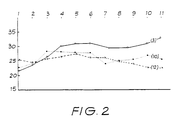
- Figure 2 Changes in average bunch weight (kg.) over two month intervals in a field experiment on banana, starting June-July 1977. (3) - myconematicide with between 1 x 10⁹ and 1 x 10 10 infective propagules applied to each banana mat at six month intervals. (10) - Nemacur applied to each banana mat at six month intervals. Nematicides first applied June, 1987. (12) - untreated control.
- Figure 4 Changes over time in difference in mean bunch weight between chemically treated bananas and those in which the myconematicide was used. The mean weight of the chemically treated bananas was subtracted from that for the myconematicide treatment.
- P. lilacinus is generally regarded as oviparsitic to nematode egg masses.
- This example demonstrates that the 251 strain is also endoparasitic to various growth stages of common plant parasitic nematode genera. Spores were produced by solid phase fermentation using rice hulls as described above and added at a concentrations of 1 x 10 5 /ml to petri dishes containing populations of larvae and adults of various species of plant-parasitic nematodes isolated from roots of a variety of infested plants. After inoculation, the spores were allowed to incubate for 48 hours at room temperature. The results of the series of experiments are summarised in Table 1.
- the results show that the fungus is capable of attacking and killing nematodes that are both endoparasitic and semi-endoparasitic.
- the results indicate effectiveness at different developmental stages against nematodes with a variety of life styles.
- the fungus parasitises by means of its spores, that either adhere to the cuticle or enter the body of the nematode host through the stoma, anus or the opening of the reproductive organ.
- the germ tube of a spore adhering to the cuticle actually penetrates the body wall as a spore germinates and grows.
- Three days after inoculation a high level of mortality was observed among eleven different nematode genera examined. After five days in six of the eleven genera examined more than 80% of individuals were killed.
- Such experiments clearly demonstrate the ability of strain 251 to parasitise and kill larval and adult plant-parasitic nematodes.
- this collection included isolates from soil in Australia, Papua New Guinea and U.S.A. In addition two Australian isolates of animal origin were included; these were one strain isolated from the human cornea and another from a crocodile which died in the Melbourne Zoo. A further four isolates from the Philippines, including P. lilacinus strain 251 (AGAL, 89/030550) were included. These four strains were selected as effective nematophagous strains on the basis of a variety of laboratory and field tests. Details of these strains are summarised in Table 2.
- lactate dehydrogenase A followed by, in order of decreasing importance, lactate dehydrogenase C , aspartate aminotransferase C , fructose-1,6-diphosphatase, phosphoglycerate mutase and hexokinase.
- the growth temperature profiles of the twelve strains of P. lilacinus set out in Table 2 were examined to determine whether the isolates differed in their growth temperature profiles.
- the twelve isolates fell into two distinct groups on the basis of their maximum growth temperature.
- strain 251 is the most effective.
- strains 251 and 253 are particularly effective.
- strain 251 should also be the preferred strain for control of Globodera open field trials on potato (var. Isola) were undertaken on a farm with soil infested with the cyst nematode.
- Replicated plots were individually treated with the myconematicidal composition in which the active propagules were respectively spores of the nematicidal strains 251, 253, 254 (Tubers dipped in an aqueous suspension of 1 x 10 9 spores / ml and subsequently planted under normal agronomic conditions). Beside the untreated control plots, the experiment also included treatment plots to which the chemical FURADAN 3G® (Carbofuran-FMC Corporation) was applied.
- the chemical FURADAN 3G® Carbofuran-FMC Corporation
- strain 251 performs somewhat better than the other treatments although the difference in mean yield is not significant.
- the improvement in yield of treated over the untreated plots is obvious and significant.
- Table 8 refers to an experiment on cotton at Bauang, La Union, Luzon where the dominant infesting nematodes were Rotylenchus spp. (reniform nematode) and Pratylenchus spp. (root lesion nematode).
- Treatments 1-3 were aqueous drenches of the myconematicidal composition containing between 1 x 10 8 and 1 x 10 9 spores of strain 251 per square metre, and treatments 4-6 were the application of the myconematicidal composition as pellets containing the same number of 251 spores as treatments 1-3. It is noted that in this experiment all levels of drench application gave similar results and provided better nematode control than did the pellet composition.
- Table 9 shows the effect of the application of the myconematicidal composition containing P. lilacinus strain 251 spores on reducing a nematode population ( Rotylenchus spp., Pratylenchus spp., Helicotylenchus spp. and Tylenchus spp.) infesting pineapple cultivated at Silang, Cavite.
- a nematode population Rotylenchus spp., Pratylenchus spp., Helicotylenchus spp. and Tylenchus spp.
- Table 10 shows the result of the application of the myconematicidal preparation containing P. lilacinus strain 251 spores on the plant parasitic nematode population within the rhizosphere of ramie, cultivated at Bankal, Davao City, Mindanao.
- Table 10 shows percentage reduction on the total plant parasitic nematode population over a four month period as well as the percentage reduction in Meloidogyne spp. over the same period.
- Treatments 1-3 were aqueous suspensions providing individual plant rhizospheres from 1 x 10 7 to 1 x 10 8 spores. Decline in total plant parasitic nematodes together with Meloidogyne spp.
- Treatments - 1-3 drenches equivalent to between 1 x 10 7 and 1 x 10 8 propagules per plant.
- Treatment 12 was the control without nematicide treatment.
- the experimental blocks received all normal inputs, including fungicides. All experimental data were collected by Marsman research staff according to standard plantation practice; chemical nematicides were applied by plantation staff according to recommended practice. The experiment was initiated in June 1987 and results are shown to April 1989 in the Figures. In accordance with plantation practice the various nematicides were applied to the treatment plots at the start of the experiment and thereafter at six-monthly intervals.
- FIG. 2 shows production data for three treatments presented as mean bunch weight in kilograms for two month periods over the duration of the experiment beginning with June-July 1987 and ending with March-April 1989.
- Treatment 10 is the chemical nematicide Nemacur (BAYER) and 12 is the untreated control.
- Treatment 3 is the myconematicidal composition produced as described wherein with growth of P. lilacinus strain 251 on rice hulls. The material was packaged and transported to the plantation where it was mixed as an aqueous suspension with between 1 x 10 7 and 1 x 10 8 spores per ml. The suspension was applied by pouring 150 ml. of this aqueous carrier around the daughter sucker of the banana plant. With the myconematicidal treatment mentioned in Example 7 the same procedures were adopted.
- Example 9 (results summarized in Tables 11 and 12) is a replicated experiment involving potato variety Isola cultivated in soil infested with the potato cyst nematode Globodera spp. at Baguias, Luzon, The Philippines.
- the myconematicidal preparation was applied in two ways at planting. Firstly, it was mixed in powdered form with chicken manure to give a spore concentration of between 1 x 10 7 and 1 x 10 8 per hill on planting. Second, tubers were dipped in an aqueous spore suspension of 1 x 10 8 spores/ml and subsequently planted under normal agronomic conditions.
- the experiment also gives the results of treatment with the chemical nematicide FURADAN® (Carbofuran-FMC Corporation) applied according to the manufacturer's directions. Replicated soil nematode counts were made on a composite 500 gr sample taken from each of the treatment plots at the time of planting and four and twelve weeks into the experiment. The experiment reveals increase in production of more than 50% and effective control of the potato cyst nematode by the myconematicidal composition.
- Example 10 shows the results of a similar experiment also with potato variety Isola and cultivated in soil infested with the root lesion nematode Pratylenchus spp.
- the treatments are as in Example 9.
- Treatment effects are very similar to those for Example 9 but here control of Pratylenchus spp. is demonstrated with an increase in production of over 70%.
- a similar experiment with potato variety Granola in soil infested with Pratylenchus spp. showed reduction in the nematode population to 30% of pre-treatment levels after 3 months and an increase in production of 80% over the untreated control plots. Effects of different treatments on potato yields expressed as kg/10m 2 , potato variety Isola.
- Figure 3 shows quarterly changes in functional root volume from October 1988 to April 1990. Each data point is the mean of 12 replicates. Explanation of myconematicidal treatment and measurements given previously in discussion of examples 9 and 10. Although initially the chemical nematicide treatment gave a better result than the myconematicide, by April 1990 they are comparable.
- Figure 4 shows a time series of comparative mean monthly bunch weight through the trial from October 1988 to May 1990. Data collected as explained in Examples 7 and 8. For each month the mean bunch weight of the chemically treated bananas was subtracted from that calculated for the myconematicide treated bananas. A trend in the positive direction shows that the myconematicide is performing better than the chemical nematicides.
- the production figures for this semi-commercial trial indicate that the myconematicide performs at least as effectively as an alternation of chemical nematicides in controlling nematodes in banana.
Landscapes
- Life Sciences & Earth Sciences (AREA)
- Health & Medical Sciences (AREA)
- Engineering & Computer Science (AREA)
- Zoology (AREA)
- Microbiology (AREA)
- Chemical & Material Sciences (AREA)
- Biotechnology (AREA)
- General Health & Medical Sciences (AREA)
- Wood Science & Technology (AREA)
- Genetics & Genomics (AREA)
- Virology (AREA)
- Organic Chemistry (AREA)
- Mycology (AREA)
- Bioinformatics & Cheminformatics (AREA)
- Tropical Medicine & Parasitology (AREA)
- Dentistry (AREA)
- Agronomy & Crop Science (AREA)
- Medicinal Chemistry (AREA)
- Environmental Sciences (AREA)
- Pest Control & Pesticides (AREA)
- Biomedical Technology (AREA)
- Botany (AREA)
- Biochemistry (AREA)
- General Engineering & Computer Science (AREA)
- Plant Pathology (AREA)
- Agricultural Chemicals And Associated Chemicals (AREA)
- Micro-Organisms Or Cultivation Processes Thereof (AREA)
- Medicines That Contain Protein Lipid Enzymes And Other Medicines (AREA)
- Pharmaceuticals Containing Other Organic And Inorganic Compounds (AREA)
Claims (21)
- Myconematizid, umfassend Sporen eines oder mehrerer Stämme von Paecilomyces lilacinus und einen Träger,
dadurch gekennzeichnet,
daß der oder die Stämme von P. lilacinus ausgewählt sind aus der Gruppe, bestehend aus Stamm 251, Stamm 252, Stamm 253, Stamm 254 und Kombinationen davon, wobei Stämme 251, 252, 253 und 254 sich auf Stämme beziehen, die bei den Australian Government Analytical Laboratories hinterlegt sind und die Hinterlegungsnummern 89/030550, 90/028188A, 90/028188B bzw. 90/028188C aufweisen. - Myconematizid nach Anspruch 1, wobei der Stamm Stamm 251 ist.
- Myconematizid nach Anspruch 1 oder 2, wobei die Sporen in einer Konzentration von zwischen ungefähr 1 x 10⁵ und ungefähr 1 x 10¹⁰ Sporen/g Träger vorliegen.
- Myconematizid nach Anspruch 3, wobei die Sporen in einer Konzentration von zwischen ungefähr 5 x 10⁷ und ungefähr 5 x 10⁹ Sporen/g Träger vorliegen.
- Myconematizid nach einem der Ansprüche 1 bis 4, wobei das Myconematizid als ein Pulver oder in einer pelletierten Form formuliert ist.
- Myconematizid nach einem der Ansprüche 1 bis 5, wobei der Träger so beschaffen ist, daß er die Sporen des oder der Stämme von P. lilacinus während des Durchtritts durch den Verdauungstrakt eines Lebewesens schützt, so daß infektive Ableger des Stammes von P. lilacinus in die Fäkalien des Lebewesens freigesetzt werden.
- Verfahren zur Kontrolle einer Nematodeninfektion in Pflanzen, umfassend Einsetzen einer wirksamen Menge von infektiven Ablegern eines oder mehrerer Stämme von P. lilacinus, wobei der oder die Stämme von P. lilacinus ausgewählt werden aus der Gruppe, bestehend aus Stamm 251, Stamm 252, Stamm 253 und Stamm 254, wobei Stämme 251, 252, 253 und 254 sich auf Stämme beziehen, die bei den Australian Government Analytical Laboratories hinterlegt sind und die Hinterlegungsnummern 89/030550, 90/028188A, 90/028188B bzw. 90/028188C aufweisen.
- Verfahren nach Anspruch 7, wobei der Stamm von P. lilacinus Stamm 251 ist.
- Verfahren nach Anspruch 7 oder 8, wobei der oder die P. lilacinus-Stämme in Kombination mit einem Träger eingesetzt werden.
- Verfahren nach einem der Ansprüche 7 bis 9, wobei die Pflanzen landwirtschaftliche Nutzpflanzen, Zierpflanzen, Setzlinge, einjährige oder mehrjährige Pflanzen sind.
- Verfahren nach einem der Ansprüche 7 bis 10, wobei die Pflanze ausgewählt wird aus der Gruppe, bestehend aus Kartoffel, Banane, Tomate und Ananas.
- Verfahren nach einem der Ansprüche 7 bis 11, wobei der Stamm von P. lilacinus zur Zeit des Pflanzens eingesetzt wird.
- Verfahren nach einem der Ansprüche 7 bis 12, wobei der Stamm von P. lilacinus vor dem Pflanzen auf die Samen aufgebracht wird.
- Verfahren nach einem der Ansprüche 9 bis 13, wobei das Verfahren Eintauchen von Knollen in eine wäßrige Suspension des oder der P. lilacinus-Stämme umfaßt.
- Verfahren nach einem der Ansprüche 9 bis 13, wobei das Verfahren Aufbringen einer wäßrigen Suspension des oder der P. lilacinus-Stämme auf eine Bananenstaude umfaßt.
- Paecilomyces lilacinus-Stamm 251 in einer im wesentlichen reinen Form, wobei Stamm 251 sich auf einen Stamm bezieht, der bei den Australian Government Analytical Laboratories hinterlegt ist und die Hinterlegungsnummer 89/030550 aufweist.
- Paecilomyces lilacinus-Stamm 252 in einer im wesentlichen reinen Form, wobei Stamm 252 sich auf einen Stamm bezieht, der bei den Australian Government Analytical Laboratories hinterlegt ist und die Hinterlegungsnummer 90/028188A aufweist.
- Paecilomyces lilacinus-Stamm 253 in einer im wesentlichen reinen Form, wobei Stamm 253 sich auf einen Stamm bezieht, der bei den Australian Government Analytical Laboratories hinterlegt ist und die Hinterlegungsnummer 90/028188B aufweist.
- Paecilomyces lilacinus-Stamm 254 in einer im wesentlichen reinen Form, wobei Stamm 254 sich auf einen Stamm bezieht, der bei den Australian Government Analytical Laboratories hinterlegt ist und die Hinterlegungsnummer 90/028188C aufweist.
- Verfahren zur Selektion von Stämmen von P. lilacinus, die stark nematophagisch sind, wobei das Verfahren die Schritte umfaßt: Anfertigen allozymer Profile der Stämme für die Enzyme LactatdehydrogenaseA, LactatdehydrogenaseC, AspartataminotransferaseC, Fructose-1,6-diphosphatase, Phosphoglyceratmutase und Hexokinase und Selektieren von Stämmen, die allozyme Profile für diese Enzyme zeigen, die identisch sind mit denjenigen von Stamm 251, der bei den Australian Government Analytical Laboratories hinterlegt ist und die Hinterlegungsnummer 89/030550 aufweist.
- Verfahren nach Anspruch 20, wobei der selektierte Stamm kultiviert und zur Sporulation veranlaßt wird und anschließend die Sporen geerntet werden.
Applications Claiming Priority (7)
| Application Number | Priority Date | Filing Date | Title |
|---|---|---|---|
| AU559189 | 1989-08-03 | ||
| AU5591/89 | 1989-08-03 | ||
| AUPJ559189 | 1989-08-03 | ||
| AU712489 | 1989-10-30 | ||
| AUPJ712489 | 1989-10-30 | ||
| AU7124/89 | 1989-10-30 | ||
| PCT/AU1990/000325 WO1991002051A1 (en) | 1989-08-03 | 1990-08-02 | Myconematicide |
Publications (3)
| Publication Number | Publication Date |
|---|---|
| EP0593428A4 EP0593428A4 (de) | 1992-09-01 |
| EP0593428A1 EP0593428A1 (de) | 1994-04-27 |
| EP0593428B1 true EP0593428B1 (de) | 2001-01-31 |
Family
ID=25643726
Family Applications (1)
| Application Number | Title | Priority Date | Filing Date |
|---|---|---|---|
| EP90911830A Expired - Lifetime EP0593428B1 (de) | 1989-08-03 | 1990-08-02 | Mykonematizide |
Country Status (7)
| Country | Link |
|---|---|
| US (1) | US5989543A (de) |
| EP (1) | EP0593428B1 (de) |
| JP (1) | JP2942934B2 (de) |
| CA (1) | CA2059642C (de) |
| DE (1) | DE69033697T2 (de) |
| ES (1) | ES2153817T3 (de) |
| WO (1) | WO1991002051A1 (de) |
Families Citing this family (174)
| Publication number | Priority date | Publication date | Assignee | Title |
|---|---|---|---|---|
| EP0623672A1 (de) * | 1993-05-04 | 1994-11-09 | Research Institute For Plant Protection | Alkalische Serine-Protease von Paecilomyces lilacinus |
| CN1054262C (zh) * | 1995-10-27 | 2000-07-12 | 厦门大学 | 用啤酒厂废料生产淡紫拟青霉菌剂的方法 |
| CN1054263C (zh) * | 1995-10-27 | 2000-07-12 | 厦门大学 | 用糖厂废液生产淡紫拟青霉菌剂的方法 |
| CN1058289C (zh) * | 1995-12-29 | 2000-11-08 | 中国农业科学院生物防治研究所 | 防治大豆胞囊线虫病的菌株及其制剂 |
| WO1998059036A1 (en) | 1997-06-24 | 1998-12-30 | Abr, Llc | Composition having nematicidal activity |
| US6569632B1 (en) | 2000-10-19 | 2003-05-27 | University Of Florida | Monoclonal antibody probe for detection of adhesins associated with mature endospores of pasteuria SPP |
| AU2002243232A8 (en) | 2000-11-17 | 2009-07-30 | Univ Ohio State Res Found | Direct application of desiccated entomopathogenic nematodes for biological pest control |
| JP4792685B2 (ja) * | 2001-09-26 | 2011-10-12 | 住友化学株式会社 | 広宿主範囲を持つ昆虫病原性糸状菌 |
| KR100475131B1 (ko) * | 2001-11-02 | 2005-03-08 | 한국생명공학연구원 | 신규한 패실로마이세스 속 미생물 및 그를 포함하는 토양해충 방제용 미생물 살충제 |
| JP4625626B2 (ja) * | 2003-11-27 | 2011-02-02 | 片倉チッカリン株式会社 | 線虫害抑制微生物及び線虫害抑制微生物資材を用いた植物寄生性線虫害の抑制方法 |
| DE102005024783A1 (de) * | 2005-05-31 | 2006-12-07 | ITA Institut für innovative Technologien GmbH | Biocontrol-Produkt zur Bekämpfung aller Entwicklungsstadien von Nematoden, Schildläusen, Blattläusen, Trauermücken, Thrips, weissen Fliegen u.a. |
| WO2008073843A2 (en) * | 2006-12-08 | 2008-06-19 | The University Of Vermont And State Agricultural College | Sweet whey based biopesticide composition |
| AR075492A1 (es) * | 2008-12-19 | 2011-04-06 | Pasteuria Bioscience Inc | Materiales y metodos para controlar nematodos con esporas de pasteuria en cobertura de semillas |
| WO2011099020A1 (en) * | 2010-02-09 | 2011-08-18 | Patel, Babubhai C. | Composition and method of preparation of fungal based product for controlling nematodes living in soil and damage to crops |
| EP2460407A1 (de) * | 2010-12-01 | 2012-06-06 | Bayer CropScience AG | Wirkstoffkombinationen umfassend Pyridylethylbenzamide und weitere Wirkstoffe |
| MX364353B (es) | 2011-04-29 | 2017-06-13 | Inst De Ecologia A C Star | Usos, métodos y composiciones biológicas del género paecilomyces para el control, prevención y erradicación de fitoparásitos en cultivos de solanaceas. |
| BR112014008786A2 (pt) | 2011-10-11 | 2017-04-25 | Univ Nac Quilmes | métodos para o controle de formigas cortadeiras |
| JP6182158B2 (ja) * | 2012-01-25 | 2017-08-16 | バイエル・インテレクチュアル・プロパティ・ゲゼルシャフト・ミット・ベシュレンクテル・ハフツングBayer Intellectual Property GmbH | フルオピラムとバシルス(Bacillus)と生物学的防除剤とを含んだ活性化合物組合せ |
| US20140086878A1 (en) * | 2012-09-25 | 2014-03-27 | Marrone Bio Innovations, Inc | Muscodor albus Strain Producing Volatile Organic Compounds and Methods of Use |
| WO2014086759A2 (en) | 2012-12-03 | 2014-06-12 | Bayer Cropscience Ag | Composition comprising biological control agents |
| MX2015006631A (es) | 2012-12-03 | 2015-08-05 | Bayer Cropscience Ag | Composicion que comprende un agente de control biologico y un insecticida. |
| EP2925148A1 (de) | 2012-12-03 | 2015-10-07 | Bayer CropScience AG | Zusammensetzung mit biologischen kontrollsubstanzen |
| EP2925144A2 (de) | 2012-12-03 | 2015-10-07 | Bayer CropScience AG | Zusammensetzung aus einem biologischen bekämpfungsmittel und einem insektizid |
| JP2015535532A (ja) | 2012-12-03 | 2015-12-14 | バイエル・クロップサイエンス・アクチェンゲゼルシャフト | 生物農薬および殺菌剤を含む組成物 |
| CN105007741A (zh) * | 2012-12-03 | 2015-10-28 | 拜耳作物科学股份公司 | 包含生物防治剂和杀真菌剂的组合物 |
| MX2015006579A (es) * | 2012-12-03 | 2015-08-05 | Bayer Cropscience Ag | Composicion que comprende un agente de control biologico y un fungicida. |
| PT2925142T (pt) | 2012-12-03 | 2018-05-18 | Bayer Cropscience Ag | Composição que compreende um agente de controlo biológico e um insecticida |
| EP3318129B1 (de) | 2012-12-03 | 2019-11-06 | Bayer CropScience Aktiengesellschaft | Verfahren zur schädlingsbekäpfung durch verwendung einer zusammensetzung enthaltend paecilomyces lilacinus und fluopyram |
| WO2014086753A2 (en) | 2012-12-03 | 2014-06-12 | Bayer Cropscience Ag | Composition comprising biological control agents |
| MX360582B (es) | 2012-12-13 | 2018-11-07 | Inst De Ecologia A C Star | Biocontrol de nemátodos fitoparásitos mediante paecilomyces. |
| WO2014147528A1 (en) | 2013-03-20 | 2014-09-25 | Basf Corporation | Synergistic compositions comprising a bacillus subtilis strain and a biopesticide |
| MX372594B (es) | 2013-06-26 | 2020-04-20 | Indigo Ag Inc | Poblaciones endofitas derivadas de semillas, composiciones y métodos de uso. |
| HUE048666T2 (hu) | 2013-09-04 | 2020-08-28 | Indigo Ag Inc | Mezõgazdasági endofita-növény kompozíciók és alkalmazási eljárások |
| WO2015069938A1 (en) | 2013-11-06 | 2015-05-14 | The Texas A & M University System | Fungal endophytes for improved crop yields and protection from pests |
| WO2015100432A2 (en) | 2013-12-24 | 2015-07-02 | Symbiota, Inc. | Method for propagating microorganisms within plant bioreactors and stably storing microorganisms within agricultural seeds |
| US9364005B2 (en) | 2014-06-26 | 2016-06-14 | Ait Austrian Institute Of Technology Gmbh | Plant-endophyte combinations and uses therefor |
| EP2962568A1 (de) | 2014-07-01 | 2016-01-06 | Basf Se | Mischungen mit Bacillus amyliquefaciens ssp. Plantarum-Stamm und Pestizid |
| EP2952512A1 (de) | 2014-06-06 | 2015-12-09 | Basf Se | Substituierte [1,2,4]Triazolverbindungen |
| EP2952507A1 (de) | 2014-06-06 | 2015-12-09 | Basf Se | Substituierte [1,2,4]Triazolverbindungen |
| EP2952506A1 (de) | 2014-06-06 | 2015-12-09 | Basf Se | Substituierte [1,2,4]-triazol- und imidazolverbindungen |
| EP2962567A1 (de) | 2014-07-01 | 2016-01-06 | Basf Se | Ternäre Mischungen mit Biopestiziden und mindestens zwei chemischen Insektiziden |
| CA2963446A1 (en) | 2014-10-24 | 2016-04-28 | Basf Se | Nonampholytic, quaternizable and water-soluble polymers for modifying the surface charge of solid particles |
| WO2016128239A1 (en) | 2015-02-11 | 2016-08-18 | Basf Se | Pesticidal mixture comprising a pyrazole compound and a biopesticide |
| US11219211B2 (en) | 2015-03-11 | 2022-01-11 | Basf Agrochemical Products B.V. | Pesticidal mixture comprising a carboxamide compound and a biopesticide |
| CA2978029C (en) | 2015-03-11 | 2023-08-22 | Basf Agrochemical Products B.V. | Pesticidal mixture comprising a carboxamide compound and a biopesticide |
| EP3288361B1 (de) | 2015-05-01 | 2022-03-23 | Indigo Ag, Inc. | Isolierte komplexe endophytenzusammensetzungen und verfahren für verbesserte pflanzeneigenschaften |
| EP3097782A1 (de) * | 2015-05-29 | 2016-11-30 | Bayer CropScience Aktiengesellschaft | Verfahren zur bekämpfung von phytopathogenen nematoden durch kombination von fluopyram und biologischen pflanzenschutzmitteln |
| AU2016274683B2 (en) | 2015-06-08 | 2021-06-24 | Indigo Ag, Inc. | Streptomyces endophyte compositions and methods for improved agronomic traits in plants |
| US10798946B2 (en) | 2015-06-16 | 2020-10-13 | Basf Agrochemical Products B.V. | Method for managing flea beetles of the family chrysomelidae in Brassica crops |
| EP3111763A1 (de) | 2015-07-02 | 2017-01-04 | BASF Agro B.V. | Pestizidzusammensetzungen mit einer triazolverbindung |
| PL3383183T3 (pl) | 2015-11-30 | 2020-11-16 | Basf Se | Kompozycje zawierające cis-jasmon i bacillus amyloliquefaciens |
| BR112018012839A2 (pt) | 2015-12-21 | 2018-12-04 | Indigo Ag Inc | composições endofíticas e métodos para melhoramento de traços de plantas em plantas de importância agronômica |
| EP3205209A1 (de) | 2016-02-09 | 2017-08-16 | Basf Se | Mischungen und zusammensetzungen mit paenibacillus-stämmen oder metaboliten davon und anderen biopestiziden |
| US20190200612A1 (en) | 2016-09-13 | 2019-07-04 | Basf Se | Fungicidal mixtures i comprising quinoline fungicides |
| WO2018102733A1 (en) | 2016-12-01 | 2018-06-07 | Indigo Ag, Inc. | Modulated nutritional quality traits in seeds |
| EP3400801A1 (de) | 2017-05-10 | 2018-11-14 | Bayer CropScience Aktiengesellschaft | Pflanzengesundheitswirkung von purpureocillium lilacinum |
| WO2018119419A1 (en) | 2016-12-23 | 2018-06-28 | The Texas A&M University System | Fungal endophytes for improved crop yields and protection from pests |
| WO2018149754A1 (en) | 2017-02-16 | 2018-08-23 | Basf Se | Pyridine compounds |
| RU2019129891A (ru) | 2017-03-01 | 2021-04-01 | Индиго Аг, Инк. | Эндофитные композиции и способы улучшения признаков растений |
| WO2018177781A1 (en) | 2017-03-28 | 2018-10-04 | Basf Se | Pesticidal compounds |
| US20200187500A1 (en) | 2017-04-06 | 2020-06-18 | Basf Se | Pyridine compounds |
| AU2018260098A1 (en) | 2017-04-26 | 2019-10-31 | Basf Se | Substituted succinimide derivatives as pesticides |
| US11882838B2 (en) | 2017-04-27 | 2024-01-30 | The Flinders University Of South Australia | Bacterial inoculants |
| KR102694625B1 (ko) | 2017-05-10 | 2024-08-12 | 바스프 에스이 | 바이시클릭 화합물 |
| CR20190580A (es) | 2017-05-30 | 2020-02-10 | Basf Se | Compuestos de piridina y pirazina |
| US20210179620A1 (en) | 2017-06-16 | 2021-06-17 | Basf Se | Mesoionic imidazolium compounds and derivatives for combating animal pests |
| US11542280B2 (en) | 2017-06-19 | 2023-01-03 | Basf Se | Substituted pyrimidinium compounds and derivatives for combating animal pests |
| WO2018234488A1 (en) | 2017-06-23 | 2018-12-27 | Basf Se | Substituted cyclopropyl derivatives |
| EP3453706A1 (de) | 2017-09-08 | 2019-03-13 | Basf Se | Pestizide imidazolverbindungen |
| US12075786B2 (en) | 2017-09-18 | 2024-09-03 | Indigo Ag, Inc. | Markers of plant health |
| WO2019057660A1 (en) | 2017-09-25 | 2019-03-28 | Basf Se | INDOLE AND AZAINDOLE COMPOUNDS HAVING 6-CHANNEL SUBSTITUTED ARYL AND HETEROARYL CYCLES AS AGROCHEMICAL FUNGICIDES |
| US11399543B2 (en) | 2017-10-13 | 2022-08-02 | Basf Se | Substituted 1,2,3,5-tetrahydroimidazo[1,2-a]pyrimidiniumolates for combating animal pests |
| WO2019121143A1 (en) | 2017-12-20 | 2019-06-27 | Basf Se | Substituted cyclopropyl derivatives |
| ES3039587T3 (en) | 2017-12-21 | 2025-10-22 | Basf Se | Pesticidal compounds |
| US11414438B2 (en) | 2018-01-09 | 2022-08-16 | Basf Se | Silylethynyl hetaryl compounds as nitrification inhibitors |
| WO2019137995A1 (en) | 2018-01-11 | 2019-07-18 | Basf Se | Novel pyridazine compounds for controlling invertebrate pests |
| CA3089374A1 (en) | 2018-02-28 | 2019-09-06 | Basf Se | Use of alkoxypyrazoles as nitrification inhibitors |
| IL276745B2 (en) | 2018-02-28 | 2023-10-01 | Basf Se | Use of N-functional alkoxy pyrazole compounds as nitrification inhibitors |
| EP3758491A1 (de) | 2018-02-28 | 2021-01-06 | Basf Se | Verwendung von pyrazol-propargylethern als nitrifikationsinhibitoren |
| WO2019175713A1 (en) | 2018-03-14 | 2019-09-19 | Basf Corporation | New catechol molecules and their use as inhibitors to p450 related metabolic pathways |
| WO2019175712A1 (en) | 2018-03-14 | 2019-09-19 | Basf Corporation | New uses for catechol molecules as inhibitors to glutathione s-transferase metabolic pathways |
| WO2019224092A1 (en) | 2018-05-22 | 2019-11-28 | Basf Se | Pesticidally active c15-derivatives of ginkgolides |
| WO2020002472A1 (en) | 2018-06-28 | 2020-01-02 | Basf Se | Use of alkynylthiophenes as nitrification inhibitors |
| PL3826982T3 (pl) | 2018-07-23 | 2024-04-02 | Basf Se | Zastosowanie podstawionych związków tiazolidynowych jako inhibitora nitryfikacji |
| PL3826983T3 (pl) | 2018-07-23 | 2024-09-09 | Basf Se | Zastosowanie podstawionych 2-tiazolin jako inhibitorów nitryfikacji |
| EP3613736A1 (de) | 2018-08-22 | 2020-02-26 | Basf Se | Substituierte glutarimidderivate |
| EP3628158A1 (de) | 2018-09-28 | 2020-04-01 | Basf Se | Pestizide zusammensetzung die eine mesoionische verbindung und ein biopestizid enthält |
| EP3643705A1 (de) | 2018-10-24 | 2020-04-29 | Basf Se | Pestizidverbindungen |
| US12459934B2 (en) | 2018-11-28 | 2025-11-04 | Basf Se | Pesticidal compounds |
| EP3670501A1 (de) | 2018-12-17 | 2020-06-24 | Basf Se | Substituierte [1,2,4]triazol-verbindungen als fongizide |
| BR112021009395A2 (pt) | 2018-12-18 | 2021-08-10 | Basf Se | compostos de pirimidínio substituídos, compostos de fórmula (i), métodos para proteger culturas, para o combate, controle, prevenção ou proteção, método não terapêutico para o tratamento de animais, semente e usos dos compostos de fórmula (i) |
| EP3696177A1 (de) | 2019-02-12 | 2020-08-19 | Basf Se | Heterocyclische verbindungen zur bekämpfung von wirbellosen schädlingen |
| WO2020207995A1 (en) | 2019-04-12 | 2020-10-15 | Bayer Cropscience Biologics Gmbh | Methods of increasing the germination rate of fungal spores |
| EP3730489A1 (de) | 2019-04-25 | 2020-10-28 | Basf Se | Heteroarylverbindungen als agrochemische fungizide |
| CN113923987B (zh) | 2019-05-29 | 2024-10-01 | 巴斯夫欧洲公司 | 用于防除动物害虫的介离子咪唑鎓化合物和衍生物 |
| EP3769623A1 (de) | 2019-07-22 | 2021-01-27 | Basf Se | Mesoionische imidazolverbindungen und derivate zur bekämpfung von tierischen schädlingen |
| WO2020245154A1 (en) | 2019-06-07 | 2020-12-10 | Bayer Cropscience Biologics Gmbh | Methods of increasing the germination rate of fungal spores |
| EP3766879A1 (de) | 2019-07-19 | 2021-01-20 | Basf Se | Pestizide pyrazolverbindungen |
| US20230106291A1 (en) | 2020-02-28 | 2023-04-06 | BASF Agro B.V. | Methods and uses of a mixture comprising alpha-cypermethrin and dinotefuran for controlling invertebrate pests in t |
| EP3903584A1 (de) | 2020-04-28 | 2021-11-03 | Basf Se | Verwendung von verbindungen vom strobilurintyp zur bekämpfung von phytopathogenen pilzen, die eine aminosäuresubstitution f129l in dem mitochondrialen cytochrom-b-protein enthalten, das resistenz gegenüber qo-inhibitoren iv verleiht |
| EP3903583A1 (de) | 2020-04-28 | 2021-11-03 | Basf Se | Verwendung von verbindungen vom strobilurintyp zur bekämpfung von phytopathogenen pilzen, die eine aminosäuresubstitution f129l in dem mitochondrialen cytochrom-b-protein enthalten, das resistenz gegenüber qo-inhibitoren iii verleiht |
| WO2021219513A1 (en) | 2020-04-28 | 2021-11-04 | Basf Se | Pesticidal compounds |
| EP3903582A1 (de) | 2020-04-28 | 2021-11-03 | Basf Se | Verwendung von verbindungen vom strobilurintyp zur bekämpfung von phytopathogenen pilzen, die eine aminosäuresubstitution f129l in dem mitochondrialen cytochrom-b-protein enthalten, das resistenz gegenüber qo-inhibitoren ii verleiht |
| EP3903581A1 (de) | 2020-04-28 | 2021-11-03 | Basf Se | Verwendung von strobilurin-verbindungen zur bekämpfung von phytopathogenen pilzen, die eine aminosäuresubstitution f129l im mitochondrialen cytochrom b-protein enthalten, zur vermittlung einer resistenz gegen qo-inhibitoren i |
| EP3909950A1 (de) | 2020-05-13 | 2021-11-17 | Basf Se | Heterocyclische verbindungen zur bekämpfung von wirbellosen schädlingen |
| WO2021249800A1 (en) | 2020-06-10 | 2021-12-16 | Basf Se | Substituted [1,2,4]triazole compounds as fungicides |
| EP3945089A1 (de) | 2020-07-31 | 2022-02-02 | Basf Se | Verwendung von verbindungen vom strobilurintyp zur bekämpfung von phytopathogenen pilzen, die eine aminosäuresubstitution f129l in dem mitochondrialen cytochrom-b-protein enthalten, das resistenz gegenüber qo-inhibitoren v verleiht |
| EP3960727A1 (de) | 2020-08-28 | 2022-03-02 | Basf Se | Verwendung von verbindungen vom strobilurintyp zur bekämpfung von phytopathogenen pilzen, die eine aminosäuresubstitution f129l im mitochondrialen cytochrom-b-protein enthalten, das resistenz gegenüber qo-inhibitoren vi verleiht |
| EP3939961A1 (de) | 2020-07-16 | 2022-01-19 | Basf Se | Strobilurintyp und deren verwendung zur bekämpfung von phytopathogenen pilzen |
| WO2022017836A1 (en) | 2020-07-20 | 2022-01-27 | BASF Agro B.V. | Fungicidal compositions comprising (r)-2-[4-(4-chlorophenoxy)-2-(trifluoromethyl)phenyl]-1- (1,2,4-triazol-1-yl)propan-2-ol |
| EP3970494A1 (de) | 2020-09-21 | 2022-03-23 | Basf Se | Verwendung von verbindungen vom strobilurintyp zur bekämpfung von phytopathogenen pilzen, die eine aminosäuresubstitution f129l in dem mitochondrialen cytochrom-b-protein enthalten, das resistenz gegenüber qo-inhibitoren viii verleiht |
| WO2022089969A1 (en) | 2020-10-27 | 2022-05-05 | BASF Agro B.V. | Compositions comprising mefentrifluconazole |
| WO2022090069A1 (en) | 2020-11-02 | 2022-05-05 | Basf Se | Compositions comprising mefenpyr-diethyl |
| WO2022106304A1 (en) | 2020-11-23 | 2022-05-27 | BASF Agro B.V. | Compositions comprising mefentrifluconazole |
| EP4011208A1 (de) | 2020-12-08 | 2022-06-15 | BASF Corporation | Mikropartikelzusammensetzungen mit fluopyram |
| WO2022128812A1 (en) | 2020-12-17 | 2022-06-23 | Basf Se | Spore compositions, production and uses thereof |
| EP4288398A1 (de) | 2021-02-02 | 2023-12-13 | Basf Se | Synergistische wirkung von dcd- und alkoxypyrazolen als nitrifikationsinhibitoren |
| EP4043444A1 (de) | 2021-02-11 | 2022-08-17 | Basf Se | Substituierte isoxazolinderivate |
| BR112023023989A2 (pt) | 2021-05-18 | 2024-01-30 | Basf Se | Compostos, composição, método para combater fungos fitopatogênicos e semente |
| CN117355518A (zh) | 2021-05-18 | 2024-01-05 | 巴斯夫欧洲公司 | 用作杀真菌剂的新型取代吡啶类 |
| EP4341258B1 (de) | 2021-05-18 | 2025-12-03 | Basf Se | Neue substituierte pyridine als fungizide |
| CA3219022A1 (en) | 2021-05-21 | 2022-11-24 | Barbara Nave | Use of ethynylpyridine compounds as nitrification inhibitors |
| EP4341248A1 (de) | 2021-05-21 | 2024-03-27 | Basf Se | Verwendung einer n-funktionalisierten alkoxypyrazolverbindung als nitrifikationshemmer |
| BR112023027004A2 (pt) | 2021-06-21 | 2024-03-12 | Basf Se | Estrutura de metal-orgânica, uso da estrutura de metal-orgânica, composição para uso na redução da nitrificação, mistura agroquímica e métodos de redução da nitrificação, de tratamento de fertilizante ou composição de fertilizante e de preparação de uma estrutura de metal-orgânica |
| EP4119547A1 (de) | 2021-07-12 | 2023-01-18 | Basf Se | Triazolverbindungen zur bekämpfung von wirbellosen schädlingen |
| EP4380926A1 (de) | 2021-08-02 | 2024-06-12 | Basf Se | (3-chinolyl)-chinazolin |
| US20240351995A1 (en) | 2021-08-02 | 2024-10-24 | Basf Se | (3-pirydyl)-quinazoline |
| EP4140986A1 (de) | 2021-08-23 | 2023-03-01 | Basf Se | Pyrazolverbindungen zur bekämpfung von wirbellosen schädlingen |
| EP4140995A1 (de) | 2021-08-27 | 2023-03-01 | Basf Se | Pyrazin verbindungen zur kontrolle von wirbellosen schädlingen |
| EP4151631A1 (de) | 2021-09-20 | 2023-03-22 | Basf Se | Heterocyclische verbindungen zur bekämpfung von wirbellosen schädlingen |
| WO2023072671A1 (en) | 2021-10-28 | 2023-05-04 | Basf Se | Use of strobilurin type compounds for combating phytopathogenic fungi containing an amino acid substitution f129l in the mitochondrial cytochrome b protein conferring resistance to qo inhibitors ix |
| WO2023072670A1 (en) | 2021-10-28 | 2023-05-04 | Basf Se | Use of strobilurin type compounds for combating phytopathogenic fungi containing an amino acid substitution f129l in the mitochondrial cytochrome b protein conferring resistance to qo inhibitors x |
| EP4194453A1 (de) | 2021-12-08 | 2023-06-14 | Basf Se | Pyrazinverbindungen zur bekämpfung von wirbellosen schädlingen |
| EP4198033A1 (de) | 2021-12-14 | 2023-06-21 | Basf Se | Heterocyclische verbindungen zur bekämpfung von wirbellosen schädlingen |
| EP4198023A1 (de) | 2021-12-16 | 2023-06-21 | Basf Se | Pestizidaktive thiosemicarbazonverbindungen |
| EP4238971A1 (de) | 2022-03-02 | 2023-09-06 | Basf Se | Substituierte isoxazolinderivate |
| WO2023203066A1 (en) | 2022-04-21 | 2023-10-26 | Basf Se | Synergistic action as nitrification inhibitors of dcd oligomers with alkoxypyrazole and its oligomers |
| CA3263381A1 (en) | 2022-08-02 | 2024-02-08 | Basf Se | PYRAZOLO PESTICIDE COMPOUNDS |
| EP4342885A1 (de) | 2022-09-20 | 2024-03-27 | Basf Se | N-(3-(aminomethyl)-phenyl)-5-(4-phenyl)-5-(trifluoromethyl)-4,5-dihydroisoxazol-3-amin-derivate und ähnliche verbindungen als pestizide |
| EP4361126A1 (de) | 2022-10-24 | 2024-05-01 | Basf Se | Verwendung von strobilurin-derivaten zur bekämpfung von phytopathogenen pilzen mit aminosäuresubstitution f129l |
| WO2024104815A1 (en) | 2022-11-16 | 2024-05-23 | Basf Se | Substituted benzodiazepines as fungicides |
| CN120202194A (zh) | 2022-11-16 | 2025-06-24 | 巴斯夫欧洲公司 | 作为杀真菌剂的取代的四氢苯并二氮杂䓬 |
| CN120202196A (zh) | 2022-11-16 | 2025-06-24 | 巴斯夫欧洲公司 | 作为杀真菌剂的取代的苯并二氮杂䓬类 |
| EP4619399A1 (de) | 2022-11-16 | 2025-09-24 | Basf Se | Substituierte tetrahydrobenzoxazepine |
| EP4389210A1 (de) | 2022-12-21 | 2024-06-26 | Basf Se | Heteroarylverbindungen zur bekämpfung von wirbellosen schädlingen |
| EP4662210A1 (de) | 2023-02-08 | 2025-12-17 | Basf Se | Neue substituierte chinolinverbindungen zur bekämpfung phytopathogener pilze |
| KR20250156732A (ko) | 2023-03-17 | 2025-11-03 | 바스프 에스이 | 식물병원성 진균을 퇴치하기 위한 치환된 피리딜/피라지딜 디히드로벤조티아제핀 화합물 |
| EP4455137A1 (de) | 2023-04-24 | 2024-10-30 | Basf Se | Pyrimidinverbindungen zur bekämpfung von wirbellosen schädlingen |
| AU2023445097A1 (en) | 2023-04-26 | 2025-11-06 | Basf Se | Use of strobilurin type compounds for combating phytopathogenic fungi containing an amino acid substitution f129l in the mitochondrial cytochrome b protein conferring resistance to qo inhibitors xvi |
| EP4467535A1 (de) | 2023-05-25 | 2024-11-27 | Basf Se | Lactam-pestizidverbindungen |
| WO2025008227A1 (en) | 2023-07-05 | 2025-01-09 | Basf Se | Substituted pyridyl/pyrazinyl dihydropyrrolotriazine compounds for combatting phytopath-ogenic fungi |
| CN121464139A (zh) | 2023-07-05 | 2026-02-03 | 巴斯夫欧洲公司 | 用于对抗植物病原性真菌的取代的喹啉基/喹喔啉基二氢吡咯并三嗪化合物 |
| EP4488269A1 (de) | 2023-07-06 | 2025-01-08 | Basf Se | Triazolverbindungen zur bekämpfung von wirbellosen schädlingen |
| EP4488270A1 (de) | 2023-07-06 | 2025-01-08 | Basf Se | Triazolverbindungen zur bekämpfung von wirbellosen schädlingen |
| EP4488273A1 (de) | 2023-07-06 | 2025-01-08 | Basf Se | Triazolverbindungen zur bekämpfung von wirbellosen schädlingen |
| CN121646591A (zh) | 2023-08-09 | 2026-03-10 | 巴斯夫欧洲公司 | 用于对抗植物病原性真菌的新型取代的苯并噁嗪吡啶甲腈化合物 |
| WO2025031842A1 (en) | 2023-08-09 | 2025-02-13 | Basf Se | New substituted benzoxazepine picolinonitrile compounds for combatting phytopathogenic fungi |
| AU2024358203A1 (en) | 2023-10-09 | 2026-04-16 | Basf Se | Fungicidal mixture comprising substituted pyridines |
| AU2024358155A1 (en) | 2023-10-09 | 2026-04-16 | Basf Se | Fungicidal mixture comprising substituted quinazolyl quinolines |
| WO2025132562A1 (en) | 2023-12-22 | 2025-06-26 | Basf Agricultural Solutions Us Llc | Increased resistance by expression of a defense signal multiplier protein |
| EP4574819A1 (de) | 2023-12-22 | 2025-06-25 | Basf Se | Diazinonverbindungen zur bekämpfung von wirbellosen schädlingen |
| WO2025162985A1 (en) | 2024-01-30 | 2025-08-07 | Basf Plant Science Company Gmbh | Increased plant disease resistance by expression of a glycine-rich protein |
| WO2025180964A1 (en) | 2024-03-01 | 2025-09-04 | Basf Se | New substituted benzoxazepine compounds for combatting phytopathogenic fungi |
| WO2025223904A1 (en) | 2024-04-24 | 2025-10-30 | Basf Se | Mixtures of strobilurin type compounds for combating phytopathogenic fungi containing an amino acid substitution f129l in the mitochondrial cytochrome b protein conferring resistance to qo inhibitors with at least one further pesticide i |
| EP4640052A1 (de) | 2024-04-24 | 2025-10-29 | Basf Se | Mischungen von strobilurin-derivaten zur bekämpfung phytopathogener pilze mit einer aminosäuresubstitution f129l im mitochondrialen cytochrom b protein |
| WO2026012814A1 (en) | 2024-07-10 | 2026-01-15 | Basf Se | Compositions and methods to enhance crop yield and plant health |
| WO2026021910A1 (en) | 2024-07-23 | 2026-01-29 | Basf Se | New substituted benzothiazine pyridine compounds for combatting phytopathogenic fungi |
| WO2026021911A1 (en) | 2024-07-23 | 2026-01-29 | Basf Se | New substituted benzothiazine pyridine compounds for combatting phytopathogenic fungi |
| WO2026021909A1 (en) | 2024-07-23 | 2026-01-29 | Basf Se | New substituted benzothiazine pyridine compounds for combatting phytopathogenic fungi |
| WO2026021912A1 (en) | 2024-07-23 | 2026-01-29 | Basf Se | New substituted benzothiazine pyridine compounds for combatting phytopathogenic fungi |
| WO2026037853A1 (en) | 2024-08-14 | 2026-02-19 | Basf Se | Benzoxazole derivatives as pesticidal compounds |
| WO2026041702A1 (en) | 2024-08-21 | 2026-02-26 | Basf Se | Benzoxazole derivatives as pesticidal compounds |
| EP4710766A1 (de) | 2024-09-11 | 2026-03-18 | Basf Se | Mischungen von ambruticin mit mindestens einem weiteren pestizid |
| WO2026057375A1 (en) | 2024-09-11 | 2026-03-19 | Basf Se | Mixtures of ambruticin with at least one further pesticide |
Family Cites Families (9)
| Publication number | Priority date | Publication date | Assignee | Title |
|---|---|---|---|---|
| US4282327A (en) * | 1977-04-22 | 1981-08-04 | The Upjohn Company | Biologically pure culture of Paecilomyces abruptus |
| US4900348A (en) * | 1983-08-02 | 1990-02-13 | The Ohio State University Research Foundation | Production of disease suppresive compost and container media, and microorganism culture for use therein |
| DE3418374A1 (de) * | 1984-05-17 | 1985-11-21 | Bayer Ag, 5090 Leverkusen | Verfahren zur herstellung von cyclopropancarbonsaeuren |
| US4751082A (en) * | 1985-04-19 | 1988-06-14 | Bruno Schaerffenberg | Insecticide and method for its distribution |
| US4840903A (en) * | 1985-08-08 | 1989-06-20 | The United States Of America As Represented By The United States Department Of Energy | Process for producing ethanol from plant biomass using the fungus paecilomyces sp. |
| JPS62294093A (ja) * | 1986-06-12 | 1987-12-21 | Higeta Shoyu Kk | Pf−102及びその塩 |
| US4942030A (en) * | 1988-02-12 | 1990-07-17 | University Of Florida Research Foundation, Incorporated | Biological control of whiteflies and other pests with a fungal pathogen |
| US5068105A (en) * | 1989-03-13 | 1991-11-26 | W. R. Grace & Co.-Conn. | Fungal formulation for biocontrol of soilborne plant pathogens |
| DK0494592T3 (de) * | 1991-01-10 | 1997-03-03 | Univ Florida |
-
1990
- 1990-08-02 ES ES90911830T patent/ES2153817T3/es not_active Expired - Lifetime
- 1990-08-02 WO PCT/AU1990/000325 patent/WO1991002051A1/en not_active Ceased
- 1990-08-02 EP EP90911830A patent/EP0593428B1/de not_active Expired - Lifetime
- 1990-08-02 DE DE69033697T patent/DE69033697T2/de not_active Expired - Fee Related
- 1990-08-02 CA CA002059642A patent/CA2059642C/en not_active Expired - Lifetime
- 1990-08-02 JP JP2510772A patent/JP2942934B2/ja not_active Expired - Lifetime
-
1996
- 1996-12-04 US US08/760,384 patent/US5989543A/en not_active Expired - Fee Related
Also Published As
| Publication number | Publication date |
|---|---|
| JPH05505591A (ja) | 1993-08-19 |
| EP0593428A1 (de) | 1994-04-27 |
| DE69033697T2 (de) | 2001-05-23 |
| ES2153817T3 (es) | 2001-03-16 |
| WO1991002051A1 (en) | 1991-02-21 |
| CA2059642A1 (en) | 1991-02-04 |
| US5989543A (en) | 1999-11-23 |
| JP2942934B2 (ja) | 1999-08-30 |
| DE69033697D1 (de) | 2001-03-08 |
| EP0593428A4 (de) | 1992-09-01 |
| CA2059642C (en) | 1999-08-31 |
Similar Documents
| Publication | Publication Date | Title |
|---|---|---|
| EP0593428B1 (de) | Mykonematizide | |
| EP0706321B1 (de) | Verwendung von streptomyces wyec 108 zur bekämpfung von pflanzenschädlingen | |
| Sujarit et al. | Streptomyces palmae CMU-AB204T, an antifungal producing-actinomycete, as a potential biocontrol agent to protect palm oil producing trees from basal stem rot disease fungus, Ganoderma boninense | |
| US20110280839A1 (en) | Entomopathogenic Fungi and Uses Thereof | |
| BG105982A (bg) | Щам bacillus pumilus за контролирaне на болести по растенията | |
| JP2001503642A (ja) | 植物の真菌感染の生物学的コントロール | |
| WO1996029874A1 (en) | Use of streptomyces bacteria to control plant pathogens and degrade turf thatch | |
| WO2006121350A1 (en) | Entomopathogenic fungi and uses thereof | |
| Ibrahim et al. | Mass production, yield, quality, formulation and efficacy of entomopathogenic Metarhizium anisopliae conidia | |
| EP2688412A1 (de) | Insektizide mittel und anwendungen davon | |
| JPWO2003020032A1 (ja) | 植物の病害抵抗性誘導組成物およびその製造法 | |
| KR100204251B1 (ko) | 내한성 트리코데르마 | |
| KR20000038895A (ko) | 작물의 병해 방제용 균주, 이를 함유하는 미생물제제 및 그 용도 | |
| KR101773339B1 (ko) | 이사리아 푸모소로세아 Pf212 균주 또는 이를 이용한 진딧물, 잘록병균 및 고추 탄저병균의 동시방제용 조성물 | |
| KR101785099B1 (ko) | 뷰베리아 바시아나 Bb18 균주 또는 이를 이용한 진딧물 및 균핵병균의 동시방제용 조성물 | |
| AU633950B2 (en) | Myconematicide | |
| US4246258A (en) | Biological control system | |
| KR100347388B1 (ko) | 토양으로부터 분리한 식물기생성 토양선충에 대한포식능을 갖는 미생물 및 이의 배양방법 | |
| KR100378419B1 (ko) | 토양으로부터 분리한 식물기생성 토양선충에 대한포식능을 갖는 미생물 제제 | |
| KR20250091343A (ko) | 류코노스톡 메센테로이데스 균주 배양물 및 낭독 추출물의 혼합물을 유효성분으로 포함하는 해충 방제용 조성물 | |
| CN120796081A (zh) | 一株莱氏绿僵菌Metarhizium rileyi的分离及其应用 | |
| Durojaiye et al. | The survival of propagules of Macrophomina phaseoli and Diplodia maydis in Nigerian soils | |
| Gonzalez | Evaluation of Trichoderma atroviride as a potential biological control agent of Cryphonectria parasitica |
Legal Events
| Date | Code | Title | Description |
|---|---|---|---|
| PUAI | Public reference made under article 153(3) epc to a published international application that has entered the european phase |
Free format text: ORIGINAL CODE: 0009012 |
|
| 17P | Request for examination filed |
Effective date: 19920229 |
|
| AK | Designated contracting states |
Kind code of ref document: A1 Designated state(s): DE ES FR GB IT |
|
| 17Q | First examination report despatched |
Effective date: 19940928 |
|
| GRAG | Despatch of communication of intention to grant |
Free format text: ORIGINAL CODE: EPIDOS AGRA |
|
| GRAG | Despatch of communication of intention to grant |
Free format text: ORIGINAL CODE: EPIDOS AGRA |
|
| GRAG | Despatch of communication of intention to grant |
Free format text: ORIGINAL CODE: EPIDOS AGRA |
|
| GRAH | Despatch of communication of intention to grant a patent |
Free format text: ORIGINAL CODE: EPIDOS IGRA |
|
| GRAH | Despatch of communication of intention to grant a patent |
Free format text: ORIGINAL CODE: EPIDOS IGRA |
|
| GRAA | (expected) grant |
Free format text: ORIGINAL CODE: 0009210 |
|
| AK | Designated contracting states |
Kind code of ref document: B1 Designated state(s): DE ES FR GB IT |
|
| REF | Corresponds to: |
Ref document number: 69033697 Country of ref document: DE Date of ref document: 20010308 |
|
| ET | Fr: translation filed | ||
| REG | Reference to a national code |
Ref country code: ES Ref legal event code: FG2A Ref document number: 2153817 Country of ref document: ES Kind code of ref document: T3 |
|
| ITF | It: translation for a ep patent filed | ||
| RAP2 | Party data changed (patent owner data changed or rights of a patent transferred) |
Owner name: THE AUSTRALIAN TECHNOLOGICAL INNOVATION CORPORATIO |
|
| PLBE | No opposition filed within time limit |
Free format text: ORIGINAL CODE: 0009261 |
|
| STAA | Information on the status of an ep patent application or granted ep patent |
Free format text: STATUS: NO OPPOSITION FILED WITHIN TIME LIMIT |
|
| REG | Reference to a national code |
Ref country code: GB Ref legal event code: IF02 |
|
| 26N | No opposition filed | ||
| PGFP | Annual fee paid to national office [announced via postgrant information from national office to epo] |
Ref country code: ES Payment date: 20080922 Year of fee payment: 19 Ref country code: DE Payment date: 20080814 Year of fee payment: 19 |
|
| PGFP | Annual fee paid to national office [announced via postgrant information from national office to epo] |
Ref country code: IT Payment date: 20080827 Year of fee payment: 19 Ref country code: FR Payment date: 20080818 Year of fee payment: 19 |
|
| PGFP | Annual fee paid to national office [announced via postgrant information from national office to epo] |
Ref country code: GB Payment date: 20080813 Year of fee payment: 19 |
|
| GBPC | Gb: european patent ceased through non-payment of renewal fee |
Effective date: 20090802 |
|
| REG | Reference to a national code |
Ref country code: FR Ref legal event code: ST Effective date: 20100430 |
|
| PG25 | Lapsed in a contracting state [announced via postgrant information from national office to epo] |
Ref country code: FR Free format text: LAPSE BECAUSE OF NON-PAYMENT OF DUE FEES Effective date: 20090831 Ref country code: DE Free format text: LAPSE BECAUSE OF NON-PAYMENT OF DUE FEES Effective date: 20100302 |
|
| REG | Reference to a national code |
Ref country code: ES Ref legal event code: FD2A Effective date: 20090803 |
|
| PG25 | Lapsed in a contracting state [announced via postgrant information from national office to epo] |
Ref country code: GB Free format text: LAPSE BECAUSE OF NON-PAYMENT OF DUE FEES Effective date: 20090802 |
|
| PG25 | Lapsed in a contracting state [announced via postgrant information from national office to epo] |
Ref country code: IT Free format text: LAPSE BECAUSE OF NON-PAYMENT OF DUE FEES Effective date: 20090802 |
|
| PG25 | Lapsed in a contracting state [announced via postgrant information from national office to epo] |
Ref country code: ES Free format text: LAPSE BECAUSE OF NON-PAYMENT OF DUE FEES Effective date: 20090803 |