EP0593695B1 - Verfahren zur herstellung von kristallinem pulver aus metalloxidgemischen - Google Patents
Verfahren zur herstellung von kristallinem pulver aus metalloxidgemischen Download PDFInfo
- Publication number
- EP0593695B1 EP0593695B1 EP93905063A EP93905063A EP0593695B1 EP 0593695 B1 EP0593695 B1 EP 0593695B1 EP 93905063 A EP93905063 A EP 93905063A EP 93905063 A EP93905063 A EP 93905063A EP 0593695 B1 EP0593695 B1 EP 0593695B1
- Authority
- EP
- European Patent Office
- Prior art keywords
- mixed metal
- template
- metal oxide
- mixture
- pigment
- Prior art date
- Legal status (The legal status is an assumption and is not a legal conclusion. Google has not performed a legal analysis and makes no representation as to the accuracy of the status listed.)
- Expired - Lifetime
Links
Images



Classifications
-
- C—CHEMISTRY; METALLURGY
- C04—CEMENTS; CONCRETE; ARTIFICIAL STONE; CERAMICS; REFRACTORIES
- C04B—LIME, MAGNESIA; SLAG; CEMENTS; COMPOSITIONS THEREOF, e.g. MORTARS, CONCRETE OR LIKE BUILDING MATERIALS; ARTIFICIAL STONE; CERAMICS; REFRACTORIES; TREATMENT OF NATURAL STONE
- C04B35/00—Shaped ceramic products characterised by their composition; Ceramics compositions; Processing powders of inorganic compounds preparatory to the manufacturing of ceramic products
- C04B35/622—Forming processes; Processing powders of inorganic compounds preparatory to the manufacturing of ceramic products
- C04B35/626—Preparing or treating the powders individually or as batches ; preparing or treating macroscopic reinforcing agents for ceramic products, e.g. fibres; mechanical aspects section B
-
- C—CHEMISTRY; METALLURGY
- C01—INORGANIC CHEMISTRY
- C01B—NON-METALLIC ELEMENTS; COMPOUNDS THEREOF; METALLOIDS OR COMPOUNDS THEREOF NOT COVERED BY SUBCLASS C01C
- C01B13/00—Oxygen; Ozone; Oxides or hydroxides in general
- C01B13/14—Methods for preparing oxides or hydroxides in general
- C01B13/145—After-treatment of oxides or hydroxides, e.g. pulverising, drying, decreasing the acidity
-
- C—CHEMISTRY; METALLURGY
- C01—INORGANIC CHEMISTRY
- C01P—INDEXING SCHEME RELATING TO STRUCTURAL AND PHYSICAL ASPECTS OF SOLID INORGANIC COMPOUNDS
- C01P2002/00—Crystal-structural characteristics
- C01P2002/30—Three-dimensional structures
-
- C—CHEMISTRY; METALLURGY
- C01—INORGANIC CHEMISTRY
- C01P—INDEXING SCHEME RELATING TO STRUCTURAL AND PHYSICAL ASPECTS OF SOLID INORGANIC COMPOUNDS
- C01P2002/00—Crystal-structural characteristics
- C01P2002/30—Three-dimensional structures
- C01P2002/32—Three-dimensional structures spinel-type (AB2O4)
-
- C—CHEMISTRY; METALLURGY
- C01—INORGANIC CHEMISTRY
- C01P—INDEXING SCHEME RELATING TO STRUCTURAL AND PHYSICAL ASPECTS OF SOLID INORGANIC COMPOUNDS
- C01P2002/00—Crystal-structural characteristics
- C01P2002/30—Three-dimensional structures
- C01P2002/34—Three-dimensional structures perovskite-type (ABO3)
-
- C—CHEMISTRY; METALLURGY
- C01—INORGANIC CHEMISTRY
- C01P—INDEXING SCHEME RELATING TO STRUCTURAL AND PHYSICAL ASPECTS OF SOLID INORGANIC COMPOUNDS
- C01P2002/00—Crystal-structural characteristics
- C01P2002/30—Three-dimensional structures
- C01P2002/36—Three-dimensional structures pyrochlore-type (A2B2O7)
-
- C—CHEMISTRY; METALLURGY
- C01—INORGANIC CHEMISTRY
- C01P—INDEXING SCHEME RELATING TO STRUCTURAL AND PHYSICAL ASPECTS OF SOLID INORGANIC COMPOUNDS
- C01P2004/00—Particle morphology
- C01P2004/01—Particle morphology depicted by an image
- C01P2004/03—Particle morphology depicted by an image obtained by SEM
-
- C—CHEMISTRY; METALLURGY
- C01—INORGANIC CHEMISTRY
- C01P—INDEXING SCHEME RELATING TO STRUCTURAL AND PHYSICAL ASPECTS OF SOLID INORGANIC COMPOUNDS
- C01P2004/00—Particle morphology
- C01P2004/51—Particles with a specific particle size distribution
- C01P2004/52—Particles with a specific particle size distribution highly monodisperse size distribution
-
- C—CHEMISTRY; METALLURGY
- C01—INORGANIC CHEMISTRY
- C01P—INDEXING SCHEME RELATING TO STRUCTURAL AND PHYSICAL ASPECTS OF SOLID INORGANIC COMPOUNDS
- C01P2004/00—Particle morphology
- C01P2004/60—Particles characterised by their size
- C01P2004/61—Micrometer sized, i.e. from 1-100 micrometer
-
- C—CHEMISTRY; METALLURGY
- C01—INORGANIC CHEMISTRY
- C01P—INDEXING SCHEME RELATING TO STRUCTURAL AND PHYSICAL ASPECTS OF SOLID INORGANIC COMPOUNDS
- C01P2004/00—Particle morphology
- C01P2004/60—Particles characterised by their size
- C01P2004/62—Submicrometer sized, i.e. from 0.1-1 micrometer
-
- C—CHEMISTRY; METALLURGY
- C01—INORGANIC CHEMISTRY
- C01P—INDEXING SCHEME RELATING TO STRUCTURAL AND PHYSICAL ASPECTS OF SOLID INORGANIC COMPOUNDS
- C01P2006/00—Physical properties of inorganic compounds
- C01P2006/60—Optical properties, e.g. expressed in CIELAB-values
Definitions
- the present invention relates to a method of making mixed metal oxide crystalline powder having improved properties, and in particular to a method wherein the powder is derived from at least two materials.
- inorganic non-metallic technology There are several structural groupings that are important in inorganic non-metallic technology. Many are widely used in such diverse applications as refractories, ferroelectric devices, inorganic pigments and the like. These compounds are typically mixed metal oxides although they may also contain sulphur, carbon or the halogen elements. Of particular interest is the use of mixed metal oxides as inorganic pigments for ceramics, paints and plastics. Typically, in the pigment industry, classes of pigments that are well recognized are described in a publication of the Dry Colour Manufacturers Association, discussed in greater detail hereinbelow. For these uses, it is desirable to produce pigment particles with very small uniform particle sizes, which are phase pure and free of defects.
- mixed metal oxide inorganic pigments are commercially, although not exclusively, produced by either a) a solid state reaction process involving the wet or dry blending of various metals, oxides or salts, subsequent calcination at elevated temperatures, to ensure that the desired reaction occurs, followed by comminution (or deagglomeration) to the desired size and washing and drying (if required, to remove unwanted salts) or b) chemical precipitation which may be followed by calcination and subsequent grinding (or deagglomeration) to the desired size and washing and drying (if required to remove unwanted salts), or c) combinations of both processes.
- the raw materials used are fine powders typically with particle sizes in the range of 0.2 to 50 ⁇ . It is normally not the purpose of the dry blending process to reduce the particle sizes of the constituent powders, but seeks to distribute them evenly, However, dry blending cannot generally produce raw batches that are homogeneous on a submicron scale.
- the calcinations are typically 0.1 to 24 hours in length to allow for large scale production; however, this is often insufficient to permit complete diffusion of the active species and reaction of the coarser or more refractory raw materials. Calcination can be achieved in periodic, intermittent kilns, or continuous rotary or tunnel kilns. Final size adjustment is achieved by either wet or dry comminution devices which might include, ball milling, attrition milling, micropulverization or jet milling. Wet comminution is followed by a drying operation or, a filter, wash and drying operation.
- the typical pigment manufacturing process described above causes a number of significant problems for the production of high quality pigments. Some common difficulties are: achieving complete reaction; production of a single phase product; production of fine sized particles; production of narrow particle size distributions; formation of aggregates and large particles which are difficult or impossible to mill down to the desired size; and, elimination of grit and large particles (> 2 ⁇ or > 10 ⁇ , depending on the pigment application).
- U.S. Pat. No. 4,752,341 describes a pigment system for paper which employs zeolite and TiO 2 .
- the patent teaches the use of zeolite having an average particle size of less than 3 ⁇ and a crystallite size of less than 1 ⁇ . If the particle and crystal size are much larger, the quality of the paper is reduced. While recognizing this necessity, the patent does not provide a means for manufacturing small particle and crystal sizes.
- U.S. Pat. No. 4,767,464 is directed toward carbonate-containing mineral materials, such as chalk, limestone, marble, synthetic CaCO 3 and dolomite. Such materials have several uses, including pigments, and preferably have a small mean particle diameter of 0.5 to 2.5 ⁇ , obtained by dry grinding.
- U.S. Pat. No. 4,882,301 is directed toward glass enamel systems designed to be fused onto a glass substrate at temperatures of between 1000°F (538°C) and 1350°F (732°C).
- the glass fraction of the system is a lead borosilicate glass.
- a feature of the glass enamel system is the presence of a crystallizing amount of a precursor of cadmium or zinc orthosilicate and/or cadmium or zinc metasilicate.
- the crystallizing amount of the precursor is that amount sufficient to produce crystallized cadmium silicate upon firing to harden the melt of glass enamel.
- These systems ultimately contain inorganic pigments or opacifiers to impart a desired black or dark gray band on glass employed on automobiles.
- alpha-Iron Hematite
- alumina a seed crystal instead of alpha-alumina
- Messing et al in "Controlled Chemical Nucleation of Alpha Alumina Transformation", Science of Ceramics , 14, pp 101-106, 1988 and in “Transformation and Microstructure Control in Boehmite-Derived Alumina by Ferric Oxide Seeding", Advanced Ceramic Materials , Volume 3, Number 4, pp 387-392, 1988.
- zircon particles to increase the rate of the reassociation of plasma dissociated zircon is described by McPherson et al in "The Reassociation of Plasma Dissociated Zircon", Journal of Material Science , 20, pp 2597-2602, 1985. It should be noted that the plasma dissociation process breaks down the zircon crystal into ultra-fine ( ⁇ 0.1 ⁇ ) zirconia particles and an amorphous Silica glass.
- Typical commercial pigments are produced by mixing raw materials in the form of oxides, carbonates, hydroxides, hydrates, oxalates or the like, in wet or dry form, and then firing the mix at high temperatures in furnaces of varying construction and means of material transport.
- Two common methods are to load the mixed material into large crucibles, known in the industry as saggers, and fire them either stationary or on a moving slab or, to fire the material by feeding the material into a rotating tube furnace. It is difficult in either of these solid state processes to synthesize a material that is well crystallized, phase pure, with a controlled, fine particle size which has a narrow particle size distribution. The situation is even more difficult when one considers the economics of the situation.
- the optimum particle size of the pigment is smaller than the article size of commercially viable raw materials. It is extremely difficult to form high quality ultra-fine particles out of typical, commercially available, inexpensive larger raw materials. The material typically produced with the above processes and raw materials must often go through extensive grinding operations to reduce their size to the proper value without the use of ultra fine raw materials. Also, the very act of extensive grinding produces broad particle size distributions, which can be disadvantageous.
- None of the foregoing technology describes a method for obtaining small and uniform particle sizes and shapes of mixed metal oxide powders from a solid state reaction. Such a method would have significant advantages over current technology which requires that relatively "large" crystals be ground to desired size after manufacture and introduces the possibility of contamination by the grinding media. Not only is grinding an additional step, adding to the cost, but the quality of the product may suffer. Growth of a small crystal would also allow the crystalline structure to remain intact and impart greater stability with respect to weatherability, resistance to attack with the suspending media, e.g. ceramics, glass, plastics, paints and the like.
- the manufacture of mixed metal oxide crystalline powders having reduced particle size and improved particle structure the manufacture of mixed metal oxide crystalline powders having a narrow or controlled distribution of particle sizes and less crystalline surface imperfections; the manufacture of mixed metal oxide crystalline powders that have smaller average particle sizes, requiring less or milder grinding to produce finished particle sizes; the manufacture of mixed metal oxide crystalline powders that provides for a more pure morphological phase of product and the ability to produce a desired, tuned morphology; the manufacture of mixed metal oxide crystalline powders that provides more perfect crystals and crystal faces and concurrently, less defects; the manufacture of mixed metal oxide crystalline powders having phases and/or crystalline structures not readily available employing conventional techniques and conventional raw materials; the manufacture of mixed metal oxide crystalline powders providing a more complete reaction; the manufacture of mixed metal oxide crystalline powders utilizing larger, relatively inexpensive raw materials rather than ultra-fine materials; and the manufacture of mixed metal oxide crystalline powders for use as pigments that have improved colour strength.
- mixed metal oxide crystalline powders having improved crystalline structure, controlled particle size and narrow particle size distributions and that are more phase pure and which contain less aggregation, inter-particle necking and particle fusion.
- mixed metal oxide pigments having one or more of the following properties: improved crystalline structure; controlled particle size and narrow particle size distributions; improved colour strength; higher quality; and better stability with respect to weathering and resistance to reaction with suspending media, which pigments may have a wider firing range for use in ceramics.
- a method of making a mixed metal oxide crystalline powder which method comprises forming a mixture of a solid raw material containing at least two different metal cations and a particulate template material; blending the mixture; calcining the mixture to initiate formation of a mixed metal oxide whereby crystalline particles of the mixed metal oxides are formed; and thereafter recovering said mixed metal oxide particles; wherein the amount of template material is from 0.002 to 20% by weight of the mixture, the particle size of the template material is from 0.01 to 50 micrometres, and the template material has substantially the same crystal structure as the crystalline powder being made, or is so closely similar as to give rise to the production of said crystalline powder.
- the present method of the invention is applicable to either wet or dry process pigments in that its action is aimed at improving the solid state reactions which take place during the calcination stage regardless of the wet or dry blending process or washing steps which may be used prior or subsequent to calcination respectively.
- Practice of the present invention is primarily directed toward producing improved inorganic pigments, three examples of which are exemplified herein. Also metastable, high temperature or other crystalline phases that are difficult to synthesise under standard pigment manufacturing processes may be made via the method of the present invention. Nevertheless, the method is not limited solely to the production of powders having utility as pigments, but is also useful for the production of improved crystalline structure powders of controlled size for other industrial applications.
- this invention is primarily directed toward the production of mixed metal oxide crystalline structures and in particular, pigments and perovskites. Novelty does not reside in the various chemical components but rather in the ability to control the solid state synthesis of the particles.
- a good disclosure of the types of mixed metal oxide materials that can be synthesized and are useful as pigments is available in the DCMA Classification and Chemical Description of the Mixed Metal Oxide Inorganic Colored Pigments , sec. ed. published by the Dry Colour Manufacturers Association, (Jan. 1982) the subject matter of which is incorporated herein by reference.
- the method can be employed with the following DCMA pigment classes:
- the crystalline powders of the present invention can also include ternary structures for compounds having such stoichiometries as A 2 BX 4 , ABX 4 and ABX 3 , where A and B are cations and X is an anion.
- a and B are cations and X is an anion.
- inorganic pigments In conventional solid state production of inorganic pigments, a combination of selected metal oxides are mixed together to form a raw material mixture and then fired in a standard refractory sagger, kiln or other suitable device to produce an inorganic pigment.
- Such products typically have large particle sizes, on the order of over 10 ⁇ , which must then be milled or ground to a size of about 5 ⁇ for use in ceramics, or finer for use in paints and plastics.
- the method of the present invention is not a sol-gel process. The latter requires costly raw materials and provides powders via precipitation. Moreover, grinding and milling of the dried or calcined product may still be required.
- Achieving complete reaction in the formation of a pigment is extremely important. Any unreacted materials or byproducts will likely exhibit a different colour which may make the product look duller. To prevent the presence of colour contaminating species in the product, some pigments are grossly overfired, and must then be extensively ground to achieve an appropriate particle size. Others contain an excess of one of the raw materials, usually one that is white, to force complete reaction of a colour contaminating material.
- the present invention helps significantly in eliminating or minimizing these problems.
- the method of the present invention employs a template in the synthesis of the mixed metal oxide powder.
- the template regulates the resultant crystal structure, the particle size, and/or the particle shape (morphology), of the product made by the solid state reaction of two or more ionic species to form the desired mixed metal oxide powder.
- the effect of the template addition is a function of the template concentration and the particle size of the template.
- the template generally is of the same crystal structure as the desired product, or of a closely related crystal structure.
- the template can also be previously prepared product, as demonstrated in the examples hereinbelow.
- a zircon is the preferred template for Zircon crystal production; a sphene is the preferred template for a sphene crystal structure, and so forth.
- the size of the template can be very small, about 0.01 to 0.5 ⁇ , very large 5 to 50 ⁇ , or anywhere in between, depending on the system and the desired results.
- the template may also be formed " in situ ", as a calcination product of a precursor.
- Materials useful as templates in specific crystal systems include zircon (ZrSiO 4 ) for use in zircons, black iron oxide (Fe 3 O 4 ), magnesium aluminate spinel (MgAl 2 O 4 ) for use in spinels, finished pigments themselves, such as F-6331, a finely divided spinel-structured pigment manufactured by the Assignee of record herein also for use in spinels, other finished pigments of suitable size and crystal structures or suitable materials of the correct crystal system.
- zircon ZrSiO 4
- black iron oxide Fe 3 O 4
- magnesium aluminate spinel MgAl 2 O 4
- the template is added to the raw material mixture in amounts of at least about 0.002 to 0.1 percent by weight up to about 20 percent by weight, with a range of between about 0.1 to 5 percent by weight being preferred. Generally, the upper limit can be lesser or greater, and is controlled by the size of the template particle.
- average particle sizes of the mixed metal oxide powder after firing are controlled significantly within a range of 0.1 ⁇ up to 50 ⁇ depending on the crystal system, mean diameter by volume (MV), and application.
- particle sizes for use in paints and plastics should have a range of 0.1 to 3 ⁇ .
- the mixture is then fired in a conventional manner using intermittent or continuous kilns.
- Initiation of the mixed metal oxide powder formation is conducted by calcining at a temperature of from about 500°F (266°C) to about 2500°F (1343°C) for about 0.1 to 24 hours.
- use of the template material according to the present invention allows the initial firing temperature to be lowered by up to about 270°F (150°C), depending on the pigment system, and typically between about 50°F (28°C) to 150°F (84°C), which represents a savings of energy and of processing time.
- the mixed metal oxide powder is recovered from the crucible, or other apparatus, and often requires minimal or no additional processing, such as grinding or a much lower energy deagglomeration technique.
- a raw batch material mixture was prepared having the following composition: Weight % Material 59 Zirconium Oxide 29 Silicon Dioxide 4 Praseodymium Oxide 3 Barium Fluoride 2 Potassium Chloride 3 Ammonium Chloride Components were mixed in a blender, following which four 6.4 Kg samples were taken.
- Template materials were added to three of these samples as denoted in Table I. Amounts of template materials have been provided in weight percent and were made over and above the other ingredients. A fourth sample, Example No. 1, was not provided with any template material and served as a control. All of the samples were blended in a Henschel mixer for 5 minutes at 3400 RPM and then placed in standard covered refractory saggers. The samples were taken from room temperature to 1750°F (954°C) at a rate of 6°F (3.3°C) degrees per minute and then held at that temperature for 6 hours. The samples were then furnace cooled to room temperature.
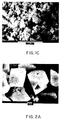
- Example 1 With reference to the SEM photomicrographs, the structure and size of Example 1 is shown in Fig. 1A; of Example 2 in Fig. 1B and of Example 4 in Fig. 1C.
- the similarity of the shape of the final product to the template is also demonstrated since the shape of the pigment template for Examples 2 and 3 is rodlike while that of the zirconium silicate template (Example 4) is blocky.
- the normal particle size for this formulation and firing condition is typically in the range of 7 to 10 ⁇ . From Table I, it is evident that the use of a template material has a significant effect on decreasing the size over the control, Example No. 1, where none was employed. In Table II, it is seen that lower particle sizes were obtained as the amount of template addition increased from 0.1 to 1.0 weight percent.
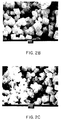
- a spine structured copper chrome black pigment having a composition of approximately 36 percent by weight cupric oxide and 64 percent by weight green chromium oxide was prepared by dry mixing these oxides in a Waring Blender for one minute. The resulting mixture was then heated in a electric oven to 1550°F (843°C) over a seven hour period, and held there for four hours. A scanning electron photomicrograph, SEM, of this calcined material is shown in Fig. 2A. This sample is labeled Example No. 9.
- Template materials including a finely divided spine-structured pigment (Ferro F-6331 pigment), a ground black iron oxide spine pigment (Fe 3 O 4 ), and a ground corundum-structured pigment (Fe 2 O 3 ) were added to separate samples of the copper chromium oxide mixture and suitably blended. Amounts of each addition by percent, based on the weight of the raw material batch, and the type of structure are reported in Table III hereinbelow. For comparison, no template material was added to Example No. 9, which serves as a control. All of the above samples were fired as described for Example No. 9. The average particle sizes (MV) of the fired examples described above were measured using a Leeds and Northrup Microtrac particle size analyzer. These values are reported in Table III.
- MV average particle sizes
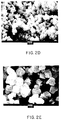
- FIG. 2A-2G A photomicrograph of each of the Examples. Nos. 9-15, has been provided as Figs. 2A-2G, respectively, also noted in Table III.
- Figs. 2B, 2C, 2D, 2E, and 2G illustrate the use of a finely divided spinel-structured material (Fe 3 O 4 or Ferro F-6331 pigment), added to the raw batch material at weight percent levels of 0%, 0.25%, and 2.0%, and 5.0%.
- Figs. 2E and 2F illustrate that it is the crystal form of the template material, not its cationic chemical species, which allows it to effect the desired crystal size reduction and improvement of the structure. The additions made to both of these contained approximately the same amount of iron ions.
- a (Zn,Co) 2 SiO 4 blue pigment (DCMA class phenacite) was also synthesized according to the present invention. Without the use of a template addition, a small amount of Co 3 O 4 was found in the calcined product by X-ray powder diffraction. A one percent addition of Ferro Corp. K230B, a zinc cobalt silicate pigment, to the raw batch eliminated the presence of a detectable amount of cobalt oxide in the product. The amount of cobalt oxide in Example No. 16, the standard material, was mimicked by firing Example No. 17, the template-added raw batch, 100°F (66°C) lower. Example nos.
- pigments are made by the general process of batching, wet or dry blending, calcining, and grinding operations.
- the raw materials used are fine powders, typically with particle sizes in the range of 0.2 to 50 ⁇ .
- the dry blending process is not primarily used to reduce the particle sizes of the powders, and generally cannot produce raw batches which are homogeneous on the submicron scale.
- the calcinations are typically 0.1 to 24 hours long to allow for large scale production, which is often insufficient to permit complete diffusion and reaction of the coarser or more refractory raw materials. Grinding is done by a variety of methods, including micropulverization, jet milling, ball milling, attrition milling. The wet grinding methods are followed by either a drying operation or a filter, wash, and dry process.
- the present invention helps alleviate one or more of these listed problems for many of the pigment systems.
- the three most important benefits of the present invention are that the templates can greatly enhance the reaction rates at low temperatures, enabling complete reaction at temperatures as much as 270°F (150°C) lower than normal; they provide the ability to control and tune the system to produce the desired particle size and a narrower particle size distribution; and they provide the ability to control the system to produce a desired particulate morphology.
- the ability to react at lower temperatures is extremely important. It contributes to producing finer particle sizes and reduces aggregation, inter-particle necking. It also helps eliminate grit and large particles, and reduces wear and attack on the reaction vessel.
- the ability to produce desired and/or finer particle sizes is very important. This enhances the pigment quality by enabling production of the optimized particle size with a narrower particle size distribution. It reduces raw material costs by enabling the use of coarser and cheaper raw materials. Finally, it reduces processing costs by enabling use of milder and/or shorter grinding operations.
- the ability to control the size, crystallinity and shape of the product by the amount or type of the template used has far reaching implications, including the production of magnetic, conducting, and superconducting or semiconducting media.
- the size, crystallinity and shape thereof greatly influence the optical properties of the pigmented system.
- the size, crystallinity and shape, together with the presence of crystalline surface defects affect their dissolution rates in glazes and affect the interfacial reactions that occur in all systems.
- the rates of interfacial reactions can affect the degradation rates or stability of the paint and plastic systems in which mixed metal oxide powders are used.
- a fourth important benefit attributable to the use of templates is that they can also help to minimize or eliminate the formation of phase impurities.
- the method of the present invention can be practiced to manufacture a variety of crystalline powders having utility as pigments for ceramics, plastics and paints as well other uses including in superconductors, semiconductors, ferroelectrics, dielectrics, piezoelectrics, refractories, catalysts, grinding media, abrasives and the like.
- the selection of components to form the crystalline powders as well as selection of a template material can readily be made within the total specification disclosure. Relative amounts of the components can be varied depending upon the compositional and structural ( i . e ., both morphologic, or shape, and crystal structure) results sought.
Landscapes
- Chemical & Material Sciences (AREA)
- Engineering & Computer Science (AREA)
- Organic Chemistry (AREA)
- Inorganic Chemistry (AREA)
- Manufacturing & Machinery (AREA)
- Ceramic Engineering (AREA)
- Materials Engineering (AREA)
- Structural Engineering (AREA)
- Inorganic Compounds Of Heavy Metals (AREA)
- Compounds Of Iron (AREA)
- Pigments, Carbon Blacks, Or Wood Stains (AREA)
- Oxygen, Ozone, And Oxides In General (AREA)
- Compositions Of Oxide Ceramics (AREA)
Claims (6)
- Eine Vorgehensweise der Herstellung eines Mischmetalloxidpulvers, bestehend aus dem Bilden einer Mischung aus festen Rohstoffen, die wenigstens zwei verschiedene Metallkationen und einen spezifischen Matrixstoff beinhalten; Vermischen der Bestandteile; Kalzinieren der Mischung zum Einleiten der Bildung eines Mischmetalloxids, wobei sich kristallinische Partikel der Mischmetalloxide bilden und anschließendes Gewinnen der Mischmetalloxidpartikel, bei dem die Menge des Matrixstoffes zwischen 0,002 und 20 % Massenanteil der Mischung fällt. Die Partikelgröße des Matrixstoffes liegt zwischen 0,01 und 50µ, während der Matrixstoff größtenteils die gleiche Kristallstruktur aufweist wie das herzustellende kristallinische Pulver oder ist dieser so ähnlich ist, daß das kristallinische Pulver hergestellt werden kann.
- Eine Vorgehensweise nach Anspruch 1, bei der die Mischung bis zu 5 % Massenanteil des Matrixstoffes enthält.
- Eine Vorgehensweise nach Anspruch 1 oder 2, bei der die Temperatur des Kalzinierungsschritts zwischen 260° C und 1343° C und die Kalzinierungsdauer zwischen 01, und 24 Stunden liegt.
- Eine Vorgehensweise nach Ansprüchen 1, 2 oder 3, bei der die Metallkationen aus den Pigmentklassen Borat, Garant, Olivin, Phenazit, Phosphat, Priderit, Pyrochlor, Sphen, Spinell und Zirkon und der Kristallklasse Perowskit ausgewählt werden.
- Eine Vorgehensweise nach Ansprüchen 1, 2, 3 oder 4, bei der die Matrixstoffe Zirkon (ZrSiO4), eisenschwarzes Oxid (Fe3O4) ein Phenazit oder ein Spinellpigment sind.
- Eine Vorgehensweise nach Anspruch 5, wobei der Spinell Magnesium-Aluminiumoxid (MgAl2O4) ist.
Applications Claiming Priority (3)
| Application Number | Priority Date | Filing Date | Title |
|---|---|---|---|
| US07/756,158 US5228910A (en) | 1991-09-06 | 1991-09-06 | Mixed metal oxide crystalline powders and method for the synthesis thereof |
| US756158 | 1991-09-06 | ||
| PCT/US1992/007507 WO1993004996A1 (en) | 1991-09-06 | 1992-09-03 | Improved mixed metal oxide crystalline powders and method for the synthesis thereof |
Publications (3)
| Publication Number | Publication Date |
|---|---|
| EP0593695A1 EP0593695A1 (de) | 1994-04-27 |
| EP0593695A4 EP0593695A4 (de) | 1994-12-21 |
| EP0593695B1 true EP0593695B1 (de) | 1997-11-19 |
Family
ID=25042272
Family Applications (1)
| Application Number | Title | Priority Date | Filing Date |
|---|---|---|---|
| EP93905063A Expired - Lifetime EP0593695B1 (de) | 1991-09-06 | 1992-09-03 | Verfahren zur herstellung von kristallinem pulver aus metalloxidgemischen |
Country Status (9)
| Country | Link |
|---|---|
| US (1) | US5228910A (de) |
| EP (1) | EP0593695B1 (de) |
| JP (1) | JPH06510272A (de) |
| AU (1) | AU2698292A (de) |
| CA (1) | CA2115460C (de) |
| DE (1) | DE69223247T2 (de) |
| ES (1) | ES2108864T3 (de) |
| MX (1) | MX9205090A (de) |
| WO (1) | WO1993004996A1 (de) |
Families Citing this family (20)
| Publication number | Priority date | Publication date | Assignee | Title |
|---|---|---|---|---|
| US5531974A (en) * | 1992-07-08 | 1996-07-02 | Hughes Aircraft Company | Flux grown, monosize oxide particles |
| FR2702216B1 (fr) * | 1993-03-03 | 1995-05-24 | Rhone Poulenc Chimie | Nouveaux pigments minéraux colorés à base de terres rares, procédé de synthèse et utilisations. |
| GB9322358D0 (en) * | 1993-10-29 | 1993-12-15 | Johnson Matthey Plc | Pigmentary material |
| FR2716185B1 (fr) * | 1994-02-11 | 1996-05-03 | Rhone Poulenc Chimie | Silicates à base d'alcalino-terreux, de cuivre et éventuellement de titane, pigments bleus ou violets à base de ces silicates, leur procédé de préparation et leur utilisation. |
| US6156114A (en) * | 1996-02-06 | 2000-12-05 | E. I. Du Pont De Nemours And Company | Treatment of deagglomerated particles with plasma-activated species |
| US6482387B1 (en) | 1996-04-22 | 2002-11-19 | Waltraud M. Kriven | Processes for preparing mixed metal oxide powders |
| US6139816A (en) * | 1997-06-09 | 2000-10-31 | Merck Kanto Advanced Chemical Ltd | Process for the preparation of ultra-fine powders of metal oxides |
| DE19742522C1 (de) * | 1997-09-26 | 1999-04-29 | Cerdec Ag | Zirkonpigmente enthaltende keramische Dekorfarben mit erhöhter Buntheit, Verfahren zu ihrer Herstellung und ihre Verwendung |
| US6174360B1 (en) * | 1998-10-26 | 2001-01-16 | Ferro Corporation | Infrared reflective color pigment |
| AU4465000A (en) | 1999-04-26 | 2000-11-10 | Ferro Corporation | Continuous calcination of mixed metal oxides |
| US20030108793A1 (en) | 2001-08-07 | 2003-06-12 | 3M Innovative Properties Company | Cathode compositions for lithium ion batteries |
| US6616744B1 (en) | 2002-04-17 | 2003-09-09 | Ferro Corporation | Method of forming inorganic pigments |
| US7211237B2 (en) | 2003-11-26 | 2007-05-01 | 3M Innovative Properties Company | Solid state synthesis of lithium ion battery cathode material |
| EP1747251B1 (de) * | 2004-04-26 | 2014-12-03 | The South African Nuclear Energy Corporation Limited | Herstellung von anorganisch dotierten zirkonpigmenten |
| US7744847B2 (en) * | 2004-05-27 | 2010-06-29 | The South African Nuclear Energy Corporation Limited | Upgrading of zircon |
| US7498081B2 (en) * | 2005-03-02 | 2009-03-03 | Thw Shwphwed Color Company | Core-shell composite inorganic pigments and method of preparation for crystallizable glass frit compositions |
| US8172935B2 (en) * | 2006-07-25 | 2012-05-08 | Ferro Corporation | Special effect pigments |
| US20100064942A1 (en) * | 2008-09-15 | 2010-03-18 | Ferro Corporation | Corundum Crystal Structure Pigments With Reduced Soluble Chromium Content |
| US10961452B2 (en) * | 2015-12-01 | 2021-03-30 | Siemens Medical Solutions Usa, Inc. | Method for controlling gallium content in gadolinium-gallium garnet scintillators |
| DE102020123443A1 (de) | 2020-09-08 | 2022-03-10 | FH Münster, Körperschaft des öffentlichen Rechts | Gelbes Farbpigment |
Family Cites Families (26)
| Publication number | Priority date | Publication date | Assignee | Title |
|---|---|---|---|---|
| BE557975A (de) * | 1956-06-04 | 1957-11-30 | ||
| US3022185A (en) * | 1957-09-02 | 1962-02-20 | Delfosse Pierre | White filler material and its preparation |
| DE1302385B (de) * | 1958-01-11 | 1971-02-11 | ||
| DE1546240B2 (de) * | 1960-07-11 | 1974-08-29 | Chemirad Corp., East Brunswick, N.J. (V.St.A.) | Füllstoff für Papier |
| US3607338A (en) * | 1968-04-11 | 1971-09-21 | Nasa | Synthesis of zinc titanate pigment and coatings containing the same |
| US3560234A (en) * | 1969-03-03 | 1971-02-02 | Thann & Mulhouse | Process for the manufacture of pigments of titanium dioxide in the rutile form |
| US3658566A (en) * | 1969-08-07 | 1972-04-25 | American Cyanamid Co | Titanium oxide pigments |
| BE755970A (fr) * | 1969-09-10 | 1971-02-15 | English Clays Lovering Pochin | Pigment mixte se composant d'un pigment a l'argile et d'un pigment au cabonate de calcium |
| US3704158A (en) * | 1969-12-04 | 1972-11-28 | George Alexander Rohan | Treatment of powdered chalk |
| US3920800A (en) * | 1973-10-12 | 1975-11-18 | Cyprus Mines Corp | Production of purified calcium carbonate |
| US3915661A (en) * | 1974-06-17 | 1975-10-28 | Allied Chem | Process and apparatus for growth of crystals |
| US4199370A (en) * | 1978-03-15 | 1980-04-22 | The New Jersey Zinc Company | Weather resistant titanium dioxide pigment having improved optical properties and process for making same |
| US4196004A (en) * | 1978-03-22 | 1980-04-01 | Manfred Berretz | Corrosion resistant glasses that contain chemical additives for application over metal substrates |
| US4227935A (en) * | 1979-02-16 | 1980-10-14 | American Cyanamid Company | High dry hide TiO2 slurries |
| US4224627A (en) * | 1979-06-28 | 1980-09-23 | International Business Machines Corporation | Seal glass for nozzle assemblies of an ink jet printer |
| US4310357A (en) * | 1980-05-14 | 1982-01-12 | Nippon Electric Glass Company, Limited | Low temperature sealing glass |
| US4365021A (en) * | 1981-07-22 | 1982-12-21 | Owens-Illinois, Inc. | Low temperature sealant glass |
| US4448608A (en) * | 1982-12-30 | 1984-05-15 | Johnson Matthey Public Limited Company | Colored inorganic complex for use as a pigment and compositions containing it |
| US4522925A (en) * | 1983-09-01 | 1985-06-11 | Owens-Illinois, Inc. | Sealing glass and method of making a Willemite filler therefor |
| US4492677A (en) * | 1984-05-17 | 1985-01-08 | Atlantic Richfield Company | Preparative process for alkaline earth metal, aluminum-containing spinels and their use for reducing the sulfur oxide content of gases |
| JPS6126554A (ja) * | 1984-07-18 | 1986-02-05 | 川崎製鉄株式会社 | セラミツク焼結体の製造方法 |
| US4882301A (en) * | 1985-10-09 | 1989-11-21 | Ferro Corporation | Decorative and protective borders for automobile side and rear lights |
| DE3617169C2 (de) * | 1986-05-22 | 1996-05-23 | Pluss Stauffer Ag | Carbonathaltige mineralische Füllstoffe und Pigmente |
| US4829031A (en) * | 1986-08-01 | 1989-05-09 | Research Corporation | Method of preparing ceramic compositions at lower sintering temperatures |
| US4752341A (en) * | 1986-08-11 | 1988-06-21 | Pq Corporation | Pigment system for paper |
| DE3802468A1 (de) * | 1988-01-28 | 1989-08-03 | Bayer Ag | Verfahren zur herstellung von rutilmischphasenpigmenten |
-
1991
- 1991-09-06 US US07/756,158 patent/US5228910A/en not_active Expired - Lifetime
-
1992
- 1992-09-03 AU AU26982/92A patent/AU2698292A/en not_active Abandoned
- 1992-09-03 ES ES93905063T patent/ES2108864T3/es not_active Expired - Lifetime
- 1992-09-03 EP EP93905063A patent/EP0593695B1/de not_active Expired - Lifetime
- 1992-09-03 WO PCT/US1992/007507 patent/WO1993004996A1/en not_active Ceased
- 1992-09-03 DE DE69223247T patent/DE69223247T2/de not_active Expired - Lifetime
- 1992-09-03 JP JP5505432A patent/JPH06510272A/ja active Pending
- 1992-09-03 CA CA002115460A patent/CA2115460C/en not_active Expired - Lifetime
- 1992-09-04 MX MX9205090A patent/MX9205090A/es not_active IP Right Cessation
Also Published As
| Publication number | Publication date |
|---|---|
| MX9205090A (es) | 1993-03-01 |
| WO1993004996A1 (en) | 1993-03-18 |
| EP0593695A4 (de) | 1994-12-21 |
| DE69223247D1 (de) | 1998-01-02 |
| CA2115460C (en) | 2004-03-23 |
| US5228910A (en) | 1993-07-20 |
| CA2115460A1 (en) | 1993-03-18 |
| ES2108864T3 (es) | 1998-01-01 |
| DE69223247T2 (de) | 1998-03-19 |
| JPH06510272A (ja) | 1994-11-17 |
| AU2698292A (en) | 1993-04-05 |
| EP0593695A1 (de) | 1994-04-27 |
Similar Documents
| Publication | Publication Date | Title |
|---|---|---|
| EP0593695B1 (de) | Verfahren zur herstellung von kristallinem pulver aus metalloxidgemischen | |
| EP0384603B1 (de) | Verfahren zur Herstellung von Magnesiumoxyd | |
| US4851293A (en) | Stabilized metallic oxides | |
| EP0429548B1 (de) | Kleine partikel und plättchen von alpha-aluminiumoxyd | |
| JP5372463B2 (ja) | アルカリ土類酸化マンガン顔料 | |
| US4820593A (en) | Stabilised metallic oxides | |
| US4681637A (en) | Process for the production of yellow-brown zinc ferrite pigments | |
| EP0232094B1 (de) | Chemische Herstellung von Zirkonium-Aluminium-Magnesiumoxid-Verbundwerkstoffen | |
| US5008223A (en) | Grayish-black encapsulated pigments and method of their production | |
| US5061473A (en) | Titanium dioxide, a process and its production | |
| Ouahdi et al. | Synthesis of CoAl2O4 by double decomposition reaction between LiAlO2 and molten KCoCl3 | |
| Rivera-Yerena et al. | Approaching the most intense reddish yellow tone of praseodymium doped zircon pigment | |
| Maslennikova | Pigments of the spinel type | |
| US6652829B2 (en) | Continuous calcination of mixed metal oxides | |
| JPH05254844A (ja) | 銅−クロム−マンガン混合酸化物を基とするスピネル黒色顔料、それらの製造方法および使用 | |
| KR101141816B1 (ko) | α-알루미나 분말의 제조방법 | |
| EP0490500B1 (de) | Stabilisierte Metalloxyde | |
| CA2024864A1 (en) | Preparation of inorganic oxide pigments (ceramics) | |
| CA2003526A1 (en) | Ceramic microspheres | |
| EP0611738B1 (de) | Herstellung von gemischten Pulvern | |
| Wang et al. | Synthesis of BaTiO3 nanocrystals by stearic acid gel method | |
| EP0582644B1 (de) | Verfahren zur herstellung gemischter oxide | |
| US5443810A (en) | Process for making bismuth-vanadium-molybdenum-containing compositions | |
| US3076716A (en) | Production of granular zirconia products | |
| Baldi et al. | Synthesis of a New Class of Red Pigments Based on Perovskite-Type Lattice AxB (2-xy) CryO3 with 0.90< x< 1, 1 0.05< y< 0.12 A= Y, lanthanides, B= Al for use in body stain and high temperature glazes |
Legal Events
| Date | Code | Title | Description |
|---|---|---|---|
| PUAI | Public reference made under article 153(3) epc to a published international application that has entered the european phase |
Free format text: ORIGINAL CODE: 0009012 |
|
| 17P | Request for examination filed |
Effective date: 19940209 |
|
| AK | Designated contracting states |
Kind code of ref document: A1 Designated state(s): BE CH DE DK ES FR GB IT LI NL SE |
|
| A4 | Supplementary search report drawn up and despatched |
Effective date: 19941028 |
|
| AK | Designated contracting states |
Kind code of ref document: A4 Designated state(s): BE CH DE DK ES FR GB IT LI NL SE |
|
| 17Q | First examination report despatched |
Effective date: 19950601 |
|
| GRAG | Despatch of communication of intention to grant |
Free format text: ORIGINAL CODE: EPIDOS AGRA |
|
| GRAG | Despatch of communication of intention to grant |
Free format text: ORIGINAL CODE: EPIDOS AGRA |
|
| GRAH | Despatch of communication of intention to grant a patent |
Free format text: ORIGINAL CODE: EPIDOS IGRA |
|
| GRAH | Despatch of communication of intention to grant a patent |
Free format text: ORIGINAL CODE: EPIDOS IGRA |
|
| GRAA | (expected) grant |
Free format text: ORIGINAL CODE: 0009210 |
|
| AK | Designated contracting states |
Kind code of ref document: B1 Designated state(s): BE CH DE DK ES FR GB IT LI NL SE |
|
| PG25 | Lapsed in a contracting state [announced via postgrant information from national office to epo] |
Ref country code: LI Free format text: LAPSE BECAUSE OF FAILURE TO SUBMIT A TRANSLATION OF THE DESCRIPTION OR TO PAY THE FEE WITHIN THE PRESCRIBED TIME-LIMIT Effective date: 19971119 Ref country code: DK Free format text: LAPSE BECAUSE OF NON-PAYMENT OF DUE FEES Effective date: 19971119 Ref country code: CH Free format text: LAPSE BECAUSE OF FAILURE TO SUBMIT A TRANSLATION OF THE DESCRIPTION OR TO PAY THE FEE WITHIN THE PRESCRIBED TIME-LIMIT Effective date: 19971119 Ref country code: BE Free format text: LAPSE BECAUSE OF FAILURE TO SUBMIT A TRANSLATION OF THE DESCRIPTION OR TO PAY THE FEE WITHIN THE PRESCRIBED TIME-LIMIT Effective date: 19971119 |
|
| ITF | It: translation for a ep patent filed | ||
| REG | Reference to a national code |
Ref country code: CH Ref legal event code: EP |
|
| REG | Reference to a national code |
Ref country code: ES Ref legal event code: FG2A Ref document number: 2108864 Country of ref document: ES Kind code of ref document: T3 |
|
| REF | Corresponds to: |
Ref document number: 69223247 Country of ref document: DE Date of ref document: 19980102 |
|
| PG25 | Lapsed in a contracting state [announced via postgrant information from national office to epo] |
Ref country code: SE Free format text: LAPSE BECAUSE OF FAILURE TO SUBMIT A TRANSLATION OF THE DESCRIPTION OR TO PAY THE FEE WITHIN THE PRESCRIBED TIME-LIMIT Effective date: 19980219 |
|
| ET | Fr: translation filed | ||
| REG | Reference to a national code |
Ref country code: CH Ref legal event code: PL |
|
| PLBE | No opposition filed within time limit |
Free format text: ORIGINAL CODE: 0009261 |
|
| STAA | Information on the status of an ep patent application or granted ep patent |
Free format text: STATUS: NO OPPOSITION FILED WITHIN TIME LIMIT |
|
| 26N | No opposition filed | ||
| REG | Reference to a national code |
Ref country code: GB Ref legal event code: IF02 |
|
| PGFP | Annual fee paid to national office [announced via postgrant information from national office to epo] |
Ref country code: NL Payment date: 20090924 Year of fee payment: 18 Ref country code: GB Payment date: 20090929 Year of fee payment: 18 |
|
| PGFP | Annual fee paid to national office [announced via postgrant information from national office to epo] |
Ref country code: IT Payment date: 20090929 Year of fee payment: 18 |
|
| PGFP | Annual fee paid to national office [announced via postgrant information from national office to epo] |
Ref country code: ES Payment date: 20100927 Year of fee payment: 19 |
|
| PGFP | Annual fee paid to national office [announced via postgrant information from national office to epo] |
Ref country code: DE Payment date: 20100929 Year of fee payment: 19 |
|
| REG | Reference to a national code |
Ref country code: NL Ref legal event code: V1 Effective date: 20110401 |
|
| GBPC | Gb: european patent ceased through non-payment of renewal fee |
Effective date: 20100903 |
|
| PG25 | Lapsed in a contracting state [announced via postgrant information from national office to epo] |
Ref country code: IT Free format text: LAPSE BECAUSE OF NON-PAYMENT OF DUE FEES Effective date: 20100903 |
|
| REG | Reference to a national code |
Ref country code: FR Ref legal event code: ST Effective date: 20110531 |
|
| PG25 | Lapsed in a contracting state [announced via postgrant information from national office to epo] |
Ref country code: FR Free format text: LAPSE BECAUSE OF NON-PAYMENT OF DUE FEES Effective date: 20100930 |
|
| PG25 | Lapsed in a contracting state [announced via postgrant information from national office to epo] |
Ref country code: NL Free format text: LAPSE BECAUSE OF NON-PAYMENT OF DUE FEES Effective date: 20110401 Ref country code: GB Free format text: LAPSE BECAUSE OF NON-PAYMENT OF DUE FEES Effective date: 20100903 |
|
| PGFP | Annual fee paid to national office [announced via postgrant information from national office to epo] |
Ref country code: FR Payment date: 20091006 Year of fee payment: 18 |
|
| REG | Reference to a national code |
Ref country code: DE Ref legal event code: R119 Ref document number: 69223247 Country of ref document: DE Effective date: 20120403 |
|
| PG25 | Lapsed in a contracting state [announced via postgrant information from national office to epo] |
Ref country code: DE Free format text: LAPSE BECAUSE OF NON-PAYMENT OF DUE FEES Effective date: 20120403 |
|
| REG | Reference to a national code |
Ref country code: ES Ref legal event code: FD2A Effective date: 20130417 |
|
| PG25 | Lapsed in a contracting state [announced via postgrant information from national office to epo] |
Ref country code: ES Free format text: LAPSE BECAUSE OF NON-PAYMENT OF DUE FEES Effective date: 20110904 |