EP0593844A2 - Système de reconnaissance de caractère - Google Patents
Système de reconnaissance de caractère Download PDFInfo
- Publication number
- EP0593844A2 EP0593844A2 EP93105671A EP93105671A EP0593844A2 EP 0593844 A2 EP0593844 A2 EP 0593844A2 EP 93105671 A EP93105671 A EP 93105671A EP 93105671 A EP93105671 A EP 93105671A EP 0593844 A2 EP0593844 A2 EP 0593844A2
- Authority
- EP
- European Patent Office
- Prior art keywords
- character
- characters
- input
- variation
- word
- Prior art date
- Legal status (The legal status is an assumption and is not a legal conclusion. Google has not performed a legal analysis and makes no representation as to the accuracy of the status listed.)
- Granted
Links
Images

Classifications
-
- G—PHYSICS
- G06—COMPUTING OR CALCULATING; COUNTING
- G06V—IMAGE OR VIDEO RECOGNITION OR UNDERSTANDING
- G06V30/00—Character recognition; Recognising digital ink; Document-oriented image-based pattern recognition
- G06V30/10—Character recognition
- G06V30/14—Image acquisition
- G06V30/142—Image acquisition using hand-held instruments; Constructional details of the instruments
-
- G—PHYSICS
- G06—COMPUTING OR CALCULATING; COUNTING
- G06V—IMAGE OR VIDEO RECOGNITION OR UNDERSTANDING
- G06V30/00—Character recognition; Recognising digital ink; Document-oriented image-based pattern recognition
- G06V30/10—Character recognition
- G06V30/26—Techniques for post-processing, e.g. correcting the recognition result
- G06V30/262—Techniques for post-processing, e.g. correcting the recognition result using context analysis, e.g. lexical, syntactic or semantic context
-
- G—PHYSICS
- G06—COMPUTING OR CALCULATING; COUNTING
- G06V—IMAGE OR VIDEO RECOGNITION OR UNDERSTANDING
- G06V30/00—Character recognition; Recognising digital ink; Document-oriented image-based pattern recognition
- G06V30/10—Character recognition
Definitions
- the present invention relates to a character recognition system. More specifically, the present invention relates to a character recognition system receiving hand written characters as inputs, recognizing the character data thereof and outputting the result of recognition.
- Fig. 10 is a schematic block diagram of a conventional character recognition system.
- input means 1 receives a hand written character as an input and turns it into electronic data.
- the input character data is applied to recognizing means 2.
- Recognizing means 2 has necessary information for recognition, and recognizes the character data supplied from input means 1. Results and states of input means 1 and recognizing means 2 are applied to output means 3 which display necessary information.
- One representative method is correction of the obtained result of recognition by confirming grammatical meaning by using grammatical knowledge.
- correct word sets are identified by using grammatical knowledge based on a dictionary related to grammar. More specifically, a plurality of candidates for characters obtained as a result of recognition are combined appropriately and a combination of characters having proper grammatical meaning is found as a unit of an idiom or a phrase.
- an object of the present invention is to provide a character recognition system capable of obtaining a combination of candidates for characters efficiently by generating a smaller number of combinations.
- input means receives hand written characters as inputs and turn them into electronic data; when thus generated data of characters are provided, variations of the input characters are expected based on the position of the data of the characters; and character recognition is carried out with the recognition results being ranked with priority based on the expected variations of the characters.
- combinations of words are generated based on the reliability of the recognition results taking into consideration the expected reliability of variation, and grammatical meaning is confirmed. Therefore, the number of words to be examined and the necessary time for examination can be reduced.
- information for determining priority of the recognition results is stored, and priority of each character is determined based on the stored information, dependent on the position of the input data of characters.
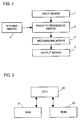
- Fig. 1 is a schematic block diagram of one embodiment of the present invention.
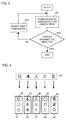
- Fig. 2 is an electric circuit diagram of the character recognition system of the present invention.
- Fig. 3 is a flow chart showing an operation for obtaining a combination of candidates for characters having grammatically correct meaning in the character recognition system in accordance with one embodiment of the present invention.
- Fig. 4 shows input characters and an example of recognition results.
- Fig. 5 shows candidates for characters weighted based on expected variations on the recognition results of Fig. 4.
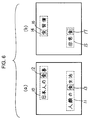
- Fig. 6 illustrates positions of a character in words.
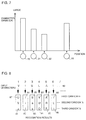
- Fig. 7 is a graph showing variety of each character in a set of characters.
- Fig. 8 shows an example of the present invention applied to a character recognition system for recognizing alphabets.
- Fig. 9 shows candidates for characters weighted based on the expected variation with respect to the recognition results of Fig. 8.
- Fig. 10 is a schematic block diagram of a conventional character recognition system.
- Fig. 6 shows positions of a character in words and Fig. 7 is a graph showing variations of each character in a set of characters.
- the character position means whether the character is at the middle of a word, at the beginning of a word or at the end of a word.
- Fig. 6 (a) shows examples of a character in the middle of a word.
- Fig. 6 (b) shows examples of characters at the beginning and at the end of words.
- a character 16 in a word 14 is said at the beginning of a word as there are other characters only on the right side of the character.
- the character 17 in the word 15 is said to be at the end of a word as other characters exist only on the left side of the character.
- word used here includes all semantic units and it refers not only to the general word but also phrases, clauses and idioms. When the position of a character in a document is considered, the "word” is used as a reference.
- the ratio of recognition of a character with small variation is high. Therefore, if the recognition result of characters having smaller expected variation are weighted much and the recognition results of characters having larger expected variation are weighted less in identifying correct word sets by using knowledge, correct identification can be easily done in examining the grammatical meaning of the word.
- Fig. 1 is a schematic block diagram of one embodiment of the present invention.
- priority processing means 5 is connected between input means 1 and recognizing means 2 shown in Fig. 10 and storing means 4 connected to priority processing means 5.
- Priority processing means 5 expects variation of an input character based on the position of the character in the word when the character provided as input to the input means 1 is hand-written, and determines priority of the recognition result based on the magnitude of the expected character variation.
- Information necessary for determining priority of the recognition result by the priority processing means 5 is stored in the storing means 4.
- Fig. 2 generally shows an electrical structure of one embodiment of the present invention.
- a CPU 30 executes recognition processing by the priority processing means 5 and the recognizing means 2 shown in Fig. 1. Character data to be recognized and data obtained in the process of recognition are temporarily stored in a RAM 31, and data base necessary for recognition and so one are stored in a ROM 32.
- Fig. 3 is a flow chart showing the operation of one embodiment of the present invention.
- step SP2 CPU 30 confirms grammatical meaning of the thus formed word by referring to the data base with respect to examination of grammatical meaning in ROM 32. If the word has appropriate meaning, the process is terminated. If not, different candidates for characters are newly selected in step SP3 to form a different word, and grammatical meaning is examined again. In this manner, examination of meaning is continuously carried out every time a word is formed by a plurality of candidates for characters until a proper combination is obtained.
- Steps for forming a word by a plurality of candidates for characters obtained as a result of recognition will be described with reference to Figs. 4 and 5.
- Fig. 4 shows an example of input characters and the recognition result thereof.
- the input characters 50 includes and For each of the input characters, first to three candidates are obtained which are ranked in accordance with the reliability of the recognition result.
- a group 51 of candidates is for the input character
- a group 52 of candidates is for the input character
- a group 53 of candidates is for the input character
- a group 54 of candidates is for the input character
- a group 55 of candidates is for the input character each group including first to third characters.
- the resulting word is which does not have appropriate grammatical meaning. Therefore, it is necessary to form another word by using characters other than the first candidate in respective groups of candidates and to examine grammatical meaning thereof.
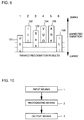
- Fig. 5 shows groups of candidates for characters weighted based on expected variation on the recognition results of Fig. 4.
- a data base with respect to how character variation depends on character position in the document (for example, at the beginning of a word, at the end of a word or at the middle of the word) is stored in the ROM 32 in advance, and the magnitude of character variation is expected by determination with reference to the data.
- the groups 51 to 55 of candidates for characters are weighted or ranked based on the knowledge of variation of characters, and a new groups 70 to 74 for candidates for characters are obtained. Referring to the groups 70 to 74 of candidates for characters shown in Fig. 5, the longitudinal direction with respect to the sheet represent the magnitude of the expected character variation.
- the expected variation becomes smaller upward and becomes larger downward.
- the weighted group 70 of candidates for the input character is relatively large as the input character is at the beginning of the word.
- the variation of weighted groups 71, 72 and 73 of candidates for input characters and respectively are smaller as these characters are at the middle of the word.
- the steps for forming a word by the weighted groups 70 to 74 of candidates for characters will be described.
- the obtained recognition results of a character with small expected variation is highly reliable, while the recognition result of a character with large variation expected is smaller. Therefore, when a word is to be formed by a plurality of candidates for characters, candidates for characters with smaller variation expected are given priority. An example when characters are input will be described.
- the first candidate 78 for the input character the variation of which is expected to be the smallest, and the first candidate 79 for the input character of which variation is expected to be the second smallest are fixed. Then, the first candidate 75 the second candidate 76 and the third candidate 77 for the input character are successively combined to provide the following groups of characters, that is, , and
- the first candidate 78 for the input character and the second candidate 80 for the input character are fixed and the first candidate 75 the second candidate 76 " ⁇ " and the third candidate 77 for the input character are successively combined, and groups of characters and are provided in the similar manner. More specifically, words are formed with candidates for characters the variation of which are expected to be small and thus the reliability of recognition results of which are high are fixed with priority, and the candidates for characters of which variation are expected to be large and the reliability of recognition results are lower are changed earlier. Every time a word is formed in accordance with such procedure, the grammatical meaning of the word is examined.
- Figs. 8 and 9 show an embodiment of the present invention applied to a character recognition system for recognizing alphabets.
- input characters 80 include "V", “I”, “S”, “U”, “A” and “L”, and first to third candidates are obtained for each of the input characters with the reliability of recognition results higher in this order.
- Fig. 9 shows the groups of candidates for characters weighted or ranked based on the expected variation.
- the variation of character is expected with reference to the data base stored in the ROM 32, in the same manner as described with reference to Fig. 5.
- the groups 81 to 86 of candidates for characters are weighted dependent on the expected character variation, and new groups 101 to 106 of candidates for characters are obtained.
- the lengthwise direction with respect to the sheet represents magnitude of the expected character variation. In other words, the variation becomes smaller upward, and the variation becomes larger downward.
- the variation of the group 101 of the weighted candidates for the input character “U” is large as the input character “U” is at the beginning of the word.
- the variations of the groups 102 to 105 of the weighted candidates for input characters "I”, “S”, “V” and “A” respectively are smaller as these characters are at the middle of the word.
- Words are formed by the groups 101 to 106 of the weighted candidates for characters. More specifically, the input characters “I”, “V” and “A” of which variations are expected to be the smallest and the input character “S” of which variation is expected to be the second smallest are fixed, and the first to third candidates “U”, “V” and “u” of the input character “V” are successively combined, resulting in groups of characters “UISVAI”, “VISVAI” and "uISVAI”.
- character variation is expected based on the character position in a sentence or word when the characters are hand-written
- combinations of characters are formed based on the reliability of recognition results dependent on the magnitude of the expected character variation and grammatical meaning of these combinations are examined when a word having a proper grammatical meaning is to be found from a plurality of candidates for characters obtained as a result of recognition, and therefore the number of combinations to be examined and the time necessary for examination can be reduced.
Landscapes
- Engineering & Computer Science (AREA)
- Computer Vision & Pattern Recognition (AREA)
- Physics & Mathematics (AREA)
- General Physics & Mathematics (AREA)
- Multimedia (AREA)
- Theoretical Computer Science (AREA)
- Computational Linguistics (AREA)
- Character Discrimination (AREA)
Applications Claiming Priority (3)
| Application Number | Priority Date | Filing Date | Title |
|---|---|---|---|
| JP27992292 | 1992-10-19 | ||
| JP4279922A JP2611904B2 (ja) | 1992-10-19 | 1992-10-19 | 文字認識装置 |
| JP279922/92 | 1992-10-19 |
Publications (3)
| Publication Number | Publication Date |
|---|---|
| EP0593844A2 true EP0593844A2 (fr) | 1994-04-27 |
| EP0593844A3 EP0593844A3 (en) | 1994-09-28 |
| EP0593844B1 EP0593844B1 (fr) | 2001-10-31 |
Family
ID=17617783
Family Applications (1)
| Application Number | Title | Priority Date | Filing Date |
|---|---|---|---|
| EP93105671A Expired - Lifetime EP0593844B1 (fr) | 1992-10-19 | 1993-04-06 | Système de reconnaissance de caractère |
Country Status (4)
| Country | Link |
|---|---|
| US (1) | US6219449B1 (fr) |
| EP (1) | EP0593844B1 (fr) |
| JP (1) | JP2611904B2 (fr) |
| DE (1) | DE69331035T2 (fr) |
Families Citing this family (7)
| Publication number | Priority date | Publication date | Assignee | Title |
|---|---|---|---|---|
| JP2001137788A (ja) * | 1999-11-12 | 2001-05-22 | Hitachi Ltd | 地名表記辞書作成方法および地名表記辞書作成装置 |
| JP3480404B2 (ja) * | 1999-12-22 | 2003-12-22 | 日本電気株式会社 | 単語大分類装置及びその単語大分類方法並びにその制御プログラムを記録した記録媒体 |
| US7110621B1 (en) * | 2000-05-19 | 2006-09-19 | Xerox Corporation | Assist channel coding using a rewrite model |
| US20020057842A1 (en) * | 2000-06-02 | 2002-05-16 | Yuen Henry C. | Smart handwriting recognition apparatus and methods |
| RU2251736C2 (ru) * | 2002-12-17 | 2005-05-10 | "Аби Софтвер Лтд." | Способ идентификации зачеркнутых символов при распознавании рукописного текста |
| JP2008268431A (ja) * | 2007-04-18 | 2008-11-06 | Oki Electric Ind Co Ltd | 筆記試験システム及び筆記試験装置 |
| TWI478074B (zh) * | 2010-12-01 | 2015-03-21 | 財團法人資訊工業策進會 | 文字辨識方法、裝置以及儲存其之電腦可讀取紀錄媒體 |
Family Cites Families (10)
| Publication number | Priority date | Publication date | Assignee | Title |
|---|---|---|---|---|
| JPS5995682A (ja) * | 1982-11-25 | 1984-06-01 | Ricoh Co Ltd | 文字認識後処理方式 |
| US4731857A (en) * | 1984-06-29 | 1988-03-15 | International Business Machines Corporation | Recognition system for run-on handwritten characters |
| US5261009A (en) * | 1985-10-15 | 1993-11-09 | Palantir Corporation | Means for resolving ambiguities in text passed upon character context |
| JPH0664631B2 (ja) * | 1987-09-09 | 1994-08-22 | インターナショナル・ビジネス・マシーンズ・コーポレーション | 文字認識装置 |
| ATE75552T1 (de) * | 1987-10-16 | 1992-05-15 | Computer Ges Konstanz | Verfahren zur automatischen zeichenerkennung. |
| US5018217A (en) * | 1988-09-26 | 1991-05-21 | Brother Kogyo Kabushiki Kaisha | Data converting apparatus having means for changing ornamental stroke end data of character outline |
| US5075896A (en) * | 1989-10-25 | 1991-12-24 | Xerox Corporation | Character and phoneme recognition based on probability clustering |
| US5151950A (en) * | 1990-10-31 | 1992-09-29 | Go Corporation | Method for recognizing handwritten characters using shape and context analysis |
| US5159644A (en) * | 1991-08-30 | 1992-10-27 | Eastman Kodak Company | Character recognition method using statistically weighted correlation |
| US5465309A (en) * | 1993-12-10 | 1995-11-07 | International Business Machines Corporation | Method of and apparatus for character recognition through related spelling heuristics |
-
1992
- 1992-10-19 JP JP4279922A patent/JP2611904B2/ja not_active Expired - Fee Related
-
1993
- 1993-04-06 DE DE69331035T patent/DE69331035T2/de not_active Expired - Fee Related
- 1993-04-06 EP EP93105671A patent/EP0593844B1/fr not_active Expired - Lifetime
-
1996
- 1996-06-21 US US08/665,974 patent/US6219449B1/en not_active Expired - Fee Related
Also Published As
| Publication number | Publication date |
|---|---|
| DE69331035T2 (de) | 2002-06-20 |
| JPH06131500A (ja) | 1994-05-13 |
| EP0593844A3 (en) | 1994-09-28 |
| EP0593844B1 (fr) | 2001-10-31 |
| US6219449B1 (en) | 2001-04-17 |
| JP2611904B2 (ja) | 1997-05-21 |
| DE69331035D1 (de) | 2001-12-06 |
Similar Documents
| Publication | Publication Date | Title |
|---|---|---|
| US4393460A (en) | Simultaneous electronic translation device | |
| US7171350B2 (en) | Method for named-entity recognition and verification | |
| US5610812A (en) | Contextual tagger utilizing deterministic finite state transducer | |
| Nafea et al. | A brief review on preprocessing text in arabic language dataset: Techniques and challenges | |
| US6219449B1 (en) | Character recognition system | |
| KR0123238B1 (ko) | 어절구조 특성을 이용한 형태소 분석 시스팀 및 분석 방법 | |
| JPH11143893A (ja) | 単語照合装置 | |
| JP3080066B2 (ja) | 文字認識装置、方法及び記憶媒体 | |
| CN116861890A (zh) | 一种公证文书自动纠错方法、装置、设备及存储介质 | |
| Simmons et al. | The acquisition and application of context sensitive grammar for English | |
| EP0553745A2 (fr) | Dispositif de reconnaissance de caractères | |
| JP4442208B2 (ja) | 文字列表記解析手法及び装置 | |
| JPH028348B2 (fr) | ||
| JP2908132B2 (ja) | 文字認識結果の後処理方法 | |
| JP2989823B2 (ja) | 文型認識方法 | |
| JP2796140B2 (ja) | 自然言語処理用データ編集支援装置 | |
| JPS62180462A (ja) | 音声入力かな漢字変換装置 | |
| JPH0546814A (ja) | 文字読み取り装置 | |
| JP2989824B2 (ja) | 文型・文法格認識方法 | |
| JPH03125264A (ja) | キーワード抽出装置 | |
| JPH01311390A (ja) | 文字置換制御方式 | |
| JPS62203276A (ja) | 形態素解析装置 | |
| Marukawa et al. | A post-processing method for handwritten Kanji name recognition using Furigana information | |
| JP3725206B2 (ja) | 文字認識装置 | |
| JP3245415B2 (ja) | 文字認識方法 |
Legal Events
| Date | Code | Title | Description |
|---|---|---|---|
| PUAI | Public reference made under article 153(3) epc to a published international application that has entered the european phase |
Free format text: ORIGINAL CODE: 0009012 |
|
| AK | Designated contracting states |
Kind code of ref document: A2 Designated state(s): DE FR GB |
|
| PUAL | Search report despatched |
Free format text: ORIGINAL CODE: 0009013 |
|
| AK | Designated contracting states |
Kind code of ref document: A3 Designated state(s): DE FR GB |
|
| 17P | Request for examination filed |
Effective date: 19941222 |
|
| 17Q | First examination report despatched |
Effective date: 19981102 |
|
| GRAG | Despatch of communication of intention to grant |
Free format text: ORIGINAL CODE: EPIDOS AGRA |
|
| GRAG | Despatch of communication of intention to grant |
Free format text: ORIGINAL CODE: EPIDOS AGRA |
|
| GRAH | Despatch of communication of intention to grant a patent |
Free format text: ORIGINAL CODE: EPIDOS IGRA |
|
| GRAH | Despatch of communication of intention to grant a patent |
Free format text: ORIGINAL CODE: EPIDOS IGRA |
|
| GRAA | (expected) grant |
Free format text: ORIGINAL CODE: 0009210 |
|
| AK | Designated contracting states |
Kind code of ref document: B1 Designated state(s): DE FR GB |
|
| REF | Corresponds to: |
Ref document number: 69331035 Country of ref document: DE Date of ref document: 20011206 |
|
| REG | Reference to a national code |
Ref country code: GB Ref legal event code: IF02 |
|
| ET | Fr: translation filed | ||
| PG25 | Lapsed in a contracting state [announced via postgrant information from national office to epo] |
Ref country code: GB Free format text: LAPSE BECAUSE OF NON-PAYMENT OF DUE FEES Effective date: 20020406 |
|
| PLBE | No opposition filed within time limit |
Free format text: ORIGINAL CODE: 0009261 |
|
| 26N | No opposition filed | ||
| PG25 | Lapsed in a contracting state [announced via postgrant information from national office to epo] |
Ref country code: DE Free format text: LAPSE BECAUSE OF NON-PAYMENT OF DUE FEES Effective date: 20021101 |
|
| GBPC | Gb: european patent ceased through non-payment of renewal fee |
Effective date: 20020406 |
|
| PG25 | Lapsed in a contracting state [announced via postgrant information from national office to epo] |
Ref country code: FR Free format text: LAPSE BECAUSE OF NON-PAYMENT OF DUE FEES Effective date: 20021231 |
|
| REG | Reference to a national code |
Ref country code: FR Ref legal event code: ST |