EP0593923B1 - Colorants au soufre insolubles dans l'eau, leur préparation et leur utilisation - Google Patents
Colorants au soufre insolubles dans l'eau, leur préparation et leur utilisation Download PDFInfo
- Publication number
- EP0593923B1 EP0593923B1 EP93115311A EP93115311A EP0593923B1 EP 0593923 B1 EP0593923 B1 EP 0593923B1 EP 93115311 A EP93115311 A EP 93115311A EP 93115311 A EP93115311 A EP 93115311A EP 0593923 B1 EP0593923 B1 EP 0593923B1
- Authority
- EP
- European Patent Office
- Prior art keywords
- formula
- dye
- sulphur
- black
- alkyl
- Prior art date
- Legal status (The legal status is an assumption and is not a legal conclusion. Google has not performed a legal analysis and makes no representation as to the accuracy of the status listed.)
- Expired - Lifetime
Links
Classifications
-
- C—CHEMISTRY; METALLURGY
- C09—DYES; PAINTS; POLISHES; NATURAL RESINS; ADHESIVES; COMPOSITIONS NOT OTHERWISE PROVIDED FOR; APPLICATIONS OF MATERIALS NOT OTHERWISE PROVIDED FOR
- C09D—COATING COMPOSITIONS, e.g. PAINTS, VARNISHES OR LACQUERS; FILLING PASTES; CHEMICAL PAINT OR INK REMOVERS; INKS; CORRECTING FLUIDS; WOODSTAINS; PASTES OR SOLIDS FOR COLOURING OR PRINTING; USE OF MATERIALS THEREFOR
- C09D11/00—Inks
- C09D11/16—Writing inks
- C09D11/17—Writing inks characterised by colouring agents
-
- C—CHEMISTRY; METALLURGY
- C09—DYES; PAINTS; POLISHES; NATURAL RESINS; ADHESIVES; COMPOSITIONS NOT OTHERWISE PROVIDED FOR; APPLICATIONS OF MATERIALS NOT OTHERWISE PROVIDED FOR
- C09B—ORGANIC DYES OR CLOSELY-RELATED COMPOUNDS FOR PRODUCING DYES, e.g. PIGMENTS; MORDANTS; LAKES
- C09B49/00—Sulfur dyes
-
- C—CHEMISTRY; METALLURGY
- C09—DYES; PAINTS; POLISHES; NATURAL RESINS; ADHESIVES; COMPOSITIONS NOT OTHERWISE PROVIDED FOR; APPLICATIONS OF MATERIALS NOT OTHERWISE PROVIDED FOR
- C09B—ORGANIC DYES OR CLOSELY-RELATED COMPOUNDS FOR PRODUCING DYES, e.g. PIGMENTS; MORDANTS; LAKES
- C09B69/00—Dyes not provided for by a single group of this subclass
- C09B69/02—Dyestuff salts, e.g. salts of acid dyes with basic dyes
- C09B69/04—Dyestuff salts, e.g. salts of acid dyes with basic dyes of anionic dyes with nitrogen containing compounds
-
- C—CHEMISTRY; METALLURGY
- C09—DYES; PAINTS; POLISHES; NATURAL RESINS; ADHESIVES; COMPOSITIONS NOT OTHERWISE PROVIDED FOR; APPLICATIONS OF MATERIALS NOT OTHERWISE PROVIDED FOR
- C09D—COATING COMPOSITIONS, e.g. PAINTS, VARNISHES OR LACQUERS; FILLING PASTES; CHEMICAL PAINT OR INK REMOVERS; INKS; CORRECTING FLUIDS; WOODSTAINS; PASTES OR SOLIDS FOR COLOURING OR PRINTING; USE OF MATERIALS THEREFOR
- C09D11/00—Inks
- C09D11/30—Inkjet printing inks
- C09D11/32—Inkjet printing inks characterised by colouring agents
- C09D11/328—Inkjet printing inks characterised by colouring agents characterised by dyes
Definitions
- the present invention relates to black water-insoluble sulfur dyes of the formula I. wherein F the dye chromophore from CI Sulfur or Leuco Sulfur Black 1, CI No.53185; CI Sulfur or Leuco Sulfur Black 2, CI No.53195; CI Sulfur or Leuco Sulfur Black 5, CI No. 53205; CI Sulfur Black 6, CI No. 53295; CI Sulfur Black 7, CI No. 53300; CI Sulfur or Leuco Sulfur Black 10, CI No. 53190; CI Sulfur Black 11, CI No.
- R1 is hydrogen, alkyl
- M ⁇ is a cation of formula II X nitrogen or phosphorus
- R2, R3, R4, R5 independently of one another are hydrogen, an optionally substituted and / or aliphatic radical which is interrupted by hetero groups and / or arylene, an optionally substituted and / or cycloaliphatic radical which is interrupted by hetero groups, an optionally substituted aryl radical or - (CH2CH2O) m
- R6 mean or 2 or 3 of the radicals R2, R3, R4, R5 together with the quaternary atom X to which they are attached form a heterocyclic ring which can also contain other hetero groups and / or be substituted
- R6 hydrogen, alkyl, m is a number from 1 to 5 mean
- n is such a large number that the dye I contains 5 to 20% by weight of -COO ⁇ groups, wherein in the cation II
- the invention also relates to a process for the preparation of the sulfur dyes of the formula I according to the invention and their use and to a recording liquid.
- the radicals R2 to R5 can be the same or different. Since in the cation of formula II the sum of the carbon atoms in the hydrophobic, ie non-water-solubilizing radicals present must be at least 6, this means that the radicals R2 to R5 cannot all be hydrogen and / or - (CH2CH2O) m R6 .
- the sum of the carbon atoms in the hydrophobic radicals present in National II is preferably at least 7, particularly preferably at least 8.
- the alkyl radicals for R1 and R6 can be straight-chain or branched.
- alkyl radicals for R1 methyl and ethyl are preferred.
- alkyl radical for R6 those with 1 to 4 carbon atoms, especially methyl and ethyl, are preferred.
- the aliphatic radicals for R2 to R5 can be straight-chain or branched, saturated or unsaturated.
- the aliphatic radicals R2 to R5 are preferably those with 1 to 30 carbon atoms.
- Straight-chain or branched alkyl or alkenyl radicals are preferred.
- the alkyl radicals particularly preferably have 1 to 22 C atoms and the alkenyl radicals particularly preferably 2 to 22 C atoms.
- Suitable aliphatic radicals are, for example: methyl, ethyl, n-propyl, i-propyl, n-butyl, i-butyl, sec-butyl, tert-butyl, n-pentyl, i-pentyl, n-hexyl, i-hexyl, n-octyl, i-octyl, nonyl, decyl, dodecyl, tetradecyl, hexadecyl, octadecyl, oleyl, coconut fatty alkyl, 9-octadecenyl, tallow fatty alkyl, soy oil alkyl.
- R2 to R5 are particularly preferred alkyl radicals: methyl, ethyl, propyl, butyl, pentyl, hexyl, octyl, nonyl, decyl, dodecyl, tetradecyl and hexadecyl, these radicals from C3 can also be branched.
- the aliphatic radicals can also be substituted one or more times and / or interrupted by hetero groups and / or aryls.
- the following may be mentioned in particular as substituents: hydroxy, alkoxy, in particular (C1-C4) alkoxy, which may be straight-chain or branched, primary, secondary and tertiary amino groups, aryl, in particular phenyl, which is mono-, triple or triple by phenyl in particular, (C1-C4) alkyl, (C1-C4) alkoxy, halogen, trifluoromethyl may be substituted.
- the aliphatic radical can also be interrupted one or more times by heterogroupings.
- heterogroupings understood in this context in particular: -O-, -S-, -NH-, -N ((C1-C4) alkyl) -, further ester groups (-COO-and -OOC-) and amide groups (-CO-NH-, -NH-CO-, -CO-N ((C1-C4) alkyl), -N ((C1-C4) alkyl-CO) -), but also bivalent heterocyclic radicals, which are derived, for example, from pyrrole, pyrrolidine, pyridine, Piperidine, imidazole can derive.
- the aliphatic radical can also be interrupted by arylene, preferably phenylene, in particular 1,4-phenylene.
- Preferred substituted aliphatic radicals are aliphatic radicals having 1 to 6 carbon atoms which are substituted by an optionally substituted (C6-C12) aryl radical, in particular ((C6-C12) aryl- (C1-C6) alkyl radicals.
- the (C6 C12) aryl radicals are in particular phenyl, ⁇ - and ⁇ -naphthyl, such substituted aliphatic radicals are, for example, benzyl, phenethyl, phenylpropyl, phenylbutyl, phenylhexyl, ⁇ - and ⁇ -naphthyl-methyl, -ethyl, -propyl, -pentyl, - hexyl, 4-biphenyl-methyl Benzyl is preferred for the (C6-C12) aryl- (C1-C6) alkyl radical.
- cycloaliphatic radicals can be mononuclear or polynuclear cycloalkyl or cycloalkenyl radicals. They normally contain at least 5 carbon atoms, preferably 5 to 12 carbon atoms. Cyclopentyl and cyclohexyl are particularly preferred.
- the cycloaliphatic radicals can also be substituted in the same way as the aliphatic radicals and / or interrupted by hetero groups.
- the substituents mentioned are, in particular, the substituents mentioned for the aliphatic radicals and preferably straight-chain or branched (C1-C22) alkyl and / or (C1-C22) alkoxy, and the hetero groupings are the hetero groups already mentioned for the aliphatic radicals, in particular -O-, -S-, -NH-, -N ((C1-C4) alkyl), ester and amide groups into consideration.
- the aryl radical for R2 to R5 is an ⁇ - or ⁇ -naphthyl radical, preferably a phenyl radical.
- the aryl radical can also be mono- or polysubstituted, in particular by hydroxyl, halogen, trifluoromethyl, primary, secondary and tertiary amino groups, but preferably by an optionally substituted and / or aliphatic radical and / or interrupted by hetero groups and / or arylene and / or an optionally substituted and / or cycloaliphatic radical interrupted by hetero groups.
- an optionally substituted and / or interrupted aliphatic and cycloaliphatic radicals as has already been stated for the aliphatic and cycloaliphatic radicals which represent R2 to R5.
- the atom X is preferably nitrogen.
- the heterocyclic ring is in particular a 5- or 6-membered ring, optionally with a fused-on aromatic 6-ring.
- the heterocyclic ring can also be mono- or polysubstituted, in particular aliphatic radicals which are optionally substituted and / or interrupted by hetero groups and / or arylene and / or by optionally substituted and / or by hetero groups interrupted cycloaliphatic residues, by hydroxy, halogen, primary, secondary or tertiary amino groups.
- aliphatic radicals which are optionally substituted and / or interrupted by hetero groups and / or arylene and / or by optionally substituted and / or by hetero groups interrupted cycloaliphatic residues, by hydroxy, halogen, primary, secondary or tertiary amino groups.
- Suitable substituents are in particular straight-chain or branched (C1-C22) alkyl and / or (C1-C22) alkoxy.
- Secondary and tertiary amino groups are in particular those which carry straight-chain or branched (C1-C4) alkyl radicals.
- Preferred substituents for cycloaliphatic, heterocyclic and aryl radicals are straight-chain and branched (C1-C22) alkyl or (C1-C22) alkoxy radicals.
- Preferred dyes of the formula I according to the invention have a content of 7 to 15% by weight of -COO ⁇ groups.
- Particularly preferred dyes of the formula I according to the invention have, as F, the dye chromophore of CI Leuco Sulfur Black 1 and / or have a content of 8 to 14% by weight of -COO ⁇ groups.
- the dyes of the general formula I according to the invention which may have uniform or mixed cations of the type mentioned, can be prepared in that a sulfur dye of the formula III, in which F ⁇ is the dye chromophore of CI Sulfur Black 1, 2, 5, 6, 7, 10, 11 or 12 in the leuco form, is reacted with an ⁇ -halocarboxylic acid of the formula IV or its alkali metal salt, where the reaction (1) takes place: and that the dye of the formula Ia thus formed oxidizes in the event that F ⁇ or F is the dye chromophore of CI Leuco Sulfur Black 6, 7 or 11, and in the case that F ⁇ or F is the dye chromophore of CI Leuco Sulfur Black means 1, 2, 5, 10 or 12, if desired oxidized, whereby F is converted into the dye chromophore of CI Sulfur Black 1, 2, 5, 6, 7, 10, 11 or 12 and then with a quaternary compound of Formula V is implemented, the dye I according to the
- Reaction (1) is normally carried out in an aqueous medium at pH values from 7 to 14, preferably 9 to 11, and Temperatures of 30 to 120 ° C, preferably 40 to 100 ° C carried out.
- a mixture of different dyes of the formula III and / or a mixture of different ⁇ -halocarboxylic acids of the formula IV and / or their alkali metal salts can also be used in the reaction (1).
- the leuco dyes of the formula III are known.
- C.I. Leuco Sulfur Black 1 C.I. No. 53185 is 2,4-dinitrophenol or its sodium salt (which can be prepared in situ by alkaline hydrolysis of 1-chloro-2,4-dinitrobenzene) e.g. with sodium polysulfide in aqueous solution at 110 to 120 ° C for 48 to 72 hours under reflux (see e.g. Color Index, Third Edition, Volume 4 (1971), p.4485, and the literature cited therein).
- the leucosulfur dyes CI Leuco Sulfur Black 2, CI No. 53195, CI Leuco Sulfur Black 5, CI No. 53205, CI Leuco Sulfur Black 10, CI No. 53190 and CI Leuco Sulfur Black 12, CI No. 53200 are manufactured similarly to CI Leuco Sulfur Black 1.
- 2,4-dinitrophenol CI Leuco Sulfur Black 2: a mixture of 2,4-dinitrophenol with picric acid or picramic acid; CI Leuco Sulfur Black 5: picric acid or picramic acid; CI Leuco Sulfur Black 10: a mixture of 2,4-dinitrophenol and p-aminophenol; CI Leuco Sulfur Black 12: a mixture of 2,4-dinitrophenol and 4- (2,4-dinitro-anilino) phenol, (see e.g. Color Index, loc.cit. Pages 4485 and 4486 and the literature cited there).
- C.I. Leuco Sulfur Black 11 C.I. No. 53290, 4-2-naphthylaminophenol, in addition to small amounts of phenol and 4,4'-iminodiphenol, is refluxed in a solution of sodium polysulfide in butanol for 30 hours at 108 ° C (cf. e.g. Color Index loc.cit., P. 4490, and the literature cited there, in particular Bios Final Report No. 983, p.59, 117-129).
- Leuco Sulfur Black 6 still small amounts of p-nitrophenol and 2,4-diaminotoluene and at C.I.
- Leuco Sulfur Black 7 still small amounts of 4- (3-carbazolylamino) phenol and p-nitrophenol can be used (see Color Index loc.cit., P.4491 and 4490, and the literature cited there).
- the leucosulfur dyes of the formula III required as starting materials for the production of the sulfur dyes I according to the invention can, however, also be obtained from the sulfur dyes C.I. Sulfur Black 1, C.I. No. 53185, C.I. Sulfur Black 2, C.I. No. 53195, C.I. Sulfur Black 5, C.I. No. 53205, C.I. Sulfur Black 6, C.I. No. 53295, C.I. Sulfur Black 7, C.I. No. 53300, C.I. Sulfur Black 10, C.I. No. 53190, C.I. Sulfur Black 11, C.I. No. 52290, C.I. Sulfur Black 12, C.I. No. 53200, by known reaction with reducing agents, e.g. Na2S and / or NaHS or sodium formaldehyde sulfoxylate can be produced.
- reducing agents e.g. Na2S and / or NaHS or sodium formaldehyde s
- CILeuco Sulfur Black 1 can also be made from CI Solubilized Sulfur Black 1, CI No. 53186, can be obtained with reducing agents (see, for example, Rev. Pure Appl. Chem. 12 , 72 (1962).
- the structure of the leucosulfur dyes of the formula III is not yet known in detail. Presumably it is a mixture of different dyes.
- the CI Leuco Sulfur Black 1 structures VI and VII (K.Venkataraman “The Chemistry of Synthetic Dyes", Vol.II, p.1090, (1952)) and VIII (F.Gordon and P.Gregory “Organic Chemistry in Color ", p.16, Springer Verlag (1983)):
- the reaction mixture obtained in the synthesis of the leucosulfur dyes can, if appropriate after dilution with water, be used directly in the synthesis of the dyes Ia according to (1).
- ⁇ -halocarboxylic acids of formula IV ⁇ -chloro or ⁇ -bromo-acetic acid, ⁇ -chloro or ⁇ -bromo-propionic acid and ⁇ -chloro or ⁇ -bromo-butyric acid.
- the ⁇ -halocarboxylic acids can also be used in the form of their alkali metal salts, in particular their sodium salts.
- the leucosulfur dyes of the formula III to be used are frequently prepared directly from the organic starting products, such as 2,4-dinitrophenol, it is convenient to add the amount of ⁇ -halocarboxylic acid of the formula IV or its alkali metal salt to the starting product in the reaction (1) the leucosulfur dye, such as 2,4-dinitrochlorobenzene.
- the amount of ⁇ -halocarboxylic acid or its alkali metal salt used can be within wide limits of e.g. 0.4 to 2 mol of ⁇ -halocarboxylic acid or its alkali salt, preferably 0.5 to 1.5 mol, and very particularly preferably 0.6 to 1.3 mol, can be varied.
- reaction after reaction (1) is advantageously carried out in an aqueous phase at an alkaline pH.
- the alkaline pH is normally present in the aqueous phase from the manufacture of the Leuco sulfur dye.
- the aqueous solutions obtained in reaction (1) are for the case that F in formula Ia is the dye chromophore of C.I. Leuco Sulfur Black 1, 2, 5, 10 or 12 means black solutions and can be reacted directly with a quaternary compound V or a mixture of such quaternary compounds after reaction (2).
- F in formula Ia is the dye chromophore of C.I. Leuco Sulfur Black 6, 7 or 11 means that reaction (1) gives greenish or dark green solutions of the compounds Ia in which the dye chromophore F present in the leuco form is oxidized to the black dye chromophore in a manner known per se of the CI Sulfur Blacks 6, 7 or 11 must be transferred.
- suitable all oxidizing agents that are known from the production of sulfur dyes or dyeing for the transfer of a sulfur dye from the leuco form into the actual dye form, e.g.
- Such a conversion of the chromophore of the leuco form into the actual dye form is in the event that the dye chromophore of C.I. Leuco Sulfur Black 1, 2, 5, 10 or 12 is not required but can be used if desired.
- the preferred oxidation with hydrogen peroxide in the aqueous phase is advantageously carried out at normal temperature or only slightly elevated temperature.
- reaction equation (2) normally take place in the aqueous reaction medium at pH values from 4 to 8, preferably 5 to 7, and temperatures from 0 to 100 ° C, preferably 10 to 50 ° C.
- the water-insoluble dyes of the formula I according to the invention obtained as an aqueous suspension can be separated off and isolated in a known manner, for example by filtration, washing and drying.
- Z ⁇ can be the anion of a weak or strong inorganic or organic acid and can be derived, for example, from hydrochloric acid, sulfuric acid, phosphoric acid, acetic acid, hydrobromic acid, sulfurous acid, p-toluenesulfonic acid.
- F is the dye chromophore of CI Leuco Sulfur Black 1, 2, 5, 10 or 12 or of CI Sulfur Black 1, 2, 5, 6, 7, 10, 11 or 12 means, by setting an acidic pH, in particular pH values from 0 to 5, preferably 2 to 4, the sparing
- the pH adjustment in reaction (3) can be adjusted with a suitable acid, e.g. with a strong acid, especially a mineral acid such as hydrochloric acid, sulfuric acid or phosphoric acid.
- a suitable acid e.g. with a strong acid, especially a mineral acid such as hydrochloric acid, sulfuric acid or phosphoric acid.
- the production-related salts present in the solution of the dyes of the formula I such as chlorides, sulfates, sulfites or thiosulfates, in particular sodium chloride, sodium sulfate, sodium sulfite or sodium thiosulfate, can be easily removed.
- the neutralization according to reaction equation (4) can be carried out in water or, preferably, in an organic solvent or solvent mixture in which the dyes of the formula I are soluble, at normal temperature, reduced or elevated temperature. If desired, the dyes of the formula I are then isolated in a suitable manner known per se.
- Suitable amines of the formula IX or suitable amines from which the quaternary compounds of the formula V are derived by quaternization with a quaternizing agent or by salt formation with an inorganic or organic acid n-hexylamine, heptylamine, isoheptylamine, n-octylamine, iso-octylamine, tert-octylamine, 2-ethyl-hexylamine, 2,4,4-trimethyl-2-pentylamine, 1,5-dimethyl-hexylamine, 1-methylheptylamine , Nonylamine, isononylamine, 3,5,5-trimethylhexylamine, decylamine, dodecylamine, hexadecylamine, stearylamine, coconut fatty amine, oleylamine, 6-ethyl-4-oxadecylamine, 11-methyl-4-oxadecylamine, di
- Quaternary ammonium and phosphonium salts of the formula V which are suitable for the preparation of the water-insoluble sulfur dyes I according to the reaction equation (2) are, for example: Tetrapropylammonium bromide, tetrabutylammonium bromide, benzyltributylammonium chloride, benzyltriethylammonium chloride, benzyldimethylhexadecylammonium chloride, 3-benzyl-5- (2-hydroxyethyl) -4-methyl-thiazolium chloride, hexadecylpyridinium chloride, methyl-trioctylammonyl-methyl-tri-octyl-ammonium-methyl-tri-ammonium-methyl-tri-octyl-ammonium-methyl-tri-ammonium-methyl-tri-octyl-methyl-tri-ammonium-methyl-tri-ammonium-methyl-tri-octyl-
- the compounds of the formulas V and IX are known, mostly commercially available or can be synthesized by the production processes known for these classes of compounds.
- the reaction (1) can also be carried out simultaneously with the reduction.
- the water-insoluble black dyes of the formula I according to the invention are e.g. Suitable as a colorant for solvent-based inks, writing inks and recording liquids, in particular for the inkjet or inkjet printing process, and for the hot-melt printing process, as an infrared absorber, and as a colorant and charge control agent for electrophotographic toners.
- the solubility of the water-insoluble sulfur dyes of the formula I according to the invention in organic solvents depends on the chain length and the degree of branching of the substituents R2 to R5.
- Dyes of the formula I which are soluble in alcohols or methyl ethyl ketone are obtained when the sum of the carbon atoms of the aliphatic, cycloaliphatic and / or aryl-alkyl radicals present in the radicals R2 to R5 is 6 to 14 and the aliphatic radicals present are in particular branched.
- Such sulfur dyes I which are soluble in organic solvents, have excellent lightfastness and waterfastness and are outstanding for the production of inks for industrial inkjet printing processes, for example for coding, Marking and addressing, suitable.
- the inks and recording liquids for the ink-jet process which can be prepared with the black dyes of the formula I according to the invention have excellent storage stability even in concentrated form and excellent printing properties, in particular good response and ejection behavior, good droplet formation and excellent image properties, in particular with regard to density, Color, contrast, water, light and weather fastness.
- An ink for the ink jet printing process or for the ink jet printing process consists of a solution of one or more dyes of the general formula I in a suitable organic solvent or solvent mixture, in particular in ethanol and / or methyl ethyl ketone.
- suitable organic solvent or solvent mixture in particular in ethanol and / or methyl ethyl ketone.
- Other solvents are, for example, methanol, propanol, isopropanol, butanol, sec-butanol; Amides such as dimethylformamide and dimethylacetamide; Ketones or ketone alcohols, such as acetone or diacetone alcohol; also glycols and glycol ethers, such as ethylene glycol, diethylene glycol, triethylene glycol, diethylene glycol monoethyl ether.
- Fatty acids and / or fatty acid esters and / or sulfonamides can also be present as non-volatile vehicles.
- the ink can also contain one or more other dyes and / or one or more auxiliaries, such as e.g. Biocides, conductive salts or means for adjusting the electrical resistance, e.g. Contain lithium chloride, sodium chloride, sodium sulfate, ammonium chloride, corrosion inhibitors, thickeners or agents to influence the viscosity etc.
- the amount of the dyes of the formula I according to the invention in the ink or recording liquid depends on the desired optical density of the image.
- the ink contains 0.5 to 20%, preferably 0.5 to 15%, by weight of one or more sulfur dyes of formula I.
- the ink or recording liquid contains e.g. 99.5 to 80, preferably 99.5 to 85% by weight of one or more organic solvents.
- a dye of the formula I according to the invention in particular a dye according to the invention prepared from CI Leuco Sulfur Black 1, which preferably has a content of 7 to 15% by weight of -COO ⁇ groups, in an organic solvent, preferably dissolved in ethanol and / or methyl ethyl ketone, or in a mixture of organic solvents and possibly then mixed with the other components, auxiliaries, etc. and then filtered.
- reaction equation (4) can also be carried out expediently in the solvent or solvent mixture of the ink or recording liquid become. If desired, further auxiliaries or constituents of the ink or the recording liquid can then be added to the resulting solution of dye I.
- Example 1 The process described in Example 1 is carried out with a solution of 174.8 g of sodium monochloroacetate in 800 ml of water (instead of 145.6 g of sodium monochloroacetate in 700 ml of water). Yield: 315.6 g black powder Absorption spectrum in ethanol: ⁇ max : 615 nm COO ⁇ content: 13.7% by weight
- Example 2 The procedure shown in Example 1 is repeated, using a solution of 163.1 g of sodium ⁇ -chloropropionate in 800 ml of water instead of a solution of 145.6 g of sodium monochloroacetate in 700 ml of water. 333.1 g of a black powder are obtained. Absorption spectrum in ethanol: ⁇ max : 618 nm COO ⁇ content: 9.9% by weight
- black dyes of the general formula I which can be prepared according to the instructions in Example 1, column 2 showing the quaternary salts of formula V used according to reaction equation 2 for the precipitation of the water-insoluble black sulfur dyes.
- the dye acid obtained is then dissolved in 1750 ml of water by adding 68 ml of 10N sodium hydroxide solution, 43.0 g of 35% strength hydrogen peroxide are added and the mixture is stirred at 25 to 30 ° C. for 6 hours.
- the black dye solution is mixed with 670 ml of a 2 molar aqueous 2-ethylhexylammonium chloride solution, the dye suspension is stirred for 1 hour at 30 ° C., filtered and the filter cake is washed with 2.5 l of water free of electrolytes.
- the dye is dried at 80 ° C in a vacuum to constant weight. Yield: 312.1 g black powder, Absorption spectrum in ethanol: ⁇ max : 590 nm COO ⁇ content: 10.6% by weight
- the precipitated color acid is filtered off and washed free of salt with 2 l of water.
- the press cake obtained is introduced into 800 ml of water and adjusted to pH 7.5 with 16 ml of 10 N sodium hydroxide solution. 20 g of 35% strength hydrogen peroxide are then added to the dark green solution, the mixture is stirred at 30 ° C. for 2 hours and 220 ml of a 2 molar aqueous 2-ethylhexylammonium chloride solution are added.
- the precipitated product is filtered off, washed with 1 l of water until free of electrolytes and dried at 80 ° C. in vacuo to constant weight. Yield: 116.8 g black powder; Absorption spectrum in ethanol: ⁇ max : 570 nm COO ⁇ content: 7.4% by weight
Landscapes
- Chemical & Material Sciences (AREA)
- Organic Chemistry (AREA)
- Life Sciences & Earth Sciences (AREA)
- Engineering & Computer Science (AREA)
- Materials Engineering (AREA)
- Wood Science & Technology (AREA)
- Inks, Pencil-Leads, Or Crayons (AREA)
- Ink Jet Recording Methods And Recording Media Thereof (AREA)
- Developing Agents For Electrophotography (AREA)
- Heat Sensitive Colour Forming Recording (AREA)
- Coloring (AREA)
Claims (10)
- Colorants noirs au soufre insolubles dans l'eau de formule I
 F signifie le chromophore des colorants du C.I. Sulphur ou Leuco Sulphur Black 1, C.I. No. 53185 ; Sulphur ou Leuco Sulphur Black 2, C.I. No. 53195 ; Sulphur ou Leuco Sulphur Black 5, C.I. No. 53205 ; Sulphur Black 6, C.I. No. 53295 ; Sulphur Black 7, C.I. No. 53300 ; Sulphur ou Leuco Sulphur Black 10, C.I. No. 53190 ; Sulphur Black 11, C.I. No. 53290, ou Sulphur ou Leuco Sulphur Black 12, C.I. No. 53200,R1 signifie un hydrogène, un alkyle,M⊕ signifie un cation de formule II
 X signifie un azote ou un phosphore,R², R³, R⁴, R⁵ , indépendamment l'un de l'autre, signifient un hydrogène, un reste aliphatique éventuellement substitué et/ou interrompu par des hétérogroupes et/ou des groupes arylène, un reste cycloaliphatique éventuellement substitué et/ou interrompu par des hétérogroupes, un reste aryle éventuellement substitué ou -(CH₂CH₂O)mR⁶, ou bien deux ou trois des radicaux R², R³, R⁴, R⁵, ensemble avec l'atome quaternaire X, auquel ils sont liés, forment un cycle hétérocyclique, qui peut aussi contenir encore d'autres hétérogroupes et/ou qui peut être substitué, etR⁶ signifie un hydrogène, un alkyle,m signifie un nombre compris entre 1 et 5,n signifie un nombre d'une grandeur telle que le colorant I contienne entre 5 et 20% en poids de groupes -COO⊖,la somme des atomes de carbone du reste hydrophobe présents dans les radicaux R², R³, R⁴ et R⁵ dans le cation II étant égal au moins à 6.
 - Colorant au soufre selon la revendication 1, caractérisé en ce que R¹ signifie un hydrogène, un méthyle ou un éthyle et/ou les radicaux R², R³, R⁴, R⁵, indépendamment l'un de l'autre, signifient un hydrogène, un reste aliphatique ayant de 1 à 30 atomes de carbone substitués éventuellement ou une plusieurs fois par un hydroxy, un alcoxy en C₁-C₄, un groupe amino primaire, secondaire ou tertiaire, un aryle éventuellement substitué et/ou interrompu une ou plusieurs fois par -O-, -S-, -NH-, -N(alkyles en C₁-C₄)-, des groupements esters, des groupements amides, des restes hétérocyliques bivalents et/ou des aryles ; un reste cycloaliphatique ayant de 5 à 12 atomes de carbone substitué une ou plusieurs fois par un hydroxy, un alkyle en C₁-C₂₂, un alcoxy en C₁-C₂₂, un aryle éventuellement substitué, un groupe amino primaire, secondaire ou tertiaire et/ou interrompu une ou plusieurs fois par un -O-, un -S-, un -NH-, un -N(alkyle en C₁-C₄)-, des groupements esters ou amides ; un reste aliphatique ayant de 1 à 30 atomes de carbone substitué éventuellement une ou plusieurs fois par un hydroxy, un halogène, un trifluorométhyle, un groupe amino primaire, secondaire ou tertiaire et/ou un aryle éventuellement substitué et/ou interrompu par un hétérogroupe et/ou un aryle et/ou un reste aryle ayant de 5 à 12 atomes de carbone substitué par un reste cycloaliphatique ayant de 5 à 12 atomes de carbone subsitué et/ou terminé par un hétérogroupe ou deux ou trois des restes R², R³, R⁴, R⁵ forment un cycle hétérocyclique à 5 ou 6 chaînons en association avec un atome quaternaire X sur lequel ils sont liés, cycle qui contient aussi de plus encore un -O-, -N=, -NH- et/ou -N(alkyle en C₁-C₄)- et/ou possédant un cycle fusionné et/ou une ou plusieurs fois par un reste aliphatique ayant de 1 à 30 atomes de carbone interrompu par un hydroxy, un alcoxy en C₁-C₄, un groupement amino primaire, secondaire ou tertiaire, un aryle éventuellement substitué et/ou une ou plusieurs fois par un -O-, un -S-, un -NH-, un -N-(alkyle en C₁-C₄)-, des groupements esters ou amides, un reste hétérocylique bivalent et/ou un aryle ; un reste cycloaliphatique ayant de 5 à 12 atomes de carbone substitué une ou plusieurs fois par un hydroxy, un alkyle en C₁-C₂₂, un alcoxy en C₁-C₂₂, un aryle éventuellement substitué, un groupe amino primaire, secondaire ou tertiaire, et/ou interrompu une ou plusieurs fois par un -O-, -S-, -NH-, -N(alkyle en C₁-C₄), un groupement ester ou amide, et/ou R⁶ signifie un hydrogène ou un alkyle en C₁-C₄.
- Colorant au soufre selon la revendication 1 et/ou 2, caractérisé en ce que F signifie le chromophore du colorant Leuco Sulphur Balck 1, C.I. No 53185 et/ou en ce que 5 à 15% de groupes carboxyles sont présents dans la molécule de colorant.
- Colorant au soufre selon une ou plusieurs des revendications 1 à 3, caractérisé en ce que la somme des atomes de carbone des restes aliphatiques, cycloaliphatiques et/ou aryles présents dans les restes de R² à R⁵ est comprise entre 6 et 14.
- Procédé de préparation du colorant au soufre selon une ou plusieurs des revendications 1 à 4, caractérisé en ce que un colorant au soufre de formule III
F⊖Y⊕ (III)
dans laquelleF⊖ signifie le chromophore des colorants Leuco Sulphur Black 1, 2, 5, 6, 7, 10, 11 ou 12 etY⊕ signifie un cation de métal alcalin,est mis en réaction avec un acide carboxylique α-halogéné de formule IV X signifie un chlore ou un brome etR¹ signifie un hydrogène, un méthyle ou un éthyle,ou un de ses sels alcalins et
en ce que le composé simultanément formé de formule Ia a) avec un composé quaternaire de formule V
M⊖Z⊖ (V)
dans laquelleM⊕ possède la signification donnée dans la revendication 1 etZ⊖ signifie un anion d'acide,soitb) l'acide du colorant de formule Ib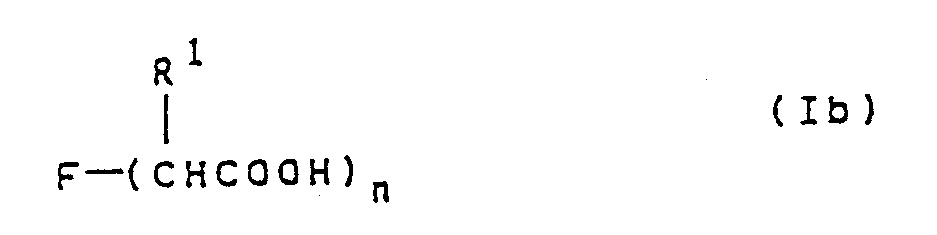

R², R³ et R⁴ possèdent la signification donnée dans la revendication 1. - Modification du procédé selon la revendication 5, caractérisée en ce que, dans le cas où F⊖ ou bien F signifie le chromophore des colorants Leuco Sulphur Black 6, 7 ou 11, l'oxydation à effectuer est, dans les autres cas, l'oxydation à effectuer dans le cas souhaité, est réalisée ainsi après la préparation du composé Ia, l'acide du colorant de formule Ib se dépose dans la solution du composé Ia après établissement d'un pH acide, il est séparé et alors oxydé et ensuite mis en réaction avec un composé quaternaire de formule V ou l'acide du colorant de formule Ib est précipité et ensuite neutralisé avec une amine de formule IX.
- Utilisation des colorants au soufre insolubles dans l'eau de formule I selon une ou plusieurs des revendications 1 à 4 en tant qu'absorbeurs infrarouge, qu'agents de coloration ou agents de dispersion de charge pour toner électrographique, ainsi que pour la préparation d'encres et de liquides d'impression en particulier pour procédé à jet d'encre ou Ink-Jet, ainsi que pour le procédé d'impression Hot-Melt.
- Liquide d'impression, en particulier pour le procédé d'impression à jet d'encre ou Ink-Jet, comprenant un colorant I selon une ou plusieurs des revendications 1 à 4 en solution organique.
- Liquide d'impression selon la revendication 8, caractérisé en ce qu'il contient entre 0,5 et 20% en poids d'un colorant de formule I, de préférence entre 0,5 et 15% en poids.
- Liquide d'impression selon la revendication 8 et/ou 9, caractérisé en ce qu'il contient entre 99,5 et 80% en poids d'un solvant organique ou d'un mélange de solvants, de préférence entre 99,5 et 85% en poids.
Applications Claiming Priority (2)
| Application Number | Priority Date | Filing Date | Title |
|---|---|---|---|
| DE4235147 | 1992-10-19 | ||
| DE4235147A DE4235147A1 (de) | 1992-10-19 | 1992-10-19 | Wasserunlösliche Schwefelfarbstoffe, ihre Herstellung und Verwendung |
Publications (2)
| Publication Number | Publication Date |
|---|---|
| EP0593923A1 EP0593923A1 (fr) | 1994-04-27 |
| EP0593923B1 true EP0593923B1 (fr) | 1995-08-09 |
Family
ID=6470768
Family Applications (1)
| Application Number | Title | Priority Date | Filing Date |
|---|---|---|---|
| EP93115311A Expired - Lifetime EP0593923B1 (fr) | 1992-10-19 | 1993-09-23 | Colorants au soufre insolubles dans l'eau, leur préparation et leur utilisation |
Country Status (6)
| Country | Link |
|---|---|
| US (1) | US5374302A (fr) |
| EP (1) | EP0593923B1 (fr) |
| JP (1) | JPH0711157A (fr) |
| AT (1) | ATE126249T1 (fr) |
| DE (2) | DE4235147A1 (fr) |
| ES (1) | ES2078092T3 (fr) |
Families Citing this family (3)
| Publication number | Priority date | Publication date | Assignee | Title |
|---|---|---|---|---|
| US6248161B1 (en) | 1999-01-11 | 2001-06-19 | Hewlett-Packard Company | Preparation of permanent color inks from water-soluble colorants using specific phosphonium salts |
| GB2433264A (en) * | 2005-12-16 | 2007-06-20 | Sun Chemical Ltd | Process for preparing ammonium, phosphonium & sulphonium salts of anionic dyes from aqueous solution of a salt of dye & non-aqueous solution of an onium salt |
| CN103013177B (zh) * | 2012-12-26 | 2014-06-25 | 山东新家园精细化学品有限公司 | 活性硫化黑染料及其制备方法 |
Family Cites Families (3)
| Publication number | Priority date | Publication date | Assignee | Title |
|---|---|---|---|---|
| JPH01185372A (ja) * | 1988-01-18 | 1989-07-24 | Nippon Kayaku Co Ltd | 水不溶性黒色色素 |
| CH684194A5 (de) * | 1991-01-26 | 1994-07-29 | Sandoz Ag | Pigmente in Form von intermolekularen Salzen von zwitterionischen Farbstoffen. |
| GB9108135D0 (en) * | 1991-04-17 | 1991-06-05 | Sandoz Ltd | Improvements in or relating to organic compounds |
-
1992
- 1992-10-19 DE DE4235147A patent/DE4235147A1/de not_active Withdrawn
-
1993
- 1993-09-23 AT AT93115311T patent/ATE126249T1/de not_active IP Right Cessation
- 1993-09-23 EP EP93115311A patent/EP0593923B1/fr not_active Expired - Lifetime
- 1993-09-23 ES ES93115311T patent/ES2078092T3/es not_active Expired - Lifetime
- 1993-09-23 DE DE59300455T patent/DE59300455D1/de not_active Expired - Fee Related
- 1993-10-06 US US08/132,208 patent/US5374302A/en not_active Expired - Lifetime
- 1993-10-18 JP JP5260112A patent/JPH0711157A/ja active Pending
Also Published As
| Publication number | Publication date |
|---|---|
| EP0593923A1 (fr) | 1994-04-27 |
| US5374302A (en) | 1994-12-20 |
| ES2078092T3 (es) | 1995-12-01 |
| ATE126249T1 (de) | 1995-08-15 |
| JPH0711157A (ja) | 1995-01-13 |
| DE4235147A1 (de) | 1994-04-21 |
| DE59300455D1 (de) | 1995-09-14 |
Similar Documents
| Publication | Publication Date | Title |
|---|---|---|
| EP0592838B1 (fr) | Colorants au soufre solubles dans l'eau, leur préparation et leur utilisation | |
| DE69520387T2 (de) | Verwendung eines Monoazofarbstoffs mit einer Kupplungskomponente aus der Aminonaphtholsulfonsäure-Reihe als Farbstoff in einer Aufzeichnungsflüssigkeit sowie diesen enthaltende Aufzeichnungsflüssigkeit | |
| EP0034725B1 (fr) | Colorants contenant des groupes imidazolyléthylène et leur utilisation | |
| DE3106906A1 (de) | Pigment-zusammensetzungen | |
| DE2500509A1 (de) | Pigmentzubereitung | |
| EP0585659B2 (fr) | Utilisation de préparations liquides de colorants contenant un colorant disazoique pour le procédé par jet d'encre | |
| DE69229917T2 (de) | Aufzeichnungsfluid | |
| EP0363759A2 (fr) | Procédé de fabrication d'une quinacridone éventuellement substituée | |
| EP0212345B1 (fr) | Préparation tinctoriale aqueuse, sa fabrication et son utilisation | |
| EP0593923B1 (fr) | Colorants au soufre insolubles dans l'eau, leur préparation et leur utilisation | |
| EP0579011B1 (fr) | Colorants cationiques de type thiadiazolediphénylamine | |
| EP0014407B1 (fr) | Solutions de colorants, leur préparation et leur utilisation pour la coloration du papier | |
| EP0281920A2 (fr) | Colorants à groupes N-(2-aminométhyle)-pipérazine et leur utilisation | |
| EP0385330B1 (fr) | Mélanges de matières colorantes comprenant des composés azoiques à base de phényloxadiazolylaniline | |
| DE2219169C3 (de) | Chinazolon-Monoazopigmente, deren Herstellung und Verwendung zum Färben von Druckfarben, Lacken, Kunststoffen oder Gummi | |
| DE1959308A1 (de) | Farbstoffsalze der Phthaloxyaninreihe | |
| EP0056578B1 (fr) | Procédé de préparation de solutions de colorants azoiques cationiques | |
| EP0752451A1 (fr) | L'utilisation de composés 4,5-dihydro-1H-1,2,3-triazolium cationiques nouveaux et connus comme colorants et nouveaux composés 4,5-dihydro-1H-1,2,3-triazolium cationiques | |
| EP0597292B1 (fr) | Colorants au soufre insolubles dans l'eau, leur préparation et leur utilisation | |
| DE2030783A1 (de) | Neue Farbstoffe, insbesondere zum Far ben hydrophober Fasern geeignet | |
| DE1079251B (de) | Verfahren zur Herstellung von Dioxazinpigmentfarbstoffen | |
| EP0061623A1 (fr) | Procédé de teinture ou d'impression du papier et colorants de phtalocyanine cationiques | |
| DE19609338A1 (de) | Benzothioxanthen-Farbstoffe, ihre Herstellung und ihre Verwendung | |
| EP0289458B1 (fr) | Colorants anioniques disazoiques | |
| DE3600349A1 (de) | Herstellung von illustrationstiefdruckfarben |
Legal Events
| Date | Code | Title | Description |
|---|---|---|---|
| PUAI | Public reference made under article 153(3) epc to a published international application that has entered the european phase |
Free format text: ORIGINAL CODE: 0009012 |
|
| AK | Designated contracting states |
Kind code of ref document: A1 Designated state(s): AT CH DE ES FR GB IT LI |
|
| 17P | Request for examination filed |
Effective date: 19940325 |
|
| 17Q | First examination report despatched |
Effective date: 19940616 |
|
| GRAA | (expected) grant |
Free format text: ORIGINAL CODE: 0009210 |
|
| AK | Designated contracting states |
Kind code of ref document: B1 Designated state(s): AT CH DE ES FR GB IT LI |
|
| REF | Corresponds to: |
Ref document number: 126249 Country of ref document: AT Date of ref document: 19950815 Kind code of ref document: T |
|
| REF | Corresponds to: |
Ref document number: 59300455 Country of ref document: DE Date of ref document: 19950914 |
|
| ITF | It: translation for a ep patent filed | ||
| GBT | Gb: translation of ep patent filed (gb section 77(6)(a)/1977) |
Effective date: 19951014 |
|
| ITPR | It: changes in ownership of a european patent |
Owner name: CESSIONE EPO;HOECHST AKTIENGESELLSCHAFT |
|
| REG | Reference to a national code |
Ref country code: ES Ref legal event code: FG2A Ref document number: 2078092 Country of ref document: ES Kind code of ref document: T3 |
|
| RAP2 | Party data changed (patent owner data changed or rights of a patent transferred) |
Owner name: HOECHST AKTIENGESELLSCHAFT |
|
| ET | Fr: translation filed | ||
| PLBE | No opposition filed within time limit |
Free format text: ORIGINAL CODE: 0009261 |
|
| 26N | No opposition filed | ||
| REG | Reference to a national code |
Ref country code: CH Ref legal event code: PUE Owner name: CASSELLA AKTIENGESELLSCHAFT TRANSFER- CLARIANT GMB |
|
| REG | Reference to a national code |
Ref country code: FR Ref legal event code: TP |
|
| REG | Reference to a national code |
Ref country code: ES Ref legal event code: PC2A |
|
| REG | Reference to a national code |
Ref country code: GB Ref legal event code: IF02 |
|
| PGFP | Annual fee paid to national office [announced via postgrant information from national office to epo] |
Ref country code: FR Payment date: 20030813 Year of fee payment: 11 |
|
| PGFP | Annual fee paid to national office [announced via postgrant information from national office to epo] |
Ref country code: GB Payment date: 20030814 Year of fee payment: 11 Ref country code: CH Payment date: 20030814 Year of fee payment: 11 |
|
| PGFP | Annual fee paid to national office [announced via postgrant information from national office to epo] |
Ref country code: AT Payment date: 20030818 Year of fee payment: 11 |
|
| PGFP | Annual fee paid to national office [announced via postgrant information from national office to epo] |
Ref country code: ES Payment date: 20030904 Year of fee payment: 11 |
|
| PGFP | Annual fee paid to national office [announced via postgrant information from national office to epo] |
Ref country code: DE Payment date: 20040804 Year of fee payment: 12 |
|
| PG25 | Lapsed in a contracting state [announced via postgrant information from national office to epo] |
Ref country code: GB Free format text: LAPSE BECAUSE OF NON-PAYMENT OF DUE FEES Effective date: 20040923 Ref country code: AT Free format text: LAPSE BECAUSE OF NON-PAYMENT OF DUE FEES Effective date: 20040923 |
|
| PG25 | Lapsed in a contracting state [announced via postgrant information from national office to epo] |
Ref country code: ES Free format text: LAPSE BECAUSE OF NON-PAYMENT OF DUE FEES Effective date: 20040924 |
|
| PG25 | Lapsed in a contracting state [announced via postgrant information from national office to epo] |
Ref country code: LI Free format text: LAPSE BECAUSE OF NON-PAYMENT OF DUE FEES Effective date: 20040930 Ref country code: CH Free format text: LAPSE BECAUSE OF NON-PAYMENT OF DUE FEES Effective date: 20040930 |
|
| GBPC | Gb: european patent ceased through non-payment of renewal fee |
Effective date: 20040923 |
|
| REG | Reference to a national code |
Ref country code: CH Ref legal event code: PL |
|
| PG25 | Lapsed in a contracting state [announced via postgrant information from national office to epo] |
Ref country code: FR Free format text: LAPSE BECAUSE OF NON-PAYMENT OF DUE FEES Effective date: 20050531 |
|
| REG | Reference to a national code |
Ref country code: FR Ref legal event code: ST |
|
| PG25 | Lapsed in a contracting state [announced via postgrant information from national office to epo] |
Ref country code: IT Free format text: LAPSE BECAUSE OF NON-PAYMENT OF DUE FEES;WARNING: LAPSES OF ITALIAN PATENTS WITH EFFECTIVE DATE BEFORE 2007 MAY HAVE OCCURRED AT ANY TIME BEFORE 2007. THE CORRECT EFFECTIVE DATE MAY BE DIFFERENT FROM THE ONE RECORDED. Effective date: 20050923 |
|
| REG | Reference to a national code |
Ref country code: ES Ref legal event code: FD2A Effective date: 20040924 |
|
| PG25 | Lapsed in a contracting state [announced via postgrant information from national office to epo] |
Ref country code: DE Free format text: LAPSE BECAUSE OF NON-PAYMENT OF DUE FEES Effective date: 20060401 |