EP0594061B1 - Appareil pour vérifier un code d'un container - Google Patents
Appareil pour vérifier un code d'un container Download PDFInfo
- Publication number
- EP0594061B1 EP0594061B1 EP93116649A EP93116649A EP0594061B1 EP 0594061 B1 EP0594061 B1 EP 0594061B1 EP 93116649 A EP93116649 A EP 93116649A EP 93116649 A EP93116649 A EP 93116649A EP 0594061 B1 EP0594061 B1 EP 0594061B1
- Authority
- EP
- European Patent Office
- Prior art keywords
- container
- verification apparatus
- code verification
- characters
- character
- Prior art date
- Legal status (The legal status is an assumption and is not a legal conclusion. Google has not performed a legal analysis and makes no representation as to the accuracy of the status listed.)
- Expired - Lifetime
Links
Images





Classifications
-
- G—PHYSICS
- G06—COMPUTING OR CALCULATING; COUNTING
- G06V—IMAGE OR VIDEO RECOGNITION OR UNDERSTANDING
- G06V10/00—Arrangements for image or video recognition or understanding
- G06V10/10—Image acquisition
-
- G—PHYSICS
- G06—COMPUTING OR CALCULATING; COUNTING
- G06V—IMAGE OR VIDEO RECOGNITION OR UNDERSTANDING
- G06V10/00—Arrangements for image or video recognition or understanding
- G06V10/70—Arrangements for image or video recognition or understanding using pattern recognition or machine learning
- G06V10/74—Image or video pattern matching; Proximity measures in feature spaces
- G06V10/75—Organisation of the matching processes, e.g. simultaneous or sequential comparisons of image or video features; Coarse-fine approaches, e.g. multi-scale approaches; using context analysis; Selection of dictionaries
- G06V10/754—Organisation of the matching processes, e.g. simultaneous or sequential comparisons of image or video features; Coarse-fine approaches, e.g. multi-scale approaches; using context analysis; Selection of dictionaries involving a deformation of the sample pattern or of the reference pattern; Elastic matching
-
- G—PHYSICS
- G06—COMPUTING OR CALCULATING; COUNTING
- G06V—IMAGE OR VIDEO RECOGNITION OR UNDERSTANDING
- G06V30/00—Character recognition; Recognising digital ink; Document-oriented image-based pattern recognition
- G06V30/10—Character recognition
- G06V30/19—Recognition using electronic means
- G06V30/192—Recognition using electronic means using simultaneous comparisons or correlations of the image signals with a plurality of references
- G06V30/194—References adjustable by an adaptive method, e.g. learning
Definitions
- the present invention relates to an apparatus for verifying a container code and more specifically for verifying an identification code on a cargo container against a target code.
- Cargo containers each have a unique identification code (ID code) which is painted or applied by other means onto the sides of the container surface.
- ID code must be read and verified against a computer record whenever a container is towed in or out of a container yard in a port. This ensures that the correct truck is towing the correct container, or containers, through a gate of a cargo terminal.
- the code is read and verified manually as the truck passes through the gate. The truck must be stopped at the gate whilst each ID code on each container being towed by the truck is checked. Human inspection of the ID code is slow and prone to oversights and errors.
- Each gate must be manned by at least one operator thus necessitating significant man power.
- One object of the present invention is to provide a container number recognition apparatus which automates the present verification process.
- Another object of the present invention is to provide a container number recognition apparatus which improves the efficiency of the verification process and to require the presence of only one gate operator to man multiple gates at the port.
- the present invention provides a container code verification apparatus as set out in claim 1.
- a cargo container such as a standard ISO container, comprises a rigid metal box container.
- Each container is identified by a unique ID code comprising a string of alphanumeric characters which is usually painted onto at least one surface of the container. Other information is also applied to the container surface, such as gross weight, net weight, country of origin and the like. Thus, the ID code is located amongst other characters containing the other information.
- the containers themselves, due to the environment in which they are used, often become marked, dirty or dented. The presence of corrugations, structural bars, smears and other noise may distort the characters. Thus, the variation in character and background intensity and the inherent lack of adequate contrast pose problems for a reliable method and apparatus for ID code character extraction, recognition and verification.
- the intensity and contrast of the characters and the background varies with respect to the illumination of the container surface in different conditions, such as during daylight, night time and cloud cover.
- the characters of the ID code may be presented to the recognition apparatus at an angle, thus resulting in characters which are skewed as shown in Figures 1a and 1b which also illustrate other characters in addition to the ID code which are present on each container.
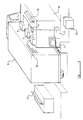
- the apparatus embodying the invention comprises a plurality of cameras 1, 2 and 3, three in this case, a multiplexer 4 which transmits the signals from the cameras 1, 2 and 3 to a transputer network 5 via a BNC connection 6.
- the flow of data from the transputer network 5 is connected to and controlled by a host computer 7 via an AT bus 8.
- the host computer 7 may be, for example a PC-AT 386 microcomputer which is in turn connected by an RS-232 serial link 9 to a gate computer 10 which stores container information obtained from a mainframe computer (not shown).
- the transputer network 5 comprises a monochrome frame grabber 11 ( Figure 20) which acts as a master transputer and controls the flow of execution commands to a number of worker transputers 12,13 AND 14 (in this case three), and a root transputer 15 which is connected to the host PC 7 and allows communication between the host PC 7 and the other transputers.
- the host PC 7 is responsible for file saving, input and output via a keyboard and VDU and for communication with the gate mainframe computer which stores a record of container information obtained from a mainframe computer which can be interrogated by the host PC 7.
- the host PC 7 also displays the results of the verification to the operator.
- the gate mainframe computer sends information about the container 8 expected at the gate, including which container ID code 16 is expected, to the gate PC 10.
- the appropriate camera 1,2 and 3 is chosen to focus on the rear of the container 8 and the frame grabber contrast setting is adjusted to obtain a good level of contrast between the characters on the container 8 and the background.
- a segmentation process locates and extracts a bounding box for each ID character of the ID code 16 from the container image.
- the extracted bounding box is normalised to a standard size and a character pixel map of this information is passed to a network character recogniser which calculates the alphanumeric character most likely to be represented by the character pixel map.
- a proposed ID character code comprising the recognised characters derived from the image information extracted from the container 8 is matched with the expected ID code provided by the gate computer 10 and the two codes are compared.
- the comparison of the two ID codes produces a confidence measure which indicates the degree to which the two ID codes match.
- the operator can then decide to hold back or allow the truck to pass through depending on the confidence measure determined by the matching comparison between the two ID codes. If the confidence measure is over a pre-set threshold then the truck may continue, if not, then the truck is held at the gate.
- the container number recognition system can handle the entire range of container sizes. This includes containers of length 20 ft, 40 ft and 45 ft (6.1m, 12.2m and 13.7m respectively) as well as heights varying from 8 ft to 9.5 ft (2.4m and 2.9m respectively). Also, the length of the chassis on which the container, or containers, are placed can be 20 ft, 40 ft or 45 ft (6.1m, 12.2m and 13.7m respectively). Therefore, the number and location of the cameras is such that the container images captured are of adequate quality to enable the ID code characters to be resolved.
- a rear light 17 is located behind the container 8 facing the gate house 19 to improve the contrast of the image of the container 8, against the background.
- a frontal illumination 18 source is located facing the container 8 to improve the illumination of features on the surface of the container such as the ID code characters 16. If the characters which are to be extracted from the surface of the container are to be resolvable from the background of the container surface then it has been found that there must be an intensity contrast between the background and the subject of at least 15 - 20% of the overall image intensity.
- the closed circuit TV cameras 1,2 and 3 have an auto-iris capability to compensate for small variations in illumination.
- the appropriate camera 1,2 or 3 Upon receipt of a target ID code from the gate computer 10 the appropriate camera 1,2 or 3 is chosen to focus on the rear of the container 8.
- the selected camera 1,2 or 3 triggers the frame grabber 11 which applies an algorithm to adjust the contrast setting of the frame grabber 11 so that the mean grey level for a predetermined image window 20 defined by the camera's field of view is at an optimal value.
- the delta operator ( ⁇ ) indicates the change in contrast or mean grey level respectively between the last iteration and the current one.
- the optimal mean value and the slope have been experimentally determined.
- the camera 1,2 or 3 captures an image which is sent via the multiplexer 4 to the frame grabber 11 where the image is processed further.
- the image consists of an array of 720 x 512 pixels, each pixel being capable of a quantisation level of between 0 and 255.
- the captured image is scanned by the frame grabber one column at a time.
- the grey level of each pixel in each column is quantised and horizontal and vertical segments are created based on the quantised value.
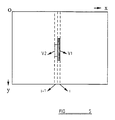
- a horizontal segment (see Figure 4) is defined as a part of a row of the image in a column for which the adjacent pixels (in the horizontal direction) have the same quantised value.
- a vertical segment (see Figure 5) is a part of a column for which adjacent pixels (in the vertical direction) have the same quantised value. Therefore, the image has now been divided into vertical and horizontal segments consisting of a number of pixels which are associated by their respective quantised values and the image can now be scanned segment by segment thus saving both time and memory space.
- the vertical segments are scanned and all segments which are on the right hand boundary of a character are detected. These are defined as right boundary vertical segments (see Figure 4) and each of these segments must satisfy two conditions : there must a corresponding vertical segment (V2) to the left of the vertical segment (V1) of which at least a part must be adjacent to the first segment (V1) and the quantised value of the corresponding vertical segment (V2) must be different from that of the right boundary vertical segment (V1).
- the threshold or extent of each potential character is based on the pixel grey level at the boundary defined by the boundary segments. If the background colour of the image is white, then the threshold is selected as the lowest grey level. If the background colour of the image is black, then the threshold is selected as the highest grey level.
- the threshold is used to determine if the potential character is connected to any other components which may belong to the same character.
- An example of connected horizontal segments is shown in Figure 4 which shows three connected horizontal components h1 to h3. By limiting the character size to a predetermined level, the number of connected components will be reduced.
- Each character is surrounded by a bounding box which defines the spatial extent of a character.
- This process creates a character pixel map comprising horizontal and vertical segments. Features based on the aspect ratio and the histogram of the character pixel map are computed. If the value of the feature defined by the character pixel map is not in an acceptable range which has been defined by heuristic rules, then the feature is eliminated as noise.
- the resultant features or characters which are in the acceptable range are processed further to define specific groupings of characters.
- This process determines the location of all potential characters in the image and finds the surrounding rectangle (bounding box) for each potential character.
- the characters are thus grouped together by proximity and height based on their relative spatial coordinates in order to retain only those characters which should belong to the ID code.
- Figures 1a and 1b show the ID code characters in one group which has been highlighted. The other characters are also grouped together, but not highlighted.
- all the boundary boxes are sorted into horizontal (x) and vertical (y) directions. This allows the characters to be further sorted into groups of horizontal rows.
- the ID code usually occurs in one, two or three horizontal rows. Any single isolated characters are discarded at this stage.
- the polarity of the characters in each group is determined, i.e. whether the characters are white on black or black on white. This information is determined based on the uniformity of the height and width of the characters in the group assuming that there are more uniform characters of one polarity than of another. This information is determined by using a belief or uniformity measure as disclosed in the journal of Mathematical Analysis and Applications 65:531-542, Nguyen HT (1978), "On random sets and belief functions".
- the grouped characters are selected starting from the top-most row of the image. Those groups which have a belief uniformity measure above a predetermined level are chosen. The number of character groups selected is guided by the total number of characters present in the target ID code provided by the mainframe computer as well as the uniformity measure.
- a normalisation step is carried out which firstly converts the pixel maps of each character to a white character on a black background and secondly standardises the size of each character pixel map using scale factors computed in both x and y directions. Usually, this results in a linear compression since the size of the extracted characters is larger than the standard size.
- the normalised grey-scale character pixel map is presented as the input to a neural network.
- the quantised grey level of each pixel is normalised to a value between 0 and 1.
- the grey level value is not binarised to either 0 or 1 as the choice of the binarisation threshold would influence the shape of the character defined by the pixel map. This may result in portions of a character being artificially connected or broken.
- the neural network is used to recognise the patterns defined by the standard size characters. This method is utilised because it offers good tolerance to noise and deformations in the input characters. Specifically a multi-layer feed-forward window-based neural network model is used. The general architecture of the neural network is shown in Figure 6.
- the neural network consists of an input layer, one or more hidden intermediate layers and an output layer. Defined areas or windows of the normalised grey level character pixel map are used as the input for the neural network. In one embodiment, shown in Figure 7, two windows are used which are defined by the upper left and lower right co-ordinates of two rectangles of equivalent size. Together, the two rectangles bound the entire character pixel map. The windows are fed to the input layer of the neural network and each pixel within the boundaries of each window constitutes an input node of the input layer.
- Each node of the network computes the following function:
- f (x) is a monotonic increasing, differentiable function, the output of which is bounded between 0 and 1.
- the input nodes of the input layer are connected to specified ones of the first hidden intermediate nodes of the first hidden intermediate layer.
- input nodes of the first window are connected to a first set of specified intermediate nodes and input nodes of the second window are connected to a second set of specified nodes.
- the input nodes associated with one window are fully connected to specified hidden intermediate nodes in the first layer but not to hidden intermediate nodes in the first layer associated with other windows.
- the two sets of this network architecture is shown in Figure 7(i) together with a conventional network as shown in Figure 7(ii). For subsequent layers after the input layer and the first intermediate layer, the nodes of consecutive layers are fully connected.
- the output layer would consist of 36 nodes each representing a particular character.
- Using a window-based neural network of this type allows windows to be strategically located in the character pixel map to discriminate between confusing characters and improve the accuracy with which the characters are classified. Also, compared to the conventional fully connected network shown in Figure 7(ii), less synaptic connections are required between the input and first intermediate layers thus reducing processing time and memory requirements. Experimental results have shown that the time required to train such a system can be substantially reduced yet the recognition performance is improved slightly.
- the neural network does not attempt to distinguish between "O” and "0” or “I” and “1” because some container companies use identical character fonts for both characters.
- the matching procedure which is to be discussed below can resolve any ambiguity that arises due to this confusion.
- the system is intended to verify the ID code of a particular container and this is finally achieved by a last processing step which compares the character string output from the neural network with the target ID code character string sent from the mainframe computer.
- the two character strings may not be simply compared.
- ID code characters may be discarded as noise resulting in the omission of a character from the recognised character string or, noise such as smears or marks on the container surface may be treated as ID code characters resulting in characters being inserted into the recognised character string.
- the segmentation step may determine a character boundary incorrectly and thereby split a single character into two.
- the neural network may recognise a character incorrectly thus substituting a particular character with an erroneous character. It can clearly be seen that the recognised character string may be potentially erroneous and so a matching step is included to establish the best match between the recognised character string and the target ID code string.
- the top row of characters represents the target ID string and the second row represents the character string achieved after the segmentation step.
- the neural network outputs a range of scores, each of which represents the degree of similarity between the input pixel map and the 36 character output classes of the neural network (i.e. the degree of recognition for each character class). Rows 3 and 4 of Figure 8 show the best and second best scores respectively. For each entry in these rows, the character denotes the recognized code while the number in parenthesis indicates the corresponding score. As shown in the example, the neural network commits two substitution errors since the best score for the letter "U" in the target string is given as "O" (0.7) and the target character of "2" is given by the neural network as "7"(0.6).
- the segmentation step has also introduced two errors, the addition of the character "#" in response, presumably, to some noise and has omitted the character "0" from the target ID code character string.
- the procedure described below has been designed to resolve these ambiguities in both the recognition and segmentation steps by converting the problem of verifying the target ID code character string into a two dimensional path searching problem, as shown in Figure 9 which indicates the matching path found for the example of Figure 8, the goal of which is to find the optimal matching path.
- the optimal path is found by a technique known as Dynamic Time Warping as discussed in Itakura F. (1975) "Minimum prediction residual principle applied to speech recognition", IEEE Transactions on Acoustics, Speech and Signal Processing 23:67-72 and in Satoe H, Chiba S (1978) "Dynamic programming algorithm optimisation for spoken word recognition", IEEE Transactions on Acoustics Speech and Signal Processing 26:43-49.
- local continuity constraints as shown in Figure 10 are defined to restrict the search area. The constraints specify that to reach point ( i, j ), five local paths are possible (paths 1-5). Under normal circumstances i.e. no insertion or deletion of characters at this point, path 3 should be taken.
- path 2 the algorithm suggests that the ( i - 1 ) th character in the recognition string is an insertion error.
- path 4 it indicates that there is an omission between the ( i - 1 ) th and i th position.
- Path 1 and path 5 are included to take care of boundary conditions. Path 1 caters for extraneous characters positioned before or after the target ID string whereas path 5 is needed for cases where the first or last few ID characters are missing. Thus paths 1 and 5 are invoked only near the beginning or the end of the search area.
- D i,j is maximised. This score can be recursively computed as follows: where S is the neural network response for the target character j, p is the penalty for an insertion error and q for an omission error. The penalties are set to 0.2 in this embodiment.
- Step 3 the optimal matching pairs between the target and the recognition string are determined.
- the result could be directly reported to the operator.
- it is better to aggregate all the types of errors into a single performance index. This is achieved by defining a confidence measure as discussed below.
- the confidence measure must be able to reflect the actual accuracy of the entire system without penalising for insignificant mistakes. For example, insertion errors are not serious mistakes though they should be avoided as far as possible.
- characters having the second or third highest scores may correspond. Further, the difference between this score and the highest score may be small. To take care of such situations, a penalty is introduced which depends on the extent to which the character has been mis-recognized.
- the final result of the entire process is the CM score. Its value lies between 0 and 1.
- the operator can therefore set a specific confidence measure threshold so that the container ID code verification is deemed successful if the CM score is higher than the threshold. Otherwise, the operator is notified and can investigate the matter.
- the processes described above have been implemented on a five transputer network which is hosted on a PC-AT microcomputer.
- the code was written in Parallel C Ver. 2.1.1. using the 3L Compiler.
- the character extraction and recognition processes were parallelised while the normalization and matching procedures were handled by the master transputer.
- the entire image is divided into five equal vertical strips.
- Each processor is allocated one image strip.
- Four of the vertical strips overlap in the x direction by an amount equal to the maximum allowable width of a character minus 1. This is to ensure that every character is extracted in full by a transputer.
- the master transputer distributes the image strips to the root and the three workers.
- the master proceeds with the grouping phase of the character extraction.
- the recognition process takes place in parallel by distributing the character maps one by one to the worker processors.
- the master transputer controls and coordinates the sending of pixel maps and receiving of recognition results.
- DS1 for training and DS2 for testing.
- DS1 consists of 221 images and 2231 alphanumeric characters, while DS2 has 2167 characters in the remaining 220 images. There are roughly twice as many numeral characters as alphabetic characters in both sets.
- the estimated verification time for each container image is approximately 13.5 seconds. This includes the time elapsed from when the container information is received from the Gate PC till the recognition results and confidence measure are sent back to the Gate PC.
- Figures 1 (a) and (b) show examples of container codes extracted by the above described method. The extracted characters and their circumscribing rectangles are shown after the thresholding process.
- Modifications are envisaged to improve the robustness of the character extraction process and increase its accuracy when the container image is noisy.
- Various approaches are being considered to recover characters with poor contrast, merged characters and partially obliterated characters.
Landscapes
- Engineering & Computer Science (AREA)
- Theoretical Computer Science (AREA)
- Computer Vision & Pattern Recognition (AREA)
- Multimedia (AREA)
- General Physics & Mathematics (AREA)
- Physics & Mathematics (AREA)
- Databases & Information Systems (AREA)
- Evolutionary Computation (AREA)
- Medical Informatics (AREA)
- Software Systems (AREA)
- General Health & Medical Sciences (AREA)
- Computing Systems (AREA)
- Artificial Intelligence (AREA)
- Health & Medical Sciences (AREA)
- Character Discrimination (AREA)
Claims (21)
- Un appareil de vérification de code de conteneur comprenant : des moyens de capture d'image (1, 2, 3) pour capturer une image d'une surface de conteneur (8) supportant un code affiché (16) ; des moyens de traitement de données (5) pour former un réseau de pixels provenant de l'image capturée ; un moyen d'analyse pour analyser le réseau de pixels ; un moyen de détection pour détecter des caractères potentiels ; un moyen de sélection et de groupement pour sélectionner et grouper ensemble des caractères potentiels des codes affichés ; et un réseau de neurones pour déterminer à partir de valeurs de pixel de caractères potentiels un ensemble de caractères reconnus constituant un code reconnu, le réseau de pixels étant divisé en une pluralité de fenêtres, le réseau de neurones comprenant une pluralité de noeuds d'entrée définissant une couche d'entrée et au moins un noeud de sortie définissant une couche de sortie, une ou plusieurs couches intermédiaires étant disposées entre la couche d'entrée et la couche de sortie, dans lequel réseau de neurones la couche d'entrée est divisée en plusieurs zones discrètes correspondant chacune à une fenêtre respective ; la valeur de chaque pixel dans une fenêtre représente le signal d'entrée pour un noeud d'entrée correspondant dans une zone de la couche d'entrée correspondant à la fenêtre respective ; chaque noeud dans le réseau calcule un signal de sortie selon une fonction prédéterminée ; les sorties des noeuds dans chaque zone de la couche d'entrée sont connectées à des noeuds spécifiques dans une première couche intermédiaire qui ne sont pas connectés aux sorties des noeuds dans une autre zone de la couche d'entrée ; les sorties des noeuds dans la première couche et les couches intermédiaires ultérieures étant reliées à des entrées des noeuds dans la couche immédiatement suivante ; et les noeuds de sortie de la dernière couche intermédiaire sont connectés aux entrées du noeud ou des noeuds de sortie de la couche de sortie, l'appareil de vérification de code de conteneur comprenant en outre : un moyen de comparaison pour comparer le code cible avec le code reconnu ; et un moyen de vérification pour vérifier ou rejeter le code reconnu selon les résultats de la comparaison entre le code cible et le code reconnu.
- Un appareil de vérification de code de conteneur selon la Revendication 1, dans lequel chaque noeud dans le réseau de neurones calcule la fonction :où

- yi =
- valeur d'excitation de sortie du noeud i
- xi =
- jème entrée de signal du noeud i
- wi,j =
- coefficient pondéral de connexion du noeud j vers le noeud i
- i =
- polarisation
- Un appareil de vérification de code de conteneur selon la Revendication 1 ou 2, dans lequel le réseau de neurones fonctionne en utilisant la fonction :
- Un appareil de vérification de code de conteneur selon l'une quelconque des Revendications 1 à 3, dans lequel le réseau de neurones est en apprentissage en utilisant la fonction :
- Un appareil de vérification de code de conteneur selon une quelconque revendication précédente dans lequel le réseau de neurones est inclus dans un réseau transcalculateur (5).
- Un appareil de vérification de code de conteneur selon une quelconque revendication précédente dans lequel la couche de sortie du réseau de neurones fournit un ensemble de scores indiquant le degré de reconnaissance entre le caractère défini par le réseau de pixels et les classes de caractère reconnaissables par le réseau de neurones.
- Un appareil de vérification de code de conteneur selon une quelconque revendication précédente dans lequel des moyens sont prévus pour entourer le caractère potentiel détecté avec un bloc de limitation.
- Un appareil de vérification de code de conteneur selon la Revendication 7, dans lequel chaque bloc de limitation est divisé en une pluralité de fenêtres et la valeur de quantification des pixels contenue dans chaque fenêtre comprend les valeurs d'entrée pour une zone discrète correspondante définie dans la couche d'entrée du réseau de neurones.
- Un appareil de vérification de code de conteneur selon une quelconque revendication précédente dans lequel des moyens sont prévus pour détecter des caractères potentiels en identifiant des segments horizontaux (h1...n) comprenant des pixels adjacents horizontalement avec des niveaux de quantification sensiblement équivalents et des segments verticaux (v1...n) comprenant des pixels adjacents verticalement avec des niveaux de quantification sensiblement équivalents et des segments horizontaux et verticaux (h1...n, v1...n) qui sont connectés ensemble, définissant un caractère potentiel.
- Un appareil de vérification de code de conteneur selon une quelconque revendication précédente dans lequel la surface du conteneur supporte des caractères potentiels qui sont spatiallement situés horizontalement adjacents les uns aux autres et les moyens de groupement groupent de tels caractères adjacents horizontalement ensemble.
- Un appareil de vérification de code de conteneur selon la Revendication 10, dans lequel les moyens de sélection sélectionnent seulement les caractères potentiels groupés horizontalement.
- Un appareil de vérification de code de conteneur selon une quelconque revendication précédente dans lequel les moyens de sélection ne sélectionnent pas de quelconques caractères potentiels isolés individuels.
- Un appareil de vérification de code de conteneur selon une quelconque revendication précédente dans lequel des moyens sont prévus pour déterminer la polarité de l'avant-plan et de l'arrière-plan de chaque caractère potentiel et pour convertir la polarité en une polarité normalisée.
- Un appareil de vérification de code de conteneur selon une quelconque revendication précédente dans lequel des moyens sont prévus pour tracer les caractères potentiels à une taille normalisée.
- Un appareil de vérification de code de conteneur selon une quelconque revendication précédente dans lequel des moyens sont prévus pour normaliser le niveau de quantification de chaque pixel à une valeur entre 0 et 1.
- Un appareil de vérification de code de conteneur selon une quelconque revendication précédente dans lequel des moyens sont prévus pour comparer le code reconnu et le code cible en obtenant une mesure de confiance représentant le degré de concordance entre les deux codes et en comparant la mesure de confiance avec un seuil prédéterminé.
- Un appareil de vérification de code de conteneur selon une quelconque revendication précédente comprenant en outre des moyens pour positionner le conteneur (8) supportant le code affiché (16) de manière adjacente au moyen de capteur (1, 2, 3) pour capter l'image de la surface de conteneur.
- Un appareil de vérification de code de conteneur selon une quelconque revendication précédente dans lequel de la lumière artificielle est prévue pour illuminer le conteneur pour augmenter le contraste de l'image.
- Un appareil de vérification de code de conteneur selon une quelconque revendication précédente dans lequel l'image est capturée par au moins une caméra TV à circuit fermé (1, 2, 3) connectée à un enregistreur d'images (11).
- Un appareil de vérification de code de conteneur selon la Revendication 19, dans lequel l'enregistreur d'images a un paramètre de contraste qui est déterminé par la méthode itérative de Newton.
- Un appareil de vérification de code de conteneur selon une quelconque revendication précédente dans lequel un ordinateur répartiteur éloigné fournit le code cible.
Applications Claiming Priority (2)
| Application Number | Priority Date | Filing Date | Title |
|---|---|---|---|
| GB9222322 | 1992-10-23 | ||
| GB9222322A GB2273191B (en) | 1992-10-23 | 1992-10-23 | A container code verification apparatus |
Publications (3)
| Publication Number | Publication Date |
|---|---|
| EP0594061A2 EP0594061A2 (fr) | 1994-04-27 |
| EP0594061A3 EP0594061A3 (fr) | 1995-03-15 |
| EP0594061B1 true EP0594061B1 (fr) | 1999-01-07 |
Family
ID=10723966
Family Applications (1)
| Application Number | Title | Priority Date | Filing Date |
|---|---|---|---|
| EP93116649A Expired - Lifetime EP0594061B1 (fr) | 1992-10-23 | 1993-10-14 | Appareil pour vérifier un code d'un container |
Country Status (6)
| Country | Link |
|---|---|
| EP (1) | EP0594061B1 (fr) |
| JP (1) | JPH0756882A (fr) |
| CA (1) | CA2109002C (fr) |
| DE (1) | DE69322923T2 (fr) |
| GB (1) | GB2273191B (fr) |
| WO (1) | WO1994010654A1 (fr) |
Cited By (1)
| Publication number | Priority date | Publication date | Assignee | Title |
|---|---|---|---|---|
| CN101652298B (zh) * | 2007-02-07 | 2011-07-20 | Nsl工程私人有限公司 | 扭锁操作的方法和设备 |
Families Citing this family (11)
| Publication number | Priority date | Publication date | Assignee | Title |
|---|---|---|---|---|
| JPH09297813A (ja) * | 1996-04-30 | 1997-11-18 | Mitsubishi Heavy Ind Ltd | コンテナ番号認識装置 |
| JP4746740B2 (ja) * | 2000-12-12 | 2011-08-10 | 株式会社サキコーポレーション | 外観検査方法および外観検査装置 |
| US7089131B2 (en) * | 2002-03-22 | 2006-08-08 | Lear Corporation | Inspection and verification system and method |
| DE10224313A1 (de) * | 2002-05-31 | 2003-12-11 | Siemens Ag | Vorrichtung zur Verifizierung von Containernummern beim Ent- und Beladen von Schiffen mit Containerkranen in Containerterminals |
| US7231065B2 (en) * | 2004-03-15 | 2007-06-12 | Embarcadero Systems Corporation | Method and apparatus for controlling cameras and performing optical character recognition of container code and chassis code |
| WO2006033645A1 (fr) * | 2004-09-24 | 2006-03-30 | Tagit Pte Ltd | Procede pour saisir une image en utilisant un appareil et obtenir des informations concernant l’image, l’image contenant une etiquette |
| JP4625962B2 (ja) * | 2005-01-24 | 2011-02-02 | 国立大学法人横浜国立大学 | カテゴリカル色知覚システム |
| EP2196953B1 (fr) * | 2008-12-12 | 2020-04-08 | Siemens Aktiengesellschaft | Procédé, programme de commande et système destinés à l'identification d'un conteneur dans une installation de grue pour conteneurs |
| JP6552012B2 (ja) * | 2017-03-03 | 2019-07-31 | Necプラットフォームズ株式会社 | コンテナ番号読取り装置、コンテナ番号読取り方法およびコンテナ番号読取りプログラム |
| DE102020213282A1 (de) | 2020-10-21 | 2022-04-14 | Zf Friedrichshafen Ag | Kamerabasierte Inventarisierung von Frachtkontainern |
| JP7426616B1 (ja) * | 2023-01-27 | 2024-02-02 | パナソニックIpマネジメント株式会社 | 進行方向推定装置および進行方向推定方法 |
Family Cites Families (8)
| Publication number | Priority date | Publication date | Assignee | Title |
|---|---|---|---|---|
| GB906166A (en) * | 1960-06-17 | 1962-09-19 | Metal Box Co Ltd | Improvements in or relating to the manufacture of containers |
| CH425296A (de) * | 1963-06-24 | 1966-11-30 | Upjohn Co | Verfahren und Vorrichtung zur Verhütung von Falschetikettierungen |
| GB1425024A (en) * | 1972-05-12 | 1976-02-18 | Hird Brown Ltd | Apparatus for recognition of instruction codes |
| US4835680A (en) * | 1985-03-15 | 1989-05-30 | Xerox Corporation | Adaptive processor array capable of learning variable associations useful in recognizing classes of inputs |
| US4914708A (en) * | 1987-06-19 | 1990-04-03 | Boston University | System for self-organization of stable category recognition codes for analog input patterns |
| US4933872A (en) * | 1988-11-15 | 1990-06-12 | Eastman Kodak Company | Method and system for wavefront reconstruction |
| IT1233215B (it) * | 1989-04-21 | 1992-03-20 | Ist Trentino Di Cultura | Rete elaborativa a nodi, procedimento e macchine per la configurazionedella stessa e relativi impieghi |
| US5204914A (en) * | 1991-08-30 | 1993-04-20 | Eastman Kodak Company | Character recognition method using optimally weighted correlation |
-
1992
- 1992-10-23 GB GB9222322A patent/GB2273191B/en not_active Expired - Fee Related
-
1993
- 1993-10-14 EP EP93116649A patent/EP0594061B1/fr not_active Expired - Lifetime
- 1993-10-14 DE DE69322923T patent/DE69322923T2/de not_active Expired - Fee Related
- 1993-10-22 CA CA002109002A patent/CA2109002C/fr not_active Expired - Fee Related
- 1993-10-22 WO PCT/US1993/010218 patent/WO1994010654A1/fr not_active Ceased
- 1993-10-25 JP JP5287227A patent/JPH0756882A/ja active Pending
Cited By (1)
| Publication number | Priority date | Publication date | Assignee | Title |
|---|---|---|---|---|
| CN101652298B (zh) * | 2007-02-07 | 2011-07-20 | Nsl工程私人有限公司 | 扭锁操作的方法和设备 |
Also Published As
| Publication number | Publication date |
|---|---|
| JPH0756882A (ja) | 1995-03-03 |
| DE69322923T2 (de) | 1999-06-24 |
| CA2109002A1 (fr) | 1994-04-24 |
| WO1994010654A1 (fr) | 1994-05-11 |
| EP0594061A3 (fr) | 1995-03-15 |
| DE69322923D1 (de) | 1999-02-18 |
| EP0594061A2 (fr) | 1994-04-27 |
| GB2273191A (en) | 1994-06-08 |
| GB9222322D0 (en) | 1992-12-09 |
| GB2273191B (en) | 1996-01-03 |
| CA2109002C (fr) | 2001-09-04 |
Similar Documents
| Publication | Publication Date | Title |
|---|---|---|
| US6339651B1 (en) | Robust identification code recognition system | |
| US5889885A (en) | Method and apparatus for separating foreground from background in images containing text | |
| US6118890A (en) | System and method for broad classification of biometric patterns | |
| EP0621552B1 (fr) | Méthode et appareil pour la détermination automatique d'écritures | |
| US5915039A (en) | Method and means for extracting fixed-pitch characters on noisy images with complex background prior to character recognition | |
| EP0594061B1 (fr) | Appareil pour vérifier un code d'un container | |
| US20050201592A1 (en) | Method and apparatus for controlling cameras and performing optical character recognition of container code and chassis code | |
| CN111325769A (zh) | 一种目标对象检测方法及装置 | |
| US20040086153A1 (en) | Methods and systems for recognizing road signs in a digital image | |
| US6246793B1 (en) | Method and apparatus for transforming an image for classification or pattern recognition | |
| WO1994010654A9 (fr) | Procede et appareil de verification du code d'un conteneur | |
| CN118279923B (zh) | 基于深度学习训练的图片文字识别方法、系统及存储介质 | |
| US5105470A (en) | Method and system for recognizing characters | |
| CN111950546B (zh) | 一种车牌识别方法、装置、计算机设备和存储介质 | |
| CN116543407A (zh) | 票据识别方法、装置、设备及存储介质 | |
| US6694059B1 (en) | Robustness enhancement and evaluation of image information extraction | |
| CN120126146B (zh) | 一种基于深度学习的智能阅卷内容检测与识别方法及系统 | |
| CN111402185A (zh) | 一种图像检测方法及装置 | |
| CN117894033B (zh) | 一种基于ocr识别的答卷一致性校验方法及系统 | |
| KR102161315B1 (ko) | 컨테이너 식별코드 모니터링 시스템 및 그 방법 | |
| CA2036274A1 (fr) | Processeur a documents utilisant une methode et un dispositif de detection et de correction des erreurs | |
| CN118097647A (zh) | 一种车牌号码的遮挡检测方法及系统 | |
| JP2003016386A (ja) | 文字認識方法および装置 | |
| KR102079123B1 (ko) | 화물 차량 번호 인식 방법 | |
| US20250156881A1 (en) | Merchant authenticity verification system and method based on street view image recognition |
Legal Events
| Date | Code | Title | Description |
|---|---|---|---|
| PUAI | Public reference made under article 153(3) epc to a published international application that has entered the european phase |
Free format text: ORIGINAL CODE: 0009012 |
|
| AK | Designated contracting states |
Kind code of ref document: A2 Designated state(s): BE DE FR IT NL |
|
| PUAL | Search report despatched |
Free format text: ORIGINAL CODE: 0009013 |
|
| AK | Designated contracting states |
Kind code of ref document: A3 Designated state(s): BE DE FR IT NL |
|
| 17P | Request for examination filed |
Effective date: 19950907 |
|
| 17Q | First examination report despatched |
Effective date: 19971010 |
|
| GRAG | Despatch of communication of intention to grant |
Free format text: ORIGINAL CODE: EPIDOS AGRA |
|
| RAP1 | Party data changed (applicant data changed or rights of an application transferred) |
Owner name: PSA CORPORATION |
|
| GRAG | Despatch of communication of intention to grant |
Free format text: ORIGINAL CODE: EPIDOS AGRA |
|
| GRAH | Despatch of communication of intention to grant a patent |
Free format text: ORIGINAL CODE: EPIDOS IGRA |
|
| GRAH | Despatch of communication of intention to grant a patent |
Free format text: ORIGINAL CODE: EPIDOS IGRA |
|
| GRAA | (expected) grant |
Free format text: ORIGINAL CODE: 0009210 |
|
| RAP1 | Party data changed (applicant data changed or rights of an application transferred) |
Owner name: PSA CORPORATION LIMITED |
|
| AK | Designated contracting states |
Kind code of ref document: B1 Designated state(s): BE DE FR IT NL |
|
| ITF | It: translation for a ep patent filed | ||
| REF | Corresponds to: |
Ref document number: 69322923 Country of ref document: DE Date of ref document: 19990218 |
|
| ET | Fr: translation filed | ||
| PLBE | No opposition filed within time limit |
Free format text: ORIGINAL CODE: 0009261 |
|
| STAA | Information on the status of an ep patent application or granted ep patent |
Free format text: STATUS: NO OPPOSITION FILED WITHIN TIME LIMIT |
|
| 26N | No opposition filed | ||
| PGFP | Annual fee paid to national office [announced via postgrant information from national office to epo] |
Ref country code: NL Payment date: 20051003 Year of fee payment: 13 |
|
| PGFP | Annual fee paid to national office [announced via postgrant information from national office to epo] |
Ref country code: DE Payment date: 20051006 Year of fee payment: 13 |
|
| PGFP | Annual fee paid to national office [announced via postgrant information from national office to epo] |
Ref country code: FR Payment date: 20051010 Year of fee payment: 13 |
|
| PGFP | Annual fee paid to national office [announced via postgrant information from national office to epo] |
Ref country code: BE Payment date: 20051220 Year of fee payment: 13 |
|
| PGFP | Annual fee paid to national office [announced via postgrant information from national office to epo] |
Ref country code: IT Payment date: 20061031 Year of fee payment: 14 |
|
| PG25 | Lapsed in a contracting state [announced via postgrant information from national office to epo] |
Ref country code: NL Free format text: LAPSE BECAUSE OF NON-PAYMENT OF DUE FEES Effective date: 20070501 Ref country code: DE Free format text: LAPSE BECAUSE OF NON-PAYMENT OF DUE FEES Effective date: 20070501 |
|
| NLV4 | Nl: lapsed or anulled due to non-payment of the annual fee |
Effective date: 20070501 |
|
| REG | Reference to a national code |
Ref country code: FR Ref legal event code: ST Effective date: 20070629 |
|
| BERE | Be: lapsed |
Owner name: *PSA CORP. LTD Effective date: 20061031 |
|
| PG25 | Lapsed in a contracting state [announced via postgrant information from national office to epo] |
Ref country code: FR Free format text: LAPSE BECAUSE OF NON-PAYMENT OF DUE FEES Effective date: 20061031 |
|
| PG25 | Lapsed in a contracting state [announced via postgrant information from national office to epo] |
Ref country code: IT Free format text: LAPSE BECAUSE OF NON-PAYMENT OF DUE FEES Effective date: 20071014 Ref country code: BE Free format text: LAPSE BECAUSE OF FAILURE TO SUBMIT A TRANSLATION OF THE DESCRIPTION OR TO PAY THE FEE WITHIN THE PRESCRIBED TIME-LIMIT Effective date: 20061031 |