EP0594556A1 - Dispositif d'entraînement pour arbre d'entraînement située dans la traverse supérieure des stores vénitiens - Google Patents
Dispositif d'entraînement pour arbre d'entraînement située dans la traverse supérieure des stores vénitiens Download PDFInfo
- Publication number
- EP0594556A1 EP0594556A1 EP93890204A EP93890204A EP0594556A1 EP 0594556 A1 EP0594556 A1 EP 0594556A1 EP 93890204 A EP93890204 A EP 93890204A EP 93890204 A EP93890204 A EP 93890204A EP 0594556 A1 EP0594556 A1 EP 0594556A1
- Authority
- EP
- European Patent Office
- Prior art keywords
- head rail
- insert
- drive according
- section
- drive
- Prior art date
- Legal status (The legal status is an assumption and is not a legal conclusion. Google has not performed a legal analysis and makes no representation as to the accuracy of the status listed.)
- Granted
Links
Images


Classifications
-
- E—FIXED CONSTRUCTIONS
- E06—DOORS, WINDOWS, SHUTTERS, OR ROLLER BLINDS IN GENERAL; LADDERS
- E06B—FIXED OR MOVABLE CLOSURES FOR OPENINGS IN BUILDINGS, VEHICLES, FENCES OR LIKE ENCLOSURES IN GENERAL, e.g. DOORS, WINDOWS, BLINDS, GATES
- E06B9/00—Screening or protective devices for wall or similar openings, with or without operating or securing mechanisms; Closures of similar construction
- E06B9/24—Screens or other constructions affording protection against light, especially against sunshine; Similar screens for privacy or appearance; Slat blinds
- E06B9/26—Lamellar or like blinds, e.g. venetian blinds
- E06B9/36—Lamellar or like blinds, e.g. venetian blinds with vertical lamellae ; Supporting rails therefor
- E06B9/361—Transmissions located at the end of the supporting rail
-
- E—FIXED CONSTRUCTIONS
- E06—DOORS, WINDOWS, SHUTTERS, OR ROLLER BLINDS IN GENERAL; LADDERS
- E06B—FIXED OR MOVABLE CLOSURES FOR OPENINGS IN BUILDINGS, VEHICLES, FENCES OR LIKE ENCLOSURES IN GENERAL, e.g. DOORS, WINDOWS, BLINDS, GATES
- E06B9/00—Screening or protective devices for wall or similar openings, with or without operating or securing mechanisms; Closures of similar construction
- E06B9/24—Screens or other constructions affording protection against light, especially against sunshine; Similar screens for privacy or appearance; Slat blinds
- E06B9/26—Lamellar or like blinds, e.g. venetian blinds
- E06B9/28—Lamellar or like blinds, e.g. venetian blinds with horizontal lamellae, e.g. non-liftable
- E06B9/30—Lamellar or like blinds, e.g. venetian blinds with horizontal lamellae, e.g. non-liftable liftable
- E06B9/32—Operating, guiding, or securing devices therefor
- E06B9/322—Details of operating devices, e.g. pulleys, brakes, spring drums, drives
-
- E—FIXED CONSTRUCTIONS
- E06—DOORS, WINDOWS, SHUTTERS, OR ROLLER BLINDS IN GENERAL; LADDERS
- E06B—FIXED OR MOVABLE CLOSURES FOR OPENINGS IN BUILDINGS, VEHICLES, FENCES OR LIKE ENCLOSURES IN GENERAL, e.g. DOORS, WINDOWS, BLINDS, GATES
- E06B9/00—Screening or protective devices for wall or similar openings, with or without operating or securing mechanisms; Closures of similar construction
- E06B9/24—Screens or other constructions affording protection against light, especially against sunshine; Similar screens for privacy or appearance; Slat blinds
- E06B9/26—Lamellar or like blinds, e.g. venetian blinds
- E06B9/28—Lamellar or like blinds, e.g. venetian blinds with horizontal lamellae, e.g. non-liftable
- E06B9/30—Lamellar or like blinds, e.g. venetian blinds with horizontal lamellae, e.g. non-liftable liftable
- E06B9/32—Operating, guiding, or securing devices therefor
- E06B9/323—Structure or support of upper box
-
- E—FIXED CONSTRUCTIONS
- E06—DOORS, WINDOWS, SHUTTERS, OR ROLLER BLINDS IN GENERAL; LADDERS
- E06B—FIXED OR MOVABLE CLOSURES FOR OPENINGS IN BUILDINGS, VEHICLES, FENCES OR LIKE ENCLOSURES IN GENERAL, e.g. DOORS, WINDOWS, BLINDS, GATES
- E06B9/00—Screening or protective devices for wall or similar openings, with or without operating or securing mechanisms; Closures of similar construction
- E06B9/24—Screens or other constructions affording protection against light, especially against sunshine; Similar screens for privacy or appearance; Slat blinds
- E06B9/26—Lamellar or like blinds, e.g. venetian blinds
- E06B9/28—Lamellar or like blinds, e.g. venetian blinds with horizontal lamellae, e.g. non-liftable
- E06B9/30—Lamellar or like blinds, e.g. venetian blinds with horizontal lamellae, e.g. non-liftable liftable
- E06B9/32—Operating, guiding, or securing devices therefor
- E06B9/324—Cord-locks
Definitions
- the invention relates to a drive for a drive shaft mounted in a head rail of an interior blind fastened to a wing and which is connected in a rotationally fixed manner to a drive wheel which is at least partially wrapped by a traction element, for example a chain, in particular a ball chain or a pull cord, which traction element is guided in at least one guide channel arranged in a housing.
- a traction element for example a chain, in particular a ball chain or a pull cord, which traction element is guided in at least one guide channel arranged in a housing.
- the interior blind attached to the inside of a window or door wing can hiebei slats or a pleated, so a leporello-like folded fabric, the slats or the pleated by cords or the like. are penetrated, which are wound up when the blind is raised by turning the drive shaft.
- louvre blinds with so-called single-organ operation, it is also known to bring about an inclined position or a parallel position of the
- the drive shaft In order to rotate the drive shaft, it is generally connected to a bevel gear transmission which is likewise arranged within the head profile and which can be actuated by means of an endless train or a crank.
- a bevel gear transmission which is likewise arranged within the head profile and which can be actuated by means of an endless train or a crank.
- such constructions are complex and require a relatively large amount of space.
- the drive shaft In the case of interior blinds attached to the inside of a window or door leaf below the glazing bead using the depth of the same, the drive shaft is guided out of the laterally open head rail by means of a flexible shaft and deflected into fittings which are mounted on a side rail of the window or door leaf and protrude there , so that they often collide with the wall reveal when opening the wing.
- a drive pin arranged perpendicular to the wing plane penetrates one leg of the head rail, the drive being effected by an endless pull, which is guided downward in the area of the glass pane and thereby has a disruptive effect, in particular when the blind is raised.
- the object of the present invention is to improve a drive for the drive shaft of an interior blind, that is to say a blind arranged on the inside of a window or door leaf, in such a way that a space-saving and shapely attachment is provided with simultaneous simple structural training.
- the invention proposes that the housing having the guide channels is formed by an insert inserted at the end into the head rail, which consists of a section received by the head rail and of a section which projects laterally from the head rail and which has outlet openings for the tension member having.
- the drive wheel In the section accommodated by the head rail, the drive wheel is mounted, which has a recess in the center for receiving the end of the drive shaft, so that a rotationally fixed connection of the drive wheel to the drive shaft is achieved only by inserting the insert part into the head rail.
- the guide channels By appropriate design of the guide channels, a deflection of the traction element from the plane of the drive wheel, which is perpendicular to the winding shaft, into a plane parallel to the plane of the wing, without using interlocking bevel gears or similar gear elements, thereby causing the outlet openings for the traction element in the out the head rail laterally protruding portion of the insert are provided, the tension member does not fall down in the area of the glass pane.
- the section of the insert protruding laterally from the head rail has only the guide channels for the traction element, but not the drive wheel or gear elements, it is also possible to keep the thickness of this section protruding from the head rail, measured perpendicular to the wing plane, considerably less than the thickness of the section taken up by the head rail, which on the one hand gives the advantage that the head rail can be arranged in a desired manner beneath the glazing bead, taking advantage of the depth of the latter, in relation to the surface of the side rails of the wing, and on the other hand the section on these side rails which protrudes from the head rail the insert does not protrude from these side rails and therefore does not collide with the wall reveal when opening the wing.
- the drive wheel is expediently not mounted directly in the insert, but rather the section of the insert received by the head rail is displaceably and preferably detachably connected to a bearing part for the drive wheel. Tolerances can be compensated for by a relative displacement between the insert and the bearing part, so that it is not necessary to adjust the length of the head rail exactly to the distance between the two vertical wing spars or the glass strips attached to these vertical wing spars.
- the detachable connection facilitates assembly, especially with regard to the arrangement of the traction element.
- the bearing part is also provided with guide channels for the tension member, which open into the guide channels of the insert. This ensures exact guidance of the traction element.
- the guide channels in the insert and / or in the bearing part have deflection sections for the deflection of the pulling element.
- the insert and the bearing part can be connected to one another via a tongue inserted into a recess, which is preferably designed to be resilient.
- the insertion of the traction element into the guide channels can be made considerably easier in that, according to the invention, at least the guide channels of the section of the insert piece projecting laterally from the head rail are formed by grooves which can be closed by a cover, preferably pivotably connected to this section and fixable to this section .
- the pulling element or the rotation of the drive shaft caused by the pulling element causes the blind to be lowered or pulled up and the blind slats to be tilted and the pulling element is not fixed by the operator, an undesired movement is necessary to prevent the tension member.
- Such an undesired movement of the pulling element can take place on the one hand through the dead weight of the blind, in which case the raised blind slides down, on the other hand through the dead weight of the pulling element, for example causing the slats to pivot.
- at least one braking device for the traction element is provided in the guide channel according to a further feature of the invention.
- a ball chain as a traction element
- the same can be fixed in that a projection protruding into the guide channel is provided which hooks into the ball chain when the ball weight is exerted when the ball chain is exerted. This prevents the raised blind from falling down in an undesirable manner due to its own weight if the operator does not fix it after being pulled up.
- the arrangement is such that the ball chain is pulled into a position by the dead weight of the blind in which the projection engages between two balls.
- a friction brake can be provided in the guide channel, which is preferably formed by a resilient section of a wall of the guide channel, which section has a braking effect on the tension member.
- the section of the insert protruding from the head rail is expediently covered by a cover cap which, on the one hand, ensures an elegant appearance, on the other hand enables adaptation to different types of sash and glazing bead profiles and covers any gaps that may be present in an elegant manner.
- a simple and secure fixation of the section of the insert piece received by the head rail in this head rail can be achieved in that this section is provided with a resilient sliding piece inserted in a shoulder which is provided at the end of one leg of the U-shaped head rail.
- the thickness of at least the section protruding laterally from the head rail, measured perpendicular to the wing plane, is less than the distance between the legs of the head rail, this protruding section forming a lateral continuation of the one leg.
- the blind equipped with a drive according to the invention is expediently fastened in that the section of the insert which projects laterally from the head rail is provided with fastening means, preferably with openings for fastening screws, nails or the like.
- fastening means preferably with openings for fastening screws, nails or the like.
- guide cords for the blind are provided on the side edges of the blind parallel to the side wing spars, which prevent the lowered blind from swinging out.
- these guide cords were tensioned by unsightly fittings attached to the lower cross member of the wing.
- a tensioning device for the guide cords it is possible to provide these inserts with a tensioning device for the guide cords, so that the tensioning devices on the lower wing cross member can be omitted.
- the tensioning devices provided in the insert can be designed in various ways, for example consist of a fixable rotating part to which the end of a guide cord is attached.
- the portion of the insert piece that protrudes laterally from the head rail can be detachably connected to a compensating piece resting on the inside of the wing.
- FIG. 1 shows part of a window sash facing the interior of the room with a slatted blind attached to the upper horizontal wing spar.
- 2 shows a section along the line II - 11 in FIG. 1 and
- FIG. 3 shows an enlarged section along the line 111 - 111 in FIG. 1.
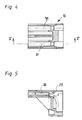
- 4 shows a section of a drive device for an elevator and / or turning mechanism in a section parallel to the wing plane, and
- FIG. 5 shows a section along the line V - V in FIG. 4.
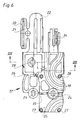
- 6 shows an insert in a view perpendicular to the wing plane.
- FIG. 7 shows a section along the line VII - VII in FIG. 6, but with the cover cap placed on the insert, and
- FIG. 8 shows a view of the cover cap in FIG Direction of arrow VIII in Fig. 7.
- FIG. 1 the upper part of a window sash is shown with its upper horizontal wing spar 1 and the two side wing spars 2, which is provided with double glazing 3, which is held by an oblique glazing bead 4.
- a slat blind 5 is fastened, which has a head rail 6, which carries conventional ladder-like support devices for slats 7, of which only the uppermost slats are shown in the drawing.
- the slats are pulled up in the usual way via cords 8 passing through the slats 7 and which can be wound up on a drive shaft 9 mounted in the interior of the head rail 6.
- the drive shaft is connected in a rotationally fixed manner to a drive wheel 10, which is partially wrapped around by a ball chain 11, which is led out of the head rail 6 in the manner described in more detail below.
- a ball chain By actuating the ball chain, not only the lifting or lowering of the slats 7, but also an adjustment of the position, for example an inclined position thereof, can be carried out by means of a conventional mechanism (not described in more detail).
- a pleated fabric that is to say a fabric folded like a leporello, can also be provided.
- the head rail 6, as can be seen in particular from FIG. 3, has a base 12 and legs 13, 14 projecting therefrom, of which the leg 14 facing the interior of the room is higher than the leg 13, so that it is the upper horizontal wing spar when the blind is installed 1 partially overlaps, as can be seen in particular from FIG.
- the higher leg 14 of the head rail 6 is provided at its free end with a U-shaped shoulder 15 facing the interior of the head rail, in which an insert 17 is fixed.
- the inserts 17 are used to attach the head rail 6 and thus the entire blind to the window sash, the insert shown on the left in FIG. 1 also with the drive device for the elevator and / or turning mechanism for the blind, i.e. the mechanism for rotating the drive wheel 10 and so that the drive shaft 9 is connected.
- This drive device has a bearing part 16 for the rotatable mounting of the drive wheel 10, which can be coupled in a rotationally fixed manner to the drive shaft 9, which is provided with guide channels 18 for the ball chain 11 which partially surrounds the drive wheel 10, which guide channels 18 communicate with guide channels 19 in the insert 17.
- the guide channels 18, 19, as can be seen from FIGS. 4, 5 and 6, have deflection sections for the ball chain 11, so that a direct deflection of the ball chain 11 partially wrapping around the drive wheel 10 takes place in such a way that this ball chain after it is wrapped around the drive wheel 10 is initially guided parallel to the longer leg 14 of the head rail 6 and parallel to the wing plane and then emerges from the insert 17 at the bottom.
- the insert 17 is fixed in the head rail 6 via a slide 20 inserted into the U-shaped shoulder 15 and held there with a clamp, which, as can be seen in FIG. 6, only has a web 21 with the remaining part of the insert 17 made of plastic is connected and therefore resiliently abuts in the U-shaped shoulder 15.
- the insert 17 is connected to the bearing part 16 via a resilient tongue 22 of the insert 17, which is inserted into a recess 23 between the guide channels 18 in the bearing part 16.
- the bearing part 16 can thus be moved relative to the insert 17, so that existing dimensional tolerances can be compensated.
- this arrangement enables the ball chain 11 to be simply inserted into the guide channels 19 after this ball chain has been inserted in the bearing part 16 in such a way that it partially wraps around the drive wheel 10 and is guided tion channels 18 is included, especially when, as will be explained in more detail below, braking devices for the ball chain are provided in the guide channels.
- openings 24 are preferably provided by elongated holes through which fastening screws, nails or the like. can be passed through.
- the guide channels 19 for the ball chain 11 are formed by open grooves which can be closed by a cover 25 pivotally connected to the insert 17. The connection is made by a film hinge 35, around which the cover 25 is pivotable. In the closed position, the cover 25 is fixed by pins 27 which snap into holes 26.
- guide cords are arranged on the side edges of the blind parallel to the side wing spars 2, which prevent the lowered blind from swinging out.
- a tensioning device is provided in the section of the insert 17 projecting laterally from the head rail, which consists of a rotating part 28 to which the end of the guide cord is fastened. By turning this rotating part 28, the guide cord is tensioned, whereupon the rotating part is fixed in its position.
- the section of the insert part 17 protruding laterally from the head rail 6 is covered by a cover cap 29, which is shown in FIG. 8 in a view towards the window sash, partly in section, and which extends onto the laterally protruding section of the Insert piece 17 is snapped.
- the cover cap 29 has outlet openings 30 for the ball chain 11 and is provided with an extension 31 for covering the gap in the region of the glass strip 4.
- the windows on the market have different glazing bead depths. It can therefore happen that there is not enough space available for the direct attachment of the section 18 projecting laterally from the head rail 6 to the side wing spar 2.
- the section 18 of the insert 17 protruding laterally from the head rail 6 can be provided with a compensating piece 32 resting on the inside of the wing, as shown in broken lines in FIG.
- a projection 33 (see FIG. 5) is provided in the guide channel 18 of the bearing part 16, in which, when a push is exerted on the ball chain 11 hooked by the weight of the blind this ball chain.
- a friction brake for the ball chain is provided in the section of the insert 17 projecting laterally from the head rail 6, which is formed from a resilient part 34 in the tongue 22, which delimits a piece of the guide channel 18 in the bearing part 16. This friction brake prevents undesired actuation of the drive shaft 9 by the weight of the ball chain 11.
Landscapes
- Engineering & Computer Science (AREA)
- Structural Engineering (AREA)
- Architecture (AREA)
- Civil Engineering (AREA)
- Blinds (AREA)
Applications Claiming Priority (4)
| Application Number | Priority Date | Filing Date | Title |
|---|---|---|---|
| AT2112/92 | 1992-10-23 | ||
| AT2110/92 | 1992-10-23 | ||
| AT211092A AT398805B (de) | 1992-10-23 | 1992-10-23 | Kopfteil für eine innenjalousie |
| AT211292A AT399020B (de) | 1992-10-23 | 1992-10-23 | Antrieb für eine in einer kopfschiene einer innenjalousie gelagerte antriebswelle |
Publications (2)
| Publication Number | Publication Date |
|---|---|
| EP0594556A1 true EP0594556A1 (fr) | 1994-04-27 |
| EP0594556B1 EP0594556B1 (fr) | 1997-03-05 |
Family
ID=25597699
Family Applications (1)
| Application Number | Title | Priority Date | Filing Date |
|---|---|---|---|
| EP19930890204 Expired - Lifetime EP0594556B1 (fr) | 1992-10-23 | 1993-10-19 | Dispositif d'entraînement pour arbre d'entraînement située dans la traverse supérieure des stores vénitiens |
Country Status (3)
| Country | Link |
|---|---|
| EP (1) | EP0594556B1 (fr) |
| DE (1) | DE59305591D1 (fr) |
| ES (1) | ES2103461T3 (fr) |
Cited By (1)
| Publication number | Priority date | Publication date | Assignee | Title |
|---|---|---|---|---|
| EP1020613A3 (fr) * | 1999-01-16 | 2002-10-23 | Josef Stehle + Söhne AG | Boítier pour une unité d'entraínement de commande de stores vénitiens ou similaires |
Citations (4)
| Publication number | Priority date | Publication date | Assignee | Title |
|---|---|---|---|---|
| FR2369410A1 (fr) * | 1976-10-29 | 1978-05-26 | Faber Ryslinge As | Store venitien a lames verticales |
| US4646808A (en) * | 1985-02-27 | 1987-03-03 | Hunter Douglas, Inc. | Cordlock structure for a blind assembly |
| US5139072A (en) * | 1990-02-07 | 1992-08-18 | Norbert Marocco | Coupling and transmission mechanism for drape or blind assembly |
| US5184660A (en) * | 1991-11-01 | 1993-02-09 | Verosol Usa Inc. | Window blind activator |
-
1993
- 1993-10-19 ES ES93890204T patent/ES2103461T3/es not_active Expired - Lifetime
- 1993-10-19 EP EP19930890204 patent/EP0594556B1/fr not_active Expired - Lifetime
- 1993-10-19 DE DE59305591T patent/DE59305591D1/de not_active Expired - Lifetime
Patent Citations (4)
| Publication number | Priority date | Publication date | Assignee | Title |
|---|---|---|---|---|
| FR2369410A1 (fr) * | 1976-10-29 | 1978-05-26 | Faber Ryslinge As | Store venitien a lames verticales |
| US4646808A (en) * | 1985-02-27 | 1987-03-03 | Hunter Douglas, Inc. | Cordlock structure for a blind assembly |
| US5139072A (en) * | 1990-02-07 | 1992-08-18 | Norbert Marocco | Coupling and transmission mechanism for drape or blind assembly |
| US5184660A (en) * | 1991-11-01 | 1993-02-09 | Verosol Usa Inc. | Window blind activator |
Cited By (1)
| Publication number | Priority date | Publication date | Assignee | Title |
|---|---|---|---|---|
| EP1020613A3 (fr) * | 1999-01-16 | 2002-10-23 | Josef Stehle + Söhne AG | Boítier pour une unité d'entraínement de commande de stores vénitiens ou similaires |
Also Published As
| Publication number | Publication date |
|---|---|
| ES2103461T3 (es) | 1997-09-16 |
| EP0594556B1 (fr) | 1997-03-05 |
| DE59305591D1 (de) | 1997-04-10 |
Similar Documents
| Publication | Publication Date | Title |
|---|---|---|
| DE2339596A1 (de) | Rollvorhang-anordnung | |
| DE69220778T2 (de) | Niederprofiljalousienkopfschiene | |
| DE8990082U1 (de) | Jalousievorrichtung für ein Fenster in einem geneigten Dach | |
| DE69329830T2 (de) | Riemenantrieb für eine markise | |
| DE3027964A1 (de) | Vertikaljalousie (dekor) | |
| DE2906871A1 (de) | Rolladen | |
| DE69600625T2 (de) | Doppelte abschirmvorrichtung für ein fenster | |
| DE3415551A1 (de) | Rolladen fuer dachfenster | |
| EP0594556B1 (fr) | Dispositif d'entraînement pour arbre d'entraînement située dans la traverse supérieure des stores vénitiens | |
| DE2906913A1 (de) | Rolladen fuer dachwohnfenster | |
| DE69622003T2 (de) | Verbessertes steuer- und aufhängungssystem für eine vertikallamellen-abdeckung für gebäudeöffnungen | |
| AT399020B (de) | Antrieb für eine in einer kopfschiene einer innenjalousie gelagerte antriebswelle | |
| AT398805B (de) | Kopfteil für eine innenjalousie | |
| DE3700745C2 (fr) | ||
| DE9117067U1 (de) | Fensterjalousie | |
| DE3625399A1 (de) | Rollo-vorhang fuer wohnwagenfenster | |
| DE202007017061U1 (de) | Universell einsetzbarer Rahmen für Vorhänge oder Rollos | |
| EP1213439A2 (fr) | Dispositif de couverture | |
| DE2742787A1 (de) | Rolladen fuer dachfenster in schwenkfluegelbauweise | |
| EP0383061B1 (fr) | Volet roulant pour couvercle d'une ouverture dans les toitures ou les murs, particulièrement pour une fenêtre de toiture | |
| DE19600949A1 (de) | Rolladen für Fenster, Türen oder dergleichen | |
| DE69717953T2 (de) | Befestigungsvorrichtung für Schiebepaneel | |
| DE9210938U1 (de) | Rollo-Vorrichtung | |
| DE2555034C3 (de) | Unterleiste für Rafflamellenjalousien | |
| DE4236548A1 (de) | Innenjalousie für ein Dachfenster |
Legal Events
| Date | Code | Title | Description |
|---|---|---|---|
| PUAI | Public reference made under article 153(3) epc to a published international application that has entered the european phase |
Free format text: ORIGINAL CODE: 0009012 |
|
| 17P | Request for examination filed |
Effective date: 19940221 |
|
| AK | Designated contracting states |
Kind code of ref document: A1 Designated state(s): DE ES FR GB IT SE |
|
| GRAG | Despatch of communication of intention to grant |
Free format text: ORIGINAL CODE: EPIDOS AGRA |
|
| 17Q | First examination report despatched |
Effective date: 19960415 |
|
| GRAH | Despatch of communication of intention to grant a patent |
Free format text: ORIGINAL CODE: EPIDOS IGRA |
|
| GRAH | Despatch of communication of intention to grant a patent |
Free format text: ORIGINAL CODE: EPIDOS IGRA |
|
| GRAA | (expected) grant |
Free format text: ORIGINAL CODE: 0009210 |
|
| ITF | It: translation for a ep patent filed | ||
| AK | Designated contracting states |
Kind code of ref document: B1 Designated state(s): DE ES FR GB IT SE |
|
| GBT | Gb: translation of ep patent filed (gb section 77(6)(a)/1977) |
Effective date: 19970307 |
|
| REF | Corresponds to: |
Ref document number: 59305591 Country of ref document: DE Date of ref document: 19970410 |
|
| ET | Fr: translation filed | ||
| REG | Reference to a national code |
Ref country code: ES Ref legal event code: FG2A Ref document number: 2103461 Country of ref document: ES Kind code of ref document: T3 |
|
| PLBE | No opposition filed within time limit |
Free format text: ORIGINAL CODE: 0009261 |
|
| STAA | Information on the status of an ep patent application or granted ep patent |
Free format text: STATUS: NO OPPOSITION FILED WITHIN TIME LIMIT |
|
| 26N | No opposition filed | ||
| REG | Reference to a national code |
Ref country code: GB Ref legal event code: IF02 |
|
| PGFP | Annual fee paid to national office [announced via postgrant information from national office to epo] |
Ref country code: SE Payment date: 20091014 Year of fee payment: 17 Ref country code: ES Payment date: 20091023 Year of fee payment: 17 |
|
| PGFP | Annual fee paid to national office [announced via postgrant information from national office to epo] |
Ref country code: IT Payment date: 20091028 Year of fee payment: 17 Ref country code: GB Payment date: 20091022 Year of fee payment: 17 Ref country code: FR Payment date: 20091110 Year of fee payment: 17 |
|
| PGFP | Annual fee paid to national office [announced via postgrant information from national office to epo] |
Ref country code: DE Payment date: 20101022 Year of fee payment: 18 |
|
| GBPC | Gb: european patent ceased through non-payment of renewal fee |
Effective date: 20101019 |
|
| PG25 | Lapsed in a contracting state [announced via postgrant information from national office to epo] |
Ref country code: FR Free format text: LAPSE BECAUSE OF NON-PAYMENT OF DUE FEES Effective date: 20101102 |
|
| REG | Reference to a national code |
Ref country code: FR Ref legal event code: ST Effective date: 20110630 |
|
| PG25 | Lapsed in a contracting state [announced via postgrant information from national office to epo] |
Ref country code: GB Free format text: LAPSE BECAUSE OF NON-PAYMENT OF DUE FEES Effective date: 20101019 |
|
| PG25 | Lapsed in a contracting state [announced via postgrant information from national office to epo] |
Ref country code: SE Free format text: LAPSE BECAUSE OF NON-PAYMENT OF DUE FEES Effective date: 20101020 |
|
| REG | Reference to a national code |
Ref country code: ES Ref legal event code: FD2A Effective date: 20111118 |
|
| PG25 | Lapsed in a contracting state [announced via postgrant information from national office to epo] |
Ref country code: IT Free format text: LAPSE BECAUSE OF NON-PAYMENT OF DUE FEES Effective date: 20101019 |
|
| PG25 | Lapsed in a contracting state [announced via postgrant information from national office to epo] |
Ref country code: ES Free format text: LAPSE BECAUSE OF NON-PAYMENT OF DUE FEES Effective date: 20101020 |
|
| PG25 | Lapsed in a contracting state [announced via postgrant information from national office to epo] |
Ref country code: DE Free format text: LAPSE BECAUSE OF NON-PAYMENT OF DUE FEES Effective date: 20130501 |
|
| REG | Reference to a national code |
Ref country code: DE Ref legal event code: R119 Ref document number: 59305591 Country of ref document: DE Effective date: 20130501 |