EP0594558B1 - Industrial process for the separation and recovery of chlorine - Google Patents
Industrial process for the separation and recovery of chlorine Download PDFInfo
- Publication number
- EP0594558B1 EP0594558B1 EP94100177A EP94100177A EP0594558B1 EP 0594558 B1 EP0594558 B1 EP 0594558B1 EP 94100177 A EP94100177 A EP 94100177A EP 94100177 A EP94100177 A EP 94100177A EP 0594558 B1 EP0594558 B1 EP 0594558B1
- Authority
- EP
- European Patent Office
- Prior art keywords
- chlorine
- gas
- carbon dioxide
- gaseous mixture
- sulfite
- Prior art date
- Legal status (The legal status is an assumption and is not a legal conclusion. Google has not performed a legal analysis and makes no representation as to the accuracy of the status listed.)
- Expired - Lifetime
Links
Images

Classifications
-
- B—PERFORMING OPERATIONS; TRANSPORTING
- B01—PHYSICAL OR CHEMICAL PROCESSES OR APPARATUS IN GENERAL
- B01D—SEPARATION
- B01D53/00—Separation of gases or vapours; Recovering vapours of volatile solvents from gases; Chemical or biological purification of waste gases, e.g. engine exhaust gases, smoke, fumes, flue gases, aerosols
-
- B—PERFORMING OPERATIONS; TRANSPORTING
- B01—PHYSICAL OR CHEMICAL PROCESSES OR APPARATUS IN GENERAL
- B01D—SEPARATION
- B01D53/00—Separation of gases or vapours; Recovering vapours of volatile solvents from gases; Chemical or biological purification of waste gases, e.g. engine exhaust gases, smoke, fumes, flue gases, aerosols
- B01D53/34—Chemical or biological purification of waste gases
- B01D53/46—Removing components of defined structure
- B01D53/68—Halogens or halogen compounds
-
- B—PERFORMING OPERATIONS; TRANSPORTING
- B01—PHYSICAL OR CHEMICAL PROCESSES OR APPARATUS IN GENERAL
- B01D—SEPARATION
- B01D53/00—Separation of gases or vapours; Recovering vapours of volatile solvents from gases; Chemical or biological purification of waste gases, e.g. engine exhaust gases, smoke, fumes, flue gases, aerosols
- B01D53/14—Separation of gases or vapours; Recovering vapours of volatile solvents from gases; Chemical or biological purification of waste gases, e.g. engine exhaust gases, smoke, fumes, flue gases, aerosols by absorption
-
- C—CHEMISTRY; METALLURGY
- C01—INORGANIC CHEMISTRY
- C01B—NON-METALLIC ELEMENTS; COMPOUNDS THEREOF; METALLOIDS OR COMPOUNDS THEREOF NOT COVERED BY SUBCLASS C01C
- C01B7/00—Halogens; Halogen acids
- C01B7/01—Chlorine; Hydrogen chloride
- C01B7/07—Purification ; Separation
- C01B7/0743—Purification ; Separation of gaseous or dissolved chlorine
-
- Y—GENERAL TAGGING OF NEW TECHNOLOGICAL DEVELOPMENTS; GENERAL TAGGING OF CROSS-SECTIONAL TECHNOLOGIES SPANNING OVER SEVERAL SECTIONS OF THE IPC; TECHNICAL SUBJECTS COVERED BY FORMER USPC CROSS-REFERENCE ART COLLECTIONS [XRACs] AND DIGESTS
- Y10—TECHNICAL SUBJECTS COVERED BY FORMER USPC
- Y10S—TECHNICAL SUBJECTS COVERED BY FORMER USPC CROSS-REFERENCE ART COLLECTIONS [XRACs] AND DIGESTS
- Y10S62/00—Refrigeration
- Y10S62/921—Chlorine
Definitions
- EP-A-0 329 385 relates to a process for the separation and recovery of chlorine from a gaseous mixture comprising chlorine, carbon dioxide and further gas, which comprises compressing and cooling the gaseous mixture thereby to separate the gaseous mixture into a residual gas formed principally of a major portion of the further gas which is non-condensable under the conditions employed, and a condensate formed primarily of chlorine, and feeding the condensate to a stripping column to desorb carbon dioxide and a minor portion of the non-condensable gas dissolved in the condensate.
- the present invention is concerned with a process for removing chlorine from a gaseous mixture containing chlorine and carbon dioxide by washing under controlled conditions.
- the invention can be applied to absorbing and removing chlorine gas contained in a mixture containing carbon dioxide which is formed upon production or utilization of chlorine.
- Chlorine is a useful raw material produced industrially on a large scale primarily by brine electrolysis, and is used widely. Gaseous components are formed as byproducts upon production of chlorine. These components are accompanied by chlorine, so that due to the toxicity of chlorine, they cannot be released into the atmosphere without further treatment.
- chlorine contained in such a gas is removed usually by its absorption with an alkaline substance.
- another gas is contained besides chlorine and said other gas is acidic (like carbon dioxide gas) it is not only chlorine but also carbon dioxide that is absorbed in an alkaline solution.
- an alkali is required in an amount equal to the sum of the carbon dioxide and chlorine.
- a gas contains carbon dioxide at a high level and chlorine at a trace level, an inconvenience arises in that a large amount of an alkali is required for the removal of such a trace amount of chlorine. It is accordingly desired to develop a process for the selective absorption and removal of chlorine which is contained in carbon dioxide.
- the process (4) has already been proposed as a process for removing chlorine from a mixture of carbon dioxide gas and chlorine.
- pH 7.5 is however a value far higher than 6.35, which is the first dissociation constant (pKa) of carbonic acid, as shown in FIG. 4 and falls within the range where carbon dioxide gas reacts with an alkali metal hydroxide and/or alkaline earth metal hydroxide to form the corresponding bicarbonate.
- pH 7.5 is close to the dissociation constant of hypochlorous acid.
- hypochlorous acid takes the form of a free acid so that it becomes prone to decomposition. Precise control of pH is therefore needed. Even if chlorine is removed successfully, the resulting hypochlorite solution has strong oxidative effects and offensive odor and cannot thus be discarded as is. An additional step is therefore required for its reduction.
- a process for the removal of chlorine from a gaseous mixture comprising chlorine gas and carbon dioxide gas.
- the process comprises feeding an aqueous solution or suspension containing an alkali metal sulfite and/or an alkaline earth metal sulfite, and washing the gaseous mixture with the solution or suspension while controlling the pH of the solution or suspension within a range of 1.9-6.3, whereby chlorine is solely removed from the gaseous mixture.
- the process of the invention may be applied to a gaseous mixture composed of carbon dioxide and non-condensable gas and containing chlorine or to carbon dioxide containing chlorine.
- a chromium oxide catalyst obtained by calcining chromium hydroxide in particular has high activity even at relatively low temperatures, leading to the provision of an industrial process for producing chlorine by oxidizing hydrogen chloride.
- This invention is useful as an effective process for the recovery of chlorine or as a process for the removal of chlorine from a waste gas in the above industrial production process of chlorine.
- a description will next be made of a process for the removal of chlorine from a gaseous mixture containing chlorine gas and carbon dioxide gas which comprises feeding an aqueous solution or suspension containing an alkali metal sulfite and/or an alkaline earth metal sulfite or containing an alkali metal sulfite and/or an alkaline earth metal sulfite along with an alkali metal hydroxide and/or an alkaline earth metal hydroxide in a proportion not greater than twice in molar ratio the alkali metal sulfite and/or alkaline earth metal sulfite, and washing the gaseous mixture with the solution or suspension while controlling the pH of the solution or suspension within a range of 1.9-6.3, whereby chlorine is removed from the gaseous mixture.
- the metal in the form of the sulfite may be an alkaline earth metal such as magnesium, calcium or barium.
- an alkali metal having a high solubility in water is however preferred.
- an alkali metal sulfite and/or an alkaline earth metal sulfite is used along with an alkali metal hydroxide and/or an alkaline earth metal hydroxide in the above process, it is essential to use the hydroxide in a proportion not greater than twice in molar ratio the sulfite.
- the sulfite acts as a substitute for the hydroxide. Further, the greater the sulfite, the more the bissulfite ions in the absorbent solution. The pH control is thus facilitated owing to their buffer action.
- the washing solution may be that containing neither alkali metal hydroxide nor alkaline earth metal hydroxide.
- Chlorine in a waste gas can be absorbed with an aqueous solution or suspension of an alkali metal and/or an alkaline earth metal sulfite alone.
- the pH range suitable for the chlorine-absorbing reaction is 1.9-6.3.
- a pH higher than 6.3 converts carbon dioxide gas into bicarbonate ions as shown in FIG. 1, so that the alkali is consumed. More alkali is therefore consumed to make the process uneconomical.
- This pH control of the aqueous solution within the range of 1.9-6.3 can be achieved by adjusting the amount of the alkali metal sulfite and/or alkaline earth metal sulfite to be added as well as the amount of the alkali metal hydroxide and/or alkaline earth metal hydroxide to be added in a proportion not greater than twice in molar ratio the sulfite.
- the hydroxide and sulfite may each be added in a solid form or as an aqueous solution, the latter being preferred. They may be fed together as a single solution. Needless to say, they may be added as separate aqueous solutions.
- each aqueous solution may preferably be in a range that in the case of an alkali metal salt or alkaline earth metal salt, the raw materials and the resulting salt and sulfate are dissolved. Operation is however still feasible even when they are each added in the form of a slurry.
- the reaction temperature should be determined taking the solubility into parallel consideration. Since the solubilities of alkali metal and alkaline earth metal sulfites and chlorides are all not dependent too much on the temperature, use of a higher temperature cannot bring about any substantial effect for increasing their concentrations.
- reaction velocity between chlorine and a sulfite increases as the temperature becomes higher.
- a reaction temperature of from 0°C to 70°C is however preferred in view of the potential problems of corrosion and deterioration of the material of the reactor.
- the gas may be absorbed by causing it to bubble in a stirring tank or by treating it in a washing column.
- stage number varies depending upon the tolerable level of chlorine in the treated gas, it is not necessary to increase the stage number too much because the reaction or absorption velocity is high.
- a gaseous mixture 401 which contains carbon dioxide gas and chlorine gas and may also contain nitrogen, oxygen and the like in some instances is introduced into a lower part of an absorption column 407, whereby the gaseous mixture 401 is washed with a washing liquid 402 recirculated from an upper part of the column.
- the washing liquid 402 is an aqueous solution or suspension which as described above, contains an alkali metal sulfite and/or alkaline earth metal sulfite or an alkali metal sulfite and/or alkaline earth metal sulfite along with an alkali metal hydroxide and/or alkaline earth metal sulfite and has a pH controlled within the range of 1.9-6.3.
- the washing liquid is diluted with water to a desired concentration, and is recirculated while controlling its pH and maintaining its flow rate constant by means of an overflow 404.
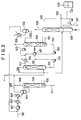
- the process according to the present invention can be used as one part of a chlorine separation process which itself constitutes an important part of an industrial production process for chlorine. Such a separation process will be described with reference to FIG. 3.
- the process permits highly-efficient recovery of chlorine from a gaseous mixture composed of carbon dioxide and non-condensable gas and containing chlorine and further almost complete removal of chlorine from a waste gas to be released out of the system, so that the pollution problem can be solved.
- a gaseous mixture composed of carbon dioxide and non-condensable gas and containing chlorine is fed through a line 531 to a compressor 501, where it is compressed to a predetermined pressure.
- the gaseous mixture is cooled by a cooler 502 to a predetermine temperature and then liquefied by a condenser 503, so that a portion of the chlorine is liquefied.
- the resultant gas-liquid mixture is fed to a separator 504, where it is separated into a residual gas formed principally of a major portion of the non-condensable gas and a condensate formed primarily of chlorine.
- the condensate is fed to an upper part of a stripping column 505.
- the carbon dioxide and non-condensable gas which have evaporated from the condensate are allowed to flow from the top of the stripping column and then through a line 509, and join the residual gas fed from the separator through a line 508.
- At least a portion of the mixed gas thus joined is fed to an absorption column 512. From the mixed gas charged into the absorption column, almost the whole chlorine and portions of the carbon dioxide and non-condensable gas are absorbed in a solvent 513 falling from the top of the column. Accordingly, the mixed gas can be converted into a waste gas 514 which is composed of carbon dioxide and non-condensable gas and contains not greater than 1% by volume of chlorine.
- a solvent 515 with chlorine, carbon dioxide and non-condensable gas absorbed therein is drawn out from the bottom and is fed by a pump 516 to a heat exchanger 517. After being preheated by the heat exchanger 517, the solvent is fed to a distillation column 518.
- the solvent charged into the distillation column 518 is boiled up by a reboiler 519, condensed by a condenser 533 and distilled by a reflux 520 to the distillation column, so that the gases absorbed are caused to evaporate to separate a recovered gas composed primarily of chlorine.
- a solvent 521 having a chlorine concentration not higher than 5,000 ppm by weight, preferably, not higher than 500 ppm by weight is drawn out through the bottom of the column and is then fed by a pump 522 to the heat exchanger 517. After heat is removed from the solvent by the heat exchanger 517, a fresh supply 523 of the solvent is added to replenish any loss. The solvent is thereafter cooled by a cooler 524 and is then fed back to the absorption column 512.
- a waste gas 514 composed of carbon dioxide and non-condensable gas and containing not more than 1% by volume of chlorine is introduced into a lower part of ban absorption column 525, in which the waste gas 514 is washed with a washing liquid 526 recirculated from an upper part of the column.
- the washing liquid is an aqueous solution or suspension which as described above, contains an alkali metal sulfite and/or alkaline earth metal sulfite or an alkali metal sulfite and/or alkaline earth metal sulfite along with an alkali metal hydroxide and/or alkaline earth metal hydroxide and has a pH controlled within the range of 1.9-6.3.
- the washing liquid is diluted with water to a desired concentration, and is recirculated while controlling its pH and maintaining its flow rate constant by means of an overflow 527.
- the washing liquid is prepared from water 530 and an aqueous solution of sodium sulfite.
- the gas passed through without absorption in the solution was caused to flow through a trap of an N/2 solution of potassium iodide and then through another trap of an N/2 solution of caustic soda.
- Those solutions were titrated with N/10 sodium thiosulfate while using an aqueous solution of starch as an indicator, whereby the chlorine levels in the traps were determined by titration.
- the concentration of chlorine in the waste gas was found to be not higher than 1 ppm by volume.
- Example 2 A similar reactor as in Example 1 was charged with an aqueous solution which contained 8.6% by weight of sodium sulfite and 1.4% by weight of caustic soda. Similarly, 1 l/min of carbon dioxide gas and 100 cc/min of chlorine gas were mixed and caused to flow. When the pH reached 4, the feeding of an aqueous solution of the same composition as the feed solution was started at a rate of 12.1 ml/min so as to maintain the pH at 4. A gas passed through the flask in the above state was analyzed by a similar method as in Example 1. As a result, it was confirmed that the chlorine level was not higher than 1 ppm by volume and the carbon dioxide passed in its entirety.
- a gaseous mixture 401 containing 30% by volume of carbon dioxide gas, 70% by volume of nitrogen plus oxygen and 1,000 ppm by volume of chlorine gas was introduced at a rate of 500 Nm 3 /hr from a lower part of the absorption column 407.
- the absorption column had a diameter of 0.8 m and was packed with 1-inch Raschig rings to a height of 2.2 m.
- the gaseous mixture 401 was washed with an absorbent liquid 402 recirculated at 10 m 3 /hr from the top of the column.
- the pH was maintained at 4.0 with about 94.5 kg/hr of an aqueous solution 403 containing 10% by weight of sodium sulfite while adding water 405 at a rate of 278 kg/hr.
- the liquid level was maintained constant by means of an overflow line 404.
- a treated gas 406 flowed out of the column through an upper part thereof was sampled.
- the chlorine level was found to be 1 ppm by volume or lower.
- FIG. 3 The flow sheet of an apparatus used in the present Example is illustrated in FIG. 3.
- a distilled gas from the upper part of the stripping column contained 18.6% by volume of chlorine, 17.1% by volume of carbon dioxide, and 64.3% by volume of nitrogen plus oxygen.
- Carbon tetrachloride in an amount 3.6 times by weight the feed gas to the absorption column was cooled to -15°C and used as an absorbent solvent.
- the absorption column was operated so as to maintain the top pressure at 7 kg/cm 2 -G.
- the composition of a waste gas from the top of the absorption column was 47 ppm by volume of chlorine, 19.7% by volume of carbon dioxide, 80.1% by volume of nitrogen plus oxygen, 0.2% by volume of carbon tetrachloride.
- Carbon tetrachloride with chlorine absorbed therein was fed by the pump from the bottom to the distillation column.
- the distillation column was operated at a top pressure of 1.3 kg/cm 2 -G, a condenser temperature of -15°C and a bottom temperature of 105.6°C.
- the composition of a gas recovered from the top of the distillation column was 89.4% by volume of chlorine, 7.3% by volume of carbon dioxide, 3.3% by volume of nitrogen plus oxygen, and 500 ppm by volume of carbon tetrachloride.
- the chlorine concentration in the solvent was 5 ppm by weight.
- the recovery rate of chlorine was 99.99%.
- a gaseous mixture discharged from the top of the absorption column and composed of 47 ppm by volume of chlorine, 19.7% by volume of carbon dioxide, 80.1% by volume of nitrogen plus oxygen and 0.2% by volume of carbon tetrachloride was introduced into the waste gas washing column to remove chlorine.
- the gaseous mixture was introduced from the bottom, while the absorbent liquid recirculated was caused fall down from the top. Accordingly, the chlorine in the gaseous mixture was absorbed.
- an aqueous solution containing 10% by weight of sodium sulfite was caused to flow down while controlling its pH at 4.2.
- the absorbent liquid was brought into contact with the gaseous mixture to have it absorb chlorine.
- the chlorine concentration in the gas released from the top was not higher than 1 ppm by volume.
Landscapes
- Chemical & Material Sciences (AREA)
- Engineering & Computer Science (AREA)
- Analytical Chemistry (AREA)
- General Chemical & Material Sciences (AREA)
- Oil, Petroleum & Natural Gas (AREA)
- Chemical Kinetics & Catalysis (AREA)
- Organic Chemistry (AREA)
- Health & Medical Sciences (AREA)
- Biomedical Technology (AREA)
- Environmental & Geological Engineering (AREA)
- Inorganic Chemistry (AREA)
- Treating Waste Gases (AREA)
Applications Claiming Priority (7)
| Application Number | Priority Date | Filing Date | Title |
|---|---|---|---|
| JP3179288A JPH028683A (ja) | 1988-02-16 | 1988-02-16 | 塩素の分離回収方法 |
| JP31792/88 | 1988-02-16 | ||
| JP63032837A JPH01212202A (ja) | 1988-02-17 | 1988-02-17 | 塩素の工業的分離回収方法 |
| JP32837/88 | 1988-02-17 | ||
| JP63059428A JP2567023B2 (ja) | 1988-03-15 | 1988-03-15 | 塩素の除害方法 |
| JP59428/88 | 1988-03-15 | ||
| EP89301394A EP0329385B2 (en) | 1988-02-16 | 1989-02-15 | Industrial process for the separation and recovery of chlorine |
Related Parent Applications (2)
| Application Number | Title | Priority Date | Filing Date |
|---|---|---|---|
| EP89301394.6 Division | 1989-02-15 | ||
| EP89301394A Division EP0329385B2 (en) | 1988-02-16 | 1989-02-15 | Industrial process for the separation and recovery of chlorine |
Publications (3)
| Publication Number | Publication Date |
|---|---|
| EP0594558A2 EP0594558A2 (en) | 1994-04-27 |
| EP0594558A3 EP0594558A3 (en) | 1994-12-21 |
| EP0594558B1 true EP0594558B1 (en) | 1997-05-02 |
Family
ID=27287469
Family Applications (2)
| Application Number | Title | Priority Date | Filing Date |
|---|---|---|---|
| EP94100177A Expired - Lifetime EP0594558B1 (en) | 1988-02-16 | 1989-02-15 | Industrial process for the separation and recovery of chlorine |
| EP89301394A Expired - Lifetime EP0329385B2 (en) | 1988-02-16 | 1989-02-15 | Industrial process for the separation and recovery of chlorine |
Family Applications After (1)
| Application Number | Title | Priority Date | Filing Date |
|---|---|---|---|
| EP89301394A Expired - Lifetime EP0329385B2 (en) | 1988-02-16 | 1989-02-15 | Industrial process for the separation and recovery of chlorine |
Country Status (11)
| Country | Link |
|---|---|
| US (1) | US5000006A (cs) |
| EP (2) | EP0594558B1 (cs) |
| KR (1) | KR910005983B1 (cs) |
| AU (1) | AU597523B2 (cs) |
| BR (1) | BR8900671A (cs) |
| CA (2) | CA1319316C (cs) |
| CS (1) | CS99889A3 (cs) |
| DE (2) | DE68928021T2 (cs) |
| HU (1) | HU205867B (cs) |
| IL (1) | IL89280A0 (cs) |
| RO (1) | RO103830B1 (cs) |
Families Citing this family (22)
| Publication number | Priority date | Publication date | Assignee | Title |
|---|---|---|---|---|
| US5254323A (en) * | 1988-02-16 | 1993-10-19 | Mitsui Toatsu Chemicals, Incorporated | Industrial process for the separation and recovery of chlorine |
| US5057125A (en) * | 1990-05-14 | 1991-10-15 | Uop | Process for the treatment of vent gas containing organic halide compounds |
| DE4442743A1 (de) * | 1994-12-01 | 1996-06-05 | Hoechst Ag | Verfahren zur Abtrennung von Chlorwasserstoff |
| DE19536976A1 (de) * | 1995-10-04 | 1997-04-10 | Basf Ag | Verfahren zur selektiven Abtrennung und Wiedergewinnung von Chlor aus Gasgemischen |
| US5769927A (en) * | 1997-01-24 | 1998-06-23 | Membrane Technology And Research, Inc. | Monomer recovery process |
| US5785739A (en) * | 1997-01-24 | 1998-07-28 | Membrane Technology And Research, Inc. | Steam cracker gas separation process |
| US6357112B1 (en) * | 1997-11-25 | 2002-03-19 | Tessera, Inc. | Method of making connection component |
| US6134912A (en) * | 1999-01-27 | 2000-10-24 | Air Liquide America Corporation | Method and system for separation of a mixed gas containing oxygen and chlorine |
| JP2004028549A (ja) * | 2001-12-28 | 2004-01-29 | Canon Inc | 複数の物質を含有する混合気体から各物質を分離する分離方法及びその装置 |
| FR2836839B1 (fr) † | 2002-03-07 | 2004-07-09 | Cit Alcatel | Procede de traitement de rejets gazeux provenant d'une unite de fabrication d'une preforme de fibre optique |
| US8152989B2 (en) * | 2005-01-18 | 2012-04-10 | Severn Trent De Nora, Llc | System and process for treating ballast water |
| US8147673B2 (en) * | 2005-01-18 | 2012-04-03 | Severn Trent De Nora, Llc | System and process for treatment and de-halogenation of ballast water |
| US20070122329A1 (en) * | 2005-11-30 | 2007-05-31 | Alain Briglia | Purification of raw hydrogen |
| KR101379634B1 (ko) * | 2006-01-27 | 2014-03-28 | 바스프 에스이 | 염소의 제조 방법 |
| DE102007013964A1 (de) * | 2007-03-23 | 2008-09-25 | Bayer Materialscience Ag | Prozess zur Entfernung und Rückführung kondensierbarer Komponenten aus chlorhaltigen Gasströmen |
| DE102007020148A1 (de) * | 2007-04-26 | 2008-10-30 | Bayer Materialscience Ag | Prozess zur Herstellung von Chlor aus HCI |
| CN102656113B (zh) * | 2009-12-17 | 2015-04-01 | 陶氏环球技术有限责任公司 | 氯气生产 |
| US9016110B2 (en) * | 2010-11-22 | 2015-04-28 | Nalco Company | Apparatus for on-line continuous chlorine analysis in turbid water and process streams |
| DE102011087654A1 (de) | 2011-12-02 | 2013-06-06 | Bayer Materialscience Aktiengesellschaft | Verfahren zur Herstellung von Isocyanaten |
| WO2015097351A1 (fr) * | 2013-12-23 | 2015-07-02 | Gea Process Engineering | Dispositif de lavage de buees comportant un moyen pour absorber et/ou neutraliser l'acide chlorhydrique |
| CN111298603B (zh) * | 2020-03-12 | 2022-02-15 | 江苏维尤纳特精细化工有限公司 | 一种用于百菌清生产线的氯化氢检测处理设备及其处理工艺 |
| KR102873618B1 (ko) * | 2022-03-07 | 2025-10-17 | 한화솔루션 주식회사 | 염소 제조 방법 |
Family Cites Families (10)
| Publication number | Priority date | Publication date | Assignee | Title |
|---|---|---|---|---|
| US2868325A (en) * | 1956-02-29 | 1959-01-13 | Cathala Marie Edouard Joseph | Method of extraction of chlorine from gaseous mixtures |
| US3374637A (en) * | 1965-12-13 | 1968-03-26 | Fmc Corp | Recovery of chlorine |
| AT273904B (de) * | 1967-05-23 | 1969-08-25 | Chemie Linz Ag | Verfahren zur destillativen Abtrennung von reinem Chlor aus einem Chlor, Stickstoffdioxyd, Nitrosylchlorid und Sauerstoff enthaltenden Gasgemisch |
| JPS5219556B2 (cs) * | 1972-10-18 | 1977-05-28 | ||
| JPS5425519B2 (cs) * | 1973-05-31 | 1979-08-28 | ||
| RO62211A2 (cs) * | 1973-09-10 | 1977-06-15 | ||
| US3948622A (en) * | 1974-07-12 | 1976-04-06 | The Lummus Company | Separation of aqueous hydrogen chloride from gaseous chlorinated hydrocarbons |
| GB1518372A (en) * | 1976-02-25 | 1978-07-19 | Tioxide Group Ltd | Chlorine recovery process |
| US4321795A (en) * | 1980-09-22 | 1982-03-30 | Helmut Brandt | Process for the purification of gaseous chlorine |
| JPS57197023A (en) * | 1981-05-28 | 1982-12-03 | Toho Titanium Co Ltd | Treatment of waste gas from chlorinating furnace |
-
1989
- 1989-02-14 IL IL89280A patent/IL89280A0/xx unknown
- 1989-02-15 CS CS89998A patent/CS99889A3/cs unknown
- 1989-02-15 DE DE68928021T patent/DE68928021T2/de not_active Expired - Fee Related
- 1989-02-15 AU AU29959/89A patent/AU597523B2/en not_active Ceased
- 1989-02-15 BR BR898900671A patent/BR8900671A/pt not_active IP Right Cessation
- 1989-02-15 EP EP94100177A patent/EP0594558B1/en not_active Expired - Lifetime
- 1989-02-15 EP EP89301394A patent/EP0329385B2/en not_active Expired - Lifetime
- 1989-02-15 DE DE68917335T patent/DE68917335T3/de not_active Expired - Lifetime
- 1989-02-15 HU HU89765A patent/HU205867B/hu not_active IP Right Cessation
- 1989-02-15 CA CA000591062A patent/CA1319316C/en not_active Expired - Fee Related
- 1989-02-16 RO RO138274A patent/RO103830B1/ro unknown
- 1989-02-16 US US07/310,929 patent/US5000006A/en not_active Expired - Lifetime
- 1989-02-16 KR KR1019890001794A patent/KR910005983B1/ko not_active Expired
-
1991
- 1991-06-28 CA CA000616106A patent/CA1320120C/en not_active Expired - Fee Related
Also Published As
| Publication number | Publication date |
|---|---|
| HU205867B (en) | 1992-07-28 |
| DE68928021D1 (de) | 1997-06-05 |
| AU2995989A (en) | 1989-09-14 |
| RO103830B1 (en) | 1993-10-22 |
| DE68917335D1 (de) | 1994-09-15 |
| EP0594558A2 (en) | 1994-04-27 |
| KR910005983B1 (ko) | 1991-08-09 |
| EP0329385B2 (en) | 2002-03-06 |
| HUT50659A (en) | 1990-03-28 |
| EP0329385A2 (en) | 1989-08-23 |
| CA1319316C (en) | 1993-06-22 |
| DE68928021T2 (de) | 1997-08-14 |
| KR890012691A (ko) | 1989-09-18 |
| IL89280A0 (en) | 1989-09-10 |
| BR8900671A (pt) | 1989-10-10 |
| EP0329385A3 (en) | 1990-08-08 |
| CS276380B6 (en) | 1992-05-13 |
| CA1320120C (en) | 1993-07-13 |
| EP0594558A3 (en) | 1994-12-21 |
| DE68917335T2 (de) | 1994-12-01 |
| CS99889A3 (en) | 1992-05-13 |
| EP0329385B1 (en) | 1994-08-10 |
| US5000006A (en) | 1991-03-19 |
| DE68917335T3 (de) | 2004-08-12 |
| AU597523B2 (en) | 1990-05-31 |
Similar Documents
| Publication | Publication Date | Title |
|---|---|---|
| EP0594558B1 (en) | Industrial process for the separation and recovery of chlorine | |
| AU665889B2 (en) | Process for removing NOx/SOx oxides from gas | |
| CA1252414A (en) | Electrolysis of alkali metal chloride solution | |
| US4980144A (en) | Process for purifying nitrogen trifluoride gas | |
| US5124135A (en) | Process for the selective absorption of chlorine and/or bromine from CO.sub. -containing off-gases with the aid of steam | |
| US3971844A (en) | Method for removing sodium sulfate from aqueous solutions | |
| US20050163695A1 (en) | Process for the purification of NF3 | |
| CA1118580A (en) | Production of chlorine dioxide having low chlorine | |
| US5324499A (en) | Fluoride removal from sulphuric acid | |
| US5254323A (en) | Industrial process for the separation and recovery of chlorine | |
| CA1123170A (en) | Process for the combined manufacture of chlorinated hydrocarbons and sodium bicarbonate | |
| CA1245831A (en) | Process for desulphurizing flue gases | |
| JP4011286B2 (ja) | 炭酸ジアリールの製造方法 | |
| US4138296A (en) | Method for removing nitrogen trichloride from chlorine gas | |
| US4230673A (en) | Apparatus for removing nitrogen trichloride from chlorine gas | |
| US5230879A (en) | Reduction of metal halates and recovery of metal halides | |
| JP2755542B2 (ja) | アルカリ金属水酸化物の製造方法 | |
| US5233098A (en) | Method for removing and recovering fluorinated alcohol from waste gas | |
| US3920529A (en) | Control of alkali metal chlorates in mercury cell brine | |
| AU614220B2 (en) | Industrial process for the removal of chlorine | |
| JP4529885B2 (ja) | 一酸化炭素の製造方法、ホスゲンの製造方法及び炭酸ジアリールの製造方法 | |
| JP2788477B2 (ja) | 弗素、臭素および沃素の除害方法 | |
| KR910005984B1 (ko) | 염소의 제거방법 | |
| US4256712A (en) | Regenerable process for SO2 removal employing gelatinous aluminum hydroxide as absorbent | |
| US3974257A (en) | Process for removing sulfur dioxide contained in a gas |
Legal Events
| Date | Code | Title | Description |
|---|---|---|---|
| PUAI | Public reference made under article 153(3) epc to a published international application that has entered the european phase |
Free format text: ORIGINAL CODE: 0009012 |
|
| 17P | Request for examination filed |
Effective date: 19940127 |
|
| AC | Divisional application: reference to earlier application |
Ref document number: 329385 Country of ref document: EP |
|
| AK | Designated contracting states |
Kind code of ref document: A2 Designated state(s): CH DE ES FR GB IT LI NL |
|
| RIN1 | Information on inventor provided before grant (corrected) |
Inventor name: KUDOH, MITSUO Inventor name: AJIOKA, MASANOBU Inventor name: TAKENAKA, SHINJI Inventor name: KIKUCHI, ISAO Inventor name: KONO, YOSHITSUGU Inventor name: ITOH, HIROYUKI |
|
| RBV | Designated contracting states (corrected) |
Designated state(s): DE FR GB IT NL |
|
| PUAL | Search report despatched |
Free format text: ORIGINAL CODE: 0009013 |
|
| RIN1 | Information on inventor provided before grant (corrected) |
Inventor name: KUDOH, MITSUO Inventor name: AJIOKA, MASANOBU Inventor name: TAKENAKA, SHINJI Inventor name: KIKUCHI, ISAO Inventor name: KONO, YOSHITSUGU Inventor name: ITOH, HIROYUKI |
|
| AK | Designated contracting states |
Kind code of ref document: A3 Designated state(s): CH DE ES FR GB IT LI NL |
|
| 17Q | First examination report despatched |
Effective date: 19951204 |
|
| GRAG | Despatch of communication of intention to grant |
Free format text: ORIGINAL CODE: EPIDOS AGRA |
|
| GRAH | Despatch of communication of intention to grant a patent |
Free format text: ORIGINAL CODE: EPIDOS IGRA |
|
| GRAH | Despatch of communication of intention to grant a patent |
Free format text: ORIGINAL CODE: EPIDOS IGRA |
|
| GRAA | (expected) grant |
Free format text: ORIGINAL CODE: 0009210 |
|
| AC | Divisional application: reference to earlier application |
Ref document number: 329385 Country of ref document: EP |
|
| AK | Designated contracting states |
Kind code of ref document: B1 Designated state(s): DE FR GB IT NL |
|
| REF | Corresponds to: |
Ref document number: 68928021 Country of ref document: DE Date of ref document: 19970605 |
|
| ET | Fr: translation filed | ||
| PLBE | No opposition filed within time limit |
Free format text: ORIGINAL CODE: 0009261 |
|
| STAA | Information on the status of an ep patent application or granted ep patent |
Free format text: STATUS: NO OPPOSITION FILED WITHIN TIME LIMIT |
|
| 26N | No opposition filed | ||
| REG | Reference to a national code |
Ref country code: GB Ref legal event code: 732E |
|
| REG | Reference to a national code |
Ref country code: FR Ref legal event code: TP |
|
| NLS | Nl: assignments of ep-patents |
Owner name: MITSUI CHEMICALS, INC. |
|
| REG | Reference to a national code |
Ref country code: GB Ref legal event code: IF02 |
|
| PGFP | Annual fee paid to national office [announced via postgrant information from national office to epo] |
Ref country code: NL Payment date: 20040205 Year of fee payment: 16 |
|
| PGFP | Annual fee paid to national office [announced via postgrant information from national office to epo] |
Ref country code: FR Payment date: 20040210 Year of fee payment: 16 |
|
| PGFP | Annual fee paid to national office [announced via postgrant information from national office to epo] |
Ref country code: GB Payment date: 20040211 Year of fee payment: 16 |
|
| PGFP | Annual fee paid to national office [announced via postgrant information from national office to epo] |
Ref country code: DE Payment date: 20040226 Year of fee payment: 16 |
|
| PG25 | Lapsed in a contracting state [announced via postgrant information from national office to epo] |
Ref country code: IT Free format text: LAPSE BECAUSE OF NON-PAYMENT OF DUE FEES Effective date: 20050215 Ref country code: GB Free format text: LAPSE BECAUSE OF NON-PAYMENT OF DUE FEES Effective date: 20050215 |
|
| PG25 | Lapsed in a contracting state [announced via postgrant information from national office to epo] |
Ref country code: NL Free format text: LAPSE BECAUSE OF NON-PAYMENT OF DUE FEES Effective date: 20050901 Ref country code: DE Free format text: LAPSE BECAUSE OF NON-PAYMENT OF DUE FEES Effective date: 20050901 |
|
| GBPC | Gb: european patent ceased through non-payment of renewal fee |
Effective date: 20050215 |
|
| PG25 | Lapsed in a contracting state [announced via postgrant information from national office to epo] |
Ref country code: FR Free format text: LAPSE BECAUSE OF NON-PAYMENT OF DUE FEES Effective date: 20051031 |
|
| NLV4 | Nl: lapsed or anulled due to non-payment of the annual fee |
Effective date: 20050901 |
|
| REG | Reference to a national code |
Ref country code: FR Ref legal event code: ST Effective date: 20051031 |