EP0594849B1 - Drehkolben-verbrennungskraftmaschine - Google Patents
Drehkolben-verbrennungskraftmaschine Download PDFInfo
- Publication number
- EP0594849B1 EP0594849B1 EP92905097A EP92905097A EP0594849B1 EP 0594849 B1 EP0594849 B1 EP 0594849B1 EP 92905097 A EP92905097 A EP 92905097A EP 92905097 A EP92905097 A EP 92905097A EP 0594849 B1 EP0594849 B1 EP 0594849B1
- Authority
- EP
- European Patent Office
- Prior art keywords
- hypotrochoid
- peritrochoid
- circle
- gear
- rotating piston
- Prior art date
- Legal status (The legal status is an assumption and is not a legal conclusion. Google has not performed a legal analysis and makes no representation as to the accuracy of the status listed.)
- Expired - Lifetime
Links
- 238000002485 combustion reaction Methods 0.000 title description 22
- 238000005096 rolling process Methods 0.000 claims description 128
- 239000002131 composite material Substances 0.000 claims description 115
- 230000001143 conditioned effect Effects 0.000 claims 5
- 230000002000 scavenging effect Effects 0.000 description 20
- 230000006835 compression Effects 0.000 description 18
- 238000007906 compression Methods 0.000 description 18
- 230000002349 favourable effect Effects 0.000 description 10
- 239000000567 combustion gas Substances 0.000 description 7
- 238000006073 displacement reaction Methods 0.000 description 7
- 239000000446 fuel Substances 0.000 description 7
- 239000002245 particle Substances 0.000 description 7
- 239000007789 gas Substances 0.000 description 6
- 230000007423 decrease Effects 0.000 description 5
- 229910052760 oxygen Inorganic materials 0.000 description 3
- 239000007787 solid Substances 0.000 description 3
- QVGXLLKOCUKJST-UHFFFAOYSA-N atomic oxygen Chemical compound [O] QVGXLLKOCUKJST-UHFFFAOYSA-N 0.000 description 2
- 238000000889 atomisation Methods 0.000 description 2
- 238000006243 chemical reaction Methods 0.000 description 2
- 230000001419 dependent effect Effects 0.000 description 2
- 230000000694 effects Effects 0.000 description 2
- 230000005484 gravity Effects 0.000 description 2
- 238000002347 injection Methods 0.000 description 2
- 239000007924 injection Substances 0.000 description 2
- 238000000034 method Methods 0.000 description 2
- 239000001301 oxygen Substances 0.000 description 2
- 239000000779 smoke Substances 0.000 description 2
- 241001442234 Cosa Species 0.000 description 1
- 244000089409 Erythrina poeppigiana Species 0.000 description 1
- 101100221616 Halobacterium salinarum (strain ATCC 29341 / DSM 671 / R1) cosB gene Proteins 0.000 description 1
- 235000009776 Rathbunia alamosensis Nutrition 0.000 description 1
- 238000009434 installation Methods 0.000 description 1
- 239000000463 material Substances 0.000 description 1
- 230000035515 penetration Effects 0.000 description 1
- 239000000243 solution Substances 0.000 description 1
Images








Classifications
-
- F—MECHANICAL ENGINEERING; LIGHTING; HEATING; WEAPONS; BLASTING
- F01—MACHINES OR ENGINES IN GENERAL; ENGINE PLANTS IN GENERAL; STEAM ENGINES
- F01C—ROTARY-PISTON OR OSCILLATING-PISTON MACHINES OR ENGINES
- F01C1/00—Rotary-piston machines or engines
- F01C1/22—Rotary-piston machines or engines of internal-axis type with equidirectional movement of co-operating members at the points of engagement, or with one of the co-operating members being stationary, the inner member having more teeth or tooth- equivalents than the outer member
-
- F—MECHANICAL ENGINEERING; LIGHTING; HEATING; WEAPONS; BLASTING
- F02—COMBUSTION ENGINES; HOT-GAS OR COMBUSTION-PRODUCT ENGINE PLANTS
- F02B—INTERNAL-COMBUSTION PISTON ENGINES; COMBUSTION ENGINES IN GENERAL
- F02B55/00—Internal-combustion aspects of rotary pistons; Outer members for co-operation with rotary pistons
-
- F—MECHANICAL ENGINEERING; LIGHTING; HEATING; WEAPONS; BLASTING
- F02—COMBUSTION ENGINES; HOT-GAS OR COMBUSTION-PRODUCT ENGINE PLANTS
- F02B—INTERNAL-COMBUSTION PISTON ENGINES; COMBUSTION ENGINES IN GENERAL
- F02B55/00—Internal-combustion aspects of rotary pistons; Outer members for co-operation with rotary pistons
- F02B55/14—Shapes or constructions of combustion chambers
-
- F—MECHANICAL ENGINEERING; LIGHTING; HEATING; WEAPONS; BLASTING
- F02—COMBUSTION ENGINES; HOT-GAS OR COMBUSTION-PRODUCT ENGINE PLANTS
- F02B—INTERNAL-COMBUSTION PISTON ENGINES; COMBUSTION ENGINES IN GENERAL
- F02B75/00—Other engines
- F02B75/02—Engines characterised by their cycles, e.g. six-stroke
- F02B75/021—Engines characterised by their cycles, e.g. six-stroke having six or more strokes per cycle
-
- F—MECHANICAL ENGINEERING; LIGHTING; HEATING; WEAPONS; BLASTING
- F02—COMBUSTION ENGINES; HOT-GAS OR COMBUSTION-PRODUCT ENGINE PLANTS
- F02B—INTERNAL-COMBUSTION PISTON ENGINES; COMBUSTION ENGINES IN GENERAL
- F02B53/00—Internal-combustion aspects of rotary-piston or oscillating-piston engines
- F02B2053/005—Wankel engines
-
- F—MECHANICAL ENGINEERING; LIGHTING; HEATING; WEAPONS; BLASTING
- F02—COMBUSTION ENGINES; HOT-GAS OR COMBUSTION-PRODUCT ENGINE PLANTS
- F02B—INTERNAL-COMBUSTION PISTON ENGINES; COMBUSTION ENGINES IN GENERAL
- F02B53/00—Internal-combustion aspects of rotary-piston or oscillating-piston engines
-
- Y—GENERAL TAGGING OF NEW TECHNOLOGICAL DEVELOPMENTS; GENERAL TAGGING OF CROSS-SECTIONAL TECHNOLOGIES SPANNING OVER SEVERAL SECTIONS OF THE IPC; TECHNICAL SUBJECTS COVERED BY FORMER USPC CROSS-REFERENCE ART COLLECTIONS [XRACs] AND DIGESTS
- Y02—TECHNOLOGIES OR APPLICATIONS FOR MITIGATION OR ADAPTATION AGAINST CLIMATE CHANGE
- Y02T—CLIMATE CHANGE MITIGATION TECHNOLOGIES RELATED TO TRANSPORTATION
- Y02T10/00—Road transport of goods or passengers
- Y02T10/10—Internal combustion engine [ICE] based vehicles
- Y02T10/12—Improving ICE efficiencies
Definitions
- This invention relates to two planetary-motion engines (like planetary-motion rotary-piston engines or planetary-motion reciprocating engines), according to the first part of claim 1 (see GB-A-967983).
- Wankel type rotary-piston engine has many advantages, but also the following disadvantages:
- the Wankel type rotary-piston engine cannot obtain a compression ratio high enough to be fully suitable for a Diesel engine, and it has two constrictions on the minor axis of the contour of the normal section of the tubular cavity in the housing. This constriction divides the working chamber along the minor axis into two parts, the trailing side and the leading side. Because of this, the trailing side is compressed at the same time as the leading side is expanded near the top dead centre. Therefore mechanical loss occurs.
- JP, A, 49-46009 discloses a rotary-piston engine comprising:
- the pilot wheel slides between the parallel guide members at the same time as it makes a reciprocating motion, and it also rotates on its own axis at the same time as it also revolves around the crank pin.
- the eccentric wheel rotates on its own axis at the same time as it revolves around the crank pin.
- JP, A, 60-39361 discloses a rotary-piston engine comprising:
- JP, A, 51-104110 discloses materials of the surface of the rotating piston of the Wankel type rotary-piston engine.
- the object of this invention is to make a rotary-piston engine
- Planetary motion type engines (planetary-motion rotary-piston engines or planetary-motion reciprocating engines) of this invention have the following characteristics:
- the above-mentioned planetary-motion reciprocating engine characterized by installing a reciprocating piston on the generic point of a composite trochoid, by putting a cylinder together with the reciprocating piston, and by using a crank mechanism which exploits the reciprocating motion generated by the generic point of the composite trochoid.
- the ratio between the radius of the hypotrochoid's base circle and the radius of its rolling circle is 2:1
- the ratio between the radius of the peritrochoid's base circle and the radius of its rolling circle is 1:2.
- a section which is perpendicular to the axis of rotation of the rotating piston we call a normal section of the rotating piston.
- a vertex is a point, but in this description a corner consisting of an arc instead of a point we also call a vertex.
- a solid body enclosed by polygons is called a polyhedron
- these polygons are called the surfaces of the polyhedron
- the sides of these polygons are called the edges of the polyhedron
- the vertices of these polygons are called the vertices of the polyhedron.
- this polyhedron is called a prism
- the parallel surfaces are called the bases of the prism
- the surfaces parallel to one straight line are called the lateral faces of the prism
- the intersection of two adjacent lateral faces is called the lateral edge of the prism.
- this prism is called a right prism.
- each of the lateral faces of a right prism is flat, and each of the lateral edges of the right prism is a straight line, but in this description a right prism can also have cylindrical lateral faces and can also have cylindrical lateral edges.
- a right prism can also have cylindrical lateral faces and can also have cylindrical lateral edges.
- a base circle A 25 with the radius a and a rolling circle B 26 with the radius b generate a hypotrochoid
- a base circle E 27 with the radius e and a rolling circle F 28 with the radius f generate a peritrochoid
- the fixed point R on the prolongation of the radius of the rolling circle B 26 is called the generic point of the hypotrochoid
- the distance OQ is called the eccentric quantity of the hypotrochoid
- the distance QR is called the generic radius of the hypotrochoid.
- the fixed point P on the prolongation of the radius of the rolling circle F 28 is called the generic point of the peritrochoid
- the distance QR is called the eccentric quantity of the peritrochoid
- the distance RP is called the generic radius of the peritrochoid.
- the base circle E 27 is fixed to the point Q on the eccentric arm OQ of the hypotrochoid, in order that the base circle E 27 and the rolling circle B 26 should become concentric.
- the rolling circle B 26 can rotate on the point Q on the eccentric arm OQ of the hypotrochoid, while the base circle E 27 cannot rotate on the same point Q.
- the rolling circle B 26 rotates on the point Q on the eccentric arm OQ of the hypotrochoid at the same time as it revolves around the origin O.
- the point Q on the eccentric arm OQ of the hypotrochoid also revolves around the origin O.
- the base circle E 27 fixed to the point Q on the eccentric arm OQ of the hypotrochoid therefore revolves around the origin O, but does not rotate on its own axis.
- the base circle E 27 and the rolling circle B 26 are concentric.
- the generic point R of the hypotrochoid therefore revolves around the base circle E 27.
- the eccentric arm QR of the peritrochoid is fixed to the generic arm QR of the hypotrochoid, in order that the centre of the rolling circle F 28 should become the generic point R of the hypotrochoid.
- the centre R of the rolling circle F 28 also revolves around the base circle E 27, as the rolling circle B 26 rotates on its own axis.
- the rolling circle F 28 rolls (not slides) along the external circumference of the base circle E 27, inscribing it, as the rolling circle B 26 rotates on its own axis.
- the point Q as an origin the point P therefore generates the peritrochoid, as the rolling circle B 26 rotates on its own axis.
- the centre R of the rolling circle F 28 is the generic point of the hypotrochoid.
- the centre R of the rolling circle F 28 therefore generates the hypotrochoid, as the rolling circle B 26 rotates on its own axis.
- the eccentric arm of the peritrochoid has the segment QR in common with the generic arm of the hypotrochoid. Consequently the point P generates a locus composed of the hypotrochoid and the peritrochoid.
- we call the locus 29 of the point P a composite trochoid
- the composite trochoid is the locus of the generic point P of the peritrochoid in combination with the hypotrochoid, provided that the base circle E 27 of the peritrochoid is fixed to the eccentric arm OQ of the hypotrochoid, in order that the base circle E 27 of the peritrochoid and the rolling circle B 26 of the hypotrochoid should become concentric, and provided that the eccentric arm QR of the peritrochoid is fixed to the generic arm QR of the hypotrochoid, in order that the centre of the rolling circle F 28 of the peritrochoid should become the generic point R of the hypotrochoid.
- the rolling circle F 28 makes a planetary motion on the point Q at the same time as it revolves around the origin O. Because each of the vertices of the normal section of the rotating piston is the generic point P on the prolongation of the radius of the rolling circle F 28, the rotating piston makes the planetary motion on the point Q at the same time as it revolves around the origin O.
- the coordinates of the generic point P( x , y ) of the composite trochoid can be expressed as below, provided that ⁇ is the phase angle of the generic point P and that it is a constant.
- x ( a - b )cos ⁇ +( f - e )cos ⁇ + k cos( ⁇ + ⁇ )
- y ( a - b )sin ⁇ +( f - e )sin ⁇ + k sin( ⁇ + ⁇ )
- Equation (1) and (2) can be expressed as below, provided that ⁇ a , ⁇ b are constants.
- the coordinates of the generic point Ps( xs , ys ) which was parallelly translated outwards the fixed distance t along a normal line to the composite trochoid can be expressed as below, provided that the angle made by the x -axis and the normal line at the generic point P( x,y ) is ⁇ .
- the shape of the vertex of the normal section of the rotating piston becomes a circular arc whose centre is the generic point P of the composite trochoid and whose radius is equal to the fixed distance t . Consequently the shape of the lateral edges of the rotating piston becomes cylindrical.
- the line of contact between the cylindrical lateral edge of the rotating piston and the lateral face of the tubular cavity moves continuously on the surface of the cylindrical lateral edge of the rotating piston. Therefore this line of contact is not all the time in the same position on the cylindrical lateral edge of the rotating piston.
- the inner envelope of the family of curves determining the contour of the normal section of the tubular cavity is used as the contour of the normal section of the rotating piston, the minimal volume of the working chamber becomes the smallest possible.
- the compression ratio increases, which is favourable. Because of this, we generally use the inner envelope of the family of curves determining the contour of the normal section of the tubular cavity for the contour of the normal section of the rotating piston. Therefore the curve determining the contour of the normal section of the rotating piston becomes either the inner envelope of the family of curves of the composite trochoid or the inner envelope of the family of curves of the translated composite trochoid.
- a circle F 32 In order that the centre of a circle F 32 should become the origin R of an XY -coordinate system, we fix the circle F 32 to the XY -coordinate system. Further we let the circle F 32 be a base circle F and a circle E 33 be a rolling circle E. In the XY -coordinate system the rolling circle E and the base circle F generate a hypotrochoid.
- the coordinates of the generic point O of the hypotrochoid in the XY -coordinate system be ( Xo , Yo )
- the rotating angle of the rolling circle A of the peritrochoid in the XY -coordinate system be ⁇
- the coordinates of the generic point of the composite trochoid in the xy -coordinate system be ( x , y ).
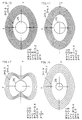
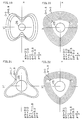
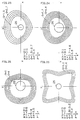
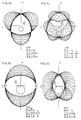
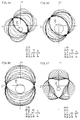
- Figs. 28 -37 representative families of curves of the composite trochoid are shown.
- the composite trochoid itself is shown with a thick line.
- the rotating piston must have at least two lateral edges which slides continuously on the lateral face of the tubular cavity. Therefore the outer envelope and the inner envelope of the family of curves of the composite trochoid must have at least two points of osculation, as shown in Figs. 28 - 37.
- the outer envelope and the inner envelope of the family of curves of the composite trochoid must have at least two points of osculation, as shown in Figs. 28 - 37.
- all composite trochoides shown in Figs. 15 - 26 as the contour of the normal section of the tubular cavity.
- the fixed point on the prolongation of the radius of the rolling circle of the trochoid generates a locus, as the idle circle rolls (not slides) along the circumference of the base circle of the trochoid.
- a composite trochoid characterized in that at least one idle circle is installed between a trochoid's base circle and its rolling circle a quasi-composite trochoid.
- the circle F 32 be a base circle F
- the circle E 33 be a rolling circle E.
- the rolling circle E and the base circle F generate a hypotrochoid.
- the circle A 35 may rotate on the generic point O of the hypotrochoid
- the rolling circle A and the base circle B generate a peritrochoid. Further we let the ratio between the generic radius of the peritrochoid and the radius a of the rolling circle A of the peritrochoid be h and express the generic radius of the peritrochoid as ha .
- the coordinates of the generic point ( v , w ) of a composite trochoid with the above structure can be expressed as below, provided that ⁇ c is the phase angle of the generic point ( v , w ) and that it is a constant.
- v ( f - e )cos( ⁇ + ⁇ )+( a - b )cos( ⁇ + ⁇ )+ ha cos( ⁇ + ⁇ c + ⁇ )
- w ( f - e )sin( ⁇ + ⁇ )+( a - b )sin( ⁇ + ⁇ )+ ha sin( ⁇ + ⁇ c + ⁇ )
- FIGs. 38 - 40 some representative families of curves expressed by equations (7) and (8) are shown.
- the composite trochoid generated by the generic point ( v , w ) is shown with a thick line.
- equations (7) and (8) express the coordinates of the generic point P of the composite trochoid expressed by equations (1) and (2).
- the curve determining the contour of the normal section of the tubular cavity in the housing is either the composite trochoid or the translated composite trochoid.
- Each of the vertices of the normal section of the rotating piston is either the generic point P of the composite trochoid, or it has the form of a circular arc whose centre is the generic point P of the composite trochoid and whose radius is equal to the fixed distance t.
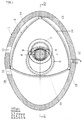
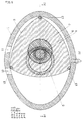
- the first embodiment (see Figs. 1 - 5, 9, and 10):
- the first embodiment is a rotary-piston engine having a structure wherein a housing contains a tubular cavity, wherein the curve determining the contour of the normal section of the tubular cavity is either a composite trochoid or a translated composite trochoid in which the composite trochoid has been parallelly translated outwards a fixed distance, wherein a rotating piston 3 is inserted into the tubular cavity, wherein all the edges of the rotating piston 3 slide continuously on the inside face of the tubular cavity, wherein the lateral faces of the rotating piston 3 and the inside face of the tubular cavity form three working chambers with changing volume, and wherein connecting ducts for gas exchange consist of an intake duct 10 and an exhaust duct 11.
- the rotating piston 3 For the contour of the normal section of the rotating piston 3 we generally use the inner envelope of the family of curves determining the contour of the normal section of the tubular cavity of the rotor housing 1. Because of this, the rotating piston 3 has the shape of a right prism with a quasi-trigonal normal section.
- Each of the three vertices of the quasi-trigonal normal section of the rotating piston 3 is either the generic point (one of the point P1, the point P2, and the point P3 in Fig. 10) of the composite trochoid, or it has the form of a circular arc whose centre is the generic point of the composite trochoid and whose radius equal to the fixed distance.
- the angles between each two of the three vertices of the quasi-trigonal normal section and the centre of the quasi-trigonal normal section are all 120 .
- apex seals 13 are attached to the three lateral edges of the rotating piston 3, and side seals 14 are attached to the edges of the two bases of the rotating piston 3.
- the intake duct 10 and the exhaust duct 11 make openings through the rotor housing 1 into the working chamber. Further an ignition plug 12 is installed in the rotor housing 1.
- both the intake duct 10 and the exhaust duct 11 can be installed in the side housing 2.
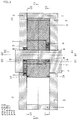
- a crank shaft 4 consists of a crank main shaft and a crank pin and is an output shaft.
- the axis of rotation of the crank shaft 4 is the axis of the crank main shaft.
- the crank main shaft is pierced through the side housings 2, in order that the crank main shaft and the tubular cavity should become coaxial.
- the distance between the axis (the origin O) of the crank main shaft and the axis (the point Q) of the crank pin is equal to the eccentric quantity OQ of the hypotrochoid.
- the function of the crank shaft 4 is equivalent to the function of the eccentric arm OQ of the hypotrochoid.
- a fixed gear A 5 is fixed to the side housing 2, in order that the fixed gear A 5 and the tubular cavity should become coaxial.
- the fixed gear A 5 is coaxial with the crank main shaft and is an internal gear.
- a rolling gear B 6 is attached to the crank pin and can rotate on the axis of the crank pin, with the axis of the rolling gear B 6 as the axis of rotation.
- the rolling gear B 6 is an external gear and is engaged with the fixed gear A 5.
- the geometric relation between the fixed gear A 5 and the rolling gear B 6 is the same as the relation between the hypotrochoid's fixed circle A 25 and its rolling circle B 26.
- the rolling gear B 6 rotates on the axis of the crank pin at the same time as it revolves around the axis of the crank main shaft.
- An eccentric shaft 7 consists of an eccentric main shaft and an eccentric wheel.
- the eccentric main shaft is attached to the crank pin and can rotate on the axis of the crank pin, with the axis of the eccentric main shaft as the axis of rotation. Further the eccentric main shaft is fixed to the rolling gear B 6, in order that the eccentric main shaft and the rolling gear B 6 should become coaxial. Therefore the axis of the eccentric wheel is the fixed point on the prolongation of the radius of the rolling gear B 6, and it is also the generic point (the point R) of the hypotrochoid.
- the distance between the axis (the point Q) of the eccentric main shaft and the axis (the point R) of the eccentric wheel is equal to the eccentric quantity QR of the peritrochoid, and it is also equal to the generic radius QR of the hypotrochoid.
- the function of the eccentric shaft 7 is equivalent to the function of the eccentric arm QR of the peritrochoid, and it is also equivalent to the function of the generic arm QR of the hypotrochoid.
- a fixed gear E 8 is fixed to the crank pin, in order that the fixed gear E 8 and the crank pin should become coaxial.
- the fixed gear E 8 is coaxial with the rolling gear B 6 and is an external gear.
- a rolling gear F 9 is attached to the eccentric wheel and can rotate on the axis of the eccentric wheel, with the axis of the rolling gear F 9 as the axis of rotation.
- the rolling gear F 9 is an internal gear and is engaged with the fixed gear E 8.
- the geometric relation between the fixed gear E 8 and the rolling gear F 9 is the same as the relation between the peritrochoid's base circle E 27 and its rolling circle F 28.
- the rotating piston 3 is fixed to the rolling gear F 9, in order that the rotating piston 3 and the rolling gear F 9 should become coaxial. Accordingly each of the three vertices of the quasi-trigonal normal section of the rotating piston 3 is the fixed point on the prolongation of the radius of the rolling gear F 9, and it is also the generic point (the point P) of the composite trochoid.
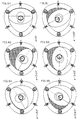
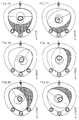
- the rotating piston 3 makes a planetary motion on the axis (the point Q) of the crank pin at the same time as it revolves around the axis (the origin O) of the crank main shaft. Because of this, the volume of the working chambers changes, the apex seal 13 opens and closes the intake duct 10 and the exhaust duct 11, and the combustion gas in the working chamber is exchanged. This way we get four strokes: an intake stroke (Figs. 42 - 45), a compression stroke (Figs. 46 - 48), a combustion/expansion stroke (Figs. 49 - 51), and an exhaust stroke (Figs. 52 - 53).
- the expansion pressure of the combustion gas changes into turning effort from the crank shaft 4.
- the angular velocity of the rotation of the rotating piston 3 is 1/3 of the angular velocity of the rotation of the crank shaft 4, and the direction of rotation of the rotating piston 3 is the same as the direction of rotation of the crank shaft 4.
- Figs. 42 - 53 show the operating situations after separate 90 changes in the angle of the crank shaft 4.
- Fig. 48 shows the operating situation after completion of the compression stroke. In this position we have ignition and combustion.
- Figs. 54 - 59 show the operating situations in the expansion stroke after separate 18 changes in the angle of the crank shaft 4. From Figs. 54 - 59 we see that near the top dead centre the change in the volume of the working chamber is very slow.
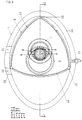
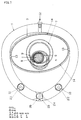
- the second embodiment is essentially identical with the rotary-piston engine of the first embodiment, except that the curve determining the contour of the normal section of the tubular cavity of the rotor housing 1 is a composite trochoid in which the ratio between the radius of the base circle A 25 and the radius of the rolling circle B 26 is 3:2, and the ratio between the radius of the base circle E 27 and the radius of the rolling circle F 28 is 1:2.
- the rotating piston 3 has the shape of a right prism with an oval normal section with two vertices, as shown in Fig. 32. Accordingly the lateral face of the tubular cavity of the rotor housing 1, the inside face of the side housings 2, and the lateral faces of the rotating piston 3 form two working chambers with changing volume.
- the angles between the two vertices of the oval normal section and the centre of the oval normal section are both 180 .
- the angular velocity of the rotation of the rotating piston 3 is 1/4 of the angular velocity of the rotation of the crank shaft 4, and the direction of rotation of the rotating piston 3 is the same as the direction of rotation of the crank shaft 4.
- the intake ducts 10 and the exhaust ducts 11 make openings through the rotor housing 1 into the working chambers.
- a rotary intake/exhaust valve 20 is installed both in the intake duct 10 and in the exhaust duct 11. Here opening and closing of both the intake duct 10 and the exhaust duct 11 is controlled by the rotary intake/exhaust valve 20. Further the rotary intake/exhaust valve 20 is controlled by the rotating motion of the rotating piston 3.
- the angular velocity of the rotation of the rotary intake/exhaust valve 20 is 1/8 of the angular velocity of the rotation of the crank shaft 4, and the direction of rotation of the rotary intake/exhaust valve 20 is the opposite of the direction of the rotation of the crank shaft 4.
- valves such as poppet valves, etc., instead of rotary valves.
- the structure of the rotary-piston engine of the second embodiment is identical with the structure of the rotary-piston engine of the first embodiment.
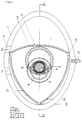
- the third embodiment (see Fig. 7):
- the third embodiment is essentially identical with the rotary-piston engine of the second embodiment, except that scavenging ducts 23 are opened through the rotor housing 1 into the working chamber.
- the intake duct 10, the exhaust duct 11, and the scavenging ducts 23 make openings through the rotor housing 1 into the working chambers.
- a rotary intake valve 22 is installed in the intake duct 10, a rotary exhaust valve 21 in the exhaust duct 11, and a rotary scavenging valve 24 in the scavenging duct 23.
- opening and closing of the intake duct 10 is controlled by the rotary intake valve 22, opening and closing of the exhaust duct 11 by the rotary exhaust valve 21, and opening and closing of the scavenging duct 23 by the rotary scavenging valve 24.
- the rotary intake valve 22, the rotary exhaust valve 21, and the rotary scavenging valve 24 are controlled by the rotating motion of the rotating piston 3.
- the angular velocity of the rotation of the rotary scavenging valve 24 is 1/4 of the angular velocity of the rotation of the crank shaft 4, and the direction of rotation of the rotary scavenging valve 24 is the opposite of the direction of rotation of the crank shaft 4.
- the angular velocity of the rotation of both the rotary intake valve 22 and the rotary exhaust valve 21 is 1/4 of the angular velocity of the rotation of the crank shaft 4, and the direction of rotation of both the rotary intake valve 22 and the rotary exhaust 21 valve is the same as the direction of rotation of the crank shaft 4.
- the structure of the rotary-piston engine of the third embodiment is identical with the structure of the rotary-piston engine of the second embodiment.
- the rotating piston 3 makes a planetary motion on the axis of the crank pin at the same time as it revolves around the axis of the crank main shaft, the volume of the working chambers changes.
- the rotary intake valve 22 opens and closes the intake duct 10
- the rotary exhaust valve 21 opens and closes the exhaust duct 11
- the rotary scavenging valve 24 opens and closes the scavenging ducts 23. Because of this, the combustion gas in the working chamber is exchanged. This way we get five strokes: a combustion/expansion stroke (Figs. 71 - 72), an exhaust stroke (Figs. 73 - 74), a scavenging stroke (Figs. 75 - 78), an intake stroke (Figs.
- Figs. 81 and 70 The expansion pressure of the combustion gas changes into turning effort from the crank shaft 4.
- Figs. 70 - 81 show the operating situations after separate 105 changes in the angle of the crank shaft 4.
- Fig. 70 shows the operating situation after completion of the compression stroke. In this position we have ignition and combustion.
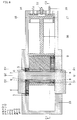
- the fourth embodiment is a reciprocating engine using a crank mechanism which exploits the reciprocating motion generated by the generic point of a composite trochoid, instead of the crank mechanism of the reciprocating engines in use to-day.
- a reciprocating type working chamber by installing a reciprocating piston 17 on the generic point of a composite trochoid and by putting a cylinder 16 together with it. Further we install a crank case 15 and install a poppet type intake valve 18, a poppet type exhaust valve 19, and an ignition plug 12 in the top of the cylinder 16.
- This structure is identical with that of the reciprocating engines in use to-day except its crank mechanism, and its operating situations are identical with those of the reciprocating engines in use to-day.
- the counter weights of Fig. 13 are omitted.
- the structure of the crank mechanism of this invented reciprocating engine is essentially identical with the structure consisting of the rotating piston 3, the eccentric shaft 7, the crank shaft 4, and the two gear units in the first embodiment, except that the ratio between the radius of the pitch circle of the fixed gear A 5 and the radius of the pitch circle of the rolling gear B 6 is 2:1, and except that the ratio between the radius of the pitch circle of the fixed gear E 8 and the radius of the pitch circle of the rolling gear F 9 is 1:2.
- the tilt ⁇ d of the composite trochoid becomes ⁇ b /2. Therefore the generic point of the composite trochoid generates a reciprocating motion, the prolongation of the composite trochoid passes through the origin O, the angle formed by the prolongation of the composite trochoid and the x -axis becomes ⁇ b /2, and the displacement of the composite trochoid becomes a cosine function with the amplitude 2 b and the variable ⁇ .
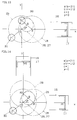
- Fig. 13 let the mass of the reciprocating piston 17 be M1 and its particle be the generic point P. Let the mass of a counter weight M2 30 be M2 and its particle be the point G. Let the mass of a counter weight M3 31 be M3 and its particle be the point Z. The point G and the point R are symmetric around the point Q. The point Z is on the circumference of the base circle A 25, and the phase angle between point Z and point Q is ⁇ .
- the point G and the point R need not be symmetric around the point Q, the point Z need not be on the circumference of the base circle A 25, and the phase angle between the point Z and the point Q need not be ⁇ .
- the engine of the fourth embodiment has the form of a reciprocating engine, it is, mechanically speaking, essentially a rotary-piston engine.
- a quasi-composite trochoid illustrated with Fig. 85 as the contour of the normal section of the tubular cavity in the housing.
Landscapes
- Engineering & Computer Science (AREA)
- Mechanical Engineering (AREA)
- General Engineering & Computer Science (AREA)
- Chemical & Material Sciences (AREA)
- Combustion & Propulsion (AREA)
- Physics & Mathematics (AREA)
- Geometry (AREA)
- Transmission Devices (AREA)
- Rotary Pumps (AREA)
- Retarders (AREA)
- Applications Or Details Of Rotary Compressors (AREA)
- Pistons, Piston Rings, And Cylinders (AREA)
Claims (6)
- Drehkolbenmotor mit Planetenbewegung, miteinem Gehäuse (1), das eine rohrförmige Kammer enthält, die als aufrechter, nicht kreisförmiger Zylinder geformt ist, der eine Achse (O1-O2) aufweist, wobei die rohrförmige Kammer, die an jedem Ende von zwei Seitengehäusen (2) begrenzt wird, geometrisch zwei Grundkörpern des aufrechten, nicht kreiförmigen Zylinders entspricht,einer Kurbelwelle (4), die eine Hauptwelle aufweist und die Seitengehäuse (2) der rohrförmigen Kammer entlang der Achse (O1-O2) durchdringt,einer exzentrischen Welle (7), die eine Hauptwelle aufweist und koaxial an einem Kurbelzapfen (Q1-Q2) der Kurbelwelle (4) angebracht ist,einem Drehkolben (3), der drehbar an der exzentrischen Welle (7) angebracht ist, wobei der Drehkolben (3) als aufrechtes Prisma geformt ist, das zwei Grundkörper aufweist, die kontinuierlich an dem Seitengehäuse (2) der rohrförmigen Kammer gleiten,einer ersten Getriebeeinheit und einer zweiten Getriebeeinheit, die angeordnet sind, um die Drehbewegung des Drehkolbens (3) auf die Drehbewegung der Kurbelwelle (4) zu übertragen, wobei die erste Getriebeeinheit ein erstes feststehendes Rad (5), das koaxial an dem einen der Seitengehäuse (2) der rohrförmigen Kammer festgelegt ist, und ein erstes drehbares Rad (6) aufweist, die miteinander in Eingriff stehen, wobei die zweite Getriebeeinheit ein zweites feststehendes Rad (8), das koaxial an dem Kurbelzapfen (Q1-Q2) festgelegt ist, und ein zweites drehbares Rad (9) aufweist, das koaxial an dem Drehkolben (3) festgelegt ist, wobei das zweite feststehende Rad (8) und das zweite drehbare Rad (9) die miteinander in Eingriff stehen, undVerbindungsleitungen (10, 11) für den Gasaustausch, deren Öffnen und Schließen von dem Drehkolben (3) gesteuert werden,
dadurch gekennzeichnet, daßder Umriß des Normalschnitts der rohrförmigen Kammer durch eine äußere Umhüllung einer Familie von Kurven definiert ist, die den Umriß des Normalschnitts des Drehkolben (3) bestimmen,der Umriß des Normalschnitts des Drehkolbens (3) durch eine zusammengesetzte Trochoide definiert ist, die aus einer Hypotrochoide und einer Peritrochoide zusammengesetzt ist, wobei der generische Punkt (v,w) der zusammengesetzten Trochoide durch ein erstes Paar von Parametergleichungen definiert ist:c(r-b) gleich der Länge des exzentrischen Armes der Hypotrochoide ist,(a-b) gleich der Länge des generischen Armes der Hypotrochoide und der Länge des exzentrischen Armes der Peritochoide ist,ha gleich der Länge des generischen Armes der Peritrochoide ist,ω die Winkelgeschwindigkeit des exzentrischen Armes der Hypotrochoide ist,(1-r/b)ω die Winkelgeschwindigkeit des generischen Armes der Hypotrochoide und auch die Winkelgeschwindigkeit des exzentrischen Armes der Peritrochoide ist,(1-r/b+r/a)ω die Winkelgeschwindigkeit des generischen Armes der Peritrochoide ist, undβc gleich dem Phasenwinkel des generischen Armes der Peritrochoide ist,die Hypotrochoide durch einen Grundkreis (32) mit dem Radius cr und einen Rollkreis (33) mit dem Radius cb erzeugt wird,die Peritrochoide durch einen Grundkreis (34) mit dem Radius b und einen Rollkreis (35) mit dem Radius a erzeugt wird,die Familie von Kurven durch ein zweites Paar von Parametergleichungen definiert ist:(a-b) gleich dem Abstand zwischen der Achse der Hauptwelle der Kurbelwelle (4) und der Achse des Kurbelzapfens der Kurbelwelle (4) ist,c(r-b) gleich dem Abstand zwischen der Achse der Hauptwelle der exzentrischen Welle (7) und einer Achse eines exzentrischen Rades an der exzentrischen Welle (7) ist, die Winkelgeschwindigkeit der Kurbelwelle (4) ist,(1-a/b) die Winkelgeschwindigkeit der exzentrischen Welle (7) ist,(1-a/b+a/r) die Winkelgeschwindigkeit des Drehkolbens (3) ist, undβ gleich dem Phasenwinkel des Drehkolbens (3) und dem Phasenwinkel der zusammengesetzten Trochoide ist,die Familie von Kurven geometrisch eine Struktur einer weiteren zusammengesetzten Trochoide aufweist, die aus einer weiteren Hypotrochoide und einer weiteren Peritrochoide zusammengesetzt ist,die weitere Hypotrochoide durch einen Basiskreis (25) mit dem Radius a und einen Rollkreis (26) mit dem Radius b erzeugt wird,die weitere Peritrochoide durch einen Grundkreis (27) mit dem Radius cb und einen Rollkreis (28) mit dem Radius cr erzeugt wird, wobei die Länge des exzentrischen Armes der weiteren Hypotrochoide gleich a-b ist, wobei die beiden Längen des generischen Armes der weiteren Hypotrochoide und des exzentrischen Armes der weiteren Peritrochoide gleich c(r-b) sind,der Drehkolben (3) geometrisch an dem Rollkreis (28) der weiteren Peritrochoide festgelegt ist, wobei die Winkelgeschwindigkeit des Drehkolbens (3) (1-a/b+a/r) ist, und wobei der Phasenwinkel des Drehkolbens (3) gleich β ist,die Kurbelwelle (4) sich wie der exzentrische Arm der weiteren Hypotrochoide bewegt, wobei die Winkelgeschwindigkeit der Kurbelwelle (4) ist, und wobei der Abstand zwischen der Achse der Hauptwelle der Kurbelwelle (4) und der Achse des Kurbelzapfens der Kurbelwelle (4) gleich a-b ist,die exzentrische Welle (7) sich wie der generische Arm der weiteren Hypotrochoide und wie der exzentrische Arm der weiteren Peritrochoide bewegt, wobei die Winkelgeschwindigkeit der exzentrischen Welle (7) (1-a/b) ist, und wobei der Abstand zwischen der Achse der Hauptwelle der exzentrischen Welle (7) und der Achse des exzentrischen Rades an der exzentrischen Welle (7) gleich c(r-b) ist,das erste feststehende Rad (5) koaxial zu der Hauptwelle der Kurbelwelle 849 ist und sich wie der Grundkreis (25) der weiteren Hypotrochoide bewegt,das erste drehbare Rad (6) sich wie der Rollkreis (26) weiteren Hypotrochoide bewegt,das zweite feststehende Rad (8) sich wie der Grundkreis (27) der weiteren Peritrochoide bewegt, unddas zweite drehbare Rad (9) sich wie der Rollkreis (28) der weiteren Peritrochoide bewegt. - Drehkolbenmotor mit Planetenbewegung nach Anspruch 1, wobei der Normalschnitt des Drehkolbens (3) einen Umriß aufweist, der zumindest zwei Scheitel hat, von denen jeder als Kreisbogen geformt ist, dessen Mitte einen generischen Punkt der weiteren zusammengesetzten Trochoide bildet, der durch w=0 undder Umriß des Normalschnitts der rohrförmigen Kammer durch eine äußere Umhüllung einer Familie von Kurven definiert ist, die die kreisbogenförmigen Scheitelpunkte des Umrisses des Normalschnitts des Drehkolbens (3) bestimmen.
- Drehkolbenmotor mit Planetenbewegung nach Anspruch 1, wobei der Umriß des Normalschnitts der rohrförmigen Kammer durch eine versetzte zusammengesetzte Trochoide definiert ist, bei welcher die weitere zusammengesetzte Trochoide, die durch w=0 undder Normalschnitt des Drehkolbens (3) einen Umriß aufweist, der zumindest zwei Scheitel hat, von denen jeder als Kreisbogen geformt ist, dessen Radius gleich dem festgelegten Abstand t ist und dessen Mitte einen generischen Punkt der weiteren zusammengesetzten Trochoide bildet, der durch w=0 und
- Drehkolbenmotor mit Planetenbewegung nach einem der Ansprüche 1-3, wobei das Verhältnis zwischen den Radien des Grundkreises und des Rollkreises der weiteren Hypotrochoide 2:1 ist und das Verhältnis zwischen den Radien des Grundkreises und des Rollkreises der weiteren Peritrochoide 2:3 ist.
- Drehkolbenmotor mit Planetenbewegung nach einem der Ansprüche 1-3, wobei das Verhältnis zwischen den Radien des Grundkreises und des Rollkreises der weiteren Hypotrochoide 2:1 ist und das Verhältnis zwischen den Radien des Grundkreises und des Rollkreises der weiteren Hypotrochoide 1:3 ist.
- Drehkolbenmotor mit Planetenbewegung nach einem der Ansprüche 1-3, wobei das Verhältnis zwischen den Radien des Grundkreises und des Rollkreises der weiteren Hypotrochoide 3:2 ist und das Verhältnis zwischen den Radien des Grundkreises und des Rollkreises der weiteren Hypotrochoide 1:2 ist.
Applications Claiming Priority (4)
| Application Number | Priority Date | Filing Date | Title |
|---|---|---|---|
| JP229863/91 | 1991-02-21 | ||
| JP22986391 | 1991-02-21 | ||
| JP3229863A JPH0819856B2 (ja) | 1991-02-21 | 1991-02-21 | 遊星運動型エンジン |
| PCT/JP1992/000175 WO1992014909A1 (fr) | 1991-02-21 | 1992-02-20 | Moteur a combustion interne a piston rotatif |
Publications (3)
| Publication Number | Publication Date |
|---|---|
| EP0594849A4 EP0594849A4 (de) | 1994-02-09 |
| EP0594849A1 EP0594849A1 (de) | 1994-05-04 |
| EP0594849B1 true EP0594849B1 (de) | 2000-05-10 |
Family
ID=16898881
Family Applications (1)
| Application Number | Title | Priority Date | Filing Date |
|---|---|---|---|
| EP92905097A Expired - Lifetime EP0594849B1 (de) | 1991-02-21 | 1992-02-20 | Drehkolben-verbrennungskraftmaschine |
Country Status (7)
| Country | Link |
|---|---|
| US (1) | US5399078A (de) |
| EP (1) | EP0594849B1 (de) |
| JP (1) | JPH0819856B2 (de) |
| KR (1) | KR100223699B1 (de) |
| AU (1) | AU1209292A (de) |
| DE (1) | DE69231034T2 (de) |
| WO (1) | WO1992014909A1 (de) |
Families Citing this family (25)
| Publication number | Priority date | Publication date | Assignee | Title |
|---|---|---|---|---|
| RU2120042C1 (ru) * | 1996-06-28 | 1998-10-10 | Валерий Александрович Лугинин | Роторный корпусно-поршневой двигатель внутреннего сгорания |
| FI101411B1 (fi) * | 1996-09-03 | 1998-06-15 | Risto Antero Auvinen | Voimansiirtolaite kiertomäntämoottoriin |
| US6164263A (en) * | 1997-12-02 | 2000-12-26 | Saint-Hilaire; Roxan | Quasiturbine zero vibration-continuous combustion rotary engine compressor or pump |
| US6526925B1 (en) | 1999-05-19 | 2003-03-04 | Willie A. Green, Jr. | Piston driven rotary engine |
| US6575719B2 (en) | 2000-07-27 | 2003-06-10 | David B. Manner | Planetary rotary machine using apertures, volutes and continuous carbon fiber reinforced peek seals |
| WO2002075118A1 (fr) * | 2001-03-15 | 2002-09-26 | Normand Beaudoin | Machines poly inductives et turbines differentielles |
| US7178502B2 (en) * | 2001-06-05 | 2007-02-20 | Paul D. Okulov | Balanced rotary internal combustion engine or cycling volume machine |
| FR2872859B1 (fr) * | 2004-07-08 | 2006-08-25 | Pham Pascal Andre Georges Ha | Moteur a piston rotatif tripode 6 temps |
| KR100680775B1 (ko) * | 2004-09-24 | 2007-02-09 | 주식회사 원택 | 로터리 엔진 |
| WO2007060688A1 (en) | 2005-11-24 | 2007-05-31 | Vikrant Dhoke | A high efficiency rotary internal combustion engine |
| CN101149017A (zh) * | 2006-09-18 | 2008-03-26 | 谭波 | 旋转活塞的固定轴结构 |
| RU2382216C2 (ru) * | 2008-05-05 | 2010-02-20 | Николай Леонович Черников | Двухтактный роторно-поршневой двигатель |
| CN101576005B (zh) * | 2008-05-07 | 2011-04-20 | 华峰 | 橄榄形转子发动机 |
| CZ302294B6 (cs) * | 2008-07-29 | 2011-02-09 | Dvorák@Jirí | Rotacní motor na stlacitelná média |
| GR1006627B (el) * | 2009-01-12 | 2009-12-08 | Δημητριος Χανιωτης | Τρικεντρη λοβοειδης περιστροφικη μηχανη |
| US8539931B1 (en) * | 2009-06-29 | 2013-09-24 | Yousry Kamel Hanna | Rotary internal combustion diesel engine |
| JP5198691B1 (ja) * | 2012-08-18 | 2013-05-15 | 浩平 岸高 | ロータリーエンジン |
| US20150240638A1 (en) * | 2012-08-31 | 2015-08-27 | The Regents Of The University Of California | Technique for apex-seal profile design |
| CZ306225B6 (cs) * | 2014-05-22 | 2016-10-12 | Jiří Dvořák | Rotační motor s ozubeným převodem pro použití pohonu stlačitelným médiem |
| KR20160046527A (ko) | 2014-10-21 | 2016-04-29 | 김헌규 | 삼각형상의 실린더를 가진 내연기관에서 타원형 로터의 피스톤 실링 구조 |
| DE102014223142A1 (de) * | 2014-11-13 | 2016-05-19 | Robert Bosch Gmbh | Rotationskolbenmaschine |
| CN105863830A (zh) * | 2016-05-20 | 2016-08-17 | 左方 | 卫星轮转子发动机 |
| US10082029B2 (en) | 2016-07-08 | 2018-09-25 | Pratt & Whitney Canada Corp. | Internal combustion engine with rotor having offset peripheral surface |
| US10907531B1 (en) * | 2018-07-24 | 2021-02-02 | Rotary Research Group LLC | Heavy fuel rotary engine with compression ignition |
| US12540572B2 (en) * | 2023-10-06 | 2026-02-03 | Uditi CHANDRASHEKHAR | Rotary piston machine |
Family Cites Families (10)
| Publication number | Priority date | Publication date | Assignee | Title |
|---|---|---|---|---|
| DE1158752B (de) * | 1961-05-25 | 1963-12-05 | Daimler Benz Ag | Rotationskolben-Brennkraftmaschine |
| US3226013A (en) * | 1964-05-04 | 1965-12-28 | Toyota Motor Co Ltd | Rotary machine |
| US3716314A (en) * | 1970-12-16 | 1973-02-13 | Nissan Motor | Rotary motion device |
| GB1350728A (en) * | 1972-06-15 | 1974-04-24 | Dornier System Gmbh | Trochoid-type rotary piston machine |
| CH545413A (de) * | 1972-08-19 | 1973-12-15 | M Guenthard Ernst | Drehkolben-Brennkraftmaschine |
| DE2510149C3 (de) * | 1975-03-08 | 1982-01-21 | Audi Nsu Auto Union Ag, 7107 Neckarsulm | Gehäuse einer Kreiskolbenmaschine in Trochoidenbauart |
| JPS51104110A (ja) * | 1975-03-10 | 1976-09-14 | Masaaki Kusano | Rootariipisutonnainenkikan |
| US4417862A (en) * | 1981-09-03 | 1983-11-29 | Fenton John W | Rotary motor with multilobed rotor and orbiting coupling means |
| JPS6039361A (ja) * | 1983-08-11 | 1985-03-01 | ジヨン・フエントン | 回転モ−タ |
| US5067456A (en) * | 1990-11-16 | 1991-11-26 | Beachley Norman H | Hypocycloid engine |
-
1991
- 1991-02-21 JP JP3229863A patent/JPH0819856B2/ja not_active Expired - Fee Related
-
1992
- 1992-02-20 DE DE69231034T patent/DE69231034T2/de not_active Expired - Fee Related
- 1992-02-20 AU AU12092/92A patent/AU1209292A/en not_active Abandoned
- 1992-02-20 WO PCT/JP1992/000175 patent/WO1992014909A1/ja not_active Ceased
- 1992-02-20 KR KR1019930702390A patent/KR100223699B1/ko not_active Expired - Fee Related
- 1992-02-20 EP EP92905097A patent/EP0594849B1/de not_active Expired - Lifetime
- 1992-02-20 US US08/107,695 patent/US5399078A/en not_active Expired - Lifetime
Also Published As
| Publication number | Publication date |
|---|---|
| AU1209292A (en) | 1992-09-15 |
| DE69231034T2 (de) | 2001-02-15 |
| JPH0819856B2 (ja) | 1996-02-28 |
| JPH07109930A (ja) | 1995-04-25 |
| US5399078A (en) | 1995-03-21 |
| EP0594849A4 (de) | 1994-02-09 |
| EP0594849A1 (de) | 1994-05-04 |
| WO1992014909A1 (fr) | 1992-09-03 |
| DE69231034D1 (de) | 2000-06-15 |
| KR100223699B1 (ko) | 1999-10-15 |
| KR930703523A (ko) | 1993-11-30 |
Similar Documents
| Publication | Publication Date | Title |
|---|---|---|
| EP0594849B1 (de) | Drehkolben-verbrennungskraftmaschine | |
| US3996901A (en) | Rotary piston mechanism | |
| AU2003303875B2 (en) | Rotary engine | |
| US4096828A (en) | Rotary piston internal combustion engine | |
| EP1300563B1 (de) | Brennkraftmaschine | |
| US4877379A (en) | Rotary mechanism for three-dimensional volumetric change | |
| US3950117A (en) | Machine with rotary articulated pistons | |
| KR100266999B1 (ko) | 왕복 및 회전 피스톤을 구비한, 특히 4행정 기관인 용적형 기계 | |
| US3918415A (en) | Rotary internal combustion engine | |
| US20070119408A1 (en) | Rotary machine with major and satellite rotors | |
| KR101866558B1 (ko) | 6행정 로터리 엔진 | |
| US4417862A (en) | Rotary motor with multilobed rotor and orbiting coupling means | |
| JP2509514B2 (ja) | ロ―タリ―エンジン | |
| US4036566A (en) | Fluid displacement apparatus | |
| EP1642003A1 (de) | Rotationsmaschine mit haupt- und satellitenrotoren | |
| JPH01134001A (ja) | 回転ピストン移動装置 | |
| US4144865A (en) | Fluid displacement apparatus | |
| JPS6039361A (ja) | 回転モ−タ | |
| KR960011722B1 (ko) | 로터리 엔진 | |
| RU2731210C2 (ru) | Двигатель внутреннего сгорания роторно-лопастного типа | |
| JPS63295818A (ja) | ロ−タリエンジン | |
| JPS63192901A (ja) | フルロ−タリ−機関 | |
| KR200318394Y1 (ko) | 로터리엔진 | |
| WO1984003124A1 (en) | Rotary piston mechanism | |
| CA2084215A1 (en) | Rotary internal combustion engine |
Legal Events
| Date | Code | Title | Description |
|---|---|---|---|
| PUAI | Public reference made under article 153(3) epc to a published international application that has entered the european phase |
Free format text: ORIGINAL CODE: 0009012 |
|
| 17P | Request for examination filed |
Effective date: 19930818 |
|
| AK | Designated contracting states |
Kind code of ref document: A1 Designated state(s): AT BE CH DE DK ES FR GB GR IT LI LU NL SE |
|
| RBV | Designated contracting states (corrected) |
Designated state(s): DE FR GB IT SE |
|
| K1C3 | Correction of patent application (complete document) published |
Effective date: 19940504 |
|
| 17Q | First examination report despatched |
Effective date: 19961219 |
|
| GRAG | Despatch of communication of intention to grant |
Free format text: ORIGINAL CODE: EPIDOS AGRA |
|
| GRAG | Despatch of communication of intention to grant |
Free format text: ORIGINAL CODE: EPIDOS AGRA |
|
| GRAH | Despatch of communication of intention to grant a patent |
Free format text: ORIGINAL CODE: EPIDOS IGRA |
|
| GRAH | Despatch of communication of intention to grant a patent |
Free format text: ORIGINAL CODE: EPIDOS IGRA |
|
| GRAA | (expected) grant |
Free format text: ORIGINAL CODE: 0009210 |
|
| AK | Designated contracting states |
Kind code of ref document: B1 Designated state(s): DE FR GB IT SE |
|
| PG25 | Lapsed in a contracting state [announced via postgrant information from national office to epo] |
Ref country code: IT Free format text: LAPSE BECAUSE OF FAILURE TO SUBMIT A TRANSLATION OF THE DESCRIPTION OR TO PAY THE FEE WITHIN THE PRESCRIBED TIME-LIMIT;WARNING: LAPSES OF ITALIAN PATENTS WITH EFFECTIVE DATE BEFORE 2007 MAY HAVE OCCURRED AT ANY TIME BEFORE 2007. THE CORRECT EFFECTIVE DATE MAY BE DIFFERENT FROM THE ONE RECORDED. Effective date: 20000510 Ref country code: FR Free format text: LAPSE BECAUSE OF FAILURE TO SUBMIT A TRANSLATION OF THE DESCRIPTION OR TO PAY THE FEE WITHIN THE PRESCRIBED TIME-LIMIT Effective date: 20000510 |
|
| REF | Corresponds to: |
Ref document number: 69231034 Country of ref document: DE Date of ref document: 20000615 |
|
| PG25 | Lapsed in a contracting state [announced via postgrant information from national office to epo] |
Ref country code: SE Free format text: LAPSE BECAUSE OF FAILURE TO SUBMIT A TRANSLATION OF THE DESCRIPTION OR TO PAY THE FEE WITHIN THE PRESCRIBED TIME-LIMIT Effective date: 20000810 |
|
| EN | Fr: translation not filed | ||
| PG25 | Lapsed in a contracting state [announced via postgrant information from national office to epo] |
Ref country code: GB Free format text: LAPSE BECAUSE OF NON-PAYMENT OF DUE FEES Effective date: 20010220 |
|
| PLBE | No opposition filed within time limit |
Free format text: ORIGINAL CODE: 0009261 |
|
| STAA | Information on the status of an ep patent application or granted ep patent |
Free format text: STATUS: NO OPPOSITION FILED WITHIN TIME LIMIT |
|
| 26N | No opposition filed | ||
| GBPC | Gb: european patent ceased through non-payment of renewal fee |
Effective date: 20010220 |
|
| PGFP | Annual fee paid to national office [announced via postgrant information from national office to epo] |
Ref country code: DE Payment date: 20020212 Year of fee payment: 11 |
|
| PG25 | Lapsed in a contracting state [announced via postgrant information from national office to epo] |
Ref country code: DE Free format text: LAPSE BECAUSE OF NON-PAYMENT OF DUE FEES Effective date: 20030902 |