EP0594985A1 - Serrure à gâchette avec gâchettes rotatives - Google Patents
Serrure à gâchette avec gâchettes rotatives Download PDFInfo
- Publication number
- EP0594985A1 EP0594985A1 EP93114186A EP93114186A EP0594985A1 EP 0594985 A1 EP0594985 A1 EP 0594985A1 EP 93114186 A EP93114186 A EP 93114186A EP 93114186 A EP93114186 A EP 93114186A EP 0594985 A1 EP0594985 A1 EP 0594985A1
- Authority
- EP
- European Patent Office
- Prior art keywords
- beard
- tumblers
- bulge
- key
- point
- Prior art date
- Legal status (The legal status is an assumption and is not a legal conclusion. Google has not performed a legal analysis and makes no representation as to the accuracy of the status listed.)
- Granted
Links
Images



Classifications
-
- E—FIXED CONSTRUCTIONS
- E05—LOCKS; KEYS; WINDOW OR DOOR FITTINGS; SAFES
- E05B—LOCKS; ACCESSORIES THEREFOR; HANDCUFFS
- E05B21/00—Locks with lamelliform tumblers which are not set by the insertion of the key and in which the tumblers do not follow the movement of the bolt e.g. Chubb-locks
Definitions
- the invention relates to a tumbler lock with a plurality of swivel tumblers mounted on a common tumbler rotation axis and with a beard key which attacks with different beard levels on an approximately arcuate bulge of a swivel tumbler, the bulges being congruent in particular and one adjacent to the entry of the beard step into the bulge Point of attack for the respective, differently long beard level of the key beard is arranged.
- Such a tumbler lock is known from DE-PS 16 78 021 or DE-PS 19 04 486 for a double-bit key with a corresponding all-round closed recess with two bulges on the swivel tumblers. Due to the pivoting of the swivel tumblers, existing tour channels are arranged on the individual tumblers at different locations on their end faces so that a tour pin or stud of the bolt belonging to the lock can enter these tour channels when it is opened.
- the invention is therefore based on the object to provide a tumbler lock of the type mentioned, in which the points of attack for the beard steps on the Tumblers do not allow conclusions to be drawn about the length of the beard, not even after a long period of actuation.
- a cam-like projection is provided as the actuating cam as the point of attack on the respective tumbler at the area immediately adjacent to the entry into the bulge, and that the part of the tumbler adjoining it on the side of the actuating cam facing away from the inlet is also recessed and / or that the key bit on its flank facing the point of attack at least the longer step or steps has such a rounding, recess, bevel or similar deformation that the point of attack of the key bit is shifted from the actually extreme beard length to the center of the key axis.
- the actuating cams on the recessed tumblers can be practically achieved by removing the previous contact surface except for the actuating cams or by forming a recess. There then remains practically only one such actuating cam for the attack of the key bit, on which then beard steps of different lengths attack each in approximately the same way and thus also in the same place, so that no conclusions can be drawn about the respective length of the beard steps taking effect on the individual tumblers are more possible, even if longer wear occurs or appropriate coloring is carried out.
- a bevel on the actuating flank of the key bit facilitates interaction with the actuating cam, thus improving the operability of the tumbler lock, which is safer due to an actuating cam on the tumblers.
- This invention is particularly advantageous when the tumblers have congruent cutouts, be it for simple beard keys or, above all, for double beard keys.
- the unauthorized user can then neither draw conclusions about the beard gradation of the key by sensing the recesses nor by traces of use, for example, on colored tumblers.
- the actuating cam is rounded at its most projecting point and in particular also at the transition and entry into the bulge of the tumbler.
- flanks of all beard levels of the key bit used to pivot the tumblers have a particularly matching one have a convex or spherical cross-sectional shape, the point of greatest cross-sectional thickness of the beard being provided in particular at all beard levels and, when the lock is opened, impinging on the area adjacent to the entry into the bulges at a matching point of attack and rubbing and touching this point of attack when pivoting.
- An embodiment of the invention of its own worthy of protection can be applied to a tumbler lock of the type mentioned at the beginning, in which the pivot tumblers each have approximately rectangular, closed recesses, on each of which bulges, in particular congruent bulges, are provided, which are provided by a Envelope are formed according to DE Patent 1,678,021. While a longitudinal axis of the "rectangle" with bulge and actuating cams serves to pivot the tumblers, in particular against gravity, the opposite recess with the beard part of the double-bit key acting on it serves to forcibly pivot and force control without the influence of gravity and without the risk of an unwanted pivoting of a tumbler To allow frictional forces against a neighboring tumbler.
- Such a lock could possibly even be used turned through 180 degrees.
- the envelope curve for producing the corresponding bulge or cutout there is a point at which all the circles forming this envelope curve intersect or very much come close, this point also projects slightly towards the inside of the recess compared to the actual envelope curve.
- the key bit detects this point at an angle at which the tumblers are arranged in such a way that the touring pin can enter the touring channels, and at the same time the bolt is shifted from the key bit so that a first entry into these touring channels already begins or begins Has.
- the above-mentioned protection-worthy embodiment of the invention consists in that at least in the direction of movement of the key bit during the opening movement adjacent to the Interface of the circles forming the envelope curve, the bulge corresponding to the envelope curve is further recessed from the envelope curve, so that the beard steps in this area are at a distance from the bulge.
- the forced control of the recesses is maintained until the tour pin enters the touring channels of the tumblers, that is to say fixes them against further pivoting, and then in the further course it is not necessary to define the tumblers by the key itself.
- the guard locking is forcibly determined by the respective key bit on the retained envelope curve as a cut-out limitation so that this entry can be made with certainty. Since this area is only very short, it does not allow any conclusions to be drawn about the length of the beard step, even if it is worn or stained and the paint is scraped away.
- traces of abrasion is also made more difficult, whether after prolonged use or after abrasion of a previously sprayed substance, in particular paint, when the individual tumblers are in contact with one another with friction.
- a first pivoted tumbler can then take the neighboring tumbler a little way, so that this also obscures an exact point of attack of the associated key bit and in particular such an attack on the actuating cam and on the tumbler bulge opposite the actuating cam.
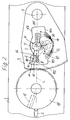
- tumbler 3 From a tumbler lock, as is known for example from DE-PS 16 78 021, only part of the bolt 1, the bolt studs or tour pin 2 arranged thereon and a swivel tumbler, hereinafter referred to as tumbler 3, are shown in FIG.
- the key 4 can also be seen, its shaft 5 being arranged on the end face, from which the differently graded two beard steps 6 and 7 project radially and opposite one another.
- this recess 10 Approximately in the middle of the tumblers 3 there is a recess 10 in which the double-bit key 4 engages.
- the basic shape of this recess 10 is a rectangle delimited approximately by lines 101, 102, 103, 104, 105 and 106. Lines 101, 106 and 103, 104 form the long sides and lines 102 and 105 the narrow sides of this rectangle.
- the key is inserted into the keyhole in the position shown in solid lines in FIGS. 1 and 2, although it is already pivoted by a small angle with respect to the actual insertion position, as a result of which the flank 13 used to pivot the tumblers the key bit 6 and its transition 14 to the top 15 of the inside of the line 101, that is, the actuation point on the tumbler 3 approaches.
- this embodiment would also be possible with a guard locking that only with a simple key is actuated, in which the lower part of the recess 10 is missing or could be open at the bottom.
- a closed recess 10 which is important for forced pivoting, is provided for interacting with a double bit. So that the second beard 7 does not leave any traces of wear on the bulge 12, this is recessed next to the point at which the key acc. the dash-dotted representation in Fig.1, 2 and 4 the tumblers 3 after a rotation by about 65 degrees has pivoted so far that the tour pin 2 straight into the tour channel 17 on the front side of the tumbler 3 (Fig.1) or on the turntable 18 (Fig. 2 and 3) can occur.
- This point at which all steps of the second beard 7 should have an exact contact with the bulge 12 or recess 10 is the point at which the circles forming the envelope of the congruent recess 10 intersect or come very close and which in the exemplary embodiment are compared to the actual bulge 12, which is recessed somewhat more with respect to the envelope curve, than control cam 19 projecting inwards.
- the respective step of the key bit 7 can position the tumbler 3 exactly when the key has to align the tour channel 17 precisely with the tour pin 2 after a rotation of about 65 degrees, so that this tour pin 2 in this pivoted position can enter the tour channel 17.
- the beard 7 can have so much play with respect to the tumblers 3 that there is no longer any appreciable or trace friction.
- the actuating cam 16 is rounded at its most projecting point and also at the transition and entry into the recess or bulge 11 of the tumbler, so that the flank 13 of the key bit 6 largely rolls on this actuating cam 16 during the pivoting movement and can thereby largely prevent wear. At the same time it is achieved that the transition 14 and the upper side 15 can slide well into the bulge 11, as is indicated by the dash-dotted representation in FIG.
- a counter-toothing 22 of the rotatable disk 18 acts on an end toothing 21 of the tumblers 3, which then has the tour channel 17 for cooperation with the tour pin 2.
- Such locks according to Figure 2 allow, after a certain time to change the assignment of the gradation of a key to the lock by moving the toothing apart, then inserting the new key and pivoting the tumblers accordingly due to their congruent recesses and then bringing the toothing together again.
- tour channel 17 is arranged opposite tour pin 2, only the new key now fits.
- flanks 13 of all beard levels 8 have a matching convex or spherical cross-sectional shape, which is curved and arranged in such a way that when the lock is opened, all tumblers 3 are acted upon at the same point, that is to say at the area adjacent to the entry into the bulges 11, at a corresponding point of attack .
- the point of greatest cross-sectional thickness of the beard 6 is provided at this point and coincides with the respectively corresponding point of attack, which corresponds approximately to the point at which the actuating cam 16 is arranged in the exemplary embodiment according to FIGS. 1 to 3.
- the projecting shape of the cam 16 is replaced by an analogous projecting or curved shape of the key bit flank 13.
- a control cam 19 is also provided on the opposite bulge 12, as in the exemplary embodiments according to FIGS. 1 to 3. In the manner already described, this prevents conclusions about the length of the beard steps of the opposite key bit 7 in the region of the bulge 12.
- the recesses 10 of the tumblers can also be used when using a spherical actuating key bit be congruent and therefore also exclude conclusions about the beard levels.
- the tumbler lock with swivel tumblers 3 and a beard key 4 has matching points of attack for several beard levels on the individual tumblers 3 in that an actuating cam projects on the respective tumbler, particularly near the entrance to a bulge 11, and / or the flank 13 of the key bit that acts on the point of attack 6 is rounded or convexly rounded and thus rolls on this corresponding point of attack when the key is turned, regardless of how long the individual beard step extends from this common point of contact in the radial direction.
Landscapes
- Adornments (AREA)
- Lock And Its Accessories (AREA)
- Toys (AREA)
- Table Devices Or Equipment (AREA)
- Rotary Pumps (AREA)
Applications Claiming Priority (2)
| Application Number | Priority Date | Filing Date | Title |
|---|---|---|---|
| DE4236201A DE4236201C1 (de) | 1992-10-27 | 1992-10-27 | Zuhaltungsschloß mit Schwenkzuhaltungen |
| DE4236201 | 1992-10-27 |
Publications (2)
| Publication Number | Publication Date |
|---|---|
| EP0594985A1 true EP0594985A1 (fr) | 1994-05-04 |
| EP0594985B1 EP0594985B1 (fr) | 1996-01-03 |
Family
ID=6471435
Family Applications (1)
| Application Number | Title | Priority Date | Filing Date |
|---|---|---|---|
| EP93114186A Expired - Lifetime EP0594985B1 (fr) | 1992-10-27 | 1993-09-04 | Serrure à gâchette avec gâchettes rotatives |
Country Status (3)
| Country | Link |
|---|---|
| EP (1) | EP0594985B1 (fr) |
| AT (1) | ATE132565T1 (fr) |
| DE (2) | DE4236201C1 (fr) |
Citations (2)
| Publication number | Priority date | Publication date | Assignee | Title |
|---|---|---|---|---|
| DE1904486A1 (de) * | 1969-01-30 | 1970-08-20 | Kromer Kg Theodor | Zuhaltungsschloss mit Kontrollsperre |
| DE1678021A1 (de) * | 1967-07-05 | 1971-07-22 | Kromer Kg Theodor | Zuhaltungsschloss mit einem Doppelbartschluessel |
Family Cites Families (3)
| Publication number | Priority date | Publication date | Assignee | Title |
|---|---|---|---|---|
| DE76190C (de) * | F. MANN und H. H. AKERS in Hornsey Rise, Grfsch. Middlesex, England | Schlofs mit Chubbzuhaltungen und Ringstufen am Schlüsselschaft | ||
| DE1061226B (de) * | 1955-04-21 | 1959-07-09 | Theodor Kromer | Schluessel, insbesondere Zweibartschluessel, fuer Protektorschloesser und aehnliche Drehzylinderschloesser |
| GB2153425B (en) * | 1984-01-23 | 1987-12-16 | Enviroment Secretary Of State | Lever lock |
-
1992
- 1992-10-27 DE DE4236201A patent/DE4236201C1/de not_active Expired - Fee Related
-
1993
- 1993-09-04 DE DE59301321T patent/DE59301321D1/de not_active Expired - Lifetime
- 1993-09-04 AT AT93114186T patent/ATE132565T1/de not_active IP Right Cessation
- 1993-09-04 EP EP93114186A patent/EP0594985B1/fr not_active Expired - Lifetime
Patent Citations (2)
| Publication number | Priority date | Publication date | Assignee | Title |
|---|---|---|---|---|
| DE1678021A1 (de) * | 1967-07-05 | 1971-07-22 | Kromer Kg Theodor | Zuhaltungsschloss mit einem Doppelbartschluessel |
| DE1904486A1 (de) * | 1969-01-30 | 1970-08-20 | Kromer Kg Theodor | Zuhaltungsschloss mit Kontrollsperre |
Also Published As
| Publication number | Publication date |
|---|---|
| DE59301321D1 (de) | 1996-02-15 |
| EP0594985B1 (fr) | 1996-01-03 |
| ATE132565T1 (de) | 1996-01-15 |
| DE4236201C1 (de) | 1994-04-28 |
Similar Documents
| Publication | Publication Date | Title |
|---|---|---|
| EP0335069B1 (fr) | Clef plate pour serrures cylindriques ainsi que sa serrure cylindrique | |
| EP0851079B1 (fr) | Serrure cylindrique | |
| DE8035193U1 (de) | Schluessel fuer einen schliesszylinder | |
| DE19549053C2 (de) | Sicherheitsschloß mit einem Schließzylinder und einem Schlüssel mit flachem Schaft | |
| EP1212500B1 (fr) | Dispositif de fermeture, en particulier pour vehicules a moteur | |
| EP1482109B1 (fr) | Serrure cylindrique avec clef | |
| DE1905859A1 (de) | Zylinderschloss mit Stechschluesel und plattenfoermigen Zuhaltungen | |
| DE2910886A1 (de) | Verschlussanlage | |
| DE3736129C2 (fr) | ||
| EP0607993B1 (fr) | Ensemble de serrures à cylindre, une serrure à cylindre pour former un tel ensemble, dispositif de verrouillage hierarchique à la base d'un tel ensemble, clé pour la serrure à cylindre et méthode de fabrication de la clé | |
| DE2546551C3 (de) | Zylinderschloß mit Flachschlüssel | |
| EP1251223A1 (fr) | Clefs d'une système de clef passe-partout | |
| DE3021334C2 (fr) | ||
| EP0594985B1 (fr) | Serrure à gâchette avec gâchettes rotatives | |
| EP0215383A1 (fr) | Serrure de sécurité | |
| DE3016393A1 (de) | Schliessvorrichtung | |
| DE1678021C3 (fr) | ||
| DE4430807A1 (de) | Schließzylinder, Gruppe von Schließzylindern, Schließanlage, Flachschlüssel, Gruppe von Flachschlüsseln, Verfahren zur Herstellung eines Schlüssels und Verfahren zur Herstellung einer Gruppe von Schließzylindern | |
| DE102006058558B4 (de) | Wendeschlüssel für Profilzylinder | |
| EP0582787B1 (fr) | Serrure de sécurité pour conteneurs d'objets de valeur | |
| DE667248C (de) | Schloss | |
| DE1904486A1 (de) | Zuhaltungsschloss mit Kontrollsperre | |
| DE2345497C2 (de) | Türverschluß mit Fallen- und Sicherheitsriegel | |
| DE10127705A1 (de) | Schließzylinder für insbesondere an Fahrzeugen vollziehbare Schließfunktionen | |
| DE3626552A1 (de) | Zylinderschloss mit flachschluessel |
Legal Events
| Date | Code | Title | Description |
|---|---|---|---|
| PUAI | Public reference made under article 153(3) epc to a published international application that has entered the european phase |
Free format text: ORIGINAL CODE: 0009012 |
|
| 17P | Request for examination filed |
Effective date: 19940216 |
|
| AK | Designated contracting states |
Kind code of ref document: A1 Designated state(s): AT CH DE FR IT LI NL |
|
| 17Q | First examination report despatched |
Effective date: 19950510 |
|
| GRAA | (expected) grant |
Free format text: ORIGINAL CODE: 0009210 |
|
| AK | Designated contracting states |
Kind code of ref document: B1 Designated state(s): AT CH DE FR IT LI NL |
|
| REF | Corresponds to: |
Ref document number: 132565 Country of ref document: AT Date of ref document: 19960115 Kind code of ref document: T |
|
| REF | Corresponds to: |
Ref document number: 59301321 Country of ref document: DE Date of ref document: 19960215 |
|
| ITF | It: translation for a ep patent filed | ||
| REG | Reference to a national code |
Ref country code: CH Ref legal event code: NV Representative=s name: HANS RUDOLF GACHNANG PATENTANWALT |
|
| ET | Fr: translation filed | ||
| PLBE | No opposition filed within time limit |
Free format text: ORIGINAL CODE: 0009261 |
|
| 26N | No opposition filed | ||
| REG | Reference to a national code |
Ref country code: CH Ref legal event code: PFA Free format text: THEODOR KROMER GMBH & CO.KG SPEZIALFABRIK FUER SICHERHEITSSCHLOESSER TRANSFER- THEODOR KROMER GMBH UNTERNEHMENSGRUPPE UNICAN |
|
| REG | Reference to a national code |
Ref country code: FR Ref legal event code: CD |
|
| PGFP | Annual fee paid to national office [announced via postgrant information from national office to epo] |
Ref country code: FR Payment date: 20020910 Year of fee payment: 10 |
|
| PGFP | Annual fee paid to national office [announced via postgrant information from national office to epo] |
Ref country code: CH Payment date: 20020924 Year of fee payment: 10 |
|
| PGFP | Annual fee paid to national office [announced via postgrant information from national office to epo] |
Ref country code: AT Payment date: 20020927 Year of fee payment: 10 |
|
| PGFP | Annual fee paid to national office [announced via postgrant information from national office to epo] |
Ref country code: NL Payment date: 20020930 Year of fee payment: 10 |
|
| PG25 | Lapsed in a contracting state [announced via postgrant information from national office to epo] |
Ref country code: AT Free format text: LAPSE BECAUSE OF NON-PAYMENT OF DUE FEES Effective date: 20030904 |
|
| PG25 | Lapsed in a contracting state [announced via postgrant information from national office to epo] |
Ref country code: LI Free format text: LAPSE BECAUSE OF NON-PAYMENT OF DUE FEES Effective date: 20030930 Ref country code: CH Free format text: LAPSE BECAUSE OF NON-PAYMENT OF DUE FEES Effective date: 20030930 |
|
| PG25 | Lapsed in a contracting state [announced via postgrant information from national office to epo] |
Ref country code: NL Free format text: LAPSE BECAUSE OF NON-PAYMENT OF DUE FEES Effective date: 20040401 |
|
| REG | Reference to a national code |
Ref country code: CH Ref legal event code: PL |
|
| PG25 | Lapsed in a contracting state [announced via postgrant information from national office to epo] |
Ref country code: FR Free format text: LAPSE BECAUSE OF NON-PAYMENT OF DUE FEES Effective date: 20040528 |
|
| NLV4 | Nl: lapsed or anulled due to non-payment of the annual fee |
Effective date: 20040401 |
|
| REG | Reference to a national code |
Ref country code: FR Ref legal event code: ST |
|
| PG25 | Lapsed in a contracting state [announced via postgrant information from national office to epo] |
Ref country code: IT Free format text: LAPSE BECAUSE OF NON-PAYMENT OF DUE FEES;WARNING: LAPSES OF ITALIAN PATENTS WITH EFFECTIVE DATE BEFORE 2007 MAY HAVE OCCURRED AT ANY TIME BEFORE 2007. THE CORRECT EFFECTIVE DATE MAY BE DIFFERENT FROM THE ONE RECORDED. Effective date: 20050904 |
|
| PGFP | Annual fee paid to national office [announced via postgrant information from national office to epo] |
Ref country code: DE Payment date: 20100929 Year of fee payment: 18 |
|
| REG | Reference to a national code |
Ref country code: DE Ref legal event code: R119 Ref document number: 59301321 Country of ref document: DE Effective date: 20120403 |
|
| PG25 | Lapsed in a contracting state [announced via postgrant information from national office to epo] |
Ref country code: DE Free format text: LAPSE BECAUSE OF NON-PAYMENT OF DUE FEES Effective date: 20120403 |