EP0595584A2 - Idle speed and fuel vapor recovery control system for internal combustion engine - Google Patents
Idle speed and fuel vapor recovery control system for internal combustion engine Download PDFInfo
- Publication number
- EP0595584A2 EP0595584A2 EP93308489A EP93308489A EP0595584A2 EP 0595584 A2 EP0595584 A2 EP 0595584A2 EP 93308489 A EP93308489 A EP 93308489A EP 93308489 A EP93308489 A EP 93308489A EP 0595584 A2 EP0595584 A2 EP 0595584A2
- Authority
- EP
- European Patent Office
- Prior art keywords
- bypass throttle
- throttle position
- engine
- purge flow
- idle speed
- Prior art date
- Legal status (The legal status is an assumption and is not a legal conclusion. Google has not performed a legal analysis and makes no representation as to the accuracy of the status listed.)
- Granted
Links
Images


Classifications
-
- F—MECHANICAL ENGINEERING; LIGHTING; HEATING; WEAPONS; BLASTING
- F02—COMBUSTION ENGINES; HOT-GAS OR COMBUSTION-PRODUCT ENGINE PLANTS
- F02D—CONTROLLING COMBUSTION ENGINES
- F02D31/00—Use of speed-sensing governors to control combustion engines, not otherwise provided for
- F02D31/001—Electric control of rotation speed
- F02D31/002—Electric control of rotation speed controlling air supply
- F02D31/003—Electric control of rotation speed controlling air supply for idle speed control
- F02D31/005—Electric control of rotation speed controlling air supply for idle speed control by controlling a throttle by-pass
-
- F—MECHANICAL ENGINEERING; LIGHTING; HEATING; WEAPONS; BLASTING
- F02—COMBUSTION ENGINES; HOT-GAS OR COMBUSTION-PRODUCT ENGINE PLANTS
- F02D—CONTROLLING COMBUSTION ENGINES
- F02D41/00—Electrical control of supply of combustible mixture or its constituents
- F02D41/0025—Controlling engines characterised by use of non-liquid fuels, pluralities of fuels, or non-fuel substances added to the combustible mixtures
- F02D41/003—Adding fuel vapours, e.g. drawn from engine fuel reservoir
- F02D41/0032—Controlling the purging of the canister as a function of the engine operating conditions
-
- F—MECHANICAL ENGINEERING; LIGHTING; HEATING; WEAPONS; BLASTING
- F02—COMBUSTION ENGINES; HOT-GAS OR COMBUSTION-PRODUCT ENGINE PLANTS
- F02D—CONTROLLING COMBUSTION ENGINES
- F02D41/00—Electrical control of supply of combustible mixture or its constituents
- F02D41/02—Circuit arrangements for generating control signals
- F02D41/04—Introducing corrections for particular operating conditions
- F02D41/08—Introducing corrections for particular operating conditions for idling
Definitions
- the invention relates to idle speed control systems for motor vehicles having fuel vapor recovery systems coupled between the fuel system and engine air/fuel intake.
- the inventor herein has recognized at least one problem with such idle speed control systems.
- the fuel vapor recovery system When the fuel vapor recovery system is purged into the engine air/fuel intake during engine idle control, the purged flow may be greater than the airflow required for desired engine idling. Accurate control of engine idling speed may therefore be unachievable under all engine operating conditions. For example, the engine idle may surge even though the bypass throttling device is fully throttled.
- the above object is achieved, and problems of prior approaches overcome, by providing both a control system and method for controlling idle speed in an engine via bypass throttle connected in parallel to a primary engine throttle and also controlling purge flow through a vapor recovery system into an engine air/fuel intake.
- the method comprises the steps of: positioning the bypass throttle to decrease any difference between a desired engine idle speed and actual engine idle speed; and decreasing the purge flow when the bypass throttle position is less than a preselected fraction of a maximum bypass throttle position.
- Controller 10 is shown receiving various signals from conventional engine sensors coupled to engine 28 including: measurement of inducted mass airflow (MAF) from mass airflow sensor 32; indication of primary throttle position (TP) from throttle position sensor 34; manifold absolute pressure (MAP), commonly used as an indication of engine load, from pressure sensor 36; engine coolant temperature (T) from temperature sensor 40; indication of engine speed (rpm) from tachometer 42; and output signal EGO from exhaust gas oxygen sensor 44 which, in this particular example, provides an indication of whether exhaust gases are either rich or lean of stoichiometric combustion.
- MAF inducted mass airflow
- TP primary throttle position
- MAP manifold absolute pressure
- T engine coolant temperature
- rpm engine speed
- exhaust gas oxygen sensor 44 which, in this particular example, provides an indication of whether exhaust gases are either rich or lean of stoichiometric combustion.
- Purge compensation signal is subtracted from desired fuel signal Fd during step 108 to generate modified desired fuel signal Fdm.
- signal PCOMP represents the mass flow rate of fuel vapors inducted by engine 28 from fuel vapor recovery system 86.
- the modified desired liquid fuel (Fdm) is converted into fuel pulse width signal fpw for actuating fuel injector 76 (step 110). Accordingly, the liquid fuel delivered by fuel injector 76 is both trimmed by feedback from EGO sensor 44 and reduced in proportion to the mass of fuel vapors inducted per unit of time to maintain stoichiometric combustion.
- step 220 When controller 10 is in closed loop or feedback air/fuel control (step 220), and vapor purge is enabled (step 226), signal FFV is compared to its reference or nominal value, which is unity in this particular example. If signal FFV is greater than unity (step 224), indicating a lean fuel correction is being provided, signal PCOMP is incremented by integration value Wp during step 236. The liquid fuel delivered to engine 28 is thereby decreased, or leaned, by Wp each sample time when signal FFV is greater than unity. When signal FFV is less than unity (step 246), integral value Wp is subtracted from signal PCOMP during step 248. Delivery of liquid fuel is thereby increased and signal FFV is again forced towards unity.
- the purge compensation routine executed by controller 10 adaptively learns the mass flow rate of recovered fuel vapors. Delivery of liquid fuel is corrected by this learned value (PCOMP) as shown in Figure 2 to maintain stoichiometric combustion while fuel vapors are recovered or purged.
- PCOMP this learned value
- a desired (or reference) idle speed DIS is calculated as a function of engine operating conditions such as engine speed (rpm) and coolant temperature (see step 306).
- the previous idle speed feedback variable ISFV is also reset to zero (see step 308) at the beginning of each idle speed control period.
- step 312 the corrected throttle position (desired or initial position corrected by signal ISLC) is further corrected by the idle speed feedback variable ISFV, the generation of which is described below.
- the idle speed duty cycle ISDC for operating solenoid valve 72 of bypass throttling device 66 is then calculated in step 316. This duty cycle moves the bypass throttle to the value calculated in step 312.
- Controller 10 in this one example of operation, provides a dead band with hysteresis around desired idle speed DIS in steps 320 and 322.
- DIS minus W1 idle speed feedback variable ISFV is increased by predetermined amount Wx in step 326.
- ISFV is decreased by predetermined amount Wy in step 328. Accordingly, ISFV will appropriately increase or decrease the bypass throttle position (see step 312) to maintain, on average, desired idle speed DIS.
Landscapes
- Engineering & Computer Science (AREA)
- Chemical & Material Sciences (AREA)
- Combustion & Propulsion (AREA)
- Mechanical Engineering (AREA)
- General Engineering & Computer Science (AREA)
- Supplying Secondary Fuel Or The Like To Fuel, Air Or Fuel-Air Mixtures (AREA)
- Electrical Control Of Air Or Fuel Supplied To Internal-Combustion Engine (AREA)
Abstract
Description
- The invention relates to idle speed control systems for motor vehicles having fuel vapor recovery systems coupled between the fuel system and engine air/fuel intake.
- Feedback idle speed control systems are known which control a bypass throttling device, connected in parallel with the primary engine throttle, in response to a difference between desired idling speed and actual idling speed.
- The inventor herein has recognized at least one problem with such idle speed control systems. When the fuel vapor recovery system is purged into the engine air/fuel intake during engine idle control, the purged flow may be greater than the airflow required for desired engine idling. Accurate control of engine idling speed may therefore be unachievable under all engine operating conditions. For example, the engine idle may surge even though the bypass throttling device is fully throttled.
- An object of the invention herein is to control both a bypass throttle valve and fuel vapor recovery system to achieve accurate engine idle speed control.
- The above object is achieved, and problems of prior approaches overcome, by providing both a control system and method for controlling idle speed in an engine via bypass throttle connected in parallel to a primary engine throttle and also controlling purge flow through a vapor recovery system into an engine air/fuel intake. In one particular aspect of the invention, the method comprises the steps of: positioning the bypass throttle to decrease any difference between a desired engine idle speed and actual engine idle speed; and decreasing the purge flow when the bypass throttle position is less than a preselected fraction of a maximum bypass throttle position.
- An advantage of the above aspect of the invention is that accurate idle speed control is maintained while purging the fuel vapor recovery system into the engine air/fuel intake.
- The invention will now be described further, by way of example, with reference to the accompanying drawings, in which:
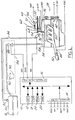
- Figure 1 is a block diagram of an embodiment wherein the invention is used to advantage; and
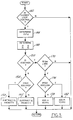
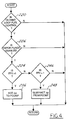
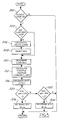
- Figures 2-6 are high level flowcharts illustrating steps performed by a portion of the embodiment illustrated in Figure 1.
-
Controller 10 is shown in the block diagram of Figure 1 as a conventional microcomputer including:microprocessor unit 12;input ports 14;output ports 16; read onlymemory 18, for storing control programs;random access memory 20, for temporary data storage which may also be used for counters or timers; keep-alive memory 22, for storing learned values; and a conventional data bus. As described in greater detail later herein with particular reference to Figures 2-6,controller 10 controls operation ofengine 28 by the following control signals: pulse width signal fpw for controlling liquid fuel delivery; purge duty cycle signal pdc for controlling fuel vapor recovery; and idle speed duty cycle signal ISDC for controlling engine idle speed. -
Controller 10 is shown receiving various signals from conventional engine sensors coupled toengine 28 including: measurement of inducted mass airflow (MAF) frommass airflow sensor 32; indication of primary throttle position (TP) fromthrottle position sensor 34; manifold absolute pressure (MAP), commonly used as an indication of engine load, frompressure sensor 36; engine coolant temperature (T) fromtemperature sensor 40; indication of engine speed (rpm) fromtachometer 42; and output signal EGO from exhaustgas oxygen sensor 44 which, in this particular example, provides an indication of whether exhaust gases are either rich or lean of stoichiometric combustion. - In this particular example,
engine 28 is shown having EGOsensor 44 coupled toexhaust manifold 50 upstream of conventionalcatalytic converter 52.Intake manifold 58 ofengine 28 is shown coupled tothrottle body 54 havingprimary throttle plate 62 positioned therein. Bypass throttling device 66 is shown coupled tothrottle body 54 and includes:bypass conduit 68 connected for bypassingprimary throttle plate 62; and solenoid valve 72 for throttlingconduit 68 in proportion to the duty cycle of idle speed duty cycle signal ISCDC fromcontroller 10.Throttle body 54 is also shown havingfuel injector 76 coupled thereto for delivering liquid fuel in proportion to the pulse width of signal fpw fromcontroller 10. Fuel is delivered tofuel injector 76 by a conventional fuel system includingfuel tank 80,fuel pump 82, andfuel rail 84. - Fuel
vapor recovery system 86 is shown includingvapor storage canister 90, connected in parallel tofuel tank 80, for absorbing fuel vapors by activated charcoal contained within the canister. Fuelvapor recovery system 86 is shown connected tointake manifold 58 via electronically actuatedpurge control valve 88. In this particular example, the cross-sectional area ofpurge control valve 88 is determined by the duty cycle of actuating signal pdc fromcontroller 10. - During fuel vapor recovery, commonly referred to as vapor purge, air is drawn through
canister 90 viainlet vent 92 thereby desorbing hydrocarbons from the activated charcoal. The mixture of purged air and recovered fuel vapors is inducted intomanifold 58 viapurge control valve 88. Concurrently, fuel vapors fromfuel tank 80 are drawn intointake manifold 58 throughvalve 88. - Referring now to Figure 2, a flowchart of the liquid fuel delivery routine executed by
controller 10 for controllingengine 28 is now described. An open loop calculation of desired liquid fuel is first calculated instep 102. The measurement of inducted mass airflow (MAF) is divided by a desired air fuel ratio (AFd) which, in this particular example, is selected for stoichiometric combustion (14.7 lbs. air per 1 lb. fuel). After a determination is made that closed loop or feedback fuel control is desired (step 104), the open loop fuel calculation is trimmed by fuel feedback variable FFV to generate desired fuel signal Fd duringstep 106. The operation ofcontroller 10 in generating fuel feedback variable FFV to maintain stoichiometric combustion is described later herein with particular reference to Figure 3. - Purge compensation signal (PCOMP) is subtracted from desired fuel signal Fd during
step 108 to generate modified desired fuel signal Fdm. As described later herein with respect to the routine executed bycontroller 10 shown in Figure 4, signal PCOMP represents the mass flow rate of fuel vapors inducted byengine 28 from fuelvapor recovery system 86. After correction by signal PCOMP, the modified desired liquid fuel (Fdm) is converted into fuel pulse width signal fpw for actuating fuel injector 76 (step 110). Accordingly, the liquid fuel delivered byfuel injector 76 is both trimmed by feedback from EGOsensor 44 and reduced in proportion to the mass of fuel vapors inducted per unit of time to maintain stoichiometric combustion. - The air/fuel feedback routine executed by
controller 10 to generate fuel feedback variable FFV is now described with reference to the flowchart shown in Figure 3. After a determination is made that closed loop (i.e., feedback) air/fuel control is desired instep 140, the desired air/fuel ratio (AFd) is determined instep 144. The proportional terms (Pi and Pj) and integral terms (Wi and Wj) of the proportional plus integral feedback control system described below are then determined instep 148. These proportional and integral terms are selected to achieve, on average, air/fuel operation at AFd. - EGO
sensor 44 is sampled instep 150 during each background loop ofcontroller 10. When EGOsensor 44 is low (i.e., lean), but was high (i.e., rich) during the previous background loop (step 154), proportional term Pj is subtracted from signal FFV instep 158. When EGOsensor 44 is low, and was also low during the previous background loop, integral term Wj is subtracted from signal FFV instep 162. Accordingly, in this particular example of operation, proportional term Pj represents a predetermined rich correction which is applied when EGO sensor 26 switches from rich to lean. Integral term Wj represents an integration step to provide continuously increasing rich fuel delivery while EGO sensor 26 continues to indicate combustion lean of stoichiometry. - When EGO
sensor 44 is high, but was low during the previous background loop (step 174), proportional term Pi is added to signal FFV instep 182. When EGOsensor 44 is high, and was also high during the previous background loop, integral term Wi is added to signal FFV instep 178. Proportional terms Pi represents a proportional correction in a direction to decrease fuel delivery when EGOsensor 44 switches from lean to rich, and integral term Wi represents an integration step in a fuel decreasing direction whileEGO sensor 44 continues to indicate combustion rich of stoichiometry. - Referring now to Figure 4, the routine executed by
controller 10 to generate purge compensation signal PCOMP is now described. Whencontroller 10 is in closed loop or feedback air/fuel control (step 220), and vapor purge is enabled (step 226), signal FFV is compared to its reference or nominal value, which is unity in this particular example. If signal FFV is greater than unity (step 224), indicating a lean fuel correction is being provided, signal PCOMP is incremented by integration value Wp duringstep 236. The liquid fuel delivered toengine 28 is thereby decreased, or leaned, by Wp each sample time when signal FFV is greater than unity. When signal FFV is less than unity (step 246), integral value Wp is subtracted from signal PCOMP duringstep 248. Delivery of liquid fuel is thereby increased and signal FFV is again forced towards unity. - In accordance with the above described operation, the purge compensation routine executed by
controller 10 adaptively learns the mass flow rate of recovered fuel vapors. Delivery of liquid fuel is corrected by this learned value (PCOMP) as shown in Figure 2 to maintain stoichiometric combustion while fuel vapors are recovered or purged. - Referring now to Figure 5, the idle speed feedback control routine performed by
controller 10 is now described. Feedback or closed loop idle speed control (ISC) commences when preselected operating conditions are detected (see step 300). Typically such operating conditions are a closed primary throttle position and engine speed less than a preselected value thereby distinguishing closed throttle idling from closed throttle deceleration. - Closed loop idle speed control continues for the time period during which selected engine operating conditions remain at preselected values. At the beginning of each idle speed control period (see step 302), a desired (or reference) idle speed DIS is calculated as a function of engine operating conditions such as engine speed (rpm) and coolant temperature (see step 306). The previous idle speed feedback variable ISFV is also reset to zero (see step 308) at the beginning of each idle speed control period.
- After the above described initial conditions are established, the following steps (310-328) are performed each background loop of
controller 10. Duringstep 310, the appropriate load operating cell is selected to receive idle speed correction.Controller 10 then calculates desired throttle position for bypass throttling device 66 (step 312). The desired idling speed DIS at the beginning of the idle speed control period is converted into a bypass throttle position, typically by a look-up table, and this initial throttle position is corrected by idle speed learned correction ISLC. In general, signal ISLC is based upon the error between the initial throttle position (derived from DIS) and the actual throttle position which feedback control maintained to operate at the desired idle speed DIS. - During
step 312, the corrected throttle position (desired or initial position corrected by signal ISLC) is further corrected by the idle speed feedback variable ISFV, the generation of which is described below. The idle speed duty cycle ISDC for operating solenoid valve 72 of bypass throttling device 66 is then calculated instep 316. This duty cycle moves the bypass throttle to the value calculated instep 312. -
Controller 10, in this one example of operation, provides a dead band with hysteresis around desired idle speed DIS insteps step 326. When average engine speed is greater than the dead band (DIS plus W2), ISFV is decreased by predetermined amount Wy instep 328. Accordingly, ISFV will appropriately increase or decrease the bypass throttle position (see step 312) to maintain, on average, desired idle speed DIS. - The routine for controlling purge flow during engine idling is now described with reference to Figure 6. After fuel vapor recovery, or purge, is enabled (step 400), idle speed duty cycle ISDC is compared to a dead band in
steps step 408. More specifically, the duty cycle of purge duty cycle signal pdc fromcontroller 10 is decreased a predetermined percentage thereby decreasing purge flow throughpurge valve 88. - When idle speed duty cycle ISDC is within the dead band (selected between 20% and 25% in this particular example), purge flow is unaltered provided
EGO sensor 44 has switched states during predetermined time t2 (step 410). On the other hand, ifEGO sensor 44 has not switched states during time t2, purge flow is decreased a predetermined amount (step 414). - If idle speed duty cycle ISDC is greater than the dead band, increases in purge flow are enabled (
steps 404 and 416). More specifically, purge duty cycle pdc is incremented when both idle speed duty cycle ISDC is above the dead band andEGO sensor 44 has changed states since the last background loop ofcontroller 10. - The above operation may also be described with reference to bypass throttle position because idle speed duty cycle ISDC determines bypass throttle position. For example, 25% idle speed duty cycle is substantially equivalent to 25% of the maximum bypass throttle position.
- In accordance with the above described operation, purge flow is maximized without impinging on the ability of the feedback idle speed control to maintain accurate control. Further, air/fuel transients are minimized while purging at a maximum rate during idle speed control.
- Although one example of an embodiment which practices the invention has been described herein, there are numerous other examples which could also be described. For example, analog devices, or discrete IC's may be used to advantage rather than a microcomputer.
Claims (11)
- A method for controlling idling speed of an engine (28) via a bypass throttle (66) connected in parallel to a primary engine throttle (62) and for controlling purge flow through a vapor recovery system (86) into an air/fuel intake (54) of the engine (28), comprising the steps of:
positioning the bypass throttle (66) to decrease any difference between a desired engine idle speed and actual engine idle speed; and
decreasing the purge flow when said bypass throttle position is less than a preselected fraction of a maximum bypass throttle position. - A method as claimed in claim 1, further comprising the step of enabling an increase in the purge flow when said bypass throttle position is greater than a predetermined fraction of said maximum bypass throttle position, said predetermined fraction being greater than said preselected fraction.
- A method for controlling idling speed of an engine via a bypass throttle connected in parallel to a primary engine throttle and for controlling purge flow through a vapor recovery system into an air/fuel intake of the engine, comprising the steps of:
positioning the bypass throttle to decrease any difference between a desired engine idle speed and actual engine idle speed;
decreasing the purge flow when said bypass throttle position is less than a preselected fraction of a maximum
bypass throttle position; and
increasing the purge flow when said bypass throttle position is greater than a predetermined fraction of said maximum bypass throttle position and feedback derived from an exhaust gas oxygen sensor indicates that desired air/fuel operation of the engine may be maintained while increasing in the purge flow. - A method claimed in claim 3, wherein said step of decreasing the purge flow dependent upon said feedback further comprises a step of determining when said exhaust gas oxygen sensor switches from a state associated with exhaust gases rich of stoichiometric combustion to another state associated with exhaust gases lean of stoichiometric combustion.
- A method claimed in claim 3, wherein said step of decreasing also decreases the purge flow when feedback from an exhaust gas oxygen sensor indicates engine air/fuel operation rich of stoichiometric combustion for a preselected time.
- A method claimed in claim 1 or 2 further comprising a step of inhibiting any increase in the purge flow when said bypass throttle position is between said preselected fraction and said predetermined fraction of said maximum bypass throttle position.
- A control system for controlling idling speed of an engine, comprising:
a bypass throttle connected in parallel to a primary engine throttle;
idle speed control means for positioning said bypass throttle to decrease any difference between a desired engine idle speed and actual engine idle speed;
an exhaust gas oxygen sensor having a first output state when exhaust gases are rich of stoichiometric combustion and a second output state when exhaust gases are lean of stoichiometric combustion; and
a vapor recovery system including a purge control means for controlling purge flow through said vapor recovery system into an air/fuel intake of the engine, said purge control means for decreasing said purge flow when said bypass throttle position is less than a preselected fraction of a maximum bypass throttle position, said purge control means increasing said purge flow when said bypass throttle position is greater than a predetermined fraction of said maximum bypass throttle position and said exhaust gas oxygen sensor has switched said output states during a predetermined time. - A control system claimed in claim 7, wherein alterations to said purge flow by said purge control means when said bypass throttle position is greater than said preselected fraction of said maximum bypass throttle position and less than said predetermined fraction of said maximum bypass throttle position and said exhaust gas oxygen sensor has switched said output states during a preselected time.
- A control system as claimed in claim 7, wherein said purge control means reduces said purge flow when said bypass throttle position is greater than said preselected fraction of said maximum bypass throttle position and less than said predetermined fraction of said maximum bypass throttle position and said exhaust gas oxygen sensor has maintained one of said output states during a preselected time.
- A control system as claimed in claim 7, further comprising an integral plus proportional controller responsive to said exhaust gas oxygen sensor for maintaining induction of liquid fuel at a value corresponding to stoichiometric combustion.
- A control system as claimed in claim 7, further comprising an integral plus proportional controller responsive to said exhaust gas oxygen sensor for maintaining both induction of liquid fuel and recovered fuel vapors at a value corresponding to stoichiometric combustion.
Applications Claiming Priority (2)
| Application Number | Priority Date | Filing Date | Title |
|---|---|---|---|
| US07/967,503 US5215055A (en) | 1992-10-28 | 1992-10-28 | Idle speed and fuel vapor recovery control system |
| US967503 | 1992-10-28 |
Publications (3)
| Publication Number | Publication Date |
|---|---|
| EP0595584A2 true EP0595584A2 (en) | 1994-05-04 |
| EP0595584A3 EP0595584A3 (en) | 1994-11-17 |
| EP0595584B1 EP0595584B1 (en) | 1998-01-07 |
Family
ID=25512901
Family Applications (1)
| Application Number | Title | Priority Date | Filing Date |
|---|---|---|---|
| EP93308489A Expired - Lifetime EP0595584B1 (en) | 1992-10-28 | 1993-10-25 | Idle speed and fuel vapor recovery control system for internal combustion engine |
Country Status (4)
| Country | Link |
|---|---|
| US (1) | US5215055A (en) |
| EP (1) | EP0595584B1 (en) |
| JP (1) | JP3294921B2 (en) |
| DE (1) | DE69316153T2 (en) |
Families Citing this family (7)
| Publication number | Priority date | Publication date | Assignee | Title |
|---|---|---|---|---|
| JP2920805B2 (en) * | 1992-03-31 | 1999-07-19 | 本田技研工業株式会社 | Evaporative fuel control system for internal combustion engine |
| US5366151A (en) * | 1993-12-27 | 1994-11-22 | Ford Motor Company | Hybrid vehicle fuel vapor management apparatus |
| DE19538786A1 (en) * | 1995-10-18 | 1997-04-24 | Bosch Gmbh Robert | Idling control for IC engine |
| JP2000274295A (en) * | 1999-03-19 | 2000-10-03 | Unisia Jecs Corp | Idle rotation control device for internal combustion engine |
| US8180084B2 (en) | 2007-03-21 | 2012-05-15 | Starkey Laboratories, Inc. | Integrated battery door and switch |
| US9624853B2 (en) | 2015-03-12 | 2017-04-18 | Ford Global Technologies, Llc | System and methods for purging a fuel vapor canister |
| US10280875B2 (en) | 2017-08-01 | 2019-05-07 | Ford Global Technologies, Llc | Methods and system for controlling engine airflow with an auxiliary throttle arranged in series with a venturi and in parallel with a main intake throttle |
Family Cites Families (19)
| Publication number | Priority date | Publication date | Assignee | Title |
|---|---|---|---|---|
| JPS57165644A (en) * | 1981-04-07 | 1982-10-12 | Nippon Denso Co Ltd | Control method of air-fuel ratio |
| US4619232A (en) * | 1985-05-06 | 1986-10-28 | Ford Motor Company | Interactive idle speed control with a direct fuel control |
| JPH025751A (en) * | 1988-06-21 | 1990-01-10 | Fuji Heavy Ind Ltd | Method for controlling air-fuel ratio |
| DE3914536C2 (en) * | 1989-05-02 | 1998-05-14 | Bosch Gmbh Robert | Method and device for diagnosing actuators in the regulation and / or control of operating parameters in connection with the idle control and the tank ventilation in internal combustion engines |
| US5041976A (en) * | 1989-05-18 | 1991-08-20 | Ford Motor Company | Diagnostic system using pattern recognition for electronic automotive control systems |
| US4974444A (en) * | 1989-07-05 | 1990-12-04 | Ford Motor Company | Electronically controlled engine throttle plate adjustment |
| JPH0739818B2 (en) * | 1989-08-31 | 1995-05-01 | 富士通テン株式会社 | Idle speed control device for internal combustion engine |
| JP2832301B2 (en) * | 1989-09-29 | 1998-12-09 | 富士重工業株式会社 | Engine idling speed control system |
| JPH0436055A (en) * | 1990-05-31 | 1992-02-06 | Nissan Motor Co Ltd | Self-diagnostic unit in device for processing evaporated gas of fuel tank |
| EP0459006A1 (en) * | 1990-06-01 | 1991-12-04 | Siemens Aktiengesellschaft | Arrangement for controlling the opening angle of an idle mixture regulator |
| JPH0460142A (en) * | 1990-06-29 | 1992-02-26 | Nissan Motor Co Ltd | Idling speed control device |
| JPH04101043A (en) * | 1990-08-20 | 1992-04-02 | Mitsubishi Electric Corp | Electronic automotive controller |
| US5048493A (en) * | 1990-12-03 | 1991-09-17 | Ford Motor Company | System for internal combustion engine |
| US5090388A (en) * | 1990-12-03 | 1992-02-25 | Ford Motor Company | Air/fuel ratio control with adaptive learning of purged fuel vapors |
| US5048492A (en) * | 1990-12-05 | 1991-09-17 | Ford Motor Company | Air/fuel ratio control system and method for fuel vapor purging |
| US5083541A (en) * | 1990-12-10 | 1992-01-28 | Ford Motor Company | Method and system for controlling engine idle speed |
| US5069188A (en) * | 1991-02-15 | 1991-12-03 | Siemens Automotive Limited | Regulated canister purge solenoid valve having improved purging at engine idle |
| JPH04358750A (en) * | 1991-06-05 | 1992-12-11 | Honda Motor Co Ltd | Evaporated fuel control device for internal combustion engine |
| JPH051632A (en) * | 1991-06-21 | 1993-01-08 | Honda Motor Co Ltd | Evaporative fuel control device for internal combustion engine |
-
1992
- 1992-10-28 US US07/967,503 patent/US5215055A/en not_active Expired - Lifetime
-
1993
- 1993-10-25 DE DE69316153T patent/DE69316153T2/en not_active Expired - Fee Related
- 1993-10-25 EP EP93308489A patent/EP0595584B1/en not_active Expired - Lifetime
- 1993-10-27 JP JP26905993A patent/JP3294921B2/en not_active Expired - Fee Related
Also Published As
| Publication number | Publication date |
|---|---|
| EP0595584B1 (en) | 1998-01-07 |
| EP0595584A3 (en) | 1994-11-17 |
| DE69316153D1 (en) | 1998-02-12 |
| JP3294921B2 (en) | 2002-06-24 |
| JPH06200844A (en) | 1994-07-19 |
| DE69316153T2 (en) | 1998-04-16 |
| US5215055A (en) | 1993-06-01 |
Similar Documents
| Publication | Publication Date | Title |
|---|---|---|
| US5228421A (en) | Idle speed control system | |
| US5203300A (en) | Idle speed control system | |
| EP0489490B1 (en) | Air/fuel ratio control with adaptive learning of purged fuel vapors | |
| EP0142101B1 (en) | Automotive engine control system capable of detecting specific engine operating conditions and projecting subsequent engine operating patterns | |
| US5048492A (en) | Air/fuel ratio control system and method for fuel vapor purging | |
| US6161531A (en) | Engine control system with adaptive cold-start air/fuel ratio control | |
| JP2694123B2 (en) | Fuel tank exhaust system for internal combustion engine | |
| CA2052755C (en) | Air/fuel controller for internal combustion engine | |
| US5245978A (en) | Control system for internal combustion engines | |
| EP0718493B1 (en) | Engine control to achieve rapid catalyst warm-up | |
| US5143040A (en) | Evaporative fuel control apparatus of internal combustion engine | |
| EP0415590A1 (en) | Vapour purge control system | |
| US5150686A (en) | Evaporative fuel control apparatus of internal combustion engine | |
| JPS6212380B2 (en) | ||
| US5224462A (en) | Air/fuel ratio control system for an internal combustion engine | |
| JP3194670B2 (en) | Electronic control unit for internal combustion engine | |
| US4841940A (en) | Air-fuel ratio control device of an internal combustion engine | |
| US5261368A (en) | Apparatus and method for controlling an internal combustion engine | |
| EP0595584B1 (en) | Idle speed and fuel vapor recovery control system for internal combustion engine | |
| US5655507A (en) | Evaporated fuel purge device for engine | |
| JP2007113519A (en) | Evaporative fuel processing equipment | |
| US5921226A (en) | Apparatus for controlling the fuel injection quantity | |
| US6651640B1 (en) | Vapor recovery purge system and method | |
| JPH08218953A (en) | Evaporative fuel treatment system for internal combustion engine | |
| JP2503474B2 (en) | Air-fuel ratio control device |
Legal Events
| Date | Code | Title | Description |
|---|---|---|---|
| PUAI | Public reference made under article 153(3) epc to a published international application that has entered the european phase |
Free format text: ORIGINAL CODE: 0009012 |
|
| AK | Designated contracting states |
Kind code of ref document: A2 Designated state(s): DE FR GB |
|
| PUAL | Search report despatched |
Free format text: ORIGINAL CODE: 0009013 |
|
| AK | Designated contracting states |
Kind code of ref document: A3 Designated state(s): DE FR GB |
|
| 17P | Request for examination filed |
Effective date: 19950410 |
|
| 17Q | First examination report despatched |
Effective date: 19960430 |
|
| GRAG | Despatch of communication of intention to grant |
Free format text: ORIGINAL CODE: EPIDOS AGRA |
|
| GRAG | Despatch of communication of intention to grant |
Free format text: ORIGINAL CODE: EPIDOS AGRA |
|
| GRAH | Despatch of communication of intention to grant a patent |
Free format text: ORIGINAL CODE: EPIDOS IGRA |
|
| GRAH | Despatch of communication of intention to grant a patent |
Free format text: ORIGINAL CODE: EPIDOS IGRA |
|
| GRAA | (expected) grant |
Free format text: ORIGINAL CODE: 0009210 |
|
| AK | Designated contracting states |
Kind code of ref document: B1 Designated state(s): DE FR GB |
|
| PG25 | Lapsed in a contracting state [announced via postgrant information from national office to epo] |
Ref country code: FR Free format text: LAPSE BECAUSE OF FAILURE TO SUBMIT A TRANSLATION OF THE DESCRIPTION OR TO PAY THE FEE WITHIN THE PRESCRIBED TIME-LIMIT Effective date: 19980107 |
|
| REF | Corresponds to: |
Ref document number: 69316153 Country of ref document: DE Date of ref document: 19980212 |
|
| EN | Fr: translation not filed | ||
| PLBE | No opposition filed within time limit |
Free format text: ORIGINAL CODE: 0009261 |
|
| 26N | No opposition filed | ||
| REG | Reference to a national code |
Ref country code: GB Ref legal event code: IF02 |
|
| PGFP | Annual fee paid to national office [announced via postgrant information from national office to epo] |
Ref country code: GB Payment date: 20030929 Year of fee payment: 11 |
|
| PGFP | Annual fee paid to national office [announced via postgrant information from national office to epo] |
Ref country code: DE Payment date: 20031010 Year of fee payment: 11 |
|
| PG25 | Lapsed in a contracting state [announced via postgrant information from national office to epo] |
Ref country code: GB Free format text: LAPSE BECAUSE OF NON-PAYMENT OF DUE FEES Effective date: 20041025 |
|
| PG25 | Lapsed in a contracting state [announced via postgrant information from national office to epo] |
Ref country code: DE Free format text: LAPSE BECAUSE OF NON-PAYMENT OF DUE FEES Effective date: 20050503 |
|
| GBPC | Gb: european patent ceased through non-payment of renewal fee |
Effective date: 20041025 |