EP0595719A1 - Verfahren für die automatische Bestimmung von mit einer Booleschen Fuktion verbundenen wahrscheinlichkeiten - Google Patents
Verfahren für die automatische Bestimmung von mit einer Booleschen Fuktion verbundenen wahrscheinlichkeiten Download PDFInfo
- Publication number
- EP0595719A1 EP0595719A1 EP93402638A EP93402638A EP0595719A1 EP 0595719 A1 EP0595719 A1 EP 0595719A1 EP 93402638 A EP93402638 A EP 93402638A EP 93402638 A EP93402638 A EP 93402638A EP 0595719 A1 EP0595719 A1 EP 0595719A1
- Authority
- EP
- European Patent Office
- Prior art keywords
- event
- function
- probability
- branch
- value
- Prior art date
- Legal status (The legal status is an assumption and is not a legal conclusion. Google has not performed a legal analysis and makes no representation as to the accuracy of the status listed.)
- Ceased
Links
Images
Classifications
-
- G—PHYSICS
- G06—COMPUTING OR CALCULATING; COUNTING
- G06F—ELECTRIC DIGITAL DATA PROCESSING
- G06F17/00—Digital computing or data processing equipment or methods, specially adapted for specific functions
- G06F17/10—Complex mathematical operations
- G06F17/18—Complex mathematical operations for evaluating statistical data, e.g. average values, frequency distributions, probability functions, regression analysis
-
- G—PHYSICS
- G06—COMPUTING OR CALCULATING; COUNTING
- G06F—ELECTRIC DIGITAL DATA PROCESSING
- G06F30/00—Computer-aided design [CAD]
- G06F30/30—Circuit design
- G06F30/32—Circuit design at the digital level
- G06F30/33—Design verification, e.g. functional simulation or model checking
- G06F30/3323—Design verification, e.g. functional simulation or model checking using formal methods, e.g. equivalence checking or property checking
Definitions
- the invention relates to a method for automatically determining, using a data processing machine, the probabilities associated with a Boolean function.
- Boolean functions are handled in many areas. For example, synthesis, optimization of electronic circuits, analysis of system failures can use the manipulation of Boolean functions.
- the occurrence of a failure as a function of external events likely to cause this failure can be analyzed using a Boolean function.
- a reference event or of an action, when it is a function of one or more concomitant events, also called microscopic events, can thus be analyzed.
- Each microscopic event is therefore a function variable.
- f x1 x2 * + x1 * x2 x3.
- x1, x2, x3 are propositional variables, corresponding to the atomic events likely to cause the appearance of the reference event noted f, and given by the formula.
- the atomic events are causes of failure, and the reference event is a particular failure linked to these causes combined with each other in certain ways.
- x1 "x2”, “x3” and “x1 *”, “x2 *”, “x3 *”, which appear in the formula are literals corresponding to the propositional variables x1, x2, x3.
- a literal represents how the propositional variable intervenes in the function, that is to say if the occurrence or non-occurrence of the associated event is decisive or indifferent.
- x1 x2 * and x1 * x2 x3 are products of literals. A product is therefore a conjunction of variables and negations of variables.
- the first product x1 x2 * means that the presence or absence of the third variable x3 is indifferent.
- Such a table is called a fault tree for the purpose of analyzing system failures. More generally, it can be called an event tree.
- Such a tree can be used to perform various analyzes or calculations relating to the behavior of the system. In particular, one can consider calculating the probability of a reference event occurring as a function of that of each of the atomic events.
- the table gives not only the products contributing to the occurrence of the function, but also the probability of occurrence of each atomic event. This probability was determined for example during the simulation or the analysis.
- the aims of the invention are therefore to obtain a method which makes it possible to automatically obtain the exact probability of a reference event, without requiring significant storage capacities.
- p (H) in which p (x1) is the known probability in advance of the root event of the diagrams and p (L) and p (H) are respectively the probabilities of the negative branch and of the positive branch of the tree , the latter being obtained as the recursive traverses carried out on the binary decision diagram.
- a binary decision graph or diagram consists of a number of labels, also called labels, linked together by branches.
- Each label represents a determined function variable, from which two branches start.
- the set constituted by a label therefore a variable, and the two branches which leave it constitutes a node, sometimes called vertex.
- Each branch can be either a terminal branch, which ends on a terminal sheet of value "0" or "1", or an intermediate branch which ends on the label of another node.
- One of the branches that leaves a label is called the low or negative branch and represents what happens when the value of the associated variable is "0" (using the conventions recalled above), while the another branch, called the upper or positive branch, shows what happens when the value of the variable is "1".
- the tree begins with a single root variable (label), called the root, from which two branches to which are connected in cascade other nodes or leaves.
- Such a diagram or graph therefore makes it possible to visualize all of the combinations of variables of a function, in an extremely complete and concise manner.
- the memory space occupied is less compared to to arrays, and the processing times for functions represented as binary decision graphs are much faster.
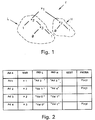
- FIG. 1 a binary decision diagram of a Boolean function has been represented in which three propositional variables x1, x2, x3 appear.
- a first variable is the root of the graph. From this variable start two branches, a first branch at the bottom left and a second branch at the bottom right. The left branch is called the lower branch, while the right branch is called the upper branch. The whole root, lower and upper branches therefore constitutes a first node of the diagram.
- the lower branch and the upper branch each lead to a second variable identified by a label x2.
- This second variable is also associated with a low branch and a high branch, which constitutes another node.
- the set of labels (or variables), branches, leaves associated with a lower branch of another variable constitutes what will be called hereinafter the lower part denoted L of this variable.
- the set associated with the upper branch of a variable constitutes the upper part, denoted H of this variable.
- the upper part of the variable x1 begins with a node whose root is the variable x2, the lower part is sheet 0 and the upper part is a sheet with value 1.
- each high (positive) or low (negative) branch of the diagram constitutes in itself a sub-diagram having itself its own high and low branches.
- determining the probability of each branch simply requires memorizing the probability of each sub-branch immediately connected to this branch.
- the diagram of FIG. 1 is obtained from an event table or tree, not shown in the figures.
- the determination of the diagram from this table is carried out so as to optimize the size of the diagram so that the number of labels and branches is as small as possible.
- L and H are sub-diagrams in which the variables x2 and / or x3 appear.
- the preliminary knowledge of the probabilities p (x1), p (x2), p (x3) associated with each microscopic event makes it possible, by performing recursive paths in the diagram, to obtain the overall probability of the reference event.
- FIG. 2 illustrates how the memory of a computer can be organized, to contain information constituting the binary decision diagram of the function represented in FIG. 1. This is absolutely not limiting.
- memory is organized in words, and each word is determined by its absolute or relative address ADn.
- each word can, for example, be divided into at least 5 fields, a first VAR field, a second IND L field, a third IND H field, a fourth GEST field, and finally a fifth PROBA field.
- the first VAR field of a word would contain information indicating the nature and rank of a propositional variable of the function, for example x n .
- the second field IND L would indicate whether the lower branch of the corresponding variable ends up on a node or on a leaf.
- the third field IND H would indicate whether the upper part of the corresponding variable ends on a leaf or on a node.
- the fourth GEST field would contain, for example, management parameters necessary for the use of the memory, when journeys are made between the different addresses.
- the second and third fields could be completed in the following way: if the lower branch associated with the propositional variable contained in the word ends up on a leaf, then this second field would contain an indication "Val 0" or "Val 1 "of the value of this sheet as shown in certain boxes of this figure 2.
- this second field IND L would contain the value of the memory address of the word where this node is registered.
- the third field IND H would indicate, in the same way as the second field, if the high branch associated with a variable ends on a node or on a leaf and contains if necessary an address, or a value.
- the fourth GEST field would contain management parameters indicating the routes that have already been taken, or any other type of information necessary for the management and exploitation of this memory.
- the fifth field PROBA would contain the value known in advance of the probability associated with the corresponding variable x n , indicated in the first field VAR.
- the processing system can reconstruct the products for which the function is equal to "1". It is therefore able to reconstruct the decision diagram and its various nodes.
- Nd (x, L, H) y decomposes the node y at its root, i.e. the variable x, in its left or low branch L and in its straight or high branch H.
- a test is first carried out to determine the nature of the function.
- GETPROBA (1-GETELEMENTARYPROBA (x k )) ⁇ GETPROBA (L) + GETELEMENTARYPROBA (x k ) ⁇ GETPROBA (H), in which "GETELEMENTARYPROBA (x k )" is an instruction whose execution consists in reading the value of the probability associated with the variable (x k ), in the fifth field "PROBA", and in incorporating it in computation.
Landscapes
- Engineering & Computer Science (AREA)
- Physics & Mathematics (AREA)
- Theoretical Computer Science (AREA)
- General Physics & Mathematics (AREA)
- Data Mining & Analysis (AREA)
- General Engineering & Computer Science (AREA)
- Pure & Applied Mathematics (AREA)
- Computer Hardware Design (AREA)
- Computational Mathematics (AREA)
- Mathematical Analysis (AREA)
- Mathematical Optimization (AREA)
- Mathematical Physics (AREA)
- Databases & Information Systems (AREA)
- Life Sciences & Earth Sciences (AREA)
- Algebra (AREA)
- Operations Research (AREA)
- Bioinformatics & Computational Biology (AREA)
- Software Systems (AREA)
- Bioinformatics & Cheminformatics (AREA)
- Probability & Statistics with Applications (AREA)
- Evolutionary Biology (AREA)
- Evolutionary Computation (AREA)
- Geometry (AREA)
- Information Retrieval, Db Structures And Fs Structures Therefor (AREA)
- Management, Administration, Business Operations System, And Electronic Commerce (AREA)
- Complex Calculations (AREA)
Applications Claiming Priority (2)
| Application Number | Priority Date | Filing Date | Title |
|---|---|---|---|
| FR9213011 | 1992-10-30 | ||
| FR9213011A FR2697652B1 (fr) | 1992-10-30 | 1992-10-30 | Procédé de détermination automatique des probabilités associées à une fonction booléenne. |
Publications (1)
| Publication Number | Publication Date |
|---|---|
| EP0595719A1 true EP0595719A1 (de) | 1994-05-04 |
Family
ID=9435024
Family Applications (1)
| Application Number | Title | Priority Date | Filing Date |
|---|---|---|---|
| EP93402638A Ceased EP0595719A1 (de) | 1992-10-30 | 1993-10-27 | Verfahren für die automatische Bestimmung von mit einer Booleschen Fuktion verbundenen wahrscheinlichkeiten |
Country Status (6)
| Country | Link |
|---|---|
| US (1) | US5737242A (de) |
| EP (1) | EP0595719A1 (de) |
| JP (1) | JPH06511588A (de) |
| CA (1) | CA2126460A1 (de) |
| FR (1) | FR2697652B1 (de) |
| WO (1) | WO1994010640A1 (de) |
Families Citing this family (6)
| Publication number | Priority date | Publication date | Assignee | Title |
|---|---|---|---|---|
| DE19701931C1 (de) * | 1997-01-21 | 1998-05-28 | Siemens Ag | Verfahren zur Detektion von Synchronizität zwischen mehreren digitalen Meßreihen mit Hilfe eines Rechners |
| US6247108B1 (en) | 1998-06-03 | 2001-06-12 | Lucent Technologies Inc. | Memory management during processing of binary decision diagrams in a computer system |
| NZ512244A (en) | 1998-11-12 | 2003-12-19 | Invitrogen Corp | Polycationic transfection reagents for introducing anions into a cell |
| US6556973B1 (en) * | 2000-04-19 | 2003-04-29 | Voxi Ab | Conversion between data representation formats |
| US20080010230A1 (en) * | 2006-07-06 | 2008-01-10 | Smith Curtis L | Hybrid assessment tool, and systems and methods of quantifying risk |
| US8468142B2 (en) * | 2008-08-06 | 2013-06-18 | Fujitsu Limited | Caching query results with binary decision diagrams (BDDs) |
Family Cites Families (8)
| Publication number | Priority date | Publication date | Assignee | Title |
|---|---|---|---|---|
| US4599692A (en) * | 1984-01-16 | 1986-07-08 | Itt Corporation | Probabilistic learning element employing context drive searching |
| US4935882A (en) * | 1986-09-15 | 1990-06-19 | International Business Machines Corporation | Probability adaptation for arithmetic coders |
| JP2690996B2 (ja) * | 1989-02-17 | 1997-12-17 | 株式会社日立製作所 | 履歴依存ヘルプ制御方式 |
| JPH0816956B2 (ja) * | 1990-01-18 | 1996-02-21 | 株式会社日立製作所 | フォールト・トリー表示方法、フォールト・トリー表示装置およびプロセス診断支援システム |
| JPH0481616A (ja) * | 1990-07-24 | 1992-03-16 | Mitsubishi Electric Corp | 故障診断装置 |
| US5233541A (en) * | 1990-08-10 | 1993-08-03 | Kaman Aerospace Corporation | Automatic target detection process |
| US5263124A (en) * | 1991-02-27 | 1993-11-16 | Neural Systems Corporation | Method for producing a binary tree, pattern recognition and binary vector classification method using binary trees, and system for classifying binary vectors |
| FR2690541B1 (fr) * | 1992-04-28 | 1994-06-17 | Bull Sa | Procede d'elaboration automatique d'une representation implicite des impliquants premiers d'une fonction. |
-
1992
- 1992-10-30 FR FR9213011A patent/FR2697652B1/fr not_active Expired - Fee Related
-
1993
- 1993-10-27 CA CA002126460A patent/CA2126460A1/fr not_active Abandoned
- 1993-10-27 JP JP6510772A patent/JPH06511588A/ja active Pending
- 1993-10-27 EP EP93402638A patent/EP0595719A1/de not_active Ceased
- 1993-10-27 WO PCT/FR1993/001055 patent/WO1994010640A1/fr not_active Ceased
- 1993-10-27 US US08/742,872 patent/US5737242A/en not_active Expired - Fee Related
Non-Patent Citations (4)
| Title |
|---|
| ANTOINE RAUZY: "NEW ALGORITHMS FOR FAULT TREES ANALYSIS", RELIABILITY ENGINEERING & SYSTEM SAFETY, ELSEVIER APPLIED SCIENCE LTD, vol. 40, 1993, ENGLAND, pages 203 - 211 * |
| K.KOCH: "REPRESENTATION OF TREE DATA STRUCTURES FOR DATA MANIPULATION AND SEARCH OPERATIONS", IBM TECHNICAL DISCLOSURE BULLETIN, vol. 14, no. 11, April 1972 (1972-04-01), pages 3521 - 3522 * |
| W.G.SCHNEEWEISS: "APPROXIMATE FAULT-TREE ANALYSIS WITHOUT CUT SETS", PROCEEDINGS OF THE ANNUAL SYMPOSIUM ON RELIABILITY AND MAINTAINABILITY, IEEE PRESS NEW YORK, US, 21 January 1992 (1992-01-21), LAS VEGAS, NEVADA, US, pages 370 - 375, XP000273440 * |
| W.G.SCNEEWEISS: "RELIABILITY THEORY FOR LARGE LINEAR SYSTEMS WITH HELPING NEIGHBORS", IEEE TRANSACTIONS ON RELIABILITY, IEEE PRESS, vol. 41, no. 3, September 1992 (1992-09-01), NEW YORK, US, pages 343 - 351 * |
Also Published As
| Publication number | Publication date |
|---|---|
| FR2697652A1 (fr) | 1994-05-06 |
| FR2697652B1 (fr) | 1994-12-16 |
| CA2126460A1 (fr) | 1994-05-11 |
| JPH06511588A (ja) | 1994-12-22 |
| US5737242A (en) | 1998-04-07 |
| WO1994010640A1 (fr) | 1994-05-11 |
Similar Documents
| Publication | Publication Date | Title |
|---|---|---|
| EP3846087A1 (de) | Verfahren und system zur auswahl eines lernmodells innerhalb einer vielzahl von lernmodellen | |
| EP0568424B1 (de) | Verfahren zur automatischen Erzeugung einer implizierten Darstellung der Primimplikanten einer Funktion | |
| EP0547974B1 (de) | Klassifizierungsverfahren für Rechnerarchitekturen | |
| FR2824160A1 (fr) | Conteneur generique configurable de facon dynamique | |
| FR2920893A1 (fr) | Procede d'analyse de la fiabilite d'installations techniques a l'aide de modeles physiques, utilisation d'un tel procede et support d'informations pour sa mise en oeuvre | |
| CN114386658A (zh) | 湖库水质监测预警方法、装置、存储介质及电子设备 | |
| EP3671578A1 (de) | Analyseverfahren einer ausführungssimulation eines quantenschaltkreises | |
| FR2962823A1 (fr) | Processeur d'analyse situationnelle | |
| EP0595719A1 (de) | Verfahren für die automatische Bestimmung von mit einer Booleschen Fuktion verbundenen wahrscheinlichkeiten | |
| FR2909198A1 (fr) | Procede et disositif de filtrage d'elements d'un document structure a partir d'une expression. | |
| US20240256784A1 (en) | Extensible chatbot framework | |
| EP3531641B1 (de) | Verfahren zur erzeugung von kommunikationswegen zwischen den knoten eines computer-clusters, entsprechendes computerprogramm und entsprechender computer-cluster | |
| FR3090163A1 (fr) | Processeur de traitement de données, procédé et programme d’ordinateur correspondant | |
| FR2699703A1 (fr) | Procédé de gestion d'une mémoire tampon, support d'enregistrement et système informatique l'incorporant. | |
| EP3671577B1 (de) | Analyseverfahren einer ausführungssimulation eines quantenschaltkreises | |
| EP0554177A1 (de) | Assoziativspeicherarchitektur | |
| CN119149676B (zh) | 基于意图识别的检索增强生成、问答方法及系统 | |
| CN117610634B (zh) | 数据迁移方法、装置、服务器及存储介质 | |
| EP0670069A1 (de) | Verfahren zum automatischen beweisen | |
| FR2825491A1 (fr) | Procede d'implementation d'un pluralite d'interfaces d'objets | |
| EP3622445B1 (de) | Verfahren, durch computer implementiert, zum suchen von regeln der assoziation in einer datenbank | |
| FR2991840A1 (fr) | Procede de traitement de donnees par un module de navigation | |
| FR3131413A1 (fr) | Réseau de neurones avec génération à la volée des paramètres du réseau | |
| WO1997043659A1 (fr) | Diagnostic de reseaux de composants, avec modelisation par bandes | |
| FR3118815A1 (fr) | Estimation de la progression de l'exécution d'une tâche logicielle |
Legal Events
| Date | Code | Title | Description |
|---|---|---|---|
| PUAI | Public reference made under article 153(3) epc to a published international application that has entered the european phase |
Free format text: ORIGINAL CODE: 0009012 |
|
| 17P | Request for examination filed |
Effective date: 19940217 |
|
| AK | Designated contracting states |
Kind code of ref document: A1 Designated state(s): AT BE CH DE DK ES FR GB GR IE IT LI LU NL PT SE |
|
| 17Q | First examination report despatched |
Effective date: 19970916 |
|
| STAA | Information on the status of an ep patent application or granted ep patent |
Free format text: STATUS: THE APPLICATION HAS BEEN REFUSED |
|
| 18R | Application refused |
Effective date: 19990426 |