EP0596280A2 - Améliorations apportées au traitement d'images - Google Patents
Améliorations apportées au traitement d'images Download PDFInfo
- Publication number
- EP0596280A2 EP0596280A2 EP93116397A EP93116397A EP0596280A2 EP 0596280 A2 EP0596280 A2 EP 0596280A2 EP 93116397 A EP93116397 A EP 93116397A EP 93116397 A EP93116397 A EP 93116397A EP 0596280 A2 EP0596280 A2 EP 0596280A2
- Authority
- EP
- European Patent Office
- Prior art keywords
- signature
- image
- signatures
- master
- peaks
- Prior art date
- Legal status (The legal status is an assumption and is not a legal conclusion. Google has not performed a legal analysis and makes no representation as to the accuracy of the status listed.)
- Granted
Links
Images
Classifications
-
- G—PHYSICS
- G06—COMPUTING OR CALCULATING; COUNTING
- G06V—IMAGE OR VIDEO RECOGNITION OR UNDERSTANDING
- G06V30/00—Character recognition; Recognising digital ink; Document-oriented image-based pattern recognition
- G06V30/40—Document-oriented image-based pattern recognition
-
- G—PHYSICS
- G06—COMPUTING OR CALCULATING; COUNTING
- G06V—IMAGE OR VIDEO RECOGNITION OR UNDERSTANDING
- G06V10/00—Arrangements for image or video recognition or understanding
- G06V10/40—Extraction of image or video features
- G06V10/42—Global feature extraction by analysis of the whole pattern, e.g. using frequency domain transformations or autocorrelation
- G06V10/421—Global feature extraction by analysis of the whole pattern, e.g. using frequency domain transformations or autocorrelation by analysing segments intersecting the pattern
-
- G—PHYSICS
- G06—COMPUTING OR CALCULATING; COUNTING
- G06V—IMAGE OR VIDEO RECOGNITION OR UNDERSTANDING
- G06V10/00—Arrangements for image or video recognition or understanding
- G06V10/40—Extraction of image or video features
- G06V10/50—Extraction of image or video features by performing operations within image blocks; by using histograms, e.g. histogram of oriented gradients [HoG]; by summing image-intensity values; Projection analysis
- G06V10/507—Summing image-intensity values; Histogram projection analysis
Definitions
- This invention relates to improvements in and relating to methods and apparatus for processing certain document images stored in digital form.
- FAX servers which are devices used in conjunction with a computer to receive FAX messages from the phone line and electronically store them in the data processing system, would need to identify the type of cover sheet of the incoming facsimile. This is an essential phase, for example, in locating the addressee name, for automating routing of the FAX in the data processing system, over for instance a computer network, to the addressee.
- a method for determining the type of an electronically stored image of a document comprising a plurality of pixels which pixels may take one of a plurality of values
- the method comprising the steps of: generating a one dimensional projection, based on a super linear function of the number of contiguous pixels having the same value along straight lines in the image in a predetermined direction; computing a signature for the image by detecting the position in the projection of a number of peaks; comparing said computed signature with a plurality of pre-stored master signatures, each master signature having a document type associated therewith, to determine the master signature which has the highest similarity with said computed signature, the type of the document being thereby determined to be the same as the document type associated with the master signature having the highest similarity.
- an image processing system for the determination of the type of electronically stored image of a document, the image comprising a plurality of pixels which pixels may take one of a plurality of values, the system comprising: logic for generating a one dimensional projection, based on a super linear function of the number of contiguous pixels having the same value along straight lines in the image in a predetermined direction; logic for computing a signature for the image by detecting the position in the projection of a number of peaks; logic for comparing said computed signature with a plurality of stored master signatures, each master signature having a document type associated therewith, to determine the master signature which has the highest similarity with said computed signature, the type of the document being thereby determined to be the same as the document type associated with the master signature having the highest similarity.
- the form is not changed, so it retains all the advantages of a regular form, and the party sending the form does not have to be computer literate.
- the method is applied in the recognition of cover sheet forms in FAX transmission.
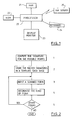
- Fig. 1 the data processing system which embodies the invention is illustrated. It includes a processor 20, a RAM memory 21, a ROM memory 22, a display monitor 23 and a keyboard 24.
- the FAX server 25 provides the system with the electronically stored image of the document to be analysed for the recognition.
- a FAX server is a device connected with the telephone line and it converts a document received as a telephone signal into the format required by the data processing system.
- the generated image signal can be bi-level, with 1 representing dark and 0 bright (or viceversa), or it can be multi-level, with 1 representing black, N representing white (or viceversa) and values between representing various shades of grey.
- the signal is assumed to be arranged in a rectangular array. However, this does not exclude the possibility that this signal is also compressed so as to minimize storage and communication time requirements.
- the invention operates equally well if the FAX server is substituted by any apparatus which provides the data processing system with the image of the document in an electronically stored format.
- Such an apparatus could be a scanner which transforms a document received by a usual FAX receiver into the electronically stored format.
- the feeding of the document can be done manually, by placing the document in the exact location where the image is captured, or automatically by placing this document in a place where a mechanical device will move it to where the image is captured.
- Scanning can be done in several ways: the document can be moved across a narrow area of the image capture device, in which intensities in the document are translated to numbers representing grey scale, or this narrow area of the image capture device can be moved along the document, or an image capture device that captures the whole image at once can be used.
- the method is composed of two parts: form signature computation, and signature matching.
- form acquisition signatures of forms are computed and stored in a template data base.
- recognition the signature of the input form is computed, and the best match between it and the signatures in the template data base is found. The input form is then considered to be the same as the form from which the best matching signature was computed.
- a "signature” is computed 1.
- a “signature”, according to the preferred embodiment, is a numeric representation of the form and it is computed using the method described below. All the "master" signatures so computed are stored in a template data base 2. When an electronically stored image of a form is received 3, it is recognized 4 as detailed in Fig 2 and the process is repeated for every form received 5.
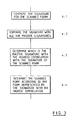
- the step of recognizing the received form is detailed in its composing steps.
- the signature of the form is derived 4.1 using the same method as step 1.
- the signature so computed is compared with the master signatures stored in the template data base 4.2 as described in more detail below.
- For each master signature a score is determined according to its similarity with the signature of the received form; the master signature with the highest score is considered to be the most representative of the received form 4.3.
- the received form is thus considered to be of the same type of the form from which the master signature with the highest score was derived 4.4.
- Bi-level image data arrives in various formats (such as IOCA, MO:DCA, RFT), and using various compression schemes (such as G3, G4, MMR). All these compression schemes are based on run-end encoding, which is particularly suitable to the processing steps of the preferred embodiment of the present invention, though the invention is not limited to the use of such encoding.
- IOCA IOCA
- MO:DCA MO:DCA
- RFT various compression schemes
- G3, G4, MMR multi-end encoding
- the image data is projected horizontally on the vertical axis, with an emphasis on long runs.
- the emphasis on long runs can be achieved using any super-linear function of the run length. In the preferred embodiment this emphasis is achieved by squaring the lengths of black runs, i.e., for each image row we compute the projection as:
- N may be a constant (e.g. the 17 highest peaks), or preferably may be determined dynamically as a function of all the projection peak heights.
- a two step heuristic procedure to find the minimum peak size is used.
- the peak sizes are sorted in descending order, and a race is held: the minimum peak size starts from 0 and grows so that large peaks increase the growth speed, but the number of peaks decreases it geometrically.
- the race stops when the remaining peaks are all smaller than the computed minimum size.
- the second step discards all the peaks that are less than half the average size of the peaks accepted by the first step.
- the input form to be recognized is unlikely to be identical to the form that was acquired for the template data base.
- the contents of the form i.e. the filled in text, is expected to be different.
- geometric transformations such as shift, rotation (for small angles), and scale may be present.
- noise may change the computed signatures by breaking long lines, and thus eliminating projection peaks, or by changing the distribution of projection peak sizes and changing the number of peaks in the signature. It is also quite common that a shadow created during the scanning of an image is represented as a long line in the image, and appears as one of the largest peaks in the signature.
- OCS Optimal Correspondence Subsequence
- the OCS is a set of 1 index pairs such that and 3) is maximal.
- the output of the algorithm is that maximal sum, and the sequence of index pairs.
- S(N-1,M-1) is the return value of the algorithm, and P has the required indices.
- the OCS algorithm can be speeded up by:
- Two passes of OCS matching are performed.
- the objective is to calculate the best shift and scale transformation between the two signatures.
- one signature is corrected by the shift and scale transformation computed in the first pass, and the OCS with respect to absolute row locations is found.
- One of the signatures to be compared is transformed using the shift and scale parameters found in this way and then the second OCS pass is performed to provide a more precise correspondance.
- f(x,y) returns a value that decreases when the distance between the row locations of the peaks increases.
- the function used in the preferred embodiment is:
- This cosine function gives a maximal weight to peaks in the same location, and a zero weight to peaks whose location difference is 10 or more. In between, the weight changes slowly near 0 and near 10, but quickly in the middle of this range.
- the final OCS match score computed is the minimum of the percentage of peaks in each signature that have a match in the other signature. For instance, if one signature has 20 peaks and the other 25, and 10 peaks are matched, the match score is 40%.
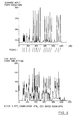
- Figure 4 illustrates this matching process.
- the same form was scanned in two different machines: One was a flat bed scanner, and the form was straight. The other was a FAX machine, and the form was considerably rotated.
- the vertical resolution of the scanner is 200 DPI, while the FAX has 196 DPI.
- Figure 4 shows the vertical projections of the two signatures, and the dominant peak locations. As can be seen, the scale difference causes a gradual drift in peak alignments, so that on the left the corresponding peaks are aligned, whereas on the right there is a shift of one peak. This shift of one peak results in a very good match between peaks that do not correspond to the same image feature.
- the sixth peak from the left in the scanner input may match either the sixth or seventh peak in the FAX input. But the sixth peak in both signatures has one neighbor far to the left, whereas the seventh has two relatively near ones. So the first pass of OCS will actually find the correct peak pairing, and compute the correct scale. As a result, although straightforward correlation of the two projections is very low, around 30%, the score computed by the two phase OCS algorithm is almost 90%.
- each signature is also represented as a binary bit map and a rough comparison of the bit maps using an XOR function is used to determine the order in which template signatures are compared with an image signature. This provides significant improvements to the program speed, especially when the set of templates is large.
- the present invention has been described for the recognition of cover sheet forms in FAX transmission, but it could equally well be practiced in other applications where a recognition of an electronically stored image of a document is needed.
- the methods of the preferred embodiement can be partially modified or substituted without departing from the scope of the invention.
- the number of peaks in a signature can be determined by other heuristics as well, and one can even construct a system that uses several heuristics concurrently. Results of matching with different criteria can be crossed, to achieve a higher confidence in the final result.
- bitmap representation to determine the order the signatures in which template signatures are compared with the image signature has application to other fields where it is necessary to compare a sequence of features with a database of similar sequences of features to determine the best match. For example when looking up a word in a dictionary of stored words it is possible to represent the words as bitmaps using the character values (eg in ASCII coding).
- the order in which the dictionary words are compared with a trial word can be determined on the basis of a XOR comparison of the bitmaps, the words being compared until a suitable stopping criterion is satisfied. This greatly improves the matching speed.
- the technique can also be applied to speech recognition where the features are recorded syllables, to signature verification or character recognition.
Landscapes
- Engineering & Computer Science (AREA)
- Computer Vision & Pattern Recognition (AREA)
- Physics & Mathematics (AREA)
- General Physics & Mathematics (AREA)
- Multimedia (AREA)
- Theoretical Computer Science (AREA)
- Artificial Intelligence (AREA)
- Character Input (AREA)
- Character Discrimination (AREA)
Priority Applications (1)
| Application Number | Priority Date | Filing Date | Title |
|---|---|---|---|
| US08/147,195 US5434933A (en) | 1993-10-09 | 1993-11-03 | Image processing |
Applications Claiming Priority (2)
| Application Number | Priority Date | Filing Date | Title |
|---|---|---|---|
| GB9223116 | 1992-11-04 | ||
| GB9223116A GB2272594A (en) | 1992-11-04 | 1992-11-04 | Determining the type of document image |
Publications (3)
| Publication Number | Publication Date |
|---|---|
| EP0596280A2 true EP0596280A2 (fr) | 1994-05-11 |
| EP0596280A3 EP0596280A3 (fr) | 1994-12-07 |
| EP0596280B1 EP0596280B1 (fr) | 1998-01-07 |
Family
ID=10724535
Family Applications (1)
| Application Number | Title | Priority Date | Filing Date |
|---|---|---|---|
| EP93116397A Expired - Lifetime EP0596280B1 (fr) | 1992-11-04 | 1993-10-09 | Procédé et appareil pour déterminer le type d'une image d'un document stockée électroniquement |
Country Status (3)
| Country | Link |
|---|---|
| EP (1) | EP0596280B1 (fr) |
| DE (1) | DE69316158T2 (fr) |
| GB (1) | GB2272594A (fr) |
Cited By (3)
| Publication number | Priority date | Publication date | Assignee | Title |
|---|---|---|---|---|
| EP1139272A3 (fr) * | 2000-03-30 | 2005-01-12 | Glory Ltd. | Procédé et appareil d'identification des documents et produit informatique |
| CN101165705B (zh) * | 2006-10-17 | 2010-06-02 | 夏普株式会社 | 图像形成装置以及用户认证系统 |
| EP3281109B1 (fr) * | 2015-04-09 | 2021-05-05 | Paperclip Inc. | Procédés permettant de traiter de manière sécurisée des informations médicales personnelles et non publiques comportant des données manuscrites |
Families Citing this family (2)
| Publication number | Priority date | Publication date | Assignee | Title |
|---|---|---|---|---|
| AUPR963401A0 (en) | 2001-12-19 | 2002-01-24 | Canon Kabushiki Kaisha | Methods for the enhancement of complex peaks |
| AU2002347217B2 (en) * | 2001-12-19 | 2007-03-15 | Canon Kabushiki Kaisha | Method for the enhancement of complex peaks |
Family Cites Families (1)
| Publication number | Priority date | Publication date | Assignee | Title |
|---|---|---|---|---|
| DE3019836A1 (de) * | 1980-05-23 | 1982-01-21 | Siemens AG, 1000 Berlin und 8000 München | Verfahren zum automatischen erkennen von bild- und text- oder graphikbereichen auf druckvorlagen |
-
1992
- 1992-11-04 GB GB9223116A patent/GB2272594A/en not_active Withdrawn
-
1993
- 1993-10-09 DE DE69316158T patent/DE69316158T2/de not_active Expired - Fee Related
- 1993-10-09 EP EP93116397A patent/EP0596280B1/fr not_active Expired - Lifetime
Non-Patent Citations (1)
| Title |
|---|
| PROCEEDINGS COMPSAC 91: THE 15TH ANNUAL INTERNATIONAL COMPUTER SOFTWARE & APPLICATIONS CONFERENCE, , SEPTEMBER 11-13, 1991, TOKYO, JAPAN pages 626 - 632, XP000260573 ARTURO PIZANO ET AL. 'A Business Form Recognition System' * |
Cited By (3)
| Publication number | Priority date | Publication date | Assignee | Title |
|---|---|---|---|---|
| EP1139272A3 (fr) * | 2000-03-30 | 2005-01-12 | Glory Ltd. | Procédé et appareil d'identification des documents et produit informatique |
| CN101165705B (zh) * | 2006-10-17 | 2010-06-02 | 夏普株式会社 | 图像形成装置以及用户认证系统 |
| EP3281109B1 (fr) * | 2015-04-09 | 2021-05-05 | Paperclip Inc. | Procédés permettant de traiter de manière sécurisée des informations médicales personnelles et non publiques comportant des données manuscrites |
Also Published As
| Publication number | Publication date |
|---|---|
| DE69316158T2 (de) | 1998-08-06 |
| GB9223116D0 (en) | 1992-12-16 |
| EP0596280B1 (fr) | 1998-01-07 |
| EP0596280A3 (fr) | 1994-12-07 |
| DE69316158D1 (de) | 1998-02-12 |
| GB2272594A (en) | 1994-05-18 |
Similar Documents
| Publication | Publication Date | Title |
|---|---|---|
| US5434933A (en) | Image processing | |
| US6546136B1 (en) | Matching CCITT compressed document images | |
| US6580804B1 (en) | Pixel-based digital watermarks located near edges of an image | |
| US4992650A (en) | Method and apparatus for barcode recognition in a digital image | |
| US5434932A (en) | Line alignment apparatus and process | |
| US5557091A (en) | Method and system for bar code image processing | |
| EP0434415B1 (fr) | Méthode de mesure d'angles d'obliquité | |
| KR100264331B1 (ko) | 원고 비틀림 보정 장치 및 방법 | |
| JP4419269B2 (ja) | 二次元コード抽出方法 | |
| WO2002101633A1 (fr) | Extraction automatique de codes a barres graphiques | |
| US20040062443A1 (en) | Extracting graphical bar codes from an input image | |
| JP3238504B2 (ja) | 書類分類方法 | |
| RU2251738C2 (ru) | Способ приведения в соответствие заполненной машиночитаемой формы и ее шаблона при наличии искажений (варианты) | |
| US8195626B1 (en) | Compressing token-based files for transfer and reconstruction | |
| EP0596280B1 (fr) | Procédé et appareil pour déterminer le type d'une image d'un document stockée électroniquement | |
| US5875038A (en) | Facsimile queuing and transmission system | |
| GB2181875A (en) | Symbol pattern matching | |
| JP3093493B2 (ja) | 画像記憶検索装置 | |
| US5790701A (en) | Character recognition apparatus using edge images | |
| Zhang et al. | Entropy-based pattern matching for document image compression | |
| JP4260908B2 (ja) | ランレングス符号化方法および画像処理装置 | |
| GB2332801A (en) | Prediction image generating apparatus | |
| US20050281463A1 (en) | Method and apparatus for processing binary image | |
| KR100274626B1 (ko) | 원고비틀림보정장치및방법 | |
| US6128419A (en) | Image processing apparatus having scanner and method for sharing the scanner with an optical mark reader |
Legal Events
| Date | Code | Title | Description |
|---|---|---|---|
| PUAI | Public reference made under article 153(3) epc to a published international application that has entered the european phase |
Free format text: ORIGINAL CODE: 0009012 |
|
| AK | Designated contracting states |
Kind code of ref document: A2 Designated state(s): DE FR GB |
|
| PUAL | Search report despatched |
Free format text: ORIGINAL CODE: 0009013 |
|
| 17P | Request for examination filed |
Effective date: 19940927 |
|
| AK | Designated contracting states |
Kind code of ref document: A3 Designated state(s): DE FR GB |
|
| 17Q | First examination report despatched |
Effective date: 19960102 |
|
| GRAG | Despatch of communication of intention to grant |
Free format text: ORIGINAL CODE: EPIDOS AGRA |
|
| GRAH | Despatch of communication of intention to grant a patent |
Free format text: ORIGINAL CODE: EPIDOS IGRA |
|
| GRAH | Despatch of communication of intention to grant a patent |
Free format text: ORIGINAL CODE: EPIDOS IGRA |
|
| GRAA | (expected) grant |
Free format text: ORIGINAL CODE: 0009210 |
|
| AK | Designated contracting states |
Kind code of ref document: B1 Designated state(s): DE FR GB |
|
| PG25 | Lapsed in a contracting state [announced via postgrant information from national office to epo] |
Ref country code: FR Free format text: LAPSE BECAUSE OF FAILURE TO SUBMIT A TRANSLATION OF THE DESCRIPTION OR TO PAY THE FEE WITHIN THE PRESCRIBED TIME-LIMIT Effective date: 19980107 |
|
| REF | Corresponds to: |
Ref document number: 69316158 Country of ref document: DE Date of ref document: 19980212 |
|
| EN | Fr: translation not filed | ||
| PLBE | No opposition filed within time limit |
Free format text: ORIGINAL CODE: 0009261 |
|
| STAA | Information on the status of an ep patent application or granted ep patent |
Free format text: STATUS: NO OPPOSITION FILED WITHIN TIME LIMIT |
|
| 26N | No opposition filed | ||
| PGFP | Annual fee paid to national office [announced via postgrant information from national office to epo] |
Ref country code: DE Payment date: 20011017 Year of fee payment: 9 |
|
| REG | Reference to a national code |
Ref country code: GB Ref legal event code: IF02 |
|
| PGFP | Annual fee paid to national office [announced via postgrant information from national office to epo] |
Ref country code: GB Payment date: 20030218 Year of fee payment: 10 |
|
| PG25 | Lapsed in a contracting state [announced via postgrant information from national office to epo] |
Ref country code: DE Free format text: LAPSE BECAUSE OF NON-PAYMENT OF DUE FEES Effective date: 20030501 |
|
| PG25 | Lapsed in a contracting state [announced via postgrant information from national office to epo] |
Ref country code: GB Free format text: LAPSE BECAUSE OF NON-PAYMENT OF DUE FEES Effective date: 20031009 |
|
| GBPC | Gb: european patent ceased through non-payment of renewal fee |
Effective date: 20031009 |