EP0596331A1 - Transformation d'un métal alcalin à l'état liquide en un carbonate alcalin - Google Patents
Transformation d'un métal alcalin à l'état liquide en un carbonate alcalin Download PDFInfo
- Publication number
- EP0596331A1 EP0596331A1 EP93116999A EP93116999A EP0596331A1 EP 0596331 A1 EP0596331 A1 EP 0596331A1 EP 93116999 A EP93116999 A EP 93116999A EP 93116999 A EP93116999 A EP 93116999A EP 0596331 A1 EP0596331 A1 EP 0596331A1
- Authority
- EP
- European Patent Office
- Prior art keywords
- gas
- gas stream
- alkali metal
- alkali
- reaction
- Prior art date
- Legal status (The legal status is an assumption and is not a legal conclusion. Google has not performed a legal analysis and makes no representation as to the accuracy of the status listed.)
- Withdrawn
Links
Images
Classifications
-
- C—CHEMISTRY; METALLURGY
- C01—INORGANIC CHEMISTRY
- C01D—COMPOUNDS OF ALKALI METALS, i.e. LITHIUM, SODIUM, POTASSIUM, RUBIDIUM, CAESIUM, OR FRANCIUM
- C01D7/00—Carbonates of sodium, potassium or alkali metals in general
Definitions
- the invention relates to the conversion of an alkali metal present in the liquid state into an alkali carbonate.
- the invention relates in particular to the disposal of large amounts of an alkali metal, especially sodium, for which purpose the chemically very reactive alkali metal has to be converted into a largely unproblematic compound, preferably alkali carbonate.
- the disposal of an alkali metal or an alloy of alkali metals is particularly problematic if the alkali metal or the alloy has been used as a coolant in a nuclear reactor and has therefore been contaminated with radioactive isotopes. Complete decontamination of radioactive isotopes is often impractical, since radioactive isotopes of the alkali metal itself are present which cannot be separated from the rest of the alkali metal on an industrial scale. For this reason, for an alkali metal that was used as a coolant in a nuclear reactor, disposal as a rule is generally only possible.
- elemental alkali metals are not directly capable of final storage, they have to be converted into sufficiently inert chemical compounds for final storage.
- the oxides and hydroxides of the alkali metals which are relatively easy to obtain, are also unsuitable for final storage, since their chemical reactivity is also too pronounced.
- alkali salts such as carbonates, sulfates and chlorides are suitable for final storage.
- the carbonate is particularly excellent among the salt-like alkali compounds, since the increase in mass associated with the formation of the carbonate is the lowest in comparison to all other compounds in question.
- CH-PS 135 214 the production of an alkali oxide takes place by oxidation of an alkali metal, a bath of a liquid alkali metal being subjected to the action of oxygen.
- EP 0 245 148 B1 sodium is converted into sodium hydroxide by injecting liquid sodium into water or an aqueous solution.
- alcohol-containing solutions which contain alkali metal compounds are worked up by removing the alkali metals from the alcohol-containing solutions by precipitation in an absorption bed or in the liquid phase.
- the present invention is based on the object of specifying a method for converting an alkali metal into an alkali metal carbonate which does not require large amounts of liquid and which in a simple manner provides a product which is capable of final storage, namely alkali metal carbonate.
- a device for performing the method is to be specified.
- the alkali metal is converted into an alkali carbonate in a stream of air, the alkali metal, the intermediate product formed by the two-stage reaction process and the alkali metal carbonate finally obtained being dispersed in a gas stream.
- It can conversions in liquid phases are practically completely dispensed with. Since the conversions are all carried out in the entrained flow, they run very quickly and completely, thus allowing the method to be implemented in a particularly compact system. This particularly meets the requirements for the disposal of coolants from nuclear reactors, since radioactive substances can thus remain enclosed in a relatively small, easily enclosable and monitorable system.
- the first gas which combines with the alkali metal to form the intermediate in a first reaction, is advantageously essentially a mixture of oxygen and an inert gas, in particular nitrogen.
- the first reaction to which the alkali metal is subjected is primarily a combustion, which incidentally takes place relatively quickly and completely in view of the fine distribution of the alkali metal in the gas stream.
- the composition of the mixture of oxygen and the inert gas can be fine-tuned to control the first reaction in its course.
- the production of heat in the first implementation can be adjusted to a predetermined, desired value by setting the mixing ratio of oxygen and inert gas.
- the first gas is advantageously formed at least partly from air, additional oxygen or additional inert gas, preferably additional nitrogen, being supplied to the air in accordance with the respective requirement.
- an inert gas in particular nitrogen
- an inert gas can be added to the gas stream immediately after the alkali metal has been dispersed.
- an inert gas in particular nitrogen
- the first gas contains a certain amount of water vapor.
- alkali hydroxide is formed in addition to alkali oxide in the gas stream during the first reaction, which can be important with regard to the further processing of the intermediate.
- excess water vapor supplied to the gas stream may remain in the gas stream after completion of the first reaction and may contribute to an increase in the conversion rate of the second reaction, which is significantly less exothermic than the first reaction.
- a certain amount of water in the gas stream may be useful for agglomeration and separation of the alkali carbonate ultimately obtained.
- the supply of oxygen to the gas stream is adjusted before or during the dispersion of the alkali metal in such a way that an approximately stoichiometric value is achieved for the first reaction.
- This development is possible in particular because of the high conversion rate in the first conversion, which is achieved due to the fine dispersion of the alkali metal in the gas stream.
- it permits further development of the process in such a way that a stream of an inert gas is conducted in a closed circuit, successively charged with alkali metal, oxygen, possibly water vapor and gaseous carbon compound and is freed from the alkali metal carbonate finally formed from these agents. Measures for cooling may be necessary to keep the temperatures in the gas stream constant.
- the compound of carbon used in the process is advantageously an oxide of carbon, preferably carbon dioxide, which is freely available commercially.
- carbon dioxide in particular provides favorable starting conditions for the second reaction which the alkali metal carbonate provides.
- the second gas advantageously consists essentially of the gaseous compound of the carbon, since in this way the less exothermic second reaction is promoted.
- water in particular in the form of steam or mist
- the supply of water has a positive effect on the agglomeration of the alkali carbonate finely distributed in the gas stream and can in particular support a previous measure for separating the alkali carbonate with purely mechanical means, for example a centrifugal separator.
- the gas stream in particular, can be freed from residual fine dust of the alkali carbonate.
- the alkali metal is advantageously dispersed in the gas stream by injecting the liquid alkali metal into the gas stream.
- the process according to the invention for converting an alkali metal present in the liquid state into an alkali carbonate is particularly suitable for converting sodium into sodium carbonate.
- Sodium which is contaminated with radioactive isotopes and is to be converted into a product that can be disposed of immediately, is particularly suitable.
- the method in which a gas stream of inert gas is fed into the circuit is particularly suitable for this, in particular in connection with the stoichiometric supply of oxygen and carbon dioxide.
- the line system can further advantageously form a closed circuit in which an inert gas is conducted as a gas stream, and oxygen, inert gas, carbon-containing gas and, if appropriate, further additives can be added to the gas stream in a defined and controlled manner. This enables sensitive control of the sometimes highly exothermic reactions in the pipe system.
- the line system forming a closed circuit advantageously has an inner tube and an outer tube, the inner tube being in the outer tube, and the spraying device, the nozzles for supplying the second gas and the separating device being arranged in the inner tube.
- the gas stream flowing between the inner tube and the outer tube can be used to some extent to dissipate heat that is released in the exothermic reactions.
- the provision of a cooling jacket for cooling the inner tube is particularly advantageous.
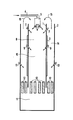
- the device is formed with an open inner tube 1, which protrudes into a closed outer tube 2, so that the gas flow, symbolized by arrows 15, can flow through the inner tube 1 from top to bottom and can get up again between the inner tube 1 and the outer tube 2 .
- Devices for starting the gas flow are not shown for the sake of clarity.
- the inner tube 1 is provided with a cooling jacket 3; this cooling jacket can be, for example, a coil arrangement through which cooling water flows.
- the liquid alkali metal is fed to the device through a feed line 4 and reaches a spray device 5, from which it can be fed to the gas stream through nozzles 6.
- the first oxygen-containing gas is fed to the gas stream through nozzles 7.
- the nozzles 7 are listed as representative of possible complex arrangements of such nozzles 7, from which arrangements oxygen, water vapor and inert gas can be supplied in stages to the gas stream.
- the first reaction between the first gas and the alkali metal takes place in a first reaction zone 8 below the spray device 5 and the nozzles 7.
- carbon dioxide is supplied to the gas stream through corresponding nozzles 9.
- the carbon dioxide reacts with the intermediate product obtained in the first reaction to give the desired alkali carbonate.
- the alkali carbonate is obtained in a finely divided form in the gas stream.
- the separation zone 11 in which an agglomeration of the alkali carbonate and a separation from the gas stream take place. Representing further separating devices, flow obstacles 12 are shown, which the gas stream must flow around, whereby it is guided through narrow cross sections which favor agglomeration of the finely divided alkali carbonate.
- the alkali carbonate separated from the gas stream can be collected in the separation zone 11; from there it must be removed periodically.
- nozzles 13 In the vicinity of the separation zone 11 there are also nozzles 13 through which water in the form of steam or mist can be sprayed in, in order also to enable the finest dusts of the alkali carbonate to be separated from the gas stream.
- further filter devices can optionally be provided in the device.
- a backflow zone 14 for the gas stream Between the inner tube 1 and the outer tube 2 there is a backflow zone 14 for the gas stream, through which it can be led upwards and fed back into the inner tube 1.
- the representation of the device it has been refrained from representing delivery devices for the various gases, as well as cooling water and water for introduction into the gas stream; the corresponding nozzles 7, 9 and 13 and the cooling jacket 3 are shown in each case. According to the invention, the selection of the corresponding delivery devices is not subject to any restrictions beyond the relevant specialist knowledge.
- the device shown is particularly suitable for converting sodium, which was used as a coolant in a nuclear reactor, into a product that can be disposed of.
Landscapes
- Chemical & Material Sciences (AREA)
- Organic Chemistry (AREA)
- Engineering & Computer Science (AREA)
- Materials Engineering (AREA)
- Inorganic Chemistry (AREA)
- Physical Or Chemical Processes And Apparatus (AREA)
- Gas Separation By Absorption (AREA)
Applications Claiming Priority (2)
| Application Number | Priority Date | Filing Date | Title |
|---|---|---|---|
| DE19924236833 DE4236833C2 (de) | 1992-11-02 | 1992-11-02 | Verfahren zur Umsetzung eines im flüssigen Zustand vorliegenden Alkalimetalls in ein Alkalicarbonat |
| DE4236833 | 1992-11-02 |
Publications (1)
| Publication Number | Publication Date |
|---|---|
| EP0596331A1 true EP0596331A1 (fr) | 1994-05-11 |
Family
ID=6471820
Family Applications (1)
| Application Number | Title | Priority Date | Filing Date |
|---|---|---|---|
| EP93116999A Withdrawn EP0596331A1 (fr) | 1992-11-02 | 1993-10-20 | Transformation d'un métal alcalin à l'état liquide en un carbonate alcalin |
Country Status (2)
| Country | Link |
|---|---|
| EP (1) | EP0596331A1 (fr) |
| DE (1) | DE4236833C2 (fr) |
Cited By (4)
| Publication number | Priority date | Publication date | Assignee | Title |
|---|---|---|---|---|
| EP0854115A1 (fr) * | 1997-01-15 | 1998-07-22 | CENTRE D'ETUDES DE L'ENERGIE NUCLEAIRE, établissement d'utilité publique | Procédé d'oxydation d'au moins un métal alcalin |
| RU2163885C2 (ru) * | 1999-03-15 | 2001-03-10 | Открытое акционерное общество "Пикалевское объединение "Глинозем" | Способ переработки содопоташного раствора |
| FR2888231A1 (fr) * | 2005-07-06 | 2007-01-12 | Framatome Anp Sas | Installation de traitement de sodium metallique, notamment pour le traitement de sodium venant de reacteurs nucleaires a neutrons rapides. |
| FR3115709A1 (fr) * | 2020-11-02 | 2022-05-06 | Framatome | Dispositif et procédé de traitement d’un matériau par mise en contact avec un gaz de traitement |
Families Citing this family (1)
| Publication number | Priority date | Publication date | Assignee | Title |
|---|---|---|---|---|
| RU2511388C1 (ru) * | 2012-08-23 | 2014-04-10 | Общество с ограниченной ответственностью "Ростхим" | Способ получения гидрокарбоната натрия, содержащего стабильный изотоп 13c |
Citations (4)
| Publication number | Priority date | Publication date | Assignee | Title |
|---|---|---|---|---|
| JPS57125399A (en) * | 1981-01-28 | 1982-08-04 | Tokyo Shibaura Electric Co | Sodium waste processing device |
| JPS57125400A (en) * | 1981-01-28 | 1982-08-04 | Tokyo Shibaura Electric Co | Sodium waste processing device |
| JPS5821597A (ja) * | 1981-07-31 | 1983-02-08 | 株式会社東芝 | 放射性ナトリウムの処理装置 |
| EP0245148A1 (fr) * | 1986-04-30 | 1987-11-11 | Commissariat A L'energie Atomique | Installation pour la transformation de sodium en soude aqueuse |
Family Cites Families (1)
| Publication number | Priority date | Publication date | Assignee | Title |
|---|---|---|---|---|
| CH135214A (de) * | 1927-02-01 | 1929-09-15 | Degussa | Verfahren zur Herstellung von Alkalioxyden. |
-
1992
- 1992-11-02 DE DE19924236833 patent/DE4236833C2/de not_active Expired - Fee Related
-
1993
- 1993-10-20 EP EP93116999A patent/EP0596331A1/fr not_active Withdrawn
Patent Citations (4)
| Publication number | Priority date | Publication date | Assignee | Title |
|---|---|---|---|---|
| JPS57125399A (en) * | 1981-01-28 | 1982-08-04 | Tokyo Shibaura Electric Co | Sodium waste processing device |
| JPS57125400A (en) * | 1981-01-28 | 1982-08-04 | Tokyo Shibaura Electric Co | Sodium waste processing device |
| JPS5821597A (ja) * | 1981-07-31 | 1983-02-08 | 株式会社東芝 | 放射性ナトリウムの処理装置 |
| EP0245148A1 (fr) * | 1986-04-30 | 1987-11-11 | Commissariat A L'energie Atomique | Installation pour la transformation de sodium en soude aqueuse |
Non-Patent Citations (3)
| Title |
|---|
| CHEMICAL ABSTRACTS, vol. 97, no. 24, 13 December 1982, Columbus, Ohio, US; abstract no. 204786y, "Apparatus for disposing of waste sodium activated in a reactor" page 458; column L; * |
| CHEMICAL ABSTRACTS, vol. 97, no. 24, 13 December 1982, Columbus, Ohio, US; abstract no. 204787z, "Waste sodium treatment apparatus" page 458; column L; * |
| CHEMICAL ABSTRACTS, vol. 98, no. 18, 2 May 1983, Columbus, Ohio, US; abstract no. 151626h, "Apparatus for treating radioactive waste sodium" page 511; column R; * |
Cited By (6)
| Publication number | Priority date | Publication date | Assignee | Title |
|---|---|---|---|---|
| EP0854115A1 (fr) * | 1997-01-15 | 1998-07-22 | CENTRE D'ETUDES DE L'ENERGIE NUCLEAIRE, établissement d'utilité publique | Procédé d'oxydation d'au moins un métal alcalin |
| BE1010854A3 (fr) * | 1997-01-15 | 1999-02-02 | En Nucleaire Etablissement D U | Procede d'oxydation d'au moins un metal alcalin. |
| US6120745A (en) * | 1997-01-15 | 2000-09-19 | Centre D'etude De L'energie Nucleaire, Cen | Method for the oxidation of at least one alkali metal |
| RU2163885C2 (ru) * | 1999-03-15 | 2001-03-10 | Открытое акционерное общество "Пикалевское объединение "Глинозем" | Способ переработки содопоташного раствора |
| FR2888231A1 (fr) * | 2005-07-06 | 2007-01-12 | Framatome Anp Sas | Installation de traitement de sodium metallique, notamment pour le traitement de sodium venant de reacteurs nucleaires a neutrons rapides. |
| FR3115709A1 (fr) * | 2020-11-02 | 2022-05-06 | Framatome | Dispositif et procédé de traitement d’un matériau par mise en contact avec un gaz de traitement |
Also Published As
| Publication number | Publication date |
|---|---|
| DE4236833C2 (de) | 1994-11-10 |
| DE4236833A1 (de) | 1994-05-05 |
Similar Documents
| Publication | Publication Date | Title |
|---|---|---|
| DE2917245C2 (de) | Verfahren und Reaktor zum Herstellen von Schwefel | |
| DE3224328A1 (de) | Verfahren und anlage zur umwandlung von abfallstoffen in bestaendige endprodukte | |
| DE69723769T2 (de) | Direkteinspritzung von Sauerstoff in der Herstellung von Salpetersäure | |
| DE3333187C2 (de) | Verfahren zur Erzeugung von Synthesegas | |
| DE69208302T2 (de) | Verfahren zur Behandlung von Halogenverbindungen enthaltenden Prozess- oder Rauchgasen | |
| DE69116690T2 (de) | Verfahren und einrichtung zur herstellung von akalichromaten aus chrommineralien | |
| DE69310782T2 (de) | Verfahren zur Rückgewinnung und Reinigung von einer sehr angereichertes Uran enthaltenden Metallegierung | |
| DE3909288A1 (de) | Verfahren zum glaseinschmelzen von fluessigem radioaktivem abfall | |
| EP0596331A1 (fr) | Transformation d'un métal alcalin à l'état liquide en un carbonate alcalin | |
| DE2243577C3 (de) | Verfahren zum Gewinnen quecksilberfreier Schwefelsäure | |
| DE1908747C3 (de) | Verfahren zur Abtrennung eines durch Hochtemperaturoxidation erzeugten Titandioxid-Pigments | |
| DE3119282A1 (de) | Verfahren zur herstellung von reduziertem eisen | |
| DE69806453T2 (de) | Verfahren zur Pyrolyse von Dioxinen durch Niedrigtemperatur | |
| EP0054607A1 (fr) | Procédé pour éliminer le nitrate d'ammonium de solutions aqueuses | |
| DE2816693C2 (fr) | ||
| DE2754762C2 (de) | Verfahren zur katalytischen Verbrennung von Schwefelwasserstoff enthaltendem Abgas und zur Durchführung des Verfahrens geeigneter Katalysator | |
| EP0367966B1 (fr) | Brûleur pour la gazéification des combustibles solides à grains fins ou pulvérulents | |
| DE2644244A1 (de) | Verfahren zur entfernung von schwefeldioxid und stickstoffoxiden aus gasen | |
| DE60105292T2 (de) | Verfahren zur zerlegung einer wässerigen carbamatlösung erhalten aus dem harnstoffrückgewinnungsteil einer anlage zur herstellung von harnstoff | |
| EP1064982B1 (fr) | Procédé d'élimination de métaux de matière résiduelle | |
| DE3201771A1 (de) | Verfahren zur zerlegung von metallnitratloesungen | |
| DE2520776A1 (de) | Verfahren zur entfernung von verunreinigungen, insbesondere schwefeldioxid, aus gasstroemen | |
| DE1112053B (de) | Verfahren und Vorrichtung zur Herstellung von Alkaliphosphaten | |
| DE69722606T2 (de) | Verfahren zur Verminderung der Emissionen von freiem Restammoniak aus einer Ureumproduktionsanlage | |
| DE3201993A1 (de) | Isolierung des chlorgehalts bei einem integrierten prozess zur oxichlorierung und verbrennung von chlorierten kohlenwasserstoffen |
Legal Events
| Date | Code | Title | Description |
|---|---|---|---|
| PUAI | Public reference made under article 153(3) epc to a published international application that has entered the european phase |
Free format text: ORIGINAL CODE: 0009012 |
|
| AK | Designated contracting states |
Kind code of ref document: A1 Designated state(s): BE CH DE ES FR GB LI SE |
|
| 17P | Request for examination filed |
Effective date: 19940608 |
|
| 17Q | First examination report despatched |
Effective date: 19950127 |
|
| STAA | Information on the status of an ep patent application or granted ep patent |
Free format text: STATUS: THE APPLICATION IS DEEMED TO BE WITHDRAWN |
|
| 18D | Application deemed to be withdrawn |
Effective date: 19950607 |