EP0596418B1 - Tissu flexible détachable, procédé pour sa production et son utilisation - Google Patents
Tissu flexible détachable, procédé pour sa production et son utilisation Download PDFInfo
- Publication number
- EP0596418B1 EP0596418B1 EP93117528A EP93117528A EP0596418B1 EP 0596418 B1 EP0596418 B1 EP 0596418B1 EP 93117528 A EP93117528 A EP 93117528A EP 93117528 A EP93117528 A EP 93117528A EP 0596418 B1 EP0596418 B1 EP 0596418B1
- Authority
- EP
- European Patent Office
- Prior art keywords
- adhesive
- melt adhesive
- structure according
- surface structure
- substrate
- Prior art date
- Legal status (The legal status is an assumption and is not a legal conclusion. Google has not performed a legal analysis and makes no representation as to the accuracy of the status listed.)
- Expired - Lifetime
Links
- 238000000034 method Methods 0.000 title claims abstract description 24
- 239000004744 fabric Substances 0.000 title abstract description 25
- 238000004519 manufacturing process Methods 0.000 title description 9
- 239000000853 adhesive Substances 0.000 claims abstract description 66
- 239000000758 substrate Substances 0.000 claims abstract description 39
- 239000000463 material Substances 0.000 claims abstract description 21
- 239000002390 adhesive tape Substances 0.000 claims abstract description 8
- 238000007639 printing Methods 0.000 claims abstract description 6
- 230000001070 adhesive effect Effects 0.000 claims description 57
- 238000000576 coating method Methods 0.000 claims description 9
- 239000011248 coating agent Substances 0.000 claims description 8
- 239000005357 flat glass Substances 0.000 claims description 8
- 239000000123 paper Substances 0.000 claims description 8
- 229920001577 copolymer Polymers 0.000 claims description 7
- 230000005855 radiation Effects 0.000 claims description 7
- 238000007646 gravure printing Methods 0.000 claims description 6
- 238000002844 melting Methods 0.000 claims description 6
- 230000008018 melting Effects 0.000 claims description 6
- 238000007650 screen-printing Methods 0.000 claims description 6
- 239000004753 textile Substances 0.000 claims description 6
- 239000011888 foil Substances 0.000 claims description 5
- 239000012790 adhesive layer Substances 0.000 claims description 4
- 239000004840 adhesive resin Substances 0.000 claims description 4
- 229920006223 adhesive resin Polymers 0.000 claims description 4
- 239000002184 metal Substances 0.000 claims description 4
- 229910052751 metal Inorganic materials 0.000 claims description 4
- 239000004014 plasticizer Substances 0.000 claims description 4
- 229920000728 polyester Polymers 0.000 claims description 4
- 239000003381 stabilizer Substances 0.000 claims description 4
- 238000012546 transfer Methods 0.000 claims description 4
- 229920001634 Copolyester Polymers 0.000 claims description 3
- 239000004952 Polyamide Substances 0.000 claims description 3
- -1 copolyamide Polymers 0.000 claims description 3
- 150000002148 esters Chemical class 0.000 claims description 3
- 239000000945 filler Substances 0.000 claims description 3
- 239000000203 mixture Substances 0.000 claims description 3
- 239000002985 plastic film Substances 0.000 claims description 3
- 229920006255 plastic film Polymers 0.000 claims description 3
- 229920002647 polyamide Polymers 0.000 claims description 3
- 229920000098 polyolefin Polymers 0.000 claims description 3
- 229920002635 polyurethane Polymers 0.000 claims description 3
- 239000004814 polyurethane Substances 0.000 claims description 3
- 230000001681 protective effect Effects 0.000 claims description 3
- 229920003051 synthetic elastomer Polymers 0.000 claims description 3
- 239000005061 synthetic rubber Substances 0.000 claims description 3
- 244000043261 Hevea brasiliensis Species 0.000 claims description 2
- VVQNEPGJFQJSBK-UHFFFAOYSA-N Methyl methacrylate Chemical compound COC(=O)C(C)=C VVQNEPGJFQJSBK-UHFFFAOYSA-N 0.000 claims description 2
- 229920005372 Plexiglas® Polymers 0.000 claims description 2
- 229910000831 Steel Inorganic materials 0.000 claims description 2
- 239000003638 chemical reducing agent Substances 0.000 claims description 2
- 238000004132 cross linking Methods 0.000 claims description 2
- 238000002372 labelling Methods 0.000 claims description 2
- 230000000873 masking effect Effects 0.000 claims description 2
- 229920003052 natural elastomer Polymers 0.000 claims description 2
- 229920001194 natural rubber Polymers 0.000 claims description 2
- 238000004806 packaging method and process Methods 0.000 claims description 2
- 229920001296 polysiloxane Polymers 0.000 claims description 2
- 239000010959 steel Substances 0.000 claims description 2
- 229920002554 vinyl polymer Polymers 0.000 claims description 2
- 239000000155 melt Substances 0.000 claims 15
- 230000001413 cellular effect Effects 0.000 claims 1
- 238000009434 installation Methods 0.000 claims 1
- 229920000193 polymethacrylate Polymers 0.000 claims 1
- 239000004831 Hot glue Substances 0.000 abstract description 53
- 239000004821 Contact adhesive Substances 0.000 abstract 2
- PPBRXRYQALVLMV-UHFFFAOYSA-N Styrene Chemical compound C=CC1=CC=CC=C1 PPBRXRYQALVLMV-UHFFFAOYSA-N 0.000 description 8
- 239000006185 dispersion Substances 0.000 description 7
- 239000004005 microsphere Substances 0.000 description 5
- 229920000642 polymer Polymers 0.000 description 5
- 229920001169 thermoplastic Polymers 0.000 description 5
- RSWGJHLUYNHPMX-UHFFFAOYSA-N Abietic-Saeure Chemical class C12CCC(C(C)C)=CC2=CCC2C1(C)CCCC2(C)C(O)=O RSWGJHLUYNHPMX-UHFFFAOYSA-N 0.000 description 4
- KHPCPRHQVVSZAH-HUOMCSJISA-N Rosin Chemical class O(C/C=C/c1ccccc1)[C@H]1[C@H](O)[C@@H](O)[C@@H](O)[C@@H](CO)O1 KHPCPRHQVVSZAH-HUOMCSJISA-N 0.000 description 4
- 238000010022 rotary screen printing Methods 0.000 description 4
- 238000010998 test method Methods 0.000 description 4
- 239000004416 thermosoftening plastic Substances 0.000 description 4
- KHPCPRHQVVSZAH-UHFFFAOYSA-N trans-cinnamyl beta-D-glucopyranoside Chemical class OC1C(O)C(O)C(CO)OC1OCC=CC1=CC=CC=C1 KHPCPRHQVVSZAH-UHFFFAOYSA-N 0.000 description 4
- VSKJLJHPAFKHBX-UHFFFAOYSA-N 2-methylbuta-1,3-diene;styrene Chemical compound CC(=C)C=C.C=CC1=CC=CC=C1.C=CC1=CC=CC=C1 VSKJLJHPAFKHBX-UHFFFAOYSA-N 0.000 description 3
- 239000004793 Polystyrene Substances 0.000 description 3
- 239000000654 additive Substances 0.000 description 3
- 230000002349 favourable effect Effects 0.000 description 3
- 238000012545 processing Methods 0.000 description 3
- 238000003860 storage Methods 0.000 description 3
- 239000000126 substance Substances 0.000 description 3
- 238000012360 testing method Methods 0.000 description 3
- KAKZBPTYRLMSJV-UHFFFAOYSA-N Butadiene Chemical compound C=CC=C KAKZBPTYRLMSJV-UHFFFAOYSA-N 0.000 description 2
- 239000004820 Pressure-sensitive adhesive Substances 0.000 description 2
- 150000001252 acrylic acid derivatives Chemical class 0.000 description 2
- 230000032683 aging Effects 0.000 description 2
- 125000002723 alicyclic group Chemical class 0.000 description 2
- 125000001931 aliphatic group Chemical class 0.000 description 2
- 150000004945 aromatic hydrocarbons Chemical class 0.000 description 2
- 238000001816 cooling Methods 0.000 description 2
- FLKPEMZONWLCSK-UHFFFAOYSA-N diethyl phthalate Chemical compound CCOC(=O)C1=CC=CC=C1C(=O)OCC FLKPEMZONWLCSK-UHFFFAOYSA-N 0.000 description 2
- 239000011521 glass Substances 0.000 description 2
- 239000010410 layer Substances 0.000 description 2
- 239000007788 liquid Substances 0.000 description 2
- VNWKTOKETHGBQD-UHFFFAOYSA-N methane Chemical compound C VNWKTOKETHGBQD-UHFFFAOYSA-N 0.000 description 2
- 229920003023 plastic Polymers 0.000 description 2
- 239000004033 plastic Substances 0.000 description 2
- 229920002223 polystyrene Polymers 0.000 description 2
- 229920005989 resin Polymers 0.000 description 2
- 239000011347 resin Substances 0.000 description 2
- ATLWFAZCZPSXII-UHFFFAOYSA-N (2-octylphenyl) 2-hydroxybenzoate Chemical compound CCCCCCCCC1=CC=CC=C1OC(=O)C1=CC=CC=C1O ATLWFAZCZPSXII-UHFFFAOYSA-N 0.000 description 1
- KPAPHODVWOVUJL-UHFFFAOYSA-N 1-benzofuran;1h-indene Chemical compound C1=CC=C2CC=CC2=C1.C1=CC=C2OC=CC2=C1 KPAPHODVWOVUJL-UHFFFAOYSA-N 0.000 description 1
- UIFVCPMLQXKEEU-UHFFFAOYSA-N 2,3-dimethylbenzaldehyde Chemical compound CC1=CC=CC(C=O)=C1C UIFVCPMLQXKEEU-UHFFFAOYSA-N 0.000 description 1
- SMZOUWXMTYCWNB-UHFFFAOYSA-N 2-(2-methoxy-5-methylphenyl)ethanamine Chemical class COC1=CC=C(C)C=C1CCN SMZOUWXMTYCWNB-UHFFFAOYSA-N 0.000 description 1
- NIXOWILDQLNWCW-UHFFFAOYSA-N 2-Propenoic acid Natural products OC(=O)C=C NIXOWILDQLNWCW-UHFFFAOYSA-N 0.000 description 1
- RIWRBSMFKVOJMN-UHFFFAOYSA-N 2-methyl-1-phenylpropan-2-ol Chemical compound CC(C)(O)CC1=CC=CC=C1 RIWRBSMFKVOJMN-UHFFFAOYSA-N 0.000 description 1
- HXIQYSLFEXIOAV-UHFFFAOYSA-N 2-tert-butyl-4-(5-tert-butyl-4-hydroxy-2-methylphenyl)sulfanyl-5-methylphenol Chemical compound CC1=CC(O)=C(C(C)(C)C)C=C1SC1=CC(C(C)(C)C)=C(O)C=C1C HXIQYSLFEXIOAV-UHFFFAOYSA-N 0.000 description 1
- VSAWBBYYMBQKIK-UHFFFAOYSA-N 4-[[3,5-bis[(3,5-ditert-butyl-4-hydroxyphenyl)methyl]-2,4,6-trimethylphenyl]methyl]-2,6-ditert-butylphenol Chemical compound CC1=C(CC=2C=C(C(O)=C(C=2)C(C)(C)C)C(C)(C)C)C(C)=C(CC=2C=C(C(O)=C(C=2)C(C)(C)C)C(C)(C)C)C(C)=C1CC1=CC(C(C)(C)C)=C(O)C(C(C)(C)C)=C1 VSAWBBYYMBQKIK-UHFFFAOYSA-N 0.000 description 1
- FXTXRXXCMFFRTL-UHFFFAOYSA-N 4-ethyl-2-methylideneoctanoic acid Chemical compound CCCCC(CC)CC(=C)C(O)=O FXTXRXXCMFFRTL-UHFFFAOYSA-N 0.000 description 1
- NLHHRLWOUZZQLW-UHFFFAOYSA-N Acrylonitrile Chemical class C=CC#N NLHHRLWOUZZQLW-UHFFFAOYSA-N 0.000 description 1
- 239000005995 Aluminium silicate Substances 0.000 description 1
- MQIUGAXCHLFZKX-UHFFFAOYSA-N Di-n-octyl phthalate Natural products CCCCCCCCOC(=O)C1=CC=CC=C1C(=O)OCCCCCCCC MQIUGAXCHLFZKX-UHFFFAOYSA-N 0.000 description 1
- RPNUMPOLZDHAAY-UHFFFAOYSA-N Diethylenetriamine Chemical compound NCCNCCN RPNUMPOLZDHAAY-UHFFFAOYSA-N 0.000 description 1
- ZVFDTKUVRCTHQE-UHFFFAOYSA-N Diisodecyl phthalate Chemical compound CC(C)CCCCCCCOC(=O)C1=CC=CC=C1C(=O)OCCCCCCCC(C)C ZVFDTKUVRCTHQE-UHFFFAOYSA-N 0.000 description 1
- VGGSQFUCUMXWEO-UHFFFAOYSA-N Ethene Chemical compound C=C VGGSQFUCUMXWEO-UHFFFAOYSA-N 0.000 description 1
- 239000005977 Ethylene Substances 0.000 description 1
- OWYWGLHRNBIFJP-UHFFFAOYSA-N Ipazine Chemical compound CCN(CC)C1=NC(Cl)=NC(NC(C)C)=N1 OWYWGLHRNBIFJP-UHFFFAOYSA-N 0.000 description 1
- CERQOIWHTDAKMF-UHFFFAOYSA-N Methacrylic acid Chemical class CC(=C)C(O)=O CERQOIWHTDAKMF-UHFFFAOYSA-N 0.000 description 1
- KFFQABQEJATQAT-UHFFFAOYSA-N N,N'-dibutylthiourea Chemical compound CCCCNC(=S)NCCCC KFFQABQEJATQAT-UHFFFAOYSA-N 0.000 description 1
- 229910019142 PO4 Inorganic materials 0.000 description 1
- 229920001944 Plastisol Polymers 0.000 description 1
- 229920002845 Poly(methacrylic acid) Polymers 0.000 description 1
- XBDQKXXYIPTUBI-UHFFFAOYSA-M Propionate Chemical compound CCC([O-])=O XBDQKXXYIPTUBI-UHFFFAOYSA-M 0.000 description 1
- 208000025747 Rheumatic disease Diseases 0.000 description 1
- XTXRWKRVRITETP-UHFFFAOYSA-N Vinyl acetate Chemical class CC(=O)OC=C XTXRWKRVRITETP-UHFFFAOYSA-N 0.000 description 1
- 125000005396 acrylic acid ester group Chemical group 0.000 description 1
- 230000002411 adverse Effects 0.000 description 1
- 125000005250 alkyl acrylate group Chemical group 0.000 description 1
- 235000012211 aluminium silicate Nutrition 0.000 description 1
- 238000007774 anilox coating Methods 0.000 description 1
- 238000013459 approach Methods 0.000 description 1
- 239000011230 binding agent Substances 0.000 description 1
- BJQHLKABXJIVAM-UHFFFAOYSA-N bis(2-ethylhexyl) phthalate Chemical compound CCCCC(CC)COC(=O)C1=CC=CC=C1C(=O)OCC(CC)CCCC BJQHLKABXJIVAM-UHFFFAOYSA-N 0.000 description 1
- ZFMQKOWCDKKBIF-UHFFFAOYSA-N bis(3,5-difluorophenyl)phosphane Chemical compound FC1=CC(F)=CC(PC=2C=C(F)C=C(F)C=2)=C1 ZFMQKOWCDKKBIF-UHFFFAOYSA-N 0.000 description 1
- 239000001913 cellulose Substances 0.000 description 1
- 229920002678 cellulose Polymers 0.000 description 1
- 150000001875 compounds Chemical class 0.000 description 1
- 238000010276 construction Methods 0.000 description 1
- 230000018044 dehydration Effects 0.000 description 1
- 238000006297 dehydration reaction Methods 0.000 description 1
- 229920000359 diblock copolymer Polymers 0.000 description 1
- JBSLOWBPDRZSMB-FPLPWBNLSA-N dibutyl (z)-but-2-enedioate Chemical compound CCCCOC(=O)\C=C/C(=O)OCCCC JBSLOWBPDRZSMB-FPLPWBNLSA-N 0.000 description 1
- MIMDHDXOBDPUQW-UHFFFAOYSA-N dioctyl decanedioate Chemical compound CCCCCCCCOC(=O)CCCCCCCCC(=O)OCCCCCCCC MIMDHDXOBDPUQW-UHFFFAOYSA-N 0.000 description 1
- 239000002270 dispersing agent Substances 0.000 description 1
- 238000001035 drying Methods 0.000 description 1
- 239000000839 emulsion Substances 0.000 description 1
- HQQADJVZYDDRJT-UHFFFAOYSA-N ethene;prop-1-ene Chemical group C=C.CC=C HQQADJVZYDDRJT-UHFFFAOYSA-N 0.000 description 1
- 239000005038 ethylene vinyl acetate Substances 0.000 description 1
- 239000006260 foam Substances 0.000 description 1
- 239000003292 glue Substances 0.000 description 1
- 150000002314 glycerols Chemical class 0.000 description 1
- 239000003999 initiator Substances 0.000 description 1
- 229910052500 inorganic mineral Inorganic materials 0.000 description 1
- NLYAJNPCOHFWQQ-UHFFFAOYSA-N kaolin Chemical compound O.O.O=[Al]O[Si](=O)O[Si](=O)O[Al]=O NLYAJNPCOHFWQQ-UHFFFAOYSA-N 0.000 description 1
- FPYJFEHAWHCUMM-UHFFFAOYSA-N maleic anhydride Chemical class O=C1OC(=O)C=C1 FPYJFEHAWHCUMM-UHFFFAOYSA-N 0.000 description 1
- 239000011159 matrix material Substances 0.000 description 1
- 239000012528 membrane Substances 0.000 description 1
- 239000011707 mineral Substances 0.000 description 1
- 238000002156 mixing Methods 0.000 description 1
- 239000000178 monomer Substances 0.000 description 1
- OMNKZBIFPJNNIO-UHFFFAOYSA-N n-(2-methyl-4-oxopentan-2-yl)prop-2-enamide Chemical class CC(=O)CC(C)(C)NC(=O)C=C OMNKZBIFPJNNIO-UHFFFAOYSA-N 0.000 description 1
- SSDSCDGVMJFTEQ-UHFFFAOYSA-N octadecyl 3-(3,5-ditert-butyl-4-hydroxyphenyl)propanoate Chemical compound CCCCCCCCCCCCCCCCCCOC(=O)CCC1=CC(C(C)(C)C)=C(O)C(C(C)(C)C)=C1 SSDSCDGVMJFTEQ-UHFFFAOYSA-N 0.000 description 1
- 230000008520 organization Effects 0.000 description 1
- NFHFRUOZVGFOOS-UHFFFAOYSA-N palladium;triphenylphosphane Chemical compound [Pd].C1=CC=CC=C1P(C=1C=CC=CC=1)C1=CC=CC=C1.C1=CC=CC=C1P(C=1C=CC=CC=1)C1=CC=CC=C1.C1=CC=CC=C1P(C=1C=CC=CC=1)C1=CC=CC=C1.C1=CC=CC=C1P(C=1C=CC=CC=1)C1=CC=CC=C1 NFHFRUOZVGFOOS-UHFFFAOYSA-N 0.000 description 1
- 235000021317 phosphate Nutrition 0.000 description 1
- 150000003013 phosphoric acid derivatives Chemical class 0.000 description 1
- 125000005498 phthalate group Chemical class 0.000 description 1
- 239000004999 plastisol Substances 0.000 description 1
- 229920001200 poly(ethylene-vinyl acetate) Polymers 0.000 description 1
- 229920000058 polyacrylate Polymers 0.000 description 1
- 229920001083 polybutene Polymers 0.000 description 1
- 150000003097 polyterpenes Chemical class 0.000 description 1
- 229920000915 polyvinyl chloride Polymers 0.000 description 1
- 239000004800 polyvinyl chloride Substances 0.000 description 1
- 239000000843 powder Substances 0.000 description 1
- 230000001737 promoting effect Effects 0.000 description 1
- 238000011160 research Methods 0.000 description 1
- 230000000552 rheumatic effect Effects 0.000 description 1
- 238000007789 sealing Methods 0.000 description 1
- 238000000926 separation method Methods 0.000 description 1
- 239000007787 solid Substances 0.000 description 1
- 239000000243 solution Substances 0.000 description 1
- 230000035882 stress Effects 0.000 description 1
- 229920006132 styrene block copolymer Polymers 0.000 description 1
- 239000000454 talc Substances 0.000 description 1
- 229910052623 talc Inorganic materials 0.000 description 1
- 230000008646 thermal stress Effects 0.000 description 1
- 229920000428 triblock copolymer Polymers 0.000 description 1
- STCOOQWBFONSKY-UHFFFAOYSA-N tributyl phosphate Chemical compound CCCCOP(=O)(OCCCC)OCCCC STCOOQWBFONSKY-UHFFFAOYSA-N 0.000 description 1
- XZZNDPSIHUTMOC-UHFFFAOYSA-N triphenyl phosphate Chemical compound C=1C=CC=CC=1OP(OC=1C=CC=CC=1)(=O)OC1=CC=CC=C1 XZZNDPSIHUTMOC-UHFFFAOYSA-N 0.000 description 1
- XLYOFNOQVPJJNP-UHFFFAOYSA-N water Substances O XLYOFNOQVPJJNP-UHFFFAOYSA-N 0.000 description 1
- BOXSVZNGTQTENJ-UHFFFAOYSA-L zinc dibutyldithiocarbamate Chemical compound [Zn+2].CCCCN(C([S-])=S)CCCC.CCCCN(C([S-])=S)CCCC BOXSVZNGTQTENJ-UHFFFAOYSA-L 0.000 description 1
Images
Classifications
-
- G—PHYSICS
- G09—EDUCATION; CRYPTOGRAPHY; DISPLAY; ADVERTISING; SEALS
- G09F—DISPLAYING; ADVERTISING; SIGNS; LABELS OR NAME-PLATES; SEALS
- G09F3/00—Labels, tag tickets, or similar identification or indication means; Seals; Postage or like stamps
- G09F3/08—Fastening or securing by means not forming part of the material of the label itself
- G09F3/10—Fastening or securing by means not forming part of the material of the label itself by an adhesive layer
-
- C—CHEMISTRY; METALLURGY
- C09—DYES; PAINTS; POLISHES; NATURAL RESINS; ADHESIVES; COMPOSITIONS NOT OTHERWISE PROVIDED FOR; APPLICATIONS OF MATERIALS NOT OTHERWISE PROVIDED FOR
- C09J—ADHESIVES; NON-MECHANICAL ASPECTS OF ADHESIVE PROCESSES IN GENERAL; ADHESIVE PROCESSES NOT PROVIDED FOR ELSEWHERE; USE OF MATERIALS AS ADHESIVES
- C09J7/00—Adhesives in the form of films or foils
- C09J7/30—Adhesives in the form of films or foils characterised by the adhesive composition
- C09J7/38—Pressure-sensitive adhesives [PSA]
-
- C—CHEMISTRY; METALLURGY
- C09—DYES; PAINTS; POLISHES; NATURAL RESINS; ADHESIVES; COMPOSITIONS NOT OTHERWISE PROVIDED FOR; APPLICATIONS OF MATERIALS NOT OTHERWISE PROVIDED FOR
- C09J—ADHESIVES; NON-MECHANICAL ASPECTS OF ADHESIVE PROCESSES IN GENERAL; ADHESIVE PROCESSES NOT PROVIDED FOR ELSEWHERE; USE OF MATERIALS AS ADHESIVES
- C09J2301/00—Additional features of adhesives in the form of films or foils
- C09J2301/20—Additional features of adhesives in the form of films or foils characterized by the structural features of the adhesive itself
- C09J2301/204—Additional features of adhesives in the form of films or foils characterized by the structural features of the adhesive itself the adhesive coating being discontinuous
Definitions
- This invention relates to residue-free removable, flexible fabrics that are again can be glued again. This also applies to Invention a method for its production and favorable uses for this.
- EP-B-0 149 135 is a residue-free removable and re-bondable, tacky sheet known. This has dome-shaped Detention points, with the dome base on the Fabric adheres. The base diameter is at 30-600 ⁇ m.
- the pressure sensitive adhesive is using an adhesive dispersion with a solids content of at least 45% by weight applied to the fabric.
- the dispersion used can be aqueous Be dispersion.
- the coating is done with the Screen printing, gravure printing or the inkjet process.
- a residue-free removable sticky sheet with dome-shaped adhesion points is also known.
- the number of detention points increases from at least 10 / cm 2 to a maximum of 15000 / cm 2 . It is thus possible that the application of adhesive increases from at least 1 g / m 2 to at most 30 g / m 2 .
- the adhesive is applied with the aid of an adhesive dispersion, which can be an aqueous dispersion. The coating takes place with the screen printing, gravure printing or the ink jet method.
- the known methods mentioned have the Disadvantage that the adhesive before coating is in dispersed form.
- the dispersant - no matter whether water or another means - must after application in a subsequent process step be removed. This process step either means a slow production speed or a long drying stretch.
- Farther thermal stresses, e.g. with a plastic film as a substrate, or unwanted dehydration processes affect coated substrate negatively. The consequences are e.g. a lack of flatness of the finished Products.
- the adhesive is first applied over the entire surface, where only a selective contact surface with the the substrate to be glued later is reached, or in the adhesive non-tacky, elastic balls are embedded or by the adhesive itself is made of pressure-sensitive, elastic Balls. In such cases, contact only the raised areas with the fabric substrate to be stuck.
- From DE-PS 24 17 312 is a self-adhesive sheet known in which the substrate on at least one side microspheres made of a copolymer of one oleophilic, water-emulsifiable alkyl acrylate esters and another monomer. Between the A substrate and the microspheres, a binder is arranged, in which the microspheres are embedded and they protrude from its free surface.
- a disadvantage of the methods described is that they are pretty expensive and cumbersome since always care must be taken to ensure that parts of the adhesive layer or the microspheres from the surface of the Sticking out of the adhesive and thus the sticky, punctual Can form contact area.
- the adhesives - which may be pressure sensitive hot-melt adhesives, solution or dispersion adhesives - are generally applied over the entire surface, usually with a surface coating of between 15 and 25 g / m 2 (dry weight).
- This has the disadvantage that there is a fairly large amount of adhesive on the substrate. If these adhesives are applied only in a punctiform manner and not over the entire surface, the amount of adhesive and thus the basis weight can be saved, but in connection with this there is also a reduction in the adhesive force. This in turn leads to a clear restriction on the usability of these fabrics. In particular, applications are ruled out under conditions which involve a higher tensile or shear stress on the fabrics.
- This invention was therefore based on the object Removable, flexible fabrics that can be removed without leaving any residue to provide, the amount of adhesive can be reduced and at the same time the adhesive force is not adversely affected.
- a method for the production of such Flat structures and favorable uses for this to be specified is also based on the object Removable, flexible fabrics that can be removed without leaving any residue to provide, the amount of adhesive can be reduced and at the same time the adhesive force is not adversely affected.
- a residue-free removable, flexible fabric of the type mentioned at the outset is characterized in that a hot melt adhesive as a pressure sensitive adhesive is used, the grid on the Substrate is applied and one on the substrate has adhesive base, the hot melt adhesive before the coating was not in a carrier system or was applied without a carrier system.
- the hot melt adhesive was not in a carrier system in front "here means that the Hot melt adhesive is not dispersed or emulsified and therefore not in the form of a dispersion, emulsion, an organosol or a plastisol for the Coating is used.
- the hot melt adhesive can as such, however, contain additives, e.g. Plasticizers, Stabilizers or similar substances like it will be explained in more detail later.
- the fabric according to the invention is characterized in particular by its residue-free removability.
- the fabric that shows a residue after detachment that has an area coverage of less than 0.1% / 625 mm 2 of originally bonded area is to be regarded as residue-free.
- the residue-free releasability depends not only on the angle and speed of detachment, but also on the type of adhesive, the grid used and the type of substrate, and the resultant adhesion of the fabric to the substrate.
- the ideal test substrates for this are window and plexiglass as well as steel, substrates with comparatively high adhesive forces to form structures with hot melt adhesives.
- the fabric according to the invention stands out by being on one of the substrates above are mentioned, glued and by this at a speed of up to 1000 mm / s can and regardless of the transfer angle Form residues in the above sense.
- Hot melt adhesive forms dome-shaped trap, the base of which is with the substrate connected is.
- a particularly high adhesive strength and yet residue-free removable, independent of peeling angle and speed, can be obtained if a ratio of the base area a hot melt adhesive point to its height in the Range from 5: 1 to 30: 1 and preferably from 10: 1 up to 25: 1 is observed.
- Procedure will have an adhesive force of 2.5 to 10 N / 25 mm reached.
- thermoplastic polymers (a) and their mixtures with components (b) to (f) are for this usable.
- thermoplastic backbone polymers are e.g. natural rubber; synthetic rubber such as SBS, SIS, SEBS (styrene / ethylene / butadiene / styrene), SEPS (Styrene / ethylene / propylene / styrene) (triblock copolymers) and S-B, S-I, S-EP (diblock copolymers); Polyolefins such as atactic PP, ethylene-propylene-butadiene copolymer; Polyacrylates such as polybutyl acrylic acid ester, poly (2-ethylhexyl acrylic acid ester), polymethacrylic acid ester and their copolymers with e.g.
- Acrylic acid methacrylic acid, Vinyl acetate, maleic anhydride, diacetone acrylamide or acrylonitrile; Polyvinyl derivatives such as Ethylene-vinyl acetate copolymer, (1-vinyl-2-pyrrolidone) -Vinyl acetate copolymer, vinyl acetate-vinyl laurate copolymer; Polyamides such as diethylene triamine polyamide; Copolyamides; Polyester; Copolyester; Copolyetherester; Polyurethanes; Silicones. These backbone polymers can as copolymers or as mixtures with one another, fully cross-linked or UV or ESH post-cross-linkable be used.
- Suitable adhesive resins are e.g. aliphatic, alicyclic and aromatic hydrocarbons; Polyterpenes; Rosin esters such as rosin glycerin esters, hydrogenated rosin pentaerythritol ester, polymerized rosin-diethylene glycol esters; polymerized rosin.
- Suitable plasticizers are e.g. Phthalates such as diethyl phthalate, Dioctyl phthalate, diisodecyl phthalate; Phosphates such as tributyl phosphate, triphenyl phosphate; Dioctyl adipate; Dioctyl sebacate; Dibutyl maleate.
- Suitable viscosity reducing additives are e.g. aliphatic, alicyclic and aromatic hydrocarbons; liquid polybutene; liquid polystyrene; Xylene-formaldehyde resins; Coumarone indene resins.
- Suitable stabilizers are e.g. Tetrakis [methylene-3- (3 ', 5'-di-tert-butyl-4'-hydroxyphenyl) propionate] methane; 1,3,5-trimethyl-2,4,6-tris (3,5-di-tert-butyl-4-hydroxy-benzyl) benzene; 4,4'-thiobis (6-tert-butyl-m-cresol); Zinc dibutyldithiocarbamate; Dibutylthiourea; Octylphenyl salicylate; 2-hydroxy-4- (2-hydroxy-3-methacryloxy) propiobenzophenone; Octa-decyl-3- (3 ', 5'-di-tert-butyl-4'-hydroxyphenyl) propionate.
- Suitable fillers are e.g. mineral substances like kaolin or talc.
- thermoplastic backbone polymers can be cross-linked by radiation are, e.g. by UV or electron radiation.
- Suitable thermoplastic backbone polymers are e.g. Acrylates; Polyester acrylates; synthetic rubbers.
- the radiation-crosslinkable hot melt adhesive is applied to the substrate of the fabric and then radiation hardened.
- radiation-crosslinkable hot melt adhesives stand out radiation-crosslinkable hot melt adhesives through a noticeably higher temperature resistance.
- the hot melt adhesive after the radiation crosslinking a melting range of 120 to 250 ° C and a softening range of 50 to 180 ° C.
- Hot melt adhesives with a viscosity of about 1000 to 80,000 mPas at a processing temperature from 100 to 160 ° C.
- the amount of adhesive is less than that of a conventional full-area application and is 3 to 15 g / m 2 , preferably 6 to 10 g / m 2 .
- the hot melt adhesive can be applied to the substrate to be coated in a dot pattern of 100 to 22500 points / 625 mm 2 , particularly preferably from 1600 to 10000 points / 625 mm 2 .
- the fabric to be coated with the hot melt adhesive is preferably a label material; it can consist of paper, cardboard, a plastic or metal foil or of textile.
- the plastic film is made, for example, from polyvinyl chloride, polystyrene, polyolefins, polyesters, polyurethanes or cellulose derivatives.
- the fabric to be coated preferably has a thickness of 10 to 1000 microns and a basis weight of 10 to 500 g / m 2 .
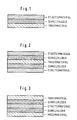
- the flexible fabrics can the structure shown in Figures 1 to 3 to have.
- the fabric consists of a label material that is attached to it Hot melt adhesive and a carrier or release material.
- the carrier or separating material can be made of paper, Cardboard, a plastic or metal foil or from Textile exist.
- 2 are two with each Label materials provided with hot melt adhesive on the both sides of a carrier or release material appropriate.
- the two Adhesive layers made from various hot melt adhesives exist and have different grids.
- the two label materials and in the case of FIG. 3, the two carrier or. Separation materials may be different.
- a gravure printing process or flexographic printing process is coated.
- Screen printing can be done with a flat screen or a circular sieve can be worked.
- flexo printing three-roll processes are used, whereby the Rollers are heated. It is also possible to use doctor blades instead of squeeze rollers.
- the pure cell squeegee systems can use the gravure printing process or well roller systems used become.
- the application systems can be closed or as open systems. All of these procedures has in common that the substrate with the Hot melt adhesive to be coated between one Pressure roller and the pressure body that holds the glue applies, is carried out.
- the point frequency as well the size of the hot melt adhesive spots can be determined by a variable, separate pressure body or either directly through the screen during screen printing, the Cup roller for gravure printing or the anilox roller be controlled in flexographic printing.
- the hotmelt adhesive is applied in pure form, the hotmelt adhesive as such being able to contain the abovementioned additives and optionally being post-crosslinked by UV or electron radiation.
- the application amount is 3 to 15 g / m 2 , preferably 6 to 10 g / m 2 .
- the ratio of the base area to the point height of the Hot melt adhesive points depend on the one hand on the rheological Properties such as of the structural viscosity, Thixotropy and the fluidity of the used hot melt adhesive. On the other hand, it can ratio of base area to point height e.g. when using a sieve by the ratio from hole diameter to wall thickness of the used Siebe be influenced.
- the hot melt adhesive is preferably applied using a rotary screen printing system.
- the advantageous ratio of base area to point height can be set particularly favorably if the screen used in the rotary screen printing system has a wall thickness of 85 to 170 ⁇ m and a passage for the hot melt adhesive of approximately 10 to 45%.
- a screen with 1600 to 10000 holes / 625 mm 2 is preferably used.
- the counter-pressure roller used in the system is provided with a thermal control.
- the necessary temperature of the counter-pressure roller results, among other things, from the softening and melting range of the hot melt adhesive used, the production speed and the adhesive strength of the hot melt adhesive to the screen, depending on the temperature and the viscosity of the hot melt adhesive.
- a melting range from 80 to 250 ° C. and a softening range from 30 to 180 ° C. are preferred.
- Hot melt adhesive in a particularly favorable way on that Apply substrate, in particular that ratio of base area to point height can be adjusted.
- the hot melt adhesive used is PS 5002 from Novamelt Research GmbH (an SIS (styrene / isoprene / styrene) block copolymer, mixed with an adhesive resin in a ratio of 1: 1).
- This hot melt adhesive has a melting point of 120 ° C. Its viscosity at 150 ° C is 49500 mPas.
- the substrate is coated in a grid pattern at a production speed of 80 m / min and a temperature of the counterpressure roller between 110 and 115 ° C., preferably 112 to 113 ° C.
- the amount of adhesive is 6 g / m 2 .
- the ratio of the base area to the height of the hot melt adhesive point is 20: 1.
- the label material produced in this way has an adhesive force of 4.3 N / 25mm on window glass, measured according to the Finat test method FTM1 (FTM: Finat Test Method). If such a label material is stuck to another substrate such as window glass, it can also be removed again without leaving any residue.
- a label is rolled onto a previously cleaned glass plate using a standard Finat pressure roller.
- the label is peeled off after FTM1.
- the contact point of the label with the plate (at least 625 mm 2 ) is then scanned using an image processing system.
- the number and size of the adhesive residues (as black flat structures) can be recorded.
- the degree of area coverage that can be recognized in this way gives a direct reference to the absence of residues.
- the materials that achieve a surface coverage of the transferred adhesive of less than 0.1% / 625 mm 2 of originally bonded area are to be regarded as residue-free.
- the storage stability is checked by artificial aging over a total period of 72 hours. This takes place at the temperatures and humidities (in%) given in the table below for the respective periods of time (for example 6 hours at 40 ° C. and a humidity of 80% rel.), The test being carried out 3 times, in total 72 hours, is going through.
- the label material keeps its above very good adhesive force.
- the hot melt adhesive used is Dynacoll A 3355 from Hüls AG (a copolyester with partially terminal acrylate double bonds), mixed with 1.5% by weight of the photo initiator Daro Cur 1173 from Ciba Geigy. This hot melt adhesive has a viscosity of 8500 mPas at 100 ° C.
- the substrate grid-like with the hot melt adhesive at 120 ° C coated.
- the grid-like hot melt adhesive with a UV lamp with a wavelength of 200nm at a distance of 4cm from the Substrate web exposed.
- the amount of adhesive applied is 10 g / m 2 .
- the ratio of the base area to the height of the hot melt adhesive point is 25: 1.
- the label material produced in this way has an adhesive force of 6.4 N / 25 mm on window glass, measured according to the Finat test method FTM 1 (FTM: Finat Test Method). If such a label material is stuck to a substrate such as window glass, it can also be removed again without leaving any residue.
Landscapes
- Physics & Mathematics (AREA)
- General Physics & Mathematics (AREA)
- Engineering & Computer Science (AREA)
- Theoretical Computer Science (AREA)
- Chemical & Material Sciences (AREA)
- Organic Chemistry (AREA)
- Adhesives Or Adhesive Processes (AREA)
- Adhesive Tapes (AREA)
- Laminated Bodies (AREA)
- Treatments For Attaching Organic Compounds To Fibrous Goods (AREA)
- Manufacture Of Macromolecular Shaped Articles (AREA)
- Chemical Or Physical Treatment Of Fibers (AREA)
Claims (19)
- Tissu flexible, redésolidarisable sans l'effet de dépôt, avec un substrat et une couche d'adhésif appliquée sur au moins une face, caractérisé en ce que l'adhésif est un adhésif à fusion, appliqué selon une trame et présentant une base adhérant sur le substrat, l'adhésif à fusion lors du revêtement ne se présentant pas en un système support, et le rapport entre la surface de base d'un point d'adhésif à fusion et la hauteur du point d'adhésif à fusion étant situé dans la plage allant de 5:1 à 30:1, la possibilité de redésolidarisation exempte de dépôt étant exclu d'un papier support siliconé.
- Tissu selon la revendication 1, caractérisé en ce que le rapport entre la surface de base et la hauteur du point d'adhésif à fusion est compris dans la plage de 10:1 à 25:1.
- Tissu selon la revendication 1 ou 2, caractérisé en ce que l'adhésif à fusion est appliqué sous forme de points.
- Tissu selon l'une des revendications 1 à 3, caractérisé en ce que l'adhésif à fusion est un caoutchouc naturel, un caoutchouc synthétique, une polyoléfine, un poly(méth)acrylate, un dérivé de polyvinyle ou un copolymère de ceux-ci, un polyamide, un copolyamide, un polyester, un copolyester, un copolyétherester, un polyuréthane ou un silicone, ou bien un mélange de ceux-ci.
- Tissu selon l'une des revendications 1 à 4, caractérisé en ce que l'adhésif à fusion contient une résine adhésive, un plastifiant, un agent d'abaissement de la viscosité, un stabilisateur et/ou une charge.
- Tissu selon l'une des revendications 1 à 5, caractérisé en ce que l'adhésif à fusion présente une plage de fusion de 80°C à 250°C et une plage d'amollissement de 30°C à 180°C
- Tissu selon l'une des revendications 1 à 5, caractérisé en ce que l'adhésif à fusion est réticulable par irradiation, au moyen d'un rayonnement UV ou d'électrons.
- Tissu selon la revendication 7, caractérisé en ce que l'adhésif à fusion présente, après réticulation par irradiation, une plage de fusion de 120 à 250°C et une plage d'amollissement de 50 à 180°C.
- Tissu selon l'une des revendications 1 à 8, caractérisé en ce que l'adhésif à fusion est appliqué en suivant une trame de 100 à 22500 points/625 mm2.
- Tissu selon l'une des revendications 1 à 9, caractérisé en ce que l'adhésif à fusion est appliqué sur le substrat selon un poids surfacique de 3 à 15 g/m2.
- Tissu selon l'une des revendications 1 à 10, caractérisé en ce que l'adhésif à fusion est appliqué sur le substrat avec un recouvrement de surface de 10 à 85 %.
- Tissu selon la revendication 11, caractérisé en ce que le substrat est un papier, un carton, une feuille de matière plastique ou de métal ou un textile.
- Tissu selon l'une des revendications 1 à 12, caractérisé en ce que le substrat est d'une épaisseur de 10 à 1000 µm.
- Tissu selon l'une des revendications 1 à 13, caractérisé en ce qu'il présente un pouvoir d'adhésion sur un vitrage de fenêtre de 2,5 à 10 N/25 mm.
- Tissu selon l'une des revendications 1 à 14, caractérisé en ce qu'il peut être désolidarisé du substrat à coller avec un résidu inférieur à 0,1% par 625 mm2 de degré de recouvrement de surface de la surface collée, le substrat à coller étant un vitrage de fenêtre ou en plexiglas ou de l'acier.
- Procédé de fabrication d'un tissu selon l'une des revendications 1 à 15, caractérisé en ce que le substrat est revêtu d'un adhésif à fusion par impression en taille douce-héliogravure, sérigraphie ou flexographie.
- Utilisation d'un tissu flexible selon l'une des revendications 1 à 15 sous la forme d'étiquettes auto-adhésives, d'aides au montage, de gabarits d'écriture, de papier photographique, de formulaires, de textiles ; sous la forme de notices adhésives, de bandes auto-adhésives, d'enveloppes, de feuilles de protection, de revêtements, de plâtre médical et serviettes hygieniques.
- Utilisation selon la revendication 17, les étiquettes auto-adhésives étant des étiquettes de traitement de l'information, d'affranchissement, de bureau, d'indication de prix, de caractérisation, d'équipement de produit, de promotion, de décoration, de gestion, de fermeture et indicatrices.
- Utilisation selon la revendication 17, les étiquettes auto-adhésives étant des rubans pour utilisation en bureautique, domestique, d'emballage, d'isolation en bandes de recouvrement, des rubans de transfert et des rubans en substances alvéolaires.
Applications Claiming Priority (2)
| Application Number | Priority Date | Filing Date | Title |
|---|---|---|---|
| DE4237252 | 1992-11-04 | ||
| DE4237252A DE4237252C2 (de) | 1992-11-04 | 1992-11-04 | Rückstandsfrei wiederablösbares, flexibles Flächengebilde, Verfahren zu dessen Herstellung und dessen Verwendung |
Publications (3)
| Publication Number | Publication Date |
|---|---|
| EP0596418A2 EP0596418A2 (fr) | 1994-05-11 |
| EP0596418A3 EP0596418A3 (fr) | 1994-12-07 |
| EP0596418B1 true EP0596418B1 (fr) | 1999-08-18 |
Family
ID=6472094
Family Applications (1)
| Application Number | Title | Priority Date | Filing Date |
|---|---|---|---|
| EP93117528A Expired - Lifetime EP0596418B1 (fr) | 1992-11-04 | 1993-10-28 | Tissu flexible détachable, procédé pour sa production et son utilisation |
Country Status (6)
| Country | Link |
|---|---|
| EP (1) | EP0596418B1 (fr) |
| JP (1) | JPH06200221A (fr) |
| AT (1) | ATE183539T1 (fr) |
| DE (1) | DE4237252C2 (fr) |
| DK (1) | DK0596418T3 (fr) |
| ES (1) | ES2136631T3 (fr) |
Families Citing this family (35)
| Publication number | Priority date | Publication date | Assignee | Title |
|---|---|---|---|---|
| JP3198023B2 (ja) * | 1995-01-31 | 2001-08-13 | シャープ株式会社 | ラベル貼付構造 |
| DE29506051U1 (de) * | 1995-04-07 | 1995-12-07 | Pago Etikettiersysteme GmbH, 72631 Aichtal | Haftklebe-Etikett |
| DE19614880A1 (de) * | 1996-04-16 | 1997-10-23 | Smb Sondermaschinenbau Gmbh | Verfahren und Vorrichtung zur Herstellung von haftklebrigen, rückstandsfrei ablösbaren und wiederholt verwendbaren Flächengebilden in Zettel- oder Blockform |
| EP0802517A1 (fr) * | 1996-04-18 | 1997-10-22 | ZWECKFORM Büro-Produkte GmbH | Feuille d'étiquettes et son procédé de fabrication |
| DE19620109A1 (de) | 1996-05-18 | 1997-11-20 | Beiersdorf Ag | Selbstklebend beschichtetes, luftdurchlässiges Trägermaterial, Verfahren zu dessen Herstellung und Verwendung |
| DE19628268A1 (de) * | 1996-07-12 | 1998-01-15 | Zweckform Buero Prod Gmbh | Selbstklebendes, luft- und feuchtigkeitsdurchlässiges Flächengebilde |
| DE19631422A1 (de) | 1996-08-06 | 1998-02-12 | Beiersdorf Ag | Selbstklebend ausgerüstete Trägermaterialien |
| SG84507A1 (en) * | 1996-09-03 | 2001-11-20 | Lintec Corp | Removable window film for motor vehicles |
| DE19729905A1 (de) * | 1997-07-12 | 1999-01-14 | Beiersdorf Ag | Trägermaterial für medizinische Zwecke |
| DE19746913C2 (de) | 1997-10-23 | 2002-04-25 | Beiersdorf Ag | Trägermaterial für medizinische Zwecke |
| DE19804774A1 (de) * | 1998-02-06 | 1999-08-12 | Beiersdorf Ag | Trägermaterial für medizinische Zwecke |
| DE29803159U1 (de) * | 1998-02-23 | 1998-04-23 | Schreiner Etiketten und Selbstklebetechnik GmbH & Co., 85764 Oberschleißheim | Etikett und Flaschenkasten |
| DE19825499C2 (de) | 1998-06-08 | 2003-07-17 | Beiersdorf Ag | Wirkstoffhaltige Pflaster |
| DE19921743A1 (de) * | 1999-05-11 | 2000-11-16 | Beiersdorf Ag | Kohäsives Trägermaterial |
| DE19934591C1 (de) * | 1999-07-23 | 2001-05-03 | Hartmann Paul Ag | Pflaster sowie Verfahren zum Herstellen eines Pflasters |
| DE19937341A1 (de) * | 1999-08-11 | 2001-02-22 | Henkel Kgaa | Klebstoff zur Herstellung gerundeter Buchrücken |
| WO2001066206A2 (fr) * | 2000-03-06 | 2001-09-13 | Rogoff, Candice, Reeve | Puzzle |
| DE10105304A1 (de) * | 2001-02-02 | 2002-08-08 | Konstantinia Kefala | Deckfolie |
| DE10152073A1 (de) | 2001-10-25 | 2003-05-08 | Tesa Ag | Laser-Transferfolie zum dauerhaften Beschriften von Bauteilen |
| DE10213111A1 (de) | 2002-03-23 | 2003-10-02 | Tesa Ag | Mehrschichtige Laser-Transferfolie zum dauerhaften Beschriften von Bauteilen |
| DE10213110A1 (de) | 2002-03-23 | 2003-10-02 | Tesa Ag | Mehrschichtige Laser-Transferfolie zum dauerhaften Beschriften von Bauteilen |
| DE10221092A1 (de) * | 2002-05-11 | 2003-12-11 | Tesa Ag | Geschäumte Haftklebemassen |
| DE10250133B4 (de) * | 2002-10-28 | 2006-03-16 | Iset Patentverwertungsgesellschaft Mbh | Slipeinlage sowie Verfahren zur Herstellung derselben |
| DE10325475A1 (de) * | 2003-06-05 | 2005-01-27 | Tesa Ag | Doppelseitiges Klebeband für die Verklebung von Tapeten |
| DE10361162A1 (de) * | 2003-12-22 | 2005-07-21 | Tesa Ag | Verwendung eines Haftklebestreifens, der sich durch dehnendes Verstrecken im wesentlichen in der Verklebungsebene wieder lösen lässt, zur Verklebung auf Papier oder Pappe |
| US7659000B2 (en) * | 2004-04-12 | 2010-02-09 | Boston Scientific Scimed, Inc. | Adhesion technique for incompatible polymers using modified polymer tie layers |
| DE102004032391A1 (de) * | 2004-07-02 | 2006-01-26 | Tesa Ag | Zumindest teilflächig mit Selbstklebemasse ausgerüstetes Flächengebilde |
| DE202004014683U1 (de) * | 2004-09-17 | 2006-02-02 | Planatol Klebetechnik Gmbh | Bindeset zum Herstellen eines gebundenen Albums |
| DE102006044580B4 (de) * | 2006-09-19 | 2011-05-12 | Linse Glasfolien.Com Gmbh | Folien zum Schützen von Glas |
| JP4873070B2 (ja) * | 2009-11-25 | 2012-02-08 | 大日本印刷株式会社 | ツイストボール型電子ペーパーの製造方法 |
| DE102011081818A1 (de) | 2011-08-30 | 2013-02-28 | Beiersdorf Ag | Wirkstoffhaltige Hautauflagen |
| CN107011854A (zh) * | 2017-03-13 | 2017-08-04 | 世星科技股份有限公司 | 一种导热石墨复合膜及其制备方法 |
| EP3894229A1 (fr) * | 2018-12-12 | 2021-10-20 | 3M Innovative Properties Company | Article libérable fabriqué par impression à jet d'encre d'un adhésif |
| DE102019202569A1 (de) | 2019-02-26 | 2020-08-27 | Tesa Se | Klebeband, umfassend mindestens zwei voneinander verschiedene Klebemassen, welche durch eine Barriereschicht voneinander getrennt sind |
| DE102019110751A1 (de) * | 2019-03-26 | 2020-10-01 | Liebherr-Hausgeräte Ochsenhausen GmbH | Deckschichtverbund für einen folienumhüllten Vakuumdämmkörper |
Family Cites Families (14)
| Publication number | Priority date | Publication date | Assignee | Title |
|---|---|---|---|---|
| DE1047968B (de) | 1957-06-08 | 1958-12-31 | Beiersdorf & Co Ag P | Verfahren und Vorrichtung zur Herstellung von flaechenmaessig begrenzten Klebstoffaufstrichen |
| US3956223A (en) | 1974-07-01 | 1976-05-11 | Borden, Inc. | Hot-melt pressure-sensitive adhesive |
| GB1516984A (en) | 1974-08-13 | 1978-07-05 | Wallis C | Method and apparatus for producing adhesive labels |
| AU502944B2 (en) | 1975-06-27 | 1979-08-16 | H.B. Fuller Licensing And Financing Inc. | Absorbent article with pressure sensitive hot-melt-adhesive strip |
| CA1248285A (fr) | 1983-07-07 | 1989-01-03 | Vincent L. Hughes | Resine de petrole integralement saturee pour l'emploi a titre de promoteur d'adherence dans les colles de contact thermofusibles |
| DE3346100A1 (de) * | 1983-12-21 | 1985-07-04 | Beiersdorf Ag, 2000 Hamburg | Rueckstandsfrei wieder abloesbare haftklebrige flaechengebilde |
| DE3433293A1 (de) * | 1984-09-11 | 1986-03-27 | Horst 4755 Holzwickede Gebauer | Selbstklebende kunststoffolie sowie verfahren zu ihrer herstellung |
| CA1298026C (fr) | 1986-02-18 | 1992-03-24 | Mary E. Ahner | Resines d'hydrocarbure non gazeux de couleur pale et a faible temperature de ramollissement et adhesifs auto-collants contenant ces resines |
| DE3608758C3 (de) * | 1986-03-15 | 1994-09-15 | Haensel Textil Gmbh & Co | Membranfolie für Textilien, Verfahren zur Herstellung der Membranfolie sowie Vorrichtung zur Durchführung des Verfahrens |
| CH673078A5 (en) * | 1987-07-08 | 1990-02-15 | Cofymex Zug Ag | Adhesive material to replace sewn seams - made of specified adhesives by spot application and calendering |
| DE3743945A1 (de) | 1987-09-01 | 1989-03-09 | Lohmann Gmbh & Co Kg | Vorrichtung zur abgabe von stoffen, verfahren zu ihrer herstellung sowie ihre verwendung |
| DE3805223A1 (de) | 1988-02-19 | 1989-08-31 | Beiersdorf Ag | Haftklebrige flaechengebilde |
| DE3906872A1 (de) | 1989-03-03 | 1990-09-06 | Knobel Gmbh | Verfahren und einrichtung zum stellenweisen beschichten von folie |
| DE4101214A1 (de) * | 1991-01-17 | 1992-07-23 | Cowerb Ges Fuer Kommunikation | Verfahren zum herstellen von rueckklebbaren aufklebern durch siebdrucken |
-
1992
- 1992-11-04 DE DE4237252A patent/DE4237252C2/de not_active Revoked
-
1993
- 1993-10-28 AT AT93117528T patent/ATE183539T1/de not_active IP Right Cessation
- 1993-10-28 ES ES93117528T patent/ES2136631T3/es not_active Expired - Lifetime
- 1993-10-28 EP EP93117528A patent/EP0596418B1/fr not_active Expired - Lifetime
- 1993-10-28 DK DK93117528T patent/DK0596418T3/da active
- 1993-11-04 JP JP5298970A patent/JPH06200221A/ja not_active Withdrawn
Also Published As
| Publication number | Publication date |
|---|---|
| JPH06200221A (ja) | 1994-07-19 |
| ATE183539T1 (de) | 1999-09-15 |
| DK0596418T3 (da) | 1999-12-06 |
| ES2136631T3 (es) | 1999-12-01 |
| EP0596418A2 (fr) | 1994-05-11 |
| DE4237252A1 (de) | 1994-05-05 |
| EP0596418A3 (fr) | 1994-12-07 |
| DE4237252C2 (de) | 1994-10-13 |
Similar Documents
| Publication | Publication Date | Title |
|---|---|---|
| DE4237252C2 (de) | Rückstandsfrei wiederablösbares, flexibles Flächengebilde, Verfahren zu dessen Herstellung und dessen Verwendung | |
| DE19724648C2 (de) | Rasterförmig beschichtetes, zwischenlagenfreies, selbstklebendes Flächengebilde | |
| EP0149135B1 (fr) | Articles plans auto-adhésifs décollables sans résidu | |
| DE60009750T2 (de) | Mehrschichtverbund-PSA-Aufbauten | |
| DE69703536T2 (de) | Haftklebemittel enthaltender graphischer Markierungsfilm | |
| DE69227955T2 (de) | Abziehbarer druckempfindlicher Klebstoff und Klebematerial unter Verwendung desselben | |
| EP0761793B1 (fr) | Usage multiple d'un laminé adhésif | |
| DE69533162T2 (de) | Mehrschicht-druckklebemittel-aufbau | |
| DE69327611T2 (de) | Selbstklebendes, dekoratives Oberflächenbelagmaterial | |
| EP2867321B1 (fr) | Composition adhésive pour le collage de clichés sur des cylindres d'impression flexographique | |
| DE60115691T2 (de) | Verfahren zur verwendung von latenten, über-tackifizierten klebstoffen | |
| EP0328925B1 (fr) | Objets plats auto-adhésifs | |
| DE10326298A1 (de) | Etikettenbogen | |
| DE69718883T2 (de) | Druckempfindliche Klebefolie | |
| CH630110A5 (de) | Selbstklebendes material. | |
| EP0356777B1 (fr) | Objet auto-adhésif | |
| DE68919186T2 (de) | Überzugselement. | |
| EP0580981B1 (fr) | Feuille auto-adhésive de transfert | |
| JPH08100155A (ja) | 両面接着テープ及び両面接着テープの製造方法 | |
| DE19724647C1 (de) | Selbstklebendes Flächengebilde für Thermodruckverfahren und Verfahren zu dessen Herstellung | |
| DE10060531A1 (de) | Transferklebeband | |
| EP1765950B1 (fr) | Structure plane au moins partiellement pourvue de matiere auto-adhesive | |
| EP0632423A2 (fr) | Panneau pour le positionnement, la fixation et le détachement répétitif de feuilles non-autoadhésives | |
| DE4228436C2 (de) | Druckempfindlicher Polyacrylsäureesterhaftkleber und dessen Verwendung zur Herstellung von selbstklebenden, flächigen Substraten | |
| DE29513795U1 (de) | Rückstandsfrei wiederablösbares Klebeelement |
Legal Events
| Date | Code | Title | Description |
|---|---|---|---|
| PUAI | Public reference made under article 153(3) epc to a published international application that has entered the european phase |
Free format text: ORIGINAL CODE: 0009012 |
|
| AK | Designated contracting states |
Kind code of ref document: A2 Designated state(s): AT BE CH DK ES FR GB IT LI NL SE |
|
| PUAL | Search report despatched |
Free format text: ORIGINAL CODE: 0009013 |
|
| AK | Designated contracting states |
Kind code of ref document: A3 Designated state(s): AT BE CH DK ES FR GB IT LI NL SE |
|
| 17P | Request for examination filed |
Effective date: 19941212 |
|
| 17Q | First examination report despatched |
Effective date: 19970421 |
|
| GRAG | Despatch of communication of intention to grant |
Free format text: ORIGINAL CODE: EPIDOS AGRA |
|
| GRAG | Despatch of communication of intention to grant |
Free format text: ORIGINAL CODE: EPIDOS AGRA |
|
| GRAH | Despatch of communication of intention to grant a patent |
Free format text: ORIGINAL CODE: EPIDOS IGRA |
|
| GRAH | Despatch of communication of intention to grant a patent |
Free format text: ORIGINAL CODE: EPIDOS IGRA |
|
| GRAA | (expected) grant |
Free format text: ORIGINAL CODE: 0009210 |
|
| AK | Designated contracting states |
Kind code of ref document: B1 Designated state(s): AT BE CH DK ES FR GB IT LI NL SE |
|
| REF | Corresponds to: |
Ref document number: 183539 Country of ref document: AT Date of ref document: 19990915 Kind code of ref document: T |
|
| REG | Reference to a national code |
Ref country code: CH Ref legal event code: EP |
|
| GBT | Gb: translation of ep patent filed (gb section 77(6)(a)/1977) |
Effective date: 19990818 |
|
| REG | Reference to a national code |
Ref country code: CH Ref legal event code: NV Representative=s name: BUECHEL & PARTNER AG PATENTBUERO |
|
| ET | Fr: translation filed | ||
| ITF | It: translation for a ep patent filed | ||
| REG | Reference to a national code |
Ref country code: ES Ref legal event code: FG2A Ref document number: 2136631 Country of ref document: ES Kind code of ref document: T3 |
|
| REG | Reference to a national code |
Ref country code: DK Ref legal event code: T3 |
|
| PLBE | No opposition filed within time limit |
Free format text: ORIGINAL CODE: 0009261 |
|
| STAA | Information on the status of an ep patent application or granted ep patent |
Free format text: STATUS: NO OPPOSITION FILED WITHIN TIME LIMIT |
|
| 26N | No opposition filed | ||
| PGFP | Annual fee paid to national office [announced via postgrant information from national office to epo] |
Ref country code: CH Payment date: 20010928 Year of fee payment: 9 Ref country code: GB Payment date: 20010928 Year of fee payment: 9 |
|
| PGFP | Annual fee paid to national office [announced via postgrant information from national office to epo] |
Ref country code: DK Payment date: 20011003 Year of fee payment: 9 |
|
| PGFP | Annual fee paid to national office [announced via postgrant information from national office to epo] |
Ref country code: BE Payment date: 20011010 Year of fee payment: 9 |
|
| PGFP | Annual fee paid to national office [announced via postgrant information from national office to epo] |
Ref country code: SE Payment date: 20011025 Year of fee payment: 9 Ref country code: AT Payment date: 20011025 Year of fee payment: 9 |
|
| PGFP | Annual fee paid to national office [announced via postgrant information from national office to epo] |
Ref country code: FR Payment date: 20011030 Year of fee payment: 9 |
|
| PGFP | Annual fee paid to national office [announced via postgrant information from national office to epo] |
Ref country code: NL Payment date: 20011031 Year of fee payment: 9 Ref country code: ES Payment date: 20011031 Year of fee payment: 9 |
|
| REG | Reference to a national code |
Ref country code: GB Ref legal event code: IF02 |
|
| PG25 | Lapsed in a contracting state [announced via postgrant information from national office to epo] |
Ref country code: GB Free format text: LAPSE BECAUSE OF NON-PAYMENT OF DUE FEES Effective date: 20021028 Ref country code: AT Free format text: LAPSE BECAUSE OF NON-PAYMENT OF DUE FEES Effective date: 20021028 |
|
| PG25 | Lapsed in a contracting state [announced via postgrant information from national office to epo] |
Ref country code: SE Free format text: LAPSE BECAUSE OF NON-PAYMENT OF DUE FEES Effective date: 20021029 Ref country code: ES Free format text: LAPSE BECAUSE OF NON-PAYMENT OF DUE FEES Effective date: 20021029 |
|
| PG25 | Lapsed in a contracting state [announced via postgrant information from national office to epo] |
Ref country code: LI Free format text: LAPSE BECAUSE OF NON-PAYMENT OF DUE FEES Effective date: 20021031 Ref country code: DK Free format text: LAPSE BECAUSE OF NON-PAYMENT OF DUE FEES Effective date: 20021031 Ref country code: CH Free format text: LAPSE BECAUSE OF NON-PAYMENT OF DUE FEES Effective date: 20021031 Ref country code: BE Free format text: LAPSE BECAUSE OF NON-PAYMENT OF DUE FEES Effective date: 20021031 |
|
| BERE | Be: lapsed |
Owner name: *ZWECKFORM BURO-PRODUKTE G.M.B.H. Effective date: 20021031 |
|
| PG25 | Lapsed in a contracting state [announced via postgrant information from national office to epo] |
Ref country code: NL Free format text: LAPSE BECAUSE OF NON-PAYMENT OF DUE FEES Effective date: 20030501 |
|
| EUG | Se: european patent has lapsed | ||
| REG | Reference to a national code |
Ref country code: DK Ref legal event code: EBP |
|
| REG | Reference to a national code |
Ref country code: CH Ref legal event code: PL |
|
| GBPC | Gb: european patent ceased through non-payment of renewal fee | ||
| PG25 | Lapsed in a contracting state [announced via postgrant information from national office to epo] |
Ref country code: FR Free format text: LAPSE BECAUSE OF NON-PAYMENT OF DUE FEES Effective date: 20030630 |
|
| NLV4 | Nl: lapsed or anulled due to non-payment of the annual fee |
Effective date: 20030501 |
|
| REG | Reference to a national code |
Ref country code: FR Ref legal event code: ST |
|
| REG | Reference to a national code |
Ref country code: ES Ref legal event code: FD2A Effective date: 20031112 |
|
| PG25 | Lapsed in a contracting state [announced via postgrant information from national office to epo] |
Ref country code: IT Free format text: LAPSE BECAUSE OF NON-PAYMENT OF DUE FEES;WARNING: LAPSES OF ITALIAN PATENTS WITH EFFECTIVE DATE BEFORE 2007 MAY HAVE OCCURRED AT ANY TIME BEFORE 2007. THE CORRECT EFFECTIVE DATE MAY BE DIFFERENT FROM THE ONE RECORDED. Effective date: 20051028 |