EP0596469B1 - Verfahren zur Beschleunigung der Ausfällung einer Emulsion mit niedrigem Abweichungskoeffizienten - Google Patents
Verfahren zur Beschleunigung der Ausfällung einer Emulsion mit niedrigem Abweichungskoeffizienten Download PDFInfo
- Publication number
- EP0596469B1 EP0596469B1 EP93117805A EP93117805A EP0596469B1 EP 0596469 B1 EP0596469 B1 EP 0596469B1 EP 93117805 A EP93117805 A EP 93117805A EP 93117805 A EP93117805 A EP 93117805A EP 0596469 B1 EP0596469 B1 EP 0596469B1
- Authority
- EP
- European Patent Office
- Prior art keywords
- oxide block
- grain
- grains
- block copolymer
- emulsion
- Prior art date
- Legal status (The legal status is an assumption and is not a legal conclusion. Google has not performed a legal analysis and makes no representation as to the accuracy of the status listed.)
- Expired - Lifetime
Links
Images
Classifications
-
- G—PHYSICS
- G03—PHOTOGRAPHY; CINEMATOGRAPHY; ANALOGOUS TECHNIQUES USING WAVES OTHER THAN OPTICAL WAVES; ELECTROGRAPHY; HOLOGRAPHY
- G03C—PHOTOSENSITIVE MATERIALS FOR PHOTOGRAPHIC PURPOSES; PHOTOGRAPHIC PROCESSES, e.g. CINE, X-RAY, COLOUR, STEREO-PHOTOGRAPHIC PROCESSES; AUXILIARY PROCESSES IN PHOTOGRAPHY
- G03C1/00—Photosensitive materials
- G03C1/005—Silver halide emulsions; Preparation thereof; Physical treatment thereof; Incorporation of additives therein
- G03C1/0051—Tabular grain emulsions
-
- G—PHYSICS
- G03—PHOTOGRAPHY; CINEMATOGRAPHY; ANALOGOUS TECHNIQUES USING WAVES OTHER THAN OPTICAL WAVES; ELECTROGRAPHY; HOLOGRAPHY
- G03C—PHOTOSENSITIVE MATERIALS FOR PHOTOGRAPHIC PURPOSES; PHOTOGRAPHIC PROCESSES, e.g. CINE, X-RAY, COLOUR, STEREO-PHOTOGRAPHIC PROCESSES; AUXILIARY PROCESSES IN PHOTOGRAPHY
- G03C1/00—Photosensitive materials
- G03C1/005—Silver halide emulsions; Preparation thereof; Physical treatment thereof; Incorporation of additives therein
- G03C1/015—Apparatus or processes for the preparation of emulsions
-
- G—PHYSICS
- G03—PHOTOGRAPHY; CINEMATOGRAPHY; ANALOGOUS TECHNIQUES USING WAVES OTHER THAN OPTICAL WAVES; ELECTROGRAPHY; HOLOGRAPHY
- G03C—PHOTOSENSITIVE MATERIALS FOR PHOTOGRAPHIC PURPOSES; PHOTOGRAPHIC PROCESSES, e.g. CINE, X-RAY, COLOUR, STEREO-PHOTOGRAPHIC PROCESSES; AUXILIARY PROCESSES IN PHOTOGRAPHY
- G03C1/00—Photosensitive materials
- G03C1/005—Silver halide emulsions; Preparation thereof; Physical treatment thereof; Incorporation of additives therein
- G03C1/04—Silver halide emulsions; Preparation thereof; Physical treatment thereof; Incorporation of additives therein with macromolecular additives; with layer-forming substances
- G03C1/043—Polyalkylene oxides; Polyalkylene sulfides; Polyalkylene selenides; Polyalkylene tellurides
-
- G—PHYSICS
- G03—PHOTOGRAPHY; CINEMATOGRAPHY; ANALOGOUS TECHNIQUES USING WAVES OTHER THAN OPTICAL WAVES; ELECTROGRAPHY; HOLOGRAPHY
- G03C—PHOTOSENSITIVE MATERIALS FOR PHOTOGRAPHIC PURPOSES; PHOTOGRAPHIC PROCESSES, e.g. CINE, X-RAY, COLOUR, STEREO-PHOTOGRAPHIC PROCESSES; AUXILIARY PROCESSES IN PHOTOGRAPHY
- G03C1/00—Photosensitive materials
- G03C1/005—Silver halide emulsions; Preparation thereof; Physical treatment thereof; Incorporation of additives therein
- G03C1/04—Silver halide emulsions; Preparation thereof; Physical treatment thereof; Incorporation of additives therein with macromolecular additives; with layer-forming substances
- G03C1/047—Proteins, e.g. gelatine derivatives; Hydrolysis or extraction products of proteins
Definitions
- the invention relates to a process of precipitating a tabular grain silver halide emulsion to be used in photography.
- Tsaur et al U.S. Patents 5,147,771; 5,147,772, 5,147,773 and 5,171,659 (corresponding to EP-A-0 513 722, 0 513 725, 0 513 724 and 0 513 723 which belong to the state of the art in accordance with Article 54(3) EPC) has provided a solution to the problem of elevated grain dispersities in tabular grain emulsions.
- Tsaur et al employs a post nucleation solvent ripening process for preparing tabular grain emulsions. That is, at a point in the precipitation process in which the grains contain the parallel twin planes necessary for tabularity a silver halide solvent is introduced to ripen out a portion of the grains.
- the post nucleation solvent ripening processes of Tsaur et al further reduce total grain dispersity in precipitating tabular grain emulsions by introducing a selected polyalkylene oxide block copolymer surfactant containing both hydrophilic and lipophilic block units into the dispersing medium at the outset of tabular grain formation.
- Tsaur et al has been able to produce tabular grain emulsions in which the grain size dispersity of the total grain population is quite low.
- a technique for quantifying grain dispersity that has been applied to both nontabular and tabular grain emulsions is to obtain a statistically significant sampling of the individual grain projected areas, calculate the corresponding ECD of each grain, determine the standard deviation of the grain ECDs, divide the standard deviation of the grain population by the mean ECD of the grains sampled and multiply by 100 to obtain the coefficient of variation (COV) of the grain population as a percentage.
- the Tsaur et al precipitation processes are generally applicable to producing tabular grain emulsions having a relatively low dispersity of the total grain population (COV ⁇ 30 percent).
- the precipitation processes of Tsaur et al produce tabular grain emulsions with a total grain population COV of less than 20 percent and, under specifically selected conditions, with a total grain population COV of less than 10 percent, an extremely low dispersity level for tabular or nontabular grain emulsions.
- Tsaur et al has effectively solved the long standing problem of grain dispersity in tabular grain emulsions
- the precipitation processes of Tsaur et al have presented the disadvantage that the presence of a polyalkylene oxide block copolymer surfactant in the dispersing medium at the outset of tabular grain formation slows the growth of the tabular grains.
- a lower average tabular grain ECD is realized using any one of the Tsaur et al processes as compared to a comparable process not employing the polyalkylene oxide block copolymer surfactant.
- the elapsed time to reach a selected average tabular grain ECD, particularly where moderate and higher(>2 ⁇ m) tabular grain ECDs are contemplated, is a matter of importance in the manufacture of photographic materials.
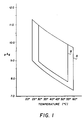
- Figure 1 is a plot of pAg versus temperature showing contemplated and preferred ranges for nucleation accounting to the process of the present invention.
- the present invention is an improvement of the tabular grain precipitation processes of Tsaur et al. Specifically, it has been discovered that the advantages of reduced total grain dispersity in tabular grain emulsions taught by Tsaur et al can be realized while increasing the rate of emulsion precipitation. The magnitude of the latter advantage of the precipitation process of the invention increases as higher average equivalent circular diameters of the tabular grains are sought.
- This invention is directed to a process of accelerating the preparation of a photographic emulsion containing tabular silver halide grains exhibiting a reduced degree of total grain dispersity comprising (1) providing a dispersing medium containing halide ions consisting essentially of bromide ions, (2) forming in the dispersing medium a population of silver halide grain nuclei containing parallel twin planes, (3) ripening out a portion of the grain nuclei, and (4) growing the silver halide grain nuclei containing parallel twin planes remaining to form tabular silver halide grains, characterized in that (5) the twin planes are formed in the silver halide grain nuclei within the pAg and temperature boundaries of Curve A in Figure 1 and (6) a polyalkylene oxide block copolymer surfactant is introduced into the emulsion, introduction being delayed until after the silver halide nuclei containing twin planes have been formed, but introduction occurring before 25 percent of the total silver used to form the emulsion has been introduced, the
- the present invention is an improvement on post nucleation solvent ripening processes of Tsaur et al, cited above, for preparing tabular grain emulsions.
- the process of the invention like the processes of Tsaur et al, reduces both the overall dispersity of the grain population and the dispersity of the tabular grain population, but the process of the invention grows larger average ECD tabular grains for a selected time of precipitation than can be obtained employing a comparable process of Tsaur et al.
- the first step is to form a population of silver halide grain nuclei containing parallel twin planes.
- a silver halide solvent is next used to ripen out a portion of the silver halide grain nuclei, and the silver halide grain nuclei containing parallel twin planes not ripened out are then grown to form tabular silver halide grains.
- the first step is to form the silver halide grain nuclei under conditions that promote uniformity.
- bromide ion is added to the dispersing medium.
- other halides can be added to the dispersing medium along with bromide, prior to introducing silver, halide ions in the dispersing medium consist essentially of bromide ions.
- the balanced double jet precipitation of grain nuclei is specifically contemplated in which an aqueous silver salt solution and an aqueous bromide salt are concurrently introduced into a dispersing medium containing water and a hydrophilic colloid peptizer.
- a small amount of bromide salt is added to the reaction vessel to establish a slight stoichiometric excess of halide ion.
- chloride and iodide salts can be introduced through the bromide jet or as a separate aqueous solution through a separate jet.
- concentration of chloride and/or iodide it is preferred to limit the concentration of chloride and/or iodide to about 20 mole percent, based on silver, most preferably these other halides are present in concentrations of less than 10 mole percent (optimally less than 6 mole percent) based on silver.
- Silver nitrate is the most commonly utilized silver salt while the halide salts most commonly employed are ammonium halides and alkali metal (e.g., lithium, sodium or potassium) halides.
- the ammonium counter ion does not function as a ripening agent since the dispersing medium is at an acid pH--i.e., less than 7.0.
- a uniform nucleation can be achieved by introducing a Lippmann emulsion into the dispersing medium. Since the Lippmann emulsion grains typically have a mean ECD of less than 0.05 ⁇ m, a small fraction of the Lippmann grains initially introduced serve as deposition sites while all of the remaining Lippmann grains dissociate into silver and halide ions that precipitate onto grain nuclei surfaces. Techniques for using small, preformed silver halide grains as a feedstock for emulsion precipitation are illustrated by Mignot U.S. Patent 4,334,012; Saito U.S. Patent 4,301,241; and Solberg et al U.S. Patent 4,433,048.
- the present invention achieves reduced grain dispersity by producing prior to ripening a population of parallel twin plane containing grain nuclei.
- the invention is compatible with either of the two most common techniques for introducing parallel twin planes into grain nuclei.
- the preferred and most common of these techniques is to form the grain nuclei population that will be ultimately grown into tabular grains while concurrently introducing parallel twin planes in the same precipitation step.
- grain nucleation occurs under conditions that are conducive to twinning.
- the second approach is to form a stable grain nuclei population and then adjust the pAg of the interim emulsion to a level conducive to twinning.
- twin planes in the grain nuclei it is advantageous to introduce the twin planes in the grain nuclei at an early stage of precipitation. It is contemplated to obtain a grain nuclei population containing parallel twin planes using less than 2 percent of the total silver used to form the tabular grain emulsion. It is usually convenient to use at least 0.05 percent of the total silver to form the parallel twin plane containing grain nuclei population, although this can be accomplished using even less of the total silver. The longer introduction of parallel twin planes is delayed after forming a stable grain nuclei population the greater is the tendency toward increased grain dispersity.
- the improved process of the present invention is based on the discovery that both the low levels of total grain dispersity produced by Tsaur et al and larger tabular grain ECDs for a given period of precipitation can be achieved by departing from the teachings of Tsaur et al in two respects.
- addition of polyalkylene oxide block copolymer surfactant, relied upon by Tsaur et al to reduce grain dispersity, is delayed until after a grain nuclei population containing twin planes have been formed.
- the lowest attainable levels of grain dispersity in the completed emulsion are achieved by control of the dispersing medium within a limited range of pAg levels.
- Tsaur et al teaches the pAg of the dispersing medium to be maintained during twin plane formation within the range of from 5.4 to 10.3 (at a temperature of 45°C)
- a more limited pAg range is required for forming twin planes in the absence of the polyalkylene oxide block copolymer if grain dispersity to be maintained at a low level.
- low levels of grain dispersity can be realized, provided pAg during twin plane formation at 45°C is maintained in the range of from 8.0 to 10.3, preferably 8.3 to 10.3.
- a tendency toward increased tabular grain ECD and thickness dispersities is observed. Any convenient conventional technique for monitoring and regulating pAg can be employed.
- the contemplated range of temperatures for twin plane formation is from 25 to 60°C, preferably 30 to 55°C.
- Curve A in Figure 1 generalizes the 8.0 to 10.3 pAg range at 45°C over the temperature range of from 25 to 60°C. Any pAg within the boundaries of Curve A is a useful temperature for twin plane formation in the absence of a polyalkylene oxide block copolymer surfactant.
- Curve B in Figure 1 generalizes the preferred 8.3 to 10.3 pAg range at 45°C over the preferred temperature range of 30 to 55°C.
- Preferred processes of preparation according to the practice of this invention form twin planes while the temperature of the dispersing medium is within the boundaries of Curve B in the absence of a polyalkylene oxide block copolymer surfactant.
- Reductions in grain dispersities have also been observed as a function of the pH of the dispersing medium. Both the incidence of nontabular grains and the thickness dispersities of the nontabular grain population have been observed to decrease when the pH of the dispersing medium is less than 6.0 at the time parallel twin planes are being introduced into the grain nuclei.
- the pH of the dispersing medium can be regulated in any convenient conventional manner. A strong mineral acid, such as nitric acid, can be used for this purpose.
- Grain nucleation and growth occurs in a dispersing medium comprised of water, dissolved salts and a conventional peptizer.
- Hydrophilic colloid peptizers such as gelatin and gelatin derivatives are specifically contemplated.
- Peptizer concentrations of from 20 to 800 (optimally 40 to 600) grams per mole of silver introduced during the nucleation step have been observed to produce emulsions of the lowest grain dispersity levels.
- the next step is to reduce the dispersity of the grain nuclei population by ripening.
- the objective of ripening grain nuclei containing parallel twin planes to reduce dispersity is disclosed by both Himmelwright U.S. Patent 4,477,565 and Nottorf U.S. Patent 4,722,886.
- a silver halide solvent to induce ripening it is possible to accomplish the ripening step by adjusting pH to a high level--e.g., greater than 9.0.
- a ripening process of this type is disclosed by Buntaine et al U.S. Patent 5,013,641.
- the post nucleation ripening step is performed by adjusting the pH of the dispersing medium to greater than 9.0 by the use of a base, such as an alkali hydroxide (e.g., lithium, sodium or potassium hydroxide) followed by digestion for a short period (typically 3 to 7 minutes).
- a base such as an alkali hydroxide (e.g., lithium, sodium or potassium hydroxide) followed by digestion for a short period (typically 3 to 7 minutes).
- the emulsion is again returned to the acidic pH ranges conventionally chosen for silver halide precipitation (e.g. less than 7.0) by introducing a conventional acidifying agent, such as a mineral acid (e.g., nitric acid).
- a conventional acidifying agent such as a mineral acid (e.g., nitric acid).
- ripening Some reduction in dispersity will occur no matter how abbreviated the period of ripening. It is preferred to continue ripening until at least about 20 percent of the total silver has been solubilized and redeposited on the remaining grain nuclei. The longer ripening is extended the fewer will be the number of surviving nuclei. This means that progressively less additional silver halide precipitation is required to produce tabular grains of an aim ECD in a subsequent growth step. Looked at another way, extending ripening decreases the size of the emulsion make in terms of total grams of silver precipitated. Optimum ripening will vary as a function of aim emulsion requirements and can be adjusted as desired.
- the halides introduced during grain growth can be selected independently of the halide selections for nucleation.
- the tabular grain emulsion can contain grains of either uniform or nonuniform silver halide composition. Although the formation of grain nuclei incorporates bromide ion and only minor amounts of chloride and/or iodide ion, the low dispersity tabular grain emulsions produced at the completion of the growth step can contain in addition to bromide ions any one or combination of iodide and chloride ions in any proportions found in tabular grain emulsions.
- the growth of the tabular grain emulsion can be completed in such a manner as to form a core-shell emulsion of reduced dispersity.
- the shelling procedure taught by Evans et al U.S. Patent 4,504,570 can be used.
- Internal doping of the tabular grains, such as with group VIII metal ions or coordination complexes, conventionally undertaken to obtain improved reversal and other photographic properties are specifically contemplated. For optimum levels of dispersity it is, however, preferred to defer doping until after the grain nuclei containing parallel twin planes have been obtained.
- a polyalkylene oxide block copolymer surfactant selected as described below is introduced into the dispersing medium following the formation of grain nuclei containing twin planes.
- the lowest COVs based on the total grain population of the emulsion are attained by creating the twin plane containing grain nuclei using the smallest convenient fraction of total silver and, prior to commencing the subsequent growth step, introducing the polyalkylene oxide block copolymer surfactant.
- Example 7E suggests that an even greater delay can be tolerated in some instances. It is preferred to produce emulsions having coefficients of variation of less than 20 percent and, optimally, less than 10 percent, based on the total grain population. It is preferred that the polyalkylene oxide be introduced into the dispersing medium before 10 percent and, optimally, before 5 percent of the total silver has been introduced. Delayed introductions of the polyalkylene oxide block copolymer commencing during the growth step are entirely compatible with utilizing minimal amounts of silver in forming the twin plane containing grain nuclei population.
- polyalkylene oxide block copolymer surfactants can take any of the forms taught to be useful by Tsaur et al, cited above. These surfactants contain both hydrophilic and lipophilic block units and are generally selected from among
- polyalkylene oxide block copolymers are those disclosed by Tsaur et al U.S. Patent 5,147,771, wherein the surfactant copolymer satisfies the formula: (I) LAO-HAO-LAO where
- polyalkylene oxide block copolymer of formula III satisfies the formula: (IV) (HAO-LAO) z -L-(LAO-HAO) z' where
- polyalkylene oxide block copolymer of formula IV satisfies the formula: (VI) (LAO-HAO) z -L-(HAO-LAO) z' where
- the lipophilic alkylene oxide block units preferably contain repeating units satisfying the formula: where
- hydrophilic alkylene oxide block unit is preferably comprised of repeating units satisfying the formula: where
- the preferred polyalkylene oxide block copolymer surfactants of formula I above are those satisfying the formula: where
- the preferred polyalkylene oxide block copolymer surfactants of formula II above are those satisfying the formula: where
- the preferred polyalkylene oxide block copolymer moieties of formula IV above are those satisfying the formula: where
- the preferred polyalkylene oxide block copolymer moieties of formula VI above are those satisfying the formula: where
- linking group L in formulae IV and VI is an amine group
- z + z' equal three.
- the amine group can take any of the forms of the formula:
- the diamine group can take any of the forms of the formula:
- surfactant weight concentrations are contemplated as low as 0.1 percent, based on the interim weight of silver--that is, the weight of silver present in the emulsion at the time the surfactant is introduced.
- a preferred minimum surfactant concentration is 1 percent, based on the interim weight of silver.
- a broad range of surfactant concentrations have been observed to be effective. Lower concentrations of the surfactant are required to achieved maximum attainable reductions in dispersity when the percent of total silver introduced prior to introduction of the polyalkylene oxide is low. No further advantages has been realized for increasing surfactant weight concentrations above 7 times the interim weight of silver. However, surfactant concentrations of 10 the interim weight of silver or more are considered feasible.
- gelatino-peptizers are commonly divided into so-called “regular” gelatino-peptizers and so-called “oxidized” gelatino-peptizers.
- Regular gelatino-peptizers are those that contain naturally occurring amounts of methionine of at least 30 micromoles of methionine per gram and usually considerably higher concentrations.
- oxidized gelatino-peptizer refers to gelatino-peptizers that contain less than 30 micromoles of methionine per gram.
- a regular gelatino-peptizer is converted to an oxidized gelatino-peptizer when treated with a strong oxidizing agent, such as taught by Maskasky U.S. Patent 4,713,323 and King et al U.S. Patent 4,942,120, the disclosures of which are here incorporated by reference.
- the oxidizing agent attacks the divalent sulfur atom of the methionine moiety, converting it to a tetravalent or, preferably, hexavalent form. While methionine concentrations of less than 30 micromoles per gram have been found to provide oxidized gelatino-peptizer performance characteristics, it is preferred to reduce methionine concentrations to less than 12 micromoles per gram.
- an oxidized gelatino-peptizer When an oxidized gelatino-peptizer is employed, it is preferred to maintain a pH during twin plane formation of less than 5.5 to achieve a minimum (less than 10 percent) COV. When a regular gelatino-peptizer is employed, the pH during twin plane formation is maintained at less than 3.0 to achieve a minimum COV.
- the surfactant when regular gelatin is employed prior to the post-ripening grain growth, the surfactant is selected so that the hydrophilic block (i.e., -HAO-) accounts for 4 to 96 (preferably 5 to 85 and optimally 10 to 80) percent of the total surfactant molecular weight. It is preferred that x and x' be at least 6 and that the minimum molecular weight of the surfactant be at least 760 and optimally at least 1000.
- the concentration levels of surfactant are preferably restricted as iodide levels are increased.
- oxidized gelatino-peptizer When oxidized gelatino-peptizer is employed prior to the post-ripening grain growth, no iodide is added during the post-ripening grain growth step and the hydrophilic block (e.g., HAO) accounts for 4 to 50 (optimally 10 to 40) percent of the total surfactant molecular weight.
- the minimum molecular weight of the surfactant continues to be determined by the minimum values of x and x' of 6. In optimized forms x and x' are at least 7, and the minimum molecular weight of the surfactant is 760 preferably 1000.
- the surfactants of formulae II and X when regular gelatin is employed prior to post-ripening grain growth, the surfactants are selected so that the lipophilic block (i.e., -LAO-) accounts for 4 to 96 (preferably 15 to 95 and optimally 20 to 90) percent of the total surfactant molecular weight. It is preferred that x be at least 13 and that the minimum molecular weight of the surfactant be at least 800 and optimally at least 1000.
- the concentration levels of surfactant are preferably restricted as iodide levels are increased.
- the lipophilic block i.e., -LAO-
- the surfactant when regular gelatin is employed prior to post-ripening grain growth, the surfactant is selected so that the lipophilic alkylene oxide block linking unit (i.e., -LOL-) accounts for 4 to 96 (preferably 15 to 95 and optimally 20 to 90) percent of the total surfactant molecular weight. It is preferred that x be at least 3 and that the minimum molecular weight of the surfactant be at least 1100 and optimally at least 2000.
- the concentration levels of surfactant are preferably restricted as iodide levels are increased.
- the lipophilic alkylene oxide block linking unit e.g., LOL
- the surfactant when regular gelatin is employed prior to post-ripening grain growth, the surfactant is selected so that the hydrophilic block linking unit (i.e., -HOL-) accounts for 4 to 96 (preferably 5 to 85 and optimally 10 to 80) percent of the total surfactant molecular weight. It is preferred that x be at least 3 and that the minimum molecular weight of the surfactant be at least 1100 and optimally at least 2000.
- the concentration levels of surfactant are preferably restricted as iodide levels are increased.
- oxidized gelatino-peptizer When oxidized gelatino-peptizer is employed prior to post-ripening post-ripening grain growth, no iodide is added during grain growth and the hydrophilic block linking unit (i.e., -HOL-) accounts for 4 to 35 (optimally 10 to 30) percent of the total surfactant molecular weight.
- Ripening agents for use in the ripening step can be selected from among a broad range of conventional ripening agents.
- Thiocyanates and thioethers as well as their selenoether and telluroether analogues, each including both acyclic and cyclic ether forms, are specifically contemplated.
- Ammonia can be employed as a ripening agent during the ripening step.
- ripening agents as well as other conventional ripening agents, such as those containing thiocarbonyl, selenocarbonyl or tellurocarbonyl groups (e.g., tetra-substituted middle chalcogen ureas), sulfites, specific mercapto compounds and compounds containing an imino group, are provided by McBride U.S. Patent 3,271,157; Illingsworth U.S. Patent 3,320,069; Jones U.S. Patent 3,574,628; Rosecrants U.S. Patent 3,737,313; Perumble U.S. Patent 3,784,381; Sugimoto et al U.S.
- Patent 4,551,421 Miyamoto et al U.S. Patent 4,565,778; Bryan et al U.S. Patents 4,695,534, 4,695,535 and 4,713,322; Friour et al U.S. Patent 4,865,965; Kojima et al U.S. Patent 5,028,522; Sasaki et al U.S. Patent 4,923,794; Nakamura U.S. Patent 4,956,260; Benard et al U.S. Patent 4,752,560; and Mifune et al U.S. Patent 5,004,679; the disclosures of which are here incorporated by reference. Saitou et al U.S.
- Patent 4,797,354 is of particular interest in disclosing the use of a variety of ripening agents in the preparation of tabular grain emulsions of relatively low levels of dispersity.
- Preferred concentrations of ripening agents during the ripening step are in the range of from 0.01 to 0.1 N, with ammonia, thiocyanate, and thioether (along with seleno and telluroether analogues) being preferred.
- Tsaur et al failed to achieve tabular grains when nucleation was undertaken in the presence of a ripening agent (note specifically Example 5, Tsaur et al U.S. Patent 5,147,771) it has been observed that, when nucleation is conducted within the pAg boundary of Curve A, the presence of a ripening agent is not incompatible with obtaining tabular grains. Nucleation in the presence of a ripening agent and delayed addition of a polyalkylene oxide block copolymer surfactant according to the teachings of this disclosure produces low levels of grain dispersity while achieving higher grain ECDs than can be achieved when the surfactant is present during nucleation.
- Ripening agent concentrations during nucleation can range up to the polyalkylene oxide block copolymer surfactant levels present during nucleation taught by Tsaur et al.
- the suffix E is employed to indicate Examples that demonstrate the process of the invention while the suffix C is employed to indicate Examples that provided for purposes of comparison. To facilitate comparison the preparation parameter of the comparative Example that fails to satisfy the requirements of the process of the invention as well as the inferior feature of the resulting emulsion are highlighted.
- aqueous gelatin solution Composed of 1 liter of water, 1.0 g of oxidized alkali-processed gelatin, 4.2 ml of 4 N nitric acid solution, and appropriate amount of sodium bromide to adjust the pAg of the vessel to 9.14
- 8 ml of an aqueous solution of silver nitrate (containing 0.68 g of silver nitrate) and equal amount of an aqueous solution of sodium bromide (containing 0.43 g of sodium bromide) were simultaneously added thereto over a period of 1 minute at a constant rate.
- pAg of the vessel was adjusted to 9.70 with a 1.0 M sodium bromide aqueous solution. Temperature of the mixture was subsequently raised to 60 C over a period of 9 minutes. At that time, 38.5 ml of an aqueous ammonia solution (containing 2.53 g of ammonia sulfate and 21.9 ml of 2.5 N sodium hydroxide solution) was added into the vessel and mixing was conducted for a period of 9 minutes.
- an aqueous silver nitrate solution containing 2.12 g of silver nitrate
- 26.3 ml of an aqueous sodium bromide solution containing 1.44 g of sodium bromide
- 487.5 ml of an aqueous silver nitrate solution containing 132.5 g of silver nitrate
- 485 ml of an aqueous sodium bromide solution containing 83.8 g of sodium bromide
- Example 1 was repeated except that PLURONIC-31R1 was not added at all in the precipitation.
- the emulsion thus made is characterized as follows:
- Example 1 was repeated except that the same amount of PLURONIC-31R1 was not added until 1.4% of silver halide was precipitated.
- the emulsion thus made is characterized as follows:
- Example 1 was repeated except that the same amount of PLURONIC-31R1 was not added until 4.4% of silver halide was precipitated.
- the emulsion thus made is characterized as follows:
- Example 1 was repeated except that the same amount of PLURONIC-31R1 was not added until 9.2% of silver halide was precipitated.
- the emulsion thus made is characterized as follows:
- Example 1 was repeated except that the same amount of PLURONIC-31R1 was not added until 15.8% of silver halide was precipitated.
- the emulsion thus made is characterized as follows:
- Example 1 was repeated except that the same amount of PLURONIC-31R1 was not added until 24.2% of silver halide was precipitated.
- the emulsion thus made is characterized as follows:
- Example 1E was repeated except that the pAg of the vessel was adjusted to a pAg of 7.92.
- the emulsion thus made is characterized as follows:
- Example 8C was repeated except that the same amount of PLURONIC-31R1 was placed in the reaction vessel prior to the precipitation.
- the emulsion thus made is characterized as follows:
- Example 1 was repeated except that the pAg of the vessel was adjusted to a pAg of 8.71.
- the emulsion thus made is characterized as follows:
- Example 10E was repeated except that the same amount of PLURONIC-31R1 was placed in the reaction vessel prior to the precipitation.
- the emulsion thus made is characterized as follows:
- Example 1 was repeated except that the pAg of the vessel was adjusted to a pAg of 8.90.
- the emulsion thus made is characterized as follows:
- Example 12E was repeated except that the same amount of PLURONIC-31R1 was placed in the reaction vessel prior to the precipitation.
- the emulsion thus made is characterized as follows:
- Example 1 was repeated except that the same amount of PLURONIC-31R1 was placed in the reaction vessel prior to the precipitation.
- the emulsion thus made is characterized as follows:
- Example 1 was repeated except that the pAg of the vessel was adjusted to a pAg of 9.70.
- the emulsion thus made is characterized as follows:
- Example 17 was repeated except that the same amount of PLURONIC-31R1 was placed in the reaction vessel prior to the precipitation.
- the emulsion thus made is characterized as follows:
- a 2.7%I bromoiodide tabular emulsion was precipitated by a double jet procedure. No Pluronic-31R1 was employed during the precipitation.
- Example 17C was repeated, except that PLURONIC-31R1 surfactant was introduced into the dispersing medium prior to precipitation. Although the coefficient of variation of the emulsion was reduced, the average grain size was also reduced.
- Example 17C was repeated, except 0.058 g of the ripening agent 1,8-dihydroxy-3,6-dithiaoctane (RA-1) was introduced into the dispersing medium prior to precipitation. Although the ripening agent increased the average grain size, it did not lower the total grain coefficient of variation.
- RA-1 1,8-dihydroxy-3,6-dithiaoctane
- Example 17C was repeated, except that 0.024 g PLURONIC-31R1 surfactant and 0.058 g RA-1 ripening agent were introduced into the dispersing medium before precipitation. The total grain coefficient of variation was reduced, but the average grain size was smaller than in Examples 17C and 19C.
- Example 20C was repeated, except that the PLURONIC-31R1 was not introduced into the dispersing medium until after 0.0083 mole of silver was introduced. By delaying the introduction of the surfactant it was possible to achieve the average grain size of Example 17C while also realizing a lower total grain coefficient of variation.
- Example 19C was repeated, except 0.0091 g of the ripening agent 1,10-dithia-4,7,12,16-tetraoxacyclooctadecane (RA-2) was substituted for RA-1.
- RA-2 1,10-dithia-4,7,12,16-tetraoxacyclooctadecane
- Example 22C was repeated, except that 0.048 g PLURONIC-31R1 surfactant was introduced into the dispersing medium after 0.0083 mole of silver was introduced.
Landscapes
- Chemical & Material Sciences (AREA)
- Chemical Kinetics & Catalysis (AREA)
- Engineering & Computer Science (AREA)
- Materials Engineering (AREA)
- Physics & Mathematics (AREA)
- General Physics & Mathematics (AREA)
- Silver Salt Photography Or Processing Solution Therefor (AREA)
Claims (10)
- Verfahren zur Beschleunigung der Herstellung einer photographischen Emulsion, die tafelförmige Silberhalogenidkörner enthält, mit einem verminderten Grad der Gesamt-Korndispersität, bei dem mandadurch gekennzeichnet, daßein Dispersionsmedium bereitstellt, das Halogenidionen enthält, die im wesentlichen aus Bromidionen bestehen,in dem Dispersionsmedium eine Population von Silberhalogenidkornkeimen mit parallelen Zwillingsebenen erzeugt,einen Teil der Kornkeime ausreifen läßt, unddie Silberhalogenidkornkeime mit parallelen Zwillingsebenen, die verblieben sind, unter Erzeugung von tafelförmigen Silberhalogenidkörnern wachsen läßt,die Zwillingsebenen in den Silberhalogenidkornkeimen innerhalb der pAg- und Temperaturgrenzen der Kurve A von Figur 1 gebildet werden, und daßein oberflächenaktives Mittel aus einem Polyalkylenoxidblockcopolymeren in die Emulsion eingeführt wird, wobei die Einführung verzögert wird, bis nachdem die Silberhalogenidkeime mit Zwillingsebenen erzeugt worden sind, wobei jedoch die Einführung erfolgt, bevor 25 % des gesamten Silbers, das zur Erzeugung der Emulsion verwendet wird, eingeführt worden sind, wobei das oberflächenaktive Mittel ausgewählt wird aus der Klasse bestehend aus(a) oberflächenaktiven Mitteln aus Polyalkylenoxidblockcopolymeren aus mindestens zwei terminalen lipophilen Alkylenoxidblockeinheiten, die durch eine hydrophile Alkylenoxidblockeinheit miteinander verbunden sind, die 4 bis 96 % des Molekulargewichtes des Copolymeren ausmacht, und(b) oberflächenaktiven Mitteln aus Polyalkylenoxidblockcopolymeren aus mindestens zwei terminalen hydrophilen Alkylenoxidblockeinheiten, die durch eine lipophile Alkylenoxidblockeinheit miteinander verbunden sind, die 4 bis 96 % des Molekulargewichtes des Copolymeren ausmacht.
- Verfahren zur Beschleunigung der Herstellung einer Emulsion nach Anspruch 1, weiter dadurch gekennzeichnet, daß die Zwillingsebenenbildung bei einem pH-Wert von weniger als 6 erfolgt.
- Verfahren zur Beschleunigung der Herstellung einer Emulsion nach Anspruch 1 oder 2, weiter dadurch gekennzeichnet, daß bei der Zwillingsebenenbildung vor der Ausreifung eines Teiles der Körner 0,05 bis 2,0 % des gesamten Silbers verwendet werden, das zur Herstellung der Emulsion verwendet wird.
- Verfahren zur Beschleunigung der Herstellung einer Emulsion nach einem der Ansprüche 1 bis 3 einschließlich, weiter dadurch gekennzeichnet, daß ein Silberhalogenidlösungsmittel verwendet wird, um einen Teil der Silberhalogenidkörner auszureifen.
- Verfahren zur Beschleunigung der Herstellung einer Emulsion nach einem der Ansprüche 1 bis 4 einschließlich, weiter dadurch gekennzeichnet, daß mindestens ein Teil des Polyalkylenoxidblockcopolymeren in das Dispersionsmedium eingeführt wird, bevor mehr als 10 % des gesamten Silberhalogenides eingeführt wurden.
- Verfahren zur Beschleunigung der Herstellung einer Emulsion nach einem der Ansprüche 1 bis 5 einschließlich, weiter dadurch gekennzeichnet, daß die Silberhalogenidkornkeime innerhalb der pAg- und Temperaturgrenzen der Kurve B von Figur 1 erzeugt werden.
- Verfahren zur Beschleunigung der Herstellung einer Emulsion nach einem der Ansprüche 1 bis 6 einschließlich, weiter dadurch gekennzeichnet, daß das Polyalkylenoxidblockcopolymer der Formel genügt:LAO- eine terminale lipophile Alkylenoxidblockeinheit darstellt,-HAO- eine verbindende hydrophile Alkylenoxidblockeinheit darstellt, unddas Molekulargewicht des Polyalkylenoxidblockcopolymeren im Bereich von 760 bis 16000 liegt.
- Verfahren zur Beschleunigung der Herstellung einer Emulsion nach einem der Ansprüche 1 bis 6 einschließlich, weiter dadurch gekennzeichnet, daß das Polyalkylenoxidblockcopolymer der Formel genügt:das Molekulargewicht des Polyalkylenoxidblockcopolymeren im Bereich von 800 bis 30000 liegt.HAO- eine terminale hydrophile Alkylenoxidblockeinheit darstellt,-LAO- eine verbindende lipophile Alkylenoxidblockeinheit darstellt, und
- Verfahren zur Beschleunigung der Herstellung einer Emulsion nach einem der Ansprüche 1 bis 6 einschließlich, weiter dadurch gekennzeichnet, daß das Polyalkylenoxidblockcopolymer der Formel genügt:das Molekulargewicht des Polyalkylenoxidblockcopolymeren im Bereich von 1100 bis 60000 liegt.HAO- eine terminale hydrophile Alkylenoxidblockeinheit darstellt,-LOL- eine lipophile, verbindende Alkylenoxidblockeinheit darstellt,z gleich 2 ist,z' für 1 oder 2 steht, und
- Verfahren zur Beschleunigung der Herstellung einer Emulsion nach einem der Ansprüche 1 bis 6 einschließlich, weiter dadurch gekennzeichnet, daß das Polyalkylenoxidblockcopolymer der Formel genügt:das Molekulargewicht des Polyalkylenoxidblockcopolymeren im Bereich von 1100 bis 50000 liegt.LAO- eine terminale lipophile Alkylenoxidblockeinheit darstellt,-HOL- eine verbindende hydrophile Alkylenoxidblockeinheit darstellt, undz gleich 2 ist,z' für 1 oder 2 steht, und
Applications Claiming Priority (2)
| Application Number | Priority Date | Filing Date | Title |
|---|---|---|---|
| US971126 | 1992-11-04 | ||
| US07/971,126 US5252453A (en) | 1992-11-04 | 1992-11-04 | Process for accelerating the precipitation of a low coefficient of variation emulsion |
Publications (2)
| Publication Number | Publication Date |
|---|---|
| EP0596469A1 EP0596469A1 (de) | 1994-05-11 |
| EP0596469B1 true EP0596469B1 (de) | 1998-02-18 |
Family
ID=25517963
Family Applications (1)
| Application Number | Title | Priority Date | Filing Date |
|---|---|---|---|
| EP93117805A Expired - Lifetime EP0596469B1 (de) | 1992-11-04 | 1993-11-03 | Verfahren zur Beschleunigung der Ausfällung einer Emulsion mit niedrigem Abweichungskoeffizienten |
Country Status (4)
| Country | Link |
|---|---|
| US (1) | US5252453A (de) |
| EP (1) | EP0596469B1 (de) |
| JP (1) | JPH06202258A (de) |
| DE (1) | DE69317034T2 (de) |
Families Citing this family (15)
| Publication number | Priority date | Publication date | Assignee | Title |
|---|---|---|---|---|
| JPH06258744A (ja) * | 1993-03-02 | 1994-09-16 | Fuji Photo Film Co Ltd | ハロゲン化銀写真乳剤およびハロゲン化銀写真感光材料 |
| US5372927A (en) * | 1993-10-21 | 1994-12-13 | Eastman Kodak Company | Process for the low pag preparation of high aspect ratio tabular grain emulsions with reduced grain thicknesses |
| JP3388894B2 (ja) * | 1994-07-27 | 2003-03-24 | 富士写真フイルム株式会社 | 固体微粒子分散物とその製造方法 |
| US5541051A (en) * | 1995-01-18 | 1996-07-30 | Agfa-Gevaert, N.V. | Preparation of silver halide tabular emulsions in the presence of polar aprotic solvents and/or alcohols |
| US5733716A (en) * | 1995-08-16 | 1998-03-31 | Konica Corporation | Silver halide photographic light sensitive material |
| GB9600396D0 (en) * | 1996-01-09 | 1996-03-13 | Minnesota Mining & Mfg | Novel block copolymers |
| US6225041B1 (en) * | 1996-06-26 | 2001-05-01 | Konica Corporation | Silver halide photographic emulsion and silver halide photographic light sensitive material |
| US5726007A (en) * | 1996-09-30 | 1998-03-10 | Eastman Kodak Company | Limited dispersity epitaxially sensitized ultrathin tabular grain emulsions |
| US5763151A (en) * | 1997-01-24 | 1998-06-09 | Eastman Kodak Company | Robust process for preparing high Br low COV tabular grain emulsions |
| US5994049A (en) * | 1997-08-28 | 1999-11-30 | Eastman Kodak Company | Water-soluble non-interactive polymers and surfactant micelles for desalting and concentrating silver halide photographic emulsions |
| US6010840A (en) * | 1998-01-27 | 2000-01-04 | Agfa-Gevaert, N.V. | Method for preparing tabular grains rich in silver chloride with reduced thickness growth and improved homogeneity |
| EP0932076B1 (de) * | 1998-01-27 | 2003-08-20 | Agfa-Gevaert | Verfahren zur Herstellung von silberchloridreichen Tafelkörnern mit reduziertem Dickenwachstum und verbesserter Homogenität |
| US6136524A (en) * | 1998-04-07 | 2000-10-24 | Agfa-Gevaert, N.V. | Light-sensitive emulsion having (100) tabular grains rich in silver chloride and method for preparing said grains |
| FR2816720B1 (fr) | 2000-11-14 | 2003-03-21 | Eastman Kodak Co | Procede pour preparer les emulsions photographiques a grains tabulaires d'halogenures d'argent |
| US6514681B2 (en) | 2001-05-24 | 2003-02-04 | Eastman Kodak Company | High bromide tabular grain emulsions precipitated in a novel dispersing medium |
Family Cites Families (6)
| Publication number | Priority date | Publication date | Assignee | Title |
|---|---|---|---|---|
| US5171659A (en) * | 1991-05-14 | 1992-12-15 | Eastman Kodak Company | Process of preparing a reduced dispersity tabular grain emulsion |
| CA2067509A1 (en) * | 1991-05-14 | 1992-11-15 | John C. Loblaw | Phototypesetting paper |
| US5147772A (en) * | 1991-05-14 | 1992-09-15 | Eastman Kodak Company | Process of preparing a reduced dispersity tabular grain emulsion |
| US5210013A (en) * | 1991-05-14 | 1993-05-11 | Eastman Kodak Company | Very low coefficient of variation tabular grain emulsion |
| US5147773A (en) * | 1991-05-14 | 1992-09-15 | Eastman Kodak Company | Process of preparing a reduced dispersity tabular grain emulsion |
| US5147771A (en) * | 1991-05-14 | 1992-09-15 | Eastman Kodak Company | Process of preparing a reduced dispersity tabular grain emulsion |
-
1992
- 1992-11-04 US US07/971,126 patent/US5252453A/en not_active Expired - Lifetime
-
1993
- 1993-11-02 JP JP5273984A patent/JPH06202258A/ja active Pending
- 1993-11-03 EP EP93117805A patent/EP0596469B1/de not_active Expired - Lifetime
- 1993-11-03 DE DE69317034T patent/DE69317034T2/de not_active Expired - Fee Related
Also Published As
| Publication number | Publication date |
|---|---|
| JPH06202258A (ja) | 1994-07-22 |
| DE69317034T2 (de) | 1998-09-24 |
| EP0596469A1 (de) | 1994-05-11 |
| US5252453A (en) | 1993-10-12 |
| DE69317034D1 (de) | 1998-03-26 |
Similar Documents
| Publication | Publication Date | Title |
|---|---|---|
| EP0596469B1 (de) | Verfahren zur Beschleunigung der Ausfällung einer Emulsion mit niedrigem Abweichungskoeffizienten | |
| EP0672940B1 (de) | Emulsionen enthaltend (1,0,0) tafelförmige hochchloridhaltige Körner: verbesserte Emulsionen und verbesserte Fällungsprozesse | |
| EP0513722B1 (de) | Verfahren zur Herstellung einer Emulsion mit tafelförmigen Körnern von verminderter Dispersität | |
| EP0513724B1 (de) | Verfahren zur Herstellung einer Emulsion mit tafelförmigen Körnern von verminderter Dispersität | |
| EP0513723B1 (de) | Verfahren zur Herstellung einer Emulsion mit tafelförmigen Körnern von verminderter Dispersität | |
| US4914014A (en) | Nucleation of tabular grain emulsions at high pBr | |
| EP0513725B1 (de) | Verfahren zur Herstellung einer Emulsion mit tafelförmigen Körnern von verminderter Dispersität | |
| US4942120A (en) | Modified peptizer twinned grain silver halide emulsions and processes for their preparation | |
| EP0507701A1 (de) | Emulsionen mit hochgleichförmigen tafelförmigen Silberbromoiodidkörnern und Verfahren zu ihren Herstellung | |
| EP0494376A1 (de) | Verbessertes Verfahren zur Herstellung von Emulsionen mit tafelförmigen Körnern von hohem Chloridgehalt | |
| JPH0887087A (ja) | 平板状粒子乳剤調製用粒子成長方法 | |
| EP0667557B1 (de) | Kornwachstumsverfahren für die Herstellung von Hochbromidemulsionen mit ultradünnen tafelförmigen Körnern | |
| US5709988A (en) | Tabular grain emulsions exhibiting relatively constant high sensitivities | |
| EP1045281A1 (de) | Ein Verfahren zur Durchführung epitaktischerAbscheidung als Fortsetzung der Emulsionsfällung | |
| EP0919860B1 (de) | Modifizierter Peptisierer zur Herstellung tafelförmiger Emulsionen (100) mit hohem Chloridgehalt | |
| EP0650085B1 (de) | Chloridhaltige Hochbromidemulsionen mit ultradünnem tafelförmigem Korn | |
| US5908740A (en) | Process for preparing high chloride (100) tabular grain emulsions | |
| EP0694809A1 (de) | Eine neue Klasse von Kornwachstumsmodifikatoren zur Herstellung tafelförmiger Emulsionen mit hohem Chlorid (III) | |
| US5905022A (en) | Chloride bromide and iodide nucleation of high chloride (100) tabular grain emulsion | |
| EP0732617A1 (de) | Photographische Emulsionen, die Tafelkörner mit einer Bandstruktur und einer Kornzentrumsregion hoher Chloridkonzentration enthalten | |
| EP0731379B1 (de) | Photographische Emulsionen, die Tafelkörner mit einer Bandstruktur und einer Kornzentrumsregion hoher Bromidkonzentration enthalten | |
| JPH10115884A (ja) | 写真乳剤 | |
| US5908739A (en) | Simplified nucleation of high chloride <100> tabular grain emulsions | |
| US5736312A (en) | Process for the preparation of silver halide emulsions having iodide containing grains | |
| EP0513726A1 (de) | Verbessertes Phototypie-Papier |
Legal Events
| Date | Code | Title | Description |
|---|---|---|---|
| PUAI | Public reference made under article 153(3) epc to a published international application that has entered the european phase |
Free format text: ORIGINAL CODE: 0009012 |
|
| AK | Designated contracting states |
Kind code of ref document: A1 Designated state(s): DE FR GB |
|
| 17P | Request for examination filed |
Effective date: 19941024 |
|
| GRAG | Despatch of communication of intention to grant |
Free format text: ORIGINAL CODE: EPIDOS AGRA |
|
| 17Q | First examination report despatched |
Effective date: 19970613 |
|
| GRAG | Despatch of communication of intention to grant |
Free format text: ORIGINAL CODE: EPIDOS AGRA |
|
| GRAH | Despatch of communication of intention to grant a patent |
Free format text: ORIGINAL CODE: EPIDOS IGRA |
|
| RBV | Designated contracting states (corrected) |
Designated state(s): DE FR GB |
|
| GRAH | Despatch of communication of intention to grant a patent |
Free format text: ORIGINAL CODE: EPIDOS IGRA |
|
| GRAA | (expected) grant |
Free format text: ORIGINAL CODE: 0009210 |
|
| AK | Designated contracting states |
Kind code of ref document: B1 Designated state(s): DE FR GB |
|
| REF | Corresponds to: |
Ref document number: 69317034 Country of ref document: DE Date of ref document: 19980326 |
|
| ET | Fr: translation filed | ||
| PLBE | No opposition filed within time limit |
Free format text: ORIGINAL CODE: 0009261 |
|
| STAA | Information on the status of an ep patent application or granted ep patent |
Free format text: STATUS: NO OPPOSITION FILED WITHIN TIME LIMIT |
|
| 26N | No opposition filed | ||
| REG | Reference to a national code |
Ref country code: GB Ref legal event code: IF02 |
|
| PGFP | Annual fee paid to national office [announced via postgrant information from national office to epo] |
Ref country code: GB Payment date: 20041004 Year of fee payment: 12 |
|
| PGFP | Annual fee paid to national office [announced via postgrant information from national office to epo] |
Ref country code: FR Payment date: 20041105 Year of fee payment: 12 |
|
| PGFP | Annual fee paid to national office [announced via postgrant information from national office to epo] |
Ref country code: DE Payment date: 20041130 Year of fee payment: 12 |
|
| PG25 | Lapsed in a contracting state [announced via postgrant information from national office to epo] |
Ref country code: GB Free format text: LAPSE BECAUSE OF NON-PAYMENT OF DUE FEES Effective date: 20051103 |
|
| PG25 | Lapsed in a contracting state [announced via postgrant information from national office to epo] |
Ref country code: DE Free format text: LAPSE BECAUSE OF NON-PAYMENT OF DUE FEES Effective date: 20060601 |
|
| GBPC | Gb: european patent ceased through non-payment of renewal fee |
Effective date: 20051103 |
|
| PG25 | Lapsed in a contracting state [announced via postgrant information from national office to epo] |
Ref country code: FR Free format text: LAPSE BECAUSE OF NON-PAYMENT OF DUE FEES Effective date: 20060731 |
|
| REG | Reference to a national code |
Ref country code: FR Ref legal event code: ST Effective date: 20060731 |