EP0596512A1 - Schnellbau-Trennwandsystem - Google Patents
Schnellbau-Trennwandsystem Download PDFInfo
- Publication number
- EP0596512A1 EP0596512A1 EP93117936A EP93117936A EP0596512A1 EP 0596512 A1 EP0596512 A1 EP 0596512A1 EP 93117936 A EP93117936 A EP 93117936A EP 93117936 A EP93117936 A EP 93117936A EP 0596512 A1 EP0596512 A1 EP 0596512A1
- Authority
- EP
- European Patent Office
- Prior art keywords
- quick
- profiles
- legs
- panels
- partition system
- Prior art date
- Legal status (The legal status is an assumption and is not a legal conclusion. Google has not performed a legal analysis and makes no representation as to the accuracy of the status listed.)
- Granted
Links
- 238000000926 separation method Methods 0.000 title 1
- 238000005192 partition Methods 0.000 claims abstract description 30
- 229910052751 metal Inorganic materials 0.000 claims abstract description 7
- 239000002184 metal Substances 0.000 claims abstract description 7
- 239000004570 mortar (masonry) Substances 0.000 claims description 4
- 239000011248 coating agent Substances 0.000 claims description 3
- 238000000576 coating method Methods 0.000 claims description 3
- 239000006260 foam Substances 0.000 claims description 3
- 239000003365 glass fiber Substances 0.000 claims description 3
- 230000002787 reinforcement Effects 0.000 claims description 3
- 229910001335 Galvanized steel Inorganic materials 0.000 claims description 2
- 229910052782 aluminium Inorganic materials 0.000 claims description 2
- XAGFODPZIPBFFR-UHFFFAOYSA-N aluminium Chemical compound [Al] XAGFODPZIPBFFR-UHFFFAOYSA-N 0.000 claims description 2
- 239000008397 galvanized steel Substances 0.000 claims description 2
- 238000010276 construction Methods 0.000 abstract description 8
- 208000007101 Muscle Cramp Diseases 0.000 description 4
- 239000000945 filler Substances 0.000 description 3
- 229920001817 Agar Polymers 0.000 description 1
- 240000001592 Amaranthus caudatus Species 0.000 description 1
- 235000009328 Amaranthus caudatus Nutrition 0.000 description 1
- 229910000831 Steel Inorganic materials 0.000 description 1
- 239000000853 adhesive Substances 0.000 description 1
- 230000001070 adhesive effect Effects 0.000 description 1
- 238000005260 corrosion Methods 0.000 description 1
- 230000007797 corrosion Effects 0.000 description 1
- 230000007613 environmental effect Effects 0.000 description 1
- 238000007373 indentation Methods 0.000 description 1
- 238000004519 manufacturing process Methods 0.000 description 1
- 239000000463 material Substances 0.000 description 1
- 238000007493 shaping process Methods 0.000 description 1
- 239000010959 steel Substances 0.000 description 1
- 230000001502 supplementing effect Effects 0.000 description 1
Images

Classifications
-
- E—FIXED CONSTRUCTIONS
- E04—BUILDING
- E04H—BUILDINGS OR LIKE STRUCTURES FOR PARTICULAR PURPOSES; SWIMMING OR SPLASH BATHS OR POOLS; MASTS; FENCING; TENTS OR CANOPIES, IN GENERAL
- E04H1/00—Buildings or groups of buildings for dwelling or office purposes; General layout, e.g. modular co-ordination or staggered storeys
- E04H1/12—Small buildings or other erections for limited occupation, erected in the open air or arranged in buildings, e.g. kiosks, waiting shelters for bus stops or for filling stations, roofs for railway platforms, watchmen's huts or dressing cubicles
- E04H1/125—Small buildings, arranged in other buildings
- E04H1/1266—Cubicles for dressing; Toilets
Definitions
- the individual partitions consist of a metal support frame that holds the cut-to-size filler panels that can be assembled according to the wall height and width.
- the metal support frames consist of four U-legs joined together to form a rectangle.
- the U-legs are provided with rows of holes.
- the edges of the filler panels are folded parallel to the edge, the fold width corresponding to the width and the fold depth corresponding to the thickness of the U-legs.
- the invention has for its object to improve the known quick-build partition system in such a way that the mounting of the filling boards is made easier and faster.
- the object is achieved in that the filling panels designed as corner or surface panels on the outside corners and in corner regions of angular and in the central wall region of straight, provided with rows of holes U-profiles and on the long top and bottom between the U-profiles are held by straight rails with elevations arranged on the outside.
- the advantages achieved by the invention are in particular that the U-legs surround and hold the corner and surface panels at their critical points.
- the U-profiles are adapted to the respective basic configuration (corner or flat structures). This makes it possible to enclose the corner areas of the panels with a few prefabricated means.
- the U-profiles also serve to absorb the forces and loads from the individual wall connections that occur even on flat panels at important connection points.
- the remaining long top and bottom sides of the boards on the other hand, can be easily held by push-in smooth and straight rails. These straight and simple rails also have the great advantage that they can be cut and handled very easily on the construction site. This makes it possible to create a quick construction wall system with some stable, always constant basic elements in the form of U-shaped and short straight U-shaped profiles.
- the elevations arranged on the rails are designed as a web-shaped elevation and / or cramp-shaped or nail-shaped elevations.
- the web-shaped elevations are particularly suitable for straight and continuous long top and bottom sides. They enable simple and quick pressing into the corner or surface panels. Such easy and simple indentation is also possible with cramp-like or nail-shaped elevations.
- the cramped or nail-shaped elevations are arranged on one or both sides of the rail. If they are arranged on one side, such rails are suitable for the outer boundaries of panels. If, on the other hand, they are arranged on both sides of the rail, they can be used particularly advantageously for joining individual panel parts. As a result, it is largely invisible from the outside to implement a quick and secure connection of these panel parts.
- height-adjustable feet are arranged at least under the legs of the door frame and under the angle profiles pointing towards the floor. This makes it possible to adjust the height of the entire quick-release partition system in a simple manner. With these height-adjustable feet, the quick-build partition system is also independent of the respective surface. This makes it possible to install the quick-build partition system primarily in construction projects that have already been completed.
- the straight U-profiles and the rails have one end and the ends of the legs of the door frame pointing towards the feet are partially provided with a hanging tab.
- the arrangement of hanging brackets enables a non-positive connection to all elements of the quick-build partition system.
- the U-shaped profiles point there for corresponding recesses at certain points. By inserting screw nails or other connecting elements, there is also a firm but also releasable connection of the entire quick-build partition system.
- the surface or corner panels are made from extruded hard foam panels that are provided with double-sided glass fiber reinforcement and a special mortar coating. This creates components that are easy to handle on the construction site. Parts of the panels to be cut out can be foamed and re-foamed at any time. In addition, with the help of the rails already mentioned, these panels are particularly suitable for joining together to form larger units. Too wide panels, on the other hand, can easily be removed with the help of a separating element, e.g. B. a saw can be shortened accordingly.
- a separating element e.g. B. a saw can be shortened accordingly.
- the U-profiles, the door frame and the rails with the elevations are made of metal, preferably of aluminum or galvanized steel. This avoids corrosion if mortar is spread over the surfaces of the individual panels and tiles are laid on top of them.
- a rapid construction partition system is installed in a room from surface panels 5.1, 5.2 and 5.3 and a corner panel 6.
- the surface panels 5.1 and 5.3 and the corner panel 6 are provided with angle U-profiles 3.1 and 3.2, 3.3 and 3.4 as well as 3.5 and 3.6 towards the walls.
- the corner profiles 3.1, ... 3.6 are formed at right angles to the middle leg of the U-shaped profile.
- angle U profiles 1.1 on the top and 1.2 on the bottom in the area of their angle are bordered by angle U profiles 1.1 on the top and 1.2 on the bottom in the area of their angle. These angle U profiles 1.1 and 1.2 are angled at right angles to the two opposite legs of the U profile.
- an angle U-profile 2 is used.
- angle U profiles 1.1 and 1.2 are formed can be seen in particular from FIGS. 3c and 3d.
- the opposite legs have holes, while the leg opposite the opening is smooth and continuous.
- the respective angle is produced by appropriate shaping.
- the narrow walls 5.1 and 5.2 are bordered at the top and bottom with continuous straight U-profiles 4.1 and 4.2 or 4.3 and 4.4.
- filling board edges 13.1, ... 13.6 are folded parallel to the edge at their edges , where the fold width corresponds to the width and the fold depth corresponds to the thickness of the U-legs. It is within the professional discretion to design the fold areas differently.
- the straight and long top and bottom sides of the surface panel 5.3 and the corner panel 6 are delimited by rails 9.1 and 9.2 or 9.3 and 9.4.
- These rails 9.1,... 9.4 have a straight web-shaped elevation 10.1 or 10.2 on their side pointing towards the filling board, as can be seen in particular from FIG. 2.
- This special shape of the rails 9.1, ... 9.4 is particularly suitable for the use of panels 5.1, ... 5.4, 6 made of extruded rigid foam and made of glass fiber reinforcement and special mortar coating on both sides.
- the door frame 7.1 In order to be able to optimally manufacture the quick-build partition system on the construction site, it is possible to equip the door frame 7.1 on one side with a straight U-profile 5.4.
- a straight U-profile 5.4 Such a profile is always used when the forces caused by the wall connections in the area of the door frame are caused by the subsequent tiling the walls can occur, are perfectly absorbable. Normally, the forces that occur are absorbed by hook-in brackets 14.1, ... 14.4 or 15.1, 15.2.
- These hanging brackets are formed both in the lower area of the door frames and on all other connecting elements in the form of angle U-profiles 4.1, .. 4.5 or rails 9.1, ... 9.4.
- the straight U-profile is z. B. 4.4 adjusted accordingly by a corresponding recess.
- the hanging brackets 14.1 ... 14.4, 15.1 and 15.2 are provided with a hole in the middle. Through this hole, it is possible to establish a corresponding stable connection to the U-profiles 1.1, 1.2, 2 and 3.1, ... 3.6, whereby, if necessary, appropriate additional holes are made.
- the angle U-profiles 3.1, ... 3.6 are first attached to the walls at an appropriate height (not shown). Then the corner panel is attached as a side wall corner piece, which can be used on the right and left, with factory-fitted rails 9.3 and 9.4 above and below. Then the door frame 7.2 is connected to the corner wall via the angle U profiles 1.1 and 1.2 and then the straight U profile 4.4 is mounted as a connecting rail between the door frame 7.2 and the door frame 7.1 that has been set up.
- the flat part 5.7 is fastened as a middle wall with the rails 9.1 and 9.2 to the angle U profiles 3.3 and 3.4.
- the narrow panel 5.2 is pushed as a front piece between the frames 7.1 and 7.2 and the upper straight U-profile 4.3 is attached as a connecting rail. If it turns out during assembly that the surface panel 5.3 is too long, it can be separated with a separating device, e.g. B. can be shortened accordingly with a saw 16.
- the straight U-profile 4.2 is attached between the door frame and the angle U-profile 3.2.
- the narrow surface panel 5.1 is then inserted as a second front piece and the upper straight U-profile 4.1 is placed on top.
- the feet 8.1 ... 8.4 made of V2A steel are adjusted accordingly so that the entire quick-release partition system lies horizontally.
- the corresponding connection points are screwed or riveted.
- they are foamed.
- the cabins created in this way are tiled inside and out. This advantageously results in the possibility of designing the room and the cabins with the same tiles, which ensures a uniform appearance of the entire room.
Landscapes
- Engineering & Computer Science (AREA)
- Architecture (AREA)
- Civil Engineering (AREA)
- Structural Engineering (AREA)
- Paper (AREA)
- Finishing Walls (AREA)
- Building Environments (AREA)
- Earth Drilling (AREA)
- Mirrors, Picture Frames, Photograph Stands, And Related Fastening Devices (AREA)
- Filling Or Discharging Of Gas Storage Vessels (AREA)
- Electrical Discharge Machining, Electrochemical Machining, And Combined Machining (AREA)
- Cyclones (AREA)
- Removal Of Specific Substances (AREA)
- Catching Or Destruction (AREA)
Abstract
Description
- Die Erfindung betrifft ein Schnellbau-Trennwandsystem zum Schaffen flexibler Trennwände für die Gestaltung von Kabinen und Abtrennungen im Sanitär- und Naßbereich, bestehend aus
- - einem Metalltragrahmen, der U-Schenkel mit Lochreihen aufweist, und
- - Fülltafeln, die entsprechend der Wandhöhe und Wandbreite zusammengesetzt sind, wobei die Fülltafel-Kanten im Bereich der U-Schenkel parallel zur Kante gefalzt sind und die Falzbreite im wesentlichen der Breite und die Falztiefe im wesentlichen der Dicke der U-Schenkel entspricht.
- Aus der DE 37 22 849 C2 ist ein Schnellbau-Trennwandsystem zum Schaffen flexibler Trennwände für die Gestaltung von Kabinen und Abtrennungen im Sanitär- und Naßbereich bekannt. Die einzelnen Trennwände bestehen aus einem Metall- tragrahmen, die die entsprechend der Wandhöhe und Wandbreite zusammensetzbaren, zugeschnittenen Fülltafeln aufnimmt. Die Metall-Tragrahmen bestehen aus vier zu einem Rechteck zusammengefügten U-Schenkeln. Die U-Schenkel sind mit Lochreihen versehen. Die Fülltafeln sind an ihren Kanten parallel zur Kante gefalzt, wobei die Falzbreite der Breite und die Falztiefe der Dicke der U-Schenkel entspricht.
- Diese Gestaltung der U-Schenkel mit den Lochstreifen, die den auf der Kante bzw. im Falz eingebrachten Kleber gut verteilt und eine äußerst feste, zuverlässige Verbindung bildet, hat sich bewährt. Jedoch ist es sehr aufwendig, die Fülltafeln an allen vier Seiten mit den durchgehenden U-Profilen zu umgeben.
- Der Erfindung liegt die Aufgabe zugrunde, das bekannte Schnellbau-Trennwandsystem dahingehend zu verbessern, daß die Halterung der Fülltafeln einfacher und schneller ermöglicht wird.
- Erfindungsgemäß wird die Aufgabe dadurch gelöst, daß die als Eck- oder Flächentafeln ausgebildeten Fülltafeln an den Außenecken und in Eckbereichen von Winkel- und im Mittelwandbereich von geraden, mit Lochreihen versehenen U-Profilen und an der langen Ober- und Unterseite zwischen den U-Profilen von geraden Schienen mit außen angeordneten Erhebungen gehalten sind.
- Die mit der Erfindung erzielten Vorteile bestehen insbesondere darin, daß die U-Schenkel die Eck- und Flächentafeln an ihren kritischen Punkten umgeben und festhält. Dabei sind die U-Profile der jeweiligen Grundkonfiguration (Eck- bzw. Flächengebilde) angepaßt. Dadurch ist es mit wenigen, vorgefertigten Mitteln möglich, die Eckbereiche der Tafeln einzufassen. Die U-Profile dienen darüber hinaus dazu, an wichtigen Verbindungspunkten die auch bei ebenen Tafeln auftretenden Kräfte und Belastungen aus den einzelnen Wandverbindungen aufzunehmen. Die übrigen langen Ober- und Unterseiten der Tafeln können dagegen leicht durch eindrückbare glatte und gerade Schienen gehalten werden. Diese geraden und einfachen Schienen haben darüber hinaus den großen Vorteil, daß sie auf der Baustelle sehr leicht zuschneidbar und handhabbar sind. Damit ist es möglich, mit einigen stabilen immer gleichbleibenden Grundelementen in Form von U-förmigen und kurzen geraden U-förmigen Profilen ein Schnellbauwandsystem zu schaffen.
- In weiterer Ausgestaltung der Erfindung sind die auf den Schienen angeordneten Erhebungen als stegförmige Erhebung und/oder krampen- oder nagelförmige Erhebungen ausgebildet. Die stegförmigen Erhebungen eignen sich besonders gut für gerade und durchgehende lange Ober- und Unterseiten. Sie ermöglichen ein einfaches und schnelles Eindrücken in die Eck- oder Flächentafeln. Ein solches leichtes und einfaches Eindrücken ist ebenso mit krampen- oder nagelförmigen Erhebungen möglich.
- Vorteilhaft ist es, wenn die krampen- oder nagelförmigen Erhebungen ein- oder beidseitig an der Schiene angeordnet sind. Sind sie einseitig angeordnet, eignen sich solche Schienen für äußere Begrenzungen von Tafeln. Sind sie dagegen zu beiden Seiten der Schiene angeordnet, lassen sie sich besonders vorteilhaft für das Zusammenfügen einzelner Tafelteile verwenden. Hierdurch ist von außen weitestgehend unsichtbar ein schnelles und sicheres Zusammenstecken dieser Tafelteile zu realisieren.
- Vorteilhaft ist es, wenn das gerade U-Profil mit Lochreihen an einer Türzarge angeformt ist. Eine solche Form der Ergänzung der Türzarge wird immer dann vorgenommen, wenn außergewöhnlich große Kräfte eine zwischen den Türzargen liegende Flächentafel belasten.
- Vorteilhaft ist es, wenn wenigstens unter den Schenkeln der Türzarge und unter den zum Fußboden hin zeigenden Winkelprofilen höhenverstellbare Füße angeordnet sind. Hierdurch ist es möglich, das gesamte Schnellbau-Trennwandsystem in einfacher Weise höhenverstellbar einzujustieren. Mit diesen höhenverstellbaren Füßen wird darüber hinaus das Schnellbau-Trennwandsystem von dem jeweiligen Untergrund unabhängig. Dadurch ist es möglich, das Schnellbau-Trennwandsystem vor allem in bereits fertiggestellte Bauobjekte einzubauen.
- In weiterer Ausgestaltung der Erfindung sind die geraden U-Profile und die Schienen einendig und die zu den Füßen zeigenden Enden der Schenkel der Türzarge teilweise mit einer Einhänge-Lasche versehen. Durch das Anordnen von Einhänge-Laschen ist eine kraftschlüssige Verbindung zu allen Elementen des Schnellbau-Trennwandsystems möglich. Die U-förmigen Profile weisen dafür an bestimmten Stellen entsprechende Aussparungen auf. Durch das Einbringen von Schraubennägeln oder anderen Verbindungselementen ist darüber hinaus eine feste aber auch lösbare Verbindung des gesamten Schnellbau-Trennwandsystems gegeben.
- Vorteilhaft ist es, wenn die Flächen- bzw. Ecktafeln aus extrudierten Hartschaumtafeln hergestellt werden, die mit beiderseitiger Glasfaserarmierung und Spezialmörtelbeschichtung versehen sind. Hierdurch entstehen Bauelemente, die sich auf der Baustelle leicht handhaben lassen. Auszuschneidende Teile der Tafeln können jederzeit wieder aus- und nachgeschäumt werden. Darüberhinaus eignen sich diese Tafeln, mit Hilfe der bereits erwähnten Schienen, besonders zum Zusammenfügen zu größeren Einheiten. Zu breite Tafeln können dagegen leicht mit Hilfe eines Trennelementes, z. B. einer Säge, entsprechend gekürzt werden.
- Um den besonderen Umgebungsbedingungen optimal angepaßt zu sein, sind die U-Profile, die Türzarge und die Schienen mit den Erhebungen aus Metall, vorzugsweise aus Aluminium oder verzinktem Stahl hergestellt. Hierdurch wird Korrosion vermieden, wenn über die Flächen der einzelnen Tafeln Mörtel verstrichen und darauf Fliesen verlegt werden.
- Die Erfindung wird nachstehend an einem Ausführungsbeispiel näher erläutert. Es zeigen:
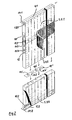
- Figur 1 ein Schnellbau-Trennwandsystem in einer perspektivischen, gesprengten schematischen Darstellung,
- Figur 2 eine Fülltafel mit Schienen in einer perspektivischen, teilgesprengten schematischen Darstellung,
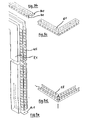
- Figur 3a einen Teilausschnitt einer Türzarge in perspektivischer schematischer Darstellung und
- Figur 3b bis 3d einzelne Formen von U-Profilen.
- Ein Schnellbau-Trennwandsystem wird, wie Figur 1 zeigt, aus Flächentafeln 5.1, 5.2 und 5.3 und einer Ecktafel 6 in einem Raum installiert. Hierzu werden zu den Wänden hin die Flächentafeln 5.1 und 5.3 und die Ecktafel 6 mit Winkel-U-Profilen 3.1 und 3.2, 3.3 und 3.4 sowie 3.5 und 3.6 versehen. Die Eckprofile 3.1, ... 3.6 sind dabei im rechten Winkel zum mittleren Schenkel des U-förmigen Profils geformt.
- Die Ecktafel 6 dagegen ist von Winkel-U-Profilen 1.1 an der Oberseite und 1.2 an der Unterseite im Bereich ihres Winkels eingefaßt. Diese Winkel-U-Profile 1.1 und 1.2 sind im rechten Winkel zu den beiden gegenüberliegenden Schenkeln des U-Profiles abgewinkelt. Sollte dagegen die Ecktafel spiegelbildlich ausgebildet sein, d. h. der kurze Schenkel nach innen, kommt ein Winkel-U-Profil 2 zum Einsatz.
- Wie die Winkel-U-Profile 1.1 und 1.2 ausgebildet sind, ist insbesondere aus den Figuren 3c und 3d zu ersehen. Die gegenüberliegenden Schenkel weisen dabei Lochbohrungen auf, während der der Öffnung gegenüberliegende Schenkel glatt und durchgehend geformt ist. Durch entsprechende Formgebung wird der jeweilige Winkel hergestellt.
- Die schmalen Wände 5.1 und 5.2 werden oben und unten mit durchgehenden geraden U-Profilen 4.1 und 4.2 bzw. 4.3 und 4.4 eingefaßt. An den Stellen, an denen die Winkel-U-Profile 1.1, 1.2 bzw. 2 und die geraden U-Profile 4.1, ... 4.5 eingesetzt werden, sind Fülltafel-Kanten 13.1, ... 13.6 an ihren Kanten parallel zur Kante gefalzt, wobei die Falzbreite der Breite und die Falztiefe der Dicke der U-Schenkel entspricht. Es liegt im fachmännischen Ermessen, die Falzbereiche auch anders auszubilden.
- Die geraden und langen Ober- und Unterseiten der Flächentafel 5.3 und der Ecktafel 6 werden von Schienen 9.1 und 9.2 bzw. 9.3 und 9.4 begrenzt. Diese Schienen 9.1, ..9.4 weisen an ihrer zur Fülltafel hin zeigenden Seite, wie insbesondere auch aus der Figur 2 hervorgeht, eine gerade durchgehende stegförmige Erhebung 10.1 bzw. 10.2 auf. Diese besondere Formgebung der Schiene 9.1, ... 9.4 eignet sich besonders für den Einsatz von aus extrudiertem Hartschaum hergestellten und mit beiderseitig versehbarer Glasfaserarmierung und Spezialmörtelbeschichtung hergestellten Tafeln 5.1, ... 5.4, 6.
- Es ist auch möglich, die stegförmige Erhebung 10.1 oder 10.2 durch krampen- oder nagelförmige Erhebungen 11.1, ... 11.4 zu ersetzen. Werden die krampen- oder nagelförmigen Erhebungen verwendet, sind auch diese, bedingt durch das Material der Tafeln, leicht und einfach in die Oberfläche der Tafeln 5.3 bzw. 6 eindrückbar. Möglich ist es darüber hinaus, Schienen 12 bzw. 12' mit beiderseitig angeordneten Krampen oder nagelförmigen Erhebungen 11.1, ... 11.4 bzw. 11.1', ... 11.4' auszubilden. Diese Schienen 12 bzw. 12' ermöglichen es auf einfache Art und Weise die Flächentafelteile 5.3.1, 5.3.2 und 5.3.3 untereinander so zu verbinden, daß die Verbindung von außen kaum sichtbar ist. Darüber hinaus ist es möglich, wie insbesondere die Figur 2 zeigt, an der Stirnseite zur schmalen Wand 5.2 hin eine Schiene 12 anzuordnen, die einen sicheren Sitz der Wand 5.3 an der Wand 5.2 ermöglicht.
- Um das Schnellbau-Trennwandsystem optimal auf der Baustelle herstellen zu können, ist es möglich, die Türzarge 7.1 einseitig mit einem geraden U-Profil 5.4 auszustatten. Ein solches Profil kommt immer dann zum Einsatz, wenn die Kräfte, die durch die Wandverbindungen im Bereich der Türzarge, bedingt durch das nachträgliche Kacheln der Wände auftreten können, einwandfrei aufnehmbar sind. Im Normalfall werden die auftretenden Kräfte durch Einhängelaschen 14.1, ... 14.4 bzw. 15.1, 15.2 aufgenommen. Diese Einhängelaschen sind sowohl im unteren Be reich der Türzargen als auch an allen anderen Verbindungselementen in Form von Winkel-U-Profilen 4.1, .. 4.5 bzw. Schienen 9.1, ... 9.4 angeformt. Hierfür ist das gerade U-Profil z. B. 4.4 durch eine entsprechende Ausnehmung entsprechend angepaßt. Die Einhängelaschen 14.1 ... 14.4, 15.1 und 15.2 sind mittig mit einer Bohrung versehen. Durch diese Bohrung ist es möglich, eine entsprechende stabile Verbindung zu den U-Profilen 1.1, 1.2, 2 und 3.1, ... 3.6 herzustellen, wobei soweit notwendig, entsprechende Zusatzbohrungen eingebracht werden.
- Unter den Schenkeln der Türzargen 7.1 und 7.2 sowie am Winkel-U-Profil 1.2 sind zum Boden hin zeigende verstellbare Füße 8.1, ... 8.5 angebracht.
- Soll das Schnellbau-Trennwandsystem aufgebaut werden, werden zuerst die Winkel-U-Profile 3.1, ... 3.6 in entsprechender Höhe an den Wänden (nicht dargestellt) befestigt. Danach wird die Ecktafel als Seitenwand-Eckstück, das rechts und links verwendbar ist, mit werkseitig vormontierten Schienen 9.3 und 9.4 oben und unten befestigt. Danach wird die Türzarge 7.2 über die Winkel-U-Profile 1.1 und 1.2 mit der Eckwand verbunden und anschließend das gerade U-Profil 4.4 als Verbindungsschiene zwischen der Türzarge 7.2 und der aufgestellten Türzarge 7.1 montiert.
- Danach wird das Flächenteil 5.7 als Mittelwand mit den Schienen 9.1 und 9.2 an den Winkel-U-Profilen 3.3 und 3.4 befestigt. Danach wird die schmale Flächentafel 5.2 als Frontstück zwischen die Zargen 7.1 und 7.2 geschoben und das obere gerade U-Profil 4.3 als Verbindungsschiene angebracht. Sollte sich bei der Montage herausstellen, daß die Flächentafel 5.3 zu lang ist, kann sie mit einer Trenneinrichtung, z. B. mit einer Säge 16 entsprechend verkürzt werden.
- Als letztes wird das gerade U-Profil 4.2 zwischen Türzarge und dem Winkel-U-Profil 3.2 angebracht. Hierauf wird als zweites Frontstück die schmale Flächentafel 5.1 eingeschoben und das obere gerade U-Profil 4.1 aufgelegt. Danach werden die aus V2A-Stahl bestehenden Füße 8.1 ... 8.4 entsprechend einjustiert, so daß das gesamte Schnellbau-Trennwandsystem waagerecht liegt. Ist dies erfolgt, werden die entsprechenden Verbindungsstellen verschraubt oder vernietet. Um die Lebensdauer der Verbindungsstellen zu erhöhen, werden sie ausgeschäumt. Das gleiche trifft für die Verbindungsstellen zwischen Türzarge und den Flachtafeln 5.1, 5.2 und dem schmalen Eckstück der Ecktafel zu. Danach wird abschließend ein Verfliesen der so geschaffenen Kabinen innen und außen vorgenommen. Dabei ergibt sich vorteilhaft die Möglichkeit, den Raum und die Kabinen mit den gleichen Fliesen auszulegen, wodurch ein einheitliches Aussehen des Gesamtraumes gewährleistet ist.
- 1.1, 1.2, 23.1, ... 3.6 Winkel-U-Profil 4.1, ...4.6 gerades U-Profil 5.1 ... 5.3 Flächentafel 5.3.1, 5.3.2 5.3.3 Flächentafelteil 6 Ecktafel 7.1,7.2 Türzarge 8.1, ... 8.4 Fuß 9.1 ... 9.4 Schiene 10.1, 10.2 stegförmige Erhebung 11.1, ... 11.4 krampen- oder nagelförmige Erhebung 11.1', ... 11.4' krampen- oder nagelförmige Erhebung 12, 12' Schiene 13, ... 13.6 Fülltafel-Kante 14.1, ... 14.4 15.1, 15.2 Einhänge-Lasche 16 Fuchsschwanz
Claims (8)
Applications Claiming Priority (2)
| Application Number | Priority Date | Filing Date | Title |
|---|---|---|---|
| DE9215128U | 1992-11-06 | ||
| DE9215128U DE9215128U1 (de) | 1992-11-06 | 1992-11-06 | Schnellbau-Trennwandsystem |
Publications (2)
| Publication Number | Publication Date |
|---|---|
| EP0596512A1 true EP0596512A1 (de) | 1994-05-11 |
| EP0596512B1 EP0596512B1 (de) | 1997-08-27 |
Family
ID=6885748
Family Applications (1)
| Application Number | Title | Priority Date | Filing Date |
|---|---|---|---|
| EP93117936A Expired - Lifetime EP0596512B1 (de) | 1992-11-06 | 1993-11-05 | Schnellbau-Trennwandsystem |
Country Status (6)
| Country | Link |
|---|---|
| EP (1) | EP0596512B1 (de) |
| AT (1) | ATE157419T1 (de) |
| DE (2) | DE9215128U1 (de) |
| DK (1) | DK0596512T3 (de) |
| ES (1) | ES2106249T3 (de) |
| GR (1) | GR3025365T3 (de) |
Cited By (3)
| Publication number | Priority date | Publication date | Assignee | Title |
|---|---|---|---|---|
| EP0707119A1 (de) * | 1994-10-14 | 1996-04-17 | Helmut Wedi | System zur Halterung und Befestigung |
| WO2000022254A1 (de) * | 1998-10-09 | 2000-04-20 | Alfred Konnerth | Raumbegrenzung aus fertigelementen, wie aussenwände, trennwände und geschossdecken oder dergleichen und verfahren zu deren aufbau |
| CN116480109A (zh) * | 2023-04-21 | 2023-07-25 | 上海宝冶建筑装饰有限公司 | 一种超高饰面活动隔断施工方法 |
Families Citing this family (1)
| Publication number | Priority date | Publication date | Assignee | Title |
|---|---|---|---|---|
| CN115162567B (zh) * | 2022-07-15 | 2024-03-26 | 江苏巴马型钢有限公司 | 一种轻质抗震隔墙板边框专用异型钢体 |
Citations (5)
| Publication number | Priority date | Publication date | Assignee | Title |
|---|---|---|---|---|
| FR1519944A (fr) * | 1967-03-24 | 1968-04-05 | Dispositif d'accouplement de cloisons mobiles sur place | |
| FR2204202A7 (de) * | 1972-10-25 | 1974-05-17 | Chaine Europ | |
| DE3418183A1 (de) * | 1984-05-16 | 1986-01-23 | Matthias 3440 Eschwege Heinrich | Verbindungselemente fuer kojenwaende |
| WO1989002502A1 (en) * | 1987-09-17 | 1989-03-23 | Jencorp Nominees Limited | Fixing of lining panels |
| DE9111122U1 (de) * | 1991-09-07 | 1991-11-21 | Hausverwaltung Friedrich GmbH, 5559 Kenn | Schnellbau-Trennwand |
-
1992
- 1992-11-06 DE DE9215128U patent/DE9215128U1/de not_active Expired - Lifetime
-
1993
- 1993-11-05 AT AT93117936T patent/ATE157419T1/de not_active IP Right Cessation
- 1993-11-05 DK DK93117936.0T patent/DK0596512T3/da active
- 1993-11-05 DE DE59307202T patent/DE59307202D1/de not_active Expired - Fee Related
- 1993-11-05 EP EP93117936A patent/EP0596512B1/de not_active Expired - Lifetime
- 1993-11-05 ES ES93117936T patent/ES2106249T3/es not_active Expired - Lifetime
-
1997
- 1997-11-12 GR GR970403007T patent/GR3025365T3/el unknown
Patent Citations (5)
| Publication number | Priority date | Publication date | Assignee | Title |
|---|---|---|---|---|
| FR1519944A (fr) * | 1967-03-24 | 1968-04-05 | Dispositif d'accouplement de cloisons mobiles sur place | |
| FR2204202A7 (de) * | 1972-10-25 | 1974-05-17 | Chaine Europ | |
| DE3418183A1 (de) * | 1984-05-16 | 1986-01-23 | Matthias 3440 Eschwege Heinrich | Verbindungselemente fuer kojenwaende |
| WO1989002502A1 (en) * | 1987-09-17 | 1989-03-23 | Jencorp Nominees Limited | Fixing of lining panels |
| DE9111122U1 (de) * | 1991-09-07 | 1991-11-21 | Hausverwaltung Friedrich GmbH, 5559 Kenn | Schnellbau-Trennwand |
Cited By (3)
| Publication number | Priority date | Publication date | Assignee | Title |
|---|---|---|---|---|
| EP0707119A1 (de) * | 1994-10-14 | 1996-04-17 | Helmut Wedi | System zur Halterung und Befestigung |
| WO2000022254A1 (de) * | 1998-10-09 | 2000-04-20 | Alfred Konnerth | Raumbegrenzung aus fertigelementen, wie aussenwände, trennwände und geschossdecken oder dergleichen und verfahren zu deren aufbau |
| CN116480109A (zh) * | 2023-04-21 | 2023-07-25 | 上海宝冶建筑装饰有限公司 | 一种超高饰面活动隔断施工方法 |
Also Published As
| Publication number | Publication date |
|---|---|
| ES2106249T3 (es) | 1997-11-01 |
| GR3025365T3 (en) | 1998-02-27 |
| DK0596512T3 (da) | 1998-04-06 |
| DE9215128U1 (de) | 1992-12-24 |
| DE59307202D1 (de) | 1997-10-02 |
| ATE157419T1 (de) | 1997-09-15 |
| EP0596512B1 (de) | 1997-08-27 |
Similar Documents
| Publication | Publication Date | Title |
|---|---|---|
| DE3726255C2 (de) | Trennwand | |
| DE60314459T2 (de) | Bauelement für die mantelbetonbauweise | |
| DE19846599A1 (de) | Verfahren zum Aufbau von Trennwänden | |
| EP2141298B1 (de) | Raumelement | |
| EP1099621A1 (de) | Bauelement zur Erstellung von Wänden, insbesondere von Innenwänden, und/oder Decken, insbesondere auf Schiffen | |
| EP1870529B1 (de) | Wand/Schrankanordnung mit einer Rahmenkonstruktion | |
| DE2637749A1 (de) | Einbau-traggeruest fuer hohlkoerperwaende zur befestigung von wandhaengenden sanitaereinrichtungen | |
| DE2610998B2 (de) | Halterung zur Befestigung von Bekleidungsplatten vor einer Bauwerkswand | |
| EP0596512B1 (de) | Schnellbau-Trennwandsystem | |
| EP0364768B1 (de) | Trennwandeinheit | |
| DE19507765A1 (de) | Vorwandelement | |
| DE3722849C2 (de) | ||
| DE3241424C2 (de) | Verbindungseinrichtung | |
| DE9203467U1 (de) | Bauelementsatz und daraus hergestellte Zellenanordnung | |
| DE19507766A1 (de) | Auflagewinkel | |
| DE9302320U1 (de) | Wandelement, insbesondere Doppelwandelement | |
| DE102017120254B4 (de) | Winkelelement und Laibungsverkleidung mit einem Winkelelement | |
| DE102007011454A1 (de) | Bauelement zur Errichtung wärmegedämmter Betonwände | |
| EP0433760B1 (de) | Türrahmen aus Metallschiene und Verkleidung | |
| DE19507745A1 (de) | Vorwandelement | |
| DE1809813A1 (de) | Trageskelett fuer Verkleidungsplatten | |
| CH598448A5 (en) | Support structure for wall covering plates | |
| DE10135112B4 (de) | Konstruktionssystem zur Herstellung von Baugruppen, wie Wand-,Boden-oder Deckenkonstruktionen | |
| AT525231B1 (de) | Raffstorekasten und Verbindungsbeschlag zur Befestigung des Raffstores | |
| DE4204638A1 (de) | Vorrichtung zur schalldaemmung in raeumen |
Legal Events
| Date | Code | Title | Description |
|---|---|---|---|
| PUAI | Public reference made under article 153(3) epc to a published international application that has entered the european phase |
Free format text: ORIGINAL CODE: 0009012 |
|
| AK | Designated contracting states |
Kind code of ref document: A1 Designated state(s): AT BE CH DE DK ES FR GB GR IE IT LI NL PT SE |
|
| 17P | Request for examination filed |
Effective date: 19941013 |
|
| 17Q | First examination report despatched |
Effective date: 19950222 |
|
| GRAG | Despatch of communication of intention to grant |
Free format text: ORIGINAL CODE: EPIDOS AGRA |
|
| GRAH | Despatch of communication of intention to grant a patent |
Free format text: ORIGINAL CODE: EPIDOS IGRA |
|
| GRAH | Despatch of communication of intention to grant a patent |
Free format text: ORIGINAL CODE: EPIDOS IGRA |
|
| GRAA | (expected) grant |
Free format text: ORIGINAL CODE: 0009210 |
|
| AK | Designated contracting states |
Kind code of ref document: B1 Designated state(s): AT BE CH DE DK ES FR GB GR IE IT LI NL PT SE |
|
| REF | Corresponds to: |
Ref document number: 157419 Country of ref document: AT Date of ref document: 19970915 Kind code of ref document: T |
|
| REG | Reference to a national code |
Ref country code: CH Ref legal event code: EP |
|
| ITF | It: translation for a ep patent filed | ||
| GBT | Gb: translation of ep patent filed (gb section 77(6)(a)/1977) |
Effective date: 19970901 |
|
| REG | Reference to a national code |
Ref country code: CH Ref legal event code: NV Representative=s name: PATMED AG |
|
| REF | Corresponds to: |
Ref document number: 59307202 Country of ref document: DE Date of ref document: 19971002 |
|
| REG | Reference to a national code |
Ref country code: ES Ref legal event code: FG2A Ref document number: 2106249 Country of ref document: ES Kind code of ref document: T3 |
|
| ET | Fr: translation filed | ||
| REG | Reference to a national code |
Ref country code: PT Ref legal event code: SC4A Free format text: AVAILABILITY OF NATIONAL TRANSLATION Effective date: 19971020 Ref country code: GR Ref legal event code: FG4A Free format text: 3025365 |
|
| REG | Reference to a national code |
Ref country code: DK Ref legal event code: T3 |
|
| PLBE | No opposition filed within time limit |
Free format text: ORIGINAL CODE: 0009261 |
|
| STAA | Information on the status of an ep patent application or granted ep patent |
Free format text: STATUS: NO OPPOSITION FILED WITHIN TIME LIMIT |
|
| 26N | No opposition filed | ||
| PGFP | Annual fee paid to national office [announced via postgrant information from national office to epo] |
Ref country code: DK Payment date: 19991025 Year of fee payment: 7 |
|
| PGFP | Annual fee paid to national office [announced via postgrant information from national office to epo] |
Ref country code: SE Payment date: 19991026 Year of fee payment: 7 |
|
| PGFP | Annual fee paid to national office [announced via postgrant information from national office to epo] |
Ref country code: GR Payment date: 19991027 Year of fee payment: 7 |
|
| PGFP | Annual fee paid to national office [announced via postgrant information from national office to epo] |
Ref country code: IE Payment date: 19991028 Year of fee payment: 7 |
|
| PGFP | Annual fee paid to national office [announced via postgrant information from national office to epo] |
Ref country code: PT Payment date: 19991104 Year of fee payment: 7 |
|
| PGFP | Annual fee paid to national office [announced via postgrant information from national office to epo] |
Ref country code: ES Payment date: 19991117 Year of fee payment: 7 |
|
| PGFP | Annual fee paid to national office [announced via postgrant information from national office to epo] |
Ref country code: AT Payment date: 20001027 Year of fee payment: 8 |
|
| PG25 | Lapsed in a contracting state [announced via postgrant information from national office to epo] |
Ref country code: IE Free format text: LAPSE BECAUSE OF NON-PAYMENT OF DUE FEES Effective date: 20001105 Ref country code: DK Free format text: LAPSE BECAUSE OF NON-PAYMENT OF DUE FEES Effective date: 20001105 |
|
| PG25 | Lapsed in a contracting state [announced via postgrant information from national office to epo] |
Ref country code: ES Free format text: LAPSE BECAUSE OF NON-PAYMENT OF DUE FEES Effective date: 20001106 |
|
| PG25 | Lapsed in a contracting state [announced via postgrant information from national office to epo] |
Ref country code: SE Free format text: THE PATENT HAS BEEN ANNULLED BY A DECISION OF A NATIONAL AUTHORITY Effective date: 20001129 |
|
| PG25 | Lapsed in a contracting state [announced via postgrant information from national office to epo] |
Ref country code: GR Free format text: LAPSE BECAUSE OF NON-PAYMENT OF DUE FEES Effective date: 20001130 |
|
| PG25 | Lapsed in a contracting state [announced via postgrant information from national office to epo] |
Ref country code: PT Free format text: LAPSE BECAUSE OF NON-PAYMENT OF DUE FEES Effective date: 20010531 |
|
| EUG | Se: european patent has lapsed |
Ref document number: 93117936.0 |
|
| REG | Reference to a national code |
Ref country code: DK Ref legal event code: EBP |
|
| REG | Reference to a national code |
Ref country code: IE Ref legal event code: MM4A |
|
| REG | Reference to a national code |
Ref country code: PT Ref legal event code: MM4A Free format text: LAPSE DUE TO NON-PAYMENT OF FEES Effective date: 20010531 |
|
| REG | Reference to a national code |
Ref country code: GB Ref legal event code: IF02 |
|
| PGFP | Annual fee paid to national office [announced via postgrant information from national office to epo] |
Ref country code: FR Payment date: 20020221 Year of fee payment: 9 |
|
| PGFP | Annual fee paid to national office [announced via postgrant information from national office to epo] |
Ref country code: GB Payment date: 20020222 Year of fee payment: 9 |
|
| PGFP | Annual fee paid to national office [announced via postgrant information from national office to epo] |
Ref country code: CH Payment date: 20020225 Year of fee payment: 9 |
|
| PGFP | Annual fee paid to national office [announced via postgrant information from national office to epo] |
Ref country code: NL Payment date: 20020228 Year of fee payment: 9 |
|
| PGFP | Annual fee paid to national office [announced via postgrant information from national office to epo] |
Ref country code: BE Payment date: 20020322 Year of fee payment: 9 |
|
| PG25 | Lapsed in a contracting state [announced via postgrant information from national office to epo] |
Ref country code: GB Free format text: LAPSE BECAUSE OF NON-PAYMENT OF DUE FEES Effective date: 20021105 Ref country code: AT Free format text: LAPSE BECAUSE OF NON-PAYMENT OF DUE FEES Effective date: 20021105 |
|
| PG25 | Lapsed in a contracting state [announced via postgrant information from national office to epo] |
Ref country code: LI Free format text: LAPSE BECAUSE OF NON-PAYMENT OF DUE FEES Effective date: 20021130 Ref country code: CH Free format text: LAPSE BECAUSE OF NON-PAYMENT OF DUE FEES Effective date: 20021130 Ref country code: BE Free format text: LAPSE BECAUSE OF NON-PAYMENT OF DUE FEES Effective date: 20021130 |
|
| BERE | Be: lapsed |
Owner name: *WEDI HELMUT Effective date: 20021130 |
|
| PG25 | Lapsed in a contracting state [announced via postgrant information from national office to epo] |
Ref country code: NL Free format text: LAPSE BECAUSE OF NON-PAYMENT OF DUE FEES Effective date: 20030601 |
|
| GBPC | Gb: european patent ceased through non-payment of renewal fee | ||
| REG | Reference to a national code |
Ref country code: CH Ref legal event code: PL |
|
| PG25 | Lapsed in a contracting state [announced via postgrant information from national office to epo] |
Ref country code: FR Free format text: LAPSE BECAUSE OF NON-PAYMENT OF DUE FEES Effective date: 20030731 |
|
| NLV4 | Nl: lapsed or anulled due to non-payment of the annual fee |
Effective date: 20030601 |
|
| REG | Reference to a national code |
Ref country code: FR Ref legal event code: ST |
|
| REG | Reference to a national code |
Ref country code: ES Ref legal event code: FD2A Effective date: 20011214 |
|
| PG25 | Lapsed in a contracting state [announced via postgrant information from national office to epo] |
Ref country code: IT Free format text: LAPSE BECAUSE OF NON-PAYMENT OF DUE FEES Effective date: 20051105 |
|
| PGFP | Annual fee paid to national office [announced via postgrant information from national office to epo] |
Ref country code: DE Payment date: 20080925 Year of fee payment: 16 |
|
| PG25 | Lapsed in a contracting state [announced via postgrant information from national office to epo] |
Ref country code: DE Free format text: LAPSE BECAUSE OF NON-PAYMENT OF DUE FEES Effective date: 20100601 |