EP0596529A1 - Electron lens - Google Patents
Electron lens Download PDFInfo
- Publication number
- EP0596529A1 EP0596529A1 EP93117996A EP93117996A EP0596529A1 EP 0596529 A1 EP0596529 A1 EP 0596529A1 EP 93117996 A EP93117996 A EP 93117996A EP 93117996 A EP93117996 A EP 93117996A EP 0596529 A1 EP0596529 A1 EP 0596529A1
- Authority
- EP
- European Patent Office
- Prior art keywords
- exciting
- electron lens
- exciting coil
- coils
- exciting coils
- Prior art date
- Legal status (The legal status is an assumption and is not a legal conclusion. Google has not performed a legal analysis and makes no representation as to the accuracy of the status listed.)
- Granted
Links
- 230000005284 excitation Effects 0.000 claims abstract 8
- 238000010894 electron beam technology Methods 0.000 claims description 11
- 238000000034 method Methods 0.000 claims 2
- 230000000149 penetrating effect Effects 0.000 claims 1
- 238000010276 construction Methods 0.000 description 10
- 230000005540 biological transmission Effects 0.000 description 4
- 238000005516 engineering process Methods 0.000 description 3
- 239000000470 constituent Substances 0.000 description 2
- 238000010884 ion-beam technique Methods 0.000 description 2
- 239000002245 particle Substances 0.000 description 2
- 238000004804 winding Methods 0.000 description 2
- 230000002411 adverse Effects 0.000 description 1
- 230000004075 alteration Effects 0.000 description 1
- 230000001788 irregular Effects 0.000 description 1
- 239000000203 mixture Substances 0.000 description 1
- 238000006467 substitution reaction Methods 0.000 description 1
Images
Classifications
-
- H—ELECTRICITY
- H01—ELECTRIC ELEMENTS
- H01J—ELECTRIC DISCHARGE TUBES OR DISCHARGE LAMPS
- H01J37/00—Discharge tubes with provision for introducing objects or material to be exposed to the discharge, e.g. for the purpose of examination or processing thereof
- H01J37/02—Details
- H01J37/04—Arrangements of electrodes and associated parts for generating or controlling the discharge, e.g. electron-optical arrangement or ion-optical arrangement
- H01J37/10—Lenses
- H01J37/14—Lenses magnetic
- H01J37/141—Electromagnetic lenses
Definitions
- This invention relates generally to an electron lens. More particularly, it relates to a magnetic field type electron lens.
- This electron lens is used for converging or expanding charged particle beams in an electron microscope, an electron beam apparatus (EB), an ion beam apparatus, and so forth.
- EB electron beam apparatus
- the magnetic field type electron lens in general converge or expand an electron beam by causing currents to flow through exciting coils disposed inside a magnetic path to generate magnetic fields.
- the currents to be caused to flow through the exciting coils are increased, or the number of turns of the exciting coils is increased.
- a power supply having the capacity of supplying greater currents is necessary.
- the number of turns of the exciting currents is increased, a high voltage must be generated because the resistance of the exciting coils increases.
- JP-A-3-20950 discloses a technology which disposes a plurality of exciting coils inside the same magnetic path, connects these coils in parallel with one another, and causes current to flow through them so as to resistrict the rise of a power supply voltage, and the increase of the current capacity while increasing the number of turns of the exciting coils and lowering their resistance.
- An electron lens according to one embodiment of the present invention has a construction wherein two exciting coils are accommodated in a hollow doughnut-shaped casing, that is, in a magnetic path.
- Each of these coils has the same number of turns of winding and the same turning direction, and is put one upon another in a vertical direction in such a manner that the center axis thereof substantially coincides with that of the other.
- the magnetic fields generated by these coils superpose with each other, and generate the same magnetic field, that is, a lens intensity, with respect to the impressed voltage.
- the magnetic field generated when a first current is applied to only a first coil is substantially equal to the magnetic field generated when the first current is applied to only a second coil.
- the magnetic fields generated by these coils offset each other when the first current is applied to both of the first and second coils.
- the intensity of the electron lens is expressed by the sum of the magnetic fields generated by these coils.
- the first embodiment of the present invention demonstrates an example of the electron lens in which the absolute values of the currents applied to the first and second coils are linearly changed.
- the current applied to each coil is independently controlled. However, to keep exothermy of each coil constant, the sum of the absolute values of the currents applied to the coils is kept constant.
- the current applied to at least one of the coils can be changed linearly and admit to take an opposite polarity beyond zero (0).
- Another embodiment uses three exciting coils.
- the present invention uses at least two exciting coils.
- a plurality of coils having different numbers of turns can also be employed.
- the intensity of the electron lens can be changed by keeping constant the sum of the absolute values of the currents to be applied to the coils, and thus keeping constant the temperature of the magnetic path and restricting deformation of the magnetic path.
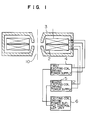
- Fig. 1 is a structural view of a magnetic field type electron lens according to an embodiment of the present invention.
- a first exciting coil 1 and a second exciting coil 2 are shown would in the same turning direction with a charged particle beam path 10 being a center axis inside a yoke (magnetic path) 3 for an electron lens.
- the first exciting coil 1 is electrically connected to a first exciting coil driving power supply 4 while the second exciting coil 2 is electrically connected to a second exciting coil driving power supply 5.
- the second exciting coil driving power supply 5 is of a bipolar type the current polarity of which can be changed over.
- the exciting currents 11 and 12 supplied from the first and second exciting coil driving power supplies 4, 5 to the first and second exciting coils 1, 2 are controlled by an exciting coil driving power supply controller unit 6.
- This controller unit 6 controls the exciting currents 11 and 12 in such a fashion that the sum of their absolute values becomes substantially constant.
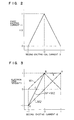
- Fig. 2 shows the relationship between these currents 11 and 12 in which the currents 12 is standardized by their maximum intensity.
- Fig. 3 shows the effective intensity of an electron lens by means of superimposition of the currents 11 and 12 versus the current 12.
- a one-dot- chain line M1 represents a first electron lens intensity which is generated only by the first exciting coil 2 with the current 11.
- a two-dot chain line M2 represents a second electron lens intensity which is generated only by the second exciting coil 2 with the current 12.
- a solid line represents the effective intensity of the electron lens, that is, it shows the sum of the first and second intensity of the two coils 1 and 2.
- the characteristics of the electron lens is as follows. At a portion A-B of the solid line, at which the electron lens intensity is constant, the currents 11 and 12 applied to the respective coils 1 and 2 have the same polarity.
- the currents 11 and 12 have the opposite polarity to each other.
- the electron lens intensity changes on proportion to the ratio of the currents 11 and 12.
- Negative lens intensity in Fig. 3 means that the rotating direction of an image becomes opposite. This phenomenon is appeared at the same time of the lens' focusing operation.
- the intensity of the electron lens can be changed from zero to the maximum value (+1) while the sum of the absolute values of the currents flowing through the same magnetic path is kept constant.
- Points C and E in Fig. 3 represent significant operational points of the lens of the present embodiment.
- the currents 11 and 12 have the same absolute value.
- the currents have opposite polarity to each other so that the magnetic fields generated by the two exciting coils 1 and 2 offset each other, and lens intensity becomes zero when the intensity of the electron lens is considered as a whole.
- the magnetic field generated by the two coils are superimposed to each other so that the lens action, which is two times stronger than the single coil, can be obtained.
- Fig. 4 shows a second embodiment of the present invention.
- a common exciting coil driving power supply 7 is used and the direction of the current 12 flowing through the second exciting coils 2 is switched by a polarity switch apparatus 8 as shown in the figure, the electron lens can easily be turned ON and OFF.
- the number of turns of the first and second exciting coils 1 and 2 is the same.
- the exciting coils 1 and 2 have the same turning direction.
- a magnetic field of the lens depends on both the turning direction and the polarity of exciting current. Accordingly, when one of coils has the opposite turning direction, the polarity of the exciting current applied to the coil should be turned so as to adapt also the above description.
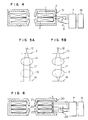
- Figs. 5A and 5B show an application example of the electron lens having the construction described above to a transmission electron microscope.
- an angular aperture of the electron beam emitted from an electron source 12 is limited by an aperture stop 13, and the electron beam is then irradiated on a specimen 16 through first and second converging lenses 14 and 15.
- the electron beam 17 is irradiated under the expanded state to the specimen 16 as shown in Fig. 5A to obtain a transmission image of this specimen.
- a portion (a very small portion) to be analyzed is determined in the image obtained in this way, and a thinly contracted electron beam is then irradiated to this portion (see Fig. 5B).
- Secondary data generated from this portion such as secondary electrons, X-rays, etc., are detected by a known detector, and useful data such as data of compositions, crystalline structures, etc., can be obtained.
- the electron lenses 14 and 15 constitute a condenser group of the electron beam irradiation system.
- the electron lens of this embodiment shown in Fig. 4 is used as the electron lens 15.
- the OFF state of this electron lens 15 is shown in Fig. 5A and its ON state, in Fig. 5B.
- the switch 8 makes the ON/OFF control of the electron lens 15.
- the controller 19 controls the power supply 7 at the time of switching of the switch 8 and makes the currents applied to the coils 1 and 2 temporarily (approximately for a second) zero.
- the coils 1 and 2 of the electron lens used in this embodiment have the number of turns of 560, and a current of 2.3 A is applied.
- the dimensions of the coils 1, 2 and the magnetic path 3 are substantially the same as those of an electron microscope (type HF-2000) produced by HITACHI, Ltd., the assigner of the present application.
- Fig. 6 shows an electron lens 20 according to another embodiment of the present invention.
- Like reference numerals are used in this drawing to identify like constituents as in Fig. 4, and the repetition of explanation of such constituents will be omitted.
- first exciting coil 1 and the second exciting coil 2 are connected in series.
- second and third exciting coils 22 and 23 are connected in parallel with the first exciting coil 21.
- These first to third exciting coils have the same number of turns.
- the turning direction of the first exciting coil is the same as that of the second exciting coil but is opposite to that of the third exciting coil.
- a switch 28 selectively connects one of the second and third exciting coils to the power supply 7. A current is always applied from the power supply 7 to the first exciting coil 21.
- the switch 28 selects the exciting coil 22
- the electron lens 20 is turned ON and the intensity of the electron lens is expressed by the sum of the magnetic fields generated by the first and second exciting coils.
- the switch 28 selects the third exciting coil 23
- the magnetic field generated by the first exciting coil 21 offsets the magnetic field generated by the third exciting coil 23, so that the electron lens 20 is turned OFF.
- the construction of the present invention when the construction of the present invention is applied to the second converging lens 15, only the lens intensity can be changed (ON/OFF) while the exciting current of the second converging lens 15 is kept constant. Accordingly, the second converging lens 15 is now substantially free from the temperature drift and can exhibit stable performance.
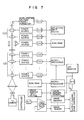
- the electron lens disclosed in each of the foregoing embodiments can be used as the electron lens of an electron microscope having the construction shown in Fig. 7.
- the electron lens is preferably used as a condenser lens 102 of the electron beam irradiation system or an image forming lens 103.
- the construction of the electron microscope shown in Fig. 7 refer to U.S. Patent Specification No. 4,788,425, which is incorporated herein by reference.
- the electron lens of each of the foregoing embodiments can further be applied to an ion beam apparatus, an electron beam apparatus (EB), and so forth.
- EB electron beam apparatus
Landscapes
- Physics & Mathematics (AREA)
- Electromagnetism (AREA)
- Chemical & Material Sciences (AREA)
- Analytical Chemistry (AREA)
- Electron Beam Exposure (AREA)
- Electron Sources, Ion Sources (AREA)
Abstract
Description
- This invention relates generally to an electron lens. More particularly, it relates to a magnetic field type electron lens. This electron lens is used for converging or expanding charged particle beams in an electron microscope, an electron beam apparatus (EB), an ion beam apparatus, and so forth.
- The magnetic field type electron lens in general converge or expand an electron beam by causing currents to flow through exciting coils disposed inside a magnetic path to generate magnetic fields.
- When an electron lens having a high intensity is necessary, the currents to be caused to flow through the exciting coils are increased, or the number of turns of the exciting coils is increased. To increase the exciting currents, however, a power supply having the capacity of supplying greater currents is necessary. When the number of turns of the exciting currents is increased, a high voltage must be generated because the resistance of the exciting coils increases.
- To solve these problems, JP-A-3-20950, for example, discloses a technology which disposes a plurality of exciting coils inside the same magnetic path, connects these coils in parallel with one another, and causes current to flow through them so as to resistrict the rise of a power supply voltage, and the increase of the current capacity while increasing the number of turns of the exciting coils and lowering their resistance.
- In the prior art technology described above, however, when the currents passed through the exciting coils are changed so as to change the intensity of the electron lens, power that is consumed by the coils is proportional to the square of the exciting current unless the resistance of the exciting coils changes. In other words, when the exciting current is increased to increase the intensity of the electron lens, the magnetic path or in other words, a casing of the coil, undergoes thermal deformation due to the heat generated in accordance with this power. This deformation adversely affects the intensity and distribution with respect to the magnetic field of the electron lens and invites problems such as an irregular drift of an electron beam.
- The prior art related with the present invention is disclosed in U.S. Patent Specification No. 4,306,149.
- It is an object of the present invention to provide an electron lens having a novel construction.
- It is another object of the present invention to provide a technology of changing the intensity of an electron lens without changing at all the temperature of a magnetic path or in other words, without inviting at all deformation of the magnetic path.
- An electron lens according to one embodiment of the present invention has a construction wherein two exciting coils are accommodated in a hollow doughnut-shaped casing, that is, in a magnetic path. Each of these coils has the same number of turns of winding and the same turning direction, and is put one upon another in a vertical direction in such a manner that the center axis thereof substantially coincides with that of the other. According to such an arrangement, the magnetic fields generated by these coils superpose with each other, and generate the same magnetic field, that is, a lens intensity, with respect to the impressed voltage. In other words, the magnetic field generated when a first current is applied to only a first coil is substantially equal to the magnetic field generated when the first current is applied to only a second coil. When the first current is applied to the first coil while a second current having an equal absolute value to that of the first current but having an opposite polarity is applied to the second coil, the magnetic fields generated by the two coils offset each other.
- Assuming that the turning directions of the windings of the first and second coils are opposite to each other, then, the magnetic fields generated by these coils offset each other when the first current is applied to both of the first and second coils. In this case, if the first current is applied to the first coil and a second coil having an equal absolute value to that of the first current but having an opposite polarity is applied to the second coil, the intensity of the electron lens is expressed by the sum of the magnetic fields generated by these coils.
- The first embodiment of the present invention demonstrates an example of the electron lens in which the absolute values of the currents applied to the first and second coils are linearly changed. The current applied to each coil is independently controlled. However, to keep exothermy of each coil constant, the sum of the absolute values of the currents applied to the coils is kept constant. The current applied to at least one of the coils can be changed linearly and admit to take an opposite polarity beyond zero (0).
- Another embodiment uses three exciting coils. The present invention uses at least two exciting coils.
- A plurality of coils having different numbers of turns can also be employed. In such a case, too, the intensity of the electron lens can be changed by keeping constant the sum of the absolute values of the currents to be applied to the coils, and thus keeping constant the temperature of the magnetic path and restricting deformation of the magnetic path.
-
- Fig. 1 is a sectional view showing the construction of a magnetic field type electron lens according to an embodiment of the present invention;
- Fig. 2 is a graph showing the relationship between a first exciting current and a second exciting current each being applied to an exciting coil of the electron lens shown in Fig. 1;
- Fig. 3 is a graph showing the relationship between the second exciting current and an electron lens intensity;
- Fig. 4 is a sectional view showing the construction of a magnetic field type electron lens according to another embodiment of the present invention;
- Figs. 5A and 5B are explanatory views each useful for explaining the operation principle of an electron microscope to which the lens shown in Fig. 4 is applied;
- Fig. 6 is a sectional view showing the construction of a magnetic field type lens according to still another embodiment of the present invention; and
- Fig. 7 is a structural view of a transmission electron microscope.
- Hereinafter, preferred embodiments of the present invention will be described in detail with reference to the accompanying drawings.
- Fig. 1 is a structural view of a magnetic field type electron lens according to an embodiment of the present invention.
- In Fig. 1, a first exciting coil 1 and a second
exciting coil 2 are shown would in the same turning direction with a chargedparticle beam path 10 being a center axis inside a yoke (magnetic path) 3 for an electron lens. The first exciting coil 1 is electrically connected to a first exciting coildriving power supply 4 while the secondexciting coil 2 is electrically connected to a second exciting coildriving power supply 5. - Whereas a current polarity of the first exciting coil
driving power supply 4 is constant, the second exciting coildriving power supply 5 is of a bipolar type the current polarity of which can be changed over. Theexciting currents 11 and 12 supplied from the first and second exciting coildriving power supplies exciting coils 1, 2 are controlled by an exciting coil driving power supply controller unit 6. - This controller unit 6 controls the
exciting currents 11 and 12 in such a fashion that the sum of their absolute values becomes substantially constant. Fig. 2 shows the relationship between thesecurrents 11 and 12 in which thecurrents 12 is standardized by their maximum intensity. - Fig. 3 shows the effective intensity of an electron lens by means of superimposition of the
currents 11 and 12 versus the current 12. A one-dot- chain line M1 represents a first electron lens intensity which is generated only by the firstexciting coil 2 with the current 11. A two-dot chain line M2 represents a second electron lens intensity which is generated only by the secondexciting coil 2 with the current 12. A solid line represents the effective intensity of the electron lens, that is, it shows the sum of the first and second intensity of the twocoils 1 and 2. - The characteristics of the electron lens is as follows. At a portion A-B of the solid line, at which the electron lens intensity is constant, the
currents 11 and 12 applied to therespective coils 1 and 2 have the same polarity. - On the other hand, at a portion B-C-D on the solid line, the
currents 11 and 12 have the opposite polarity to each other. The electron lens intensity changes on proportion to the ratio of thecurrents 11 and 12. Negative lens intensity in Fig. 3 means that the rotating direction of an image becomes opposite. This phenomenon is appeared at the same time of the lens' focusing operation. As described above, when a pair of coils are disposed in the single magnetic path and the direction of the current to be passed through each of the coils is reversed, the intensity of the electron lens can be changed from zero to the maximum value (+1) while the sum of the absolute values of the currents flowing through the same magnetic path is kept constant. - Points C and E in Fig. 3 represent significant operational points of the lens of the present embodiment. At these points, the
currents 11 and 12 have the same absolute value. At the point C, the currents have opposite polarity to each other so that the magnetic fields generated by the twoexciting coils 1 and 2 offset each other, and lens intensity becomes zero when the intensity of the electron lens is considered as a whole. On the contrary, at the point E, the magnetic field generated by the two coils are superimposed to each other so that the lens action, which is two times stronger than the single coil, can be obtained. - Fig. 4 shows a second embodiment of the present invention. When a common exciting coil driving
power supply 7 is used and the direction of the current 12 flowing through the secondexciting coils 2 is switched by apolarity switch apparatus 8 as shown in the figure, the electron lens can easily be turned ON and OFF. In this case, the number of turns of the first and secondexciting coils 1 and 2 is the same. - The above description is applied in the case where the
exciting coils 1 and 2 have the same turning direction. A magnetic field of the lens depends on both the turning direction and the polarity of exciting current. Accordingly, when one of coils has the opposite turning direction, the polarity of the exciting current applied to the coil should be turned so as to adapt also the above description. - Figs. 5A and 5B show an application example of the electron lens having the construction described above to a transmission electron microscope.
- In the drawing, an angular aperture of the electron beam emitted from an
electron source 12 is limited by anaperture stop 13, and the electron beam is then irradiated on aspecimen 16 through first and second converginglenses - Analysis of the specimen is carried out by the transmission electron microscope in the following way. First of all, the
electron beam 17 is irradiated under the expanded state to thespecimen 16 as shown in Fig. 5A to obtain a transmission image of this specimen. A portion (a very small portion) to be analyzed is determined in the image obtained in this way, and a thinly contracted electron beam is then irradiated to this portion (see Fig. 5B). Secondary data generated from this portion such as secondary electrons, X-rays, etc., are detected by a known detector, and useful data such as data of compositions, crystalline structures, etc., can be obtained. - In the construction shown in Figs. 5A and 5B, the
electron lenses electron lens 15. In other words, the OFF state of thiselectron lens 15 is shown in Fig. 5A and its ON state, in Fig. 5B. - As described above, the
switch 8 makes the ON/OFF control of theelectron lens 15. To prevent wear of the contacts of theswitch 8 in this embodiment, thecontroller 19 controls thepower supply 7 at the time of switching of theswitch 8 and makes the currents applied to thecoils 1 and 2 temporarily (approximately for a second) zero. - The
coils 1 and 2 of the electron lens used in this embodiment have the number of turns of 560, and a current of 2.3 A is applied. The dimensions of thecoils 1, 2 and themagnetic path 3 are substantially the same as those of an electron microscope (type HF-2000) produced by HITACHI, Ltd., the assigner of the present application. - Fig. 6 shows an
electron lens 20 according to another embodiment of the present invention. Like reference numerals are used in this drawing to identify like constituents as in Fig. 4, and the repetition of explanation of such constituents will be omitted. - In the embodiment shown in Fig. 4, the first exciting coil 1 and the second
exciting coil 2 are connected in series. In this embodiment, however, second and thirdexciting coils exciting coil 21. These first to third exciting coils have the same number of turns. The turning direction of the first exciting coil is the same as that of the second exciting coil but is opposite to that of the third exciting coil. Aswitch 28 selectively connects one of the second and third exciting coils to thepower supply 7. A current is always applied from thepower supply 7 to the firstexciting coil 21. - As is obvious from this drawing, when the
switch 28 selects theexciting coil 22, theelectron lens 20 is turned ON and the intensity of the electron lens is expressed by the sum of the magnetic fields generated by the first and second exciting coils. On the other hand, when theswitch 28 selects the thirdexciting coil 23, the magnetic field generated by the firstexciting coil 21 offsets the magnetic field generated by the thirdexciting coil 23, so that theelectron lens 20 is turned OFF. - On the other hand, when a conventional electron lens is used, the current which excites the second converging
lens 15 greatly fluctuates. Accordingly, the temperature change of the second converginglens 15 becomes so vigorous that stability of theelectron lens 15 is lost and defocusing and a temperature drift take place. - In contrast, when the construction of the present invention is applied to the second converging
lens 15, only the lens intensity can be changed (ON/OFF) while the exciting current of the second converginglens 15 is kept constant. Accordingly, the second converginglens 15 is now substantially free from the temperature drift and can exhibit stable performance. - The electron lens disclosed in each of the foregoing embodiments can be used as the electron lens of an electron microscope having the construction shown in Fig. 7. Particularly, the electron lens is preferably used as a
condenser lens 102 of the electron beam irradiation system or animage forming lens 103. As to the construction of the electron microscope shown in Fig. 7, refer to U.S. Patent Specification No. 4,788,425, which is incorporated herein by reference. - The electron lens disclosed in each of the foregoing embodiments can further be applied to the electron microscopes described in U.S. Patent Specification Nos. 4,945,237 and 5,144,129, both of which are incorporated herein by reference.
- Needless to say, the electron lens of each of the foregoing embodiments can further be applied to an ion beam apparatus, an electron beam apparatus (EB), and so forth.
- Although the present invention has thus been described with reference to some preferred forms thereof, it should be understood that various changes, substitutions and alterations can be made without departing from the spirit and scope of the invention as defined by the appended claims.
Claims (17)
Applications Claiming Priority (3)
| Application Number | Priority Date | Filing Date | Title |
|---|---|---|---|
| JP32148392 | 1992-11-06 | ||
| JP32148392 | 1992-11-06 | ||
| JP321483/92 | 1992-11-06 |
Publications (2)
| Publication Number | Publication Date |
|---|---|
| EP0596529A1 true EP0596529A1 (en) | 1994-05-11 |
| EP0596529B1 EP0596529B1 (en) | 2002-02-27 |
Family
ID=18133072
Family Applications (1)
| Application Number | Title | Priority Date | Filing Date |
|---|---|---|---|
| EP93117996A Expired - Lifetime EP0596529B1 (en) | 1992-11-06 | 1993-11-05 | Electron lens |
Country Status (3)
| Country | Link |
|---|---|
| US (1) | US5442182A (en) |
| EP (1) | EP0596529B1 (en) |
| DE (1) | DE69331620T2 (en) |
Cited By (1)
| Publication number | Priority date | Publication date | Assignee | Title |
|---|---|---|---|---|
| FR2818002A1 (en) * | 2000-12-11 | 2002-06-14 | Schlumberger Technologies Inc | WINDING COIL FOR MAGNETIC LENS AND MAGNETIC LENS COMPRISING SUCH A COIL |
Families Citing this family (9)
| Publication number | Priority date | Publication date | Assignee | Title |
|---|---|---|---|---|
| US6523240B1 (en) | 1996-05-09 | 2003-02-25 | Spotless Plastics Pty. Ltd. | Method for reusing hangers with size indicia |
| US6627899B2 (en) * | 1998-05-27 | 2003-09-30 | Nikon Corporation | Magnetic lenses, charged-particle-beam optical systems, and charged-particle-beam pattern-transfer apparatus |
| JP2002117800A (en) * | 2000-10-05 | 2002-04-19 | Jeol Ltd | Electron microscope equipped with an electron biprism device |
| US7078994B2 (en) * | 2003-02-18 | 2006-07-18 | Glenn Henry Martin | Constant power and temperature coil |
| DE102004019835B4 (en) * | 2004-04-23 | 2007-08-02 | Vistec Electron Beam Gmbh | Illumination condenser for a particle-optical projection system |
| JP6285753B2 (en) * | 2014-02-28 | 2018-02-28 | 日本電子株式会社 | Transmission electron microscope |
| CN110265278A (en) * | 2016-12-14 | 2019-09-20 | 聚束科技(北京)有限公司 | A kind of magnetic lenses and exciting current control method |
| JP2019169362A (en) * | 2018-03-23 | 2019-10-03 | 株式会社日立製作所 | Electron beam device |
| JP6954885B2 (en) | 2018-11-26 | 2021-10-27 | 日本電子株式会社 | Control method of charged particle beam device and charged particle beam device |
Citations (2)
| Publication number | Priority date | Publication date | Assignee | Title |
|---|---|---|---|---|
| EP0045844A1 (en) * | 1980-08-11 | 1982-02-17 | The Perkin-Elmer Corporation | Arrangement for focusing a beam of charged particles with variable focus |
| JPS5981850A (en) * | 1982-11-02 | 1984-05-11 | Internatl Precision Inc | Electron lens |
Family Cites Families (5)
| Publication number | Priority date | Publication date | Assignee | Title |
|---|---|---|---|---|
| US2323328A (en) * | 1940-10-31 | 1943-07-06 | Rca Corp | Projection lens for electron microscopes |
| US2418349A (en) * | 1945-12-13 | 1947-04-01 | Rca Corp | Method of and means for correcting for distortion in electron lens systems |
| NL6918302A (en) * | 1969-12-05 | 1971-06-08 | ||
| JPS5213713B2 (en) * | 1971-12-15 | 1977-04-16 | ||
| US4544847A (en) * | 1983-07-28 | 1985-10-01 | Varian Associates, Inc. | Multi-gap magnetic imaging lens for charged particle beams |
-
1993
- 1993-11-03 US US08/145,161 patent/US5442182A/en not_active Expired - Lifetime
- 1993-11-05 DE DE69331620T patent/DE69331620T2/en not_active Expired - Lifetime
- 1993-11-05 EP EP93117996A patent/EP0596529B1/en not_active Expired - Lifetime
Patent Citations (2)
| Publication number | Priority date | Publication date | Assignee | Title |
|---|---|---|---|---|
| EP0045844A1 (en) * | 1980-08-11 | 1982-02-17 | The Perkin-Elmer Corporation | Arrangement for focusing a beam of charged particles with variable focus |
| JPS5981850A (en) * | 1982-11-02 | 1984-05-11 | Internatl Precision Inc | Electron lens |
Non-Patent Citations (1)
| Title |
|---|
| PATENT ABSTRACTS OF JAPAN vol. 8, no. 194 (E - 264) 6 September 1984 (1984-09-06) * |
Cited By (2)
| Publication number | Priority date | Publication date | Assignee | Title |
|---|---|---|---|---|
| FR2818002A1 (en) * | 2000-12-11 | 2002-06-14 | Schlumberger Technologies Inc | WINDING COIL FOR MAGNETIC LENS AND MAGNETIC LENS COMPRISING SUCH A COIL |
| US6624426B2 (en) | 2000-12-11 | 2003-09-23 | Schlumberger Technologies Inc. | Split magnetic lens for controlling a charged particle beam |
Also Published As
| Publication number | Publication date |
|---|---|
| DE69331620T2 (en) | 2002-10-17 |
| DE69331620D1 (en) | 2002-04-04 |
| EP0596529B1 (en) | 2002-02-27 |
| US5442182A (en) | 1995-08-15 |
Similar Documents
| Publication | Publication Date | Title |
|---|---|---|
| US4306149A (en) | Electron microscope (comprising an auxiliary lens) | |
| EP0966752B1 (en) | Correction device for correcting the lens defects in particle-optical apparatus | |
| US7872240B2 (en) | Corrector for charged-particle beam aberration and charged-particle beam apparatus | |
| US6852983B2 (en) | Charged-particle beam apparatus equipped with aberration corrector | |
| EP0451370A1 (en) | Correction system for a charged-particle beam apparatus | |
| US5442182A (en) | Electron lens | |
| KR19990028770A (en) | Correction apparatus for correcting lens aberrations in particle-optical devices | |
| US20050017194A1 (en) | Charged-particle beam instrument and method of correcting aberration therein | |
| US20080224063A1 (en) | Charged particle optics with azimuthally-varying third-order aberrations for generation of shaped beams | |
| US7105833B2 (en) | Deflection system for a particle beam device | |
| US3851172A (en) | Compound electron lens for electron microscope and the like | |
| US4590379A (en) | Achromatic deflector and quadrupole lens | |
| US5965894A (en) | Method of operating a particle-optical apparatus | |
| EP0179294A1 (en) | Ion microbeam apparatus | |
| JP2007280966A (en) | Electro-optic lens device | |
| US4105890A (en) | Device for electron-beam heating of materials | |
| US4494000A (en) | Image distortion-free, image rotation-free electron microscope | |
| US6049084A (en) | Charged-particle-beam optical system | |
| JP2003346697A (en) | Scanning electron microscope using permanent magnetic lens | |
| JP3234373B2 (en) | Magnetic field type electron lens and electron beam device using the same | |
| JPH05128986A (en) | Magnetic field type lens | |
| JPS5810818B2 (en) | electromagnetic lens device | |
| SU764004A1 (en) | Method for correcting chromatic aberration in system of two electronic lenses | |
| JP2004199912A (en) | Aberration correction device in charged particle beam device | |
| SU1109824A1 (en) | Optronic system |
Legal Events
| Date | Code | Title | Description |
|---|---|---|---|
| PUAI | Public reference made under article 153(3) epc to a published international application that has entered the european phase |
Free format text: ORIGINAL CODE: 0009012 |
|
| AK | Designated contracting states |
Kind code of ref document: A1 Designated state(s): DE NL |
|
| 17P | Request for examination filed |
Effective date: 19941013 |
|
| 17Q | First examination report despatched |
Effective date: 19951121 |
|
| GRAG | Despatch of communication of intention to grant |
Free format text: ORIGINAL CODE: EPIDOS AGRA |
|
| GRAG | Despatch of communication of intention to grant |
Free format text: ORIGINAL CODE: EPIDOS AGRA |
|
| GRAH | Despatch of communication of intention to grant a patent |
Free format text: ORIGINAL CODE: EPIDOS IGRA |
|
| GRAH | Despatch of communication of intention to grant a patent |
Free format text: ORIGINAL CODE: EPIDOS IGRA |
|
| GRAA | (expected) grant |
Free format text: ORIGINAL CODE: 0009210 |
|
| AK | Designated contracting states |
Kind code of ref document: B1 Designated state(s): DE NL |
|
| REF | Corresponds to: |
Ref document number: 69331620 Country of ref document: DE Date of ref document: 20020404 |
|
| PLBE | No opposition filed within time limit |
Free format text: ORIGINAL CODE: 0009261 |
|
| STAA | Information on the status of an ep patent application or granted ep patent |
Free format text: STATUS: NO OPPOSITION FILED WITHIN TIME LIMIT |
|
| 26N | No opposition filed |
Effective date: 20021128 |
|
| PGFP | Annual fee paid to national office [announced via postgrant information from national office to epo] |
Ref country code: DE Payment date: 20121031 Year of fee payment: 20 |
|
| PGFP | Annual fee paid to national office [announced via postgrant information from national office to epo] |
Ref country code: NL Payment date: 20121116 Year of fee payment: 20 |
|
| REG | Reference to a national code |
Ref country code: DE Ref legal event code: R071 Ref document number: 69331620 Country of ref document: DE |
|
| REG | Reference to a national code |
Ref country code: NL Ref legal event code: V4 Effective date: 20131105 |
|
| PG25 | Lapsed in a contracting state [announced via postgrant information from national office to epo] |
Ref country code: DE Free format text: LAPSE BECAUSE OF EXPIRATION OF PROTECTION Effective date: 20131106 |