EP0596811A1 - Dispositif médical moulé à base de polychlorure de vinyle - Google Patents
Dispositif médical moulé à base de polychlorure de vinyle Download PDFInfo
- Publication number
- EP0596811A1 EP0596811A1 EP93402725A EP93402725A EP0596811A1 EP 0596811 A1 EP0596811 A1 EP 0596811A1 EP 93402725 A EP93402725 A EP 93402725A EP 93402725 A EP93402725 A EP 93402725A EP 0596811 A1 EP0596811 A1 EP 0596811A1
- Authority
- EP
- European Patent Office
- Prior art keywords
- medical device
- vinyl chloride
- group
- malate
- weight
- Prior art date
- Legal status (The legal status is an assumption and is not a legal conclusion. Google has not performed a legal analysis and makes no representation as to the accuracy of the status listed.)
- Granted
Links
Images

Classifications
-
- A—HUMAN NECESSITIES
- A61—MEDICAL OR VETERINARY SCIENCE; HYGIENE
- A61L—METHODS OR APPARATUS FOR STERILISING MATERIALS OR OBJECTS IN GENERAL; DISINFECTION, STERILISATION OR DEODORISATION OF AIR; CHEMICAL ASPECTS OF BANDAGES, DRESSINGS, ABSORBENT PADS OR SURGICAL ARTICLES; MATERIALS FOR BANDAGES, DRESSINGS, ABSORBENT PADS OR SURGICAL ARTICLES
- A61L31/00—Materials for other surgical articles, e.g. stents, stent-grafts, shunts, surgical drapes, guide wires, materials for adhesion prevention, occluding devices, surgical gloves, tissue fixation devices
- A61L31/04—Macromolecular materials
- A61L31/048—Macromolecular materials obtained by reactions only involving carbon-to-carbon unsaturated bonds
-
- A—HUMAN NECESSITIES
- A61—MEDICAL OR VETERINARY SCIENCE; HYGIENE
- A61L—METHODS OR APPARATUS FOR STERILISING MATERIALS OR OBJECTS IN GENERAL; DISINFECTION, STERILISATION OR DEODORISATION OF AIR; CHEMICAL ASPECTS OF BANDAGES, DRESSINGS, ABSORBENT PADS OR SURGICAL ARTICLES; MATERIALS FOR BANDAGES, DRESSINGS, ABSORBENT PADS OR SURGICAL ARTICLES
- A61L29/00—Materials for catheters, medical tubing, cannulae, or endoscopes or for coating catheters
- A61L29/04—Macromolecular materials
- A61L29/041—Macromolecular materials obtained by reactions only involving carbon-to-carbon unsaturated bonds
-
- A—HUMAN NECESSITIES
- A61—MEDICAL OR VETERINARY SCIENCE; HYGIENE
- A61L—METHODS OR APPARATUS FOR STERILISING MATERIALS OR OBJECTS IN GENERAL; DISINFECTION, STERILISATION OR DEODORISATION OF AIR; CHEMICAL ASPECTS OF BANDAGES, DRESSINGS, ABSORBENT PADS OR SURGICAL ARTICLES; MATERIALS FOR BANDAGES, DRESSINGS, ABSORBENT PADS OR SURGICAL ARTICLES
- A61L33/00—Antithrombogenic treatment of surgical articles, e.g. sutures, catheters, prostheses, or of articles for the manipulation or conditioning of blood; Materials for such treatment
- A61L33/0005—Use of materials characterised by their function or physical properties
- A61L33/0011—Anticoagulant, e.g. heparin, platelet aggregation inhibitor, fibrinolytic agent, other than enzymes, attached to the substrate
- A61L33/0041—Anticoagulant, e.g. heparin, platelet aggregation inhibitor, fibrinolytic agent, other than enzymes, attached to the substrate characterised by the choice of an antithrombatic agent other than heparin
-
- A—HUMAN NECESSITIES
- A61—MEDICAL OR VETERINARY SCIENCE; HYGIENE
- A61L—METHODS OR APPARATUS FOR STERILISING MATERIALS OR OBJECTS IN GENERAL; DISINFECTION, STERILISATION OR DEODORISATION OF AIR; CHEMICAL ASPECTS OF BANDAGES, DRESSINGS, ABSORBENT PADS OR SURGICAL ARTICLES; MATERIALS FOR BANDAGES, DRESSINGS, ABSORBENT PADS OR SURGICAL ARTICLES
- A61L33/00—Antithrombogenic treatment of surgical articles, e.g. sutures, catheters, prostheses, or of articles for the manipulation or conditioning of blood; Materials for such treatment
- A61L33/0005—Use of materials characterised by their function or physical properties
- A61L33/0052—Plasticizers
-
- C—CHEMISTRY; METALLURGY
- C08—ORGANIC MACROMOLECULAR COMPOUNDS; THEIR PREPARATION OR CHEMICAL WORKING-UP; COMPOSITIONS BASED THEREON
- C08K—Use of inorganic or non-macromolecular organic substances as compounding ingredients
- C08K5/00—Use of organic ingredients
- C08K5/04—Oxygen-containing compounds
- C08K5/10—Esters; Ether-esters
- C08K5/11—Esters; Ether-esters of acyclic polycarboxylic acids
Definitions
- This invention relates to a medical device, and more particularly, to a highly safe medical device. More illustratively, this invention is directed to a highly safe blood bag system having an excellent blood- or blood component-storability.
- Soft bags fabricated from polyvinyl chloride are recently used to store blood for transfusion instead of rigid glass containers mainly in view of the reduced damage of erythrocytes during the storage.
- Use of such polyvinyl chloride soft bags has increased also for their superior workability, flexibility, transparency, resistance to vapor permeation, heat resistance, and the like.
- Conventional polyvinyl chloride resins which has been used for fabricating such blood storage bags contain from about 30 to 60 parts by weight of a phtalate for plasticizing purpose.
- Such phtalate elutes into blood during the blood storage, and it has been found out that the phthalate in blood protects membrane of various cells of the blood, in particular, erythrocytes. Despite such positive effects, the phtalate eluted into the blood may induce safety problems upon its introduction into the body by blood transfusion.
- an object of the present invention is to provide a medical device molded from a highly safe, flexible polyvinyl chloride resin composition which has blood storability equivalent to or higher than conventional materials.
- a plasticizing agent which has a plasticizing efficiency equivalent to or higher than the phtalate
- the plasticizer that has been used for medical flexible polyvinyl chlorides, and which has an erythrocyte membrane-protecting action equivalent to or higher than the phtalate , and which is safer than the phtalate.
- a medical device comprising a molded article of a resin composition prepared by blending 100 parts by weight of a vinyl chloride-based resin; 5 to 100 parts by weight of a dialkyl malate represented by the general formula: wherein a and b independently represent an integer of from 2 to 12, and R represent a member selected from the group consisting of hydrogen atom, acetyl group, propionyl group, and butyryl group; and 1 to 20 parts by weight of a stabilizer.
- a and b may most preferably be from 4 to 8, and the dialkyl malate may preferably be dihexyl malate, dioctyl malate, monohexyl monooctyl malate, dihexyl acetylmalate, dioctyl acetylmalate, monohexyl monooctyl acetylmalate, dihexyl butyrylmalate, dioctyl butyrylmalate, or monohexyl monooctyl butyrylmalate.
- the stabilizer may mainly comprise an epoxidized vegetable oil, and/or a Ba-Zn or a Ca-Zn-based stabilizer.
- the medical device of the invention may preferably be a flexible medical device that is brought into contact with a body fluid or a medicament fluid, and most preferably, a blood bag system comprising blood bags and tubes.
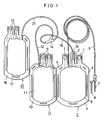
- FIG. 1 is a plan view of a blood bag system according to an embodiment of the invention.
- FIG. 2 diagrammatically shows decomposition of various plasticizers in relation to incubation period.
- the medical device of the present invention comprises an article molded from a resin composition prepared by blending 100 parts by weight of a vinyl chloride-based resin; 5 to 100 parts by weight of a dialkyl malate represented by the general formula (I); and 1 to 20 parts by weight of a stabilizer.
- the vinyl chloride-based resins which may be used in the present invention include vinyl chloride homopolymers and vinyl chloride copolymers containing at least 70% by weight, and preferably, at least 85% by weight of vinyl chloride.
- the vinyl chloride homopolymers and copolymers may have an average degree of polymerization of from 700 to 3,000, and preferably, from 1,000 to 2,400.
- the comonomers which may be copolymerized with the vinyl chloride include vinylidene chloride; ethylene; propylene; vinyl acetate; vinyl bromide; vinyl fluoride; styrene; vinyltoluene; vinyl pyridine; acrylic acid; alkyl acrylate such as methyl acrylate, ethyl acrylate, isopropyl acrylate, n-butyl acrylate, and 2-ethylhexyl acrylate; methacrylic acid; alkyl methacrylate such as methyl methacrylate, ethyl methacrylate, and 2-ethylhexyl methacrylate; acrylonitrile, and methacrylonitrile.
- the vinyl chloride-based resins may optionally have blended therewith a resin such as a styrene-acrylonitrile copolymer or a styrenemethacrylonitrile copolymer.
- dialkyl malates blended in the present resin composition as a plasticizing agent include those represented by the general formula: wherein a and b may independently represent an integer of from 2 to 12; and preferably, from 4 to 8; and R may represent hydrogen atom or an acyl group represented by the formula: R'CO, which may preferably be acetyl group, propionyl group, or butyryl group.
- dialkyl malates include dihexyl malate, dioctyl malate, monohexyl monooctyl malate, dihexyl acetylmalate, dioctyl acetylmalate, monohexyl monooctyl acetylmalate, dihexyl butyrylmalate, dioctyl butyrylmalate, and monohexyl monooctyl butyrylmalate.
- alkyl group represented by the formula: (CH2) a H or (CH2) b H in the general formula (I) may be either a straight-chain or a branched alkyl group.
- exemplary branched alkyl groups include ethyl hexyl group.
- the dialkyl malates as described above may be synthesized by any desired conventional process.
- the dialkyl malate may be produced by heating malic acid and more than two molar amounts of an aliphatic alcohol in the presence of an acid such as sulfuric acid to allow a reaction to take place; neutralizing the reaction product with a base such as caustic soda; washing the product with water; and distilling the product for purification.
- an aliphatic acid anhydride may be further reacted with the malate in the presence of an acid such as sulfuric acid, followd by neutralization with a base such as caustic soda, washing with water, and purification by distillation.
- the dialkyl malate may be used in an amount of from 5 to 100 parts by weight, preferably, from 40 to 80 parts by weight, and most preferably, from 50 to 70 parts by weight per 100 parts by weight of the vinyl chloride-based resin.
- the stabilizer which may be used in the present resin composition include epoxy compounds such as epoxidized vegetable oils, for example, epoxidized soybean oil and epoxidized linseed oil; cyclohexene oxide derivatives such as di-2-ethylhexyl epoxy hexahydrophthalate, vinylcyclohexane dioxide, 3,4-epoxy-6-methylcyclohexylmethyl-3,4-epoxy-6-methylcyclohexane carbonate, and dicyclopentadiene dioxide; metallic salts such as salts between calcium, zinc, barium, magnesium or tin and stearic acid, lauric acid, ricinoleic acid, naphthenic acid or 2-ethylhexoic acid, for example calcium stearate, zinc stearate, calcium laurate, zinc laurate, barium stearate, magnesium stearate, and tin stearate; phosphorous esters such as didecylphenyl
- the stabilizer may be used generally in an amount of from 1 to 20 parts by weight, and preferably, from 1 to 15 parts by weight per 100 parts by weight of the vinyl chloride-based resin.
- the above-mentioned stabilizers can be used alone, use of the epoxy compound in combination with the metallic salt, the phosphorous ester, or the organic stabilizer is preferred.
- the epoxy compound when used as the stabilizer, it may be used generally in an amount of from 1 to 15 parts by weight, and preferably, from 5 to 10 parts by weight per 100 parts by weight of the vinyl chloride-based resin, and use of epoxidized soybean oil is the most preferred.
- the metallic salt, the phosphorous ester, or the organic stabilizer when used in combination with the epoxy compound, it may be used in an amount of from 0.01 to 8 parts by weight, and preferably, from 0.05 to 5 parts by weight per 100 parts by weight of the vinyl chloride-based resin, and use of a Ca-Zn-based or Ba-Zn-based metallic salt is the most preferred.
- the resin composition of the present invention may optionally contain a conventional additive such as an inorganic or an organic filler or a pigment.
- exemplary fillers include talc, calcium carbonate, silica, carbon, tar and asphalt.
- components may be blended in a ribbon blender, tumbling mixer or Henschel mixer .
- the resulting blend may be directly molded into the product, or alternatively, further melt milled in an extruder, Banbury mixer or two-roll mill before molding.
- the components may be dissolved in a suitable solvent such as a hydrocarbon or an aromatic solvent to form a polymeric solution.
- the molten mixture or the mixed solution may then be molded into the product of desired shape by means of a suitable molding machine, for example, a single-screw extruder, vented extruder, twin-screw extruder, co-kneader, plasticator, mixtruder, twin conical screw extruder, planetary screw extruder, gear extruder, and screwless extruder.
- a suitable molding machine for example, a single-screw extruder, vented extruder, twin-screw extruder, co-kneader, plasticator, mixtruder, twin conical screw extruder, planetary screw extruder, gear extruder, and screwless extruder.
- a blood bag system which is an example of the medical device according to the present invention, is described in detail by referring to the drawing.
- the blood bag 3 is fabricated from the resin composition of the present invention, and is sealed in its periphery 4 by such means as high frequency heating to define an interior space 5.
- the blood bag 3 is formed with a plurality of outlets 1 each provided with a peel-tab, and an outlet 2.
- a blood-collecting tube 6 which also comprises the resin composition of the present invention is connected to the blood bag 3 such that the interior of the tube 6 is in communication with the interior space 5 of the blood bag 3.
- an anticoagulant such as citrate-phosphate-dextrose (CPD) solution.
- CPD citrate-phosphate-dextrose
- the auxiliary blood bag 13 is also fabricated from the resin composition of the present invention, and is sealed in its periphery 10 by such means as high frequency heating to define an interior space 11.
- the blood bag 13 is formed with a plurality of outlets 9 each provided with a peel-tab.
- a connection tube 12 which also comprises the resin composition of the present invention is connected to the blood bag 13 such that the interior of the tube 12 is in communication with the interior space 11 of the blood bag 13.
- the connection tube 12 is connected to a connection tube 16 via a branch pipe 14, and the connection tube 16 is connected to the outlet 2 which is provided for such connection purpose at its connecting site 15.
- the auxiliary blood bag 22 is also fabricated from the resin composition of the present invention, and is sealed in its periphery 18 by such means as high frequency heating to define an interior space 19.
- the blood bag 22 is formed with a plurality of outlets 17 each provided with a peel-tab.
- a connection tube 21 which also comprises the resin composition of the present invention is connected to the blood bag 22 such that the interior of the tube 21 is in communication with the interior space 19 of the blood bag 22.
- the connection tube 21 is connected to the connection tubes 12 and 16 via the branch pipe 14.
- the main blood bag 3 is thereby connected to the auxiliary blood bag 22 as well as the auxiliary blood bag 13.
- the medical device according to the present invention has been described by referring to the embodiment of a blood bag system.
- the resin composition of the present invention can also be used in such medical devices as blood storage containers, containers for a blood transfusion system, containers for a blood circuit, infusion bags; catheters, dialysis tubes and various other medical tubes; artificial kidneys, artificial lungs, artificial livers, and other artificial organs; and tubes and other devices used for a respiratory circuit.
- the resulting sheet was evaluated for its tensile properties using Strograph manufactured by Toyo Precision Machines K.K. in accordance with Japanese Industrial Standards (JIS) K-6301 by using rubber #3 dumbbell at a tensile speed of 200 mm/min and at a temperature of 23°C.
- JIS Japanese Industrial Standards
- the resulting sheet was also evaluated for its elution properties in accordance with "Standards for Blood Sets Fabricated from Polyvinyl Chloride" noticed by Ministry of Health and Welfare of Japan.
- the sheet was also evaluated for its safety with regard to its cytotoxicity.
- a test sheet having a surface area of 18 cm2 and 3 ml of MEM medium (manufactured by Nihon Pharmaceutical K.K.) were placed in a vial with threaded top, and subjected a treatment in an autoclave at 121°C for 60 minutes to obtain an extract.
- the liquid extract was administered to Hela-S3 cells, and the cells were incubated at 37°C for another 2 days. The cells were then microscopically observed by comparing with the blank cell culture wherein the cells had been incubated with no administration of such an extract.
- the cell culture which showed no difference with the blank cell culture was determined to be negative, and the cell culture wherein the cell growth had been hindered or wherein the cells had died was determined to be positive.
- the sheet was cut into a predetermined shape, and two pieces of the thus cut sheets were stuck one on another and high-frequency sealed to produce a blood bag having an interior surface area of about 50 cm2.
- the thus produced blood bag was heat sealed, and sterilized in an autoclave. No significant deformation was noted for both the bags of the Examples and the Comparative Example to indicate that the bags could endure the sterilization under practical conditions.
- a test piece having a surface area of 6 cm2 (total of the front and back surfaces) was cut out of the sheet.
- the test piece was placed in a glass test tube, and sterilized in an autoclave at 121°C for 20 minutes.
- To the test tube was aseptically poured 5 ml of whole blood having added thereto citrate-phosphate-dextrose (CPD).
- CPD citrate-phosphate-dextrose
- the test tube was then sealed and stored at 4°C for 28 days. After the storage, the blood was centrifuged at 1,500 rpm for 10 minutes at room temperature. Concentration of hemoglobin in the supernatant plasma was measured by cyanmethemoglobin method to use it for the index of hemolysis during the storage.
- Plasticizers as shown in Table 2 were evaluated for their decomposition in a solution containing plasma by such an enzyme as esterase.
- di-n-butyl acetylmalate, di-n-hexyl acetylmalate, and di-n-octyl acetylmalate are the ones used in the resins according to the present invention
- phthalate (di-n-decyl-phthalate) tri-n-butyl acetylcitrate, and tri-n-hexyl acetylcitrate are the ones evaluated for the purpose of comparison.
- the plasticizers were respectively dissolved in ethanol to 50,000 ppm.
- test tubes Two glass test tubes were used for the evaluation of each plasticizer.
- the test tubes were filled with 4.90 ml of 10 mM phosphate buffered saline (PBS), pH 7.4, and then, with 50 ⁇ l of the plasticizer solution in ethanol to a final concentration of 500 ppm. The mixture was stirred.
- PBS phosphate buffered saline
- To one test tube was added 50 ⁇ l of human plasma having CPD added thereto, and to the other test tube was added 50 ⁇ l of PBS as a control.
- the test tubes were incubated at 37°C.
- 500 ⁇ l samples were removed from each test tube.
- To the sample was sequentially added 5 ml isopropanol and 5 ml diethylether, and the mixture was stirred after each addition.
- the mixture was subjected to centrifugation at 2,500 rpm for 10 min.
- the upper layer was collected and the solvent was removed under nitrogen atmosphere at 30°C.
- the residue was dissolved in 500 ⁇ l ethyl acetate, and evaluated for its content of the plasticizer by gas chromatography under the following conditions.
- the medical device of the present invention molded from a resin composition prepared by blending 100 parts by weight of a vinyl chloride-based resin; 5 to 100 parts by weight of a dialkyl malate; and 1 to 20 parts by weight of a stabilizer is equivalent to the conventional medical device molded from a resin composition having blended therein a phthalate as the plasticizing agent in its physical properties (tensile properties), workability (susceptibility for high-frequency sealing, and adhesion), as well as sterilization resistance.
- the medical device of the present invention is highly safe, and exhibits an erythrocyte retention properties superior to such a conventional medical device when it is kept in contact with blood.
Landscapes
- Health & Medical Sciences (AREA)
- Chemical & Material Sciences (AREA)
- Animal Behavior & Ethology (AREA)
- Veterinary Medicine (AREA)
- Public Health (AREA)
- General Health & Medical Sciences (AREA)
- Epidemiology (AREA)
- Life Sciences & Earth Sciences (AREA)
- Surgery (AREA)
- Chemical Kinetics & Catalysis (AREA)
- Hematology (AREA)
- Materials Engineering (AREA)
- Engineering & Computer Science (AREA)
- Heart & Thoracic Surgery (AREA)
- Vascular Medicine (AREA)
- Medicinal Chemistry (AREA)
- Polymers & Plastics (AREA)
- Organic Chemistry (AREA)
- Medical Preparation Storing Or Oral Administration Devices (AREA)
- Materials For Medical Uses (AREA)
- Compositions Of Macromolecular Compounds (AREA)
Applications Claiming Priority (3)
| Application Number | Priority Date | Filing Date | Title |
|---|---|---|---|
| JP29745292 | 1992-11-06 | ||
| JP297452/92 | 1992-11-06 | ||
| JP29745292 | 1992-11-06 |
Publications (2)
| Publication Number | Publication Date |
|---|---|
| EP0596811A1 true EP0596811A1 (fr) | 1994-05-11 |
| EP0596811B1 EP0596811B1 (fr) | 1999-09-15 |
Family
ID=17846697
Family Applications (1)
| Application Number | Title | Priority Date | Filing Date |
|---|---|---|---|
| EP93402725A Expired - Lifetime EP0596811B1 (fr) | 1992-11-06 | 1993-11-05 | Dispositif médical moulé à base de polychlorure de vinyle |
Country Status (3)
| Country | Link |
|---|---|
| US (1) | US5454806A (fr) |
| EP (1) | EP0596811B1 (fr) |
| DE (1) | DE69326413T2 (fr) |
Families Citing this family (27)
| Publication number | Priority date | Publication date | Assignee | Title |
|---|---|---|---|---|
| US5912269A (en) * | 1996-04-30 | 1999-06-15 | Vertex Pharmaceuticals, Inc. | Butyrate prodrugs derived from lactic acid |
| US5883123A (en) * | 1995-10-06 | 1999-03-16 | Vertex Pharmaceuticals, Inc. | Butyrate prodrugs derived from lactic acid |
| US5880152A (en) * | 1995-10-06 | 1999-03-09 | Vertex Pharmaceuticals, Inc. | Butyrate prodrugs derived from lactic acid |
| US6225350B1 (en) | 1998-03-10 | 2001-05-01 | Vertex Pharmaceuticals, Inc. | Butyrate prodrugs derived from lactic acid |
| AU6498600A (en) | 1999-07-29 | 2001-02-19 | Baxter International Inc. | Sampling tube holder for blood sampling system |
| US7824343B2 (en) * | 1999-07-29 | 2010-11-02 | Fenwal, Inc. | Method and apparatus for blood sampling |
| US20030176813A1 (en) * | 1999-07-29 | 2003-09-18 | Jean-Marie Mathias | Biological fluid sampling apparatus |
| US7479131B2 (en) * | 1999-07-29 | 2009-01-20 | Fenwal, Inc. | Biological fluid sampling apparatus, assembly and method |
| US20040086970A1 (en) * | 2000-03-22 | 2004-05-06 | Genentech, Inc. | Novel cytokine receptors and nucleic acids encoding the same |
| CA2436175A1 (fr) * | 2001-02-20 | 2002-08-29 | Pall Corporation | Contenant pour liquide biologique |
| US20070031812A1 (en) * | 2003-06-20 | 2007-02-08 | Pall Corporation | Processing of platelet-containing biological fluids |
| CN102007176A (zh) | 2008-02-15 | 2011-04-06 | 联合碳化化学及塑料技术有限责任公司 | 用于邻苯二甲酸酯增塑制剂的替代增塑剂体系 |
| KR101770005B1 (ko) | 2009-09-30 | 2017-08-21 | 다우 글로벌 테크놀로지스 엘엘씨 | 에폭시화 지방산 에스테르 가소제를 함유하는 열 안정화 중합체 조성물 |
| CA2775930C (fr) | 2009-09-30 | 2017-02-14 | Dow Global Technologies Inc. | Derives acetyles d'huile de ricin et leurs melanges avec des esters d'acide gras epoxydes |
| US8552098B2 (en) * | 2009-09-30 | 2013-10-08 | Dow Global Technologies Llc | Purified acetylated derivatives of castor oil and compositions including same |
| CA2775973C (fr) | 2009-09-30 | 2018-01-09 | Dow Global Technologies Llc | Glyceride acetyle d'acide 12-hydroxystearique et ses melanges avec des esters d'acide gras epoxydes |
| WO2011143028A1 (fr) | 2010-05-10 | 2011-11-17 | Dow Global Technologies Llc | Compositions de pvc souple fabriquées avec des plastifiants dérivés de sources renouvelables |
| TW201209168A (en) | 2010-07-28 | 2012-03-01 | Dow Global Technologies Llc | Plasticizers made from oil extracted from microorganisms and polar polymeric compositions comprising the same |
| MX357165B (es) | 2012-02-08 | 2018-06-28 | Dow Global Technologies Llc | Composiciones de plastificante y metodos para fabricar composiciones de plastificante. |
| CN104379653B (zh) | 2012-06-22 | 2017-07-18 | 陶氏环球技术有限责任公司 | 乙酰化多元醇羟基硬脂酸酯增塑剂和经增塑的聚合物组合物 |
| EP2864406B1 (fr) | 2012-06-26 | 2017-03-08 | Dow Global Technologies LLC | Plastifiants et compositions polymères plastifiées |
| CA2887048C (fr) | 2012-10-18 | 2020-03-24 | Neeta RAO | Plastifiants d'ester d'alkyle d'acide gras epoxyde et procedes de fabrication de plastifiants d'ester d'alkyle d'acide gras epoxyde |
| BR112015010692B1 (pt) | 2012-11-12 | 2019-04-09 | Dow Global Technologies Llc | Composição plastificante, composição polimérica e processo para produzir alquil ésteres de ácido graxo epoxidado |
| JP6189967B2 (ja) | 2012-11-12 | 2017-08-30 | ダウ グローバル テクノロジーズ エルエルシー | エポキシ化脂肪酸アルキルエステルを作製するための方法 |
| GB201223276D0 (en) | 2012-12-21 | 2013-02-06 | Ucb Pharma Sa | Antibodies and methods of producing same |
| US20210015579A1 (en) * | 2018-03-30 | 2021-01-21 | Bemis Company, Inc. | Package for pvc products |
| EP3744775A1 (fr) * | 2019-05-30 | 2020-12-02 | Fenwal, Inc. | Récipients de stockage de sang en chlorure de polyvinyle et plastifiants mixtes |
Citations (5)
| Publication number | Priority date | Publication date | Assignee | Title |
|---|---|---|---|---|
| GB834235A (en) * | 1956-04-13 | 1960-05-04 | British Celanese | Plastic compositions |
| JPS49130444A (fr) * | 1973-04-16 | 1974-12-13 | ||
| FR2542320A1 (fr) * | 1983-03-09 | 1984-09-14 | Terumo Corp | Dispositif medical capable de supporter une sterilisation par irradiation et composition pour un tel dispositif |
| EP0165579A2 (fr) * | 1984-06-18 | 1985-12-27 | TERUMO KABUSHIKI KAISHA trading as TERUMO CORPORATION | Composition à base d'une résine de chlorure de vinyle et instrument médical |
| EP0300951A2 (fr) * | 1987-07-22 | 1989-01-25 | Shell Oil Company | Agent antistatique pour chlorure de polyvinyle |
Family Cites Families (2)
| Publication number | Priority date | Publication date | Assignee | Title |
|---|---|---|---|---|
| JPS5731580B2 (fr) * | 1975-02-26 | 1982-07-06 | ||
| US4824893A (en) * | 1984-06-11 | 1989-04-25 | Morflex Chemical Company, Inc. | Citrate esters and methods |
-
1993
- 1993-11-04 US US08/145,628 patent/US5454806A/en not_active Expired - Lifetime
- 1993-11-05 EP EP93402725A patent/EP0596811B1/fr not_active Expired - Lifetime
- 1993-11-05 DE DE69326413T patent/DE69326413T2/de not_active Expired - Lifetime
Patent Citations (5)
| Publication number | Priority date | Publication date | Assignee | Title |
|---|---|---|---|---|
| GB834235A (en) * | 1956-04-13 | 1960-05-04 | British Celanese | Plastic compositions |
| JPS49130444A (fr) * | 1973-04-16 | 1974-12-13 | ||
| FR2542320A1 (fr) * | 1983-03-09 | 1984-09-14 | Terumo Corp | Dispositif medical capable de supporter une sterilisation par irradiation et composition pour un tel dispositif |
| EP0165579A2 (fr) * | 1984-06-18 | 1985-12-27 | TERUMO KABUSHIKI KAISHA trading as TERUMO CORPORATION | Composition à base d'une résine de chlorure de vinyle et instrument médical |
| EP0300951A2 (fr) * | 1987-07-22 | 1989-01-25 | Shell Oil Company | Agent antistatique pour chlorure de polyvinyle |
Non-Patent Citations (1)
| Title |
|---|
| DATABASE WPI Week 9035, Derwent World Patents Index; AN 75-57701 * |
Also Published As
| Publication number | Publication date |
|---|---|
| US5454806A (en) | 1995-10-03 |
| DE69326413D1 (de) | 1999-10-21 |
| EP0596811B1 (fr) | 1999-09-15 |
| DE69326413T2 (de) | 2000-03-30 |
Similar Documents
| Publication | Publication Date | Title |
|---|---|---|
| EP0596811B1 (fr) | Dispositif médical moulé à base de polychlorure de vinyle | |
| US4710532A (en) | Medical article and method | |
| EP0152835B1 (fr) | Instrument médical | |
| US4280497A (en) | Container for platelet storage | |
| EP0396724B1 (fr) | Composition plastique a effet anti-hemolytique | |
| AU610120B2 (en) | Hemolysis depressent and blood preserving composition | |
| US4329992A (en) | Medical apparatus for parenteral liquids | |
| US5248531A (en) | Hemolysis depressant and plasticizer | |
| AU623071B2 (en) | Hemolysis inhibitor and medical resin composition, medical implement, and blood-preserving fluid containing the same | |
| US4883905A (en) | Process for preparing citrates using organic titanates | |
| JP3549246B2 (ja) | 医療用器具 | |
| JP2889087B2 (ja) | 医療物品の製造方法 | |
| JP3243348B2 (ja) | 医療用器具 | |
| JP3447391B2 (ja) | 医療用器具 | |
| US4560720A (en) | Compositions of polyvinyl chloride and tetracarboxylic tetraesters and medical articles thereof | |
| EP0330151A2 (fr) | Sac pour le magasinage de plaquettes sanguines | |
| KR950000989B1 (ko) | 의료용 염화비닐수지조성물 | |
| CA1294087C (fr) | Formation d'articles medicaux non toxiques en pvc plasticise au citrate | |
| AU625741C (en) | Plastic composition with anti-hemolytic effect | |
| JPH01104266A (ja) | 医療用軟質塩化ビニル系樹脂組成物および医療用具 | |
| JPH06169973A (ja) | 医療用器具 | |
| JPH0242504B2 (fr) | ||
| JPH01104264A (ja) | 医療用軟質樹脂組成物および医療用具 | |
| JPH01104265A (ja) | 医療用軟質塩化ビニル系樹脂組成物および医療用具 | |
| JPWO2019102995A1 (ja) | 内容物視認性の改善方法、塩化ビニル系樹脂組成物、安定化剤、塩化ビニル系樹脂成形体、医療材料、及び滅菌処理方法 |
Legal Events
| Date | Code | Title | Description |
|---|---|---|---|
| PUAI | Public reference made under article 153(3) epc to a published international application that has entered the european phase |
Free format text: ORIGINAL CODE: 0009012 |
|
| 17P | Request for examination filed |
Effective date: 19931110 |
|
| AK | Designated contracting states |
Kind code of ref document: A1 Designated state(s): BE DE FR GB IT NL SE |
|
| 17Q | First examination report despatched |
Effective date: 19980130 |
|
| GRAG | Despatch of communication of intention to grant |
Free format text: ORIGINAL CODE: EPIDOS AGRA |
|
| GRAG | Despatch of communication of intention to grant |
Free format text: ORIGINAL CODE: EPIDOS AGRA |
|
| GRAH | Despatch of communication of intention to grant a patent |
Free format text: ORIGINAL CODE: EPIDOS IGRA |
|
| GRAH | Despatch of communication of intention to grant a patent |
Free format text: ORIGINAL CODE: EPIDOS IGRA |
|
| GRAA | (expected) grant |
Free format text: ORIGINAL CODE: 0009210 |
|
| AK | Designated contracting states |
Kind code of ref document: B1 Designated state(s): BE DE FR GB IT NL SE |
|
| PG25 | Lapsed in a contracting state [announced via postgrant information from national office to epo] |
Ref country code: SE Free format text: THE PATENT HAS BEEN ANNULLED BY A DECISION OF A NATIONAL AUTHORITY Effective date: 19990915 Ref country code: NL Free format text: LAPSE BECAUSE OF FAILURE TO SUBMIT A TRANSLATION OF THE DESCRIPTION OR TO PAY THE FEE WITHIN THE PRESCRIBED TIME-LIMIT Effective date: 19990915 |
|
| REF | Corresponds to: |
Ref document number: 69326413 Country of ref document: DE Date of ref document: 19991021 |
|
| ITF | It: translation for a ep patent filed | ||
| PG25 | Lapsed in a contracting state [announced via postgrant information from national office to epo] |
Ref country code: GB Free format text: LAPSE BECAUSE OF NON-PAYMENT OF DUE FEES Effective date: 19991215 |
|
| ET | Fr: translation filed | ||
| NLV1 | Nl: lapsed or annulled due to failure to fulfill the requirements of art. 29p and 29m of the patents act | ||
| PLBE | No opposition filed within time limit |
Free format text: ORIGINAL CODE: 0009261 |
|
| STAA | Information on the status of an ep patent application or granted ep patent |
Free format text: STATUS: NO OPPOSITION FILED WITHIN TIME LIMIT |
|
| GBPC | Gb: european patent ceased through non-payment of renewal fee |
Effective date: 19991215 |
|
| 26N | No opposition filed | ||
| PGFP | Annual fee paid to national office [announced via postgrant information from national office to epo] |
Ref country code: IT Payment date: 20091112 Year of fee payment: 17 Ref country code: FR Payment date: 20091123 Year of fee payment: 17 |
|
| PGFP | Annual fee paid to national office [announced via postgrant information from national office to epo] |
Ref country code: BE Payment date: 20091019 Year of fee payment: 17 |
|
| BERE | Be: lapsed |
Owner name: *TERUMO K.K. Effective date: 20101130 |
|
| REG | Reference to a national code |
Ref country code: FR Ref legal event code: ST Effective date: 20110801 |
|
| PG25 | Lapsed in a contracting state [announced via postgrant information from national office to epo] |
Ref country code: BE Free format text: LAPSE BECAUSE OF NON-PAYMENT OF DUE FEES Effective date: 20101130 |
|
| PG25 | Lapsed in a contracting state [announced via postgrant information from national office to epo] |
Ref country code: FR Free format text: LAPSE BECAUSE OF NON-PAYMENT OF DUE FEES Effective date: 20101130 |
|
| PG25 | Lapsed in a contracting state [announced via postgrant information from national office to epo] |
Ref country code: IT Free format text: LAPSE BECAUSE OF NON-PAYMENT OF DUE FEES Effective date: 20101105 |
|
| PGFP | Annual fee paid to national office [announced via postgrant information from national office to epo] |
Ref country code: DE Payment date: 20121031 Year of fee payment: 20 |
|
| REG | Reference to a national code |
Ref country code: DE Ref legal event code: R071 Ref document number: 69326413 Country of ref document: DE |
|
| REG | Reference to a national code |
Ref country code: DE Ref legal event code: R071 Ref document number: 69326413 Country of ref document: DE |
|
| PG25 | Lapsed in a contracting state [announced via postgrant information from national office to epo] |
Ref country code: DE Free format text: LAPSE BECAUSE OF EXPIRATION OF PROTECTION Effective date: 20131106 |