EP0597630B1 - Verfahren, um natursprachliche Abfragen von Textdatenbanken zu lösen - Google Patents
Verfahren, um natursprachliche Abfragen von Textdatenbanken zu lösen Download PDFInfo
- Publication number
- EP0597630B1 EP0597630B1 EP93308829A EP93308829A EP0597630B1 EP 0597630 B1 EP0597630 B1 EP 0597630B1 EP 93308829 A EP93308829 A EP 93308829A EP 93308829 A EP93308829 A EP 93308829A EP 0597630 B1 EP0597630 B1 EP 0597630B1
- Authority
- EP
- European Patent Office
- Prior art keywords
- meanings
- word
- identified
- documents
- identifying
- Prior art date
- Legal status (The legal status is an assumption and is not a legal conclusion. Google has not performed a legal analysis and makes no representation as to the accuracy of the status listed.)
- Expired - Lifetime
Links
Images



Classifications
-
- G—PHYSICS
- G06—COMPUTING OR CALCULATING; COUNTING
- G06F—ELECTRIC DIGITAL DATA PROCESSING
- G06F16/00—Information retrieval; Database structures therefor; File system structures therefor
- G06F16/30—Information retrieval; Database structures therefor; File system structures therefor of unstructured textual data
- G06F16/36—Creation of semantic tools, e.g. ontology or thesauri
- G06F16/374—Thesaurus
-
- G—PHYSICS
- G06—COMPUTING OR CALCULATING; COUNTING
- G06F—ELECTRIC DIGITAL DATA PROCESSING
- G06F16/00—Information retrieval; Database structures therefor; File system structures therefor
- G06F16/30—Information retrieval; Database structures therefor; File system structures therefor of unstructured textual data
- G06F16/33—Querying
- G06F16/3331—Query processing
- G06F16/3332—Query translation
- G06F16/3334—Selection or weighting of terms from queries, including natural language queries
-
- G—PHYSICS
- G06—COMPUTING OR CALCULATING; COUNTING
- G06F—ELECTRIC DIGITAL DATA PROCESSING
- G06F16/00—Information retrieval; Database structures therefor; File system structures therefor
- G06F16/30—Information retrieval; Database structures therefor; File system structures therefor of unstructured textual data
- G06F16/33—Querying
- G06F16/3331—Query processing
- G06F16/334—Query execution
- G06F16/3344—Query execution using natural language analysis
-
- G—PHYSICS
- G06—COMPUTING OR CALCULATING; COUNTING
- G06F—ELECTRIC DIGITAL DATA PROCESSING
- G06F16/00—Information retrieval; Database structures therefor; File system structures therefor
- G06F16/30—Information retrieval; Database structures therefor; File system structures therefor of unstructured textual data
- G06F16/34—Browsing; Visualisation therefor
- G06F16/345—Summarisation for human users
-
- G—PHYSICS
- G06—COMPUTING OR CALCULATING; COUNTING
- G06F—ELECTRIC DIGITAL DATA PROCESSING
- G06F40/00—Handling natural language data
- G06F40/20—Natural language analysis
- G06F40/253—Grammatical analysis; Style critique
Definitions
- the present invention is a method for computer-based information retrieval. Specifically, the method of the present invention comprises a computer-implemented text retrieval and management system.
- the present invention offers four advances in the art of computer-based text retrieval. First, querying is simple. Queries may be expressed in plain English (or in another suitable human language). Second, searching for "concepts" has been found to be more accurate than Boolean, keyword or statistical searching as practiced in the prior art. Third, the method of the present invention is more efficient than sophisticated text retrieval methods of the prior art. It is faster (in equivalent applications), and features recall in excess of 80%, as compared to recall of less than 30% for Boolean systems, and approximately 50% for statistical methods of the prior art. Finally, the method of the present invention manages the entire research process for a user.
- Keyword or Boolean systems dominate the market. These systems are difficult to use and perform poorly (typically 20% recall for isolated queries). They have succeeded only because of the assistance of human experts trained to paraphrase queries many different ways and to take the time to humanly eliminate the bad hits. While statistical search systems have increased performance to near 50% recall, trained search expertise is still needed to formulate queries in several ways to conduct an adequate search.
- a concept based search system further closes the performance gap by adding knowledge to the system. To date, there is no standard way to add this knowledge. There are very few concept based search systems available and those that exist require intensive manual building of the underlying knowledge base.
- NLP Natural Language Processing
- Brian Slator discusses use of a "subject hierarchy" to compute a "context score” to disambiguate word senses.
- a "subject" or topic is identified by the context.
- a meaning is then selected by its relevance to the topic.
- This approach is only as strong as the depth of the subject hierarchy and it does not handle exceptions.
- a drawback of this approach is that available subject hierarchies do not cover a significant portion of the lexicon of any dictionary, let alone the vocabulary of a native speaker of a language.
- Typical text search systems contain an index of words with references to the database.
- the prior art substitutes thesaurus entries for search terms, or simply requires the user rephrase his queries in order to "tease information out of the database".
- the prior art has many limitations. In the prior art, processing is at the level of words, not concepts. Therefore, the query explosion produces too many irrelevant variations to be useful in most circumstances. In most prior art systems, the user is required to restate queries to maximize recall. This limits such systems to use by "expert" users. In prior art systems, many relationships not found in a classical thesaurus cannot be exploited (for example, a "keyboard" is related to a "computer” but it is not a synonym).
- Routing means managing the flow of text or message streams and selecting only text that meets the desired profile of a given user to send to that user. Routing is useful for electronic mail, news wire text, and intelligent message handling. It is usually the case that a text retrieval system designed for retrieval from archived data is not good for routing and visa versa. For news wire distribution applications (which seek to automate distribution of the elements of a "live” news feed to members of a subscriber audience based on "interest profiles”), it is time-intensive and very difficult to write the compound Boolean profiles upon which such systems depend. Furthermore, these systems engage in unnecessary and repetitive processing as each interest profile and article are processed.
- the prior art comprises of two distinct methods for searching for "concepts".
- the first and most common of these is to use a private thesaurus where a user simply defines terms in a set that are believed to be related. Searching for any one of these terms will physically also search for and find the others.
- the literature is replete with research papers on uses of a thesaurus.
- Verity in its Topic software, uses a second approach. In this approach users create a "topic" by linking terms together and declaring a numerical strength for each link, similar to the construction of a "neural network”. Searching in this system retrieves any document that contains sufficient (as defined by the system) "evidence" (the presence of terms that are linked to the topic under search). Neither of these approaches is based upon the meanings of the words as defined by a publisher's dictionary.
- cross-reference links are normally established by the document author or editor, and are static for a given document. When the linked terms are highlighted or selected by a user, the cross-reference links are used to find and display related text.
- EDS Electronic Data Systems
- the present invention is similar, except that the retrieval of information for the abstract is based upon concepts, not just keywords.
- the present invention uses semantic networks to further abstract these concepts to gain some general idea of the intent of the document.
- the prior art may be summarized by the shortcomings of prior art systems for textual document search and retrieval.
- Most commercial systems of the prior art rely on "brute force indexing'' and word or wild card search which provides fast response only for lists of documents which are ranked according to a precomputed index (such as document date) and not for relevance-ranked lists.
- a precomputed index such as document date
- relevance-ranked lists For systems which attempt to relevance rank, the user must wait for the entire search to complete before any information is produced.
- some systems display documents quickly, but without any guarantee that documents displayed are the most relevant.
- the systems of the prior art rank documents retrieved on the presence of words, not word meanings.
- the prior art systems fail to use linguistic evidence such as syntax or semantic distance.
- No known prior art system can combine more than a two or three ranking criteria.
- No known system in the prior art is capable of acquiring semantic network information directly from published dictionaries, and thus, to the extent that such networks are used at all, they must be "hand built” at great expense, and with the brittleness which results from the author's purpose and bias.
- hypertext links to present a hypertextual document to users because a natural language search (perhaps taken directly from the document itself) will find all relevant concepts, not just those found by the author.
- Patent US 4,849,898 describes a text comprehension and retrieval method that uses letter-semantic analysis of the micro-syntax, or syntax between the letters in two words to provide a numeric measure of how much those words might be related. Rather than attempting to find a language-specific likely meaning of a word before conducting a search, the method attempts to use consonant structure and positioning within a word to provide a language-independent method.
- EP 0494573 A1 discloses a method for automatically disambiguating the synonymic links in a dictionary for a natural language processing system. Said dictionary is stored in the memory of a data processing system and includes a list of headwords with their respective synonym lists.
- the same headword can have different meanings, each of which has its own synonym list, each of which also can have different meanings.
- Disambiguation of the synonymic links is performed by reading from said dictionary a "meaning- entry", the words from which it is a synonym and its own list of synonyms, to build a synonymic environment table. A similarity index is computed for each pair of words of said environment and the words having the greatest similarity with the aggregate are incrementally clustered. The final cluster is then validated and the "meaning- entry" and its disambiguated synonyms are written back into the dictionary.
- US 5,056,021 describes a method for abstracting meanings from natural language words using a thesaurus to determine levels of abstraction and category of meanings for words.
- Each word is analysed for its semantic content by mapping into its category of meanings within each of four levels of abstraction.
- the preferred embodiment uses Roget's Thesaurus and Index of Classification to determine the levels of abstraction and category of meanings for words.
- Each of a sequence of words is mapped into the various levels of abstraction, forming a file of category of meanings for each of the words.
- the common categories between words are determined, and these common elements are output as data indicative of the most likely categories of meaning in each of the levels of abstraction to indicate the proper meaning intended to be conveyed. This data is then processed according to a rule to obtain a result.
- the method of the present invention combines concept searching, document ranking, high speed and efficiency, browsing capabilities, "intelligent” hypertext, document routing, and summarization (machine abstracting) in an easy-to-use implementation.
- the method offers three query options:
- the method of the present invention continues to provide Boolean and statistical query options so that users will have easy access to a familiar interface and functionality while learning new and more powerful features of the present invention.
- the method of the present invention is based upon "concept indexing" (an index of "word senses” rather than just words.)
- a word sense is a specific use or meaning of a word or idiom.
- the method of the present invention builds its concept index from a "semantic network" of word relationships with word definitions drawn from one or more standard English dictionaries. During query, users may select the meaning of a word from the dictionary during query construction. This results in a measurable improvement in precision.
- Results of text searching are retrieved and displayed in ranked order.
- the ranking process is more sophisticated than prior art systems providing ranking because it takes linguistics and concepts, as well as statistics into account.
- the method of the present invention uses an artificial intelligence "hill climbing" search to retrieve and display the best documents while the remainder of the search is still being processed.
- the method of the present invention achieves major speed advantages for interactive users.
- the method of the present invention is a "Natural Language Processing" based, text retrieval method.
- Natural Language Processing There are very few concept based search systems available and those that exist require intensive manual building of the underlying knowledge bases.
- the method of the present invention uses published dictionaries to build (automatically) the underlying knowledge base.
- the dictionary provides the knowledge needed to process accurately plain English or "natural language” input, making the user interface considerably simpler.
- the method of the present invention has combined the document ranking procedure with the search procedure. This allows for fast "hill-climbing" search techniques to quickly find the only the best documents regardless of database size. All available search systems first retrieve all possible documents and then rank the results, a much slower process. The method of the present invention uses these search techniques to support the advanced demands of natural language text retrieval.
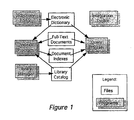
- the method of the present invention has been implemented as 5 computer program modules: the Query Program, the Index Program, the Library Manager, Dictionary Manager, and the Integrator's Toolkit. Each of these are defined below and their relationships are shown in Figure 1.
- the method of the present invention offers Graphical User Interfaces, command line interfaces, and tools to customize the user interface.
- the display shows the title hits in ranked-order and the full text of the documents.
- Documents can be viewed, browsed and printed from the interface.
- the Integrator's Toolkit allows the product to be installed in any interface format.
- the system is an open system. It makes heavy use of "Application Program Interfaces" (APIs), or interfaces that allow it to be integrated, linked or compiled with other systems.
- APIs Application Program Interfaces
- the method of the present invention is the first text search system that uses published dictionaries to build automatically the underlying knowledge base, eliminating the up front cost that an organization must absorb to use other concept based search systems.
- the dictionary gives knowledge needed to process accurately natural language input, making the user interface considerably simpler.
- the algorithms used identify the meaning of each word based upon a process called "spreading activation".
- NLP as used in the present invention improves text retrieval in many ways, including the following:
- the purpose of this method is to identify the specific meaning of each word in the text as identified in a publisher's dictionary. The reason to do this is to increase the precision of the return during document retrieval and browsing.
- This is primarily a semantic "word sense disambiguation” and takes place via a “spreading activation” concept through a “semantic network”.
- the method used disambiguates word senses (identify word meanings) based on "concept collocation”. If a new word sense appears in the text, the likelihood is that it is similar in meaning or domain to recent words in the text Hence, recent syntactically compatible terms are compared through the semantic network (discussed below) by "semantic distance".
- a classic example is that the word “bank” when used in close proximity to "river” has a different meaning from the same word when used in close proximity to "check”.
- the present invention uses a new form of statistical natural language processing that uses only information directly acquirable from a published dictionary and statistical context tests. Words are observed in a local region about the word in question and compared against terms in a "semantic network" that is derived directly from published dictionaries (see discussion below on automatic acquisition.) The resulting statistical test determines the meaning, or reports that it cannot determine the meaning based upon the available context (In this latter case, the method simply indexes over the word itself as in conventional text retrieval, defaulting to keyword or thesaurus processing).
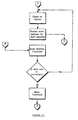
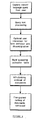
- Figures 2a-d show a detailed breakout of the concept indexing process.
- the process extracts sentences from the text, tags the words within those sentences, looks up words and analyzes morphology, executes a robust syntactic parse, disambiguates word senses and produces the index.
- the first step in the indexing process is to extract sentences or other appropriate lexical units from the text.
- a tokenizer module that matches character strings is used for this task. While most sentences end in periods or other terminal punctuation, sentence extraction is considerably more difficult than looking for the next period. Often, sentences are run on, contain periods with abbreviations creating ambiguities, and sometimes have punctuation within quotes or parenthesis. In addition, there exist non-sentinel strings in text such as lists, figure titles, footnotes, section titles and exhibit labels. Just as not all periods indicate sentence boundaries, so too, not all paragraphs are separated by a blank line.
- the tokenizer algorithm attempts to identify these lexical boundaries by accumulating evidence from a variety of sources, including a) Blank lines, b) Periods, c) Multiple spaces, d) List bullets, e) Uppercase Letters, f) Section numbers, h) Abbreviations, g) Other Punctuation.
- ConQuestTM by Mr. Edwin R. Addison and Mr. Paul E. Nelson is 90.9 percent accurate in retrieving relevant documents. It has the following characteristics:
- the sentence contains 6 periods, but only the last one demarks the end of the sentence. The others are ignored for the following reasons. They follow abbreviations or single capital letters; they are not followed by two spaces; or they are embedded between numbers. Furthermore, the next three sentences are not separated by periods. In the method of the present invention, the list header and each item are considered separate sentences.
- Dictionary lookup the second step in the process requires several subordinate processes (defined in more detail below) which includes a tokenizer, morphological analyzer, proper noun identification, idiom processing and a spell checker.
- the tokenizer applies matching rules to the input sentence to look for multiple word idioms or proper nouns, contractions, special numbers like phone numbers or social security numbers, alphanumeric strings, and the like.
- a dictionary look-up takes place that extracts all ambiguous word senses and idioms.
- morphological analysis routines are activated to find candidate words. These pattern matching rules apply appropriate spelling and feature change rules to dictionary roots for affixes. If a candidate word is still not found, a closed loop spelling corrector is applied. Finally, if there is still no word candidate, proper noun identification, acronym testing or a word category inference algorithm is activated using special rules to identify unknown words. For example, it may be inferred that any string of the form "DD Form WXYZ" where WXYZ is a number is a single token corresponding to a government form.
- This spell check mechanism is "fuzzy” because it is not based on a rigid set of rules like typical soundex mechanisms. Rather, it uses accumulated evidence (in much the same way as the text retrieval engine) to find strong candidate words, which are then ranked by their suitability. This "fuzziness” provides a single integrated mechanism for correcting words with spelling errors, phonetic errors, and Optical Character Recognition (OCR) errors.
- OCR Optical Character Recognition
- the third step is parsing. Once the input sentence has been prepared for parsing, a robust syntactic parser with integrated semantic interpretation is applied.
- the parser is a bottom up chart parser with unification rules. Full sentences will always be attempted in parsing. However, when sentences are ungrammatical or unwieldy, or when the input text string is not a full sentence, the chart parser will produce phrase or fragment parses. Hence, the output of the parser may be a complete sentence parse, a collection of phrase parses with missing attachments, or even an isolated word group. In any case, the parser never fails (100% recovery).
- the fourth step in the processing is to disambiguate word senses not handled by the parser.
- This is a semantic word sense disambiguation and takes place via a spreading activation concept through a semantic network.
- Figure 3 illustrates the concept which is to disambiguate word senses based on "concept collocation". If a new word sense appears in the text, the likelihood is that it is similar in meaning to recent words in the text. Hence, recent syntactically compatible terms are compared through the semantic network by spreading activation or semantic "distance".
- association link An underlying semantic network defined over the word senses is used in this step. Note that only an "association link” types is used (which will be assigned a link strength from 0 to 1, or a fuzzy link strength in a fuzzy logic implementation of the network.)
- tool-1 The spreading activation algorithm will find its relationship and weight to other terms by searching the network from this point. The following (linked) list will be produced.
- the weights are the product of the weights on the arcs that must be traversed to arrive at the listed node: tool-1 1.0 saw 0.7 hammer 0.7 hardware 0.5 computer 0.4 software 0.35 software 0.32 - - removed! code 0.24
- the weights in the list are obtained by multiplying all the link weights along the path from the top word in the list (tool-1) to each word in the list as the process "spreads" in the network. Notice that software was in the list twice, but the lower weight was removed. The second instance of software was arrived at by traversing from tool-1 to hardware to computer to software , rather than directly from hardware to software.
- tool-1 The relationship between tool-1 and software , both significant words in the parse of the sentence, has weight 0.35.
- the relationship between tool-2 and software is 0.5.
- tool-2 relates to bug by weight 0.4.
- the words identify and require (not shown) are both rather distant from senses of tool .
- tool-2 will be selected as the meaning of tool because it relates more strongly to the topic of conversation.
- the fifth and final step in the concept indexing process is to assign index values.
- Each word sense or idiom found in the text is indexed by assigning an appropriate document number to that word sense (word meaning) or idiom.
- a separate file is used to reference the documents themselves and the location of the hits. These two files are the list of unique concepts or tokens, and the index trees.
- the method of the present invention incorporates an index which groups sets of documents hierarchically. Each group of documents is divided into sets of smaller sub-groups, which are further divided until only a single document remains.
- the method of the present invention stores many indicators with each group. Each indicator answers a particular question useful for text retrieval, such as "does any document in this group contain the word 'X'? Besides the mere presence or absence of a word in any document, indicators may hold the count of documents which contain the word, and any other useful information. By first searching over large sets of documents, the most promising sets can be quickly identified for more detailed analysis.
- the hill climbing search algorithm uses the document sets described above to find document using a query from the user. First, the least frequent word sense in the query (as determined by the inverted index) is checked. However, an exhaustive list of documents containing this term is not produced. Rather a list of document sets is produced. This document set list is then checked for the presence of other word senses from the query, selecting only sets with a high presence of appropriate combined concepts. Then sub-sets of documents considered hits are searched similarly, gradually working down a tree data structure to the roots. Backtracking in the search is permitted.
- the method of the present invention can efficiently search for the best matching document, even when the request contains dozens of search terms. The net effect is the nearly instant and accurate response to the user before all the searching is complete.
- One or more publisher's dictionaries may be loaded into a "semantic network", see Figure 4.
- This is a network of word meanings and relationships to other word meanings. With each word meaning or concept, information is stored, such as its part of speech, syntactic features as needed for processing, and links to several other related (not simply synonyms) word meanings.
- these atomic concepts may also be idiomatic phrases, proper names that are more than one word long, or special token categories such as date patterns.
- the novel feature is the ability to quickly and efficiently rebundle the contents of one or more electronic dictionaries for use in text processing, a capability not previously possible because of the reliance on rule-based processing by prior art approaches.
- non-dictionary data may be added to the semantic network, such as almanac data or business names and SIC number listings. This enables the retrieval of information based upon such database entries.
- This network at the meaning of words or concept level may be built by reconciling word meanings against each other from multiple dictionaries and thesaurus data such as Princeton's Word-Net (George Miller of Princeton University, has produced a 60,000 term semantic network of basic English terms).
- a benefit of this method is the ability to add or merge nearly any published dictionary, whether generic or specialized.
- Automatic acquisition methods can be used to build the lexical database semantics and evidential reasoning weights for a new text domain, if additional accuracy is required. This includes methods to assign appropriate weight strengths, identify missing words, identify esoteric uses of words in specialized domains, etc. Most of these operations will be transparent to the user and will be accomplished as new text is indexed, or as a one-time process over a large database sample.
- An on-line machine readable dictionary provides access functions to allow these algorithms to operate.
- Princeton's "Word-Net” a semantic net of English word senses, is used as a machine readable source.
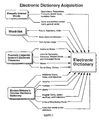
- Figure 5 illustrates the expected resulting dictionary and how it will be acquired.
- the shaded boxes illustrate information which may be obtained by algorithms and tools.
- the outlines and shaded boxes represent automatic acquisition methods.
- the method of the present invention uses a suite of software tools to import publisher dictionaries into the desired data structure format.
- This suite handles many of the aspects and irregularities inherent in natural languages. These tools include but are not limited to the following:
- Text scanning or statistical algorithms operating on large bodies of text may be used to acquire additional dictionary words and semantic network nodes and links.
- These tools include the following:
- the method of the present invention uses its semantic network to "explode” queries into related concepts and then to "paraphrase” the queries into many different ways of saying the same thing.
- Each linguistic variation is used in a statistical search over word meanings in the texts and retrievals are ranked by semantic closeness among other factors.
- These techniques may also be used to "front end" other search systems and databases, by producing alternative ways of requesting information.
- FIG. 6 A block diagram of the query process is shown in Figure 6. Note that the user's natural language query is initially followed by the same NLP processing that was used for concept indexing. However there are some additional processes for the augmentation by synonym word senses of the user's query and term weighting. The last step is a document retrieval for all relevant concepts which are then weighted and ordered by priority.
- the user's query may be a natural language query that consists of a word, phrase or sentence.
- the most effective query contains detailed information, but any natural language query will be accepted. In general, however, the query is expected to be similar in content to the information to be retrieved.
- Step 1 Identify Words, Syntactic Parsing, and Semantic Interpretation
- each phrase is put into different "slots" by syntactic and semantic parsing, to help determine their function.
- the slots give a coarse indication of how important each word is for reducing the number of documents to be retrieved.
- a "weighting factor” (or a "confidence factor”) is attached to each word in the phrase based on the slot to which it was assigned.
- Step 3 Look for Closely Associated Concepts
- Each word in the user's phrase request has one or more meanings, which were determined in semantic interpretation as best as possible. However, if the user's exact request is not in any of the documents, it seems natural to extract information that is closely related. For example, if the user asks for "radar”, it seems reasonable to also retrieve information on "jammers”.
- semantic links identify how concepts are related
- the word “things” causes difficulty because it refers to a very wide range of possible objects, and therefore it does not help reduce the number of documents very much. Because of this problem, word senses have weights which indicate how specific or general they are. These are included into the weighting factors determined so far. Very general concepts, such as “things”, “objects”, and “stuff”, contain a very low weight. Very specific concepts, such as “knee cap” have a much higher weighting factor.
- Step 5 Index into the Concept Indexes
- the word senses in the user's request (along with closely associated concepts) are used as keys into the database of concepts which were built from documents which were stored and indexed.
- Each concept in the index has a list of references associated with it
- Each concept reference points to a particular document, sentence, and phrase.
- Step 6 Weighting by Quantity (AKA Inverse Document Frequency)
- each concept index is stored a quantity of occurrences.
- the weighting factor of each concept is adjusted based on this quantity of occurrences (a large number of occurrences will cause the weight to be reduced because a frequently occurring concept carries less information since it will be in many documents).
- Step 7 Ranking by Proximity
- Documents are further ranked by how close the references occur to each other. For example, if the query is "the red ball”, then we might extract all the references for “red” and all the references for "ball”. Then, if both "red” and “ball” point to the same phrase, then naturally this phrase is a better match than other phrases in the documents.
- Step 8 Adjust Phrase Weights with a Fine-grain match
- the user's noun phrase query and the stored document noun phrase can be compared in detail with a graph matching procedure. This algorithm is described in more detail below. At this point, the top 100 (or other appropriate limit) candidate phrases will be fully ranked, based on their weights. Note that these weights include information all the way from the start of this algorithm and were adjusted as more information became available.
- a user interaction facility will be incorporated within the method of the present invention as proposed for this program.
- This includes a user interaction and a user verification component.
- the user interaction component allows the user to respond to system queries regarding possible ambiguous queries by choosing among word meanings.
- the user verification component is more complex and allows the user to broaden or narrow a search. This component estimates the time required for document retrieval, allows the user to enter a new broader query, or further restrict the current query with an additional natural language delimiter.
- the verification step may not be required in most systems, depending on machine speed and number of simultaneous users.
- the system augments the user's query.
- This augmentation begins with the parsed query, including head words of key phrases and describes associated with those words.
- a weight is assigned to each slot in the query phrase templates based on a generic template type. The weights will be determined empirically.
- the augmentation then takes place by adding closely related word senses extracted via spreading activation from the semantic word sense network.
- the augmented query is then used to reference the concept index and the document reference files.
- a merge join algorithm is used to sort the resulting retrieved texts.
- a weighting is assigned to each close concept in the index based upon the closeness of the word sense in the semantic word sense network, the syntactic position relative to the query, the modifiers used in association with the head word, and a number of heuristic check questions. The weighting factor adjustments will be determined empirically during installation.
- the method of the present invention has a "query by example” feature (also known in the art as relevance feedback) that allows a user to find a document similar to the one being viewed.
- the natural language processing enables this to also be used in routing of news wires, electronic mail, and the like.
- profiles may now be documents or portions thereof, or user written as English descriptions of a few words to a few paragraphs in length.
- the present invention indexes the English profiles as documents. Inbound news or messages are treated as "queries”. Those profiles "retrieved” indicate to whom the items will be sent.
- Context vector means a collection of terms used together in context.
- context vector is a collection of word meanings used together in context, not just a collection of terms.
- the method of the present invention includes the physical ordering of the terms in the original profile into the context vector.
- the context vector, or representation of the query document is matched against the context vector of stored documents via the index. Documents with high enough similar content are chosen to be retrieved.
- the present invention presents two significant advances: First, the "context vector" is at the word meaning level, and second, for routing applications, the end user writes a plain English abstract which is indexed as a "document”, then inbound news wires are treated as queries, reducing the amount of repetitive processing required.
- the method of the present invention has the ability to rank on a multitude of factors simultaneously, including those factors mentioned above combined with several new methods based upon linguistics.
- the main novel feature is the ability to "tune" the ranking based on all these factors and to easily add other factors whenever needed. Different document collections can be ranked on criteria that are optimized to them.
- a concept level "inference network” is used to match the concept sought after to concepts represented in the text.
- This inference network computes a matching score based upon evidence from 6 different sources. More or fewer sources could be used in the same mechanism.
- the importance of the factors used is the inference networks is determined by the statistics of the database being searched. The factors count information based upon word meanings, not just words, and linguistic information, not just statistical, is taken into account.
- Ranking of documents means sequencing the documents returned by a query so that documents which best match the user's query are displayed first.
- the ranking algorithm is the heart of the decision making process and is therefore one of the most important algorithms in any information retrieval system.
- the present invention has a very sophisticated ranking algorithm that uses six criterion for ranking documents based on the terms in the expanded query. These are defined below. Following is a definition of the algorithm to be used for combining these factors.
- the ranking algorithm proceeds as follows. Each query is dissected into "atomic" query fragments. These "fragments” are words for Boolean or statistical queries, but are phrases or even short sentences for natural language queries. For each "fragment”, the "evidence” of each occupancy of that fragment in the document is assessed. Then, the total evidence for the fragment is calculated. Finally, the evidence for the presentation of a document is calculated by combining the fragment evidence. Thus we have a 4-step process.
- Query fragments, Q i are "independent" parts of a query.
- each word or idiom in the query is an independent Q i .
- the entire query is usually a single fragment Q 1 , unless that query is compound (multiple sentences, or use of widely scoped conjunctions, or test items). If it is compound, each Q i is found by heuristic. Query by example will contain many Q i .
- P i j Other factors in P i j include importance factors (word specificity, inverse document frequency and syntactic position) and closeness of match factors (semantic distance, syntactic order). An "untested" one has been proposed, but will not be presented here due to its tentative status.
- the final display is then prepared for the user.
- This display may contain the portion of the retrieved document with the concept "hit" in a window with the relevant text highlighted.
- the title and details of the document may be shown as well.
- the user may offered the options discussed above, which include a new query, a refined query, find the next hit, etc.
- a display of the quality of a query is also available. This is the relative unlikelihood of the query drawing false hits. The more specific the query, the better.
- the user may describe a subject or topic by constructing relationships in a conceptual graph. This subject is then attached to the underlying semantic network. The concept or topic may then be searched for by using it within a plain English query.
- Prior art systems stored references in the indexes to the text databases which were used to build the indexes. These references typically contained the character position, line number, page number, or other textual positioning information.
- the method of the present invention can store arbitrary reference data in the indexes. This allows the present invention to store references any kind of object, such as words in an image (a bitmap representation of a document page), features in a picture, points in a audio presentation, points in a video presentation, etc.
- the high accuracy of search and retrieval of the method of the present invention enables documents to be "browsed" without the need for pre-established hypertext links.
- a user enters or highlights text and the system searches for similar concepts elsewhere in the document as previously described.
- the method of the present invention can be used to automatically create summaries of English documents (called “machine abstracting”). This is done with the following algorithm:
- the present invention may be useful in search and retrieval tasks related to computer databases. It is particularly suited for enhanced precision and recall in textual databases.
Landscapes
- Engineering & Computer Science (AREA)
- Theoretical Computer Science (AREA)
- Physics & Mathematics (AREA)
- General Engineering & Computer Science (AREA)
- General Physics & Mathematics (AREA)
- Databases & Information Systems (AREA)
- Data Mining & Analysis (AREA)
- Computational Linguistics (AREA)
- Artificial Intelligence (AREA)
- Health & Medical Sciences (AREA)
- Audiology, Speech & Language Pathology (AREA)
- General Health & Medical Sciences (AREA)
- Machine Translation (AREA)
Claims (17)
- Verfahren zum automatischen Durchsuchen einer Computerdatenbank, die ein oder mehrere Dokumente enthält, die aus Symbolen bestehen, welche Informationen wiedergeben, die in einer Sprache ausgedrückt sind, welche menschlichen Benutzern verständlich ist, wobei das computerimplementierte Verfahren die Schritte aufweist:(a) Akzeptieren einer Frage, die ein oder mehrere Informationen wiedergebende Symbole aufweist, als Eingabe, wobei die Frage einen oder mehrere Terme aufweist, die jeweils einem Wort, einer Phrase oder einem Satz der Sprache entsprechen, die dem menschlichen Benutzer verständlich ist, und
gekennzeichnet ist durch die weiteren Schritte:(a1) Identifizieren der Terme in der Frage als Wort, Phrase oder Satz;(b) Bestimmen einer oder mehrerer möglicher Bedeutungen für jeden identifizierten Term in der Frage;(c) Identifizieren in bewerteter Reihenfolge einer oder mehrerer der möglichen Bedeutungen in der Datenbank;(d) Identifizieren in bewerteter Reihenfolge von Dokumenten innerhalb der Datenbank, die mindestens eine der möglichen Bedeutungen enthalten, die in dem Schritt (c) identifiziert wurden;(e) Speichern eines Hinweises auf die Identität der identifizierten individuellen Dokumente in dem Speicher eines digitalen Computers. - Verfahren nach Anspruch 1, wobei der Schritt (a) das Eingeben eines Satzes in Englisch oder einer anderen natürlichen menschlichen Sprache aufweist.
- Verfahren nach Anspruch 1, wobei der Schritt (a) das Akzeptieren eines Dokuments aufweist, das aus Symbolen besteht, die Informationen wiedergeben, die in einer Sprache ausgedrückt sind, welche menschlichen Benutzern verständlich ist, wobei das Dokument Informationen enthält, von denen ein Benutzer beabsichtigt, dass sie den Informationen ähnlich sind, die in den identifizierten individuellen Dokumenten enthalten sind.
- Verfahren nach Anspruch 1, wobei der Schritt (a1) weiterhin das Identifizieren eines oder mehrerer Terme als solchen Termen entsprechend umfasst, die in einem oder mehreren Dokumenten innerhalb der Datenbank gefunden werden.
- Verfahren nach Anspruch 1, wobei jeder identifizierte Term mit einer vorgegebenen Liste von Termen verglichen wird, die bei linguistischen Idiomen auftreten, und wobei dann, falls ein Term als in der Liste existierend bestimmt wird, der Term und eine Identifikation des Idioms oder der Idiome, in denen er auftritt, in dem Speicher eines digitalen Computers gespeichert wird.
- Verfahren nach Anspruch 5, wobei der Schritt (b) weiterhin aufweist: Nachschlagen jedes identifizierten Terms in einem maschinenlesbaren Wörterbuch und Erhalten von Informationen von dem Wörterbuch, die mindestens einen der folgenden Punkte aufweisen: Bedeutungen des Terms; die Teile der gesprochenen Sprache jeder solchen Bedeutung; Hinweisdatenstrukturen in ein zugeordnetes semantisches Netzwerk für jede solche Bedeutung; und Informationen über die Verwendung des Terms in linguistischen Idiomen.
- Verfahren nach Anspruch 5, wobei die möglichen Bedeutungen jedes Terms in der Frage ausgewertet werden in Bezug auf ein zugeordnetes Netzwerk von Termbedeutungen, von denen jeder ein Gewichtungswert zugeordnet ist, der eine statistische Bedeutung der Wahrscheinlichkeit der speziellen Bedeutung des Terms bereitstellt.
- Verfahren nach Anspruch 7, wobei das assoziative Netzwerk von Termbedeutungen erhalten wird durch Verarbeiten von maschinenlesbaren Quellen von linguistischen Informationen, wobei diese linguistischen Informationen verwendet werden, um Assoziationsverknüpfungen zwischen Termen zu entwickeln, deren Bedeutungen semantisch verknüpft sind, und um Verknüpfungsstärken zu entwickeln, die die semantische Geschlossenheit der Termbedeutungen anzeigen.
- Verfahren nach Anspruch 1, wobei der Schritt (c) eine Bewertung gemäß mindestens einem der folgenden Kriterien aufweist: inverse Dokumentfrequenz; syntaktische Position; Teil der gesprochenen Sprache; Anwendung eines vorgegebenen Konzeptbaums; Teil der gesprochenen Sprache; vorgegebenes Bewerten; und explizite Auswahl durch einen menschlichen Benutzer.
- Verfahren nach Anspruch 1, wobei der Schritt (d) des Identifizierens von Dokumenten weiterhin die Schritte aufweist:(d1) Identifizieren in bewerteter Reihenfolge von Sätzen von Dokumenten innerhalb der Datenbank, die ein oder mehrere Dokumente enthalten, die mindestens eine der möglichen Bedeutungen enthalten, die in den Schritten (c) identifiziert wurden; und(d2) sukzessives Identifizieren kleinerer Dokumente enthaltender Sätze, bis eine vorgegebene Anzahl von individuellen Dokumenten identifiziert worden ist.
- Verfahren nach Anspruch 1, wobei der Schritt (c) weiterhin den Schritt aufweist:(c1) Identifizieren zusätzlicher möglicher Bedeutungen, die semantisch den möglichen Bedeutungen verwandt sind, die in dem Schritt (c) identifiziert wurden, und weiterhin das Identifizieren in einer bewerteten Reihenfolge von einem oder mehreren Dokumenten, die mindestens eine der möglichen Bedeutungen enthalten, die in dem Schritt (c) oder (c1) identifiziert wurden.
- Verfahren nach Anspruch 1, wobei das eine oder die mehreren Dokumente aus Abschnitten bestehen, wobei die Abschnitte jeweils aus den Symbolen ausgebildet sind, und wobei die Frage weiterhin eine Identifikation von einem oder mehreren Abschnitten eines ausgewählten Dokuments innerhalb der Datenbank umfasst;
wobei der Schritt (d) weiterhin den Schritt des Identifizierens in bewerteter Reihenfolge von einem oder mehreren der Abschnitte aufweist, die mindestens eine mögliche Bedeutung enthalten, die in dem Schritt (c) identifiziert wurde; und
wobei das Verfahren weiterhin den Schritt des Speicherns einer Identifikation der Identitäten der identifizierten individuellen Abschnitte in dem Speicher eines digitalen Computers aufweist. - Verfahren zum automatischen Konstruieren einer Kombination eines assoziativen Netzwerks von Termbedeutungen und eines maschinenlesbaren Wörterbuchs aus einer Mehrzahl von maschinenlesbaren linguistischen Datenbanken geeignet zum Bestimmen von einer oder mehreren möglichen Bedeutungen von identifizierten Termen in einer Frage, wobei jeder Term als ein Wort, eine Phrase oder ein Satz identifiziert wird, gekennzeichnet durch die Schritte:(a) Identifizieren von Kemworten und ihrer zugehörigen Bedeutungen;(b) Identifizieren von Nicht-Kernworten und ihrer zugehörigen Bedeutungen und Identifizieren ihrer Beziehungen zu den Kernworten, die in dem Schritt (a) identifiziert wurden;(c) Identifizieren von beschreibenden Phrasen und Idiomen und ihrer zugeordneten Bedeutungen und Identifizierung ihrer semantischen Beziehungen zu den Kernworten, die in dem Schritt (a) identifiziert wurden;(d) Identifizieren von Verknüpfungsbeziehungen zwischen den Kernworten, Nicht-Kernworten, beschreibenden Phrasen, Idiomen und ihren zugeordneten Bedeutungen, die in den Schritten (a-c) identifiziert wurden;(e) Bestimmen der Verknüpfungsstärken, die die semantische Enge der Bedeutungen für jede Verknüpfungsbeziehung anzeigen, die in dem Schritt (d) identifiziert wurde; und(f) Speichern der Kernworte, Nicht-Kernworte, beschreibenden Phrasen, Idiome, Bedeutungen, Verknüpfungen und Verknüpfungsstärken in dem Speicher eines digitalen Computers.
- Verfahren nach Anspruch 1, wobei der Schritt (b) des Bestimmens der möglichen Bedeutung jedes Terms den Schritt des Durchsuchens einer Datenbank, die diese Terme und weitergehende Informationen, die diesen zugeordnet sind, enthält, und das Zuordnen der weitergehenden Informationen zu der Frage aufweist.
- Verfahren zum automatischen Weiterentwickeln des Inhalts eines Dokuments, das aus Symbolen besteht, welche Informationen wiedergeben, die in einer Sprache ausgedrückt sind, welche menschlichen Benutzern verständlich ist, wobei das Dokument einen oder mehrere Terme enthält, die jeweils einem Wort, einer Phrase oder einem Satz der Sprache entsprechen, die dem menschlichen Benutzer verständlich ist, wobei das computerimplementierte Verfahren die Schritte aufweist:(a) Identifizieren des einen oder der mehreren Terme, die durch ein oder mehrere Symbole innerhalb des Dokuments ausgebildet werden, als Wort, Phrase oder Satz;(b) Bestimmen einer oder mehrerer möglicher Bedeutungen für jeden Term in dem Dokument;(c) Identifizieren in bewerteter Reihenfolge von einer oder mehreren der möglichen Bedeutungen der identifizierten Terme;(d) optionales Identifizieren zusätzlicher möglicher Bedeutungen, die mit den möglichen Bedeutungen in Beziehung stehen, die in dem Schritt (c) identifiziert wurden; und(e) Speichern des Dokuments, der identifizierten möglichen Bedeutungen und der identifizierten zusätzlichen möglichen Bedeutungen in dem Speicher eines digitalen Computers.
- Verfahren nach Anspruch 16, das weiterhin das Wiederholen der Schritte (a) bis (e) für nachfolgende Dokumente umfasst, um eine Datenbank der Dokumente aufzubauen.
- Verfahren nach Anspruch 16, wobei der Schritt (c) des Identifizierens in bewerteter Reihenfolge einer oder mehrerer der möglichen Bedeutungen weiterhin den Schritt aufweist des Bestimmens eines Informationswerts jeder der möglichen Bedeutungen und des Vernachlässigens solcher möglichen Bedeutungen, die einen Informationswert haben, der kleiner als ein vorgegebener Wert ist.
Applications Claiming Priority (2)
| Application Number | Priority Date | Filing Date | Title |
|---|---|---|---|
| US97071892A | 1992-11-04 | 1992-11-04 | |
| US970718 | 1997-11-14 |
Publications (2)
| Publication Number | Publication Date |
|---|---|
| EP0597630A1 EP0597630A1 (de) | 1994-05-18 |
| EP0597630B1 true EP0597630B1 (de) | 2002-07-31 |
Family
ID=25517389
Family Applications (1)
| Application Number | Title | Priority Date | Filing Date |
|---|---|---|---|
| EP93308829A Expired - Lifetime EP0597630B1 (de) | 1992-11-04 | 1993-11-04 | Verfahren, um natursprachliche Abfragen von Textdatenbanken zu lösen |
Country Status (6)
| Country | Link |
|---|---|
| EP (1) | EP0597630B1 (de) |
| AT (1) | ATE221683T1 (de) |
| AU (2) | AU5047893A (de) |
| CA (1) | CA2102325A1 (de) |
| DE (1) | DE69332166D1 (de) |
| IL (1) | IL107482A (de) |
Cited By (32)
| Publication number | Priority date | Publication date | Assignee | Title |
|---|---|---|---|---|
| EP1391817A3 (de) * | 2002-08-21 | 2006-04-19 | Deutsche Telekom AG | Verfahren zum sprachgesteuerten Zugriff auf Informationen unter Berücksichtigung inhaltlicher Beziehungen |
| US7243095B2 (en) | 2000-05-02 | 2007-07-10 | International Business Machines Corporation | Prose feedback in information access system |
| US7343372B2 (en) | 2002-02-22 | 2008-03-11 | International Business Machines Corporation | Direct navigation for information retrieval |
| US7376641B2 (en) | 2000-05-02 | 2008-05-20 | International Business Machines Corporation | Information retrieval from a collection of data |
| US7389230B1 (en) | 2003-04-22 | 2008-06-17 | International Business Machines Corporation | System and method for classification of voice signals |
| US7509313B2 (en) | 2003-08-21 | 2009-03-24 | Idilia Inc. | System and method for processing a query |
| US7567957B2 (en) | 2000-05-18 | 2009-07-28 | Endeca Technologies, Inc. | Hierarchical data-driven search and navigation system and method for information retrieval |
| US7644057B2 (en) | 2001-01-03 | 2010-01-05 | International Business Machines Corporation | System and method for electronic communication management |
| US7756810B2 (en) | 2003-05-06 | 2010-07-13 | International Business Machines Corporation | Software tool for training and testing a knowledge base |
| US7774333B2 (en) | 2003-08-21 | 2010-08-10 | Idia Inc. | System and method for associating queries and documents with contextual advertisements |
| US7856434B2 (en) | 2007-11-12 | 2010-12-21 | Endeca Technologies, Inc. | System and method for filtering rules for manipulating search results in a hierarchical search and navigation system |
| US7912823B2 (en) | 2000-05-18 | 2011-03-22 | Endeca Technologies, Inc. | Hierarchical data-driven navigation system and method for information retrieval |
| US8019752B2 (en) | 2005-11-10 | 2011-09-13 | Endeca Technologies, Inc. | System and method for information retrieval from object collections with complex interrelationships |
| US8290768B1 (en) | 2000-06-21 | 2012-10-16 | International Business Machines Corporation | System and method for determining a set of attributes based on content of communications |
| US20130144863A1 (en) * | 2011-05-25 | 2013-06-06 | Forensic Logic, Inc. | System and Method for Gathering, Restructuring, and Searching Text Data from Several Different Data Sources |
| US8478732B1 (en) | 2000-05-02 | 2013-07-02 | International Business Machines Corporation | Database aliasing in information access system |
| WO2011115768A3 (en) * | 2010-03-16 | 2013-09-12 | Empire Technology Development Llc | Search engine inference based virtual assistance |
| US8594996B2 (en) | 2007-10-17 | 2013-11-26 | Evri Inc. | NLP-based entity recognition and disambiguation |
| US8645372B2 (en) | 2009-10-30 | 2014-02-04 | Evri, Inc. | Keyword-based search engine results using enhanced query strategies |
| US8645125B2 (en) | 2010-03-30 | 2014-02-04 | Evri, Inc. | NLP-based systems and methods for providing quotations |
| US8676802B2 (en) | 2006-11-30 | 2014-03-18 | Oracle Otc Subsidiary Llc | Method and system for information retrieval with clustering |
| US8700604B2 (en) | 2007-10-17 | 2014-04-15 | Evri, Inc. | NLP-based content recommender |
| US8725739B2 (en) | 2010-11-01 | 2014-05-13 | Evri, Inc. | Category-based content recommendation |
| US8751513B2 (en) | 2010-08-31 | 2014-06-10 | Apple Inc. | Indexing and tag generation of content for optimal delivery of invitational content |
| US8838633B2 (en) | 2010-08-11 | 2014-09-16 | Vcvc Iii Llc | NLP-based sentiment analysis |
| US8954469B2 (en) | 2007-03-14 | 2015-02-10 | Vcvciii Llc | Query templates and labeled search tip system, methods, and techniques |
| US9116995B2 (en) | 2011-03-30 | 2015-08-25 | Vcvc Iii Llc | Cluster-based identification of news stories |
| US9378285B2 (en) | 2005-11-16 | 2016-06-28 | Vcvc Iii Llc | Extending keyword searching to syntactically and semantically annotated data |
| US9405848B2 (en) | 2010-09-15 | 2016-08-02 | Vcvc Iii Llc | Recommending mobile device activities |
| US9584665B2 (en) | 2000-06-21 | 2017-02-28 | International Business Machines Corporation | System and method for optimizing timing of responses to customer communications |
| US10152538B2 (en) | 2013-05-06 | 2018-12-11 | Dropbox, Inc. | Suggested search based on a content item |
| US10289667B2 (en) | 2013-11-14 | 2019-05-14 | Elsevier B.V. | Computer-program products and methods for annotating ambiguous terms of electronic text documents |
Families Citing this family (54)
| Publication number | Priority date | Publication date | Assignee | Title |
|---|---|---|---|---|
| US5493677A (en) * | 1994-06-08 | 1996-02-20 | Systems Research & Applications Corporation | Generation, archiving, and retrieval of digital images with evoked suggestion-set captions and natural language interface |
| DE4432632A1 (de) * | 1994-09-14 | 1996-03-21 | Philips Patentverwaltung | System zum Ausgeben von Sprachinformation in Rekation auf eingegebene Sprachsignale |
| US6078914A (en) * | 1996-12-09 | 2000-06-20 | Open Text Corporation | Natural language meta-search system and method |
| GB9713019D0 (en) * | 1997-06-20 | 1997-08-27 | Xerox Corp | Linguistic search system |
| AU6200300A (en) * | 1999-06-24 | 2001-01-09 | Simpli.Com | Search engine interface |
| US6510431B1 (en) | 1999-06-28 | 2003-01-21 | International Business Machines Corporation | Method and system for the routing of requests using an automated classification and profile matching in a networked environment |
| US6816857B1 (en) | 1999-11-01 | 2004-11-09 | Applied Semantics, Inc. | Meaning-based advertising and document relevance determination |
| US7325201B2 (en) | 2000-05-18 | 2008-01-29 | Endeca Technologies, Inc. | System and method for manipulating content in a hierarchical data-driven search and navigation system |
| US7617184B2 (en) | 2000-05-18 | 2009-11-10 | Endeca Technologies, Inc. | Scalable hierarchical data-driven navigation system and method for information retrieval |
| US9699129B1 (en) | 2000-06-21 | 2017-07-04 | International Business Machines Corporation | System and method for increasing email productivity |
| GB2366893B (en) * | 2000-09-08 | 2004-06-16 | Roke Manor Research | Improvements in or relating to word processor systems or the like |
| US7426505B2 (en) | 2001-03-07 | 2008-09-16 | International Business Machines Corporation | Method for identifying word patterns in text |
| GB2375192B (en) * | 2001-04-27 | 2003-04-16 | Premier Systems Technology Ltd | Search engine systems |
| US7283951B2 (en) | 2001-08-14 | 2007-10-16 | Insightful Corporation | Method and system for enhanced data searching |
| US7398201B2 (en) | 2001-08-14 | 2008-07-08 | Evri Inc. | Method and system for enhanced data searching |
| US7526425B2 (en) | 2001-08-14 | 2009-04-28 | Evri Inc. | Method and system for extending keyword searching to syntactically and semantically annotated data |
| US7386442B2 (en) | 2002-07-03 | 2008-06-10 | Word Data Corp. | Code, system and method for representing a natural-language text in a form suitable for text manipulation |
| US7016895B2 (en) | 2002-07-05 | 2006-03-21 | Word Data Corp. | Text-classification system and method |
| US7003516B2 (en) | 2002-07-03 | 2006-02-21 | Word Data Corp. | Text representation and method |
| US7024408B2 (en) | 2002-07-03 | 2006-04-04 | Word Data Corp. | Text-classification code, system and method |
| US7181451B2 (en) * | 2002-07-03 | 2007-02-20 | Word Data Corp. | Processing input text to generate the selectivity value of a word or word group in a library of texts in a field is related to the frequency of occurrence of that word or word group in library |
| US20050038781A1 (en) * | 2002-12-12 | 2005-02-17 | Endeca Technologies, Inc. | Method and system for interpreting multiple-term queries |
| FR2854259B1 (fr) * | 2003-04-28 | 2005-10-21 | France Telecom | Systeme d'aide a la generation de requetes et procede correspondant |
| US20050187913A1 (en) | 2003-05-06 | 2005-08-25 | Yoram Nelken | Web-based customer service interface |
| US20070136251A1 (en) * | 2003-08-21 | 2007-06-14 | Idilia Inc. | System and Method for Processing a Query |
| US7428528B1 (en) | 2004-03-31 | 2008-09-23 | Endeca Technologies, Inc. | Integrated application for manipulating content in a hierarchical data-driven search and navigation system |
| WO2007088254A1 (fr) * | 2006-02-02 | 2007-08-09 | Boris Solinski | Systeme d'information structure, relationnel et incremental |
| US20080086465A1 (en) * | 2006-10-09 | 2008-04-10 | Fontenot Nathan D | Establishing document relevance by semantic network density |
| US8108410B2 (en) | 2006-10-09 | 2012-01-31 | International Business Machines Corporation | Determining veracity of data in a repository using a semantic network |
| AU2013205851B2 (en) * | 2006-12-29 | 2016-05-26 | Thomson Reuters Enterprise Centre Gmbh | Information-retrieval systems, methods, and software with concept-based searching and ranking |
| JP5379696B2 (ja) * | 2006-12-29 | 2013-12-25 | トムソン ルーターズ グローバル リソーシーズ | 概念ベースの検索とランク付けを伴う情報検索のシステム、方法およびソフトウェア |
| US8229730B2 (en) | 2007-08-31 | 2012-07-24 | Microsoft Corporation | Indexing role hierarchies for words in a search index |
| WO2009029923A2 (en) * | 2007-08-31 | 2009-03-05 | Powerset, Inc. | Emphasizing search results according to conceptual meaning |
| US8346756B2 (en) | 2007-08-31 | 2013-01-01 | Microsoft Corporation | Calculating valence of expressions within documents for searching a document index |
| US8229970B2 (en) | 2007-08-31 | 2012-07-24 | Microsoft Corporation | Efficient storage and retrieval of posting lists |
| US8868562B2 (en) | 2007-08-31 | 2014-10-21 | Microsoft Corporation | Identification of semantic relationships within reported speech |
| US8280721B2 (en) | 2007-08-31 | 2012-10-02 | Microsoft Corporation | Efficiently representing word sense probabilities |
| US8209321B2 (en) | 2007-08-31 | 2012-06-26 | Microsoft Corporation | Emphasizing search results according to conceptual meaning |
| US8712758B2 (en) | 2007-08-31 | 2014-04-29 | Microsoft Corporation | Coreference resolution in an ambiguity-sensitive natural language processing system |
| US8463593B2 (en) | 2007-08-31 | 2013-06-11 | Microsoft Corporation | Natural language hypernym weighting for word sense disambiguation |
| US8316036B2 (en) | 2007-08-31 | 2012-11-20 | Microsoft Corporation | Checkpointing iterators during search |
| US9710556B2 (en) | 2010-03-01 | 2017-07-18 | Vcvc Iii Llc | Content recommendation based on collections of entities |
| US8346563B1 (en) * | 2012-04-10 | 2013-01-01 | Artificial Solutions Ltd. | System and methods for delivering advanced natural language interaction applications |
| WO2014003543A1 (en) * | 2012-06-29 | 2014-01-03 | Sopheon N.V. | Method, system and computer program for generating a query representation of a document, and querying a document retrieval system using said query representation |
| JP6972653B2 (ja) * | 2017-05-16 | 2021-11-24 | 富士通株式会社 | 解析プログラム、解析方法および解析装置 |
| JP6435467B1 (ja) * | 2018-03-05 | 2018-12-12 | 株式会社テンクー | 検索システム及び検索システムの動作方法 |
| CN110389965B (zh) * | 2018-11-30 | 2023-03-14 | 上海德拓信息技术股份有限公司 | 一种多维度数据查询及缓存的优化方法 |
| CN111831786A (zh) * | 2020-07-24 | 2020-10-27 | 刘秀萍 | 完善主题词的全文数据库精准高效检索方法 |
| CN115470323B (zh) * | 2022-10-31 | 2023-03-10 | 中建电子商务有限责任公司 | 一种基于分词技术提高建筑行业搜索精度的方法 |
| CN116450582B (zh) * | 2023-03-22 | 2025-09-23 | 中国科学院软件研究所 | 一种基于模式的软件过程证据收集方法 |
| CN117194616A (zh) * | 2023-11-06 | 2023-12-08 | 湖南四方天箭信息科技有限公司 | 一种垂域知识图谱的知识查询方法、装置、计算机设备和存储介质 |
| CN118467680B (zh) * | 2024-07-02 | 2024-11-08 | 暗物智能科技(广州)有限公司 | 一种动态多意图语义理解方法、装置、计算机设备及可读存储介质 |
| CN119358528A (zh) * | 2024-10-28 | 2025-01-24 | 乐山鑫讯科技有限公司 | 基于自然语言处理的erp智能文档管理方法及系统 |
| CN122087089B (zh) * | 2026-04-24 | 2026-07-24 | 华中科技大学同济医学院附属协和医院 | 基于父子节点结构的医疗文档检索增强生成方法及系统 |
Family Cites Families (3)
| Publication number | Priority date | Publication date | Assignee | Title |
|---|---|---|---|---|
| US4849898A (en) * | 1988-05-18 | 1989-07-18 | Management Information Technologies, Inc. | Method and apparatus to identify the relation of meaning between words in text expressions |
| US5056021A (en) * | 1989-06-08 | 1991-10-08 | Carolyn Ausborn | Method and apparatus for abstracting concepts from natural language |
| EP0494573A1 (de) * | 1991-01-08 | 1992-07-15 | International Business Machines Corporation | Verfahren zur automatischen Unterdrückung der Zweideutigkeit von den Verbindungen von Synonymen in einem elektronischen Wörterbuch für ein Natursprachenverarbeitungssystem |
-
1993
- 1993-11-03 IL IL10748293A patent/IL107482A/en not_active IP Right Cessation
- 1993-11-03 CA CA002102325A patent/CA2102325A1/en not_active Abandoned
- 1993-11-04 DE DE69332166T patent/DE69332166D1/de not_active Expired - Lifetime
- 1993-11-04 EP EP93308829A patent/EP0597630B1/de not_active Expired - Lifetime
- 1993-11-04 AT AT93308829T patent/ATE221683T1/de active
- 1993-11-04 AU AU50478/93A patent/AU5047893A/en not_active Abandoned
-
1997
- 1997-05-01 AU AU19984/97A patent/AU1998497A/en not_active Abandoned
Cited By (43)
| Publication number | Priority date | Publication date | Assignee | Title |
|---|---|---|---|---|
| US8645405B2 (en) | 2000-05-02 | 2014-02-04 | International Business Machines Corporation | Natural language expression in response to a query |
| US7376641B2 (en) | 2000-05-02 | 2008-05-20 | International Business Machines Corporation | Information retrieval from a collection of data |
| US8478732B1 (en) | 2000-05-02 | 2013-07-02 | International Business Machines Corporation | Database aliasing in information access system |
| US7702677B2 (en) | 2000-05-02 | 2010-04-20 | International Business Machines Corporation | Information retrieval from a collection of data |
| US7243095B2 (en) | 2000-05-02 | 2007-07-10 | International Business Machines Corporation | Prose feedback in information access system |
| US7912823B2 (en) | 2000-05-18 | 2011-03-22 | Endeca Technologies, Inc. | Hierarchical data-driven navigation system and method for information retrieval |
| US7567957B2 (en) | 2000-05-18 | 2009-07-28 | Endeca Technologies, Inc. | Hierarchical data-driven search and navigation system and method for information retrieval |
| US9584665B2 (en) | 2000-06-21 | 2017-02-28 | International Business Machines Corporation | System and method for optimizing timing of responses to customer communications |
| US8290768B1 (en) | 2000-06-21 | 2012-10-16 | International Business Machines Corporation | System and method for determining a set of attributes based on content of communications |
| US7752159B2 (en) | 2001-01-03 | 2010-07-06 | International Business Machines Corporation | System and method for classifying text |
| US7644057B2 (en) | 2001-01-03 | 2010-01-05 | International Business Machines Corporation | System and method for electronic communication management |
| US7783643B2 (en) | 2002-02-22 | 2010-08-24 | International Business Machines Corporation | Direct navigation for information retrieval |
| US7343372B2 (en) | 2002-02-22 | 2008-03-11 | International Business Machines Corporation | Direct navigation for information retrieval |
| EP1391817A3 (de) * | 2002-08-21 | 2006-04-19 | Deutsche Telekom AG | Verfahren zum sprachgesteuerten Zugriff auf Informationen unter Berücksichtigung inhaltlicher Beziehungen |
| US7389230B1 (en) | 2003-04-22 | 2008-06-17 | International Business Machines Corporation | System and method for classification of voice signals |
| US7756810B2 (en) | 2003-05-06 | 2010-07-13 | International Business Machines Corporation | Software tool for training and testing a knowledge base |
| US8495002B2 (en) | 2003-05-06 | 2013-07-23 | International Business Machines Corporation | Software tool for training and testing a knowledge base |
| CN100580666C (zh) * | 2003-08-21 | 2010-01-13 | 伊迪利亚公司 | 使用消除歧义的查询搜索消除歧义信息的方法和系统 |
| US7509313B2 (en) | 2003-08-21 | 2009-03-24 | Idilia Inc. | System and method for processing a query |
| US7895221B2 (en) | 2003-08-21 | 2011-02-22 | Idilia Inc. | Internet searching using semantic disambiguation and expansion |
| US8024345B2 (en) | 2003-08-21 | 2011-09-20 | Idilia Inc. | System and method for associating queries and documents with contextual advertisements |
| US7774333B2 (en) | 2003-08-21 | 2010-08-10 | Idia Inc. | System and method for associating queries and documents with contextual advertisements |
| US8019752B2 (en) | 2005-11-10 | 2011-09-13 | Endeca Technologies, Inc. | System and method for information retrieval from object collections with complex interrelationships |
| US9378285B2 (en) | 2005-11-16 | 2016-06-28 | Vcvc Iii Llc | Extending keyword searching to syntactically and semantically annotated data |
| US8676802B2 (en) | 2006-11-30 | 2014-03-18 | Oracle Otc Subsidiary Llc | Method and system for information retrieval with clustering |
| US8954469B2 (en) | 2007-03-14 | 2015-02-10 | Vcvciii Llc | Query templates and labeled search tip system, methods, and techniques |
| US8594996B2 (en) | 2007-10-17 | 2013-11-26 | Evri Inc. | NLP-based entity recognition and disambiguation |
| US9471670B2 (en) | 2007-10-17 | 2016-10-18 | Vcvc Iii Llc | NLP-based content recommender |
| US8700604B2 (en) | 2007-10-17 | 2014-04-15 | Evri, Inc. | NLP-based content recommender |
| US7856434B2 (en) | 2007-11-12 | 2010-12-21 | Endeca Technologies, Inc. | System and method for filtering rules for manipulating search results in a hierarchical search and navigation system |
| US8645372B2 (en) | 2009-10-30 | 2014-02-04 | Evri, Inc. | Keyword-based search engine results using enhanced query strategies |
| WO2011115768A3 (en) * | 2010-03-16 | 2013-09-12 | Empire Technology Development Llc | Search engine inference based virtual assistance |
| US10380206B2 (en) | 2010-03-16 | 2019-08-13 | Empire Technology Development Llc | Search engine inference based virtual assistance |
| US8645125B2 (en) | 2010-03-30 | 2014-02-04 | Evri, Inc. | NLP-based systems and methods for providing quotations |
| US9092416B2 (en) | 2010-03-30 | 2015-07-28 | Vcvc Iii Llc | NLP-based systems and methods for providing quotations |
| US8838633B2 (en) | 2010-08-11 | 2014-09-16 | Vcvc Iii Llc | NLP-based sentiment analysis |
| US8751513B2 (en) | 2010-08-31 | 2014-06-10 | Apple Inc. | Indexing and tag generation of content for optimal delivery of invitational content |
| US9405848B2 (en) | 2010-09-15 | 2016-08-02 | Vcvc Iii Llc | Recommending mobile device activities |
| US8725739B2 (en) | 2010-11-01 | 2014-05-13 | Evri, Inc. | Category-based content recommendation |
| US9116995B2 (en) | 2011-03-30 | 2015-08-25 | Vcvc Iii Llc | Cluster-based identification of news stories |
| US20130144863A1 (en) * | 2011-05-25 | 2013-06-06 | Forensic Logic, Inc. | System and Method for Gathering, Restructuring, and Searching Text Data from Several Different Data Sources |
| US10152538B2 (en) | 2013-05-06 | 2018-12-11 | Dropbox, Inc. | Suggested search based on a content item |
| US10289667B2 (en) | 2013-11-14 | 2019-05-14 | Elsevier B.V. | Computer-program products and methods for annotating ambiguous terms of electronic text documents |
Also Published As
| Publication number | Publication date |
|---|---|
| IL107482A (en) | 1998-10-30 |
| DE69332166D1 (de) | 2002-09-05 |
| AU1998497A (en) | 1997-07-03 |
| AU5047893A (en) | 1994-05-19 |
| IL107482A0 (en) | 1994-10-07 |
| CA2102325A1 (en) | 1994-05-05 |
| ATE221683T1 (de) | 2002-08-15 |
| EP0597630A1 (de) | 1994-05-18 |
Similar Documents
| Publication | Publication Date | Title |
|---|---|---|
| EP0597630A1 (de) | Verfahren, um natursprachliche Abfragen von Textdatenbanken zu lösen | |
| US5576954A (en) | Process for determination of text relevancy | |
| CN103136352B (zh) | 基于双层语义分析的全文检索系统 | |
| US7398201B2 (en) | Method and system for enhanced data searching | |
| Anick et al. | The paraphrase search assistant: terminological feedback for iterative information seeking | |
| US7509313B2 (en) | System and method for processing a query | |
| US6286000B1 (en) | Light weight document matcher | |
| US20020188586A1 (en) | Multi-layered semiotic mechanism for answering natural language questions using document retrieval combined with information extraction | |
| US20040117352A1 (en) | System for answering natural language questions | |
| EP0971294A2 (de) | Verfahren und Apparat zum Verarbeiten einer automatischen Suche und Wiederauffindung | |
| WO1997004405A9 (en) | Method and apparatus for automated search and retrieval processing | |
| JPH03172966A (ja) | 類似文書検索装置 | |
| Kruger et al. | DEADLINER: Building a new niche search engine | |
| JP2572314B2 (ja) | キーワード抽出装置 | |
| Croft et al. | TREC-2 routing and ad-hoc retrieval evaluation using the INQUERY system | |
| Roche et al. | AcroDef: A quality measure for discriminating expansions of ambiguous acronyms | |
| Besançon et al. | Concept-based searching and merging for multilingual information retrieval: First experiments at clef 2003 | |
| AU6552399A (en) | Method for resolution of natural-language queries against full-text databases | |
| Kimº et al. | FromTo-CLIR94*: web-based natural language interface for cross-language information retrieval | |
| Daelemans et al. | Part-of-speech tagging for Dutch with MBT, a memory-based tagger generator | |
| Pradhan et al. | Building a foundation system for producing short answers to factual questions | |
| KR20000036487A (ko) | 정보검색기술을 이용한 한영번역 데이터베이스 시스템 | |
| Rinaldi et al. | Answer extraction in technical domains | |
| Croft | The university of Massachusetts TIPSTER project | |
| Tokunaga et al. | Paraphrasing Japanese noun phrases using character-based indexing |
Legal Events
| Date | Code | Title | Description |
|---|---|---|---|
| PUAI | Public reference made under article 153(3) epc to a published international application that has entered the european phase |
Free format text: ORIGINAL CODE: 0009012 |
|
| AK | Designated contracting states |
Kind code of ref document: A1 Designated state(s): AT BE CH DE DK ES FR GB GR IE IT LI LU MC NL PT SE |
|
| 17P | Request for examination filed |
Effective date: 19941104 |
|
| 17Q | First examination report despatched |
Effective date: 19980928 |
|
| GRAG | Despatch of communication of intention to grant |
Free format text: ORIGINAL CODE: EPIDOS AGRA |
|
| RIC1 | Information provided on ipc code assigned before grant |
Free format text: 7G 06F 17/27 A, 7G 06F 17/30 B |
|
| RIC1 | Information provided on ipc code assigned before grant |
Free format text: 7G 06F 17/27 A, 7G 06F 17/30 B |
|
| GRAG | Despatch of communication of intention to grant |
Free format text: ORIGINAL CODE: EPIDOS AGRA |
|
| GRAH | Despatch of communication of intention to grant a patent |
Free format text: ORIGINAL CODE: EPIDOS IGRA |
|
| GRAH | Despatch of communication of intention to grant a patent |
Free format text: ORIGINAL CODE: EPIDOS IGRA |
|
| GRAA | (expected) grant |
Free format text: ORIGINAL CODE: 0009210 |
|
| AK | Designated contracting states |
Kind code of ref document: B1 Designated state(s): AT BE CH DE DK ES FR GB GR IE IT LI LU MC NL PT SE |
|
| PG25 | Lapsed in a contracting state [announced via postgrant information from national office to epo] |
Ref country code: NL Free format text: LAPSE BECAUSE OF FAILURE TO SUBMIT A TRANSLATION OF THE DESCRIPTION OR TO PAY THE FEE WITHIN THE PRESCRIBED TIME-LIMIT Effective date: 20020731 Ref country code: LI Free format text: LAPSE BECAUSE OF FAILURE TO SUBMIT A TRANSLATION OF THE DESCRIPTION OR TO PAY THE FEE WITHIN THE PRESCRIBED TIME-LIMIT Effective date: 20020731 Ref country code: IT Free format text: LAPSE BECAUSE OF FAILURE TO SUBMIT A TRANSLATION OF THE DESCRIPTION OR TO PAY THE FEE WITHIN THE PRESCRIBED TIME-LIMIT;WARNING: LAPSES OF ITALIAN PATENTS WITH EFFECTIVE DATE BEFORE 2007 MAY HAVE OCCURRED AT ANY TIME BEFORE 2007. THE CORRECT EFFECTIVE DATE MAY BE DIFFERENT FROM THE ONE RECORDED. Effective date: 20020731 Ref country code: GR Free format text: LAPSE BECAUSE OF FAILURE TO SUBMIT A TRANSLATION OF THE DESCRIPTION OR TO PAY THE FEE WITHIN THE PRESCRIBED TIME-LIMIT Effective date: 20020731 Ref country code: FR Free format text: LAPSE BECAUSE OF FAILURE TO SUBMIT A TRANSLATION OF THE DESCRIPTION OR TO PAY THE FEE WITHIN THE PRESCRIBED TIME-LIMIT Effective date: 20020731 Ref country code: CH Free format text: LAPSE BECAUSE OF FAILURE TO SUBMIT A TRANSLATION OF THE DESCRIPTION OR TO PAY THE FEE WITHIN THE PRESCRIBED TIME-LIMIT Effective date: 20020731 Ref country code: BE Free format text: LAPSE BECAUSE OF FAILURE TO SUBMIT A TRANSLATION OF THE DESCRIPTION OR TO PAY THE FEE WITHIN THE PRESCRIBED TIME-LIMIT Effective date: 20020731 Ref country code: AT Free format text: LAPSE BECAUSE OF FAILURE TO SUBMIT A TRANSLATION OF THE DESCRIPTION OR TO PAY THE FEE WITHIN THE PRESCRIBED TIME-LIMIT Effective date: 20020731 |
|
| REF | Corresponds to: |
Ref document number: 221683 Country of ref document: AT Date of ref document: 20020815 Kind code of ref document: T |
|
| REG | Reference to a national code |
Ref country code: GB Ref legal event code: FG4D Ref country code: CH Ref legal event code: EP |
|
| REG | Reference to a national code |
Ref country code: IE Ref legal event code: FG4D |
|
| REF | Corresponds to: |
Ref document number: 69332166 Country of ref document: DE Date of ref document: 20020905 |
|
| PG25 | Lapsed in a contracting state [announced via postgrant information from national office to epo] |
Ref country code: SE Free format text: LAPSE BECAUSE OF FAILURE TO SUBMIT A TRANSLATION OF THE DESCRIPTION OR TO PAY THE FEE WITHIN THE PRESCRIBED TIME-LIMIT Effective date: 20021031 Ref country code: DK Free format text: LAPSE BECAUSE OF FAILURE TO SUBMIT A TRANSLATION OF THE DESCRIPTION OR TO PAY THE FEE WITHIN THE PRESCRIBED TIME-LIMIT Effective date: 20021031 |
|
| PG25 | Lapsed in a contracting state [announced via postgrant information from national office to epo] |
Ref country code: DE Free format text: LAPSE BECAUSE OF FAILURE TO SUBMIT A TRANSLATION OF THE DESCRIPTION OR TO PAY THE FEE WITHIN THE PRESCRIBED TIME-LIMIT Effective date: 20021101 |
|
| PG25 | Lapsed in a contracting state [announced via postgrant information from national office to epo] |
Ref country code: LU Free format text: LAPSE BECAUSE OF NON-PAYMENT OF DUE FEES Effective date: 20021104 Ref country code: IE Free format text: LAPSE BECAUSE OF NON-PAYMENT OF DUE FEES Effective date: 20021104 Ref country code: GB Free format text: LAPSE BECAUSE OF NON-PAYMENT OF DUE FEES Effective date: 20021104 |
|
| PG25 | Lapsed in a contracting state [announced via postgrant information from national office to epo] |
Ref country code: PT Free format text: LAPSE BECAUSE OF FAILURE TO SUBMIT A TRANSLATION OF THE DESCRIPTION OR TO PAY THE FEE WITHIN THE PRESCRIBED TIME-LIMIT Effective date: 20021112 |
|
| NLV1 | Nl: lapsed or annulled due to failure to fulfill the requirements of art. 29p and 29m of the patents act | ||
| PG25 | Lapsed in a contracting state [announced via postgrant information from national office to epo] |
Ref country code: ES Free format text: LAPSE BECAUSE OF FAILURE TO SUBMIT A TRANSLATION OF THE DESCRIPTION OR TO PAY THE FEE WITHIN THE PRESCRIBED TIME-LIMIT Effective date: 20030130 |
|
| REG | Reference to a national code |
Ref country code: CH Ref legal event code: PL |
|
| PG25 | Lapsed in a contracting state [announced via postgrant information from national office to epo] |
Ref country code: MC Free format text: LAPSE BECAUSE OF NON-PAYMENT OF DUE FEES Effective date: 20030601 |
|
| PLBE | No opposition filed within time limit |
Free format text: ORIGINAL CODE: 0009261 |
|
| GBPC | Gb: european patent ceased through non-payment of renewal fee | ||
| 26N | No opposition filed |
Effective date: 20030506 |
|
| REG | Reference to a national code |
Ref country code: IE Ref legal event code: MM4A |