EP0599236A1 - Système d'émission-réception d'un signal de télévision avec un traitement ultérieur assisté au récepteur - Google Patents
Système d'émission-réception d'un signal de télévision avec un traitement ultérieur assisté au récepteur Download PDFInfo
- Publication number
- EP0599236A1 EP0599236A1 EP93118712A EP93118712A EP0599236A1 EP 0599236 A1 EP0599236 A1 EP 0599236A1 EP 93118712 A EP93118712 A EP 93118712A EP 93118712 A EP93118712 A EP 93118712A EP 0599236 A1 EP0599236 A1 EP 0599236A1
- Authority
- EP
- European Patent Office
- Prior art keywords
- transmission
- information
- image
- movement
- television signals
- Prior art date
- Legal status (The legal status is an assumption and is not a legal conclusion. Google has not performed a legal analysis and makes no representation as to the accuracy of the status listed.)
- Withdrawn
Links
- 238000012805 post-processing Methods 0.000 title 1
- 230000033001 locomotion Effects 0.000 claims abstract description 27
- 230000005540 biological transmission Effects 0.000 claims abstract description 22
- 239000013598 vector Substances 0.000 claims description 8
- 238000006243 chemical reaction Methods 0.000 claims description 6
- 238000000034 method Methods 0.000 description 5
- 230000000254 damaging effect Effects 0.000 description 2
- 230000000694 effects Effects 0.000 description 2
- 230000000750 progressive effect Effects 0.000 description 2
- 238000001228 spectrum Methods 0.000 description 2
- 230000006835 compression Effects 0.000 description 1
- 238000007906 compression Methods 0.000 description 1
- 230000001419 dependent effect Effects 0.000 description 1
- 238000003780 insertion Methods 0.000 description 1
- 230000037431 insertion Effects 0.000 description 1
- 230000000135 prohibitive effect Effects 0.000 description 1
- 230000008054 signal transmission Effects 0.000 description 1
- 230000005236 sound signal Effects 0.000 description 1
- 230000002123 temporal effect Effects 0.000 description 1
Images

Classifications
-
- H—ELECTRICITY
- H04—ELECTRIC COMMUNICATION TECHNIQUE
- H04N—PICTORIAL COMMUNICATION, e.g. TELEVISION
- H04N7/00—Television systems
- H04N7/01—Conversion of standards, e.g. involving analogue television standards or digital television standards processed at pixel level
- H04N7/0117—Conversion of standards, e.g. involving analogue television standards or digital television standards processed at pixel level involving conversion of the spatial resolution of the incoming video signal
- H04N7/012—Conversion between an interlaced and a progressive signal
-
- H—ELECTRICITY
- H04—ELECTRIC COMMUNICATION TECHNIQUE
- H04N—PICTORIAL COMMUNICATION, e.g. TELEVISION
- H04N7/00—Television systems
- H04N7/015—High-definition television systems
- H04N7/0152—High-definition television systems using spatial or temporal subsampling
-
- H—ELECTRICITY
- H04—ELECTRIC COMMUNICATION TECHNIQUE
- H04N—PICTORIAL COMMUNICATION, e.g. TELEVISION
- H04N7/00—Television systems
- H04N7/08—Systems for the simultaneous or sequential transmission of more than one television signal, e.g. additional information signals, the signals occupying wholly or partially the same frequency band, e.g. by time division
Definitions
- the present invention refers to a transmission and reception system of television signals, in particular of the digital type.
- the aim of the present invention is that of indicating a transmission and reception system of television signals that allows an efficient compensation of the damaging effects of processing techniques of the image due to the movement of the image itself, without for this causing prohibitive costs on the overall costs of the receiver.
- the present invention has as its object a transmission and reception system of television signals, in particular of the digital type; characterised in the fact that it is provided to insert in the channel, in transmission, information on the movement of the image, and the use of such information, by way of the receiver, for improving the characteristics of the image.
- the invention is based on the acknowledgement of the fact that the addition, by the receiver, of a possible up-conversion function, understood for obtaining a progressive scanning, for instance 1250/50/2:1, or a double frequency field, for instance 1250/100/2:1, allows for overcoming well known drawbacks such as interline twitters or dot crawls, in the first case, or large area flicker in the second case.
- the algorithms for realising the up-conversion generally make use of a set of moving vectors; on the other hand the algorithms of compression provided for the digital transmission of a video signal, are based, by the transmission, on a set of vectors in motion, appropriately estimated, and that can be transmitted in a digital form, eventually compressed, as auxiliary information (Digital Assisted TV).
- a movement estimator of efficient abilities that takes into consideration facts such as objects that appear and disappear, scene changes, small objects etc., results in being far more complicated and expensive than is reasonable for a consumer product.
- the up-conversion procedure taking into consideration the performance and the limits of the various types of display, can significantly improve the overall quality of the image from a subjective point of view; whereas on the other hand such procedure requires information being extremely accurate so as to avoid disturbing instead of improving the quality of the system by introducing drawbacks.
- the invention proposes to dedicate a portion of the capacity of the transmission channel for inserting such information, naturally being specifically protected. Even if such capacity can result in being of a few percent, the appropriate use of such information can improve significantly the quality of the reproduced image.
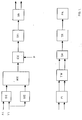
- reference tag Al indicates the audio signal to be transmitted;
- tag V1 indicates the video signal to be transmitted.
- the reference tag SE indicates a coder source; the tag ME indicates a movement estimator; the tag MX indicates a multiplexer that receives information coming from the coder SE and from the movement estimator ME.
- the signal exiting from the multiplexer MX reaches a channel coder CE, which also receives the information P relative to specific channel protection (P).
- the signal exiting from the coder CE then reaches a temporal and frequencial interlacer TFI, and from here to a mapper MA.
- the signals cross a filter FI and a time multiplexer TM, then reaching an analogue/digital coder DA, a converter TR from intermediate frequency to radio frequency, and finally a power amplifier of radio frequency PA.
- the new part of the transmitter according to the invention is represented by the fact that the information coming from the movement estimator ME is inserted in the transmitted television signal.
- the reference tag TU indicates a signal tuner; the tag IF indicates an intermediate frequency amplifier and demodulator; from here the signals reach a time demultiplexer TD; the tag TF indicates the time reference signal.
- the demultiplexed signals then reach, by way of the filter FI, a deinterlacing circuit DE, and successively, by way of a channel decoder CD, a demultiplexer DM.
- the demultiplexed audio, video and motion information signals exiting from the demultiplexer reach an audio decoder SD1, a video decoder SD2, and a movement decoder MD respectively.
- the video signals exiting the decoder SD2 reach an up-converter UC, to which the physical movement vectors also reach, coming from the movement decoder MD.
- the improved signals exiting the converter UC are then sent to the display to then be presented.
- the insertion of information on the movement of an image could also be provided in an analogue television system, with the aim of allowing, by way of the receiver, an assisted processing for the improvement of the characteristics of the image.
Landscapes
- Engineering & Computer Science (AREA)
- Multimedia (AREA)
- Signal Processing (AREA)
- Computer Graphics (AREA)
- Television Systems (AREA)
- Compression Or Coding Systems Of Tv Signals (AREA)
- Two-Way Televisions, Distribution Of Moving Picture Or The Like (AREA)
Applications Claiming Priority (2)
| Application Number | Priority Date | Filing Date | Title |
|---|---|---|---|
| ITTO920953 | 1992-11-25 | ||
| ITTO920953A IT1257918B (it) | 1992-11-25 | 1992-11-25 | Sistema di ricetrasmissione di segnali televisivi con postelaborazioneassistita dal lato ricevente. |
Publications (1)
| Publication Number | Publication Date |
|---|---|
| EP0599236A1 true EP0599236A1 (fr) | 1994-06-01 |
Family
ID=11410878
Family Applications (1)
| Application Number | Title | Priority Date | Filing Date |
|---|---|---|---|
| EP93118712A Withdrawn EP0599236A1 (fr) | 1992-11-25 | 1993-11-22 | Système d'émission-réception d'un signal de télévision avec un traitement ultérieur assisté au récepteur |
Country Status (2)
| Country | Link |
|---|---|
| EP (1) | EP0599236A1 (fr) |
| IT (1) | IT1257918B (fr) |
Citations (2)
| Publication number | Priority date | Publication date | Assignee | Title |
|---|---|---|---|---|
| EP0456995A2 (fr) * | 1990-03-29 | 1991-11-21 | Salora Oy | Méthode d'amélioration d'un signal vidéo |
| EP0475499A1 (fr) * | 1990-09-03 | 1992-03-18 | Koninklijke Philips Electronics N.V. | Conversion de fréquence d'image à compensation de mouvement |
-
1992
- 1992-11-25 IT ITTO920953A patent/IT1257918B/it active IP Right Grant
-
1993
- 1993-11-22 EP EP93118712A patent/EP0599236A1/fr not_active Withdrawn
Patent Citations (2)
| Publication number | Priority date | Publication date | Assignee | Title |
|---|---|---|---|---|
| EP0456995A2 (fr) * | 1990-03-29 | 1991-11-21 | Salora Oy | Méthode d'amélioration d'un signal vidéo |
| EP0475499A1 (fr) * | 1990-09-03 | 1992-03-18 | Koninklijke Philips Electronics N.V. | Conversion de fréquence d'image à compensation de mouvement |
Non-Patent Citations (2)
| Title |
|---|
| FERNANDO ET AL.: "MOTION COMPENSATED DISPLAY FIELD RATE CONVERSION OF BANDWIDTH COMPRESSED HD-MAC PICTURES", PROCEEDINGS OF THE INTERNATIONAL WORSHOP ON HDTV, TURIN, 30 AUGUST - 1 SEPTEMBER 1989, ELSEVIER (AMSTERDAM,NL), pages 643 - 648 * |
| LHUILLIER: "HDTV DIGITAL CODEC BASED ON A FIELD SKIP APPROACH", PROCEEDINGS OF THE INTERNATIONAL WORKSHOP ON HDTV, TURIN, 30 AUGUST - 1 SEPTEMBER 1989, ELSEVIER (AMSTERDAM, NL), pages 731 - 738 * |
Also Published As
| Publication number | Publication date |
|---|---|
| ITTO920953A0 (it) | 1992-11-25 |
| IT1257918B (it) | 1996-02-19 |
| ITTO920953A1 (it) | 1994-05-25 |
Similar Documents
| Publication | Publication Date | Title |
|---|---|---|
| EP0657080B1 (fr) | Desentrelacement a mouvements compenses utilisant un signal d'assistance numeriquement | |
| FI100572B (fi) | Yhteensopiva televisiolähetysjärjestelmä | |
| US4931855A (en) | Method for generating and transmitting high-definition color television signals, compatible with current standards and process and apparatus for receiving said signals | |
| EP0250534B2 (fr) | Compression de la largeur de bande de signaux de television | |
| US5949908A (en) | Method of reducing quantization noise generated during a decoding process of image data and device for decoding image data | |
| US6147712A (en) | Format conversion circuit and television receiver provided therewith and method of converting video signals | |
| US5136380A (en) | Display signal device and method for providing compatibility between ntsc television and hdtv | |
| HU9801730D0 (en) | Preprocessing process and device for motion estimation | |
| US6784917B1 (en) | Digital broadcasting system | |
| CA2107414A1 (fr) | Methode et appareil pour ameliorer le traitement temporel de signaux video utilisant des vecteurs de mouvement transmis avec le signal video | |
| CA2164709A1 (fr) | Methode et appareil de generation de signaux video comprimes | |
| ES2010626A6 (es) | Sistema de television de pantalla ancha y definicion ampliada, en el que se usan varios canales de transmision de senales. | |
| US5014116A (en) | Color television system | |
| US4901149A (en) | Method and apparatus for providing an enhanced television signal | |
| EP0599236A1 (fr) | Système d'émission-réception d'un signal de télévision avec un traitement ultérieur assisté au récepteur | |
| GB2262198A (en) | Video to film conversion | |
| HU9201567D0 (en) | Transmission system | |
| US5115301A (en) | Apparatus for eliminating a motion artifact in a widescreen television signal | |
| Toth et al. | Hierarchical evolution of high definition television | |
| JP2621730B2 (ja) | ワイド画面テレビ信号の送信装置及び受信装置 | |
| EP0641127A2 (fr) | Appareil de transmission de télévision à écran large | |
| EP0580225A2 (fr) | Filtre non-linéaire pondéré pour signaux vidéo avec compensation prenant en compte les corrélations spatiales | |
| KR20010038013A (ko) | 영상신호 송수신방법 및 장치 | |
| JP2989362B2 (ja) | 動き検出回路及び動き検出方法 | |
| JPH03179890A (ja) | テレビジョン受像機 |
Legal Events
| Date | Code | Title | Description |
|---|---|---|---|
| PUAI | Public reference made under article 153(3) epc to a published international application that has entered the european phase |
Free format text: ORIGINAL CODE: 0009012 |
|
| AK | Designated contracting states |
Kind code of ref document: A1 Designated state(s): DE ES FR GB IT NL PT |
|
| 17P | Request for examination filed |
Effective date: 19941125 |
|
| 17Q | First examination report despatched |
Effective date: 19950118 |
|
| STAA | Information on the status of an ep patent application or granted ep patent |
Free format text: STATUS: THE APPLICATION IS DEEMED TO BE WITHDRAWN |
|
| 18D | Application deemed to be withdrawn |
Effective date: 19990601 |