EP0600352B1 - Überspannungsschutzvorrichtung für Fernsehgeräte - Google Patents
Überspannungsschutzvorrichtung für Fernsehgeräte Download PDFInfo
- Publication number
- EP0600352B1 EP0600352B1 EP93118867A EP93118867A EP0600352B1 EP 0600352 B1 EP0600352 B1 EP 0600352B1 EP 93118867 A EP93118867 A EP 93118867A EP 93118867 A EP93118867 A EP 93118867A EP 0600352 B1 EP0600352 B1 EP 0600352B1
- Authority
- EP
- European Patent Office
- Prior art keywords
- voltage
- signal
- generating
- feedback
- winding
- Prior art date
- Legal status (The legal status is an assumption and is not a legal conclusion. Google has not performed a legal analysis and makes no representation as to the accuracy of the status listed.)
- Expired - Lifetime
Links
- 238000004804 winding Methods 0.000 claims description 26
- 239000002131 composite material Substances 0.000 claims description 7
- 230000000977 initiatory effect Effects 0.000 claims description 2
- CLSVJBIHYWPGQY-UHFFFAOYSA-N [3-(2,5-dimethylphenyl)-8-methoxy-2-oxo-1-azaspiro[4.5]dec-3-en-4-yl] ethyl carbonate Chemical compound CCOC(=O)OC1=C(C=2C(=CC=C(C)C=2)C)C(=O)NC11CCC(OC)CC1 CLSVJBIHYWPGQY-UHFFFAOYSA-N 0.000 description 14
- 239000003990 capacitor Substances 0.000 description 10
- 101100365087 Arabidopsis thaliana SCRA gene Proteins 0.000 description 5
- 101150105073 SCR1 gene Proteins 0.000 description 5
- 101100134054 Saccharomyces cerevisiae (strain ATCC 204508 / S288c) NTG1 gene Proteins 0.000 description 5
- 244000145841 kine Species 0.000 description 3
- 238000010586 diagram Methods 0.000 description 2
- 238000000034 method Methods 0.000 description 2
- 230000001105 regulatory effect Effects 0.000 description 2
- 238000000926 separation method Methods 0.000 description 2
- XUIMIQQOPSSXEZ-UHFFFAOYSA-N Silicon Chemical compound [Si] XUIMIQQOPSSXEZ-UHFFFAOYSA-N 0.000 description 1
- 230000003247 decreasing effect Effects 0.000 description 1
- 239000003814 drug Substances 0.000 description 1
- 229940079593 drug Drugs 0.000 description 1
- 229910052710 silicon Inorganic materials 0.000 description 1
- 239000010703 silicon Substances 0.000 description 1
Images

Classifications
-
- H—ELECTRICITY
- H04—ELECTRIC COMMUNICATION TECHNIQUE
- H04N—PICTORIAL COMMUNICATION, e.g. TELEVISION
- H04N3/00—Scanning details of television systems; Combination thereof with generation of supply voltages
- H04N3/10—Scanning details of television systems; Combination thereof with generation of supply voltages by means not exclusively optical-mechanical
- H04N3/16—Scanning details of television systems; Combination thereof with generation of supply voltages by means not exclusively optical-mechanical by deflecting electron beam in cathode-ray tube, e.g. scanning corrections
- H04N3/18—Generation of supply voltages, in combination with electron beam deflecting
- H04N3/19—Arrangements or assemblies in supply circuits for the purpose of withstanding high voltages
-
- H—ELECTRICITY
- H04—ELECTRIC COMMUNICATION TECHNIQUE
- H04N—PICTORIAL COMMUNICATION, e.g. TELEVISION
- H04N3/00—Scanning details of television systems; Combination thereof with generation of supply voltages
- H04N3/10—Scanning details of television systems; Combination thereof with generation of supply voltages by means not exclusively optical-mechanical
- H04N3/16—Scanning details of television systems; Combination thereof with generation of supply voltages by means not exclusively optical-mechanical by deflecting electron beam in cathode-ray tube, e.g. scanning corrections
- H04N3/18—Generation of supply voltages, in combination with electron beam deflecting
- H04N3/185—Maintaining DC voltage constant
Definitions
- This invention relates generally to the field of overvoltage protection systems for television apparatus, and in particular, to an X-radiation protection circuit which enables television apparatus to operate at ultor voltage levels which are closer to the isoexposure curves of cathode ray tubes.
- the isoexposure curve represents X-radiation at a level of 0.5 milliRoentgens per hour (mR/Hr).
- the Y axis is the ultor, or high voltage level designated HV.
- the X axis is beam current (I BEAM ), denoted in milliamps (ma).
- I BEAM beam current
- a maximum beam current level of approximately 2 ma exceeds the safe level defined by the isoexposure curve at approximately 38 KV.
- a television chassis shall not be allowed to drive a picture tube to any HV vs. I BEAM point which exceeds the isoexposure curve. It is also required that these excessive conditions cannot exist even with only one fault in the chassis. This fault can occur in any circuit, including for example the high voltage circuit, the X-ray protection (XRP) circuit and the power supply; or can result from any component value change.
- XRP X-ray protection
- Figure 3 also shows two operating curves.
- the upper curve is designated with tracking high voltage HV and the lower curve is designated without tracking high voltage HV.
- the lower operating curve represents operation without benefit of the invention taught herein.
- the upper operating curve represents operation in accordance with the invention taught herein. Normal operation of the chassis would be at HV vs. I BEAM levels below the isoexposure curve.
- a fourth curve in the graph, between the operating curve(s) and the isoexposure curve is the XRP circuit trip curve, that is, the voltage level at which the XRP circuit disables the television in a manner which prevents generation of X-radiation, for example by shutting down the high voltage power supply.
- Ultor voltage is ordinarily generated in a flyback transformer of a resonant retrace horizontal deflection circuit. Such a circuit might generate 29 KV. Some picture tubes require still higher ultor voltages for proper operation.
- a second resonant retrace circuit having a second flyback transformer can generate a boost voltage, for example 3 KV.
- the appropriate windings of the flyback transformers of the two resonant retrace circuits are coupled in series to generate an ultor voltage which is the sum of the two voltages, 32 KV in this example.
- the XRP circuit is a circuit which detects the value of the kine ultor (HV) voltage and will shut down the HV power supply if the HV reaches a certain voltage. This voltage is determined by the kine X-radiation characteristics.
- HV kine ultor
- a peak detected voltage from the HV transformer is used to indicate the value of HV. This peak detected voltage is not generated by the same winding as the HV, but is on the same transformer and therefore proportional to the HV.
- a HV regulator is used which regulates by inserting a pulse voltage in series with the HV transformer winding which generates HV. Therefore, the high voltage is the peak detected sum of the HV winding voltage and the HV regulator winding voltage.
- the XRP voltage is not proportional to the HV in this configuration, but is proportional only to the portion of the HV that is generated by the HV transformer. If the isoexposure curves are high enough, such as in certain projection televisions, a large pad can be added to compensate for whatever the HV regulator may boost. Most direct view chassis do not have the luxury of sufficient voltage to allow for this pad between the nominal operating HV and the HV where X-radiation is emitted.
- US-A- 5,047,698 discloses a high voltage shutdown circuit having first and second transformer windings that are coupled in series for producing corresponding first and second flyback pulses.
- a first protection circuit disables the generation of each of the pulse voltages when the amplitude of the first pulse voltage becomes excessive.
- a second protection circuit disables the generation of each of the pulse voltages when the amplitude of the second pulse voltage becomes excessive.
- US 4,145,639 discloses a television receiver protection circuit having means for generating first and second deflection voltages.
- An overprotection circuit combines the first and second voltages to produce a fault signal. When the fault signal is present, the overprotection circuit generates a disabling signal.
- the invention is set out in claim 1.
- An overvoltage protection system results in a feedback voltage which is directly proportional to HV when a HV boost regulator is being used.
- the high voltage is therefor closely tracked, which in turn enables the operating curve to be much closer to the isoexposure curve without risking generation of X-radiation or causing frequent interruptions in operation of the television.
- a first resonant retrace circuit is operable for generating a first voltage signal and a second resonant retrace circuit coupled to the first resonant retrace circuit is operable for generating a second voltage signal summed with the first voltage signal.
- An auxiliary winding of a flyback transformer in the first resonant retrace circuit generates a first feedback signal representative of the first voltage signal.
- a regulator senses the summed first and second voltage signals and generates a second feedback signal representative of the summed first and second voltage signals.
- the second resonant retrace means is responsive to the regulator.
- a resistive summing junction combines the first and second feedback signals to generate a composite feedback signal.
- An overvoltage protection circuit is responsive to the composite feedback signal for disabling operation of at least one of the first and second resonant retrace circuits.
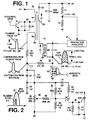
- FIGURE 1 is a schematic diagram of an overvoltage protection system for a television.
- FIGURE 2 is a timing diagram illustrating the relative phase of filament and HVR pulses generated in the circuit of FIGURE 1.
- FIGURE 3 is an isoexposure graph useful for explaining inventive arrangements.
- An overvoltage protection system 10 comprising a circuit for generating an ultor voltage, or high voltage, HV and an X-radiation protection circuit is shown in FIGURE 1.
- a first resonant retrace circuit 20, for implementing horizontal deflection, comprises a source of horizontal drive signals (not shown), a horizontal output transistor Q1, a retrace capacitor C1, a damper diode D1 and a flyback transformer Tr1.
- Transformer Tr1 has a winding W1 connected to transistor Q1, capacitor C1 and diode D1 for generating the B+ voltage.
- a first voltage signal V1 is induced in winding W2, which forms part of the high voltage generating circuit.
- the first voltage signal is approximately 29.5 KV, in accordance with the isoexposure graph shown in FIGURE 3.
- An auxiliary winding W3 generates a filament pulse FP which has an amplitude, or energy level, proportional to the voltage induced in winding W2.
- the filament pulse FP is a first feedback pulse, or signal, which is supplied to summing junction ⁇ 1 through resistor R3.
- a boost voltage circuit 30 comprises a second transformer Tr2, a second transistor Q2 switched by a horizontal drive signal, and a flyback capacitor C3 in parallel with winding W5 of transformer Tr2.
- a second voltage signal V2 is induced in winding W4 of transformer Tr2, which is connected in series with winding W2 and a diode D2, representative of an ultor voltage generating diode set.
- the second voltage signal is approximately 2.5 KV.
- the first and second voltage signals are summed by the series connected windings and develop a high voltage signal HV at capacitor C2.
- Capacitor C2 represents a combination of the kine capacitance and the capacitance of the high voltage splitter.
- a voltage divider formed by resistors R1 and R2 provides a feedback signal to a high voltage regulator 32, which may be embodied as a series pass regulator. The voltage divider provides a reduction factor of approximately 1/300.
- the boost voltage is regulated by having the drain of transistor Q2 switch the resonant circuit formed by winding W5 and capacitor C3 creating the high voltage regulating (HVR) pulse.
- the HVR pulse will range between approximately 50 V peak and 400 V peak, depending upon the operation of the regulator 32.
- the HVR pulse is also supplied to summing junction ⁇ 1 as a second feedback pulse, through resistor R4.
- the filament pulse FP is narrower than the HVR pulse, and will have a lower amplitude under normal conditions.
- the summing junction ⁇ 1 produces a combination feedback pulse having contributions of both inputs to the summing junction. It can be seen that the combination feedback pulse is not symmetric. As shown in FIGURE 2, the filament pulse occurs earlier in time. This results from diode D2 initiating conduction approximately at the trailing edge (right edge in the FIGURE) of the filament pulse.
- an overvoltage protection circuit comprises a voltage sensing circuit 40 and a trip circuit 50.
- the distinction between circuits 40 and 50 is somewhat arbitrary, and made for convenience in description.
- Successive combination feedback pulses are rectified by diode D3 and develop a voltage level across capacitor C5.
- a filter capacitor C4 is in parallel with diode D3.
- Resistors R5, which is adjustable, R6, R7 and R8 determine the bias level at the base of transistor Q3.
- the voltage level is coupled to the emitter of transistor Q3 through Zener diode Z1 and resistor R9, when Zener diode Z1 is biased for reverse conduction. Zener diode Z1 is rated for 10 volts.
- Transistor Q3 will conduct when the emitter to base voltage exceeds approximately 0.7 volts. This will occur when the voltage Vtrip across resistor R7 exceeds approximately 10.7 volts. This can be set rather precisely by adjustment of resistor R5.
- Trip circuit 50 includes a silicon controlled rectifier SCR1, which is normally nonconductive.
- the anode of SCR1 is normally high, in the logic sense. Conduction of transistor Q3 charges capacitor C6. When the voltage across capacitor C6 is high enough, SCR1 will be gated into conduction. The anode of SCR1 will be pulled to ground. The anode of SCR1 therefor provides an ON/OFF signal for X-radiation protection.
- the control signal can be used for disabling the power supply and/or the horizontal deflection circuit and/or the boost circuit and/or as a command signal to a microprocessor, which would in turn disable some or all of the television circuitry to prevent generation of X-radiation.
- Tracking the high voltage and combining the two feedback pulse signals for defining the trip voltage Vtrip each contribute to defining an operating curve which is much closer to the isoexposure curve than would be possible with known circuits, as shown in FIGURE 3, without sacrificing safety.
- the tolerances of only a small number of resistors are important for precise control.
- Resistors R7, R8 and R9 have a 1% tolerance and resistors R3 and R4 have a 2% tolerance. This reduces the cost of the overvoltage protection circuit and contributes to the need for a smaller pad between the operating curve and the isoexposure curve.
Landscapes
- Engineering & Computer Science (AREA)
- Multimedia (AREA)
- Signal Processing (AREA)
- Details Of Television Scanning (AREA)
- Emergency Protection Circuit Devices (AREA)
Claims (7)
- Überspannungs-Schutzvorrichtung für ein Fernsehgerät, enthaltend:gekennzeichnet durch:erste abgestimmte Rücklaufmittel (20) zum Erzeugen eines ersten Spannungssignals (V1),zweite abgestimmte Rücklaufmittel (30), die mit den ersten abgestimmten Rücklaufmitteln (20) verbunden sind und ein zweites Spannungssignal (V2) erzeugen, das zu dem ersten Spannungssignal (V1) addiert wird,Mittel (W3, R3) zum Erzeugen eines ersten Rückkopplungssignals (FP), das das erste Spannungssignal (V1) darstellt, undeine Überspannungs-Schutzschaltung (40, 50) zum Abschalten der ersten und/oder der zweiten abgestimmten Rücklaufmittel (20, 30),Mittel (R4) zum Erzeugen eines zweiten Rückkopplungssignals (HVR), das das addierte erste und zweite Spannungssignal (HV) darstellt,Mittel (Σ1, D3, C5) zum Kombinieren des ersten und des zweiten Rückkopplungssignals zum Erzeugen eines zusammengesetzten Rückkopplungssignals,wobei die Überspannungs-Schutzschaltung (40, 50) auf das zusammengesetzte Rückkopplungssignal anspricht.
- Vorrichtung nach Anspruch 1, wobei:die ersten abgestimmten Rücklaufmittel (20) gekennzeichnet sind durch einen ersten Rücklauftransformator (Tr1) mit einer Primärwicklung (W1), die zwischen einer ersten Quelle einer Betriebsspannung (B+) und einer ersten Schaltanordnung (Q1) liegt, mit einer Sekundärwicklung (W2) zum Erzeugen des ersten Spannungssignals (V1) und mit einer Zusatzwicklung (W3) zum Erzeugen des ersten Rückkopplungssignals (FP), wobei die zweiten abgestimmten Rücklaufmittel (30) gekennzeichnet sind durch einen zweiten Rücklauftransformator (Tr2) mit einer Primärwicklung (W5), die zwischen einer zweiten Quelle einer Betriebsspannung, die die Summe der ersten und der zweiten Spannung (HV) darstellt, und einer zweiten Schaltanordnung (Q2) liegt, und durch eine Sekundärwicklung (W4) zum Erzeugen des zweiten Spannungssignals (V2), die mit der Sekundärwicklung (W2) des ersten Rücklauftransformators (Tr1) verbunden ist, wobei das zweite Rückkopplungssignal (HVR) die Spannung über den zweiten Schaltmitteln (Q2) darstellt.
- Vorrichtung nach Anspruch 1, dadurch gekennzeichnet, daßdie Kombiniermittel einen Widerstands-Summierpunkt (Σ1) enthalten.
- Vorrichtung nach Anspruch 1, dadurch gekennzeichnet, daßdie zweiten abgestimmten Rücklaufmittel (30) einen Rücklauftransformator (Tr2) mit einer Wicklung (W5) enthalten, die zwischen einer Quelle (32) einer Betriebsspannung, die die Summe der ersten und der zweiten Spannung (HV) darstellt, und einer Schaltanordnung (Q2) liegt.
- Vorrichtung nach Anspruch 1, gekennzeichnet durch:einen ersten und einen zweiten Transformator (Tr1, Tr2) je mit jeweils in Reihe geschalteten Wicklungen (W2, W4) zum Erzeugen eines Hochspannungssignals (HV), das durch eine Summe des ersten und des zweiten Spannungssignals (V1, V2) bestimmt ist, die in den jeweiligen Wicklungen (W2, W4) induziert werden, und eine zweite Wicklung (W3) des ersten Transformators (Tr1) zum Erzeugen von ersten Rückkopplungsimpulsen (FP), die das erste Spannungssignal (V1) darstellen.
- Vorrichtung nach Anspruch 1, dadurch gekennzeichnet, daßgekennzeichnet durchdie Mittel (R3, R4, Σ1) zum Kombinieren des ersten und des zweiten Rückkopplungsimpulses (FP, HVR) aufeinanderfolgende zusammengesetzte Rückkopplungsimpulse liefern,Mittel (D3, C5) zum Erzeugen eines kontinuierlichen Signals, das die Amplitude in den zusammengesetzten Rückkopplungsimpulsen anzeigt, undMittel (40, 50) zum Abtasten des kontinuierlichen Signals und zum Erzeugen eines Steuersignals (EIN/AUS) zur Auslösung einer Überspannungs-Schutzschaltung, wenn die Amplitude der zusammengesetzten Rückkopplungsimpulse einen vorbestimmten Wert übersteigt.
- Vorrichtung nach Anspruch 6, wobei das kontinuierliche Signal ein Spannungspegel-Signal ist.
Applications Claiming Priority (2)
| Application Number | Priority Date | Filing Date | Title |
|---|---|---|---|
| US98663592A | 1992-12-01 | 1992-12-01 | |
| US986635 | 1992-12-01 |
Publications (3)
| Publication Number | Publication Date |
|---|---|
| EP0600352A2 EP0600352A2 (de) | 1994-06-08 |
| EP0600352A3 EP0600352A3 (de) | 1995-01-18 |
| EP0600352B1 true EP0600352B1 (de) | 1999-05-12 |
Family
ID=25532610
Family Applications (1)
| Application Number | Title | Priority Date | Filing Date |
|---|---|---|---|
| EP93118867A Expired - Lifetime EP0600352B1 (de) | 1992-12-01 | 1993-11-24 | Überspannungsschutzvorrichtung für Fernsehgeräte |
Country Status (10)
| Country | Link |
|---|---|
| US (1) | US5418705A (de) |
| EP (1) | EP0600352B1 (de) |
| JP (1) | JP3569305B2 (de) |
| KR (1) | KR100311268B1 (de) |
| CN (1) | CN1047050C (de) |
| CA (1) | CA2110002C (de) |
| DE (1) | DE69324892T2 (de) |
| MX (1) | MX9307568A (de) |
| MY (1) | MY111080A (de) |
| SG (1) | SG86969A1 (de) |
Families Citing this family (7)
| Publication number | Priority date | Publication date | Assignee | Title |
|---|---|---|---|---|
| GB9623611D0 (en) * | 1996-11-13 | 1997-01-08 | Rca Thomson Licensing Corp | High voltage regulation by switching retrace capacitors |
| US5982641A (en) * | 1998-08-07 | 1999-11-09 | Thomson Consumer Electronics, Inc. | High-voltage power supply for video display apparatus |
| US6009006A (en) * | 1998-08-07 | 1999-12-28 | Thomson Consumer Electronics, Inc. | Synchronized high voltage generator |
| US6847404B1 (en) | 1998-09-29 | 2005-01-25 | Thomson Licensing S.A. | Video display protection circuit |
| US6252361B1 (en) | 1999-10-15 | 2001-06-26 | Thomson Licensing S.A. | High-voltage power supply disabling circuit for video display |
| DE10243570B3 (de) * | 2002-09-19 | 2004-02-05 | Infineon Technologies Ag | Diodenschaltungsanordnung, z.B. für Netzteile |
| CN103647261B (zh) * | 2013-12-28 | 2016-06-22 | 盖洪儒 | 便携式x射线机专用模块保护器 |
Family Cites Families (14)
| Publication number | Priority date | Publication date | Assignee | Title |
|---|---|---|---|---|
| US3629644A (en) * | 1970-01-15 | 1971-12-21 | Sylvania Electric Prod | High-voltage regulation and protection circuit |
| US3931548A (en) * | 1974-04-26 | 1976-01-06 | Admiral Corporation | Over voltage protection circuit |
| US4126816A (en) * | 1977-05-13 | 1978-11-21 | Rca Corporation | High voltage protection circuit |
| US4145639A (en) * | 1977-10-27 | 1979-03-20 | Rca Corporation | Television receiver protection circuit |
| US4234829A (en) * | 1979-10-01 | 1980-11-18 | Rca Corporation | High voltage disabling circuit for a television receiver |
| US4287535A (en) * | 1979-10-24 | 1981-09-01 | Zenith Radio Corporation | High voltage shutdown circuit with current feedback for cathode ray tube |
| US4335335A (en) * | 1980-02-11 | 1982-06-15 | Rca Corporation | Television receiver high voltage protection circuit |
| US4967121A (en) * | 1987-05-27 | 1990-10-30 | Rca Licensing Corporation | Isolating high voltage transformer for video apparatus |
| GB8805759D0 (en) * | 1988-03-10 | 1988-04-07 | Rca Licensing Corp | Switched-mode power supply with secondary to primary control |
| US4827194A (en) * | 1988-05-06 | 1989-05-02 | Thomson Consumer Electronics, Inc. | Raster size regulating circuit |
| YU47607B (sh) * | 1988-06-16 | 1995-10-24 | Siemens Ag. | Prekidački mrežni deo sa zaštitom radi ograničavanja izlaznog napona |
| US5119262A (en) * | 1988-08-22 | 1992-06-02 | Murata Mfg. Co., Ltd. | High-voltage transformer protection circuit |
| US5047698A (en) * | 1991-03-14 | 1991-09-10 | Thomson Consumer Electronics, Inc. | High voltage shutdown circuit |
| US5111122A (en) * | 1991-05-03 | 1992-05-05 | Thomson Consumer Electronics, Inc. | Video display high voltage protection circuit |
-
1993
- 1993-11-24 EP EP93118867A patent/EP0600352B1/de not_active Expired - Lifetime
- 1993-11-24 SG SG9602449A patent/SG86969A1/en unknown
- 1993-11-24 DE DE69324892T patent/DE69324892T2/de not_active Expired - Fee Related
- 1993-11-25 CA CA002110002A patent/CA2110002C/en not_active Expired - Fee Related
- 1993-11-29 MY MYPI93002518A patent/MY111080A/en unknown
- 1993-11-30 CN CN93112771A patent/CN1047050C/zh not_active Expired - Fee Related
- 1993-11-30 JP JP34106793A patent/JP3569305B2/ja not_active Expired - Lifetime
- 1993-11-30 KR KR1019930025748A patent/KR100311268B1/ko not_active Expired - Fee Related
- 1993-12-01 MX MX9307568A patent/MX9307568A/es not_active IP Right Cessation
-
1994
- 1994-08-30 US US08/309,714 patent/US5418705A/en not_active Expired - Lifetime
Also Published As
| Publication number | Publication date |
|---|---|
| US5418705A (en) | 1995-05-23 |
| JPH0746421A (ja) | 1995-02-14 |
| EP0600352A2 (de) | 1994-06-08 |
| MX9307568A (es) | 1994-06-30 |
| CN1047050C (zh) | 1999-12-01 |
| EP0600352A3 (de) | 1995-01-18 |
| CA2110002A1 (en) | 1994-06-02 |
| DE69324892D1 (de) | 1999-06-17 |
| KR100311268B1 (ko) | 2001-12-15 |
| JP3569305B2 (ja) | 2004-09-22 |
| CA2110002C (en) | 1999-02-02 |
| DE69324892T2 (de) | 1999-09-16 |
| SG86969A1 (en) | 2002-03-19 |
| KR940017707A (ko) | 1994-07-27 |
| CN1092582A (zh) | 1994-09-21 |
| MY111080A (en) | 1999-08-30 |
Similar Documents
| Publication | Publication Date | Title |
|---|---|---|
| US4126816A (en) | High voltage protection circuit | |
| CA1104249A (en) | High voltage protection circuit | |
| EP0600352B1 (de) | Überspannungsschutzvorrichtung für Fernsehgeräte | |
| EP0414184B1 (de) | Hochspannungsregelungsschaltung für Bildröhre | |
| EP0642261B1 (de) | Spannungsregler für die Versorgung der Elektrode einer Kathodenstrahlröhre | |
| US4525739A (en) | Television receiver power supply regulation responding to beam current changes | |
| US6282071B1 (en) | Frequency dependent X-ray protection for a multimedia monitor | |
| EP0520141B1 (de) | Abschalteanordnung für Hochspannung | |
| US4562508A (en) | Regulator fault protection circuit | |
| US5982641A (en) | High-voltage power supply for video display apparatus | |
| GB2239377A (en) | Power regulation during deflection system start up and shut down | |
| CA1292560C (en) | High voltage regulator in a television apparatus | |
| KR0173686B1 (ko) | 텔레비젼 수상기용 전원 및 편향 시스템 | |
| EP0370660B1 (de) | Stromversorgungsschutzschaltung | |
| JP3236319B2 (ja) | エックス線保護回路 | |
| EP0266995B1 (de) | Schutzschaltung gegen Versagen der Ablenkung | |
| JP3120850B2 (ja) | テレビジョン装置の電源 | |
| US5111122A (en) | Video display high voltage protection circuit | |
| EP0434075B1 (de) | Schutzsystem für eine Vertikalablenkspule | |
| HK1003240B (en) | Video apparatus deflection loss protection | |
| JP3201476B2 (ja) | テレビジョン偏向装置 | |
| JP2595030B2 (ja) | ブラウン管保護回路 | |
| JPH07254996A (ja) | 水平偏向回路 |
Legal Events
| Date | Code | Title | Description |
|---|---|---|---|
| PUAI | Public reference made under article 153(3) epc to a published international application that has entered the european phase |
Free format text: ORIGINAL CODE: 0009012 |
|
| AK | Designated contracting states |
Kind code of ref document: A2 Designated state(s): DE GB IT |
|
| PUAL | Search report despatched |
Free format text: ORIGINAL CODE: 0009013 |
|
| AK | Designated contracting states |
Kind code of ref document: A3 Designated state(s): DE GB IT |
|
| 17P | Request for examination filed |
Effective date: 19950617 |
|
| 17Q | First examination report despatched |
Effective date: 19970926 |
|
| GRAG | Despatch of communication of intention to grant |
Free format text: ORIGINAL CODE: EPIDOS AGRA |
|
| GRAG | Despatch of communication of intention to grant |
Free format text: ORIGINAL CODE: EPIDOS AGRA |
|
| GRAH | Despatch of communication of intention to grant a patent |
Free format text: ORIGINAL CODE: EPIDOS IGRA |
|
| GRAH | Despatch of communication of intention to grant a patent |
Free format text: ORIGINAL CODE: EPIDOS IGRA |
|
| GRAA | (expected) grant |
Free format text: ORIGINAL CODE: 0009210 |
|
| AK | Designated contracting states |
Kind code of ref document: B1 Designated state(s): DE GB IT |
|
| REF | Corresponds to: |
Ref document number: 69324892 Country of ref document: DE Date of ref document: 19990617 |
|
| PLBE | No opposition filed within time limit |
Free format text: ORIGINAL CODE: 0009261 |
|
| STAA | Information on the status of an ep patent application or granted ep patent |
Free format text: STATUS: NO OPPOSITION FILED WITHIN TIME LIMIT |
|
| 26N | No opposition filed | ||
| REG | Reference to a national code |
Ref country code: GB Ref legal event code: IF02 |
|
| REG | Reference to a national code |
Ref country code: GB Ref legal event code: 746 Effective date: 20030103 |
|
| PGFP | Annual fee paid to national office [announced via postgrant information from national office to epo] |
Ref country code: DE Payment date: 20081121 Year of fee payment: 16 |
|
| PGFP | Annual fee paid to national office [announced via postgrant information from national office to epo] |
Ref country code: IT Payment date: 20081127 Year of fee payment: 16 |
|
| PGFP | Annual fee paid to national office [announced via postgrant information from national office to epo] |
Ref country code: GB Payment date: 20081028 Year of fee payment: 16 |
|
| GBPC | Gb: european patent ceased through non-payment of renewal fee |
Effective date: 20091124 |
|
| PG25 | Lapsed in a contracting state [announced via postgrant information from national office to epo] |
Ref country code: DE Free format text: LAPSE BECAUSE OF NON-PAYMENT OF DUE FEES Effective date: 20100601 |
|
| PG25 | Lapsed in a contracting state [announced via postgrant information from national office to epo] |
Ref country code: GB Free format text: LAPSE BECAUSE OF NON-PAYMENT OF DUE FEES Effective date: 20091124 |
|
| PG25 | Lapsed in a contracting state [announced via postgrant information from national office to epo] |
Ref country code: IT Free format text: LAPSE BECAUSE OF NON-PAYMENT OF DUE FEES Effective date: 20091124 |