EP0600504B1 - Procédé et dispositif pour codage de parole basés sur des techniques d'analyse par synthèse - Google Patents
Procédé et dispositif pour codage de parole basés sur des techniques d'analyse par synthèse Download PDFInfo
- Publication number
- EP0600504B1 EP0600504B1 EP93119522A EP93119522A EP0600504B1 EP 0600504 B1 EP0600504 B1 EP 0600504B1 EP 93119522 A EP93119522 A EP 93119522A EP 93119522 A EP93119522 A EP 93119522A EP 0600504 B1 EP0600504 B1 EP 0600504B1
- Authority
- EP
- European Patent Office
- Prior art keywords
- index
- contribution
- subframe
- gain
- amplitude
- Prior art date
- Legal status (The legal status is an assumption and is not a legal conclusion. Google has not performed a legal analysis and makes no representation as to the accuracy of the status listed.)
- Expired - Lifetime
Links
Images



Classifications
-
- G—PHYSICS
- G10—MUSICAL INSTRUMENTS; ACOUSTICS
- G10L—SPEECH ANALYSIS TECHNIQUES OR SPEECH SYNTHESIS; SPEECH RECOGNITION; SPEECH OR VOICE PROCESSING TECHNIQUES; SPEECH OR AUDIO CODING OR DECODING
- G10L19/00—Speech or audio signals analysis-synthesis techniques for redundancy reduction, e.g. in vocoders; Coding or decoding of speech or audio signals, using source filter models or psychoacoustic analysis
- G10L19/04—Speech or audio signals analysis-synthesis techniques for redundancy reduction, e.g. in vocoders; Coding or decoding of speech or audio signals, using source filter models or psychoacoustic analysis using predictive techniques
- G10L19/08—Determination or coding of the excitation function; Determination or coding of the long-term prediction parameters
- G10L19/083—Determination or coding of the excitation function; Determination or coding of the long-term prediction parameters the excitation function being an excitation gain
-
- G—PHYSICS
- G10—MUSICAL INSTRUMENTS; ACOUSTICS
- G10L—SPEECH ANALYSIS TECHNIQUES OR SPEECH SYNTHESIS; SPEECH RECOGNITION; SPEECH OR VOICE PROCESSING TECHNIQUES; SPEECH OR AUDIO CODING OR DECODING
- G10L19/00—Speech or audio signals analysis-synthesis techniques for redundancy reduction, e.g. in vocoders; Coding or decoding of speech or audio signals, using source filter models or psychoacoustic analysis
- G10L19/04—Speech or audio signals analysis-synthesis techniques for redundancy reduction, e.g. in vocoders; Coding or decoding of speech or audio signals, using source filter models or psychoacoustic analysis using predictive techniques
- G10L19/08—Determination or coding of the excitation function; Determination or coding of the long-term prediction parameters
- G10L19/12—Determination or coding of the excitation function; Determination or coding of the long-term prediction parameters the excitation function being a code excitation, e.g. in code excited linear prediction [CELP] vocoders
Definitions
- the present invention relates to speech coders, and more particularly it concerns a method of and a device for quantizing excitation gains in speech coders employing analysis-by-synthesis techniques.
- the excitation signal for the synthesis filter simulating the speech production apparatus is chosen within a set of excitation signals so as to minimize a perceptually meaningful measure of distortion.
- excitation signals can be for example regularly spaced pulses (regular pulse excitation coding or RPE), pulses spaced in a non uniform way (multipulse excitation coding or MPE), vectors or words made up of a certain number of samples (e.g. codebook excitation coding or CELP), etc.
- Each excitation signal comprises a "shape" contribution (possible configurations of pulse positions in the case of regular pulse excitation or multipulse excitation, codebook vectors or words in case of CELP) and an amplitude contribution (amplitude of the individual pulses in the case of regular pulse excitation or multipulse excitation, gain or scale factor for CELP).
- Information relevant to pulse signs can be included in one of the two contributions or in both or also kept separate, depending on the specific case.
- the two contributions will respectively be called “innovation” and “gain” and information on pulse signs will be comprised in the innovation, so that gain will be an absolute value.
- Information relevant to the two contributions are quantized separately during coding; during decoding, this information allows reconstructing the optimum excitation signal, which is filtered in a synthesis filter, corresponding to that utilized in the coder, in order to give the reconstructed signal.
- Synthesis filter includes a short-term filter, which inserts features linked to the signal spectral envelope, and may include a long- term filter, which inserts features linked to the fine signal spectral structure.
- synthesis filter parameters must be updated periodically.
- the validity period commonly called frame, varies typically from a few milliseconds to a few tens of milliseconds (e.g. 2 - 30 ms).
- Each frame comprises therefore a number of samples which, when the sampling rate is equal to 8 kHz, varies from about ten to 1 - 2 hundreds.
- it is not possible to use only one excitation signal for representing the whole frame since this would require the use of relatively long pulse sequences, words or vectors, making too heavy or even unbearable the computational burden necessary to detect the optimum excitation.
- Each frame is then divided into a certain number of subframes and for each of them an optimum excitation is determined. Typical lengths for the subframes are 16 - 40 samples.
- a lower number of bits remains therefore available for coding other information: considering that analysis-by-synthesis coders are mostly used in applications with a relatively low bit rate, the remaining availability can be insufficient to obtain a good quality coded signal, cancelling the advantages deriving from the quantization at each subframe.
- a first method is vector quantization, which, as it is well-known, is a particularly efficient technique for quantization of correlated or generally non-independent parameters. This method is however scarcely adopted since vector quantization is very sensitive to transmission errors and its use would also imply the adoption of sophisticated error protection techniques, making therefore the coder more complicated.
- the aim of the invention is to supply a method and a device for gain quantization allowing both availability at the coder of the quantized values relevant to each subframe, so as to keep account of quantization effects during optimum excitation search in a subframe and computation of initial conditions at the passage from a subframe to the next, and an efficient exploitation of correlations between adjacent subframe gains, with a consequent reduction of the coding bit number.
- the amplitude contribution of the excitation signal is quantized at each subframe determining a gain index i(g); the maximum value i(gmax) taken in a frame by the gain index i(g) is determined; a normalized index i(gnor) relevant to each subframe is calculated as the difference between maximum index i(gmax) and subframe gain index i(g); and the maximum index i(gmax) and the set of normalized indexes i(gnor) are coded and transmitted, in order to represent amplitude contributions relevant to a frame.
- the gain index i(g) of each subframe is reconstructed starting from the maximum index in the frame i(gmax) and from the normalized index i(gnor) relevant to the subframe.
- gains are quantized at each subframe, even if the relevant index is not transmitted, so that the quantized value is available and it can therefore be used, as in the case of scalar quantization at each subframe; moreover, information is transmitted in a differential (or normalized) form on the indexes and not on the values, thus permitting a reduction of the quantity of information to be transmitted, as in EP-A-0 396 211, and the use of only one quantization codebook.
- the invention supplies also a device for carrying out the method, comprising, at the transmission side:
- the invention also concerns a method for coding speech signals employing analysis-by-synthesis techniques, where the excitation gains are quantized with the above mentioned quantization method, and a speech coder including the above mentioned device for quantizing excitation gains.
- the transmitter of a CELP coding system can be outlined by:
- the innovation codebook also contains a null word, which is used under certain conditions which will be described later and which is not taken into consideration during the optimum word search, and that the gains are quantized gains, so that the effects of quantization can be taken into account in determining the optimum word and in calculating the synthesis filter initial conditions at each subframe.
- This information is normally represented by indexes or set of indexes allowing identifying the quantized value of each quantity in a relevant codebook of quantized values provided at the receiver.
- indexes i(s) of the words relevant to individual subframes are supplied to CD at the end of the frame, since only at this moment it can be checked whether the conditions exist for the choice of the null excitation word, as it will be explained further on.
- Gain quantization is carried out in a circuit IT, connected between block EL and coding circuit CD, to be described with reference to Fig. 3.
- the receiver comprises: a decoder DC, performing operations complementary to those of the circuit CD; a first read-only memory VI2, a multiplier M2 and a synthesis filter FS2, identical to the transmitter units VI1, M1, FS1; a second read-only memory VG which contains the quantized gain codebook.
- Information coming from the transmitter suitably decoded in DC, allows selecting in VI2 and VG, at each subframe, the word s and(n) and the gain g and(n) corresponding to those chosen during the coding stage, and updating the parameters of filter FS2.
- the reconstructed signal x and(n) possibly converted into analogue form, is supplied to the utilization devices.
- Ng Nm+Nn-1
- Each of these values is associated with an index i(g) which is not transmitted but which is supplied to IT.
- index i(gmax) and indexes i[gnor(k)] of the different subframes will be transmitted; these indexes will be given preset values when certain conditions occur, as explained further on.
- the normalized index i(gnor) has clearly a dynamics between 0 and a certain positive value.
- the maximum positive value (which indicates a very low gain in the concerned subframe) is limited to a suitable value, selected so that the probability of exceeding it is reasonably low. Should it be exceeded, the maximum admissible value for the index i(gnor) could be transmitted, and this corresponds to the amplification of the transmitted signal portion.
- the subframe it is however preferred to consider the subframe as silence and transmit the index i(s) corresponding to the null innovation word, since the distortion (subjective or objective) introduced by silencing a certain signal portion is lower than that due to an excessive amplification. Even if the index i(gnor) for this subframe does not bear any information, it is in any case preferred to transmit it with value Nn-1 because this reduces the distortion in case of errors introduced by the channel on the index i(s).
- the null word is not tested in the course of the optimum excitation search, and it is therefore convenient that it should be the first or the last word in the codebook contained in VI1. It is obvious that the number of words must be sufficiently high to make negligible the performance loss inherent in the renunciation to one of them. This is already obtained, for example, by a codebook with 64 words, and this is in practice a small codebook enabling to obtain a good quality.
- the value i(gmax) is set to Nn.
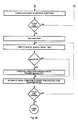
- the different innovation words are then tested, their gains g(j,k) are calculated and the quantized values of these gains are determined, thus obtaining indexes i[g(j,k)].
- the energy of the weighted error is calculated and indexes i(s), i(g) of the pair innovation word-gain giving the minimum energy are stored.
- i(gmax) is updated if i[g(1)] > Nn.
- the initial conditions of the filters in FS1 (Fig.1) are calculated and then the described operations are repeated for the other subframes.
- the index i(gnor) for each subframe is calculated and for each value the comparison with Nn-1 is carried out, causing transmission of index i(s) corresponding to the null innovation word for the subframes where i(gnor)>Nn-1.
- index i(gmax) does not appear in the flow chart.
- the check is implicit in the initialization of i(gmax) to the value Nn before the search for the optimum excitation, since in this way this value will be issued as a value of i(gmax) if no indexes i(g) > Nn exist in the frame.
- Fig. 3 contains the diagram of a possible realization of block IT.
- This comprises a quantization circuit QU, quantizing, e.g. according to a logarithmic law, the gain values g determined by EL (Fig. 1) for each innovation word and present on a connection 1.
- QU supplies quantized values g and to M1 (connection 4) and also generates indexes i(g) which represent the quantized values.
- the index i(g) present at that instant at the output of QU is loaded in a buffer MT.
- the index i(g) present in MT (indicating the optimum gain for the specific subframe) is loaded, upon command of signal CK1 which has a period equal to that of a subframe, into the proper cell of a register R1, having as many cells as the subframes in a frame.
- This index is also loaded, upon command of the same signal CK1, into a comparison logic network CFR, which is able to recognize and to store into an internal register the maximum among the indexes received.
- the minimum value Nn admissible for i(gmax) will have been loaded before the beginning of the frame, so as to effect the above mentioned check.
- the value i(gmax) in the register of CFR (which as said before is one of the indexes i(g) or value Nn) is supplied by means of a connection 2a to the positive input of an adder S3 and transferred to index coding circuit CD. Reading of i(gmax) takes place upon command of a signal CK2, emitted after loading index i(g) relevant to the last subframe in a frame.
- Adder S3 receives in sequence from register R1 the values of indexes i(g) of the current frame by means of multiplexer MX controlled by a signal CK3, and subtracts each of them from i(gmax) giving the normalized values i[gnor(k)].
- a comparator CM compares indexes i(gnor) with a second threshold Nn-1 and at each comparison sends to circuit CD, via an output connection 2b, the value i(gnor), if it is less than or equal to Nn-1, otherwise it emits value Nn-1; CM also emits a signal indicating the result of the comparison, sent to EL by means of connection 3 to cause EL to send to CD the index corresponding to the null word when i(gnor) > Nn- 1.
- the aim of the invention is to allow a good efficiency of the gain coding, taking into account, with a high probability, the gain quantization effects in the optimum excitation search and in the computation of the synthesis filter initial conditions.
- the first aspect also implies that the total number Ng of quantization levels is rather limited.
- the gain codebook can be a logarithmic codebook, so that the ratio between two consecutive values is a constant. To design the codebook it is necessary to take into account several requirements:
- the described method actually eliminates the drawbacks of the known technique.
- quantized gain values are in any case calculated at each subframe and they can therefore be used in the search for the optimum word for individual subframes: in this way, except for the case of silencing, the optimization of the innovation word is improved since it takes into account quantization effects. The same effect is taken into consideration for initializing the filters at each subframe. In this way the distortion introduced will be reduced if compared to the case in which quantization effects are not taken into consideration.
- null innovation word could be decided beforehand (i.e. outside the analysis-by-synthesis loop) in order to represent with a perfect silence signal portions the energy of which is below a certain threshold or more generally signal portions for which such representation is deemed to be suitable from the perceptual standpoint (idle channel noise).
- This solution offers some advantages with respect to having the silencing carried out at the decoder since, in this way, the decoder is not bound to reconstruct the whole frame before effecting the silencing (to be assessed considering at least a complete frame) and it can immediately reproduce any subframe, as soon as it has the necessary information available, thus reducing the overall communication delay.
- the invention can be applied to the quantization of the excitation gain in any analysis-by-synthesis coder.
- gains can have a positive or a negative sign.
- the invention however concerns absolute value quantization: information about the sign, if necessary, will be supplied to CD by EL (Fig. 1) and transmitted through a special bit.
- the invention can be applied to coders where the innovation is supplied by different branches (with their respective gains), such as the coders described by I.A. Gerson and M.A. Iasuk in the paper "Vector Sum Excited Linear Prediction (VSELP) Speech Coding at 8 kbp/s” presented at International Conference on Acoustics, Speech and Signal Processing (ICASSP 90), Albuquerque (US), 3-6 April 1990, or by R. Drogo De Iacovo and D. Sereno in the paper "Embedded CELP coding for variable bit rate between 6,4 and 9,6 kbits/s” presented at International Conference on Acoustics, Speech and Signal Processing (ICASSP 91), Toronto (Canada), 14-17 May 1991.
- the gain quantization method remains as described.
- the normalized index is represented by the difference between gain index i(g) determined for the preceding branch in the same subframe and that of the branch being considered, and only the normalized index is transmitted.
- i(gnor) The dynamics of i(gnor) must be limited also for these branches, considering that i(gnor) can be positive or negative: more particularly, if i(gnor) is positive and exceeds a certain threshold, innovation will be silenced as before; if i(gnor) is too much negative, it is clipped to a preset value, e.g. -2, -1 or even 0, so that the innovation component supplied by that branch has a limited amplitude.
- the limits are obviously chosen so as to have low probabilities both of silencing and of clipping.
- the advantage as compared to the normalization with respect to i(gmax) also for the branches following the first one is twofold:
Landscapes
- Engineering & Computer Science (AREA)
- Computational Linguistics (AREA)
- Signal Processing (AREA)
- Health & Medical Sciences (AREA)
- Audiology, Speech & Language Pathology (AREA)
- Human Computer Interaction (AREA)
- Physics & Mathematics (AREA)
- Acoustics & Sound (AREA)
- Multimedia (AREA)
- Compression, Expansion, Code Conversion, And Decoders (AREA)
- Transmission Systems Not Characterized By The Medium Used For Transmission (AREA)
- Compression Or Coding Systems Of Tv Signals (AREA)
Claims (19)
- Procédé pour quantifier l'amplitude de l'excitation dans des codeurs de la parole basés sur des techniques d'analyse par synthèse, où des échantillons du signal de parole à coder sont organisés en trames dont chacune comprend une pluralité de sous-trames adjacentes pour chacune desquelles on doit déterminer un signal d'excitation optimal en minimisant une mesure de distorsion significative du point de vue perceptif, ledit signal d'excitation comprenant une première contribution, représentative d'une forme du signal, et une seconde contribution, représentative d'une amplitude du signal, les deux contributions étant choisies dans des ensembles respectifs à l'intérieur desquels chaque contribution possible est identifiée respectivement par un indice d'innovation i[s(j)] et un indice de gain i[g(j)], caractérisé en ce que, pendant le codage, on quantifie la contribution d'amplitude du signal d'excitation pour chaque sous-trame en déterminant un indice de gain correspondant i(g); on détermine la valeur maximum i(gmax) de l'indice de gain i(g) dans une trame; on calcule un indice normalisé i(gnor) relatif à chaque sous-trame comme différence entre l'indice maximum i(gmax) et l'indice de gain i(g) de la sous-trame; on code et on transmet, pour représenter les contributions d'amplitude relatives à une trame, l'indice maximum i(gmax) et l'ensemble des indices normalisés i(gnor); et en ce que, pendant le décodage, on reconstitue l'indice de gain i(g) de chaque sous-trame à partir de l'indice maximum dans la trame i(gmax) et de l'indice normalisé i(gnor) relatif à la sous-trame.
- Procédé selon la revendication 1, caractérisé en ce que ledit indice maximum et tous les indices normalisés identifient des valeurs quantifiées de l'amplitude à l'intérieur d'un même ensemble.
- Procédé selon la revendication 2, caractérisé en ce que, dans le cas où l'indice maximum dans une trame i(gmax) identifie une valeur quantifiée d'amplitude inférieure à un premier seuil, on utilise pour la détermination des indices normalisés i(gnor), on code et on transmet l'indice de gain associé audit premier seuil au lieu de l'indice maximum.
- Procédé selon les revendications 2 ou 3, caractérisé en ce que l'ensemble des contributions de forme comprend aussi une contribution nulle, et en ce que, lorsque l'indice normalisé i(gnor) dans une sous-trame identifie une valeur quantifiée d'amplitude supérieure à un second seuil, on transmet l'information relative au moyen de l'indice d'innovation correspondant à la contribution de forme nulle, de manière à réduire au silence l'excitation pour cette sous-trame.
- Procédé selon la revendication 4, caractérisé en ce qu'on code et on transmet, comme indice normalisé, l'indice associé audit second seuil.
- Procédé selon l'une quelconque des revendications précédentes, caractérisé en ce que le signal d'excitation pour une sous-trame est obtenu comme combinaison d'excitations choisies dans des sous-ensembles distincts, comprenant un sous-ensemble principal et un ou plusieurs sous-ensembles secondaires, et en ce que, pour le sous-ensemble principal, la contribution d'amplitude est quantifiée en utilisant ledit indice maximum et lesdits indices normalisés, et en ce que pour le sous-ensemble ou chaque sous-ensemble secondaire, on quantifie la contribution d'amplitude uniquement à l'aide d'un groupe d'indices différentiels, un pour chaque sous-trame, chaque indice différentiel relatif au sous-ensemble ou à un sous-ensemble secondaire étant obtenu en soustrayant l'indice de gain relatif au sous-ensemble secondaire actuel de celui déterminé pour la même sous-trame pour le sous-ensemble secondaire précédent ou pour le sous-ensemble principal, dans le cas du premier sous-ensemble secondaire ou d'un unique sous-ensemble secondaire.
- Procédé selon la revendication 6, caractérisé en ce que, dans le cas où un indice différentiel est supérieur à une première valeur positive préétablie, on réduit la correspondante contribution de forme de l'excitation au silence, et dans le cas où ledit indice différentiel est inférieur à une seconde valeur préétablie, on lui attribue une valeur non inférieure à la seconde valeur préétablie.
- Procédé selon l'une quelconque des revendications précédentes, caractérisé en ce que la contribution d'amplitude est quantifiée selon une loi de quantification logarithmique.
- Procédé selon l'une quelconque des revendications précédentes, caractérisé en ce qu'on réduit l'excitation au silence pour au moins une trame, en transmettant, pour toutes les sous-trames, l'indice d'innovation correspondant à la contribution de forme nulle, chaque fois que les caractéristiques du signal à coder sont telles qu'elles rendent avantageuse, d'un point de vue perceptif, la reproduction du signal avec une période de silence.
- Procédé selon la revendication 9 si elle se réfère aux revendications 4 et 5, caractérisé en ce qu'on transmet, comme indices i(gmax) et i(gnor), les valeurs correspondant auxdits premier et second seuil.
- Dispositif pour quantifier l'amplitude de l'excitation dans des codeurs de la parole basés sur des techniques d'analyse par synthèse, où des échantillons du signal de parole à coder sont organisés en trames dont chacune comprend une pluralité de sous-trames adjacentes pour chacune desquelles on détermine un signal d'excitation optimal en minimisant une mesure de distorsion significative du point de vue perceptif, ledit signal d'excitation comprenant une première contribution, représentative de la forme du signal, et une seconde contribution, représentative de l'amplitude du signal, les deux contributions étant choisies dans des ensembles respectifs à l'intérieur desquels chaque contribution possible est identifiée respectivement par un indice d'innovation i[s(j)] et un indice de gain i[g(j)], caractérisé en ce que le dispositif comprend, du côté transmission:et en ce que le dispositif comprend, du côté réception, des moyens (S2) pour reconstruire un indice de gain i(g) pour chaque sous-trame à partir de l'indice maximum et des indices normalisés, décodés dans un circuit de décodage (DC), et fournir cet indice de gain i(g) comme adresse de lecture à une mémoire (VG), contenant l'ensemble des valeurs quantifiées de l'amplitude.des moyens (QU) pour quantifier des valeurs de la contribution d'amplitude déterminées par une unité (EL) de minimisation de la distorsion pour chaque contribution de forme possible, les moyens de quantification (QU) fournissant des valeurs quantifiées de l'amplitude et des indices de gain représentatifs de ces valeurs;un réseau logique de comparaison (CFR) qui reçoit des moyens de quantification, à chaque sous-trame, l'indice de gain i(g) qui identifie la contribution d'amplitude optimale pour cette sous-trame et qui est capable de reconnaítre et de fournir à un circuit (CD) de codage des indices, à la fin d'une trame, l'indice maximum i(gmax) parmi les indices de gain reçus;des moyens (R1) pour mémoriser temporairement tous les indices de gain i(g) relatifs à une trame; etdes moyens (S3) pour calculer un ensemble d'indices normalisés i(gnor), un pour chaque sous-trame, ces moyens recevant du réseau logique de comparaison (CFR) l'indice maximum et des moyens de mémorisation (R1) les indices de gain mémorisés, et calculant ledit ensemble d'indices normalisés comme différence entre l'indice maximum i(gmax) et chaque indice de gain i(g) mémorisé dans lesdits moyens de mémorisation, les indices normalisés étant fournis au circuit (CD) de codage des indices;
- Dispositif selon la revendication 11, caractérisé en ce que ledit circuit de quantification (QU) quantifie les valeurs de la contribution d'amplitude selon une échelle logarithmique.
- Dispositif selon la revendication 11 ou 12, caractérisé en ce que ledit réseau logique de comparaison (CFR) mémorise, au début de chaque trame, une valeur initiale pour l'indice maximum i(gmax), cette valeur initiale étant une première valeur de seuil qui représente la valeur minimum admise pour l'indice maximum i(gmax).
- Dispositif selon la revendication 11, caractérisé en ce que les moyens (S3) pour calculer les indices normalisés foumissent lesdits indices normalisés à des moyens de comparaison (CM) qui comparent chaque indice normalisé à une seconde valeur de seuil et foumissent en sortie, à chaque comparaison, soit l'indice normalisé soit la seconde valeur de seuil, selon lequel des deux est le plus grand.
- Dispositif selon la revendication 14, caractérisé en ce que les moyens de comparaison (CM), chaque fois qu'un indice normalisé dépasse ladite seconde valeur de seuil, signalent ce dépassement aussi à l'unité de minimisation (EL), pour réduire au silence la contribution de forme correspondante du signal d'excitation en transmettant l'indice d'innovation correspondant à une contribution de forme nulle.
- Procédé pour le codage du signal de parole à l'aide de techniques d'analyse par synthèse, où des échantillons du signal de parole à coder sont organisés en trames dont chacune comprend une pluralité de sous-trames adjacentes pour chacune desquelles on doit déterminer un signal d'excitation optimal en minimisant une mesure de distorsion significative du point de vue perceptif, ledit signal d'excitation comprenant une première contribution, représentative de la forme du signal, et une seconde contribution, représentative de l'amplitude du signal, choisies dans des ensembles respectifs à l'intérieur desquels chaque contribution possible est identifiée respectivement par un indice d'innovation i[s(j)] et un indice de gain i[g(j)], caractérisé en ce que la contribution d'amplitude est quantifiée avec un procédé selon l'une quelconque des revendications de 1 à 10.
- Procédé selon la revendication 16, caractérisé en ce que pour la minimisation de la distorsion dans chaque sous-trame on utilise des valeurs quantifiées de la contribution d'amplitude, et en ce qu'à chaque nouvelle sous-trame les conditions initiales du filtre de synthèse qui simule le système phonatoire sont calculées en utilisant la valeur quantifiée de la contribution d'amplitude de signal d'excitation de la sous-trame précédente.
- Procédé selon la revendication 17, caractérisé en ce que les conditions initiales du filtre de synthèse sont calculées à nouveau après la détermination des indices normalisés.
- Codeur de la parole utilisant des techniques d'analyse par synthèse, contenant, du côté transmission, un système filtrant (FS1) qui simule le système phonatoire et qui est alimenté avec un signal d'excitation qui est choisi dans un ensemble de signaux de manière à minimiser une mesure de distorsion significative du point de vue perceptif et qui se compose d'une contribution de forme et d'une contribution d'amplitude, et des moyens (EL, IT) pour quantifier lesdites contributions, caractérisé en ce que les moyens (IT) pour quantifier la contribution d'amplitude comprennent un dispositif selon l'une quelconque des revendications 11 à 15.
Applications Claiming Priority (2)
| Application Number | Priority Date | Filing Date | Title |
|---|---|---|---|
| ITTO920982A IT1257431B (it) | 1992-12-04 | 1992-12-04 | Procedimento e dispositivo per la quantizzazione dei guadagni dell'eccitazione in codificatori della voce basati su tecniche di analisi per sintesi |
| ITTO920982 | 1992-12-04 |
Publications (2)
| Publication Number | Publication Date |
|---|---|
| EP0600504A1 EP0600504A1 (fr) | 1994-06-08 |
| EP0600504B1 true EP0600504B1 (fr) | 1998-10-07 |
Family
ID=11410902
Family Applications (1)
| Application Number | Title | Priority Date | Filing Date |
|---|---|---|---|
| EP93119522A Expired - Lifetime EP0600504B1 (fr) | 1992-12-04 | 1993-12-03 | Procédé et dispositif pour codage de parole basés sur des techniques d'analyse par synthèse |
Country Status (10)
| Country | Link |
|---|---|
| US (1) | US5519807A (fr) |
| EP (1) | EP0600504B1 (fr) |
| JP (1) | JP3204581B2 (fr) |
| AT (1) | ATE172045T1 (fr) |
| CA (1) | CA2110645C (fr) |
| DE (2) | DE600504T1 (fr) |
| ES (1) | ES2054606T3 (fr) |
| FI (1) | FI115327B (fr) |
| GR (1) | GR940300069T1 (fr) |
| IT (1) | IT1257431B (fr) |
Families Citing this family (13)
| Publication number | Priority date | Publication date | Assignee | Title |
|---|---|---|---|---|
| TW419645B (en) * | 1996-05-24 | 2001-01-21 | Koninkl Philips Electronics Nv | A method for coding Human speech and an apparatus for reproducing human speech so coded |
| US6370238B1 (en) | 1997-09-19 | 2002-04-09 | Siemens Information And Communication Networks Inc. | System and method for improved user interface in prompting systems |
| US6584181B1 (en) | 1997-09-19 | 2003-06-24 | Siemens Information & Communication Networks, Inc. | System and method for organizing multi-media messages folders from a displayless interface and selectively retrieving information using voice labels |
| US6069940A (en) * | 1997-09-19 | 2000-05-30 | Siemens Information And Communication Networks, Inc. | Apparatus and method for adding a subject line to voice mail messages |
| SE519563C2 (sv) * | 1998-09-16 | 2003-03-11 | Ericsson Telefon Ab L M | Förfarande och kodare för linjär prediktiv analys-genom- synteskodning |
| CA2252170A1 (fr) * | 1998-10-27 | 2000-04-27 | Bruno Bessette | Methode et dispositif pour le codage de haute qualite de la parole fonctionnant sur une bande large et de signaux audio |
| KR100935961B1 (ko) * | 2001-11-14 | 2010-01-08 | 파나소닉 주식회사 | 부호화 장치 및 복호화 장치 |
| DE10249386B3 (de) * | 2002-10-23 | 2004-07-08 | Pingo Erzeugnisse Gmbh | Mittel zur präventiven und abwehrenden Bekämpfung von Metallbränden |
| US7542899B2 (en) * | 2003-09-30 | 2009-06-02 | Alcatel-Lucent Usa Inc. | Method and apparatus for adjusting the level of a speech signal in its encoded format |
| US8265929B2 (en) * | 2004-12-08 | 2012-09-11 | Electronics And Telecommunications Research Institute | Embedded code-excited linear prediction speech coding and decoding apparatus and method |
| US9454974B2 (en) * | 2006-07-31 | 2016-09-27 | Qualcomm Incorporated | Systems, methods, and apparatus for gain factor limiting |
| WO2011048094A1 (fr) * | 2009-10-20 | 2011-04-28 | Fraunhofer-Gesellschaft zur Förderung der angewandten Forschung e.V. | Codec audio multimode et codage celp adapté à ce codec |
| US10373608B2 (en) | 2015-10-22 | 2019-08-06 | Texas Instruments Incorporated | Time-based frequency tuning of analog-to-information feature extraction |
Family Cites Families (12)
| Publication number | Priority date | Publication date | Assignee | Title |
|---|---|---|---|---|
| CA1229681A (fr) * | 1984-03-06 | 1987-11-24 | Kazunori Ozawa | Methode et appareil de codage de signaux dans la bande de frequences vocales |
| US4704730A (en) * | 1984-03-12 | 1987-11-03 | Allophonix, Inc. | Multi-state speech encoder and decoder |
| CA1255802A (fr) * | 1984-07-05 | 1989-06-13 | Kazunori Ozawa | Codage et decodage de signaux a faible debit binaire utilisant un nombre restreint d'impulsions d'excitation |
| JPS6332599A (ja) * | 1986-07-25 | 1988-02-12 | 松下電器産業株式会社 | 音声符号化装置 |
| US4771465A (en) * | 1986-09-11 | 1988-09-13 | American Telephone And Telegraph Company, At&T Bell Laboratories | Digital speech sinusoidal vocoder with transmission of only subset of harmonics |
| US4803730A (en) * | 1986-10-31 | 1989-02-07 | American Telephone And Telegraph Company, At&T Bell Laboratories | Fast significant sample detection for a pitch detector |
| EP0360265B1 (fr) * | 1988-09-21 | 1994-01-26 | Nec Corporation | Système de transmission capable de modifier la qualité de la parole par classement des signaux de paroles |
| WO1990013112A1 (fr) * | 1989-04-25 | 1990-11-01 | Kabushiki Kaisha Toshiba | Codeur vocal |
| IT1232084B (it) * | 1989-05-03 | 1992-01-23 | Cselt Centro Studi Lab Telecom | Sistema di codifica per segnali audio a banda allargata |
| US5144671A (en) * | 1990-03-15 | 1992-09-01 | Gte Laboratories Incorporated | Method for reducing the search complexity in analysis-by-synthesis coding |
| EP0500961B1 (fr) * | 1990-09-14 | 1998-04-29 | Fujitsu Limited | Systeme de codage de la parole |
| US5369724A (en) * | 1992-01-17 | 1994-11-29 | Massachusetts Institute Of Technology | Method and apparatus for encoding, decoding and compression of audio-type data using reference coefficients located within a band of coefficients |
-
1992
- 1992-12-04 IT ITTO920982A patent/IT1257431B/it active IP Right Grant
-
1993
- 1993-10-12 US US08/135,298 patent/US5519807A/en not_active Expired - Lifetime
- 1993-12-02 JP JP32962093A patent/JP3204581B2/ja not_active Expired - Lifetime
- 1993-12-03 CA CA002110645A patent/CA2110645C/fr not_active Expired - Lifetime
- 1993-12-03 DE DE0600504T patent/DE600504T1/de active Pending
- 1993-12-03 AT AT93119522T patent/ATE172045T1/de active
- 1993-12-03 FI FI935423A patent/FI115327B/fi not_active IP Right Cessation
- 1993-12-03 ES ES93119522T patent/ES2054606T3/es not_active Expired - Lifetime
- 1993-12-03 EP EP93119522A patent/EP0600504B1/fr not_active Expired - Lifetime
- 1993-12-03 DE DE69321444T patent/DE69321444T2/de not_active Expired - Lifetime
-
1994
- 1994-10-31 GR GR940300069T patent/GR940300069T1/el unknown
Also Published As
| Publication number | Publication date |
|---|---|
| DE69321444D1 (de) | 1998-11-12 |
| JP3204581B2 (ja) | 2001-09-04 |
| DE600504T1 (de) | 1994-12-08 |
| EP0600504A1 (fr) | 1994-06-08 |
| FI935423A7 (fi) | 1994-06-05 |
| JPH06348300A (ja) | 1994-12-22 |
| FI115327B (fi) | 2005-04-15 |
| FI935423A0 (fi) | 1993-12-03 |
| ITTO920982A0 (it) | 1992-12-04 |
| IT1257431B (it) | 1996-01-16 |
| ITTO920982A1 (it) | 1994-06-04 |
| ATE172045T1 (de) | 1998-10-15 |
| ES2054606T3 (es) | 1998-12-16 |
| ES2054606T1 (es) | 1994-08-16 |
| CA2110645C (fr) | 1998-06-16 |
| US5519807A (en) | 1996-05-21 |
| CA2110645A1 (fr) | 1994-06-05 |
| DE69321444T2 (de) | 1999-04-22 |
| GR940300069T1 (en) | 1994-10-31 |
Similar Documents
| Publication | Publication Date | Title |
|---|---|---|
| EP0504627B1 (fr) | Méthode et dispositif de codage de paramètres de voix | |
| US6073092A (en) | Method for speech coding based on a code excited linear prediction (CELP) model | |
| US6014622A (en) | Low bit rate speech coder using adaptive open-loop subframe pitch lag estimation and vector quantization | |
| US5675702A (en) | Multi-segment vector quantizer for a speech coder suitable for use in a radiotelephone | |
| CN1820306B (zh) | 可变比特率宽带语音编码中增益量化的方法和装置 | |
| EP0600504B1 (fr) | Procédé et dispositif pour codage de parole basés sur des techniques d'analyse par synthèse | |
| EP1093116A1 (fr) | Boucle de recherche basée sur l'autocorrélation pour un codeur de parole de type CELP | |
| US7065338B2 (en) | Method, device and program for coding and decoding acoustic parameter, and method, device and program for coding and decoding sound | |
| US6249758B1 (en) | Apparatus and method for coding speech signals by making use of voice/unvoiced characteristics of the speech signals | |
| US4963034A (en) | Low-delay vector backward predictive coding of speech | |
| US6148282A (en) | Multimodal code-excited linear prediction (CELP) coder and method using peakiness measure | |
| RU2223555C2 (ru) | Адаптивный критерий кодирования речи | |
| US6205423B1 (en) | Method for coding speech containing noise-like speech periods and/or having background noise | |
| EP0778561B1 (fr) | Dispositif de codage de la parole | |
| US5526464A (en) | Reducing search complexity for code-excited linear prediction (CELP) coding | |
| EP0578436B1 (fr) | Application sélective de techniques de codage de parole | |
| EP0747884A2 (fr) | Atténuation de gain de dictionnaire en cas de pertes des paquets de données | |
| US5797119A (en) | Comb filter speech coding with preselected excitation code vectors | |
| US4945567A (en) | Method and apparatus for speech-band signal coding | |
| JPH02231825A (ja) | 音声符号化方法、音声復号方法、およびこれらを使用した通信方法 | |
| Tseng | An analysis-by-synthesis linear predictive model for narrowband speech coding | |
| EP0910063B1 (fr) | Procédé de codage de parole | |
| Zinser et al. | 4800 and 7200 bit/sec hybrid codebook multipulse coding | |
| JPH05273999A (ja) | 音声符号化方法 | |
| Chui et al. | A hybrid input/output spectrum adaptation scheme for LD-CELP coding of speech |
Legal Events
| Date | Code | Title | Description |
|---|---|---|---|
| PUAI | Public reference made under article 153(3) epc to a published international application that has entered the european phase |
Free format text: ORIGINAL CODE: 0009012 |
|
| AK | Designated contracting states |
Kind code of ref document: A1 Designated state(s): AT BE CH DE ES FR GB GR IT LI NL SE |
|
| 17P | Request for examination filed |
Effective date: 19940511 |
|
| TCAT | At: translation of patent claims filed | ||
| EL | Fr: translation of claims filed | ||
| REG | Reference to a national code |
Ref country code: ES Ref legal event code: BA2A Ref document number: 2054606 Country of ref document: ES Kind code of ref document: T1 |
|
| TCNL | Nl: translation of patent claims filed | ||
| DET | De: translation of patent claims | ||
| RTI1 | Title (correction) | ||
| GRAG | Despatch of communication of intention to grant |
Free format text: ORIGINAL CODE: EPIDOS AGRA |
|
| 17Q | First examination report despatched |
Effective date: 19970509 |
|
| GRAG | Despatch of communication of intention to grant |
Free format text: ORIGINAL CODE: EPIDOS AGRA |
|
| RAP1 | Party data changed (applicant data changed or rights of an application transferred) |
Owner name: TELECOM ITALIA MOBILE S.P.A. |
|
| GRAG | Despatch of communication of intention to grant |
Free format text: ORIGINAL CODE: EPIDOS AGRA |
|
| GRAH | Despatch of communication of intention to grant a patent |
Free format text: ORIGINAL CODE: EPIDOS IGRA |
|
| GRAH | Despatch of communication of intention to grant a patent |
Free format text: ORIGINAL CODE: EPIDOS IGRA |
|
| GRAA | (expected) grant |
Free format text: ORIGINAL CODE: 0009210 |
|
| AK | Designated contracting states |
Kind code of ref document: B1 Designated state(s): AT BE CH DE ES FR GB GR IT LI NL SE |
|
| REF | Corresponds to: |
Ref document number: 172045 Country of ref document: AT Date of ref document: 19981015 Kind code of ref document: T |
|
| REG | Reference to a national code |
Ref country code: CH Ref legal event code: NV Representative=s name: BOVARD AG PATENTANWAELTE Ref country code: CH Ref legal event code: EP |
|
| REF | Corresponds to: |
Ref document number: 69321444 Country of ref document: DE Date of ref document: 19981112 |
|
| REG | Reference to a national code |
Ref country code: ES Ref legal event code: FG2A Ref document number: 2054606 Country of ref document: ES Kind code of ref document: T3 |
|
| ET | Fr: translation filed | ||
| PLBE | No opposition filed within time limit |
Free format text: ORIGINAL CODE: 0009261 |
|
| STAA | Information on the status of an ep patent application or granted ep patent |
Free format text: STATUS: NO OPPOSITION FILED WITHIN TIME LIMIT |
|
| 26N | No opposition filed | ||
| REG | Reference to a national code |
Ref country code: GB Ref legal event code: IF02 |
|
| REG | Reference to a national code |
Ref country code: CH Ref legal event code: PFA Owner name: TELECOM ITALIA MOBILE S.P.A. Free format text: TELECOM ITALIA MOBILE S.P.A.#VIA BERTOLA, 34#10122 TORINO (IT) -TRANSFER TO- TELECOM ITALIA MOBILE S.P.A.#VIA BERTOLA, 34#10122 TORINO (IT) |
|
| PGFP | Annual fee paid to national office [announced via postgrant information from national office to epo] |
Ref country code: CH Payment date: 20121226 Year of fee payment: 20 |
|
| PGFP | Annual fee paid to national office [announced via postgrant information from national office to epo] |
Ref country code: GR Payment date: 20121228 Year of fee payment: 20 Ref country code: GB Payment date: 20121227 Year of fee payment: 20 Ref country code: IT Payment date: 20121220 Year of fee payment: 20 |
|
| PGFP | Annual fee paid to national office [announced via postgrant information from national office to epo] |
Ref country code: FR Payment date: 20130110 Year of fee payment: 20 Ref country code: AT Payment date: 20121121 Year of fee payment: 20 |
|
| PGFP | Annual fee paid to national office [announced via postgrant information from national office to epo] |
Ref country code: SE Payment date: 20130102 Year of fee payment: 20 Ref country code: DE Payment date: 20121231 Year of fee payment: 20 Ref country code: BE Payment date: 20121227 Year of fee payment: 20 Ref country code: ES Payment date: 20121226 Year of fee payment: 20 |
|
| PGFP | Annual fee paid to national office [announced via postgrant information from national office to epo] |
Ref country code: NL Payment date: 20121225 Year of fee payment: 20 |
|
| REG | Reference to a national code |
Ref country code: DE Ref legal event code: R071 Ref document number: 69321444 Country of ref document: DE |
|
| REG | Reference to a national code |
Ref country code: DE Ref legal event code: R071 Ref document number: 69321444 Country of ref document: DE |
|
| REG | Reference to a national code |
Ref country code: NL Ref legal event code: V4 Effective date: 20131203 |
|
| REG | Reference to a national code |
Ref country code: CH Ref legal event code: PL |
|
| REG | Reference to a national code |
Ref country code: GB Ref legal event code: PE20 Expiry date: 20131202 |
|
| BE20 | Be: patent expired |
Owner name: *TELECOM ITALIA MOBILE S.P.A. Effective date: 20131203 |
|
| REG | Reference to a national code |
Ref country code: AT Ref legal event code: MK07 Ref document number: 172045 Country of ref document: AT Kind code of ref document: T Effective date: 20131203 |
|
| PG25 | Lapsed in a contracting state [announced via postgrant information from national office to epo] |
Ref country code: GB Free format text: LAPSE BECAUSE OF EXPIRATION OF PROTECTION Effective date: 20131202 Ref country code: DE Free format text: LAPSE BECAUSE OF EXPIRATION OF PROTECTION Effective date: 20131204 |
|
| REG | Reference to a national code |
Ref country code: SE Ref legal event code: EUG |
|
| REG | Reference to a national code |
Ref country code: GR Ref legal event code: MA Ref document number: 980401494 Country of ref document: GR Effective date: 20131204 |
|
| REG | Reference to a national code |
Ref country code: ES Ref legal event code: FD2A Effective date: 20140210 |
|
| PG25 | Lapsed in a contracting state [announced via postgrant information from national office to epo] |
Ref country code: ES Free format text: LAPSE BECAUSE OF EXPIRATION OF PROTECTION Effective date: 20131204 |
|
| PG25 | Lapsed in a contracting state [announced via postgrant information from national office to epo] |
Ref country code: BE Free format text: THE PATENT HAS BEEN ANNULLED BY A DECISION OF A NATIONAL AUTHORITY Effective date: 19981007 |