EP0600720A2 - Structure d'armoire - Google Patents
Structure d'armoire Download PDFInfo
- Publication number
- EP0600720A2 EP0600720A2 EP93309590A EP93309590A EP0600720A2 EP 0600720 A2 EP0600720 A2 EP 0600720A2 EP 93309590 A EP93309590 A EP 93309590A EP 93309590 A EP93309590 A EP 93309590A EP 0600720 A2 EP0600720 A2 EP 0600720A2
- Authority
- EP
- European Patent Office
- Prior art keywords
- wall
- cabinet
- connector
- panel
- attached
- Prior art date
- Legal status (The legal status is an assumption and is not a legal conclusion. Google has not performed a legal analysis and makes no representation as to the accuracy of the status listed.)
- Withdrawn
Links
- 238000005728 strengthening Methods 0.000 claims abstract description 36
- 239000000463 material Substances 0.000 claims abstract description 30
- 230000001419 dependent effect Effects 0.000 claims description 3
- 230000013011 mating Effects 0.000 description 68
- 238000003780 insertion Methods 0.000 description 12
- 230000037431 insertion Effects 0.000 description 12
- 239000002184 metal Substances 0.000 description 4
- 238000000034 method Methods 0.000 description 4
- 238000003466 welding Methods 0.000 description 4
- 239000011087 paperboard Substances 0.000 description 3
- 238000010521 absorption reaction Methods 0.000 description 2
- 239000011111 cardboard Substances 0.000 description 2
- 239000003000 extruded plastic Substances 0.000 description 2
- 238000007792 addition Methods 0.000 description 1
- 239000000853 adhesive Substances 0.000 description 1
- 230000001070 adhesive effect Effects 0.000 description 1
- 238000005452 bending Methods 0.000 description 1
- 238000004891 communication Methods 0.000 description 1
- 238000010276 construction Methods 0.000 description 1
- 239000010432 diamond Substances 0.000 description 1
- 230000014759 maintenance of location Effects 0.000 description 1
- 238000012986 modification Methods 0.000 description 1
- 230000004048 modification Effects 0.000 description 1
- 230000000717 retained effect Effects 0.000 description 1
- 239000000126 substance Substances 0.000 description 1
- 238000006467 substitution reaction Methods 0.000 description 1
Images








Classifications
-
- A—HUMAN NECESSITIES
- A47—FURNITURE; DOMESTIC ARTICLES OR APPLIANCES; COFFEE MILLS; SPICE MILLS; SUCTION CLEANERS IN GENERAL
- A47B—TABLES; DESKS; OFFICE FURNITURE; CABINETS; DRAWERS; GENERAL DETAILS OF FURNITURE
- A47B87/00—Sectional furniture, i.e. combinations of complete furniture units, e.g. assemblies of furniture units of the same kind such as linkable cabinets, tables, racks or shelf units
-
- A—HUMAN NECESSITIES
- A47—FURNITURE; DOMESTIC ARTICLES OR APPLIANCES; COFFEE MILLS; SPICE MILLS; SUCTION CLEANERS IN GENERAL
- A47B—TABLES; DESKS; OFFICE FURNITURE; CABINETS; DRAWERS; GENERAL DETAILS OF FURNITURE
- A47B47/00—Cabinets, racks or shelf units, characterised by features related to dismountability or building-up from elements
- A47B47/02—Cabinets, racks or shelf units, characterised by features related to dismountability or building-up from elements made of metal only
-
- A—HUMAN NECESSITIES
- A47—FURNITURE; DOMESTIC ARTICLES OR APPLIANCES; COFFEE MILLS; SPICE MILLS; SUCTION CLEANERS IN GENERAL
- A47B—TABLES; DESKS; OFFICE FURNITURE; CABINETS; DRAWERS; GENERAL DETAILS OF FURNITURE
- A47B83/00—Combinations comprising two or more pieces of furniture of different kinds
-
- Y—GENERAL TAGGING OF NEW TECHNOLOGICAL DEVELOPMENTS; GENERAL TAGGING OF CROSS-SECTIONAL TECHNOLOGIES SPANNING OVER SEVERAL SECTIONS OF THE IPC; TECHNICAL SUBJECTS COVERED BY FORMER USPC CROSS-REFERENCE ART COLLECTIONS [XRACs] AND DIGESTS
- Y10—TECHNICAL SUBJECTS COVERED BY FORMER USPC
- Y10T—TECHNICAL SUBJECTS COVERED BY FORMER US CLASSIFICATION
- Y10T428/00—Stock material or miscellaneous articles
- Y10T428/12—All metal or with adjacent metals
- Y10T428/1234—Honeycomb, or with grain orientation or elongated elements in defined angular relationship in respective components [e.g., parallel, inter- secting, etc.]
Definitions
- This invention relates to a cabinet structure having a wall structure with improved strength and sound absorption.
- a connector system for connecting a cabinet to either a panel, a second cabinet, or both a panel and a second cabinet.
- cabinets were commonly constructed from a frame structure comprising four vertical posts arranged at the vertices of a rectangle where adjacent posts were connected to each other by horizontal bars.
- Single sheets of sheet metal were attached to adjacent vertical posts so as to form the bottom, top, side walls, and rear wall of the cabinet. Shelving was inserted in the interior of the cabinet and attached to the vertical posts. Drawers or doors were attached to the other side of the cabinet.
- a conventional cabinet structure is shown in U.S. Patent No. 2,789,199.
- the '199 patent discloses a rectangular base which supports the cabinet on the ground.
- the base has flanges on each of its four sides. Connected to the base at the flanges are two rectangular sides and a rectangular back wall. The two side walls and the back wall are each made of sheet metal.
- a top for the cabinet comprises a rectangular sheet having three flanges. The top is connected to the back wall and side walls at the flanges.
- the above described structure employs single sheets for the walls resulting in inadequate strength and sound absorption for the walls.
- an embodiment of the present invention comprising a cabinet having a panel comprising an inner wall and an outer wall attached to the inner wall, wherein a strengthening piece or material is positioned in the cavity located between the inner wall and the outer wall.
- Embodiments of thepresent invention present many advantages such as providing improved strength to the panels or walls. The strength is improved to such an extent that a frame is not needed to support the top, bottom, rear wall, side walls, or rear wall of a cabinet.
- the panels and walls themselves serve as the cabinet structure as compared with a cabinet having walls placed over a frame. This leads to improved savings in cost and construction time.
- Embodiments of thepresent invention provide an improved panel to resist shear forces so that buckling is reduced during bending of the panel. Thus, should the cabinet panels be attached to an office panel system, the loads on the cabinet are compensated for allowing file drawers and flipper doors attached to the cabinet to be opened and closed.
- embodiments of the present invention reduce the irritating tinny, metallic sound characteristic of sheet metal cabinets.
- embodiments of the present invention substantially deadens sound so that a more aesthetically pleasing working environment is produced.
- a cabinet according to the preferred embodiment is schematically shown in the exploded view of Figure 1.
- the cabinet 2 has two sides such as side walls or panels 4, a rear side such as a rear wall or panel 6, a bottom piece 8 and a top piece 10.
- the two side walls 4 and the rear wall 6 each possess a sandwich-like structure to provide improved strength and rigidity.
- the side wall 4 comprises a rectangular metallic inner wall 12 and a metallic outer wall 14 which are attached to each other by welding or other known methods.
- Each inner wall 12 preferably contains a plurality of holes to allow for insertion of shelves in a well known manner.
- a substantially rectangular strengthening piece or material 16 is inserted in the substantially rectangular cavity defined between the inner and outer walls 12 and 14, respectively.
- Strengthening piece or material 16 preferably is made of paper or cardboard. Strengthening piece or material 16 preferably is centrally located so as to strengthen the wall 4 uniformly.
- strengthening piece or material 16 is symmetrically positioned about the two planes of symmetry oriented perpendicular to each other along the length and width of either side wall 4, the inner wall 12 or outer wall 14.
- the strengthening piece 16 is rectangular, has a length of approximately 45" and a width of approximately 4''.
- the size of strengthening piece 16 is dependent on the amount of strength desired (the greater the size the greater the strength) and the amount of cost desired (the lesser the size the lesser the cost).
- the strengthening piece 16 is attached to both the inner wall 12 and outer wall 14 by appropriate devices.
- an adhesive such as Flexbond 165 available from Air Products and Chemicals of Lehigh, Pennsylvania, is preferred.
- Strengthening piece or material 16 preferably has a thickness of approximately 0.781''.
- the thickness of strengthening piece or material 16 is chosen such that strengthening piece or material 16 contacts both walls 12 and 14. It should be noted that other shapes for strengthening piece or material 16 are possible, such as a square or a circle. In addition, the strengthening piece or material 16 may be used for panels or walls having non-rectangular shapes, such as triangles, pentagons, or hexagons.
- the strengthening piece or material 16 preferably has a regular pattern of hexagonal apertures forming a honeycomb structure.
- a honeycomb structure made from paper or cardboard is available from Hexagon Corporation located in Kalamazoo, Michigan.
- the apertures are facing the inner and outer side walls 12 and 14.
- the honeycomb apertures are each in the shape of a regular hexagon wherein each side of the hexagon has a length of approximately 3/8". Furthermore, two of the sides of the hexagonal aperture are parallel with the bottom edge of the wall 4. It is understood that other values for the thickness and lengths of the sides of the hexagon are possible depending on the desired strength and rigidity.
- a honeycomb structure is described other patterns employing other shapes for the apertures are possible, such as circles, diamonds, and squares.
- the above-described strengthening piece 16 provides improved strength for the cabinet side wall 4 to such an extent that prior art frames are not needed to support the walls. However, it is of course possible to attach the improved walls of the described embodiment to prior art frames to provide even greater structural strength.
- each strengthening piece or material 16 is symmetrically positioned with respect to a plane of symmetry oriented along the width of the rear wall 6. Furthermore, both strengthening pieces 16 are symmetrically spaced from each other with respect to a second plane of symmetry oriented perpendicular to the first plane of symmetry and along the length of the rear wall 6.
- Top piece 10 comprises a rectangular pan 22 having a width of approximately 24'', 30'', 36'', 42'' or 48'' and depths of approximately 16'' or 22''. Of course the choice of the width and depth of top piece 10 depends on the desired width and depth of the cabinet 2.
- the front longitudinal side 26 and rear longitudinal side 24 of pan 22 have flanges 28 which extend vertically a distance of approximately 2''.
- Each vertical flange 28 has a longitudinal side element 30 connected thereto and lateral side elements 32 are connected to the lateral sides of pan 22. Connection of the longitudinal and lateral side elements 30 and 32 to the pan 22 is accomplished by well known attachment means, such as clips (not shown) which are adhesively fastened to pan 22.
- a top cover 34 rests on vertical flanges 28 and is clipped to vertical flanges 28 by a pair of flanges which extend horizontally from the longitudinal side elements 30 so as to engage the top cover 34 and the bottom of flanges 28.
- Top corner elements 36 and 38 are provided at rear and front corners, respectively, of top pan 22.
- Rear corner elements 36 comprise a pair of mating pieces 40 which are oriented perpendicular to each other and are clipped together, so as to form a rear corner element 36.
- Each of the rear corner elements 36 so formed fit in the rear longitudinal side 30 and the lateral side 32 and are held in place by spring fingers on their bottoms.
- corner elements 38 are provided which comprise a unitary front corner piece 44 having two perpendicular sides forming a corner. Each corner piece 44 is retained by a spring clip 42 fitting into the side walls 4.
- top piece 10 Attachment of top piece 10 to side walls 4 and rear wall 6 is accomplished by well known attachment means, such as screws.
- Bottom piece 8 comprises a rectangular floor 46 and a rectangular base.
- the rectangular base comprises two side elements 56, a rear element 64, and a front element 54 attached to each other in a well known manner, such as welding.
- Rectangular floor 46 preferably has a width of approximately 24'', 30'', 36'', 42'', and 48'' and a depth of approximately 16'' and 22'', as with pan 22.
- Floor 46 preferably has an opening 48 for providing access to electrical outlets.
- Side elements 56 have apertures 58 for allowing electrical outlets and wiring to be in communication with the interior of the cabinet 2.
- Outer covers 62 are positioned against side elements 56 to trim the base visually. Trim extensions 84 are snapped onto covers 62 so as to cover the openings defined by covers 62 and front element 54.
- At the bottom portion of each outer cover 62 is a hook which engages the bottom of a corresponding side element 56.
- the top portion of each cover 62 is attached to an extruded plastic snap 60.
- rear element 64 has an aperture 58 to receive electrical outlets 72 supported on a harness 68.
- An outer cover 66 is positioned against rear element 64 to define a space to contain the harness 68.
- At the bottom portion of each outer cover 66 is a hook which engages the bottom of rear element 64.
- the top portion of each cover 66 is attached to an extruded plastic snap 70.
- Bottom corner elements 74 and 76 are provided at rear and front corners, respectively, of bottom piece 8.
- Front bottom corner elements 76 comprise a pair of mating pieces 80 and 82 which are oriented perpendicular to each other and are joined together in a well known manner, such as welding.
- Each of the front bottom corner elements 76 so formed are attached to a side wall 4 by a spring clip 78.
- corner elements 74 are comprised of a pair of mating pieces which are oriented perpendicular to each other and clipped together. Corner elements 74 are attached at their top to the side walls 14 by clips. Furthermore, corner elements 74 comprise VELCRO pads at their bottom to allow for further retention with the cabinet and permit easy removal.
- bottom piece 8 is constructed the two side walls 4 and rear wall 6 are attached thereto by well known attachment means, such as screws, rivets or welding.
- a cabinet embodying the present invention is capable of a wide variety of attachment schemes.
- a cabinet 2 is attached either to a panel 86, another cabinet, or both a panel and another cabinet via a connector 88.
- Cabinet 2 is capable of being attached to various panels 86 having heights which are either the same as, larger than, or smaller than the height of side wall 4 of cabinet 2. Attachment is achieved in the various embodiments by simultaneously clamping the top and bottom portions of both the cabinet 2 and panel 86 between a connector 88.
- panel 86 has the same height as side wall 4 and outer wall 14.
- Outer wall 14 of side wall 4 comprises a slotted area into which a bracket, comprising right-angled pieces 90 and 92 formed from a single piece, is welded to both the top and bottom of the slotted area.
- Pieces 90 and 92 each have a slot to receive a tab extending from the bottom of mating piece 40.
- the end of panel 86 comprises two U-shaped pieces 94 and 96, located at the top and bottom respectively.
- the U-shaped pieces 94 and 96 preferably have the same width as the end of panel 86.
- the legs of the top U-shaped piece 94 are preferably longer than the legs of the bottom U-shaped piece 96.
- Top and bottom pieces 94 and 96 are inverted with respect to each other and are screwed to the panel 86 itself.
- connector 88 comprises a connection rod 102 with a plurality of connected sections including a threaded base 104, a sleeve 106, and a head 108.
- the connected sections are substantially cylindrical in shape though other shapes are possible.
- the length of middle section 106 is chosen to approximately match the length of cylindrical section 122.
- Head 108 includes a stop portion 110 located at the end thereof which preferably has a diameter larger than the remaining portion of head 108. Head 108 further includes an opening 112 to receive a hex driver, such as an allen key.
- connector 88 comprises a top latch element 114 having a top support 116, a top panel mating element 118, and a top side wall mating element 120.
- Top panel mating element 118 preferably has a cylindrical section 122 having an opening to allow the insertion of connector rod 102 therethrough. A snug fit between rod 102 and the opening of section 122 is accomplished by placing sleeve 106 over that portion of rod 102 which intersects the opening of section 122.
- Sleeve 106 preferably has a longitudinal slit to allow rod 102 to be easily inserted therein.
- Top panel mating element 118 fits in a channel in top support 116.
- Top panel mating element 118 further comprises an engagement piece 124 pointing in a downward direction.
- Top side wall mating element 120 preferably is attached to the top of support 116 and has an opening to allow the insertion of connector rod 102 therethrough.
- Top side wall mating element 120 further comprises an engagement piece 126 pointing in a downward direction and parallel to engagement piece 124. Engagement piece 126 is attached to wall 14 by inserting it into a corresponding slot of bracket 90, 92 located in the top of the slot of the wall 14.
- Connector 88 similarly comprises a bottom latch element 128 which comprises a bottom support 130, a bottom panel mating element 132, and a bottom side wall mating element 134.
- bottom panel mating element 132 preferably has a cylindrical section 136 having an opening to allow the insertion of connector rod 102 therethrough.
- bottom panel mating element 132 fits in a channel in bottom support 130 and has an engagement piece 138 pointing, however, in an upward direction.
- Bottom side wall mating element 134 preferably is attached to the bottom of bottom support 130 and has a base 140 to allow connector rod 102 to be supported thereon.
- Bottom side wall mating element 134 further comprises an engagement piece 144 pointing in an upward direction and parallel to engagement piece 138. Engagement piece 144 is attached to wall 14 by inserting it into a corresponding slot of bracket 90, 92 located in the bottom of the slot of the wall 14.
- Connector rod 102 is then inserted into the openings of cylindrical sections 122, 136 and top and bottom side wall mating elements 120, 134.
- the base 104 of connector rod 102 preferably is inserted into the opening of bottom side wall mating element.
- connector 88 is attached to panel 86 by having the top and bottom panel mating elements 124, 138 engage with the openings and bases of U-shaped pieces 94, 96, respectively.
- U-shaped cover 146 is placed over top support 116.
- Cover 146 has tabs 148 which engage the base of U-shaped piece 94 to provide a snap-like connection.
- Cover 146 further includes attachment pieces 150 and 152 which are attached to the sides of cover 146.
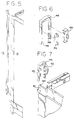
- Attachment piece 152 preferably has downwardly extending tabs to engage upwardly extending tabs 154 of mating piece 40 as shown in FIGS. 6 and 7. In another embodiment shown in FIG. 20, attachment piece 152 is rotated so the tabs extend upwardly to engage tabs 154 should they extend downwardly.
- connector 88 comprises a connection rod 102 (not to scale) with a plurality of threads 155 including a head 108, stop portion 110 and opening 112.
- Sleeve cover 224 has a pair of slots 228 that engage a pair of prongs 230 attached to top support 116 and bottom support 130, respectively.
- the length of sleeve cover 224 is chosen such that when connector 88 is assembled it covers the rod 102.
- the single sleeve cover 224 may be replaced with a pair of covers 224, 226 as seen in FIG. 18.
- the length of sleeve 106 is chosen to approximately match the length of cylindrical section 122.
- Head 108 includes a stop portion 110 located at the end thereof which preferably has a diameter larger than the remaining portion of head 108. Head 108 further includes an opening 112 to receive a hex driver, such as an allen key.
- the connector 88 of FIG. 18 comprises a top latch element 114 having a top support 116, a top panel mating element 118, and a top side wall mating element 120.
- Top panel mating element 118 preferably has a cylindrical section 122 having an opening to allow the insertion of rod 102 therethrough. A snug fit between rod 102 and the opening of section 122 is accomplished by placing sleeve 106 over that portion of rod 102 which passes through the opening of section 122.
- Sleeve 106 preferably has a longitudinal slit to allow rod 102 to be easily inserted therein.
- Top panel mating element 118 fits in a channel in top support 116.
- Top panel mating element 118 further comprises an engagement piece 124 pointing in a downward direction.
- Top side wall mating element 120 preferably is attached to the top of support 116 and has an opening to allow the insertion of rod 102 therethrough.
- Top side wall mating element 120 further comprises an engagement piece 126 pointing in a downward direction and parallel to engagement piece 124. As with the embodiment of FIG. 2, engagement piece 126 is attached to wall 14 by inserting it into a corresponding slot of bracket 90, 92 located in the top of the slot of the wall 14.
- Connector 88 also comprises a bottom latch element 128 which comprises a bottom support 130, a bottom panel mating element 132, and a bottom side wall mating element 134.
- bottom panel mating element 132 preferably has a cylindrical section 136 having an opening to allow the insertion of rod 102 therethrough.
- bottom panel mating element 132 fits in a channel in bottom support 130 and has an engagement piece 138 pointing, however, in an upward direction.
- the rod 102 passes through annular ring 142 that spaces bottom panel mating element 132 away from base 140.
- Bottom side wall mating element 134 further comprises an engagement piece 144 pointing in an upward direction and parallel to engagement piece 138.
- engagement piece 144 is attached to wall 14 by inserting it into a corresponding slot of bracket 90, 92 located in the bottom of the slot of the wall 14.
- Rod 102 is then inserted into the openings of cylindrical sections 122, 136 and top and bottom side wall mating elements 120, 134 and inserted through the opening of base 140 where a nut is then attached to the threads 155.
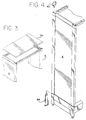
- the process of attaching side wall 4 and panel 86 comprises removing top cover 34 of cabinet 2 as shown in FIG. 3. Next pieces 40 and 84 are removed to allow for connector 88 to be attached to the outer wall 14 of side wall 4 as shown in FIG. 5.
- connector 88 is attached to panel 86 by having the top and bottom panel mating elements 124, 138 engage with the openings and bases of U-shaped pieces 94, 96, respectively.
- Cover 146 has tabs 148 which engage the base of U-shaped piece 94 to provide a snap-like connection.
- Cover 146 further includes attachment pieces 150 and 152 which are attached to the sides of cover 146.
- Attachment piece 152 preferably has upwardly extending tabs to engage downwardly extending tabs 154 of mating piece 40 similar to those shown in FIGS. 6 and 7.
- top support 116 comprises a top bracket 234 having a pair of holes 236.
- Top support 116 receives top panel mating element 118 which comprises a two attachment components 238, 240.
- Attachment component 238 comprises a cylindrical section 122 and face 242 having openings 244. Face 242 receives an engagement piece 126 and is attached thereto via screws 246.
- Cylindrical section 122 has an opening to allow the insertion of rod 102 therethrough.
- cylindrical section 122 is inserted through attachment component 240 which is half-cylindrical in shape and comprises an engagement piece 124 pointing in a downward direction and parallel to engagement piece 124.
- connector 88 of FIG. 19 is assembled and attached in a manner similar to that described for the connector 88 of FIG. 18.
- engagement piece 126 is attached to wall 14 by inserting it into a corresponding slot of bracket 90, 92 located in the top of the slot of the wall 14.
- FIG. 8 illustrates the situation where outer wall 14 has a height less than that of panel 86. In that situation, connection is accomplished in a manner similar to that described in the embodiment of FIGS. 2-7.
- connector 88 comprises a top latch element 114 which comprises a top support 116.
- mating assembly 156 performs the functions of top panel mating element 118 and top side wall mating element 120 of the embodiment of FIGS. 2-7.
- Mating assembly 156 preferably has a cylindrical section 122 having an opening to allow the insertion of connector rod 102 therethrough.
- Mating assembly 156 fits in top support 116.
- Mating piece 156 further comprises engagement pieces such as horizontally extending hooks 158.
- Mating piece 156 further comprises an engagement piece 126 pointing in a downward direction.
- Connector 88 comprises a bottom latch element 128 having a bottom support 130, bottom panel mating element 132, and bottom side wall mating element 134 as in the embodiment of FIGS. 2-7.
- Connector rod 102 with sleeve 106 attached thereto as before, is then inserted into the openings of cylindrical sections 122, 136 and top and bottom side wall mating elements 120, 134.
- the base 104 of connector rod 102 preferably is inserted into the opening of bottom side wall mating element.
- connector 88 is attached by having bottom latch element 128 engage the panel 86 and the bracket 90, 92 of outer wall 14 as in the embodiment of FIGS. 2-7. Furthermore, engagement piece 126 engages outer wall 14 as described previously. However, further engagement with panel 86 is obtained by inserting hooks 158 into corresponding openings 160 located on columns 98. It should be appreciated that other configurations for rod 102, top latch element 114, bottom latch element 128, and the other elements of connector 88 are possible without departing from the spirit of the invention.
- FIG. 9 illustrates the situation where outer wall 14 has a height greater than that of panel 86.
- Connector 88 comprises top panel mating element 118 and top side wall mating element 120.
- Top panel mating element 118 of top latch element 114 is located between connector guides 162 and 164 which are slidably attached via planar guides 166 and 168, respectively, to a channel located in support 170.
- Top panel mating element 118 further comprises an engagement piece 124 pointing in a downward direction.
- Top side wall mating element 120 preferably is attached to the top of support 170 and has an opening to allow the insertion of connector rod 102 therethrough.
- Top side wall mating element 120 further comprises an engagement piece 126 pointing in a downward direction and parallel to engagement piece 124.
- Connector 88 further comprises a bottom latch element 128 which comprises a bottom support 136, a bottom panel mating element 132, and a bottom side wall mating element 134.
- Bottom latch element 128 preferably is located directly below support 170.
- bottom panel mating element 132 preferably has a cylindrical section 136 having an opening to allow the insertion of connector rod 102 therethrough.
- Bottom side wall mating element 134 preferably is attached to the bottom of support 170 and has a base 140 to allow connector rod 102 to be supported thereon.
- An opening such as annular ring 142 is attached to base 140 to allow connector rod 102 to be inserted therein and fix the rod 102 in place.
- Bottom side wall mating element 134 further comprises an engagement piece 144 pointing in an upward direction and parallel to engagement piece 138.
- Connector rod 102 with sleeve 106 (not shown), is then inserted into the openings of cylindrical sections 122, 136, connector guides 162, 164 and top and bottom side wall mating elements 120, 134.
- the base 104 of connector rod 102 preferably is inserted into the opening of bottom side wall mating element 134.
- connector 88 is attached to panel 86 by having the top and bottom panel mating elements 124, 138 engage with the openings and bases of U-shaped pieces 94, 96, respectively, as in the FIG. 2 embodiment.
- Support 170 is attached to outer wall 14 via top and bottom engagement pieces 126 and 144 engaging brackets 90, 92 located at the top and bottom of the slot of outer wall 14. It should be appreciated that other configurations for rod 102, top latch element 114, bottom latch element 128, and the other elements of connector 88 are possible without departing from the spirit of the invention.
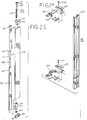
- connector 88 can be modified as shown by the embodiment of FIG. 21 where rod 102 is inserted through an opening in top side wall element 120 and through connector guide 162.
- a sleeve 248 is inserted through connector guide 164 and cylindrical section 122 of top panel mating element 118.
- cylindrical section 136 is adjacent to connector guide 164. Connection between the pieces is accomplished by inserting rod 102 through guides 162, 164, cylindrical sections 122, 136 and an opening in base 140. A nut is attached to the threaded portion 155 extending through the opening of base 140.
- FIGS. 10-14 and 22-23 it is also possible to attach a panel 86 to outer wall 14 which are oriented at a 90° angle with respect to each other.
- outer wall 14 of side wall 4 comprises two vertical slotted areas. Furthermore, panel 86 is located above a skirt 172 and comprises two U-shaped pieces 94 and 96 as described before in the embodiment of FIG. 2. Connection between panel 86 and side wall 4 is accomplished by a connector 88.
- Connector 88 comprises a connection piece 174 having a side wall attachment surface 176 and a panel attachment surface 178 which are oriented at 90° with respect to each other.
- Side wall connectors 180 such as right-angled brackets, are attached to attachment surface 176 by means of attachment devices 182, such as screws or nuts and bolts, that are inserted into openings 184 present on attachment surface 176.
- Brackets 186 are attached in a well known manner along the vertical edges of attachment surface 176 to provide a trim to cover the openings formed by connector 88, outer wall 14, and panel 86.
- panel attachment surface 178 comprises top and bottom panel connectors 188, 190, respectively, located near the top and bottom of surface 178.
- top panel connector 188 has a U-shape and is connected to surface 178 by well known means, such as nuts and bolts.
- an engagement piece 191 is inserted in the channel of the U-shaped connector 188 in the channel of the U-shaped connector 188.
- Engagement piece 191 comprises a threaded opening which is aligned with another threaded opening on connector 188.
- Attachment between engagement piece 191 and connector 188 is accomplished by inserting a threaded bolt or screw into the aligned openings of connector 188 and engagement piece 191.
- Engagement piece 191 comprises a seat 192 such that engagement piece 191 rests on the bottom of the channel of connector 188.
- Engagement piece 191 is compressively secured to connector 188 when connector 188 is pressed against attachment surface 178 upon attachment thereto. When properly secured, engagement piece 191 has an engagement portion 194 which extends beyond connector 188 (See
- Bottom panel connector 190 is attached to surface 178 by well known means, such as nuts and bolts.
- Connector 190 comprises an engagement portion 196 which extends in an upward direction from the connector 190.
- connector 190 is attached to a connector skirt 198 via an attachment device 200, such as a bracket wherein attachment is achieved by the use of such well known means as nuts and bolts.
- attachment device 200 such as a bracket wherein attachment is achieved by the use of such well known means as nuts and bolts.
- Connector skirt 198 comprises one or more pieces to give the desired aesthetic look.
- Attachment of side wall 4 to panel 86 is accomplished by first removing top cover 34 as shown in FIG. 12. Next, trim extensions 84 are removed to allow for connector 88 to be attached to the outer wall 14 of side wall 4 as shown in FIG. 13.
- Connector 88 is attached to a top bracket 202 which has a top attachment device 204 attached thereto in a well known manner, such as nuts and bolts.
- Top attachment device 204 has a vertical opening 205.
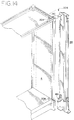
- Connector 88 is connected by aligning the openings of the top bracket 180 with the opening of top attachment device 204 and inserting a bolt therethrough which is attached by a nut 206, as shown in FIG. 14.
- Attachment is accomplished in a similar manner for the bottom parts of connector 88 and outer wall by bottom attachment device 208 (connected to bracket 210 of outer wall 14) and bottom bracket 180, as shown in FIG. 14.
- Panel 86 is attached to connector 88 by having engagement portions 194 and 196 engage the openings and bases of U-shaped pieces 94, 96, respectively, in a manner similar to the attachment of top and bottom mating elements 124 and 138 to U-shaped pieces 94, 96 as shown in FIGS. 2-9.
- cap 212 is placed over and pressed into the top opening formed by connector 88 as shown in FIGS. 10 and 11.
- FIG. 22 A variation of the connector 88 of FIG. 10 is shown in FIG. 22.
- the differences between the two embodiments involves the use of a wider rectangular piece 250 for top and bottom brackets 180 that extends across the width of connection piece 174 and is used for attaching brackets 180 to connection piece 174.
- a cover 252 is attached to panel attachment surface 178 and extends between panel connectors 188 and 190.
- the attachment piece 254 of side wall connectors 180 of FIG. 22 have a triangular-like shape versus the rectangular-like shape of the connectors 180 of FIG. 10.
- the above-described cabinet may also be attached to one or more cabinets either side to side or back to back.
- the first step is to remove top cover 37, as shown in FIG. 15.
- top cover 37 When it is desired to attach two cabinets side-to-side which embody the present invention, it is necessary to remove on each of the cabinets the bottom covers 62 corresponding to the sides to be attached. It is also necessary to remove the lateral sides 32, as shown in FIG. 16.
- one or more top bolts 214 and bottom bolts 216 are attached to corresponding top holes 218 and bottom holes 220 present in each cabinet.
- each bolt 214, 216 is inserted through a separator 270 positioned between the attached sides of the cabinets. Washers 272 may be used to assist connection by attaching nut 274. A similar procedure is performed for back-to-back attachment.
- connector 88 comprises a connection piece 174 having a pair of side wall attachment surfaces 176 and a panel attachment surface 178 which bisected by and is oriented at 90° with respect to attachment surfaces 178.
- Side wall attachment surfaces 176 and attachment surface 178 may be integrally formed together or be separate pieces that are connected to each other in a well known manner.
- Top and bottom side wall connectors 180 are provided to attach the side walls of adjacent cabinets together.
- Top connector 180 preferably is flat while bottom connector 180 is elevated in the middle.
- Each connector 180 is attached to surfaces 176 in a well known manner such as by a threaded rod 102 that extends through middle openings of connectors 180 and a cylindrical mount 260.
- a nut is attached to the threaded portion of rod 102 extending through the bottom connector 180.
- the attachment of the panel is accomplished by a structure similar to that shown in FIGS. 10-14 with panel attachment surface 178 comprising top and bottom panel connectors 188, 190, respectively, located near the top and bottom of surface 178 and a cover 252 therebetween. Attachment of a panel is accomplished in the same manner as described for FIGS. 10-14. Furthermore, attachment of the side walls is accomplished in a manner similar to that described for FIGS. 10-14. The only difference being that the connectors 180 in the embodiment of FIGS. 10-14 is only capable of being attached to one side wall, while the connector of FIG. 23 has holes at both ends, each to be attached to a side wall in the manner described for the embodiment of FIGS. 10-14.
- Connector 88 is in the shape of a cover having a groove 258.
- L-shaped brackets 264 are mounted within the groove 258 and are located near the top and bottom of connector 88.
- Each bracket 264 has a connector 180 attached thereto by nut 266 and bolt 268 that corresponds to the connectors of the embodiment of FIG. 23.
- each bracket 264 is attached to a separate inner sleeve that is attached within groove 258. Attachment of the walls of the cabinets is accomplished much in the same manner as described for the embodiment of FIG. 23.
- a top cover 222 such as shown in either FIG. 17 or FIG. 25, is attached to both cabinets in a well known manner and the cover 222 is positioned to conceal the space as one looks at both cabinets from above.
Landscapes
- Casings For Electric Apparatus (AREA)
- Assembled Shelves (AREA)
- Laminated Bodies (AREA)
Applications Claiming Priority (4)
| Application Number | Priority Date | Filing Date | Title |
|---|---|---|---|
| US98344192A | 1992-12-01 | 1992-12-01 | |
| US983441 | 1992-12-01 | ||
| US155946 | 1993-11-19 | ||
| US08/155,946 US6550879B1 (en) | 1992-12-01 | 1993-11-19 | Cabinet structure |
Publications (2)
| Publication Number | Publication Date |
|---|---|
| EP0600720A2 true EP0600720A2 (fr) | 1994-06-08 |
| EP0600720A3 EP0600720A3 (fr) | 1997-12-10 |
Family
ID=26852734
Family Applications (1)
| Application Number | Title | Priority Date | Filing Date |
|---|---|---|---|
| EP93309590A Withdrawn EP0600720A3 (fr) | 1992-12-01 | 1993-12-01 | Structure d'armoire |
Country Status (4)
| Country | Link |
|---|---|
| US (2) | US6550879B1 (fr) |
| EP (1) | EP0600720A3 (fr) |
| JP (1) | JPH0739426A (fr) |
| CA (1) | CA2110248C (fr) |
Cited By (2)
| Publication number | Priority date | Publication date | Assignee | Title |
|---|---|---|---|---|
| ES2123389A1 (es) * | 1994-07-26 | 1999-01-01 | Leroy Merlin Sa Ets | Conjunto modular de elementos para la realizacion de una estructura destinada a la colocacion de objetos en orden. |
| EP1342878A1 (fr) * | 2002-03-07 | 2003-09-10 | Les Ateliers d'Herqueville | Armoire métallique monobloc à rideau vertical à joues de support intégrées |
Families Citing this family (25)
| Publication number | Priority date | Publication date | Assignee | Title |
|---|---|---|---|---|
| US6167665B1 (en) | 1996-06-07 | 2001-01-02 | Herman Miller, Inc. | Corner post for a wall panel system |
| US6341457B1 (en) * | 1996-06-07 | 2002-01-29 | Herman Miller, Inc. | Light seal assembly for a wall panel system |
| US6223485B1 (en) | 1996-06-07 | 2001-05-01 | Herman Miller, Inc. | Wall panel system |
| GB2375289B (en) * | 1998-12-30 | 2002-12-31 | Apw Electronics Ltd | Cabinet |
| CA2310548A1 (fr) | 1999-06-04 | 2000-12-04 | Herman Miller, Inc. | Systeme de panneaux muraux jointifs |
| GB2353541B (en) | 1999-06-04 | 2003-10-15 | Miller Herman Inc | Stackable wall panel system |
| US6094872A (en) * | 1999-10-08 | 2000-08-01 | Steelcase Development Inc. | Partition and floor channel construction |
| US6729085B2 (en) | 2001-02-09 | 2004-05-04 | Herman Miller, Inc. | Wall panel system |
| US20040251799A1 (en) * | 2003-06-12 | 2004-12-16 | International Business Machines Corporation | System for securing a component in a computer system |
| US7934494B1 (en) * | 2003-10-10 | 2011-05-03 | Donna Gail Schneider | Collapsible heating apparatus |
| FR2866217B1 (fr) * | 2004-02-13 | 2006-04-14 | Pierre Henry Sa | Meuble de rangement tel qu'une armoire |
| US7914091B1 (en) * | 2004-09-04 | 2011-03-29 | Joyce Jared L | Furniture systems |
| ITUD20040186A1 (it) * | 2004-09-24 | 2004-12-24 | Euroinox Srl | Apparecchiatura e procedimento per realizzare una cella metallica per mobili, e |
| US20070278170A1 (en) * | 2006-03-17 | 2007-12-06 | John Wiebe | Audio equipment storage device |
| CA2670511A1 (fr) * | 2006-11-30 | 2008-06-05 | Waterloo Industries, Inc. | Boite de rangement munie d'une armature interne |
| US8042890B2 (en) * | 2007-04-24 | 2011-10-25 | Edsal Manufacturing Co., Inc. | Boltless storage cabinet |
| DE102008041488A1 (de) * | 2008-08-22 | 2010-02-25 | BSH Bosch und Siemens Hausgeräte GmbH | Haushaltsgerät für den Einbau in einem Möbelrahmen |
| US20100090567A1 (en) * | 2008-10-09 | 2010-04-15 | Ergami, Llc | Storage furniture system and methods for assembling the storage furniture system |
| US20110084576A1 (en) * | 2009-10-09 | 2011-04-14 | Leatherman Todd R | Modular integrated outdoor locker and system |
| US20110084577A1 (en) * | 2009-10-09 | 2011-04-14 | Leatherman Todd R | Modular integrated outdoor locker with enhanced cap, and system |
| MX2012002921A (es) * | 2009-10-29 | 2012-04-30 | Krueger Int Inc | Sistema de paneles. |
| US9810474B2 (en) * | 2015-05-28 | 2017-11-07 | Haier Us Appliance Solutions, Inc. | Joint members for refrigerator appliance casings |
| GB2555078A (en) * | 2016-08-03 | 2018-04-25 | Inscape Interiors Ltd | A modular locker system |
| CN110301767A (zh) * | 2018-03-20 | 2019-10-08 | 平遥县唐都推光漆器有限公司 | 可组合宫廷柜 |
| DE202018103454U1 (de) * | 2018-06-19 | 2018-06-26 | SieMatic Möbelwerke GmbH & Co. KG | Möbelsystem |
Family Cites Families (50)
| Publication number | Priority date | Publication date | Assignee | Title |
|---|---|---|---|---|
| US1178612A (en) | 1914-01-26 | 1916-04-11 | Yawman & Erbe Mfg Co | Metallic-furniture casing. |
| US1397269A (en) | 1921-02-28 | 1921-11-15 | Zenas U Dodge | Knockdown refrigerating-box |
| US1523653A (en) | 1921-08-18 | 1925-01-20 | Art Metal Construction Co | Metal cabinet |
| US2020337A (en) * | 1934-02-08 | 1935-11-12 | Howard W Schwartz | Hollow metal door |
| US2162333A (en) | 1938-02-02 | 1939-06-13 | Interstate Metal Products Comp | Metal cabinet door |
| US2559099A (en) | 1948-03-24 | 1951-07-03 | Halstead W West | Wall hanger |
| US2613623A (en) | 1948-09-04 | 1952-10-14 | Diebold Inc | Insulated filing cabinet construction |
| US2793718A (en) * | 1950-01-25 | 1957-05-28 | Glenn L Martin Co | Honeycomb panel and method of making same |
| US2749199A (en) | 1952-11-18 | 1956-06-05 | Lyon Metal Products Inc | Locker construction |
| US2808307A (en) | 1953-08-20 | 1957-10-01 | Diebold Inc | Insulated filing cabinet construction |
| FR1083832A (fr) * | 1953-09-18 | 1955-01-12 | Thevenot & Hochet | Abri démontable, notamment pour compteur à gaz et applications analogues |
| US2765056A (en) * | 1954-09-27 | 1956-10-02 | Andrew T Tyree | Laminated door construction |
| US2719809A (en) * | 1954-10-14 | 1955-10-04 | Weisberg Baer Co | Method of making hollow panel structural units |
| US2911274A (en) | 1956-04-20 | 1959-11-03 | All Steel Equipment Inc | Desk top construction |
| US2901781A (en) | 1957-02-19 | 1959-09-01 | Sha Ag Solomon | Building elements |
| US3029910A (en) * | 1958-11-07 | 1962-04-17 | Gen Dynamics Corp | Composite structural unit |
| US3095625A (en) | 1960-08-15 | 1963-07-02 | Miller Herman Inc | Connector |
| US3192306A (en) * | 1962-09-26 | 1965-06-29 | Philco Corp | Cooling wall structure for electronic equipment cabinet |
| FR1383986A (fr) * | 1963-11-18 | 1965-01-04 | Perfectionnement d'un procédé de fabrication de panneaux rigides | |
| DE1252578B (de) * | 1964-03-30 | 1967-10-19 | Midland Ross Corporation, Cleve land, Ohio (V St A) | Behalter wie Gehäuse mit mehrschichtiger Wandung |
| US3333385A (en) * | 1964-09-14 | 1967-08-01 | Steelcraft Mfg Company | Closure caps for composite doors |
| US3341270A (en) | 1965-10-21 | 1967-09-12 | Art Metal Inc | Office equipment system and components thereof |
| USRE27215E (en) | 1966-02-09 | 1971-11-02 | Space divider system | |
| US3430997A (en) | 1967-05-17 | 1969-03-04 | Miller Herman Inc | Panel joint |
| US3572263A (en) | 1968-06-13 | 1971-03-23 | Miller Herman Inc | Furniture construction |
| GB1279405A (en) * | 1968-06-29 | 1972-06-28 | Transtec Engineering Company L | Weatherproof closure member |
| US3594055A (en) | 1969-06-11 | 1971-07-20 | Burger Eisenwerke Ag | Sheet metal airfreight container |
| US3826554A (en) | 1971-09-09 | 1974-07-30 | Groovfold Inc | Drawer construction |
| US3853367A (en) * | 1972-02-09 | 1974-12-10 | Hughes Aircraft Co | Cabinet |
| US3819466A (en) | 1973-06-18 | 1974-06-25 | Care Inc | Reinforced and insulating building panel |
| US3856374A (en) | 1974-03-18 | 1974-12-24 | Outers Laboratories | Knock-down electric food smoker |
| US3927924A (en) | 1974-05-28 | 1975-12-23 | Miller Herman Inc | Panel joining and work surface support apparatus |
| DE2552571A1 (de) | 1975-11-24 | 1977-06-02 | Wolfgang Guenther | Bodenbeschichtung und eckenabdichtung fuer nassraeume |
| US4014143A (en) | 1976-04-23 | 1977-03-29 | Purcell Kenneth G | Building structural system |
| US4338990A (en) * | 1978-08-18 | 1982-07-13 | American Seating Company | Panel wall systems with modular component build-up |
| US4233495A (en) | 1978-12-15 | 1980-11-11 | Lincoln Manufacturing Company, Inc. | Food warming cabinet |
| FR2463677A1 (fr) * | 1979-08-25 | 1981-02-27 | Messerschmitt Boelkow Blohm | Element de structure metallique composite de type sandwich |
| DE3135471A1 (de) | 1981-09-08 | 1983-03-24 | Joachim Dr.-Ing. 8070 Ingolstadt Hess | Bauelementensatz zur erstellung von schutzschraenken |
| DE3220287A1 (de) | 1982-05-28 | 1983-12-01 | Siemens AG, 1000 Berlin und 8000 München | Belueftungseinsatz fuer geschirmte kabinen und raumabschirmungen |
| USRE32890E (en) | 1984-08-15 | 1989-03-21 | Herman Miller, Inc. | Frame connector system |
| US4875552A (en) * | 1986-07-29 | 1989-10-24 | Montgomery Elevator Company | Modular elevator cab construction |
| CH672881A5 (fr) | 1987-08-01 | 1990-01-15 | Jean Luc Duc | |
| US4902365A (en) * | 1987-12-03 | 1990-02-20 | Westlake Sr Edward F | Method for making a composite sheet-like structure |
| US5155960A (en) * | 1988-03-29 | 1992-10-20 | Indal Furniture Systems A Division Of Indal Limited | Cam action connector for joining furniture panels |
| US4836626A (en) | 1988-04-15 | 1989-06-06 | Tennsco Corporation | Knock-down cabinet |
| US5106173A (en) | 1988-06-10 | 1992-04-21 | Herman Miller, Inc. | Work space management system and cabinet therefor |
| US5058347A (en) | 1990-09-18 | 1991-10-22 | Herman Miller, Inc. | Panel connector system |
| US5134826A (en) * | 1991-04-23 | 1992-08-04 | Precision Manufacturing, Inc. | Structural panel connector for space dividing system |
| DE9105346U1 (de) | 1991-04-30 | 1991-06-20 | Bulthaup GmbH & Co. KG, 8313 Aich | Möbelfront mit wannenförmiger Außenverkleidung |
| US5430984A (en) * | 1993-09-13 | 1995-07-11 | Wireway South Inc. | Modular wall construction utilizing woven wire partitions |
-
1993
- 1993-11-19 US US08/155,946 patent/US6550879B1/en not_active Expired - Fee Related
- 1993-11-29 CA CA002110248A patent/CA2110248C/fr not_active Expired - Fee Related
- 1993-12-01 JP JP5302014A patent/JPH0739426A/ja active Pending
- 1993-12-01 EP EP93309590A patent/EP0600720A3/fr not_active Withdrawn
-
1995
- 1995-06-07 US US08/477,901 patent/US5809714A/en not_active Expired - Fee Related
Cited By (2)
| Publication number | Priority date | Publication date | Assignee | Title |
|---|---|---|---|---|
| ES2123389A1 (es) * | 1994-07-26 | 1999-01-01 | Leroy Merlin Sa Ets | Conjunto modular de elementos para la realizacion de una estructura destinada a la colocacion de objetos en orden. |
| EP1342878A1 (fr) * | 2002-03-07 | 2003-09-10 | Les Ateliers d'Herqueville | Armoire métallique monobloc à rideau vertical à joues de support intégrées |
Also Published As
| Publication number | Publication date |
|---|---|
| JPH0739426A (ja) | 1995-02-10 |
| US5809714A (en) | 1998-09-22 |
| CA2110248C (fr) | 2001-05-15 |
| CA2110248A1 (fr) | 1994-06-02 |
| US6550879B1 (en) | 2003-04-22 |
| EP0600720A3 (fr) | 1997-12-10 |
Similar Documents
| Publication | Publication Date | Title |
|---|---|---|
| US5809714A (en) | Cabinet structure | |
| DE69220731T2 (de) | Regal | |
| US6301846B1 (en) | Knock-down portable partition system | |
| EP1310189B1 (fr) | Système de bureau | |
| JP2885685B2 (ja) | 組立システム | |
| US4996811A (en) | Open office system partition panel assembly | |
| US5174532A (en) | Leg assembly | |
| US5899035A (en) | Knock-down portable partition system | |
| DE69429879T2 (de) | Modulare möbeltrennwand für büroraüme | |
| US6167579B1 (en) | Furniture system | |
| US6484647B2 (en) | Office furniture system | |
| EP0512256A2 (fr) | Système de stockage modulaire et démontable, à multi-usages, ainsi que sa méthode d'assemblage | |
| US20100218432A1 (en) | Adjustable wall system | |
| CA2174638A1 (fr) | Baie pour armoires de distribution | |
| CA1120088A (fr) | Presentoir d'images encadrees | |
| US4038790A (en) | Partition structure | |
| US4907773A (en) | Adjustable mounting surface | |
| US5941492A (en) | Appliance mounting apparatus | |
| CA2042818A1 (fr) | Attache a blocage pour montage de cloisons | |
| US5644477A (en) | Frame carrier and modular cover panel system | |
| US5219443A (en) | Cabinet for accepting electronic assemblies | |
| EP1647646B1 (fr) | Profilé de chant d'un élément de mur | |
| US5441162A (en) | Wire shelf corner support system | |
| JP2841271B2 (ja) | 間仕切り装置 | |
| JPH0740004Y2 (ja) | 支柱への壁パネル等の係止装置 |
Legal Events
| Date | Code | Title | Description |
|---|---|---|---|
| PUAI | Public reference made under article 153(3) epc to a published international application that has entered the european phase |
Free format text: ORIGINAL CODE: 0009012 |
|
| AK | Designated contracting states |
Kind code of ref document: A2 Designated state(s): DE ES FR GB IT |
|
| PUAL | Search report despatched |
Free format text: ORIGINAL CODE: 0009013 |
|
| AK | Designated contracting states |
Kind code of ref document: A3 Designated state(s): DE ES FR GB IT |
|
| 17P | Request for examination filed |
Effective date: 19971218 |
|
| 17Q | First examination report despatched |
Effective date: 19990705 |
|
| STAA | Information on the status of an ep patent application or granted ep patent |
Free format text: STATUS: THE APPLICATION IS DEEMED TO BE WITHDRAWN |
|
| 18D | Application deemed to be withdrawn |
Effective date: 20010703 |