EP0600950B1 - Inhibiteurs d'acat a base de tetrazole d'amide - Google Patents
Inhibiteurs d'acat a base de tetrazole d'amide Download PDFInfo
- Publication number
- EP0600950B1 EP0600950B1 EP92917230A EP92917230A EP0600950B1 EP 0600950 B1 EP0600950 B1 EP 0600950B1 EP 92917230 A EP92917230 A EP 92917230A EP 92917230 A EP92917230 A EP 92917230A EP 0600950 B1 EP0600950 B1 EP 0600950B1
- Authority
- EP
- European Patent Office
- Prior art keywords
- tetrazole
- phenyl
- dodecyl
- acetamide
- carbon atoms
- Prior art date
- Legal status (The legal status is an assumption and is not a legal conclusion. Google has not performed a legal analysis and makes no representation as to the accuracy of the status listed.)
- Expired - Lifetime
Links
- 0 Cc1c(*)[n](*)nc1[Re] Chemical compound Cc1c(*)[n](*)nc1[Re] 0.000 description 9
- PGFORLSRJVQLPA-UHFFFAOYSA-N CC(CC(C)N1)C2C1N=C(C)CC2 Chemical compound CC(CC(C)N1)C2C1N=C(C)CC2 PGFORLSRJVQLPA-UHFFFAOYSA-N 0.000 description 1
Classifications
-
- C—CHEMISTRY; METALLURGY
- C07—ORGANIC CHEMISTRY
- C07D—HETEROCYCLIC COMPOUNDS
- C07D231/00—Heterocyclic compounds containing 1,2-diazole or hydrogenated 1,2-diazole rings
- C07D231/02—Heterocyclic compounds containing 1,2-diazole or hydrogenated 1,2-diazole rings not condensed with other rings
- C07D231/10—Heterocyclic compounds containing 1,2-diazole or hydrogenated 1,2-diazole rings not condensed with other rings having two or three double bonds between ring members or between ring members and non-ring members
- C07D231/12—Heterocyclic compounds containing 1,2-diazole or hydrogenated 1,2-diazole rings not condensed with other rings having two or three double bonds between ring members or between ring members and non-ring members with only hydrogen atoms, hydrocarbon or substituted hydrocarbon radicals, directly attached to ring carbon atoms
-
- A—HUMAN NECESSITIES
- A61—MEDICAL OR VETERINARY SCIENCE; HYGIENE
- A61P—SPECIFIC THERAPEUTIC ACTIVITY OF CHEMICAL COMPOUNDS OR MEDICINAL PREPARATIONS
- A61P43/00—Drugs for specific purposes, not provided for in groups A61P1/00-A61P41/00
-
- A—HUMAN NECESSITIES
- A61—MEDICAL OR VETERINARY SCIENCE; HYGIENE
- A61P—SPECIFIC THERAPEUTIC ACTIVITY OF CHEMICAL COMPOUNDS OR MEDICINAL PREPARATIONS
- A61P9/00—Drugs for disorders of the cardiovascular system
- A61P9/10—Drugs for disorders of the cardiovascular system for treating ischaemic or atherosclerotic diseases, e.g. antianginal drugs, coronary vasodilators, drugs for myocardial infarction, retinopathy, cerebrovascula insufficiency, renal arteriosclerosis
-
- C—CHEMISTRY; METALLURGY
- C07—ORGANIC CHEMISTRY
- C07D—HETEROCYCLIC COMPOUNDS
- C07D233/00—Heterocyclic compounds containing 1,3-diazole or hydrogenated 1,3-diazole rings, not condensed with other rings
- C07D233/54—Heterocyclic compounds containing 1,3-diazole or hydrogenated 1,3-diazole rings, not condensed with other rings having two double bonds between ring members or between ring members and non-ring members
- C07D233/56—Heterocyclic compounds containing 1,3-diazole or hydrogenated 1,3-diazole rings, not condensed with other rings having two double bonds between ring members or between ring members and non-ring members with only hydrogen atoms or radicals containing only hydrogen and carbon atoms, attached to ring carbon atoms
-
- C—CHEMISTRY; METALLURGY
- C07—ORGANIC CHEMISTRY
- C07D—HETEROCYCLIC COMPOUNDS
- C07D249/00—Heterocyclic compounds containing five-membered rings having three nitrogen atoms as the only ring hetero atoms
- C07D249/02—Heterocyclic compounds containing five-membered rings having three nitrogen atoms as the only ring hetero atoms not condensed with other rings
- C07D249/04—1,2,3-Triazoles; Hydrogenated 1,2,3-triazoles
-
- C—CHEMISTRY; METALLURGY
- C07—ORGANIC CHEMISTRY
- C07D—HETEROCYCLIC COMPOUNDS
- C07D257/00—Heterocyclic compounds containing rings having four nitrogen atoms as the only ring hetero atoms
- C07D257/02—Heterocyclic compounds containing rings having four nitrogen atoms as the only ring hetero atoms not condensed with other rings
- C07D257/04—Five-membered rings
-
- C—CHEMISTRY; METALLURGY
- C07—ORGANIC CHEMISTRY
- C07D—HETEROCYCLIC COMPOUNDS
- C07D261/00—Heterocyclic compounds containing 1,2-oxazole or hydrogenated 1,2-oxazole rings
- C07D261/02—Heterocyclic compounds containing 1,2-oxazole or hydrogenated 1,2-oxazole rings not condensed with other rings
- C07D261/06—Heterocyclic compounds containing 1,2-oxazole or hydrogenated 1,2-oxazole rings not condensed with other rings having two or more double bonds between ring members or between ring members and non-ring members
- C07D261/08—Heterocyclic compounds containing 1,2-oxazole or hydrogenated 1,2-oxazole rings not condensed with other rings having two or more double bonds between ring members or between ring members and non-ring members with only hydrogen atoms, hydrocarbon or substituted hydrocarbon radicals, directly attached to ring carbon atoms
-
- C—CHEMISTRY; METALLURGY
- C07—ORGANIC CHEMISTRY
- C07D—HETEROCYCLIC COMPOUNDS
- C07D271/00—Heterocyclic compounds containing five-membered rings having two nitrogen atoms and one oxygen atom as the only ring hetero atoms
- C07D271/02—Heterocyclic compounds containing five-membered rings having two nitrogen atoms and one oxygen atom as the only ring hetero atoms not condensed with other rings
- C07D271/06—1,2,4-Oxadiazoles; Hydrogenated 1,2,4-oxadiazoles
-
- C—CHEMISTRY; METALLURGY
- C07—ORGANIC CHEMISTRY
- C07D—HETEROCYCLIC COMPOUNDS
- C07D271/00—Heterocyclic compounds containing five-membered rings having two nitrogen atoms and one oxygen atom as the only ring hetero atoms
- C07D271/02—Heterocyclic compounds containing five-membered rings having two nitrogen atoms and one oxygen atom as the only ring hetero atoms not condensed with other rings
- C07D271/10—1,3,4-Oxadiazoles; Hydrogenated 1,3,4-oxadiazoles
-
- C—CHEMISTRY; METALLURGY
- C07—ORGANIC CHEMISTRY
- C07D—HETEROCYCLIC COMPOUNDS
- C07D277/00—Heterocyclic compounds containing 1,3-thiazole or hydrogenated 1,3-thiazole rings
- C07D277/02—Heterocyclic compounds containing 1,3-thiazole or hydrogenated 1,3-thiazole rings not condensed with other rings
- C07D277/20—Heterocyclic compounds containing 1,3-thiazole or hydrogenated 1,3-thiazole rings not condensed with other rings having two or three double bonds between ring members or between ring members and non-ring members
- C07D277/22—Heterocyclic compounds containing 1,3-thiazole or hydrogenated 1,3-thiazole rings not condensed with other rings having two or three double bonds between ring members or between ring members and non-ring members with only hydrogen atoms, hydrocarbon or substituted hydrocarbon radicals, directly attached to ring carbon atoms
-
- C—CHEMISTRY; METALLURGY
- C07—ORGANIC CHEMISTRY
- C07D—HETEROCYCLIC COMPOUNDS
- C07D401/00—Heterocyclic compounds containing two or more hetero rings, having nitrogen atoms as the only ring hetero atoms, at least one ring being a six-membered ring with only one nitrogen atom
- C07D401/02—Heterocyclic compounds containing two or more hetero rings, having nitrogen atoms as the only ring hetero atoms, at least one ring being a six-membered ring with only one nitrogen atom containing two hetero rings
- C07D401/06—Heterocyclic compounds containing two or more hetero rings, having nitrogen atoms as the only ring hetero atoms, at least one ring being a six-membered ring with only one nitrogen atom containing two hetero rings linked by a carbon chain containing only aliphatic carbon atoms
-
- C—CHEMISTRY; METALLURGY
- C07—ORGANIC CHEMISTRY
- C07D—HETEROCYCLIC COMPOUNDS
- C07D401/00—Heterocyclic compounds containing two or more hetero rings, having nitrogen atoms as the only ring hetero atoms, at least one ring being a six-membered ring with only one nitrogen atom
- C07D401/02—Heterocyclic compounds containing two or more hetero rings, having nitrogen atoms as the only ring hetero atoms, at least one ring being a six-membered ring with only one nitrogen atom containing two hetero rings
- C07D401/12—Heterocyclic compounds containing two or more hetero rings, having nitrogen atoms as the only ring hetero atoms, at least one ring being a six-membered ring with only one nitrogen atom containing two hetero rings linked by a chain containing hetero atoms as chain links
-
- C—CHEMISTRY; METALLURGY
- C07—ORGANIC CHEMISTRY
- C07D—HETEROCYCLIC COMPOUNDS
- C07D401/00—Heterocyclic compounds containing two or more hetero rings, having nitrogen atoms as the only ring hetero atoms, at least one ring being a six-membered ring with only one nitrogen atom
- C07D401/14—Heterocyclic compounds containing two or more hetero rings, having nitrogen atoms as the only ring hetero atoms, at least one ring being a six-membered ring with only one nitrogen atom containing three or more hetero rings
-
- C—CHEMISTRY; METALLURGY
- C07—ORGANIC CHEMISTRY
- C07D—HETEROCYCLIC COMPOUNDS
- C07D403/00—Heterocyclic compounds containing two or more hetero rings, having nitrogen atoms as the only ring hetero atoms, not provided for by group C07D401/00
- C07D403/02—Heterocyclic compounds containing two or more hetero rings, having nitrogen atoms as the only ring hetero atoms, not provided for by group C07D401/00 containing two hetero rings
- C07D403/12—Heterocyclic compounds containing two or more hetero rings, having nitrogen atoms as the only ring hetero atoms, not provided for by group C07D401/00 containing two hetero rings linked by a chain containing hetero atoms as chain links
-
- C—CHEMISTRY; METALLURGY
- C07—ORGANIC CHEMISTRY
- C07D—HETEROCYCLIC COMPOUNDS
- C07D471/00—Heterocyclic compounds containing nitrogen atoms as the only ring hetero atoms in the condensed system, at least one ring being a six-membered ring with one nitrogen atom, not provided for by groups C07D451/00 - C07D463/00
- C07D471/02—Heterocyclic compounds containing nitrogen atoms as the only ring hetero atoms in the condensed system, at least one ring being a six-membered ring with one nitrogen atom, not provided for by groups C07D451/00 - C07D463/00 in which the condensed system contains two hetero rings
- C07D471/04—Ortho-condensed systems
Definitions
- the present invention describes a series of novel amide tetrazoles which inhibit acyl-CoA: cholesterol acyltransferase (ACAT), the enzyme responsible for the esterification of dietary cholesterol.
- ACAT cholesterol acyltransferase
- Such agents may decrease the absorption of dietary cholesterol and therefore provide a therapy for individuals with hypercholesterolemia.
- n is zero, one or two; wherein R 1 is selected from
- Suitable acids for forming acid salts of the compounds of Formula I containing a basic group include, but are not necessarily limited to acetic, benzoic, benzenesulfonic, hydrobromic, hydrochloric, citric, fumaric, gluconic, glucuronic, glutamic, lactic, malic, maleic, methanesulfonic, pamoic, salicylic, stearic, succinic, sulfuric, and tartaric acids.
- the acid addition salts are formed by procedures well known in the art.
- Certain compounds of the present invention may also exist in different stereoisomeric forms by virtue of the presence of asymmetric centers in the compound.
- the present invention contemplates all stereoisomers may be obtained, if desired, by methods known in the art as, for example, the separation of stereoisomers by chiral chromatographic columns.
- the compounds of this invention may exist in unsolvated as well as solvated forms with pharmaceutically acceptable solvents such as water, ethanol, and the like.
- the solvated forms are considered equivalent to the unsolvated forms for the purposes of this invention.
- Illustrative examples of straight or branched saturated hydrocarbon chains having from 1 to 20 carbon atoms include methyl, ethyl, n -propyl, isopropyl, n -butyl, iso-butyl, tert-butyl, n -pentyl, isopentyl, n -hexyl, n -heptyl, n -octyl, n -undecyl, n -dodecyl, n -hexadecyl, 2,2-dimethyldodecyl, 2-tetradecyl, and n -octadecyl groups.
- Illustrative examples of straight or branched hydrocarbon chains having from 1 to 20 carbon atoms and having 1 double bond or 2-nonadjacent double bonds include ethenyl, 2-propenyl, 2-butenyl, 3-pentenyl, 2-octenyl, 5-nonenyl, 4-undecenyl, 5-heptadecenyl, 3-octadecenyl, 9-octadecenyl, 2,2-dimethyl-11-eicosenyl, 9,12-octadecadienyl, and hexadecenyl.
- Straight or branched alkoxy groups having 1 to 3 carbon atoms include methoxy, ethoxy, n -propoxy, and isopropoxy.
- Straight or branched alkyl groups having from 1 to 4 carbon atoms include, for example, methyl, ethyl, n -propyl, isopropyl, and n -butyl.
- Cycloalkyl groups having from 3 to 8 carbon atoms which R 1 may represent are cyclopropyl, cyclobutyl, cyclopentyl, cyclohexyl, cycloheptyl, and cyclooctyl.
- Halo is fluoro, chloro, bromo, or iodo, but preferably fluoro.
- a 5- or 6-membered monocyclic or fused bicyclic heterocycle is a monocyclic or fused bicyclic aromatic ring containing at least one to four heteroatoms in at least one ring, such as nitrogen, oxygen, or sulfur or a combination thereof.
- Such a heterocyclic group includes, for example, thienyl, benzothienyl, furanyl, benzofuranyl, pyridyl, pyrimidinyl, pyridazinyl, pyrazinyl, pyrrolyl, pyrazolyl, isothiazolyl, thiazolyl, oxazolyl, isoxazolyl, triazolyl, tetrazolyl, imidazolyl, benzothiazolyl, indolyl, quinolinyl, isoquinolinyl, or N-oxides of heterocycles containing a nitrogen atom.
- such a heterocycle may be a 2- or 3-thienyl; 2-, or 3-furanyl; 2-, or 3-, or 4-pyridyl or 2-, or 3-, or 4-pyridinyl-N-oxide; 2-, 4-, or 5-pyrimidinyl; 3- or 4-pyridazinyl; 2-pyrazinyl; 2-pyrazinyl-N-oxide; 2- or 3-pyrrolyl; 3-, 4-, or 5-pyrazolyl; 2-, 4-, or 5-thiazolyl; 3-, 4-, or 5-isoxazolyl; 2-, 4-, or 5-oxazolyl; 3-, 4-, or 5-isothiazolyl; 5-tetrazolyl; 3- or 5-(1,2,4)-triazolyl; 4- or 5-(1,2,3)-triazolyl; 2-, 4-, or 5-imidazolyl; 2-, 3-, 4-, 5-, 6-, or 7-indolyl; 2-, 3-, 4-, 5-, 6-, 7-, or 8-quinolinyl; 2-
- Preferred compounds of this invention are those wherein the R 4 substituent group is attached to the 2-position of the tetrazole moiety and the side chain or remainder of the molecule is attached to the carbon atom of the tetrazole moiety, the 5-position.
- Compounds wherein n is zero or one are also preferred with compounds wherein n is zero being more preferred.
- Compounds wherein R 1 is other than naphthyl or substituted naphthyl are also preferred.
- Compounds wherein n is zero, R 1 is substituted phenyl, and R 4 is in the 2-position and has from 8 to 18 carbon atoms are most preferred.
- R 1 is 2,6-(1-methylethyl)phenyl or 2,4,6-trimethoxyphenyl
- n is zero
- R 2 and R 3 are each independently hydrogen, methyl, fluoro, cyclohexyl, or phenyl
- R 4 is in the 2-position and has 12 carbon atoms.
- the compounds of the present invention are potent inhibitors of the enzyme acyl-CoA: cholesterol acyltransferase (ACAT), and are thus effective in inhibiting the esterification and transport of cholesterol across the intestinal cell wall.
- ACAT cholesterol acyltransferase
- the compounds of the present invention are thus useful in pharmaceutical formulations for the treatment of hypercholesterolemia or atherosclerosis.
- test assesses the ability of a test compound to inhibit the acylation of cholesterol by oleic acid by measuring the amount of radiolabeled cholesterol oleate formed from radiolabeled oleic acid in a tissue preparation containing rabbit intestinal microsomes (designated IAI) or from rat liver microsomes (designated LAI).
- APCC In one in vivo screen designated APCC, male Sprague-Dawley rats (200 to 225 g) were randomly divided into treatment groups and dosed at 4 PM with either vehicle (CMC/Tween) or suspensions of compounds in vehicle. The normal chow diet was then replaced with a high fat, high cholesterol diet with 0.5% cholic acid. The rats consumed this diet ad libitum during the night and were sacrificed at 8 AM to obtain blood samples for cholesterol analysis using standard procedures. Statistical differences between mean cholesterol values for the same vehicle were determined using analysis of variance followed by Fisher's least significant test. The results of this trial for representative compounds of the present invention appear in Table 2. The compounds were dosed at 30 mg/kg unless otherwise noted.
- the compounds of Formula I or pharmaceutically acceptable salts thereof are administered to the patient at dosage levels of from 250 to 3000 mg per day. For a normal human adult of approximately 70 kg of body weight, this translates into a dosage of from 5 to 40 mg/kg of body weight per day.
- the specific dosages employed, however, may be varied depending upon the requirements of the patient, the severity of the condition being treated, and the activity of the compound being employed. The determination of optimum dosages for a particular situation is within the skill of the art.
- inert, pharmaceutically acceptable carriers can be either solid or liquid.
- Solid form preparations include powders, tablets, dispersible granules, capsules, and cachets.
- a solid carrier can be one or more substances which may also act as diluents, flavoring agents, solubilizers, lubricants, suspending agents, binders, or tablet disintegrating agents; it can also be an encapsulating material.
- the carrier is a finely divided solid which is in a mixture with the finely divided active component.
- the active component is mixed with the carrier having the necessary binding properties in suitable proportions and compacted in the shape and size desired.
- Powders and tablets preferably contain between about 5% to about 70% by weight of the active ingredient.
- Suitable carriers are magnesium dicarbonate, magnesium stearate, talc, lactose, sugar, pectin, dextrin, starch, tragacanth, methyl cellulose, sodium carboxymethyl cellulose, a low-melting wax, cocoa butter, and the like.
- preparation is intended to include the formulation of the active compound with encapsulating material as a carrier providing a capsule in which the active component (with or without carriers) is surrounded by a carrier, which is thus in association with it. In a similar manner cachets are also included.
- Tablets, powders, cachets, and capsules can be used as solid dosage forms suitable for oral administration.
- Liquid form preparations include solutions, suspensions, or emulsions suitable for oral administration.
- Aqueous solutions for oral administration can be prepared by dissolving the active compound in water and adding suitable flavorants, coloring agents, stabilizers, and thickening agents as desired.
- Aqueous suspensions for oral use can be made by dispersing the finely divided active component in water together with a viscous material such as natural or synthetic gums, resins, methyl cellulose, sodium carboxymethylcellulose, and other suspending agents known to the pharmaceutical formulation art.
- the pharmaceutical preparation is in unit dosage form.
- the preparation is divided into unit doses containing appropriate quantities of the active component.
- the unit dosage form can be a packaged preparation containing discrete quantities of the preparation, for example, packeted tablets, capsules, and powders in vials or ampoules.
- the unit dosage form can also be a capsule, cachet, or tablet itself, or it can be the appropriate number of these packaged forms.
- the compounds of the present invention can be prepared by various routes all of which are generally known in the art.
- the compounds of Formula I wherein n is zero, each of R 2 and R 3 is hydrogen and R 1 and R 4 are as defined in Formula I can be prepared as set forth in Chart I hereof.
- the tetrazole ester (2) is synthesized via treatment of ethyl cyanoacetate (1) with sodium azide.
- Esters (4) and (7) can then be independently hydrolyzed to the acids (5) and (8) which are coupled with an amine of the formula R 1 NH 2 wherein R 1 has the meaning defined in Formula I using carbonyldiimidazole in THF to give the 2 and 1 substituted tetrazole amides (6) and (9), respectively.
- the resulting 2- and 1-regioisomers compounds (13) and (14)] are separated by chromatography.
- Compound (13) is easily hydrolyzed to carboxylic acid (15) when treated with NaOH or KOH in an alcoholic solvent such as methanol or ethanol at room temperature.
- R 2 is hydrogen and R 3 is alkyl, aryl, or alkenyl
- regioisomer (14) decarboxylates to (17) when subjected to the previously described hydrolytic conditions.
- the carboxylic acids (15, 19) are easily converted to the corresponding amides (16, 18) when treated with a coupling agent such as carbonyldiimidazole or dicyclohexylcarbodiimide in tetrahydrofuran or dichloromethane and an appropriate amine.
- a coupling agent such as carbonyldiimidazole or dicyclohexylcarbodiimide in tetrahydrofuran or dichloromethane and an appropriate amine.
- regioisomer (18) is prepared by treating (17) with n-butyllithium in tetrahydrofuran at -20°C followed by the addition of an appropriate isocyanate.
- Compound 15 may be deprotonated using n-BuLi in THF at -78°C to give an anion which can then be treated with an electrophilic reagent (R 2 X) to give the ⁇ , ⁇ '-disubstituted acid shown which can then be coupled with an appropriate amine (R 1 NH 2 ) in a manner as previously described to yield the corresponding amides.
- Ethyl cyanoacetate is treated with one equivalent of sodium hydride in dimethylformamide or tetrahydrofuran followed by the addition of an appropriate alkylating agent such as 1-bromopropane or benzyl bromide to give monoalkylated analogs of Compound 11.
- an appropriate alkylating agent such as 1-bromopropane or benzyl bromide
- a second equivalent of base may then be added followed by the addition of an appropriate alkylating agent to give disubstituted ethyl cyanoacetates of formula (11).
- Spirocycloalkyl analogues are synthesized in a similar manner by employing dihalo alkyl halides of the formula halo-(CH 2 ) p -halo wherein p is two to six and halo is chlorine or bromine as the alkylating agent.
- An illustrative alkylating agent is 1,4-dibromobutane.
- the resulting acid was converted to the acid chloride via treatment with oxalyl chloride in dichloromethane at room temperature.
- the crude acid chloride was treated with an appropriate amine in dichloromethane with Et 3 N as base at 0°C to yield the desired amide.
- Specific Example 65 is illustrative of this synthetic route.
- the hydroxyester may be treated with t-butyldimethyl silyl trifluoromethane sulfonate in dichloromethane with Et 3 N as base to yield the protected hydroxy ester, which can then be converted to the desired amide as shown in the scheme.
- the tetrazole ester (20-A) is heated, typically at temperatures between 50° and 100°C, with a tertiary amine such as triethylamine, and an appropriate alkyl halide, including alkyl bromides, chlorides, and iodides, or an arylalkyl halide in a polar solvent, such as CH 3 CN, to give after work-up and chromatographic separation both of the corresponding regioisomeric 1-alkylated and 2-alkylated tetrazole esters (22) and (21).
- a tertiary amine such as triethylamine
- an appropriate alkyl halide including alkyl bromides, chlorides, and iodides
- an arylalkyl halide in a polar solvent, such as CH 3 CN
- alkyl tetrazole esters (21 and 22) are stirred, typically at temperatures between 0° and 30°C, with alkali metal hydroxides, such as LiOH, NaOH, or KOH, in an alcoholic solvent such as methanol or ethanol for 1 to 24 hours to give after work-up the corresponding alkyltetrazole carboxylic acids (23 and 24).
- alkali metal hydroxides such as LiOH, NaOH, or KOH
- the alkyltetrazole carboxylic acids are coupled with primary amines, especially aryl amines of the formula R 1 NH 2 wherein R 1 is as defined in Formula I such as 2,4,6-trimethoxyaniline, 2,6-diisopropylaniline, and 2,4-difluoroaniline, using a carboxylic acid activating reagent such as carbonyldiimidazole or dicyclohexylcarbodiimide in an aprotic solvent such as THF or CH 2 Cl 2 , at temperatures between -10° and +110°C to give after work-up the corresponding alkyltetrazole amides (25 and 26).
- a carboxylic acid activating reagent such as carbonyldiimidazole or dicyclohexylcarbodiimide in an aprotic solvent such as THF or CH 2 Cl 2
- the ⁇ -substituted cyanopropionic acid compound (27) is prepared from the corresponding aldehyde of the formula XCHO using the procedure described in US 4,760,089.
- Compound (27) is treated with an appropriate amine, R 1 NH 2 wherein R 1 has the meaning defined in general Formula I employing a coupling agent such as carbonyldiimidazole in tetrahydrofuran at room temperature or dicylohexylcarbodiimide in dichloromethane at 0°C to give the nitrile amide (28).
- nitrile amide (28) is converted to the tetrazole (29) by treatment with (n-Bu) 3 SnN 3 in refluxing dioxane and then is alkylated with an appropriate compound of the formula R 4 halo wherein R 4 has the meaning defined in Formula I and halo is chlorine, or bromine employing triethylamine in acetonitrile.
- R 4 has the meaning defined in Formula I and halo is chlorine, or bromine employing triethylamine in acetonitrile.
- the products (30) and (31) are separated by chromatography. Specific Example 45 is illustrative of this synthetic route.
- the acids are then coupled with an appropriate amine of the formula R 1 NH 2 wherein R 1 is as defined in Formula I employing carbonyldiimidazole in tetrahydrofuran at room temperature or dicyclohexylcarbodiimide in CH 2 Cl 2 at 0°C as coupling agent to give the amides (37) and (39).
- Ethyl cyanoacetate is alkylated (or dialkylated) by treatment with NaH in an appropriate solvent such as dimethylformamide or tetrahydrofuran at from 0° to 25°C to give the alkylated nitrile (40).
- the nitrile is then treated with (n-Bu) 3 SnN 3 in dioxane at reflux for 24 hours to give after acidic hydrolysis the tetrazole (41) which is then alkylated with an alkyl halide (R 4 Br) in CH 3 CN employing Et 3 N as base to give a mixture of regioisomers (42) and (43).
- the regioisomers are separated by flash chromatography and each ester is reduced by DIBAL-H in CH 2 Cl 2 or toluene at -78°C to give the corresponding alcohols (44) and (45).
- the alcohols are treated with methanesulfonyl chloride in CH 2 Cl 2 using triethylamine as a base at 0°C to give the corresponding mesylates which are then treated with KCN in dimethylformamide or dimethyl sulfoxide at 100°C to give the corresponding nitriles (46) and (47). These are then hydrolyzed to the corresponding acids (48) and (49) by treatment with ethanolic NaOH (or KOH) at reflux.
- the acids are then coupled with an appropriate amine employing carbonyldiimidazole in tetrahydrofuran at room temperature or dicyclohexylcarbodiimide in CH 2 Cl 2 at 0°C to give the amides (50) and (51).
- Malonitrile is alkylated (or dialkylated) by treatment with NaH in an appropriate solvent such as dimethylformamide or tetrahydrofuran at 0° to 25°C to give compounds (51).
- the regioisomers are then separated by flash chromatography and each nitrile is then reduced to the corresponding aldehydes (55) and (56) by treatment with Raney nickel in formic acid at 60°C.
- the resulting aldehydes are then treated with a stabilized ylide such as ethyl(triphenylphosphoranylidene)acetate in CH 2 Cl 2 at room temperature to give (57) and (58) which are reduced catalytically using hydrogen gas, Pd/C as catalyst in methanol or ethanol at room temperature to give esters (59) and (60).
- N-oxides of compounds of this invention are prepared by standard procedures known in the art, for example, by treatment with m -perchlorobenzoic acid at reflux in chloroform or dichloromethane.
- the isocyanates, R 1 NCO, and the amines R 1 NH 2 wherein R 1 has the meaning defined in Formula I, employed in preparing the compounds of this invention are known in the art or can be prepared by procedures generally known in the art.
- the pyrazole amines are prepared as set forth in Chart X hereof wherein the reaction conditions are indicated in the chart.
- compounds of Formula I having an asymmetric carbon atom can be synthesized in either enantiomeric form (R 2 does not equal R 3 ) by treating compounds (15) or (19) in Chart II, (27) in Chart IV, (36) or (38) in Chart V, (48) or (49) in Chart VII, and (61) or (62) in Chart IX with appropriate chiral amines such as R-(+)- or S-(-)- ⁇ -methylbenzyl amine, (1S, 2R) ephedrine, or brucine.
- the salts are prepared by dissolving the racemic acid enumerated above in ethyl acetate or a mixture of hexane/ethyl acetate containing the appropriate chiral amine.
- the chiral salt is collected by filtration and recrystallized several times from hexane/ethyl acetate.
- the chiral acid is then liberated through an acidic workup and its enantiomeric purity is determined by chiral HPLC.
- the chiral acids are then coupled with appropriate amines to give enantiomerically pure compounds designated as (16), (18), (28), (37), (39), (50), (51), (63), and (64), respectively.
- a nitrile (R 4 CN) is converted to the corresponding 5-substituted tetrazole by cycloaddition with an azide (ammonium azide, tributyltin azide, etc) in an inert solvent such as dimethylformamide.
- the resulting 5-substituted tetrazole can be alkylated with an ⁇ -bromo ester using a base such as triethylamine in a neutral solvent such as acetonitrile.
- the resulting mixture of 1,5 and 2,5 regioisomers is separated by chromatography or recrystallization.
- esters of the pure regioisomers are then individually saponified using an inorganic base (NaOH, KOH, etc) and acidified with a mineral acid such as HCl to give the corresponding carboxylic acids.
- the carboxylic acids are coupled with various amines using standard coupling reagents (CDI, DCC, mixed anhydride, etc) to give the final products.
- Carbonyldiimidazole (5.74 g, 0.035 mol) was added to a solution of the 2-dodecyltetrazole acetic acid (10.0 g, 0.034 mol) obtained in (c) above in dry THF (100 mL) under an inert atmosphere (N 2 ). The mixture was stirred at room temperature for 30 minutes, then 2,6-diisopropylaniline (6.7 mL, 0.038 mol) was added in one portion. The resulting solution was stirred for 3 days at room temperature, concentrated in vacuo, taken up in dichloromethane (200 mL), washed with water (100 mL) and brine (100 mL), and dried over Na 2 SO 4 .
- Example 9 The compounds of Example 9 and 10 above were made as a mixture.
- tetrazole ester (a) 47 g; 0.20 moles was dissolved in acetonitrile (550 mL) containing one equivalent of triethylamine (20.2 g; 0.20 moles). The solution was heated to reflux and then 1-bromododecane (49.8 g; 0.20 moles) was added dropwise over 20 minutes. Upon completion, the solution was heated to reflux for 16 hours, cooled to room temperature, and concentrated in vacuo. The residue was triturated with ethyl acetate (1 L), filtered, and the filtrate was washed with aqueous HCl (1N), brine, and dried over magnesium sulfate.
- Example 13(e) When in the procedure of Example 13(e) an appropriate amount of the amine listed below was substituted for 2,4,6-trimethoxyaniline and the general procedure of Example 13(e) was followed, the respective products listed below were obtained.
- Example 23 The compound of Example 23 (0.50 g; 1.0 mmole) was dissolved in dichloromethane and then treated with MCPBA (0.22 g; 1.1 mmole) in one portion and stirred at room temperature for 12 hours. The resulting 3-chlorobenzoic acid byproduct was removed by washing the organic solution with aqueous potassium carbonate and then brine. The dichloromethane was dried over magnesium sulfate, filtered, and concentrated in vacuo, leaving a white precipitate. The crude product was triturated with ethyl ether and collected by filtration.
- Example 25(b) When in the procedure of Example 25(b) an appropriate amount of 2,6-diisopropylphenylisocyanate was substituted for 2,4-difluorophenylisocyanate and the general procedure of Example 25(b) was followed, the title compound was obtained, mp 113-115°C.
- the carboxylic acid obtained in (d) above (2.0 g; 0.006 moles) was dissolved in dry THF (50 mL) and then treated with carbonyldiimidazole (1.0 g; 0.006 moles) in one portion.
- the solution was stirred for 1 hour under nitrogen before adding 2,4,6-trimethoxyaniline (1.0 g; 0.006 moles), also in one portion.
- the solution was stirred for 5 days under nitrogen and at room temperature.
- the solution was diluted with ethyl acetate and washed with aqueous HCl (1N), NaOH (1N), and brine. Magnesium sulfate was added as the drying agent and the solution filtered.
- Example 13(e) When in the procedure of Example 13(e) an appropriate amount of tert -butylamine was substituted for 2,4,6-trimethoxyaniline and the general procedure of Example 13(e) was followed, the title compound was obtained.
- 1 H NMR (CDCl 3 ) ⁇ 7.3 (m, 5H), 6.4 (bs, 1H), 5.1 (s, 1H), 4.6 (t, 2H), 2.0 (m, 2H), 1.3 (s, 18H), 1.2 (s, 9H), 0.9 (t, 3H) ppm.
- Example 13(b) When in the procedure of Example 13(b) an appropriate amount of 1-bromooctane was substituted for 1-bromododecane and the general procedure of Example 13(b), (d), and (e) was followed, the title compound was obtained, mp 113-116°C.
- Example 13(b) When in the procedure of Example 13(b) an appropriate amount of 1-bromohexadecane was substituted for 1-bromododecane and the general procedure of Example 13(b), (d), and (e) was followed, the title compound was obtained, mp 134-135°C.
- Example 27(c) When in the procedure of Example 27(c) an appropriate amount of 1-bromotridecane was substituted for 1-bromododecane and the general procedure of Example 27(c), (d), and (e) was followed, the title compound was obtained.
- 1 H NMR (CDCl 3 ) ⁇ 7.5 (br.s, 1H), 6.05 (s, 2H), 4.6 (t, 2H), 3.8 (s, 3H), 3.75 (s, 6H), 1.8 (s, 6H), 1.2-1.4 (m, 22H), 0.9 (m, 3H) ppm.
- the tetrazole (a) (3.0 g; 0.015 moles) was taken up in acetonitrile (50 mL) containing two equivalents of triethylamine (3.0 g; 0.030 moles). The suspension was heated to reflux and then treated with 1-bromododecane (3.7 g; 0.015 moles) dropwise for several minutes. The solution was refluxed for 16 hours, cooled to room temperature, and the solvent removed in vacuo. The residue was triturated with ethyl acetate, filtered, and concentration of the filtrate in vacuo leaving a maroon-colored liquid.
- the 2-isomer was obtained by dissolving the crude product in 50% hexane/50% ethyl acetate and removing the impurities, including the 1-regioisomer, by silica gel chromatography. Yield: 2.0 g (41%).
- a chromatographic charge is prepared by completely dissolving 1.85 g of racemic 2-dodecyl- ⁇ -phenyl-N-(2,4,6-trimethoxyphenyl)-2H-tetrazole-5-acetamide, Example 13, in 45 mL of a solution of 80:20 2-propanol:hexane and warming to 65°C. Two milliliters of this solution is injected onto a 500 x 20.0 mm Chiralcel OG® preparative column (Diacel Chemical Industries, Tokyo, Japan). This charge is chromatographed over the support with 80:20 hexane:2-propanol at a flow rate of 8.0 mL/min. The column and injector are jacketed in an Advanced Air Oven (Kariba Instruments Fantasy, South Wales, UK) at a constant temperature of 40°C. The eluate is monitored by measuring its ultraviolet absorbance at 290 nm.
- the first major ultraviolet absorbing fraction is the (-) enantiomer, (-)-2-dodecyl- ⁇ -phenyl-N-(2,4,6-trimethoxyphenyl)-2H-tetrazole-5-acetamide.
- the capacitance Factor k' for this enantiomer is approximately 5.6 (112 mL solution) and the solution is designated as "Solution A”.
- the second major ultraviolet absorbing fraction is the (+) enantiomer, (+)-2-dodecyl- ⁇ -phenyl-N-(2,4,6-trimethoxyphenyl)-2H-tetrazole-5-acetamide.
- This component elutes at a k' of 7.3 (208 mL solution) and is designated as "Solution B".
- An intermediate fraction eluting at a k' of 6.7 (48 mL solution), which corresponds to the ultraviolet minimum between the two enantiomers contains approximately equal parts of each enantiomer.
- (+)-2-dodecyl- ⁇ -phenyl-N-(2,4,6-trimethoxyphenyl)-2H-tetrazole-5-acetamide is found to be 96% enantiomerically pure by high performance liquid chromatography using the system described in Table A.
- the physical properties of (-)-2-dodecyl- ⁇ -phenyl-N-(2,4,6-trimethoxyphenyl)-2H-tetrazole-5-acetamide and (+)-2-dodecyl- ⁇ -phenyl-N-(2,4,6-trimethoxyphenyl)-2H-tetrazole-5-acetamide appear in Table B.
- step (a) To a dichloromethane solution (90 mL) of compound in step (a) was added 2,4,6-trimethoxyaniline ⁇ HCl (0.64 g, 0.0029 mol) and triethylamine (0.4 mL, 0.0029 mol) at 0°C under a nitrogen atmosphere with stirring. After 40 minutes, DCC (0.63 g, 0.003 mol) was added in one portion. After 10 minutes a precipitate resulted and the resulting suspension was allowed to warm to room temperature over 72 hours. The suspension was then filtered and the organic layers washed with 1N HCl, water, brine, dried over MgSO 4 , filtered, and concentrated in vacuo.
- step (a) To a suspension of the material from step (a) (5.1 g, 0.016 mol) in dioxane (150 mL) at room temperature was added tri- n -butyltin azide (9.36 g, 0.016 mol) under N 2 with stirring. The resulting solution was heated to reflux for 24 hours. The solution was then cooled and concentrated in vacuo. The residue was redissolved in ether and HCl gas was then passed through the solution for 30 minutes. This was then concentrated in vacuo to give ⁇ -(1 H -tetrazol-5-yl)-N-(2,4,6-trimethoxyphenyl)benzene propanamide as a white solid (2.1 g) which was used without further purification.
- Example Product 60 ( ⁇ )-2-Dodecyl- ⁇ -(cyclohexyl)-N-(2,4,6-trimethoxy-phenyl)-2H-tetrazole-5-acetamide NMR (CDCl 3 ): ⁇ 7.7 (s, 1H), 6.1 (s, 2H), 4.6 (t, 2H), 3.7 (d, 9H), 3.8 (d, 1H), 2.2 (m, 1H), 2.0 (m, 3H), 1.6 (m, 6H), 1.2 (s, 20H), 1.1 (m, 3H), 0.9 (t, 3H) ppm.
- Vinylic amides (11,12) are prepared from Compound 5 in Chart I as follows: where R 1 , R 2 , and R 3 have been previously defined in Formula I.
- n-Butyllithium (6.9 mL of a 1.6 M hexanes solution, Aldrich) was added dropwise to a -78°C solution of tetramethylethylenediamine (1.66 mL, 11 mmole, distilled from CaH 2 ) in 10 mL of anhydrous THF (distilled from Na-benzophene) under dry nitrogen. The mixture was stirred for 15 minutes, then 2-dodecyltetrazole (2.38 g, 10 mmole) in anhydrous THF (5 mL) was added dropwise.
- Oxalyl chloride (0.08 mL, 0.92 mmole) was added to a stirred solution of 2-dodecyl- ⁇ -fluoro- ⁇ -phenyl-2H-tetrazole-5-acetic acid (0.24 g, 0.61 mmole) in 5 mL of CH 2 Cl 2 at room temperature. The mixture was stirred 60 minutes, the one drop of DMF was added (immediate gas evolution). The solution was stirred overnight, concentrated (rotovap), toluene was added, and the solution concentrated again.
- Example 65(d) When in the procedure of Example 65(d) an appropriate amount of 2,4,6-trimethoxyaniline was substituted for 2,6-diisopropylaniline the following Example 66 was obtained.
- Tributyltin azide 51.55 g, 0.155 mol
- diphenyl acetonitrile 20.0 g, 0.103 mol
- HCl(g) was bubbled through the solution for 1 hour and the resulting precipitate was collected and washed with hexanes to give the HCl salt of the title compound (15.88 g, 58%), mp 156-160°C.
Landscapes
- Chemical & Material Sciences (AREA)
- Organic Chemistry (AREA)
- Health & Medical Sciences (AREA)
- Engineering & Computer Science (AREA)
- Bioinformatics & Cheminformatics (AREA)
- Veterinary Medicine (AREA)
- General Health & Medical Sciences (AREA)
- Public Health (AREA)
- Animal Behavior & Ethology (AREA)
- Chemical Kinetics & Catalysis (AREA)
- General Chemical & Material Sciences (AREA)
- Medicinal Chemistry (AREA)
- Nuclear Medicine, Radiotherapy & Molecular Imaging (AREA)
- Pharmacology & Pharmacy (AREA)
- Life Sciences & Earth Sciences (AREA)
- Heart & Thoracic Surgery (AREA)
- Vascular Medicine (AREA)
- Cardiology (AREA)
- Urology & Nephrology (AREA)
- Pharmaceuticals Containing Other Organic And Inorganic Compounds (AREA)
- Plural Heterocyclic Compounds (AREA)
- Heterocyclic Carbon Compounds Containing A Hetero Ring Having Nitrogen And Oxygen As The Only Ring Hetero Atoms (AREA)
- Nitrogen Condensed Heterocyclic Rings (AREA)
- Pyridine Compounds (AREA)
- Acyclic And Carbocyclic Compounds In Medicinal Compositions (AREA)
- Preparation Of Compounds By Using Micro-Organisms (AREA)
Claims (45)
- Un composé représenté par la formule:
 n est égal à zéro, un ou deux;R1 est sélectionné parmi:où R2 et R3 sont identiques ou différents l'un de l'autre et sont sélectionnés parmi:(a) un radical phényl non substitué ou substitué par un à trois substituants sélectionnés parmi:un radical alkyl comportant 1 à 4 atomes de carbone, linéaire ou ramifié, un radical alkoxy comportant 1 à 3 atomes de carbone, linéaire ou ramifié,un radical alkylthio comportant 1 à 3 atomes de carbone, linéaire ou ramifié,hydroxy,phényl,un atome de fluore, de chlore, de brome, un groupe nitro,cyano, trifluorométhyl,-COOH,-COOalkyl dans lequel le radical alkyl comporte 1 à 4 atomes de carbone et est linéaire ou ramifié,- (CH2)mNR5R6 où m est égal à zéro ou un et chacun des radicaux R5 et R6 représente un groupe hydrogène ou un radical alkyl linéaire ou ramifié comportant 1 à 4 atomes de carbone;(b) un groupe 1- ou 2-naphtyl non substitué ou substitué par un à trois substituants sélectionnés parmi:un radical alkyl linéaire ou ramifié comportant 1 à 4 atomes de carbone, un radical alkoxy linéaire ou ramifié commportant 1 à 3 atomes de carbone,hydroxy,un atome de fluore, de chlore, de brome, un groupe nitro, cyano, trifluorométhyl,-COOH,-COOalkyl où le radical alkyl est linéaire ou ramifié et comporte 1 à 4 atomes de carbone,-(CH2)mNR5R6 où m, R5 et R6 sont tels que définis ci-dessus;(c) le groupe:
 R7 est un radical alkyl inférieur comportant 1 à 3 atomes de carbone linéaire ou ramifié;(d) le groupe:
 R8 et R9 sont des radicaux alkyl linéaires ou ramifiés comportant 1 à 4 atomes de carbone ou un groupe phényl, etR10 est un groupe hydrocarboné, linéaire ou ramifié, comportant 1 à 18 atomes de carbone saturé ou insaturé, contenant une double liaison ou deux doubles liaisons non adjacentes; un groupe phényl; un groupe phényl substitué par un à trois substituants sélectionnés parmi des radicaux alkyl linéaires ou ramifiés comportant 1 à 4 atomes de carbone, des radicaux alkoxy linéaires ou ramifiés comportant 1 à 3 atomes de carbone, des groupes hydroxy, un atome de fluor, de chlore, de brome, un groupe nitro, cyano, trifluorométhyl, -COOH, -COOalkyl, le radical alkyl linéaire ou ramifié comportant 1 à 4 atomes de carbone ou un groupe (CH2)mNR5R6 où m, R5 et R6 sont tels que définis ci-dessus; ou un groupe hétérocyclique sélectionné parmi 2-, 3-, ou 4-pyridyl, 2-, 4-, ou 5-pyrimidinyl, 2- ou 3-pyrazinyl, 2-, 3-, 4-, 5-,6-, 7-, ou 8-quinolinyl, ou 3- ou 4-pyridazinyl et les N-oxides en dérivant;(e) le groupe:
 (f) le groupe:
 (g) un groupe hydrocarboné linéaire ou ramifié comportant 1 à 18 atomes de carbone qui est saturé ou insaturé contenant une double liaison ou deux doubles liaisons non-adjacentes;(h) un groupe cycloalkyl comportant 3 à 8 atomes de carbone;(i) un groupe hétéroaromatique choisi parmi 2-, 3-, ou 4-pyridyl qui est non substitué ou substitué par un groupe alkyl comportant 1 à 4 atomes de carbone ou 2-, 4- ou 5-pyrimidinyl, et les N-oxydes en dérivant;(j) le groupe:
 --- signifie une liaison simple ou double;Y et Z représentent chacun indépendamment l'un de l'autre un groupe hydrogène, un radical alkyl linéaire ou ramifié comportant 1 à 4 atomes de carbone, un groupe alkoxy comportant 1 à 3 atomes de carbone ou un groupe halo;X représente un atome d'oxygène ou deux atomes d'hydrogène;R11 représentant un atome d'hydrogène ou un radical alkyl linéaiare ou ramifié comportant 1 à 4 atomes de carbone, et n'est égal à zéro ou un; ou(k) est sélectionné parmi les groupes:
 R12, R13, R14 et R15 sont, sélectionnés indépendamment les uns des autres, parmi un atome d'hydrogène, un radical halo, un groupe alkyl linéaire ou ramifié comprenant 1 à 4 atomes de carbone, un groupe alkoxy comportant 1 à 3 atomes de carbone, et un groupe alkylthio comportant 1 à 3 atomes de carbone, un groupe cycloalkylthio comportant de 5 à 7 atomes de carbone, un groupe phénylalkylthio dans lequel le radical alkyl comprend 1 à 4 atomes de carbone, un groupe phénylthio substitué, hétéroarylthio, ou hétéroaryloxy; et B, D, E et G sont des atomes d'azote ou de carbone où un ou plusieurs des groupes B, D, et E correspondent à un atome d'azote; à la condition que lorsque G représente un atome d'azote, le groupe est lié à l'atome d'azote de la formule I à la position 4- ou 5- du cycle pyrimidine (a et b);(a) un groupe hydrogène, un groupe halo ou l'un des radicaux R2 ou R3 représente un groupe hydroxy;(b) un radical alkyl linéaire ou ramifié comportant 1 à 12 atomes de carbone, ou un radical cycloalkyl comportant 3 à 8 atomes de carbone;(c) un groupe phényl ou phénylalkyl où le radical akyl comporte 1 à 4 atomes de carbone et dans lequel le groupe phényl est non substitué ou substitué parmi 1 à 3 substituants sélectionnés parmi des radicaux alkyl linéaires ou ramifiés comportant 1 à 4 atomes de carbone, des radicaux alkoxy linéaires ou ramifiés comportant 1 à 4 atomes de carbone, les groupes alkylthio linéaires ou ramifiés comportant 1 à 4 atomes de carbone, hydroxy, un atome de fluore, de chlore, de brome, un groupe trifluorométhyl , cyano, nitro, phényl ou (CH2)mNR5R6 où m, R5 et R6 sont tels que définis ci-dessus;(d) un groupe akenyl linéaire ou ramifié, comportant de 2 à 6 atomes de carbone; ou(e) R2 et R3 forment ensemble avec l'atome de carbone auquel ils sont liés un groupe alkylidène comportant 1 à 4 atomes de carbone un goupe benzylidène ou un groupe spiroalkyl comportant 3 à 7 atomes de carbone; ou(f) lorsque R2 représente un atome d'hydrogène, F, un radical alkyl comportant 1 à 12 atomes de carbone, R3 est un radical hétéroaryl sélectionné parmi les groupes hétérocycliques bicycliques fusionnés ou monocycliques à 5 ou 6 membres contenant au moins 1 à 4 hétéroatomes dans au moins 1 cycle, lesdits hétéroatomes étant sélectionnés parmi les atomes d'azote, d'oxygène, ou de soufre et leur combinaison, ledit groupe hétérocyclique étant non-substitué ou substitué par un groupe alkyl comportant 1 à 4 atomes de carbone et les N-oxydes en dérivant;(g) le groupe 1- ou 2-naphtyl qui est non substitué ou substitué par un ou trois substituants sélectionnés parmi:où R4 est une chaîne hydrocarbonée linéaire ou ramififée comportant 1 à 20 atomes de carbone et est saturé ou non-saturé et comporte une double liaison ou deux doubles liaisons non adjacentes, ou correspond à un alkylthio comprenant 1 à 20 atomes de carbone et est saturé; ou un sel pharmaceutiquement acceptable ou un isomère énantiomérique individuel en dérivant.un radical alkyl linéaire ou ramifié comprenant 1 à 4 atomes de carbone;un radical alkoxy linéaire ou ramifié comprenant 1 à 3 atomes de carbone,
 - Un composé selon la revendication 1, dans lequel R4 est en position 2 sur le cycle tétrazole et la chaîne latérale est liée à l'atome de carbone du cycle tétrazole.
- Un composé selon la revendication 2, dans lequel n est égal à zéro.
- Un composé selon la revendication 3, dans lequel chacun des radicaux R2 et R3 représente un atome d'hydrogène.
- Un composé selon la revendication 4, dans lequel R4 est une chaîne hydrocarbonée saturée et comporte de 8 à 18 atomes de carbone.
- Un composé selon la revendication 5, dans lequel R1 est un radical phényl ou un radical phényl substitué.
- Un composé selon la revendication 6, qui correspond à:N-[2,6-Bis(1-méthyléthyl)phényl]-2-dodécyl-2H-tétreazole-5-acétamide;2-dodécyl-N-(2,4,6-triméthoxyphényl)-2H-tétrazole-5-acétamide;N-(2,4-difluorophényl)-2-dodécyl-2H-tétrazole-5-acétamide;2-tétradécyl-N-(2,4,6-tri-méthoxyphényl)-2H-tétrazole-5-acétamide.
- Un composé selon la revendication 5, dans lequel R1 présente un groupe:
 R7 est un radical alkyl inférieur comportant 1 à 3 atomes de carbone et est linéaire ou ramifié.
 - Un composé selon la revendication 8, correspondant à:N-(4,6-diméthoxy-5-pyrimidinyl)-2-dodécyl-2H-tétrazole-5-acétamide; ouN-(4,6-diméthoxy-5-pyrimidinyl)-2-dodécyl-1H-tétrazole-5-acétamide.
- Un composé selon la revendication 5, dans lequel R1 est un groupe hétéroaromatique sélectionné parmi 2-, 3-, ou 4-pyridyl qui est non-substitué ou substitué par un groupe alkyl comportant 1 à 4 atomes de carbone, ou 2-, 4- ou 5-pyrimidinyl et les N-oxydes en dérivant.
- Un composé selon la revendication 10, qui correspond au:
2-dodécyl-N-(3-méthyl-2-pyridinyl)-2H-tétrazole-5-acétamide. - Un composé selon la revendication 5, dans lequel R1 représente le groupe:
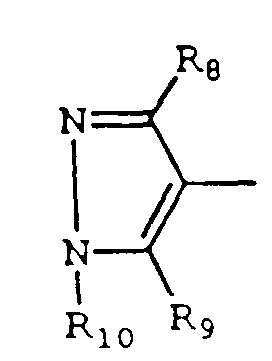 R8 et R9 sont des radicaux alkyl linéaires ou ramifiés comportant 1 à 4 atomes de carbone ou un groupe phényl, etR10 est un groupe hydrocarboné, linéaire ou ramifié, comportant 1 à 18 atomes de carbone, et saturé ou insaturé, contenant une double liaison ou deux doubles liaisons non adjacentes; un groupe phényl; un groupe phényl substitué par un à trois substituants sélectionnés parmi des radicaux alkyl linéaires ou ramifiés comportant 1 à 4 atomes de carbone, des radicaux alkoxy linéaires ou ramifiés comportant 1 à 3 atomes de carbone, des groupes hydroxy, un atome de fluor, de chlore, de brome, un groupe nitro, cyano, trifluorométhyl, -COOH, -COO alkyl, le radical alkyl linéaire ou ramifié comportant 1 à 4 atomes de carbone ou un groupe (CH2)mNR5R6 où m, R5 et R6 sont tels que définis ci-dessus; ou un groupe hétérocyclique sélectionné parmi 2-, 3-, ou 4-pyridyl, 2-, 4-, ou 5-pyrimidinyl, 2- ou 3-pyrazinyl, 2-, 3-, 4-, 5-,6-, 7-, ou 8-quinolinyl, ou 3- ou 4-pyridazinyl et les N-oxides en dérivant.
 - Un composé selon la revendication 12, correspondant au:2-dodécyl-N-(1,3,5 -triméthyl-1H-pyrazol-4-yl)-2H-tétrazole-5-acétamide; ou1-dodécyl-N-(1,3,5-triméthyl-1H-pyrazol-4-yl)-1H-tétrazole-5-actamide.
- Un composé selon la revendication 3, dans lequel l'un des groupes R2 et R3 représente un atome d'hydrogène et l'autre représente un groupe phényl substitué ou non substitué.
- Un composé selon la revendication 14, dans lequel R4 est une chaîne hydrocarbonée saturée comportant 8 à 18 atomes de carbone.
- Un composé selon la revendication 15, dans lequel R1 est un radical phényl substitué ou non substitué.
- Un composé selon la revendication 16, correspondant à:(±) 2-dodécyl-α-phényl-N-(2,4,6-triméthoxyphényl)-2H-tétrazole-5-acétamide,(±) 2-dodécyl-N,α-diphényl-2H-tétrazole-5-acétamide,(±) -N-[2,6-bis(1-méthyléthyl)phényl]-2-dodécyl-α-phényl-2H-tétrazole-5-acétamide,(±)-N-(2,4-difluorophényl)-2-dodécyl-α-phényl-2H-tétrazole-5-acétamide,(±) -2-octyl-α-phényl-N-(2,4,6-triméthoxy-phényl)-2H-tétrazole-5-acétamide, ou(±) -2-hexadécyl-α-phényl-N-(2,4,6-triméthoxyphényl)-2H-tétrazole-5-acétamide.
- Un composé selon la revendication 15 correspondant à:(±) -N-(4,6-diméthoxy-5-pyrimidinyl)s-2-dodécyl-α-phényl-2H-tétrazole-5-acétamide,(±) -N-(5,7-diméthyl-1,8-naphtyridine-2-yl)-2-dodécyl-α-phényl-2H-tétrazole-5-acétamide,(±)-2-dodécyl-α-phényl-N-(1,3,5-triméthyl-1H-pyrazol-4-yl)-2H-tétrazole-5-acétamide,(±) -N-cyclopropyl-2-dodécyl-α-phényl-2H-tétrazole-5-acétamide,(±)-2-dodécyl-α-phényl-N-2-pyridinyl-2H-tétrazole-5-acétamide,(±)-2-dodécyl-N-(3-méthyl-2-pyridinyl)-α-phényl-2H-tétrazole-5-acétamide,(±) -2-dodécyl-N-(3-méthyl-2-pyridinyl)-2-phényl-2H-tétrazole-5-acétamide, N-oxyde ou(±)-N-(1,1-diméthyléthyl)-2-dodécyl-α-phényl-2H-tétrazole-5-acétamide.
- La composition de la revendication 3, dans laquelle R3 présente un groupe hétérocyclique bicyclique fusionné ou monocyclique à 5 ou 6 membres contenant au moins 1 à 4 hétéroatomes dans au moins un cycle, ledit hétéroatome étant sélectionné parmi l'atome d'azote, d'oxygène, ou de soufre, et leurs combinaisons, ledit groupe hétérocyclique étant non-substitué ou substitué par un groupe alkyl comportant 1 à 4 atomes de carbone, et les N-oxydes en dérivant.
- Un composé selon la revendication 19, dans lequel R3 représente un groupe 2-, 3-, ou 4-pyridyl.
- Un composé selon la revendication 20 qui correspond au:(±)-2-dodécyl-α-(2-pyridyl)-N-(2,4,6-triméthoxyphényl)-2H-tétrazole-5-acétamide, ou(±)-N-[2,6-bis(1-méthyléthyl)phényl]-2-dodécyl-α-2-pyridinyl-2H-tétrazole-5-acétamide.
- Un composé selon la revendication 3, dans lequel chacun des groupes R2 et R3 ne représentent pas un atome d'hydrogène.
- Un composé selon la revendication 22, qui correspond au:2-dodécyl-α,α-diméthyl-N-(2,4,6-triméthoxyphényl)-2H-tétrazole-5-acétamide,2-dodécyl-α,α'-(2-propényl)-N-(2,4,6-triméthoxyphényl)-2H-tétrazole-5-acétamide,1-(2-dodécyl-2H-tétrazol-5-yl)-N-(2,4,6-triméthoxyphényl)cyclopentanecarboxamide, ou2-tridécyl-α,α-diméthyl-N-(2,4,6-triméthoxyphényl)-2H-tétrazole-5-acétamide.
- Un composé selon la revendication 2, dans lequel n est égal à un ou deux.
- Un composé selon la revendication 24, dans lequel R1 est un radical phényl non substitué ou substitué.
- Un composé selon la revendication 25, qui correspond au:
2-dodécyl-N-(2,4,6-triméthoxyphényl)-2H-tétrazole-5-propanamide,- N-(2,6-bis(1-méthyléthyl)phényl)-2-dodécyl-2H-tétrazole-5-propanamide,- N-(2,4-difluorophényl)-2-dodécyl-2H-tétrazole-5-propanamide, ou- 1-dodécyl-N-(2,4,6-triméthoxyphényl)-1H-tétrazole-5-propanamide. - Un composé selon la revendication 1, qui correspond au:(±) -n-(2,4-difluorophényl)-1-dodécyl-α-phényl-1H-tétrazole-5-acétamide,(±)-N-[2,6-bis(1-méthyléthyl)phényl]-1-dodécyl-α-phényl-1H-tétrazole-5-acétamide.
- Un composé selon la revendication 6, dans lequel R1 représente 2,6-[1-méthyléthyl)phényl ou 2,4,6-triméthoxyphényl; n est égal à zéro; R2 et R3 sont chacun indépendamment l'un de l'autre un groupe hydrogène, un groupe méthyl, un groupe fluoro, cyclohéxyl, phényl, ou un groupe phényl substitué, phénylalkyl, ou naphthyl, et R4 est en position 2 et comporte pour 12 atomes de carbone du cycle et est lié à l'atome de carbone du cycle tétrazole.
- Un composé selon la revendication 28, qui correspond au:(±)-2-dodécyl-α-méthyl-α-phényl-N-(2,4,6-triméthoxyphényl)-2H-tétrazole-5-acétamide,(±) -2-dodécyl-α-(4-fluorophényl)-N-(2,4,6-triméthoxyphényl)-2H-tétrazole-5-acétamide,(±) -2-dodécyl-α-naphtalényl-N-(2,4,6-triméthoxyphényl)-2H-tétrazole-5-acétamide,(±) -α-([1,1'-biphényl]-4-yl)-2-dodécyl-N-(2,4,6-triméthoxy-phényl)-2H-tétrazole-5-acétamide,(±) -2-dodécyl-α-méthyl-N-(2,4,6-triméthoxy-phényl)-2H-tétrazole-5-acétamide,(±) -2-dodécyl-α-phénylméthyl-N-(2,4,6-triméthoxyphényl)-2H-tétrazole-5-acétamide,(±) -2-dodécyl-α-cyclohexyl-N-(2,4,6-triméthoxy-phényl)-2H-tétrazole-5-acétamide,(-) -2-dodécyl-α-phényl-N-(2,4,6-triméthoxyphényl)-2H-tétrazole-5-actamide [α]D = -58° (1% dans CH3OH),(±) -2-2-dodécyl-α-phényl-N-(2,4,6-triméthoxyphényl)-2H-tétrazole-5-acétamide [α]D= +55,1° (1% dans CH3OH),(±)-N-[2,6-bis(1-méthyléthyl)phényl]-2-dodécyl-α-fluoro-α-phényl-2H-tétrazole-5-acétamide, ou(±) -2-dodécyl-α-fluoro-α-phényl-N-(2,4,6-triméthoxy phényl)-2H-tétrazole-5-acétamide.
- Un composé selon la revendication 1, dans lequel R4 est lié à l'atome de carbone du cycle tétrazole et la chaîne latérale est en position 2 sur le cycle trétrazole.
- Un composé selon la revendication 30, qui correspond au:N-[2,6-bis(1-méthmyléthyl)phényl]-5-décyl-2H-tétrazole-2-acétamide;N-[2,6-bis(1-méthyléthyl)phényl-5-dodécyl-2H-tétrazole-2-acétamide;(±)-N-[2,6-bis(1-méthyléthyl)phényl]-5-dodécyl-α-phényl-2H-tétrazole-2-acétamide;(±)-N-[2,6-bis(1-méthyléthyl)phényl]-5-dodécyl-α-pentyl-2H-tétrazole-5-acétamide;(±)-N-[2,6-bis(1-méthyléthyl)phényl-5-(dodécylthio)-α-phényl-2H-tétrazole-2-acétamide;(±)-5-décyl-α-phényl-N-(2,4,6-triméthoxyphényl-2H-tétrazole-2-acétamide; 5-dodécyl-N-(2,4,6-triméthoxy-phényl)-2H-tétrazole-2-acétamide;(±)-5-dodécyl-α-phényl-N-(2,4,6-triméthoxyphényl)-2H-tétrazole-2-acétamide;(±)-5-dodécyl-α-pentyl-N-(2,4,6-triméthoxyphényl)-2H-tétrazole-2-acétamide;(±)-N-(2,4-difluorophényl-5-dodécyl-α-phényl-2H-tétrazole-2-acétamide;5-dodécyl-α,α-diméthyl-N-(2,4,6-triméthoxyphényl)-2H-tétrazole-2-acétamide;(±)-5-(dodécylthio)-α-phényl-N-(2,4,6-triméthoxyphényl)-2H-tétrazole-2-acétamide; ou(±)-5-(dodécylsulfinyl)-α-phényl-N-(2,4,6-triméthoxyphényl)-2H-tétrazole-2-acétamide.
- Une composition pharmaceutique comprenant un composé selon l'une quelconque des revendications 1 à 31 et un adjuvant, diluant ou support solide ou liquide pharmaceutiquement acceptable.
- Utilisation d'un composé selon l'une quelconque des revendications 1 à 31 pour la préparation de compositions pharmarceutiques agissant en tant qu'inhibiteurs de l'acy-CoA: chlolesterol acyltransférase (ACAT) diminuant l'absorption du cholestérol alimentaire et fournissant une thérapie pour l'hypercholestérolémie.
- Un procédé de préparation d'un composé de formule I:
 n est égal à 0, etR2 et R3 représentent des atomes d'hydrogène etR1 et R4 sont tels que définis selon la formule I de la revendication 1, caractérisé par les voies de synthèse suivantes:
- Un procédé pour la préparation d'un composé de formule I:
 n est égal à zéro,R1, R2, R3 et R4 sont tels que définis dans la formule I de la revendication 1, caractérisé par les voies de synthèse suivantes:
- Un procédé pour la préparation d'un composé de formule I:
 n est égal à un ou deux,R2 et R3 représentent des atomes hydrogènes, etR1 et R4 sont tels que définis à la formule I de la revendication 1, caractérisé par les voies de synthèse suivantes:
- Un procédé de préparation d'un composé de formule I, selon la revendication 1:
 n est égal à 1,R2 est un atome d'hydrogène et R3(x) est un radical phényl, phényl substitué, alkyl, alkényl ou hétéroaryl, caractérisé par les voies de synthèse suivantes:
- Un procédé de préparation d'un composé de formule I, selon la revendication 1:
 n est zéro, etR2 et R3 représentent des radicaux alkyl ou aryl, caractérisé par les voies de synthèse suivantes:
- Un procédé pour la préparation d'un composé de formule I, selon la revendication 1:
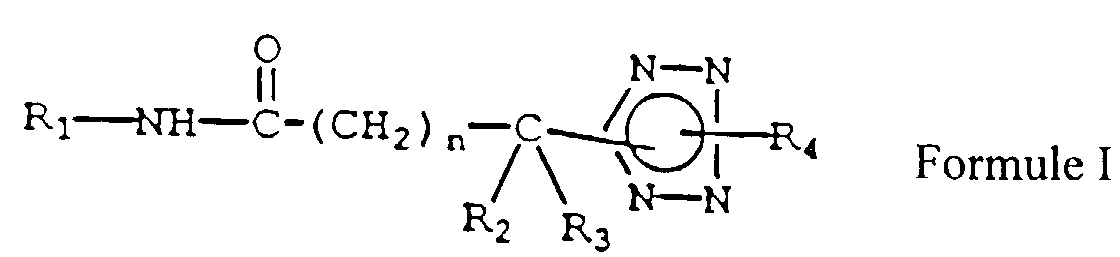 n est égal à 2,R2 est un atome d'hydrogène. etR3 représente un radical phényl ou phényl substitué, caractérisé par les voies de synthèse suivantes:
- Un procédé pour la préparation d'un composé de formule I, selon la revendication 1:
 n est égal à zéro,R2 représente un atome d'hydrogène, etR3 est hétéroarayl, 1- ou 2-naphthyl ou phényl substitué, caractérisé par les voies de synthèse suivantes:
- Un procédé de préparation d'un composé de formule I, selon la revendication 1:
 n est égal à un, caractérisé par les voies de synthèse suivantes:
- Un procédé pour la préparation d'un composé de formule I, selon la revendication 1:
 n est égal à un, etR3 est un groupe hétéroaryl, caractérisé par les voies de synthèse suivantes:
- Un procédé pour la préparation d'un composé de formule I, selon la revendication 1:
 n est égal à deux, à condition qu'au moins l'un des substituants R2 ou R3 soit différent d'un atome d'hydrogène, caractérisé par les voies de synthèse suiantes:
- Un procédé pour la préparation d'un composé de formule I:
 n est égal à zéro,R3 est F ou OH, caractérisé par les voies de synthèse suivantes:
- Un procédé pour la préparation d'une composition pharmaceutique caractérisé par la combinaison d'un composé fabriqué selon l'une quelconque des revendications 34 à 43, avec un adjuvant, diluant ou support solide ou liquide pharmaceutiquement acceptable.
Applications Claiming Priority (5)
| Application Number | Priority Date | Filing Date | Title |
|---|---|---|---|
| US74856891A | 1991-08-22 | 1991-08-22 | |
| US748568 | 1991-08-22 | ||
| US91364392A | 1992-07-20 | 1992-07-20 | |
| US913643 | 1992-07-20 | ||
| PCT/US1992/006388 WO1993004052A1 (fr) | 1991-08-22 | 1992-08-03 | Inhibiteurs d'acat a base de tetrazole d'amide |
Publications (2)
| Publication Number | Publication Date |
|---|---|
| EP0600950A1 EP0600950A1 (fr) | 1994-06-15 |
| EP0600950B1 true EP0600950B1 (fr) | 1996-10-23 |
Family
ID=27114964
Family Applications (1)
| Application Number | Title | Priority Date | Filing Date |
|---|---|---|---|
| EP92917230A Expired - Lifetime EP0600950B1 (fr) | 1991-08-22 | 1992-08-03 | Inhibiteurs d'acat a base de tetrazole d'amide |
Country Status (20)
| Country | Link |
|---|---|
| EP (1) | EP0600950B1 (fr) |
| JP (1) | JP3113678B2 (fr) |
| KR (1) | KR100221764B1 (fr) |
| AT (1) | ATE144501T1 (fr) |
| AU (1) | AU657790B2 (fr) |
| CA (1) | CA2114017C (fr) |
| CZ (1) | CZ281314B6 (fr) |
| DE (1) | DE69214827T2 (fr) |
| DK (1) | DK0600950T3 (fr) |
| ES (1) | ES2093270T3 (fr) |
| FI (1) | FI112221B (fr) |
| GR (1) | GR3021942T3 (fr) |
| HK (1) | HK1005187A1 (fr) |
| HU (1) | HU221190B1 (fr) |
| MX (1) | MX9204877A (fr) |
| NO (1) | NO300632B1 (fr) |
| NZ (1) | NZ244029A (fr) |
| PT (1) | PT100804B (fr) |
| RU (1) | RU2117664C1 (fr) |
| WO (1) | WO1993004052A1 (fr) |
Families Citing this family (13)
| Publication number | Priority date | Publication date | Assignee | Title |
|---|---|---|---|---|
| US5366987A (en) * | 1991-08-22 | 1994-11-22 | Warner-Lambert Company | Isoxazolyl-substituted alkyl amide ACAT inhibitors |
| US5239082A (en) * | 1992-08-03 | 1993-08-24 | Warner-Lambert Company | Sulfonamide tetrazole ACAT inhibitors |
| US5461049A (en) * | 1994-05-27 | 1995-10-24 | Warner-Lambert Company | Amide tetrazole ACAT inhibitors |
| ATE386716T1 (de) * | 2000-12-26 | 2008-03-15 | Pola Pharma Inc | Biphenylderivate |
| US7365199B2 (en) * | 2001-04-20 | 2008-04-29 | Fujifilm Corporation | Dye-forming coupler, silver halide photographic light-sensitive material, and azomethine dye compound |
| US7320967B2 (en) * | 2002-04-23 | 2008-01-22 | L'oreal | Cosmetic composition, method of cosmetic treatment and preparation of a composition for promoting the growth and/or preventing or delaying the loss of hair |
| FR2845991B1 (fr) * | 2002-10-16 | 2005-02-04 | Pf Medicament | Derives d'alpha-phenyl acetanilides et leur application en therapeutique humaine |
| GB0316546D0 (en) | 2003-07-15 | 2003-08-20 | Novartis Ag | Process for the manufacture of organic compounds |
| KR20080095915A (ko) | 2004-05-06 | 2008-10-29 | 워너-램버트 캄파니 엘엘씨 | 4-페닐아미노-퀴나졸린-6-일-아미드 |
| US7598279B2 (en) * | 2005-04-22 | 2009-10-06 | Sk Holdings Co., Ltd. | Neurotherapeutic azole compounds |
| PL2445890T3 (pl) * | 2009-06-22 | 2016-02-29 | Sk Biopharmaceuticals Co Ltd | Sposób wytwarzania estru (R)-1-arylo-2-tetrazoliloetylowego kwasu karbaminowego |
| CN102153591B (zh) * | 2011-01-17 | 2013-11-06 | 天津师范大学 | 2-(1h-四唑-5-甲基)吡啶和5-硝基间苯二甲酸混合配体锰(ii)配合物及制备方法与应用 |
| CA3121202A1 (fr) | 2018-11-30 | 2020-06-04 | Nuvation Bio Inc. | Composes pyrrole et pyrazole et leurs procedes d'utilisation |
Family Cites Families (4)
| Publication number | Priority date | Publication date | Assignee | Title |
|---|---|---|---|---|
| US3624097A (en) * | 1969-07-22 | 1971-11-30 | Warner Lambert Co | N-pyridine 5-aminooxazoles |
| JPS5536447A (en) * | 1978-09-07 | 1980-03-14 | Otsuka Pharmaceut Co Ltd | Butyramide derivative |
| US4871861A (en) * | 1987-07-06 | 1989-10-03 | Olin Corporation | Substituted 5-amidotetrazoles |
| US5073565A (en) * | 1990-04-27 | 1991-12-17 | Warner-Lambert Company | Tetrazole ureas and thioureas and their use as acat inhibitors |
-
1992
- 1992-08-03 HU HU9400491A patent/HU221190B1/hu not_active IP Right Cessation
- 1992-08-03 AT AT92917230T patent/ATE144501T1/de not_active IP Right Cessation
- 1992-08-03 DK DK92917230.2T patent/DK0600950T3/da active
- 1992-08-03 EP EP92917230A patent/EP0600950B1/fr not_active Expired - Lifetime
- 1992-08-03 CZ CZ94361A patent/CZ281314B6/cs not_active IP Right Cessation
- 1992-08-03 CA CA002114017A patent/CA2114017C/fr not_active Expired - Fee Related
- 1992-08-03 HK HK98104234A patent/HK1005187A1/en not_active IP Right Cessation
- 1992-08-03 RU RU94016198A patent/RU2117664C1/ru not_active IP Right Cessation
- 1992-08-03 AU AU24147/92A patent/AU657790B2/en not_active Ceased
- 1992-08-03 ES ES92917230T patent/ES2093270T3/es not_active Expired - Lifetime
- 1992-08-03 KR KR1019940700515A patent/KR100221764B1/ko not_active Expired - Fee Related
- 1992-08-03 WO PCT/US1992/006388 patent/WO1993004052A1/fr not_active Ceased
- 1992-08-03 DE DE69214827T patent/DE69214827T2/de not_active Expired - Fee Related
- 1992-08-03 JP JP05504315A patent/JP3113678B2/ja not_active Expired - Fee Related
- 1992-08-20 NZ NZ244029A patent/NZ244029A/en not_active IP Right Cessation
- 1992-08-21 PT PT100804A patent/PT100804B/pt not_active IP Right Cessation
- 1992-08-21 MX MX9204877A patent/MX9204877A/es not_active IP Right Cessation
-
1994
- 1994-02-16 FI FI940731A patent/FI112221B/fi not_active IP Right Cessation
- 1994-02-21 NO NO940596A patent/NO300632B1/no unknown
-
1996
- 1996-12-06 GR GR960403360T patent/GR3021942T3/el unknown
Also Published As
| Publication number | Publication date |
|---|---|
| DE69214827D1 (de) | 1996-11-28 |
| HU221190B1 (en) | 2002-08-28 |
| AU2414792A (en) | 1993-03-16 |
| CA2114017C (fr) | 2004-09-21 |
| DE69214827T2 (de) | 1997-03-06 |
| KR100221764B1 (ko) | 1999-09-15 |
| FI940731A0 (fi) | 1994-02-16 |
| GR3021942T3 (en) | 1997-03-31 |
| JPH06510040A (ja) | 1994-11-10 |
| NO940596D0 (no) | 1994-02-21 |
| PT100804B (pt) | 1999-07-30 |
| CA2114017A1 (fr) | 1993-03-04 |
| ATE144501T1 (de) | 1996-11-15 |
| AU657790B2 (en) | 1995-03-23 |
| CZ281314B6 (cs) | 1996-08-14 |
| PT100804A (pt) | 1993-09-30 |
| CZ36194A3 (en) | 1994-07-13 |
| NO940596L (no) | 1994-02-22 |
| MX9204877A (es) | 1993-04-01 |
| JP3113678B2 (ja) | 2000-12-04 |
| FI940731A7 (fi) | 1994-04-15 |
| EP0600950A1 (fr) | 1994-06-15 |
| NZ244029A (en) | 1995-09-26 |
| HU9400491D0 (en) | 1994-05-30 |
| FI112221B (fi) | 2003-11-14 |
| HK1005187A1 (en) | 1998-12-24 |
| WO1993004052A1 (fr) | 1993-03-04 |
| HUT70754A (en) | 1995-10-30 |
| DK0600950T3 (da) | 1997-04-21 |
| RU2117664C1 (ru) | 1998-08-20 |
| ES2093270T3 (es) | 1996-12-16 |
| NO300632B1 (no) | 1997-06-30 |
Similar Documents
| Publication | Publication Date | Title |
|---|---|---|
| CA2155104C (fr) | Derives de substitution heterocycliques d'un alkylamide, inhibiteurs d'acat | |
| EP0600950B1 (fr) | Inhibiteurs d'acat a base de tetrazole d'amide | |
| US7396843B2 (en) | 5′-carbamoyl-1,1′-biphenyl-4-carboxamide derivatives and their use as p38 kinase inhibitors | |
| KR101638671B1 (ko) | 글루카곤 수용체 조절자 | |
| US5183899A (en) | Pyrazole derivative | |
| US5550147A (en) | Pyrazole derivatives, processes for preparation thereof and pharmaceutical composition comprising the same | |
| HK1005187B (en) | Amide tetrazole acat inhibitors | |
| WO1997001551A1 (fr) | Composes pyrazole et compositions pharmaceutiques | |
| JP5666468B2 (ja) | システインプロテアーゼ阻害剤 | |
| US5461049A (en) | Amide tetrazole ACAT inhibitors | |
| FR2556720A1 (fr) | Derives de l'amidine et tonicardiaques les contenant | |
| JP2010504906A (ja) | アリールおよびヘテロアリール−エチル−アシルグアニジン誘導体、これらの調製、および治療におけるこれらの適用 | |
| EP0131973A1 (fr) | Dérivés amidiniques phényl-4-imidazole-substitué-2 | |
| US5239082A (en) | Sulfonamide tetrazole ACAT inhibitors | |
| HU187565B (en) | Process for preparing guanidine derivatives | |
| PL182101B1 (pl) | Nowe pochodne acylowanych aminoalkanoimidazoli i srodek farmaceutyczny do selektywnego inhibitowania hydroksylaz 25-hydroksywitaminy D3 PL |
Legal Events
| Date | Code | Title | Description |
|---|---|---|---|
| PUAI | Public reference made under article 153(3) epc to a published international application that has entered the european phase |
Free format text: ORIGINAL CODE: 0009012 |
|
| 17P | Request for examination filed |
Effective date: 19940210 |
|
| AK | Designated contracting states |
Kind code of ref document: A1 Designated state(s): AT BE CH DE DK ES FR GB GR IE IT LI LU MC NL SE |
|
| 17Q | First examination report despatched |
Effective date: 19950426 |
|
| GRAH | Despatch of communication of intention to grant a patent |
Free format text: ORIGINAL CODE: EPIDOS IGRA |
|
| GRAH | Despatch of communication of intention to grant a patent |
Free format text: ORIGINAL CODE: EPIDOS IGRA |
|
| GRAA | (expected) grant |
Free format text: ORIGINAL CODE: 0009210 |
|
| AK | Designated contracting states |
Kind code of ref document: B1 Designated state(s): AT BE CH DE DK ES FR GB GR IE IT LI LU MC NL SE |
|
| REF | Corresponds to: |
Ref document number: 144501 Country of ref document: AT Date of ref document: 19961115 Kind code of ref document: T |
|
| REG | Reference to a national code |
Ref country code: CH Ref legal event code: NV Representative=s name: SCHMAUDER & WANN PATENTANWALTSBUERO, INHABER KLAUS |
|
| ET | Fr: translation filed | ||
| REF | Corresponds to: |
Ref document number: 69214827 Country of ref document: DE Date of ref document: 19961128 |
|
| REG | Reference to a national code |
Ref country code: IE Ref legal event code: FG4D Free format text: 70367 |
|
| REG | Reference to a national code |
Ref country code: ES Ref legal event code: FG2A Ref document number: 2093270 Country of ref document: ES Kind code of ref document: T3 |
|
| ITF | It: translation for a ep patent filed | ||
| REG | Reference to a national code |
Ref country code: GR Ref legal event code: FG4A Free format text: 3021942 |
|
| REG | Reference to a national code |
Ref country code: DK Ref legal event code: T3 |
|
| PLBE | No opposition filed within time limit |
Free format text: ORIGINAL CODE: 0009261 |
|
| 26N | No opposition filed | ||
| REG | Reference to a national code |
Ref country code: GB Ref legal event code: IF02 |
|
| PGFP | Annual fee paid to national office [announced via postgrant information from national office to epo] |
Ref country code: AT Payment date: 20050624 Year of fee payment: 14 |
|
| PGFP | Annual fee paid to national office [announced via postgrant information from national office to epo] |
Ref country code: IE Payment date: 20050630 Year of fee payment: 14 |
|
| PGFP | Annual fee paid to national office [announced via postgrant information from national office to epo] |
Ref country code: LU Payment date: 20050701 Year of fee payment: 14 |
|
| PGFP | Annual fee paid to national office [announced via postgrant information from national office to epo] |
Ref country code: GB Payment date: 20050707 Year of fee payment: 14 |
|
| PGFP | Annual fee paid to national office [announced via postgrant information from national office to epo] |
Ref country code: DK Payment date: 20050711 Year of fee payment: 14 |
|
| PGFP | Annual fee paid to national office [announced via postgrant information from national office to epo] |
Ref country code: NL Payment date: 20050712 Year of fee payment: 14 |
|
| PGFP | Annual fee paid to national office [announced via postgrant information from national office to epo] |
Ref country code: GR Payment date: 20050726 Year of fee payment: 14 |
|
| PGFP | Annual fee paid to national office [announced via postgrant information from national office to epo] |
Ref country code: MC Payment date: 20050801 Year of fee payment: 14 |
|
| PGFP | Annual fee paid to national office [announced via postgrant information from national office to epo] |
Ref country code: FR Payment date: 20050804 Year of fee payment: 14 |
|
| PGFP | Annual fee paid to national office [announced via postgrant information from national office to epo] |
Ref country code: SE Payment date: 20050805 Year of fee payment: 14 |
|
| PGFP | Annual fee paid to national office [announced via postgrant information from national office to epo] |
Ref country code: ES Payment date: 20050826 Year of fee payment: 14 Ref country code: BE Payment date: 20050826 Year of fee payment: 14 |
|
| PGFP | Annual fee paid to national office [announced via postgrant information from national office to epo] |
Ref country code: DE Payment date: 20050831 Year of fee payment: 14 |
|
| PGFP | Annual fee paid to national office [announced via postgrant information from national office to epo] |
Ref country code: CH Payment date: 20050927 Year of fee payment: 14 |
|
| PG25 | Lapsed in a contracting state [announced via postgrant information from national office to epo] |
Ref country code: IE Free format text: LAPSE BECAUSE OF NON-PAYMENT OF DUE FEES Effective date: 20060803 Ref country code: AT Free format text: LAPSE BECAUSE OF NON-PAYMENT OF DUE FEES Effective date: 20060803 |
|
| PG25 | Lapsed in a contracting state [announced via postgrant information from national office to epo] |
Ref country code: SE Free format text: LAPSE BECAUSE OF NON-PAYMENT OF DUE FEES Effective date: 20060804 |
|
| PG25 | Lapsed in a contracting state [announced via postgrant information from national office to epo] |
Ref country code: MC Free format text: LAPSE BECAUSE OF NON-PAYMENT OF DUE FEES Effective date: 20060831 Ref country code: LI Free format text: LAPSE BECAUSE OF NON-PAYMENT OF DUE FEES Effective date: 20060831 Ref country code: DK Free format text: LAPSE BECAUSE OF NON-PAYMENT OF DUE FEES Effective date: 20060831 Ref country code: CH Free format text: LAPSE BECAUSE OF NON-PAYMENT OF DUE FEES Effective date: 20060831 Ref country code: BE Free format text: LAPSE BECAUSE OF NON-PAYMENT OF DUE FEES Effective date: 20060831 |
|
| PGFP | Annual fee paid to national office [announced via postgrant information from national office to epo] |
Ref country code: IT Payment date: 20060831 Year of fee payment: 15 |
|
| PG25 | Lapsed in a contracting state [announced via postgrant information from national office to epo] |
Ref country code: NL Free format text: LAPSE BECAUSE OF NON-PAYMENT OF DUE FEES Effective date: 20070301 Ref country code: DE Free format text: LAPSE BECAUSE OF NON-PAYMENT OF DUE FEES Effective date: 20070301 |
|
| REG | Reference to a national code |
Ref country code: DK Ref legal event code: EBP |
|
| REG | Reference to a national code |
Ref country code: CH Ref legal event code: PL |
|
| EUG | Se: european patent has lapsed | ||
| GBPC | Gb: european patent ceased through non-payment of renewal fee |
Effective date: 20060803 |
|
| NLV4 | Nl: lapsed or anulled due to non-payment of the annual fee |
Effective date: 20070301 |
|
| REG | Reference to a national code |
Ref country code: IE Ref legal event code: MM4A |
|
| REG | Reference to a national code |
Ref country code: FR Ref legal event code: ST Effective date: 20070430 |
|
| REG | Reference to a national code |
Ref country code: ES Ref legal event code: FD2A Effective date: 20060804 |
|
| PG25 | Lapsed in a contracting state [announced via postgrant information from national office to epo] |
Ref country code: GB Free format text: LAPSE BECAUSE OF NON-PAYMENT OF DUE FEES Effective date: 20060803 |
|
| BERE | Be: lapsed |
Owner name: *WARNER-LAMBERT CY Effective date: 20060831 |
|
| PG25 | Lapsed in a contracting state [announced via postgrant information from national office to epo] |
Ref country code: ES Free format text: LAPSE BECAUSE OF NON-PAYMENT OF DUE FEES Effective date: 20060804 |
|
| PG25 | Lapsed in a contracting state [announced via postgrant information from national office to epo] |
Ref country code: FR Free format text: LAPSE BECAUSE OF NON-PAYMENT OF DUE FEES Effective date: 20060831 |
|
| PG25 | Lapsed in a contracting state [announced via postgrant information from national office to epo] |
Ref country code: LU Free format text: LAPSE BECAUSE OF NON-PAYMENT OF DUE FEES Effective date: 20060803 |
|
| PG25 | Lapsed in a contracting state [announced via postgrant information from national office to epo] |
Ref country code: GR Free format text: LAPSE BECAUSE OF NON-PAYMENT OF DUE FEES Effective date: 20070302 |
|
| PG25 | Lapsed in a contracting state [announced via postgrant information from national office to epo] |
Ref country code: IT Free format text: LAPSE BECAUSE OF NON-PAYMENT OF DUE FEES Effective date: 20070803 |