EP0601589A2 - Appareil modulaire transportable de surveillance du patient avec module d'acquisition de données - Google Patents
Appareil modulaire transportable de surveillance du patient avec module d'acquisition de données Download PDFInfo
- Publication number
- EP0601589A2 EP0601589A2 EP93119901A EP93119901A EP0601589A2 EP 0601589 A2 EP0601589 A2 EP 0601589A2 EP 93119901 A EP93119901 A EP 93119901A EP 93119901 A EP93119901 A EP 93119901A EP 0601589 A2 EP0601589 A2 EP 0601589A2
- Authority
- EP
- European Patent Office
- Prior art keywords
- data
- patient
- portable monitor
- data acquisition
- accordance
- Prior art date
- Legal status (The legal status is an assumption and is not a legal conclusion. Google has not performed a legal analysis and makes no representation as to the accuracy of the status listed.)
- Granted
Links
- 238000012544 monitoring process Methods 0.000 claims abstract description 27
- 238000012546 transfer Methods 0.000 claims abstract description 16
- 230000015654 memory Effects 0.000 claims description 48
- 230000001143 conditioned effect Effects 0.000 claims description 23
- 238000000034 method Methods 0.000 claims description 20
- CURLTUGMZLYLDI-UHFFFAOYSA-N Carbon dioxide Chemical compound O=C=O CURLTUGMZLYLDI-UHFFFAOYSA-N 0.000 claims description 18
- 238000010168 coupling process Methods 0.000 claims description 16
- 230000008878 coupling Effects 0.000 claims description 15
- 238000005859 coupling reaction Methods 0.000 claims description 15
- 230000036772 blood pressure Effects 0.000 claims description 14
- 230000000747 cardiac effect Effects 0.000 claims description 12
- 229910002092 carbon dioxide Inorganic materials 0.000 claims description 9
- 230000004044 response Effects 0.000 claims description 8
- 239000008280 blood Substances 0.000 claims description 7
- 210000004369 blood Anatomy 0.000 claims description 7
- 239000001569 carbon dioxide Substances 0.000 claims description 6
- 238000005259 measurement Methods 0.000 claims description 6
- QVGXLLKOCUKJST-UHFFFAOYSA-N atomic oxygen Chemical compound [O] QVGXLLKOCUKJST-UHFFFAOYSA-N 0.000 claims description 5
- 229910052760 oxygen Inorganic materials 0.000 claims description 5
- 239000001301 oxygen Substances 0.000 claims description 5
- 210000001147 pulmonary artery Anatomy 0.000 claims description 5
- 239000007789 gas Substances 0.000 claims description 2
- 230000003750 conditioning effect Effects 0.000 claims 4
- 238000003032 molecular docking Methods 0.000 abstract description 38
- 230000002093 peripheral effect Effects 0.000 description 21
- 238000012545 processing Methods 0.000 description 16
- 238000004891 communication Methods 0.000 description 13
- 230000006870 function Effects 0.000 description 12
- HHXNVASVVVNNDG-UHFFFAOYSA-N 1,2,3,4,5-pentachloro-6-(2,3,6-trichlorophenyl)benzene Chemical compound ClC1=CC=C(Cl)C(C=2C(=C(Cl)C(Cl)=C(Cl)C=2Cl)Cl)=C1Cl HHXNVASVVVNNDG-UHFFFAOYSA-N 0.000 description 9
- 238000010586 diagram Methods 0.000 description 9
- 238000002955 isolation Methods 0.000 description 7
- 230000008569 process Effects 0.000 description 6
- 230000029058 respiratory gaseous exchange Effects 0.000 description 5
- 101100172132 Mus musculus Eif3a gene Proteins 0.000 description 3
- 239000000872 buffer Substances 0.000 description 3
- 230000008859 change Effects 0.000 description 3
- 238000001990 intravenous administration Methods 0.000 description 3
- 230000013011 mating Effects 0.000 description 3
- 230000007246 mechanism Effects 0.000 description 3
- 241001522296 Erithacus rubecula Species 0.000 description 2
- 210000001367 artery Anatomy 0.000 description 2
- 230000005540 biological transmission Effects 0.000 description 2
- 238000009530 blood pressure measurement Methods 0.000 description 2
- 238000001914 filtration Methods 0.000 description 2
- 238000012986 modification Methods 0.000 description 2
- 230000004048 modification Effects 0.000 description 2
- 230000010352 nasal breathing Effects 0.000 description 2
- 238000002496 oximetry Methods 0.000 description 2
- 238000001441 oximetry spectrum Methods 0.000 description 2
- 230000003068 static effect Effects 0.000 description 2
- 230000001360 synchronised effect Effects 0.000 description 2
- 101100183125 Arabidopsis thaliana MBD12 gene Proteins 0.000 description 1
- 108010054147 Hemoglobins Proteins 0.000 description 1
- 102000001554 Hemoglobins Human genes 0.000 description 1
- 101000868440 Homo sapiens Sorting nexin-8 Proteins 0.000 description 1
- 208000012513 MVP1 Diseases 0.000 description 1
- 108010064719 Oxyhemoglobins Proteins 0.000 description 1
- 102100032848 Sorting nexin-8 Human genes 0.000 description 1
- 230000003321 amplification Effects 0.000 description 1
- 238000004458 analytical method Methods 0.000 description 1
- 206010003119 arrhythmia Diseases 0.000 description 1
- 230000006793 arrhythmia Effects 0.000 description 1
- 230000004872 arterial blood pressure Effects 0.000 description 1
- 230000036760 body temperature Effects 0.000 description 1
- OJIJEKBXJYRIBZ-UHFFFAOYSA-N cadmium nickel Chemical compound [Ni].[Cd] OJIJEKBXJYRIBZ-UHFFFAOYSA-N 0.000 description 1
- 230000005465 channeling Effects 0.000 description 1
- 238000006243 chemical reaction Methods 0.000 description 1
- 230000000295 complement effect Effects 0.000 description 1
- 210000004351 coronary vessel Anatomy 0.000 description 1
- 238000013480 data collection Methods 0.000 description 1
- 230000001934 delay Effects 0.000 description 1
- 238000009795 derivation Methods 0.000 description 1
- 238000013461 design Methods 0.000 description 1
- 230000001066 destructive effect Effects 0.000 description 1
- 238000001514 detection method Methods 0.000 description 1
- 238000011161 development Methods 0.000 description 1
- 230000003205 diastolic effect Effects 0.000 description 1
- 238000004868 gas analysis Methods 0.000 description 1
- 230000036541 health Effects 0.000 description 1
- 238000003780 insertion Methods 0.000 description 1
- 230000037431 insertion Effects 0.000 description 1
- 230000003993 interaction Effects 0.000 description 1
- 239000007788 liquid Substances 0.000 description 1
- 239000004973 liquid crystal related substance Substances 0.000 description 1
- 230000007774 longterm Effects 0.000 description 1
- 239000011159 matrix material Substances 0.000 description 1
- 238000012806 monitoring device Methods 0.000 description 1
- 238000010606 normalization Methods 0.000 description 1
- 238000003199 nucleic acid amplification method Methods 0.000 description 1
- 238000007781 pre-processing Methods 0.000 description 1
- 238000003825 pressing Methods 0.000 description 1
- 238000002106 pulse oximetry Methods 0.000 description 1
- 238000011084 recovery Methods 0.000 description 1
- 238000001228 spectrum Methods 0.000 description 1
- 230000004083 survival effect Effects 0.000 description 1
- 238000000870 ultraviolet spectroscopy Methods 0.000 description 1
- XLYOFNOQVPJJNP-UHFFFAOYSA-N water Substances O XLYOFNOQVPJJNP-UHFFFAOYSA-N 0.000 description 1
Images




Classifications
-
- A—HUMAN NECESSITIES
- A61—MEDICAL OR VETERINARY SCIENCE; HYGIENE
- A61B—DIAGNOSIS; SURGERY; IDENTIFICATION
- A61B5/00—Measuring for diagnostic purposes; Identification of persons
- A61B5/0002—Remote monitoring of patients using telemetry, e.g. transmission of vital signals via a communication network
- A61B5/0015—Remote monitoring of patients using telemetry, e.g. transmission of vital signals via a communication network characterised by features of the telemetry system
- A61B5/002—Monitoring the patient using a local or closed circuit, e.g. in a room or building
-
- G—PHYSICS
- G16—INFORMATION AND COMMUNICATION TECHNOLOGY [ICT] SPECIALLY ADAPTED FOR SPECIFIC APPLICATION FIELDS
- G16H—HEALTHCARE INFORMATICS, i.e. INFORMATION AND COMMUNICATION TECHNOLOGY [ICT] SPECIALLY ADAPTED FOR THE HANDLING OR PROCESSING OF MEDICAL OR HEALTHCARE DATA
- G16H40/00—ICT specially adapted for the management or administration of healthcare resources or facilities; ICT specially adapted for the management or operation of medical equipment or devices
- G16H40/60—ICT specially adapted for the management or administration of healthcare resources or facilities; ICT specially adapted for the management or operation of medical equipment or devices for the operation of medical equipment or devices
- G16H40/63—ICT specially adapted for the management or administration of healthcare resources or facilities; ICT specially adapted for the management or operation of medical equipment or devices for the operation of medical equipment or devices for local operation
-
- G—PHYSICS
- G16—INFORMATION AND COMMUNICATION TECHNOLOGY [ICT] SPECIALLY ADAPTED FOR SPECIFIC APPLICATION FIELDS
- G16H—HEALTHCARE INFORMATICS, i.e. INFORMATION AND COMMUNICATION TECHNOLOGY [ICT] SPECIALLY ADAPTED FOR THE HANDLING OR PROCESSING OF MEDICAL OR HEALTHCARE DATA
- G16H40/00—ICT specially adapted for the management or administration of healthcare resources or facilities; ICT specially adapted for the management or operation of medical equipment or devices
- G16H40/60—ICT specially adapted for the management or administration of healthcare resources or facilities; ICT specially adapted for the management or operation of medical equipment or devices for the operation of medical equipment or devices
- G16H40/67—ICT specially adapted for the management or administration of healthcare resources or facilities; ICT specially adapted for the management or operation of medical equipment or devices for the operation of medical equipment or devices for remote operation
-
- A—HUMAN NECESSITIES
- A61—MEDICAL OR VETERINARY SCIENCE; HYGIENE
- A61B—DIAGNOSIS; SURGERY; IDENTIFICATION
- A61B5/00—Measuring for diagnostic purposes; Identification of persons
- A61B5/74—Details of notification to user or communication with user or patient; User input means
- A61B5/742—Details of notification to user or communication with user or patient; User input means using visual displays
- A61B5/7445—Display arrangements, e.g. multiple display units
-
- G—PHYSICS
- G16—INFORMATION AND COMMUNICATION TECHNOLOGY [ICT] SPECIALLY ADAPTED FOR SPECIFIC APPLICATION FIELDS
- G16H—HEALTHCARE INFORMATICS, i.e. INFORMATION AND COMMUNICATION TECHNOLOGY [ICT] SPECIALLY ADAPTED FOR THE HANDLING OR PROCESSING OF MEDICAL OR HEALTHCARE DATA
- G16H10/00—ICT specially adapted for the handling or processing of patient-related medical or healthcare data
- G16H10/60—ICT specially adapted for the handling or processing of patient-related medical or healthcare data for patient-specific data, e.g. for electronic patient records
-
- G—PHYSICS
- G16—INFORMATION AND COMMUNICATION TECHNOLOGY [ICT] SPECIALLY ADAPTED FOR SPECIFIC APPLICATION FIELDS
- G16H—HEALTHCARE INFORMATICS, i.e. INFORMATION AND COMMUNICATION TECHNOLOGY [ICT] SPECIALLY ADAPTED FOR THE HANDLING OR PROCESSING OF MEDICAL OR HEALTHCARE DATA
- G16H40/00—ICT specially adapted for the management or administration of healthcare resources or facilities; ICT specially adapted for the management or operation of medical equipment or devices
- G16H40/40—ICT specially adapted for the management or administration of healthcare resources or facilities; ICT specially adapted for the management or operation of medical equipment or devices for the management of medical equipment or devices, e.g. scheduling maintenance or upgrades
Definitions
- the present invention relates to medical systems and in particular to patient monitoring systems for collecting, storing and displaying medical data.
- Monitoring systems in the related art have typically fallen into one of two general categories: multi-function monitoring, recording and displaying systems which process and collect all of the data desired, but are bulky and difficult to transport; and small, portable systems which are easy to transport, but process and collect fewer types of data and have limited storage capability.
- multi-function monitoring, recording and displaying systems which process and collect all of the data desired, but are bulky and difficult to transport
- small, portable systems which are easy to transport, but process and collect fewer types of data and have limited storage capability.
- a patient is connected to a simple, portable monitor to observe a limited number of medical attributes, such as EKG or non-invasive blood pressure.
- higher care facilities e.g., an intensive care unit or operating room
- this is accomplished by disconnecting the patient from the simple monitor and connecting the patient to a monitoring system having more robust capabilities.
- U.S. Patent Nos. 4,715,385 and 4,895,385 to Cudahy et al. discuss a monitoring system which includes a fixed location display unit and a portable display unit.
- a digital acquisition and processing module (DAPM) receives data from sensors attached to the patient and provides the data to either or both of the fixed and portable display units.
- the DAPM is inserted into a bedside display unit located near the patient's bed.
- the DAPM is connected to the portable display and then disconnected from the bedside display.
- the DAPM remains attached to the patient during this reconfiguration step and during patient transport, eliminating the need to reconnect the patient to intrusive devices.
- a transportable monitoring system is formed, comprising the portable display and DAPM.
- the digital acquisition and processing module of the Cudahy et al. system has a fixed parameter configuration, and if the parameter requirements change due to a change in condition of the patient, the digital acquisition and processing module must be disconnected and a different module including the new parameters which are required to be monitored must be connected. This process is not only time consuming, due to the reconnection of the sensors and cables between the patient and the module, but also destructive of data since patient data acquired in the first processing module is lost when it is disconnected and is not transferred to the subsequent processing module.
- the processing module of Cudahy et al. is extremely bulky and difficult to position near a patient. In order to use the fixed display to observe data from the DAPM, the DAPM must be inserted into the fixed display. And furthermore, the processing module of Cudahy et al. requires extensive cabling to the different patient sensors, which further adds to the complexity and setup time of the system.
- Additional simplification of the steps performed to reconfigure the system is also desirable in order to reduce the time to prepare the patient and monitoring system for transportation to an operating room or intensive care unit.
- the present invention is embodied in patient monitoring apparatus for display on a display device of patient data.
- the apparatus is adapted for use in a system which includes a plurality of sensors.
- the patient data are collected from a medical patient using the plurality of sensors.
- the apparatus includes a data acquisition cartridge which selectively communicates with the plurality of sensors.
- the data acquisition cartridge collects patient data from a selected sensor and transmits conditioned data signals produced from the patient data to a portable monitor.
- the apparatus also includes an independently positionable, self contained data acquisition pod.
- the data acquisition pod selectively communicates with the plurality of sensors.
- the data acquisition pod is adapted to collect further patient data from a further selected sensor.
- the data acquisition pod transmits the further conditioned data signals produced from the patient data to the portable monitor.
- the portable monitor detachably couples to the data acquisition cartridge and the data acquisition pod.
- the portable monitor receives and stores the conditioned data and the further conditioned data.
- Figure 1a is a block diagram of an exemplary patient monitoring system in accordance with the invention.
- Figure 1b is an isometric view of the patient monitoring system shown in Figure 1a.
- Figure 2 is a block diagram of a printed circuit board within the patient monitoring system shown in Figure 1a.
- Figure 3 is a block diagram of a printed circuit board within the patient monitoring system shown in Figure 1a.
- Figure 4 is a block diagram of a data acquisition pod shown in Figure 1a.
- Figure 5 is an isometric view of a cartridge shown in Figure 1a.
- Figure 6 is an isometric view of the docking station shown in Figure 1a.
- FIG 7 is a flow diagram of the memory update process used in the system shown in Figure 1a.
- a portable monitor 102 is detachably coupled to and acquires physiological data signals from a plurality of data acquisition modules.
- the data acquisition modules include data acquisition pods 150, 152, 154, 155, 156 and 158 and data acquisition cartridges 160 and 162.
- the pod basically combines the patient data into a single output signal, whereas the cartridges combine patient data and may also include signal processing and sensor support devices.
- the pods 150-158 are advantageously small, and may be placed in a variety of locations, providing a high degree of flexibility to medical personnel.
- the pods 150-158 provide cable management capability because each pod is connected to monitor 102 by, at most, one cable, regardless of how many sensors are coupled to the pod.
- the pods 150-158 and cartridges 160 and 162 may be attached to both invasive and non-invasive sensors (not shown) for collecting physiological data from a patient.
- the detachable coupling of the data acquisition modules, and in particular for pods 150-156 is intended to include any manner of communicating the acquired data signals to monitor 102, such as a wireless communication link.
- the data acquisition pods in the present invention are standalone (self-contained) devices. In addition, they connect directly to the case 103 of the portable monitor 102. There is no need to insert the pods into a bulky box, or into a display unit, to display data. As a result the monitor-pod configuration need not be changed to transport the patient. No additional connections need be established between the monitor and the pods, and no connections need be detached.
- Pods 150-158 and cartridges 160 and 162 may be connected to portable monitor 102 independently of one another. To add function to the monitoring system for a higher level of care, an additional pod 150-158 or cartridge 160 or 162 may be added without affecting any other modules that are already coupled to monitor 102. There is no need to reconfigure the entire system to add a module.
- Pods 150-158 are independently positionable, both from one another, and from monitor 102.
- pods 150-158 may be placed in any convenient location close to the patient.
- Each pod may be placed at a different location if desired, to minimize the lengths of the cables and hoses connecting the patient to the respective pods.
- the pods may be collocated, so that all of the cables and hoses are confined to a single region. Either method enhances cable management.
- the portable monitor 102 displays the physiological data and includes means for detachably mounting data acquisition cartridges, which may include a Non-Invasive Blood Pressure (NIBP) cartridge 160 and/or an end-tidal cartridge 162 (for measuring airway carbon dioxide).
- NIBP Non-Invasive Blood Pressure
- a three channel recorder 164, and a battery pack 166 may also be detachably connected to portable monitor 102.
- Each device 160-166 is configured to provide both electrical and mechanical couplings when the device is mounted on the monitor 102.
- Each cartridge 160 and 162 and recorder 166 provide their own return circuits with 5000 volts isolation from the portable monitor ground, to prevent current flow from the patient to earth ground by way of the cartridge and monitor 102.
- the portable monitor 102 has a user-accessible slot for one random access memory card (or RAM card) 106 which allows easy removal and storage of patient data, such as demographic and physiological trend data.
- the memory card may also be used to transfer replacement software instructions to the portable monitor.
- Each pod 150-158 receives analog data signals from a plurality of sensors, and combines the data from the plurality of sensors into a combined analog data signal.
- the combined analog data signal is then converted to a digital output channel which is coupled to portable monitor 102.
- the desired cable management is achieved. For example, if pod 150 is located at or on the bed, the number of cables between the bed and monitor 102 is reduced from eight to one.
- a base EKG pod 150 provides connections for a five electrode (7 lead) EKG, one connection for a pulse oximetry (SpO2) sensor, and two multifunction receptacles for measuring temperature, impedance respiration and/or cardiac output.
- SpO2 pulse oximetry
- a diagnostic pod 156 accepts data from the same sensors as base pod 150, and also has five extra leads which may be used for EEG or for a 12 lead EKG.
- a neonatal pod 158 has input terminals for the same types of data as diagnostic pod 156, plus an additional terminal for a transcutaneous oxygen or carbon dioxide sensor.
- Pod 152 includes channels for mounting four pressure transducers and two additional temperature sensors.
- Pod 154 may be used to collect data from two pressure transducers.
- Catheter Pod 155 provides oximetry data (Sv02). Further pods performing different functions may optionally be added and would be understood by those skilled in the art.
- portable monitor 102 is detachably coupled to a docking station 110 which may be positioned near the patient's bed (e.g., on the bed, a bed rail, a wall, an intravenous pole or a shelf).
- portable monitor 102 and docking station 110 provide complementary services. Monitoring devices which attach to the patient's body or are transported with the patient are coupled to the portable monitor 102; whereas devices and services which are fixed in the room or are to be made continuously available in the room are coupled to the docking station.
- the docking station 110 provides portable monitor 102 with a full suite of power and communications services. These services allow portable monitor 102 to perform functions previously performed primarily through the use of large, fixed monitoring systems. At the same time, the simple connection between the docking station 110 and monitor 102 allows rapid disconnection of monitor 102 for transporting the patient. The user merely picks up monitor 102 from docking station 110 to prepare monitor 102 for transport. Docking station 110 recharges the battery of monitor 102 while the monitor is in the docking station, so that in most instances, it is not even necessary to install a battery pack to transport the patient.
- Docking station 110 provides mechanical support for mounting the portable monitor 102, as well as electrical couplings to a remote display device 120 (typically a bedside display), power 114, large display 122, and television display 124.
- Remote display device 120 may be a fully functioning monitor including processing and display functions, or just a slave display receiving signals from the docking station for display.
- Docking Station 110 can also communicate with several local area networks (LANs). Docking station 110 provides a simple mechanism to connect portable monitor 102 with several devices and networks without the need to connect individual cables. Data and power connectors on docking station 110 and on the case 103 of portable monitor 102 allow physical and electrical connections to be established concurrently.
- docking station 110 may be coupled to networks and remote stations outside of the patient's room, docking station need not mount on the wall to connect to these networks and stations. Docking station 110 may be connected to a wallbox 140 to provide the additional communications links.
- the portable monitor 102 as described in the exemplary embodiment performs the functions of a multi-function bedside monitor when attached to docking station 110, it may be desirable to use the portable monitor 102 in conjunction with an additional remote display 120.
- the remote display 120 may be a slave display so as to provide a larger or more easily readable display.
- the remote display 120 may be a conventional, fully functioning bedside patient monitoring unit which receives, stores, displays and transmits medical data.
- the remote display 120 may be an intelligent workstation with a VGA display and conventional disk storage.
- the portable monitor 102 also includes a port 127 for optionally connecting the portable monitor directly to a remote display 120 when the portable monitor is not in docking station 110.
- assembly 102 Upon establishment of a connection between portable monitor 102 and docking station 110, assembly 102 determines whether the most recent physiological data for the patient is stored in the assembly or in a remote display 120 coupled to docking station 110. The more recent data are then copied to the device (display monitor 102 or remote display 120) having the less recent data (assuming that the remote display 120 has processing capability).
- a conventional memory card 106 (shown in Figure 2), is used to transfer data between the portable monitor 102 and the remote display 120. It is understood by those skilled in the art that, as an alternative to using a memory card for data transfers, the data may be directly transferred by a communications link.
- the portable monitor 102 is coupled to the remote display 120, and the data in the two monitors are synchronized by the memory card 106 transfer discussed above, all patient data received by the portable monitor 102 are transferred to the remote display 120. In this manner, patient data are stored redundantly in remote display 120 and portable monitor 102. The patient can be switched from one portable monitor 102 to another 102' (not shown) by transferring the memory card to the second portable monitor 102', and from one remote display 120 to another 120' (not shown) without any loss of data, or any break in the continuity of the data.
- display setup data are stored in portable monitor 102.
- the setup data are used to define which waveforms and which parameters appear in the available screen areas.
- the setup data in monitor 102 are independent of which sensors are furnishing data, or which display is used (Whereas in the prior art, the setup data were typically stored in the display and were entered by the user each time a new display was attached to the monitor).
- the setup data are applied when the display is coupled to monitor 102 and turned on. If the display is configured to display the waveform being monitored, portable monitor 102 places the data in the appropriate areas of the display. If the display is not configured to display the waveform, then it is not displayed until the user selects the waveform on the display.
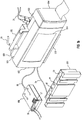
- FIG 1b shows the physical configuration of the monitor assembly 100 of Figure 1a.
- Portable monitor 102 is mounted on docking station 110, providing physical support, power, and communications.
- Monitor 102 acquires physiological data signals from data acquisition pods 150 for EKG data and 152 for pressure data.
- the non-invasive blood pressure cartridge 160, the end tidal CO2 cartridge 162, a hardcopy output device such as recorder 164 and the battery back 166 are individually attached to portable monitor 102 for purposes of illustration.
- portable monitor 102 is the core of a modular patient monitoring system 100.
- Portable monitor 102 includes an integrated liquid crystal display (LCD) 104.
- Peripheral devices may be coupled to the portable monitor 102, including input devices (e.g., pods 150, 152, 154, 155, 156, 158 and cartridges 160 and 162) and output devices (e.g., recorder 164 and cathode ray tube (CRT) display 120 and LCD 122).
- input devices e.g., pods 150, 152, 154, 155, 156, 158 and cartridges 160 and 162
- output devices e.g., recorder 164 and cathode ray tube (CRT) display 120 and LCD 122).
- CTR cathode ray tube
- a possible minimum configuration of the exemplary embodiment includes portable monitor 102, an EKG pod (150, 156 or 158) and the battery pack 166.
- Portable monitor 102 may be directly connected to additional external displays 120 and 122 through analog output ports 172. Alternatively, portable monitor 102 may be detachably mounted on a docking station, such as docking station 110, which can provide couplings to both power and communications networks. Portable monitor 102 receives power from docking station 110 through a connector 125.
- FIG. 2 is a block diagram showing the interaction of the components of portable monitor 102.
- Portable monitor 102 includes two printed circuit boards (PCBs): a processor PCB 200 and a peripheral PCB 220.
- Processor PCB 200 provides processing and storage resources for algorithm computation and for controlling system operations.
- peripheral printed circuit board (PCB) 220 Processor PCB 200 controls the acquisition of data from the pods and cartridges, the processing of patient data, display of parameters and waveforms, alarms and EthernetTM and multi-vendor connectivity.
- Processor 202 may be a Motorola 68EC040 or comparable processor. It controls the operation of portable monitor 102 and performs the non-numerically intensive arithmetic computations. Some numerically intensive computations are performed by components on peripheral PCB 220, and are discussed below.
- a 32 bit processor bus which may be Multibus II, provides the processor 202 access to the other devices on the processor PCB 200.
- a boot erasable programmable read only memory (EPROM) 230 provides the initial program startup, system console support, and the method to erase and download software into the flash EPROM (FPROM) 232.
- the EPROM may include 27C1024, 27C2048 or 27C4096 devices, which allow two wait state operation for the processor 202.
- the EPROM has a total memory size of 256KB to 1MB, with 32 bit access.
- Flash EPROM 232 contains the executable code. Flash EPROM 232 is programmed on processor PCB 200 under the control of processor 202. Flash EPROM 232 may include AMD/NEC 28F020 or 28F040 devices, which allow two wait state operation. Flash EPROM has a total memory size of 2 to 4 MB of memory, with 32 bit access. Flash EPROM 232 supports a line burst fill mode of operation.
- a dynamic random access memory (DRAM) 208 provides program data space.
- the system may also be set to a development mode, in which executable code is placed in DRAM 208.
- DRAM 208 may include NEC D424190 or HM514280 devices, which allow 2 wait state operation.
- the DRAM 208 has a total memory size of 1 MB of memory. The memory is organized as 32 data bits and 4 parity bits.
- Processor PCB 200 includes support circuitry 203 for processor 202.
- Circuitry 203 includes: DRAM parity generation and checking 236; two interval timers 240 and 242; a watchdog timer 238, an interrupt handler 244, a serial diagnostic port 234, memory mode selection 248, bus error time-out 246 and PC memory common interface adaptor control 247.
- support circuitry 203 is implemented in application specific integrated circuits (ASIC).
- Parity circuit 236 generates odd parity on memory writes and checks for errors on memory reads. If an error is detected, a parity error flag is set on a byte basis.
- the first timer 240 has a range of 0.1 to 12.7 milliseconds (msec).
- the second timer 242 has a range of 1 to 127 msec. The user selects the interval for each timer. If either timer is enabled and counts to the specified interval, an interrupt flag is set.
- Watchdog timer 238 allows selection of a timeout interval between 0.01 and 1.27 seconds. The user selects the interval. During system startup, watchdog timer 238 is disabled. If timer 238 is enabled and counts to the specified value during execution of any process, an interrupt flag is set. If the interrupt is not serviced within predetermined interval, a processor reset is generated.
- Interrupt handler 244 prioritizes the various interrupt sources into seven levels for the processor.
- the interrupts may be generated by watchdog timer 238, parity checker 236, timer 240, peripheral PCB 220, timer 242, graphics controller 254, or diagnostic port 234.
- Diagnostic serial port 234 provides a receive and transmit communications channel at 1.2, 9.6, or 19.2 Kbits per second, with 8 data bits, no parity, and 1 stop bit. The choice of the data rate is determined by a programmable parameter value. Data transfers are supported by polled status and interrupt control. Internal loopback may be programmed.
- Memory mode selection 248 controls the allocation of normal program execution space to the three physical memory devices: boot EPROM 230, flash PROM 232 and DRAM 208. During system startup, the execution space is allocated on boot EPROM 230.
- the bus error time-out function 246 activates a 10 microsecond timer when a bus cycle starts.
- the bus error is activated if a data acknowledge signal is not received within the 10 microsecond time period.
- Bus master circuit 206 on processor PCB 200 maps a 16 Mbyte peripheral space into the address space of CPU 202.
- CPU 202 has a 32 bit data bus 212 and peripheral bus 328 (as shown in Figure 3) includes a 16 bit data bus.
- bus master 206 includes a circuit to split each 32 bit word received from CPU 202 into two 16 bit words which peripheral bus 328 can accept. Each pair of 16 bit words is transmitted over two peripheral bus cycles.
- a conventional random access memory card 106 is used for information storage and transfer.
- the memory card interface is controlled by the PC memory common interface adaptor control function 247 of ASIC 203.
- Memory card 106 is a credit card sized encapsulated circuit board containing static RAM and a small battery.
- the information stored in the memory card 106 includes setup data (e.g., alarm limits), patient specific demographic and physiological trend data, and software.
- memory card 106 will be used when transferring patient data between two different portable monitors 102. Such transfers typically occur when a patient moves from one care unit (e.g., intensive care unit, operating room, or recovery room) to another. When used for storing software, memory card 106 provides a convenient mechanism for downloading software upgrades to portable monitor 102, which are then stored in a flash EPROM 232, shown in Figure 3. When used for these purposes, memory card 106 may be removed from portable monitor 102, except when in use for data or software transfers.
- one care unit e.g., intensive care unit, operating room, or recovery room
- memory card 106 When used for storing software, memory card 106 provides a convenient mechanism for downloading software upgrades to portable monitor 102, which are then stored in a flash EPROM 232, shown in Figure 3. When used for these purposes, memory card 106 may be removed from portable monitor 102, except when in use for data or software transfers.
- memory card 106 may be to associate a respective card with each patient from admission to checkout, providing rapid access to the patient's history at any time during his or her stay in the hospital.
- memory card 106 may remain in portable monitor 102 at all times between patient admission and discharge, except when the card is transferred between two portable monitors. All patient trend data would be stored, in a particular memory card and continuously upgraded at appropriate intervals.
- Still another use for the memory card is for software maintenance and upgrades.
- a new (second) set of instructions may be downloaded to the Flash EPROM 232 from the memory card 106 to replace the existing (first) set of instructions.
- FIG 3 is a block diagram of peripheral PCB 220 shown in Figure 2.
- Peripheral PCB 220 manages the interfaces between portable monitor 102 and all external devices and networks to which it may be connected.
- Peripheral PCB 220 is coupled to a port 327 of processor PCB 200.
- a peripheral bus 328 which may use conventional Intel Multibus format, couples processor 202 and the devices on the peripheral PCB 220.
- Peripheral bus 328 includes a 16-bit data path and a 24-bit address space, and has a bandwidth of at least 8 Mbytes/second.
- the bus masters can access peripheral bus 328, under the control of an arbiter 361, described below.
- the bus masters include: host bus master 206 for processor 202; two digital signal processors (DSPs) 330a and 330b for preprocessing the data acquisition samples; a carrier sense multiple access / collision detection (CSMA/CD) controller direct memory access (DMA) channel 362; two DMA channels 344a and 344b for transmitting commands to pods 150-158 and cartridges 160, 162 and for receiving sample data from the pods and cartridges; and a DMA channel for transmitting data to thermal recorder 164.
- DSPs digital signal processors
- CSMA/CD carrier sense multiple access / collision detection
- DMA direct memory access
- bus masters which may be either 206, 334, 362, 344a, 344b or 358
- processor 202 gives permission and releases control of address, data and strobe lines (not shown) in the bus 328.
- the bus master 206, 334, 344a, 344b, 358 or 362 then places memory addresses on bus 328, directing DMA data transfers to send or receive data.
- the DSP DMA control is implemented in a bus master application specific integrated circuit (ASIC) 334.
- Bus master circuit 334 connected to the DSPs 330a and 330b allows the DSPs to access the entire memory space 322 via peripheral bus 328.
- DSPs 330a and 330b access bus 328 by an indirect method.
- the DSP first writes to an address register 334a in bus master 334. This address points to the desired address on peripheral bus 328. After loading the address, the DSP may write to locations on bus 328. After each word is written, the lower sixteen address lines (not shown) will automatically increment, allowing efficient moves of block data.
- Bus Master 334 may also operate in slave mode, allowing the CPU 202 to arbitrate DSPs' 330a and 330b communications with peripheral bus 328. In this mode, CPU 202 can write directly into the DSPs' static random access memories (SRAM) 332a and 332b. This capability is used during initial download of the DSP code from CPU flash programmable read only memory (FPROM) 232 as shown in Figure 2.
- FPROM CPU flash programmable read only memory
- CPU 202 may also use this capability to deposit variables to and retrieve variables from DSPs 330a and 330b. All other bus masters (DMA channels 344a, 344b, 358 and 362) are prevented from accessing the DSPs' SRAM 332a and 332b in this manner, to ensure the integrity of the DSP code.
- DMA channels 344a, 344b, 358 and 362 are prevented from accessing the DSPs' SRAM 332a and 332b in this manner, to ensure the integrity of the DSP code.
- DMA channels 344a, 344b, 358 and 362 use peripheral bus 328 to read and write shared SRAM memory 322 and peripherals 150, 152, 154, 155, 156, 158, 160, 162, and 164.
- Channels 344a and 344b are used for data acquisition from pods 150, 152, 154, 155, 156, 158 and/or cartridges 160, 162.
- Channels 344a, 344b send commands and timing information to the pods and cartridges, and receive data and status from them.
- channels 344a, 344b When receiving data, channels 344a, 344b write the received data to respective buffers every two milliseconds (msec). After five consecutive two msec cycles, the data in the buffers are written over with new data. To ensure transfer of the data to the shared memory 322 for storage, two different types of interrupts are generated within channels 344a and 344b. The first interrupt is generated every two msec when data are placed in the buffer. The second interrupt is generated each time five blocks of data are received, i.e., every ten msec.
- DMA channel 358 is a special purpose thermal head driver for recorder 164. This channel combines data from three different locations in shared memory 322 to overlay grid, text and waveform data. Channel 358 also chains together print pages of varying length for outputting the data to recorder 164. The output signal from channel 358 is sent over a serial link 386 to recorder 164.
- DMA channel 362 is a conventional single chip CSMA/CD controller for twisted pair cable. This channel is used for communications to LANs when portable monitor 102 is placed in a docking station 110. Channel 362 is not operated when portable monitor 102 is removed from docking station 110.
- crosspoint switch 346a does not provide this isolation, so cartridges 160, 162 provide their own 5000 volt isolation between cartridge return circuits and the portable monitor 102 ground. Otherwise the two crosspoint switches 346a and 346b are functionally and logically identical.
- the crosspoint switches 346a, 346b receive patient data signals from the pods and cartridges and multiplex the data signals before passing them on to channels 344a and 344b.
- Each switch 346a and 346b can communicate with either channel 344a or 344b via separate 1.6 Mhz links 348a, 348b, 350a, and 350b.
- the two DMA channels 344a and 344b are synchronous and are run in a master/slave configuration. Every 15.6 microseconds, there are transfers between the pods/cartridges and shared memory 322. These transfers include two reads (one per channel 344a and 344b) and two writes (one per channel 344a and 344b) to a shared memory 322. Shared memory 322 includes an extra two byte word for channels 344a and 344b that is fetched during each 15 microsecond transfer to configure the crosspoint switches 346a and 346b. The low byte is used to control the crosspoint switch of slave DMA channel 344b and the high byte is used to control master DMA channel 344a.
- one respective bit in the control word is used to enable power to the pod, and another respective bit is used to enable transmission of a sync signal to the pod.
- a total of five words are transferred during each 15 msec cycle.
- the data samples are interleaved between the two DMA channels 344a and 344b.
- CPU 202 issues a request for identification to the pods and cartridges by way of their respective ports 364, 366, 368, 370, 372 and 374.
- the pod or cartridge responds with a unique identification signal.
- the channels 344a and 344b fetch 24 bit words from shared memory 322.
- Each 24 bit word includes an 8-bit DMA control word and a 16-bit front end command.
- the 8-bit DMA control word includes a 3-bit slot address identifying the port 364, 366, 368, 370, 372 and 374 to which the command is routed and a 2-bit DSP redirection control to identify the routing of the data returned by the pod or cartridge.
- the 16-bit command is transferred to the pods/cartridges.
- the DMA channels 344a and 344b also communicate with DSPs 330a and 330b by way of a serial interface 338. All of the data received by channels 344a and 344b is routed to the DSPs in addition to shared memory 322.
- the DSP is sent a frame sync signal from master DMA channel 344a every 2 msec.
- a bus arbiter 352 controls access to bus master 334 and DMA channels 344a and 344b.
- Bus master circuit 334 provides both round robin and prioritized arbitration. Since DMA channels 344a and 344b could lose data if denied access to bus 328 for an extended period, a round robin element is included in the arbitration scheme.
- bus arbiter 352 also allows burst mode operation, allowing multiple words to be written without entering additional wait states. Bus arbiter 352 also allows burst mode operation during read cycles.
- slave devices coupled to bus 328 by universal asynchronous receiver/transmitters (UARTs) 354. These include two multi-vendor ports 380 and 382 (MVP1, MVP2 respectively), and a battery port 378.
- UARTs universal asynchronous receiver/transmitters
- the two DSPs 330a and 330b may be conventional processors such as Analog Devices ADSP 2101 or 2105 DSP chips. These are 16-bit processors with an instruction set which includes normalization and exponent derivation by barrel shifting. Since many of the operations performed in the EKG algorithms are common signal processing functions, most of the computationally intensive and simply defined processing stages may be performed in the DSPs. These stages may include finite impulse response (FIR) and infinite impulse response (IIR) filtering, cross-correlation, power spectrum estimation and others. Matrix algorithms and other numerical processing may also be performed in the DSPs.
- FIR finite impulse response
- IIR infinite impulse response
- Matrix algorithms and other numerical processing may also be performed in the DSPs.
- DSPs 330a and 330b distribute data to all of the output devices coupled to portable monitor 102, including local display devices and network devices.
- the DSPs perform appropriate sample rate conversion, data scaling, and offsetting to the raw sample data collected by monitor 102.
- Monitor 102 includes a small internal battery (not shown). If external battery 166 (shown in Figure 1b) is at a low charge level, the internal battery provides power for a time period (e.g., 1 minute) which is sufficient to remove battery 166 and install another external battery.
- a time period e.g. 1 minute
- FIG. 4 shows a block diagram of an exemplary data acquisition pod 150.
- Pod 150 is self-contained. That is, Pod 150 includes all of the electronics required to acquire a signal from a sensor, condition the signal and transmit the signal to portable monitor 102, without inserting pod 150 in the monitor 102, or in a box (Pod 150 is unlike prior art data acquisition cartridges which must be mechanically inserted into a separate box to couple with the monitoring system).
- the use of a self-contained, standalone pod 150 simplifies preparing the patient for transportation. There is no need to remove pod 150 from a box, or to reconnect any cables between the pod 150 and monitor 102.
- Pod 150 receives patient data from a plurality of sensors 410a-410n via terminals 411a-411n (or terminals 16 and 17 as shown in FIG. 1). These sensors may measure EKG, blood pressure, pulse, temperature, EEG or other physiological parameters. Each input data stream is amplified and filtered by circuits 418a-418n to remove noise and any undesirable signals which the sensors may acquire. The amplified and filtered output signals 420a-420d are combined to form a single signal 415 by a combiner which may be a time division multiplexer 414. The combined signal 415 is then converted from analog form to digital form by A/D converter 412. Pod 150 includes a single coupling 150a to portable monitor 102.
- Pod 150 may also optionally include a memory 432 for storing calibration data and alarm limits.
- Pods 152, 154, 155, 156 and 158 are similar insofar as the functions shown in Figure 4 are concerned.
- the main function of the pods 150-158 is data acquisition.
- the filtering and amplification are performed to ensure that the data furnished to monitor 102 accurately represent the parameters sensed by sensors 410a-410n.
- the application of mathematical algorithms to these data to process the signals is performed inside portable monitor 102.
- This division of services between pods 150-158 and monitor 102 reduces the size of the pods 150-158 relative to typical prior art data acquisition cartridges.
- Pods 150-158 are small enough to be positioned conveniently in a variety of positions, including: on a shelf, on a bed, on a bed rail or headboard, under a pillow, or on an intravenous pole.
- An exemplary patient monitoring system in accordance with the invention may include any one of a basic, diagnostic or neonatal pod.
- a base EKG pod 150 acquires real-time EKG and respiration waveforms as input data, which are processed by QRS, arrhythmia and S-T segment analysis algorithms in DSP's 330a and 330b.
- the sensors (not shown) in pod 150 are five electrodes with leads I, II, III, IV (AVR, AVL and AVF leads) and V (chest). From this data, portable monitor 102 can determine impedance respiration as well as heart rate.
- Base pod 150 also accepts input data from two temperature sensors which may be used for measuring nasal respiration and cardiac output (C.O.).
- a nasal respiration thermistor (not shown) may be used to detect respiration by sensing the changes in nasal passage temperature due to the difference in temperature between inhaled and exhaled air.
- C.O. data are acquired by using the thermodilution method.
- An Edwards type catheter (not shown) can be used to inject either cooled or room temperature water into the coronary artery. Downstream blood temperature and injectate temperatures are then measured.
- pod 150 receives data representative of pulse and oximetry.
- Oximetry data representing the saturation, or fraction of oxyhemoglobin to functional hemoglobin (SpO2 in %O2) are collected using absorption spectrophotometry.
- pod 150 includes two proximately located switches 13 and 15.
- Switch 13 is coupled to a circuit which transmits a signal to monitor 102 causing monitor 102 to condition itself to start the cardiac output procedure (e.g., perform range and alarm limit adjustments). The operator actuates switch 13 at the same time that he or she injects the injectate into the patient for cardiac output measurement.
- the DSPs 330a and 330b in monitor 102 calculate the waveform of the temperature gradient between thermistors for the cardiac output procedure.
- switch 15 is coupled to a circuit which transmits a signal to monitor 102 causing monitor 102 to configure itself to start the wedge procedure and/or switch the display to wedge mode. (The wedge procedure is executed during a measurement of the pulmonary artery wedge pressure).
- switch 15 The operator actuates switch 15 at the same time that he or she inflates a balloon inside the patient's pulmonary artery for pulmonary artery wedge pressure measurement.
- Switches 13 and 15 are conveniently co-located on pod 150 (near the sensors on the patient). This facilitates concurrent actuation of switch 13 while starting the cardiac output measurement, and facilitates concurrent actuation of switch 15 while starting the wedge procedure.
- Diagnostic pod 156 includes input terminals to receive data from sensors similar to those used in conjunction with base pod 150. In addition, the diagnostic pod accepts five further leads for receiving EKG data from additional electrodes which may be placed on the patient's chest. Alternatively, additional terminals may be used to receive EEG data.
- Neonatal pod 158 includes input terminals similar to diagnostic pod 156.
- neonatal pod 158 includes terminals for receiving long-term, non-invasive, transcutaneous data for monitoring the partial pressures of oxygen and carbon dioxide.
- a general gas bench for blood gas analysis may be included.
- an exemplary patient monitoring system in accordance with the invention may include a pressure pod 152 (or 154) and/or an oximetry catheter pod 155.
- Pressure pod 152 accepts data from 4 invasive pressure sensors, which are fluidly coupled to strain gage transducers, and accepts data from 2 temperature sensors.
- the pressure pod 152 has a zero switch 42 conveniently located on pod 152, where it is easily actuated while calibrating sensors (not shown) by exposing them to atmospheric pressure. Actuating the zero switch causes pod 152 to transmit a zero signal to monitor 102, causing monitor 102 to reset the value of its waveform to zero in response to the voltage currently detected across the sensor.
- a second switch 44 located on pod 152 sends a further signal to monitor 102, causing monitor 102 to condition itself to begin a wedge procedure. The response of monitor 102 to this further signal is the same as described above with respect to actuation of switch 15 on pod 150.
- the location of the control switches on the pod simplifies operations.
- Pressure/Temperature pod 154 accepts data from two transducers.
- the catheter pod 155 receives data from a catheter inserted into the patients artery.
- Figure 5 shows the mechanical configuration of an exemplary non-invasive blood pressure cartridge 160.
- cartridge 160 is not independently positionable, but mounts on monitor 102,
- Cartridge 160 accepts data via line 19 for oscillometric measurement of systolic, diastolic, and mean arterial pressures from a cuff transducer (not shown). Cartridge 160 performs functions similar to the pod functions shown in Figure 4. In addition, the cartridge provides a separate 5000 volt isolation between the cartridge return circuit and the portable monitor ground for safety and to reduce undesirable noise.
- cartridge 160 includes a suitable mechanism to attach itself to portable monitor 102.
- This may be in the form of a guide piece 160a with a latch 160c.
- Guide piece 160a slides into a mating guide (not shown) on portable monitor 102, engaging connector 160b with a mating connector 129 (shown in FIG. 1a) on the monitor, and engaging the latch 160c with a mating catch (not shown) on the monitor in a single operation.
- Many variations in the shape of guide piece 160a and latch 160c may be used to provide the mechanical coupling at the same time that connector 160b is engaged to provide electrical coupling.
- Mounting cartridge 160 directly to monitor 102 is convenient and uses space efficiently; a bulky box is not needed to house the cartridge.
- the end-tidal CO2 Cartridge 162, recorder 164 and battery pack 166 each use a similar coupling technique, to facilitate reconfiguration of the portable monitor 102.
- the end-tidal CO2 Cartridge 162 receives data representing inhaled and exhaled carbon dioxide partial pressures from an airway adapter (not shown) via line 21, and engages connector 131 (shown in Figure 1).
- the recorder 164 is a conventional three channel thermal printer.
- the battery pack 166 includes a conventional nickel-cadmium battery.
- the data acquisition cartridge may be practiced in a number of alternative embodiments. Both the types of sensors used and the number of sensors of each type may be varied. Preferably, data acquisition modules which are bulky, heavy, or consume large amounts of power are implemented as cartridges, while small, lightweight low power data acquisition modules are implemented as pods.
- pressure cartridge 160 includes a motor and pneumatic devices, in addition to the filters, amplifiers, multiplexer and A/D converter. In considering whether a new type of sensor should be added to a pod or a cartridge, isolation requirements may be a factor, since each cartridge provides its own isolation.
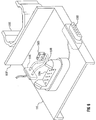
- FIG. 6 shows docking station 110 to which portable monitor 102 may be attached.
- a connector 110a provides data communications couplings to the portable monitor.
- a guide 110b which may be integral with connector 110a as shown in Figure 6, facilitates proper positioning of monitor 102 on docking station 110, and assists in maintaining monitor 102 in position while monitor 102 is on docking station 110.
- a separate connector 110g provides power.
- Respective connectors 110c and 110d provide power and data communications links from portable monitor 102 to external power sources, devices and networks, when monitor 102 is on docking station 110.
- Connector 102d may be a conventional connector to interface directly to an EthernetTM LAN 118 (shown in Figure 1A). Additionally, the data may be output to a remote display 120 or 122 , or to an intelligent workstation, for display in VGA format.
- clamp 110e may be used to mount a docking station on an intravenous pole (not shown).
- clamp 110e may be omitted and backplate 110f may be fastened directly to a wall or bed.
- connector 110a and guide 110b may be separate from one another. There may be multiple connectors 110a and/or multiple connectors 110d. Additional mechanical fasteners may be added to improve the stability of the detachable mounting.
- Connector 110d may alternatively connect to a smart wallbox 140, as indicated in Figure 1a.
- the wallbox converts the twisted pair CSMA/CD signal from line 136 (shown in Figure 1a) to 10 Mbits/second Thinnet, which uses the IEEE 802.3 Type 10-Base-2 standard.
- This connection provides a LAN connection between portable monitor 102 and remote stations which may be patient monitoring systems or computers.
- a separate connection 138 provides 1 Mbit/second communications with an input/output device LAN, which may include keyboards, pointing devices, voice input, bar code readers and label printers.
- Eight additional multi-vendor ports (MVP) 130 are provided.
- Four analog output ports provide waveform data for transmission to external devices (e.g., monitors, recorders).
- Wall box 140 assigns ID numbers to devices which connect to it. This allows the portable monitor to automatically identify any changes to the configuration devices connected to the wall box 140.
- Figure 7 is a flow diagram showing steps which are performed automatically to update the patient data in portable monitor 102 memory (the portable monitor data storing means), or the data in remote display 120 memory (assuming that remote display 120 has storage), so that both are kept current.
- portable monitor 102 is inserted in docking station 110, and the connection to the remote display 120 is established.
- memory in the remote display 120 is checked for data. If there are no data then patient physiological data stored in the portable monitor 102 is downloaded to remote display 120 memory at step 754. If there are data in remote display 120, at step 756, a determination is made whether the data in remote display 120 and the data in portable monitor 102 are associated with the same patient. A double comparison is made; both patient name and patient identification are compared. If either the name or the ID do not match, or if either the name or ID is blank, then the data in the portable monitor 102 and remote display 120 are considered to be associated with two different patients.
- remote display 120 will prompt the operator to choose either the data in remote display 120 or the data in portable monitor 102.
- the data are copied from remote display 120 to the portable monitor 102 if remote display 120 is selected, or from portable monitor 102 to remote display 120 if portable monitor 102 is selected.
- step 756 If it is determined at step 756 that the data in remote display 120 and portable monitor 102 are associated with the same patient, then at step 762, a determination is made whether the data in remote display 120 are newer than the data in portable monitor 102. If the portable monitor data are newer, then at step 764 the portable monitor data are copied to remote display 120. If the remote display data are newer, then at step 766, the remote display data are copied to portable monitor 102.
- monitor 102 exchanges data with memory card 106 instead of remote display 120. It is understood that replacing display 120 with memory card 106 in steps 750 through 766 above, the data in monitor 102 and memory card 106 are kept current.
Landscapes
- Health & Medical Sciences (AREA)
- Engineering & Computer Science (AREA)
- Biomedical Technology (AREA)
- General Health & Medical Sciences (AREA)
- Life Sciences & Earth Sciences (AREA)
- Public Health (AREA)
- Medical Informatics (AREA)
- Primary Health Care (AREA)
- Epidemiology (AREA)
- General Business, Economics & Management (AREA)
- Business, Economics & Management (AREA)
- Molecular Biology (AREA)
- Animal Behavior & Ethology (AREA)
- Surgery (AREA)
- Heart & Thoracic Surgery (AREA)
- Veterinary Medicine (AREA)
- Pathology (AREA)
- Biophysics (AREA)
- Physics & Mathematics (AREA)
- Computer Networks & Wireless Communication (AREA)
- Measuring And Recording Apparatus For Diagnosis (AREA)
Applications Claiming Priority (2)
| Application Number | Priority Date | Filing Date | Title |
|---|---|---|---|
| US98941592A | 1992-12-11 | 1992-12-11 | |
| US989415 | 1992-12-11 |
Publications (3)
| Publication Number | Publication Date |
|---|---|
| EP0601589A2 true EP0601589A2 (fr) | 1994-06-15 |
| EP0601589A3 EP0601589A3 (fr) | 1995-06-28 |
| EP0601589B1 EP0601589B1 (fr) | 2000-03-08 |
Family
ID=25535093
Family Applications (1)
| Application Number | Title | Priority Date | Filing Date |
|---|---|---|---|
| EP93119901A Expired - Lifetime EP0601589B1 (fr) | 1992-12-11 | 1993-12-09 | Appareil modulaire transportable de surveillance du patient avec module d'acquisition de données |
Country Status (5)
| Country | Link |
|---|---|
| US (1) | US6221012B1 (fr) |
| EP (1) | EP0601589B1 (fr) |
| AT (1) | ATE190413T1 (fr) |
| DE (1) | DE69328011T2 (fr) |
| DK (1) | DK0601589T3 (fr) |
Cited By (19)
| Publication number | Priority date | Publication date | Assignee | Title |
|---|---|---|---|---|
| US5579775A (en) * | 1994-10-20 | 1996-12-03 | Hewlett-Packard Company | Dynamic control of a patient monitoring system |
| US5687734A (en) * | 1994-10-20 | 1997-11-18 | Hewlett-Packard Company | Flexible patient monitoring system featuring a multiport transmitter |
| WO1999023597A3 (fr) * | 1997-10-31 | 1999-07-08 | Mercury Diagnostics Inc | Systeme servant a recueillir et a communiquer des informations concernant la concentration d'une substance a analyser |
| WO2000067636A1 (fr) * | 1999-05-06 | 2000-11-16 | Shell, Allan, Michael | Cable d'acquisition d'un signal physiologique |
| WO2002015781A1 (fr) * | 2000-08-18 | 2002-02-28 | Masimo Corporation | Sphygmo-oxymetre bi-mode |
| WO2002041773A1 (fr) * | 2000-11-20 | 2002-05-30 | Siemens Medical Solutions Usa, Inc. | Systeme de couplage de signaux et de puissance isole electriquement pour un dispositif relie a un patient |
| US6584336B1 (en) | 1999-01-25 | 2003-06-24 | Masimo Corporation | Universal/upgrading pulse oximeter |
| US6658276B2 (en) | 1999-01-25 | 2003-12-02 | Masimo Corporation | Pulse oximeter user interface |
| US6770028B1 (en) | 1999-01-25 | 2004-08-03 | Masimo Corporation | Dual-mode pulse oximeter |
| WO2003094712A3 (fr) * | 2002-05-08 | 2004-11-04 | Philips Intellectual Property | Systeme de diagnostic et/ou d'analyse installe sur le lieu d'administration des soins |
| DE102005032431A1 (de) * | 2005-03-15 | 2006-09-21 | Weinmann Geräte für Medizin GmbH & Co. KG | Modulares medizintechnisches Gerät |
| EP1746978A4 (fr) * | 2004-05-20 | 2010-03-03 | Animas Corp | Procedes et systemes pour etablir une interface entre un dispositif medical ambulatoire et un dispositif d'affichage |
| USRE41946E1 (en) | 1997-07-22 | 2010-11-23 | International Technidyne Corporation | Portable immediate response medical analyzer having multiple testing modules |
| EP2392253A1 (fr) * | 2007-04-18 | 2011-12-07 | Weinmann | Dispositif et procédé destinés à l'actualisation d'appareils respiratoires |
| EP2043503A4 (fr) * | 2006-07-05 | 2012-08-01 | Elcam Medical Agricultural Cooperative Ass Ltd | Système de surveillance médicale sans fil |
| EP2214552A4 (fr) * | 2007-11-09 | 2013-01-09 | Integrated Medical Systems Inc | Informations et architecture pneumatique pour un dispositif de soins et de traitement pour un patient |
| EP2211693A4 (fr) * | 2007-10-26 | 2013-08-21 | Hill Rom Services Inc | Système et procédé pour la collecte et la communication de données provenant de multiples dispositifs de soin de patient |
| US9375185B2 (en) | 1999-01-25 | 2016-06-28 | Masimo Corporation | Systems and methods for acquiring calibration data usable in a pulse oximeter |
| US10360787B2 (en) | 2016-05-05 | 2019-07-23 | Hill-Rom Services, Inc. | Discriminating patient care communications system |
Families Citing this family (224)
| Publication number | Priority date | Publication date | Assignee | Title |
|---|---|---|---|---|
| US6968375B1 (en) | 1997-03-28 | 2005-11-22 | Health Hero Network, Inc. | Networked system for interactive communication and remote monitoring of individuals |
| US5956501A (en) | 1997-01-10 | 1999-09-21 | Health Hero Network, Inc. | Disease simulation system and method |
| US7613590B2 (en) | 1992-11-17 | 2009-11-03 | Health Hero Network, Inc. | Modular microprocessor-based power tool system |
| US5832448A (en) | 1996-10-16 | 1998-11-03 | Health Hero Network | Multiple patient monitoring system for proactive health management |
| US8095340B2 (en) | 1992-11-17 | 2012-01-10 | Health Hero Network, Inc. | Home power management system |
| US5307263A (en) | 1992-11-17 | 1994-04-26 | Raya Systems, Inc. | Modular microprocessor-based health monitoring system |
| US8027809B2 (en) | 1992-11-17 | 2011-09-27 | Health Hero Network, Inc. | Home power management system |
| US9215979B2 (en) | 1992-11-17 | 2015-12-22 | Robert Bosch Healthcare Systems, Inc. | Multi-user remote health monitoring system |
| US6330426B2 (en) | 1994-05-23 | 2001-12-11 | Stephen J. Brown | System and method for remote education using a memory card |
| US6196970B1 (en) | 1999-03-22 | 2001-03-06 | Stephen J. Brown | Research data collection and analysis |
| WO2001037174A1 (fr) * | 1992-11-17 | 2001-05-25 | Health Hero Network, Inc. | Procede et systeme pour ameliorer l'observance d'un programme dietetique ou de tout autre regime medical |
| US7624028B1 (en) * | 1992-11-17 | 2009-11-24 | Health Hero Network, Inc. | Remote health monitoring and maintenance system |
| US8078431B2 (en) | 1992-11-17 | 2011-12-13 | Health Hero Network, Inc. | Home power management system |
| US20010011224A1 (en) | 1995-06-07 | 2001-08-02 | Stephen James Brown | Modular microprocessor-based health monitoring system |
| US8078407B1 (en) | 1997-03-28 | 2011-12-13 | Health Hero Network, Inc. | System and method for identifying disease-influencing genes |
| US5951300A (en) | 1997-03-10 | 1999-09-14 | Health Hero Network | Online system and method for providing composite entertainment and health information |
| GB2288922B (en) | 1994-04-25 | 1998-04-01 | John Edward Mcgrath | Patient monitoring apparatus |
| US5778882A (en) * | 1995-02-24 | 1998-07-14 | Brigham And Women's Hospital | Health monitoring system |
| US7305348B1 (en) | 1996-02-20 | 2007-12-04 | Health Hero Network, Inc. | Aggregating and pooling health related information in a communication system with feedback |
| WO1998028039A2 (fr) * | 1996-12-20 | 1998-07-02 | Ep Technologies, Inc. | Systeme unifie de commutation servant a effectuer une stimulation electrophysiologique, un enregistrement et une analyse de signaux |
| US7590549B2 (en) | 1996-12-23 | 2009-09-15 | Health Hero Network, Inc. | Network media access control system for encouraging patient compliance with a treatment plan |
| US6032119A (en) | 1997-01-16 | 2000-02-29 | Health Hero Network, Inc. | Personalized display of health information |
| US7612999B2 (en) * | 1998-09-18 | 2009-11-03 | Flo Healthcare Solutions, Llc | Mobile clinical workstation |
| US8521546B2 (en) | 1998-09-25 | 2013-08-27 | Health Hero Network | Dynamic modeling and scoring risk assessment |
| EP1175240B1 (fr) * | 1999-05-04 | 2004-09-01 | MAP Medizin-Technologie GmbH | Dispositif de detection de potentiels electriques dans la zone frontale d'un patient |
| US7256708B2 (en) * | 1999-06-23 | 2007-08-14 | Visicu, Inc. | Telecommunications network for remote patient monitoring |
| US6424525B1 (en) * | 1999-08-27 | 2002-07-23 | Stratos Product Development Llc | External peripheral attachment device for use as a hub or computer |
| US6564104B2 (en) * | 1999-12-24 | 2003-05-13 | Medtronic, Inc. | Dynamic bandwidth monitor and adjuster for remote communications with a medical device |
| US7286894B1 (en) * | 2000-01-07 | 2007-10-23 | Pasco Scientific | Hand-held computer device and method for interactive data acquisition, analysis, annotation, and calibration |
| US20020046278A1 (en) * | 2000-07-17 | 2002-04-18 | Roy Hays | Method and system for global log on in a distributed system |
| US6454709B1 (en) * | 2000-08-29 | 2002-09-24 | Peter Kleinschmidt | Tele-evaluation system, especially for medicine |
| US20050192841A1 (en) * | 2000-09-01 | 2005-09-01 | Roy Hays | Method and system for collecting information before user registration |
| US6970737B1 (en) * | 2000-09-13 | 2005-11-29 | Ge Medical Systems Information Technologies, Inc. | Portable ECG device with wireless communication interface to remotely monitor patients and method of use |
| EP1197178B1 (fr) * | 2000-10-12 | 2008-07-09 | GE Medical Systems Information Technologies, Inc. | Système d'information clinique mobile |
| US6524240B1 (en) * | 2000-11-22 | 2003-02-25 | Medwave, Inc. | Docking station for portable medical devices |
| EP1349491B1 (fr) | 2000-12-07 | 2013-04-17 | Children's Medical Center Corporation | Systeme de soins medicaux a interpretation automatisee |
| EP1226784B1 (fr) * | 2001-01-25 | 2007-04-11 | Matsushita Electric Industrial Co., Ltd. | Système de détection de signaux vitaux et méthode de contrôle de santé |
| WO2002064032A2 (fr) | 2001-02-14 | 2002-08-22 | Siemens Medical Solutions Usa, Inc. | Réseau de zone de surveillance des patients |
| CA2694414C (fr) * | 2001-05-07 | 2014-07-08 | Respironics, Inc. | Transducteur de pression portatif, pneumotachographe utilise avec celui-ci et procedes associes |
| US20020198740A1 (en) * | 2001-06-21 | 2002-12-26 | Roman Linda L. | Intelligent data retrieval system and method |
| US20080177154A1 (en) * | 2001-08-13 | 2008-07-24 | Novo Nordisk A/S | Portable Device and Method Of Communicating Medical Data Information |
| US6773397B2 (en) | 2001-10-11 | 2004-08-10 | Draeger Medical Systems, Inc. | System for processing signal data representing physiological parameters |
| US20070124292A1 (en) * | 2001-10-30 | 2007-05-31 | Evan Kirshenbaum | Autobiographical and other data collection system |
| US6588670B2 (en) * | 2001-10-30 | 2003-07-08 | Symbol Technologies, Inc. | Medical diagnostic monitoring |
| US6859667B2 (en) * | 2001-11-07 | 2005-02-22 | Cardiac Pacemakers, Inc. | Multiplexed medical device lead with standard header |
| US6829501B2 (en) * | 2001-12-20 | 2004-12-07 | Ge Medical Systems Information Technologies, Inc. | Patient monitor and method with non-invasive cardiac output monitoring |
| USD470849S1 (en) | 2002-01-04 | 2003-02-25 | Medtronic Physio-Control Corp. | Docking station |
| US10173008B2 (en) | 2002-01-29 | 2019-01-08 | Baxter International Inc. | System and method for communicating with a dialysis machine through a network |
| US8775196B2 (en) | 2002-01-29 | 2014-07-08 | Baxter International Inc. | System and method for notification and escalation of medical data |
| US20030149593A1 (en) * | 2002-02-04 | 2003-08-07 | Msc Healthcare (S) Pte. Ltd. | Health-care system |
| US6865418B2 (en) | 2002-03-04 | 2005-03-08 | Medtronic Physio-Control Corp. | Docking station for defibrillator |
| US6850788B2 (en) | 2002-03-25 | 2005-02-01 | Masimo Corporation | Physiological measurement communications adapter |
| US7338443B1 (en) * | 2002-04-29 | 2008-03-04 | Tucker Peter L | Secure patient data recorder for recording monitored vital sign data |
| US8234128B2 (en) | 2002-04-30 | 2012-07-31 | Baxter International, Inc. | System and method for verifying medical device operational parameters |
| US7134994B2 (en) * | 2002-05-20 | 2006-11-14 | Volcano Corporation | Multipurpose host system for invasive cardiovascular diagnostic measurement acquisition and display |
| US20030236450A1 (en) * | 2002-06-24 | 2003-12-25 | Kocinski Richard J. | System for remotely monitoring and controlling CPAP apparatus |
| US6870475B2 (en) * | 2002-07-08 | 2005-03-22 | Draeger Medical Systems Inc. | Electrically isolated power and data coupling system suitable for portable and other equipment |
| US20050288571A1 (en) | 2002-08-20 | 2005-12-29 | Welch Allyn, Inc. | Mobile medical workstation |
| US20040186357A1 (en) * | 2002-08-20 | 2004-09-23 | Welch Allyn, Inc. | Diagnostic instrument workstation |
| US20040147818A1 (en) * | 2002-11-18 | 2004-07-29 | Andrew Levy | Portable system for monitoring and processing patient parameters in multiple oprational modes |
| USD497995S1 (en) | 2002-12-19 | 2004-11-02 | Huntleigh Technology Plc | Medical device casing |
| US20040189444A1 (en) * | 2003-03-31 | 2004-09-30 | Gill Andrew M. | Maintenance interval timer and method of monitoring maintence intervals |
| US7260480B1 (en) | 2003-04-07 | 2007-08-21 | Health Hero Network, Inc. | Method and system for integrating feedback loops in medical knowledge development and healthcare management |
| US7399276B1 (en) * | 2003-05-08 | 2008-07-15 | Health Hero Network, Inc. | Remote health monitoring system |
| EP1631929B1 (fr) * | 2003-06-11 | 2013-08-07 | Draeger Medical Systems, Inc. | Systeme de surveillance de patient portable comprenant une fonction d'identification d'emplacement |
| IL156556A (en) * | 2003-06-19 | 2010-02-17 | Eran Schenker | A system detects life signals |
| US7129836B2 (en) * | 2003-09-23 | 2006-10-31 | Ge Medical Systems Information Technologies, Inc. | Wireless subject monitoring system |
| WO2005050525A1 (fr) * | 2003-11-12 | 2005-06-02 | Draeger Medical Systems, Inc. | Dispositif de traitement et systeme d'affichage de soins de sante |
| CN1871611A (zh) * | 2003-11-12 | 2006-11-29 | 德雷格医疗系统股份有限公司 | 模块化医疗护理系统 |
| EP1683066A2 (fr) * | 2003-11-13 | 2006-07-26 | Draeger Medical Systems, Inc. | Systeme compose d'un dispositif de traitement et d'un afficheur |
| JP3832473B2 (ja) * | 2004-02-25 | 2006-10-11 | オムロンヘルスケア株式会社 | 血圧測定装置 |
| US7292141B2 (en) * | 2004-04-29 | 2007-11-06 | Zoe Medical Incorporated | Audible alarm enhancement for monitoring systems |
| CA2578753A1 (fr) * | 2004-07-28 | 2006-02-02 | National University Of Ireland, Galway | Systeme de controle et de diagnostic medical portatif |
| EP1782360A4 (fr) * | 2004-08-27 | 2009-03-18 | Medic4All Ag | Procede et systeme pour l'utilisation d'un dispositif mobile comme terminal personnel portatif pour l'information medicale |
| JP2008519494A (ja) * | 2004-10-29 | 2008-06-05 | ドレーガー メディカル システムズ インコーポレイテッド | 無線pan/lan間の自動切り替え装置 |
| CN101128149B (zh) * | 2004-12-13 | 2010-05-12 | 卡迪科尔实验室公司 | 捕捉的心电图的传输 |
| WO2006076498A2 (fr) * | 2005-01-13 | 2006-07-20 | Welch Allyn, Inc. | Moniteur de signes vitaux |
| US8321241B1 (en) * | 2005-05-31 | 2012-11-27 | Allscripts Software, Llc | Electronic patient record documentation with push and pull of data to and from database |
| US20070064615A1 (en) * | 2005-09-20 | 2007-03-22 | Honeywell International Inc. | Methods and systems for observing digital signal output |
| US7638897B2 (en) * | 2005-09-22 | 2009-12-29 | The General Electric Company | Method and system for powering a patient monitoring system |
| US20070073266A1 (en) * | 2005-09-28 | 2007-03-29 | Zin Technologies | Compact wireless biometric monitoring and real time processing system |
| US8764654B2 (en) * | 2008-03-19 | 2014-07-01 | Zin Technologies, Inc. | Data acquisition for modular biometric monitoring system |
| EP1962671A2 (fr) * | 2005-12-03 | 2008-09-03 | Masimo Corporation | Systeme de notification d'alarmes physiologiques |
| US7699786B2 (en) * | 2006-04-05 | 2010-04-20 | Omron Healthcare Co., Ltd. | Electronic blood pressure monitor |
| US20090270689A1 (en) * | 2006-06-02 | 2009-10-29 | Cbb International Pty Ltd | Monitoring system |
| US20080076969A1 (en) * | 2006-08-29 | 2008-03-27 | Ulrich Kraft | Methods for modifying control software of electronic medical devices |
| US20080081980A1 (en) * | 2006-09-18 | 2008-04-03 | Michael Maschke | Apparatus and process for stroke examination and treatment using a C-arch X-ray system |
| US8840549B2 (en) * | 2006-09-22 | 2014-09-23 | Masimo Corporation | Modular patient monitor |
| US9161696B2 (en) * | 2006-09-22 | 2015-10-20 | Masimo Corporation | Modular patient monitor |
| US8727618B2 (en) * | 2006-11-22 | 2014-05-20 | Siemens Aktiengesellschaft | Robotic device and method for trauma patient diagnosis and therapy |
| US7870400B2 (en) * | 2007-01-02 | 2011-01-11 | Freescale Semiconductor, Inc. | System having a memory voltage controller which varies an operating voltage of a memory and method therefor |
| US20080234555A1 (en) * | 2007-03-23 | 2008-09-25 | Stryker Corporation | Patient care system |
| US20080274552A1 (en) * | 2007-05-04 | 2008-11-06 | Brian Guthrie | Dynamic Information Transfer |
| DE202007018568U1 (de) * | 2007-05-31 | 2008-11-13 | Dräger Medical AG & Co. KG | Patientenpflegeeinheit mit einer Liegefläche |
| DE102007026910A1 (de) | 2007-06-12 | 2008-12-18 | Siemens Ag | Untersuchungseinheit mit integrierter Minilabor-Analyseeinheit |
| US20090005651A1 (en) * | 2007-06-27 | 2009-01-01 | Welch Allyn, Inc. | Portable systems, devices and methods for displaying varied information depending on usage circumstances |
| WO2009042063A1 (fr) * | 2007-09-27 | 2009-04-02 | Cardiac Pacemakers, Inc. | Dérivation implantable comprenant un condensateur d'électrostimulation |
| ATE547044T1 (de) * | 2007-10-11 | 2012-03-15 | Lidco Group Plc | Monitor zur hämodynamischen überwachung |
| US8310336B2 (en) * | 2008-10-10 | 2012-11-13 | Masimo Corporation | Systems and methods for storing, analyzing, retrieving and displaying streaming medical data |
| WO2009049254A2 (fr) | 2007-10-12 | 2009-04-16 | Masimo Corporation | Systèmes et procédés pour stocker, analyser et récupérer des données médicales |
| US8974398B2 (en) * | 2007-11-08 | 2015-03-10 | St. Jude Medical Coordination Center Bvba | Removable energy source for sensor guidewire |
| US7998089B2 (en) * | 2007-11-08 | 2011-08-16 | Radi Medical Systems Ab | Method of making a guide wire based assembly and reusing an energy source |
| US8169304B2 (en) | 2008-02-22 | 2012-05-01 | Hill-Rom Services, Inc. | User station for healthcare communication system |
| US20090240527A1 (en) * | 2008-03-21 | 2009-09-24 | Computerized Screening, Inc. | Community based managed health kiosk system |
| EP2278911A1 (fr) * | 2008-05-02 | 2011-02-02 | Masimo Corporation | Système de configuration de moniteur |
| US20090292309A1 (en) * | 2008-05-20 | 2009-11-26 | Michael Maschke | System and workflow for diagnosing and treating septum defects |
| US20100010320A1 (en) * | 2008-07-07 | 2010-01-14 | Perkins David G | Mobile medical workstation and a temporarily associating mobile computing device |
| US10089443B2 (en) | 2012-05-15 | 2018-10-02 | Baxter International Inc. | Home medical device systems and methods for therapy prescription and tracking, servicing and inventory |
| US8057679B2 (en) | 2008-07-09 | 2011-11-15 | Baxter International Inc. | Dialysis system having trending and alert generation |
| US8554579B2 (en) | 2008-10-13 | 2013-10-08 | Fht, Inc. | Management, reporting and benchmarking of medication preparation |
| DE102009005404A1 (de) * | 2009-01-19 | 2010-07-22 | Carl Freudenberg Kg | Flexibel deformierbares Kabel mit textilem Verbund |
| US20100228101A1 (en) * | 2009-03-04 | 2010-09-09 | Michael Maschke | Workflow for stroke diagnosis combining in-vitro diagnosis (ivd) with an imaging modality |
| US10007758B2 (en) | 2009-03-04 | 2018-06-26 | Masimo Corporation | Medical monitoring system |
| WO2010102069A2 (fr) | 2009-03-04 | 2010-09-10 | Masimo Corporation | Système de surveillance médicale |
| US10032002B2 (en) | 2009-03-04 | 2018-07-24 | Masimo Corporation | Medical monitoring system |
| US9323894B2 (en) | 2011-08-19 | 2016-04-26 | Masimo Corporation | Health care sanitation monitoring system |
| US9596989B2 (en) | 2009-03-12 | 2017-03-21 | Raytheon Company | Networked symbiotic edge user infrastructure |
| US20110208015A1 (en) | 2009-07-20 | 2011-08-25 | Masimo Corporation | Wireless patient monitoring system |
| CA2775921C (fr) | 2009-10-08 | 2017-11-21 | The Regents Of The University Of Michigan | Affichage d'alerte visuelle en temps reel |
| US8936555B2 (en) * | 2009-10-08 | 2015-01-20 | The Regents Of The University Of Michigan | Real time clinical decision support system having linked references |
| US20110257563A1 (en) * | 2009-10-26 | 2011-10-20 | Vytronus, Inc. | Methods and systems for ablating tissue |
| US9153112B1 (en) * | 2009-12-21 | 2015-10-06 | Masimo Corporation | Modular patient monitor |
| US9126000B2 (en) * | 2010-02-26 | 2015-09-08 | Nihon Kohden Corporation | Artificial ventilation apparatus |
| US20230165524A1 (en) * | 2010-04-22 | 2023-06-01 | Leaf Healthcare, Inc. | Systems and Methods for Managing A Person's Position to Encourage Proning |
| US8578082B2 (en) | 2010-07-29 | 2013-11-05 | Covidien LLP | Configurable patient monitoring system |
| US8694600B2 (en) | 2011-03-01 | 2014-04-08 | Covidien Lp | Remote monitoring systems for monitoring medical devices via wireless communication networks |
| US8897198B2 (en) | 2011-01-14 | 2014-11-25 | Covidien Lp | Medical device wireless network architectures |
| US8798527B2 (en) | 2011-01-14 | 2014-08-05 | Covidien Lp | Wireless relay module for remote monitoring systems |
| US8855550B2 (en) | 2011-01-14 | 2014-10-07 | Covidien Lp | Wireless relay module having emergency call functionality |
| US8811888B2 (en) | 2011-01-14 | 2014-08-19 | Covidien Lp | Wireless relay module for monitoring network status |
| US9495511B2 (en) | 2011-03-01 | 2016-11-15 | Covidien Lp | Remote monitoring systems and methods for medical devices |
| US8903308B2 (en) | 2011-01-14 | 2014-12-02 | Covidien Lp | System and method for patient identification in a remote monitoring system |
| US9020419B2 (en) | 2011-01-14 | 2015-04-28 | Covidien, LP | Wireless relay module for remote monitoring systems having power and medical device proximity monitoring functionality |
| US8818260B2 (en) | 2011-01-14 | 2014-08-26 | Covidien, LP | Wireless relay module for remote monitoring systems |
| US9629566B2 (en) | 2011-03-11 | 2017-04-25 | Spacelabs Healthcare Llc | Methods and systems to determine multi-parameter managed alarm hierarchy during patient monitoring |
| US8671237B2 (en) | 2011-05-31 | 2014-03-11 | Covidien Lp | Patient monitoring platform interface |
| US9943269B2 (en) | 2011-10-13 | 2018-04-17 | Masimo Corporation | System for displaying medical monitoring data |
| US9436645B2 (en) | 2011-10-13 | 2016-09-06 | Masimo Corporation | Medical monitoring hub |
| US10149616B2 (en) | 2012-02-09 | 2018-12-11 | Masimo Corporation | Wireless patient monitoring device |
| US10307111B2 (en) | 2012-02-09 | 2019-06-04 | Masimo Corporation | Patient position detection system |
| CN104471623A (zh) * | 2012-05-15 | 2015-03-25 | 太空实验室健康护理有限公司 | 可配置便携式患者监测系统 |
| KR20150056580A (ko) | 2012-09-13 | 2015-05-26 | 코비디엔 엘피 | 장내 급식 펌프용 도킹 스테이션 |
| US9749232B2 (en) | 2012-09-20 | 2017-08-29 | Masimo Corporation | Intelligent medical network edge router |
| EP3453377B1 (fr) | 2012-10-26 | 2026-04-29 | Baxter Corporation Englewood | Station de travail améliorée pour système de préparation de doses médicales |
| KR101695119B1 (ko) | 2012-10-26 | 2017-01-23 | 백스터 코포레이션 잉글우드 | 의료 투여분 조제 시스템을 위한 개선된 이미지 취득 |
| US20130281801A1 (en) | 2013-03-04 | 2013-10-24 | Hello Inc. | System using patient monitoring devices with unique patient ID's and a telemetry system |
| US9430938B2 (en) | 2013-03-04 | 2016-08-30 | Hello Inc. | Monitoring device with selectable wireless communication |
| US9367793B2 (en) | 2013-03-04 | 2016-06-14 | Hello Inc. | Wearable device with magnets distanced from exterior surfaces of the wearable device |
| US9432091B2 (en) | 2013-03-04 | 2016-08-30 | Hello Inc. | Telemetry system with wireless power receiver and monitoring devices |
| US9298882B2 (en) | 2013-03-04 | 2016-03-29 | Hello Inc. | Methods using patient monitoring devices with unique patient IDs and a telemetry system |
| US9204798B2 (en) | 2013-03-04 | 2015-12-08 | Hello, Inc. | System for monitoring health, wellness and fitness with feedback |
| US9427160B2 (en) | 2013-03-04 | 2016-08-30 | Hello Inc. | Wearable device with overlapping ends coupled by magnets positioned in the wearable device by an undercut |
| US9553486B2 (en) | 2013-03-04 | 2017-01-24 | Hello Inc. | Monitoring system and device with sensors that is remotely powered |
| US9530089B2 (en) | 2013-03-04 | 2016-12-27 | Hello Inc. | Wearable device with overlapping ends coupled by magnets of a selected width, length and depth |
| US9392939B2 (en) | 2013-03-04 | 2016-07-19 | Hello Inc. | Methods using a monitoring device to monitor individual activities, behaviors or habit information and communicate with a database with corresponding individual base information for comparison |
| US9406220B2 (en) | 2013-03-04 | 2016-08-02 | Hello Inc. | Telemetry system with tracking receiver devices |
| US9345404B2 (en) | 2013-03-04 | 2016-05-24 | Hello Inc. | Mobile device that monitors an individuals activities, behaviors, habits or health parameters |
| US9330561B2 (en) | 2013-03-04 | 2016-05-03 | Hello Inc. | Remote communication systems and methods for communicating with a building gateway control to control building systems and elements |
| US9424508B2 (en) | 2013-03-04 | 2016-08-23 | Hello Inc. | Wearable device with magnets having first and second polarities |
| US9445651B2 (en) | 2013-03-04 | 2016-09-20 | Hello Inc. | Wearable device with overlapping ends coupled by magnets |
| US9320434B2 (en) | 2013-03-04 | 2016-04-26 | Hello Inc. | Patient monitoring systems and messages that send alerts to patients only when the patient is awake |
| US9436903B2 (en) | 2013-03-04 | 2016-09-06 | Hello Inc. | Wearable device with magnets with a defined distance between adjacent magnets |
| US9737214B2 (en) | 2013-03-04 | 2017-08-22 | Hello Inc. | Wireless monitoring of patient exercise and lifestyle |
| US9662015B2 (en) | 2013-03-04 | 2017-05-30 | Hello Inc. | System or device with wearable devices having one or more sensors with assignment of a wearable device user identifier to a wearable device user |
| US9582748B2 (en) | 2013-03-04 | 2017-02-28 | Hello Inc. | Base charging station for monitoring device |
| US9420857B2 (en) | 2013-03-04 | 2016-08-23 | Hello Inc. | Wearable device with interior frame |
| US9704209B2 (en) | 2013-03-04 | 2017-07-11 | Hello Inc. | Monitoring system and device with sensors and user profiles based on biometric user information |
| US9345403B2 (en) | 2013-03-04 | 2016-05-24 | Hello Inc. | Wireless monitoring system with activity manager for monitoring user activity |
| US9634921B2 (en) | 2013-03-04 | 2017-04-25 | Hello Inc. | Wearable device coupled by magnets positioned in a frame in an interior of the wearable device with at least one electronic circuit |
| US9420856B2 (en) | 2013-03-04 | 2016-08-23 | Hello Inc. | Wearable device with adjacent magnets magnetized in different directions |
| US9398854B2 (en) | 2013-03-04 | 2016-07-26 | Hello Inc. | System with a monitoring device that monitors individual activities, behaviors or habit information and communicates with a database with corresponding individual base information for comparison |
| US9427189B2 (en) | 2013-03-04 | 2016-08-30 | Hello Inc. | Monitoring system and device with sensors that are responsive to skin pigmentation |
| US9339188B2 (en) | 2013-03-04 | 2016-05-17 | James Proud | Methods from monitoring health, wellness and fitness with feedback |
| US9149189B2 (en) | 2013-03-04 | 2015-10-06 | Hello, Inc. | User or patient monitoring methods using one or more analysis tools |
| US9159223B2 (en) | 2013-03-04 | 2015-10-13 | Hello, Inc. | User monitoring device configured to be in communication with an emergency response system or team |
| US9848776B2 (en) | 2013-03-04 | 2017-12-26 | Hello Inc. | Methods using activity manager for monitoring user activity |
| US9414651B2 (en) | 2013-03-04 | 2016-08-16 | Hello Inc. | Wearable device with overlapping ends coupled by magnets operating in a temperature range of 200° F. to 400° F. |
| US9361572B2 (en) | 2013-03-04 | 2016-06-07 | Hello Inc. | Wearable device with magnets positioned at opposing ends and overlapped from one side to another |
| US9357922B2 (en) | 2013-03-04 | 2016-06-07 | Hello Inc. | User or patient monitoring systems with one or more analysis tools |
| US9526422B2 (en) | 2013-03-04 | 2016-12-27 | Hello Inc. | System for monitoring individuals with a monitoring device, telemetry system, activity manager and a feedback system |
| US9532716B2 (en) | 2013-03-04 | 2017-01-03 | Hello Inc. | Systems using lifestyle database analysis to provide feedback |
| US10987026B2 (en) | 2013-05-30 | 2021-04-27 | Spacelabs Healthcare Llc | Capnography module with automatic switching between mainstream and sidestream monitoring |
| US10004451B1 (en) | 2013-06-21 | 2018-06-26 | Fitbit, Inc. | User monitoring system |
| US10009581B2 (en) | 2015-01-02 | 2018-06-26 | Fitbit, Inc. | Room monitoring device |
| US9610030B2 (en) | 2015-01-23 | 2017-04-04 | Hello Inc. | Room monitoring device and sleep analysis methods |
| US9993166B1 (en) | 2013-06-21 | 2018-06-12 | Fitbit, Inc. | Monitoring device using radar and measuring motion with a non-contact device |
| US9993197B2 (en) | 2013-06-21 | 2018-06-12 | Fitbit, Inc. | Patient monitoring systems and messages that send alerts to patients only when the patient is awake |
| US10058290B1 (en) | 2013-06-21 | 2018-08-28 | Fitbit, Inc. | Monitoring device with voice interaction |
| USD746441S1 (en) | 2013-09-13 | 2015-12-29 | Covidien Lp | Pump |
| US10832818B2 (en) | 2013-10-11 | 2020-11-10 | Masimo Corporation | Alarm notification system |
| JP2017525032A (ja) | 2014-06-30 | 2017-08-31 | バクスター・コーポレーション・イングルウッドBaxter Corporation Englewood | 管理された医療情報交換 |
| US11107574B2 (en) | 2014-09-30 | 2021-08-31 | Baxter Corporation Englewood | Management of medication preparation with formulary management |
| US11575673B2 (en) | 2014-09-30 | 2023-02-07 | Baxter Corporation Englewood | Central user management in a distributed healthcare information management system |
| EP3210183B1 (fr) | 2014-10-24 | 2020-09-02 | Baxter Corporation Englewood | Échange automatique d'informations sur les soins de santé pour effectuer des dosages de médicaments |
| US9642967B2 (en) * | 2014-11-18 | 2017-05-09 | Hill-Rom Services, Inc. | Catheter monitor integration with patient support, hygiene and healthcare communication systems |
| EP3937116A1 (fr) | 2014-12-05 | 2022-01-12 | Baxter Corporation Englewood | Analyse de données de préparation de dose |
| CA2978455A1 (fr) | 2015-03-03 | 2016-09-09 | Baxter Corporation Englewood | Gestion de flux de travail en pharmacie avec alertes integrees |
| JP6783781B2 (ja) * | 2015-03-03 | 2020-11-11 | コーニンクレッカ フィリップス エヌ ヴェKoninklijke Philips N.V. | 患者モニタリング及び電気療法供給のためのモジュール式医療システム |
| EP3314488B1 (fr) | 2015-06-25 | 2024-03-13 | Gambro Lundia AB | Système et procédé de dispositif médical comprenant une base de données distribuée |
| AU2016315947B2 (en) | 2015-08-31 | 2021-02-18 | Masimo Corporation | Wireless patient monitoring systems and methods |
| US10361508B2 (en) | 2016-03-14 | 2019-07-23 | Drägerwerk AG & Co. KGaA | Docking devices and cable connectors for patient monitoring systems |
| US10076458B2 (en) | 2016-05-19 | 2018-09-18 | Aaron McClellan | Hospital bed having modular power/data hub |
| US10617302B2 (en) | 2016-07-07 | 2020-04-14 | Masimo Corporation | Wearable pulse oximeter and respiration monitor |
| WO2018035758A1 (fr) * | 2016-08-24 | 2018-03-01 | 深圳迈瑞生物医疗电子股份有限公司 | Dispositif médical |
| US11076777B2 (en) | 2016-10-13 | 2021-08-03 | Masimo Corporation | Systems and methods for monitoring orientation to reduce pressure ulcer formation |
| KR102476516B1 (ko) | 2016-12-21 | 2022-12-09 | 감브로 룬디아 아베 | 외부 도메인을 지원하는 안전한 클러스터 도메인을 구비한 정보 기술 인프라를 포함하는 의료 장치 시스템 |
| CN109564445B (zh) * | 2016-12-27 | 2023-04-14 | 德尔格制造股份两合公司 | 显示器监视器和监视器安装件 |
| GB2564098A (en) * | 2017-06-28 | 2019-01-09 | Remote Diagnostic Tech Ltd | Patient monitoring |
| US11721939B2 (en) | 2018-04-06 | 2023-08-08 | Drägerwerk AG & Co. KGaA | Modular patient monitoring medical device and connector |
| EP3782165A1 (fr) | 2018-04-19 | 2021-02-24 | Masimo Corporation | Affichage d'alarme de patient mobile |
| US12495968B2 (en) | 2018-10-12 | 2025-12-16 | Masimo Corporation | System for transmission of sensor data using dual communication protocol |
| CA3115108A1 (fr) | 2018-10-12 | 2020-04-16 | Masimo Corporation | Systeme de transmission de donnees d'un capteur a l'aide d'un protocole de communication double |
| US11204622B2 (en) * | 2019-05-24 | 2021-12-21 | Drägerwerk AG & Co. KGaA | Systems, monitor mounts, monitors, racks, modules, and cable holders |
| CN114040710B (zh) | 2019-06-26 | 2024-09-03 | 太空实验室健康护理有限公司 | 使用身体穿戴传感器的数据修改所监测的生理数据 |
| JP7737391B2 (ja) | 2020-03-20 | 2025-09-10 | マシモ・コーポレイション | 非侵襲的な体温測定のためのウェアラブルデバイス |
| USD980091S1 (en) | 2020-07-27 | 2023-03-07 | Masimo Corporation | Wearable temperature measurement device |
| USD974193S1 (en) | 2020-07-27 | 2023-01-03 | Masimo Corporation | Wearable temperature measurement device |
| USD1072837S1 (en) | 2020-10-27 | 2025-04-29 | Masimo Corporation | Display screen or portion thereof with graphical user interface |
| WO2022224167A1 (fr) | 2021-04-21 | 2022-10-27 | Chamoun Tony | Dispositif et système pour améliorer les soins apportés à des patients sur des dispositifs médicaux |
| USD1000975S1 (en) | 2021-09-22 | 2023-10-10 | Masimo Corporation | Wearable temperature measurement device |
| US12521021B2 (en) | 2021-09-22 | 2026-01-13 | Masimo Corporation | Wearable device for noninvasive body temperature measurement |
| WO2023132952A1 (fr) | 2022-01-05 | 2023-07-13 | Masimo Corporation | Système d'oxymétrie de pouls porté au poignet et au doigt |
| USD1048908S1 (en) | 2022-10-04 | 2024-10-29 | Masimo Corporation | Wearable sensor |
| CN121488161A (zh) * | 2024-06-06 | 2026-02-06 | 深圳迈瑞动物医疗科技股份有限公司 | 即时检测设备、模块和即时检测设备的控制方法 |
Family Cites Families (55)
| Publication number | Priority date | Publication date | Assignee | Title |
|---|---|---|---|---|
| DE6948919U (de) | 1969-12-16 | 1970-03-19 | Bbc Brown Boveri & Cie | Wandmonitor zur patientenueberwachung |
| US3848582A (en) | 1972-07-10 | 1974-11-19 | Medical Res Labor Inc | Portable electrocardiographic signal apparatus |
| US3910257A (en) * | 1973-04-25 | 1975-10-07 | Nasa | Medical subject monitoring systems |
| US3858576A (en) | 1973-05-23 | 1975-01-07 | Sachs Elektronik Kg Hugo | Portable electrocardioscope |
| DE2813764C3 (de) | 1978-03-30 | 1981-09-03 | Siemens AG, 1000 Berlin und 8000 München | Elektromedizinisches Gerät zur Abnahme und Verarbeitung von elektrischen physiologischen Signalen |
| US4356825A (en) * | 1978-08-21 | 1982-11-02 | United States Surgical Corporation | Method and system for measuring rate of occurrence of a physiological parameter |
| JPS5558154A (en) | 1978-10-24 | 1980-04-30 | Toshimitsu Mushiya | Electronic diagnosis device |
| US4519398A (en) * | 1979-07-09 | 1985-05-28 | Del Mar Avionics | Method and apparatus for long-term monitoring of physiological activity to provide a compact portable record |
| JPS57500499A (fr) | 1980-03-31 | 1982-03-25 | ||
| DE3027719A1 (de) * | 1980-07-22 | 1982-02-11 | Patent-Treuhand-Gesellschaft für elektrische Glühlampen mbH, 8000 München | Reflektor zur ausleuchtung einer flaeche |
| US4356475A (en) | 1980-09-12 | 1982-10-26 | Siemens Aktiengesellschaft | System containing a predetermined number of monitoring devices and at least one central station |
| US4325385A (en) | 1980-09-19 | 1982-04-20 | Simonsen & Weel's Eftf. A/S | Patient monitoring equipment |
| US4378021A (en) | 1981-02-18 | 1983-03-29 | Strand Eric J | Electronic EKG measurement mode selection system |
| US4458690A (en) * | 1982-05-24 | 1984-07-10 | Novatec, Inc. | Blood pressure monitor |
| US4546436A (en) * | 1983-07-06 | 1985-10-08 | The Johns Hopkins University | Portable pH data collector |
| US4981139A (en) * | 1983-08-11 | 1991-01-01 | Pfohl Robert L | Vital signs monitoring and communication system |
| US4619265A (en) * | 1984-03-08 | 1986-10-28 | Physio-Control Corporation | Interactive portable defibrillator including ECG detection circuit |
| JPS618002U (ja) * | 1984-06-18 | 1986-01-18 | 日本光電工業株式会社 | 有線式患者監視装置用入力装置 |
| US4606352A (en) | 1984-07-13 | 1986-08-19 | Purdue Research Foundation | Personal electrocardiogram monitor |
| US4577639A (en) | 1984-11-08 | 1986-03-25 | Spacelabs, Inc. | Apparatus and method for automatic lead selection in electrocardiography |
| US4756706A (en) * | 1985-01-23 | 1988-07-12 | American Hospital Supply Corporation | Centrally managed modular infusion pump system |
| US4724844A (en) | 1985-06-26 | 1988-02-16 | Stephen Rafelson | Vital sign modular unit |
| US4835372A (en) * | 1985-07-19 | 1989-05-30 | Clincom Incorporated | Patient care system |
| US5012411A (en) * | 1985-07-23 | 1991-04-30 | Charles J. Policastro | Apparatus for monitoring, storing and transmitting detected physiological information |
| US5029590A (en) * | 1985-08-09 | 1991-07-09 | Allain Joseph L | Portable, life detection monitor system |
| US5181521A (en) * | 1986-03-20 | 1993-01-26 | Lemelson Jerome H | Portable electronic instrument and method |
| US4850009A (en) * | 1986-05-12 | 1989-07-18 | Clinicom Incorporated | Portable handheld terminal including optical bar code reader and electromagnetic transceiver means for interactive wireless communication with a base communications station |
| US4940058A (en) * | 1986-06-09 | 1990-07-10 | Taff Barry E | Cryogenic remote sensing physiograph |
| US4803625A (en) * | 1986-06-30 | 1989-02-07 | Buddy Systems, Inc. | Personal health monitor |
| JPH0420215Y2 (fr) | 1986-07-21 | 1992-05-08 | ||
| US4875486A (en) * | 1986-09-04 | 1989-10-24 | Advanced Techtronics, Inc. | Instrument and method for non-invasive in vivo testing for body fluid constituents |
| US4889132A (en) * | 1986-09-26 | 1989-12-26 | The University Of North Carolina At Chapel Hill | Portable automated blood pressure monitoring apparatus and method |
| US4715385A (en) | 1986-09-26 | 1987-12-29 | Marquette Electronics, Inc. | Patient monitoring system having transportable data module and display unit |
| US4895161A (en) | 1986-09-26 | 1990-01-23 | Marquette Electronics | Transportable data module and display unit for patient monitoring system |
| JPH03502893A (ja) * | 1987-06-30 | 1991-07-04 | マイクロメディカル インダストリーズ リミテッド | モジュール式生理モニタ |
| US4814759A (en) | 1987-07-08 | 1989-03-21 | Clinicom Incorporated | Flat panel display monitor apparatus |
| JPH0191834A (ja) * | 1987-08-20 | 1989-04-11 | Tsuruta Hiroko | 個人医療データの集中管理装置 |
| US4909260A (en) * | 1987-12-03 | 1990-03-20 | American Health Products, Inc. | Portable belt monitor of physiological functions and sensors therefor |
| US4966154A (en) * | 1988-02-04 | 1990-10-30 | Jonni Cooper | Multiple parameter monitoring system for hospital patients |
| US4916441A (en) * | 1988-09-19 | 1990-04-10 | Clinicom Incorporated | Portable handheld terminal |
| US5077476A (en) * | 1990-06-27 | 1991-12-31 | Futrex, Inc. | Instrument for non-invasive measurement of blood glucose |
| CA1323922C (fr) | 1989-09-26 | 1993-11-02 | William Fang | Moniteur personnel de parametres de sante |
| US5227988A (en) * | 1989-11-09 | 1993-07-13 | Nippon Steel Corporation | Apparatus for detecting various process values and apparatus for recording information |
| US5025808A (en) * | 1990-01-31 | 1991-06-25 | Marquette Electronics, Inc. | Cardiac monitoring method and apparatus |
| NL9001571A (nl) | 1990-07-10 | 1992-02-03 | Viggo Spectramed B V | Verbindingsinrichting. |
| US5036856A (en) * | 1990-07-19 | 1991-08-06 | Thornton William E | Cardiovascular monitoring system |
| US5267147A (en) * | 1990-10-19 | 1993-11-30 | Heads Up Technologies, Inc. | Portable checklist system |
| US5133346A (en) * | 1990-12-03 | 1992-07-28 | Arvee Medical, Incorporated | Apnea monitor data system |
| US5239997A (en) * | 1990-12-20 | 1993-08-31 | Guarino John R | Diagnostic apparatus utilizing low frequency sound waves |
| US5168206A (en) * | 1990-12-21 | 1992-12-01 | Dallas Semiconductor Corp. | Battery manager chip with connections for redundant backup battery |
| US5256157A (en) * | 1991-01-31 | 1993-10-26 | Baxter International Inc. | Automated infusion pump with replaceable memory cartridges |
| US5099463A (en) * | 1991-05-02 | 1992-03-24 | Lloyd Harry A | Portable electronic medication dosage instruction and alarm device |
| US5228450A (en) * | 1991-05-03 | 1993-07-20 | Diagnostic Medical Instruments, Inc. | Methods and apparatus for ambulatory physiological monitoring |
| US5226431A (en) * | 1991-06-20 | 1993-07-13 | Caliber Medical Corporation | Optical/electrical transceiver |
| US5307263A (en) * | 1992-11-17 | 1994-04-26 | Raya Systems, Inc. | Modular microprocessor-based health monitoring system |
-
1993
- 1993-12-09 DE DE69328011T patent/DE69328011T2/de not_active Expired - Lifetime
- 1993-12-09 EP EP93119901A patent/EP0601589B1/fr not_active Expired - Lifetime
- 1993-12-09 AT AT93119901T patent/ATE190413T1/de active
- 1993-12-09 DK DK93119901T patent/DK0601589T3/da active
-
1995
- 1995-01-06 US US08/369,853 patent/US6221012B1/en not_active Expired - Lifetime
Cited By (29)
| Publication number | Priority date | Publication date | Assignee | Title |
|---|---|---|---|---|
| US5579775A (en) * | 1994-10-20 | 1996-12-03 | Hewlett-Packard Company | Dynamic control of a patient monitoring system |
| US5687734A (en) * | 1994-10-20 | 1997-11-18 | Hewlett-Packard Company | Flexible patient monitoring system featuring a multiport transmitter |
| USRE41946E1 (en) | 1997-07-22 | 2010-11-23 | International Technidyne Corporation | Portable immediate response medical analyzer having multiple testing modules |
| WO1999023597A3 (fr) * | 1997-10-31 | 1999-07-08 | Mercury Diagnostics Inc | Systeme servant a recueillir et a communiquer des informations concernant la concentration d'une substance a analyser |
| US6134504A (en) * | 1997-10-31 | 2000-10-17 | Mercury Diagnostics, Incorporated | Analyte concentration information collection and communication system |
| US6584336B1 (en) | 1999-01-25 | 2003-06-24 | Masimo Corporation | Universal/upgrading pulse oximeter |
| US9375185B2 (en) | 1999-01-25 | 2016-06-28 | Masimo Corporation | Systems and methods for acquiring calibration data usable in a pulse oximeter |
| US6658276B2 (en) | 1999-01-25 | 2003-12-02 | Masimo Corporation | Pulse oximeter user interface |
| US6770028B1 (en) | 1999-01-25 | 2004-08-03 | Masimo Corporation | Dual-mode pulse oximeter |
| US10231676B2 (en) | 1999-01-25 | 2019-03-19 | Masimo Corporation | Dual-mode patient monitor |
| WO2000067636A1 (fr) * | 1999-05-06 | 2000-11-16 | Shell, Allan, Michael | Cable d'acquisition d'un signal physiologique |
| EP2064989A3 (fr) * | 2000-08-18 | 2010-12-15 | Masimo Corporation | Sphygmo-oxymètre bimode |
| WO2002015781A1 (fr) * | 2000-08-18 | 2002-02-28 | Masimo Corporation | Sphygmo-oxymetre bi-mode |
| US6819013B2 (en) | 2000-11-20 | 2004-11-16 | Draeger Medical Systems, Inc. | Electrically isolated power and signal coupler system for a patient connected device |
| WO2002041773A1 (fr) * | 2000-11-20 | 2002-05-30 | Siemens Medical Solutions Usa, Inc. | Systeme de couplage de signaux et de puissance isole electriquement pour un dispositif relie a un patient |
| WO2003094712A3 (fr) * | 2002-05-08 | 2004-11-04 | Philips Intellectual Property | Systeme de diagnostic et/ou d'analyse installe sur le lieu d'administration des soins |
| EP1746978A4 (fr) * | 2004-05-20 | 2010-03-03 | Animas Corp | Procedes et systemes pour etablir une interface entre un dispositif medical ambulatoire et un dispositif d'affichage |
| DE102005032431A1 (de) * | 2005-03-15 | 2006-09-21 | Weinmann Geräte für Medizin GmbH & Co. KG | Modulares medizintechnisches Gerät |
| DE102005032431B4 (de) * | 2005-03-15 | 2025-04-30 | Weinmann Emergency Medical Technology Gmbh + Co. Kg | Modulares medizintechnisches Gerät |
| US8753274B2 (en) | 2006-07-05 | 2014-06-17 | Elcam Medical Agricultural Cooperative Association, Ltd. | Wireless medical monitoring system |
| EP2043503A4 (fr) * | 2006-07-05 | 2012-08-01 | Elcam Medical Agricultural Cooperative Ass Ltd | Système de surveillance médicale sans fil |
| EP2392253A1 (fr) * | 2007-04-18 | 2011-12-07 | Weinmann | Dispositif et procédé destinés à l'actualisation d'appareils respiratoires |
| US8756078B2 (en) | 2007-10-26 | 2014-06-17 | Hill-Rom Services, Inc. | System and method for collection and communication of data from multiple patient care devices |
| EP2211693A4 (fr) * | 2007-10-26 | 2013-08-21 | Hill Rom Services Inc | Système et procédé pour la collecte et la communication de données provenant de multiples dispositifs de soin de patient |
| US9734293B2 (en) | 2007-10-26 | 2017-08-15 | Hill-Rom Services, Inc. | System and method for association of patient care devices to a patient |
| US11031130B2 (en) | 2007-10-26 | 2021-06-08 | Hill-Rom Services, Inc. | Patient support apparatus having data collection and communication capability |
| EP2214552A4 (fr) * | 2007-11-09 | 2013-01-09 | Integrated Medical Systems Inc | Informations et architecture pneumatique pour un dispositif de soins et de traitement pour un patient |
| US10360787B2 (en) | 2016-05-05 | 2019-07-23 | Hill-Rom Services, Inc. | Discriminating patient care communications system |
| US11791055B2 (en) | 2016-05-05 | 2023-10-17 | Hill-Rom Services, Inc. | Discriminating patient care communications system |
Also Published As
| Publication number | Publication date |
|---|---|
| ATE190413T1 (de) | 2000-03-15 |
| DE69328011D1 (de) | 2000-04-13 |
| US6221012B1 (en) | 2001-04-24 |
| EP0601589B1 (fr) | 2000-03-08 |
| DE69328011T2 (de) | 2000-08-03 |
| EP0601589A3 (fr) | 1995-06-28 |
| DK0601589T3 (da) | 2000-07-24 |
Similar Documents
| Publication | Publication Date | Title |
|---|---|---|
| US5375604A (en) | Transportable modular patient monitor | |
| EP0601589B1 (fr) | Appareil modulaire transportable de surveillance du patient avec module d'acquisition de données | |
| EP1181888B1 (fr) | Appareil de manipulation des câbles à liaisons multiples | |
| JP4121568B2 (ja) | フレキシブルな患者モニタ・システム | |
| JP3817283B2 (ja) | 患者モニタ・システム | |
| EP0603666B1 (fr) | Dispositif d'acquisition de données de pression pour système de surveillance du patient | |
| US6493568B1 (en) | Patient interface system | |
| CA2836481C (fr) | Interface de plateforme de surveillance de patient | |
| EP0553372B1 (fr) | Méthode et système de surveillance de fonctions vitales | |
| JPH08214379A (ja) | 患者モニタ・システム | |
| WO1999013766A1 (fr) | Systeme de gestion des soins aux patients en phase critique a tele-imagerie et telesurveillance | |
| EP1126779A1 (fr) | Dispositif d'acquisition de signal physiologique a main | |
| JPH08237759A (ja) | 遠隔測定ドッキング・ステーション | |
| WO2021137110A1 (fr) | Système de connecteur modulaire et connecteur modulaire ayant deux logements fixés de manière amovible ou plus | |
| US20210013929A1 (en) | Electrical node with monitoring feature | |
| US20040249279A1 (en) | Patient monitor for processing signals from an ultrasound probe | |
| CN217566086U (zh) | 生命体征测量装置 |
Legal Events
| Date | Code | Title | Description |
|---|---|---|---|
| PUAI | Public reference made under article 153(3) epc to a published international application that has entered the european phase |
Free format text: ORIGINAL CODE: 0009012 |
|
| AK | Designated contracting states |
Kind code of ref document: A2 Designated state(s): AT DE DK FR GB IT NL SE |
|
| PUAL | Search report despatched |
Free format text: ORIGINAL CODE: 0009013 |
|
| AK | Designated contracting states |
Kind code of ref document: A3 Designated state(s): AT DE DK FR GB IT NL SE |
|
| 17P | Request for examination filed |
Effective date: 19950818 |
|
| 17Q | First examination report despatched |
Effective date: 19980116 |
|
| GRAG | Despatch of communication of intention to grant |
Free format text: ORIGINAL CODE: EPIDOS AGRA |
|
| GRAG | Despatch of communication of intention to grant |
Free format text: ORIGINAL CODE: EPIDOS AGRA |
|
| GRAH | Despatch of communication of intention to grant a patent |
Free format text: ORIGINAL CODE: EPIDOS IGRA |
|
| GRAH | Despatch of communication of intention to grant a patent |
Free format text: ORIGINAL CODE: EPIDOS IGRA |
|
| GRAA | (expected) grant |
Free format text: ORIGINAL CODE: 0009210 |
|
| AK | Designated contracting states |
Kind code of ref document: B1 Designated state(s): AT DE DK FR GB IT NL SE |
|
| REF | Corresponds to: |
Ref document number: 190413 Country of ref document: AT Date of ref document: 20000315 Kind code of ref document: T |
|
| REF | Corresponds to: |
Ref document number: 69328011 Country of ref document: DE Date of ref document: 20000413 |
|
| ITF | It: translation for a ep patent filed | ||
| ET | Fr: translation filed | ||
| REG | Reference to a national code |
Ref country code: DK Ref legal event code: T3 |
|
| PLBE | No opposition filed within time limit |
Free format text: ORIGINAL CODE: 0009261 |
|
| STAA | Information on the status of an ep patent application or granted ep patent |
Free format text: STATUS: NO OPPOSITION FILED WITHIN TIME LIMIT |
|
| 26N | No opposition filed | ||
| REG | Reference to a national code |
Ref country code: GB Ref legal event code: IF02 |
|
| REG | Reference to a national code |
Ref country code: GB Ref legal event code: 732E |
|
| REG | Reference to a national code |
Ref country code: FR Ref legal event code: TP Ref country code: FR Ref legal event code: CD |
|
| NLS | Nl: assignments of ep-patents |
Owner name: DRAEGER MEDICAL SYSTEMS, INC. Effective date: 20061017 |
|
| NLT1 | Nl: modifications of names registered in virtue of documents presented to the patent office pursuant to art. 16 a, paragraph 1 |
Owner name: SIEMENS MEDICAL SOLUTIONS USA, INC. |
|
| PGFP | Annual fee paid to national office [announced via postgrant information from national office to epo] |
Ref country code: DK Payment date: 20121228 Year of fee payment: 20 |
|
| PGFP | Annual fee paid to national office [announced via postgrant information from national office to epo] |
Ref country code: GB Payment date: 20121227 Year of fee payment: 20 Ref country code: IT Payment date: 20121220 Year of fee payment: 20 |
|
| PGFP | Annual fee paid to national office [announced via postgrant information from national office to epo] |
Ref country code: FR Payment date: 20130110 Year of fee payment: 20 Ref country code: AT Payment date: 20121121 Year of fee payment: 20 |
|
| PGFP | Annual fee paid to national office [announced via postgrant information from national office to epo] |
Ref country code: DE Payment date: 20121231 Year of fee payment: 20 Ref country code: SE Payment date: 20130102 Year of fee payment: 20 |
|
| PGFP | Annual fee paid to national office [announced via postgrant information from national office to epo] |
Ref country code: NL Payment date: 20121225 Year of fee payment: 20 |
|
| REG | Reference to a national code |
Ref country code: DE Ref legal event code: R071 Ref document number: 69328011 Country of ref document: DE |
|
| REG | Reference to a national code |
Ref country code: DK Ref legal event code: EUP Effective date: 20131209 |
|
| REG | Reference to a national code |
Ref country code: NL Ref legal event code: V4 Effective date: 20131209 |
|
| REG | Reference to a national code |
Ref country code: GB Ref legal event code: PE20 Expiry date: 20131208 |
|
| REG | Reference to a national code |
Ref country code: AT Ref legal event code: MK07 Ref document number: 190413 Country of ref document: AT Kind code of ref document: T Effective date: 20131209 |
|
| PG25 | Lapsed in a contracting state [announced via postgrant information from national office to epo] |
Ref country code: GB Free format text: LAPSE BECAUSE OF EXPIRATION OF PROTECTION Effective date: 20131208 Ref country code: DE Free format text: LAPSE BECAUSE OF EXPIRATION OF PROTECTION Effective date: 20131210 |
|
| REG | Reference to a national code |
Ref country code: SE Ref legal event code: EUG |