EP0601898A2 - Anpassbares Ein/Ausgabe-Gerät unter Verwendung von ausgewähten Musterdaten gemäss einer Auswertungsgrösse - Google Patents
Anpassbares Ein/Ausgabe-Gerät unter Verwendung von ausgewähten Musterdaten gemäss einer Auswertungsgrösse Download PDFInfo
- Publication number
- EP0601898A2 EP0601898A2 EP93402267A EP93402267A EP0601898A2 EP 0601898 A2 EP0601898 A2 EP 0601898A2 EP 93402267 A EP93402267 A EP 93402267A EP 93402267 A EP93402267 A EP 93402267A EP 0601898 A2 EP0601898 A2 EP 0601898A2
- Authority
- EP
- European Patent Office
- Prior art keywords
- data
- output
- input
- sample data
- holding portion
- Prior art date
- Legal status (The legal status is an assumption and is not a legal conclusion. Google has not performed a legal analysis and makes no representation as to the accuracy of the status listed.)
- Withdrawn
Links
Images






Classifications
-
- G—PHYSICS
- G06—COMPUTING OR CALCULATING; COUNTING
- G06F—ELECTRIC DIGITAL DATA PROCESSING
- G06F17/00—Digital computing or data processing equipment or methods, specially adapted for specific functions
- G06F17/10—Complex mathematical operations
- G06F17/18—Complex mathematical operations for evaluating statistical data, e.g. average values, frequency distributions, probability functions, regression analysis
-
- G—PHYSICS
- G06—COMPUTING OR CALCULATING; COUNTING
- G06F—ELECTRIC DIGITAL DATA PROCESSING
- G06F17/00—Digital computing or data processing equipment or methods, specially adapted for specific functions
- G06F17/10—Complex mathematical operations
- G06F17/17—Function evaluation by approximation methods, e.g. inter- or extrapolation, smoothing, least mean square method
-
- G—PHYSICS
- G06—COMPUTING OR CALCULATING; COUNTING
- G06F—ELECTRIC DIGITAL DATA PROCESSING
- G06F17/00—Digital computing or data processing equipment or methods, specially adapted for specific functions
- G06F17/40—Data acquisition and logging
-
- G—PHYSICS
- G06—COMPUTING OR CALCULATING; COUNTING
- G06F—ELECTRIC DIGITAL DATA PROCESSING
- G06F18/00—Pattern recognition
- G06F18/20—Analysing
- G06F18/21—Design or setup of recognition systems or techniques; Extraction of features in feature space; Blind source separation
- G06F18/214—Generating training patterns; Bootstrap methods, e.g. bagging or boosting
-
- G—PHYSICS
- G06—COMPUTING OR CALCULATING; COUNTING
- G06N—COMPUTING ARRANGEMENTS BASED ON SPECIFIC COMPUTATIONAL MODELS
- G06N3/00—Computing arrangements based on biological models
- G06N3/02—Neural networks
- G06N3/08—Learning methods
- G06N3/09—Supervised learning
Definitions
- the present invention generally relates to an adaptive input-output apparatus and in particular, relates to an adaptive input-output apparatus which is used in recognition, prediction and motion control of robots and the like. More specifically, the present invention relates to an adaptive input-output apparatus.
- the adaptive input-output apparatus uses the Bayes method for minimizing the mean of functions for a probability distribution in parameter space, and the K approximation method for determining the closest element of the three-dimensional elements of the given elements, and neural network modeling which obtain optimum values by learning, future mapping and other methods when a problem to be solved is given.
- an adaptive input-output apparatus fills an important role as a technical element of such apparatus.
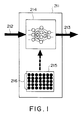
- FIG.1 shows the constitution of a conventional adaptive input-output apparatus.
- the adaptive input-output apparatus 211 shown in the figure is comprised of the input/output portion 214 for the determination of the input/output function 213 which is determined from the sample data 216, and a data management portion 215 which holds and manages the sample data 216.
- the input/output portion 215 refers to the sample data (x ,y i ) and determines the input-output function f N (x).
- the sample data 216 is used as learning data.
- a input/output portion 214 which uses a neural network learns so that the output errore, is minimized by the learning and approximates the truth function. Accordingly, the input/output portion supplements the input 212 which does not exist in the sample data 216. Also, it is possible for the output 218 of the adaptive input-output apparatus 211 to provide prompt responses with respect to the input 212.
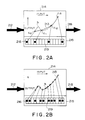
- FIG.2 shows details of a conventional adaptive input-output apparatus.
- the input/output portion 214 uses the sample data 216 given from the data holding portion 219, and determines the input/output function 213 (f N (x)) so that the truth function f true (x 1 is approximated.
- FIG.2A shows the case when there is a small quantity of sample data 216 in the data holding portion 219.
- the accuracy of the output 218 deteriorates since the input/output function 213 does not sufficiently approximate the truth function "b".
- FIG.2B shows the case when there is a large quantity of sample data 216 in the data holding portion 219.
- the truth function is not approximated when there is a small quantity of sample data 216 of the data holding portion 219, but as shown in FIG.2B, there is interpolation of the sample data which does not exist in FIG.2A when there is an increase in the quantity of sample data 216 so that the input/output function 213 sufficiently approximates the truth function "b" and the accuracy of the output 218 improves as a result.
- a conventional adaptive input-output apparatus has a rough input/output function 213 when there is a small quantity of sample data 216 and fine sample data are not determined, hence making it difficult to obtain a input/output function 213 of a shape which approaches the truth function "b".
- a general object of the present invention is to provide an novel and an effective adaptive input- output apparatus which solves the problems described above.
- Another object of the present invention is to provide an adaptive input-output apparatus which uses sample data to select points having large evaluation quantities (large feature of sample data) so that it becomes possible to increase the accuracy of output even for small quantity of sample data.
- Another object of the present invention is to provide an adaptive input-output apparatus comprising a data holding portion which holds sample data for determining an input/output function, a data selector which uses a predetermined evaluation standard to select valid sample data from said sample data, and an input/output portion which determines an input/output function in accordance with sample data selected by the data selector and outputs on the basis of said input/output function and in accordance with external input.
- Futhermore specific object of the present invention is achieved by an adaptive input-output apparatus which comprises a data selection and holding portion which holds valid sample data selected by the data selector, and a corrective input/output portion which corrects a change difference forthe output of arbitrary sample data and output of an input/output function when that sample data is ignored, and an adder which adds an output from an input/output portion, and corrected output of a corrective input/output portion.
- FIG.3 is a view showing the constitution of the present invention.
- An adaptive input-output apparatus 100 is comprised from a data holding portion 111 which holds a plural quantity of sample data 112, a data management portion 110 which manages the data holding portion 111, a data selector portion 120 for selecting the valid data on the basis of the sample data 112 so that the input/output function sufficiently approximates the truth function, and an input/output portion 130 which uses the sample data 112 selected by the external input 140 and the data selector portion 120 to output the input/output function.
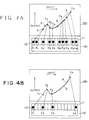
- FIG.4Aand FIG.4B show the concept of an embodiment according to the present invention.
- the input and output portion 130 and the data management portion 110 are shown in order to facilitate understanding.
- FIG.4Aand FIG.4B those portions which have the same constitution as that shown in FIG.3 are indicated with the same reference numerals.
- FIG.4A shows the status prior to data selection
- FIG.4B corresponds to only the valid sample data from the data selector portion 120.
- FIG.4A shown the status prior to data selection
- FIG.4B corresponds to only the valid sample data from the data selector portion 120.
- "a” is an input/output function "f N "
- "b” is a truth function "f true (X i )”
- "d” is invalid sample data for which the evaluation quantity is small.
- the data which is invalidated is data which has a small evaluation quantity when compared with the valid sample data "c".
- the valid sample data c l , C2 , c 3 , c 4 are compared with the invalid sample data d 1 , d 2 , d 3 , it is possible to obtain an input/output function "a" without there being any sample data d 1 , d 2 , d 3 as long as there are valid sample data c l , C2 , c 3 , c 4 .
- FIG.5 is a flowchart for shown the procedure for selection of the sample data using the output error of a neural network of the sample data selector portion of the first embodiment according to the present invention.
- Step 2 Once the errors e i - e n relating to all of the sample data (x i ,y i ) ⁇ (x n ,yn) have been determined by the data selector portion 120, the data selector portion 120 stores the errors in the memory and so that they correspond to all of the sample data.
- Step 4) The data selector portion 120 selects sample data.
- sample data other than five sample data having the largest values for the error E i are removed then only the sample data having the four largest values remain in the data selector portion 120.
- the input/output portion 130 learns using sample data in the neural network.
- FIG.6 is a view describing the results of evaluation of the sample data using the error of the data selector portion 120 of the first embodiment according to the present invention.
- the data selector 120 selects or rejects so that there can be enough learning to sufficiently approximate the truth function even if the quantity of sample data is reduced.
- the input/output portion 130 uses the neural network, the adaptive input/output apparatus enables the calculation time predetermined for learning to be reduced without much loss to the accuracy of output.
- applying this to the input/output portion 130 has a similar effect if another Bayes method, a K-approximation method, future mapping or LVQ is used.
- the error was used as the reference for selection of the sample data but with this reference if the error "e 1 of the input/output function "f N (x)" and the sample data 112 is large, it is necessary to have much correction of the output in the input/output portion 130 to give a high utility, but when there is no error between the sample data 112 and the input/output function, the output (y i ) of the sample data and the input/output function f N (x) are in agreement and the squared error becomes zero. It is not possible for this value to be used as reference for evaluation and so the following description of a second embodiment uses a method to eliminate this deficiency.
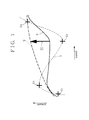
- FIG.7 is a view describing the sample data selection of the data selector portion of a second embodiment according to the present invention.
- those portions which correspond to portions of FIG.6 are shown with corresponding numerals.
- the squared error "e, 2” is given by obtained when the output f(x :c 1 , c 2 , c 4 ) and the output y i of the data is used as the reference for evaluation.
- the data become valid data with a larger difference quantity IG and a larger utility for the larger squared error "e i 2" .
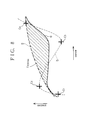
- FIG.8 is a view describing the sample data selector portion of the third embodiment according to the present invention.
- FIG.8 those portions which have the same constitution as that shown in FIG.7 are indicated with the same reference numerals and the corresponding descriptions are omitted.
- This embodiment uses the following equation. to integrate the difference quantity IG when the sample data of the second embodiment is ignored and selects the sample data which has a large integration amount. In this case, the sample data "c 3 " is the most valid data.
- the evaluation standard calculated from the squared error "e, 2 " includes the evaluation standard from the distribution status. For example, when the sample data " P; " exists in the proximity of the sample data " P i ", the squared error becomes smaller for the closer the sample data " P i " is to the sample data "P ". This is to say that if there is a concentration of sample data in the input portion for which the truth function "b" is smooth, the evaluation of the mutual sample data becomes lower.
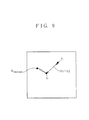
- FIG.9 is a view describing the selection of sample data fro the case when the spatial relationship of the data selecting portion.
- the data holding portion 111 hold the sample data which is to be selected by the data selector portion 120, and furthermore, holds the sample data which is invalid and which has been removed by the data selector portion 120.
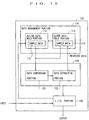
- FIG.10 is a view describing the adaptive input/output apparatus of the embodiment according to the present invention.
- the constitution shown in FIG.10 is provided with a sleep data holding portion 113.
- the data management portion 110 is comprised from the active data holding portion 111 and the sleep data holding portion 113.
- the active data holding portion 111 has some active sample data 112.
- the sleep data holding portion 113 has some sleep sample data 114.
- the data comparison portion 121 of data selector portion 120 compares the active sample data 112 from the active data holding portion 111.
- the data extraction portion 122 removes needless data according to the predetermined valuation standard.
- the processing of the present invention supplies the sample data 112 from the active data holding portion 111 to the data comparison portion 121 of the data selector portion 120.
- the sample data 112 is supplied to the data selector portion 120 and sample data which is not valid is removed but there are instances where the removed data becomes necessary later.
- the present embodiment has the data management portion 110 provided with a sleep data holding portion 113.
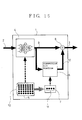
- FIG.11 is a detailed view describing a data holding portion.
- the sample data from the active data holding portion 111 is supplied to the data selector portion 120.
- the data comparison portion 121 of the data selector portion 120 compares each of the sample data and when the data d i , d 2 , d 3 which is not valid is removed so that the valid data c l , C2 , c 3 , c 4 remain, that data d, , d 2 , d 3 is transferred to the sleep data holding portion 113.
- the sample data transferred from the data selector portion 120 is held in the sleep data holding portion 113 for a predetermined period of time.
- FIG.12 is a flowchart shown the operation of a first embodiment of the data management portion of the present invention.
- the use of the sleep data holding portion 113 means that only a small quantity of valid sample data is discarded by the data selector portion 120 and so it is possible to hold more suitable sample data inside the active data holding portion 111.
- the input/output function it is possible for the input/output function to approach the truth function.
- the new data is transferred to the active data holding portion 111 but it can be added to the active data holding portion 111.
- the active data holding portion 111 deletes unnecessary data while successively taking in new data and so the data set A selects and holds the active data for which learning for the neural network and correction of the output can be validly performed and so uses the data set S of the sleep data holding portion 113.
- FIG.13 is a flowchart shown the processing for the case when there is a limit to the quantity of data which can be held in the sleep data holding portion and the active data holding portion of the data management portion in a second embodiment according to the present invention.
- FIG.14A, FIG.14B, FIG.14C and FIG.14D show examples of the holding of sleep data and active data in a second embodiment of the data management portion according to the present invention.
- the bar extending across each data shows the size of the error " e ; 2 ".
- FIG.14A shows the initial status, and the active data holding portion 111 stores for example, the ten data [A - J], while the sleep data holding portion 113 can store the 5 data [K-N].
- FIG.14B shows when the new data (New) is added to the highest position of the sleep data holding portion "S", and when the other data simultaneously dropped one position.
- FIG.14C the data at the lowest position of the sleep data holding portion "S" and that data above it are compared and there is swapping if the data has a smaller error. This swapping is performed for each data in ascending order.
- FIG.14D shows the comparison of the data [I] at the highest position of the sleep data holding portion "S” and the data [L] of the active data holding portion "A” and for which the error is smallest, and the swapping if the error of the sleep data holding portions "S" is large. In this case, [L > I] and there is no swapping.
- the active data holding portion 111 holds data having the long bars as active data.
- the following is a description when there is sequential addition, with reference to FIG.14A, FIG.14B, FIG.14C and FIG.14D.
- the data A - data J are held in the active data holding portion A
- the data K- data N are held in the sleep data holding portion 113.
- FIG.14C there is swapping inside the sleep data holding portion "S" in descending order.
- the data [M] at position Q4 inside the sleep data holding portion "S” is compared with the data [N] at position Q5, and the data having the larger evaluation quantity is placed in position Q4.
- the same operation is performed for the data at position Q3 and the data at position Q4.
- the data having the highest evaluation quantity inside the sleep data holding portion (L, in the case of FIG.14B) is placed at position Q1.
- the data [L] of the sample data and the data [I] of the active data holding portion "A" are swapped if they are larger than the data at the highest position Q1 of the sample data and the data [I] having the lowest evaluation inside the active data holding portion "A".
- FIG.15 is a view showing the sample data selector portion and the data management portion according to the present invention, used in an adaptive input-output apparatus.
- the adaptive input-output apparatus 1 shown in FIG.15 is comprised of a main input/output portion 4, a data holding portion 5, a corrective input/output portion 6, a data selecting and holding portion 7 and an adder 8.
- the adaptive input-output apparatus 1 outputs the output 3 in accordance with the input 2 which has been received from externally.
- the main input/output portion 4 performs applied input and output having a fast response such as for a neural network or the like.
- the data holding portion 5 has a function the same as that of the active data holding portion 111 of the data management portion 110.
- the data holding portion 5 stores the sample data which is referred to when the main input/output portion 4 determines the output 5 and is used as learning data (sample data) for the main input/output portion 4.
- the data selecting and holding portion 7 must reduce the quantity of the sample data 11 which are referred to by the corrective input/output portion 6 in order for the amount of processing to be reduced to meet the response requirements of the corrective input/output portion 6. This is activated by either of the methods of the previously described embodiments of the data selector portion, and the sample data having a high utility is selected from the data holding portion 5 and held.
- the corrective input/output portion 6 avoids neural network learning and uses the method of ignoring the sample data to generate the corrected output 12 which supplements the error "e".
- the adder 8 adds the main output 9 and the corrected output 12 from the corrective input/output portion 6 and outputs the output 3. As shown in FIG.16, the output of the adder 3 is when the corrected output 12 due to the sample data 11 selected by the data selecting and holding portion 7 is added to the main output 9. In this manner, the addition of the main output 9 and the corrected output 12 causes the added output 4 to be suitably output from the main output 9.
- the adder 8 obtains the output f(x :c 1 , C2 , c 4 ) when the data c i which is the output f(x :) which is the sum of the corrected output of the corrective input/output portion 6 and the output from the main input/output portion 4. It is necessary to have neural network learning in order to do this. However, performing learning which is different for each learning data of the neural network is not practical from the point of view of the processing cost. Accordingly, there is the use of the squared error "e, 2 " which is generated by noting the change of the corrected output e(x) when there is the ignoring of a data "c i for which neural network learning is avoided as follows
- the amount of calculation to obtain the output 3 ( y i ) from the input 2 ( x i ) is small and so it is possible to have a faster response.
- the amount of calculation when the selection of the data is performed is small in the case of the relationship ( x i ,y i ) between the input 2 and the output 3.
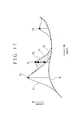
- FIG.17 shows the case for the present invention when the sample data is evaluated using the error.
- the error “e” is used, "e " which is the difference between the output y i and the main output 9 (f N (x)) of the selected sample data is used and the sample data ( x i ,y i ) having a large error 13 (e i ) is selected.
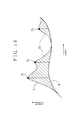
- other methods of selecting the sample data include the method using the second embodiment of the data selector portion 120 shown in FIG. 7 here, when the sample data 14 is ignored without changing the main output 9 (f N (x)), the output 15 and the output 3 which is not ignored are compared and difference amount 16 of the output in the sample data 14 and the integration value 17 over a suitable range and with respect to the input space of the difference amount 16 of the output can be used.
- the response time for the corrective input/output portion 6 is short and so this is efficient when there is a comparison for only the output change of the corrective input 12 when certain sample data (x i ,y i ) is ignored but the output change due to the use of the main output 9 can be considered.
- the data selecting and holding portion 7 in FIG.15 keeps records of selected the sample data selected according to a selecting rule during a predetermined time.
- a past history such as the time average of the reference for selection as shown by the following equation, can be included in the selection standard of the sample data.
- Futhermore it is possible to improve the characteristics of the output 3 in accordance with the object.
- the present invention removes unnecessary sample data or uses a predetermined condition to remove sample data having a small evaluation quantity and validity when the input/output function is determined, extracts sample data having a high validity and determines an input/output function. Accordingly, sample data having a small evaluation quantity are removed and so the quantity of sample data used is reduced so that the learning of the neural network becomes faster.
- sample data which have been judged invalid can be again supplied for later data selection when judged necessary. Furthermore, sample data which has been held for a certain time are later removed after they have been held for a predetermined period and so it is possible to hold down the amount of memory used to hold the sample data.
- a data selector mechanism and a data holding mechanism having the constitution of the present invention are used in an applied input and output apparatus, it is possible to have a prompt output response with respect to the input, and at the same time for the speed of response of the main input/output portion to be covered by adding a corrected output of a corrective input/output portion and therefore reduce the predetermined time for response of the output.
Landscapes
- Engineering & Computer Science (AREA)
- Physics & Mathematics (AREA)
- General Physics & Mathematics (AREA)
- Data Mining & Analysis (AREA)
- Theoretical Computer Science (AREA)
- Mathematical Physics (AREA)
- Computational Mathematics (AREA)
- Mathematical Optimization (AREA)
- Pure & Applied Mathematics (AREA)
- Mathematical Analysis (AREA)
- General Engineering & Computer Science (AREA)
- Software Systems (AREA)
- Databases & Information Systems (AREA)
- Algebra (AREA)
- Life Sciences & Earth Sciences (AREA)
- Bioinformatics & Computational Biology (AREA)
- Evolutionary Biology (AREA)
- Bioinformatics & Cheminformatics (AREA)
- Probability & Statistics with Applications (AREA)
- Operations Research (AREA)
- Evolutionary Computation (AREA)
- Artificial Intelligence (AREA)
- Computer Vision & Pattern Recognition (AREA)
- Computing Systems (AREA)
- Computer Hardware Design (AREA)
- Molecular Biology (AREA)
- General Health & Medical Sciences (AREA)
- Computational Linguistics (AREA)
- Biophysics (AREA)
- Biomedical Technology (AREA)
- Health & Medical Sciences (AREA)
- Feedback Control In General (AREA)
- Image Analysis (AREA)
- Input From Keyboards Or The Like (AREA)
- Communication Control (AREA)
Applications Claiming Priority (2)
| Application Number | Priority Date | Filing Date | Title |
|---|---|---|---|
| JP4332080A JPH06180691A (ja) | 1992-12-11 | 1992-12-11 | 適応的入出力装置 |
| JP332080/92 | 1992-12-11 |
Publications (2)
| Publication Number | Publication Date |
|---|---|
| EP0601898A2 true EP0601898A2 (de) | 1994-06-15 |
| EP0601898A3 EP0601898A3 (de) | 1994-11-23 |
Family
ID=18250926
Family Applications (1)
| Application Number | Title | Priority Date | Filing Date |
|---|---|---|---|
| EP19930402267 Withdrawn EP0601898A3 (de) | 1992-12-11 | 1993-09-17 | Anpassbares Ein/Ausgabe-Gerät unter Verwendung von ausgewähten Musterdaten gemäss einer Auswertungsgrösse. |
Country Status (4)
| Country | Link |
|---|---|
| US (1) | US5420810A (de) |
| EP (1) | EP0601898A3 (de) |
| JP (1) | JPH06180691A (de) |
| KR (1) | KR960015593B1 (de) |
Families Citing this family (8)
| Publication number | Priority date | Publication date | Assignee | Title |
|---|---|---|---|---|
| JP3432612B2 (ja) * | 1994-09-30 | 2003-08-04 | バブコック日立株式会社 | プラントの運転制御装置 |
| US5752007A (en) * | 1996-03-11 | 1998-05-12 | Fisher-Rosemount Systems, Inc. | System and method using separators for developing training records for use in creating an empirical model of a process |
| US5727128A (en) * | 1996-05-08 | 1998-03-10 | Fisher-Rosemount Systems, Inc. | System and method for automatically determining a set of variables for use in creating a process model |
| KR102881595B1 (ko) | 2016-12-22 | 2025-11-06 | 삼성전자주식회사 | 컨볼루션 신경망 시스템 및 그것의 동작 방법 |
| JP6564412B2 (ja) * | 2017-03-21 | 2019-08-21 | ファナック株式会社 | 機械学習装置及び熱変位補正装置 |
| KR102913049B1 (ko) * | 2019-10-16 | 2026-01-15 | 엘지전자 주식회사 | 음성 처리 방법 및 음성 처리 장치 |
| JP7040543B2 (ja) * | 2020-02-05 | 2022-03-23 | 沖電気工業株式会社 | データ圧縮装置、データ圧縮システム、学習モデル構築装置及びプログラム |
| CN122056127A (zh) * | 2023-10-26 | 2026-05-15 | 东京毅力科创株式会社 | 基板处理方法和基板处理系统 |
Family Cites Families (10)
| Publication number | Priority date | Publication date | Assignee | Title |
|---|---|---|---|---|
| GB1162096A (en) * | 1965-09-07 | 1969-08-20 | Toyo Electric Mfg Co Ltd | Pulse Allotting System for Curve Tracing Equipment |
| GB1363073A (en) * | 1970-07-17 | 1974-08-14 | Solartron Electronic Group | Generation of trigonometrical and other functions by interpolation between point values |
| JPS586959B2 (ja) * | 1976-08-20 | 1983-02-07 | 日本電信電話株式会社 | 曲線発生器 |
| US4754410A (en) * | 1986-02-06 | 1988-06-28 | Westinghouse Electric Corp. | Automated rule based process control method with feedback and apparatus therefor |
| CA1270953C (en) * | 1986-05-23 | 1990-06-26 | CURVE APPROXIMATION METHOD | |
| US4879558A (en) * | 1986-12-12 | 1989-11-07 | Sangamo Weston, Inc. | Data compression apparatus and method for data recorder with waveform envelope display |
| GB8810357D0 (en) * | 1988-04-30 | 1988-06-08 | Univ Manchester | Data analysis method & apparatus |
| EP0462815B1 (de) * | 1990-06-21 | 1996-09-25 | Honeywell Inc. | Auf variablem Horizont basierende adaptive Steuerung mit Mitteln zur Minimierung der Betriebskosten |
| WO1992021102A1 (en) * | 1991-05-16 | 1992-11-26 | The United States Of America, Represented By The Secretary, United States Department Of Commerce | Multiple memory self-organizing pattern recognition network |
| US5184218A (en) * | 1991-07-03 | 1993-02-02 | Wavephore, Inc. | Bandwidth compression and expansion system |
-
1992
- 1992-12-11 JP JP4332080A patent/JPH06180691A/ja active Pending
-
1993
- 1993-09-10 US US08/118,745 patent/US5420810A/en not_active Expired - Lifetime
- 1993-09-17 EP EP19930402267 patent/EP0601898A3/de not_active Withdrawn
- 1993-09-20 KR KR1019930019062A patent/KR960015593B1/ko not_active Expired - Fee Related
Also Published As
| Publication number | Publication date |
|---|---|
| EP0601898A3 (de) | 1994-11-23 |
| KR960015593B1 (ko) | 1996-11-18 |
| JPH06180691A (ja) | 1994-06-28 |
| US5420810A (en) | 1995-05-30 |
| KR940015847A (ko) | 1994-07-21 |
Similar Documents
| Publication | Publication Date | Title |
|---|---|---|
| KR950008396B1 (ko) | 포지로직 마이크로콘트롤러 | |
| Olson et al. | Automatic target recognition by matching oriented edge pixels | |
| CN113554156B (zh) | 基于注意力机制与可变形卷积的多任务图像处理方法 | |
| EP0454037A2 (de) | Neuronales Netzwerk zum Verarbeiten einer Vielzahl von Informationen und Lernverfahren | |
| EP0652536A2 (de) | Verfahren und Gerät zur Bestimmung von Bewegungsvektorfelden durch die Unterdrückung lokaler Abweichungen | |
| US5420810A (en) | Adaptive input/output apparatus using selected sample data according to evaluation quantity | |
| EP0384709B1 (de) | Lernmaschine | |
| CN115690170A (zh) | 一种针对不同尺度目标自适应的光流估计的方法及系统 | |
| JP3461525B2 (ja) | データを正規化する手段を含むニューラル・プロセッサ | |
| US5142593A (en) | Apparatus and method for classifying feature data at a high speed | |
| EP0579341A2 (de) | Lernmaschine mit Multi-Eingangs-Einzelausgangsschaltungen verbunden in hierarchischer Struktur | |
| JP3214876B2 (ja) | ニューラルネットワークの構成方法およびニューラルネットワーク構築支援システム | |
| EP0474222A2 (de) | Lernmaschine mit hierarchischer Struktur ohne wechselseitige Verbindungen in gleichen Niveaus | |
| CN116206188A (zh) | 一种图像识别方法、系统、设备及存储介质 | |
| US6052677A (en) | Next alternative generating apparatus using simulated annealing and method thereof | |
| Fathi-Torbaghan et al. | Model-free optimization of fuzzy rule-based systems using evolution strategies | |
| EP0451742B1 (de) | Unscharfe Folgerungsanlage | |
| EP0513689A2 (de) | Verfahren und Gerät zur Fertigstellung von Daten einer Mitgliedschaftsfunktion | |
| US5664064A (en) | Object form division method and system | |
| Flentge | Locally weighted interpolating growing neural gas | |
| EP1430447A2 (de) | Messung geometrischer variablen einer in einem bild enthaltenen struktur | |
| EP0567983A2 (de) | Lernende Wellenformerkennungseinrichtung | |
| JPH0755469A (ja) | 多視点ステレオ画像計測法 | |
| JP3310009B2 (ja) | ニューラルネットワークシステム | |
| BURSAL et al. | System identification using interpolated cell mapping |
Legal Events
| Date | Code | Title | Description |
|---|---|---|---|
| PUAI | Public reference made under article 153(3) epc to a published international application that has entered the european phase |
Free format text: ORIGINAL CODE: 0009012 |
|
| AK | Designated contracting states |
Kind code of ref document: A2 Designated state(s): DE GB |
|
| PUAL | Search report despatched |
Free format text: ORIGINAL CODE: 0009013 |
|
| AK | Designated contracting states |
Kind code of ref document: A3 Designated state(s): DE GB |
|
| 17P | Request for examination filed |
Effective date: 19941214 |
|
| 17Q | First examination report despatched |
Effective date: 19980827 |
|
| STAA | Information on the status of an ep patent application or granted ep patent |
Free format text: STATUS: THE APPLICATION IS DEEMED TO BE WITHDRAWN |
|
| 18D | Application deemed to be withdrawn |
Effective date: 19990108 |