EP0601907A2 - Mikroelektronische Kompaktanlage zum Ausführen modulärer Multiplizierung und Potenzierung mit grossen Operanden - Google Patents
Mikroelektronische Kompaktanlage zum Ausführen modulärer Multiplizierung und Potenzierung mit grossen Operanden Download PDFInfo
- Publication number
- EP0601907A2 EP0601907A2 EP93402865A EP93402865A EP0601907A2 EP 0601907 A2 EP0601907 A2 EP 0601907A2 EP 93402865 A EP93402865 A EP 93402865A EP 93402865 A EP93402865 A EP 93402865A EP 0601907 A2 EP0601907 A2 EP 0601907A2
- Authority
- EP
- European Patent Office
- Prior art keywords
- register
- bit
- multiplication
- bits
- serial
- Prior art date
- Legal status (The legal status is an assumption and is not a legal conclusion. Google has not performed a legal analysis and makes no representation as to the accuracy of the status listed.)
- Granted
Links
Images





Classifications
-
- G—PHYSICS
- G06—COMPUTING OR CALCULATING; COUNTING
- G06F—ELECTRIC DIGITAL DATA PROCESSING
- G06F7/00—Methods or arrangements for processing data by operating upon the order or content of the data handled
- G06F7/60—Methods or arrangements for performing computations using a digital non-denominational number representation, i.e. number representation without radix; Computing devices using combinations of denominational and non-denominational quantity representations, e.g. using difunction pulse trains, STEELE computers, phase computers
- G06F7/72—Methods or arrangements for performing computations using a digital non-denominational number representation, i.e. number representation without radix; Computing devices using combinations of denominational and non-denominational quantity representations, e.g. using difunction pulse trains, STEELE computers, phase computers using residue arithmetic
- G06F7/728—Methods or arrangements for performing computations using a digital non-denominational number representation, i.e. number representation without radix; Computing devices using combinations of denominational and non-denominational quantity representations, e.g. using difunction pulse trains, STEELE computers, phase computers using residue arithmetic using Montgomery reduction
Definitions
- the present invention relates to modular processing of large numbers in the Galois field of prime numbers and also of composite prime modules. More specifically, the invention relates to a device to implement modular multiplications/exponentiations of large numbers, which is suitable for performing the operations essential to Public Key Cryptographic authentication and encryption protocols, which cannot be executed with small microprocessors in reasonable processing time.
- the present invention relates to the hardware implementation of a procedure known as "the interleaved Montgomery multiprecision modular multiplication method" often used in encryption software oriented systems.
- a unique original method is provided to accelerate modular exponentiation; and vital proofs are used to simplify the architecture and extend the use of the device to large number calculations in the normal field of numbers.
- the essential architecture is of a machine that can be integrated to any microcontroller design, mapped into memory; while working in parallel with the controller which must constantly load commands and operands, then unload and transmit the final answer.
- the unique solution uses only two serial/parallel multipliers, and a complete serial pipelined approach that saves silicon area. Using present popular technologies, it enables the integration of the complete solution including a microcontroller with memories onto a 4 by 4.5 by 0.2 mm microelectronic circuit that can meet the ISO 7816 standards. [International Organization for Standardization, "Identification cards - integrated circuit cards", ISO 7816:
- ISO 7816 Part 3- ISO/IEC 7816-3, "Electronic signals & transmission protocols", 1989.] hereinafter referred to as "ISO 7816".
- the invention is directed to the architecture of this solution, based on mathematical innovations, published by Montgomery, with several modifications and improvements and non-obvious methods are provided for reducing the time necessary for modular exponentiation to little more than half the time required using known processing and the Montgomery method.
- a and B be the multiplicand and the multiplier
- N to be the module which is usually larger than A or B.
- N may in some instances be smaller than A.
- a value is often either the desired value, or equal to the desired value plus the module.
- X can be equal to 2 or 9.
- X has limited congruence to 2 mod 7.
- the modular multiplicative inverse is a basic concept.
- MS and LS are used to signify most significant and least significant when referencing bits, characters, and full operand values.
- N designates both the value N, and the name of the shift register which contains N.
- a and N are constant values throughout an entire exponentiation.
- A is the value of the number which is to be exponentiated.
- B is equal to A.
- B is also the name of the register wherein the accumulated value which finally equals the desired result of exponentiation resides.
- S designates a temporary value, and also the register in which the Y of S is stored.
- S(i-1) denotes the value of S at the outset of the i'th iteration; So denotes the LS character of an S(i) 'th value.
- the Montgomery function (A ⁇ B) N performs a multiplication modulo N of the A ⁇ B product into the field.
- the retrieval from the field back into the normal modular field is performed by enacting ? on the result of (A ⁇ B) N and a precalculated constant H.
- P ⁇ (A ⁇ B) N then (P ⁇ H) N ⁇ A ⁇ B mod N; thereby performing a normal modular multiplication in two field multiplications.
- the intention of efficient modular reduction methods is to avert a series of multiplication and division operations on operands that are n and 2n bits long, by performing a series of multiplications, additions, and subtractions on operands that are n bits long, and that yield a final result that is a maximum of n bits long.
- A, B and odd N these odd modules are always either simple or a composite of large primes
- Q there is always a Q, such that A ⁇ B + Q.N will result in a number whose n LS bits are zero, or:
- the retrieval from the field is calculated by operating on P ⁇ H, making:
- J is a precalculated constant which is a function of N only, and, obviously, we must always choose that positive J which is smaller than N.
- the process shown employs three multiplications, one summation, and a maximum of one subtraction, for the given A, B, N, and a precalculated constant; we obtain (A ⁇ B) N .
- a precalculated constant, H (a function of the module N) we are able to find A ⁇ B mod N.
- A can be equal to B, this operator can be used as a device to square or multiply in the modular arithmetic.
- J o will be the LS character of J.
- n the length of the modulus, of the operand was also the exact length of N. For ordinary exponentiations and multiplications this would be most efficient.
- a second constant, 1- 1 2 n mod N, which when Montgomery multiplied by the number to reduced, in one operation effects a minimum reduction.
- This constant, 1- 1 can be calculated with the same mechanism which calculates the constant H (see sections on calculating H parameter), by placing the module, N, in the most significant part of the divisor operand, so that its most significant "1" rests in the most significant bit of the divisor register.
- the number of shift/trial-subtracts obviously, must now be n + 1 - L, wherein L is the number of relevant bits of N. Note that this 1- 1 will be an operand L bits long.
- Knuth The following derivation of a sequence [D. Knuth, The art of computer programming, vol. 2: Seminumerical algorithms, Addison-Wesley, Reading Mass., 1981] hereinafter referred to as "Knuth", explains a sequence of squares and multiplies, which implements a modular exponentiation.
- N is subtracted from B whenever B is larger than or equal to N.
- the value B is to A E mod N.
- q is the number of relevant bits in E (disregard any leading zeros).
- N is subtracted from B, whenever B is larger than or equal to N.
- N is subtracted from B whenever B is larger than or equal to N.
- the value B is Y to A E mod N, and C is the final value.
- the last step could be: B (B ⁇ 1) N instead of B Y (B ⁇ A) N
- H parameter is a constant that is vital for computations in the Montgomery field. Using certain protocols, H will be a constant that might be precalculated on a larger computer; or in other cases it might be a useful constant which will be a first stage parameter used in calculating a more useful constant. See the previous section.
- H In regular communications it might be assumed that H will be precalculated, however, for several protocols, e.g., authenticating a signature in a random communication in RSA, it might be necessary to calculate H with this device, e.g., the Smart Card.
- the H parameter is defined as:
- H is the remainder of a normal division operation wherein a string with an MS bit of one followed by 2n LS zeros (a 2n + 1 bit long operand) is divided by the modular base N.
- N Binary division by the divisor, N, of a dividend consisting of a "1" and a string of zeros, is tantamount to sequentially trial-subtracting N, i.e. subtracting N from the residual trial-dividend when the most significant n+1 bits are larger than N. (Follow the example.)
- This invention relates to a compact synchronous microelectronic peripheral machine for standard microprocessors with means for proper clocking and control, having as essential elements: three main subdivided, switched and clocked shift registers, B, S and N; two only multiplexed serial/parallel multipliers; borrow detectors, ancillary subtractors and adders; delay registers and switching elements; all of which embody a totally integrated concurrent and synchronous process approach to modular multiplication, squaring, and exponentiation.
- a further embodiment implements a unique, not straightforward, synchronized hardware derivation of the Montgomery method designed for hardware modular multiplication, squaring, and exponentiation.
- Such a machine according to this invention may also use the microcontroller to regulate the cascade of field sequences of squarings and multiplications, wherein the exponent E need not be stored in the MULT block, saving one n bit long shift register; simplifying the MULT control , while demanding little additional microcontroller ROM code.
- two storage registers and separate serial subtraction operations are deleted from a straight forward implementation of the Montgomery method. This is accomplished by enacting a single serial detection on Z/2 k minus N, to determine if Z/2 k is larger than or equal to N and subsequently achieving smaller than N operands with only one serial subtraction.
- the circuit is synchronized in such a quasi-parallel manner so that only two multipliers are used to perform three simultaneous multiplication operations.
- serial/parallel multipliers can occupy 40% of the silicon area. Using two instead of three serial/parallel multipliers, conserves enough silicon to double the number of cells in the remaining two multipliers. This doubling of the multiplier size reduces the process time for a 512 bit multiplication by more than 45%.
- a machine can be used with a digital delay circuit, Delay3, (a k bit shift register) to synchronize the serial addition of X with the serial result of the multiplier ML1, Y o .N; precluding double storage of products or a repetition of a serial/parallel multiplication.
- Delay3 a digital delay circuit
- Delayl there are two digital delay circuits, Delayl and Delay2, (two k bit shift registers), used to synchronize three serial multiplications in which N is a factor, i.e., B ⁇ A i , X.J o , and Y o .N.
- a machine as described above could be constructed, in which a digital delay circuit, Delay3, synchronizes the operation of the serial/parallel multiplier, ML2, so that it can perform two separate multiplication operations in the process stream, i.e., X J o and Y o .N.
- the registers S, B, and N are configured to be either n bits or n/2 bits long; whereby exponentiation over n/2 length modules can be accomplished in little more than one eighth of the effective clock cycles that would be necessary for n bit length exponentiations.
- a machine according to the above is anticipated, which when processed with an original retrieval factor T, can reduce the number of field multiplication operations on a full RSAsigna- ture exponentiation to close to half.
- This machine could also, assuming necessary precalculations, execute the complete multiplication process (A ⁇ B)N of an n bit number in only m(n+2k) effective clock cycles, because of "on the fly” loading of the A register, and “on the fly prediction” of the size of the contents of the S register, and “on the fly” synchronization of the partial operands.
- This invention further includes a machine according to the above, using the same registers in the same machine as used for Montgomery multiplications, to which a small borrow detect circuit is appended and a simple addition to the controlling mechanism, operating in a second mode calculates the H parameter.
- every subprocess and process are executed with predetermined numbers of clock cycles, so that a field multiplication and/or a squaring is performed in known sequences of clock cycles, enabling the embodiment of a simplified control consisting of a cascade of self-exciting counting mechanisms with no internal conditional branches.
- Another object of the invention includes a method for carrying out conventional multiplication of two numbers whose average significant length is n/2 bits, comprising carrying out modular multiplication of said numbers by the multiplication process as described by at least one of the methods described herein (infra or supra), wherein the modulus, N, is an n-bit number consisting of all "1's" (fffffff....fff), equating J o to 1, and loading the multiplicand in B and manipulating A as in said multiplication process of Claim 1; N can be all ones either by means of preloading register N with all ones or by setting the multiplexer which outputs N to output a series of "hard" ones.
- a concurrent process and a unique hardware architecture have been provided, to preform modular exponentiation without division with the same number of operations as would be performed with a classic multi- plication/division device, wherein a classic device would perform both a multiplication and a division on each operation.
- Division is usually a non-deterministic process, and considered more difficult and time consuming than multiplication.
- the machine By properly synchronizing and on the fly detecting and preloading operands, the machine operates in a deterministic fashion, wherein all multiplications and exponentiations are executed in a predetermined number of clock cycles.
- Conditional branches are replaced with local detection and compensation devices, thereby providing a basis for the simple type control mechanism, which, when refined, can consist of a series of self-exciting cascaded counters.
- the machine has particularly lean demands on volatile memory, as operands are loaded into and stored in the machine for the total length of the operation; however, the machine exploits the CPU onto which it is appended, to execute simple loads and unloads, and sequencing of commands to the machine, whilst the machine performs its large number calculations.
- the exponentiation processing time is virtually independent of the CPU which controls it. In practice, no architecturial changes are necessary when appending the machine to any CPU.
- the hardware device is self-contained, and can be appended to any CPU bus.
- the means for accelerating the modular multiplication and exponentiation process is provided, with means for precalculating the necessary constants.
- the device may also be incorporated in computer and fax terminals, door locks, vending machines, etc.
- the hardware described carries out modular multiplication and exponentiation by applying the operator in a new and original proceeding. Further, the squaring can be carried out in the same method, by applying it to a multiplicand and a multiplier that are equal.
- Modular exponentiation involves a succession of modular multiplications and squarings, and therefore is carried out by a method which comprises the repeated, suitably combined and oriented application of the aforesaid multiplication squaring and exponentiation methods.
- a novel and improved way of carrying out modular exponentiation will be further specified herein.
- the method for carrying out modular multiplication wherein the multiplicand, A, the multiplier, B, and the modulus, N, comprise m characters of k bits each, the multiplicand and the multiplier not being greater than the modulus, comprises the steps of:
- register B by the parameter T ( (B ⁇ T) N ), and then storing the result of the last operation as D Y A E mod N in register B.
- T (2n) S mod N, wherein
- all connections between the n bit registers and the remaining components are 1 bit serial connections.
- the figures depict several layers of logical concepts necessary for understanding the device in its totality.
- the clock signal motivates the circuit, and if there is a reset signal, its purpose is to initialize a circuit to a zero state.
- FIG. 1 is a block diagram of the monolithic circuit into which the invention is integrated.
- the MULT block contains the hardware device which is the basis for the invention;
- the State machine contains the controller which drives the MULT circuit;
- the ROM block contains all the non-volatile memory (ROM and EEPROM), wherein the program for controlling the Smart Card resides, the trusted third party public keys, and the program for driving the MULT block and the State machine;
- the RAM block contains the volatile memory which stores temporary operands, such as messages to be exponentiated, public keys to be authenticated, data in transit to the MULT block, etc.;
- the CPU central processing unit
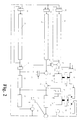
- Fig. 2 shows in block diagram form a modular multiplication circuit according to the invention, which can be used for carrying out modular squaring and modular exponentiation.
- the aforesaid registers are preferably divided into two n/2 registers, preferably including a k least significant bit subdivision for the N and B registers.
- Multiplexers 13, 14 and 15 respectively are placed before the said registers, and if they are subdivided into component parts, a multiplexer is placed before each subdivision.
- registers 16 and 17 are three registers, each of which is k bits long, for receiving the values A;, J o , and Y o values respectively.
- Registers 16 and 17 are serial load-parallel output or serial and parallel load-parallel output shift registers.
- Register 18 is preferably a serial in parallel output shift register.
- the content of these registers is intended to be processed by multiplying means 19 and 20 through components 21 and 22, which are preferably k bit latches. If they are latches, they are loaded from registers 16, 17 and 18 through k bit buses. If they are registers, they can be serially loaded through 1 bit connections.
- Multipliers 19 and 20 may be Aserial, B parallel inputs, serial output multiplier means or any other serial/parallel inputs-serial outputs multiplying means.
- Multiplexer 38 can force the modulus N to be all "1"s for multiplying in the normal field of numbers.
- Numerals 27, 28, 29, 30, and 31 designate 1 bit full/half adder/subtract means.
- 31 designates a full adder/subtract means.
- 32, 33 and 34 designate k bit k clock cycle delay means capable of delaying digital signals, which may be composed of analog or digital components, though digital components are preferred.
- 35 is a Borrow detector, which is a two bit latch/storage means.
- the device according to the invention although it is intended to handle large numbers such as 512 bit numbers does not comprise buses, except optionally a few k bit buses, and this constitutes an important saving of hardware.
- registers B, S and N comprise n/2 bit parts, the device of the invention can be used to carry out multiplication and exponentiation operations on 256 bit numbers, which is a substantial advantage as to the flexibility of the use of the device.
- Fig. 3 shows the logic cells according to one preferred embodiment of the invention. Operands are fed into the A latch, the J o register, the B register and the N register via serial connect DI, and results are unloaded via serial connect DO, from the B or S register.
- Signal X is the bit stream summation of the product of Band A and S. (Values after Sand B have assumed values smaller than N.)
- Signal Y o is the k LS bit stream of the product of J o and X.
- Signal Z is the summation of X and the product of Y o and N. The k LS bits of Z, being all zeros are disregarded, and only the n MS bits are serially fed into S or B.
- the Borrow_detector is a logic circuit which detects whether the value of Z/2 k is, or is not larger than N.
- the subtractors Sub1 and Sub2 subtract the bit stream N from the bit streams of B and S, whenever B or S is larger than N.
- Ad1 and Ad2 summate bit streams to produce X and Z streams.
- the Delay1 and Delay2 shift registers are necessary to provide storage for synchronizing the mathematical processes.
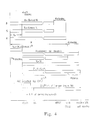
- Fig. 4 a succession of the various operations is illustrated as a function of the effective clock cycles, which are marked on the abscissa axis.
- the values of B, N and S are loaded in the respective registers.
- the first character of A is also loaded into the respective register.
- the shifting of the content of the B and S registers is carried out.
- the generation of the X value takes place during n+k effective clock cycles, the first k clock cycles being occupied by entering the value of X o .
- the value of Y o has been entered.
- the value of X which had been introduced into multiplier 20, is now shifted or introduced into adder 31 after having been delayed by delay 34.
- the value of N is used at three different time phases. First, to "update" S and B, second, delayed k effective clock cycles to multiply by Y o , and then delayed a second k effective clock cycles to sense how the next value of S or B will be "updated".
- Z is calculated, as well as Z/2 k .
- the value ofA is loaded beginning with the first k effective clock cycles and continuing during the successive part of the iteration.
- the final value of Z/2 k is entered into register S (or B) during n clock cycles after the first 2k effective clock cycles.
- FIG. 1 illustrates in block diagram form a device for carrying out the methods according to the invention.
- Block CONTROL of the device includes:
- the CPU contains volatile and non-volatile memory some of which can be utilized by this multiplication process.
- the CPU controls the modular arithmetic block in the circuit.
- the CPU The CPU:
- the counters generate the address for the embodied State Machine.
- the State Machine decodes the addresses and generates control signals to the MULT block. These control signals command the MULT block to perform the proper sequence of operations necessary to calculate the (A ⁇ B) N transformation (where A can be equal to B).
- Fig. 3 is a hardware block diagram of the hardware device that embodies the physical aspects of the invention (MULT), and is intended to aid in focusing onto several of the architectural concepts to be protected by this patent.
- the block concurrently implements the sequence specified in equations (1) to (5), and also, without changing the synchronous clocking, the transformations of Sand B from limited congruence to equality.
- the constants (functions of N), J o and H have been precalculated.
- the circuit performs (A ⁇ B) N . Using this function the circuit can be utilized to calculate:
- serial/parallel (s/p) multipliers or any of the conventional components used form a part of the invention perse.
- the following is included to clarify the use of standard logic cells in the public domain as several of them are not commonly used.
- the gate implementation shown here is for demonstration only. Skilled technicians optimize these logic cells.
- multipliers execute the Booth's algorithm for unsigned multiplication, wherein the parallel operand is k cells (bits) long and the serially loaded operand can be of any required length.
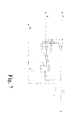
- Each serial/parallel multiplier is made of k-1 MPL cells (figure 5).
- the most significant cell, its MS bit, consists of an AND gate, only.
- Each MPL cell multiplies the serial input Y with its parallel XI input bits and summates this result with the serial output of the preceding MPL unit and its own previous cycle's carry out bit.
- the MPL cell is a 2 bit multiplier adder.
- the block multiplies the input bit XI and the serial input bit Y and summates the result with DI, (Data In) and the carry Cl, (Carry In) from the previous cycle.
- the final result is DO, (Data Out) and a CO, (Carry Out) for the next cycle.
- This carry out is stored in a Data Flip-Flop (D F-F). and the saved carry CO will be the CI on the next cycle.
- This carry is the Boolean sum:
- the two inputs A and B are summated with the carry CI from the previous cycle to generate the modulo 2 sum, which is saved in the D F-F for the output signal, S. Upon reset the carry bit is set to "0".
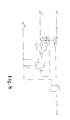
- Each of the blocks, described in figure 8, is a full subtractor with a storage D F-F for the previous borrow.
- This block is similar to the Ad1 block with the exceptions that it serially subtracts the B stream from the A stream.
- k bit shift registers consisting of k 1 bit concatenated memory devices. They are used to synchronize the various operands in the mathematical sequence. This will become obvious as the circuit is explained.
- the thin lines are serial one bit conductors, and the bold lines denote k bit parallel conductors.
- X(s:t) is a t - s + 1 bit long shift register
- s is the index for the first bit of X(s:t)
- t is the index of the last bit of the X(s:t) register.
- B(0:511) is composed of the three shorter cascaded registers: B(0:31), B(32:255) and B(256:511).
- n1 256
- n2 511
- n 512
- k 32.
- These two latches are k bit registers. They are used to lock the parallel data into the multiplier to enable single clock parallel transitions in the multiplication sequences.
- register S is loaded with zeros.
- Stage 2 Executing the B.A o iteration.
- Register B is cyclicly shifted to the right. At the initiation of a process the Borrow2 control signal is "0", therefore, the content of B simply passes unchanged through the subtractor Sub1 and is multiplied by A o in ML1. Register B's output is fed back, unchanged, into the register's input.
- J o from the J o register is loaded into Latch2.
- X is serially input to ML2 to be multiplied by J o .
- the content of the register Y o is the k least significant bits of the product of X 0 ⁇ J 0 .
- the first k bits from Ad2 being all zeros are disregarded and the next n bits are serially returned to the S register.
- This final quantity may be larger than or equal to N (in which case it must be reduced by N); i.e., S(1) ⁇ S(1) mod N.
- Stage 3 Subsequent B ⁇ A i iterations.
- a i is transferred into Latchl, the parallel input of ML1.
- the first operation in a normal exponentiation is a squaring operation, performed like a normal multiplication with the multiplier A loaded into the B register, and the multiplicand loaded into the Ai register in k bit increments as described in the previous section. Subsequent squarings are performed on operands (multiplier and multiplicand) whose limited congruence resides in the B register.
- the Ai register is preloaded from the B stream "on the fly". Once the CPU has given the command to square, it has no task to perform during the subsequent B ⁇ B i squaring operations.
- the B i 's which are loaded, are segments of B which have flown through Sub1 (B i segments of B's which are already smaller than N).
- the k LS bits of registers B and N are cyclically shifted to the right, thus after k effective clocks, the B and N registers are restored to their original states.
- the value in the B register is either the proper B value or the B-N value to be used for the next multiplication. So, for the first round, the Ai register is to be preloaded with either B o which resides in the B register or the k LS bits of B-N.
- this first k bit rotate is to be able to stream through Sub1 the first k bits of preload for register Ai. Immediately after being serially loaded, Ai is unloaded into Latch1, and the Ai preload register is free to be loaded with B 1 , the second character of B.
- the output string from Sub1 is positive and always smaller than N.
- B 1 emanates from the B stream, during this first B ⁇ B 0 process, the B 1 segment is serially switched into the Ai preload register "on the fly" in preparation for the next squaring operation, i.e., the B ⁇ B 1 iteration.
- n + 2k e.g., n + 64
- the signals Borrow1 and Borrow2 determine if N is to be subtracted from the streams emanating from the B and S registers. If the number in the S register is larger than or equal to N then Borrow1 is set and with subtractor Sub2, N is subtracted from S. N is subtracted from B, if necessary, for the duration of a complete m iteration multiplication loop. Such a condition would have been sensed with Borrow2 at the end of the previous multiplication or square.
- the two flip-flops, Borrow1 and Borrow2 contain the final values of the conditioned Borrow Out from Sub3. Borrow1 is set or reset after each iteration of S. Borrow2 is set or reset after the last S(m) iteration, whence B is loaded with S(m).
- the conditioned Borrow Out is the signal which indicates whether an S(i) is larger than N.
- the B 2 character is loaded "on the fly" into the Ai preload register as the B 2 character exits the Sub1 subtractor.
- the module N is loaded into the N register and the borrow detect flag is reset, signifying that the first trial subtraction will be successful; the output flip flop of Subl is reset to zero.
- the MS (n'th) bit of the trial dividend is one. This bit is stored by inference in the "Next subtract” flip flop (no space in S). The "Next subtract” commands the S-N subtract in round 1.
Landscapes
- Physics & Mathematics (AREA)
- Engineering & Computer Science (AREA)
- General Physics & Mathematics (AREA)
- Mathematical Analysis (AREA)
- Mathematical Optimization (AREA)
- Pure & Applied Mathematics (AREA)
- Computational Mathematics (AREA)
- Theoretical Computer Science (AREA)
- Computing Systems (AREA)
- Mathematical Physics (AREA)
- General Engineering & Computer Science (AREA)
- Complex Calculations (AREA)
- Aiming, Guidance, Guns With A Light Source, Armor, Camouflage, And Targets (AREA)
- Electrophonic Musical Instruments (AREA)
- Electronic Switches (AREA)
Applications Claiming Priority (6)
| Application Number | Priority Date | Filing Date | Title |
|---|---|---|---|
| IL10392192 | 1992-11-30 | ||
| IL10392192 | 1992-11-30 | ||
| IL10475393 | 1993-02-16 | ||
| IL10475393 | 1993-02-16 | ||
| IL10692393A IL106923A (en) | 1993-09-06 | 1993-09-06 | Device for performing modular multiplication |
| IL10692393 | 1993-09-06 |
Publications (3)
| Publication Number | Publication Date |
|---|---|
| EP0601907A2 true EP0601907A2 (de) | 1994-06-15 |
| EP0601907A3 EP0601907A3 (de) | 1994-11-23 |
| EP0601907B1 EP0601907B1 (de) | 2001-02-14 |
Family
ID=27271582
Family Applications (1)
| Application Number | Title | Priority Date | Filing Date |
|---|---|---|---|
| EP93402865A Expired - Lifetime EP0601907B1 (de) | 1992-11-30 | 1993-11-26 | Mikroelektronische Kompaktanlage zum Ausführen modulärer Multiplizierung und Potenzierung mit grossen Operanden |
Country Status (5)
| Country | Link |
|---|---|
| US (2) | US5513133A (de) |
| EP (1) | EP0601907B1 (de) |
| JP (1) | JP3636740B2 (de) |
| AT (1) | ATE199189T1 (de) |
| DE (1) | DE69329929T2 (de) |
Cited By (22)
| Publication number | Priority date | Publication date | Assignee | Title |
|---|---|---|---|---|
| FR2724741A1 (fr) * | 1994-09-21 | 1996-03-22 | Sgs Thomson Microelectronics | Circuit electronique de calcul modulaire dans un corps fini |
| FR2726666A1 (fr) * | 1994-11-08 | 1996-05-10 | Sgs Thomson Microelectronics | Procede de production d'un parametre de correction d'erreur associe a la mise en oeuvre d'operations modulaires selon la methode de montgomery |
| FR2726667A1 (fr) * | 1994-11-08 | 1996-05-10 | Sgs Thomson Microelectronics | Procede de mise en oeuvre de multiplication modulaire selon la methode montgomery |
| FR2741973A1 (fr) * | 1995-12-04 | 1997-06-06 | Sgs Thomson Microelectronics | Procede de production d'un parametre jo associe a la mise en oeuvre d'operation modulaire selon la methode de montgomery |
| EP0784262A1 (de) | 1996-01-15 | 1997-07-16 | STMicroelectronics S.A. | Einrichtung zur Verbesserung der Verarbeitungsgeschwindigkeit eines Koprozessors für moduläre Arithmetik |
| WO1997025668A1 (fr) * | 1996-01-12 | 1997-07-17 | Sgs-Thomson Microelectronics S.A. | Coprocesseur d'arithmetique modulaire comportant un circuit de division entiere |
| EP0785503A1 (de) | 1996-01-18 | 1997-07-23 | STMicroelectronics S.A. | Verfahren zum Erzeugen eines Fehlerkorrekturparameters bezüglich der Verwendung von modularen Operationen nach der Montgomery-Methode |
| EP0785502A1 (de) | 1996-01-18 | 1997-07-23 | STMicroelectronics S.A. | Verfahren zum Erzeugen eines Fehlerkorrekturparameters bezüglich der Verwendung von modularen Operationen nach der Montgomery-Methode |
| EP0793165A1 (de) * | 1996-03-01 | 1997-09-03 | Sgs Thomson Microelectronics Sa | Koprozessor für moduläre Arithmetik mit einer schnellen Ausführung von nicht-modulären Operationen |
| FR2745646A1 (fr) * | 1996-03-01 | 1997-09-05 | Sgs Thomson Microelectronics | Coprocesseur d'arithmetique modulaire permettant de realiser des operations non modulaires rapidement |
| WO1998019230A1 (en) * | 1996-10-31 | 1998-05-07 | Motorola Limited | Co-processor for performing modular multiplication |
| WO1998019231A1 (en) * | 1996-10-31 | 1998-05-07 | Motorola Limited | Co-processor for performing modular multiplication |
| FR2758195A1 (fr) * | 1997-01-09 | 1998-07-10 | Sgs Thomson Microelectronics | Coprocesseur d'arithmetique modulaire comprenant deux circuits de multiplication operant en parallele |
| EP0947915A1 (de) * | 1998-03-30 | 1999-10-06 | Rainbow Technologies Inc. | Hochgeschwindige Montgomerywert-Berechnung |
| EP0947914A1 (de) * | 1998-03-30 | 1999-10-06 | Rainbow Technologies Inc. | Vom Rechenaufwand her effizientes modulares Multiplikationsverfahren und Gerät |
| RU2157560C1 (ru) * | 1999-05-25 | 2000-10-10 | Воронежский государственный технический университет | Арифметическое устройство по модулю |
| FR2794258A1 (fr) * | 1999-05-26 | 2000-12-01 | St Microelectronics Sa | Circuit de multiplication |
| WO2001088692A3 (en) * | 2000-05-11 | 2002-04-18 | Netoctave Inc | Accelerated montgomery multiplication using plural multipliers |
| EP1724675A1 (de) * | 2005-05-16 | 2006-11-22 | VIA Technologies, Inc. | Mikroprozessor-Vorrichtung und Verfahren zur modularen Montgomery Multiplikation |
| EP1299797A4 (de) * | 2000-05-15 | 2008-04-02 | Sandisk Il Ltd | Erweiterung des bereichs rechnerischer körper von ganzen zahlen |
| US7509486B1 (en) * | 1999-07-08 | 2009-03-24 | Broadcom Corporation | Encryption processor for performing accelerated computations to establish secure network sessions connections |
| EP2490144A1 (de) * | 2011-02-18 | 2012-08-22 | Bull S.A.S. | Für Kryptografie programmierbarer integrierter Schaltkreis |
Families Citing this family (70)
| Publication number | Priority date | Publication date | Assignee | Title |
|---|---|---|---|---|
| KR19990024971A (ko) * | 1997-09-09 | 1999-04-06 | 정선종 | 모듈러 승산장치 |
| EP0656709B1 (de) * | 1993-11-30 | 2005-07-13 | Canon Kabushiki Kaisha | Verfahren und Anordnung zur Verschlüsselung/Entschlüsselung auf der Basis des Montgomery-Verfahrens unter Verwendung von effizienter modularer Multiplikation |
| FR2726668B1 (fr) * | 1994-11-08 | 1997-01-10 | Sgs Thomson Microelectronics | Procede de mise en oeuvre de reduction modulaire selon la methode de montgomery |
| IL117085A (en) | 1996-02-08 | 2005-07-25 | Milsys Ltd | Secure computer system |
| US6317769B1 (en) * | 1996-09-18 | 2001-11-13 | International Business Machines Corporation | Apparatus for calculating of Bc (mod n) with repeatedly shifting a holding value |
| US5928315A (en) * | 1996-09-18 | 1999-07-27 | International Business Machines Corporation | Apparatus and method for calculating Bc (mod n) |
| US6748410B1 (en) | 1997-05-04 | 2004-06-08 | M-Systems Flash Disk Pioneers, Ltd. | Apparatus and method for modular multiplication and exponentiation based on montgomery multiplication |
| JP2001527673A (ja) * | 1997-05-04 | 2001-12-25 | フォートレス ユー アンド ティー リミティド | モントゴメリー乗算に基づくモジュラ乗算及び累乗の改善された装置と方法 |
| US6064740A (en) * | 1997-11-12 | 2000-05-16 | Curiger; Andreas | Method and apparatus for masking modulo exponentiation calculations in an integrated circuit |
| KR100267009B1 (ko) * | 1997-11-18 | 2000-09-15 | 윤종용 | 고속 암호화 처리를 위한 어레이 구조를 가지는 모듈러 곱셈장치 |
| FR2773231B1 (fr) * | 1997-12-31 | 2000-02-25 | Sgs Thomson Microelectronics | Procede de production ameliore d'un parametre jo associe a la mise en oeuvre d'operations modulaires selon la methode de montgomery |
| US6085210A (en) * | 1998-01-22 | 2000-07-04 | Philips Semiconductor, Inc. | High-speed modular exponentiator and multiplier |
| US5939693A (en) * | 1998-02-02 | 1999-08-17 | Motorola Inc. | Polynomial calculator device, and method therefor |
| US6044390A (en) * | 1998-04-16 | 2000-03-28 | V L S I Technology, Inc. | Recursive lookahead-based 2n -bit serial multipliers over Galois Field GF (2m) |
| DE19820605A1 (de) * | 1998-05-08 | 1999-11-11 | Giesecke & Devrient Gmbh | Verfahren zur sicheren Verteilung von Software |
| US6182104B1 (en) * | 1998-07-22 | 2001-01-30 | Motorola, Inc. | Circuit and method of modulo multiplication |
| KR100304693B1 (ko) * | 1998-07-22 | 2001-09-29 | 윤종용 | 모듈러연산장치및모듈러연산기능을갖는ic카드 |
| US7277540B1 (en) * | 1999-01-20 | 2007-10-02 | Kabushiki Kaisha Toshiba | Arithmetic method and apparatus and crypto processing apparatus for performing multiple types of cryptography |
| FR2791155B1 (fr) * | 1999-03-17 | 2001-05-11 | St Microelectronics Sa | Dispositif et procede de mise en oeuvre d'une operation modulaire elementaire selon la methode de montgomery |
| FR2791156B1 (fr) * | 1999-03-17 | 2001-05-11 | St Microelectronics Sa | Dispositif et procede de mise en oeuvre d'une operation modulaire elementaire selon la methode de montgomery |
| US6298135B1 (en) | 1999-04-29 | 2001-10-02 | Motorola, Inc. | Method of preventing power analysis attacks on microelectronic assemblies |
| GB2352309B (en) * | 1999-07-21 | 2004-02-11 | Advanced Risc Mach Ltd | A system and method for performing modular multiplication |
| US7240204B1 (en) | 2000-03-31 | 2007-07-03 | State Of Oregon Acting By And Through The State Board Of Higher Education On Behalf Of Oregon State University | Scalable and unified multiplication methods and apparatus |
| IL140267A0 (en) | 2000-12-13 | 2003-09-17 | Milsys Ltd | Dual processor trusted computing environment |
| US6963977B2 (en) * | 2000-12-19 | 2005-11-08 | International Business Machines Corporation | Circuits and methods for modular exponentiation |
| US6978016B2 (en) * | 2000-12-19 | 2005-12-20 | International Business Machines Corporation | Circuits for calculating modular multiplicative inverse |
| US20020116429A1 (en) * | 2000-12-19 | 2002-08-22 | International Business Machines Corporation | System and method for modular multiplication |
| US6763365B2 (en) | 2000-12-19 | 2004-07-13 | International Business Machines Corporation | Hardware implementation for modular multiplication using a plurality of almost entirely identical processor elements |
| US6804696B2 (en) | 2000-12-19 | 2004-10-12 | International Business Machines Corporation | Pipelining operations in a system for performing modular multiplication |
| US6914983B2 (en) | 2000-12-19 | 2005-07-05 | International Business Machines Corporation | Method for checking modular multiplication |
| US6963645B2 (en) | 2000-12-19 | 2005-11-08 | International Business Machines Corporation | Method for implementing the chinese remainder theorem |
| FR2819070B1 (fr) * | 2000-12-28 | 2003-03-21 | St Microelectronics Sa | Procede et dispositif de protection conte le piratage de circuits integres |
| KR20020071327A (ko) * | 2001-03-06 | 2002-09-12 | 미션텔레콤 주식회사 | 씨알티를 이용한 하이래딕스 알에스에이 모듈로 멱승 처리기 |
| US20020172355A1 (en) * | 2001-04-04 | 2002-11-21 | Chih-Chung Lu | High-performance booth-encoded montgomery module |
| KR100417136B1 (ko) * | 2001-04-13 | 2004-02-05 | 한국전자통신연구원 | 다항식 기저에서 유한체 승산 장치 및 그 방법 |
| US7017064B2 (en) * | 2001-05-09 | 2006-03-21 | Mosaid Technologies, Inc. | Calculating apparatus having a plurality of stages |
| JP2002358010A (ja) * | 2001-05-31 | 2002-12-13 | Mitsubishi Electric Corp | べき乗剰余演算器 |
| US20030072442A1 (en) * | 2001-10-01 | 2003-04-17 | Blakley George Robert | Cisponentiation method, software, and device for exponentiation |
| DE10151129B4 (de) * | 2001-10-17 | 2004-07-29 | Infineon Technologies Ag | Verfahren und Vorrichtung zum Berechnen eines Ergebnisses einer Exponentiation in einer Kryptographieschaltung |
| KR100449491B1 (ko) * | 2001-12-11 | 2004-09-21 | 한국전자통신연구원 | 모듈러 곱셈 장치 |
| ATE316668T1 (de) * | 2001-12-14 | 2006-02-15 | Koninkl Philips Electronics Nv | Fliessbandkern in einem montgomery-multiplizierer |
| JP3999554B2 (ja) * | 2002-04-19 | 2007-10-31 | 沖電気工業株式会社 | 乗算剰余演算方法及び演算装置 |
| US7512230B2 (en) * | 2002-04-30 | 2009-03-31 | She Alfred C | Method and apparatus of fast modular reduction |
| US7451326B2 (en) * | 2002-08-26 | 2008-11-11 | Mosaid Technologies, Inc. | Method and apparatus for processing arbitrary key bit length encryption operations with similar efficiencies |
| US7386705B2 (en) | 2002-08-27 | 2008-06-10 | Mosaid Technologies Inc. | Method for allocating processor resources and system for encrypting data |
| RU2231822C2 (ru) * | 2002-09-12 | 2004-06-27 | Российский государственный открытый технический университет путей сообщения | Устройство для деления числа в модулярном коде на основание системы счисления |
| US7627114B2 (en) * | 2002-10-02 | 2009-12-01 | International Business Machines Corporation | Efficient modular reduction and modular multiplication |
| RU2235423C2 (ru) * | 2002-10-25 | 2004-08-27 | Дагестанский государственный университет | Устройство для преобразования числа из системы остаточных классов в позиционный код |
| KR100481586B1 (ko) * | 2002-11-22 | 2005-04-08 | 한국전자통신연구원 | 모듈러 곱셈 장치 |
| JP2004258141A (ja) * | 2003-02-24 | 2004-09-16 | Fujitsu Ltd | モンゴメリ乗算剰余の多倍長演算のための演算装置 |
| KR100458031B1 (ko) * | 2003-03-14 | 2004-11-26 | 삼성전자주식회사 | 몽고메리 유형의 모듈라 곱셈 장치 및 방법 |
| US7185039B2 (en) * | 2003-05-19 | 2007-02-27 | Lsi Logic Corporation | Multiplier for modular exponentiation |
| FR2862454A1 (fr) * | 2003-11-18 | 2005-05-20 | Atmel Corp | Methode de reduction modulaire aleatoire et equipement associe |
| KR100550015B1 (ko) * | 2003-12-18 | 2006-02-08 | 한국전자통신연구원 | GF(3^m)의 유한체 곱셈 연산에 적합한 유한체 곱셈연산 장치, 이에 적합한 mod 3 비트 곱셈기, 그리고이에 적합한 mod 3 비트열 덧셈기 |
| JP4170267B2 (ja) * | 2004-07-09 | 2008-10-22 | Necエレクトロニクス株式会社 | 乗算剰余演算器及び情報処理装置 |
| JP4180024B2 (ja) * | 2004-07-09 | 2008-11-12 | Necエレクトロニクス株式会社 | 乗算剰余演算器及び情報処理装置 |
| US7801937B1 (en) * | 2004-09-01 | 2010-09-21 | Altera Corporation | Method and apparatus for implementing a look-ahead for low radix Montgomery multiplication |
| FR2885711B1 (fr) * | 2005-05-12 | 2007-07-06 | Atmel Corp | Procede et materiel modulaire et aleatoire pour la reduction polynomiale |
| CN100435090C (zh) * | 2005-08-18 | 2008-11-19 | 上海微科集成电路有限公司 | 可扩展高基蒙哥马利模乘算法及其电路结构 |
| US8090957B2 (en) * | 2005-10-19 | 2012-01-03 | Panasonic Corporation | Information security device, information security method, computer program, computer-readable recording medium, and integrated circuit |
| US7873830B2 (en) * | 2006-01-13 | 2011-01-18 | International Business Machines Corporation | Methods for coordinating access to memory from at least two cryptography secure processing units |
| US7870395B2 (en) * | 2006-10-20 | 2011-01-11 | International Business Machines Corporation | Load balancing for a system of cryptographic processors |
| US8532288B2 (en) | 2006-12-01 | 2013-09-10 | International Business Machines Corporation | Selectively isolating processor elements into subsets of processor elements |
| US7890559B2 (en) * | 2006-12-22 | 2011-02-15 | International Business Machines Corporation | Forward shifting of processor element processing for load balancing |
| US10003341B1 (en) | 2009-06-30 | 2018-06-19 | Altera Corporation | Flexible input structure for arithmetic processing block |
| DE102010051853A1 (de) * | 2010-11-18 | 2012-05-24 | Giesecke & Devrient Gmbh | Verfahren zur Langzahldivision |
| US9813232B2 (en) * | 2015-03-17 | 2017-11-07 | Cypress Semiconductor Corporation | Device and method for resisting non-invasive attacks |
| CN109710308B (zh) * | 2017-10-25 | 2023-03-31 | 阿里巴巴集团控股有限公司 | 任务的处理方法、装置和系统 |
| US11508263B2 (en) | 2020-06-24 | 2022-11-22 | Western Digital Technologies, Inc. | Low complexity conversion to Montgomery domain |
| US11468797B2 (en) | 2020-06-24 | 2022-10-11 | Western Digital Technologies, Inc. | Low complexity conversion to Montgomery domain |
Family Cites Families (11)
| Publication number | Priority date | Publication date | Assignee | Title |
|---|---|---|---|---|
| US4625076A (en) * | 1984-03-19 | 1986-11-25 | Nippon Telegraph & Telephone Public Corporation | Signed document transmission system |
| EP0281303A3 (de) * | 1987-03-04 | 1990-08-29 | Cylink Corporation | Modulo-arithmetischer Rechnerchip |
| US4891781A (en) * | 1987-03-04 | 1990-01-02 | Cylink Corporation | Modulo arithmetic processor chip |
| GB8815868D0 (en) * | 1988-07-04 | 1988-08-10 | British Aerospace | Digital signal processing |
| US5073870A (en) * | 1989-01-30 | 1991-12-17 | Nippon Telegraph And Telephone Corporation | Modular multiplication method and the system for processing data |
| US5121431A (en) * | 1990-07-02 | 1992-06-09 | Northern Telecom Limited | Processor method of multiplying large numbers |
| US5210710A (en) * | 1990-10-17 | 1993-05-11 | Cylink Corporation | Modulo arithmetic processor chip |
| US5101431A (en) * | 1990-12-14 | 1992-03-31 | Bell Communications Research, Inc. | Systolic array for modular multiplication |
| IL97413A (en) * | 1991-03-04 | 1995-06-29 | Fortress U & T 2000 Ltd | Microcircuit for the implementation of rsa algorithm and ordinary and modular arithmetic in particular exponentiation with large operands |
| DE69229766T2 (de) * | 1991-09-05 | 2000-03-23 | Canon K.K., Tokio/Tokyo | Verfahren und Gerät zum Verschlüsseln und Entschlüsseln von Kommunikationsdaten |
| US5159632A (en) * | 1991-09-17 | 1992-10-27 | Next Computer, Inc. | Method and apparatus for public key exchange in a cryptographic system |
-
1993
- 1993-11-18 US US08/154,220 patent/US5513133A/en not_active Expired - Lifetime
- 1993-11-26 AT AT93402865T patent/ATE199189T1/de active
- 1993-11-26 EP EP93402865A patent/EP0601907B1/de not_active Expired - Lifetime
- 1993-11-26 DE DE69329929T patent/DE69329929T2/de not_active Expired - Lifetime
- 1993-11-30 JP JP32600893A patent/JP3636740B2/ja not_active Expired - Lifetime
-
1995
- 1995-12-28 US US08/579,951 patent/US5742530A/en not_active Expired - Lifetime
Cited By (49)
| Publication number | Priority date | Publication date | Assignee | Title |
|---|---|---|---|---|
| US5742534A (en) * | 1994-09-21 | 1998-04-21 | Sgs-Thomson Microelectronics, S.A. | Electronic circuit for modular computation in a finite field |
| EP0703528A1 (de) * | 1994-09-21 | 1996-03-27 | STMicroelectronics S.A. | Elektronische Schaltung zur Modularberechnung in einem endlichen Körper |
| FR2724741A1 (fr) * | 1994-09-21 | 1996-03-22 | Sgs Thomson Microelectronics | Circuit electronique de calcul modulaire dans un corps fini |
| FR2726666A1 (fr) * | 1994-11-08 | 1996-05-10 | Sgs Thomson Microelectronics | Procede de production d'un parametre de correction d'erreur associe a la mise en oeuvre d'operations modulaires selon la methode de montgomery |
| FR2726667A1 (fr) * | 1994-11-08 | 1996-05-10 | Sgs Thomson Microelectronics | Procede de mise en oeuvre de multiplication modulaire selon la methode montgomery |
| EP0712070A1 (de) | 1994-11-08 | 1996-05-15 | STMicroelectronics S.A. | Verfahren zum Erzeugen eines Fehlerkorrekturparameters in Verbindung mit der Verwendung von modularen Operationen nach der Montgomery-Methode |
| EP0712071A1 (de) | 1994-11-08 | 1996-05-15 | STMicroelectronics S.A. | Verfahren zur Verwendung der modularen Multiplikation nach der Montgomery-Methode |
| US5745398A (en) * | 1994-11-08 | 1998-04-28 | Sgs-Thomson Microelectronics S.A. | Method for the implementation of modular multiplication according to the Montgomery method |
| US5751620A (en) * | 1994-11-08 | 1998-05-12 | Sgs-Thomson Microelectronics S.A. | Method for the production of an error correction parameter associated with the implementation of modular operations according to the Montgomery method |
| US5999953A (en) * | 1995-12-04 | 1999-12-07 | Stmicroelectronics S.A. | Method for the production of a parameter Jo associated with the implementation of a modular operation according to the Montgomery method |
| EP0778518A1 (de) | 1995-12-04 | 1997-06-11 | STMicroelectronics S.A. | Verfahren zum Erzeugen eines Parameters J0 bezüglich der Verwendung von modularen Operationen nach der Montgomery-Methode |
| FR2741973A1 (fr) * | 1995-12-04 | 1997-06-06 | Sgs Thomson Microelectronics | Procede de production d'un parametre jo associe a la mise en oeuvre d'operation modulaire selon la methode de montgomery |
| FR2743646A1 (fr) * | 1996-01-12 | 1997-07-18 | Sgs Thomson Microelectronics | Coprocesseur d'arithmetique modulaire comportant un circuit de division entiere |
| WO1997025668A1 (fr) * | 1996-01-12 | 1997-07-17 | Sgs-Thomson Microelectronics S.A. | Coprocesseur d'arithmetique modulaire comportant un circuit de division entiere |
| US6163790A (en) * | 1996-01-12 | 2000-12-19 | Sgs-Thomson Microelectronics S.A. | Modular arithmetic coprocessor comprising an integer division circuit |
| FR2743645A1 (fr) * | 1996-01-15 | 1997-07-18 | Sgs Thomson Microelectronics | Dispositif ameliorant la vitesse de traitement d'un coprocesseur d'arithmetique modulaire |
| US5948051A (en) * | 1996-01-15 | 1999-09-07 | Sgs-Thomson Microelectronics S.A. | Device improving the processing speed of a modular arithmetic coprocessor |
| EP0784262A1 (de) | 1996-01-15 | 1997-07-16 | STMicroelectronics S.A. | Einrichtung zur Verbesserung der Verarbeitungsgeschwindigkeit eines Koprozessors für moduläre Arithmetik |
| FR2743907A1 (fr) * | 1996-01-18 | 1997-07-25 | Sgs Thomson Microelectronics | Procede de production d'un parametre de correction d'erreur associe a la mise en oeuvre d'operation modulaire selon la methode de montgomery |
| US5777916A (en) * | 1996-01-18 | 1998-07-07 | Sgs-Thomson Microelectronics S.A. | Method for the production of an error correction parameter associated with the implementation of modular operations according to the montgomery method |
| FR2743908A1 (fr) * | 1996-01-18 | 1997-07-25 | Sgs Thomson Microelectronics | Procede de production d'un parametre de correction d'erreur associe a la mise en oeuvre d'operation modulaire selon la methode de montgomery |
| US5912904A (en) * | 1996-01-18 | 1999-06-15 | Sgs-Thomson Microelectronics S.A. | Method for the production of an error correction parameter associated with the implementation of modular operations according to the Montgomery method |
| EP0785502A1 (de) | 1996-01-18 | 1997-07-23 | STMicroelectronics S.A. | Verfahren zum Erzeugen eines Fehlerkorrekturparameters bezüglich der Verwendung von modularen Operationen nach der Montgomery-Methode |
| EP0785503A1 (de) | 1996-01-18 | 1997-07-23 | STMicroelectronics S.A. | Verfahren zum Erzeugen eines Fehlerkorrekturparameters bezüglich der Verwendung von modularen Operationen nach der Montgomery-Methode |
| FR2745646A1 (fr) * | 1996-03-01 | 1997-09-05 | Sgs Thomson Microelectronics | Coprocesseur d'arithmetique modulaire permettant de realiser des operations non modulaires rapidement |
| EP0793165A1 (de) * | 1996-03-01 | 1997-09-03 | Sgs Thomson Microelectronics Sa | Koprozessor für moduläre Arithmetik mit einer schnellen Ausführung von nicht-modulären Operationen |
| US5987489A (en) * | 1996-03-01 | 1999-11-16 | Sgs-Thomson Microelectronics S.A. | Modular arithmetic coprocessor enabling the performance of non-modular operations at high speed |
| WO1998019230A1 (en) * | 1996-10-31 | 1998-05-07 | Motorola Limited | Co-processor for performing modular multiplication |
| WO1998019231A1 (en) * | 1996-10-31 | 1998-05-07 | Motorola Limited | Co-processor for performing modular multiplication |
| GB2318892B (en) * | 1996-10-31 | 2001-07-11 | Motorola Ltd | Co-processor for performing modular multiplication |
| FR2758195A1 (fr) * | 1997-01-09 | 1998-07-10 | Sgs Thomson Microelectronics | Coprocesseur d'arithmetique modulaire comprenant deux circuits de multiplication operant en parallele |
| US6035317A (en) * | 1997-01-09 | 2000-03-07 | Sgs-Thomson Microelectronics S.A. | Modular arithmetic coprocessor comprising two multiplication circuits working in parallel |
| EP0853275A1 (de) * | 1997-01-09 | 1998-07-15 | STMicroelectronics S.A. | Koprozessor für moduläre Arithmetik mit zwei parallel arbeitenden Multiplizierschaltungen |
| EP0947914A1 (de) * | 1998-03-30 | 1999-10-06 | Rainbow Technologies Inc. | Vom Rechenaufwand her effizientes modulares Multiplikationsverfahren und Gerät |
| EP0947915A1 (de) * | 1998-03-30 | 1999-10-06 | Rainbow Technologies Inc. | Hochgeschwindige Montgomerywert-Berechnung |
| US6240436B1 (en) | 1998-03-30 | 2001-05-29 | Rainbow Technologies, Inc. | High speed montgomery value calculation |
| RU2157560C1 (ru) * | 1999-05-25 | 2000-10-10 | Воронежский государственный технический университет | Арифметическое устройство по модулю |
| FR2794258A1 (fr) * | 1999-05-26 | 2000-12-01 | St Microelectronics Sa | Circuit de multiplication |
| US7509486B1 (en) * | 1999-07-08 | 2009-03-24 | Broadcom Corporation | Encryption processor for performing accelerated computations to establish secure network sessions connections |
| US6691143B2 (en) | 2000-05-11 | 2004-02-10 | Cyberguard Corporation | Accelerated montgomery multiplication using plural multipliers |
| US6820105B2 (en) | 2000-05-11 | 2004-11-16 | Cyberguard Corporation | Accelerated montgomery exponentiation using plural multipliers |
| WO2001088692A3 (en) * | 2000-05-11 | 2002-04-18 | Netoctave Inc | Accelerated montgomery multiplication using plural multipliers |
| EP1299797A4 (de) * | 2000-05-15 | 2008-04-02 | Sandisk Il Ltd | Erweiterung des bereichs rechnerischer körper von ganzen zahlen |
| US7904719B2 (en) | 2000-05-15 | 2011-03-08 | Sandisk Il Ltd. | Extending the range of computational fields of integers |
| US7664810B2 (en) | 2004-05-14 | 2010-02-16 | Via Technologies, Inc. | Microprocessor apparatus and method for modular exponentiation |
| EP1724675A1 (de) * | 2005-05-16 | 2006-11-22 | VIA Technologies, Inc. | Mikroprozessor-Vorrichtung und Verfahren zur modularen Montgomery Multiplikation |
| EP2490144A1 (de) * | 2011-02-18 | 2012-08-22 | Bull S.A.S. | Für Kryptografie programmierbarer integrierter Schaltkreis |
| FR2971872A1 (fr) * | 2011-02-18 | 2012-08-24 | Bull Sas | Circuit integre programmable de cryptographie |
| US8891757B2 (en) | 2011-02-18 | 2014-11-18 | Bull Sas | Programmable cryptographic integrated circuit |
Also Published As
| Publication number | Publication date |
|---|---|
| EP0601907A3 (de) | 1994-11-23 |
| ATE199189T1 (de) | 2001-02-15 |
| US5742530A (en) | 1998-04-21 |
| JP3636740B2 (ja) | 2005-04-06 |
| DE69329929D1 (de) | 2001-03-22 |
| JPH07253949A (ja) | 1995-10-03 |
| EP0601907B1 (de) | 2001-02-14 |
| US5513133A (en) | 1996-04-30 |
| DE69329929T2 (de) | 2001-09-27 |
Similar Documents
| Publication | Publication Date | Title |
|---|---|---|
| US5513133A (en) | Compact microelectronic device for performing modular multiplication and exponentiation over large numbers | |
| US6185596B1 (en) | Apparatus & method for modular multiplication & exponentiation based on Montgomery multiplication | |
| JP4955182B2 (ja) | 整数の計算フィールド範囲の拡張 | |
| EP0801345B1 (de) | Schaltung für Modulo-Multiplikations- und Exponentiationsarithmetik | |
| US6182104B1 (en) | Circuit and method of modulo multiplication | |
| US6748410B1 (en) | Apparatus and method for modular multiplication and exponentiation based on montgomery multiplication | |
| EP0917047B1 (de) | Gerät für die modulare Inversion zur Sicherung von Information | |
| US20120057695A1 (en) | Circuits for modular arithmetic based on the complementation of continued fractions | |
| Großschädl | A bit-serial unified multiplier architecture for finite fields GF (p) and GF (2m) | |
| US7046800B1 (en) | Scalable methods and apparatus for Montgomery multiplication | |
| EP1068565B1 (de) | Beschleunigung und sicherheitsverbesserung für koprozessoren zur berechnung einer elliptischen kurve und einer rsa-funktion | |
| EP0350278A2 (de) | Digitale Signalverarbeitung | |
| Orup et al. | A high-radix hardware algorithm for calculating the exponential ME modulo N. | |
| US7607165B2 (en) | Method and apparatus for multiplication and/or modular reduction processing | |
| Wang et al. | New VLSI architectures of RSA public-key cryptosystem | |
| US20050283514A1 (en) | Method and apparatus for calculating a modular inverse | |
| Elias et al. | On efficient implementation of FPGA-based hyperelliptic curve cryptosystems | |
| de Macedo Mourelle et al. | Fast reconfigurable hardware for the m-ary modular exponentiation | |
| Großschädl | A new serial/parallel architecture for a low power modular multiplier | |
| Põldre | Cryptoprocessor PLD001 | |
| Koo et al. | High-speed RSA crypto-processor with radix-4 modular multiplication and Chinese remainder theorem | |
| IL106923A (en) | Device for performing modular multiplication |
Legal Events
| Date | Code | Title | Description |
|---|---|---|---|
| PUAI | Public reference made under article 153(3) epc to a published international application that has entered the european phase |
Free format text: ORIGINAL CODE: 0009012 |
|
| AK | Designated contracting states |
Kind code of ref document: A2 Designated state(s): AT CH DE DK FR GB IT LI NL SE |
|
| PUAL | Search report despatched |
Free format text: ORIGINAL CODE: 0009013 |
|
| AK | Designated contracting states |
Kind code of ref document: A3 Designated state(s): AT CH DE DK FR GB IT LI NL SE |
|
| 17P | Request for examination filed |
Effective date: 19950520 |
|
| 17Q | First examination report despatched |
Effective date: 19980930 |
|
| GRAG | Despatch of communication of intention to grant |
Free format text: ORIGINAL CODE: EPIDOS AGRA |
|
| GRAG | Despatch of communication of intention to grant |
Free format text: ORIGINAL CODE: EPIDOS AGRA |
|
| GRAH | Despatch of communication of intention to grant a patent |
Free format text: ORIGINAL CODE: EPIDOS IGRA |
|
| GRAH | Despatch of communication of intention to grant a patent |
Free format text: ORIGINAL CODE: EPIDOS IGRA |
|
| GRAH | Despatch of communication of intention to grant a patent |
Free format text: ORIGINAL CODE: EPIDOS IGRA |
|
| GRAA | (expected) grant |
Free format text: ORIGINAL CODE: 0009210 |
|
| AK | Designated contracting states |
Kind code of ref document: B1 Designated state(s): AT CH DE DK FR GB IT LI NL SE |
|
| PG25 | Lapsed in a contracting state [announced via postgrant information from national office to epo] |
Ref country code: SE Free format text: LAPSE BECAUSE OF FAILURE TO SUBMIT A TRANSLATION OF THE DESCRIPTION OR TO PAY THE FEE WITHIN THE PRESCRIBED TIME-LIMIT Effective date: 20010214 Ref country code: NL Free format text: LAPSE BECAUSE OF FAILURE TO SUBMIT A TRANSLATION OF THE DESCRIPTION OR TO PAY THE FEE WITHIN THE PRESCRIBED TIME-LIMIT Effective date: 20010214 Ref country code: IT Free format text: LAPSE BECAUSE OF FAILURE TO SUBMIT A TRANSLATION OF THE DESCRIPTION OR TO PAY THE FEE WITHIN THE PRE;WARNING: LAPSES OF ITALIAN PATENTS WITH EFFECTIVE DATE BEFORE 2007 MAY HAVE OCCURRED AT ANY TIME BEFORE 2007. THE CORRECT EFFECTIVE DATE MAY BE DIFFERENT FROM THE ONE RECORDED.SCRIBED TIME-LIMIT Effective date: 20010214 Ref country code: AT Free format text: LAPSE BECAUSE OF FAILURE TO SUBMIT A TRANSLATION OF THE DESCRIPTION OR TO PAY THE FEE WITHIN THE PRESCRIBED TIME-LIMIT Effective date: 20010214 |
|
| REF | Corresponds to: |
Ref document number: 199189 Country of ref document: AT Date of ref document: 20010215 Kind code of ref document: T |
|
| REG | Reference to a national code |
Ref country code: CH Ref legal event code: EP |
|
| REF | Corresponds to: |
Ref document number: 69329929 Country of ref document: DE Date of ref document: 20010322 |
|
| PG25 | Lapsed in a contracting state [announced via postgrant information from national office to epo] |
Ref country code: DK Free format text: LAPSE BECAUSE OF FAILURE TO SUBMIT A TRANSLATION OF THE DESCRIPTION OR TO PAY THE FEE WITHIN THE PRESCRIBED TIME-LIMIT Effective date: 20010514 |
|
| RAP2 | Party data changed (patent owner data changed or rights of a patent transferred) |
Owner name: FORTRESS U&T LTD. |
|
| ET | Fr: translation filed | ||
| NLV1 | Nl: lapsed or annulled due to failure to fulfill the requirements of art. 29p and 29m of the patents act | ||
| RAP2 | Party data changed (patent owner data changed or rights of a patent transferred) |
Owner name: M-SYSTEMS FLASH DISK PIONEERS LTD. |
|
| PLBE | No opposition filed within time limit |
Free format text: ORIGINAL CODE: 0009261 |
|
| STAA | Information on the status of an ep patent application or granted ep patent |
Free format text: STATUS: NO OPPOSITION FILED WITHIN TIME LIMIT |
|
| REG | Reference to a national code |
Ref country code: GB Ref legal event code: IF02 |
|
| REG | Reference to a national code |
Ref country code: GB Ref legal event code: 732E |
|
| 26N | No opposition filed | ||
| REG | Reference to a national code |
Ref country code: CH Ref legal event code: PUE Owner name: FORTRESS U&T LTD. TRANSFER- M-SYSTEMS FLASH DISK P Ref country code: CH Ref legal event code: NV Representative=s name: RIEDERER HASLER & PARTNER PATENTANWAELTE AG |
|
| REG | Reference to a national code |
Ref country code: CH Ref legal event code: PFA Owner name: SANDISK IL LTD. Free format text: M-SYSTEMS FLASH DISK PIONEERS LTD.#7 ATIR YEDA STREET#KFAR SABA 44425 (IL) -TRANSFER TO- SANDISK IL LTD.#7 ATIR YEDA STREET#KFAR SABA 44425 (IL) |
|
| REG | Reference to a national code |
Ref country code: FR Ref legal event code: CD |
|
| PGFP | Annual fee paid to national office [announced via postgrant information from national office to epo] |
Ref country code: CH Payment date: 20121113 Year of fee payment: 20 Ref country code: FR Payment date: 20121130 Year of fee payment: 20 Ref country code: DE Payment date: 20121121 Year of fee payment: 20 |
|
| PGFP | Annual fee paid to national office [announced via postgrant information from national office to epo] |
Ref country code: GB Payment date: 20121121 Year of fee payment: 20 |
|
| REG | Reference to a national code |
Ref country code: DE Ref legal event code: R071 Ref document number: 69329929 Country of ref document: DE |
|
| REG | Reference to a national code |
Ref country code: CH Ref legal event code: PL |
|
| REG | Reference to a national code |
Ref country code: GB Ref legal event code: PE20 Expiry date: 20131125 |
|
| PG25 | Lapsed in a contracting state [announced via postgrant information from national office to epo] |
Ref country code: GB Free format text: LAPSE BECAUSE OF EXPIRATION OF PROTECTION Effective date: 20131125 Ref country code: DE Free format text: LAPSE BECAUSE OF EXPIRATION OF PROTECTION Effective date: 20131127 |