EP0601929A1 - Procédé de préparation de l'acétate d'isopropyle - Google Patents
Procédé de préparation de l'acétate d'isopropyle Download PDFInfo
- Publication number
- EP0601929A1 EP0601929A1 EP93402962A EP93402962A EP0601929A1 EP 0601929 A1 EP0601929 A1 EP 0601929A1 EP 93402962 A EP93402962 A EP 93402962A EP 93402962 A EP93402962 A EP 93402962A EP 0601929 A1 EP0601929 A1 EP 0601929A1
- Authority
- EP
- European Patent Office
- Prior art keywords
- column
- mixture
- distillation column
- acetic acid
- isopropyl acetate
- Prior art date
- Legal status (The legal status is an assumption and is not a legal conclusion. Google has not performed a legal analysis and makes no representation as to the accuracy of the status listed.)
- Granted
Links
Images
Classifications
-
- C—CHEMISTRY; METALLURGY
- C07—ORGANIC CHEMISTRY
- C07C—ACYCLIC OR CARBOCYCLIC COMPOUNDS
- C07C67/00—Preparation of carboxylic acid esters
- C07C67/48—Separation; Purification; Stabilisation; Use of additives
- C07C67/52—Separation; Purification; Stabilisation; Use of additives by change in the physical state, e.g. crystallisation
- C07C67/54—Separation; Purification; Stabilisation; Use of additives by change in the physical state, e.g. crystallisation by distillation
Definitions
- the present invention relates to a process for the preparation of isopropyl acetate.
- the present invention relates to an improved process for the refinement of isopropyl acetate, whereby there can be effectively prepared isopropyl acetate having a high purity, namely of, for example, approximately 99.9%, in which there can be used a distillate fraction having a carbon number of 3 which is obtained by catalytically cracking petroleums such as naphtha or a crude propylene which is obtained as a by-product in a process for the preparation of isobutene by the dehydrogenation of isobutane.
- Isopropyl acetate is a compound which is useful as a solvent or as a material for preparing perfumes.
- isopropyl acetate can be prepared in a liquid phase reaction of acetic acid with propylene in the presence of an acidic ionexchange resin catalyst[eg. Japanese Patent Unexamined publication(Kokai) No. 169552/1992], through the following equation.
- CH3COOH + CH2 CHCH3 ⁇ CH3COOCH(CH3)2
- a hydrocarbon mixture containing above 20 % by weight of propylene is preferably used in the industrial process for the preparation of isopropyl acetate as a starting propylene having impurities from the view point of cost.
- the hydrocarbon mixture includes a distillate fraction having a carbon number of 3 which is obtained by catalytically cracking petroleums such as a naphtha or a crude propylene which is obtained as a by-product in a process for the preparation of isobutene by the dehydrogenation of isobutane, as the starting propylene having impurities.
- isopropyl alcohol(boiling point of 82 °C), etc. are produced as a by-product in the reaction of propylene with small amounts of water which is contained in the starting crude propylene and acetic acid.
- olefins having a carbon number of 7 and acetates having a carbon number of above 6 are produced as by-products by the reaction of the impurities(olefins having a carbon number of 4) in the starting materials with propylene and acetic acid, respectively.
- the by-products have boiling points that are close to those of isopropyl acetate and acetic acid, resulting in that there is difficult to separate by distillation.
- An object of the present invention is to provide a process for the preparation of isopropyl acetate having a high purity with a high yield.
- An aspect of the present invention is a process for the preparation of isopropyl acetate by the reaction of propylene having impurities with acetic acid which comprises the following steps:
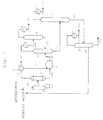
- Figure 1 is a block diagram illustrating a process for the preparation of isopropyl acetate having a high purity.
- numbers 1, 2, 3 and 4 are a reaction vessel, a flush tank, a condenser and a reservoir, respectively, and numbers 5, 6, 7 and 8 are a first distillation column, a second distillation column, a third distillation column and a fourth distillation column, respectively.
- Figure 1 is a block diagram that shows a process for the preparation of isopropyl acetate in which the steps, (a) to (g), are combinedly shown.
- numbers 1, 2, 3 and 4 are a reaction vessel, a flush tank, a condenser and a reservoir, respectively, and numbers 5, 6, 7 and 8 are a first distillation column, a second distillation column, a third distillation column and a fourth distillation column, respectively.
- An arrow shows the stream direction of the solution or gas
- letters (A) to (P) show the solution or gas streaming therethrough.
- the starting mixture(A) containing isopropyl acetate is firstly prepared by the reaction of propylene having impurities with acetic acid in the presence of a catalyst in the reaction vessel (1).
- the propylene having impurities which is one starting material includes a crude propylene obtained by catalytically cracking petroleums such as naphtha and a crude propylene by-produced in a process for the preparation of isobutene by dehydrogenation of isobutane.
- the former crude propylene primarily contains propylene, propane and olefins having a carbon number of 4, etc.
- the latter crude propylene primarily contains propylene, methane, ethane, propane, isobutane and olefins having a carbon number of 2 and 4, etc.
- C2 olefin can be cited ethylene.
- reaction system contains small amounts of water derived from the crude propylene and acetic acid and inevitably produced with the generation of acetic anhydride from acetic acid by a side reaction in the reaction of propylene with acetic acid.
- the catalyst is to be selected from catalysts commonly used in reactions of this kind, which are not particular catalysts.
- Acidic catalysts such as an acidic ion-exchange resin are generally used, and the reaction can be carried out in a liquid phase, gas phase or a mixed phase composed of gas phase and liquid phase.
- the acetic acid having small amounts of water and propylene having impurities which are starting materials(P) are preferably fed through parallel liquid-phase streams into the continuous-flow fixed-bed reaction vessel(1) in which an acidic ion-exchange resin is packed as a catalyst.
- the molar ratio of acetic acid to propylene is preferably within a range of from 1.0 to 2.0.
- the internal pressures in the reaction vessel are suitably maintained to within a range of 15 to 100 kg/cm2, preferably 15 to 50 kg/cm2 which is sufficient to keep the reaction system in a liquid state.
- the reaction is carried out while maintaining the temperature of the area around the inlet of the catalyst bed to within the range of 70 to 120 °C.
- the crude reaction mixture(A) containing isopropyl acetate obtained in the reaction is used as a starting material in the present invention.
- the crude reaction mixture(A) is usually fed in a pressurized state into a flush tank(2), and then depressurized back to atmospheric pressure.
- a liquid phase(D) and a gas phase(B) are separated from each other.
- the gas phase(B) is cooled through a condenser(3) in order to recover isopropyl acetate, this minimizes the loss of isopropyl acetate that occurs in flushing.
- a gas phase(0) discharged from the condenser(3) primarily contains propylene and inert gases such as methane, propane, butane and carbondioxide, etc. which are usually disposed of as waste gases.
- the temperature of the coolant to be used in the condenser(3) is preferably not more than 20 °C.
- a condensate(C) containing isopropyl acetate in the condenser(3) is mixed with a liquid phase(D) in a tank(4), and the mixture(E) is continuously charged into the first distillation column(5).
- the first distillation column(5) is installed for the purpose of removing low-boiling-point ingredients(F) which include isopropyl acetate, isopropyl alcohol, isopropyl ethers and olefins having a carbon number of 7 which are impurities produced in the present reaction conditions.
- low-boiling-point ingredients(F) which include isopropyl acetate, isopropyl alcohol, isopropyl ethers and olefins having a carbon number of 7 which are impurities produced in the present reaction conditions.
- the olefins having a carbon number of 7 contained in the low-boiling-point ingredients(F) are produced by the reaction of propylene with olefins having a carbon number 4.
- the olefins having a carbon number of 7 mainly cause a deterioration in the purity of isopropyl acetate which is the desired product.
- Isopropyl alcohol and isopropyl ether are produced as by-products by the reaction of propylene with the above-mentioned small amount of water.
- the operating conditions in the first distillation column(5) are selected so that the above-mentioned low-boiling-point ingredients in a mixture(I) from the bottom of the first distillation column(5) are decreased to a regulated concentration, the olefins having a carbon number of 7 are not readily separated from isopropyl acetate because of the close boiling points in the two.
- the low-boiling-Point ingredients(F) are charged into the second distillation column(6) to recover isopropyl acetate therefrom.
- the mixture(H) discharged from the bottom of the second distillation column(6) which includes isopropyl acetate and small amounts of low-boiling-point ingredients is charged into a reasonable stage in the first distillation column(5), that is, a multi-stage process is conducted, resulting in that the loss of isopropyl acetate can be remarkably decreased.
- the reasonable stage means a middle portion in the first distillation column(5) near which the mixture(E) is charged.
- volume of the low-boiling-point ingredients(F) charged into the second distillation column(6) is approximately 1/20 of the volume of the above-mentioned mixture(E).
- the second distillation column(6) may have the diameter of not more than 1/3 compared to the first distillation column(5), in order to keep engineering and operation costs to a minimum.
- a distillate(G) discharged from the top of the second distillation column(6) is usually burned as a waste.
- the mixture(I) discharged from the bottom of the first distillation column(5) is charged into the third distillation column(7) to obtain from the column top isopropyl acetate(J) which is the desired product.
- the mixture(K) discharged from the bottom of the third distillation column(7) is charged into the side portion of the fourth distillation column(8).
- the mixture(K) primarily contains acetic acid which is an unreacted starting material, sec-butyl acetate and high-boiling-point ingredients.
- the high-boiling-point in-gredients(N) and a mixture(L) which primarily contains acetic acid and olefins having a carbon number of 9 are removed to recover a mixture(M) which primarily contains the unreacted acetic acid and sec-butyl acetate.
- the mixture(M) is discharged from a Portion lower than the side portion to charge the mixture(K), and the mixture(M) is recirculated into the reaction system(1).
- Sec-butyl acetate is produced by the reaction of acetic acid with olefins having a carbon number of 4 which are impure ingredients in the starting crude propylene.
- the boiling point of sec-butyl acetate is close to the boiling point of acetic acid, resulting in both being difficult to separate from each other by distillation.
- the mixture(K) contains acetic acid, olefins having a carbon number of 9 which exist primarily in the form of trimers of propylene, esters of olefins having a carbon number of 9 and minor amount of isopropyl acetate.
- the olefins having a carbon number of 9 would produce an azeotropic mixture with acetic acid, resulting in that acetic acid is incapable of being separated from the olefins having a carbon number of 9 by distilling off acetic acid from the top of the distillation column and discharging the olefins having a carbon number of 9.
- esters of olefins having a carbon number of 9 are produced by the addition reaction of acetic acid to the olefins having a carbon number of 9.
- acetic acid is recovered and recirculated into the reaction vessel.
- a mixture(L) primarily composed of the olefins having a carbon number of 9 and acetic acid is distilled off from the top of the fourth distillation column(8) by making use of the azeotropic property between acetic acid and the olefins, and the high-boiling-point ingredients(N) containing acetates, etc. are discharged from the bottom of the fourth distillation column(8).
- the mixture(M) which includes acetic acid and sec-butyl acetate is discharged from the side portion of the fourth distillation column(8), whereby acetic acid not containing undesirable impurities can be recovered.
- a mixture(P) composed of acetic acid having below 0.1 % of water and a crude propylene which contains 76.1 % of propylene, 22.0 % of propane and 1.9 % of olefins having a carbon number of 4, etc. was supplied into a tube-typed reaction vessel(1) shown in Figure 1, in which also an acidic ion-exchange resin was placed as a catalyst.
- the mixture(P) was allowed to react while passing through the catalyst layer, after which it was cooled while being partially recirculated through a heat exchanger(not shown in Figure 1).
- Acetic acid was supplied into the reaction vessel(1) at an LHSV (quantity of feed current to the catalyst) of acetic acid relative to the catalyst layer of 1.0, acetic acid/propylene molar ratio of 1.4 and a reaction pressure of 40 kg/cm2.
- LHSV quantitative of feed current to the catalyst
- the pressurized reaction crude solution obtained was discharged into a flush tank(2) to separate it into a gas phase mixture(B)[non-condensation ingredients] and a liquid phase mixture(D)[condensation ingredients].
- the non-condensation ingredients(B) were cooled to 10 °C in a condenser(3) in order to condense isopropyl acetate, and a mixture(C) containing the condensed isopropyl acetate, etc. was mixed with the liquid phase mixture(D).
- the mixture(E) was supplied into a first distillation column(5) which has 20 stages in the concentration portion and 20 stages in the collection portion. Distillation in column(5) was carried out at a reflux ratio of 30, so that the amounts in it of isopropanol, isopropyl ether and the olefins having a carbon number of 7 were decreased to approximately 500 ppm which is a specified value in a column-bottom mixture(I).
- the column-bottom mixture(I) was supplied into a third distillation column(7).
- the composition of the distillate(F) in the first distillation column(5) consisted to 83 % of isopropyl acetate, to 16 % of low-boiling-point ingredients which included isopropyl alcohol, isopropyl ether, and olefins having carbon number of 7, and to 1% of water.
- distillate(F) is disposed of without any treatment
- loss of isopropyl alcohol would correspond to 7 % based on the amount of the starting materials.
- distillate(F) was supplied into a second distillation column(6) in order to collect isopropyl acetate.
- the second distillation column(6) was equipped with 20 stages in the concentration portion and 20 stages in the collection portion.
- the distillation in the column(6) was carried out in a reflux ratio of 30, whereby the low-boiling point ingredients were concentrated to within the range of from 16 % to 70 % or so.
- the distillate(G) in the first distillation column(6) was burned.
- the column-bottom mixture(H) was supplied into the middle portion of the first distillation column(5).
- the loss of isopropyl acetate was decreased to approximately 0.7 % based on the amount of the starting materials.
- the column-bottom mixture(I) discharged from the first distillation column(5) was supplied into the third distillation column(7) having 40 stages in the concentration portion and 20 stages in the collection portion.
- the third distillation column(7) was carried out in a reflux ratio of 1, so that an isopropyl acetate product(J) having a purity of 99.9 % was distilled off at the column top.
- the mixture(M) was recirculated to the reaction vessel(1), whereby the loss of acetic acid was 0.8 % based on the amount of the starting acetic acid.
- Example 2 Same procedures as described in Example 1 were repeated, except that there was used a crude propylene which contains 69.0 % of propylene, 29.0 % of propane and 2.0 % of olefins having a carbon number of 4, etc.
- composition of the mixture(E) consisted to 71 % of isopropyl acetate, to 25 % of acetic acid and to 4 % of other ingredients.
- Example 2 The same refining procedures in Example 1 were repeated to obtain an isopropyl acetate product having a purity of 99.9 %.
- the mixtures (A) to (P) in Examples 1 and 2 show the composition of the liquid or gas described below.
- Example 2 Same procedures as described in Example 1 were repeated, except that there was used a crude propylene which contains 58 % of propylene, 28 % of propane, 7 % of carbondioxide, 2 % of methane, 3 % of isobutane as olefins having a carbon number of 4 and 2 % of other ingredients.
- the crude propylene was obtained as a by-product in a process for the preparation of isobutene by the dehydrogenation of isobutane.
- composition of the mixture(E) consisted to 70 % of isopropyl acetate, to 26 % of acetic acid and to 4 % of other ingredients.
- Example 2 The same refining procedures in Example 1 were repeated to obtain an isopropyl acetate product having a purity of 99.9 %.
Landscapes
- Chemical & Material Sciences (AREA)
- Organic Chemistry (AREA)
- Crystallography & Structural Chemistry (AREA)
- Organic Low-Molecular-Weight Compounds And Preparation Thereof (AREA)
Applications Claiming Priority (2)
| Application Number | Priority Date | Filing Date | Title |
|---|---|---|---|
| JP35191592 | 1992-12-08 | ||
| JP351915/92 | 1992-12-08 |
Publications (2)
| Publication Number | Publication Date |
|---|---|
| EP0601929A1 true EP0601929A1 (fr) | 1994-06-15 |
| EP0601929B1 EP0601929B1 (fr) | 1997-09-03 |
Family
ID=18420490
Family Applications (1)
| Application Number | Title | Priority Date | Filing Date |
|---|---|---|---|
| EP93402962A Expired - Lifetime EP0601929B1 (fr) | 1992-12-08 | 1993-12-08 | Procédé de préparation de l'acétate d'isopropyle |
Country Status (3)
| Country | Link |
|---|---|
| US (1) | US5384426A (fr) |
| EP (1) | EP0601929B1 (fr) |
| DE (1) | DE69313595T2 (fr) |
Cited By (2)
| Publication number | Priority date | Publication date | Assignee | Title |
|---|---|---|---|---|
| EP0952141A1 (fr) * | 1998-04-25 | 1999-10-27 | BP Chemicals Limited | Procédé de purification |
| WO2009006815A1 (fr) * | 2007-07-11 | 2009-01-15 | Hunan Zhongchuang Chemical Co., Ltd | Procédé de protection d'un catalyseur utilisé pour la préparation d'un ester gras inférieur |
Families Citing this family (9)
| Publication number | Priority date | Publication date | Assignee | Title |
|---|---|---|---|---|
| US5981818A (en) * | 1995-03-21 | 1999-11-09 | Stone & Webster Engineering Corp. | Integrated cracking and olefins derivative process utilizing dilute olefins |
| CN100463897C (zh) * | 2007-02-02 | 2009-02-25 | 胡先念 | 一种从乙酸与混合c4反应后的混合物中分离乙酸仲丁酯的方法 |
| CN100445259C (zh) * | 2007-09-14 | 2008-12-24 | 胡先念 | 脱除制备乙酸仲丁酯反应产物中重烃的方法 |
| CN100443461C (zh) * | 2007-11-30 | 2008-12-17 | 胡先念 | 一种分离乙酸仲丁酯、乙酸和重烃的方法 |
| CN101168505B (zh) * | 2007-11-30 | 2010-06-09 | 湖南中创化工有限责任公司 | 带产物分离和回收工艺的制备乙酸仲丁酯的方法 |
| CN103880591A (zh) * | 2012-12-24 | 2014-06-25 | 中国科学院大连化学物理研究所 | 一种以丙烯和醋酸为原料制备异丙醇和乙醇的方法 |
| CN104744248B (zh) * | 2013-12-31 | 2016-08-31 | 湖南中创化工股份有限公司 | 一种由丙烯与乙酸反应制备乙酸异丙酯的方法及装置 |
| CN108863793B (zh) * | 2018-05-23 | 2021-06-18 | 惠州宇新化工有限责任公司 | 一种乙酸异丙酯的制备方法 |
| US20260042242A1 (en) * | 2024-08-12 | 2026-02-12 | Iko Industries Ltd. | System and method for recycling asphalt shingles |
Citations (1)
| Publication number | Priority date | Publication date | Assignee | Title |
|---|---|---|---|---|
| EP0054576A1 (fr) * | 1980-12-18 | 1982-06-30 | Union Explosivos Rio Tinto, S.A. | Procédé de production d'esters à partir d'oléfines |
Family Cites Families (14)
| Publication number | Priority date | Publication date | Assignee | Title |
|---|---|---|---|---|
| US1862522A (en) * | 1929-04-26 | 1932-06-14 | Union Metal Prod Co | Drop door for railway cars |
| US1877291A (en) * | 1930-01-21 | 1932-09-13 | Standard Oil Dev Co | Continuous method of producing esters from olefins |
| US2021851A (en) * | 1932-03-09 | 1935-11-19 | Dow Chemical Co | Method of making isopropyl esters of aliphatic acids |
| US2042218A (en) * | 1934-08-04 | 1936-05-26 | Shell Dev | Recovery of organic acid esters |
| US2224809A (en) * | 1935-10-21 | 1940-12-10 | Dow Chemical Co | Method of making isopropyl esters of aliphatic acids |
| US2414999A (en) * | 1944-06-27 | 1947-01-28 | Standard Oil Co | Esterification process |
| US2678332A (en) * | 1949-12-23 | 1954-05-11 | Standard Oil Dev Co | Esterification of olefins using ion exchange resins catalysts |
| FR1068204A (fr) * | 1952-12-05 | 1954-06-23 | Melle Usines Sa | Procédé de fabrication d'esters aliphatiques |
| US3055934A (en) * | 1959-04-30 | 1962-09-25 | Texaco Inc | Preparation of esters from tertiary olefins |
| US3102905A (en) * | 1959-10-30 | 1963-09-03 | Celanese Corp | Process for preparing tertiary butyl acetate |
| US3053887A (en) * | 1959-11-03 | 1962-09-11 | Robert S Aries | Esterification of iso-olefins |
| US3299110A (en) * | 1963-08-22 | 1967-01-17 | Exxon Research Engineering Co | Condensation of carboxylic acids and olefins to produce esters |
| US3474131A (en) * | 1966-10-31 | 1969-10-21 | Universal Oil Prod Co | Preparation of primary alkyl esters |
| CA1047524A (fr) * | 1973-02-10 | 1979-01-30 | Ernst I. Leupold | Synthese industrielle d'esters d'isopropyle |
-
1993
- 1993-12-07 US US08/163,304 patent/US5384426A/en not_active Expired - Fee Related
- 1993-12-08 DE DE69313595T patent/DE69313595T2/de not_active Expired - Fee Related
- 1993-12-08 EP EP93402962A patent/EP0601929B1/fr not_active Expired - Lifetime
Patent Citations (1)
| Publication number | Priority date | Publication date | Assignee | Title |
|---|---|---|---|---|
| EP0054576A1 (fr) * | 1980-12-18 | 1982-06-30 | Union Explosivos Rio Tinto, S.A. | Procédé de production d'esters à partir d'oléfines |
Non-Patent Citations (1)
| Title |
|---|
| PETER RONA ET AL: "NEW ROUTE TO ACETIC ESTERS", HYDROCARBON PROCESSING, vol. 54, no. 4, April 1975 (1975-04-01), HOUSTON US, pages 185 - 186 * |
Cited By (4)
| Publication number | Priority date | Publication date | Assignee | Title |
|---|---|---|---|---|
| EP0952141A1 (fr) * | 1998-04-25 | 1999-10-27 | BP Chemicals Limited | Procédé de purification |
| US6232491B1 (en) | 1998-04-25 | 2001-05-15 | Bp Chemicals Limited | Purification process for removal of impurities in acetic acid-ethylene reactions |
| RU2237652C2 (ru) * | 1998-04-25 | 2004-10-10 | Бп Кемикэлз Лимитед | Способ очистки |
| WO2009006815A1 (fr) * | 2007-07-11 | 2009-01-15 | Hunan Zhongchuang Chemical Co., Ltd | Procédé de protection d'un catalyseur utilisé pour la préparation d'un ester gras inférieur |
Also Published As
| Publication number | Publication date |
|---|---|
| EP0601929B1 (fr) | 1997-09-03 |
| US5384426A (en) | 1995-01-24 |
| DE69313595D1 (de) | 1997-10-09 |
| DE69313595T2 (de) | 1998-04-02 |
Similar Documents
| Publication | Publication Date | Title |
|---|---|---|
| KR100269194B1 (ko) | 메틸 메타크릴레이트의 제조 방법 | |
| RU2165405C2 (ru) | Способ этерификации-гидрирования | |
| EP0619286A1 (fr) | Elimination des composés contenant de l'oxygène dans un procédé de production d'oxyde de MTBE par distillation réactive | |
| EP0031205B1 (fr) | Carbonylation d'éthylène ou de propylène | |
| CA2274751A1 (fr) | Production d'esters d'acides organiques carboxyliques | |
| US5446224A (en) | Integrated process for producing iso-butene and alkyl tert-butyl ethers | |
| EP0605822A1 (fr) | Procédé intégré pour la production d'éther méthyl tertio-butyl (MTBE) | |
| US5384426A (en) | Process for the preparation of isopropyl acetate | |
| EP0023119B1 (fr) | Procédé de préparation d'isobutylène de pureté élevée | |
| KR920005693B1 (ko) | 메타크릴산 에스테르의 제조방법 | |
| KR100703914B1 (ko) | 프로필렌 히드로포르밀화 생성물 및 아크릴산 및(또는)아크롤레인의 제조 방법 | |
| JPH11335323A (ja) | 精製法 | |
| US5136108A (en) | Production of oxygenated fuel components | |
| US5986148A (en) | Di-isopropyl ether synthesis and dry product recovery | |
| CN1329350C (zh) | 从裂解c4制备1-辛烯的方法 | |
| JP2557099B2 (ja) | ジメチルカーボネートの分離方法 | |
| JP2543694B2 (ja) | プロピレングリコ―ルモノt―ブチルエ―テルの製法 | |
| EP0728721B1 (fr) | Procédé pour la production d'alcool isopropylique | |
| JPS6351343A (ja) | イソプロピルアルコ−ル及び炭素原子数が4〜5個の第3アルコ−ルの製造方法 | |
| US20040220427A1 (en) | Process for producing (meth)acrylic acid | |
| US5925685A (en) | Method for carrying out heterogeneous catalysis | |
| US5324865A (en) | Di-isopropyl ether production | |
| JPH08291092A (ja) | イソプロピルアルコールの製造方法 | |
| US4383894A (en) | Removal of organic iodine compounds from acetaldehyde | |
| JP2024509898A (ja) | C4炭化水素混合物からイソブテンを得る方法 |
Legal Events
| Date | Code | Title | Description |
|---|---|---|---|
| PUAI | Public reference made under article 153(3) epc to a published international application that has entered the european phase |
Free format text: ORIGINAL CODE: 0009012 |
|
| AK | Designated contracting states |
Kind code of ref document: A1 Designated state(s): DE FR GB |
|
| 17P | Request for examination filed |
Effective date: 19941024 |
|
| 17Q | First examination report despatched |
Effective date: 19951128 |
|
| GRAG | Despatch of communication of intention to grant |
Free format text: ORIGINAL CODE: EPIDOS AGRA |
|
| GRAH | Despatch of communication of intention to grant a patent |
Free format text: ORIGINAL CODE: EPIDOS IGRA |
|
| GRAH | Despatch of communication of intention to grant a patent |
Free format text: ORIGINAL CODE: EPIDOS IGRA |
|
| RAP1 | Party data changed (applicant data changed or rights of an application transferred) |
Owner name: NIPPON PETROCHEMICALS CO., LTD. Owner name: DAICEL CHEMICAL INDUSTRIES, LTD. |
|
| GRAA | (expected) grant |
Free format text: ORIGINAL CODE: 0009210 |
|
| AK | Designated contracting states |
Kind code of ref document: B1 Designated state(s): DE FR GB |
|
| REF | Corresponds to: |
Ref document number: 69313595 Country of ref document: DE Date of ref document: 19971009 |
|
| ET | Fr: translation filed | ||
| PLBE | No opposition filed within time limit |
Free format text: ORIGINAL CODE: 0009261 |
|
| STAA | Information on the status of an ep patent application or granted ep patent |
Free format text: STATUS: NO OPPOSITION FILED WITHIN TIME LIMIT |
|
| 26N | No opposition filed | ||
| PGFP | Annual fee paid to national office [announced via postgrant information from national office to epo] |
Ref country code: GB Payment date: 19991208 Year of fee payment: 7 Ref country code: FR Payment date: 19991208 Year of fee payment: 7 |
|
| PGFP | Annual fee paid to national office [announced via postgrant information from national office to epo] |
Ref country code: DE Payment date: 19991210 Year of fee payment: 7 |
|
| PG25 | Lapsed in a contracting state [announced via postgrant information from national office to epo] |
Ref country code: GB Free format text: LAPSE BECAUSE OF NON-PAYMENT OF DUE FEES Effective date: 20001208 |
|
| GBPC | Gb: european patent ceased through non-payment of renewal fee |
Effective date: 20001208 |
|
| PG25 | Lapsed in a contracting state [announced via postgrant information from national office to epo] |
Ref country code: FR Free format text: LAPSE BECAUSE OF NON-PAYMENT OF DUE FEES Effective date: 20010831 |
|
| REG | Reference to a national code |
Ref country code: FR Ref legal event code: ST |
|
| PG25 | Lapsed in a contracting state [announced via postgrant information from national office to epo] |
Ref country code: DE Free format text: LAPSE BECAUSE OF NON-PAYMENT OF DUE FEES Effective date: 20011002 |