EP0602049B1 - Nukleinsäurenachweis - Google Patents
Nukleinsäurenachweis Download PDFInfo
- Publication number
- EP0602049B1 EP0602049B1 EP92914059A EP92914059A EP0602049B1 EP 0602049 B1 EP0602049 B1 EP 0602049B1 EP 92914059 A EP92914059 A EP 92914059A EP 92914059 A EP92914059 A EP 92914059A EP 0602049 B1 EP0602049 B1 EP 0602049B1
- Authority
- EP
- European Patent Office
- Prior art keywords
- probe
- enzyme
- nucleic acid
- sequence
- interest
- Prior art date
- Legal status (The legal status is an assumption and is not a legal conclusion. Google has not performed a legal analysis and makes no representation as to the accuracy of the status listed.)
- Expired - Lifetime
Links
- 150000007523 nucleic acids Chemical class 0.000 title claims abstract description 93
- 238000003556 assay Methods 0.000 title claims abstract description 65
- 108020004707 nucleic acids Proteins 0.000 title claims description 83
- 102000039446 nucleic acids Human genes 0.000 title claims description 83
- 239000000523 sample Substances 0.000 claims abstract description 128
- 102000004190 Enzymes Human genes 0.000 claims abstract description 120
- 108090000790 Enzymes Proteins 0.000 claims abstract description 120
- 230000027455 binding Effects 0.000 claims abstract description 53
- 230000000694 effects Effects 0.000 claims abstract description 51
- 239000003446 ligand Substances 0.000 claims abstract description 32
- 230000000295 complement effect Effects 0.000 claims abstract description 27
- 239000000126 substance Substances 0.000 claims abstract description 26
- 108091028043 Nucleic acid sequence Proteins 0.000 claims abstract description 12
- 238000012544 monitoring process Methods 0.000 claims abstract description 9
- 238000000034 method Methods 0.000 claims description 41
- 230000004913 activation Effects 0.000 claims description 31
- 108010005774 beta-Galactosidase Proteins 0.000 claims description 27
- 102000005936 beta-Galactosidase Human genes 0.000 claims description 24
- 239000012634 fragment Substances 0.000 claims description 18
- 230000003213 activating effect Effects 0.000 claims description 8
- 229950004398 broxuridine Drugs 0.000 claims description 7
- 239000002773 nucleotide Substances 0.000 claims description 5
- 125000003729 nucleotide group Chemical group 0.000 claims description 5
- WOVKYSAHUYNSMH-RRKCRQDMSA-N 5-bromodeoxyuridine Chemical compound C1[C@H](O)[C@@H](CO)O[C@H]1N1C(=O)NC(=O)C(Br)=C1 WOVKYSAHUYNSMH-RRKCRQDMSA-N 0.000 claims description 3
- WOVKYSAHUYNSMH-UHFFFAOYSA-N BROMODEOXYURIDINE Natural products C1C(O)C(CO)OC1N1C(=O)NC(=O)C(Br)=C1 WOVKYSAHUYNSMH-UHFFFAOYSA-N 0.000 claims description 3
- 239000000758 substrate Substances 0.000 claims description 3
- 239000003248 enzyme activator Substances 0.000 claims description 2
- 230000009870 specific binding Effects 0.000 claims description 2
- 102100031126 6-phosphogluconolactonase Human genes 0.000 claims 1
- 108010029731 6-phosphogluconolactonase Proteins 0.000 claims 1
- 108010018962 Glucosephosphate Dehydrogenase Proteins 0.000 claims 1
- 125000003275 alpha amino acid group Chemical group 0.000 claims 1
- 108010066533 ribonuclease S Proteins 0.000 claims 1
- 239000002853 nucleic acid probe Substances 0.000 abstract description 23
- 108020004711 Nucleic Acid Probes Proteins 0.000 abstract description 22
- 238000009396 hybridization Methods 0.000 description 48
- 108091034117 Oligonucleotide Proteins 0.000 description 44
- 108020004414 DNA Proteins 0.000 description 38
- 108090000765 processed proteins & peptides Proteins 0.000 description 34
- 239000012491 analyte Substances 0.000 description 28
- 239000000203 mixture Substances 0.000 description 24
- 239000003298 DNA probe Substances 0.000 description 22
- 108020003215 DNA Probes Proteins 0.000 description 21
- JLCPHMBAVCMARE-UHFFFAOYSA-N [3-[[3-[[3-[[3-[[3-[[3-[[3-[[3-[[3-[[3-[[3-[[5-(2-amino-6-oxo-1H-purin-9-yl)-3-[[3-[[3-[[3-[[3-[[3-[[5-(2-amino-6-oxo-1H-purin-9-yl)-3-[[5-(2-amino-6-oxo-1H-purin-9-yl)-3-hydroxyoxolan-2-yl]methoxy-hydroxyphosphoryl]oxyoxolan-2-yl]methoxy-hydroxyphosphoryl]oxy-5-(5-methyl-2,4-dioxopyrimidin-1-yl)oxolan-2-yl]methoxy-hydroxyphosphoryl]oxy-5-(6-aminopurin-9-yl)oxolan-2-yl]methoxy-hydroxyphosphoryl]oxy-5-(6-aminopurin-9-yl)oxolan-2-yl]methoxy-hydroxyphosphoryl]oxy-5-(6-aminopurin-9-yl)oxolan-2-yl]methoxy-hydroxyphosphoryl]oxy-5-(6-aminopurin-9-yl)oxolan-2-yl]methoxy-hydroxyphosphoryl]oxyoxolan-2-yl]methoxy-hydroxyphosphoryl]oxy-5-(5-methyl-2,4-dioxopyrimidin-1-yl)oxolan-2-yl]methoxy-hydroxyphosphoryl]oxy-5-(4-amino-2-oxopyrimidin-1-yl)oxolan-2-yl]methoxy-hydroxyphosphoryl]oxy-5-(5-methyl-2,4-dioxopyrimidin-1-yl)oxolan-2-yl]methoxy-hydroxyphosphoryl]oxy-5-(5-methyl-2,4-dioxopyrimidin-1-yl)oxolan-2-yl]methoxy-hydroxyphosphoryl]oxy-5-(6-aminopurin-9-yl)oxolan-2-yl]methoxy-hydroxyphosphoryl]oxy-5-(6-aminopurin-9-yl)oxolan-2-yl]methoxy-hydroxyphosphoryl]oxy-5-(4-amino-2-oxopyrimidin-1-yl)oxolan-2-yl]methoxy-hydroxyphosphoryl]oxy-5-(4-amino-2-oxopyrimidin-1-yl)oxolan-2-yl]methoxy-hydroxyphosphoryl]oxy-5-(4-amino-2-oxopyrimidin-1-yl)oxolan-2-yl]methoxy-hydroxyphosphoryl]oxy-5-(6-aminopurin-9-yl)oxolan-2-yl]methoxy-hydroxyphosphoryl]oxy-5-(4-amino-2-oxopyrimidin-1-yl)oxolan-2-yl]methyl [5-(6-aminopurin-9-yl)-2-(hydroxymethyl)oxolan-3-yl] hydrogen phosphate Polymers Cc1cn(C2CC(OP(O)(=O)OCC3OC(CC3OP(O)(=O)OCC3OC(CC3O)n3cnc4c3nc(N)[nH]c4=O)n3cnc4c3nc(N)[nH]c4=O)C(COP(O)(=O)OC3CC(OC3COP(O)(=O)OC3CC(OC3COP(O)(=O)OC3CC(OC3COP(O)(=O)OC3CC(OC3COP(O)(=O)OC3CC(OC3COP(O)(=O)OC3CC(OC3COP(O)(=O)OC3CC(OC3COP(O)(=O)OC3CC(OC3COP(O)(=O)OC3CC(OC3COP(O)(=O)OC3CC(OC3COP(O)(=O)OC3CC(OC3COP(O)(=O)OC3CC(OC3COP(O)(=O)OC3CC(OC3COP(O)(=O)OC3CC(OC3COP(O)(=O)OC3CC(OC3COP(O)(=O)OC3CC(OC3COP(O)(=O)OC3CC(OC3CO)n3cnc4c(N)ncnc34)n3ccc(N)nc3=O)n3cnc4c(N)ncnc34)n3ccc(N)nc3=O)n3ccc(N)nc3=O)n3ccc(N)nc3=O)n3cnc4c(N)ncnc34)n3cnc4c(N)ncnc34)n3cc(C)c(=O)[nH]c3=O)n3cc(C)c(=O)[nH]c3=O)n3ccc(N)nc3=O)n3cc(C)c(=O)[nH]c3=O)n3cnc4c3nc(N)[nH]c4=O)n3cnc4c(N)ncnc34)n3cnc4c(N)ncnc34)n3cnc4c(N)ncnc34)n3cnc4c(N)ncnc34)O2)c(=O)[nH]c1=O JLCPHMBAVCMARE-UHFFFAOYSA-N 0.000 description 18
- 239000000863 peptide conjugate Substances 0.000 description 18
- 108090000623 proteins and genes Proteins 0.000 description 16
- FAPWRFPIFSIZLT-UHFFFAOYSA-M Sodium chloride Chemical compound [Na+].[Cl-] FAPWRFPIFSIZLT-UHFFFAOYSA-M 0.000 description 14
- 102100025064 Cellular tumor antigen p53 Human genes 0.000 description 13
- 230000000692 anti-sense effect Effects 0.000 description 13
- 239000012190 activator Substances 0.000 description 12
- 239000000872 buffer Substances 0.000 description 12
- 102000004169 proteins and genes Human genes 0.000 description 12
- 238000004458 analytical method Methods 0.000 description 11
- 238000012360 testing method Methods 0.000 description 11
- 210000004027 cell Anatomy 0.000 description 10
- 239000000562 conjugate Substances 0.000 description 10
- 235000018417 cysteine Nutrition 0.000 description 10
- XUJNEKJLAYXESH-UHFFFAOYSA-N cysteine Natural products SCC(N)C(O)=O XUJNEKJLAYXESH-UHFFFAOYSA-N 0.000 description 10
- 238000003752 polymerase chain reaction Methods 0.000 description 10
- 238000002360 preparation method Methods 0.000 description 10
- 238000003018 immunoassay Methods 0.000 description 9
- LFQSCWFLJHTTHZ-UHFFFAOYSA-N Ethanol Chemical compound CCO LFQSCWFLJHTTHZ-UHFFFAOYSA-N 0.000 description 8
- 230000005764 inhibitory process Effects 0.000 description 8
- 239000000243 solution Substances 0.000 description 8
- 201000003883 Cystic fibrosis Diseases 0.000 description 7
- 229930182817 methionine Natural products 0.000 description 7
- 239000011780 sodium chloride Substances 0.000 description 7
- ZHNUHDYFZUAESO-UHFFFAOYSA-N Formamide Chemical compound NC=O ZHNUHDYFZUAESO-UHFFFAOYSA-N 0.000 description 6
- FFEARJCKVFRZRR-BYPYZUCNSA-N L-methionine Chemical compound CSCC[C@H](N)C(O)=O FFEARJCKVFRZRR-BYPYZUCNSA-N 0.000 description 6
- TWRXJAOTZQYOKJ-UHFFFAOYSA-L Magnesium chloride Chemical compound [Mg+2].[Cl-].[Cl-] TWRXJAOTZQYOKJ-UHFFFAOYSA-L 0.000 description 6
- CSNNHWWHGAXBCP-UHFFFAOYSA-L Magnesium sulfate Chemical compound [Mg+2].[O-][S+2]([O-])([O-])[O-] CSNNHWWHGAXBCP-UHFFFAOYSA-L 0.000 description 6
- KWYUFKZDYYNOTN-UHFFFAOYSA-M Potassium hydroxide Chemical compound [OH-].[K+] KWYUFKZDYYNOTN-UHFFFAOYSA-M 0.000 description 6
- 229920004890 Triton X-100 Polymers 0.000 description 6
- 230000035945 sensitivity Effects 0.000 description 6
- 101150029409 CFTR gene Proteins 0.000 description 5
- 102000023732 binding proteins Human genes 0.000 description 5
- 108091008324 binding proteins Proteins 0.000 description 5
- 230000015572 biosynthetic process Effects 0.000 description 5
- 230000008859 change Effects 0.000 description 5
- 238000006243 chemical reaction Methods 0.000 description 5
- 238000001514 detection method Methods 0.000 description 5
- 238000011161 development Methods 0.000 description 5
- 238000010790 dilution Methods 0.000 description 5
- 239000012895 dilution Substances 0.000 description 5
- 239000012528 membrane Substances 0.000 description 5
- 235000018102 proteins Nutrition 0.000 description 5
- 238000000926 separation method Methods 0.000 description 5
- 108091032973 (ribonucleotides)n+m Proteins 0.000 description 4
- KUWPCJHYPSUOFW-YBXAARCKSA-N 2-nitrophenyl beta-D-galactoside Chemical compound O[C@@H]1[C@@H](O)[C@@H](O)[C@@H](CO)O[C@H]1OC1=CC=CC=C1[N+]([O-])=O KUWPCJHYPSUOFW-YBXAARCKSA-N 0.000 description 4
- HEDRZPFGACZZDS-UHFFFAOYSA-N Chloroform Chemical compound ClC(Cl)Cl HEDRZPFGACZZDS-UHFFFAOYSA-N 0.000 description 4
- LRHPLDYGYMQRHN-UHFFFAOYSA-N N-Butanol Chemical compound CCCCO LRHPLDYGYMQRHN-UHFFFAOYSA-N 0.000 description 4
- WCUXLLCKKVVCTQ-UHFFFAOYSA-M Potassium chloride Chemical compound [Cl-].[K+] WCUXLLCKKVVCTQ-UHFFFAOYSA-M 0.000 description 4
- 238000002835 absorbance Methods 0.000 description 4
- 150000001413 amino acids Chemical group 0.000 description 4
- 230000003321 amplification Effects 0.000 description 4
- 239000003153 chemical reaction reagent Substances 0.000 description 4
- 238000011534 incubation Methods 0.000 description 4
- 238000003199 nucleic acid amplification method Methods 0.000 description 4
- 230000003287 optical effect Effects 0.000 description 4
- 230000008569 process Effects 0.000 description 4
- 239000001509 sodium citrate Substances 0.000 description 4
- NLJMYIDDQXHKNR-UHFFFAOYSA-K sodium citrate Chemical compound O.O.[Na+].[Na+].[Na+].[O-]C(=O)CC(O)(CC([O-])=O)C([O-])=O NLJMYIDDQXHKNR-UHFFFAOYSA-K 0.000 description 4
- 239000012064 sodium phosphate buffer Substances 0.000 description 4
- 241000894007 species Species 0.000 description 4
- QKNYBSVHEMOAJP-UHFFFAOYSA-N 2-amino-2-(hydroxymethyl)propane-1,3-diol;hydron;chloride Chemical compound Cl.OCC(N)(CO)CO QKNYBSVHEMOAJP-UHFFFAOYSA-N 0.000 description 3
- WEVYAHXRMPXWCK-UHFFFAOYSA-N Acetonitrile Chemical compound CC#N WEVYAHXRMPXWCK-UHFFFAOYSA-N 0.000 description 3
- KCXVZYZYPLLWCC-UHFFFAOYSA-N EDTA Chemical compound OC(=O)CN(CC(O)=O)CCN(CC(O)=O)CC(O)=O KCXVZYZYPLLWCC-UHFFFAOYSA-N 0.000 description 3
- ZMXDDKWLCZADIW-UHFFFAOYSA-N N,N-Dimethylformamide Chemical compound CN(C)C=O ZMXDDKWLCZADIW-UHFFFAOYSA-N 0.000 description 3
- VMHLLURERBWHNL-UHFFFAOYSA-M Sodium acetate Chemical compound [Na+].CC([O-])=O VMHLLURERBWHNL-UHFFFAOYSA-M 0.000 description 3
- WQZGKKKJIJFFOK-FPRJBGLDSA-N beta-D-galactose Chemical compound OC[C@H]1O[C@@H](O)[C@H](O)[C@@H](O)[C@H]1O WQZGKKKJIJFFOK-FPRJBGLDSA-N 0.000 description 3
- 229910021538 borax Inorganic materials 0.000 description 3
- 229960001484 edetic acid Drugs 0.000 description 3
- 230000003993 interaction Effects 0.000 description 3
- 229910001629 magnesium chloride Inorganic materials 0.000 description 3
- 229910052943 magnesium sulfate Inorganic materials 0.000 description 3
- 235000019341 magnesium sulphate Nutrition 0.000 description 3
- 239000011702 manganese sulphate Substances 0.000 description 3
- 235000007079 manganese sulphate Nutrition 0.000 description 3
- SQQMAOCOWKFBNP-UHFFFAOYSA-L manganese(II) sulfate Chemical compound [Mn+2].[O-]S([O-])(=O)=O SQQMAOCOWKFBNP-UHFFFAOYSA-L 0.000 description 3
- 238000005259 measurement Methods 0.000 description 3
- 238000002156 mixing Methods 0.000 description 3
- 238000010369 molecular cloning Methods 0.000 description 3
- 239000008188 pellet Substances 0.000 description 3
- 239000001632 sodium acetate Substances 0.000 description 3
- 235000017281 sodium acetate Nutrition 0.000 description 3
- 235000010339 sodium tetraborate Nutrition 0.000 description 3
- 239000007790 solid phase Substances 0.000 description 3
- BSVBQGMMJUBVOD-UHFFFAOYSA-N trisodium borate Chemical compound [Na+].[Na+].[Na+].[O-]B([O-])[O-] BSVBQGMMJUBVOD-UHFFFAOYSA-N 0.000 description 3
- XLYOFNOQVPJJNP-UHFFFAOYSA-N water Chemical compound O XLYOFNOQVPJJNP-UHFFFAOYSA-N 0.000 description 3
- FWMNVWWHGCHHJJ-SKKKGAJSSA-N 4-amino-1-[(2r)-6-amino-2-[[(2r)-2-[[(2r)-2-[[(2r)-2-amino-3-phenylpropanoyl]amino]-3-phenylpropanoyl]amino]-4-methylpentanoyl]amino]hexanoyl]piperidine-4-carboxylic acid Chemical compound C([C@H](C(=O)N[C@H](CC(C)C)C(=O)N[C@H](CCCCN)C(=O)N1CCC(N)(CC1)C(O)=O)NC(=O)[C@H](N)CC=1C=CC=CC=1)C1=CC=CC=C1 FWMNVWWHGCHHJJ-SKKKGAJSSA-N 0.000 description 2
- 229920000936 Agarose Polymers 0.000 description 2
- 102000002260 Alkaline Phosphatase Human genes 0.000 description 2
- 108020004774 Alkaline Phosphatase Proteins 0.000 description 2
- 108091003079 Bovine Serum Albumin Proteins 0.000 description 2
- 102000016928 DNA-directed DNA polymerase Human genes 0.000 description 2
- 108010014303 DNA-directed DNA polymerase Proteins 0.000 description 2
- 101100297421 Homarus americanus phc-2 gene Proteins 0.000 description 2
- 108020005187 Oligonucleotide Probes Proteins 0.000 description 2
- 108010033276 Peptide Fragments Proteins 0.000 description 2
- 102000007079 Peptide Fragments Human genes 0.000 description 2
- 108091093037 Peptide nucleic acid Proteins 0.000 description 2
- CDBYLPFSWZWCQE-UHFFFAOYSA-L Sodium Carbonate Chemical compound [Na+].[Na+].[O-]C([O-])=O CDBYLPFSWZWCQE-UHFFFAOYSA-L 0.000 description 2
- WYURNTSHIVDZCO-UHFFFAOYSA-N Tetrahydrofuran Chemical compound C1CCOC1 WYURNTSHIVDZCO-UHFFFAOYSA-N 0.000 description 2
- 241000589500 Thermus aquaticus Species 0.000 description 2
- 108700025716 Tumor Suppressor Genes Proteins 0.000 description 2
- 102000044209 Tumor Suppressor Genes Human genes 0.000 description 2
- 235000001014 amino acid Nutrition 0.000 description 2
- BFNBIHQBYMNNAN-UHFFFAOYSA-N ammonium sulfate Chemical compound N.N.OS(O)(=O)=O BFNBIHQBYMNNAN-UHFFFAOYSA-N 0.000 description 2
- 229910052921 ammonium sulfate Inorganic materials 0.000 description 2
- 239000001166 ammonium sulphate Substances 0.000 description 2
- 235000011130 ammonium sulphate Nutrition 0.000 description 2
- 229940098773 bovine serum albumin Drugs 0.000 description 2
- 239000013592 cell lysate Substances 0.000 description 2
- 230000021615 conjugation Effects 0.000 description 2
- 239000005547 deoxyribonucleotide Substances 0.000 description 2
- 125000002637 deoxyribonucleotide group Chemical group 0.000 description 2
- 239000000499 gel Substances 0.000 description 2
- 210000005260 human cell Anatomy 0.000 description 2
- 230000007062 hydrolysis Effects 0.000 description 2
- 238000006460 hydrolysis reaction Methods 0.000 description 2
- 238000004519 manufacturing process Methods 0.000 description 2
- 239000000463 material Substances 0.000 description 2
- 238000012986 modification Methods 0.000 description 2
- 230000004048 modification Effects 0.000 description 2
- 239000002777 nucleoside Substances 0.000 description 2
- -1 nucleoside phosphoramidites Chemical class 0.000 description 2
- 239000002751 oligonucleotide probe Substances 0.000 description 2
- 239000013612 plasmid Substances 0.000 description 2
- 229920002401 polyacrylamide Polymers 0.000 description 2
- 239000001103 potassium chloride Substances 0.000 description 2
- 235000011164 potassium chloride Nutrition 0.000 description 2
- 230000006798 recombination Effects 0.000 description 2
- 238000005215 recombination Methods 0.000 description 2
- 230000011664 signaling Effects 0.000 description 2
- 239000008223 sterile water Substances 0.000 description 2
- 238000003786 synthesis reaction Methods 0.000 description 2
- 238000012546 transfer Methods 0.000 description 2
- LWIHDJKSTIGBAC-UHFFFAOYSA-K tripotassium phosphate Chemical compound [K+].[K+].[K+].[O-]P([O-])([O-])=O LWIHDJKSTIGBAC-UHFFFAOYSA-K 0.000 description 2
- 238000005406 washing Methods 0.000 description 2
- LLXVXPPXELIDGQ-UHFFFAOYSA-N (2,5-dioxopyrrolidin-1-yl) 3-(2,5-dioxopyrrol-1-yl)benzoate Chemical compound C=1C=CC(N2C(C=CC2=O)=O)=CC=1C(=O)ON1C(=O)CCC1=O LLXVXPPXELIDGQ-UHFFFAOYSA-N 0.000 description 1
- BPHPUYQFMNQIOC-MBOVONDJSA-N (2r,3r,4s,5r)-2-(hydroxymethyl)-6-propan-2-ylsulfanyloxane-3,4,5-triol Chemical compound CC(C)SC1O[C@H](CO)[C@H](O)[C@H](O)[C@H]1O BPHPUYQFMNQIOC-MBOVONDJSA-N 0.000 description 1
- NDJNDUULNXNRQD-XKBRQERYSA-N 1-[(2r,4s,5s)-5-[bromo(hydroxy)methyl]-4-hydroxyoxolan-2-yl]pyrimidine-2,4-dione Chemical class C1[C@H](O)[C@@H](C(Br)O)O[C@H]1N1C(=O)NC(=O)C=C1 NDJNDUULNXNRQD-XKBRQERYSA-N 0.000 description 1
- AUIWZCVHAVRVAC-VYFMYZSASA-N 3-[amino-[[(2r,3s,5r)-5-(5-bromo-2,4-dioxopyrimidin-1-yl)-3-hydroxyoxolan-2-yl]methoxy]phosphanyl]oxypropanenitrile Chemical compound C1[C@H](O)[C@@H](COP(OCCC#N)N)O[C@H]1N1C(=O)NC(=O)C(Br)=C1 AUIWZCVHAVRVAC-VYFMYZSASA-N 0.000 description 1
- 235000010585 Ammi visnaga Nutrition 0.000 description 1
- 244000153158 Ammi visnaga Species 0.000 description 1
- ATRRKUHOCOJYRX-UHFFFAOYSA-N Ammonium bicarbonate Chemical compound [NH4+].OC([O-])=O ATRRKUHOCOJYRX-UHFFFAOYSA-N 0.000 description 1
- 229910000013 Ammonium bicarbonate Inorganic materials 0.000 description 1
- 108090001008 Avidin Proteins 0.000 description 1
- 241000606153 Chlamydia trachomatis Species 0.000 description 1
- 108020004705 Codon Proteins 0.000 description 1
- 241000588724 Escherichia coli Species 0.000 description 1
- WQZGKKKJIJFFOK-GASJEMHNSA-N Glucose Natural products OC[C@H]1OC(O)[C@H](O)[C@@H](O)[C@@H]1O WQZGKKKJIJFFOK-GASJEMHNSA-N 0.000 description 1
- 101100166894 Homo sapiens CFTR gene Proteins 0.000 description 1
- 101001066878 Homo sapiens Polyribonucleotide nucleotidyltransferase 1, mitochondrial Proteins 0.000 description 1
- DGAQECJNVWCQMB-PUAWFVPOSA-M Ilexoside XXIX Chemical compound C[C@@H]1CC[C@@]2(CC[C@@]3(C(=CC[C@H]4[C@]3(CC[C@@H]5[C@@]4(CC[C@@H](C5(C)C)OS(=O)(=O)[O-])C)C)[C@@H]2[C@]1(C)O)C)C(=O)O[C@H]6[C@@H]([C@H]([C@@H]([C@H](O6)CO)O)O)O.[Na+] DGAQECJNVWCQMB-PUAWFVPOSA-M 0.000 description 1
- 206010025323 Lymphomas Diseases 0.000 description 1
- 241000588652 Neisseria gonorrhoeae Species 0.000 description 1
- 239000000020 Nitrocellulose Substances 0.000 description 1
- ISWSIDIOOBJBQZ-UHFFFAOYSA-N Phenol Chemical compound OC1=CC=CC=C1 ISWSIDIOOBJBQZ-UHFFFAOYSA-N 0.000 description 1
- 108010021757 Polynucleotide 5'-Hydroxyl-Kinase Proteins 0.000 description 1
- 102000008422 Polynucleotide 5'-hydroxyl-kinase Human genes 0.000 description 1
- 102000002681 Polyribonucleotide nucleotidyltransferase Human genes 0.000 description 1
- 229920005654 Sephadex Polymers 0.000 description 1
- 239000012507 Sephadex™ Substances 0.000 description 1
- VYPSYNLAJGMNEJ-UHFFFAOYSA-N Silicium dioxide Chemical compound O=[Si]=O VYPSYNLAJGMNEJ-UHFFFAOYSA-N 0.000 description 1
- XSQUKJJJFZCRTK-UHFFFAOYSA-N Urea Chemical compound NC(N)=O XSQUKJJJFZCRTK-UHFFFAOYSA-N 0.000 description 1
- 239000002253 acid Substances 0.000 description 1
- 150000007513 acids Chemical class 0.000 description 1
- 230000004075 alteration Effects 0.000 description 1
- 235000012538 ammonium bicarbonate Nutrition 0.000 description 1
- 239000001099 ammonium carbonate Substances 0.000 description 1
- AVKUERGKIZMTKX-NJBDSQKTSA-N ampicillin Chemical compound C1([C@@H](N)C(=O)N[C@H]2[C@H]3SC([C@@H](N3C2=O)C(O)=O)(C)C)=CC=CC=C1 AVKUERGKIZMTKX-NJBDSQKTSA-N 0.000 description 1
- 229960000723 ampicillin Drugs 0.000 description 1
- 238000005571 anion exchange chromatography Methods 0.000 description 1
- 230000002823 anti-activator Effects 0.000 description 1
- 238000002820 assay format Methods 0.000 description 1
- 238000000376 autoradiography Methods 0.000 description 1
- 230000001580 bacterial effect Effects 0.000 description 1
- 230000008436 biogenesis Effects 0.000 description 1
- 239000004202 carbamide Substances 0.000 description 1
- 238000001648 catalysed chemiluminescence detection Methods 0.000 description 1
- 238000005119 centrifugation Methods 0.000 description 1
- 238000012875 competitive assay Methods 0.000 description 1
- 238000003271 compound fluorescence assay Methods 0.000 description 1
- 239000013256 coordination polymer Substances 0.000 description 1
- UKJLNMAFNRKWGR-UHFFFAOYSA-N cyclohexatrienamine Chemical group NC1=CC=C=C[CH]1 UKJLNMAFNRKWGR-UHFFFAOYSA-N 0.000 description 1
- 125000000151 cysteine group Chemical group N[C@@H](CS)C(=O)* 0.000 description 1
- 238000012217 deletion Methods 0.000 description 1
- 230000037430 deletion Effects 0.000 description 1
- 238000006073 displacement reaction Methods 0.000 description 1
- 238000001962 electrophoresis Methods 0.000 description 1
- 238000010828 elution Methods 0.000 description 1
- 239000012149 elution buffer Substances 0.000 description 1
- 238000005516 engineering process Methods 0.000 description 1
- 239000002532 enzyme inhibitor Substances 0.000 description 1
- 229940125532 enzyme inhibitor Drugs 0.000 description 1
- DNJIEGIFACGWOD-UHFFFAOYSA-N ethyl mercaptane Natural products CCS DNJIEGIFACGWOD-UHFFFAOYSA-N 0.000 description 1
- 210000003527 eukaryotic cell Anatomy 0.000 description 1
- 238000002875 fluorescence polarization Methods 0.000 description 1
- 230000007274 generation of a signal involved in cell-cell signaling Effects 0.000 description 1
- 239000008103 glucose Substances 0.000 description 1
- 239000011544 gradient gel Substances 0.000 description 1
- 238000010348 incorporation Methods 0.000 description 1
- 230000002401 inhibitory effect Effects 0.000 description 1
- BPHPUYQFMNQIOC-NXRLNHOXSA-N isopropyl beta-D-thiogalactopyranoside Chemical compound CC(C)S[C@@H]1O[C@H](CO)[C@H](O)[C@H](O)[C@H]1O BPHPUYQFMNQIOC-NXRLNHOXSA-N 0.000 description 1
- 238000002372 labelling Methods 0.000 description 1
- 230000000670 limiting effect Effects 0.000 description 1
- 125000001360 methionine group Chemical group N[C@@H](CCSC)C(=O)* 0.000 description 1
- 244000005700 microbiome Species 0.000 description 1
- 230000018791 negative regulation of catalytic activity Effects 0.000 description 1
- 229920001220 nitrocellulos Polymers 0.000 description 1
- 102000044158 nucleic acid binding protein Human genes 0.000 description 1
- 108700020942 nucleic acid binding protein Proteins 0.000 description 1
- 238000000424 optical density measurement Methods 0.000 description 1
- 108700025694 p53 Genes Proteins 0.000 description 1
- 230000036961 partial effect Effects 0.000 description 1
- 239000012071 phase Substances 0.000 description 1
- RXNXLAHQOVLMIE-UHFFFAOYSA-N phenyl 10-methylacridin-10-ium-9-carboxylate Chemical group C12=CC=CC=C2[N+](C)=C2C=CC=CC2=C1C(=O)OC1=CC=CC=C1 RXNXLAHQOVLMIE-UHFFFAOYSA-N 0.000 description 1
- 230000018767 positive regulation of catalytic activity Effects 0.000 description 1
- 229910000160 potassium phosphate Inorganic materials 0.000 description 1
- 235000011009 potassium phosphates Nutrition 0.000 description 1
- 210000001236 prokaryotic cell Anatomy 0.000 description 1
- 238000000746 purification Methods 0.000 description 1
- 230000002285 radioactive effect Effects 0.000 description 1
- 230000002829 reductive effect Effects 0.000 description 1
- 238000004007 reversed phase HPLC Methods 0.000 description 1
- 108020004418 ribosomal RNA Proteins 0.000 description 1
- 239000012146 running buffer Substances 0.000 description 1
- 238000007790 scraping Methods 0.000 description 1
- 239000011734 sodium Substances 0.000 description 1
- 229910052708 sodium Inorganic materials 0.000 description 1
- 229910000029 sodium carbonate Inorganic materials 0.000 description 1
- 239000001488 sodium phosphate Substances 0.000 description 1
- 229910000162 sodium phosphate Inorganic materials 0.000 description 1
- 159000000000 sodium salts Chemical class 0.000 description 1
- 239000007787 solid Substances 0.000 description 1
- 239000000725 suspension Substances 0.000 description 1
- YLQBMQCUIZJEEH-UHFFFAOYSA-N tetrahydrofuran Natural products C=1C=COC=1 YLQBMQCUIZJEEH-UHFFFAOYSA-N 0.000 description 1
- RYFMWSXOAZQYPI-UHFFFAOYSA-K trisodium phosphate Chemical compound [Na+].[Na+].[Na+].[O-]P([O-])([O-])=O RYFMWSXOAZQYPI-UHFFFAOYSA-K 0.000 description 1
- DGVVWUTYPXICAM-UHFFFAOYSA-N β‐Mercaptoethanol Chemical compound OCCS DGVVWUTYPXICAM-UHFFFAOYSA-N 0.000 description 1
Images


Classifications
-
- C—CHEMISTRY; METALLURGY
- C12—BIOCHEMISTRY; BEER; SPIRITS; WINE; VINEGAR; MICROBIOLOGY; ENZYMOLOGY; MUTATION OR GENETIC ENGINEERING
- C12Q—MEASURING OR TESTING PROCESSES INVOLVING ENZYMES, NUCLEIC ACIDS OR MICROORGANISMS; COMPOSITIONS OR TEST PAPERS THEREFOR; PROCESSES OF PREPARING SUCH COMPOSITIONS; CONDITION-RESPONSIVE CONTROL IN MICROBIOLOGICAL OR ENZYMOLOGICAL PROCESSES
- C12Q1/00—Measuring or testing processes involving enzymes, nucleic acids or microorganisms; Compositions therefor; Processes of preparing such compositions
- C12Q1/68—Measuring or testing processes involving enzymes, nucleic acids or microorganisms; Compositions therefor; Processes of preparing such compositions involving nucleic acids
- C12Q1/6813—Hybridisation assays
- C12Q1/6816—Hybridisation assays characterised by the detection means
Definitions
- the present invention relates to methods for homogeneous nucleic acid probe-based tests for genetic materials whereby the formation of a nucleic acids hybrid modulates a signal-producing moiety or intermediate resulting in production of or a change in the signal.
- the present invention relates to methods whereby the formation of a nucleic acids hybrid modulates the activity of an enzyme or an enzyme intermediate.
- the present invention also relates to substances required for such homogeneous nucleic acids-based tests.
- RNA probe-based assays for detection of genetic material usually require the purification of genetic material from these organisms followed by its immobilisation on a solid phase, typically a nitrocellulose membrane.
- the membrane is then usually incubated with a DNA probe labelled with either a radioactive moiety (for example, phosphorous-32), an enzyme (for example, alkaline phosphatase) or any other signal producing moiety or intermediate.
- a radioactive moiety for example, phosphorous-32
- an enzyme for example, alkaline phosphatase
- the membrane is then washed to remove non-hybridised DNA probe before undertaking the appropriate steps for analysis of signal associated with the membrane (for example autoradiography for phosphorous-32, addition of an enzyme substrate for alkaline phosphatase).
- heterogeneous DNA probe assays whereby, following hybridisation, the hybridised DNA probe must be separated from the unhybridised DNA probe in the solution phase in order to determine the presence of specific genetic material as measured by signal associated with the membrane
- heterogeneous nucleic acid probe-based assays require a number of different manipulation steps including extensive washing of the solid phase in order to remove excess probe.
- the large number of steps makes automation or routine use difficult such that heterogeneous assays have not been widely introduced for analyses (for example, in routine clinical testing).
- nucleic acid probe-based assays where no separation of hybridised and unhybridised DNA probe is required for signal generation can be termed "homogeneous DNA probe assays".
- the main principle of such assays is that hybridised probe gives rise to a different signal from unhybridised probe such that separation of hybridised and unhybridised probe is unnecessary.
- Such homogeneous assays therefore avoid any need for separation or washing steps such that suitable preparations of genetic material can be simply mixed with one or more reagents in succession to produce the final modified signal.
- EP232967 assigned to Amoco provides a competitive assay variation of EP144914 whereby the two DNA probes normally hybridise together to produce a signal but where a test nucleic acid competes for hybridisation with one probe to produce a different signal (fluorescence in the example provided).
- EP229943 assigned to Molecular Biosystems appears to be a more specific variation of EP144914 comprising fluorescence energy transfer between adjacently hybridised probes.
- Patents whereby hybridisation affects or creates signalling are exemplified by EP144913 assigned to Miles whereby species recognised by an antibody are created by hybridisation of a nucleic acid probe to its target.
- EP231495 assigned to Enzo appears to broaden this concept to produce a "property change" upon hybridisation which is the signal.
- One example given is the alteration in fluorescence of a dye conjugated to a DNA probe which intercalates into hybrids formed to give a modified fluorescence signal.
- a novel hybridisation associated "change" is described by Vary (Nucl. Acids Res.
- homogeneous assays i.e. assays involving antibodies
- immunoassays i.e. assays involving antibodies
- the enzyme-labelled systems involve the binding of a low molecular weight analyte to an enzyme whereby an antibody which binds to the analyte modulates the signal produced by the enzyme.
- the fluorescence polarisation system commercialised by the Abbott company (Dandliker et al, Imnunochemistry 10 (1973) p219) is similar in concept to the Ames system except the the analyte is conjugated to a fluorescent molecule whose fluorescence is modified directly as a change in polarisation through binding of an antibody specific for the analyte.
- the enzyme inhibitor system of Kallestad (Bacquet and Twumasi, Anal. Biochem.
- Analyte-specific antibody can interfere with this recombination to preclude enzyme activity whilst added analyte will compete for antibody binding to the peptide-analyte fragment to allow enzyme activation in an analyte concentration-dependant fashion.
- This assay system is not restricted to low molecular weight analytes and has a sensitivity >10 -10 M).
- EP199801 and related patents it is not obvious how to apply this assay system for nucleic acid hybridisations. Indeed, the claims refer to an analyte binding protein which directly competes with the beta-galactosidase "enzyme-acceptor" (i.e.
- the present invention comprises methods for homogeneous nucleic acid probe-based hybridisation assays based on modulation of enzyme activity.
- nucleic acid probes can either be attached to a moiety which activates an enzyme or directly to the enzyme itself without respectively abolishing the enzyme activation or the enzyme activity, and which in principle can be attached to a moiety which inhibits an enzyme without abolishing inhibition of enzyme activity.
- the invention then provides the means for modulating enzyme activity through the hybridisation of derivatised nucleic acid probes whereby moieties attached to the probe either directly or indirectly interfere respectively with enzyme activity, activation or inhibition.
- One embodiment of the current invention provides a means to modulate the reconstitution of an active enzyme by nucleic acid hybridisation.
- a key finding in the development of this "homogeneous DNA probe-based enzyme activation assay" is that nucleic acids can, by certain methods, be attached to an inactive peptide component of an enzyme without precluding the ability of that peptide to activate enzyme activity.
- Another key finding is that hybridisation of unmodified nucleic acids alone to this nucleic acid-peptide conjugate is not sufficient to totally preclude enzyme activation (although larger nucleic acid molecules can reduce activation).
- the "analyte” (nucleic acid)-peptide conjugate in a nucleic acid probe-based assay cannot be directly inhibited from reconstituting enzyme activity by hybridisation with a complementary sample-derived nucleic acid analyte molecule.
- the analyte-peptide conjugate is inhibited from reconstituting enzyme activity by an "analyte-binding protein", invariably an antibody, which binds to the analyte both in the analyte-peptide conjugate or as free analyte.
- an analyte-binding protein would be needed which recognises a nucleic acid-peptide conjugate together with the free nucleic acid. It is well understood that development of an antibody (or any other protein) with high specificity for a specific nucleic acid sequence is very difficult and thus alternative non-obvious ways would be needed to apply the system of EP199801 to nucleic acids.
- a synthetic nucleic acid molecule with a nucleotide sequence complementary to that of the nucleic acid-peptide conjugate might inhibit reconstitution of enzyme activity; it was also considered that, in turn, this inhibition might be reversed by the introduction of a free nucleic acid from a test sample with the same or a similar sequence as the synthetic nucleic acid molecule which would divert the synthetic nucleic acid molecule away from the nucleic acid-peptide conjugate.
- the synthetic nucleic acid molecule would act in an analogous manner to the analyte-binding protein in EP199801 by inhibiting reconstitution of enzyme activity until sequestered by a test sample analyte.
- a synthetic complementary nucleic acid molecule failed to efficiently inhibit the reconstitution of enzyme activity.
- the synthetic nucleic acid molecule with a nucleotide sequence complementary to that of the nucleic acid-peptide conjugate could be modified by certain methods to effectively inhibit reconstitution of enzyme activity.
- a preferred method is to locate a ligand molecule on the synthetic nucleic acid which is subsequently bound by an antibody which inhibits reconstitution, possibly by steric hindrance.
- the antibody in the case of nucleic acids hybridisation does not bind directly to the analyte-peptide conjugate.
- An alternative method is to use an antibody or nucleic acid binding protein (or any other molecule) specific for single-stranded nucleic acid which will bind to the nucleic acid-peptide conjugate and inhibit reconstitution of enzyme activity.
- the hybridisation of a complementary test nucleic acid to the nucleic acid-peptide conjugate can then preclude antibody or protein binding thus allowing enzyme reconstitution.
- the antibody (or binding moiety) in the case of nucleic acids hybridisation is not diverted from the analyte-peptide conjugate by binding to analyte from the sample but rather by the nucleic acid in the conjugate becoming double-stranded.
- An alternative method still is to employ a modified synthetic nucleic acid-peptide conjugate whereby an antibody binds to the specific modification and inhibits reconstitution of enzyme activity but whereby the hybridisation of a complementary test nucleic acid to the nucleic acid-peptide conjugate can then preclude antibody or protein binding thus allowing enzyme reconstitution.
- An alternative method still is to employ a modified synthetic nucleic acid molecule which, instead of hybridising directly to the nucleic acid-peptide conjugate, will hybridise adjacent to the nucleic acid-peptide conjugate on a contiguous strand of target nucleic acid whereby, as in the preferred method, an antibody can bind to a ligand on the modified nucleic acid molecule and inhibit enzyme reconstitution by the nucleic acid-peptide molecule.
- the invention provides a homogeneous assay method for determining the presence of a nucleic acid sequence of interest in a sample, the method comprising the steps of:
- the invention also provides a homogeneous assay method for determining the presence of a nucleic acid sequence of interest in a sample, the method comprising the steps of:
- the present invention provides a homogeneous assay method for determining the presence of a nucleic acid sequence of interest in a sample, the method comprising the steps of:
- the present invention provides a homogeneous assay method for determining the presence of a nucleic acid sequence of interest in a sample, the method comprising the steps of:
- Figure 16 shows the amino acid sequence of the synthetic "cysteine/peptide" of beta-galactosidase as used for examples 1 and 2 below.
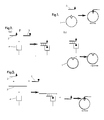
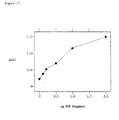
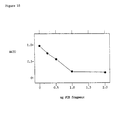
- Figures 17 and 18 show the effect of sample human CFTR gene "PCR fragment" on the enzyme activation assays described in examples I.IV and I.VI respectively.
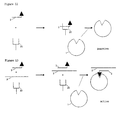
- one version of the enzyme activation assay comprises an inactive enzyme fragment 1 which can be activated by a peptide conjugated to a nucleic acid probe 2 to restore activity.
- a peptide conjugated to a nucleic acid probe 2 to restore activity.
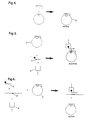
- the activation of enzyme fragment 1 by the peptide conjugated nucleic acid probe 2 is inhibited.
- the extent of hybridisation of probe 3 to probe 2 is thus reduced to leave a proportion of probe 2 unhybridised and thus able to activate enzyme fragment 1.
- another version of the enzyme activation assay comprises the same inactive enzyme fragment 1 as in figures 1 to 3 which can be activated by a peptide conjugated to a nucleic acid probe 2 to restore enzyme activity.
- a single-stranded nucleic acid specific antibody 20 (or other sequence-specific or non-specific molecule with appropriate binding specificity) is included which binds to the peptide conjugated nucleic acid 2 to inhibit enzyme activation.
- the specific antibody 20 or other molecule
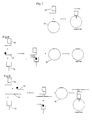
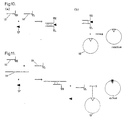
- another version of the enzyme activation assay comprises the same inactive enzyme fragment 1 as in figures 1 to 3 which can be activated by a peptide conjugated to a nucleic acid probe 2 to restore enzyme activity.
- a second nucleic acid probe 21 is included which is non-complementary to the peptide-nucleic acid 2 and to which is attached a ligand which then becomes associated with a ligand-specific antibody 4.
- the activation of enzyme is only inhibited when the nucleic acid-peptide molecule 2 and the ligand-derivatised nucleic acid 21 hybridise adjacently to a target nucleic acid 5 whereby the binding of ligand-specific antibody 4 interferes with activation of the enzyme fragment 1 by the nucleic acid-peptide 2.
- beta-galactosidase other enzymes could be used where it is possible to split off a peptide with a loss of enzyme activity which is then automatically restored upon interaction of the peptide with the inactive enzyme fragment.
- N-terminal peptide fragments of RNAase S can be removed and added back to restore full enzyme activity.
- nucleic acid probe-based assays described herein circumvent many of the difficulties in achieving practical hybridisation assays particulary through avoidance of a solid phase. Assays may be undertaken by mixing together dilutions of target genetic material with nucleic acid probe, enzyme and antibody reagents and by recording enzyme activities at specific timepoints. Alternatively, samples and reagents may be loaded into an appropriate commercially available clinical analyser and the dilution, mixing and optical density measurements could then be undertaken by the machine.
- the enzyme activation assays as referred to in figures 1 to 3 and 12 to 15 were adapted for the detection of CFTR (Cystic Fibrosis related) genes in human DNA.
- the peptide-nucleic acid probe conjugates 2 of the figures will be hereafter called the “activator oligonucleotides” whilst the ligand-associated nucleic acid probes 3 of the figures will be hereafter referred to as the “blocker oligonucleotides”.
- the enzyme system used was beta-galactosidase whereby the alpha peptide complements the M15 mutant of this enzyme (Ullmann et al, J. Mol. Biol., 24 (1967) p339) to restore beta-galactosidase activity.
- the activator oligonucleotide probes included the following nucleotide sequences:
- oligonucleotides were synthesised on an Applied Biosystems 380A synthesiser with nucleoside phosphoramidites.
- CFTR (A) and CFA508 (A) were each synthesised with a primary 3'-aliphatic amine by synthesis on a 3'-amino-ON CPG support supplied by Cruachem (UK) and using manufacturer's instructions.
- All oligonucleotides were purified by reverse-phase HPLC on a Unimetrics 5u RP-8 column using a linear-gradient of 7-35% acetonitrile in 100mM sodium acetate.
- CFTR (A) and CFA508 (A) were 5'-end labelled with trace amounts of 32P using 0.1 ⁇ Ci 32PATP (Amersham, 3000Ci/mmol) and 100 units of T4 polynucleotide kinase (Boehringer) in 200 ⁇ l using conditions recommended with the enzyme.
- the labelled oligonucleotides were then heated to 80°C for 10 minutes, extracted twice with buffer equilibrated phenol (Gibco BRL) and chloroform (1:1), extracted once with chloroform, made 0.3M in sodium acetate pH5.2 and precipitated with 2 volumes of ice-cold ethanol. The pellets were washed once in 70% ethanol and lyophilised.
- cysteine/peptide Two alternative forms of beta-galactosidase peptide were used, one comprising a 43 residue fragment with an N-terminal cysteine, herein called the cysteine/peptide, with an amino acid sequence detailed in figure 16 and the other comprising a plasmid derived alpha-peptide with an N-terminal methionine, herein called the methionine/peptide, as isolated from bacterial cells as detailed below.
- the cysteine/peptide was synthesised on an Applied Biosystems 431A peptide synthesiser using manufacturer's reagents and protocols and the peptide was purified using an Applied Biosystems ABS151A Separation System.
- the peptide was then dialysed into 1mM ammonium bicarbonate/1mM mercaptoethanol and lyophilised.
- the methionine/peptide was isolated from E.coli TG1 cells (obtained from Dr George Salmond, Dept Biological Sciences, University of Warwick, Coventry, UK) harbouring the plasmid pUC8 (obtained from CP Laboratories, Southampton, UK). Cells were grown in M9 medium (Molecular Cloning, supra) containing 100 ⁇ g/ml ampicillin (sodium salt, Sigma, Poole, UK) and 0.02% w/v glucose.
- IPTG isopropyl thiogalactopyranoside, Sigma
- buffer A 0.05M Tris.HCl pH7.5, 0.1M NaCl, 0.01M MgCl2
- the suspension was sonicated on ice using a Model XL20D Ultrasonicator (Heat Systems Inc, Farmingdale, New York, USA) at 6u peak to peak for five 20 second pulses at 60 second intervals. Cell debris was removed by centrifugation at 48,000g for 20 minutes at 4°C.
- the clear supernatent material was fractionated by adjusting to 50% saturation with solid ammonium sulphate and centrifuging at 18,000g for 10 minutes.
- the resulting ammonium sulphate pellet was resuspended in 2.5ml of buffer A and the solution was applied to a buffer A equilibrated PD10 column (Pharmacia, Milton Keynes, UK).
- Protein containing elution fractions were pooled and loaded onto a 2ml APTG-agarose column (p-aminophenyl beta-D-thiogalactopyranoside agarose, Sigma) and eluted with 0.1M sodium borate pH10.5.
- Beta-galactosidase containing fractions were pooled and tested for beta-galactosidase activity by the addition of 25 ⁇ l of fraction to 1ml of 0.75mg/ml o-nitrophenyl-beta-D-galactopyranoside (ONPG, Sigma) in buffer A, incubation at 37°C for 30 minutes and the measurement of optical absorbance at 414nm.
- Beta-galactosidase containing fractions were treated with 8mol/litre urea and then run on a 10-15% SDS-polyacrylamide gradient gel. Gel slices below 14kD were excised and materials eluted into buffer A.
- oligonucleotide For conjugation of oligonucleotide to cysteine/peptide, 100 ⁇ g of each 3'-amino-oligonucleotide and 5mg of m-maleimidobenzoyl-N-hydroxysuccinimide ester (MBS, Pierce) were dissolved in 1ml of anhydrous tetrahydrofuran. To this solution was added 10mg of sodium carbonate and the reaction was allowed to proceed for 30 minutes. The mixture was then diluted 1:1 in 0.2M sodium phosphate buffer, pH7 and applied to a 20ml Sephadex® G25 column (Pharmacia) using 0.1M sodium phoshate, pH7 as the running buffer.
- MBS m-maleimidobenzoyl-N-hydroxysuccinimide ester
- Peak 32P-labelled fractions were pooled, made 0.3M in sodium acetate, pH5.2 and precipitated with 2 volumes of ice-cold ethanol. The pellets were washed once in 70% ethanol and lypophilised. To the maleimido-oligonucleotide was added 10 ⁇ g of cysteine/peptide in 200 ⁇ l 0.1M sodium phosphate, pH7. The mixture was stirred for 1 hour at room temperature and the oligonucleotide-peptide conjugate was then purified by anion exchange HPLC using a DuPont Zorbax GF250 column and an elution buffer of 0.2M potassium phosphate, pH7.
- oligonucleotide For conjugation of oligonucleotide to methionine/peptide, 100 ⁇ g of each 3'-amino-oligonucleotide was dissolved in 25 ⁇ l 0.1M sodium borate pH9.3 and 10mg of diisothiocyanate (DITC, Pierce, dissolved in 0.5ml dimethylformamide) was added. The mixture was shaken gently for 2 hours in the dark and further mixed with 6ml 50% (v/v) butan-1-ol. The mixture was shaken vigourously and centrifuged at 3000g for 5 minutes. The activated oligonucleotide solution was then further extracted with butan-1-ol to reduce the volume to ⁇ 50 ⁇ l and then dessicated.
- DITC diisothiocyanate
- Methionine/alpha peptide was concentrated into 0.1M sodium borate pH9.3 using a Minicon CS15 concentrator (Amicon). 100 ⁇ g (50 ⁇ l) was mixed with the activated oligonucleotide preparation and incubated for 18 hours in the dark. Peptide/oligonucleotide conjugate was purified by electrophoresis on a 12.5% Swank Munkres SDS-polyacrylamide gel (Anal. Biochem., 99 (1979) p170) using trace 5'-32P labelling of oligonucleotide (Molecular Cloning, supra) in order to identify the conjugate band which was then excised, eluted into buffer A and dialysed in buffer A.
- the blocker oligonucleotides comprised the following oligonucleotide sequences complementary to the corresponding activator oligonucleotides (CFTR (B) and CFA508 (B)) and to a site on the CFTR gene adjacent to that complementary to the activator oligonucleotides (CFTR(C));
- oligonucleotides were synthesised with a 5'-bromodeoxyuridine nucleoside by incorporation of a 5-bromodeoxyuridine cyanoethyl phosphoramidite (Cruachem) into the synthesis.
- DNA samples were obtained from a normal individual homozygous for the non-mutated CFTR (cystic fibrosis transregulator) gene and from an individual afflicted with cystic fibrosis by virtue of a homozygous deletion of codon 508 in the CFTR gene.
- DNA was derived from buccal cells obtained from these individuals by gentle scraping of the buccal lining with a sterile toothpick. Buccal cells were then suspended in 10 ⁇ l sterile water, lysed with 20 ⁇ l 0.1M potassium hydroxide and 0.1% Triton®-X-100 at 65°C for 20 minutes, and neutralised with 20 ⁇ l of 0.1M HCl and 0.1% Triton®-X-100.
- Regions of the CFTR gene were then amplified by the polymerase chain reaction (PCR) procedure as described in EP200362 (Cetus Corp). 5 ⁇ l of the human cell lysate was denatured at 94°C for 3 minutes and mixed into 5 ⁇ l of 20mM Tris.HCl pH8.3, 100mM potassium chloride, 3mM magnesium chloride, 20ng/ml bovine serum albumin (fraction V, Sigma), 400 ⁇ M deoxyribonucleotide mixture (Pharmacia), 0.1% Triton®-X-100, 0.05 units Thermus aquaticus DNA polymerase (Perkin Elmer) and 0.5 ⁇ M oligonucleotide amplification primers (5'-CAGTGGAAGAATGGCATTCTGTT-3' and 5'-GGCATGCTTTGATGACGCTTCTG-3').
- Amplification was undertaken by 40 cycles in a thermal cycler (Techne, model PHC-2) comprising successive steps of 93°C for 1 minute, 55°C for 1.5 minutes and 72°C for 3 minutes. An additional 0.05 units of polymerase was added at the 20 cycle stage.
- Hybridisations analyses were undertaken as illustrated in figures 12 and 13.
- Hybridisation reactions comprised mixtures of DNA derived from normal individuals (confirmed homozygous wild-type CFTR gene), prepared as described in III. above, with the oligonucleotide combination CFTR(A) and CFTR(B).
- controls comprised mixtures without human DNA.
- 10 pmoles of methionine peptide/oligonucleotide conjugate was mixed with dilutions of target human DNA (or PCR buffer blank) in 50 ⁇ l of 5% formamide, 0.6M sodium chloride and 0.06M sodium citrate at pH7 and mixtures were incubated at 37°C for 30 minutes.
- Beta-galactosidase activity was measured as follows. To the above mixture was added 900 ⁇ l of a mixture comprising 1mg/ml ONPG, 125 pmoles of M15 preparation in 1mM magnesium sulphate, 0.18mM manganese sulphate, 1mM ethylene diamine tetraacetic acid and 0.5M sodium phosphate buffer, pH7. The mixture was incubated for 30 minutes at 37°C and the optical absorbance at 420nm was measured. The results are shown in figure 17 and show that the introduction of human DNA results in an increased beta-galactosidase activity than in the control.
- Hybridisation analyses were undertaken as illustrated in figures 2 and 3.
- Hybridisation reactions comprised mixtures of DNA, prepared as described in III. above, derived from normal or cystic fibrosis afflicted individuals either with the oligonucleotide combination CFTR(A) and CFTR(B) or the combination CFA508(A) and CFA508(B).
- controls comprised mixtures without human DNA.
- Beta-galactosidase activity was measured as follows. To the above mixture was added 440 ⁇ l of a mixture comprising 1mg/ml ONPG, 125 pmoles of M15 preparation in 1mM magnesium sulphate, 0.18mM manganese sulphate, 1mM ethylene diamine tetraacetic acid and 0.5M sodium phosphate buffer, pH7. The mixture was incubated for 30 minutes at 37°C and the optical absorbance at 414nm was measured.
- Hybridisation analyses were undertaken as illustrated in figures 14 and 15. Hybridisation reactions comprised mixtures of normal human DNA (confirmed homozygous CFTR gene) prepared as described in III. above with the oligonucleotide combination CFTR(A) and CFTR(C). In addition, controls comprised mixtures without human DNA.
- CFTR(A) 10 pmoles of cysteine peptide/oligonucleotide conjugate CFTR(A) was mixed with 10 pmoles of blocker oligonucleotide CFTR(C) and dilutions of human DNA (or PCR buffer blank) in 50 ⁇ l of 5% formamide, 0.6M sodium chloride and 0.06M sodium citrate at pH7 and mixtures were incubated at 37°C for 30 minutes. 20 ⁇ l of an anti-bromodeoxyuridine antibody (Amersham) diluted 1:2 in 10 ⁇ l 0.6M sodium chloride was added and the incubation continued for a further 30 minutes.
- an anti-bromodeoxyuridine antibody Amersham
- Beta-galactosidase activity was measured as described in V. above and the results, as shown in figure 18, show that the introduction of human DNA results in a dose dependant decrease in beta-galactosidase activity.
- the activator oligonucleotide probes included the following nucleotide sequences:
- Oligonucleotides were synthesised and conjugated to cysteine/peptide as in example 1 above.
- the blocker oligonucleotides comprised the following oligonucleotide sequences complementary to the corresponding activator oligonucleotides;
- oligonucleotides were synthesised with a 5'-bromodeoxyuridine nucleotide as in example 1.
- DNA samples were obtained from the human lymphoma cell line RAJI (ATCC7936) which is homozygous for a tract of p53 sequence complementary to p53(A) and (B) as above. 10 4 cells were suspended in 100 ⁇ l sterile water, lysed with 200 ⁇ l 0.1M potassium hydroxide and 0.1% Triton®-X-100 at 65°C for 20 minutes, and neutralised with 200 ⁇ l of 0.1M HCl and 0.1% Triton®-X-100.
- Regions of the p53 gene were then amplified by the polymerase chain reaction (PCR) procedure as described in example 1.
- 5 ⁇ l of the human cell lysate was denatured at 94°C for 3 minutes and mixed into 5 ⁇ l of 20mM Tris.HCl pH8.3, 100mM potassium chloride, 3mM magnesium chloride, 20ng/ml bovine serum albumin (fraction V, Sigma), 400 ⁇ M deoxyribonucleotide mixture (Pharmacia), 0.1% Triton®-X-100, 0.05 units Thermus aquaticus DNA polymerase (Perkin Elmer) and 0.5 ⁇ M oligonucleotide amplification primers (5'-ATGCGAATTCCCCTGCCCTCAACAAGAT-3' and 5'-TATAGGAATTCGTGGTGAGGCTCCCCTT-3'). Amplification was undertaken by 35 cycles in a thermal cycler (Techne, model PHC-2) comprising successive steps of 94°C for 1 minute, 55°C for 2 minutes and 72°C
- Hybridisation analyses were undertaken as illustrated in figures 2 and 3.
- Hybridisation reactions comprised mixtures of DNA, prepared as described in III. above, either with the oligonucleotide combination p53(A) and p53(B), the combination p53mut(A) and p53mut(B) or activator oligonucleotides alone.
- controls comprised mixtures without human DNA.
- 10 pmoles of cysteine peptide/oligonucleotide conjugate was mixed with 20 pmoles of blocker oligcnucleotide and 2 ⁇ l of human DNA (or PCR buffer blank).
- Hybridisation conditions addition of anti-bromodeoxyuridine antibody and measurement of beta-galactosidase activity was as in example 1 above.
- the results were as follows; Activator/Blocker Human DNA A414nm (Beta-Gal Activity) p53(A) /p53(B) 2 ⁇ l 0.96 p53(A) /p53(B) none 0.16 p53(A) 2 ⁇ l 1.23 p53(A) none 1.33 p53mut(A)/p53mut(B) 2 ⁇ l 0.38 p53mut(A)/p53mut(B) none 0.18 p53mut(A) 2 ⁇ l 0.94 p53mut(A) none 1.17
- the assay method of the present invention requires a detectable change in the behaviour of an enzyme. Such changes include the generation of enzyme activity.
- probes may be joined to enzyme fragments, enzyme activators or enzyme cofactors.
- the sequence of interest may be a synthetic nucleic acid, a nucleic acid obtained from a prokaryotic or eukaryotic cell or derived by polymerase chain reaction. Typically, its size will be in the range from 10-10,000 nucleotides long.
- the probes may be synthetic oligonucleotides or derived from substantially natural sources. They may comprise synthetic base analogues, such as bromodeoxyuridine, which act as the ligand for a binding partner (such as anti-bromodeoxyuridine antibodies).
- synthetic base analogues such as bromodeoxyuridine, which act as the ligand for a binding partner (such as anti-bromodeoxyuridine antibodies).
Landscapes
- Chemical & Material Sciences (AREA)
- Organic Chemistry (AREA)
- Life Sciences & Earth Sciences (AREA)
- Zoology (AREA)
- Wood Science & Technology (AREA)
- Proteomics, Peptides & Aminoacids (AREA)
- Health & Medical Sciences (AREA)
- Engineering & Computer Science (AREA)
- Microbiology (AREA)
- Biochemistry (AREA)
- Physics & Mathematics (AREA)
- Molecular Biology (AREA)
- Biotechnology (AREA)
- Biophysics (AREA)
- Analytical Chemistry (AREA)
- Immunology (AREA)
- Bioinformatics & Cheminformatics (AREA)
- General Engineering & Computer Science (AREA)
- General Health & Medical Sciences (AREA)
- Genetics & Genomics (AREA)
- Measuring Or Testing Involving Enzymes Or Micro-Organisms (AREA)
- Saccharide Compounds (AREA)
Claims (18)
- Homogenes Nachweisverfahren zur Bestimmung des Vorliegens einer interessierenden Nukleinsäuresequenz in einer Probe, wobei das Verfahren die Schritte umfaßt:(a) Kombinieren in Lösung der Probe, einer ersten Sonde, die eine einzelsträngige Nukleinsäure umfaßt, die im wesentlichen zumindest zu einem Teil der interessierenden Sequenz komplementär ist und mit einer zum Aktivieren eines Enzyms fähigen Substanz assoziiert ist, und einer zweiten Sonde, die eine spezifische Bindungsaktivität für die erste Sonde aufweist, wenn die erste Sonde nicht an die interessierende Sequenz gebunden ist;(b) Zugeben eines Enzyms, das in der Lage ist, von der mit der ersten Sonde assoziierten Substanz aktiviert zu werden, so daß in Abwesenheit der interessierenden Sequenz die zweite Sonde an die erste Sonde bindet, wobei diese Bindung die Aktivierung des Enzyms durch die Substanz, die mit der ersten Sonde assoziiert ist, inhibiert und(c) Überwachen der Enzymaktivität.
- Homogenes Nachweisverfahren zur Bestimmung des Vorliegens einer interessierenden Nukleinsäuresequenz in einer Probe, wobei das Verfahren die Schritte umfaßt:(a) kombinieren in Lösung der Probe, einer ersten Sonde, die eine einzelsträngige Nukleinsäure umfaßt, die zumindest zu einem Teil der interessierenden Sequenz komplementär ist und mit einer zum Aktivieren eines Enzyms fähigen Substanz assoziiert ist, und einer zweiten Sonde, die einen Ligandenteil und eine zur ersten Sonde komplementäre einzelsträngige Nukleinsäuresequenz umfaßt, so daß das Vorliegen der interessierenden Sequenz in der Probe zu einer Inhibierung der Bindung der zweiten Sonde an die erste Sonde führt;(b) Zugeben eines Enzyms, das durch die mit der ersten Sonde assoziierte Substanz aktivierbar ist, und eines zur Bindung an den Ligandenteil fähigen Bindungspartners, so daß, falls die erste und die zweite Sonde aneinander gebunden sind, die Bindung des Bindungspartners an den Ligandenteil die Aktivierung des Enzyms durch die mit der ersten Sonde assoziierte Substanz inhibiert und(c) Überwachen der Enzymaktivität.
- Homogenes Nachweisverfahren zur Bestimmung des Vorliegens einer interessierenden Nukleinsäuresequenz in einer Probe, wobei das Verfahren die Schritte umfaßt:(a) Kombinieren in Lösung der Probe, einer ersten Sonde, die eine einzelsträngige Nukleinsäure umfaßt, die im wesentlichen zumindest zu einem Teil der interessierenden Sequenz homolog ist und mit einer zur Aktivierung eines Enzyms fähigen Substanz assoziiert ist, und einer zweiten Sonde, die einen Ligandenteil und eine einzelsträngige Nukleinsäure umfaßt, die sowohl zumindest zu einem Teil der interessierenden Sequenz, als auch zu der in der ersten Sonde vorliegenden Nukleinsäure komplementär ist, so daß das vorliegen der interessierenden Sequenz in der Probe zur Inhibierung der Bindung der zweiten Sonde an die erste Sonde führt;(b) Zugeben eines Enzyms, das durch die mit der ersten Sonde assoziierte Substanz aktivierbar ist, und eines zur Bindung an den Ligandenteil fähigen Bindungspartners, so daß, falls die erste und zweite Sonde aneinander gebunden sind, die Bindung des Bindungspartners an den Ligandenteil die Aktivierung des Enzyms durch die mit der ersten Sonde assoziierte Substanz inhibiert und(c) Überwachen der Enzymaktivität.
- Homogenes Nachweisverfahren zur Bestimmung des Vorliegens einer interessierenden Nukleinsäuresequenz in einer Probe, wobei das Verfahren die Schritte umfaßt:(a) Kombinieren in Lösung der Probe, einer ersten Sonde, die eine einzelsträngige Nukleinsäure umfaßt, die im wesentlichen zumindest zu einem Teil der interessierenden Sequenz komplementär ist und mit einer zur Aktivierung eines Enzyms fähigen Substanz assoziiert ist, und einer zweiten Sonde, die einen Ligandenteil und eine einzelsträngige Nukleinsäure umfaßt, die zumindest zu einem Teil der interessierenden Sequenz komplementär ist, so daß das Vorliegen der interessierenden Sequenz in der Probe zur Bindung der ersten und zweiten Sonde in großer Nähe zueinander an der interessierenden Sequenz führt;(b) Zugeben eines Enzyms, das durch die mit der ersten Sonde assoziierte Substanz aktivierbar ist, und eines zur Bindung an den Ligandenteil fähigen Bindungspartners, so daß, falls die erste und die zweite Sonde in großer Nähe zueinander gebunden sind, die Bindung des Bindungspartners an den Ligandenteil die Aktivierung des Enzyms durch die mit der ersten Sonde assoziierte Substanz inhibiert und(c) Überwachen der Enzymaktivität.
- Verfahren nach Anspruch 1, wobei die zweite Sonde ein gegen die erste Sonde gerichteter Antikörper ist.
- Verfahren gemäß Anspruch 5, wobei die erste Sonde ein synthetisches Basenanalogon umfaßt und die zweite Sonde ein gegen das synthetische Basenanalogon gerichteter Antikörper ist.
- Verfahren gemäß Anspruch 6, wobei das synthetische Basenanalogon Bromdeoxyuridin umfaßt.
- Verfahren nach mindestens einem der Ansprüche 2, 3 oder 4, wobei der Ligandenteil ein synthetisches Basenanalogon umfaßt und der Bindungspartner ein gegen das Basenanalogon gerichteter Antikörper ist.
- Verfahren gemäß Anspruch 8, wobei der Ligandenteil Bromdeoxyuridin umfaßt.
- Verfahren gemäß mindestens einem der Ansprüche 1 bis 9, wobei die erste Sonde mit einem Enzymfragment, Enzymaktivator oder Enzymcofaktor assoziiert ist.
- Verfahren gemäß Anspruch 10, wobei die erste Sonde mit einem Fragment der β-Galactosidase oder der RNase S assoziiert ist.
- Verfahren gemäß Anspruch 11, wobei die erste Sonde mit dem M15-Mutantenfragment der β-Galactosidase assoziiert ist.
- Verfahren gemäß Anspruch 11, wobei die erste Sonde mit einem Fragment der β-Galactosidase assoziiert ist, die die in Figur 16 (Sequenz ID Nr. 14) gezeigte Aminosäuresequenz umfaßt, oder mit funktionellen Äquivalenten dieser.
- Verfahren gemäß Anspruch 10, wobei die erste Sonde mit Glucose-6-phosphatdehydrogenase assoziiert ist.
- Verfahren gemäß mindestens einem der vorhergehenden Ansprüche, wobei die interessierende Sequenz eine beliebige Nukleinsäure mit mehr als 10 Nukleotiden Länge umfaßt.
- Verfahren gemäß Anspruch 15, wobei die interessierende Sequenz eine beliebige Nukleinsäure mit weniger als 10.000 Nukleotiden Länge umfaßt.
- Verfahren gemäß mindestens einem der vorhergehenden Ansprüche, wobei das Verhalten des Enzyms quantitativ überwacht wird.
- Kit zum Ausführen des Verfahrens nach mindestens einem der Ansprüche 2, 3 oder 4, umfassend eine erste Sonde, eine zweite Sonde, ein Enzymsubstrat und einen Bindungspartner, wie in diesen Ansprüchen definiert.
Applications Claiming Priority (3)
| Application Number | Priority Date | Filing Date | Title |
|---|---|---|---|
| GB919114525A GB9114525D0 (en) | 1991-07-05 | 1991-07-05 | Homogeneous nucleic acids probe based tests and substances |
| GB9114525 | 1991-07-05 | ||
| PCT/GB1992/001229 WO1993001313A1 (en) | 1991-07-05 | 1992-07-06 | Nucleic acids assay |
Publications (2)
| Publication Number | Publication Date |
|---|---|
| EP0602049A1 EP0602049A1 (de) | 1994-06-22 |
| EP0602049B1 true EP0602049B1 (de) | 1999-09-08 |
Family
ID=10697855
Family Applications (1)
| Application Number | Title | Priority Date | Filing Date |
|---|---|---|---|
| EP92914059A Expired - Lifetime EP0602049B1 (de) | 1991-07-05 | 1992-07-06 | Nukleinsäurenachweis |
Country Status (8)
| Country | Link |
|---|---|
| EP (1) | EP0602049B1 (de) |
| JP (1) | JPH06508753A (de) |
| AT (1) | ATE184323T1 (de) |
| AU (1) | AU2231392A (de) |
| CA (1) | CA2112670A1 (de) |
| DE (1) | DE69229954D1 (de) |
| GB (2) | GB9114525D0 (de) |
| WO (1) | WO1993001313A1 (de) |
Families Citing this family (10)
| Publication number | Priority date | Publication date | Assignee | Title |
|---|---|---|---|---|
| SE9403953D0 (sv) * | 1994-07-15 | 1994-11-16 | Pharmacia Biotech Ab | Sequence-based diagnosis |
| JP6430253B2 (ja) * | 2011-11-05 | 2018-11-28 | プレジデント アンド フェローズ オブ ハーバード カレッジ | 相互作用を検出および測定するための核酸ベースのリンカー |
| US11198900B2 (en) | 2014-12-06 | 2021-12-14 | Children's Medical Center Corporation | Nucleic acid-based linkers for detecting and measuring interactions |
| US11396650B2 (en) | 2015-06-02 | 2022-07-26 | Children's Medical Center Corporation | Nucleic acid complexes for screening barcoded compounds |
| US12077807B2 (en) | 2015-06-27 | 2024-09-03 | The Research Foundation For The State University Of New York | Compositions and methods for analyte detection using nanoswitches |
| WO2017139409A1 (en) | 2016-02-09 | 2017-08-17 | Children's Medical Center Corporation | Method for detection of analytes via polymer complexes |
| US10919037B2 (en) | 2016-03-23 | 2021-02-16 | Children's Medical Center Corporation | Systems and apparatus for detecting compounds in human biological samples |
| WO2017165647A1 (en) | 2016-03-23 | 2017-09-28 | Children's Medical Center Corporation | Rapid and sensitive detection and quantification of analytes in complex samples using polymer-based methods |
| US11591636B2 (en) | 2017-11-20 | 2023-02-28 | Children's Medical Center Corporation | Force-controlled nanoswitch assays for single-molecule detection in complex biological fluids |
| WO2021174071A1 (en) | 2020-02-29 | 2021-09-02 | President And Fellows Of Harvard College | Nanoswitch caliper trains for high-throughput, high-resolution structural analysis of biomolecules |
Family Cites Families (8)
| Publication number | Priority date | Publication date | Assignee | Title |
|---|---|---|---|---|
| EP0144913A3 (de) * | 1983-12-12 | 1986-08-20 | Miles Inc. | Hybridisierungstest mittels einer markierten Probe und Anti-Hybrid |
| EP0144914A3 (de) * | 1983-12-12 | 1986-08-13 | Miles Inc. | Hybridisierungstest mittels markierter Paare von hybridbindenden Reagenzien |
| US4840893A (en) * | 1983-12-16 | 1989-06-20 | Medisense, Inc. | Electrochemical assay for nucleic acids and nucleic acid probes |
| EP0199801B1 (de) * | 1984-10-29 | 1993-08-25 | MICROGENICS CORPORATION (a Delaware corporation) | Ergänzungstestverfahren von proteine bindenden enzymen |
| ATE88761T1 (de) * | 1986-01-10 | 1993-05-15 | Amoco Corp | Kompetitiver homogener test. |
| WO1989002476A1 (en) * | 1987-09-21 | 1989-03-23 | Ml Technology Ventures, L.P. | Homogeneous protection assay |
| DE68909445T2 (de) * | 1988-02-26 | 1994-05-11 | Profile Diagnostic Sciences | Methode zur Bestimmung genetischer Sequenzen und Testsatz hierfür. |
| EP0343955A3 (de) * | 1988-05-27 | 1990-04-18 | Bioventures, Inc. | Verfahren zur Bindung von Komplexen beabsichtigter Molekularspezies |
-
1991
- 1991-07-05 GB GB919114525A patent/GB9114525D0/en active Pending
- 1991-09-13 GB GB919119650A patent/GB9119650D0/en active Pending
-
1992
- 1992-07-06 DE DE69229954T patent/DE69229954D1/de not_active Expired - Lifetime
- 1992-07-06 EP EP92914059A patent/EP0602049B1/de not_active Expired - Lifetime
- 1992-07-06 CA CA002112670A patent/CA2112670A1/en not_active Abandoned
- 1992-07-06 WO PCT/GB1992/001229 patent/WO1993001313A1/en not_active Ceased
- 1992-07-06 JP JP5502095A patent/JPH06508753A/ja not_active Withdrawn
- 1992-07-06 AT AT92914059T patent/ATE184323T1/de not_active IP Right Cessation
- 1992-07-06 AU AU22313/92A patent/AU2231392A/en not_active Abandoned
Also Published As
| Publication number | Publication date |
|---|---|
| JPH06508753A (ja) | 1994-10-06 |
| GB9119650D0 (en) | 1991-10-23 |
| AU2231392A (en) | 1993-02-11 |
| DE69229954D1 (de) | 1999-10-14 |
| CA2112670A1 (en) | 1993-01-21 |
| WO1993001313A1 (en) | 1993-01-21 |
| EP0602049A1 (de) | 1994-06-22 |
| GB9114525D0 (en) | 1991-08-21 |
| ATE184323T1 (de) | 1999-09-15 |
Similar Documents
| Publication | Publication Date | Title |
|---|---|---|
| JP3205555B2 (ja) | 複製型rnaのターゲット依存合成 | |
| EP1062367B1 (de) | Methoden zur detektion von nukleinsäuren unter verwendung von zymogenen und dazugehörige kits | |
| US5102784A (en) | Restriction amplification assay | |
| US5688643A (en) | Method of nucleic acid-differentiation and assay kit for nucleic acid differentiation | |
| JP4216333B2 (ja) | オリゴヌクレオチドの化学結合による核酸検出及び増幅 | |
| EP0975805B1 (de) | Hybridisierungsverfahren in dem überschüssige sonden abgebaut werden | |
| JP5276648B2 (ja) | 抗生物質耐性微生物を同定するための方法およびキット | |
| CA2260749A1 (en) | Methods for detecting rna analytes using modified probes | |
| US20030003490A1 (en) | Nucleic acid detection methods using universal priming | |
| EP0892856A1 (de) | Methode zur vervielfältigung und zum nachweis eines gewünschten nukleinsäurefragments | |
| WO1997032044A9 (en) | A method for the amplification and detection of a nucleic acid fragment of interest | |
| JP2547517B2 (ja) | 鳥型結核菌、ミコバクテリウム・イントラセルレアおよびパラ結核菌に対するプローブ | |
| JP2006525809A5 (de) | ||
| US20030077622A1 (en) | Method for monitoring nucleic acid assays using synthetic internal controls with reversed nucleotide sequences | |
| EP0602049A1 (de) | Nukleinsäurenachweis | |
| EP0915170B1 (de) | Testverfahren für Chlamydia Trachomatis durch Amplifizierung und Erkennung von Chlamydia Trachomatis kryptischen Plasmid | |
| EP1176213A2 (de) | Vervielfältigung und Detektion von Legionella pneumophila Nukleinsäuren | |
| JP4209977B2 (ja) | 淋菌の核酸の増幅および検出による淋菌の検出 | |
| EP1180169B1 (de) | Verfahren zur detektion von polynukleotidkinase und deren verwendung als markierung | |
| US20030165917A1 (en) | Isothermal amplification in nucleic acid analysis | |
| US9121054B2 (en) | Detection of nucleic acid amplification products in the presence of an internal control sequence on an immunochromatographic strip | |
| EP1300473A1 (de) | Methode zum nachweis von nukleinsäurepolymorphismen | |
| EP1007733B1 (de) | Universelles gerät für festphasenhybridisierung | |
| US20020155456A1 (en) | Method of amplification for increasing the sensitivity of detecting nucleic acid-probe target hybrids | |
| EP0739421B1 (de) | Hybridisierungsverfahren |
Legal Events
| Date | Code | Title | Description |
|---|---|---|---|
| PUAI | Public reference made under article 153(3) epc to a published international application that has entered the european phase |
Free format text: ORIGINAL CODE: 0009012 |
|
| 17P | Request for examination filed |
Effective date: 19940112 |
|
| AK | Designated contracting states |
Kind code of ref document: A1 Designated state(s): AT BE CH DE DK ES FR GB IT LI NL SE |
|
| 17Q | First examination report despatched |
Effective date: 19960726 |
|
| GRAG | Despatch of communication of intention to grant |
Free format text: ORIGINAL CODE: EPIDOS AGRA |
|
| GRAG | Despatch of communication of intention to grant |
Free format text: ORIGINAL CODE: EPIDOS AGRA |
|
| GRAG | Despatch of communication of intention to grant |
Free format text: ORIGINAL CODE: EPIDOS AGRA |
|
| GRAH | Despatch of communication of intention to grant a patent |
Free format text: ORIGINAL CODE: EPIDOS IGRA |
|
| RAP1 | Party data changed (applicant data changed or rights of an application transferred) |
Owner name: CYTOCELL LIMITED |
|
| GRAH | Despatch of communication of intention to grant a patent |
Free format text: ORIGINAL CODE: EPIDOS IGRA |
|
| GRAA | (expected) grant |
Free format text: ORIGINAL CODE: 0009210 |
|
| AK | Designated contracting states |
Kind code of ref document: B1 Designated state(s): AT BE CH DE DK ES FR GB IT LI NL SE |
|
| PG25 | Lapsed in a contracting state [announced via postgrant information from national office to epo] |
Ref country code: SE Free format text: THE PATENT HAS BEEN ANNULLED BY A DECISION OF A NATIONAL AUTHORITY Effective date: 19990908 Ref country code: NL Free format text: LAPSE BECAUSE OF FAILURE TO SUBMIT A TRANSLATION OF THE DESCRIPTION OR TO PAY THE FEE WITHIN THE PRESCRIBED TIME-LIMIT Effective date: 19990908 Ref country code: LI Free format text: LAPSE BECAUSE OF FAILURE TO SUBMIT A TRANSLATION OF THE DESCRIPTION OR TO PAY THE FEE WITHIN THE PRESCRIBED TIME-LIMIT Effective date: 19990908 Ref country code: IT Free format text: LAPSE BECAUSE OF FAILURE TO SUBMIT A TRANSLATION OF THE DESCRIPTION OR TO PAY THE FEE WITHIN THE PRESCRIBED TIME-LIMIT;WARNING: LAPSES OF ITALIAN PATENTS WITH EFFECTIVE DATE BEFORE 2007 MAY HAVE OCCURRED AT ANY TIME BEFORE 2007. THE CORRECT EFFECTIVE DATE MAY BE DIFFERENT FROM THE ONE RECORDED. Effective date: 19990908 Ref country code: FR Free format text: LAPSE BECAUSE OF FAILURE TO SUBMIT A TRANSLATION OF THE DESCRIPTION OR TO PAY THE FEE WITHIN THE PRESCRIBED TIME-LIMIT Effective date: 19990908 Ref country code: ES Free format text: THE PATENT HAS BEEN ANNULLED BY A DECISION OF A NATIONAL AUTHORITY Effective date: 19990908 Ref country code: CH Free format text: LAPSE BECAUSE OF FAILURE TO SUBMIT A TRANSLATION OF THE DESCRIPTION OR TO PAY THE FEE WITHIN THE PRESCRIBED TIME-LIMIT Effective date: 19990908 Ref country code: BE Free format text: LAPSE BECAUSE OF FAILURE TO SUBMIT A TRANSLATION OF THE DESCRIPTION OR TO PAY THE FEE WITHIN THE PRESCRIBED TIME-LIMIT Effective date: 19990908 Ref country code: AT Free format text: LAPSE BECAUSE OF FAILURE TO SUBMIT A TRANSLATION OF THE DESCRIPTION OR TO PAY THE FEE WITHIN THE PRESCRIBED TIME-LIMIT Effective date: 19990908 |
|
| REF | Corresponds to: |
Ref document number: 184323 Country of ref document: AT Date of ref document: 19990915 Kind code of ref document: T |
|
| REG | Reference to a national code |
Ref country code: CH Ref legal event code: EP |
|
| REF | Corresponds to: |
Ref document number: 69229954 Country of ref document: DE Date of ref document: 19991014 |
|
| PG25 | Lapsed in a contracting state [announced via postgrant information from national office to epo] |
Ref country code: DK Free format text: LAPSE BECAUSE OF FAILURE TO SUBMIT A TRANSLATION OF THE DESCRIPTION OR TO PAY THE FEE WITHIN THE PRESCRIBED TIME-LIMIT Effective date: 19991208 |
|
| PG25 | Lapsed in a contracting state [announced via postgrant information from national office to epo] |
Ref country code: DE Free format text: LAPSE BECAUSE OF FAILURE TO SUBMIT A TRANSLATION OF THE DESCRIPTION OR TO PAY THE FEE WITHIN THE PRESCRIBED TIME-LIMIT Effective date: 19991209 |
|
| NLV1 | Nl: lapsed or annulled due to failure to fulfill the requirements of art. 29p and 29m of the patents act | ||
| EN | Fr: translation not filed | ||
| REG | Reference to a national code |
Ref country code: CH Ref legal event code: PL |
|
| PLBE | No opposition filed within time limit |
Free format text: ORIGINAL CODE: 0009261 |
|
| STAA | Information on the status of an ep patent application or granted ep patent |
Free format text: STATUS: NO OPPOSITION FILED WITHIN TIME LIMIT |
|
| 26N | No opposition filed | ||
| REG | Reference to a national code |
Ref country code: GB Ref legal event code: IF02 |
|
| PGFP | Annual fee paid to national office [announced via postgrant information from national office to epo] |
Ref country code: GB Payment date: 20040615 Year of fee payment: 13 |
|
| PG25 | Lapsed in a contracting state [announced via postgrant information from national office to epo] |
Ref country code: GB Free format text: LAPSE BECAUSE OF NON-PAYMENT OF DUE FEES Effective date: 20050706 |
|
| GBPC | Gb: european patent ceased through non-payment of renewal fee |
Effective date: 20050706 |