EP0602089B1 - Interferometre optique nonlineaire a amplificateur sature - Google Patents
Interferometre optique nonlineaire a amplificateur sature Download PDFInfo
- Publication number
- EP0602089B1 EP0602089B1 EP92918236A EP92918236A EP0602089B1 EP 0602089 B1 EP0602089 B1 EP 0602089B1 EP 92918236 A EP92918236 A EP 92918236A EP 92918236 A EP92918236 A EP 92918236A EP 0602089 B1 EP0602089 B1 EP 0602089B1
- Authority
- EP
- European Patent Office
- Prior art keywords
- optical
- input
- pulses
- interferometer
- power
- Prior art date
- Legal status (The legal status is an assumption and is not a legal conclusion. Google has not performed a legal analysis and makes no representation as to the accuracy of the status listed.)
- Expired - Lifetime
Links
Images



Classifications
-
- H—ELECTRICITY
- H04—ELECTRIC COMMUNICATION TECHNIQUE
- H04B—TRANSMISSION
- H04B10/00—Transmission systems employing electromagnetic waves other than radio-waves, e.g. infrared, visible or ultraviolet light, or employing corpuscular radiation, e.g. quantum communication
- H04B10/29—Repeaters
- H04B10/291—Repeaters in which processing or amplification is carried out without conversion of the main signal from optical form
- H04B10/299—Signal waveform processing, e.g. reshaping or retiming
-
- G—PHYSICS
- G02—OPTICS
- G02F—OPTICAL DEVICES OR ARRANGEMENTS FOR THE CONTROL OF LIGHT BY MODIFICATION OF THE OPTICAL PROPERTIES OF THE MEDIA OF THE ELEMENTS INVOLVED THEREIN; NON-LINEAR OPTICS; FREQUENCY-CHANGING OF LIGHT; OPTICAL LOGIC ELEMENTS; OPTICAL ANALOGUE/DIGITAL CONVERTERS
- G02F1/00—Devices or arrangements for the control of the intensity, colour, phase, polarisation or direction of light arriving from an independent light source, e.g. switching, gating or modulating; Non-linear optics
- G02F1/35—Non-linear optics
- G02F1/3515—All-optical modulation, gating, switching, e.g. control of a light beam by another light beam
- G02F1/3517—All-optical modulation, gating, switching, e.g. control of a light beam by another light beam using an interferometer
- G02F1/3519—All-optical modulation, gating, switching, e.g. control of a light beam by another light beam using an interferometer of Sagnac type, i.e. nonlinear optical loop mirror [NOLM]
-
- H—ELECTRICITY
- H04—ELECTRIC COMMUNICATION TECHNIQUE
- H04B—TRANSMISSION
- H04B10/00—Transmission systems employing electromagnetic waves other than radio-waves, e.g. infrared, visible or ultraviolet light, or employing corpuscular radiation, e.g. quantum communication
- H04B10/29—Repeaters
- H04B10/291—Repeaters in which processing or amplification is carried out without conversion of the main signal from optical form
- H04B10/2912—Repeaters in which processing or amplification is carried out without conversion of the main signal from optical form characterised by the medium used for amplification or processing
Definitions
- This invention relates to an optical transmission system.
- a known optical transmission system includes an interferometer and a source of optical signals.
- the interferometer comprises a four port optical coupler having first and second input ports and first and second output ports, an optical coupling means coupling the first and second output ports and including an optical non-linearity, and an optical amplifier.
- the source of optical signals is coupled to the first input port of the interferometer.
- An optical input signal coupled to an input port of such an interferometer is split into two portions by the optical coupler, which portions counter-propagate round the coupling means, for example an optical fibre loop, to return to, and recombine at, the coupler.
- the optical path along the coupling means is the same for the two portions. So, for a 50:50 coupler and a symmetrically positioned amplifier, the portions recombine such that the input signal emerges from the port to which it was originally input. The input signal is said to be "reflected" by the interferometer. For this reason, this configuration is often described as a loop mirror, the "loop" being the optical coupling means.
- NALM non-linear amplifying loop mirror
- NOLMs and NALMs can provide pulse shaping in optical transmission systems, and in particular provide pedestal suppression.
- these devices have the potential for the suppression of inter-pulse radiation, and for filtering bits in long-distance, all-optical communications systems.
- Such applications are discussed in an article entitled “Pulse Shaping, Compression, and Pedestal Suppression employing a Non-Linear Optical Loop Mirror" by K Smith, N J Doran, and P G J Wigley, Opt. Lett., 15, p.1294 (1990).
- a NALM could provide amplification in addition to such pulse shaping in an all-optical communications system.
- the NALM has an oscillatory output, the intensity of the input signal must be relatively constant in order to avoid reflection by the loop mirror.
- Non-linear amplifying loop mirrors are described in papers by Richardson et al (Electronics Letters, Vol.26, No. 21, pages 1779-1781, October 1990) and Betts et al (Electronics Letters, Vol. 27, No. 10, pages 858-860, May 1991).
- the paper by Richardson is concerned with the power required to achieve switching: earlier referenced papers had switching thresholds of 100-1000W, 10-100W and, finally, a few Watts.
- Richardson by using a high gain (46dB) erbium doped fibre amplifier (EDFA) reduced this to 200 ⁇ w.
- the effect of the mark-space ratio of the input signal on the output of the EDFA was investigated - understandably, the EDFA output fell as the mark-space ratio was increased.
- Richardson also noted the pulse distortions produced by switching: the leading and trailing edges of square pulses are transmitted, while the centres of input pulses are reflected once the non-linear regime is entered.
- Richardson observed the typical oscillatory relationship between pulse input power and pulse output powers - maximum output extinction (95%) being achieved for a pulse input power of 200 ⁇ w. Richardson made no mention of any influence of the EDFA on the transfer function of the NALM-except for the 200 ⁇ w switching threshold.
- the paper of Betts which cites the Richardson paper, is primarily concerned with pulse compression.
- the NALM included not only an EDFA but also a semiconductor laser amplifier (SLA).
- SLA semiconductor laser amplifier
- the non-linear refractive index of the SLA is "used to achieve an appropriate transmission characteristic for pulse compression".
- the transmission characteristic which is reported, for input powers of between 20 ⁇ w up to 250 ⁇ w, is liner but 30 increasing. Thus, the typical oscillatory behaviour is suppressed. While the gain and the non-linear refractive index of the SLA both saturate, resulting in a desirable transmission characteristic, there is no discussion of the contribution of the EDFA and no mention or hint of saturation of the EDFA.
- the present invention provides a method of processing an optical pulse stream which comprises optical pulses, the method comprising:applying the pulse stream to a first input port of an interferometer, the interferometer comprising a four-port optical coupler which has first and second input ports and first and second output ports, an optical coupling means coupling the first and second output ports and including an optical non-linearity and an optical fibre amplifier, characterised in that the duty cycle of the optical pulse stream and the power of the optical pulses are such that the optical fibre amplifier is saturated; the interferometer is operated so that its transfer characteristic is non-oscillatory; and in that the pulse power is such that the pulses cause the interferometer to switch from a state in which its output is provided from the first input port to a state in which its output is provided from the second input port.
- the invention provides an optical transmission system comprising an interferometer and a source of optical signals, the interferometer comprising a four-port optical coupler having first and second input ports and first and second output ports, an optical coupling means coupling the first and second output ports and including an optical non-linearity, the source of optical signals being coupled to the first input port of the interferometer , characterised in that the coupler is asymmetric and in that the system further comprises an optical amplifier coupled to the first input port, upstream of the output ports, to amplify the input signals prior to their being input to the interferometer, the system is such that the optical signals saturate the optical amplifier, and such that the power and duty cycle of the optical signals are such as to switch an input signal coupled to the first input port to the second input port ; the transfer function of the interferometer being non-oscillatory.
- the inventive system and method achieve an approximately constant output over a range of intensities of input signal, so that a range of intensities of input optical pulse will all be switched to the output of the interferometer. Moreover, the signals will be amplified to an approximately constant intensity.
- the method and system therefore, provide amplification of the signal, as well as pulse shaping and noise filtering as described in the article by Smith et al. This is of particular application to optical communications systems.
- the optical source may be a pulsed laser, in which case the optical transmission system of the present invention provides, at the second input port, noise-filtered optical pulses of substantially constant peak power, even for what may be variable peak power input pulses.
- the system of the invention could, therefore, be used as a repeater in a long distance optical communications link, for example a submarine link.
- the optical amplifier may comprise part of the coupling means, as described with reference to the NALMS referred to above, or may be coupled to the first input port to amplify the input signals prior to their being switched. In this latter case, the interferometer will require the symmetry to be broken by, for example, a non-50: 50 coupler as the amplifier no longer forms part of the coupling means.
- the interferometer may include an optical fibre loop, although other forms of waveguide may be used, for example, a waveguide formed in a planar substrate such as lithium niobate.
- the optical amplifier is conveniently an optical fibre amplifier spliced to the fibre forming the loop.
- the optical fibre of the loop may be made of material exhibiting the desired non-linearity, or a separate non-linear element may be included in the loop.
- a highly non-linear element may be incorporated to shorten the loop length, for example a semiconductor laser amplifier.
- the invention also provides a method of using an interferometer which comprises a four-port optical coupler having first and second input ports and first and second output ports, an optical coupling means coupling the first and second output ports and including an optical non-linearity, and an optical amplifier, the method comprising coupling a source of optical signals to the first input port of the interferometer in such a manner that the optical signals saturate the amplifier thereby suppressing any oscillatory output, and such that the power of the optical signals is sufficient to switch an input signal coupled to the first input port to the second input port.
- Figure 1 shows an optical transmission system formed from a Sagnac loop interferometer 2 which comprises a four-port, fused-fibre optical coupler 4 having first and second input ports 6 and 8, and first and second output ports 10 and 12.
- the output ports 10 and 12 are optically coupled by an optical fibre loop 14.
- the interferometer 2 is conveniently formed from a single optical fibre 14, two portions of which are fused to form the coupler 4.
- the loop 14 comprises an 8. 8 km length of dispersion-shifted fibre with a dispersion zero around 1. 55 ⁇ m obtained from Corning Corporation. The nature of this fibre ensures that pulse shaping due to propagation effects is negligible.
- Fibre polarisation controllers 16 are also included in the loop 14 to adjust the device to reflection mode at low powers.
- a 30m long erbium doped fibre amplifier (EDFA) 18 is spliced to the output port 10 of the fibre coupler 4.
- An optical fibre coupler 20 is used to couple pump radiation for the EDFA 18 from a high-power MQW semiconductor laser 22 with a maximum pump power of the order of 50 mW at 1.48 ⁇ m. Under these conditions, the EDFA 18 has a small signal gain of 28 dB, and a time-average saturation power of 24 ⁇ W. For the above loop parameters, and an effective loop length of 7 km, the saturation power of the amplifier is of the order of 0. 6mW.
- An optical source 24 (an actively mode-locked semiconductor laser providing pulses at 1.545 ⁇ m of about 12 ps duration at a repetition rate of 2.5 GHz and a mean power of about 50 ⁇ W) is connected to the input port 6.
- the measured time-bandwidth products of the pulses produced by the laser 24 are at best 0. 4.
- P t and P i are the transmitted and input powers respectively
- ⁇ is the power coupling coefficient of the coupler
- L is the loop length
- ⁇ is the wavelength
- a eff is the effective fibre core area
- G is the power gain (P out /P in ) of the amplifier.
- FIG. 6 shows the computed gain characteristics for sech 2 intensity profile pulses (dashed curve).
- the fibre amplifier gain characteristics are also shown for the same values of G SS and P sat (full curve).
- the device At low input powers, the device is in reflecting mode, and hence the small signal gain is well suppressed. As the input power is increased, however, the device approaches a transmitting state, and the efficiency closely follows that of the EDFA 18 for P i > P Sa . It is expected that the varying response of the loop throughout the pulse gives rise to incomplete switching and pulse shaping. Although this is largely responsible for the small (2-3 dB) reduction in efficiency relative to the EDFA 18 at high powers, the loop amplifier benefits from pulse compression and low-level light suppression.
- Pulse durations are inferred from the second harmonic auto-correlation measurements.
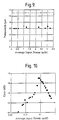
- the auto-correlation shape of the transmitted pulses does not change significantly as a function of the input power, this being clearly illustrated in Figure 9, where the ratio of the input and output correlation widths is plotted against the input power for average powers up to 3. 5 mW (120 mW peak). It should be noted that the ratio of about 0.55 varies by less than 20% over a range of power of the order of 200 x P Sa .
- the device gain follows the trend described in Figure 6, with a maximum of 17 dB occurring at an average input power of 50 ⁇ W (1.6 mW peak).
- Figures 8a and 8b A further clear demonstration of the intensity filtering properties is shown in Figures 8a and 8b.
- the amplified, shortened (to 6 ps) and pedestal-free output (Figure 8b) is shown for input pulses with substantial inter-pulse radiation ( Figure 8a). This behaviour is observed over the total range of input power.
- FIG. 2 A further embodiment of the present invention is shown in Figure 2, in which the erbium amplifier 18 of Figure 1 is now coupled to the input port 6 of the interferometer 2. Like elements are given the same reference numerals as in Figure 1.
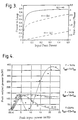
- FIG. 3 there is shown the power circulating in the two counter-propagating directions as a function of input peak power for the embodiment of Figure 1, where (a) is the power circulating anti-clockwise between the port 12 and the input of the erbium amplifier 18, and (b) is the power circulating in the loop in a clockwise direction from the erbium amplifier to the output port 12.
- the solid curve (c) of the graph of Figure 3 shows the non-linear phase shift of the pulses circulating in the two directions round the loop as a function of input peak power; and, as can be clearly seen, the non-linear phase shift becomes substantially constant at higher peak powers.
- FIG 4 there is shown a graph of the peak output power from the port 8 as a function of peak input power (in mW) of an optical signal input at the input port 6 at three different pulse repetition rates f equal to 1, 2 and 3 kHz.
- P sat equals five times the switching power, P Sa , of the interferometer of Figure 1.
- the output power is an oscillatory function of the input power. As the saturation power moves closer to the switching power with increasing frequency, the peak output power becomes more nearly a constant for peak input powers corresponding to P Sa .
- FIG. 10 there is shown a graph of the gain of the embodiment of Figure 1 as a function of the average input power of the optical signals from the optical source 24.
Landscapes
- Physics & Mathematics (AREA)
- Nonlinear Science (AREA)
- Engineering & Computer Science (AREA)
- Computer Networks & Wireless Communication (AREA)
- Signal Processing (AREA)
- Electromagnetism (AREA)
- Power Engineering (AREA)
- General Physics & Mathematics (AREA)
- Optics & Photonics (AREA)
- Optical Communication System (AREA)
- Instruments For Measurement Of Length By Optical Means (AREA)
- Spectrometry And Color Measurement (AREA)
- Lasers (AREA)
Claims (9)
- Procédé de traitement d'un flux d'impulsions optiques qui comprend des impulsions optiques, le procédé comprenant :l'application des impulsions optiques présentant une puissance d'entrée à un premier point d'accès d'entrée (6) d'un interféromètre optique non linéaire (2), l'interféromètre optique non linéaire comprenant un coupleur optique à quatre points d'accès (4) qui comporte des premier (6) et second (8) points d'accès d'entrée et des premier (10) et second (12) points d'accès de sortie, un moyen de couplage optique (14) qui couple les premier et second points d'accès de sortie et présentant une non-linéarité optique et un amplificateur à fibre optique (18), la séparation de l'impulsion d'entrée en un premier segment qui se propage dans un premier sens le long du moyen de couplage optique et un second segment qui se propage dans le second sens opposé le long du moyen de couplage optique, d'où il résulte que chacun desdits segments est soumis à un déphasage non linéaire, dans lequel la différence du déphasage subie par ledit premier segment et ledit second segment varie en fonction de la puissance d'entrée des impulsions optiques, caractérisé parla sélection de la puissance de crête des impulsions d'entrée et de la fréquence de répétition des impulsions d'entrée de façon à saturer le gain dudit amplificateur à fibre optique, de sorte que ladite différence de déphasage non linéaire entre lesdits premier et second segments ait un niveau fixé de façon à fournir une caractéristique de transfert non oscillatoire et à amener l'interféromètre à basculer dans l'état dans lequel les impulsions traitées sont fournies en sortie à partir du second point d'accès d'entrée.
- Procédé selon la revendication 1, dans lequel les impulsions sont d'une forme telle que les caractéristiques de mise en forme d'impulsion dudit interféromètre soient insensibles à la puissance d'entrée.
- Procédé selon la revendication 1, dans lequel la puissance de commutation dudit interféromètre est égale à la puissance de saturation dudit amplificateur.
- Procédé selon la revendication 1, dans lequel le coupleur optique (4) présente un coefficient de couplage de puissance, α, entre 0,4 et 0,5.
- Procédé selon l'une quelconque des revendications 1 à 4, dans lequel la sortie au niveau du second point d'accès d'entrée est constituée d'impulsions optiques filtrées pour le bruit de puissance de crête sensiblement constante.
- Procédé selon l'une quelconque des revendications 1 à 4, dans lequel le flux d'impulsions optiques appliqué en entrée à l'interféromètre optique non linéaire comprend des impulsions comportant des paliers substantiels, la sortie provenant du second point d'accès d'entrée comprenant des impulsions optiques présentant des paliers significativement réduits.
- Procédé selon l'une quelconque des revendications 1 à 4, dans lequel la sortie provenant du second point d'accès d'entrée comprend des impulsions à profil d'intensité en sech2.
- Système de transmission optique destiné à traiter un flux d'impulsions optiques qui comprend des impulsions optiques, le système comprenant :
une source (24) d'impulsions optiques, et un interféromètre optique non linéaire comportant un premier point d'accès d'entrée (6), auquel des impulsions optiques provenant de la source (24) sont appliquées, l'interféromètre optique non linéaire comprenant un coupleur optique à quatre points d'accès (4) qui comporte des premier (6) et second (8) points d'accès d'entrée et des premier (10) et second (12) points d'accès de sortie, un moyen de couplage optique (14) qui couple les premier et second points d'accès de sortie et présentant une non-linéarité optique et un amplificateur à fibre optique (18), dans lequel ledit coupleur optique (4) sépare l'impulsion d'entrée en un premier segment qui se propage dans un premier sens le long du moyen de couplage optique (14) et un second segment qui se propage dans le second sens opposé le long du moyen de couplage optique (14), dans lequel chacun desdits segments est soumis à un déphasage non linéaire, dans lequel la différence du déphasage subie par ledit premier segment et ledit second segment varie en fonction de la puissance d'entrée des impulsions optiques, caractérisé en ce que :
le système de transmission optique est configuré de manière à ce que ladite source (24) fournisse des impulsions présentant une puissance de crête des impulsions et une fréquence de répétition des impulsions de façon à saturer le gain dudit amplificateur à fibre optique, d'où il résulte que ladite différence de déphasage non linéaire entre lesdits premier et second segments a son niveau fixé pour fournir une caractéristique de transfert non oscillatoire et pour amener l'interféromètre à basculer dans l'état dans lequel les impulsions traitées sont fournies en sortie depuis le second point d'accès d'entrée. - Liaison de communications optiques comprenant
une source (24) d'impulsions optiques, une ligne de transmission à fibre optique et un répéteur à l'intérieur de la ligne de transmission, le répéteur comprenant un interféromètre optique non linéaire (2) comprenant un coupleur optique à quatre points d'accès (4) qui comporte des premier (6) et second (8) points d'accès d'entrée et des premier (10) et second (12) points d'accès de sortie, un moyen de couplage optique (14) qui couple les premier et second points d'accès de sortie et présentant une non-linéarité optique et un amplificateur à fibre optique (18), des impulsions optiques provenant de la source (24) passant le long de la ligne de transmission vers le premier point d'accès d'entrée (6) de l'interféromètre, dans laquelle ledit coupleur optique (4) sépare l'impulsion d'entrée en un premier segment qui se propage dans un premier sens le long du moyen de couplage optique (14) et un second segment qui se propage dans le second sens opposé le long du moyen de couplage optique (14), dans laquelle chacun desdits segments est soumis à un déphasage non linéaire, dans laquelle la différence du déphasage subie par ledit premier segment et ledit second segment varie en fonction de la puissance d'entrée des impulsions optiques, caractérisée en ce que :
la liaison de communications optiques est configurée de sorte que ladite source (244 procure des impulsions présentant une puissance de crête des impulsions d'entrée et une fréquence de répétition des impulsions de façon à saturer le gain dudit amplificateur à fibre optique, d'où il résulte que ladite différence de déphasage non linéaire entre lesdits premier et second segments a son niveau fixé afin de fournir une caractéristique de transfert non oscillatoire et d'amener l'interféromètre à basculer dans l'état dans lequel les impulsions traitées sont fournies en sortie à partir du second point d'accès d'entrée.
Applications Claiming Priority (3)
| Application Number | Priority Date | Filing Date | Title |
|---|---|---|---|
| GB9118843 | 1991-09-03 | ||
| GB919118843A GB9118843D0 (en) | 1991-09-03 | 1991-09-03 | An optical transmission system |
| PCT/GB1992/001579 WO1993005592A1 (fr) | 1991-09-03 | 1992-08-28 | Interferometre optique nonlineaire a amplificateur sature |
Publications (2)
| Publication Number | Publication Date |
|---|---|
| EP0602089A1 EP0602089A1 (fr) | 1994-06-22 |
| EP0602089B1 true EP0602089B1 (fr) | 2001-04-04 |
Family
ID=10700847
Family Applications (1)
| Application Number | Title | Priority Date | Filing Date |
|---|---|---|---|
| EP92918236A Expired - Lifetime EP0602089B1 (fr) | 1991-09-03 | 1992-08-28 | Interferometre optique nonlineaire a amplificateur sature |
Country Status (12)
| Country | Link |
|---|---|
| US (1) | US5479291A (fr) |
| EP (1) | EP0602089B1 (fr) |
| JP (1) | JPH06510135A (fr) |
| KR (1) | KR100272402B1 (fr) |
| AT (1) | ATE200368T1 (fr) |
| AU (1) | AU656225B2 (fr) |
| CA (1) | CA2112596C (fr) |
| DE (1) | DE69231767T2 (fr) |
| ES (1) | ES2157206T3 (fr) |
| GB (2) | GB9118843D0 (fr) |
| HK (1) | HK154696A (fr) |
| WO (1) | WO1993005592A1 (fr) |
Families Citing this family (28)
| Publication number | Priority date | Publication date | Assignee | Title |
|---|---|---|---|---|
| GB9122182D0 (en) * | 1991-10-18 | 1991-11-27 | British Telecomm | Optical memory |
| EP0567693A1 (fr) * | 1992-04-27 | 1993-11-03 | BRITISH TELECOMMUNICATIONS public limited company | Récupération optique d'horloge |
| US5825530A (en) * | 1994-12-02 | 1998-10-20 | Hewlett-Packard Company | Arrangement and method for operating and testing an optical device |
| CN1175334A (zh) * | 1994-12-23 | 1998-03-04 | 英国电讯公司 | 光时分复用网络中的节点 |
| JP3272895B2 (ja) * | 1995-02-24 | 2002-04-08 | 安藤電気株式会社 | 光パルス発生器 |
| JP4440343B2 (ja) * | 1995-03-24 | 2010-03-24 | ブリティッシュ・テレコミュニケーションズ・パブリック・リミテッド・カンパニー | 光網 |
| EP0753787A1 (fr) * | 1995-07-05 | 1997-01-15 | Koninklijke Philips Electronics N.V. | Unité optique pour le traitement d'une configuration d'impulsions optiques |
| US6157762A (en) * | 1996-12-09 | 2000-12-05 | The Regents Of The University Of California | Nonlinear pulse reshaping for optical fiber transmission systems |
| US6052393A (en) | 1996-12-23 | 2000-04-18 | The Regents Of The University Of Michigan | Broadband Sagnac Raman amplifiers and cascade lasers |
| CN1155173C (zh) * | 1998-02-16 | 2004-06-23 | 皇家菲利浦电子有限公司 | 配有采用全光学时钟恢复接收机的光传输系统 |
| US6374006B1 (en) | 1998-03-20 | 2002-04-16 | Xtera Communications, Inc. | Chirped period gratings for raman amplification in circulator loop cavities |
| US6356384B1 (en) | 1998-03-24 | 2002-03-12 | Xtera Communications Inc. | Broadband amplifier and communication system |
| US6760148B2 (en) | 1998-03-24 | 2004-07-06 | Xtera Communications, Inc. | Nonlinear polarization amplifiers in nonzero dispersion shifted fiber |
| US6600592B2 (en) | 1998-03-24 | 2003-07-29 | Xtera Communications, Inc. | S+ band nonlinear polarization amplifiers |
| US6885498B2 (en) | 1998-06-16 | 2005-04-26 | Xtera Communications, Inc. | Multi-stage optical amplifier and broadband communication system |
| US6359725B1 (en) | 1998-06-16 | 2002-03-19 | Xtera Communications, Inc. | Multi-stage optical amplifier and broadband communication system |
| US6574037B2 (en) | 1998-06-16 | 2003-06-03 | Xtera Communications, Inc. | All band amplifier |
| ATE488037T1 (de) | 1998-06-16 | 2010-11-15 | Xtera Communications Inc | Dispersionskompensierendes und verstärkendes optisches element |
| US6335820B1 (en) | 1999-12-23 | 2002-01-01 | Xtera Communications, Inc. | Multi-stage optical amplifier and broadband communication system |
| US6567430B1 (en) | 1998-09-21 | 2003-05-20 | Xtera Communications, Inc. | Raman oscillator including an intracavity filter and amplifiers utilizing same |
| SE516882C2 (sv) * | 1998-12-23 | 2002-03-19 | Ericsson Telefon Ab L M | Anordning för att reflektera ljus |
| US6295308B1 (en) * | 1999-08-31 | 2001-09-25 | Corning Incorporated | Wavelength-locked external cavity lasers with an integrated modulator |
| CA2639993A1 (fr) | 2000-01-12 | 2001-07-19 | Xtera Communications, Inc. | Systeme de transmission a fibres optiques a large bande avec amplificateur raman |
| AU2001264548A1 (en) | 2000-02-14 | 2001-10-23 | Xtera Communications, Inc. | Nonlinear optical loop mirror |
| US6404541B2 (en) * | 2000-03-24 | 2002-06-11 | Oprel Technologies Inc. | Optical amplifier with active-fiber loop mirror |
| US6744553B1 (en) | 2000-06-20 | 2004-06-01 | Xtera Communications, Inc. | System and method for converting a plurality of wavelengths |
| ITMI20031773A1 (it) * | 2003-09-17 | 2005-03-18 | Marconi Comm Spa | Rigeneratore di segnali ottici per sistemi di trasmissione con bit rate elevati |
| JP2005173530A (ja) * | 2003-11-17 | 2005-06-30 | Osaka Industrial Promotion Organization | 光信号処理方法及び装置、非線形光ループミラーとその設計方法並びに光信号変換方法 |
Family Cites Families (2)
| Publication number | Priority date | Publication date | Assignee | Title |
|---|---|---|---|---|
| US5369520A (en) * | 1992-05-22 | 1994-11-29 | At&T Corp. | Optical regeneration circuit |
| US5309267A (en) * | 1992-09-25 | 1994-05-03 | At&T Bell Laboratories | Optical communication system using a Sagnac switch |
-
1991
- 1991-09-03 GB GB919118843A patent/GB9118843D0/en active Pending
-
1992
- 1992-08-28 CA CA002112596A patent/CA2112596C/fr not_active Expired - Fee Related
- 1992-08-28 EP EP92918236A patent/EP0602089B1/fr not_active Expired - Lifetime
- 1992-08-28 AT AT92918236T patent/ATE200368T1/de not_active IP Right Cessation
- 1992-08-28 JP JP5505027A patent/JPH06510135A/ja active Pending
- 1992-08-28 DE DE69231767T patent/DE69231767T2/de not_active Expired - Lifetime
- 1992-08-28 GB GB9325690A patent/GB2274036B/en not_active Expired - Fee Related
- 1992-08-28 ES ES92918236T patent/ES2157206T3/es not_active Expired - Lifetime
- 1992-08-28 US US08/199,299 patent/US5479291A/en not_active Expired - Lifetime
- 1992-08-28 WO PCT/GB1992/001579 patent/WO1993005592A1/fr not_active Ceased
- 1992-08-28 AU AU24923/92A patent/AU656225B2/en not_active Ceased
- 1992-08-28 KR KR1019940700509A patent/KR100272402B1/ko not_active Expired - Fee Related
-
1996
- 1996-08-15 HK HK154696A patent/HK154696A/xx not_active IP Right Cessation
Also Published As
| Publication number | Publication date |
|---|---|
| GB9118843D0 (en) | 1991-10-16 |
| GB9325690D0 (en) | 1994-03-09 |
| US5479291A (en) | 1995-12-26 |
| AU2492392A (en) | 1993-04-05 |
| CA2112596C (fr) | 1998-01-20 |
| CA2112596A1 (fr) | 1993-03-18 |
| DE69231767T2 (de) | 2001-10-25 |
| ATE200368T1 (de) | 2001-04-15 |
| HK154696A (en) | 1996-08-23 |
| AU656225B2 (en) | 1995-01-27 |
| EP0602089A1 (fr) | 1994-06-22 |
| GB2274036A (en) | 1994-07-06 |
| KR100272402B1 (ko) | 2000-11-15 |
| GB2274036B (en) | 1995-07-05 |
| ES2157206T3 (es) | 2001-08-16 |
| DE69231767D1 (de) | 2001-05-10 |
| JPH06510135A (ja) | 1994-11-10 |
| WO1993005592A1 (fr) | 1993-03-18 |
Similar Documents
| Publication | Publication Date | Title |
|---|---|---|
| US5479291A (en) | Non-linear optical interferometer with saturated amplifier | |
| Agrawal | Nonlinear fiber optics | |
| US5757529A (en) | In-line regenerating apparatus for regenerating a soliton-conveyed signal by synchronously modulating the solitons by means of a non-linear optical loop mirror | |
| EP1130456B1 (fr) | Méthode, dispositif et système de mise en forme d'ondes du signal optique | |
| US6453082B1 (en) | Device and system for waveform shaping | |
| EP1430574A2 (fr) | Dispositifs a fibre optique utilisant l'effet raman | |
| AU615363B2 (en) | Non-linear interferometer | |
| Deshmukh et al. | Four wave mixing in DWDM optical system | |
| Olsson et al. | Polarization independent demultiplexing in a polarization diversity nonlinear optical loop mirror | |
| Dahir et al. | Dispersion Compensation by Using FBG and Low Pass Gaussian Filter. | |
| Maruta et al. | Effectiveness of densely dispersion managed solitons in ultra-high speed transmission | |
| Toda et al. | Optical soliton transmission experiment in a comb-like dispersion profiled fiber loop | |
| WO1997010652A2 (fr) | Propagation d'impulsion optique | |
| Chi et al. | 2R regenerator based on high non-linear dispersion-imbalanced loop mirror | |
| Veith | Useful and detrimental aspects of self-phase modulation in fiber optical applications | |
| Cao et al. | Soliton-like pulse train generation using a nonlinear optical loop mirror constructed from dispersion decreasing fiber | |
| Erro et al. | Third-order dispersion in linearly chirped Bragg gratings and its compensation | |
| Tomlinson | Nonlinear Phenomena in Single‐Mode Optical Fibers | |
| Man et al. | Optimal loop length of a nonlinear optical loop mirror in switching solitons | |
| White et al. | Towards Ultimate Pulse Propagation in Optical Fibres | |
| Escalera-Santos et al. | Stimulated Raman Scattering for All Optical Switches | |
| Abbi et al. | Ajoy Ghatak and K. Thyagarajan | |
| KR20050027638A (ko) | 광 펄스의 소광비 향상장치 | |
| Hasegawa et al. | Other Applications of Optical Solitons | |
| Evans | Dispersion-tapered fiber in nonlinear loop mirrors for intensity and pulse width switching |
Legal Events
| Date | Code | Title | Description |
|---|---|---|---|
| PUAI | Public reference made under article 153(3) epc to a published international application that has entered the european phase |
Free format text: ORIGINAL CODE: 0009012 |
|
| 17P | Request for examination filed |
Effective date: 19931220 |
|
| AK | Designated contracting states |
Kind code of ref document: A1 Designated state(s): AT BE CH DE DK ES FR IT LI LU NL SE |
|
| 17Q | First examination report despatched |
Effective date: 19961223 |
|
| REG | Reference to a national code |
Ref country code: GB Ref legal event code: 732E |
|
| GRAG | Despatch of communication of intention to grant |
Free format text: ORIGINAL CODE: EPIDOS AGRA |
|
| GRAG | Despatch of communication of intention to grant |
Free format text: ORIGINAL CODE: EPIDOS AGRA |
|
| GRAH | Despatch of communication of intention to grant a patent |
Free format text: ORIGINAL CODE: EPIDOS IGRA |
|
| RBV | Designated contracting states (corrected) |
Designated state(s): AT BE CH DE DK ES FR IT LI LU NL SE |
|
| GRAH | Despatch of communication of intention to grant a patent |
Free format text: ORIGINAL CODE: EPIDOS IGRA |
|
| GRAA | (expected) grant |
Free format text: ORIGINAL CODE: 0009210 |
|
| AK | Designated contracting states |
Kind code of ref document: B1 Designated state(s): AT BE CH DE DK ES FR IT LI LU NL SE |
|
| PG25 | Lapsed in a contracting state [announced via postgrant information from national office to epo] |
Ref country code: NL Free format text: LAPSE BECAUSE OF FAILURE TO SUBMIT A TRANSLATION OF THE DESCRIPTION OR TO PAY THE FEE WITHIN THE PRESCRIBED TIME-LIMIT Effective date: 20010404 Ref country code: LI Free format text: LAPSE BECAUSE OF FAILURE TO SUBMIT A TRANSLATION OF THE DESCRIPTION OR TO PAY THE FEE WITHIN THE PRESCRIBED TIME-LIMIT Effective date: 20010404 Ref country code: CH Free format text: LAPSE BECAUSE OF FAILURE TO SUBMIT A TRANSLATION OF THE DESCRIPTION OR TO PAY THE FEE WITHIN THE PRESCRIBED TIME-LIMIT Effective date: 20010404 Ref country code: BE Free format text: LAPSE BECAUSE OF FAILURE TO SUBMIT A TRANSLATION OF THE DESCRIPTION OR TO PAY THE FEE WITHIN THE PRESCRIBED TIME-LIMIT Effective date: 20010404 Ref country code: AT Free format text: LAPSE BECAUSE OF FAILURE TO SUBMIT A TRANSLATION OF THE DESCRIPTION OR TO PAY THE FEE WITHIN THE PRESCRIBED TIME-LIMIT Effective date: 20010404 |
|
| REF | Corresponds to: |
Ref document number: 200368 Country of ref document: AT Date of ref document: 20010415 Kind code of ref document: T |
|
| REG | Reference to a national code |
Ref country code: CH Ref legal event code: EP |
|
| REF | Corresponds to: |
Ref document number: 69231767 Country of ref document: DE Date of ref document: 20010510 |
|
| ITF | It: translation for a ep patent filed | ||
| PG25 | Lapsed in a contracting state [announced via postgrant information from national office to epo] |
Ref country code: SE Free format text: LAPSE BECAUSE OF FAILURE TO SUBMIT A TRANSLATION OF THE DESCRIPTION OR TO PAY THE FEE WITHIN THE PRESCRIBED TIME-LIMIT Effective date: 20010704 |
|
| ET | Fr: translation filed | ||
| REG | Reference to a national code |
Ref country code: ES Ref legal event code: FG2A Ref document number: 2157206 Country of ref document: ES Kind code of ref document: T3 |
|
| PG25 | Lapsed in a contracting state [announced via postgrant information from national office to epo] |
Ref country code: LU Free format text: LAPSE BECAUSE OF NON-PAYMENT OF DUE FEES Effective date: 20010828 |
|
| NLV1 | Nl: lapsed or annulled due to failure to fulfill the requirements of art. 29p and 29m of the patents act | ||
| PG25 | Lapsed in a contracting state [announced via postgrant information from national office to epo] |
Ref country code: DK Free format text: LAPSE BECAUSE OF FAILURE TO SUBMIT A TRANSLATION OF THE DESCRIPTION OR TO PAY THE FEE WITHIN THE PRESCRIBED TIME-LIMIT Effective date: 20011011 |
|
| REG | Reference to a national code |
Ref country code: CH Ref legal event code: PL |
|
| PLBE | No opposition filed within time limit |
Free format text: ORIGINAL CODE: 0009261 |
|
| 26N | No opposition filed | ||
| PGFP | Annual fee paid to national office [announced via postgrant information from national office to epo] |
Ref country code: IT Payment date: 20060831 Year of fee payment: 15 |
|
| REG | Reference to a national code |
Ref country code: FR Ref legal event code: TP |
|
| PG25 | Lapsed in a contracting state [announced via postgrant information from national office to epo] |
Ref country code: IT Free format text: LAPSE BECAUSE OF NON-PAYMENT OF DUE FEES Effective date: 20070828 |
|
| PGFP | Annual fee paid to national office [announced via postgrant information from national office to epo] |
Ref country code: ES Payment date: 20090821 Year of fee payment: 18 |
|
| PGFP | Annual fee paid to national office [announced via postgrant information from national office to epo] |
Ref country code: DE Payment date: 20090821 Year of fee payment: 18 |
|
| REG | Reference to a national code |
Ref country code: FR Ref legal event code: ST Effective date: 20110502 |
|
| REG | Reference to a national code |
Ref country code: DE Ref legal event code: R119 Ref document number: 69231767 Country of ref document: DE Effective date: 20110301 |
|
| PG25 | Lapsed in a contracting state [announced via postgrant information from national office to epo] |
Ref country code: FR Free format text: LAPSE BECAUSE OF NON-PAYMENT OF DUE FEES Effective date: 20100831 Ref country code: DE Free format text: LAPSE BECAUSE OF NON-PAYMENT OF DUE FEES Effective date: 20110301 |
|
| PGFP | Annual fee paid to national office [announced via postgrant information from national office to epo] |
Ref country code: FR Payment date: 20090914 Year of fee payment: 18 |
|
| REG | Reference to a national code |
Ref country code: ES Ref legal event code: FD2A Effective date: 20111118 |
|
| PG25 | Lapsed in a contracting state [announced via postgrant information from national office to epo] |
Ref country code: ES Free format text: LAPSE BECAUSE OF NON-PAYMENT OF DUE FEES Effective date: 20100829 |