EP0602311B1 - Appareil de reconnaissance de caractères - Google Patents
Appareil de reconnaissance de caractères Download PDFInfo
- Publication number
- EP0602311B1 EP0602311B1 EP93110362A EP93110362A EP0602311B1 EP 0602311 B1 EP0602311 B1 EP 0602311B1 EP 93110362 A EP93110362 A EP 93110362A EP 93110362 A EP93110362 A EP 93110362A EP 0602311 B1 EP0602311 B1 EP 0602311B1
- Authority
- EP
- European Patent Office
- Prior art keywords
- character
- induction
- field
- characters
- recognition
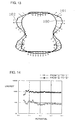
- Prior art date
- Legal status (The legal status is an assumption and is not a legal conclusion. Google has not performed a legal analysis and makes no representation as to the accuracy of the status listed.)
- Expired - Lifetime
Links
Images





Classifications
-
- G—PHYSICS
- G06—COMPUTING OR CALCULATING; COUNTING
- G06V—IMAGE OR VIDEO RECOGNITION OR UNDERSTANDING
- G06V30/00—Character recognition; Recognising digital ink; Document-oriented image-based pattern recognition
- G06V30/10—Character recognition
- G06V30/18—Extraction of features or characteristics of the image
- G06V30/186—Extraction of features or characteristics of the image by deriving mathematical or geometrical properties from the whole image
-
- G—PHYSICS
- G06—COMPUTING OR CALCULATING; COUNTING
- G06V—IMAGE OR VIDEO RECOGNITION OR UNDERSTANDING
- G06V30/00—Character recognition; Recognising digital ink; Document-oriented image-based pattern recognition
- G06V30/10—Character recognition
- G06V30/19—Recognition using electronic means
- G06V30/19007—Matching; Proximity measures
- G06V30/19013—Comparing pixel values or logical combinations thereof, or feature values having positional relevance, e.g. template matching
- G06V30/1902—Shifting or otherwise transforming the patterns to accommodate for positional errors
- G06V30/1904—Shifting or otherwise transforming the patterns to accommodate for positional errors involving a deformation of the sample or reference pattern; Elastic matching
-
- G—PHYSICS
- G06—COMPUTING OR CALCULATING; COUNTING
- G06V—IMAGE OR VIDEO RECOGNITION OR UNDERSTANDING
- G06V30/00—Character recognition; Recognising digital ink; Document-oriented image-based pattern recognition
- G06V30/10—Character recognition
Definitions
- the present invention relates to a character recognizing apparatus. More specifically, the present invention relates to a character recognizing apparatus to which hand-written characters are input, character data thereof are recognized and the result of recognition is output.
- Fig. 2 is a schematic block diagram showing a conventional apparatus for character recognition.
- characters which have been turned into electronic data are input by input means 10 such as an OCR, and features of characters are extracted by feature extracting means 11.
- recognizing means 12 Based on the extracted features, recognizing means 12 recognizes a character by calculating a distance between the feature which has been prepared in advance as a dictionary and the feature of the input character. States and results output from input means 10, feature extracting means 11 and recognizing means 12 are provided as outputs to output means 13.
- hand-written characters more specifically non constrained hand-written characters vary greatly in style and shape. Therefore, it is difficult to recognize hand-written characters in a high recognition rate.
- the method of recognition itself has been improved by developing a dictionary for recognition especially for characters liable to erroneous recognition, by enhancing capability of feature extraction of the character recognizing apparatus by combining a plurality of features.
- the candidates include the correct character and similar characters and that the candidates do not include characters of much different shapes or characters of different categories.
- candidates do include such inappropriate characters and, in such a case, a correct result cannot be obtained even when grammatical knowledge is used.
- a plurality of candidates are produced simply in the order of first candidate, second candidate and the like, in accordance with the magnitude of the result (quantitative amount such as similarity to the dictionary) of the character recognition of the candidates.
- an appropriate one is to be selected from the plurality of candidates by using grammatical knowledge, characters are combined in order starting from the first candidate. At this time, since all candidates are treated with the same weight, a large number of combinations must be examined to obtain one combination having proper meaning, which takes long time.
- an object of the present invention is to provide an apparatus for character recognition which can present a plurality of candidates of a result of recognition which have proper content and high reliability, and in which it can be intuitionally understood how the deformation of the character pattern is reflected by what amount on the feature.
- the magnitude of strain generated by the deformation of the field of induction is evaluated by an elastic energy.
- Fig. 1 shows a structure of one embodiment of the present invention.
- Fig. 2 shows a structure of a conventional character recognizing apparatus.
- Fig. 3 shows an array of pixels of a digital image.
- Fig. 4 shows an example of the field of induction on the retina of a character "E".
- Fig. 5 shows an example of calculation of the fields of induction on the retina of various characters in the process of deformation of a part of a line of the character "E" to be changed to the character "F".
- Fig. 6 illustrates the principle of discrimination of characters utilizing the difference of distribution of the field of induction.
- Fig. 7 shows an example of the field of induction considered as a three dimensional elastic body.
- Fig. 8 shows displacement of the contour of the equational potential plane.
- Fig. 9 shows a general electrical structure of one embodiment of the present invention.
- Fig. 10 is a flow chart showing the operation of one embodiment of the present invention.
- Fig. 11 is an example of the field of induction calculated for an actual hand-written character " ".
- Fig. 12 shows examples of the fields of induction calculated for characters " " and " ".
- Fig. 13 shows an example of displacement of the contour line at a certain potential from “ “ to “ “” when the character " " is used as a reference and is deformed to match " ".
- Fig. 14 shows elastic energy calculated when the character " " is changed to “ "” and when the character " " is changed to “ ".
- Fig. 15 shows elastic energy calculated when each pattern shown in Fig. 5 is deformed to match the field of induction.
- a method of estimating the field of induction on the retina by calculation from digital images of characters which are provided as the result of electronic processing will be described as an example of estimation of the field of induction on the retina of character images based on physiological and psychological knowledge.
- Fig. 3 shows an array of pixels of a digital image.
- the pixels of a digital image are arranged in the form of a lattice, and the distance between pixels is assumed to be 1.
- the field of induction on the retina is formed at point 30 by curve 38 which is constituted by an array of n dots 31 to 37.
- the curve 38 corresponds to a line of a drawing or a contour of a figure. Each point constituting the curve 38 is assumed to have +1 electric charge.
- the field of induction on the retina of an arbitrary digital image can be calculated.
- Fig. 4 shows an example of the distribution of the field of induction on the retina of a character "E" obtained in accordance with the method of calculation described above.
- the thick line represents the character "E” and lines existing thereabout are contour lines showing equipotential lines each connecting the same strength of the field of induction on the retina.
- the numerals in Fig. 4 show the strength of the field at the equipotential line.
- the field of induction on the retina (hereinafter simply referred to as the field of induction) is distributed around a character and the strength therefor depends on the distance from the character.
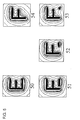
- Fig. 5 shows fields of inductions of various characters in the process of deformation of a portion of the line of character "E” to character “F". Since character “E” is different from character “F", the distribution of the fields of induction of these characters are quite different from each other. However, as the line is deformed, the distribution of the field of induction changes from the field of induction 50 of the character “E” gradually through fields 51, 52, 53 in this order to be the field of induction 54. The distribution of the field of induction becomes closer to the field of induction 54 in the order of the fields 51, 52, and 53, and the field of induction is closer to the field of induction 50 in the order of fields 53, 52, and 51. As described above, different characters have different distribution of the field of induction, and similarity of characters derived from variations of characters can also be expressed properly. Therefore, by quantizing the difference in distribution of the field of induction, characters can be discriminated from each other.
- Fig. 6 illustrates the principle of character recognition utilizing the difference in distribution of the fields of induction.
- the field of induction is considered as an elastic body such as rubber.
- strain is generated in the elastic body. Since the strain becomes larger as the elastic body is deformed to larger extent, the difference between both fields of induction can be quantitatively known by examining the amount of strain.
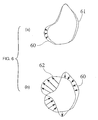
- elastic energy is employed for determining the strain quantitatively. Assume that there are fields of induction of an unknown pattern and of two reference patterns A and B.
- the contour 60 in Fig. 6 denotes the unknown character
- the contour 61 shows reference pattern A
- the contour 62 shows an equipotential line at the field of induction of reference pattern B.
- Fig. 6 (a) shows the state of deformation of an unknown character to match reference pattern A on an equipotential plane
- Fig. 6 (b) shows the state of deformation of the unknown character to match reference pattern B on the equipotential plane. Since the equational potential plane of the unknown character has distribution closer to pattern A than to pattern B, the degree of deformation is smaller.
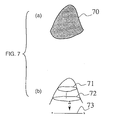
- Fig. 7 is a three dimensional representation of the field of induction. Since the field of induction is a scalar field on a two-dimensional plane, it can be considered as a three dimensional elastic body 70 as shown in Fig. 7 (a). However, since calculation of displacement is difficult when it is considered as a three dimensional body, the three dimensional field of induction is regarded as a gathering of two dimensional equipotential planes 71 and 72 as shown in Fig. 7 (b), and strains of respective equipotential planes are calculated and added. Since only the contour should be considered on the equipotential plane, after all the calculation can be effected as a problem of one dimensional array of dots 73.
- Fig. 8 shows displacement of a contour on an equipotential plane.
- Displacements 82, 83 and 84 generated when various points on border line 81 on an equipotential plane of one character pattern move to border line 80 on same equipotential plane of the other character pattern are calculated, and elastic energy caused by strains is calculated based on the displacements. This corresponds to calculation of the elastic energy caused by deformation of a membrane extended on a contour.
- the energy U required for the displacement of the membrane from the equilibrium state to a certain position includes an energy U 1 required for the deformation of the membrane and the energy U 2 required for the deformation of the contour, which is the edge of the membrane.
- Respective energies can be calculated in accordance with the following equations.
- Fig. 1 is a schematic block diagram of one embodiment of the present invention.
- the character recognizing apparatus of this embodiment includes input means for turning characters into electronic data and inputting character image such as an OCR; field of induction calculating means 2, for calculating the field of induction on the retina of the character image obtained by input means 1; recognizing means 3 having information necessary for character recognition and recognizing the character by evaluating, using elastic energy, the magnitude of strain generated when one field of induction on the retina is deformed to be matched with the other field of induction on the retina by using the field of induction of the retina calculated by the field of induction calculating means; and output means 4 for displaying states and results of outputs from input means 1, field of induction calculating means 2 and recognizing means 3.
- Fig. 9 shows a general electric structure of one embodiment of the present invention.
- a CPU 90 carries out the process of recognition by the field of induction calculating means 2 and the recognition means 3 shown in Fig. 1. Character data to be recognized, data during the process of recognition and so one are temporarily stored in a RAM 91. Data necessary for recognition are stored in a ROM 92.
- Fig. 10 is a flow chart showing the operation of one embodiment of the present invention. A specific operation of one embodiment of the present invention will be described with reference to Figs. 1, 9 and 10.
- CPU 90 calculates the field of induction of the input character in accordance with the equation (1) in step (denoted by SP in the drawings) SP1.
- CPU 90 calculates displacement when the field of induction of the input character calculated in the preceding step deforms to match with the field of induction of a certain dictionary pattern which has been stored in ROM 92 in advance. Then, CPU 90 calculates the elastic energy based on the obtained displacement in accordance with the equations (2) and (3), using expressions (4) to (8) in step SP3.
- step SP4 whether or not the input character matches the dictionary pattern which is being referred to is determined based on the magnitude of the calculated elastic energy. If it is appropriate to determine that the input character is the same as the dictionary pattern, the process is terminated. If not, another dictionary pattern is selected as a candidate in step SP5, the displacement and the elastic energy are calculated again, and determination for recognition is carried out. In this manner, the difference between the fields of induction of the input character pattern and of the dictionary patterns prepared in advance are successively evaluated in terms of the elastic energy, and recognition is realized by searching for the appropriate dictionary.
- Fig. 11 shows an example of the field of induction calculated for the actual hand-written character " ".
- the character of Fig. 11 (a) is blurred, the distribution of the field of induction of Fig. 11 (a) is quite similar to that of Fig. 11 (b) written in a general manner.
- the distribution of the fields of induction are similar among the characters of the same category. Therefore, application of the field of induction to character recognition reduces the influence of the character quality to the recognition.
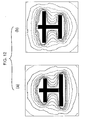
- Fig. 12 shows examples of the fields of induction of the characters " “ and “ “.
- the characters “ “ and “ “ are very similar except that the length of component line are different. Generally, it is difficult to recognize these characters correctly. However, since distribution of the fields of induction of characters “ “ and “ “ differ from each other as can be seen from Fig. 12, the character “ “ “ can be easily discriminated from “ “ when the difference in the field of induction is used as a reference.
- Fig. 13 shows an example of displacement of a contour " “ “ to “ “ at a certain potential value when the character " " is used as a reference and it is deformed to be matched with the character " ".
- Contour 100 represents the contour of " " at a certain potential value and the contour 101 is a contour of " " at the same potential value.
- Displacement 102 represents one of the displacements from “ “ to " “. As can be understood from this example, it can be recognized visually which portion of the character pattern is how much deformed, by the display of the displacement. Accordingly, reflection of great variations of hand-written characters or error in calculation at the time of displacement can be easily examined.
- Fig. 14 shows elastic energies calculated when the character “ “ is displaced to “ “” and the character “ “ “ is displaced to “ “.
- the ordinate represents the elastic energy e i (P) and the abscissa represents the potential value P.
- the values are calculated for the character patterns shown in Fig. 12 in accordance with the principle of displacement shown in Fig. 13.
- the elastic energy required for the displacement from “ “ to “” is about ten times larger than the elastic energy required for the displacement from “ “ to “ “.”
- the difference of distribution of the fields of induction between the two appears as the difference in energy.
- Fig. 15 shows elastic energys calculated when respective patterns shown in Fig. 5 are deformed to match the field of induction 50. It can be understood from the magnitudes of the elastic energys that distributions of the induction fields 51, 52 and 53 are closer to the field of induction 54 in this order, and the distributions of the fields of induction of fields 53, 52 and 51 are closer to the filed 50 in this order. The influence of deformation of the line appears at portions where the elastic energy at the potential value of 0.1 or smaller at fields 52 to 54 of Fig. 15 are larger than that of the field of induction 50.
- the peak "a" of Fig. 15 shows the influence at the lower right portion of the field of induction 53.
- elastic energy for each potential value is calculated, and therefore such influence can be easily known. Further, we can assume that a large difference between the character patterns can be known mostly at portion having low potential values. Therefore, by calculating the elastic energy for various potential values only for the necessary portions, the time for calculation can be saved, and local deformation can be detected.
- the embodiment of the present invention by recognizing characters by calculating the field of induction on the retina of a character image based on physiological and phychological knowledge, quantizing the magnitude of a strain generated when the field of induction of one character image is deformed to match the field of induction of another character image, a plurality of candidates of the result of recognition having proper contents and high reliability can be presented, and in addition, how the deformation of the character pattern is reflected on the feature by which amount can be easily known.
- the time for calculation can be saved and local deformation can be detected when only the portions necessary for recognition are calculated.
Landscapes
- Engineering & Computer Science (AREA)
- Physics & Mathematics (AREA)
- General Physics & Mathematics (AREA)
- Computer Vision & Pattern Recognition (AREA)
- Multimedia (AREA)
- Theoretical Computer Science (AREA)
- Algebra (AREA)
- Mathematical Analysis (AREA)
- Mathematical Optimization (AREA)
- Mathematical Physics (AREA)
- Pure & Applied Mathematics (AREA)
- Character Discrimination (AREA)
Claims (4)
- Appareil de reconnaissance de caractères, comprenant :un moyen d'entrée (1) pour entrer une image de caractère ;un moyen de calcul de champ d'induction (2) pour calculer un champ d'induction induit par des points sur l'image de caractère sur la rétine de l'image de caractère entrée à partir dudit moyen d'entrée ; etun moyen de reconnaissance de caractères (3) pour reconnaítre un caractère sur la base de la différence entre les champs d'induction sur la rétine des différentes images de caractère calculées par ledit moyen de calcul de champ d'induction (2) en évaluant quantitativement une grandeur d'une contrainte générée lorsque le champ d'induction d'une image de caractère se déforme pour correspondre au champ d'induction d'une autre image de caractère.
- Appareil de reconnaissance de caractères selon la revendication 1, dans lequel
ledit moyen de reconnaissance (3) évalue la grandeur de la contrainte générée par la déformation dudit champ d'induction en termes d'énergie élastique (SP3). - Appareil de reconnaissance de caractères selon la revendication 1 ou 2, comprenant en outre :un moyen de mémoire (92) pour mémoriser à l'avance des champs d'induction d'une pluralité de caractères qui sont différents les uns des autres ; dans lequelledit moyen de reconnaissance de caractères (3) inclut un moyen (SP2 à SP5) pour évaluer successivement, en termes d'énergie élastique, la différence entre le champ d'induction de chacun des caractères mémorisés dans ladite mémoire dans ledit moyen de mémoire (92 ) et le champ d'induction dudit caractère entré.
- Appareil de reconnaissance de caractères selon l'une quelconque des revendications 1 à 3, comprenant en outre :
un moyen de sortie (4) pour sortir les résultats de la reconnaissance par ledit moyen de reconnaissance de caractères (3).
Applications Claiming Priority (3)
| Application Number | Priority Date | Filing Date | Title |
|---|---|---|---|
| JP4308791A JPH07117986B2 (ja) | 1992-11-18 | 1992-11-18 | 文字認識装置 |
| JP308791/92 | 1992-11-18 | ||
| JP30879192 | 1992-11-18 |
Publications (3)
| Publication Number | Publication Date |
|---|---|
| EP0602311A2 EP0602311A2 (fr) | 1994-06-22 |
| EP0602311A3 EP0602311A3 (fr) | 1995-03-22 |
| EP0602311B1 true EP0602311B1 (fr) | 2001-04-18 |
Family
ID=17985356
Family Applications (1)
| Application Number | Title | Priority Date | Filing Date |
|---|---|---|---|
| EP93110362A Expired - Lifetime EP0602311B1 (fr) | 1992-11-18 | 1993-06-29 | Appareil de reconnaissance de caractères |
Country Status (4)
| Country | Link |
|---|---|
| US (1) | US5845020A (fr) |
| EP (1) | EP0602311B1 (fr) |
| JP (1) | JPH07117986B2 (fr) |
| DE (1) | DE69330159T2 (fr) |
Families Citing this family (6)
| Publication number | Priority date | Publication date | Assignee | Title |
|---|---|---|---|---|
| EP0826292B1 (fr) * | 1995-05-04 | 2002-09-25 | Interwave Communications International, Ltd. | Procede et appareil de communication cellulaire hybride |
| US6785419B1 (en) * | 2000-12-22 | 2004-08-31 | Microsoft Corporation | System and method to facilitate pattern recognition by deformable matching |
| JP4165042B2 (ja) * | 2001-07-13 | 2008-10-15 | セイコーエプソン株式会社 | 画像レイアウト評価方法および画像レイアウト評価システムならびに画像レイアウト評価処理プログラム |
| JP4147754B2 (ja) * | 2001-07-13 | 2008-09-10 | セイコーエプソン株式会社 | 画像評価方法および画像評価システムならびに画像評価処理プログラム |
| WO2003023696A1 (fr) | 2001-09-12 | 2003-03-20 | Auburn University | Systeme et procede de reconnaissance de caracteres manuscrits |
| JP2008268431A (ja) * | 2007-04-18 | 2008-11-06 | Oki Electric Ind Co Ltd | 筆記試験システム及び筆記試験装置 |
Family Cites Families (3)
| Publication number | Priority date | Publication date | Assignee | Title |
|---|---|---|---|---|
| US3874586A (en) * | 1972-12-18 | 1975-04-01 | Addressograph Multigraph | Information-carrying article and reading apparatus and method |
| US3818446A (en) * | 1973-02-20 | 1974-06-18 | Cavcom Inc | Magnetic ink character transition reader |
| US4475238A (en) * | 1982-04-05 | 1984-10-02 | Everhart Glenn C | Magnetoresistive image correlation device |
-
1992
- 1992-11-18 JP JP4308791A patent/JPH07117986B2/ja not_active Expired - Fee Related
-
1993
- 1993-06-11 US US08/074,518 patent/US5845020A/en not_active Expired - Fee Related
- 1993-06-29 DE DE69330159T patent/DE69330159T2/de not_active Expired - Fee Related
- 1993-06-29 EP EP93110362A patent/EP0602311B1/fr not_active Expired - Lifetime
Also Published As
| Publication number | Publication date |
|---|---|
| DE69330159T2 (de) | 2001-10-18 |
| JPH06162261A (ja) | 1994-06-10 |
| EP0602311A2 (fr) | 1994-06-22 |
| JPH07117986B2 (ja) | 1995-12-18 |
| DE69330159D1 (de) | 2001-05-23 |
| US5845020A (en) | 1998-12-01 |
| EP0602311A3 (fr) | 1995-03-22 |
Similar Documents
| Publication | Publication Date | Title |
|---|---|---|
| Kashi et al. | A Hidden Markov Model approach to online handwritten signature verification | |
| US5742705A (en) | Method and apparatus for character recognition of handwritten input | |
| US6671404B1 (en) | Method and apparatus for recognizing patterns | |
| Suen et al. | Building a new generation of handwriting recognition systems | |
| Kashi et al. | On-line handwritten signature verification using hidden Markov model features | |
| US7336827B2 (en) | System, process and software arrangement for recognizing handwritten characters | |
| EP0539749B1 (fr) | Système et méthode pour la reconnaissance automatique d'écriture manuscrite | |
| US7068821B2 (en) | Information processing method and apparatus | |
| US6118890A (en) | System and method for broad classification of biometric patterns | |
| Shafiei et al. | A new online signature verification algorithm using variable length segmentation and hidden Markov models | |
| Bukhari et al. | Script-independent handwritten textlines segmentation using active contours | |
| US6044171A (en) | Method and apparatus for pattern recognition and representation using fourier descriptors and iterative transformation-reparametrization | |
| US20020143761A1 (en) | Data classifying apparatus and material recognizing apparatus | |
| WO1993020533A1 (fr) | Systemes et procedes de reconnaissance de caracteres avec des moyens permettant de mesurer les caracteristiques des points d'extremite dans des graphiques en mode point | |
| EP0960381B1 (fr) | Procede et dispositif de reconnaissance de formes | |
| CN100416589C (zh) | 采用概率密度函数的模式识别装置及其方法 | |
| US6694054B1 (en) | Pattern recognition process | |
| US11715288B2 (en) | Optical character recognition using specialized confidence functions | |
| EP0762313A2 (fr) | Méthode et appareil améliorés pour la reconnaissance d'écriture manuscripte en utilisant des caractéristiques invariantes | |
| US8340428B2 (en) | Unsupervised writer style adaptation for handwritten word spotting | |
| US5940534A (en) | On-line handwritten character recognition using affine transformation to maximize overlapping of corresponding input and reference pattern strokes | |
| US6330358B1 (en) | Apparatus for character segmentation and apparatus for character recognition using the same | |
| US5845020A (en) | Character recognizing apparatus | |
| US6778704B1 (en) | Method and apparatus for pattern recognition using a recognition dictionary partitioned into subcategories | |
| Lin et al. | Chinese text distinction and font identification by recognizing most frequently used characters |
Legal Events
| Date | Code | Title | Description |
|---|---|---|---|
| PUAI | Public reference made under article 153(3) epc to a published international application that has entered the european phase |
Free format text: ORIGINAL CODE: 0009012 |
|
| AK | Designated contracting states |
Kind code of ref document: A2 Designated state(s): DE FR GB |
|
| PUAL | Search report despatched |
Free format text: ORIGINAL CODE: 0009013 |
|
| AK | Designated contracting states |
Kind code of ref document: A3 Designated state(s): DE FR GB |
|
| 17P | Request for examination filed |
Effective date: 19950411 |
|
| 17Q | First examination report despatched |
Effective date: 19990315 |
|
| GRAG | Despatch of communication of intention to grant |
Free format text: ORIGINAL CODE: EPIDOS AGRA |
|
| GRAG | Despatch of communication of intention to grant |
Free format text: ORIGINAL CODE: EPIDOS AGRA |
|
| GRAH | Despatch of communication of intention to grant a patent |
Free format text: ORIGINAL CODE: EPIDOS IGRA |
|
| GRAA | (expected) grant |
Free format text: ORIGINAL CODE: 0009210 |
|
| AK | Designated contracting states |
Kind code of ref document: B1 Designated state(s): DE FR GB |
|
| PGFP | Annual fee paid to national office [announced via postgrant information from national office to epo] |
Ref country code: GB Payment date: 20010518 Year of fee payment: 9 Ref country code: FR Payment date: 20010518 Year of fee payment: 9 |
|
| REF | Corresponds to: |
Ref document number: 69330159 Country of ref document: DE Date of ref document: 20010523 |
|
| ET | Fr: translation filed | ||
| PGFP | Annual fee paid to national office [announced via postgrant information from national office to epo] |
Ref country code: DE Payment date: 20010627 Year of fee payment: 9 |
|
| REG | Reference to a national code |
Ref country code: GB Ref legal event code: IF02 |
|
| PLBE | No opposition filed within time limit |
Free format text: ORIGINAL CODE: 0009261 |
|
| STAA | Information on the status of an ep patent application or granted ep patent |
Free format text: STATUS: NO OPPOSITION FILED WITHIN TIME LIMIT |
|
| 26N | No opposition filed | ||
| PG25 | Lapsed in a contracting state [announced via postgrant information from national office to epo] |
Ref country code: GB Free format text: LAPSE BECAUSE OF NON-PAYMENT OF DUE FEES Effective date: 20020629 |
|
| PG25 | Lapsed in a contracting state [announced via postgrant information from national office to epo] |
Ref country code: DE Free format text: LAPSE BECAUSE OF NON-PAYMENT OF DUE FEES Effective date: 20030101 |
|
| GBPC | Gb: european patent ceased through non-payment of renewal fee |
Effective date: 20020629 |
|
| PG25 | Lapsed in a contracting state [announced via postgrant information from national office to epo] |
Ref country code: FR Free format text: LAPSE BECAUSE OF NON-PAYMENT OF DUE FEES Effective date: 20030228 |
|
| REG | Reference to a national code |
Ref country code: FR Ref legal event code: ST |