EP0602317A2 - Bandage pour l'articulation du genou - Google Patents
Bandage pour l'articulation du genou Download PDFInfo
- Publication number
- EP0602317A2 EP0602317A2 EP93112490A EP93112490A EP0602317A2 EP 0602317 A2 EP0602317 A2 EP 0602317A2 EP 93112490 A EP93112490 A EP 93112490A EP 93112490 A EP93112490 A EP 93112490A EP 0602317 A2 EP0602317 A2 EP 0602317A2
- Authority
- EP
- European Patent Office
- Prior art keywords
- bandage
- pad
- pelotte
- bandage according
- elastic
- Prior art date
- Legal status (The legal status is an assumption and is not a legal conclusion. Google has not performed a legal analysis and makes no representation as to the accuracy of the status listed.)
- Withdrawn
Links
Images




Classifications
-
- A—HUMAN NECESSITIES
- A61—MEDICAL OR VETERINARY SCIENCE; HYGIENE
- A61F—FILTERS IMPLANTABLE INTO BLOOD VESSELS; PROSTHESES; DEVICES PROVIDING PATENCY TO, OR PREVENTING COLLAPSING OF, TUBULAR STRUCTURES OF THE BODY, e.g. STENTS; ORTHOPAEDIC, NURSING OR CONTRACEPTIVE DEVICES; FOMENTATION; TREATMENT OR PROTECTION OF EYES OR EARS; BANDAGES, DRESSINGS OR ABSORBENT PADS; FIRST-AID KITS
- A61F13/00—Bandages or dressings; Absorbent pads
- A61F13/06—Bandages or dressings; Absorbent pads specially adapted for feet or legs; Corn-pads; Corn-rings
- A61F13/061—Bandages or dressings; Absorbent pads specially adapted for feet or legs; Corn-pads; Corn-rings for knees
-
- D—TEXTILES; PAPER
- D04—BRAIDING; LACE-MAKING; KNITTING; TRIMMINGS; NON-WOVEN FABRICS
- D04B—KNITTING
- D04B1/00—Weft knitting processes for the production of fabrics or articles not dependent on the use of particular machines; Fabrics or articles defined by such processes
- D04B1/14—Other fabrics or articles characterised primarily by the use of particular thread materials
- D04B1/18—Other fabrics or articles characterised primarily by the use of particular thread materials elastic threads
-
- A—HUMAN NECESSITIES
- A61—MEDICAL OR VETERINARY SCIENCE; HYGIENE
- A61F—FILTERS IMPLANTABLE INTO BLOOD VESSELS; PROSTHESES; DEVICES PROVIDING PATENCY TO, OR PREVENTING COLLAPSING OF, TUBULAR STRUCTURES OF THE BODY, e.g. STENTS; ORTHOPAEDIC, NURSING OR CONTRACEPTIVE DEVICES; FOMENTATION; TREATMENT OR PROTECTION OF EYES OR EARS; BANDAGES, DRESSINGS OR ABSORBENT PADS; FIRST-AID KITS
- A61F5/00—Orthopaedic methods or devices for non-surgical treatment of bones or joints; Nursing devices ; Anti-rape devices
- A61F5/01—Orthopaedic devices, e.g. long-term immobilising or pressure directing devices for treating broken or deformed bones such as splints, casts or braces
- A61F5/0102—Orthopaedic devices, e.g. long-term immobilising or pressure directing devices for treating broken or deformed bones such as splints, casts or braces specially adapted for correcting deformities of the limbs or for supporting them; Ortheses, e.g. with articulations
- A61F2005/0132—Additional features of the articulation
- A61F2005/0172—Additional features of the articulation with cushions
- A61F2005/0176—Additional features of the articulation with cushions supporting the patella
-
- D—TEXTILES; PAPER
- D10—INDEXING SCHEME ASSOCIATED WITH SUBLASSES OF SECTION D, RELATING TO TEXTILES
- D10B—INDEXING SCHEME ASSOCIATED WITH SUBLASSES OF SECTION D, RELATING TO TEXTILES
- D10B2403/00—Details of fabric structure established in the fabric forming process
- D10B2403/01—Surface features
- D10B2403/011—Dissimilar front and back faces
- D10B2403/0113—One surface including hollow piping or integrated straps, e.g. for inserts or mountings
-
- D—TEXTILES; PAPER
- D10—INDEXING SCHEME ASSOCIATED WITH SUBLASSES OF SECTION D, RELATING TO TEXTILES
- D10B—INDEXING SCHEME ASSOCIATED WITH SUBLASSES OF SECTION D, RELATING TO TEXTILES
- D10B2509/00—Medical; Hygiene
- D10B2509/02—Bandages, dressings or absorbent pads
- D10B2509/028—Elastic support stockings or elastic bandages
Definitions
- the invention relates to a bandage for the knee joint made of elastic bandage material in the form of a tube with a front bandage part and a rear bandage part and with longitudinal spring rods optionally incorporated in the rear bandage part.
- the knee is the most at risk of injury and most commonly affected by arthrosis because it is unstable and carries the full body weight. Muscular imbalances are often the cause of front knee pain. Especially in people with sedentary professions, the hamstring muscles are mostly shortened and pull the joint capsule backwards, which increases the contact pressure of the kneecap unphysiologically. Sports injuries to the knee particularly occur when playing football and skiing due to sudden twists and strains on the lower leg. Affections of the knee usually result in local pain. The complexity of the joint makes accurate diagnosis difficult. Therefore, it often happens that patients do not receive the correct initial treatment, which can lead to later degenerative diseases.
- DE-A-34 16 231 provides a knee support for slipping out of elastic material integrated, longitudinal springs for reinforcing the medial and lateral side of the knee joint, a recess for the patella and a padding surrounding this recess are known, the padding surrounding the recess being designed in such a way that a contact pressure on the patellar ligament results which results in the femoral patellar slide bearing relieved.
- the padding surrounds the recess in a U-shape, the U-shape being open at the top.
- the upholstery is an elastic U-element that is integrated into the knee support and only surrounds the recess on the side and from below. This element is made of silicone material or rubber. Furthermore, the U-element is designed as a bead with a convex side to the body. It is essential in this knee brace that the main volume of the padding or the bead is arranged above the kneecap. In addition to being comfortable to wear, optimal relief of the knee joint should be achieved with simultaneous guidance of the knee joint, in order to achieve the shortest possible and most gentle healing process in the event of injuries, irritation or other pathological conditions.
- the knee joint bandage according to DE-U-90 04 974 consists of a tapered knee sock made of an elastic material, such as a rubber fabric.
- the knee-high stockings on its front side in the area of the kneecap has two brackets which extend downwards and which support the kneecap on the underside.
- This knee brace is intended to allow the knee cap to change its height in relation to the muscles, but opposite the knee cap Hold the sliding surface in the raised state by supporting the kneecap on the underside.
- DE-A-39 91 334 describes an elastic knee brace in the form of a tube with an elastic profile insert that encompasses the kneecap in a recess.
- a flexible, non-stretchable tendon is embedded in the profile insert in firm connection with it, connecting the areas of the profile insert adjacent to the patella poles on the calf bone side in the arch around the patella in such a way that the distance between the arches increases when the distance of these regions is increased when the knee joint is bent is reduced by the connecting line of the patella poles and the relevant edge of the recess of the profile insert on the adjacent side of the patella presses this medially displacing and centering.
- This knee joint bandage is intended to act dynamically on a kneecap that is either pathological from its ideal position or, as a very common standard variant, is displaced on the calf side, when the knee joint is flexed in order to correct the position of the kneecap.
- the brace used in this knee brace is pulled apart, with the result that the brace straightens up and the desired centering effect is not fully achieved.
- a Genu knee brace consists of one according to claim 1 anatomically shaped tubular body made of a fabric or knitted fabric with an all-round insert made of a highly elastic wave knitted fabric, spring bars being incorporated into the tubular body material via the seams connecting the rear bandage part to the front bandage part.
- a first pad Arranged in the front bandage part is a first pad made of a soft or soft-elastic material which lies in the region above the kneecap when the bandage is applied and which leaves the quadriceps tendon free.
- a second or a second and a third the approach of the sciatic musculature pelotte made of a soft or soft-elastic material is used.
- the patella knee brace is designed according to the Genu knee brace; according to claim 2, it additionally has in its front bandage part at least one clip that stabilizes the first pad and runs in the longitudinal direction of the bandage, which is an integral part of the first pad or lying to the side thereof.
- This clasp is elastic and is preferably inelastic in the longitudinal direction.
- the indication framework "painful irritation of the knee joint" is very broad and ranges from soft tissue swelling after sports or work accidents to chronic complaints to femoropatellar dysplasia with a tendency to lateralization.
- the latter require design features of a knee support that go beyond the properties required for the treatment of general knee problems. Incorporating all active factors in a product would have a restrictive effect on the indication area: the bandage becomes a special bandage and would e.g. represent an oversupply for non-specific knee pain.
- the genu and patella knee braces support physiotherapy and relieve the knee and patella. Rapid swelling, pain relief and functional improvement is brought about.
- intermittent compression is applied to the soft tissues of the joint and a deep massage.
- An undesirable pressure on the patella and the underlying cartilage is avoided.
- the pressure on the patella is reduced, maintaining its physiological lubricity.
- the approach of the sciatic muscles is relieved.
- An undesirable pressure on the nerves and vessels that run in the hollow of the knee is avoided. There are no negative effects on muscle activity.
- the bandage does not lace up and does not create any circulatory difficulties. Wrinkling of the bandage in the hollow of the knee when the knee is bent is minimized.
- the bandage does not slip and a continuously good fit is maintained even when moving.
- the bandage is extremely comfortable because it is not chafing and is kind to the skin.
- the knee brace has the advantage that the function of the quadriceps tendon to pull the patella into its correct position is not impaired.
- the patella knee joint bandage guides the patella from the side, thereby reducing the lateral deviation.
- the Genu knee brace is a three-dimensionally anatomically knitted two-pass bandage that extends from the lower leg to the thigh and has a functional, slight flexion position of around 10 o and is equipped with pressure reduction rims.
- the bandage itself consists of two parts, with the front bandage part spanning 2/3 of the leg circumference. Above the knee joint is an insert made of highly elastic knitted fabric that extends around the entire leg. The rear bandage part is sewn in with the pre-tensioned shaft of the knitted wave.
- the patella knee bandage is also a three-dimensionally anatomically form-knitted two-pass bandage for the knee joint.
- the bandage extends from the lower leg to the thigh and has a functional, light flexion position of about 10 o and is equipped with pressure-reducing edges.
- the bandage also consists of two parts, the front part spanning 2/3 of the leg circumference.
- Above the knee joint is an insert made of highly elastic knitted fabric that extends around the entire leg.
- the rear bandage part is sewn in with a pre-tensioned shaft. Spring bars worked into pockets on the side seams keep the bandage taut.
- the knitted fabric is closed over the patella.
- a horseshoe-shaped first pad is preferably located in the area above the patella.
- the pad opened upwards releases the quadriceps tendon.
- the profile of the pad is adapted to the tibia head and the course of the ligamentum patellae.
- the pad used in the patella bandage may contain a button-shaped friction core made of a material whose degree of hardness is higher than the degree of hardness of the material from which the pad is made. This core of friction is then arranged infrapatellar.
- the pad of the patella knee brace can have a component with different stretching properties.
- the first pad is connected laterally with a fan-like strip or with a clip, which preferably consists of a resilient-elastic material, but has no longitudinal elasticity.
- this strip or the clip pulls straight and exerts a centering force on the pad.
- Two elliptical pads can be sewn into the back bandage part of the patella knee joint bandage, which act on the attachment of the ischiocrural muscles. These two pads are placed approximately 1 cm above the knee joint gap directly at the side seams.
- the configuration of the knitted wave, from which the insert is made, which is arranged in the flexion region of the bandage, is particularly advantageous.
- This knitted wave has a relief in the form of a wave structure on at least one side.
- This wave structure is elastically pre-tensioned and stabilized by an underlying thread arrangement made of highly elastic yarn or thread, whereby the cover structure bulges out like a wave, preferably half-wave, in the relaxed state of the knitted wave. Accordingly, if this surface structure is used in a bandage and is loaded perpendicular to the alignment of the transverse shafts, which is the case, for example, when bending the bandaged joint, only the transverse shafts are first pulled flat or smooth without stretching or stretching the cover structure .
- Overstretching of the cover structure can be reliably ruled out in this way, which at the same time prevents the occurrence of wrinkles, even after the bandage has been used for a long time, in the inner articular flexion area.
- the knitted wave is therefore particularly suitable for use in bandages which are used for the joints with a large freedom of movement or flexion angle, as is the case, for example, with knee joint bandages.
- the knitted wave has a corrugated structure of a cover structure, which is formed on at least one side and is oriented substantially perpendicular to the main direction of expansion, this corrugated structure being elastically pre-tensioned and stabilized by an elastic thread arrangement incorporated or located below this cover structure, which in predetermined distances is connected to the cover structure and is shaped such that the number of transverse shafts is greatest where the greatest expansion path occurs due to the articulation of the joints.
- Such a knitted wave fabric allows the use of despite relatively high elongation relatively inelastic yarn for the cover structure, which creates the conditions for an economical production of the knitted wave. Furthermore, there is no risk of overstretching of the yarn used in the knitted wave, since there is a large basic elasticity.
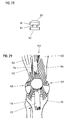
- the knee joint shown in FIG. 29 in the middle of the “lower extremity” movement chain is the largest joint of the human body.
- the upper joint body is a notch in the middle. It is opposed by a very flat joint surface formed only by the shin.
- the menisci two cartilage plates lying on the shin joint surface, represent the pans in which the role of the upper joint body can move like a hinge. There is no bony guidance of the knee joint. This function is taken over by other structures.
- the strong side bands serve as guide rails for the hinge movement.
- the short cruciate ligaments inside the joint prevent the joint-forming bones from slipping backwards or forwards.
- the kneecap lies in front of the joint, embedded in a tendon. It is the largest free bone and serves to improve the pulling action of the lower leg extensor.
- the patella tendon is very sensitive.
- Fig. 29 In the knee joint shown in Fig. 29 is with 100 the vastus lateralis muscle, with 102 the vasti lateralis muscle, with 103 the vastus intermedius muscle, with 104 the recto femoris muscle, with 105 the vastus medialis muscle, with 106 the vastus medialis obliquus muscle, with 107 the patella, with 108 the ligamentum patellofemorale laterale, with 109 the ligamentum patellofemorale mediale, with 110 the ligamentum patellotibiale laterale, with 111 the ligamentum patellotibiale mediale and with 112 the ligamentum patellae.
- the stabilizers of the knee are divided into four functional units: The stabilizers of the medial and lateral complex as well as the dorsal and ventral structures, whereby a distinction is made between static and dynamic stabilizers.
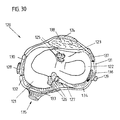
- FIG. 30 shows the right tibia 120 in a cross section.
- the inner meniscus at 121 the outer meniscus at 122, the transverse ligament at 123, the patellar ligament at 124, the anterior cruciate ligament at 125, the posterior cruciate ligament at 126, the meniscofemoral posterior ligament at 127, the ligament at 128 medial collateral ligament, with 129 the lateral collateral ligament, with 130 the medial capsular ligament, with 131 the lateral capsular ligament, with 132 the posterior ligament ligament, with 133 the popliteum obliquum ligament, with 133 the popliteum liguum ligament, with 124 the popliteum arcuatum ligament, with 135 the semimembranous muscle, with 136 the popliteus muscle, 137 the iliotibial tract and 138 the Hoffasche fat body.
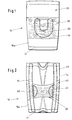
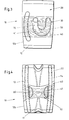
- the bandage 10 shown in the drawing for a knee joint consists of an anatomically shaped tubular body 20 made of a fabric or knitted fabric with an all-round insert 30 made of a highly elastic corrugated knitted fabric 40.
- Spring rods 13, 14 are incorporated into the tubular body material via the seams connecting the rear bandage part 11 to the front bandage part 12
- the shape of the tube body 20 are arcuate, as shown in FIGS. 2 and 4. These spring bars 13, 14 are straight; they will only get the arched shape afterwards when the bandage is formed.
- a first pad 50 Arranged in the front band part 12 of the bandage 10 is a first pad 50, which is open at the top and leaves the quatriceps tendon free, made of a soft or soft-elastic material, this pad 50 sitting in the region above the kneecap when the bandage is applied.
- This pad 50 is U-shaped and is formed by the legs 51, 52 and the web 53 connecting the legs, wherein the pad 50 can also be V-shaped.
- a second or a second and a third elliptical pad 60, 60 ' which acts on the attachment of the ischiocrural muscles, is inserted, which likewise consists of a soft or soft-elastic material.
- FIG. 1 and 2 show a bandage 10 which is designed as a Genu knee joint bandage 10a.
- a further embodiment of the bandage 10 is a bandage based on the Genu knee joint bandage Patella knee joint bandage 10b is provided, which differs from the Genu knee joint bandage 10a only in that in addition in the front bandage part 12 at least one, the pad 50 stabilizing, extending in the longitudinal direction of the bandage is arranged, this clip 70 being an integral part of the pad 50 or lying to the side of this.
- This clasp 70 preferably has no longitudinal elasticity.
- the pad 50 in the front bandage part 12 preferably has a horseshoe-shaped configuration with an arcuate shape of the outer edges 50a, 50b of the two pad legs 51, 52 (FIGS. 7, 10 and 11).
- the pad 50 has an outside, flat base surface 54; the cross section of the pad legs 51, 52 and the cross section in a partial area of the pad web 53 corresponds to a semicircle or a partial circle (FIGS. 12 and 13).
- an inner recess 55 is provided in the center for adaptation to the tibia head and to the course of the patellar ligament.
- the approximately rectangular or square recess 55 has lateral guides 56, 57 running in the longitudinal direction of the bandage.
- this recess 55 in the pad 50 By means of this recess 55 in the pad 50, an increased pressure on the patella band is avoided, this profiling of the pad 50 simultaneously effecting a surface massage.
- the lateral guides 56, 57 serve to guide the patella band. It is essential, however, that this depression 55 in the pad 50 not only leads to a reduction in pressure, but is also adapted to the contour of the tendon.
- the pad 50 is made of felt, foam rubber, neoprene, rubber, made of a viscoelastic silicone rubber or an elastic, compressible, pressure-deformable silicone rubber or a material with the same elastic properties as natural rubber, silicone foam or the like.
- the pad 50 can also be bag-shaped and have a filling made of a gaseous or liquid medium.
- the pad stabilizing clip 70 is adjacent to one of the two legs 51, 52 of the pad 50.
- the shape of the clip 70 corresponds to the shape of the outer leg edge 50a or 50b of the pad 50 (FIG. 3).
- the clip 70 can be arranged at a distance from the leg 51 of the pad 50.
- a fabric or knitted section 41 is then arranged between the leg 51 of the pad 50 and the clasp 70 (FIG. 3).
- the clip 70 is integrally formed on the leg 51 of the pad 50 and is therefore part of the pad 50 (FIG. 6).
- the clip 70 and the pad 50 are then formed in one piece, the clip 70 having a form elasticity corresponding to its effect.
- the clip 70 is passed through the leg 51 of the pad 50 and embedded in the pad material.
- the clip 70 is embedded in the leg 51 of the pad 50, in such a way that the clip 70 protrudes on both sides from the pad leg 51, each with a section 70a, 70b.
- the pad stabilizing clip 70 is preferably made of a resilient, elastic material in order to be able to adapt to all movements.
- the clip 70 is preferably made of a plastic with sufficient flexibility and a degree of hardness that is higher than the degree of hardness of the material from which the pad 50 is made. In the longitudinal direction, the clip 70 is inelastic; however, it can also be elastic in the longitudinal direction.
- a button-shaped friction core 80 is incorporated into the pad 50, which consists of a material that has a higher degree of hardness than the hardness of the pad material.
- This friction core 80 is arranged in the middle of the web 53 connecting the two legs 51, 52 of the pad 50 (FIGS. 9 and 10).
- the difference between the hardness of the pad 50 and the hardness of the friction core 80 is at least 10 Shore, preferably 20 Shore A.
- the material of the pad 50 can also have a hardness below 50 Shore A and the material of the friction core 80 can be above 50 Shore A. Exhibit hardness. It is essential that the friction core 80 consists of a material that is somewhat harder than the material of the pad 50.
- the pad 50 is made of a soft or soft-elastic material, preferably of a viscoelastic silicone rubber or an elastic, compressible, pressure-deformable silicone rubber, for example with a hardness of 40 Shore A, a silicone rubber with a hardness of 9 to 13 Shore A or a compressible silicone rubber of the type of a type of a cold rubber vulcanizing by the process of polyaddition, which deforms in its shape without pressure and does not spring back into shape, which, in addition to high flexibility, has a hardness below 4 Shore A, but silicone rubbers whose hardness is above 4 Shore A can also be used, the friction core 80 consists of a hard or incompressible plastic.
- Such viscoelastic silicone rubbers or materials with the same elasticity properties used for the manufacture of the pad 50 have the property of having a massaging effect when the bandage is applied with such a pad 50 due to the sliding movement, triggered by mass shift, when pressure is applied or during movement sequences in the contact area.
- a material should always be selected for the manufacture of the pad 50, which is viscoelastic and, because of its elastic properties, brings about a massage.
- the friction core 80 Compared to the pad 50, the friction core 80 consists of a hard or incompressible plastic, for example with a hardness lying above 50 Shore A, and thus has a much greater hardness than the pad 50, so that a targeted friction massage on specific pain points of the joint is achieved during movement becomes. Natural or artificial rubber or hard rubber can be used as the material for the friction core 80.
- a chloroprene polymer (trade name NEOPRENE) with a hardness of 50 Shore A
- a rubber-elastic, crosslinked polyurethane (trade name VULKOLLAN) with a hardness of 65 to 90 Shore A
- a silicone rubber with a hardness of 60 Shore A
- an ethylene -Propylene-diene rubber (EPDM) with a hardness of 80 Shore A or a copolymer with acrylonitrile (trade name PERBUNAN) with a hardness of 70 Shore A
- EPDM ethylene -Propylene-diene rubber
- PERBUNAN copolymer with acrylonitrile
- a polyamide can also be used.
- other plastics or natural product derivatives can be used to produce the friction core 80. It is essential that the friction core 80 has sufficient hardness to be able to apply the targeted friction massage to specific pain points.
- the friction core 80 can also consist of metal or wood.
- the friction core 80 can be arranged interchangeably in the pad 50.
- the pad 50 is provided with a recess, not shown in the drawing, of approximately the size of the friction core 80, into which the friction core 80 is pressed by means of a slight pressure.
- the inner wall surface delimiting the recess in the pad 50 preferably has a profile which enables an engagement in the profile of the circumferential wall surface of the friction core 80 and since the pad material is elastic, but the friction core 80 has a greater hardness than the pad material, the Press the friction core 80 into the recess, the profile of the inner wall surface being pressed together during the pressing process in such a way that the friction core 80 can slide completely into the recess and, due to the resilience of the material of the pad 50, the pad material is pressed into the edge profile of the friction core 80, so that this is held firmly in the pad 450.
- the friction core 80 can be pressed out of the pad 50 by correspondingly deforming the pad 50 by applying a strong external pressure. This makes it possible to use friction cores of different hardness. In the case in which pads 50 with exchangeable friction cores 80 are used, the pad 80 is attached to the hose body 20 of the bandage 10 in such a way that the pad 50 can be removed.
- the friction core 80 consisting of a hard or incompressible material is fixed in its position in the material of the pad 50.
- the friction core 80 has a spherical cap-shaped surface 83 or a surface configuration which corresponds in design and shape to the surface configuration of the pad 50 in the arrangement area of the friction core 80.
- the material is made of a plastic, e.g. Silicone rubber, existing friction core 80 fused to the material of the pad 50 and permanently connected to its molded body.
- the friction core 80 can also be obtained in the manufacture of the pad 50 by material hardening of a section which is to form the later friction core and therefore has a greater hardness than the soft material of the pad 50, the pad 50. In both cases, silicone rubber should preferably be used as the material.
- the pad 50 can also be bag-shaped.
- This bag then consists of soft, elastic plastics.
- the interior of the bag is filled with a gaseous medium, e.g. Air, or a liquid medium, e.g. a viscous silicone oil, water or the like. filled.
- the friction core 80 is then fixed in position on the inner wall surface of the bag.
- the Genu knee brace 10a is provided with a friction core 80 arranged in its pad 50 as described above (FIGS. 1 and 2), whereas the patella knee brace 10b is provided with the pad 50, which can be designed with or without a friction core 80 (Fig. 3 and 4).
- the mode of action of the pad 50 is that of a pressure pad.
- a pad stabilizing clip 70 is arranged on the side of the pad 50.
- a pad stabilizing clip 70, 70 'in each of the front bandage part 12 is also possible to arrange a pad stabilizing clip 70, 70 'in each of the front bandage part 12 on both sides of the legs 51, 52 of the pad 50 (FIG. 20).
- the pads 60, 60 'sewn into the rear bandage part 11 consist of the same material as the pad 50.
- the pads 60, 60' can also have a different shape.
- Each of these two pads 60, 60 ' is designed as a bead-shaped body. Instead of two pads 60, 60 ', only one pad 60 or 60' can also be sewn into the rear bandage part 11.
- the two pads 60, 60 'in the rear bandage part 11 can be connected to one another via a web 61 be (Fig. 16 and 17). There is also the possibility of connecting the two pads 60, 60 'in the rear bandage part 11 via webs 58, 59 to the legs 51, 52 of the pad 50 (FIGS. 18 and 19).
- the webs 61, 58, 59 connecting the pads 60, 60 'to one another or to the pad 50 are thin-walled and consist of the same material as the pads 50, 60, 60', so that these webs 61 and 58, 59 have a high height Have flexibility.
- the rear bandage part 11 is sewn in with the prestressed wave fabric 40 (FIGS. 1 and 2).
- the pad 50 as well as the pads 60, 60 'and the pad stabilizing clip 70 are arranged in the area of the insert 30 made of the knitted wave 40 and integrated into the tubular body 20 of the bandage 10.
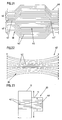
- the knitted shaft 40 of the insert 30 has a larger number of shafts 42 in the front bandage part 12 than in the rear bandage part 11.
- the guidance of the shafts 42 of the knitted shaft 40 of the insert 30 is based on a smaller number of shafts in the rear bandage part 11 for a division of the shafts 42 into two spaced-apart shaft groups 46, 46 'in the front bandage part 12, in the between the two shaft groups 46, 46 'in the front bandage part 12, a shaft group 46''which extends into wedge-shaped end sections 47, 47' is arranged (FIGS. 21 and 22).
- a special feature of the bandage 10 is that a special textile structure, namely the knitted wave 40, is used for the insert 30, which is provided where the highest elongation alternating stresses of the bandage occur, and which is explained in more detail below.
- the strip-shaped representation of the insert 30 in FIGS. 21 and 22 indicates that the knitted wave 40 forms a relief in this area, which is illustrated in the illustration according to FIG. 24.
- This relief is a wave structure which is formed at least on one side of the bandage - in the embodiment shown in the drawings on the side facing away from the body.
- a series of half-waves 218 are lined up with the interposition of nodes or node areas 220, which arise as follows:
- a cover knit 224 formed by stitches 222 is firmly connected in the area of individual stitches 222 'with an elastic thread arrangement 226 on the underside of the cover knit 224 such that a row of stitches 222 of the cover knit 224 - in the embodiment four - of a longer stitch 228 underlying elastic thread arrangement 226 is bridged.
- the meshes 222 between the nodes or regions 220 are thereby bulged upward, as a result of which the transverse shafts 218 are prestressed and stabilized.
- Wave knitted fabrics 40 can be seen in detail from the illustration according to FIG. 25.
- the stitches are indicated by lines and the connection of the stitches to each other by small circles.
- the elastic yarn 226 provided on the underside bridges the knot regions 220, between which four stitches 222 of the knitted cover 224 are formed.
- the prestressing of the elastic thread arrangement 226 bulges the stitches 222 into half-waves 218, as a result of which the relief structure is created.
- the half waves 218 each have between two and twelve, preferably four, courses.
- the right hand side shows how the knitted wave 40 behaves when subjected to a tensile force F. It can be seen that the elastic thread arrangement 226 is stretched between the knot regions 220 without any additional stretching stress in the region of the half-waves 218, i.e. occurs in the area of the meshes 222. Correspondingly, the knitted wave 40 can lengthen by the dimension L before the stitches 222 of the knitted cover 224 are subjected to tension. Accordingly, this dimension L creates a stretch reserve of the bandage knitted fabric in comparison to conventional textile fabrics.
- connection between the cover fabric 224 and the elastic thread arrangement 226 can be made in a wide variety of ways. It is also possible to select or establish the connection in such a way that 40 waves 42 are formed on both sides of the knitted wave.
- the cover knitted fabric 224 does not have to be formed with one surface.
- normal knitting yarn such as e.g. Cotton or polyamide yarn
- this elastic thread can also be plated to improve the wear resistance of the textile fabric or knitted fabric.
- An insertion thread can also be worked into the stitches 222 of the cover fabric 224 in order to achieve a compression effect of the bandage in this area of the undulating relief structure as well.
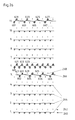
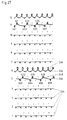
- 26 and 27 show two possibilities of how the above-mentioned wave knitted fabric 40 can be produced on automatic knitting machines.
- Two needle beds are used here, namely a first needle bed 260 and a second needle bed 262 with needles arranged at the same distance from one another.
- On the first needle bed 260 several rows of stitches made of normal knitting yarn, such as cotton or polyamide yarn 264, are knitted on the first needle bed 260.
- Two rows of stitches are then knitted on both needle beds 260, 262 with elastic yarn, such as rubber or wrapping yarn 268, whereby this is elastic
- a cladding thread 266 is preferably added to the yarn.
- In the fifth row of knitting only needles 602, 604, 606, ... etc. or 622, 626, 626, ... etc. of both needle beds are knitted.
- the plating thread can be formed from a polyamide HE thread. The illustration shows that the course of stitches six is again knitted on all needles of the two needle beds 260, 262. However, this is not absolutely
- the eleventh row of knits differing from the fifth row of knits in that the needles involved in the needle beds 260,262 are offset by one.
- FIG. 27 shows another pattern with a slightly different weave in the area of the later knitted knot 220.
- the rows of knitting one to five and seven to eleven correspond to the knitting pattern according to FIG. 26. The only difference is the formation of the 6th and the 12th row of knitting, so that it does not appear necessary to go into this figure in more detail.
- the insert 30 consists of a knitted wave 40 described above.
- the textile fabric forming the insert 30 has such a structure that an elastic thread arrangement, either incorporated or connected to a textile cover structure in accordance with a predetermined pattern, gives the fabric such an internal prestress that a wave-like relief is formed at least on one side , which are then initially pulled smooth or smoother by external stress can without stretching the deck structure in this phase.
- the insert 30 made of the knitted wave 40 prevents wrinkle formation or counteracts wrinkle formation, in particular in the inner flexion area of the bandage 10 applied.
- the pelotte stabilizing clip 70 is preferably led out of the insert 30 of the knitted wave 40 on both sides, the free clip ends being sewn into the fabric or knitted fabric of the tubular body 20 of the bandage 10.
- the web of the pad 50 can be provided with a tongue-like molding that tapers to the outer edge and consists of the pad material.
- a tongue-like molding that tapers to the outer edge and consists of the pad material.
- the outer edge of the pad web is thus designed to taper flat outward.
- the free ends of the two legs of the pad can be widened in the manner of an elephant foot, whereby the support and effective range of the pad 50 is improved.
Landscapes
- Engineering & Computer Science (AREA)
- Health & Medical Sciences (AREA)
- Textile Engineering (AREA)
- Biomedical Technology (AREA)
- Heart & Thoracic Surgery (AREA)
- Vascular Medicine (AREA)
- Life Sciences & Earth Sciences (AREA)
- Animal Behavior & Ethology (AREA)
- General Health & Medical Sciences (AREA)
- Public Health (AREA)
- Veterinary Medicine (AREA)
- Orthopedics, Nursing, And Contraception (AREA)
Priority Applications (3)
| Application Number | Priority Date | Filing Date | Title |
|---|---|---|---|
| DE59308342T DE59308342D1 (de) | 1992-11-05 | 1993-10-26 | Bandage für das Kniegelenk |
| EP93117295A EP0600218B1 (fr) | 1992-11-05 | 1993-10-26 | Bandage pour l'articulation du genou |
| US08/615,583 US6149616A (en) | 1992-11-05 | 1996-03-12 | Bandage for the knee joint |
Applications Claiming Priority (2)
| Application Number | Priority Date | Filing Date | Title |
|---|---|---|---|
| DE4237389A DE4237389A1 (de) | 1992-11-05 | 1992-11-05 | Bandage für das Kniegelenk |
| DE4237389 | 1992-11-05 |
Publications (2)
| Publication Number | Publication Date |
|---|---|
| EP0602317A2 true EP0602317A2 (fr) | 1994-06-22 |
| EP0602317A3 EP0602317A3 (fr) | 1994-10-12 |
Family
ID=6472189
Family Applications (1)
| Application Number | Title | Priority Date | Filing Date |
|---|---|---|---|
| EP19930112490 Withdrawn EP0602317A3 (fr) | 1992-11-05 | 1993-08-04 | Bandage pour l'articulation du genou. |
Country Status (3)
| Country | Link |
|---|---|
| US (1) | US6149616A (fr) |
| EP (1) | EP0602317A3 (fr) |
| DE (2) | DE4237389A1 (fr) |
Cited By (4)
| Publication number | Priority date | Publication date | Assignee | Title |
|---|---|---|---|---|
| US5769808A (en) * | 1996-12-02 | 1998-06-23 | Matthijs; Omer C. | Wrist support band |
| US9125787B2 (en) | 2011-09-30 | 2015-09-08 | Covidien Lp | Compression garment having a foam layer |
| US9402779B2 (en) | 2013-03-11 | 2016-08-02 | Covidien Lp | Compression garment with perspiration relief |
| DE102019119396A1 (de) * | 2019-07-17 | 2021-01-21 | Julius Zorn Gmbh | Medizinisches Gestrickteil und Verfahren zur Herstellung eines solchen Gestrickteils |
Families Citing this family (72)
| Publication number | Priority date | Publication date | Assignee | Title |
|---|---|---|---|---|
| US5814094A (en) | 1996-03-28 | 1998-09-29 | Becker; Robert O. | Iontopheretic system for stimulation of tissue healing and regeneration |
| US6861570B1 (en) | 1997-09-22 | 2005-03-01 | A. Bart Flick | Multilayer conductive appliance having wound healing and analgesic properties |
| US8801681B2 (en) | 1995-09-05 | 2014-08-12 | Argentum Medical, Llc | Medical device |
| US7214847B1 (en) | 1997-09-22 | 2007-05-08 | Argentum Medical, L.L.C. | Multilayer conductive appliance having wound healing and analgesic properties |
| US8455710B2 (en) | 1997-09-22 | 2013-06-04 | Argentum Medical, Llc | Conductive wound dressings and methods of use |
| US6087549A (en) | 1997-09-22 | 2000-07-11 | Argentum International | Multilayer laminate wound dressing |
| DE19938322A1 (de) | 1999-08-12 | 2001-02-15 | Beiersdorf Ag | Selbstklebender Formkörper |
| DE20000265U1 (de) * | 2000-01-07 | 2001-06-07 | Otto Bock Orthopädische Industrie GmbH & Co., 37115 Duderstadt | Kniebandage |
| KR100385790B1 (ko) * | 2000-12-21 | 2003-06-02 | 동해메디칼 주식회사 | 절곡부목과 그 제조방법 |
| US20020147422A1 (en) * | 2001-02-08 | 2002-10-10 | Darcey Thomas D. | Custom-moldable patellar support, support product for improved patella tracking, and method |
| US6776769B2 (en) | 2001-03-05 | 2004-08-17 | Joseph Smith | Anatomically configured tubular body of woven or knitted fabric for pressure support of articulating joint |
| US6755800B2 (en) * | 2001-08-08 | 2004-06-29 | Beiersdorf, Inc. | Tennis elbow support comprising tendon pad |
| US20040006295A1 (en) * | 2002-07-05 | 2004-01-08 | Testa Anthony S. | ACL/MCL impact absorbtion device |
| US8926539B2 (en) * | 2004-03-10 | 2015-01-06 | Dean E. Cropper | Knee orthosis and orthotic method |
| US7361153B1 (en) * | 2004-05-17 | 2008-04-22 | Martin Dennis W | Tool for manipulating the patella and patellar tendon |
| DE102004040800A1 (de) | 2004-08-23 | 2006-03-02 | Bauerfeind Ag | Mit einem Polster versehene Gelenkbandage |
| DE102004040793B4 (de) * | 2004-08-23 | 2014-06-05 | Bauerfeind Ag | Elastische Kniegelenkbandage |
| US7361154B2 (en) * | 2004-09-08 | 2008-04-22 | James M. Jablonka | Strap for treating medical ailments |
| US20060094999A1 (en) * | 2004-11-01 | 2006-05-04 | Cropper Dean E | Apparatus for and method of diagnosing and treating patello-femoral misalignment |
| GB0515294D0 (en) | 2005-07-26 | 2005-08-31 | Novamedix Distrib Ltd | Limited durability closure means for an inflatable medical garment |
| USD574084S1 (en) * | 2005-09-02 | 2008-07-29 | Bauerfeind Ag | Bandage for a knee joint |
| US20070060857A1 (en) * | 2005-09-12 | 2007-03-15 | Testa Anthony S Jr | Knee brace |
| USD548350S1 (en) | 2006-04-04 | 2007-08-07 | 3M Innovative Properties Company | Pad ornamentation for appendage wrap |
| USD572827S1 (en) * | 2006-04-26 | 2008-07-08 | Bauerfeind Ag | Knee joint bandage |
| US7625350B2 (en) * | 2006-06-03 | 2009-12-01 | Glenn Colaco | Glide sleeve brace |
| DE102006061060B4 (de) * | 2006-12-22 | 2012-12-20 | Bauerfeind Ag | Kniegelenkbandage |
| US8162861B2 (en) | 2007-04-09 | 2012-04-24 | Tyco Healthcare Group Lp | Compression device with strategic weld construction |
| US8016779B2 (en) | 2007-04-09 | 2011-09-13 | Tyco Healthcare Group Lp | Compression device having cooling capability |
| US8109892B2 (en) | 2007-04-09 | 2012-02-07 | Tyco Healthcare Group Lp | Methods of making compression device with improved evaporation |
| US8070699B2 (en) | 2007-04-09 | 2011-12-06 | Tyco Healthcare Group Lp | Method of making compression sleeve with structural support features |
| US8506508B2 (en) | 2007-04-09 | 2013-08-13 | Covidien Lp | Compression device having weld seam moisture transfer |
| US8034007B2 (en) | 2007-04-09 | 2011-10-11 | Tyco Healthcare Group Lp | Compression device with structural support features |
| US8128584B2 (en) | 2007-04-09 | 2012-03-06 | Tyco Healthcare Group Lp | Compression device with S-shaped bladder |
| US20090076625A1 (en) * | 2007-09-14 | 2009-03-19 | The Ohio Willow Wood Company | Reinforced prosthetic suspension sleeve |
| DE102008009635B4 (de) | 2008-02-15 | 2012-08-16 | Otto Bock Healthcare Gmbh | Bandage |
| US8114117B2 (en) | 2008-09-30 | 2012-02-14 | Tyco Healthcare Group Lp | Compression device with wear area |
| IL192038A0 (en) * | 2008-06-10 | 2009-02-11 | David Ben Kiki | Cervical spine traction collar |
| US20100115681A1 (en) * | 2008-10-06 | 2010-05-13 | Gsm (Operations) Pty Ltd | Wetsuit |
| TWI551227B (zh) * | 2010-01-22 | 2016-10-01 | Kowa Co | Knee support belt |
| US8652079B2 (en) | 2010-04-02 | 2014-02-18 | Covidien Lp | Compression garment having an extension |
| DE102010020069B4 (de) * | 2010-05-07 | 2013-02-21 | Otto Bock Healthcare Gmbh | Textilbandage |
| US10751221B2 (en) * | 2010-09-14 | 2020-08-25 | Kpr U.S., Llc | Compression sleeve with improved position retention |
| USD686330S1 (en) | 2011-01-26 | 2013-07-16 | Bauerfeind Ag | Orthotic insert |
| DE102011010827B4 (de) * | 2011-01-31 | 2016-09-08 | Bauerfeind Ag | Verbesserte patellapelotte und diese enthaltende kniegelenksorthese |
| US9265629B2 (en) | 2011-04-01 | 2016-02-23 | The Ohio Willow Wood Company | Fabric covered polymeric prosthetic liner |
| US9205021B2 (en) | 2012-06-18 | 2015-12-08 | Covidien Lp | Compression system with vent cooling feature |
| EP2861194A1 (fr) * | 2012-06-18 | 2015-04-22 | 3M Innovative Properties Company | Pansement compressif double densité |
| DE102013001732A1 (de) * | 2013-01-31 | 2014-08-14 | Exos Gmbh | Trägermittel zum Ankoppeln von zumindest einer Leit-Stütz-Struktur an einem Lebewesen |
| EP2983626B1 (fr) | 2013-04-08 | 2021-10-27 | Ossur hf | Dispositif orthopédique et son procédé de fixation |
| FR3005570B1 (fr) * | 2013-05-16 | 2016-07-29 | Millet Innovation | Orthese proprioceptive assurant le maintien d'une articulation |
| DE102013022088A1 (de) * | 2013-12-23 | 2015-06-25 | Bauerfeind Ag | Patellarsehnenbandage |
| CN105939694B (zh) * | 2014-02-03 | 2018-05-11 | Djo有限责任公司 | 支撑护具 |
| DE102014104800A1 (de) * | 2014-04-03 | 2015-10-08 | Aesculap Ag | Medizinische Befestigungseinrichtung sowie Referenzierungsvorrichtung und medizinisches Instrumentarium |
| DE102016103960B3 (de) | 2016-03-04 | 2017-07-13 | medi prosthetics GmbH | Gestrickteil in Form eines Bein- oder Armstrumpfes |
| CN109688986B (zh) | 2016-08-09 | 2021-06-22 | 奥索冰岛有限公司 | 矫形设备 |
| US10966851B2 (en) | 2016-08-09 | 2021-04-06 | Ossur Iceland Ehf | Orthopedic device |
| USD870298S1 (en) | 2017-11-17 | 2019-12-17 | Ossur Iceland Ehf | Strap for an orthopedic device |
| USD872285S1 (en) | 2017-11-17 | 2020-01-07 | Ossur Iceland Ehf | Lumbar support |
| USD863566S1 (en) | 2017-11-17 | 2019-10-15 | Ossur Iceland Ehf | Orthopedic device |
| USD863567S1 (en) | 2017-11-27 | 2019-10-15 | Ossur Iceland Ehf | Orthopedic device |
| USD891623S1 (en) | 2017-12-05 | 2020-07-28 | Ossur Iceland Ehf | Hinge |
| ES2722248B2 (es) * | 2018-02-07 | 2020-03-03 | Gil Francisco Javier Fernandez | Complemento dinámico de protección y sujeción de la meseta tibial, rótula y rodilla |
| JP2019189955A (ja) * | 2018-04-19 | 2019-10-31 | ピップ株式会社 | 膝用サポーター |
| DE102018207727A1 (de) | 2018-05-17 | 2019-11-21 | Bauerfeind Ag | Stabilisierungsstab für ein orthopädisches Hilfsmittel |
| WO2020159647A1 (fr) | 2019-01-30 | 2020-08-06 | Ossur Iceland Ehf | Dispositif orthopédique pour problèmes fémoro-patellaires |
| EP3699342B1 (fr) * | 2019-02-22 | 2021-11-17 | medi GmbH & Co. KG | Procédé de fabrication d'une pièce tricotée ainsi que pièce tricotée |
| EP4267049A1 (fr) | 2020-12-28 | 2023-11-01 | Ossur Iceland Ehf | Manchon et procédé d'utilisation avec dispositif orthopédique |
| JP7229606B1 (ja) | 2022-08-03 | 2023-02-28 | 日本シグマックス株式会社 | 膝サポータ |
| DE102023200768A1 (de) * | 2023-01-31 | 2024-08-01 | Bauerfeind Ag | Pelotte mit zugeordnetem gekrümmten Zügelelement |
| CN219375087U (zh) * | 2023-03-22 | 2023-07-21 | 陶平 | 一种脚趾矫正器 |
| TWI850044B (zh) * | 2023-07-31 | 2024-07-21 | 稷富國際科技有限公司 | 具有晶片之髕骨支撐護具 |
| US20250143906A1 (en) * | 2023-11-07 | 2025-05-08 | Jill C. POKASKI AZAR | Devices and methods to mitigate patella malpositioning |
Family Cites Families (27)
| Publication number | Priority date | Publication date | Assignee | Title |
|---|---|---|---|---|
| DE1015364B (de) * | 1955-07-29 | 1957-09-05 | Kurt Kraenzle | Fussgelenk- und Knoechelschutz |
| US3375821A (en) * | 1965-07-14 | 1968-04-02 | Cicero P. Meek | Kneepad |
| US3831467A (en) * | 1973-03-16 | 1974-08-27 | R Moore | Knee brace |
| DE2632706A1 (de) * | 1976-07-21 | 1978-01-26 | Schmidt & Co Karl J G | Bandage |
| US4084584A (en) * | 1976-10-15 | 1978-04-18 | Detty Garnett E | Knee sleeve |
| US4116236A (en) * | 1977-02-14 | 1978-09-26 | Surgical Applicance Industries, Inc. | Knee brace with kneecap-encircling flexible resilient pad |
| DE2936174A1 (de) * | 1979-09-07 | 1981-03-19 | Bauerfeind Gmbh, 4152 Kempen | Bandage |
| US4287885A (en) * | 1979-12-06 | 1981-09-08 | Surgical Appliance Industries, Inc. | Knee brace with resilient pad surrounding patella |
| US4370978A (en) * | 1981-10-21 | 1983-02-01 | Palumbo Pasquale M | Knee brace |
| US4445505A (en) * | 1981-12-28 | 1984-05-01 | Donald Labour | Knee brace for preventing lateral displacement of the patella |
| US4425912A (en) * | 1982-06-11 | 1984-01-17 | Rampon Products, Inc. | Knee protector/stabilizer |
| FR2532839B1 (fr) * | 1982-09-15 | 1986-04-11 | Bertheas Michel | Genouillere de readaptation fonctionnelle |
| DE3412772C1 (de) * | 1984-04-05 | 1985-10-24 | Horst 8502 Zirndorf Kleylein | Knie-Orthese |
| DE3416231A1 (de) * | 1984-05-02 | 1985-11-07 | Henning Dr.med. 8000 München Malze | Kniebandage |
| DE3637879A1 (de) * | 1986-11-06 | 1988-05-19 | Rahm Orthopaedie Technik Gmbh | Kniegelenkbandage |
| FR2607384B1 (fr) * | 1986-12-02 | 1991-01-18 | Bertheas Michel | Genouillere perfectionnee de reeducation fonctionnelle |
| FR2633512A1 (fr) * | 1988-07-04 | 1990-01-05 | Richard Freres Sa | Bandages elastiques de soutien, de compression et/ou de contention |
| FR2636228A1 (fr) * | 1988-09-13 | 1990-03-16 | Pichon Freres Ets | Genouillere rotulienne |
| US4986263A (en) * | 1990-04-23 | 1991-01-22 | Biomet, Inc. | Musculoskeletal knee support |
| DE9004974U1 (de) * | 1990-05-03 | 1990-08-09 | Scheffler, Heinz, 2410 Mölln | Kniegelenkbandage |
| DE4101965A1 (de) * | 1991-01-24 | 1992-07-30 | Beiersdorf Ag | Gelenkbandage |
| US5135473A (en) * | 1991-01-31 | 1992-08-04 | Marcia Epler | Achilles tendon wrap |
| DE4103383C2 (de) * | 1991-02-05 | 1993-12-09 | Beiersdorf Ag | Ellenbogen-Bandage |
| DE4103386A1 (de) * | 1991-02-05 | 1992-08-06 | Beiersdorf Ag | Aus textilienfaeden hergestelltes flaechengebilde und daraus hergestellte gelenkbandage |
| DE4104930C2 (de) * | 1991-02-18 | 2000-05-04 | Beiersdorf Ag | Sprunggelenk-Bandage |
| US5261871A (en) * | 1991-12-12 | 1993-11-16 | Greenfield Raphael L | Orthopedic device |
| DE4238610A1 (de) * | 1992-11-16 | 1994-05-19 | Hauber Ferd Gmbh | Gelenkbandage |
-
1992
- 1992-11-05 DE DE4237389A patent/DE4237389A1/de not_active Withdrawn
-
1993
- 1993-08-04 EP EP19930112490 patent/EP0602317A3/fr not_active Withdrawn
- 1993-10-26 DE DE59308342T patent/DE59308342D1/de not_active Expired - Lifetime
-
1996
- 1996-03-12 US US08/615,583 patent/US6149616A/en not_active Expired - Fee Related
Cited By (4)
| Publication number | Priority date | Publication date | Assignee | Title |
|---|---|---|---|---|
| US5769808A (en) * | 1996-12-02 | 1998-06-23 | Matthijs; Omer C. | Wrist support band |
| US9125787B2 (en) | 2011-09-30 | 2015-09-08 | Covidien Lp | Compression garment having a foam layer |
| US9402779B2 (en) | 2013-03-11 | 2016-08-02 | Covidien Lp | Compression garment with perspiration relief |
| DE102019119396A1 (de) * | 2019-07-17 | 2021-01-21 | Julius Zorn Gmbh | Medizinisches Gestrickteil und Verfahren zur Herstellung eines solchen Gestrickteils |
Also Published As
| Publication number | Publication date |
|---|---|
| DE59308342D1 (de) | 1998-05-07 |
| DE4237389A1 (de) | 1994-05-11 |
| EP0602317A3 (fr) | 1994-10-12 |
| US6149616A (en) | 2000-11-21 |
Similar Documents
| Publication | Publication Date | Title |
|---|---|---|
| EP0602317A2 (fr) | Bandage pour l'articulation du genou | |
| DE4104930C2 (de) | Sprunggelenk-Bandage | |
| EP0496071B1 (fr) | Bandage articulaire | |
| EP2442773B2 (fr) | Bande de contention | |
| EP3086746B1 (fr) | Bande de maintien rotulien | |
| DE102019212740B3 (de) | Pelotte umfassend ein Druckelement | |
| EP1179325A1 (fr) | Bandage pour la cheville | |
| EP0600218B1 (fr) | Bandage pour l'articulation du genou | |
| CH672061A5 (fr) | ||
| EP2179711B1 (fr) | Bandage articulé | |
| DE4103383C2 (de) | Ellenbogen-Bandage | |
| EP3661382B1 (fr) | Chaussure destinée à amortir un mouvement du pied par le biais de la cheville | |
| DE9316342U1 (de) | Bandage für das Kniegelenk | |
| DE4106883C2 (de) | Schultergelenk-Bandage | |
| EP1803425B1 (fr) | Remède orthopédique | |
| CH716437A2 (de) | Medizinisches Gestrickteil, dessen Verwendung und Verfahren zur Herstellung eines solchen Gestrickteils. | |
| DE9417712U1 (de) | Sprunggelenk-Bandage | |
| EP4574103B1 (fr) | Orthèse de cheville | |
| DE19614877A1 (de) | Gestrick als Teil von Bandagen oder anderer orthopädischer Hilfsmittel | |
| AT368U1 (de) | Sprunggelenk-bandage | |
| DE102009025415C5 (de) | Stützbandage | |
| DE102023205183A1 (de) | Pelotte mit beweglichen Erhebungen | |
| DE102023205185A1 (de) | Pelotte mit mehreren verbundenen beweglichen Erhebungen | |
| DE102009050383B3 (de) | Stützbandage | |
| DE102020101745A1 (de) | Kniegelenkbandage |
Legal Events
| Date | Code | Title | Description |
|---|---|---|---|
| PUAI | Public reference made under article 153(3) epc to a published international application that has entered the european phase |
Free format text: ORIGINAL CODE: 0009012 |
|
| AK | Designated contracting states |
Kind code of ref document: A2 Designated state(s): DE ES FR GB IT NL |
|
| PUAL | Search report despatched |
Free format text: ORIGINAL CODE: 0009013 |
|
| AK | Designated contracting states |
Kind code of ref document: A3 Designated state(s): DE ES FR GB IT NL |
|
| 18D | Application deemed to be withdrawn |
Effective date: 19950413 |