EP0602347A1 - Verfahren zum Spülen und Rekonditionieren von Transfersystemen - Google Patents
Verfahren zum Spülen und Rekonditionieren von Transfersystemen Download PDFInfo
- Publication number
- EP0602347A1 EP0602347A1 EP93116941A EP93116941A EP0602347A1 EP 0602347 A1 EP0602347 A1 EP 0602347A1 EP 93116941 A EP93116941 A EP 93116941A EP 93116941 A EP93116941 A EP 93116941A EP 0602347 A1 EP0602347 A1 EP 0602347A1
- Authority
- EP
- European Patent Office
- Prior art keywords
- purge gas
- corrosive
- transfer systems
- oxygen
- media
- Prior art date
- Legal status (The legal status is an assumption and is not a legal conclusion. Google has not performed a legal analysis and makes no representation as to the accuracy of the status listed.)
- Granted
Links
- 238000000034 method Methods 0.000 title claims abstract description 21
- 230000008569 process Effects 0.000 title abstract description 9
- 238000011010 flushing procedure Methods 0.000 title abstract description 8
- 239000007789 gas Substances 0.000 claims abstract description 14
- 239000001301 oxygen Substances 0.000 claims abstract description 14
- 229910052760 oxygen Inorganic materials 0.000 claims abstract description 14
- QVGXLLKOCUKJST-UHFFFAOYSA-N atomic oxygen Chemical compound [O] QVGXLLKOCUKJST-UHFFFAOYSA-N 0.000 claims abstract description 13
- 239000000463 material Substances 0.000 claims abstract description 12
- CBENFWSGALASAD-UHFFFAOYSA-N Ozone Chemical compound [O-][O+]=O CBENFWSGALASAD-UHFFFAOYSA-N 0.000 claims abstract description 8
- 229910001507 metal halide Inorganic materials 0.000 claims description 13
- 150000005309 metal halides Chemical class 0.000 claims description 13
- 238000010926 purge Methods 0.000 claims description 12
- XLYOFNOQVPJJNP-UHFFFAOYSA-N water Chemical compound O XLYOFNOQVPJJNP-UHFFFAOYSA-N 0.000 claims description 11
- XLYOFNOQVPJJNP-UHFFFAOYSA-M hydroxide Chemical compound [OH-] XLYOFNOQVPJJNP-UHFFFAOYSA-M 0.000 claims description 4
- 229910001566 austenite Inorganic materials 0.000 claims description 2
- 238000011109 contamination Methods 0.000 abstract description 3
- 229910000859 α-Fe Inorganic materials 0.000 abstract description 2
- 230000007797 corrosion Effects 0.000 description 12
- 238000005260 corrosion Methods 0.000 description 12
- 230000015572 biosynthetic process Effects 0.000 description 5
- 229910044991 metal oxide Inorganic materials 0.000 description 5
- 150000004679 hydroxides Chemical class 0.000 description 4
- 229910052751 metal Inorganic materials 0.000 description 4
- 239000002184 metal Substances 0.000 description 4
- 239000000203 mixture Substances 0.000 description 4
- 229910001385 heavy metal Inorganic materials 0.000 description 3
- IXCSERBJSXMMFS-UHFFFAOYSA-N hydrogen chloride Substances Cl.Cl IXCSERBJSXMMFS-UHFFFAOYSA-N 0.000 description 3
- 150000004706 metal oxides Chemical class 0.000 description 3
- IJGRMHOSHXDMSA-UHFFFAOYSA-N Atomic nitrogen Chemical compound N#N IJGRMHOSHXDMSA-UHFFFAOYSA-N 0.000 description 2
- PXGOKWXKJXAPGV-UHFFFAOYSA-N Fluorine Chemical compound FF PXGOKWXKJXAPGV-UHFFFAOYSA-N 0.000 description 2
- VEXZGXHMUGYJMC-UHFFFAOYSA-N Hydrochloric acid Chemical compound Cl VEXZGXHMUGYJMC-UHFFFAOYSA-N 0.000 description 2
- XEEYBQQBJWHFJM-UHFFFAOYSA-N Iron Chemical compound [Fe] XEEYBQQBJWHFJM-UHFFFAOYSA-N 0.000 description 2
- 229910045601 alloy Inorganic materials 0.000 description 2
- 239000000956 alloy Substances 0.000 description 2
- 230000008859 change Effects 0.000 description 2
- 238000006243 chemical reaction Methods 0.000 description 2
- 150000001805 chlorine compounds Chemical class 0.000 description 2
- UOUJSJZBMCDAEU-UHFFFAOYSA-N chromium(3+);oxygen(2-) Chemical class [O-2].[O-2].[O-2].[Cr+3].[Cr+3] UOUJSJZBMCDAEU-UHFFFAOYSA-N 0.000 description 2
- 230000007547 defect Effects 0.000 description 2
- 238000004090 dissolution Methods 0.000 description 2
- 238000001035 drying Methods 0.000 description 2
- 150000004820 halides Chemical class 0.000 description 2
- 229910052736 halogen Inorganic materials 0.000 description 2
- 150000002367 halogens Chemical class 0.000 description 2
- 230000036571 hydration Effects 0.000 description 2
- 238000006703 hydration reaction Methods 0.000 description 2
- 229910000041 hydrogen chloride Inorganic materials 0.000 description 2
- 229910000039 hydrogen halide Inorganic materials 0.000 description 2
- 239000012433 hydrogen halide Substances 0.000 description 2
- 230000006872 improvement Effects 0.000 description 2
- 230000003993 interaction Effects 0.000 description 2
- 239000007800 oxidant agent Substances 0.000 description 2
- 230000009467 reduction Effects 0.000 description 2
- 229910003336 CuNi Inorganic materials 0.000 description 1
- MYMOFIZGZYHOMD-UHFFFAOYSA-N Dioxygen Chemical compound O=O MYMOFIZGZYHOMD-UHFFFAOYSA-N 0.000 description 1
- UFHFLCQGNIYNRP-UHFFFAOYSA-N Hydrogen Chemical compound [H][H] UFHFLCQGNIYNRP-UHFFFAOYSA-N 0.000 description 1
- 229910000831 Steel Inorganic materials 0.000 description 1
- 239000002253 acid Substances 0.000 description 1
- 239000000443 aerosol Substances 0.000 description 1
- 239000012159 carrier gas Substances 0.000 description 1
- 230000003750 conditioning effect Effects 0.000 description 1
- 238000011161 development Methods 0.000 description 1
- 230000018109 developmental process Effects 0.000 description 1
- 230000002349 favourable effect Effects 0.000 description 1
- 239000011737 fluorine Substances 0.000 description 1
- 229910052731 fluorine Inorganic materials 0.000 description 1
- 239000001257 hydrogen Substances 0.000 description 1
- 229910052739 hydrogen Inorganic materials 0.000 description 1
- 230000007062 hydrolysis Effects 0.000 description 1
- 238000006460 hydrolysis reaction Methods 0.000 description 1
- 239000011261 inert gas Substances 0.000 description 1
- 229910052742 iron Inorganic materials 0.000 description 1
- 238000012423 maintenance Methods 0.000 description 1
- 238000004519 manufacturing process Methods 0.000 description 1
- 229910001510 metal chloride Inorganic materials 0.000 description 1
- 239000007769 metal material Substances 0.000 description 1
- 229910052757 nitrogen Inorganic materials 0.000 description 1
- 230000003647 oxidation Effects 0.000 description 1
- 238000007254 oxidation reaction Methods 0.000 description 1
- 230000001590 oxidative effect Effects 0.000 description 1
- 239000004065 semiconductor Substances 0.000 description 1
- 229910001220 stainless steel Inorganic materials 0.000 description 1
- 239000010959 steel Substances 0.000 description 1
- 238000006557 surface reaction Methods 0.000 description 1
Images

Classifications
-
- C—CHEMISTRY; METALLURGY
- C23—COATING METALLIC MATERIAL; COATING MATERIAL WITH METALLIC MATERIAL; CHEMICAL SURFACE TREATMENT; DIFFUSION TREATMENT OF METALLIC MATERIAL; COATING BY VACUUM EVAPORATION, BY SPUTTERING, BY ION IMPLANTATION OR BY CHEMICAL VAPOUR DEPOSITION, IN GENERAL; INHIBITING CORROSION OF METALLIC MATERIAL OR INCRUSTATION IN GENERAL
- C23C—COATING METALLIC MATERIAL; COATING MATERIAL WITH METALLIC MATERIAL; SURFACE TREATMENT OF METALLIC MATERIAL BY DIFFUSION INTO THE SURFACE, BY CHEMICAL CONVERSION OR SUBSTITUTION; COATING BY VACUUM EVAPORATION, BY SPUTTERING, BY ION IMPLANTATION OR BY CHEMICAL VAPOUR DEPOSITION, IN GENERAL
- C23C8/00—Solid state diffusion of only non-metal elements into metallic material surfaces; Chemical surface treatment of metallic material by reaction of the surface with a reactive gas, leaving reaction products of surface material in the coating, e.g. conversion coatings, passivation of metals
- C23C8/06—Solid state diffusion of only non-metal elements into metallic material surfaces; Chemical surface treatment of metallic material by reaction of the surface with a reactive gas, leaving reaction products of surface material in the coating, e.g. conversion coatings, passivation of metals using gases
- C23C8/08—Solid state diffusion of only non-metal elements into metallic material surfaces; Chemical surface treatment of metallic material by reaction of the surface with a reactive gas, leaving reaction products of surface material in the coating, e.g. conversion coatings, passivation of metals using gases only one element being applied
- C23C8/10—Oxidising
Definitions
- the invention relates to a method for rinsing and reconditioning transfer systems for corrosive media made of passivable materials.
- these are steels with an austenitic structure such as austenitic stainless steels or austenitic structure components, such as austenite ferrites or CrNi alloys, CuNi alloys or the like, whose limited resistance to corrosive media is solely due to the formation of dense, homogeneous passive layers of approx 10um is based.
- this layer is at least covered with a monomolecular water layer (Fig. 2/1). If this layer comes into contact with dry gaseous hydrogen chloride, this water layer is first removed. The driving force behind this reaction is the enormous hydration tendency of HCI. The original, pure oxide passive layer is then converted into a mixture of metal chlorides and oxides. The iron and chromium oxides are only kinetically not thermodynamically stable with respect to the corrosive medium HCI, especially with a high HCI excess. This process, which takes place in the absence of oxygen, is called acid corrosion (Fig. 2/11). The resulting metal halide layer prevents further dissolution of the metal. However, if the transfer system or parts of it have to be flushed (e.g.
- the invention is therefore based on the object of providing a method for rinsing and reconditioning transfer systems for corrosive media from passivatable materials, which makes it possible to increase the service life of the transfer systems and to reduce the contamination of the media.
- the metal halide is converted into the corresponding hydroxide by means of the water vapor.
- the halogen hydrogen formed is removed by hydrate formation.
- the hydroxide is then converted into a stable passive oxide layer using dry oxygen or ozone.
- the preferred ranges for the admixtures 0 2 range from 0.1% to 100% and / or from 0 3 from 0.1 to 100 g / m 3 and / or from water vapor from 10 ppm to 100%.
- the metal halide surfaces can be reconditioned using a one- or two-stage procedure:
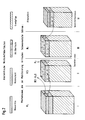
- a perfectly passivated and dried surface of an austenitic material consists of a dense, very thin, homogeneous metal oxide layer that is covered with a monomolecular water layer at approx. 200 ° C (Fig. 1/1).
- a dry, gaseous, halide-containing corrosive medium this layer of water is first removed.
- the driving force behind this reaction is the tendency towards hydration of halide-containing corrosive media.
- the original, purely oxide passive layer is then converted into a mixture of metal halides and oxides (Fig. 11/11). The resulting metal halide layer prevents further dissolution of the metal.
- the metal halides are converted into the corresponding hydroxides.
- the hydrogen halide formed is removed by hydrate formation (Fig. 1/111).
- a shiny metallic surface is formed.
- Repassivation is carried out by flushing with a gas mixture which, in addition to an inert carrier gas, contains a gaseous oxidizing agent such as oxygen or ozone.
- the hydroxides are largely converted into the more stable oxides of the respective metal (Fig. 2 / IV).
- the metal halide surface of a passivatable material is reconditioned.
- a purge gas containing oxygen and water vapor e.g. 20% 0 2 ; 100ppm H 2 0
- the metal halides are converted into the corresponding hydroxides
- the hydrogen halide formed is removed by hydrate formation and the hydroxides are converted into oxides of the respective metal. Due to the simultaneous surface reaction, the two-step process described in embodiment 1 is advantageously replaced by a one-step process.
- the purge gas contains a gaseous oxidizing agent, such as oxygen or ozone, which is also capable of oxidizing the metal halides directly.
- a gaseous oxidizing agent such as oxygen or ozone
Landscapes
- Chemical & Material Sciences (AREA)
- Chemical Kinetics & Catalysis (AREA)
- Engineering & Computer Science (AREA)
- Materials Engineering (AREA)
- Mechanical Engineering (AREA)
- Metallurgy (AREA)
- Organic Chemistry (AREA)
- Cleaning And De-Greasing Of Metallic Materials By Chemical Methods (AREA)
- Nitrogen And Oxygen Or Sulfur-Condensed Heterocyclic Ring Systems (AREA)
- Solid-Phase Diffusion Into Metallic Material Surfaces (AREA)
- Physical Or Chemical Processes And Apparatus (AREA)
Abstract
Description
- Die Erfindung betrifft ein Verfahren zum Spülen und Rekonditionieren von Transfersystemen für korrosive Medien aus passivierbaren Werkstoffen.
- Die Standzeit und Betriebssicherheit von Transfersystemen für korrosive i.d.R. gasförmige Medien, wie sie z.B. im Rahmen einer modernen Halbleiterfertigung eingesetzt werden (HCI, C12, HF, HBr, NH3 usw.) hängen häufig davon ab, inwieweit Korrosionsvorgänge verhindert werden können. Hierbei steht nicht nur die Standzeit im Vordergrund, sondern es geht vor allem auch um eine deutliche Verringerung der Kontamination der Prozeßmedien durch kritische Schwermetalle, die durch Korrosionsprozesse, z.B. in Rohrleitungssystemen mobilisiert werden und anschließend in hochsensible Anlagenteile oder Produkte gelangen können. Solche passivierbaren Transfersysteme bestehen üblicherweise aus metallischen Werkstoffen. In der Regel sind dies Stähle mit austenitischem Gefüge, wie austenitische Edelstähle bzw. austenitischen Gefügeanteilen, wie Austenit-Ferrite oder CrNi-Legierungen, CuNi-Legierungen oder dergleichen, deren begrenzte Beständigkeit gegenüber korrosiven Medien einzig und allein auf der Ausbildung dichter homogener Passivschichten von ca. 10um beruht.
- Bis heute stehen vielfältige Methoden zur Verbesserung der Korrosionsbeständigkeit dieser passivierbaren Werkstoffe zur Verfügung.
- Hierzu gehören:
- - Veränderung der Werkstoffzusammensetzung
- - Aufbau einer besonders widerstandsfähigen Passivschicht vor dem Ersteinsatz durch Sauerstoff oder Fluor
- - Verbesserung der Oberflächengüte z.B. durch Elektropolitur
- - Günstigeres Freispülverhalten von Rohrleitungen und Komponenten durch minimierte Toträume
- - Verzicht auf kaltverformte Teile.
- Medienseitig versucht man die Korrosion durch intensives Trocknen und Spülen der passivierbaren Werkstoffoberflächen der Transfersysteme und durch verschärfte Anforderungen an die korrosiven in der Regel gasförmigen Medien, vor allem hinsichtlich deren Feuchtgehalte wie z.B. in HCI zu verhindern.
- Insgesamt muß allerdings festgehalten werden, daß im Zusammenwirken sämtlicher Maßnahmen zwar eine deutliche Verbesserung der Standzeit erreichbar erscheint und z.T. auch realisiert wurde; allein die prinzipiellen Schwächen, passivierbarer z.B. austenitischer Werkstoffe gegenüber halogeninduzierten Korrosionsformen oder mit diesen vergleichbaren Korrosionsformen wie sie z.B. bei dem korrosiven Medium NH3 entstehen, konnten nicht beseitigt werden, da korrosionsfördernde Fehlstellen im Gefügeaufbau nie gänzlich auszuschließen sind. Diese korrosionsfördernden Fehlstellen im Gefügeaufbau entstehen auf Grund der Wechselwirkung von Passivschichten mit korrosiven Medien, z.B. mit HCI. Eine einwandfrei passivierte und getrocknete Oberfläche eines austenitischen Werkstoffes besteht aus einer dichten, sehr dünnen, homogenen Metalloxidschicht die hauptsächlich Chromoxide aufweist. Unter den technisch realisierbaren Trocknungsbedingungen ist diese Schicht zumindest mit einer monomolekularen Wasserschicht bedeckt (Fig.2/1). Kommt diese Schicht in Kontakt mit trockenem gasförmigen Chlorwasserstoff, so wird zunächst diese Wasserschicht abgetragen. Die Triebkraft dieser Reaktion ist die enorme Hydratisierungstendenz von HCI. Anschließend wird die ursprüngliche, reinoxidische Passivschicht in ein Gemisch aus Metallchloriden und Oxiden umgewandelt. Die Eisen- und Chromoxide sind dabei gegenüber dem korrosiven Medium HCI, insbesondere bei hohem HCI-Überschuß nur kinetisch nicht aber thermodynamisch stabil. Man nennt diesen Vorgang, der sich unter Sauerstoffausschluß vollzieht, Säurekorrosion (Fig.2/11). Die resultierende Metallhalogenoxidschicht verhindert eine weitere Auflösung des Metalls. Muß allerdings das Transfersystem oder Teile davon freigespült werden (z.B. bei Wartungsarbeiten oder bei Flaschenwechsel), so kann entsprechend der Intensität des eingeleiteten Spülvorgangs mit einem inerten Gas nur der an der Oberfläche adsorbierte Chlorwasserstoff abgetrieben werden. Einmal gebildete Metallhalogenide lassen sich - da im Werkstoffgefüge fest verankert - durch einfaches Spülen, auch mit noch so trockenem Stickstoff nicht entfernen Fig.2/111). Kommt jetzt Luft als weiteres Medium hinzu (Sauerstoffkorrosion) - wird in Umkehrung der Metallhalogenidbildung die Passivschicht durch Hydrolyse und Oxidation rekonstruiert. Allerdings entsteht hierbei hydratisierter Chlorwasserstoff (Salzsäure), der zu einem "imperfekten" Aufbau der Passivschicht und damit zu schwerwiegenden Korrosionsfolgeschäden führt (Sauerstoffkorrosion Fig.2/IV). Die Korrosionsprodukte - in der Hauptsache Schwermetallchloride und Oxydchloride, die ihrerseite starke Korrosionspromotoren darstellen - sind flüchtig bzw. liegen z.T. in Aerosolform vor: Sie sind daher filtergängig. Bei der Wiederinbetriebnahme des Gasversorgungssystems können sie in hochsensible Anlagenteile gelangen.
- Der Erfindung liegt daher die Aufgabe zugrunde, ein Verfahren zum Spülen und Rekonditionieren von Transfersystemen für korrosive Medien aus passivierbaren Werkstoffen zu schaffen, das es ermöglicht, die Standzeit der Transfersysteme zu erhöhen und die Kontamination der Medien zu verringern.
- Ausgehend von dem im Oberbegriff berücksichtigten Stand der Technik ist diese Aufgabe erfindungsgemäß gelöst mit den im kennzeichnenden Teil des Anspruches 1 angegebenen Merkmalen.
- Vorteilhafte Weiterbildungen der Erfindung sind in den Unteransprüchen angegeben.
- Es hat sich überraschend gezeigt, daß durch den Einsatz von Spülmedien, die Sauerstoff und/oder Ozon und/oder Wasserdampf enhalten eine entscheidende Reduzierung des Schwermetallaustrags von Transfersystemen für korrosive Medien realisieren läßt, weil eine Rückbildung der durch ein korrosives gasförmiges Medium aktivierten Oberfläche in den ursprünglichen passivierten Zustand bewirkt wird. Diese prinzpielle Änderung der Vorgehensweise bei diesen Spül- und Konditionierungsschritten, während des Betriebes eines Transfersystems für korrosive Medien ist insofern überraschend, da der Stand der Technik auf den Einsatz immer reinerer, d. h. trockener und sauerstoffreier Spülmedien abhebt.
- Durch das erfindungsgemäße Spülen mit sauerstoff- und/oder ozon- und/oder wasserdampfhaltigen Spülgasen wird das Metallhalogenid mittels des Wasserdampfes in das entsprechende Hydroxid überführt. Der gebildete Halogen-Wasserstoff wird durch Hydratbildung abgeführt. Danach wird das Hydroxid mittels des trockenen Sauerstoffs oder Ozons in eine stabile passive Oxydschicht umgewandelt.
- Die bevorzugten Bereiche für die erfindungsgemäßen Beimischungen 02 erstrecken sich von 0.1 % bis 100 % und/oder von 03 von 0.1 bis 100 g/m3 und/oder von Wasserdampf von 10ppm bis 100 %.
- Durch das Spülgas Luft werden in besonders wirtschaftlicher Weise diese Vorteile erreicht.
- Das Rekonditionieren der Metallhalogenid-Oberflächen kann durch eine ein- oder zweistufige Verfahrensweise vorgenommen werden:
- Eine einwandfrei passivierte und getrocknete Oberfläche eines austenitischen Werkstoffes besteht aus einer dichten, sehr dünnen, homogenen Metalloxidschicht, die bei ca. 200 °C mit einer monomolekularen Wasserschicht bedeckt ist (Fig.1/1). Bei Kontakt mit einem trockenen gasförmigen halogenidhaltigen korrosiven Medium wird zunächst diese Wasserschicht abgetragen. Die Triebkraft dieser Reaktion ist die Hydratisierungstendenz von halogenidhaltigen korrosiven Medien. Anschließend wird die ursprüngliche, reinoxidische Passivschicht in ein Gemisch aus Metallhalogeniden und Oxiden umgewandelt (Fig.1/11). Die resultierende Metallhalogenoxidschicht verhindert eine weitere Auflösung des Metalls. Wird das Versorgungssystem oder Teile davon nun mit einem angefeuchteten sauerstofffreien Spülgas freigespült, werden die Metallhalogenide in die entsprechenden Hydroxide umgewandelt. Gleichzeitig wird der gebildete Halogenwasserstoff durch Hydratbildung abgeführt (Fig.1/111). Es bildet sich eine metallisch blanke Werkstoff-Oberfläche. Die Repassivierung erfolgt durch das Spülen mit einem Gasgemisch, das neben einem inerten Trägergas ein gasförmiges Oxidationsmittel wie Sauerstoff oder Ozon enthält. Hierbei werden die Hydroxide größtenteils in die stabileren Oxide des jeweiligen Metalls überführt (Fig.2/IV).
- Bei einer Temperatur zwischen Raumtemperatur und 400 ° C eines sauerstoff- und wasserdampfhaltigen Spülgases (z.B. 20 % 02; 100ppm H20) wird die Metallhalogenid-Oberflächeeines passivierbaren Werkstoffes rekonditioniert. Hierbei werden die Metallhalogenide in die entsprechenden Hydroxide umgewandelt, gleichzeitig der gebildete Halogenwasserstoff durch Hydratbildung abgeführt und die Hydroxide in Oxide des jeweiligen Metalls überführt. Durch die simultan ablaufende Oberflächenreaktion wird vorteilhaft der im Ausführungsbeispiel 1 beschriebene zweistufige Prozeß durch einen einstufigen abgelöst.
- Wesentlich ist in jeden Fall, daß das Spülgas ein gasförmiges Oxidationsmittel, wie Sauerstoff oder Ozon enthält, das auch direkt in der Lage ist, die Metallhalogenide zu oxidieren.
Claims (6)
Applications Claiming Priority (2)
| Application Number | Priority Date | Filing Date | Title |
|---|---|---|---|
| DE4242967A DE4242967A1 (de) | 1992-12-18 | 1992-12-18 | Verfahren zum Spülen und Rekonditionieren von Transfersystemen |
| DE4242967 | 1992-12-18 |
Publications (2)
| Publication Number | Publication Date |
|---|---|
| EP0602347A1 true EP0602347A1 (de) | 1994-06-22 |
| EP0602347B1 EP0602347B1 (de) | 1997-05-14 |
Family
ID=6475770
Family Applications (1)
| Application Number | Title | Priority Date | Filing Date |
|---|---|---|---|
| EP93116941A Expired - Lifetime EP0602347B1 (de) | 1992-12-18 | 1993-10-20 | Verfahren zum Spülen und Rekonditionieren von Transfersystemen |
Country Status (3)
| Country | Link |
|---|---|
| EP (1) | EP0602347B1 (de) |
| AT (1) | ATE153081T1 (de) |
| DE (2) | DE4242967A1 (de) |
Cited By (1)
| Publication number | Priority date | Publication date | Assignee | Title |
|---|---|---|---|---|
| WO2003015944A1 (en) * | 2001-08-17 | 2003-02-27 | Exxonmobil Research And Engineering Company | Furnace run length extension by fouling control |
Citations (4)
| Publication number | Priority date | Publication date | Assignee | Title |
|---|---|---|---|---|
| US4475958A (en) * | 1981-11-13 | 1984-10-09 | M.A.N. Maschinenfabrik Augsburg-Nurnberg Aktiengesellchaft | Method for the manufacture of deformation resistant oxidic protective layers |
| EP0168609A1 (de) * | 1984-06-15 | 1986-01-22 | International Business Machines Corporation | Verfahren zum Ausbessern von Durchschlagstellen in dielektrischen Schichten |
| EP0504621A1 (de) * | 1991-03-18 | 1992-09-23 | Urea Casale S.A. | Verfahren zum Passivieren von Metalloberflächen angegriffen durch Betriebsbedingungen und korrosionsförderende Medien |
| EP0512782A1 (de) * | 1991-05-03 | 1992-11-11 | The Boc Group, Inc. | Verfahren zur Herstellung einer Oxidschicht auf der Oberfläche von rostfreiem Stahl |
Family Cites Families (1)
| Publication number | Priority date | Publication date | Assignee | Title |
|---|---|---|---|---|
| JPH02179867A (ja) * | 1988-12-29 | 1990-07-12 | Tadahiro Omi | プロセスガス供給システム |
-
1992
- 1992-12-18 DE DE4242967A patent/DE4242967A1/de not_active Withdrawn
-
1993
- 1993-10-20 AT AT93116941T patent/ATE153081T1/de not_active IP Right Cessation
- 1993-10-20 EP EP93116941A patent/EP0602347B1/de not_active Expired - Lifetime
- 1993-10-20 DE DE59306445T patent/DE59306445D1/de not_active Expired - Fee Related
Patent Citations (4)
| Publication number | Priority date | Publication date | Assignee | Title |
|---|---|---|---|---|
| US4475958A (en) * | 1981-11-13 | 1984-10-09 | M.A.N. Maschinenfabrik Augsburg-Nurnberg Aktiengesellchaft | Method for the manufacture of deformation resistant oxidic protective layers |
| EP0168609A1 (de) * | 1984-06-15 | 1986-01-22 | International Business Machines Corporation | Verfahren zum Ausbessern von Durchschlagstellen in dielektrischen Schichten |
| EP0504621A1 (de) * | 1991-03-18 | 1992-09-23 | Urea Casale S.A. | Verfahren zum Passivieren von Metalloberflächen angegriffen durch Betriebsbedingungen und korrosionsförderende Medien |
| EP0512782A1 (de) * | 1991-05-03 | 1992-11-11 | The Boc Group, Inc. | Verfahren zur Herstellung einer Oxidschicht auf der Oberfläche von rostfreiem Stahl |
Cited By (3)
| Publication number | Priority date | Publication date | Assignee | Title |
|---|---|---|---|---|
| WO2003015944A1 (en) * | 2001-08-17 | 2003-02-27 | Exxonmobil Research And Engineering Company | Furnace run length extension by fouling control |
| US6648988B2 (en) | 2001-08-17 | 2003-11-18 | Exxonmobil Research And Engineering Company | Furnace run length extension by fouling control |
| AU2002322602B2 (en) * | 2001-08-17 | 2007-02-15 | Exxonmobil Research And Engineering Company | Furnace run length extension by fouling control |
Also Published As
| Publication number | Publication date |
|---|---|
| DE4242967A1 (de) | 1994-06-23 |
| DE59306445D1 (de) | 1997-06-19 |
| ATE153081T1 (de) | 1997-05-15 |
| EP0602347B1 (de) | 1997-05-14 |
Similar Documents
| Publication | Publication Date | Title |
|---|---|---|
| ATE146230T1 (de) | Verfahren zum passivieren von metalloberflächen angegriffen durch betriebsbedingungen und korrosionsförderende medien | |
| DE2850564C2 (de) | Verfahren und Vorrichtung zum Regenerieren einer Kupfer(II)-Chlorid und/oder Eisen(III)-Chlorid enthaltenden Ätzlösung in einer Elektrolysezelle | |
| DE69128982T2 (de) | Verfahren zur Herstellung eines korrosionsbeständigen Schutzüberzugs auf Aluminiumsubstrat | |
| DE19525182C2 (de) | Verfahren zur Erzeugung von Korrosions- und Verschleißschutzschichten auf Eisenbasiswerkstoffen | |
| US4746369A (en) | Peroxide selective stripping compositions and method | |
| EP0602347B1 (de) | Verfahren zum Spülen und Rekonditionieren von Transfersystemen | |
| DE60305492T2 (de) | Gegenüber metal-dusting-korrosion beständige legierungen mit oxiden | |
| DE3248041C2 (de) | Wäßrige Lösung zum Abbeizen harter Oberflächenüberzüge von Metallsubstraten und deren Verwendung | |
| GB1568894A (en) | Method for forming an anti-corrosive oxide layer on steels | |
| EP0517735A1 (de) | Plasmatron mit wasserdampf als plasmagas und verfahren zum stabilen betrieb des plasmatrons. | |
| DE4232475C2 (de) | Verfahren zum plasmachemischen Trockenätzen von Si¶3¶N¶4¶-Schichten hochselektiv zu SiO¶2¶-Schichten | |
| EP1663568A1 (de) | Lötwerkstück, lötverfahren und wärmetauscher | |
| DE69113020T2 (de) | Beizzusammensetzung und verfahren zur beizung von titanverbindungen aus metallsubstraten. | |
| EP0306810B1 (de) | Verfahren zur Herstellung lochfrassbeständiger hartgezogener Rohre aus Kupfer oder Kupferlegierungen | |
| KR100188555B1 (ko) | 니켈 합금 | |
| DE3145236A1 (de) | "verfahren zur herstellung von verformungsbestaendigen, oxidischen schutzschichten" | |
| DE19803084B4 (de) | Verwendung von Stahlpulver auf der Basis Fe-Cr-Si für korrosionsbeständige Beschichtungen | |
| Antill et al. | Deformation of magnesium and its alloys on oxidation | |
| DE2730819A1 (de) | Plasma-aetzverfahren | |
| DE60000436T2 (de) | Anoden aus hochfestem, niedriglegiertem stahl für zellen zur aluminium-schmelzelektrolyse | |
| CN1227277A (zh) | 废塑料处理设备的防蚀处理方法 | |
| JPS62238378A (ja) | 耐水素誘起割れ性の優れた表面処理鋼材 | |
| DE3346161C2 (de) | Verfahren und Vorrichtung zum Schutzgaslöten hochlegierter Cr-Ni-Stahlbauteile | |
| DE2738839A1 (de) | Plasma-aetzverfahren fuer chrom- schichten | |
| DE3047588C2 (de) | Ätzflüssigkeit für Aufdampfschichten und Verfahren zur Ätzung von Dünnfilmstrukturen |
Legal Events
| Date | Code | Title | Description |
|---|---|---|---|
| PUAI | Public reference made under article 153(3) epc to a published international application that has entered the european phase |
Free format text: ORIGINAL CODE: 0009012 |
|
| AK | Designated contracting states |
Kind code of ref document: A1 Designated state(s): AT CH DE FR GB IT LI NL |
|
| 17P | Request for examination filed |
Effective date: 19941222 |
|
| 17Q | First examination report despatched |
Effective date: 19950811 |
|
| RAP1 | Party data changed (applicant data changed or rights of an application transferred) |
Owner name: MESSER GRIESHEIM GMBH |
|
| GRAG | Despatch of communication of intention to grant |
Free format text: ORIGINAL CODE: EPIDOS AGRA |
|
| GRAH | Despatch of communication of intention to grant a patent |
Free format text: ORIGINAL CODE: EPIDOS IGRA |
|
| GRAH | Despatch of communication of intention to grant a patent |
Free format text: ORIGINAL CODE: EPIDOS IGRA |
|
| GRAA | (expected) grant |
Free format text: ORIGINAL CODE: 0009210 |
|
| AK | Designated contracting states |
Kind code of ref document: B1 Designated state(s): AT CH DE FR GB IT LI NL |
|
| PG25 | Lapsed in a contracting state [announced via postgrant information from national office to epo] |
Ref country code: NL Free format text: LAPSE BECAUSE OF FAILURE TO SUBMIT A TRANSLATION OF THE DESCRIPTION OR TO PAY THE FEE WITHIN THE PRESCRIBED TIME-LIMIT Effective date: 19970514 Ref country code: IT Free format text: LAPSE BECAUSE OF FAILURE TO SUBMIT A TRANSLATION OF THE DESCRIPTION OR TO PAY THE FEE WITHIN THE PRE;WARNING: LAPSES OF ITALIAN PATENTS WITH EFFECTIVE DATE BEFORE 2007 MAY HAVE OCCURRED AT ANY TIME BEFORE 2007. THE CORRECT EFFECTIVE DATE MAY BE DIFFERENT FROM THE ONE RECORDED.SCRIBED TIME-LIMIT Effective date: 19970514 |
|
| REF | Corresponds to: |
Ref document number: 153081 Country of ref document: AT Date of ref document: 19970515 Kind code of ref document: T |
|
| REG | Reference to a national code |
Ref country code: CH Ref legal event code: EP |
|
| REF | Corresponds to: |
Ref document number: 59306445 Country of ref document: DE Date of ref document: 19970619 |
|
| GBT | Gb: translation of ep patent filed (gb section 77(6)(a)/1977) |
Effective date: 19970619 |
|
| ET | Fr: translation filed | ||
| NLV1 | Nl: lapsed or annulled due to failure to fulfill the requirements of art. 29p and 29m of the patents act | ||
| PG25 | Lapsed in a contracting state [announced via postgrant information from national office to epo] |
Ref country code: LI Free format text: LAPSE BECAUSE OF NON-PAYMENT OF DUE FEES Effective date: 19971031 Ref country code: CH Free format text: LAPSE BECAUSE OF NON-PAYMENT OF DUE FEES Effective date: 19971031 |
|
| PLBE | No opposition filed within time limit |
Free format text: ORIGINAL CODE: 0009261 |
|
| STAA | Information on the status of an ep patent application or granted ep patent |
Free format text: STATUS: NO OPPOSITION FILED WITHIN TIME LIMIT |
|
| 26N | No opposition filed | ||
| REG | Reference to a national code |
Ref country code: CH Ref legal event code: PL |
|
| PGFP | Annual fee paid to national office [announced via postgrant information from national office to epo] |
Ref country code: DE Payment date: 20011029 Year of fee payment: 9 |
|
| REG | Reference to a national code |
Ref country code: GB Ref legal event code: IF02 |
|
| PG25 | Lapsed in a contracting state [announced via postgrant information from national office to epo] |
Ref country code: DE Free format text: LAPSE BECAUSE OF NON-PAYMENT OF DUE FEES Effective date: 20030501 |
|
| PGFP | Annual fee paid to national office [announced via postgrant information from national office to epo] |
Ref country code: FR Payment date: 20031003 Year of fee payment: 11 |
|
| PGFP | Annual fee paid to national office [announced via postgrant information from national office to epo] |
Ref country code: AT Payment date: 20031013 Year of fee payment: 11 |
|
| PG25 | Lapsed in a contracting state [announced via postgrant information from national office to epo] |
Ref country code: AT Free format text: LAPSE BECAUSE OF NON-PAYMENT OF DUE FEES Effective date: 20041020 |
|
| PG25 | Lapsed in a contracting state [announced via postgrant information from national office to epo] |
Ref country code: FR Free format text: LAPSE BECAUSE OF NON-PAYMENT OF DUE FEES Effective date: 20050630 |
|
| REG | Reference to a national code |
Ref country code: FR Ref legal event code: ST |
|
| PGFP | Annual fee paid to national office [announced via postgrant information from national office to epo] |
Ref country code: GB Payment date: 20070921 Year of fee payment: 15 |
|
| GBPC | Gb: european patent ceased through non-payment of renewal fee |
Effective date: 20081020 |
|
| PG25 | Lapsed in a contracting state [announced via postgrant information from national office to epo] |
Ref country code: GB Free format text: LAPSE BECAUSE OF NON-PAYMENT OF DUE FEES Effective date: 20081020 |