EP0602380B1 - Récipient pour la stérilisation et la désinfection - Google Patents
Récipient pour la stérilisation et la désinfection Download PDFInfo
- Publication number
- EP0602380B1 EP0602380B1 EP93118010A EP93118010A EP0602380B1 EP 0602380 B1 EP0602380 B1 EP 0602380B1 EP 93118010 A EP93118010 A EP 93118010A EP 93118010 A EP93118010 A EP 93118010A EP 0602380 B1 EP0602380 B1 EP 0602380B1
- Authority
- EP
- European Patent Office
- Prior art keywords
- container
- permeable
- permeable region
- region
- closed
- Prior art date
- Legal status (The legal status is an assumption and is not a legal conclusion. Google has not performed a legal analysis and makes no representation as to the accuracy of the status listed.)
- Expired - Lifetime
Links
Images



Classifications
-
- B—PERFORMING OPERATIONS; TRANSPORTING
- B65—CONVEYING; PACKING; STORING; HANDLING THIN OR FILAMENTARY MATERIAL
- B65D—CONTAINERS FOR STORAGE OR TRANSPORT OF ARTICLES OR MATERIALS, e.g. BAGS, BARRELS, BOTTLES, BOXES, CANS, CARTONS, CRATES, DRUMS, JARS, TANKS, HOPPERS, FORWARDING CONTAINERS; ACCESSORIES, CLOSURES, OR FITTINGS THEREFOR; PACKAGING ELEMENTS; PACKAGES
- B65D77/00—Packages formed by enclosing articles or materials in preformed containers, e.g. boxes, cartons, sacks or bags
- B65D77/10—Container closures formed after filling
- B65D77/16—Container closures formed after filling by collapsing and twisting mouth portion
- B65D77/18—Container closures formed after filling by collapsing and twisting mouth portion and securing by a deformable clip or binder
-
- A—HUMAN NECESSITIES
- A61—MEDICAL OR VETERINARY SCIENCE; HYGIENE
- A61B—DIAGNOSIS; SURGERY; IDENTIFICATION
- A61B50/00—Containers, covers, furniture or holders specially adapted for surgical or diagnostic appliances or instruments, e.g. sterile covers
- A61B50/30—Containers specially adapted for packaging, protecting, dispensing, collecting or disposing of surgical or diagnostic appliances or instruments
- A61B50/36—Containers specially adapted for packaging, protecting, dispensing, collecting or disposing of surgical or diagnostic appliances or instruments for collecting or disposing of used articles
-
- A—HUMAN NECESSITIES
- A61—MEDICAL OR VETERINARY SCIENCE; HYGIENE
- A61L—METHODS OR APPARATUS FOR STERILISING MATERIALS OR OBJECTS IN GENERAL; DISINFECTION, STERILISATION OR DEODORISATION OF AIR; CHEMICAL ASPECTS OF BANDAGES, DRESSINGS, ABSORBENT PADS OR SURGICAL ARTICLES; MATERIALS FOR BANDAGES, DRESSINGS, ABSORBENT PADS OR SURGICAL ARTICLES
- A61L11/00—Methods specially adapted for refuse
-
- A—HUMAN NECESSITIES
- A61—MEDICAL OR VETERINARY SCIENCE; HYGIENE
- A61L—METHODS OR APPARATUS FOR STERILISING MATERIALS OR OBJECTS IN GENERAL; DISINFECTION, STERILISATION OR DEODORISATION OF AIR; CHEMICAL ASPECTS OF BANDAGES, DRESSINGS, ABSORBENT PADS OR SURGICAL ARTICLES; MATERIALS FOR BANDAGES, DRESSINGS, ABSORBENT PADS OR SURGICAL ARTICLES
- A61L2/00—Disinfection or sterilisation of materials or objects, in general; Accessories therefor
- A61L2/02—Disinfection or sterilisation of materials or objects, in general; Accessories therefor using physical processes
- A61L2/04—Heat
- A61L2/06—Hot gas
-
- A—HUMAN NECESSITIES
- A61—MEDICAL OR VETERINARY SCIENCE; HYGIENE
- A61L—METHODS OR APPARATUS FOR STERILISING MATERIALS OR OBJECTS IN GENERAL; DISINFECTION, STERILISATION OR DEODORISATION OF AIR; CHEMICAL ASPECTS OF BANDAGES, DRESSINGS, ABSORBENT PADS OR SURGICAL ARTICLES; MATERIALS FOR BANDAGES, DRESSINGS, ABSORBENT PADS OR SURGICAL ARTICLES
- A61L2/00—Disinfection or sterilisation of materials or objects, in general; Accessories therefor
- A61L2/26—Accessories
-
- B—PERFORMING OPERATIONS; TRANSPORTING
- B65—CONVEYING; PACKING; STORING; HANDLING THIN OR FILAMENTARY MATERIAL
- B65D—CONTAINERS FOR STORAGE OR TRANSPORT OF ARTICLES OR MATERIALS, e.g. BAGS, BARRELS, BOTTLES, BOXES, CANS, CARTONS, CRATES, DRUMS, JARS, TANKS, HOPPERS, FORWARDING CONTAINERS; ACCESSORIES, CLOSURES, OR FITTINGS THEREFOR; PACKAGING ELEMENTS; PACKAGES
- B65D33/00—Details of, or accessories for, sacks or bags
- B65D33/01—Ventilation or drainage of bags
Definitions
- the invention relates to a closable sack or bag-like container for infectious waste, with liquid and gas impermeable wall material and at least one permeable area formed therein, which is permeable to liquids, gases and vapors, and an introduction opening which is closed after the introduction of waste .
- lockable barrels with a pressure vacuum valve into which waste bags are hung. Once waste has been brought in, the barrels are closed and fed to a disinfection or sterilization system. After the disinfection or sterilization process has been completed, the containers are removed from the system, opened and the suspended sacks removed. The bags generally remain open and are fed to a press container or directly to a landfill or incinerator. A new waste bag is hung in each emptied container and the container is returned to its place of filling, e.g. an operating room, brought back. No more bags can be filled than there are containers. A direct storage of the containers at the place of use creates space problems, by bringing the containers back, contamination by the personnel or the containers to the filling location, e.g. an operating room.
- garbage bags In sterilization technology, as is known for example from DE-U-92 12 865.3, garbage bags are used which are provided with a plastic fleece strip in their upper area. These garbage bags are closed after the introduction of waste in such a way that the fleece strip is still connected to the interior of the garbage bag. Gases and vapors contaminated with germs can escape from the interior of the bag via this fleece strip, in particular when the waste bag is deformed, for example when it is being transported to a disinfection or sterilization system, even when the bag is closed.
- a garbage bag for infectious garbage is known, which is formed from a flexible material which forms pores under the action of a sterilization process.
- plastic barrels which are closed with a lid which can be destroyed by the action of heat after the introduction of waste.
- bins are single-use containers that are brought to a landfill after their single use.
- the tons are bulky, complex to manufacture and expensive, and they cannot be stored in large quantities on site.
- the invention has for its object to provide a container of the type mentioned, which can be handled easily and safely without risk of contamination for the operating or disposal personnel, which in the filled and closed state until a disinfection or sterilization process is carried out, is gas and vapor tight and can be disposed of in an environmentally friendly and economical manner.
- the container is bag-shaped with flexible wall material, it is possible to Fold the container together to save space before use so that the container can be stored directly at the place of use. Even if the container is not completely filled, the flexible wall proves to be particularly advantageous, since the container, when it is further layered, only takes up the volume of space corresponding to the amount of waste.
- the container can be attached particularly universally in known bag filling aids or bag hanging devices.
- a configuration of the container which is particularly favorable for keeping the permeability region ineffective is provided in that the locking device separates the container contents from the permeability region in the closed position, in particular by constricting the bag-like container in the region of the insertion opening. This ensures that the container is completely closed and that the permeability area can be designed in a simple manner.
- a further embodiment of the container which is particularly favorable for keeping the permeability region ineffective is provided in that the blocking device covers the permeability region which is connected to the container contents. This makes it possible to keep the permeability area ineffective even while introducing waste into the container, as a result of which, in particular, its contamination does not have a disadvantageous effect.
- An advantageous embodiment of the container is given in that when the change in the physical parameter by the predetermined amount occurs, the blocking device releases a connection between the contents of the container and its surroundings via the permeable area. This makes it possible for the permeability region to take effect automatically and for the contents of the container to come into contact with the surroundings of the container only after it has been introduced into a disinfection or sterilization system, as a result of which particularly effective personal protection is guaranteed.
- a favorable embodiment of the container is provided by the fact that a closure device is provided, by means of which the container can be closed in the area of the insertion opening and remains closed during a disinfection or sterilization process, since this means that the disinfected or sterilized waste is transported away without resealing of the container becomes possible.
- the treated and filled container can be handled like a conventional garbage bag, particularly in the case of a bag-like configuration of the container.
- the closure device can in particular be made of a wire stretched with a twisting device or a plastic cable tie, e.g. made of polyamide 6.6 HS.
- a particularly advantageous closure of the container is provided in that a fold neck can be formed and the permeability area in the fold neck lies between the locking device and the closure device. As a result, the permeability area is separated from the container contents and the container remains closed in the area of the insertion opening after the blocking device has been released.
- the closure device can consist in knotting the fold neck.
- a favorable structural design of the container is given in that the locking device keeps the bag-like container closed by constricting the fold neck in the closed position and opens when a predetermined temperature jump occurs, the previously constricted region of the fold neck releasing a passage cross-section and a connection between the permeability area and the container content arises.
- the locking device by entering a certain one
- the jump in temperature is particularly favorable to use in a disinfection or sterilization process by means of heating, for example using superheated steam.
- the locking device opens automatically without additional precautions.
- the locking device can advantageously have a binder or a band made of polyethylene.
- the locking device is designed as a loop or ring which is provided with at least one predetermined breaking point.
- a device is simple and can be produced at low cost.
- the effectiveness of the predetermined breaking point can be made dependent on other physical parameters. So it is e.g. possible to provide in the locking device an element with at least one cavity or a closed chamber, which deforms when the ambient pressure changes, in particular pressure drop, and the opening of the locking device, e.g. by deflecting a locking spring element, initiates from a locking position. It is also possible to make the predetermined breaking point effective by the occurrence of a chemical reaction. With this locking device, conventional garbage bags can also be closed in an advantageous manner. These bags can then a disinfection or. Sterilization procedures are supplied.
- Another particularly favorable design of the container is given by the fact that the locking device in the closed position keeps the bag-like container closed by constricting the fold neck in such a way that a connection between the permeable area and the contents of the container is initially blocked and becomes deformed of the container is released by the occurrence of a predetermined excess pressure in the interior of the container, so that the permeability area is in communication with the contents of the container.
- the connection between the permeability area and the contents of the container can be achieved in particular by displacing a ring or a loop along the fold neck by deforming the container, in particular due to excess pressure inside the container, such that the permeability region is no longer separated from the container contents.
- a particularly advantageous embodiment of the container is provided in that the permeable area is formed by perforation or needles, punching and / or cutting the container wall material.
- the permeability area can be produced at a particularly low cost.
- particularly favorable opening cross sections can be produced by cutting, which e.g. after a gas has passed through the inherent elasticity of the material, step back into a closed position with a substantially smaller opening cross-section.
- a particularly favorable embodiment of the container is given in that the permeability area is formed by substitution of wall material with at least one liquid, gas and vapor permeable element. This advantageously makes it possible to bring the particular properties of the material into effect in a particularly targeted manner. It has also proven particularly favorable to provide the material of the permeability region or a surface section thereof with an indicator which changes its color under the action of the disinfection or sterilization process, so that it is clearly recognizable whether the filled container has been subjected to the treatment process. Furthermore, it is also possible in a particularly favorable manner To provide material of the permeability area with germicidal additives.
- a particularly favorable embodiment of the container is also given in that the permeability region consists of an at least two-layer film-like element, the layers of which are provided with through openings which are offset from one another such that each opening is at least partially covered by a film layer.
- This makes it possible in a particularly favorable manner to obtain a secure restraining effect with regard to the waste introduced into the container even with large through openings.
- Contact with the contents of the sack, in particular after the disinfection or sterilization process, is thereby avoided in a particularly simple and effective manner.
- the film layers can be applied particularly easily by gluing or welding and in particular by a combination of gluing and welding.
- the permeability area is designed in the form of a strip.
- Such a permeability area is particularly easy to produce by rolling over it with a needle, punching or cutting roller. It is also possible to process several layers of film or sacks lying on top of each other at the same time. It is possible to produce a sufficient passage cross section with a strip-shaped permeability area.
- a particularly advantageous embodiment of the container is provided in that the blocking device is designed as a film applied to the permeable area.
- a locking device is particularly reliable and comfortable, since after the waste has been introduced, the container, in particular the sack, can be closed with only one closure device. It is possible to make the film from a heat resistant To produce material so that the film changes during the disinfection or sterilization process in such a way that the permeability area is released.
- a particularly favorable embodiment of the container is provided in that the blocking device, in particular the film, has an adhesive layer on its side facing the permeability region.
- Such a locking device is particularly easy to manufacture, effective and reliable.
- the above-mentioned locking device is advantageously designed according to the invention in such a way that the adhesive layer consists of a heat-resistant adhesive layer.
- the adhesive layer consists of a heat-resistant adhesive layer.
- a configuration of the container which is particularly favorable for keeping the permeability region ineffective is provided in that the permeability region is initially covered by folding over with an impermeable wall region and is kept liquid, gas and vapor tight in a closed position by the locking device, preferably an adhesive, with low temperature resistance.
- the locking device preferably an adhesive, with low temperature resistance.
- Such a design is simple and can be produced at low cost without additional film material.
- the release of the permeability area is also supported by the inflation of the sack. Folds are possible, which loosen adhesive points with certain shear strengths by peeling.
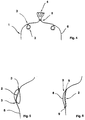
- a closable container made of liquid and gas impermeable wall material 6 has a permeable area 2 which is permeable to liquids, gases and vapors (here indicated by broken lines).
- the permeability area 2 is separated from the contents of the container by the blocking device 3 and is thereby kept ineffective.
- An insertion opening 4 is closed with a closure device 5.
- the closure device 5 remains closed even during a disinfection or sterilization process.
- the permeability area 2 lies between the closure device 5 and the blocking device 3 on a fold neck.
- the permeable area 2 is connected to the container contents.
- the permeability area 2 extends as a narrow perforated strip all around on the container wall 6.
- connection points 8 8
- the 4 shows an exemplary embodiment of the container with a permeability area 2 of the wall material 6 which is kept ineffective by a blocking device 3.
- the container is permanently closed in the area of the insertion opening 4 with a closure device 5.
- the locking device 3 is preferably an adhesive bond with low temperature resistance.
- Fig. 5 shows an embodiment for keeping the Permeability area by folding over the area with wall material 6 in connection with the locking device 3. With this folding, the permeability area 2 is kept completely closed, in particular also during the introduction of waste, and is separated from the waste. Because the permeability area 2 is initially completely separated from the surroundings and the contents of the container, it is advantageously possible to provide the permeability area 2 with germicidal agents or color indicators.
- the blocking device consists of a film 8 and optionally an adhesive layer 9. It is thus possible to manufacture the film 8 from a preferably heat-resistant material and / or the adhesive layer to be interpreted in such a way that this occurs when a predetermined change in a physical parameter of the immediate surroundings of the container occurs.
- FIG. 7 shows a section of a permeability area 2 produced by cuts in the container wall material 6.
- FIG. 8 shows a section of a permeability area 2, likewise produced by cuts, in the container wall material 6.
- the cut shape shown creates foldable sections 10 which, due to the inherent elasticity of the material of the permeability area, can spring back into a position in which the opening cross section of the individual passages is reduced becomes.
- FIG. 9 shows a section of a permeability area 2 produced by crossed cuts.
- the opening cross section is also reduced in this exemplary embodiment at the end of a gas or steam exchange independently by flaps 10 springing back due to the inherent elasticity of the material of the permeability region.
- the container described above with reference to exemplary embodiments can be used, for example, in the following manner:
- contaminated waste coming from an operating room is introduced into the container, which is suspended from an annular bag holder and kept open in the area of the insertion opening.
- the filled container is closed by forming a pleat neck in the area of the insertion opening with a plastic clamp which opens under the action of heat such that the permeable area is separated from the contents of the container and is thereby kept ineffective.
- the container is then closed in an intermediate area of the fold hold between the insertion opening and the permeable area with a permanent closure device.
- the filled container is closed and placed in a loading container and placed therein in a vacuum disinfection chamber.
- the disinfection chamber is closed. Hot steam is fed to the disinfection chamber. This heats the container and the heat-resistant plastic clamp. The plastic clamp loosens and falls off. The closure device is heat-resistant and continues to keep the insertion opening closed. By loosening the plastic clamp, a connection path between the permeable area and the contents of the container is released. The superheated steam supply is stopped and the pressure in the disinfection chamber is reduced. With this reduction in pressure, gases and vapors escape from the interior of the container via the permeability area. The pressure is reduced until a certain vacuum is reached. The pressure drop is set and superheated steam is fed to the disinfection chamber. The superheated steam penetrates the permeability area into the container and heats the contents of the container.
- the disinfection chamber Due to the inflow of superheated steam, there is an increase in pressure in the disinfection chamber. After a certain holding time or hot steam exposure time has elapsed, the pressure is reduced again and gas or steam escapes from the interior of the container over the permeability area. Pressure reduction and hot steam admission can be carried out several times with also changed process-specific parameters, in particular steam temperature, exposure time and negative pressure.
- the disinfection chamber is opened, the loading container is removed from the disinfection chamber and the contents of the loading container are tipped into a press container. The contents of the press container are sent to a landfill or incinerator.
- the invention is not restricted to the exemplary embodiment described above.
- the permeability area can also be closed by a heat-resistant film until sterilization or disinfection is carried out.
Landscapes
- Health & Medical Sciences (AREA)
- Life Sciences & Earth Sciences (AREA)
- Veterinary Medicine (AREA)
- Animal Behavior & Ethology (AREA)
- General Health & Medical Sciences (AREA)
- Public Health (AREA)
- Engineering & Computer Science (AREA)
- Epidemiology (AREA)
- Surgery (AREA)
- Mechanical Engineering (AREA)
- Nuclear Medicine, Radiotherapy & Molecular Imaging (AREA)
- Biomedical Technology (AREA)
- Heart & Thoracic Surgery (AREA)
- Medical Informatics (AREA)
- Molecular Biology (AREA)
- Packages (AREA)
- Apparatus For Disinfection Or Sterilisation (AREA)
- Accommodation For Nursing Or Treatment Tables (AREA)
Claims (18)
- Récipient (1) pouvant être fermé, sous la forme d'un sac ou d'un sachet, pour des déchets infectieux, dont le matériau de paroi (6) est flexible, imperméable au fluide et au gaz et dans lequel sont ménagées au moins une zone perméable (2) laissant passer les gaz, les vapeurs et les fluides et une ouverture d'admission (4) qui est fermée après l'admission des déchets, caractérisé en ce qu'il est prévu un dispositif d'obturation (3) qui sépare la zone perméable (2) du contenu du récipient, jusqu'à la modification d'un paramètre physique de l'environnement direct du récipient (1) d'une valeur prédéterminée par un processus de stérilisation ou de désinfection.
- Récipient (1) pouvant être fermé, sous la forme d'un sac ou d'un sachet, pour des déchets infectieux, dont le matériau de paroi (6) est flexible, imperméable au fluide et au gaz et dans lequel sont ménagées au moins une zone perméable (2) laissant passer les gaz, les vapeurs et les fluides et une ouverture d'admission (4) qui est fermée après l'admission des déchets, caractérisé en ce qu'il est prévu un dispositif d'obturation (3) qui recouvre, la zone perméable (2), jusqu'à la modification d'un paramètre physique de l'environnement direct du récipient (1) d'une valeur prédéterminée par un processus de stérilisation et de désinfection.
- Récipient (1) selon l'une des revendications 1 ou 2, caractérisé en ce le paramètre physique étant modifié de la valeur prédéterminée, le dispositif d'obturation (3) libère une connexion entre le contenu du récipient (1) et son environnement, par l'intermédiaire de la zone perméable (2).
- Récipient (1) selon au moins l'une des revendications 1 à 3, caractérisé en ce que la zone perméable (2) est formée de perforations par piqûres, par poinçonnage et/ou découpe du matériau (6) de la paroi du récipient.
- Récipient (1) selon au moins l'une des revendications 1 à 4, caractérisé en ce que la zone perméable (2) est constituée par substitution de la matière de paroi avec au moins un élément perméable au liquide, au gaz et à la vapeur.
- Récipient (1) selon au moins l'une des revendications 1 à 5, caractérisé en ce que la zone perméable (2) se compose d'un élément en forme de feuille et comportant au moins deux couches, dont les couches sont munies d'ouvertures de passage (7) qui sont disposées de manière décalée les unes par rapport aux autres de manière que chaque ouverture soit du moins partiellement recouverte par une couche de feuille.
- Récipient (1) selon au moins l'une des revendications 1 à 6, caractérisé en ce que la zone perméable (2) est striée.
- Récipient (1) selon la revendication 7, la zone perméable (2) s'étend sur au moins une partie de la périphérie de la paroi de récipient.
- Récipient (1) selon au moins l'une des revendications 2 à 8, caractérisé en ce que le dispositif d'obturation (3) se présente comme une feuille (8) appliquée sur la zone perméable (2).
- Récipient (1) selon au moins l'une des revendications 1 à 9, caractérisé en ce que le dispositif d'obturation (3), en particulier la feuille (8), présente, sur sa face tournée vers la zone perméable (2), une couche intermédiaire adhésive (9).
- Récipient (1) selon la revendication 10, caractérisé en ce que la couche intermédiaire adhésive (9) se compose d'un revêtement de colle thermosensible.
- Récipient (1) selon au moins l'une des revendications 1 à 11, caractérisé en ce qu'il est prévu un dispositif de fermeture (5) au moyen duquel peut être fermé le récipient dans la zone de l'ouverture d'admission (4) et reste fermé pendant un processus de stérilisation ou de désinfection.
- Récipient (1) selon la revendication 1, caractérisé en ce que le dispositif d'obturation (3) sépare, en position de fermeture, le contenu du récipient de la zone perméable (2), par ficelage du récipient en forme de sachet (1), dans la zone de l'ouverture d'admission (4).
- Récipient (1) selon au moins l'une des revendications 1 à 13, caractérisé en ce que, pour fermer le récipient (1), on peut former un col à soufflet et en ce que la zone perméable (2) se trouve dans le col à soufflet entre le dispositif d'obturation (3) et le dispositif de fermeture (5).
- Récipient (1) selon au moins l'une des revendications 1 à 14, caractérisé en ce que le dispositif d'obturation (3), en position fermée, maintient le récipient en forme de sachet (1) fermé par ficelage du col à soufflet et s'ouvre quand survient un saut de température prédéterminé, la zone, ficelée auparavant, du col à soufflet libère ainsi une section de passage et une connexion se crée entre la zone perméable (2) et le contenu du récipient.
- Récipient (1) selon au moins l'une des revendications 1 à 15, caractérisé en ce que le dispositif d'obturation (3) revêt la forme d'une boucle ou d'un anneau qui est muni d'au moins un point de rupture.
- Récipient (1) selon au moins l'une des revendications 1 à 16, caractérisé en ce que le dispositif d'obturation (3), en position de fermeture, maintient, par ficelage du col à soufflet, le récipient en forme de sachet (1) fermé, de telle sorte qu'une connexion entre la zone perméable (2) et le contenu du récipient (1) soit obturée puis libérée, au moment de la déformation du récipient (1), par la génération d'une surpression prédéterminée à l'intérieur du récipient, si bien que la zone perméable (2) soit en connexion avec le contenu du récipient (1).
- Récipient (1) pouvant être fermé, sous la forme d'un sac ou d'un sachet pour des déchets infectieux, dont le matériau de paroi (6) est flexible, imperméable au fluide et au gaz et dans lequel sont ménagées au moins une zone perméable (2) laissant passer les gaz, les vapeurs et les fluides et une ouverture d'admission (4) qui est fermée après l'admission des déchets, caractérisé en ce que la zone perméable (2) est tout d'abord recouverte par un repliage avec une zone de paroi imperméable et en ce qu'elle est maintenue en position fermée étanche au gaz, au liquide et au fluide par un dispositif d'obturation (3), de préférence un collage de faible résistance thermique, qui maintient la zone perméable (2) inactive jusqu'à la modification d'un paramètre physique de l'environnement direct du récipient par un processus de désinfection ou de stérilisation.
Applications Claiming Priority (2)
| Application Number | Priority Date | Filing Date | Title |
|---|---|---|---|
| DE9217097U DE9217097U1 (de) | 1992-12-15 | 1992-12-15 | Verschließbarer Behälter |
| DE9217097U | 1992-12-15 |
Publications (2)
| Publication Number | Publication Date |
|---|---|
| EP0602380A1 EP0602380A1 (fr) | 1994-06-22 |
| EP0602380B1 true EP0602380B1 (fr) | 1996-09-11 |
Family
ID=6887160
Family Applications (1)
| Application Number | Title | Priority Date | Filing Date |
|---|---|---|---|
| EP93118010A Expired - Lifetime EP0602380B1 (fr) | 1992-12-15 | 1993-11-05 | Récipient pour la stérilisation et la désinfection |
Country Status (5)
| Country | Link |
|---|---|
| EP (1) | EP0602380B1 (fr) |
| AT (1) | ATE142584T1 (fr) |
| CZ (1) | CZ285468B6 (fr) |
| DE (2) | DE9217097U1 (fr) |
| DK (1) | DK0602380T3 (fr) |
Families Citing this family (2)
| Publication number | Priority date | Publication date | Assignee | Title |
|---|---|---|---|---|
| DE9307217U1 (de) * | 1993-05-12 | 1994-09-22 | Odenwald-Chemie GmbH, 69250 Schönau | Sterilisationsdoppelsack für infektiösen Müll |
| FR2886207A1 (fr) * | 2005-05-26 | 2006-12-01 | Lehdal Sarl | Dispositif et procede de compactage et d'assechement de matieres comprenant des substances solides et liquides, en particulier de dechets menagers alimentaires |
Family Cites Families (7)
| Publication number | Priority date | Publication date | Assignee | Title |
|---|---|---|---|---|
| NL6904549A (en) * | 1969-03-25 | 1970-09-29 | Plastic sack with air vents | |
| US4515841A (en) * | 1983-12-30 | 1985-05-07 | American Sterilizer Company | Pore forming sterilization bag |
| NL8400578A (nl) * | 1984-02-24 | 1985-09-16 | Wavin Bv | Kunststofzak met in de zakfoliewand door middel van laserstraling aangebrachte perforaties alsmede kunststoffolie geschikt voor toepassing bij een dergelijke kunststofzak. |
| US4670227A (en) * | 1984-08-10 | 1987-06-02 | Bio-Environmental Systems, Inc. | Apparatus and method for handling of infectious waste material |
| FR2603164B1 (fr) * | 1986-08-27 | 1990-06-01 | Blanc Marc | Dispositif destine a la conservation du pain et de ses derives |
| DE3925622A1 (de) * | 1989-08-02 | 1991-02-07 | Gleitz Klaus H | Verpackung fuer lebensmittel, insbesondere backwaren, wie brot, kuchen oder dgl. |
| DE9212865U1 (de) * | 1992-09-24 | 1992-11-26 | Sengewald Klinikprodukte GmbH, 83101 Rohrdorf | Müllsack für infektiösen Müll |
-
1992
- 1992-12-15 DE DE9217097U patent/DE9217097U1/de not_active Expired - Lifetime
-
1993
- 1993-11-05 AT AT93118010T patent/ATE142584T1/de not_active IP Right Cessation
- 1993-11-05 EP EP93118010A patent/EP0602380B1/fr not_active Expired - Lifetime
- 1993-11-05 DE DE59303748T patent/DE59303748D1/de not_active Expired - Fee Related
- 1993-11-05 DK DK93118010.3T patent/DK0602380T3/da active
- 1993-11-30 CZ CZ932583A patent/CZ285468B6/cs not_active IP Right Cessation
Also Published As
| Publication number | Publication date |
|---|---|
| ATE142584T1 (de) | 1996-09-15 |
| DE9217097U1 (de) | 1993-03-11 |
| DE59303748D1 (de) | 1996-10-17 |
| EP0602380A1 (fr) | 1994-06-22 |
| CZ285468B6 (cs) | 1999-08-11 |
| CZ258393A3 (en) | 1994-07-13 |
| DK0602380T3 (da) | 1996-12-30 |
Similar Documents
| Publication | Publication Date | Title |
|---|---|---|
| DE60021397T2 (de) | Steriles verpackungssystem | |
| DE1617957C3 (de) | Verfahren zum Sterilisieren von Gegenständen in einer Umhüllung mittels eines gasförmigen Sterilisationsmittels | |
| DE102013018499B3 (de) | Belüftungsventil-Anordnung für einen unter Unterdruck stehenden Sterilisierbehälter | |
| DE69824118T2 (de) | Sterile, eine mikrobielle Barriere und eine Lüftungsanordnung aufweisende Verpackung, sowie Verpackungsverfahren für medizinische Gegenstände | |
| EP2944328A2 (fr) | Unité d'emballage pour un objet pharmaceutique, médical ou cosmétique et procédé de stérilisation d'un objet pharmaceutique, médical ou cosmétique pouvant être disposé dans une unité d'emballage | |
| DE3146349A1 (de) | Sterilisierbehaelter | |
| EP0378183B1 (fr) | Emballage stérile en matière plastique | |
| DE69935957T2 (de) | Sterilisierbarer Behälter mit sterilisierbarem Adapter zum Ankoppeln an den Eingang einer Trennkammer | |
| DE102008019598A1 (de) | Beutel, insbesondere zur Aufnahme von kontaminierten Gegenständen | |
| DE69715945T2 (de) | Verfahren zum sterilen Verpacken eines Produktes | |
| DE69604505T2 (de) | Übertragungssystem zwischen einem beutel und einem sterilen gehäuse | |
| CH621066A5 (en) | Method and device for the sterilisation of articles, especially surgical instruments | |
| DE102007004114B3 (de) | Geschützte Filtereinheiten zur Sicherheitsfiltration und Verfahren zu ihrer Herstellung | |
| DE69901715T2 (de) | Verfahren zur externen dekontamination eines verpackten gegenstands | |
| EP0602380A1 (fr) | Récipient pour la stérilisation et la désinfection | |
| DE69817842T2 (de) | Behälter mit aufreisstülle | |
| EP0624378B1 (fr) | Sac double pour la stérilisation | |
| DE3717916A1 (de) | Verfahren zum verpacken von sterilisiergut und sterilisierverpackung | |
| DE1289946B (de) | Verfahren zum Verpacken und Sterilisieren eines chirurgischen Schutztuches | |
| DE4413806A1 (de) | Verfahren und Kraftfahrzeug zum Desinfizieren von, insbesondere medizinischem oder dergleichen, Abfall | |
| DE19847620C1 (de) | Abfallbehälter | |
| EP0589355B1 (fr) | Sac-poubelle pour déchets infectieux | |
| EP0362612A1 (fr) | Récipient fermant hermétiquement | |
| DE3102141A1 (de) | Behaelter aus kunststoff | |
| EP0657177B1 (fr) | Dispositif pour tester et contrÔler des sterilisateurs à vapeur fonctionnant selon le procédé sous vide |
Legal Events
| Date | Code | Title | Description |
|---|---|---|---|
| PUAI | Public reference made under article 153(3) epc to a published international application that has entered the european phase |
Free format text: ORIGINAL CODE: 0009012 |
|
| AK | Designated contracting states |
Kind code of ref document: A1 Designated state(s): AT CH DE DK IT LI NL |
|
| 17P | Request for examination filed |
Effective date: 19941208 |
|
| 17Q | First examination report despatched |
Effective date: 19950127 |
|
| GRAH | Despatch of communication of intention to grant a patent |
Free format text: ORIGINAL CODE: EPIDOS IGRA |
|
| GRAH | Despatch of communication of intention to grant a patent |
Free format text: ORIGINAL CODE: EPIDOS IGRA |
|
| GRAA | (expected) grant |
Free format text: ORIGINAL CODE: 0009210 |
|
| AK | Designated contracting states |
Kind code of ref document: B1 Designated state(s): AT CH DE DK IT LI NL |
|
| REF | Corresponds to: |
Ref document number: 142584 Country of ref document: AT Date of ref document: 19960915 Kind code of ref document: T |
|
| REG | Reference to a national code |
Ref country code: CH Ref legal event code: NV Representative=s name: PATENTANWALTSBUERO JEAN HUNZIKER |
|
| REF | Corresponds to: |
Ref document number: 59303748 Country of ref document: DE Date of ref document: 19961017 |
|
| ITF | It: translation for a ep patent filed | ||
| REG | Reference to a national code |
Ref country code: DK Ref legal event code: T3 |
|
| PLBE | No opposition filed within time limit |
Free format text: ORIGINAL CODE: 0009261 |
|
| STAA | Information on the status of an ep patent application or granted ep patent |
Free format text: STATUS: NO OPPOSITION FILED WITHIN TIME LIMIT |
|
| 26N | No opposition filed | ||
| PGFP | Annual fee paid to national office [announced via postgrant information from national office to epo] |
Ref country code: DK Payment date: 20031121 Year of fee payment: 11 Ref country code: AT Payment date: 20031121 Year of fee payment: 11 |
|
| PGFP | Annual fee paid to national office [announced via postgrant information from national office to epo] |
Ref country code: CH Payment date: 20031124 Year of fee payment: 11 |
|
| PGFP | Annual fee paid to national office [announced via postgrant information from national office to epo] |
Ref country code: NL Payment date: 20031125 Year of fee payment: 11 |
|
| PG25 | Lapsed in a contracting state [announced via postgrant information from national office to epo] |
Ref country code: AT Free format text: LAPSE BECAUSE OF NON-PAYMENT OF DUE FEES Effective date: 20041105 |
|
| PG25 | Lapsed in a contracting state [announced via postgrant information from national office to epo] |
Ref country code: LI Free format text: LAPSE BECAUSE OF NON-PAYMENT OF DUE FEES Effective date: 20041130 Ref country code: DK Free format text: LAPSE BECAUSE OF NON-PAYMENT OF DUE FEES Effective date: 20041130 Ref country code: CH Free format text: LAPSE BECAUSE OF NON-PAYMENT OF DUE FEES Effective date: 20041130 |
|
| PG25 | Lapsed in a contracting state [announced via postgrant information from national office to epo] |
Ref country code: NL Free format text: LAPSE BECAUSE OF NON-PAYMENT OF DUE FEES Effective date: 20050601 |
|
| REG | Reference to a national code |
Ref country code: DK Ref legal event code: EBP |
|
| REG | Reference to a national code |
Ref country code: CH Ref legal event code: PL |
|
| NLV4 | Nl: lapsed or anulled due to non-payment of the annual fee |
Effective date: 20050601 |
|
| PG25 | Lapsed in a contracting state [announced via postgrant information from national office to epo] |
Ref country code: IT Free format text: LAPSE BECAUSE OF NON-PAYMENT OF DUE FEES;WARNING: LAPSES OF ITALIAN PATENTS WITH EFFECTIVE DATE BEFORE 2007 MAY HAVE OCCURRED AT ANY TIME BEFORE 2007. THE CORRECT EFFECTIVE DATE MAY BE DIFFERENT FROM THE ONE RECORDED. Effective date: 20051105 |
|
| PGFP | Annual fee paid to national office [announced via postgrant information from national office to epo] |
Ref country code: DE Payment date: 20071106 Year of fee payment: 15 |
|
| PG25 | Lapsed in a contracting state [announced via postgrant information from national office to epo] |
Ref country code: DE Free format text: LAPSE BECAUSE OF NON-PAYMENT OF DUE FEES Effective date: 20090603 |