EP0602658A1 - Verfahren und Vorrichtung zur Reinigung von Polyolefin - Google Patents
Verfahren und Vorrichtung zur Reinigung von Polyolefin Download PDFInfo
- Publication number
- EP0602658A1 EP0602658A1 EP19930120349 EP93120349A EP0602658A1 EP 0602658 A1 EP0602658 A1 EP 0602658A1 EP 19930120349 EP19930120349 EP 19930120349 EP 93120349 A EP93120349 A EP 93120349A EP 0602658 A1 EP0602658 A1 EP 0602658A1
- Authority
- EP
- European Patent Office
- Prior art keywords
- solvent
- water
- polyolefin
- cleaned
- chips
- Prior art date
- Legal status (The legal status is an assumption and is not a legal conclusion. Google has not performed a legal analysis and makes no representation as to the accuracy of the status listed.)
- Granted
Links
- 238000000034 method Methods 0.000 title claims abstract description 62
- 229920000098 polyolefin Polymers 0.000 title claims abstract description 48
- 238000000746 purification Methods 0.000 title 1
- 239000002904 solvent Substances 0.000 claims abstract description 114
- XLYOFNOQVPJJNP-UHFFFAOYSA-N water Substances O XLYOFNOQVPJJNP-UHFFFAOYSA-N 0.000 claims abstract description 55
- IJGRMHOSHXDMSA-UHFFFAOYSA-N Atomic nitrogen Chemical compound N#N IJGRMHOSHXDMSA-UHFFFAOYSA-N 0.000 claims abstract description 40
- -1 polyethylene Polymers 0.000 claims abstract description 26
- 239000004698 Polyethylene Substances 0.000 claims abstract description 25
- 229920000573 polyethylene Polymers 0.000 claims abstract description 25
- 229910052757 nitrogen Inorganic materials 0.000 claims abstract description 20
- 239000000020 Nitrocellulose Substances 0.000 claims abstract description 15
- 229920001220 nitrocellulos Polymers 0.000 claims abstract description 15
- 238000005406 washing Methods 0.000 claims abstract description 9
- XEKOWRVHYACXOJ-UHFFFAOYSA-N Ethyl acetate Chemical compound CCOC(C)=O XEKOWRVHYACXOJ-UHFFFAOYSA-N 0.000 claims description 69
- 238000004140 cleaning Methods 0.000 claims description 30
- 238000000605 extraction Methods 0.000 claims description 21
- 238000001556 precipitation Methods 0.000 claims description 19
- 239000007787 solid Substances 0.000 claims description 15
- 238000005191 phase separation Methods 0.000 claims description 13
- OKTJSMMVPCPJKN-UHFFFAOYSA-N Carbon Chemical compound [C] OKTJSMMVPCPJKN-UHFFFAOYSA-N 0.000 claims description 12
- 239000000203 mixture Substances 0.000 claims description 12
- 239000002244 precipitate Substances 0.000 claims description 12
- 238000009835 boiling Methods 0.000 claims description 5
- 238000003756 stirring Methods 0.000 claims description 5
- 238000009833 condensation Methods 0.000 claims description 4
- 230000005494 condensation Effects 0.000 claims description 4
- SNAAJJQQZSMGQD-UHFFFAOYSA-N aluminum magnesium Chemical compound [Mg].[Al] SNAAJJQQZSMGQD-UHFFFAOYSA-N 0.000 claims description 3
- 238000001914 filtration Methods 0.000 claims description 3
- 238000005057 refrigeration Methods 0.000 claims description 2
- 239000002699 waste material Substances 0.000 claims description 2
- 238000010438 heat treatment Methods 0.000 claims 2
- 238000001816 cooling Methods 0.000 claims 1
- 239000000976 ink Substances 0.000 description 10
- 238000007639 printing Methods 0.000 description 9
- 239000001993 wax Substances 0.000 description 7
- 239000000049 pigment Substances 0.000 description 5
- 239000000047 product Substances 0.000 description 5
- 238000003860 storage Methods 0.000 description 5
- 239000000126 substance Substances 0.000 description 5
- 239000011230 binding agent Substances 0.000 description 4
- 239000011888 foil Substances 0.000 description 4
- 238000000926 separation method Methods 0.000 description 4
- 239000000654 additive Substances 0.000 description 3
- 239000002216 antistatic agent Substances 0.000 description 3
- 238000005108 dry cleaning Methods 0.000 description 3
- 238000001704 evaporation Methods 0.000 description 3
- 230000008020 evaporation Effects 0.000 description 3
- 239000004615 ingredient Substances 0.000 description 3
- 239000000314 lubricant Substances 0.000 description 3
- 239000000463 material Substances 0.000 description 3
- 238000005259 measurement Methods 0.000 description 3
- 239000002245 particle Substances 0.000 description 3
- 239000000470 constituent Substances 0.000 description 2
- 239000012535 impurity Substances 0.000 description 2
- 239000003960 organic solvent Substances 0.000 description 2
- 238000004806 packaging method and process Methods 0.000 description 2
- 125000005498 phthalate group Chemical class 0.000 description 2
- 238000012545 processing Methods 0.000 description 2
- 238000004064 recycling Methods 0.000 description 2
- 239000013557 residual solvent Substances 0.000 description 2
- 239000008237 rinsing water Substances 0.000 description 2
- 239000002689 soil Substances 0.000 description 2
- 238000001179 sorption measurement Methods 0.000 description 2
- 239000012963 UV stabilizer Substances 0.000 description 1
- 238000004026 adhesive bonding Methods 0.000 description 1
- 239000003463 adsorbent Substances 0.000 description 1
- 238000013019 agitation Methods 0.000 description 1
- 229940053200 antiepileptics fatty acid derivative Drugs 0.000 description 1
- 230000015572 biosynthetic process Effects 0.000 description 1
- 230000015556 catabolic process Effects 0.000 description 1
- 238000000354 decomposition reaction Methods 0.000 description 1
- 239000007857 degradation product Substances 0.000 description 1
- 238000006731 degradation reaction Methods 0.000 description 1
- 235000014113 dietary fatty acids Nutrition 0.000 description 1
- 238000002845 discoloration Methods 0.000 description 1
- 230000008030 elimination Effects 0.000 description 1
- 238000003379 elimination reaction Methods 0.000 description 1
- 229930195729 fatty acid Natural products 0.000 description 1
- 239000000194 fatty acid Substances 0.000 description 1
- 150000004665 fatty acids Chemical class 0.000 description 1
- 150000002191 fatty alcohols Chemical class 0.000 description 1
- 239000010408 film Substances 0.000 description 1
- 239000007789 gas Substances 0.000 description 1
- 229910052500 inorganic mineral Inorganic materials 0.000 description 1
- 238000004519 manufacturing process Methods 0.000 description 1
- 239000011707 mineral Substances 0.000 description 1
- 229920000642 polymer Polymers 0.000 description 1
- 239000010909 process residue Substances 0.000 description 1
- 230000035484 reaction time Effects 0.000 description 1
- 230000001105 regulatory effect Effects 0.000 description 1
- 238000012958 reprocessing Methods 0.000 description 1
- 239000003017 thermal stabilizer Substances 0.000 description 1
- 229920001169 thermoplastic Polymers 0.000 description 1
- 239000004416 thermosoftening plastic Substances 0.000 description 1
- 238000003466 welding Methods 0.000 description 1
- 238000010626 work up procedure Methods 0.000 description 1
Images
Classifications
-
- C—CHEMISTRY; METALLURGY
- C08—ORGANIC MACROMOLECULAR COMPOUNDS; THEIR PREPARATION OR CHEMICAL WORKING-UP; COMPOSITIONS BASED THEREON
- C08J—WORKING-UP; GENERAL PROCESSES OF COMPOUNDING; AFTER-TREATMENT NOT COVERED BY SUBCLASSES C08B, C08C, C08F, C08G or C08H
- C08J11/00—Recovery or working-up of waste materials
- C08J11/04—Recovery or working-up of waste materials of polymers
- C08J11/06—Recovery or working-up of waste materials of polymers without chemical reactions
-
- B—PERFORMING OPERATIONS; TRANSPORTING
- B29—WORKING OF PLASTICS; WORKING OF SUBSTANCES IN A PLASTIC STATE IN GENERAL
- B29B—PREPARATION OR PRETREATMENT OF THE MATERIAL TO BE SHAPED; MAKING GRANULES OR PREFORMS; RECOVERY OF PLASTICS OR OTHER CONSTITUENTS OF WASTE MATERIAL CONTAINING PLASTICS
- B29B17/00—Recovery of plastics or other constituents of waste material containing plastics
- B29B17/02—Separating plastics from other materials
-
- B—PERFORMING OPERATIONS; TRANSPORTING
- B29—WORKING OF PLASTICS; WORKING OF SUBSTANCES IN A PLASTIC STATE IN GENERAL
- B29B—PREPARATION OR PRETREATMENT OF THE MATERIAL TO BE SHAPED; MAKING GRANULES OR PREFORMS; RECOVERY OF PLASTICS OR OTHER CONSTITUENTS OF WASTE MATERIAL CONTAINING PLASTICS
- B29B17/00—Recovery of plastics or other constituents of waste material containing plastics
- B29B17/02—Separating plastics from other materials
- B29B2017/0213—Specific separating techniques
- B29B2017/0286—Cleaning means used for separation
- B29B2017/0289—Washing the materials in liquids
-
- B—PERFORMING OPERATIONS; TRANSPORTING
- B29—WORKING OF PLASTICS; WORKING OF SUBSTANCES IN A PLASTIC STATE IN GENERAL
- B29B—PREPARATION OR PRETREATMENT OF THE MATERIAL TO BE SHAPED; MAKING GRANULES OR PREFORMS; RECOVERY OF PLASTICS OR OTHER CONSTITUENTS OF WASTE MATERIAL CONTAINING PLASTICS
- B29B17/00—Recovery of plastics or other constituents of waste material containing plastics
- B29B17/02—Separating plastics from other materials
- B29B2017/0213—Specific separating techniques
- B29B2017/0293—Dissolving the materials in gases or liquids
-
- B—PERFORMING OPERATIONS; TRANSPORTING
- B29—WORKING OF PLASTICS; WORKING OF SUBSTANCES IN A PLASTIC STATE IN GENERAL
- B29K—INDEXING SCHEME ASSOCIATED WITH SUBCLASSES B29B, B29C OR B29D, RELATING TO MOULDING MATERIALS OR TO MATERIALS FOR MOULDS, REINFORCEMENTS, FILLERS OR PREFORMED PARTS, e.g. INSERTS
- B29K2023/00—Use of polyalkenes or derivatives thereof as moulding material
-
- B—PERFORMING OPERATIONS; TRANSPORTING
- B29—WORKING OF PLASTICS; WORKING OF SUBSTANCES IN A PLASTIC STATE IN GENERAL
- B29K—INDEXING SCHEME ASSOCIATED WITH SUBCLASSES B29B, B29C OR B29D, RELATING TO MOULDING MATERIALS OR TO MATERIALS FOR MOULDS, REINFORCEMENTS, FILLERS OR PREFORMED PARTS, e.g. INSERTS
- B29K2023/00—Use of polyalkenes or derivatives thereof as moulding material
- B29K2023/04—Polymers of ethylene
- B29K2023/06—PE, i.e. polyethylene
-
- B—PERFORMING OPERATIONS; TRANSPORTING
- B29—WORKING OF PLASTICS; WORKING OF SUBSTANCES IN A PLASTIC STATE IN GENERAL
- B29K—INDEXING SCHEME ASSOCIATED WITH SUBCLASSES B29B, B29C OR B29D, RELATING TO MOULDING MATERIALS OR TO MATERIALS FOR MOULDS, REINFORCEMENTS, FILLERS OR PREFORMED PARTS, e.g. INSERTS
- B29K2105/00—Condition, form or state of moulded material or of the material to be shaped
- B29K2105/06—Condition, form or state of moulded material or of the material to be shaped containing reinforcements, fillers or inserts
- B29K2105/065—Condition, form or state of moulded material or of the material to be shaped containing reinforcements, fillers or inserts containing impurities
-
- B—PERFORMING OPERATIONS; TRANSPORTING
- B29—WORKING OF PLASTICS; WORKING OF SUBSTANCES IN A PLASTIC STATE IN GENERAL
- B29L—INDEXING SCHEME ASSOCIATED WITH SUBCLASS B29C, RELATING TO PARTICULAR ARTICLES
- B29L2007/00—Flat articles, e.g. films or sheets
- B29L2007/008—Wide strips, e.g. films, webs
-
- B—PERFORMING OPERATIONS; TRANSPORTING
- B29—WORKING OF PLASTICS; WORKING OF SUBSTANCES IN A PLASTIC STATE IN GENERAL
- B29L—INDEXING SCHEME ASSOCIATED WITH SUBCLASS B29C, RELATING TO PARTICULAR ARTICLES
- B29L2009/00—Layered products
- B29L2009/005—Layered products coated
- B29L2009/006—Layered products coated painted
-
- C—CHEMISTRY; METALLURGY
- C08—ORGANIC MACROMOLECULAR COMPOUNDS; THEIR PREPARATION OR CHEMICAL WORKING-UP; COMPOSITIONS BASED THEREON
- C08J—WORKING-UP; GENERAL PROCESSES OF COMPOUNDING; AFTER-TREATMENT NOT COVERED BY SUBCLASSES C08B, C08C, C08F, C08G or C08H
- C08J2323/00—Characterised by the use of homopolymers or copolymers of unsaturated aliphatic hydrocarbons having only one carbon-to-carbon double bond; Derivatives of such polymers
- C08J2323/02—Characterised by the use of homopolymers or copolymers of unsaturated aliphatic hydrocarbons having only one carbon-to-carbon double bond; Derivatives of such polymers not modified by chemical after treatment
-
- Y—GENERAL TAGGING OF NEW TECHNOLOGICAL DEVELOPMENTS; GENERAL TAGGING OF CROSS-SECTIONAL TECHNOLOGIES SPANNING OVER SEVERAL SECTIONS OF THE IPC; TECHNICAL SUBJECTS COVERED BY FORMER USPC CROSS-REFERENCE ART COLLECTIONS [XRACs] AND DIGESTS
- Y02—TECHNOLOGIES OR APPLICATIONS FOR MITIGATION OR ADAPTATION AGAINST CLIMATE CHANGE
- Y02W—CLIMATE CHANGE MITIGATION TECHNOLOGIES RELATED TO WASTEWATER TREATMENT OR WASTE MANAGEMENT
- Y02W30/00—Technologies for solid waste management
- Y02W30/50—Reuse, recycling or recovery technologies
- Y02W30/62—Plastics recycling; Rubber recycling
-
- Y—GENERAL TAGGING OF NEW TECHNOLOGICAL DEVELOPMENTS; GENERAL TAGGING OF CROSS-SECTIONAL TECHNOLOGIES SPANNING OVER SEVERAL SECTIONS OF THE IPC; TECHNICAL SUBJECTS COVERED BY FORMER USPC CROSS-REFERENCE ART COLLECTIONS [XRACs] AND DIGESTS
- Y10—TECHNICAL SUBJECTS COVERED BY FORMER USPC
- Y10S—TECHNICAL SUBJECTS COVERED BY FORMER USPC CROSS-REFERENCE ART COLLECTIONS [XRACs] AND DIGESTS
- Y10S264/00—Plastic and nonmetallic article shaping or treating: processes
- Y10S264/911—Recycling consumer used articles or products
- Y10S264/913—From fiber or filament, or fiber or filament containing article or product, e.g. textile, cloth fabric, carpet, fiberboard
-
- Y—GENERAL TAGGING OF NEW TECHNOLOGICAL DEVELOPMENTS; GENERAL TAGGING OF CROSS-SECTIONAL TECHNOLOGIES SPANNING OVER SEVERAL SECTIONS OF THE IPC; TECHNICAL SUBJECTS COVERED BY FORMER USPC CROSS-REFERENCE ART COLLECTIONS [XRACs] AND DIGESTS
- Y10—TECHNICAL SUBJECTS COVERED BY FORMER USPC
- Y10S—TECHNICAL SUBJECTS COVERED BY FORMER USPC CROSS-REFERENCE ART COLLECTIONS [XRACs] AND DIGESTS
- Y10S264/00—Plastic and nonmetallic article shaping or treating: processes
- Y10S264/911—Recycling consumer used articles or products
- Y10S264/92—Recycling consumer used articles or products by extruding material recycled from consumer used article or product
Definitions
- the invention relates to processes for cleaning polyolefin, in particular polyethylene recyclate chips, and devices for carrying out the processes.
- Polyethylene is a polyolefin that is processed in large quantities to produce films for packaging purposes.
- the foils are e.g. Shrink hoods, sacks and the like.
- Polyethylene as a thermoplastic, can be repeatedly melted and deformed due to its structural molecular structure. It is generally suitable for repeated reuse.
- a reprocessing to high-quality recycling products preferably polyethylene films with defined properties, stands in the way, however, that the used objects, especially films, are applied with additives, such as antistatic agents, lubricants, thermal or UV stabilizers, which are then manufactured in them Recycled product is available in unknown quantities and combinations.
- additives such as antistatic agents, lubricants, thermal or UV stabilizers
- Recycled products especially films that contain these ingredients, cause problems in their further processing, for example when gluing, welding or printing.
- connecting seams only dissolve with the user.
- the used films contain degradation materials from polyethylene, such as polyethylene waxes, as well as degradation products from the additives. These arise during the lifespan in the course of processing processes as well as heat, light and weather. In some cases, these result in a significant reduction in the usage properties of the recycling product.
- the used foils are more or less strongly printed.
- these printing inks lead to polyethylene films with a strong undefined discoloration so that only darkly over-colored rubbish bags can be produced from them. If the proportion of the printing area is very high in relation to the amount of polymer, even unusable regranulates foamed by decomposition gases can arise.
- the chips treated with an organic solvent in the heat still contain about 50 to 60% by weight of solvent. This can be found on both the surfaces the schnitzel as well as diffuses inside the schnitzel. Furthermore, the chips contain superficial residues of nitrocellulose, the preferred binder for flexographic printing inks. These residual amounts of nitrocellulose, even if they are low, lead to charring during regranulation and thus to black specks in the recycled film.
- the invention has for its object to provide methods with which you can clean polyolefin, preferably in the form of polyethylene chips.
- This object is achieved according to the invention by a process for removing solvent and / or nitrocellulose residues from pre-cleaned polyolefin, in particular from pre-cleaned polyethylene recyclate chips, which is characterized in that water is added to the polyolefin, the solvent is either driven off or separated off by extraction and at the same time the Residues of nitrocellulose can be washed off the surfaces of the polyolefin chips.
- the expulsion and / or the extraction can take place continuously or discontinuously.
- ethyl acetate is used as the solvent.
- the solvent preferably ethyl acetate
- the solvent is driven off with stirring at a temperature which is above the boiling point of the solvent or evaporated from the surface of the polyolefin.
- stirring for 30 minutes at a temperature of 85-90 ° C is sufficient.
- a weight ratio of polyolefin chips to wash water of 1: 8 to 1:10 has proven to be advantageous.
- the polyolefin chips are freed from the solvent by means of water slightly below the boiling point of the solvent, preferably at a temperature of 70-75 ° C.
- a multi-chamber extractor has proven to be suitable for this.
- the water flows through the chips in the individual chambers with a continuously adjustable volume flow over a certain time.
- the water is led in countercurrent to the polyolefin chips.
- the polyolefin chips are flushed again with water of high turbulence for 5-10 minutes.
- This rinsing water can be circulated with an integrated filter for cleaning the water.
- residues of nitrocellulose are separated from the surfaces of the polyolefin chips as well as the finest mineral impurities that have been passed through.
- the ink pigments and binders, film constituents, such as lubricants and antistatic agents, and solvent loaded with polyethylene waxes, which was mechanically separated from the polyolefin chips before the treatment with water, are transferred to a downstream precipitation container.
- the precipitation for quantitative separation of the flexographic printing ink binder nitrocellulose from the solvent can be carried out with the wash water.
- the precipitation is advantageously carried out with stirring at a temperature of 30-70 ° C. and a precipitation period of 10 minutes.
- a temperature of 30-40 ° C. and a weight ratio of solvent / water of 1: 1 is preferred.
- the water-insoluble printing ink pigments are also completely precipitated at the same time.
- the solvent vapors that arise during the washing process are condensed, collected and fed to a solvent tank.
- This tank serves as a storage tank for the solvent. From there, the solvent can then be fed back to the cleaning and extraction reactor as a circulating solvent.
- the three-phase mixture, solvent / solid precipitate / water, which forms during the precipitation, can be separated in a phase separation bottle.
- the solid precipitate from the three-phase mixture can be separated off by filtration and the water can optionally be used as circulating wash water, the water optionally being decolorized beforehand via a column with activated carbon.
- the majority of the solvent in the solid precipitate is stirred in a downstream container with hot water at approx. 90 ° C for a certain time.
- the solvent is expelled.
- steam can also be used for solvent-free stripping and the solvent can be reused after condensation.
- the precipitate agglomerates and can easily be separated mechanically.
- the solvent is condensed and can be reused as a circulating solvent. In this way, the solid precipitate is discharged in a water-moist and solvent-free manner and thus fulfills the safety regulations for transport and disposal in relation to nitrocellulose.
- the solvent-enriched water from the phase separation can again be used completely to precipitate the nitrocellulose.
- the solvent from the phase separation has already been cleaned to such an extent that a partial amount can be used again as a circulating solvent in the cleaning process step, that is to say, for example, for ink separation.
- This partial flow can be regulated by means of a corresponding measurement analysis of the solvent after the phase separation. For measurement analysis, e.g. the measurement of the refractive index or the color depth.
- the other part of the solvent is fed to an evaporator system for workup and / or it is cleaned via an adsorber column. In this way, this part of the solvent can be completely reused as a recycle product via the solvent storage tank in the extraction process step.
- Evaporation leaves a residue, with the main constituents polyethylene waxes and small amounts of higher fatty acids, fatty acid derivatives, fatty alcohols, phthalates and lacquered printing ink pigments. These process residues can be used as valuable materials for selected applications, e.g. for the production of certain film ranges, such as colored rubbish bags.
- the partial solvent stream is completely cleaned from the phase separation by sorption.
- the accompanying substances such as phthalates, polyethylene waxes, which remain in the solvent after the precipitation with water and small amounts of ink pigments are separated.
- So-called adsorber soils such as magnesium aluminum hydrosilicates, are suitable for such a process.
- Special activated carbons are also suitable for this, as well as the combination of both adsorbents.
- the complete elimination of an evaporator system is advantageous, but the increased costs for the disposal of both the loaded adsorber substance and the solvent accompanying substances are disadvantageous.
- the two partial streams can be fed together to the solvent tank and thus be used completely for a new cleaning and extraction process.
- Another variant provides for the cleaning of the entire loaded solvent after cleaning and extraction without water precipitation, by means of high-performance filtration, which can be carried out in combination with sorption or evaporation.
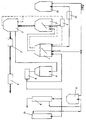
- FIG. 1 An exemplary embodiment, from which further inventive features result, is shown schematically in FIG. 1.
- FIG. 1 shows a flow chart to illustrate the sequence of the method according to the invention.
- a cleaning and extraction reactor 1 which can also function as a solvent bath, used polyolefin chips are stirred into ethyl acetate as the solvent.
- ethyl acetate which contains foil ingredients, is mixed with ink pigments and binders and polyethylene waxes is loaded, mechanically separated from the polyolefin chips and fed to a downstream precipitation tank 2, which is also equipped with a stirrer.
- the schnitzel is suspended with water at 85-90 ° C and washed with vigorous agitation. It is essential that the temperature of the water is above the boiling point of the ethyl acetate so that it evaporates.
- the solvent vapors released can be fed to a solvent tank via a downstream condensation path.
- the solvent-free chips are then mechanically separated from the wash water.
- the wash water loaded with residues of nitrocellulose and ethyl acetate can also be fed to the precipitation tank 2 for the precipitation of the nitrocellulose.
- the precipitation is carried out at a temperature of 30-40 ° C., a precipitation time of 10 minutes and an ethyl acetate / water ratio of 1: 1.
- the mixture of ethyl acetate / solid precipitate / water is fed from the precipitation container 2 to a phase separation bottle 3, in which the separation into individual phases takes place.
- the solid is separated from the mixture by a filter device 5 and then stripped with solvent-free steam. Via a downstream partial dewatering device 6, which works mechanically or thermally, the solid deposit can be adjusted to the residual moisture which is required for safety reasons with regard to the nitrocellulose.
- Part of the water is used as circulating water in the precipitation tank fed.
- the other part can be decolorized using a column with activated carbon 4, if necessary.
- the water purified in this way is now returned to the cleaning and extraction system as circulating wash water in order to free the polyolefin chips from residual solvent and nitrocellulose residues.
- the solvent from the phase separation is fed to a buffer container 7 and then analyzed in an analysis device 8.
- a partial stream can be reused directly as a circulating solvent for the cleaning process stage.
- the other part of the solvent is fed to an evaporator system 9 or an adsorber 10 and is completely cleaned there.
- the cleaned solvent is then collected in a storage tank 11 and used as a circulating solvent in the extraction process step.
- the solvent vapors emerging from the reactor 1 are condensed by the condenser 12 and the solvent is fed to a storage tank 13. From there, the solvent can be used again as a circulating solvent for cleaning in reactor 1.
- the object stated at the outset is further achieved according to the invention by a process for cleaning polyolefin, in particular shredded polyethylene film, which is characterized in that the polyolefin chips are freed of loose impurities by mechanically dry cleaning, in the cleaning process step with a mixture of solvent / Water are added, whereby the three-phase mixture is already formed in the reactor, which can then be transferred directly to the phase separation bottle.
- the polyolefin chips are with the firmly adhering residual dirt without cleaning the water beforehand and subjected to extraction with the solvent. These dirt particles introduced into the process prove to be advantageous in the precipitation of the nitrocellulose with water, since they promote the formation of condensation nuclei. This significantly improves the filterability of the solid precipitate.
- the finest particles of dirt which are passed through the process steps of cleaning and extraction, are treated with clean water in a rinsing process after the residual solvent has been removed from the chips.
- a filter for separating the solid particles is installed in the rinsing water circuit.
- the duration of the rinsing process can be controlled via a measuring device, which measures the degree of turbidity, for example. It is particularly advantageous in this process according to the invention that the polyolefin chips are no longer cleaned of dirt by means of a complex wash with water. A reduction in operating costs can therefore be achieved with this embodiment according to the invention.
- the solvent / water ratio is preferably 1: 1 to 1: 3, the reaction time is a maximum of 5 minutes at a temperature of 50-60 ° C.
- the three-phase mixture already formed in this process step can be discharged directly into the phase separation bottle.
- This embodiment according to the invention has the advantage that the cleaning of the polyolefin chips via water washing is not necessary. Furthermore, the residual dirt adhering firmly to the chips after the mechanical dry cleaning becomes already in the process step completely separated from the cleaning.
- the object stated is achieved according to the invention by a process for removing solvent and / or nitrocellulose residues from pre-cleaned polyolefin, in particular from pre-cleaned polyethylene recyclate chips, which is characterized in that the polyolefin is washed with cleaned solvent, the solvent is mechanically separated and the solvent residues remaining on the polyolefin are driven off by a stream of nitrogen.
- Ethyl acetate is preferred as the solvent.
- Shredded polyethylene films which have been pre-cleaned by extraction processes can be used as the polyolefin.
- the polyolefin for example treated with warm ethyl acetate over a period of 30 minutes, still carries about 50 to 60% by weight of ethyl acetate with it after it has been mechanically separated from the ethyl acetate.
- the entrained solvent is driven off by a nitrogen stream of approximately 85-90 ° C.
- the solvent carried in the nitrogen stream can be used again as a circulating solvent.
- the nitrogen freed from the solvent is heated to 70 to 90 ° C. via a heat exchanger and used again as the cycle nitrogen to remove the polyolefin from the solvent.
- the mechanically separated washing solvent which is loaded with film contents, such as lubricants and antistatic agents and with polyethylene waxes, can be passed through an adsorber column.
- adsorber soils of the magnesium aluminum hydrosilicate type in combination with activated carbon can be used as adsorber substances.
- ethyl acetate is almost completely separated from all accompanying substances.
- the solvent which has been decolorized and purified in this way can be collected in the solvent storage container and also used as a circulating solvent for further cleaning and extraction processes.
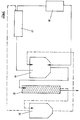
- FIG. 2 An embodiment from which further features according to the invention result is shown schematically in FIG. 2.
- FIG. 2 shows a flow chart to clarify the sequence of this method according to the invention.
- a cleaning container 14 is supplied with purified ethyl acetate to remove nitrocellulose residues from pre-cleaned polyethylene recyclate chips.
- the washing process is supported by a stirring device in the cleaning container 14.
- the solvent is mechanically separated and cleaned via a downstream adsorber column 15, which is followed by a solvent tank 16.
- the remaining ethyl acetate on the polyethylene are driven out by a nitrogen stream, which has a temperature of 85-90 ° C.
- the ethyl acetate entrained in the nitrogen stream is freed of nitrogen by means of a refrigeration unit 17 and used again as cycle ethyl acetate via the solvent container 16.
- the nitrogen freed from the ethyl acetate is heated via a heat exchanger 18 and used as circulating nitrogen.
Landscapes
- Chemical & Material Sciences (AREA)
- Engineering & Computer Science (AREA)
- Chemical Kinetics & Catalysis (AREA)
- Environmental & Geological Engineering (AREA)
- Life Sciences & Earth Sciences (AREA)
- Medicinal Chemistry (AREA)
- Polymers & Plastics (AREA)
- Organic Chemistry (AREA)
- Sustainable Development (AREA)
- Health & Medical Sciences (AREA)
- Mechanical Engineering (AREA)
- Addition Polymer Or Copolymer, Post-Treatments, Or Chemical Modifications (AREA)
- Extraction Or Liquid Replacement (AREA)
- Cleaning By Liquid Or Steam (AREA)
- Separation, Recovery Or Treatment Of Waste Materials Containing Plastics (AREA)
- Processing Of Solid Wastes (AREA)
- Processes Of Treating Macromolecular Substances (AREA)
- Detergent Compositions (AREA)
Abstract
Description
- Die Erfindung betrifft Verfahren zur Reinigung von Polyolefin, insbesondere von Polyethylenrecyclatschnitzeln, sowie Vorrichtungen zur Durchführung der Verfahren.
- Polyethylen ist ein Polyolefin, das in großen Mengen zur Herstellung von Folien für Verpackungszwecke verarbeitet wird. Aus den Folien werden z.B. Schrumpfhauben, Säcke und dergl. hergestellt.
- Polyethylen, als ein thermoplastischer Kunststoff, ist aufgrund seines strukturellen Molekülaufbaus wiederholt aufschmelzbar und verformbar. Es ist für eine mehrmalige Wiederverwendung grundsätzlich geeignet. Einer Wiederverarbeitung zu hochwertigen Recyclingprodukten, vorzugsweise Polyethylenfolien mit definierten Eigenschaften, steht jedoch entgegen, daß die gebrauchten Gegenstände, insbesondere Folien, bei ihrer Herstellung anwendungsorientiert mit Zuschlagstoffen, wie Antistatika, Gleitmittel, Thermo- oder UV-Stabilisatoren ausgerüstet werden, die dann im daraus hergestellten Recyclingprodukt in unbekannten Mengen und Kombinationen vorliegen. Eine Sortierung der gebrauchten Gegenstände nach Inhaltsstoffen ist technisch und wirtschaftlich kaum möglich.
- Recyclingprodukte, insbesondere Folien, die mit diesen Inhaltsstoffen belastet sind, führen bei ihrer Weiterverarbeitung zu Problemen, beispielsweise beim Kleben, Schweißen oder Bedrucken. Vielfach lösen sich Verbindungsnähte nach anfänglich guten Eigenschaften erst beim Anwender auf.
- Darüber hinaus enthalten die gebrauchten Folien Abbaustoffe des Polyethylens, wie Polyethylenwachse sowie Abbauprodukte der Zuschlagsstoffe. Diese entstehen während der Lebensdauer im Zuge von Verarbeitungsprozessen sowie durch Wärme-, Licht- und Wettereinwirkung. Diese bewirken zum Teil eine erhebliche Minderung der Gebrauchseigenschaften des Recyclingprodukts.
- Letztlich sind die gebrauchten Folien, besonders Verpackungsfolien, mehr oder minder stark bedruckt. Diese Druckfarben führen bei der Extrusion von aufbereiteten Materialien zu Polyethylenfolien mit einer starken undefinierten Verfärbung, so daß daraus nur dunkel überfärbte Müllsäcke hergestellt werden können. Bei sehr hohen Druckflächenanteilen im Verhältnis zur Polymermenge können sogar unbrauchbare, von Zersetzungsgasen geschäumte Regranulate entstehen.
- Zur Entfernung der Folienzuschlagsstoffe, der unpolaren Polyethylenwachse sowie der anhaftenden Druckfarben aus den gebrauchten Folien wird in der DE-OS 4 122 277, die teilweise ein älteres Recht darstellt, ein Verfahren beschrieben, bei dem die gebrauchten Folien zerschnitzelt und unter intensiver Bewegung in einem ein organisches Lösungsmittel enthaltenden Lösungsmittelbad einer Extraktion unterzogen werden.
- Die mit einem organischen Lösungsmittel, in der Wärme behandelten Schnitzel enthalten nach der mechanischen Abrennung des Lösungsmittels, z.B. im Fall von Ethylacetat noch ca. 50 bis 60 Gew.% Lösungsmittel. Dieses findet sich sowohl an den Oberflächen der Schnitzel als auch eindiffundiert im Schnitzelinneren. Ferner enthalten die Schnitzel noch oberflächlich Reste an Nitrocellulose, dem bevorzugten Bindemittel bei Flexodruckfarben. Diese Restmengen an Nitrocellulose, auch wenn sie gering sind, führen bei der Regranulierung zur Verkohlung und damit zu schwarzen Stippen in der Recyclatfolie.
- Der Erfindung liegt die Aufgabe zugrunde, Verfahren bereitzustellen, mit denen man Polyolefin, vorzugsweise in Form von Polyethylenschnitzeln, reinigen kann.
- Diese Aufgabe wird erfindungsgemäß gelöst durch ein Verfahren zur Entfernung von Lösungsmittel- und/oder Nitrocelluloseresten aus vorgereinigtem Polyolefin, insbesondere aus vorgereinigten Polyethylenrecyclatschnitzeln, das dadurch gekennzeichnet ist, daß das Polyolefin mit Wasser versetzt wird, das Lösungsmittel entweder ausgetrieben oder durch Extraktion abgetrennt und gleichzeitig die Reste an Nitrocellulose von den Oberflächen der Polyolefinschnitzel abgewaschen werden.
- Bei dem erfindungsgemäßen Verfahren kann die Austreibung und/oder die Extraktion kontinuierlich oder diskontinuierlich erfolgen.
- In einer besonderen Ausführungsform wird als Lösungsmittel Ethylacetat verwendet.
- Bei der diskontinuierlichen Fahrweise, z.B. im Rührreaktor, wird das Lösungsmittel, vorzugsweise Ethylacetat, unter Rühren bei einer Temperatur, die über der Siedetemperatur des Lösungsmittels liegt, ausgetrieben bzw. von der Oberfläche des Polyolefins verdampft. Im Falle des Ethylacetats genügt ein 30-minütiges Rühren bei einer Temperatur von 85-90°C.
- Ein Gewichtsverhältnis von Polyolefinschnitzel zu Waschwasser von 1:8 bis 1:10 hat sich als vorteilhaft erwiesen.
- Bei der kontinuierlichen Fahrweise erfolgt die Befreiung der Polyolefinschnitzel vom Lösungsmittel mittels Wasser etwas unterhalb der Siedetemperatur des Lösungsmittels, vorzugsweise bei einer Temperatur von 70-75°C. Als hierfür geeignet hat sich ein Mehrkammerextrakteur erwiesen. Das Wasser durchströmt dabei die Schnitzelschüttung in den einzelnen Kammern mit einem konkret einstellbaren kontinuierlichen Volumenstrom über eine bestimmte Zeit. Das Wasser wird im Gegenstrom zu den Polyolefinschnitzeln geführt.
- Nach diesem Wasch- und Extraktionsprozeß werden die Polyolefinschnitzel nochmals 5-10 Minuten mit Wasser hoher Turbulenz durchspült. Dieses Spülwasser kann im Kreislauf gefahren werden mit einem integrierten Filter zur Reinigung des Wassers. Mit diesem Spülvorgang werden noch Reste an Nitrocellulose von den Oberflächen der Polyolefinschnitzel sowie bis dahin durchgeschleuste feinste mineralische Verunreinigungen abgetrennt.
- In einer speziellen Ausführungsform der Erfindung wird das mit Druckfarbenpigmenten und -bindemitteln, Folieninhaltsstoffen, wie Gleitmittel und Antistatika, sowie mit Polyethylenwachsen beladene Lösungsmittel, das vor der Behandlung mit Wasser von den Polyolefinschnitzeln mechanisch abgetrennt wurde, in einen nachgeschalteten Fällungsbehälter überführt.
- Die Fällung zur quantitativen Abtrennung des Flexodruckfarbenbindemittels Nitrocellulose aus dem Lösungsmittel kann mit dem Waschwasser erfolgen. Die Fällung erfolgt vorteilhafterweise unter Rühren bei einer Temperatur von 30-70°C und einer Fällungsdauer von 10 Minuten. Bevorzugt ist hierbei eine Temperatur von 30-40°C und ein Gewichtsverhältnis von Lösungsmittel/Wasser von 1:1.
- Bei diesem Fällungsprozeß werden neben der Nitrocellulose gleichzeitig die wasserunlöslichen Druckfarbenpigmente vollständig mit ausgefällt.
- Die Lösungsmittelbrüden, die beim Waschvorgang entstehen, werden kondensiert, gesammelt und einem Lösungsmitteltank zugeführt. Dieser Tank dient als Vorratstank für das Lösungsmittel. Von dort kann das Lösungsmittel dann erneut dem Reinigungs- und Extraktionsreaktor als Kreislauflösungsmittel zugeführt werden.
- Die Trennung des sich bei der Fällung bildenden Dreiphasengemisches, Lösungsmittel/Feststoffniederschlag/Wasser, kann in einer Phasentrennflasche erfolgen.
- Der Feststoffniederschlag aus dem Dreiphasengemisch kann durch Filtration abgetrennt werden und das Wasser gegebenenfalls als Kreislaufwaschwasser eingesetzt werden, wobei das Wasser vorher gegebenenfalls über eine Säule mit Aktivkohle entfärbt werden kann.
- Der Hauptanteil des Lösungsmittels im Feststoffniederschlag wird in einem nachgeschalteten Behälter mit heißem Wasser von ca. 90°C über eine bestimmte Zeit gerührt. Dabei wird das Lösungsmittel ausgetrieben. Zur vollständigen Beseitigung des Lösungsmittels aus dem Feststoffniederschlag kann desweiteren mit Dampf lösungsmittelfrei gestrippt werden und das Lösungsmittel nach Kondensation wiederverwendet werden. Der Niederschlag agglomeriert und kann problemlos mechanisch abgetrennt werden. Das Lösungsmittel wird kondensiert und kann als Kreislauflösungsmittel wiederverwendet werden. Auf diese Weise erfolgt der Austrag des Feststoffniederschlags wasserfeucht und lösungsmittelfrei und erfüllt somit die Sicherheitsvorschriften für den Transport und die Entsorgung in bezug auf Nitrocellulose.
- Das mit Lösungsmittel angereicherte Wasser aus der Phasentrennung kann erneut vollständig zur Fällung der Nitrocellulose eingesetzt werden.
- Das Lösungsmittel aus der Phasentrennung ist bereits soweit gereinigt, daß eine Teilmenge als Kreislauflösungsmittel im Verfahrensschritt Reinigung, das heißt zum Beispiel für die Druckfarbenablösung, erneut eingesetzt werden kann. Über eine entsprechende Meßanalyse des Lösungsmittels nach der Phasentrennung ist dieser Teilstrom regulierbar. Für die Meßanalyse eignet sich z.B. die Messung des Brechungsindex oder der Farbtiefe.
- Der andere Teil des Lösungsmittels wird zur Aufarbeitung einer Verdampferanlage zugeführt und/oder er wird über eine Adsorbersäule gereinigt. Auf diese Weise kann dieser Teil des Lösungsmittels vollständig als Kreislaufprodukt über den Lösungsmittelvorratstank im Verfahrensschritt Extraktion wiederverwendet werden.
- Diese Verfahrensweise ermöglicht die Reduzierung des erforderlichen Lösungsmittelbedarfs pro Mengeneinheit Polyolefinschnitzel auf eine technisch notwendige Mindestmenge, wobei die volle Wirksamkeit des Reinigungs- und Extraktionsprozesses gesichert ist. Gleichzeitig wird die erforderliche Verdampferleistung pro Mengeneinheit Polyolefinschnitzel, das heißt die Energiekosten für die Verdampfung, auf ein Minimum reduziert.
- Bei der Verdampfung fällt ein Rückstand an, mit den Hauptbestandteilen Polyethylenwachse und geringen Anteilen an höheren Fettsäuren, Fettsäurederivaten, Fettalkohole, Phthalate und verlackten Druckfarbenpigmenten. Diese Prozeßrückstände sind als Wertstoffe für ausgewählte Anwendungen verwertbar, z.B. zur Herstellung bestimmter Foliensortimente, wie beispielsweise eingefärbte Müllsäcke.
- Bei einer zweiten Verfahrensvariante erfolgt die vollständige Reinigung des Lösungsmittelteilstroms aus der Phasentrennung durch Sorption. Die noch nach der Fällung mit Wasser im Lösungsmittel verbliebenen Begleitstoffe, wie Phthalate, Polyethylenwachse und geringe Anteile an Druckfarbenpigmenten, werden abgetrennt. Für ein solches Verfahren eignen sich sogenannte Adsorber-Erden, wie beispielsweise Magnesium-Aluminium-Hydrosilikate. Auch spezielle Aktivkohlen sind hierfür geeignet, sowie die Kombination beider Adsorbenzien. Bei dieser Verfahrensvariante ist der völlige Verzicht auf eine Verdampferanlage vorteilhaft, nachteilig sind jedoch die erhöhten Kosten für die Entsorgung sowohl der beladenen Adsorbersubstanz als auch der Lösungsmittelbegleitstoffe.
- Die beiden Teilströme können gemeinsam dem Lösungsmitteltank zugeführt werden und somit vollständig für einen neuen Reinigungs- und Extraktionsprozeß verwendet werden.
- Eine weitere Variante sieht die Reinigung des gesamten beladenen Lösungsmittels nach der Reinigung und Extraktion ohne Wasserfällung, durch Hochleistungsfiltration vor, die in Kombination mit Sorption bzw. Verdampfung vorgenommen werden kann.
- Ein Ausführungsbeispiel, aus dem sich weitere erfinderische Merkmale ergeben, ist in Fig. 1 schematisch dargestellt.
- Die Fig. 1 zeigt ein Fließdiagramm zur Verdeutlichung des Ablaufs des erfindungsgemäßen Verfahrens.
- In der Fig. 1 beschreiben die gestrichelten Linien den Fluß des Wassers, die dünnen durchgehenden Linien den Fluß des Lösungsmittels und die Doppellinien den Fluß von Feststoffen.
- In einem Reinigungs- und Extraktionsreaktor 1, der auch die Funktion eines Lösungsmittelbades haben kann, werden gebrauchte Polyolefinschnitzel in Ethylacetat als Lösungsmittel eingerührt.
- Sobald die Reinigung und Extraktion beendet ist, wird Ethylacetat, das mit Folieninhaltsstoffen, mit Druckfarbenpigmenten und -bindemitteln sowie Polyethylenwachsen beladen ist, mechanisch von den Polyolefinschnitzel getrennt und einem nachgeschalteten Fällungsbehälter 2, der ebenfalls mit einem Rührwerk ausgestattet ist, zugeführt.
- Die Schnitzel werden mit Wasser von 85-90°C suspendiert und unter starker Bewegung gewaschen. Dabei ist es wesentlich, daß die Temperatur des Wassers über dem Siedepunkt des Ethylacetats liegt, damit dessen Verdampfung erfolgt.
- Die freigesetzten Lösungsmitteldämpfe können über eine nachgeschaltete Kondensationsstrecke einem Lösungsmitteltank zugeführt werden.
- Danach werden die lösungsmittelfreien Schnitzel mechanisch vom Waschwasser abgetrennt.
- Das mit Resten an Nitrocellulose und Ethylacetat befrachtete Waschwasser kann ebenfalls dem Fällungsbehälter 2 zur Ausfällung der Nitrocellulose zugeführt werden. Die Ausfällung wird bei einer Temperatur von 30-40°C, einer Fällungsdauer von 10 Minuten und einem Verhältnis Ethylacetat/Wasser von 1:1 durchgeführt. Aus dem Fällungsbehälter 2 wird das Gemisch aus Ethylacetat/Feststoffniederschlag/Wasser einer Phasentrennflasche 3 zugeführt, in der die Trennung in einzelne Phasen erfolgt.
- Der Feststoff wird aus dem Gemisch durch eine Filtriervorrichtung 5 abgetrennt und anschließend mit Dampf lösungsmittelfrei gestrippt. Über eine nachgeschaltete Teilentwässerungsvorrichtung 6, die mechanisch oder thermisch arbeitet, kann der Feststoffniederschlag auf die Restfeuchte eingestellt werden, die aus Sicherheitsgründen bezüglich der Nitrocellulose erforderlich ist.
- Ein Teil des Wassers wird als Kreislaufwasser dem Fällungsbehälter zugeführt. Der andere Teil kann über eine Säule mit Aktivkohle 4, falls erforderlich, entfärbt werden. Das so gereinigte Wasser wird nunmehr als Kreislaufwaschwasser wieder der Reinigungs- und Extraktionsanlage zugeführt, um die Polyolefinschnitzel vom Restlösungsmittel und Resten an Nitrocellulose zu befreien.
- Das Lösungsmittel aus der Phasentrennung wird einem Pufferbehälter 7 zugeführt und anschließend in einer Analysevorrichtung 8 analysiert. Ein Teilstrom kann direkt als Kreislauflösungsmittel für die Verfahrensstufe Reinigung wiederverwendet werden. Der andere Teil des Lösungsmittels wird einer Verdampferanlage 9 oder einem Adsorber 10 zugeführt und dort vollständig gereinigt. Das gereinigte Lösungsmittel wird anschließend in einem Vorratstank 11 gesammelt und als Kreislauflösungsmittel in der Verfahrensstufe Extraktion eingesetzt.
- Die aus dem Reaktor 1 austretenden Lösungsmittelbrüden werden durch den Kondensator 12 kondensiert und das Lösungsmittel einem Vorratstank 13 zugeführt. Von dort kann das Lösungsmittel als Kreislauflösungsmittel erneut zur Reinigung im Reaktor 1 eingesetzt werden.
- Die eingangs gestellt Aufgabe wird ferner erfindungsgemäß gelöst durch ein Verfahren zur Reinigung von Polyolefin, insbesondere von Polyethylen-Altfolienschnitzeln, das dadurch gekennzeichnet ist, daß die Polyolefinschnitzel über eine mechanisch trockene Reinigung von losen Verunreinigungen befreit werden, im Verfahrensschritt der Reinigung mit einem Gemisch aus Lösungsmittel/Wasser versetzt werden, wodurch das Dreiphasengemisch bereits im Reaktor gebildet wird, das anschließend direkt in die Phasentrennflasche überführt werden kann.
- Die Polyolefinschnitzel werden mit dem fest anhaftenden Restschmutzanteil hierbei ohne vorherige Wasserwäsche der Reinigung und Extraktion mit dem Lösungsmittel unterzogen. Diese in den Prozeß mit eingebrachten Schmutzteilchen erweisen sich als vorteilhaft bei der Ausfällung der Nitrocellulose mit Wasser, da sie die Bildung von Kondensationskeimen fördern. Damit wird die Filtrierbarkeit des Feststoffniederschlags wesentlich verbessert.
- Feinste Teilchen an Schmutz, die durch die Verfahrensschritte der Reinigung und Extraktion mit durchgeschleust werden, werden nach der Restlösungsmittelentfernung der Schnitzel in einem Spülprozeß mit sauberem Wasser behandelt.
- In den Spülwasserkreislauf ist ein Filter zur Abscheidung der Feststoffteilchen eingebaut. Über eine Meßeinrichtung , die beispielsweise den Trübungsgrad mißt, ist die Dauer des Spülvorgangs steuerbar. An diesem erfindungsgemäßen Verfahren ist besonders vorteilhaft, daß die Polyolefinschnitzel nicht mehr über eine aufwendige Wäsche mit Wasser von Schmutz gereinigt werden. Mit dieser erfindungsgemäßen Ausführungsform kann daher eine Verringerung der Betriebskosten erreicht werden.
- In einer weiteren Verfahrensvariante zur Reinigung von Polyolefin, insbesondere von Polyethylen-Altfolienschnitzeln, wird das Polyolefin nach einer mechanisch trockenen Reinigung mit einem Gemisch aus Lösungsmittel/Wasser einem ersten kurzen Reinigungsschritt mit hoher Friktionsbewegung unterzogen.
- Das Verhältnis Lösungsmittel/Wasser ist vorzugsweise 1:1 bis 1:3, die Reaktionszeit beträgt maximal 5 Minuten bei einer Temperatur von 50-60°C. Das sich bereits bei diesem Verfahrensschritt bildende Dreiphasengemisch kann unmittelbar in die Phasentrennflasche abgeführt werden. Diese erfindungsgemäße Ausführungsform hat den Vorteil, daß die Reinigung der Polyolefinschnitzel über eine Wasserwäsche entfällt. Ferner wird der an den Schnitzeln fest anhaftende Restschmutz nach der mechanischen trockenen Reinigung bereits im Verfahrensschritt der Reinigung vollständig abgetrennt.
- Desweiteren wird die eingangs gestellte Aufgabe erfindungsgemäß gelöst durch ein Verfahren zur Entfernung von Lösungsmittel- und/oder Nitrocelluloseresten aus vorgereinigtem Polyolefin, insbesondere aus vorgereinigten Polyethylen-Recyclatschnitzeln, das dadurch gekennzeichnet ist, daß das Polyolefin mit gereinigtem Lösungsmittel gewaschen, das Lösungsmittel mechanisch abgetrennt und die am Polyolefin verbliebenen Lösungsittelreste durch einen Stickstoffstrom ausgetrieben werden.
- Als Lösungsmittel ist Ethylacetat bevorzugt.
- Als Polyolefin können zerschnitzelte Polyethylenfolien verwendet werden, die durch Extraktionsvorgänge vorgereinigt sind.
- Das zum Beispiel mit Ethylacetat in der Wärme über eine Zeit von 30 Minuten behandelte Polyolefin führt nach seiner mechanischen Abtrennung vom Ethylacetat noch ca. 50 bis 60 Gew.% Ethylacetat mit sich.
- Gemäß einer bevorzugten Ausführungsform der Erfindung wird das mitgeführte Lösungsmittel durch einen Stickstoffstrom von ca. 85-90°C ausgetrieben.
- Dabei kann das im Stickstoffstrom mitgeführte Lösungsmittel, nach Abtrennen des Lösungsmittels vom Stickstoff und einer Zwischenlagerung in einem Lösungsmittelvorratsbehälter, wieder als Kreislauflösungsmittel eingesetzt werden.
- In einer weiteren vorteilhaften Ausführungsform der Erfindung wird der vom Lösungsmittel befreite Stickstoff über einen Wärmeaustauscher auf 70 bis 90°C erwärmt und als Kreislaufstickstoff erneut zur Lösungsmittelentfernung des Polyolefins eingesetzt.
- Gemäß einer vorteilhaften Ausgestaltung des Verfahrens kann das mechanisch abgetrennte Waschlösungsmittel, das mit Folieninhaltsstoffen, wie Gleitmittel und Antistatika sowie mit Polyethylenwachsen beladen ist, über eine Adsorbersäule gegeben werden. Dabei können als Adsorbersubstanzen Adsorber-Erden vom Typ Magnesium-Aluminium-Hydrosilikat in Kombination mit Aktivkohle eingesetzt werden. Ethylacetat wird auf diese Weise nahezu vollständig von allen Begleitstoffen getrennt. Das so entfärbte und gereinigte Lösungsmittel kann in dem Lösungsmittelvorratsbehälter gesammelt und ebenfalls als Kreislauflösungsmittel für weitere Reinigungs- und Extraktionsprozesse verwendet werden.
- Ein Ausführungsbeispiel, aus dem sich weitere erfindungsgemäße Merkmale ergeben, ist in der Fig. 2 schematisch dargestellt.
- Fig. 2 zeigt ein Fließdiagramm zur Verdeutlichung des Ablaufs dieses erfindungsgemäßen Verfahrens.
- Einem Reinigungsbehälter 14 wird zur Entfernung von Nitrocelluloseresten aus vorgereinigten Polyethylen-Recyclatschnitzeln gereinigtes Ethylacetat zugeführt. Der Waschvorgang wird durch eine Rühreinrichtung in dem Reinigungsbehälter 14 unterstützt. Das Lösungsmittel wird mechanisch abgetrennt und über eine nachgeschaltete Adsorbersäule 15 gereinigt, der ein Lösungsmittelbehälter 16 nachgeschaltet ist.
- Die am Polyethylen verbliebenen Ethylacetatreste werden durch einen Stickstoffstrom ausgetrieben, der eine Temperatur von 85-90°C aufweist. Das im Stickstoffstrom mitgeführte Ethylacetat wird durch einen Kältesatz 17 von Stickstoff befreit und über den Lösungsmittelbehälter 16 wieder als Kreislaufethylacetat eingesetzt.
- Der vom Ethylacetat befreite Stickstoff wird über einen Wärmeaustauscher 18 erwärmt und als Kreislaufstickstoff eingesetzt.
Claims (28)
- Verfahren zur Entfernung von Lösungsmittel- und/oder Nitrocellulose-Resten aus vorgereinigtem Polyolefin, insbesondere aus vorgereinigten Polyethylen-Recyclatschnitzeln,
dadurch gekennzeichnet,
daß das Polyolefin mit Wasser versetzt wird, das Lösungsmittel entweder ausgetrieben oder durch Extraktion abgetrennt und gleichzeitig die Reste an Nitrocellulose von der Oberfläche der Polyolefinschnitzel abgewaschen werden. - Verfahren nach Anspruch 1, dadurch gekennzeichnet, daß die Austreibung und/oder die Extraktion kontinuierlich oder diskontinuierlich erfolgt.
- Verfahren nach Anspruch 1 oder 2, dadurch gekennzeichnet, daß als Lösungsmittel Ethylacetat verwendet wird.
- Verfahren nach einem der vorhergehenden Ansprüche, dadurch gekennzeichnet, daß die Austreibung des Lösungsmittels durch Erwärmen des Wassers auf eine über der Siedetemperatur des Lösungsmittels liegende Temperatur erfolgt.
- Verfahren nach Anspruch 3, dadurch gekennzeichnet, daß das Wasser unter Rühren auf eine Temperatur von 85 bis 90°C erwärmt wird.
- Verfahren nach einem der vorhergehenden Ansprüche, dadurch gekennzeichnet, daß das Gewichtsverhältnis bei diskontinuierlicher Fahrweise Polyolefin zu Waschwasser 1:8 bis 1:10 und die Kontaktzeit 30 Minuten beträgt.
- Verfahren nach einem der Ansprüche 1 bis 3, dadurch gekennzeichnet, daß die Befreiung der Polyolefinschnitzel vom Lösungsmittel kontinuierlich mit Wasser kurz unterhalb des Siedepunktts des Lösungsmittels erfolgt.
- Verfahren nach Anspruch 7, dadurch gekennzeichnet, daß das Wasser auf 70 bis 75°C erwärmt und die Polyolefinschnitzelschüttung mit einem definierten Volumenstrom durchströmt wird.
- Verfahren nach einem der Ansprüche 7 oder 8, dadurch gekennzeichnet, daß das Wasser zur Extraktion im Kreislauf mit einem bestimmten Volumenstrom über eine definierte Zeit gefahren wird.
- Verfahren nach einem der vorhergehenden Ansprüche, dadurch gekennzeichnet, daß das Waschwasser zur Ausfällung der Nitrocellulose aus dem Lösungsmittel verwendet wird.
- Verfahren nach einem der vorhergehenden Ansprüche, dadurch gekennzeichnet, daß die Fällungsdauer 10 Minuten, die Temperatur 30 bis 70°C beträgt.
- Verfahren nach Anspruch 11, dadurch gekennzeichnet, daß die Temperatur 30 bis 40°C und das Gewichtsverhältnis Lösungsmittel zu Wasser 1:1 beträgt.
- Verfahren nach einem der vorhergehenden Ansprüche, dadurch gekennzeichnet, daß Lösungsmittelbrüden beim Waschen gesammelt und einem Lösungsmitteltank (13) zugeführt werden und gegebenenfalls als Kreislauflösungsmittel eingesetzt werden.
- Verfahren nach einem der Ansprüche 10 bis 13, dadurch gekennzeichnet, daß das Gemisch aus Lösungsmittel/Wasser/Feststoffniederschlag mittels einer Phasentrennflasche (3) in Lösungsmittel, Wasser und Feststoffniederschlag getrennt wird.
- Verfahren nach Anspruch 14, dadurch gekennzeichnet, daß der Feststoffniederschlag aus dem Dreiphasengemisch durch Filtration abgetrennt wird und das Wasser gegebenenfalls als Kreislaufwaschwasser eingesetzt wird, wobei das Wasser vorher gegebenenfalls über eine Säule mit Aktivkohle (4) entfärbt wird.
- Verfahren nach Anspruch 15, dadurch gekennzeichnet, daß der Feststoffniederschlag mit Dampf lösungsmittelfrei gestrippt wird und das Lösungsmittel nach Kondensation wiederverwendet wird.
- Verfahren nach einem der Ansprüche 10 bis 14, dadurch gekennzeichnet, daß das Lösungsmittel durch die Fällung mit Wasser so weit gereinigt wird, daß es nach der Phasentrennung in einem ersten Teilstrom direkt als Kreislauflösungsmittel im Verfahrensschritt Reinigung eingesetzt werden kann.
- Verfahren nach Anspruch 17, dadurch gekennzeichnet, daß das Lösungsmittel in einem zweiten Teilstrom über eine Verdampferanlage (9) und/oder über eine Adsorbersäule (10) gereinigt wird.
- Vorrichtung zur Durchführung des Verfahrens nach einem der Ansprüche 1 bis 18, gekennzeichnet durch einen Reinigungs- und Extraktionsreaktor (1), einen nachgeschalteten Fällungsbehälter (2), jeweils mit integriertem Rührwerk, eine nachfolgende Phasentrennflasche (3), gegebenenfalls eine Säule mit Aktivkohle (4) zur Entfärbung des Wassers, eine Verdampferanlage (9) und/oder eine Adsorbersäule (10) zur Lösungsmittelreinigung sowie einen Lösungsmitteltank (11).
- Verfahren zur Entfernung von Lösungsmittel- und/oder Nitrocellulose-Resten aus vorgereinigtem Polyolefin, insbesondere aus vorgereinigten Polyethylenrecyclatschnitzeln, dadurch gekennzeichnet, daß das Polyolefin mit gereinigtem Lösungsmittel gewaschen, das Lösungsmittel mechanisch abgetrennt und die am/im Polyolefin verbliebenen Lösungsmittelreste durch einen Stickstoffstrom ausgetrieben werden.
- Verfahren nach Anspruch 20, dadurch gekennzeichnet, daß als Lösungsmittel Ethylacetat verwendet wird.
- Verfahren nach Anspruch 20 oder 21, dadurch gekennzeichnet, daß der Stickstoffstrom eine Temperatur von 85 bis 90°C aufweist.
- Verfahren nach einem der Ansprüche 20 bis 22, dadurch gekennzeichnet, daß das im Stickstoffstrom mitgeführte Lösungsmittel über einen Kältesatz (17) von Stickstoff befreit wird und gegebenenfalls über einen Lösungsmittelbehälter (16) wieder als Kreislauflösungsmittel eingesetzt wird.
- Verfahren nach Anspruch 23, dadurch gekennzeichnet, daß der vom Lösungsmittel befreite Stickstoff über einen Wärmeaustauscher (18) auf 70 bis 90°C erwärmt wird und wieder als Kreislaufstickstoff eingesetzt wird.
- Verfahren nach einem der Ansprüche 20 bis 24, dadurch gekennzeichnet, daß das mechanisch abgetrennte Waschlösungsmittel über eine Adsorbersäule (15) geführt, dort gereinigt und gegebenenfalls über einen Lösungsmittelbehälter (16) wieder als Kreislauf- Ethylacetat eingesetzt wird.
- Verfahren nach Anspruch 25, dadurch gekennzeichnet, daß in der Adsorbersäule Adsorbererden vom Typ Magnesium-Aluminiumsilikat in Kombination mit Aktivkohle verwendet werden.
- Vorrichtung zur Durchführung des Verfahrens nach einem der Ansprüche 20 bis 26, gekennzeichnet durch einen Reinigungsbehälter (14) mit integriertem Rührwerk, eine nachgeschaltete Adsorbersäule (15), einen nachfolgenden Lösungsmittelbehälter (16), einen Kältesatz (17) zur Rückgewinnung des Lösungsmittels aus dem Stickstoffstrom sowie einen Wärmeaustauscher (18) zur Erwärmung des Stickstoffstroms.
- Verfahren zur Reinigung von Polyolefin, insbesondere von Polyethylen-Altfolienschnitzeln, dadurch gekennzeichnet, daß mechanisch trocken gereinigte Polyolefinschnitzel im Verfahrensschritt der Reinigung mit einem Gemisch aus Lösungsmittel/Wasser versetzt werden, wodurch das Dreiphasengemisch bereits im Reaktor gebildet wird, das anschließend direkt in die Phasentrennflasche geführt werden kann.
Applications Claiming Priority (2)
| Application Number | Priority Date | Filing Date | Title |
|---|---|---|---|
| DE4242858 | 1992-12-18 | ||
| DE4242858 | 1992-12-18 |
Publications (2)
| Publication Number | Publication Date |
|---|---|
| EP0602658A1 true EP0602658A1 (de) | 1994-06-22 |
| EP0602658B1 EP0602658B1 (de) | 2000-02-16 |
Family
ID=6475688
Family Applications (1)
| Application Number | Title | Priority Date | Filing Date |
|---|---|---|---|
| EP19930120349 Expired - Lifetime EP0602658B1 (de) | 1992-12-18 | 1993-12-16 | Verfahren und Vorrichtung zur Reinigung von Polyolefin |
Country Status (10)
| Country | Link |
|---|---|
| US (1) | US5714070A (de) |
| EP (1) | EP0602658B1 (de) |
| AT (1) | ATE189825T1 (de) |
| CA (1) | CA2129451C (de) |
| DE (2) | DE4342848A1 (de) |
| DK (1) | DK0602658T3 (de) |
| ES (1) | ES2144439T3 (de) |
| GR (1) | GR3033291T3 (de) |
| PT (1) | PT602658E (de) |
| WO (1) | WO1994014883A1 (de) |
Cited By (1)
| Publication number | Priority date | Publication date | Assignee | Title |
|---|---|---|---|---|
| EP0981553A4 (de) * | 1997-05-13 | 2000-12-20 | Prs Llc | Polymer entfernung durch lösungsmittel filtration |
Families Citing this family (8)
| Publication number | Priority date | Publication date | Assignee | Title |
|---|---|---|---|---|
| EP0758001A1 (de) * | 1995-07-21 | 1997-02-12 | Nordenia Verpackungswerke GmbH | Verfahren zur wertstofflichen Verarbeitung eines Sumpfproduktes aus einer destillativen Aufbereitung |
| DE19646834A1 (de) * | 1996-11-13 | 1998-05-14 | Nordenia Verpackung Gmbh | Verfahren zum Recycling gebrauchter Kraftstoffbehälter aus HD-Polyethylen |
| WO1999025493A1 (en) * | 1997-11-19 | 1999-05-27 | Eric Winston Schwass | Improvements in recycling methods |
| DE10215344A1 (de) * | 2002-03-28 | 2003-10-30 | Primary Product Technologies G | Verfahren zur Abtrennung von festen Beimengungen aus Kunststofflösungen |
| CN100368169C (zh) * | 2003-01-10 | 2008-02-13 | 兰州瑞德干燥技术有限公司 | 一种氮气循环超高分子量聚乙烯蒸汽管回转干燥方法 |
| US20140084090A1 (en) * | 2012-09-24 | 2014-03-27 | Torsten Kallweit | Method and device for cleaning of paper machine clothing which is to be recycled |
| WO2018048736A1 (en) * | 2016-09-06 | 2018-03-15 | Geo-Tech Polymers, Llc | Film treatment system |
| EP4293084A1 (de) | 2022-06-14 | 2023-12-20 | polycirQ GmbH | Zusammensetzung und verfahren zum deinken eines bedruckten polymersubstrats |
Citations (4)
| Publication number | Priority date | Publication date | Assignee | Title |
|---|---|---|---|---|
| JPS49107070A (de) * | 1973-02-13 | 1974-10-11 | ||
| US4746422A (en) * | 1985-07-26 | 1988-05-24 | Rutgers University | Method for the separation of a mixture of plastic and contaminant |
| EP0359106A2 (de) * | 1988-09-12 | 1990-03-21 | HERBOLD GMBH Maschinenfabrik | Verfahren zum Aufbereiten und Wiederverwenden verschmutzter Kunststoffprodukte |
| EP0521418A1 (de) * | 1991-07-05 | 1993-01-07 | Nordenia Verpackungswerke GmbH | Verfahren zur Aufbereitung von gebrauchten Gegenständen aus Polyolefin zu wiederverwendbarem Rohstoff |
Family Cites Families (12)
| Publication number | Priority date | Publication date | Assignee | Title |
|---|---|---|---|---|
| US3764384A (en) * | 1970-07-24 | 1973-10-09 | Gaf Corp | Process for removing polyvinyl halide residues from processing equipment |
| GB2111857A (en) * | 1980-12-24 | 1983-07-13 | Sir Spa Societa Italiana Resin | Heat-sealable polyolefin films and processes for their production |
| US4379525A (en) * | 1981-08-06 | 1983-04-12 | Owens-Illinois, Inc. | Process for recycling plastic container scrap |
| US4379724A (en) * | 1981-08-14 | 1983-04-12 | Taiyo Denko Kabushiki Kaisha | Method for reclaiming waste thermoplastic resin film |
| IT1218840B (it) * | 1984-01-10 | 1990-04-24 | Fibropolimeri Srl | Lavatrice per il lavaggio o separazione del film di plastica dalle fibre di carta o cellulosa e procedimento relativo |
| US4797128A (en) * | 1984-12-10 | 1989-01-10 | Quadrex Hps, Inc. | Method of and apparatus for cleaning garments and soft goods contaminated with nuclear, chemical and/or biological contaminants |
| US5248593A (en) * | 1985-03-06 | 1993-09-28 | Boehringer Mannheim Gmbh | Process and reagent for the determination of the luteinizing hormone and monoclonal antibodies suitable thereof |
| US4680060A (en) * | 1985-09-20 | 1987-07-14 | The Coca-Cola Company | Process for the extraction of contaminants from plastics |
| US5110055A (en) * | 1989-04-03 | 1992-05-05 | Partek Corporation | Method and apparatus for cleaning thermoplastic material for reuse |
| US5169558A (en) * | 1989-07-21 | 1992-12-08 | Fox Valley Systems, Inc. | Two-part aerosol composition for increasing the light reflectivity of an object |
| DE4034459A1 (de) * | 1990-10-30 | 1992-05-07 | Hoechst Ag | Verfahren zur aufbereitung thermisch beanspruchter polyester-abfaelle |
| US5266124A (en) * | 1991-11-27 | 1993-11-30 | Southern Research Institute | Process for removing contaminants from polyolefins |
-
1993
- 1993-12-16 DE DE4342848A patent/DE4342848A1/de not_active Withdrawn
- 1993-12-16 WO PCT/DE1993/001207 patent/WO1994014883A1/de not_active Ceased
- 1993-12-16 US US08/284,553 patent/US5714070A/en not_active Expired - Lifetime
- 1993-12-16 EP EP19930120349 patent/EP0602658B1/de not_active Expired - Lifetime
- 1993-12-16 DE DE59309955T patent/DE59309955D1/de not_active Expired - Lifetime
- 1993-12-16 AT AT93120349T patent/ATE189825T1/de active
- 1993-12-16 ES ES93120349T patent/ES2144439T3/es not_active Expired - Lifetime
- 1993-12-16 CA CA002129451A patent/CA2129451C/en not_active Expired - Fee Related
- 1993-12-16 DK DK93120349T patent/DK0602658T3/da active
- 1993-12-16 PT PT93120349T patent/PT602658E/pt unknown
-
2000
- 2000-04-20 GR GR20000400973T patent/GR3033291T3/el unknown
Patent Citations (4)
| Publication number | Priority date | Publication date | Assignee | Title |
|---|---|---|---|---|
| JPS49107070A (de) * | 1973-02-13 | 1974-10-11 | ||
| US4746422A (en) * | 1985-07-26 | 1988-05-24 | Rutgers University | Method for the separation of a mixture of plastic and contaminant |
| EP0359106A2 (de) * | 1988-09-12 | 1990-03-21 | HERBOLD GMBH Maschinenfabrik | Verfahren zum Aufbereiten und Wiederverwenden verschmutzter Kunststoffprodukte |
| EP0521418A1 (de) * | 1991-07-05 | 1993-01-07 | Nordenia Verpackungswerke GmbH | Verfahren zur Aufbereitung von gebrauchten Gegenständen aus Polyolefin zu wiederverwendbarem Rohstoff |
Non-Patent Citations (1)
| Title |
|---|
| DATABASE WPI Derwent World Patents Index; AN 75-39965W[24] * |
Cited By (1)
| Publication number | Priority date | Publication date | Assignee | Title |
|---|---|---|---|---|
| EP0981553A4 (de) * | 1997-05-13 | 2000-12-20 | Prs Llc | Polymer entfernung durch lösungsmittel filtration |
Also Published As
| Publication number | Publication date |
|---|---|
| PT602658E (pt) | 2000-08-31 |
| ATE189825T1 (de) | 2000-03-15 |
| ES2144439T3 (es) | 2000-06-16 |
| GR3033291T3 (en) | 2000-09-29 |
| DE59309955D1 (de) | 2000-03-23 |
| US5714070A (en) | 1998-02-03 |
| DE4342848A1 (de) | 1994-06-23 |
| CA2129451C (en) | 1999-04-06 |
| EP0602658B1 (de) | 2000-02-16 |
| DK0602658T3 (da) | 2000-07-31 |
| WO1994014883A1 (de) | 1994-07-07 |
| CA2129451A1 (en) | 1994-07-07 |
Similar Documents
| Publication | Publication Date | Title |
|---|---|---|
| EP0521418B1 (de) | Verfahren zur Aufbereitung von gebrauchten Gegenständen aus Polyolefin zu wiederverwendbarem Rohstoff | |
| EP0894818B1 (de) | Verfahren zur Wiedergewinnung von löslichen Polymeren oder Polymerengemischen aus kunststoffhaltigen Materialien | |
| DE19653076A1 (de) | Verfahren zur Gewinnung von Polyolefinen aus polyolefinhaltigen Kunststoff-Gemischen oder polyolefinhaltigen Abfällen | |
| EP1737904A1 (de) | Verfahren zum recycling von polyestern oder polyestergemischen aus polyesterhaltigen abfällen | |
| DE10039363A1 (de) | Verfahren zur Trennung und Rückgewinnung von Zielpolymeren und deren Additiven aus einem polymerhaltigen Material | |
| DE102008056311A1 (de) | Verfahren zum Abtrennen einzelner Wertstoffe aus gemischtem, insbesondere zerkleinertem Kunststoffabfall | |
| DE10062437A1 (de) | Verfahren zum Aufbereiten eines Kunststoffgemisches | |
| EP0602658B1 (de) | Verfahren und Vorrichtung zur Reinigung von Polyolefin | |
| DE19629042C2 (de) | Verfahren zur Gewinnung von Terephthalsäure und Ethylenglykol, insbesondere aus Polyethylenterephthalat-Abfällen und Vorrichtung zur Durchführung des Verfahrens | |
| DE4119303C2 (de) | ||
| WO2002100932A1 (de) | Verfahren zur gewinnung von ldpe aus gebrauchten kunststoffolien | |
| DE69220665T2 (de) | Behandlung und rückgewinnung von overspray erhalten bei dem aufsprühen von wasserlöslichen überzügen | |
| DE19739659C2 (de) | Verfahren und Vorrichtung(en) zum Aufbereiten von Alt-Schmierfetten | |
| DE4028999C2 (de) | ||
| DE4134889A1 (de) | Verfahren zur aufbereitung von insbesondere polyethylen-verbundfolien, zu wiederverwendbaren rohstoffen | |
| DE102024204994B3 (de) | Verfahren zum Recycling mindestens eines Verunreinigungen enthaltenden Polyolefins | |
| DD207629A3 (de) | Verfahren zur rueckgewinnung von reinen polyolefin-, polyvinylchlorid- und polystyrolartigen polymeren | |
| DD207628A3 (de) | Verfahren zur rueckgewinnung von reinen polystyrol-, polyolefin- und polyvinylchloridartigen polymeren | |
| DE4323320A1 (de) | Verfahren zur Trennung, Reinigung, Sortierung und zum Recycling von Mischungen und/oder Verbunden von Kunststoffen untereinander und/oder mit anderen Werkstoffen mit Lösungsmittelverfahren | |
| DE10340524A1 (de) | Verfahren und Vorrichtung zur Aufbereitung von Kunststoffabfällen aus verunreinigtem Polyethylenterephthalat | |
| EP0348555A2 (de) | Verfahren zur Rückgewinnung von Pigmenten und Bindemitteln aus Lack-Koagulaten | |
| DE3904698A1 (de) | Verfahren zur verarbeitung von tierischen einsatzstoffen | |
| DE388351C (de) | Verfahren zur Wiedergewinnung fluechtiger Loesungsmittel aus Gasgemischen durch Absorptionsmittel | |
| DE19751442A1 (de) | Verfahren zur Gewinnung von Polystyrol aus Polystyrol- oder polystyrolhaltigen Abfällen | |
| DE4421954A1 (de) | Verfahren zum Abtrennen einer ersten Flüssigkeit von einer zweiten Flüssigkeit, sowie Vorrichtung hierfür |
Legal Events
| Date | Code | Title | Description |
|---|---|---|---|
| PUAI | Public reference made under article 153(3) epc to a published international application that has entered the european phase |
Free format text: ORIGINAL CODE: 0009012 |
|
| AK | Designated contracting states |
Kind code of ref document: A1 Designated state(s): AT BE CH DE DK ES FR GB GR IE IT LI LU MC NL PT SE |
|
| 17P | Request for examination filed |
Effective date: 19941129 |
|
| 17Q | First examination report despatched |
Effective date: 19970109 |
|
| GRAG | Despatch of communication of intention to grant |
Free format text: ORIGINAL CODE: EPIDOS AGRA |
|
| GRAG | Despatch of communication of intention to grant |
Free format text: ORIGINAL CODE: EPIDOS AGRA |
|
| GRAH | Despatch of communication of intention to grant a patent |
Free format text: ORIGINAL CODE: EPIDOS IGRA |
|
| GRAH | Despatch of communication of intention to grant a patent |
Free format text: ORIGINAL CODE: EPIDOS IGRA |
|
| GRAA | (expected) grant |
Free format text: ORIGINAL CODE: 0009210 |
|
| AK | Designated contracting states |
Kind code of ref document: B1 Designated state(s): AT BE CH DE DK ES FR GB GR IE IT LI LU MC NL PT SE |
|
| REF | Corresponds to: |
Ref document number: 189825 Country of ref document: AT Date of ref document: 20000315 Kind code of ref document: T |
|
| REG | Reference to a national code |
Ref country code: CH Ref legal event code: EP |
|
| REF | Corresponds to: |
Ref document number: 59309955 Country of ref document: DE Date of ref document: 20000323 |
|
| ITF | It: translation for a ep patent filed | ||
| REG | Reference to a national code |
Ref country code: CH Ref legal event code: NV Representative=s name: PATENTANWAELTE SCHAAD, BALASS, MENZL & PARTNER AG |
|
| REG | Reference to a national code |
Ref country code: IE Ref legal event code: FG4D Free format text: GERMAN |
|
| ET | Fr: translation filed | ||
| GBT | Gb: translation of ep patent filed (gb section 77(6)(a)/1977) |
Effective date: 20000518 |
|
| REG | Reference to a national code |
Ref country code: ES Ref legal event code: FG2A Ref document number: 2144439 Country of ref document: ES Kind code of ref document: T3 |
|
| REG | Reference to a national code |
Ref country code: DK Ref legal event code: T3 |
|
| REG | Reference to a national code |
Ref country code: PT Ref legal event code: SC4A Free format text: AVAILABILITY OF NATIONAL TRANSLATION Effective date: 20000515 |
|
| PLBE | No opposition filed within time limit |
Free format text: ORIGINAL CODE: 0009261 |
|
| STAA | Information on the status of an ep patent application or granted ep patent |
Free format text: STATUS: NO OPPOSITION FILED WITHIN TIME LIMIT |
|
| 26N | No opposition filed | ||
| REG | Reference to a national code |
Ref country code: GB Ref legal event code: IF02 |
|
| PGFP | Annual fee paid to national office [announced via postgrant information from national office to epo] |
Ref country code: MC Payment date: 20081217 Year of fee payment: 16 |
|
| PG25 | Lapsed in a contracting state [announced via postgrant information from national office to epo] |
Ref country code: MC Free format text: LAPSE BECAUSE OF NON-PAYMENT OF DUE FEES Effective date: 20100701 |
|
| PGFP | Annual fee paid to national office [announced via postgrant information from national office to epo] |
Ref country code: IE Payment date: 20101220 Year of fee payment: 18 Ref country code: FR Payment date: 20110107 Year of fee payment: 18 Ref country code: DK Payment date: 20101223 Year of fee payment: 18 Ref country code: AT Payment date: 20101220 Year of fee payment: 18 |
|
| PGFP | Annual fee paid to national office [announced via postgrant information from national office to epo] |
Ref country code: PT Payment date: 20101203 Year of fee payment: 18 Ref country code: LU Payment date: 20101222 Year of fee payment: 18 Ref country code: CH Payment date: 20101223 Year of fee payment: 18 |
|
| PGFP | Annual fee paid to national office [announced via postgrant information from national office to epo] |
Ref country code: SE Payment date: 20101221 Year of fee payment: 18 Ref country code: GR Payment date: 20101224 Year of fee payment: 18 Ref country code: GB Payment date: 20101221 Year of fee payment: 18 |
|
| PGFP | Annual fee paid to national office [announced via postgrant information from national office to epo] |
Ref country code: IT Payment date: 20101229 Year of fee payment: 18 |
|
| PGFP | Annual fee paid to national office [announced via postgrant information from national office to epo] |
Ref country code: ES Payment date: 20101222 Year of fee payment: 18 |
|
| PGFP | Annual fee paid to national office [announced via postgrant information from national office to epo] |
Ref country code: NL Payment date: 20111221 Year of fee payment: 19 |
|
| PGFP | Annual fee paid to national office [announced via postgrant information from national office to epo] |
Ref country code: BE Payment date: 20111220 Year of fee payment: 19 |
|
| PGFP | Annual fee paid to national office [announced via postgrant information from national office to epo] |
Ref country code: DE Payment date: 20111223 Year of fee payment: 19 |
|
| REG | Reference to a national code |
Ref country code: PT Ref legal event code: MM4A Free format text: LAPSE DUE TO NON-PAYMENT OF FEES Effective date: 20120618 |
|
| REG | Reference to a national code |
Ref country code: DK Ref legal event code: EBP |
|
| REG | Reference to a national code |
Ref country code: CH Ref legal event code: PL Ref country code: SE Ref legal event code: EUG |
|
| GBPC | Gb: european patent ceased through non-payment of renewal fee |
Effective date: 20111216 |
|
| PG25 | Lapsed in a contracting state [announced via postgrant information from national office to epo] |
Ref country code: PT Free format text: LAPSE BECAUSE OF NON-PAYMENT OF DUE FEES Effective date: 20120618 |
|
| REG | Reference to a national code |
Ref country code: GR Ref legal event code: ML Ref document number: 20000400973 Country of ref document: GR Effective date: 20120704 |
|
| REG | Reference to a national code |
Ref country code: FR Ref legal event code: ST Effective date: 20120831 |
|
| REG | Reference to a national code |
Ref country code: IE Ref legal event code: MM4A |
|
| PG25 | Lapsed in a contracting state [announced via postgrant information from national office to epo] |
Ref country code: IE Free format text: LAPSE BECAUSE OF NON-PAYMENT OF DUE FEES Effective date: 20111216 Ref country code: GB Free format text: LAPSE BECAUSE OF NON-PAYMENT OF DUE FEES Effective date: 20111216 Ref country code: CH Free format text: LAPSE BECAUSE OF NON-PAYMENT OF DUE FEES Effective date: 20111231 Ref country code: LI Free format text: LAPSE BECAUSE OF NON-PAYMENT OF DUE FEES Effective date: 20111231 Ref country code: SE Free format text: LAPSE BECAUSE OF NON-PAYMENT OF DUE FEES Effective date: 20111217 |
|
| PG25 | Lapsed in a contracting state [announced via postgrant information from national office to epo] |
Ref country code: GR Free format text: LAPSE BECAUSE OF NON-PAYMENT OF DUE FEES Effective date: 20120704 |
|
| PG25 | Lapsed in a contracting state [announced via postgrant information from national office to epo] |
Ref country code: DK Free format text: LAPSE BECAUSE OF NON-PAYMENT OF DUE FEES Effective date: 20120102 |
|
| PG25 | Lapsed in a contracting state [announced via postgrant information from national office to epo] |
Ref country code: FR Free format text: LAPSE BECAUSE OF NON-PAYMENT OF DUE FEES Effective date: 20120102 |
|
| PG25 | Lapsed in a contracting state [announced via postgrant information from national office to epo] |
Ref country code: LU Free format text: LAPSE BECAUSE OF NON-PAYMENT OF DUE FEES Effective date: 20111216 |
|
| BERE | Be: lapsed |
Owner name: *NORDENIA VERPACKUNGSWERKE G.M.B.H. Effective date: 20121231 |
|
| REG | Reference to a national code |
Ref country code: ES Ref legal event code: FD2A Effective date: 20130703 |
|
| REG | Reference to a national code |
Ref country code: NL Ref legal event code: V1 Effective date: 20130701 |
|
| PG25 | Lapsed in a contracting state [announced via postgrant information from national office to epo] |
Ref country code: ES Free format text: LAPSE BECAUSE OF NON-PAYMENT OF DUE FEES Effective date: 20111217 |
|
| REG | Reference to a national code |
Ref country code: AT Ref legal event code: MM01 Ref document number: 189825 Country of ref document: AT Kind code of ref document: T Effective date: 20121216 |
|
| PG25 | Lapsed in a contracting state [announced via postgrant information from national office to epo] |
Ref country code: BE Free format text: LAPSE BECAUSE OF NON-PAYMENT OF DUE FEES Effective date: 20121231 |
|
| REG | Reference to a national code |
Ref country code: DE Ref legal event code: R119 Ref document number: 59309955 Country of ref document: DE Effective date: 20130702 |
|
| PG25 | Lapsed in a contracting state [announced via postgrant information from national office to epo] |
Ref country code: DE Free format text: LAPSE BECAUSE OF NON-PAYMENT OF DUE FEES Effective date: 20130702 Ref country code: NL Free format text: LAPSE BECAUSE OF NON-PAYMENT OF DUE FEES Effective date: 20130701 Ref country code: AT Free format text: LAPSE BECAUSE OF NON-PAYMENT OF DUE FEES Effective date: 20121216 |
|
| PG25 | Lapsed in a contracting state [announced via postgrant information from national office to epo] |
Ref country code: IT Free format text: LAPSE BECAUSE OF NON-PAYMENT OF DUE FEES Effective date: 20121216 |