EP0602673A2 - System und Verfahren zum Zuteilen von Betreibsmitteln - Google Patents
System und Verfahren zum Zuteilen von Betreibsmitteln Download PDFInfo
- Publication number
- EP0602673A2 EP0602673A2 EP93120436A EP93120436A EP0602673A2 EP 0602673 A2 EP0602673 A2 EP 0602673A2 EP 93120436 A EP93120436 A EP 93120436A EP 93120436 A EP93120436 A EP 93120436A EP 0602673 A2 EP0602673 A2 EP 0602673A2
- Authority
- EP
- European Patent Office
- Prior art keywords
- asset
- schedules
- data
- processor
- indices
- Prior art date
- Legal status (The legal status is an assumption and is not a legal conclusion. Google has not performed a legal analysis and makes no representation as to the accuracy of the status listed.)
- Granted
Links
Images

Classifications
-
- G—PHYSICS
- G06—COMPUTING OR CALCULATING; COUNTING
- G06Q—INFORMATION AND COMMUNICATION TECHNOLOGY [ICT] SPECIALLY ADAPTED FOR ADMINISTRATIVE, COMMERCIAL, FINANCIAL, MANAGERIAL OR SUPERVISORY PURPOSES; SYSTEMS OR METHODS SPECIALLY ADAPTED FOR ADMINISTRATIVE, COMMERCIAL, FINANCIAL, MANAGERIAL OR SUPERVISORY PURPOSES, NOT OTHERWISE PROVIDED FOR
- G06Q10/00—Administration; Management
- G06Q10/06—Resources, workflows, human or project management; Enterprise or organisation planning; Enterprise or organisation modelling
-
- G—PHYSICS
- G06—COMPUTING OR CALCULATING; COUNTING
- G06F—ELECTRIC DIGITAL DATA PROCESSING
- G06F13/00—Interconnection of, or transfer of information or other signals between, memories, input/output devices or central processing units
- G06F13/10—Program control for peripheral devices
-
- G—PHYSICS
- G06—COMPUTING OR CALCULATING; COUNTING
- G06F—ELECTRIC DIGITAL DATA PROCESSING
- G06F15/00—Digital computers in general; Data processing equipment in general
Definitions
- the present invention relates to systems and techniques for allocating and scheduling resources. More specifically, the present invention relates to methods and apparatus for the allocation and scheduling of resources in time critical (e.g., military applications).
- time critical e.g., military applications
- a conventional resource allocation technique utilizes a supercomputer and an exhaustive search to examine all possible combinations of resources to arrive at the optimum allocation schedule.
- the technique is computation intensive and the time required for the completion of a single execution plan may be on the order of an entire month.
- the conventional method of resource management utilizing supercomputers is of limited utility in time critical situations.
- C3I workstation Another method of resource management involves the use of a command, control, communications and intelligence (C3I) workstation.
- the C3I workstation enables C3I planners to perform resource allocation and scheduling without analysis or validation, in the vicinity of the battlefield.
- the remote C3I workstation is a portable unit having computing power inferior to that of a conventional supercomputer.
- the computer associated with the remote C3I workstation typically does not have sufficient computing power to perform the necessary computer simulations required to complete an execution plan.
- the need in the art is addressed by the resource allocation system of the present invention.
- the inventive system includes a first mechanism for receiving a collection of input parameters and a second mechanism for processing data in accordance with the input parameters.
- the second mechanism further includes a third mechanism for generating a collection of asset schedules, a fourth mechanism for providing a random set of combinations of asset schedules and a fifth mechanism for providing a set of asset allocation schedules.
- a sixth mechanism is provided for allocating resources in accordance with the set of asset allocation schedules.
- the system for allocating resources of the present invention receives and formats input data. Upon activation of a switch, the formatted data is loaded into and operated upon by a data processor.
- the data processor generates, stores, evaluates and prioritizes asset schedules. A reduced set of combinations of asset schedules is selected for reproduction to provide a random set of asset schedules after several iterations within a feedback loop. A selected combination of asset schedules and the effectiveness rating thereof is thereafter monitored on a display.
- Fig. 1 is a simplified block diagram of an illustrative embodiment of the system for allocating resources of the present invention shown in a data processing environment.
- Fig. 2 is a more detailed block diagram of the system for allocating resources of Fig. 1 showing the components of a data processor utilized to determine a set of asset allocation schedules.
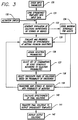
- Fig. 3 is a flow diagram of the system for allocating resources of Fig. 1 showing the processing steps executed to determine the set of asset allocation schedules.
- the system for allocating resources 100 of the present invention is shown in Fig. 1.
- a user interface 102 is employed for receiving a plurality of input parameters into the system 100 from, for example, an operator.
- the user interface 102 can be any of several known data input devices such as a keyboard.
- the input parameters include data such as resources, priorities, constraints and the like that is specific to the problem that the system 100 is being utilized to address.
- the input parameters are entered, for example as by typing, into a plurality of input data templates 104 as shown in Fig. 1.
- the function of the input data templates 104 is to ensure that the input parameters are in the correct format for loading into a data processor 106.
- the data processor 106 utilizes the data of the input parameters to determine an optimum schedule for allocating a plurality of available resources or assets.
- an activation switch 108 Located between the input data templates 104 and the data processor 106 is an activation switch 108 as shown in Fig. 1.
- the function of the activation switch 108 is to permit the data access to the data processor 106.
- the input data which represents the properly formatted input parameters, is transmitted to the data processor 106.
- the data processor 106 then operates on the input data provided by the input data templates 104.
- the data processor 106 generates, stores, evaluates and prioritizes asset schedules. Thereafter, a reduced set of asset schedules is selected for reproduction to provide a random set of combinations of asset schedules after several iterations within the circuitry of the data processor 106.
- a set of selected schedules for allocating the available assets or resources to a plurality of required tasks and the effectiveness rating thereof is provided by the data processor 106 to a plurality of output data templates 110.
- the output data templates 110 format the asset allocation schedules and the corresponding effectiveness rating for entry into a machine-human interface such as a display monitor 112.
- the asset allocation schedule can also be stored in a memory (not shown) for reference and control of the data processor 106 is then returned to the user interface 102. Thereafter, a different input data template 104 is utilized to transmit input data to the data processor 106 upon operation of the activation switch 108.
- the input data templates 104 and the output data templates 110 can be software controlled.
- the input data templates 104 and the output data templates 110 can each be commercial spreadsheet templates known in the art.
- the data is typed directly into the spreadsheet templates 104 via the user interface 102, e.g., the keyboard.
- the activation switch 108 is operated.
- the activation switch 108 can be, for example, a software button appearing on the screen of the display monitor 112.
- the activation switch or software button 108 can be triggered by a mouse associated with the display monitor 112.
- the method associated with the system 100 is executed by utilizing a genetic algorithm in the data processor 106.
- the data processor 106 utilizes the genetic algorithm to generate, store, evaluate and prioritize the asset schedules.
- the genetic algorithm is a search and optimization technique that utilizes bit swapping among candidate solutions to leverage a search for a set of asset allocation schedules. Bit swapping is defined as a method of combining candidate solutions to form a new solution.
- Use of the inventive method does not require an exhaustive search of all possible solutions but instead utilizes a leveraged search.
- a leveraged search input parameters associated with a problem being addressed are entered into the input data templates 104 via the user interface 102. Entry of the input parameters into the system 100 allows the data processor 106 to avoid examining each and every possible schedule of assets. Thus, the number of computations and the search time required are reduced.
- the reduced set of asset schedules is thereafter selected for reproduction. Reproduction of the reduced set provides a random set of combinations of asset schedules for selecting the schedule to allocate the available resources to the plurality of required tasks. Operation of the activation switch 108 accesses the code for the genetic algorithm. This action transfers control of the data processor 106 from the spreadsheet templates 104 to the genetic algorithm. After the genetic algorithm has evaluated the number of solutions indicated by the input parameters, the results are transferred to the output data templates 110. The operator can then access the evaluated solutions via the display monitor 112.
- the genetic algorithm uses the input data entered into the input data templates 104 from the user interface 102 (e.g., keyboard) to search for a suitable combination of asset allocation schedules.
- the combination of asset allocation schedules is a solution to the problem addressed and defined by the input parameters entered into the template 104.
- input parameters include mission profiles, effectiveness matrices, asset allocations and genetic parameters.
- Genetic parameters consist of the probabilities of crossover and mutation, number of generations, population size and a random seed to search for the combination of asset allocation schedules.
- the objectives of the problem addressed are also provided to the genetic algorithm. In the specific implementation of the present invention, a main objective is to allocate military materiel to a plurality of tasks in the most efficient manner.
- the input data from the templates 104 enters the data processor 106 as shown in Fig. 2. Within the data processor 106, the input data is directed to a random number generator 114.
- the genetic algorithm utilizes the random seed input data parameter in the random number generator 114 to randomly generate a population of solutions or sets of combinations of asset schedules represented as strings of indices.
- An asset schedule is defined as a set of asset assignments that do not overlap in time.
- Each index is employed as a mechanism for allowing the genetic algorithm to manipulate the plurality of solution schedules. Further, each index references one of a set of maximal schedules for a particular asset.
- a maximal asset schedule is defined as a set of assignments to which no assignment can be added without causing an overlap in time.
- the size of the population of solutions or asset schedules is determined from the input parameters.
- the plurality of asset schedules referred to as the maximum schedule for assets, are then stored in a data base storage memory 116 as shown in Fig. 2.
- the strings of indices identifying the plurality of asset schedules are then passed to an initial evaluation processor 118.
- the initial evaluation processor 118 utilizes the effectiveness matrices of the input parameters to evaluate combinations of asset schedules in the population of solutions. Each combination of asset schedules is initially evaluated to determine the fitness of each set to be a solution. Each particular combination of asset schedules is evaluated against the problem objectives that were entered with the input parameters. This combination of asset schedules is represented by a string of indices. Each index within the string of indices is utilized as a pointer to retrieve an individual asset schedule from the set of maximum schedules for assets in the data base storage memory 116. Based upon the results of the evaluation, the combinations of asset schedules are ranked or prioritized according to the ability to satisfy the problem objectives. Those combinations or solutions that perform better at satisfying the problem objectives are ranked higher.
- the output signal transmitted from the initial evaluation processor 118 is a plurality of prioritized strings of indices.
- the plurality of strings of prioritized indices are then transmitted from the initial evaluation processor 118 to a probability assignment and selection processor 120 as shown in Fig. 2. Based upon the priorities of the strings of indices, a probability of selection for each combination of asset schedules or strings of indices is determined. The combination of asset schedules that are prioritized the highest are assigned the highest probabilities of selection. The genetic algorithm then selects a reduced set of combinations of asset schedules or strings of indices using the assigned probabilities of selections. The reduced set is selected such that only a top percentage of the prioritized strings of indices are represented in the future population of combinations of asset schedules. As an example, if there are a total of one-hundred prioritized strings of indices, the top twenty-five strings can be selected. The top twenty-five strings of indices selected represents the top twenty-five combinations of asset schedules or solutions to the problem. The selected strings of indices are then transmitted to a reproduction processor 122 as shown in Fig. 2.
- the reproduction processor 122 replicates the selected strings of indices to increase the number of strings of indices available for selection. This is accomplished in the operations known as crossover and mutation.
- the crossover operation consists of randomly selecting pairs of strings of indices of the combinations of asset schedules. Each of the pairs of strings of indices are then bisected at a randomly selected slice point creating four partial strings of indices. The four partial strings of indices are then exchanged to form two new strings of indices or combinations of asset schedules. It is noted that the original strings of indices of the selected pair of combinations of asset schedules are lost.
- the genetic algorithm performs the crossover operation on the set of best combinations of asset schedules based upon the probability of crossover which is included in the input parameters.
- the number of strings of indices is now equivalent to the number of prioritized strings of indices entering the probability assignment and selection processor 120. It is further noted that when an index string representing a combination of asset schedules having a high priority is paired with itself during the crossover operation, the high priority combination of asset schedules is propagated into the next generation of combinations of asset schedules or solutions.
- a transcription error process is applied to each index in each string of indices.
- a mutation probability parameter determines whether the index is altered on transcription. If the index is altered, a new schedule is selected from the maximum schedules of assets for the corresponding asset. This is in accordance with the definition of mutation which is the random swapping of indices according to the probability of mutation. Further, the index of the new schedule is substituted for the original index in the appropriate string of indices.
- the reproduction processor 122 Upon completion of the crossover and mutation operations, the reproduction processor 122 has defined a new generation of combinations of asset schedules.
- the genetic algorithm will continue to evaluate, prioritize and select strings of indices and to perform reproduction of the strings of indices via crossover and mutation for several iterations. Each iteration defines a new generation of strings of indices or combinations of asset schedules and the number of generations is specified as an input parameter entered by the operator. This is accomplished via a feedback loop 124 as shown in Fig. 2.
- the feedback loop 124 includes the initial evaluation processor 118, the probability assignment and selection processor 120 and the reproduction processor 122.
- Each new generation of strings of indices is fedback from the reproduction processor 122 to the initial evaluation processor 118 and is transmitted through the loop 124 for the specified number of iterations.
- the set of combinations of asset schedules represented by the set of strings of indices of the most recent generation, is then transmitted to a final evaluation processor 126 as shown in Fig. 2.
- the final evaluation processor 126 receives the set of strings of indices of the selected combinations of asset schedules from the reproduction processor 122.
- the final evaluation processor 126 serves to determine the fitness of the selected set of combinations of asset schedules to be solutions.
- the final evaluation processor 126 utilizes the problem objectives to evaluate the fitness of each of the selected combinations of asset schedules.
- the selected combinations of asset schedules can be, for example, a plurality of high priority asset schedules. Each of the high priority asset schedules reasonably satisfy the problem objectives.
- a major problem objective is the efficient allocation of resources such as military materiel.
- the selected combination of asset schedules might include ten asset schedules that reasonably meet these specific problem objectives.
- the plurality of high priority asset schedules ensures that a solution exists if the highest priority asset schedules are not feasible to the C3I planner.
- the selected combination of asset schedules and the effectiveness rating thereof are transmitted to the output data templates 110 and displayed on the monitor 112 as shown in Fig. 1.
- the selected combination of asset schedules is thereafter utilized for allocating resources.
- the operating steps of the system for allocating resources 100 is shown in Fig. 3. Initially, the input parameters are entered into the user interface 102 as shown in step 130. The input parameters or data are loaded into the input spreadsheet templates 104 as shown in step 131. Thereafter, the activation switch 108 is operated as shown in step 132 to transfer the data loaded into the input spreadsheet templates 104 to the data processor 106. Then, the population of asset schedules or solutions represented by strings of indices is generated as shown in step 133 and stored in the memory 116 of maximum schedules for assets as shown in step 134. Thereafter, the population of combinations of asset schedules, via the strings of indices, is evaluated for effectiveness to meet the problem objectives in the initial evaluation processor 118 as shown in step 135.
- step 136 the assignment of the selection probabilities to the strings of indices by the probability assignment and selection processor 120 is shown in step 136.
- the selection of the reduced set of combinations of asset schedules according to the selection probabilities is shown in step 137.
- the crossover pairs of solutions based upon the probability of crossover within the reproduction processor 122 are selected as shown in step 138.
- the new strings of indices are transcribed based upon the probability of mutation as shown in step 139.
- the plurality of steps 135, 136, 137, 138 and 139 are repeated for a specified number of iterations to provide a generation of random strings of indices representing the reduced combination of asset schedules.
- the effectiveness of each of the selected combinations of asset schedules or final solutions is determined in the final evaluation processor 126 as shown in step 140.
- the selected combinations of asset schedules or final solutions are then transferred to the output spreadsheet templates 110 as shown in step 141.
- the selected combination of asset schedules or final solutions are displayed on monitor 112 as shown in step 142.
- the method of the present invention disclosed in Fig. 3 is implemented in the data processor 106. Use of this method permits planners to address extremely demanding optimization problems.
- An example is that of allocating military resources, such as materiel, using a desktop computer which exhibits a computing performance inferior to that of the supercomputer used for the same purpose in the past.
- An application of the inventive system 100 is in the command, control, communications and intelligence (C3I) workstation.
- the C3I workstation is a data processing system used, for example, in developing and planning military strategy on a daily basis.
- a C3I workstation receives a plurality of input parameters related to resources, personnel, verbal orders and intelligence data from the battlefield.
- Implementation of the present invention in the C3I workstation adds analysis capabilities thereto and enables C3I planners to utilize the system for allocating resources in the field during time critical situations to arrive at acceptable solutions to realistic problems.
- An example application of the system for allocating resources 100 is as follows.
- the threats may include surface-to-air missile (SAM) sites and airborne interceptors.
- Other hostile assets such as airbases may be included as targets of offensive counter air missions.
- a set of offensive counter air missions designed to accomplish specific tasks is available.
- Each mission has a predetermined weapon loading, an allotment of weapons to each threat, and a predetermined (e.g., expected) time of engagement. The probabilities of kill of weapons against threats are also given.
- a set of command, control and communication countermeasure (C3CM) resources are allocated to support the missions.
- the resources can include communication jammers and radar jammers on stand-off aircraft.
- a communication jammer aircraft has a preassigned set of jammers. Some of the jammers carried by the radar jammer aircraft are computed in the solution of the problem.
- Capabilities of the resources against specific threats and mission targets are specified in terms of probabilities. The probability of kill of each threat type against an aircraft in a mission is also provided. The threat degradation achieved by a single jammer against each threat type is also given.
- the system for allocating resources 100 is applied to determine the allocation of radar and communication jammer resources to threats over time which will maximize mission effectiveness.
- Each mission crosses a border into enemy territory to achieve a specific mission objective, for example, destroying runways on an airbase or suppressing enemy air defenses (e.g., destroying SAM sites).
- the mission must survive threats including airborne interceptors and several different types of SAM sites to succeed in the mission and on the subsequent return to a friendly base.
- Countermeasures consist of a plurality of noise jammers employed against radars to prevent detection of the missions.
- the jammers are also applied against communication systems to prevent attack warning and aircraft track from being relayed to weapons systems.
- Jammers are carried by stand-off jammer platforms. Jamming is only effective against a specific threat and not against any nearby threats. Each stand-off jammer platform is assigned a station and from a given station, the jammers on the platform can reach a subset of threats.
- stand-off jammer platforms are able to locate and identify radars and communication links serving a particular threat. This is necessary if a stand-off jammer is to jam a particular radar or link rather than jam over a broad band against an entire class of threats. This requires that the platform correlate signal location, frequency and modulation with a known threat position. To be effective against a threat, a jammer must jam that threat throughout a time window during which a mission encounters the threat. The length of the time window is assumed to be ten minutes to account for uncertainty regarding the time of encounter.
- a table of jammer degradation factors against threats is assumed to be given by an off-line tool. The degradation factors are chosen somewhat arbitrarily within the bounds of common sense.
- the input parameters to the user interface 102 define the scenario.
- the input parameters include: the missions, the mission sizes, the mission weapons and the number of weapons assigned to each threat; the threats encountered, the number of threats and their effectiveness against blue aircraft; the effectiveness of weapons and command, control and communication countermeasure (C3CM) resources against the threats; and the set of missions affected by each stand-off radar or communication jammer.
- the following arrays of data are input for a mission "S".
- N R is the number of threat or target elements (e.g., SAM sites or airborne interceptors associated with a single threat), and T R is the type and identification of a threat or target (e.g., regiment, battery or aircraft flight).
- Each jammer platform "J" of the C3CM resources requires the input L J which is the set of missions supported by the stand-off jammer.
- Degradation matrices [Pe ij ] specify the effect of a weapon on a threat and of a threat on a mission.
- the indices "i" and “j” represent the attacker and the attacked entities, respectively.
- Each matrix entry Pe ij is the degradation of the attacked entity by the attacking entity. If a mission uses weapons of type "i" to attack a SAM regiment of type "j", then Pe ij is a single shot probability of kill against one battery of the SAM regiment. If a SAM battery of type 5 attacks a mission of type 1, then Pe51 represents the single shot probability of kill of the SAM battery against a single aircraft. It is assumed that all missions are of the same type and that all missions are composed of the same aircraft.
- the assignments of a single jammer are grouped together. Maximal schedules (those to which no assignments can be added without creating a time conflict) are constructed initially. This approach has the advantage of ensuring that each jammer is used to the fullest extent possible in each trial asset schedule or solution.
- the resulting representation contains an ordered sequence of resource schedules with each schedule being represented by an integer index to a list of maximal schedules stored in memory 116.
- the representation is (V1, V2, V3, V4, ..., V n ) [4] where V i is the schedule for resource "i", a time ordered sequence of assignments of jammer "i" to threats or targets.
- the set of maximal schedules for a resource is easy to create using the following recursive algorithm comprised of three procedures. Let "a" be an assignment of a jammer and define the following functions of "a”:
- a basic equation is used for the expected number of survivors in an engagement between attackers of type "i” and targets of type "j".
- Attackers can be blue or red aircraft or red SAM sites.
- the targets can be red or blue aircraft, red SAM sites or other red targets.
- Equation [5] is applied iteratively enough times to account for the number of weapons launched.
- the probabilities Pe ij are given in tabular form for red attackers versus blue targets and also for blue attackers versus red targets.
- the probabilities for the effectiveness of red attackers versus blue targets are modified by the effectiveness of the countermeasures according to where K ij is the number of countermeasures applied against threat "j" in support of an attacker of type "i", and "k” indexes the set of countermeasures applied against threat "j” in support of an attacker of type "i”.
- the objective of the system for allocating resources 100 is to maximize the probability of accomplishment for each of a given set of prioritized blue offensive counter air missions.
- a higher priority mission is to receive resources in preference to a lower priority mission until the higher priority mission achieves a probability of effectiveness of 0.9.
- the rate of blue aircraft loss over all missions is not to exceed 2% of the total aircraft used.
- the value of the objective for a given resource allocation is determined by a time-stepped simulation model. The expected number of aircraft remaining in each mission and the expected number of surviving threats must be updated in chronological sequence since the outcome of an engagement depends on the number of attackers and targets entering the engagement.
- the probability of mission accomplishment for each mission is the expected number of threats killed by the mission divided by the expected number of threats targeted by each mission.
- the aircraft survival rate is also determined which is the number of aircraft surviving in each mission divided by the number of aircraft used in each mission.
- the simulation processes the events chronologically at a one minute resolution.
- the simulation updates the status of any mission or threat affected at each time step.
- the status of a mission is the number of aircraft remaining and the number of weapons of each type remaining. It is noted that the number of weapons surviving is reduced in proportion to the number of aircraft killed in the mission.
- the status of a threat is the number of threats surviving and the possibly degraded effectiveness of the surviving threats. The degradation caused by any jammers targeting a threat is applied in determining threat effectiveness against blue aircraft.
- a mission timeline is specified as follows: (E1, E2, E3, ..., E n ) [8] where E i is the "ith" event in the timeline as previously defined. If the threat encountered consists of red aircraft, the blue aircraft have the first opportunity to fire. If the threat encountered consists of a SAM site or regiment, the SAM site has the first opportunity to fire.
- a multiobjective fitness or evaluation function is utilized to find an optimal solution.
- the effectiveness of each mission can fall within the range of (0.0 - 0.9) which represents the fraction of assigned threats killed. Any achieved effectiveness value larger than 0.9 is truncated to 0.9. This prevents a mission from being allocated more jammer resources than is necessary to meet the effectiveness goal.
- the multiobjective fitness or evaluation function seeks to simultaneously optimize the effectiveness of each of the missions. Because missions may compete with one another for jammer resources, high effectiveness on one mission may be achieved at the expense of lower effectiveness on another mission.
- the multiobjective approach is known in the art and can be reviewed in the work entitled Learning Multiclass Pattern Discrimination by J. D. Schaffer published in the Proceedings of an International Conference on Genetic Algorithms and Their Applications, 1985, pp. 93 - 100.
- a Pareto optimal solution “y” is one which is not dominated by any other solution "x” in the sense that "y” is more effective than every "x" on some mission or equal to "x" on all missions.
- each objective is used to select some members of the population for reproduction in the reproduction processor 122. Crossover is applied to the pool of selected members.
- the entire population of solutions or strings of indices are evaluated against all objectives in the initial evaluation processor 118.
- the strings of indices or asset schedules which maximize the objective for the highest priority mission are selected.
- the tie is broken by the next mission in priority order.
- the tie-breaking process continues down the mission priority list until a single mission is selected or until the end of a list is reached. In this situation, an asset schedule or solution is selected arbitrarily from the tied solutions.
- the aircraft loss rate for the particular jammer allocation is also computed.
- the crossover operation is performed in the following manner. First, a pair of asset schedule members from the pool of selected members are randomly selected. Second, the crossover operation is performed on the randomly selected pair of asset schedule members with a probability of Pc. This is accomplished by cutting the string of indices of each selected pair in the same randomly chosen location. Then, the pieces of the randomly selected pair are rearranged to form two new strings of indices with each new string receiving one piece from each of the original selected pair. Thereafter, each asset schedule element of each new string of indices is mutated with the probability Pm. Because each element of each string of indices corresponds to an asset schedule for a specific resource, mutation consists of randomly choosing a schedule from the maximum schedules for assets in storage memory 116 for that particular resource.
Landscapes
- Engineering & Computer Science (AREA)
- Theoretical Computer Science (AREA)
- Business, Economics & Management (AREA)
- Entrepreneurship & Innovation (AREA)
- Human Resources & Organizations (AREA)
- Strategic Management (AREA)
- Physics & Mathematics (AREA)
- General Physics & Mathematics (AREA)
- Economics (AREA)
- Educational Administration (AREA)
- Game Theory and Decision Science (AREA)
- Development Economics (AREA)
- General Engineering & Computer Science (AREA)
- Marketing (AREA)
- Operations Research (AREA)
- Quality & Reliability (AREA)
- Tourism & Hospitality (AREA)
- General Business, Economics & Management (AREA)
- Computer Hardware Design (AREA)
- Management, Administration, Business Operations System, And Electronic Commerce (AREA)
- Information Retrieval, Db Structures And Fs Structures Therefor (AREA)
Applications Claiming Priority (2)
| Application Number | Priority Date | Filing Date | Title |
|---|---|---|---|
| US07/993,172 US5404516A (en) | 1992-12-18 | 1992-12-18 | System for allocating resources and method |
| US993172 | 1992-12-18 |
Publications (3)
| Publication Number | Publication Date |
|---|---|
| EP0602673A2 true EP0602673A2 (de) | 1994-06-22 |
| EP0602673A3 EP0602673A3 (de) | 1995-05-10 |
| EP0602673B1 EP0602673B1 (de) | 1999-03-31 |
Family
ID=25539185
Family Applications (1)
| Application Number | Title | Priority Date | Filing Date |
|---|---|---|---|
| EP93120436A Expired - Lifetime EP0602673B1 (de) | 1992-12-18 | 1993-12-17 | System zum Zuteilen von Betriebsmitteln |
Country Status (6)
| Country | Link |
|---|---|
| US (1) | US5404516A (de) |
| EP (1) | EP0602673B1 (de) |
| JP (1) | JP2581892B2 (de) |
| KR (1) | KR970005019B1 (de) |
| DE (1) | DE69324218T2 (de) |
| IL (1) | IL107689A (de) |
Cited By (4)
| Publication number | Priority date | Publication date | Assignee | Title |
|---|---|---|---|---|
| WO2003003257A3 (en) * | 2001-06-28 | 2003-12-18 | Coredata Ltd | Hata management |
| US7386465B1 (en) | 1999-05-07 | 2008-06-10 | Medco Health Solutions, Inc. | Computer implemented resource allocation model and process to dynamically and optimally schedule an arbitrary number of resources subject to an arbitrary number of constraints in the managed care, health care and/or pharmacy industry |
| CN111126726A (zh) * | 2018-10-30 | 2020-05-08 | 北京同方软件有限公司 | 一种基于异构融合数据的智慧决策多目标分析方法 |
| CN113376594A (zh) * | 2021-06-10 | 2021-09-10 | 西安电子科技大学 | 基于moead-gas的stap雷达分布式干扰方法 |
Families Citing this family (48)
| Publication number | Priority date | Publication date | Assignee | Title |
|---|---|---|---|---|
| US6272543B1 (en) * | 1995-09-19 | 2001-08-07 | Kabushiki Kaisha Toshiba | Network-computer system build support system and support method |
| US5926745A (en) | 1995-11-30 | 1999-07-20 | Amsc Subsidiary Corporation | Network operations center for mobile earth terminal satellite communications system |
| US6032123A (en) * | 1997-05-12 | 2000-02-29 | Jameson; Joel | Method and apparatus for allocating, costing, and pricing organizational resources |
| US6385638B1 (en) * | 1997-09-04 | 2002-05-07 | Equator Technologies, Inc. | Processor resource distributor and method |
| US6085216A (en) * | 1997-12-31 | 2000-07-04 | Xerox Corporation | Method and system for efficiently allocating resources for solving computationally hard problems |
| US6665271B1 (en) * | 1998-03-17 | 2003-12-16 | Transnexus, Llc | System for real-time prediction of quality for internet-based multimedia communications |
| US6965867B1 (en) | 1998-04-29 | 2005-11-15 | Joel Jameson | Methods and apparatus for allocating, costing, and pricing organizational resources |
| US5999990A (en) * | 1998-05-18 | 1999-12-07 | Motorola, Inc. | Communicator having reconfigurable resources |
| US6240399B1 (en) * | 1998-12-24 | 2001-05-29 | Glenn Frank | System and method for optimizing investment location |
| US20020013754A1 (en) * | 1999-07-02 | 2002-01-31 | Glenn Frank | Financial optimization system and method |
| US6219649B1 (en) * | 1999-01-21 | 2001-04-17 | Joel Jameson | Methods and apparatus for allocating resources in the presence of uncertainty |
| US7444407B2 (en) | 2000-06-29 | 2008-10-28 | Transnexus, Inc. | Intelligent end user devices for clearinghouse services in an internet telephony system |
| US7203956B2 (en) | 1999-12-22 | 2007-04-10 | Transnexus, Inc. | System and method for the secure enrollment of devices with a clearinghouse server for internet telephony and multimedia communications |
| AU2001291007A1 (en) | 2000-09-11 | 2002-03-26 | Transnexus, Inc. | Clearinghouse server for internet telephony and multimedia communications |
| US7525956B2 (en) | 2001-01-11 | 2009-04-28 | Transnexus, Inc. | Architectures for clearing and settlement services between internet telephony clearinghouses |
| US6497169B1 (en) | 2001-04-13 | 2002-12-24 | Raytheon Company | Method for automatic weapon allocation and scheduling against attacking threats |
| US20020199200A1 (en) * | 2001-05-25 | 2002-12-26 | N2 Broadband, Inc. | System and method for scheduling the distribution of assets from multiple asset providers to multiple receivers |
| US8024766B2 (en) * | 2001-08-01 | 2011-09-20 | Ericsson Television, Inc. | System and method for distributing network-based personal video |
| US7376542B2 (en) * | 2003-08-15 | 2008-05-20 | The Boeing Company | System, method and computer program product for modeling a force structure |
| US7568209B1 (en) | 2003-11-14 | 2009-07-28 | Tanderberg Television, Inc. | Method and system for the management of targeted material insertion using a campaign manager |
| US20050177616A1 (en) * | 2003-12-19 | 2005-08-11 | N2 Broadband, Inc. | Method and system for distributing services in a digital asset environment |
| US6929507B2 (en) * | 2003-12-30 | 2005-08-16 | Huang Liang Precision Enterprise Co., Ltd. | Coaxial connector structure |
| JP4203001B2 (ja) * | 2004-01-28 | 2008-12-24 | 株式会社東芝 | 並列計算方法、並列計算プログラム及び計算機 |
| WO2005089147A2 (en) * | 2004-03-11 | 2005-09-29 | Transnexus, Inc. | Method and system for routing calls over a packet switched computer network |
| US7617498B1 (en) * | 2004-09-15 | 2009-11-10 | Nortel Networks Limited | Resource conflict management using predefined XML schemas |
| US7561784B2 (en) * | 2004-10-01 | 2009-07-14 | Flir Systems, Inc. | Gimbal system |
| GB2435587B (en) * | 2004-12-13 | 2008-10-01 | Transnexus Inc | Method and system for securely authorizing VOIP interconnections between anonymous peers of VOIP networks |
| US8238329B2 (en) | 2005-12-13 | 2012-08-07 | Transnexus, Inc. | Method and system for securely authorizing VoIP interconnections between anonymous peers of VoIP networks |
| US20060161467A1 (en) * | 2005-01-14 | 2006-07-20 | Tarun Kumar | System and method for strategic budgeting of initial response for managing wildfires |
| US7698237B2 (en) * | 2005-02-22 | 2010-04-13 | Northrop Grumman Corporation | Interactive course of action analysis tool using case based injected genetic algorithm |
| US7757595B2 (en) * | 2006-04-14 | 2010-07-20 | Raytheon Company | Methods and apparatus for optimal resource allocation |
| US8069127B2 (en) * | 2007-04-26 | 2011-11-29 | 21 Ct, Inc. | Method and system for solving an optimization problem with dynamic constraints |
| US8005657B2 (en) * | 2008-04-23 | 2011-08-23 | Lockheed Martin Corporation | Survivability mission modeler |
| US8185256B2 (en) | 2008-04-23 | 2012-05-22 | Lockheed Martin Corporation | Threat prioritization using engagement timeline |
| US8280702B2 (en) * | 2008-07-08 | 2012-10-02 | Lockheed Martin Corporation | Vehicle aspect control |
| US8898108B2 (en) * | 2009-01-14 | 2014-11-25 | Vmware, Inc. | System and method for scheduling data storage replication over a network |
| WO2010112907A1 (en) * | 2009-03-31 | 2010-10-07 | Bae Systems Plc | Assigning weapons to threats |
| US10032136B1 (en) * | 2012-07-30 | 2018-07-24 | Verint Americas Inc. | System and method of scheduling work within a workflow with defined process goals |
| FR3002058A1 (fr) * | 2013-02-08 | 2014-08-15 | Mbda France | Procede et dispositif d'optimisation multi-objectif |
| US20150025927A1 (en) * | 2013-07-16 | 2015-01-22 | Raytheon Company | Mission component evaluation and response architecture |
| JP6209120B2 (ja) * | 2014-03-31 | 2017-10-04 | 三菱重工業株式会社 | 戦術支援装置、戦術支援方法、及び戦術支援プログラム |
| US20150339619A1 (en) * | 2014-05-23 | 2015-11-26 | Mckinsey & Company, Inc. | Automatically updating work schedules |
| US9655034B2 (en) | 2014-10-31 | 2017-05-16 | At&T Intellectual Property I, L.P. | Transaction sensitive access network discovery and selection |
| US9629076B2 (en) | 2014-11-20 | 2017-04-18 | At&T Intellectual Property I, L.P. | Network edge based access network discovery and selection |
| US10162351B2 (en) * | 2015-06-05 | 2018-12-25 | At&T Intellectual Property I, L.P. | Remote provisioning of a drone resource |
| US10129706B2 (en) | 2015-06-05 | 2018-11-13 | At&T Intellectual Property I, L.P. | Context sensitive communication augmentation |
| US10470241B2 (en) | 2016-11-15 | 2019-11-05 | At&T Intellectual Property I, L.P. | Multiple mesh drone communication |
| US10558937B1 (en) * | 2019-04-22 | 2020-02-11 | Lineage Logistics Llc | Scheduled thermal control system |
Family Cites Families (5)
| Publication number | Priority date | Publication date | Assignee | Title |
|---|---|---|---|---|
| JPS6140643A (ja) * | 1984-07-31 | 1986-02-26 | Hitachi Ltd | システムの資源割当て制御方式 |
| US5115499A (en) * | 1986-05-14 | 1992-05-19 | Sequoia Systems, Inc. | Shared computer resource allocation system having apparatus for informing a requesting computer of the identity and busy/idle status of shared resources by command code |
| US5003464A (en) * | 1988-05-23 | 1991-03-26 | Bell Communications Research, Inc. | Methods and apparatus for efficient resource allocation |
| WO1992003905A2 (en) * | 1990-08-31 | 1992-03-19 | Ab Volvo | A method and apparatus for optimally allocating resources |
| JPH05173989A (ja) * | 1991-12-24 | 1993-07-13 | Kawasaki Steel Corp | 計算機及びマルチプロセッサ計算装置 |
-
1992
- 1992-12-18 US US07/993,172 patent/US5404516A/en not_active Expired - Lifetime
-
1993
- 1993-11-22 IL IL10768993A patent/IL107689A/en not_active IP Right Cessation
- 1993-12-17 JP JP31870993A patent/JP2581892B2/ja not_active Expired - Lifetime
- 1993-12-17 KR KR1019930028150A patent/KR970005019B1/ko not_active Expired - Fee Related
- 1993-12-17 DE DE69324218T patent/DE69324218T2/de not_active Expired - Fee Related
- 1993-12-17 EP EP93120436A patent/EP0602673B1/de not_active Expired - Lifetime
Cited By (6)
| Publication number | Priority date | Publication date | Assignee | Title |
|---|---|---|---|---|
| US7386465B1 (en) | 1999-05-07 | 2008-06-10 | Medco Health Solutions, Inc. | Computer implemented resource allocation model and process to dynamically and optimally schedule an arbitrary number of resources subject to an arbitrary number of constraints in the managed care, health care and/or pharmacy industry |
| WO2003003257A3 (en) * | 2001-06-28 | 2003-12-18 | Coredata Ltd | Hata management |
| US7155368B2 (en) | 2001-06-28 | 2006-12-26 | Data Systems & Solutions Limited | Data management |
| CN111126726A (zh) * | 2018-10-30 | 2020-05-08 | 北京同方软件有限公司 | 一种基于异构融合数据的智慧决策多目标分析方法 |
| CN113376594A (zh) * | 2021-06-10 | 2021-09-10 | 西安电子科技大学 | 基于moead-gas的stap雷达分布式干扰方法 |
| CN113376594B (zh) * | 2021-06-10 | 2023-07-18 | 西安电子科技大学 | 基于moea/d-gas的stap雷达分布式干扰方法 |
Also Published As
| Publication number | Publication date |
|---|---|
| IL107689A (en) | 1996-06-18 |
| US5404516A (en) | 1995-04-04 |
| KR940015891A (ko) | 1994-07-22 |
| JP2581892B2 (ja) | 1997-02-12 |
| EP0602673A3 (de) | 1995-05-10 |
| IL107689A0 (en) | 1994-07-31 |
| JPH076186A (ja) | 1995-01-10 |
| DE69324218T2 (de) | 1999-07-29 |
| DE69324218D1 (de) | 1999-05-06 |
| KR970005019B1 (ko) | 1997-04-11 |
| EP0602673B1 (de) | 1999-03-31 |
Similar Documents
| Publication | Publication Date | Title |
|---|---|---|
| EP0602673B1 (de) | System zum Zuteilen von Betriebsmitteln | |
| Matlin | A review of the literature on the missile-allocation problem | |
| US20030019350A1 (en) | Method for automatic weapon allocation and scheduling against attacking threats | |
| Khosla | Hybrid genetic approach for the dynamic weapon-target allocation problem | |
| US20100015579A1 (en) | Cognitive amplification for contextual game-theoretic analysis of courses of action addressing physical engagements | |
| Hosseinian et al. | P-GWO and MOFA: two new algorithms for the MSRCPSP with the deterioration effect and financial constraints (case study of a gas treating company) P-GWO and MOFA: two new algorithms for the MSRCPSP with the deterioration effect and financial constraints (case study of a gas treating company) | |
| EP2414767A1 (de) | Zuordnung von waffen zu bedrohungen | |
| EP2239533A1 (de) | Zuordnung von Waffen zu Bedrohungen | |
| Liu et al. | Coordinating networked uninhabited air vehicles for persistent area denial | |
| JP2009514123A (ja) | ミッションプロファイリング | |
| Ghanbari et al. | A survey on weapon target allocation models and applications | |
| Caballero et al. | Defense and security planning under resource uncertainty and multi‐period commitments | |
| Ramirez et al. | Optimization and Analysis for Defense Simulation Models | |
| Connors | Agent-based modeling methodology for analyzing weapons systems | |
| Choi et al. | An improved budget allocation procedure for selecting the best-simulated design in the presence of large stochastic noise | |
| Wade | Convergent set-based design in integrated analysis of alternatives: designing engineered resilient systems | |
| Costello et al. | Theater Air Base Resiliency Optimization Model (TAB-ROM) | |
| Khosla et al. | Hybrid evolutionary algorithms for network-centric command and control | |
| Braafladt | Accelerated simulation-based analysis of emergent and stochastic behavior in military capability design | |
| Shin et al. | Improving counterfire operations with enhanced command and control structure | |
| Bordes et al. | Fires Support Next | |
| Metin et al. | Optimization in military planning: resource allocation problems | |
| Tsonev et al. | A Generalized Net Model of Integration of Electronic-Communication Networks to Support the Command and Control Process | |
| Gaver et al. | Operations analysis of Fleet battle experiments using the Battlespace Information War methodology: preliminary report | |
| Alkire et al. | Enhancing Assessments of Space Mission Assurance |
Legal Events
| Date | Code | Title | Description |
|---|---|---|---|
| PUAI | Public reference made under article 153(3) epc to a published international application that has entered the european phase |
Free format text: ORIGINAL CODE: 0009012 |
|
| AK | Designated contracting states |
Kind code of ref document: A2 Designated state(s): CH DE GB LI |
|
| PUAL | Search report despatched |
Free format text: ORIGINAL CODE: 0009013 |
|
| AK | Designated contracting states |
Kind code of ref document: A3 Designated state(s): CH DE GB LI |
|
| 17P | Request for examination filed |
Effective date: 19951107 |
|
| GRAG | Despatch of communication of intention to grant |
Free format text: ORIGINAL CODE: EPIDOS AGRA |
|
| 17Q | First examination report despatched |
Effective date: 19980525 |
|
| GRAG | Despatch of communication of intention to grant |
Free format text: ORIGINAL CODE: EPIDOS AGRA |
|
| GRAH | Despatch of communication of intention to grant a patent |
Free format text: ORIGINAL CODE: EPIDOS IGRA |
|
| RAP1 | Party data changed (applicant data changed or rights of an application transferred) |
Owner name: RAYTHEON COMPANY |
|
| GRAH | Despatch of communication of intention to grant a patent |
Free format text: ORIGINAL CODE: EPIDOS IGRA |
|
| GRAA | (expected) grant |
Free format text: ORIGINAL CODE: 0009210 |
|
| AK | Designated contracting states |
Kind code of ref document: B1 Designated state(s): CH DE GB LI |
|
| REG | Reference to a national code |
Ref country code: CH Ref legal event code: EP |
|
| REG | Reference to a national code |
Ref country code: CH Ref legal event code: NV Representative=s name: ISLER & PEDRAZZINI AG |
|
| REF | Corresponds to: |
Ref document number: 69324218 Country of ref document: DE Date of ref document: 19990506 |
|
| PGFP | Annual fee paid to national office [announced via postgrant information from national office to epo] |
Ref country code: GB Payment date: 19991117 Year of fee payment: 7 Ref country code: CH Payment date: 19991117 Year of fee payment: 7 |
|
| PGFP | Annual fee paid to national office [announced via postgrant information from national office to epo] |
Ref country code: DE Payment date: 19991129 Year of fee payment: 7 |
|
| PLBE | No opposition filed within time limit |
Free format text: ORIGINAL CODE: 0009261 |
|
| STAA | Information on the status of an ep patent application or granted ep patent |
Free format text: STATUS: NO OPPOSITION FILED WITHIN TIME LIMIT |
|
| 26N | No opposition filed | ||
| PG25 | Lapsed in a contracting state [announced via postgrant information from national office to epo] |
Ref country code: GB Free format text: LAPSE BECAUSE OF NON-PAYMENT OF DUE FEES Effective date: 20001217 |
|
| PG25 | Lapsed in a contracting state [announced via postgrant information from national office to epo] |
Ref country code: LI Free format text: LAPSE BECAUSE OF NON-PAYMENT OF DUE FEES Effective date: 20001231 Ref country code: CH Free format text: LAPSE BECAUSE OF NON-PAYMENT OF DUE FEES Effective date: 20001231 |
|
| GBPC | Gb: european patent ceased through non-payment of renewal fee |
Effective date: 20001217 |
|
| REG | Reference to a national code |
Ref country code: CH Ref legal event code: PL |
|
| PG25 | Lapsed in a contracting state [announced via postgrant information from national office to epo] |
Ref country code: DE Free format text: LAPSE BECAUSE OF NON-PAYMENT OF DUE FEES Effective date: 20011002 |