EP0602780A2 - Traitement et filtrage numérique de signaux - Google Patents
Traitement et filtrage numérique de signaux Download PDFInfo
- Publication number
- EP0602780A2 EP0602780A2 EP93308374A EP93308374A EP0602780A2 EP 0602780 A2 EP0602780 A2 EP 0602780A2 EP 93308374 A EP93308374 A EP 93308374A EP 93308374 A EP93308374 A EP 93308374A EP 0602780 A2 EP0602780 A2 EP 0602780A2
- Authority
- EP
- European Patent Office
- Prior art keywords
- digital signal
- trend indicator
- difference
- time
- predetermined intervals
- Prior art date
- Legal status (The legal status is an assumption and is not a legal conclusion. Google has not performed a legal analysis and makes no representation as to the accuracy of the status listed.)
- Granted
Links
Images



Classifications
-
- H—ELECTRICITY
- H03—ELECTRONIC CIRCUITRY
- H03H—IMPEDANCE NETWORKS, e.g. RESONANT CIRCUITS; RESONATORS
- H03H17/00—Networks using digital techniques
- H03H17/02—Frequency selective networks
- H03H17/0223—Computation saving measures; Accelerating measures
- H03H17/0238—Measures concerning the arithmetic used
-
- H—ELECTRICITY
- H03—ELECTRONIC CIRCUITRY
- H03H—IMPEDANCE NETWORKS, e.g. RESONANT CIRCUITS; RESONATORS
- H03H17/00—Networks using digital techniques
- H03H17/02—Frequency selective networks
-
- H—ELECTRICITY
- H03—ELECTRONIC CIRCUITRY
- H03H—IMPEDANCE NETWORKS, e.g. RESONANT CIRCUITS; RESONATORS
- H03H17/00—Networks using digital techniques
- H03H17/02—Frequency selective networks
- H03H17/0248—Filters characterised by a particular frequency response or filtering method
Definitions
- the way the lag filter works is that it compares the difference between the new sensor value and the previous lag filter value.
- the current lag filter value becomes the previous lag filter value plus a fraction of this difference which is dictated by the value of the damping weight.
- the lag filter is defined in terms of discrete intervals of time as in the following equation where dt is the time period of the control cycle and TC is the time constant associated with the damping weight of the filter. For example, the output response of this filter will reach 63.2% of the input step value in the amount of time defined by the time constant.
- a moving average filter In contrast to the lag filter, a moving average filter consists of a number of previously stored measurement values as well as the current measurement value. The output of the moving average filter is simply the average of the predetermined number of stored measurements.
- a moving average takes the form of where MA(n) is the current output of the moving average filter and w(n), w(n-1), and so on are the past values of the sensor signal.
- a "smart filter” is used in the preferred embodiment of the invention to determine how to adjust a value in a recursive fashion every control cycle.
- the technique lies in the ability to differentiate between random noise, noise spikes and true input signal change which appear at the input to the industrial controller.
- the smart filter uses this distinction to assign dynamic damping weight factors to the filter.
- the technique may use any type of filter or digital signal processing (DSP) technique such as, but not limited to, a lag filter, windowed filter, or a moving average filter.
- DSP digital signal processing
- the smart filter embodying the present invention may be used in an industrial process control application 8 as shown in Figure 1.
- the process control application 8 includes a controller 10 and a field process system 13.
- the controller 10 comprises a proportional, integral and derivative ("PID") unit 9 which includes therein the PID algorithm.
- the field process system includes actuator 14, process 15 and sensor 16.
- the controller 10 acts on the field process system 13 at certain discrete intervals of time, commonly referred to as control cycles.
- the desired value of the actual output 17 of process 15 appears at input 7 of the controller as the setpoint ("SP").
- Sensor 16 senses the actual process output to provide the analog process variable (“PV”) signal at input 12 to the controller.
- the analog PV represents the value of the actual process output 17.
- the controller uses the PID algorithm to calculate and generate at its output 11 the control output ("CO"). The control output is transferred to the process 15 through actuator 14.
- thermocouple may be used as sensor 16 to provide the input signal 12 representative of the temperature at the process output 17.
- Some thermocouples have very sensitive voltage to temperature relationships. For example, a type "S" thermocouple may produce only about 3 microvolts for a one degree Fahrenheit temperature change. Very noisy industrial applications can easily produce noise which is several orders of magnitude larger than this 3 microvolts on the thermocouple sensor input. Hence, a temperature reading could be bouncing several orders of magnitude, solely due to noise which is clearly unacceptable in process control and monitoring applications.
- a value of 2 was selected for AMT1.
- the credit has a scaling factor AMT2 which can be set for instance to a value of double the largest anticipated noise level for the application wherein the smart filter is to be used.
- the scaling factor AMT2 determines the minimum change that must occur in input signal amplitude before the change is allowed to contribute to the credit. In this example a value of 0.4 was assigned to AMT2 based on the level of random noise in the input signal shown in Fig. 4. If credit is stored in integer form and the absolute value of CSB is less than AMT2, then the credit equals zero (i.e. the credit is truncated).
- step 26 the CSB is adjusted by adding the credit to the CSB as well as the sign function output of the delta value [sign(DELTA)].
- the sign(DELTA) returns a plus one if the delta value is positive, zero if the delta value is zero, and a negative one if the delta value is negative.
- the smart filter determines in step 28 the scalar (SCALAR) value, i.e. the filter factor, based on this adjusted CSB.
- the SCALAR in this example is defined as a positive value or zero, where negative values are set to zero.
- the max(0,answer) function in step 28 returns the answer if it is positive and zero if the answer is zero or negative.
- AMT4 is used to define the largest SCALAR value which is desired; hence, this defines the heaviest (largest) damping weight. Step 28 shows that when the CSB is zero the SCALAR will be largest and never less than zero.
- step 29 the output of the smart filter is the previous output adjusted by a fraction of the current delta value.
- the adjustment consists of the delta value divided by the sum of the SCALAR squared plus an amount AMT5.
- the amount AMT5 can be set to the least amount of desired damping weight. Note that AMT5 must be greater than zero to prevent a division by zero in step 29. In this example AMT5 equals one.
- the old average value is set to the value of the current output in step 30.
- step 29 in the present invention can be replaced with a conventional lag filter whose time constant is defined by the SCALAR value in step 28.
- a conventional moving average filter could also replace step 29, where the number of averaged stored measurements is based on the SCALAR value in step 28. This flexibility of the present invention allows a variety of filter types to benefit from the performance of the smart filter.
- Figure 5 show waveforms which allow a comparison of the real time error of the smart filter response 50, the conventional lag filter response 51 and the noisy step input signal 52 to the ideal step response.
- the noisy input signal 52 is simply the noise which was superimposed on the ideal step.
- the lag filter error 51 shows a sharp jump and gradual decay around where the step occurs. This is due to the fact that the conventional lag type filter has a slower response (longer response time) to the true step in signal. Initially the lag filter response is off by approximately the amount of the step. As time goes on the lag filter response slowly closes in on the step which by this time becomes a major contributor to the error in the lag filter response.
- the smart filter error 50 does have an initial error similar to the lag filter error.However, the smart filter response recovers much quicker than the conventional lag filter response.
- the lag filter appears to produce more error than the noise itself. This is because the slow step response inherent to the lag filter has caused the majority of the error over this time frame. Given a longer time frame with only one step, the lag filter output error would likely reduce below the noise error; however, it would continue to remain inferior to the performance of the smart filter of the present invention.
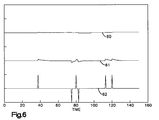
- Fig. 6 shows a steady state input signal 62 with large noise spikes superimposed on it.
- the process controller should not respond to the large noise spikes as they are not valid signal changes.
- the smart filter response 60 continues to filter heavily in the presence of incoming noise spikes.
- the lag filter response 61 is influenced by each noise spike even though a noise spike is not a valid signal change. Therefore, once again the lag filter response 61 introduces much more error to the true signal (DC in this case) when compared to the smart filter response 60.
- the response of the smart filter is substantially better than the response of the conventional lag filter. While not shown in Figs. 4 to 6, those skilled in the art will appreciate that the response of the smart filter will also be better than the response of a conventional moving average type filter.
- one of the drawbacks to using the conventional moving average type filter is its inherent poor noise rejection to noise spikes. As soon as the noise spike enters as one of the stored measurements, the output of the moving average continues to weight that noise spike evenly with the other stored measurements until the noise spike measurement has been replaced in the limited number of chronologically stored measurements. This would produce a near squarewave effect for the conventional moving average output.
- Step 25 of Figure 3 may be altered to allow use of the smart filter in those process control applications where the signal response direction dictates the signal and noise characteristics.
- the levels which were set to zero for CSB and DELTA in step 25 could be set differently.
- step 23 can be simplified for applications which do not require all of the sophistication of the smart filter.
- removing step 28 we easily accomplish the following functionality: AMT1 would represent the number of control cycles that the signal must agree in trend while maintaining an absolute delta value greater than AMT3 in order to track the signal; otherwise, damp the signal by the maximum SCALAR.
- the SCALAR value which may be passed to a filter may be modified to be squared, cubed, or represent a power of 2 in order to achieve an accelerated rate at which the smart filter damping is changed.
- a SCALAR of 3 might be cubed to pass a damping weight of 27.
- the SCALAR of 3 represents a power of 2 where 2 to the third power is a damping weight of 8.
- the smart filter of the present invention can also apply itself readily to integer format applications.
- the smart filter for integers would add one bit to the change in order to track to the input signal even when the damping weight factor is extremely large. For instance, in step 29 the output would still be the old average adjusted by the scaled delta amount; however, one would always want to round the scaled delta amount to the next integer so that it is never zero unless delta is zero.
- this invention may be carried over into a moving average filter application where the number of averaged stored measurements changes to reflect the SCALAR amount; hence, the filtering and quick response can be implemented in moving average form.
- the controller 10 (see Fig. 1) would store a certain amount of measurements of the process variable signal at input 12 chronologically. The amount of measurements the controller stored would reflect the heaviest (largest) desired damping weight for the moving average.
- One application of the moving average could use the SCALAR term of 28 squared plus 1 to indicate how many measurements are to be averaged to determine the output of the smart filter. For example, if the controller stores up to 10 values for the moving average smart filter, and the current SCALAR is 2, then the SCALAR squared plus 1 is 5 and the output of the moving average smart filter is the average of the last 5 measurements.
- Another form of the invention uses a method of multiple recursive iterations based on the SCALAR of the smart filter.
- the SCALAR value from step 28 could be based on from a value of one up to the absolute value of CSB.
- This SCALAR value squared would indicate how many times a heavy (large) damping weight lag filter should be run recursively during each cycle.
- the CSB is zero the SCALAR is one and the squared SCALAR is one, having the lag filter run only once.
- the CSB were 4 then the squared SCALAR would be 16 and the lag filter would run recursively 16 times in that control cycle.
- the more times a lag filter is run recursively the more it tracks to the change in signal. Likewise, the less the lag filter runs each cycle, the more the noise rejection will take effect.
- the invention is not limited to using the squared term of the SCALAR in step 28 as a means of determining the weight of the filter; the SCALAR could be cubed or simply used as itself.
- the squared SCALAR term provides an accelerated dynamic filter weight which allows the smart filter to respond from heavy damping to quick tracking in a relatively short period of time with minimal processing time.
- a windowed filter version is another form of the invention which uses windowed values to determine the damping weight.
- step 29 shows a term with 'SCALAR ⁇ 2+AMT5' which can be substituted by a set of damping weights determined by a windowed value of CSB.
- the substitution may for example be 'If
- the advantage of this is that only a limited number of weights (two in this case) are used, and a window is set up around the CSB value to determine the damping weight.
- Figure 7 shows an extension of the present invention which allows signal trending within the defined noise band set by AMT3. Hence, rather than zero out CSB if the absolute delta value is less than AMT3, the trend is analyzed within this band with a NB_CSB which is the noise band cumulative status byte. This additional level of sophistication in the smart filter allows quicker response to a true signal change happening within the noise band.
- Step 70 in Figure 7 would replace step 25 in figure 3.
- step 74 replaces step 27. All of the other steps in Figure 3 remain as is with the addition of the steps in Figure 7.
- Step 77 asks if the absolute value of the noise band trend NB_CSB is greater or equal to an AMT6. If so, NB_CSB is set back to zero in step 78 and then goes to step 26 as shown by 72 where CSB will be adjusted to show trend recognition.
- AMT6 is set by the number of consecutive signal trends in same direction within the noise band which would constitute a valid signal change. For example if AMT6 is set to 5, then this requires the signal to trend in the same direction within the noise band for at least 5 consecutive control cycles before adjusting CSB to represent a valid signal change.
- NB_CSB can be applied to the increment-decrement function described earlier for integer format applications. This is because the extension allows signal tracking within the noise band; therefore, for integer applications, the smart filter output no longer would need to change by one regardless in order to track a signal change. It could change by one only when
Landscapes
- Engineering & Computer Science (AREA)
- Physics & Mathematics (AREA)
- Computer Hardware Design (AREA)
- Mathematical Physics (AREA)
- Computing Systems (AREA)
- Theoretical Computer Science (AREA)
- Feedback Control In General (AREA)
- Noise Elimination (AREA)
- Networks Using Active Elements (AREA)
- Testing And Monitoring For Control Systems (AREA)
- Combined Controls Of Internal Combustion Engines (AREA)
Applications Claiming Priority (2)
| Application Number | Priority Date | Filing Date | Title |
|---|---|---|---|
| US990516 | 1992-12-15 | ||
| US07/990,516 US5339335A (en) | 1992-12-15 | 1992-12-15 | Method and apparatus for digitally processing and filtering signals in industrial control applications |
Publications (3)
| Publication Number | Publication Date |
|---|---|
| EP0602780A2 true EP0602780A2 (fr) | 1994-06-22 |
| EP0602780A3 EP0602780A3 (fr) | 1995-08-09 |
| EP0602780B1 EP0602780B1 (fr) | 1999-09-15 |
Family
ID=25536238
Family Applications (1)
| Application Number | Title | Priority Date | Filing Date |
|---|---|---|---|
| EP93308374A Expired - Lifetime EP0602780B1 (fr) | 1992-12-15 | 1993-10-21 | Traitement et filtrage numérique de signaux |
Country Status (13)
| Country | Link |
|---|---|
| US (1) | US5339335A (fr) |
| EP (1) | EP0602780B1 (fr) |
| JP (1) | JPH06222885A (fr) |
| KR (1) | KR970006623B1 (fr) |
| CN (1) | CN1112751A (fr) |
| AU (1) | AU667136B2 (fr) |
| BR (1) | BR9305030A (fr) |
| CA (1) | CA2108086C (fr) |
| DE (1) | DE69326420T2 (fr) |
| ES (1) | ES2136114T3 (fr) |
| MX (1) | MX9307416A (fr) |
| NO (1) | NO934015L (fr) |
| SG (1) | SG46500A1 (fr) |
Cited By (3)
| Publication number | Priority date | Publication date | Assignee | Title |
|---|---|---|---|---|
| WO2002058440A1 (fr) * | 2001-01-22 | 2002-07-25 | Koninklijke Philips Electronics N.V. | Ballast et procédé d'alimentation d'une lampe fluorescente |
| WO2005001395A1 (fr) * | 2003-06-30 | 2005-01-06 | Endress + Hauser Flowtec Ag | Procede permettant de faire fonctionner un appareil de mesure dans des processus |
| WO2004101322A3 (fr) * | 2003-05-06 | 2005-05-12 | Snap On Tools Corp | Filtrage reposant sur une identification de parametres |
Families Citing this family (13)
| Publication number | Priority date | Publication date | Assignee | Title |
|---|---|---|---|---|
| JP3039365B2 (ja) * | 1996-04-15 | 2000-05-08 | 日本電気株式会社 | 受信同期位置制御方式 |
| US5909188A (en) * | 1997-02-24 | 1999-06-01 | Rosemont Inc. | Process control transmitter with adaptive analog-to-digital converter |
| US6263288B1 (en) | 1998-07-22 | 2001-07-17 | Eastman Kodak Company | Method and apparatus for indicating proximity of film scanner to CRT display monitor |
| US6594613B1 (en) * | 1998-12-10 | 2003-07-15 | Rosemount Inc. | Adjustable bandwidth filter for process variable transmitter |
| US6937678B2 (en) | 2001-10-12 | 2005-08-30 | Honeywell International, Inc. | Rate and acceleration limiting filter and method for processing digital signals |
| DE10259719B4 (de) * | 2002-12-19 | 2007-03-15 | Cs Clean Systems Ag | Verfahren zur Minimierung des Fehlers einer Messgröße |
| US6920799B1 (en) | 2004-04-15 | 2005-07-26 | Rosemount Inc. | Magnetic flow meter with reference electrode |
| JP2010505121A (ja) | 2006-09-29 | 2010-02-18 | ローズマウント インコーポレイテッド | 検証を備える磁気流量計 |
| US7509163B1 (en) * | 2007-09-28 | 2009-03-24 | International Business Machines Corporation | Method and system for subject-adaptive real-time sleep stage classification |
| DE102007052047B4 (de) * | 2007-10-31 | 2014-06-26 | Abb Ag | Verfahren und Einrichtung zur Messung von Fremdkörpern im Messmedium |
| US20110119279A1 (en) * | 2009-11-13 | 2011-05-19 | Honeywell International Inc. | Event-based trending filter system |
| CN102651641B (zh) * | 2011-02-24 | 2015-03-04 | 同济大学 | 基于对数量化的网络控制系统l2-l∞滤波信息处理方法 |
| CN114942585B (zh) * | 2022-06-24 | 2025-04-11 | 成都乐创自动化技术股份有限公司 | 一种基于时滞滤波器和pid控制器设置复合控制系统的方法 |
Family Cites Families (5)
| Publication number | Priority date | Publication date | Assignee | Title |
|---|---|---|---|---|
| GB1290865A (fr) * | 1969-09-24 | 1972-09-27 | ||
| DE2410957C2 (de) * | 1974-03-07 | 1982-10-21 | Nixdorf Computer Ag, 4790 Paderborn | Schaltungsanordnung für Datenübertragungsanlagen, zur Unterdrückung impulsförmiger Signale in einer Eingangssignalfolge |
| DE3275266D1 (en) * | 1982-10-09 | 1987-02-26 | Itt Ind Gmbh Deutsche | Digital circuit to suppress changes in a digital signal |
| CA1290083C (fr) * | 1987-06-10 | 1991-10-01 | Grass Valley Group, Inc. (The) | Detecteur analogique de signaux de numerotation |
| CA2052600C (fr) * | 1990-10-17 | 1995-09-19 | Abdi Mohtashemi | Filtre passe-bande adaptatif a moyenne mobile |
-
1992
- 1992-12-15 US US07/990,516 patent/US5339335A/en not_active Expired - Fee Related
-
1993
- 1993-10-08 CA CA002108086A patent/CA2108086C/fr not_active Expired - Fee Related
- 1993-10-21 EP EP93308374A patent/EP0602780B1/fr not_active Expired - Lifetime
- 1993-10-21 ES ES93308374T patent/ES2136114T3/es not_active Expired - Lifetime
- 1993-10-21 DE DE69326420T patent/DE69326420T2/de not_active Expired - Fee Related
- 1993-10-21 SG SG1996005252A patent/SG46500A1/en unknown
- 1993-10-27 AU AU50325/93A patent/AU667136B2/en not_active Ceased
- 1993-11-05 NO NO934015A patent/NO934015L/no unknown
- 1993-11-25 MX MX9307416A patent/MX9307416A/es not_active IP Right Cessation
- 1993-12-13 BR BR9305030A patent/BR9305030A/pt not_active IP Right Cessation
- 1993-12-14 KR KR1019930027538A patent/KR970006623B1/ko not_active Expired - Lifetime
- 1993-12-15 JP JP5342296A patent/JPH06222885A/ja not_active Withdrawn
- 1993-12-15 CN CN93120441A patent/CN1112751A/zh active Pending
Cited By (5)
| Publication number | Priority date | Publication date | Assignee | Title |
|---|---|---|---|---|
| WO2002058440A1 (fr) * | 2001-01-22 | 2002-07-25 | Koninklijke Philips Electronics N.V. | Ballast et procédé d'alimentation d'une lampe fluorescente |
| US6628092B2 (en) | 2001-01-22 | 2003-09-30 | Koninklijke Philips Electronics N.V. | Ballast and method of feeding a fluorescent lamp |
| WO2004101322A3 (fr) * | 2003-05-06 | 2005-05-12 | Snap On Tools Corp | Filtrage reposant sur une identification de parametres |
| WO2005001395A1 (fr) * | 2003-06-30 | 2005-01-06 | Endress + Hauser Flowtec Ag | Procede permettant de faire fonctionner un appareil de mesure dans des processus |
| RU2335740C2 (ru) * | 2003-06-30 | 2008-10-10 | Эндресс+Хаузер Флоутек Аг | Способ работы устройства измерения процесса и магнитно-индуктивный расходометр |
Also Published As
| Publication number | Publication date |
|---|---|
| EP0602780B1 (fr) | 1999-09-15 |
| DE69326420D1 (de) | 1999-10-21 |
| SG46500A1 (en) | 1998-02-20 |
| JPH06222885A (ja) | 1994-08-12 |
| NO934015D0 (no) | 1993-11-05 |
| CA2108086A1 (fr) | 1994-06-16 |
| KR940015900A (ko) | 1994-07-22 |
| AU5032593A (en) | 1994-06-30 |
| CN1112751A (zh) | 1995-11-29 |
| EP0602780A3 (fr) | 1995-08-09 |
| ES2136114T3 (es) | 1999-11-16 |
| DE69326420T2 (de) | 2000-04-13 |
| AU667136B2 (en) | 1996-03-07 |
| BR9305030A (pt) | 1994-07-05 |
| CA2108086C (fr) | 1996-11-26 |
| MX9307416A (es) | 1994-06-30 |
| NO934015L (no) | 1994-06-16 |
| KR970006623B1 (ko) | 1997-04-29 |
| US5339335A (en) | 1994-08-16 |
Similar Documents
| Publication | Publication Date | Title |
|---|---|---|
| EP0602780B1 (fr) | Traitement et filtrage numérique de signaux | |
| KR100356000B1 (ko) | 공정 변수 출력 신호의 현재 상태와 그러한 출력 신호가 허용 가능한 한도 내에 속하는지의 여부를 판정하는 방법 | |
| DE69130762T2 (de) | Digitale servosteuerung für ein plattenlaufwerk | |
| US5541833A (en) | Multivariable feedforward adaptive controller | |
| Feuer et al. | Generalized sample hold functions-frequency domain analysis of robustness, sensitivity, and intersample difficulties | |
| JPH07261804A (ja) | 自己同調制御装置におけるプロセス特性取得方法および装置 | |
| US5301080A (en) | Bias servo loop for magneto-resistive read/write head | |
| EP0417593A2 (fr) | Dispositif de commande de processus | |
| US5463346A (en) | Fast response low-pass filter | |
| US5111124A (en) | Continuous deadbeat control system with feedback control | |
| Ishii et al. | Bilateral exponential smoothing of time series | |
| EP0774176B1 (fr) | Filtre, systeme de commande repetitif et systeme de commande autodidactique munis tous deux dudit filtre | |
| CN120262337A (zh) | 基于卡尔曼滤波的电网浪涌控制方法、系统、设备及介质 | |
| Treichler | Response of the adaptive line enhancer to chirped and Doppler-shifted sinusoids | |
| DE10201902A1 (de) | Verfahren zur digitalen Filterung eines mit Rauschen behafteten Signals und Regelungssystem für ein Fahrzeug | |
| EP0554442B1 (fr) | Commande a action directe multivariable et adaptative | |
| US5801645A (en) | Automatic paired LVDT probe balancing | |
| US5363311A (en) | Data compression system using response waveform discrimination | |
| Smith et al. | A cost effective repetitive controller and its design | |
| Holst et al. | Self tuning control of plants with abrupt changes | |
| Nuninger et al. | Disturbance rejection using output and input estimation. Application to the friction compensation of a DC motor | |
| Van Schooneveld et al. | Spectral analysis: On the usefulness of linear tapering for leakage suppression | |
| Boucher et al. | True digital control: an integrated environment for the design of direct digital and adaptive control systems | |
| Palsson et al. | Generalized predictive control for non-stationary systems | |
| JPH07167981A (ja) | 原子炉安定度監視装置 |
Legal Events
| Date | Code | Title | Description |
|---|---|---|---|
| PUAI | Public reference made under article 153(3) epc to a published international application that has entered the european phase |
Free format text: ORIGINAL CODE: 0009012 |
|
| AK | Designated contracting states |
Kind code of ref document: A2 Designated state(s): DE ES FR GB IT |
|
| PUAL | Search report despatched |
Free format text: ORIGINAL CODE: 0009013 |
|
| AK | Designated contracting states |
Kind code of ref document: A3 Designated state(s): DE ES FR GB IT |
|
| 17P | Request for examination filed |
Effective date: 19960102 |
|
| GRAG | Despatch of communication of intention to grant |
Free format text: ORIGINAL CODE: EPIDOS AGRA |
|
| 17Q | First examination report despatched |
Effective date: 19981203 |
|
| GRAG | Despatch of communication of intention to grant |
Free format text: ORIGINAL CODE: EPIDOS AGRA |
|
| GRAG | Despatch of communication of intention to grant |
Free format text: ORIGINAL CODE: EPIDOS AGRA |
|
| GRAH | Despatch of communication of intention to grant a patent |
Free format text: ORIGINAL CODE: EPIDOS IGRA |
|
| GRAH | Despatch of communication of intention to grant a patent |
Free format text: ORIGINAL CODE: EPIDOS IGRA |
|
| GRAA | (expected) grant |
Free format text: ORIGINAL CODE: 0009210 |
|
| ITF | It: translation for a ep patent filed | ||
| AK | Designated contracting states |
Kind code of ref document: B1 Designated state(s): DE ES FR GB IT |
|
| ET | Fr: translation filed | ||
| REF | Corresponds to: |
Ref document number: 69326420 Country of ref document: DE Date of ref document: 19991021 |
|
| REG | Reference to a national code |
Ref country code: ES Ref legal event code: FG2A Ref document number: 2136114 Country of ref document: ES Kind code of ref document: T3 |
|
| PLBE | No opposition filed within time limit |
Free format text: ORIGINAL CODE: 0009261 |
|
| PG25 | Lapsed in a contracting state [announced via postgrant information from national office to epo] |
Ref country code: DE Free format text: LAPSE BECAUSE OF NON-PAYMENT OF DUE FEES Effective date: 20000801 |
|
| 26N | No opposition filed | ||
| PGFP | Annual fee paid to national office [announced via postgrant information from national office to epo] |
Ref country code: GB Payment date: 20010914 Year of fee payment: 9 |
|
| PGFP | Annual fee paid to national office [announced via postgrant information from national office to epo] |
Ref country code: FR Payment date: 20011011 Year of fee payment: 9 |
|
| PGFP | Annual fee paid to national office [announced via postgrant information from national office to epo] |
Ref country code: ES Payment date: 20011024 Year of fee payment: 9 |
|
| REG | Reference to a national code |
Ref country code: GB Ref legal event code: IF02 |
|
| PG25 | Lapsed in a contracting state [announced via postgrant information from national office to epo] |
Ref country code: GB Free format text: LAPSE BECAUSE OF NON-PAYMENT OF DUE FEES Effective date: 20021021 |
|
| PG25 | Lapsed in a contracting state [announced via postgrant information from national office to epo] |
Ref country code: ES Free format text: LAPSE BECAUSE OF NON-PAYMENT OF DUE FEES Effective date: 20021022 |
|
| GBPC | Gb: european patent ceased through non-payment of renewal fee |
Effective date: 20021021 |
|
| PG25 | Lapsed in a contracting state [announced via postgrant information from national office to epo] |
Ref country code: FR Free format text: LAPSE BECAUSE OF NON-PAYMENT OF DUE FEES Effective date: 20030630 |
|
| REG | Reference to a national code |
Ref country code: FR Ref legal event code: ST |
|
| REG | Reference to a national code |
Ref country code: ES Ref legal event code: FD2A Effective date: 20031112 |
|
| PG25 | Lapsed in a contracting state [announced via postgrant information from national office to epo] |
Ref country code: IT Free format text: LAPSE BECAUSE OF NON-PAYMENT OF DUE FEES;WARNING: LAPSES OF ITALIAN PATENTS WITH EFFECTIVE DATE BEFORE 2007 MAY HAVE OCCURRED AT ANY TIME BEFORE 2007. THE CORRECT EFFECTIVE DATE MAY BE DIFFERENT FROM THE ONE RECORDED. Effective date: 20051021 |