EP0602928A2 - Vorrichtung zum Entfernen des Toners aus der Reinigungsbürste eines xerographischen Gerätes - Google Patents
Vorrichtung zum Entfernen des Toners aus der Reinigungsbürste eines xerographischen Gerätes Download PDFInfo
- Publication number
- EP0602928A2 EP0602928A2 EP93310057A EP93310057A EP0602928A2 EP 0602928 A2 EP0602928 A2 EP 0602928A2 EP 93310057 A EP93310057 A EP 93310057A EP 93310057 A EP93310057 A EP 93310057A EP 0602928 A2 EP0602928 A2 EP 0602928A2
- Authority
- EP
- European Patent Office
- Prior art keywords
- brush
- housing
- fibers
- chamber
- screen
- Prior art date
- Legal status (The legal status is an assumption and is not a legal conclusion. Google has not performed a legal analysis and makes no representation as to the accuracy of the status listed.)
- Withdrawn
Links
- 239000000835 fiber Substances 0.000 claims abstract description 33
- 239000000463 material Substances 0.000 claims description 13
- 238000003384 imaging method Methods 0.000 claims description 6
- 238000004140 cleaning Methods 0.000 description 12
- 239000002245 particle Substances 0.000 description 12
- 108091008695 photoreceptors Proteins 0.000 description 11
- 238000012546 transfer Methods 0.000 description 8
- 239000000843 powder Substances 0.000 description 6
- 238000000034 method Methods 0.000 description 5
- 238000012545 processing Methods 0.000 description 5
- 238000011161 development Methods 0.000 description 3
- 150000002500 ions Chemical class 0.000 description 3
- 239000011324 bead Substances 0.000 description 2
- 239000000758 substrate Substances 0.000 description 2
- 239000005995 Aluminium silicate Substances 0.000 description 1
- 238000009825 accumulation Methods 0.000 description 1
- 235000012211 aluminium silicate Nutrition 0.000 description 1
- 239000003086 colorant Substances 0.000 description 1
- 239000000356 contaminant Substances 0.000 description 1
- 238000005286 illumination Methods 0.000 description 1
- NLYAJNPCOHFWQQ-UHFFFAOYSA-N kaolin Chemical compound O.O.O=[Al]O[Si](=O)O[Si](=O)O[Al]=O NLYAJNPCOHFWQQ-UHFFFAOYSA-N 0.000 description 1
- 239000007769 metal material Substances 0.000 description 1
- 239000000203 mixture Substances 0.000 description 1
- 238000012986 modification Methods 0.000 description 1
- 230000004048 modification Effects 0.000 description 1
- 238000011160 research Methods 0.000 description 1
Images
Classifications
-
- G—PHYSICS
- G03—PHOTOGRAPHY; CINEMATOGRAPHY; ANALOGOUS TECHNIQUES USING WAVES OTHER THAN OPTICAL WAVES; ELECTROGRAPHY; HOLOGRAPHY
- G03G—ELECTROGRAPHY; ELECTROPHOTOGRAPHY; MAGNETOGRAPHY
- G03G21/00—Arrangements not provided for by groups G03G13/00 - G03G19/00, e.g. cleaning, elimination of residual charge
- G03G21/0005—Arrangements not provided for by groups G03G13/00 - G03G19/00, e.g. cleaning, elimination of residual charge for removing solid developer or debris from the electrographic recording medium
- G03G21/0035—Arrangements not provided for by groups G03G13/00 - G03G19/00, e.g. cleaning, elimination of residual charge for removing solid developer or debris from the electrographic recording medium using a brush; Details of cleaning brushes, e.g. fibre density
Definitions
- This invention relates generally to an electrostatographic copier or printer, and more particularly, concerns a cleaning apparatus suitable for use in such a copier/printer.
- a charge retentive surface i.e. photoconductor, photoreceptor or imaging surface
- a charge retentive surface i.e. photoconductor, photoreceptor or imaging surface
- the resulting pattern of charged and discharged areas on that surface form an electrostatic charge pattern (i.e. an electrostatic latent image) conforming to the original image.
- the latent image is developed by contacting it with a finely divided electrostatically attractable powder referred to as "toner". Toner is held on the image areas by the electrostatic charge on the surface.
- toner is held on the image areas by the electrostatic charge on the surface.
- the toner image may then be transferred to a substrate (eg. paper), and the image affixed thereto to form a permanent record of the image to be reproduced. Subsequent to development, excess toner left on the charge retentive surface is cleaned from the surface.
- a substrate eg. paper
- This process is well known, and useful for light lens copying from an original, and printing applications from electronically generated or stored originals, where a charge surface may be imagewise discharged in a variety of ways. Ion projection devices where a charge is imagewise deposited on a charge retentive substrate operates similarly.
- a commercially successful mode of cleaning employed on automatic xerographic devices utilizes a brush with soft conductive fiber bristles or with insulative soft bristles which have suitable triboelectric characteristics. While the bristles are soft for the insulative brush, they provide sufficient mechanical force to dislodge residual toner particles from the charge retentive surface. In the case of the conductive brush, the brush is usually electrically biased to provide an electrostatic force for toner detachment from the charge retentive surface. Toner particles adhere to the fibers (i e. bristles) of the brush after the charge retentive surface has been cleaned. The process of removing toner from these types of cleaner brushes can be accomplished in many ways.
- a flicker bar is usually a thin long bar with a controlled amount of interference with the brush fibers.
- the fibers bend and the impact dislodges toner particles adhering to the fibers. Once released, these particles may be carried away by an airstream to a toner filter or separator.
- the disadvantage of this method is that the brush fibers have just one chance or revolution for detoning. This results in partial detoning of the fibers and a gradual accumulation of toner in the brush. When the amount of toner accumulated in the brush exceeds a critical level, a severe cleaning failure can occur.
- US-A- 4,054,381 to Bernhard discloses a spiral brush mounted for rotation on a shaft centrally located within a housing and a stationary open mesh screen coaxially located with respect to the shaft having a small space being provided between the brush fibers and the screen. Rotation of the spiral brush operates to sift toner through the screen to the outlet of the filter housing while concurrently moving the toner from the input opening toward the discharge opening.
- an apparatus comprising a brush having a multiplicity of fibers extending outwardly therefrom; a housing that defines an open-sided chamber, said brush being mounted movably in the chamber of the housing, with fibers of the brush extending outwardly from the open side of the chamber of the housing in contact with the imaging surface to remove material therefrom; and, a member positioned relative to the fibers of the brush to produce a plurality of impacts thereagainst by each fiber during movement of the brush, dislodging material adhering to the brush.
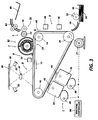
- the various processing stations employed in the reproduction machine illustrated in Figure 3 will first be described.
- the various processing elements also find use in electrophotographic printing applications from an electronically stored original, and with appropriate modifications, in an ion projection device which deposits ions in image configuration on a charge retentive surface.
- the reproduction machine has a photoreceptor belt 10, having a photoconductive (or imaging) surface 11.
- the photoreceptor belt 10 moves in the direction of arrow 12 to advance successive portions of the belt 10 sequentially through the various processing stations disposed about the path of movement thereof.
- the belt 10 is entrained about a stripping roller 14, a tension roller 16, and a drive roller 20.
- Drive roller 20 is coupled to a motor 21 by suitable means such as a belt drive.
- the belt 10 is maintained in tension by a pair of springs (not shown) resiliently urging tension roller 16 against the belt 10 with the desired spring force.
- Both stripping roller 14 and tension roller 16 are rotatably mounted. These rollers are idlers which rotate freely as the belt 10 moves in the direction of arrow 12.
- a corona device 22 charges a portion of the photoreceptor belt 10 to a relatively high, substantially uniform potential, either positive or negative.
- an original document is positioned face down on a transparent platen 30 for illumination with flash lamps 32.
- Light rays reflected from the original document are reflected through a lens 33 and projected onto the charged portion of the photoreceptor belt 10 to selectively dissipate the charge thereon.
- This records an electrostatic latent image on the belt which corresponds to the informational area contained within the original document.
- a laser may be provided to imagewise discharge the photoreceptor in accordance with stored electronic information.
- the belt 10 advances the electrostatic latent image to development station C.
- development station C either developer housing 34 or 36 is brought into contact with the belt 10 for the purpose of developing the electrostatic latent image.
- Housings 34 and 36 may be moved into and out of developing position with corresponding cams 38 and 40, which are selectively driven by motor 21.
- Each developer housing 34 and 36 supports a developing system such as magnetic brush rolls 42 and 44, which provides a rotating magnetic member to advance developer mix (i.e. carrier beads and toner) into contact with the electrostatic latent image.
- the electrostatic latent image attracts toner particles from the carrier beads, thereby forming toner powder images on the photoreceptor belt 10. If two colors of developer material are not required, the second developer housing may be omitted.
- the photoreceptor belt 10 then advances the developed latent image to transfer station D.
- a sheet of support material such as paper copy sheets is advanced into contact with the developed latent images on the belt 10.
- a corona generating device 46 charges the copy sheet to the proper potential so that it becomes tacked to the photoreceptor belt 10 and the toner powder image is attracted from the photoreceptor belt 10 to the sheet.
- the corona generator 48 charges the copy sheet to an opposite polarity to detack the copy sheet from the belt 10, whereupon the sheet is stripped from the belt 10 at stripping roller 14.
- Sheets of support material 49 are advanced to transfer station D from a supply tray 50. Sheets are fed from tray 50, with sheet feeder 52, and advanced to transfer station D along conveyor 56.
- Fusing station E includes a fuser assembly indicated generally by the reference numeral 70, which permanently affixes the transfer toner powder images to the sheets.
- the fuser assembly 70 includes a heated fuser roller 72 adapted to be pressure engaged with a backup roller 74 with the toner powder images contacting the fuser roller 72. In this manner, the toner powder image is permanently affixed to the sheet, and such sheets are directed via a chute 62 to an output 80 or finisher.
- Residual particles, remaining on the photoreceptor belt 10 after each copy is made, may be removed at cleaning station F.
- the cleaning apparatus at cleaning station F is represented by the reference numeral 92 and will be described in greater detail below with reference to Figures 1 and 2. Removed residual particles may also be stored for disposal.
- a machine controller 96 is preferably a known programmable controller or combination of controllers, which conventionally control all the machine steps and functions described above.
- the controller 96 is responsive to a variety of sensing devices to enhance control of the machine, and also provides connection diagnostic operations to a user interface (not shown) where required.
- the reproduction machine may be any of several well known devices. Variations may be expected in specific electrophotographic processing, paper handling and control arrangements. However, it is believed that the foregoing description is sufficient to illustrate the general operation of an electrophotographic printing machine in which cleaning apparatus in accordance with the present invention may be employed.
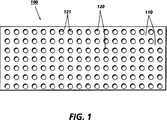
- Figure 1 shows the air pervious screen detoning element of the cleaning apparatus.
- the process of dislodging charged toner particles from the fibers of the cleaning brush depends on the nature of the fiber - toner contact and the fiber-hole contact. Due to inherent variability in these contacts, between toner laden fibers and the screen, and between toner and the fiber itself, there is an element of randomness in the toner detachment process. In order to achieve a high degree of detoning, the brush fibers must be given several opportunities to detone, each additional opportunity brings the brush fibers closer to 100% detoning.
- the screen detoning element 100 shown in Figure 1 consists of a series of holes 120 in a sheet of material 110 instead of a conventional flicker bar.
- the screen can be made of a metallic material and may even be coated with a material such as "TeflonTM".
- the edges 121 around the holes 120 of the screen act as "micro-flicker bars" and provide several opportunities for fiber-to-hole encounters to further detone the brush fibers A series of such encounters detones the brush fibers to a level that is not possible with a conventional system (i.e. a single flicker bar).
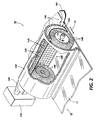
- FIG 2 shows a cut away view of the screen detoning element inside a cleaner housing.
- the screen 100 is bent to conform to the inside perimeter of the cleaner housing 130, creating an air manifold 160 therebetween.
- the screen detoning element 100 is located between the inner wall of the cleaner housing 130 and the brush fibers 140. (The brush is rotatably mounted and rotates in the direction of arrow 15.)
- the space created between the screen 100 and the inner wall of the housing 130 forms the air manifold 160 through which air flows shown by arrow 161.
- the curvature of the screen 100 is such that the brush fibers 140 are in interference with the screen 100.
- the screen 100 shown here is connected to the housing 130 at the 12 o' clock position of the housing 130 and at the base of the open side of the housing 130, covering a portion of the brush circumference. (However, the screen can cover a shorter or longer circumference of the brush as desired.)
- the screen 100 can be attached to the housing 130 in more than one way.
- the screen 100 may be attached to the housing 130 by screws or other fasteners, or may be held in place by inserting edges of the screen into grooves in the housing shell.
- the "micro-flicker bar" action of the screen 100 further detones the brush fibers 140 detaching toner particles 150 therefrom.
- the detached toner particles 150 are released into an air manifold connected to the screen 100.
- the toner particles 150 are carried away, at this point, by an air stream to a filter or separator 170 for further processing.
Landscapes
- Physics & Mathematics (AREA)
- General Physics & Mathematics (AREA)
- Cleaning In Electrography (AREA)
Applications Claiming Priority (2)
| Application Number | Priority Date | Filing Date | Title |
|---|---|---|---|
| US07/990,391 US5341201A (en) | 1992-12-14 | 1992-12-14 | Xerographic brush cleaner detoner |
| US990391 | 1992-12-14 |
Publications (2)
| Publication Number | Publication Date |
|---|---|
| EP0602928A2 true EP0602928A2 (de) | 1994-06-22 |
| EP0602928A3 EP0602928A3 (en) | 1994-08-10 |
Family
ID=25536103
Family Applications (1)
| Application Number | Title | Priority Date | Filing Date |
|---|---|---|---|
| EP19930310057 Withdrawn EP0602928A3 (en) | 1992-12-14 | 1993-12-14 | Xerographic brush cleaner detoner. |
Country Status (3)
| Country | Link |
|---|---|
| US (1) | US5341201A (de) |
| EP (1) | EP0602928A3 (de) |
| JP (1) | JPH06214491A (de) |
Families Citing this family (5)
| Publication number | Priority date | Publication date | Assignee | Title |
|---|---|---|---|---|
| US5481351A (en) * | 1993-03-18 | 1996-01-02 | Hitachi Koki Co., Ltd. | Electrophotographic recording apparatus having improved residual toner cleaning function |
| US5710960A (en) * | 1994-10-11 | 1998-01-20 | Xerox Corporation | Point of use toner filtration |
| US5587781A (en) * | 1995-12-01 | 1996-12-24 | Xerox Corporation | Optimizing electrostatic brush interferences for increased detoning efficiency |
| JP4602068B2 (ja) * | 2004-12-24 | 2010-12-22 | 京セラミタ株式会社 | 画像形成装置 |
| DE102009037126A1 (de) * | 2009-08-11 | 2011-02-17 | Oerlikon Textile Gmbh & Co. Kg | Vorrichtung zum Reinigen einer Funktionsoberfläche zur Führung oder Behandlung einer Materialbahn |
Family Cites Families (8)
| Publication number | Priority date | Publication date | Assignee | Title |
|---|---|---|---|---|
| US3942889A (en) * | 1973-03-05 | 1976-03-09 | Minolta Camera Kabushiki Kaisha | Residual toner removing apparatus |
| US4054381A (en) * | 1976-04-05 | 1977-10-18 | Xerox Corporation | Toner filter arrangement |
| US4304026A (en) * | 1979-10-01 | 1981-12-08 | Xerox Corporation | Cleaning apparatus for a xerographic reproduction machine |
| JPS56138769A (en) * | 1980-03-31 | 1981-10-29 | Ricoh Co Ltd | Fur brush cleaning device |
| JPS57108875A (en) * | 1980-12-25 | 1982-07-07 | Minolta Camera Co Ltd | Cleaning device |
| JPS5984278A (ja) * | 1982-11-08 | 1984-05-15 | Mita Ind Co Ltd | 電子写真磁気ブラシクリ−ニング方法 |
| US4878093A (en) * | 1988-10-03 | 1989-10-31 | Xerox Corporation | Dual roll cleaning apparatus for charge retentive surface |
| US5200788A (en) * | 1991-11-04 | 1993-04-06 | Xerox Corporation | Brush auger reclaim filtration in a photoreceptor cleaner housing |
-
1992
- 1992-12-14 US US07/990,391 patent/US5341201A/en not_active Expired - Fee Related
-
1993
- 1993-10-07 JP JP5250882A patent/JPH06214491A/ja not_active Withdrawn
- 1993-12-14 EP EP19930310057 patent/EP0602928A3/en not_active Withdrawn
Also Published As
| Publication number | Publication date |
|---|---|
| JPH06214491A (ja) | 1994-08-05 |
| US5341201A (en) | 1994-08-23 |
| EP0602928A3 (en) | 1994-08-10 |
Similar Documents
| Publication | Publication Date | Title |
|---|---|---|
| EP0366426B1 (de) | Elektrophotographische Vorrichtung mit einer mittels Wechselspannung betriebenen Reinigungseinrichtung | |
| US5257079A (en) | Electrostatic brush cleaner with a secondary cleaner | |
| US3590412A (en) | Brush cleaning device for electrostatic machines | |
| EP0103405B1 (de) | Gerät zur Entfernung von Toner | |
| US5530537A (en) | Biased foam roll cleaner | |
| US5444522A (en) | Replaceable cleaner subsystem that prevents particle spillage | |
| US5329344A (en) | Lubrication of a detoning roll | |
| US4878093A (en) | Dual roll cleaning apparatus for charge retentive surface | |
| EP0083990B1 (de) | Selbstreinigende xerographische Vorrichtung | |
| US6259882B1 (en) | Cleaning brush for non-imaging surfaces in an electrostatographic printer or copier | |
| US6775512B2 (en) | Dual electrostatic brush cleaner bias switching for multiple pass cleaning of high density toner inputs | |
| US5479249A (en) | Brush cleaner with roll detoning and air waste removal | |
| US5315358A (en) | Flicker bar with an integral air channel | |
| US4029047A (en) | Toner handling system | |
| US5341201A (en) | Xerographic brush cleaner detoner | |
| EP0322231B1 (de) | Tonertransport durch Drehflügel für Klingenreinigung auf horizontalen Oberflächen | |
| US5339149A (en) | Non-stick spots blade | |
| US5381218A (en) | Conductive cleaning brush belt and detoning thereof | |
| US6169872B1 (en) | Electrostatic cleaning belt brush | |
| US6311038B1 (en) | Cleaning apparatus having multiple wiper blades | |
| EP0620508B1 (de) | Reinigungsvorrichtung | |
| US5210582A (en) | Stretchable cleaner band disturber | |
| US5450186A (en) | Retractable flexible cleaner brush | |
| US5597419A (en) | Slow brush rotation in standby to avoid brush flat spots | |
| US5241352A (en) | Air detoned cleaner brush |
Legal Events
| Date | Code | Title | Description |
|---|---|---|---|
| PUAI | Public reference made under article 153(3) epc to a published international application that has entered the european phase |
Free format text: ORIGINAL CODE: 0009012 |
|
| PUAL | Search report despatched |
Free format text: ORIGINAL CODE: 0009013 |
|
| AK | Designated contracting states |
Kind code of ref document: A2 Designated state(s): DE FR GB |
|
| AK | Designated contracting states |
Kind code of ref document: A3 Designated state(s): DE FR GB |
|
| 17P | Request for examination filed |
Effective date: 19950210 |
|
| 17Q | First examination report despatched |
Effective date: 19960321 |
|
| STAA | Information on the status of an ep patent application or granted ep patent |
Free format text: STATUS: THE APPLICATION HAS BEEN WITHDRAWN |
|
| 18W | Application withdrawn |
Withdrawal date: 19961111 |