EP0603541A2 - Connecteur détachable - Google Patents
Connecteur détachable Download PDFInfo
- Publication number
- EP0603541A2 EP0603541A2 EP93118539A EP93118539A EP0603541A2 EP 0603541 A2 EP0603541 A2 EP 0603541A2 EP 93118539 A EP93118539 A EP 93118539A EP 93118539 A EP93118539 A EP 93118539A EP 0603541 A2 EP0603541 A2 EP 0603541A2
- Authority
- EP
- European Patent Office
- Prior art keywords
- guide
- plug
- plug connection
- longitudinal axis
- lever
- Prior art date
- Legal status (The legal status is an assumption and is not a legal conclusion. Google has not performed a legal analysis and makes no representation as to the accuracy of the status listed.)
- Granted
Links
- 238000003780 insertion Methods 0.000 claims description 3
- 230000037431 insertion Effects 0.000 claims description 3
- 238000000034 method Methods 0.000 claims 3
- 210000002414 leg Anatomy 0.000 description 15
- 230000008878 coupling Effects 0.000 description 14
- 238000010168 coupling process Methods 0.000 description 14
- 238000005859 coupling reaction Methods 0.000 description 14
- 238000006073 displacement reaction Methods 0.000 description 7
- 210000003127 knee Anatomy 0.000 description 1
- 230000013011 mating Effects 0.000 description 1
- 230000007704 transition Effects 0.000 description 1
Images




Classifications
-
- H—ELECTRICITY
- H01—ELECTRIC ELEMENTS
- H01R—ELECTRICALLY-CONDUCTIVE CONNECTIONS; STRUCTURAL ASSOCIATIONS OF A PLURALITY OF MUTUALLY-INSULATED ELECTRICAL CONNECTING ELEMENTS; COUPLING DEVICES; CURRENT COLLECTORS
- H01R13/00—Details of coupling devices of the kinds covered by groups H01R12/70 or H01R24/00 - H01R33/00
- H01R13/62—Means for facilitating engagement or disengagement of coupling parts or for holding them in engagement
- H01R13/629—Additional means for facilitating engagement or disengagement of coupling parts, e.g. aligning or guiding means, levers, gas pressure electrical locking indicators, manufacturing tolerances
- H01R13/62933—Comprising exclusively pivoting lever
Definitions
- the invention relates to a detachable plug connection according to the preamble of patent claim 1.
- a locking bracket on the wiring harness connector as a locking device rotatably mounted, which can be brought into engagement with the power strip.
- the releasable plug connection according to the invention with the characterizing features of claim 1 has the advantage that the aforementioned inadequacy is avoided to a satisfactory extent.
- the plug-in connection has a locking device which, in addition to the locking bracket which can be actuated by a pivoting movement, in order to overcome the plug-in and release forces of the contacts, also contains a deflection lever which is coupled to the locking bracket.
- the pivoted lever on the harness connector is moved by the pivoting movement of the locking bracket so that it, based on a longitudinal axis of the contacts, deflects either transversely or along the longitudinal axis of the contacts.
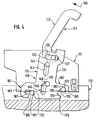
- the plug connection each shows a side view and partly in section, FIGS. 1 to 3 the first exemplary embodiment and FIGS. 4 to 6 the second exemplary embodiment.
- the plug connection is shown in FIGS. 1 and 4 in an open position, in FIGS. 2 and 5 in an engagement position and in FIGS. 3 and 6 in a locking position.
- FIG. 1 shows a first exemplary embodiment of a detachable plug connection, the main components of which are a first plug part which is designed as a wiring harness plug 11, a second plug part which is embodied in a plug strip 12 and has a locking device 13.
- the cable harness connector 11 contains, in a known and not shown manner, as contact elements a plurality of connector sleeves 14 arranged in rows, one of which is shown schematically.
- the plug sleeves 14 can be joined together with counter-contact elements which are designed as pins 16, each with a square cross-sectional area, the plug sleeves 14 at least essentially enclosing the pins 16 all around.
- the pins 16, by one of which is shown schematically, are mounted in the plug connector 12 and, as is known, arranged in rows like the plug sleeves 14.
- the locking device consists of a locking lever 17 and a deflection lever 18 coupled to it and movable relative to the locking lever 17.
- the locking lever 17 is designed as a double-leg, U-shaped lever, with two side legs 19 which are connected by a crossbar 21.
- An end part 23 adjoins this at angled knees.
- an axis in the form of a bearing pin 24 is fastened to each side leg 19, which protrudes on the inside of the side leg 19 and rotatably engages in a bore (not shown) in a side wall 26 of the wiring harness connector 11.
- an axis in the form of a driving pin 27 is attached to the outside of each side leg 19.
- the reversing lever 18, like the locking lever 17, is also in its basic form a double-leg, U-shaped lever with two elongated legs 31, which are congruently parallel and which are connected to one another on a narrow side by a web 32.
- Each of the legs 31 is rectangular in shape with a central longitudinal axis 33 and essentially parallel longitudinal sides 35.
- each of the legs 31 is on a longitudinal side 35 bulged.
- the leg 31 contains a guide track running perpendicular to the longitudinal axis 33, which is designed as a coupling groove 36 and which has the shape of an elongated hole.
- the width of the coupling groove 36 is larger by a play than the diameter of the driving pin 27 of the locking lever 17, which is coupled here by the engagement of the driving pin 27 in the coupling groove 36 with the bell crank 18.
- a guide track which is designed as an engagement groove 38, is arranged transversely to the longitudinal axis 33 in a lower section 37 near the other narrow side of the leg 31.
- the engagement groove 38 has the shape of an elongated hole which has an entry opening 39 at one end towards the narrow side of the leg 31.
- the engagement groove 38 like the entry opening 39, has a width that is greater by a play than the diameter of a holding part which is attached to a longitudinal wall 41 of the plug connector 12 and is designed as a holding bolt 42.
- a guide groove 46 is arranged, which has the shape of a kinked elongated hole, with a guide section 47 which runs symmetrically to the longitudinal axis 33 and a deflection section 48, which, viewed from the engagement groove 38, is arranged downstream of the guide section 47 and is angled at an angle of approximately 135 ° to the guide section 46 such that it is rectified to the position of the inlet opening 39 within the engagement groove 38.
- Guide pin 49, pivot pin 44 and the hole for the bearing pin 24 are arranged on the respective side wall 26 of the wiring harness connector so that they lie on a parallel to a side wall 51 of the wiring harness connector 11, as well as a longitudinal axis 52 of the receptacles 14, which, when closed Plug connection, also forms the longitudinal axis of the pins 16 and to which a boundary wall 53 of the connector strip 12 is arranged in parallel.
- the wiring harness connector 11 is placed on the connector strip 12 in such a way that when the locking device is open with the longitudinal axis 33 inclined to the above parallels and in which the guide bolt 49 rests at the end of the deflection section 48, the retaining bolt 42 passes over the inlet opening 39, which has a conical extension as an insertion aid, enters the engagement groove 38 and comes to rest here on a stop surface 54.
- the plug connection and the locking device 13 are thus in an open position, shown in FIG. 1.
- the locking lever 17 is pivoted in the direction of arrow 56 around the bearing pin 24. This leads to a displacement of the driving bolt 27 in the coupling groove 36 initially to an adjustment of the deflection lever 18 in the direction of the locking lever 17, the deflection section 48 of the guide groove 46 sliding over the guide bolt 49 and the longitudinal groove 43 over the pivot bolt 44 and thereby a rotation of the deflection lever 18 around the pivot pin 44 in a clockwise direction until the deflection lever 18 strikes the retaining pin 42 with the end region of the engagement groove 38 remote from the entry opening 39.
- the plug connection and the locking device 13 are thus in the engagement position shown in FIG. 2, in which the wiring harness plug 11 is positively coupled to the plug connector 12 via the deflection lever 18 and the retaining bolt 42.
- the longitudinal axis 33 of the deflection lever 18 and the longitudinal axis 52 are rectified by the plug sleeves 14 and the pins 16, which, as in the open position, still face each other with a small axial distance.
- the guide pin 49 is located at the free end of the deflection section 48 and thus at the beginning of the guide section 47.
- the locking lever 17 pivots about the driving pin 27 and thus a displacement of the wiring harness connector 11 via the bearing pin 24 toward the connector strip 12.
- the driving pin 27 moves in the coupling groove 36.
- the direction of the merging is predetermined by the bell crank 18, which is guided on the one hand by the displacement of the pivot pin 44 in the longitudinal groove 43 and on the other hand by the displacement of the guide pin 49 in the guide groove 46 so that the movement in the direction of the longitudinal axis 33 of the bell crank 18 and the longitudinal axis 52 through the receptacles 14 or the pins 16 and parallel to the boundary wall 53 of the connector strip 12 and a directional deviation thereof is not possible due to the design and arrangement of the longitudinal groove 43 and the guide groove 46, which run parallel to the longitudinal axis 52.
- the merging of the cable harness connector 11 and the connector strip 12 is ended by the locking lever 17 reaching the locking position shown in FIG. 3 and either the driving pin 27 in the coupling groove 36, the pivot pin 44 in the longitudinal groove 43 or the guide pin 49 in the guide groove 46 at the end attacks.
- the plug sleeves 14 are also joined together with the associated pins 16 and the plug connection is closed and electrically functional, the configuration of the plug sleeves 14 and the pins 16 only allowing a merging directed parallel to the longitudinal axis 52.
- the plug sleeves 14 and the pins 16 are also separated by the corresponding opposite movement sequences parallel to the longitudinal axis 52, the movement control on the one hand via the on the harness connector 11 pivot pin 44 is predetermined by the longitudinal groove 43 in the bell crank 18 and on the other hand via the guide pin 49 mounted on the connector strip 12 by the guide portion 47 of the guide groove 46 in the bell crank 18.
- FIG. 4 shows a second exemplary embodiment of the releasable plug connection. Compared to the first embodiment, the main components remain unchanged and similar parts are given a reference number increased by 100.
- the deflection lever 118 is modified as a component of the locking device 113. Its legs 131 with the longitudinal axis 133 are only hint of a rectangle in the basic shape and the longitudinal sides 135 in the lower section 137 run essentially transversely to the longitudinal axis 133. As a result, two cantilever arms are formed with one first arm 161 and a second arm 162.
- the first engagement groove 163 has the shape of an elongated hole which has a first entry opening 166 at one end towards the narrow side of the leg 131.
- the first engagement groove 163, like the first entry opening 166, has a width that is larger by one play than the diameter of one on the longitudinal wall 141 of the connector strip 112 attached first holding part, which is designed as a first holding bolt 167.
- the second engagement groove 173 is only partially in the form of an elongated hole, since the one imaginary long side of the elongated hole towards the narrow side of the leg 131 is almost completely missing and represents a second inlet opening 176.
- the other long side of the elongated hole forming the second engagement groove 173 is provided with a small bump 178.
- the latching part 179 is shaped in such a way that a second holding part, which is attached to the longitudinal wall 141 of the connector strip 112 and is designed as a second holding bolt 177, can be applied approximately with half the circumferential extent.
- the longitudinal orientation of the engagement grooves 163, 173 runs parallel to a swivel circular path that describes the two retaining bolts 167, 177 engaging in the engagement grooves 163, 173 relative to the moving first part 118.
- the deflection lever 118 contains, analogously to the first exemplary embodiment, a coupling groove 136, a longitudinal groove 143 and a guide groove 146, the deflection section 148 of which is angled towards the side of the second engagement groove 173 and is directed in the same direction as the longitudinal side of the second engagement groove 173 having the bumps 178.
- the position of the deflecting section 148 is in the same direction as the arrangements of the inlet openings 166, 176 within the engagement groove 163, 173.
- the wiring harness connector 111 is placed on the connector strip 112 in such a way that when the locking device 113 is open, in which the guide bolt 149 rests against the end of the deflection section 148, both the first retaining bolt 167 via the first inlet opening 166 and also the second retaining bolt 177 reaches the associated engagement grooves 163, 173 via the second inlet opening 176.
- the first retaining bolt 167 comes to rest on a first stop surface 181 and the second retaining bolt 177 on a second stop surface 182.
- the plug connection and the locking device 113 are thus in the open position, as shown in FIG. 4.
- the locking lever 117 is pivoted in the direction of arrow 156 around the bearing pin 124. This leads to a displacement of the driving pin 127 with and in the coupling groove 138 or the guide pin 149 in the deflecting section 148 of the guide groove 146 to a pivoting movement of the deflecting lever 118 about the pivot pin 144 transversely to the longitudinal axis 133 until the deflecting lever 118 on the one hand End region of the first engagement groove 163 distant from the first entry opening 166 abuts the first retaining bolt 167 and, on the other hand, strikes the second retaining bolt 177 with the latching part 179 of the second engagement groove 173.
- the plug connection and the locking device 113 are thus in the engagement position shown in FIG. 5, in which the wiring harness plug 111 is positively coupled to the plug strip 112 via the deflection lever 118 and the retaining bolts 167, 177, the second retaining bolt 177 after overcoming the Höckers 178 arrives in a latching position when it engages with the latching part 179 and secures the engagement position of the deflection lever 118 and the plug connection.
- the longitudinal axis 133 of the deflection lever 118 and the longitudinal axis 152 are rectified by the plug sleeves 114 and pins 116, which, as in the open position, are still at a slight axial distance from one another. Furthermore, the guide pin 149 is located at the free end of the deflection section 148 and thus at the beginning of the guide section 147.
- the direction of the merging is predetermined by the deflection lever 118, which is guided on the one hand by the displacement of the pivot pin 144 in the longitudinal groove 143 and on the other hand by the displacement of the guide bolt 149 in the guide groove 146 such that the movement in the direction of the longitudinal axis 133 of the deflection lever 118 and the longitudinal axis 152 through the plug sleeves 114 or the pins 116 and parallel to the boundary wall 153 of the connector strip 112 and a directional deviation thereof by the design and arrangement of the longitudinal groove 153 and the guide groove 156, which is parallel to Longitudinal axis 152 run, is not possible.
- connection of the cable harness connector 111 and the connector strip 112 supports parallel to the longitudinal axes 133 and 152. This support facilitates the merging in cases in which the contacting forces are different on both sides of the longitudinal axis 133. This increases the coupling security and stabilizes the coupling position of the bell crank 118.
- the assembly of the cable harness connector 111 and the connector strip 112 is ended by the locking lever 117 reaching the locking position shown in FIG. 3 and the driving pin 127 in the coupling groove 136, the pivot pin 144 in the longitudinal groove 143 and the guide pin 149 in the guide groove 146 striking at the end .
- the plug sleeves 114 are also joined together with the associated pins 116 and the plug connection is closed and electrically functional, the configuration of the plug sleeves 114 and the pins 116 only permitting a merging directed parallel to the longitudinal axis 152.
- the plug sleeves 114 and the pins 116 are also separated by the corresponding opposite movement sequences, parallel to the longitudinal axis 152, the movement control on the one hand via the on the wiring harness plug 111 pivot pin 144 through the longitudinal groove 143 in the bell crank 118 and on the other hand on the Connector strip 112 mounted guide pin 149 is predetermined by the guide portion 147 of the guide groove 146 in the bell crank 118.
Landscapes
- Details Of Connecting Devices For Male And Female Coupling (AREA)
Applications Claiming Priority (2)
| Application Number | Priority Date | Filing Date | Title |
|---|---|---|---|
| DE4243268A DE4243268A1 (de) | 1992-12-19 | 1992-12-19 | Lösbare Steckverbindung |
| DE4243268 | 1992-12-19 |
Publications (3)
| Publication Number | Publication Date |
|---|---|
| EP0603541A2 true EP0603541A2 (fr) | 1994-06-29 |
| EP0603541A3 EP0603541A3 (fr) | 1994-11-09 |
| EP0603541B1 EP0603541B1 (fr) | 1997-06-04 |
Family
ID=6475965
Family Applications (1)
| Application Number | Title | Priority Date | Filing Date |
|---|---|---|---|
| EP93118539A Expired - Lifetime EP0603541B1 (fr) | 1992-12-19 | 1993-11-18 | Connecteur détachable |
Country Status (3)
| Country | Link |
|---|---|
| EP (1) | EP0603541B1 (fr) |
| JP (1) | JP3372327B2 (fr) |
| DE (2) | DE4243268A1 (fr) |
Cited By (3)
| Publication number | Priority date | Publication date | Assignee | Title |
|---|---|---|---|---|
| US5785540A (en) * | 1995-10-11 | 1998-07-28 | The Whitaker Corporation | Electrical connector with an actuating slide |
| US7329132B1 (en) | 2006-07-31 | 2008-02-12 | Yazaki North America, Inc. | Low-insertion force-lever connector for blind mating |
| CN107681361A (zh) * | 2017-08-18 | 2018-02-09 | 浙江永贵电器股份有限公司 | 一种电连接器快速锁紧机构 |
Families Citing this family (7)
| Publication number | Priority date | Publication date | Assignee | Title |
|---|---|---|---|---|
| DE19701918A1 (de) * | 1997-01-21 | 1998-07-23 | Whitaker Corp | Anordnung zum Stecken und Trennen von Steckverbinderteilen, sowie Hilfswerkzeug |
| DE19961708C1 (de) * | 1999-12-21 | 2001-08-09 | Ilme Spa | Verriegelungsvorrichtung für zwei Steckverbinder enthaltende Gehäuseteile |
| DE10331935A1 (de) * | 2003-07-15 | 2005-02-03 | Leopold Kostal Gmbh & Co. Kg | Elektrischer Steckverbinder |
| JP4545052B2 (ja) * | 2005-06-22 | 2010-09-15 | 株式会社東海理化電機製作所 | コネクタの連結構造 |
| DE102010001648B4 (de) | 2010-02-05 | 2012-06-21 | Tyco Electronics Amp Gmbh | Trennschalter |
| JP5985164B2 (ja) | 2011-09-07 | 2016-09-06 | 矢崎総業株式会社 | コネクタのロック構造 |
| DE102020202822B3 (de) | 2020-03-05 | 2021-09-09 | Robert Bosch Gesellschaft mit beschränkter Haftung | Steckverbinder und Steckverbinderanordnung |
Family Cites Families (3)
| Publication number | Priority date | Publication date | Assignee | Title |
|---|---|---|---|---|
| NL137273B (fr) * | 1966-04-08 | |||
| FR2191305B1 (fr) * | 1972-06-30 | 1980-04-18 | Souriau & Cie | |
| JPH07120540B2 (ja) * | 1990-11-30 | 1995-12-20 | 矢崎総業株式会社 | 嵌合操作用カム部材付きコネクタ |
-
1992
- 1992-12-19 DE DE4243268A patent/DE4243268A1/de not_active Ceased
-
1993
- 1993-11-18 DE DE59306663T patent/DE59306663D1/de not_active Expired - Lifetime
- 1993-11-18 EP EP93118539A patent/EP0603541B1/fr not_active Expired - Lifetime
- 1993-12-14 JP JP31318393A patent/JP3372327B2/ja not_active Expired - Fee Related
Cited By (3)
| Publication number | Priority date | Publication date | Assignee | Title |
|---|---|---|---|---|
| US5785540A (en) * | 1995-10-11 | 1998-07-28 | The Whitaker Corporation | Electrical connector with an actuating slide |
| US7329132B1 (en) | 2006-07-31 | 2008-02-12 | Yazaki North America, Inc. | Low-insertion force-lever connector for blind mating |
| CN107681361A (zh) * | 2017-08-18 | 2018-02-09 | 浙江永贵电器股份有限公司 | 一种电连接器快速锁紧机构 |
Also Published As
| Publication number | Publication date |
|---|---|
| EP0603541A3 (fr) | 1994-11-09 |
| EP0603541B1 (fr) | 1997-06-04 |
| JPH06236782A (ja) | 1994-08-23 |
| DE4243268A1 (de) | 1994-06-23 |
| DE59306663D1 (de) | 1997-07-10 |
| JP3372327B2 (ja) | 2003-02-04 |
Similar Documents
| Publication | Publication Date | Title |
|---|---|---|
| DE69420382T2 (de) | Elektrischer kabelverbinder | |
| DE2644560A1 (de) | Klemmvorrichtung | |
| WO2018036898A1 (fr) | Connexion serrée à ressort | |
| DE2414640B2 (de) | Elektrischer Verbinder mit einer metallischen Anschlußklemme | |
| DE29905338U1 (de) | Verbindungselement von zwei Verbindungssteckern, angepaßten weiblichen und männlichen Elementen sowie daraus erhaltene Verbindungsvorrichtung | |
| DE1515443A1 (de) | Elektrische Steckverbindung | |
| DE102007038221B3 (de) | Elektrischer Steckverbinder mit hermaphroditischen Kontaktelementen | |
| EP2018684B1 (fr) | Module avec des raccords pour actionneurs et/ou capteurs | |
| EP0603541B1 (fr) | Connecteur détachable | |
| DE19508189C2 (de) | Elektrische Nullkraft-Kontaktsteckervorrichtung | |
| WO2020114981A1 (fr) | Ensemble formant connecteur enfichable | |
| DE19640458A1 (de) | Klemme für einen beweglichen Steckverbinder | |
| DE102018110312B4 (de) | Leiteranschlussklemme | |
| DE69516386T2 (de) | Elektrischer Steckverbinder und Buchse ohne Einführungskraft | |
| DE102021133011B3 (de) | Verriegelungsvorrichtung für Steckverbindungen sowie Steckverbindung mit einer solchen Verriegelungsvorrichtung | |
| DE69303391T2 (de) | Verriegelungsmechanismus für blindsteckbare elektrische Verbinder | |
| DE102017105077B4 (de) | Kontakteinsatz für ein Steckverbinderteil | |
| EP0724104A1 (fr) | Elément d'atténuation de contraintes et de fixation | |
| DE3150424C2 (de) | Elektrische Steckvorrichtung | |
| EP1514330A1 (fr) | Element de contact pour connecteur electriques a fiches | |
| DE19624660A1 (de) | Elektrischer Verbinder | |
| DE3636088C1 (en) | Device for insertion of an assembly into plug connectors and withdrawal of said assembly from plug connectors | |
| EP0969572A2 (fr) | Connecteur électrique | |
| DE202015101652U1 (de) | Kontaktträger zum Anbringen an einem Steckverbindergehäuse | |
| DE20111964U1 (de) | Sekundärverriegelung für einen Kabelbaumstecker mit unterschiedlichen Kontaktarten |
Legal Events
| Date | Code | Title | Description |
|---|---|---|---|
| PUAI | Public reference made under article 153(3) epc to a published international application that has entered the european phase |
Free format text: ORIGINAL CODE: 0009012 |
|
| AK | Designated contracting states |
Kind code of ref document: A2 Designated state(s): DE FR IT SE |
|
| PUAL | Search report despatched |
Free format text: ORIGINAL CODE: 0009013 |
|
| AK | Designated contracting states |
Kind code of ref document: A3 Designated state(s): DE FR IT SE |
|
| 17P | Request for examination filed |
Effective date: 19950509 |
|
| 17Q | First examination report despatched |
Effective date: 19960627 |
|
| GRAG | Despatch of communication of intention to grant |
Free format text: ORIGINAL CODE: EPIDOS AGRA |
|
| GRAH | Despatch of communication of intention to grant a patent |
Free format text: ORIGINAL CODE: EPIDOS IGRA |
|
| GRAH | Despatch of communication of intention to grant a patent |
Free format text: ORIGINAL CODE: EPIDOS IGRA |
|
| GRAA | (expected) grant |
Free format text: ORIGINAL CODE: 0009210 |
|
| AK | Designated contracting states |
Kind code of ref document: B1 Designated state(s): DE FR IT SE |
|
| ET | Fr: translation filed | ||
| REF | Corresponds to: |
Ref document number: 59306663 Country of ref document: DE Date of ref document: 19970710 |
|
| PLBE | No opposition filed within time limit |
Free format text: ORIGINAL CODE: 0009261 |
|
| STAA | Information on the status of an ep patent application or granted ep patent |
Free format text: STATUS: NO OPPOSITION FILED WITHIN TIME LIMIT |
|
| 26N | No opposition filed | ||
| PGFP | Annual fee paid to national office [announced via postgrant information from national office to epo] |
Ref country code: SE Payment date: 20051122 Year of fee payment: 13 |
|
| PG25 | Lapsed in a contracting state [announced via postgrant information from national office to epo] |
Ref country code: SE Free format text: LAPSE BECAUSE OF NON-PAYMENT OF DUE FEES Effective date: 20061119 |
|
| EUG | Se: european patent has lapsed | ||
| PGFP | Annual fee paid to national office [announced via postgrant information from national office to epo] |
Ref country code: IT Payment date: 20081126 Year of fee payment: 16 |
|
| PGFP | Annual fee paid to national office [announced via postgrant information from national office to epo] |
Ref country code: FR Payment date: 20081118 Year of fee payment: 16 |
|
| REG | Reference to a national code |
Ref country code: FR Ref legal event code: ST Effective date: 20100730 |
|
| PG25 | Lapsed in a contracting state [announced via postgrant information from national office to epo] |
Ref country code: FR Free format text: LAPSE BECAUSE OF NON-PAYMENT OF DUE FEES Effective date: 20091130 |
|
| PG25 | Lapsed in a contracting state [announced via postgrant information from national office to epo] |
Ref country code: IT Free format text: LAPSE BECAUSE OF NON-PAYMENT OF DUE FEES Effective date: 20091118 |
|
| PGFP | Annual fee paid to national office [announced via postgrant information from national office to epo] |
Ref country code: DE Payment date: 20130124 Year of fee payment: 20 |
|
| REG | Reference to a national code |
Ref country code: DE Ref legal event code: R071 Ref document number: 59306663 Country of ref document: DE |
|
| PG25 | Lapsed in a contracting state [announced via postgrant information from national office to epo] |
Ref country code: DE Free format text: LAPSE BECAUSE OF EXPIRATION OF PROTECTION Effective date: 20131119 |