EP0603561A1 - Polysiloxanhaltige Bindemittel, deren Herstellung, diese enthaltende Überzugsmittel und deren Verwendung - Google Patents
Polysiloxanhaltige Bindemittel, deren Herstellung, diese enthaltende Überzugsmittel und deren Verwendung Download PDFInfo
- Publication number
- EP0603561A1 EP0603561A1 EP93118850A EP93118850A EP0603561A1 EP 0603561 A1 EP0603561 A1 EP 0603561A1 EP 93118850 A EP93118850 A EP 93118850A EP 93118850 A EP93118850 A EP 93118850A EP 0603561 A1 EP0603561 A1 EP 0603561A1
- Authority
- EP
- European Patent Office
- Prior art keywords
- meth
- acid
- monomers
- groups
- binders
- Prior art date
- Legal status (The legal status is an assumption and is not a legal conclusion. Google has not performed a legal analysis and makes no representation as to the accuracy of the status listed.)
- Granted
Links
- -1 polysiloxane Polymers 0.000 title claims abstract description 131
- 239000011230 binding agent Substances 0.000 title claims abstract description 65
- 229920001296 polysiloxane Polymers 0.000 title claims abstract description 56
- 238000000576 coating method Methods 0.000 title claims abstract description 19
- 239000011248 coating agent Substances 0.000 title claims description 21
- 238000002360 preparation method Methods 0.000 title claims description 16
- 239000000178 monomer Substances 0.000 claims abstract description 88
- NIXOWILDQLNWCW-UHFFFAOYSA-N acrylic acid group Chemical group C(C=C)(=O)O NIXOWILDQLNWCW-UHFFFAOYSA-N 0.000 claims abstract description 51
- 125000004432 carbon atom Chemical group C* 0.000 claims abstract description 37
- 125000003178 carboxy group Chemical group [H]OC(*)=O 0.000 claims abstract description 22
- 238000004519 manufacturing process Methods 0.000 claims abstract description 21
- 239000007787 solid Substances 0.000 claims abstract description 16
- 239000004593 Epoxy Substances 0.000 claims abstract description 14
- 125000002947 alkylene group Chemical group 0.000 claims abstract description 12
- 239000005871 repellent Substances 0.000 claims abstract description 12
- 238000006116 polymerization reaction Methods 0.000 claims abstract description 8
- 150000001875 compounds Chemical class 0.000 claims description 39
- 125000002887 hydroxy group Chemical group [H]O* 0.000 claims description 38
- 229920000768 polyamine Polymers 0.000 claims description 28
- 229920001228 polyisocyanate Polymers 0.000 claims description 26
- 239000002904 solvent Substances 0.000 claims description 25
- 239000005056 polyisocyanate Substances 0.000 claims description 24
- 125000000217 alkyl group Chemical group 0.000 claims description 21
- 239000003973 paint Substances 0.000 claims description 19
- 125000002496 methyl group Chemical group [H]C([H])([H])* 0.000 claims description 15
- 238000000034 method Methods 0.000 claims description 14
- 229920000877 Melamine resin Polymers 0.000 claims description 13
- 239000004971 Cross linker Substances 0.000 claims description 12
- 239000003431 cross linking reagent Substances 0.000 claims description 11
- 239000003960 organic solvent Substances 0.000 claims description 11
- 229920000647 polyepoxide Polymers 0.000 claims description 11
- 150000001252 acrylic acid derivatives Chemical class 0.000 claims description 10
- 239000003999 initiator Substances 0.000 claims description 10
- 239000000654 additive Substances 0.000 claims description 7
- 239000000049 pigment Substances 0.000 claims description 6
- 230000008569 process Effects 0.000 claims description 6
- 239000000945 filler Substances 0.000 claims description 3
- 239000007788 liquid Substances 0.000 claims description 3
- 239000011253 protective coating Substances 0.000 claims description 2
- 239000008199 coating composition Substances 0.000 abstract description 14
- NIXOWILDQLNWCW-UHFFFAOYSA-M Acrylate Chemical compound [O-]C(=O)C=C NIXOWILDQLNWCW-UHFFFAOYSA-M 0.000 description 55
- 229920005862 polyol Polymers 0.000 description 48
- 150000003077 polyols Chemical class 0.000 description 44
- 239000002253 acid Substances 0.000 description 39
- 239000000203 mixture Substances 0.000 description 34
- 238000006243 chemical reaction Methods 0.000 description 29
- 150000002148 esters Chemical class 0.000 description 27
- SMZOUWXMTYCWNB-UHFFFAOYSA-N 2-(2-methoxy-5-methylphenyl)ethanamine Chemical compound COC1=CC=C(C)C=C1CCN SMZOUWXMTYCWNB-UHFFFAOYSA-N 0.000 description 24
- PPBRXRYQALVLMV-UHFFFAOYSA-N Styrene Chemical compound C=CC1=CC=CC=C1 PPBRXRYQALVLMV-UHFFFAOYSA-N 0.000 description 24
- 229920005989 resin Polymers 0.000 description 24
- 239000011347 resin Substances 0.000 description 24
- LYCAIKOWRPUZTN-UHFFFAOYSA-N Ethylene glycol Chemical compound OCCO LYCAIKOWRPUZTN-UHFFFAOYSA-N 0.000 description 23
- PEDCQBHIVMGVHV-UHFFFAOYSA-N Glycerine Chemical compound OCC(O)CO PEDCQBHIVMGVHV-UHFFFAOYSA-N 0.000 description 23
- CERQOIWHTDAKMF-UHFFFAOYSA-N Methacrylic acid Chemical compound CC(=C)C(O)=O CERQOIWHTDAKMF-UHFFFAOYSA-N 0.000 description 23
- 229920001577 copolymer Polymers 0.000 description 21
- 229920000728 polyester Polymers 0.000 description 21
- 229920000642 polymer Polymers 0.000 description 21
- OFOBLEOULBTSOW-UHFFFAOYSA-N Propanedioic acid Natural products OC(=O)CC(O)=O OFOBLEOULBTSOW-UHFFFAOYSA-N 0.000 description 19
- XLYOFNOQVPJJNP-UHFFFAOYSA-N water Substances O XLYOFNOQVPJJNP-UHFFFAOYSA-N 0.000 description 19
- 150000003254 radicals Chemical class 0.000 description 18
- 125000003055 glycidyl group Chemical group C(C1CO1)* 0.000 description 17
- 238000005809 transesterification reaction Methods 0.000 description 15
- LFQSCWFLJHTTHZ-UHFFFAOYSA-N Ethanol Chemical compound CCO LFQSCWFLJHTTHZ-UHFFFAOYSA-N 0.000 description 14
- 239000004793 Polystyrene Substances 0.000 description 14
- 125000001931 aliphatic group Chemical group 0.000 description 14
- 229920000058 polyacrylate Polymers 0.000 description 14
- 239000007795 chemical reaction product Substances 0.000 description 13
- 239000012948 isocyanate Substances 0.000 description 13
- LRHPLDYGYMQRHN-UHFFFAOYSA-N N-Butanol Chemical compound CCCCO LRHPLDYGYMQRHN-UHFFFAOYSA-N 0.000 description 12
- ZMANZCXQSJIPKH-UHFFFAOYSA-N Triethylamine Chemical compound CCN(CC)CC ZMANZCXQSJIPKH-UHFFFAOYSA-N 0.000 description 12
- 150000007513 acids Chemical class 0.000 description 12
- 125000000484 butyl group Chemical group [H]C([*])([H])C([H])([H])C([H])([H])C([H])([H])[H] 0.000 description 11
- 239000005058 Isophorone diisocyanate Substances 0.000 description 10
- 125000003118 aryl group Chemical group 0.000 description 10
- 125000001495 ethyl group Chemical group [H]C([H])([H])C([H])([H])* 0.000 description 10
- RRAMGCGOFNQTLD-UHFFFAOYSA-N hexamethylene diisocyanate Chemical compound O=C=NCCCCCCN=C=O RRAMGCGOFNQTLD-UHFFFAOYSA-N 0.000 description 10
- NIMLQBUJDJZYEJ-UHFFFAOYSA-N isophorone diisocyanate Chemical compound CC1(C)CC(N=C=O)CC(C)(CN=C=O)C1 NIMLQBUJDJZYEJ-UHFFFAOYSA-N 0.000 description 10
- 150000004658 ketimines Chemical class 0.000 description 10
- 239000004922 lacquer Substances 0.000 description 10
- XNGIFLGASWRNHJ-UHFFFAOYSA-N phthalic acid Chemical compound OC(=O)C1=CC=CC=C1C(O)=O XNGIFLGASWRNHJ-UHFFFAOYSA-N 0.000 description 10
- VZCYOOQTPOCHFL-UHFFFAOYSA-N trans-butenedioic acid Natural products OC(=O)C=CC(O)=O VZCYOOQTPOCHFL-UHFFFAOYSA-N 0.000 description 10
- 239000005057 Hexamethylene diisocyanate Substances 0.000 description 9
- YXFVVABEGXRONW-UHFFFAOYSA-N Toluene Chemical compound CC1=CC=CC=C1 YXFVVABEGXRONW-UHFFFAOYSA-N 0.000 description 9
- ZJCCRDAZUWHFQH-UHFFFAOYSA-N Trimethylolpropane Chemical compound CCC(CO)(CO)CO ZJCCRDAZUWHFQH-UHFFFAOYSA-N 0.000 description 9
- 125000003277 amino group Chemical group 0.000 description 9
- IISBACLAFKSPIT-UHFFFAOYSA-N bisphenol A Chemical compound C=1C=C(O)C=CC=1C(C)(C)C1=CC=C(O)C=C1 IISBACLAFKSPIT-UHFFFAOYSA-N 0.000 description 9
- 125000003700 epoxy group Chemical group 0.000 description 9
- 235000011187 glycerol Nutrition 0.000 description 9
- IQPQWNKOIGAROB-UHFFFAOYSA-N isocyanate group Chemical group [N-]=C=O IQPQWNKOIGAROB-UHFFFAOYSA-N 0.000 description 9
- 229920000570 polyether Polymers 0.000 description 9
- 239000004848 polyfunctional curative Substances 0.000 description 9
- 229920000193 polymethacrylate Polymers 0.000 description 9
- 238000012360 testing method Methods 0.000 description 9
- VZCYOOQTPOCHFL-OWOJBTEDSA-N Fumaric acid Chemical compound OC(=O)\C=C\C(O)=O VZCYOOQTPOCHFL-OWOJBTEDSA-N 0.000 description 8
- 229920006243 acrylic copolymer Polymers 0.000 description 8
- 150000001299 aldehydes Chemical class 0.000 description 8
- 150000001412 amines Chemical class 0.000 description 8
- 150000008064 anhydrides Chemical class 0.000 description 8
- 230000015572 biosynthetic process Effects 0.000 description 8
- 239000003054 catalyst Substances 0.000 description 8
- 239000003795 chemical substances by application Substances 0.000 description 8
- 125000005442 diisocyanate group Chemical group 0.000 description 8
- 230000000694 effects Effects 0.000 description 8
- 125000002768 hydroxyalkyl group Chemical group 0.000 description 8
- 150000002576 ketones Chemical class 0.000 description 8
- 150000002596 lactones Chemical class 0.000 description 8
- 239000000047 product Substances 0.000 description 8
- 229920002554 vinyl polymer Polymers 0.000 description 8
- 229920003270 Cymel® Polymers 0.000 description 7
- CTQNGGLPUBDAKN-UHFFFAOYSA-N O-Xylene Chemical compound CC1=CC=CC=C1C CTQNGGLPUBDAKN-UHFFFAOYSA-N 0.000 description 7
- 239000004721 Polyphenylene oxide Substances 0.000 description 7
- 150000001298 alcohols Chemical class 0.000 description 7
- 125000000524 functional group Chemical group 0.000 description 7
- 150000002513 isocyanates Chemical class 0.000 description 7
- JDSHMPZPIAZGSV-UHFFFAOYSA-N melamine Chemical compound NC1=NC(N)=NC(N)=N1 JDSHMPZPIAZGSV-UHFFFAOYSA-N 0.000 description 7
- 239000004814 polyurethane Substances 0.000 description 7
- 229920002635 polyurethane Polymers 0.000 description 7
- 125000002924 primary amino group Chemical group [H]N([H])* 0.000 description 7
- HJWLCRVIBGQPNF-UHFFFAOYSA-N prop-2-enylbenzene Chemical class C=CCC1=CC=CC=C1 HJWLCRVIBGQPNF-UHFFFAOYSA-N 0.000 description 7
- 238000003786 synthesis reaction Methods 0.000 description 7
- WMOVHXAZOJBABW-UHFFFAOYSA-N tert-butyl acetate Chemical compound CC(=O)OC(C)(C)C WMOVHXAZOJBABW-UHFFFAOYSA-N 0.000 description 7
- 239000008096 xylene Substances 0.000 description 7
- PAPBSGBWRJIAAV-UHFFFAOYSA-N ε-Caprolactone Chemical compound O=C1CCCCCO1 PAPBSGBWRJIAAV-UHFFFAOYSA-N 0.000 description 7
- OMIGHNLMNHATMP-UHFFFAOYSA-N 2-hydroxyethyl prop-2-enoate Chemical compound OCCOC(=O)C=C OMIGHNLMNHATMP-UHFFFAOYSA-N 0.000 description 6
- KUDUQBURMYMBIJ-UHFFFAOYSA-N 2-prop-2-enoyloxyethyl prop-2-enoate Chemical compound C=CC(=O)OCCOC(=O)C=C KUDUQBURMYMBIJ-UHFFFAOYSA-N 0.000 description 6
- QTBSBXVTEAMEQO-UHFFFAOYSA-N Acetic acid Chemical compound CC(O)=O QTBSBXVTEAMEQO-UHFFFAOYSA-N 0.000 description 6
- OKKJLVBELUTLKV-UHFFFAOYSA-N Methanol Chemical compound OC OKKJLVBELUTLKV-UHFFFAOYSA-N 0.000 description 6
- ATUOYWHBWRKTHZ-UHFFFAOYSA-N Propane Chemical compound CCC ATUOYWHBWRKTHZ-UHFFFAOYSA-N 0.000 description 6
- WNLRTRBMVRJNCN-UHFFFAOYSA-N adipic acid Chemical compound OC(=O)CCCCC(O)=O WNLRTRBMVRJNCN-UHFFFAOYSA-N 0.000 description 6
- UPIWXMRIPODGLE-UHFFFAOYSA-N butyl benzenecarboperoxoate Chemical compound CCCCOOC(=O)C1=CC=CC=C1 UPIWXMRIPODGLE-UHFFFAOYSA-N 0.000 description 6
- 238000004132 cross linking Methods 0.000 description 6
- 125000000113 cyclohexyl group Chemical group [H]C1([H])C([H])([H])C([H])([H])C([H])(*)C([H])([H])C1([H])[H] 0.000 description 6
- VZCYOOQTPOCHFL-UPHRSURJSA-N maleic acid Chemical compound OC(=O)\C=C/C(O)=O VZCYOOQTPOCHFL-UPHRSURJSA-N 0.000 description 6
- 239000011976 maleic acid Substances 0.000 description 6
- 238000010992 reflux Methods 0.000 description 6
- 150000005846 sugar alcohols Polymers 0.000 description 6
- LDHQCZJRKDOVOX-UHFFFAOYSA-N trans-crotonic acid Natural products CC=CC(O)=O LDHQCZJRKDOVOX-UHFFFAOYSA-N 0.000 description 6
- 150000007934 α,β-unsaturated carboxylic acids Chemical class 0.000 description 6
- JOYRKODLDBILNP-UHFFFAOYSA-N Ethyl urethane Chemical compound CCOC(N)=O JOYRKODLDBILNP-UHFFFAOYSA-N 0.000 description 5
- 125000003647 acryloyl group Chemical group O=C([*])C([H])=C([H])[H] 0.000 description 5
- 150000004705 aldimines Chemical class 0.000 description 5
- 125000005907 alkyl ester group Chemical group 0.000 description 5
- 150000001735 carboxylic acids Chemical class 0.000 description 5
- 230000000052 comparative effect Effects 0.000 description 5
- LDHQCZJRKDOVOX-NSCUHMNNSA-N crotonic acid Chemical compound C\C=C\C(O)=O LDHQCZJRKDOVOX-NSCUHMNNSA-N 0.000 description 5
- 235000014113 dietary fatty acids Nutrition 0.000 description 5
- GYZLOYUZLJXAJU-UHFFFAOYSA-N diglycidyl ether Chemical class C1OC1COCC1CO1 GYZLOYUZLJXAJU-UHFFFAOYSA-N 0.000 description 5
- 229930195729 fatty acid Natural products 0.000 description 5
- 239000000194 fatty acid Substances 0.000 description 5
- 150000004665 fatty acids Chemical class 0.000 description 5
- 238000010438 heat treatment Methods 0.000 description 5
- FUZZWVXGSFPDMH-UHFFFAOYSA-N hexanoic acid Chemical compound CCCCCC(O)=O FUZZWVXGSFPDMH-UHFFFAOYSA-N 0.000 description 5
- 125000000959 isobutyl group Chemical group [H]C([H])([H])C([H])(C([H])([H])[H])C([H])([H])* 0.000 description 5
- DNIAPMSPPWPWGF-UHFFFAOYSA-N monopropylene glycol Natural products CC(O)CO DNIAPMSPPWPWGF-UHFFFAOYSA-N 0.000 description 5
- 239000000243 solution Substances 0.000 description 5
- DVKJHBMWWAPEIU-UHFFFAOYSA-N toluene 2,4-diisocyanate Chemical compound CC1=CC=C(N=C=O)C=C1N=C=O DVKJHBMWWAPEIU-UHFFFAOYSA-N 0.000 description 5
- 125000000391 vinyl group Chemical group [H]C([*])=C([H])[H] 0.000 description 5
- PUPZLCDOIYMWBV-UHFFFAOYSA-N (+/-)-1,3-Butanediol Chemical compound CC(O)CCO PUPZLCDOIYMWBV-UHFFFAOYSA-N 0.000 description 4
- UAJRSHJHFRVGMG-UHFFFAOYSA-N 1-ethenyl-4-methoxybenzene Chemical compound COC1=CC=C(C=C)C=C1 UAJRSHJHFRVGMG-UHFFFAOYSA-N 0.000 description 4
- HXVNBWAKAOHACI-UHFFFAOYSA-N 2,4-dimethyl-3-pentanone Chemical compound CC(C)C(=O)C(C)C HXVNBWAKAOHACI-UHFFFAOYSA-N 0.000 description 4
- YEJRWHAVMIAJKC-UHFFFAOYSA-N 4-Butyrolactone Chemical compound O=C1CCCO1 YEJRWHAVMIAJKC-UHFFFAOYSA-N 0.000 description 4
- KKEYFWRCBNTPAC-UHFFFAOYSA-N Terephthalic acid Chemical compound OC(=O)C1=CC=C(C(O)=O)C=C1 KKEYFWRCBNTPAC-UHFFFAOYSA-N 0.000 description 4
- 150000004945 aromatic hydrocarbons Chemical class 0.000 description 4
- 239000002585 base Substances 0.000 description 4
- OHJMTUPIZMNBFR-UHFFFAOYSA-N biuret Chemical compound NC(=O)NC(N)=O OHJMTUPIZMNBFR-UHFFFAOYSA-N 0.000 description 4
- WERYXYBDKMZEQL-UHFFFAOYSA-N butane-1,4-diol Chemical compound OCCCCO WERYXYBDKMZEQL-UHFFFAOYSA-N 0.000 description 4
- 239000012141 concentrate Substances 0.000 description 4
- 150000002009 diols Chemical class 0.000 description 4
- 125000003438 dodecyl group Chemical group [H]C([H])([H])C([H])([H])C([H])([H])C([H])([H])C([H])([H])C([H])([H])C([H])([H])C([H])([H])C([H])([H])C([H])([H])C([H])([H])C([H])([H])* 0.000 description 4
- 230000008030 elimination Effects 0.000 description 4
- 238000003379 elimination reaction Methods 0.000 description 4
- 239000000839 emulsion Substances 0.000 description 4
- 239000003822 epoxy resin Substances 0.000 description 4
- 150000002170 ethers Chemical class 0.000 description 4
- 230000002349 favourable effect Effects 0.000 description 4
- 238000010528 free radical solution polymerization reaction Methods 0.000 description 4
- 239000001530 fumaric acid Substances 0.000 description 4
- JARKCYVAAOWBJS-UHFFFAOYSA-N hexanal Chemical compound CCCCCC=O JARKCYVAAOWBJS-UHFFFAOYSA-N 0.000 description 4
- NAQMVNRVTILPCV-UHFFFAOYSA-N hexane-1,6-diamine Chemical compound NCCCCCCN NAQMVNRVTILPCV-UHFFFAOYSA-N 0.000 description 4
- 125000004051 hexyl group Chemical group [H]C([H])([H])C([H])([H])C([H])([H])C([H])([H])C([H])([H])C([H])([H])* 0.000 description 4
- ZXEKIIBDNHEJCQ-UHFFFAOYSA-N isobutanol Chemical compound CC(C)CO ZXEKIIBDNHEJCQ-UHFFFAOYSA-N 0.000 description 4
- 125000001261 isocyanato group Chemical group *N=C=O 0.000 description 4
- QQVIHTHCMHWDBS-UHFFFAOYSA-N isophthalic acid Chemical compound OC(=O)C1=CC=CC(C(O)=O)=C1 QQVIHTHCMHWDBS-UHFFFAOYSA-N 0.000 description 4
- 125000001449 isopropyl group Chemical group [H]C([H])([H])C([H])(*)C([H])([H])[H] 0.000 description 4
- 239000011159 matrix material Substances 0.000 description 4
- BDAGIHXWWSANSR-UHFFFAOYSA-N methanoic acid Natural products OC=O BDAGIHXWWSANSR-UHFFFAOYSA-N 0.000 description 4
- NUJGJRNETVAIRJ-UHFFFAOYSA-N octanal Chemical compound CCCCCCCC=O NUJGJRNETVAIRJ-UHFFFAOYSA-N 0.000 description 4
- 125000002347 octyl group Chemical group [H]C([*])([H])C([H])([H])C([H])([H])C([H])([H])C([H])([H])C([H])([H])C([H])([H])C([H])([H])[H] 0.000 description 4
- 125000000913 palmityl group Chemical group [H]C([*])([H])C([H])([H])C([H])([H])C([H])([H])C([H])([H])C([H])([H])C([H])([H])C([H])([H])C([H])([H])C([H])([H])C([H])([H])C([H])([H])C([H])([H])C([H])([H])C([H])([H])C([H])([H])[H] 0.000 description 4
- WXZMFSXDPGVJKK-UHFFFAOYSA-N pentaerythritol Chemical compound OCC(CO)(CO)CO WXZMFSXDPGVJKK-UHFFFAOYSA-N 0.000 description 4
- 125000001147 pentyl group Chemical group C(CCCC)* 0.000 description 4
- 229920005906 polyester polyol Polymers 0.000 description 4
- 230000000379 polymerizing effect Effects 0.000 description 4
- BDERNNFJNOPAEC-UHFFFAOYSA-N propan-1-ol Chemical compound CCCO BDERNNFJNOPAEC-UHFFFAOYSA-N 0.000 description 4
- 125000001436 propyl group Chemical group [H]C([*])([H])C([H])([H])C([H])([H])[H] 0.000 description 4
- 229920006395 saturated elastomer Polymers 0.000 description 4
- 125000000467 secondary amino group Chemical group [H]N([*:1])[*:2] 0.000 description 4
- 125000004079 stearyl group Chemical group [H]C([*])([H])C([H])([H])C([H])([H])C([H])([H])C([H])([H])C([H])([H])C([H])([H])C([H])([H])C([H])([H])C([H])([H])C([H])([H])C([H])([H])C([H])([H])C([H])([H])C([H])([H])C([H])([H])C([H])([H])C([H])([H])[H] 0.000 description 4
- 239000000126 substance Substances 0.000 description 4
- JOXIMZWYDAKGHI-UHFFFAOYSA-N toluene-4-sulfonic acid Chemical compound CC1=CC=C(S(O)(=O)=O)C=C1 JOXIMZWYDAKGHI-UHFFFAOYSA-N 0.000 description 4
- ARCGXLSVLAOJQL-UHFFFAOYSA-N trimellitic acid Chemical compound OC(=O)C1=CC=C(C(O)=O)C(C(O)=O)=C1 ARCGXLSVLAOJQL-UHFFFAOYSA-N 0.000 description 4
- STMDPCBYJCIZOD-UHFFFAOYSA-N 2-(2,4-dinitroanilino)-4-methylpentanoic acid Chemical compound CC(C)CC(C(O)=O)NC1=CC=C([N+]([O-])=O)C=C1[N+]([O-])=O STMDPCBYJCIZOD-UHFFFAOYSA-N 0.000 description 3
- HZAXFHJVJLSVMW-UHFFFAOYSA-N 2-Aminoethan-1-ol Chemical compound NCCO HZAXFHJVJLSVMW-UHFFFAOYSA-N 0.000 description 3
- GOXQRTZXKQZDDN-UHFFFAOYSA-N 2-Ethylhexyl acrylate Chemical compound CCCCC(CC)COC(=O)C=C GOXQRTZXKQZDDN-UHFFFAOYSA-N 0.000 description 3
- GNSFRPWPOGYVLO-UHFFFAOYSA-N 3-hydroxypropyl 2-methylprop-2-enoate Chemical compound CC(=C)C(=O)OCCCO GNSFRPWPOGYVLO-UHFFFAOYSA-N 0.000 description 3
- JLBJTVDPSNHSKJ-UHFFFAOYSA-N 4-Methylstyrene Chemical compound CC1=CC=C(C=C)C=C1 JLBJTVDPSNHSKJ-UHFFFAOYSA-N 0.000 description 3
- DKPFZGUDAPQIHT-UHFFFAOYSA-N Butyl acetate Natural products CCCCOC(C)=O DKPFZGUDAPQIHT-UHFFFAOYSA-N 0.000 description 3
- GAWIXWVDTYZWAW-UHFFFAOYSA-N C[CH]O Chemical group C[CH]O GAWIXWVDTYZWAW-UHFFFAOYSA-N 0.000 description 3
- RPNUMPOLZDHAAY-UHFFFAOYSA-N Diethylenetriamine Chemical compound NCCNCCN RPNUMPOLZDHAAY-UHFFFAOYSA-N 0.000 description 3
- 239000002879 Lewis base Substances 0.000 description 3
- UIHCLUNTQKBZGK-UHFFFAOYSA-N Methyl isobutyl ketone Natural products CCC(C)C(C)=O UIHCLUNTQKBZGK-UHFFFAOYSA-N 0.000 description 3
- VVQNEPGJFQJSBK-UHFFFAOYSA-N Methyl methacrylate Chemical compound COC(=O)C(C)=C VVQNEPGJFQJSBK-UHFFFAOYSA-N 0.000 description 3
- 239000002262 Schiff base Substances 0.000 description 3
- 150000004753 Schiff bases Chemical class 0.000 description 3
- 239000001361 adipic acid Substances 0.000 description 3
- 235000011037 adipic acid Nutrition 0.000 description 3
- 229910052799 carbon Inorganic materials 0.000 description 3
- BVKZGUZCCUSVTD-UHFFFAOYSA-N carbonic acid Chemical class OC(O)=O BVKZGUZCCUSVTD-UHFFFAOYSA-N 0.000 description 3
- 150000001244 carboxylic acid anhydrides Chemical class 0.000 description 3
- 229940072282 cardura Drugs 0.000 description 3
- 125000004122 cyclic group Chemical group 0.000 description 3
- QSAWQNUELGIYBC-UHFFFAOYSA-N cyclohexane-1,2-dicarboxylic acid Chemical compound OC(=O)C1CCCCC1C(O)=O QSAWQNUELGIYBC-UHFFFAOYSA-N 0.000 description 3
- 150000004985 diamines Chemical class 0.000 description 3
- 150000005690 diesters Chemical class 0.000 description 3
- 239000004205 dimethyl polysiloxane Substances 0.000 description 3
- RUZYUOTYCVRMRZ-UHFFFAOYSA-N doxazosin Chemical compound C1OC2=CC=CC=C2OC1C(=O)N(CC1)CCN1C1=NC(N)=C(C=C(C(OC)=C2)OC)C2=N1 RUZYUOTYCVRMRZ-UHFFFAOYSA-N 0.000 description 3
- 239000003995 emulsifying agent Substances 0.000 description 3
- RTZKZFJDLAIYFH-UHFFFAOYSA-N ether Substances CCOCC RTZKZFJDLAIYFH-UHFFFAOYSA-N 0.000 description 3
- UHESRSKEBRADOO-UHFFFAOYSA-N ethyl carbamate;prop-2-enoic acid Chemical class OC(=O)C=C.CCOC(N)=O UHESRSKEBRADOO-UHFFFAOYSA-N 0.000 description 3
- 238000002474 experimental method Methods 0.000 description 3
- ACCCMOQWYVYDOT-UHFFFAOYSA-N hexane-1,1-diol Chemical compound CCCCCC(O)O ACCCMOQWYVYDOT-UHFFFAOYSA-N 0.000 description 3
- XXMIOPMDWAUFGU-UHFFFAOYSA-N hexane-1,6-diol Chemical compound OCCCCCCO XXMIOPMDWAUFGU-UHFFFAOYSA-N 0.000 description 3
- 125000004435 hydrogen atom Chemical group [H]* 0.000 description 3
- 125000003010 ionic group Chemical group 0.000 description 3
- LVHBHZANLOWSRM-UHFFFAOYSA-N itaconic acid Chemical class OC(=O)CC(=C)C(O)=O LVHBHZANLOWSRM-UHFFFAOYSA-N 0.000 description 3
- 150000007527 lewis bases Chemical class 0.000 description 3
- FPYJFEHAWHCUMM-UHFFFAOYSA-N maleic anhydride Chemical compound O=C1OC(=O)C=C1 FPYJFEHAWHCUMM-UHFFFAOYSA-N 0.000 description 3
- 238000005259 measurement Methods 0.000 description 3
- 150000007974 melamines Chemical class 0.000 description 3
- 150000002734 metacrylic acid derivatives Chemical class 0.000 description 3
- 125000005395 methacrylic acid group Chemical group 0.000 description 3
- OFBQJSOFQDEBGM-UHFFFAOYSA-N n-pentane Natural products CCCCC OFBQJSOFQDEBGM-UHFFFAOYSA-N 0.000 description 3
- SLCVBVWXLSEKPL-UHFFFAOYSA-N neopentyl glycol Chemical compound OCC(C)(C)CO SLCVBVWXLSEKPL-UHFFFAOYSA-N 0.000 description 3
- 125000005064 octadecenyl group Chemical group C(=CCCCCCCCCCCCCCCCC)* 0.000 description 3
- 229920000435 poly(dimethylsiloxane) Polymers 0.000 description 3
- 239000001294 propane Substances 0.000 description 3
- 235000013772 propylene glycol Nutrition 0.000 description 3
- 150000003335 secondary amines Chemical group 0.000 description 3
- 239000007921 spray Substances 0.000 description 3
- 239000000758 substrate Substances 0.000 description 3
- ISXSCDLOGDJUNJ-UHFFFAOYSA-N tert-butyl prop-2-enoate Chemical compound CC(C)(C)OC(=O)C=C ISXSCDLOGDJUNJ-UHFFFAOYSA-N 0.000 description 3
- DNIAPMSPPWPWGF-GSVOUGTGSA-N (R)-(-)-Propylene glycol Chemical compound C[C@@H](O)CO DNIAPMSPPWPWGF-GSVOUGTGSA-N 0.000 description 2
- PXGZQGDTEZPERC-UHFFFAOYSA-N 1,4-cyclohexanedicarboxylic acid Chemical class OC(=O)C1CCC(C(O)=O)CC1 PXGZQGDTEZPERC-UHFFFAOYSA-N 0.000 description 2
- OVBFMUAFNIIQAL-UHFFFAOYSA-N 1,4-diisocyanatobutane Chemical compound O=C=NCCCCN=C=O OVBFMUAFNIIQAL-UHFFFAOYSA-N 0.000 description 2
- CDMDQYCEEKCBGR-UHFFFAOYSA-N 1,4-diisocyanatocyclohexane Chemical compound O=C=NC1CCC(N=C=O)CC1 CDMDQYCEEKCBGR-UHFFFAOYSA-N 0.000 description 2
- HSOOIVBINKDISP-UHFFFAOYSA-N 1-(2-methylprop-2-enoyloxy)butyl 2-methylprop-2-enoate Chemical compound CC(=C)C(=O)OC(CCC)OC(=O)C(C)=C HSOOIVBINKDISP-UHFFFAOYSA-N 0.000 description 2
- OGBWMWKMTUSNKE-UHFFFAOYSA-N 1-(2-methylprop-2-enoyloxy)hexyl 2-methylprop-2-enoate Chemical compound CCCCCC(OC(=O)C(C)=C)OC(=O)C(C)=C OGBWMWKMTUSNKE-UHFFFAOYSA-N 0.000 description 2
- NFDXQGNDWIPXQL-UHFFFAOYSA-N 1-cyclooctyldiazocane Chemical compound C1CCCCCCC1N1NCCCCCC1 NFDXQGNDWIPXQL-UHFFFAOYSA-N 0.000 description 2
- NVZWEEGUWXZOKI-UHFFFAOYSA-N 1-ethenyl-2-methylbenzene Chemical compound CC1=CC=CC=C1C=C NVZWEEGUWXZOKI-UHFFFAOYSA-N 0.000 description 2
- JZHGRUMIRATHIU-UHFFFAOYSA-N 1-ethenyl-3-methylbenzene Chemical compound CC1=CC=CC(C=C)=C1 JZHGRUMIRATHIU-UHFFFAOYSA-N 0.000 description 2
- VOBUAPTXJKMNCT-UHFFFAOYSA-N 1-prop-2-enoyloxyhexyl prop-2-enoate Chemical compound CCCCCC(OC(=O)C=C)OC(=O)C=C VOBUAPTXJKMNCT-UHFFFAOYSA-N 0.000 description 2
- QEDJMOONZLUIMC-UHFFFAOYSA-N 1-tert-butyl-4-ethenylbenzene Chemical compound CC(C)(C)C1=CC=C(C=C)C=C1 QEDJMOONZLUIMC-UHFFFAOYSA-N 0.000 description 2
- OZAIFHULBGXAKX-UHFFFAOYSA-N 2-(2-cyanopropan-2-yldiazenyl)-2-methylpropanenitrile Chemical compound N#CC(C)(C)N=NC(C)(C)C#N OZAIFHULBGXAKX-UHFFFAOYSA-N 0.000 description 2
- LEJBBGNFPAFPKQ-UHFFFAOYSA-N 2-(2-prop-2-enoyloxyethoxy)ethyl prop-2-enoate Chemical compound C=CC(=O)OCCOCCOC(=O)C=C LEJBBGNFPAFPKQ-UHFFFAOYSA-N 0.000 description 2
- HIXDQWDOVZUNNA-UHFFFAOYSA-N 2-(3,4-dimethoxyphenyl)-5-hydroxy-7-methoxychromen-4-one Chemical compound C=1C(OC)=CC(O)=C(C(C=2)=O)C=1OC=2C1=CC=C(OC)C(OC)=C1 HIXDQWDOVZUNNA-UHFFFAOYSA-N 0.000 description 2
- JJRUAPNVLBABCN-UHFFFAOYSA-N 2-(ethenoxymethyl)oxirane Chemical compound C=COCC1CO1 JJRUAPNVLBABCN-UHFFFAOYSA-N 0.000 description 2
- SBYMUDUGTIKLCR-UHFFFAOYSA-N 2-chloroethenylbenzene Chemical class ClC=CC1=CC=CC=C1 SBYMUDUGTIKLCR-UHFFFAOYSA-N 0.000 description 2
- DBWWINQJTZYDFK-UHFFFAOYSA-N 2-ethenyl-1,4-dimethylbenzene Chemical compound CC1=CC=C(C)C(C=C)=C1 DBWWINQJTZYDFK-UHFFFAOYSA-N 0.000 description 2
- YBKWKURHPIBUEM-UHFFFAOYSA-N 2-methyl-n-[6-(2-methylprop-2-enoylamino)hexyl]prop-2-enamide Chemical compound CC(=C)C(=O)NCCCCCCNC(=O)C(C)=C YBKWKURHPIBUEM-UHFFFAOYSA-N 0.000 description 2
- RNLHGQLZWXBQNY-UHFFFAOYSA-N 3-(aminomethyl)-3,5,5-trimethylcyclohexan-1-amine Chemical compound CC1(C)CC(N)CC(C)(CN)C1 RNLHGQLZWXBQNY-UHFFFAOYSA-N 0.000 description 2
- YNGIFMKMDRDNBQ-UHFFFAOYSA-N 3-ethenylphenol Chemical compound OC1=CC=CC(C=C)=C1 YNGIFMKMDRDNBQ-UHFFFAOYSA-N 0.000 description 2
- RDFQSFOGKVZWKF-UHFFFAOYSA-N 3-hydroxy-2,2-dimethylpropanoic acid Chemical compound OCC(C)(C)C(O)=O RDFQSFOGKVZWKF-UHFFFAOYSA-N 0.000 description 2
- CCTFMNIEFHGTDU-UHFFFAOYSA-N 3-methoxypropyl acetate Chemical compound COCCCOC(C)=O CCTFMNIEFHGTDU-UHFFFAOYSA-N 0.000 description 2
- VPWNQTHUCYMVMZ-UHFFFAOYSA-N 4,4'-sulfonyldiphenol Chemical class C1=CC(O)=CC=C1S(=O)(=O)C1=CC=C(O)C=C1 VPWNQTHUCYMVMZ-UHFFFAOYSA-N 0.000 description 2
- OSWFIVFLDKOXQC-UHFFFAOYSA-N 4-(3-methoxyphenyl)aniline Chemical compound COC1=CC=CC(C=2C=CC(N)=CC=2)=C1 OSWFIVFLDKOXQC-UHFFFAOYSA-N 0.000 description 2
- DBCAQXHNJOFNGC-UHFFFAOYSA-N 4-bromo-1,1,1-trifluorobutane Chemical compound FC(F)(F)CCCBr DBCAQXHNJOFNGC-UHFFFAOYSA-N 0.000 description 2
- GQWAOUOHRMHSHL-UHFFFAOYSA-N 4-ethenyl-n,n-dimethylaniline Chemical compound CN(C)C1=CC=C(C=C)C=C1 GQWAOUOHRMHSHL-UHFFFAOYSA-N 0.000 description 2
- NDWUBGAGUCISDV-UHFFFAOYSA-N 4-hydroxybutyl prop-2-enoate Chemical compound OCCCCOC(=O)C=C NDWUBGAGUCISDV-UHFFFAOYSA-N 0.000 description 2
- JHWGFJBTMHEZME-UHFFFAOYSA-N 4-prop-2-enoyloxybutyl prop-2-enoate Chemical compound C=CC(=O)OCCCCOC(=O)C=C JHWGFJBTMHEZME-UHFFFAOYSA-N 0.000 description 2
- OZJPLYNZGCXSJM-UHFFFAOYSA-N 5-valerolactone Chemical compound O=C1CCCCO1 OZJPLYNZGCXSJM-UHFFFAOYSA-N 0.000 description 2
- OCIFJWVZZUDMRL-UHFFFAOYSA-N 6-hydroxyhexyl prop-2-enoate Chemical compound OCCCCCCOC(=O)C=C OCIFJWVZZUDMRL-UHFFFAOYSA-N 0.000 description 2
- JSCDRVVVGGYHSN-UHFFFAOYSA-N 8-hydroxyoctyl prop-2-enoate Chemical compound OCCCCCCCCOC(=O)C=C JSCDRVVVGGYHSN-UHFFFAOYSA-N 0.000 description 2
- WDJHALXBUFZDSR-UHFFFAOYSA-N Acetoacetic acid Natural products CC(=O)CC(O)=O WDJHALXBUFZDSR-UHFFFAOYSA-N 0.000 description 2
- HRPVXLWXLXDGHG-UHFFFAOYSA-N Acrylamide Chemical compound NC(=O)C=C HRPVXLWXLXDGHG-UHFFFAOYSA-N 0.000 description 2
- 229920000178 Acrylic resin Polymers 0.000 description 2
- 239000004925 Acrylic resin Substances 0.000 description 2
- QGZKDVFQNNGYKY-UHFFFAOYSA-N Ammonia Chemical compound N QGZKDVFQNNGYKY-UHFFFAOYSA-N 0.000 description 2
- 229930185605 Bisphenol Natural products 0.000 description 2
- SOGAXMICEFXMKE-UHFFFAOYSA-N Butylmethacrylate Chemical compound CCCCOC(=O)C(C)=C SOGAXMICEFXMKE-UHFFFAOYSA-N 0.000 description 2
- FERIUCNNQQJTOY-UHFFFAOYSA-N Butyric acid Chemical compound CCCC(O)=O FERIUCNNQQJTOY-UHFFFAOYSA-N 0.000 description 2
- SNRUBQQJIBEYMU-UHFFFAOYSA-N Dodecane Natural products CCCCCCCCCCCC SNRUBQQJIBEYMU-UHFFFAOYSA-N 0.000 description 2
- IAYPIBMASNFSPL-UHFFFAOYSA-N Ethylene oxide Chemical compound C1CO1 IAYPIBMASNFSPL-UHFFFAOYSA-N 0.000 description 2
- KRHYYFGTRYWZRS-UHFFFAOYSA-M Fluoride anion Chemical compound [F-] KRHYYFGTRYWZRS-UHFFFAOYSA-M 0.000 description 2
- YCKRFDGAMUMZLT-UHFFFAOYSA-N Fluorine atom Chemical compound [F] YCKRFDGAMUMZLT-UHFFFAOYSA-N 0.000 description 2
- 239000002841 Lewis acid Substances 0.000 description 2
- 229920003264 Maprenal® Polymers 0.000 description 2
- BAPJBEWLBFYGME-UHFFFAOYSA-N Methyl acrylate Chemical compound COC(=O)C=C BAPJBEWLBFYGME-UHFFFAOYSA-N 0.000 description 2
- NTIZESTWPVYFNL-UHFFFAOYSA-N Methyl isobutyl ketone Chemical compound CC(C)CC(C)=O NTIZESTWPVYFNL-UHFFFAOYSA-N 0.000 description 2
- 239000004952 Polyamide Substances 0.000 description 2
- 239000005062 Polybutadiene Substances 0.000 description 2
- 229920002396 Polyurea Polymers 0.000 description 2
- 229910008051 Si-OH Inorganic materials 0.000 description 2
- 229910006358 Si—OH Inorganic materials 0.000 description 2
- KDYFGRWQOYBRFD-UHFFFAOYSA-N Succinic acid Natural products OC(=O)CCC(O)=O KDYFGRWQOYBRFD-UHFFFAOYSA-N 0.000 description 2
- WYURNTSHIVDZCO-UHFFFAOYSA-N Tetrahydrofuran Chemical compound C1CCOC1 WYURNTSHIVDZCO-UHFFFAOYSA-N 0.000 description 2
- GWEVSGVZZGPLCZ-UHFFFAOYSA-N Titan oxide Chemical compound O=[Ti]=O GWEVSGVZZGPLCZ-UHFFFAOYSA-N 0.000 description 2
- DAKWPKUUDNSNPN-UHFFFAOYSA-N Trimethylolpropane triacrylate Chemical compound C=CC(=O)OCC(CC)(COC(=O)C=C)COC(=O)C=C DAKWPKUUDNSNPN-UHFFFAOYSA-N 0.000 description 2
- OKKRPWIIYQTPQF-UHFFFAOYSA-N Trimethylolpropane trimethacrylate Chemical compound CC(=C)C(=O)OCC(CC)(COC(=O)C(C)=C)COC(=O)C(C)=C OKKRPWIIYQTPQF-UHFFFAOYSA-N 0.000 description 2
- YIMQCDZDWXUDCA-UHFFFAOYSA-N [4-(hydroxymethyl)cyclohexyl]methanol Chemical compound OCC1CCC(CO)CC1 YIMQCDZDWXUDCA-UHFFFAOYSA-N 0.000 description 2
- UKLDJPRMSDWDSL-UHFFFAOYSA-L [dibutyl(dodecanoyloxy)stannyl] dodecanoate Chemical compound CCCCCCCCCCCC(=O)O[Sn](CCCC)(CCCC)OC(=O)CCCCCCCCCCC UKLDJPRMSDWDSL-UHFFFAOYSA-L 0.000 description 2
- 230000002378 acidificating effect Effects 0.000 description 2
- 150000003926 acrylamides Chemical class 0.000 description 2
- 150000001335 aliphatic alkanes Chemical class 0.000 description 2
- 150000001338 aliphatic hydrocarbons Chemical class 0.000 description 2
- XYLMUPLGERFSHI-UHFFFAOYSA-N alpha-Methylstyrene Chemical compound CC(=C)C1=CC=CC=C1 XYLMUPLGERFSHI-UHFFFAOYSA-N 0.000 description 2
- 150000001408 amides Chemical class 0.000 description 2
- 238000007098 aminolysis reaction Methods 0.000 description 2
- 239000007864 aqueous solution Substances 0.000 description 2
- WPYMKLBDIGXBTP-UHFFFAOYSA-N benzoic acid Chemical compound OC(=O)C1=CC=CC=C1 WPYMKLBDIGXBTP-UHFFFAOYSA-N 0.000 description 2
- 239000002981 blocking agent Substances 0.000 description 2
- 238000009835 boiling Methods 0.000 description 2
- CDQSJQSWAWPGKG-UHFFFAOYSA-N butane-1,1-diol Chemical compound CCCC(O)O CDQSJQSWAWPGKG-UHFFFAOYSA-N 0.000 description 2
- 235000019437 butane-1,3-diol Nutrition 0.000 description 2
- KDYFGRWQOYBRFD-NUQCWPJISA-N butanedioic acid Chemical compound O[14C](=O)CC[14C](O)=O KDYFGRWQOYBRFD-NUQCWPJISA-N 0.000 description 2
- VHRGRCVQAFMJIZ-UHFFFAOYSA-N cadaverine Chemical compound NCCCCCN VHRGRCVQAFMJIZ-UHFFFAOYSA-N 0.000 description 2
- 150000001732 carboxylic acid derivatives Chemical class 0.000 description 2
- PMMYEEVYMWASQN-IMJSIDKUSA-N cis-4-Hydroxy-L-proline Chemical compound O[C@@H]1CN[C@H](C(O)=O)C1 PMMYEEVYMWASQN-IMJSIDKUSA-N 0.000 description 2
- 238000007334 copolymerization reaction Methods 0.000 description 2
- IFDVQVHZEKPUSC-UHFFFAOYSA-N cyclohex-3-ene-1,2-dicarboxylic acid Chemical compound OC(=O)C1CCC=CC1C(O)=O IFDVQVHZEKPUSC-UHFFFAOYSA-N 0.000 description 2
- NZNMSOFKMUBTKW-UHFFFAOYSA-N cyclohexanecarboxylic acid Chemical compound OC(=O)C1CCCCC1 NZNMSOFKMUBTKW-UHFFFAOYSA-N 0.000 description 2
- 125000002704 decyl group Chemical group [H]C([H])([H])C([H])([H])C([H])([H])C([H])([H])C([H])([H])C([H])([H])C([H])([H])C([H])([H])C([H])([H])C([H])([H])* 0.000 description 2
- 230000032798 delamination Effects 0.000 description 2
- WOWBFOBYOAGEEA-UHFFFAOYSA-N diafenthiuron Chemical compound CC(C)C1=C(NC(=S)NC(C)(C)C)C(C(C)C)=CC(OC=2C=CC=CC=2)=C1 WOWBFOBYOAGEEA-UHFFFAOYSA-N 0.000 description 2
- 239000012973 diazabicyclooctane Substances 0.000 description 2
- BEPAFCGSDWSTEL-UHFFFAOYSA-N dimethyl malonate Chemical compound COC(=O)CC(=O)OC BEPAFCGSDWSTEL-UHFFFAOYSA-N 0.000 description 2
- XBDQKXXYIPTUBI-UHFFFAOYSA-N dimethylselenoniopropionate Natural products CCC(O)=O XBDQKXXYIPTUBI-UHFFFAOYSA-N 0.000 description 2
- POULHZVOKOAJMA-UHFFFAOYSA-N dodecanoic acid Chemical compound CCCCCCCCCCCC(O)=O POULHZVOKOAJMA-UHFFFAOYSA-N 0.000 description 2
- XYIBRDXRRQCHLP-UHFFFAOYSA-N ethyl acetoacetate Chemical compound CCOC(=O)CC(C)=O XYIBRDXRRQCHLP-UHFFFAOYSA-N 0.000 description 2
- STVZJERGLQHEKB-UHFFFAOYSA-N ethylene glycol dimethacrylate Substances CC(=C)C(=O)OCCOC(=O)C(C)=C STVZJERGLQHEKB-UHFFFAOYSA-N 0.000 description 2
- 229910052731 fluorine Inorganic materials 0.000 description 2
- 239000011737 fluorine Substances 0.000 description 2
- SLGWESQGEUXWJQ-UHFFFAOYSA-N formaldehyde;phenol Chemical compound O=C.OC1=CC=CC=C1 SLGWESQGEUXWJQ-UHFFFAOYSA-N 0.000 description 2
- 235000019253 formic acid Nutrition 0.000 description 2
- 238000005227 gel permeation chromatography Methods 0.000 description 2
- 239000011521 glass Substances 0.000 description 2
- LNEPOXFFQSENCJ-UHFFFAOYSA-N haloperidol Chemical compound C1CC(O)(C=2C=CC(Cl)=CC=2)CCN1CCCC(=O)C1=CC=C(F)C=C1 LNEPOXFFQSENCJ-UHFFFAOYSA-N 0.000 description 2
- IPCSVZSSVZVIGE-UHFFFAOYSA-N hexadecanoic acid Chemical compound CCCCCCCCCCCCCCCC(O)=O IPCSVZSSVZVIGE-UHFFFAOYSA-N 0.000 description 2
- 239000001257 hydrogen Substances 0.000 description 2
- 229910052739 hydrogen Inorganic materials 0.000 description 2
- WGCNASOHLSPBMP-UHFFFAOYSA-N hydroxyacetaldehyde Natural products OCC=O WGCNASOHLSPBMP-UHFFFAOYSA-N 0.000 description 2
- 239000011261 inert gas Substances 0.000 description 2
- 239000000976 ink Substances 0.000 description 2
- ZFSLODLOARCGLH-UHFFFAOYSA-N isocyanuric acid Chemical group OC1=NC(O)=NC(O)=N1 ZFSLODLOARCGLH-UHFFFAOYSA-N 0.000 description 2
- 125000001972 isopentyl group Chemical group [H]C([H])([H])C([H])(C([H])([H])[H])C([H])([H])C([H])([H])* 0.000 description 2
- GKQPCPXONLDCMU-CCEZHUSRSA-N lacidipine Chemical compound CCOC(=O)C1=C(C)NC(C)=C(C(=O)OCC)C1C1=CC=CC=C1\C=C\C(=O)OC(C)(C)C GKQPCPXONLDCMU-CCEZHUSRSA-N 0.000 description 2
- 150000007517 lewis acids Chemical class 0.000 description 2
- 229910052751 metal Inorganic materials 0.000 description 2
- 239000002184 metal Substances 0.000 description 2
- VNWKTOKETHGBQD-UHFFFAOYSA-N methane Chemical compound C VNWKTOKETHGBQD-UHFFFAOYSA-N 0.000 description 2
- 150000002763 monocarboxylic acids Chemical class 0.000 description 2
- NRMSDBSOGLOCJI-UHFFFAOYSA-N n-(4-ethenylphenyl)acetamide Chemical compound CC(=O)NC1=CC=C(C=C)C=C1 NRMSDBSOGLOCJI-UHFFFAOYSA-N 0.000 description 2
- GVWISOJSERXQBM-UHFFFAOYSA-N n-methylpropan-1-amine Chemical compound CCCNC GVWISOJSERXQBM-UHFFFAOYSA-N 0.000 description 2
- 125000000740 n-pentyl group Chemical group [H]C([H])([H])C([H])([H])C([H])([H])C([H])([H])C([H])([H])* 0.000 description 2
- BDJRBEYXGGNYIS-UHFFFAOYSA-N nonanedioic acid Chemical compound OC(=O)CCCCCCCC(O)=O BDJRBEYXGGNYIS-UHFFFAOYSA-N 0.000 description 2
- 239000012875 nonionic emulsifier Substances 0.000 description 2
- 229920003986 novolac Polymers 0.000 description 2
- RPQRDASANLAFCM-UHFFFAOYSA-N oxiran-2-ylmethyl prop-2-enoate Chemical compound C=CC(=O)OCC1CO1 RPQRDASANLAFCM-UHFFFAOYSA-N 0.000 description 2
- 230000036961 partial effect Effects 0.000 description 2
- 150000002978 peroxides Chemical class 0.000 description 2
- 229920001568 phenolic resin Polymers 0.000 description 2
- 150000004714 phosphonium salts Chemical class 0.000 description 2
- 229920002647 polyamide Polymers 0.000 description 2
- 229920002857 polybutadiene Polymers 0.000 description 2
- 229920006149 polyester-amide block copolymer Polymers 0.000 description 2
- 229920001223 polyethylene glycol Polymers 0.000 description 2
- 229920002223 polystyrene Polymers 0.000 description 2
- 229910052700 potassium Inorganic materials 0.000 description 2
- 150000003141 primary amines Chemical class 0.000 description 2
- ULWHHBHJGPPBCO-UHFFFAOYSA-N propane-1,1-diol Chemical compound CCC(O)O ULWHHBHJGPPBCO-UHFFFAOYSA-N 0.000 description 2
- 125000004805 propylene group Chemical group [H]C([H])([H])C([H])([*:1])C([H])([H])[*:2] 0.000 description 2
- CYIDZMCFTVVTJO-UHFFFAOYSA-N pyromellitic acid Chemical compound OC(=O)C1=CC(C(O)=O)=C(C(O)=O)C=C1C(O)=O CYIDZMCFTVVTJO-UHFFFAOYSA-N 0.000 description 2
- 230000009257 reactivity Effects 0.000 description 2
- 238000007142 ring opening reaction Methods 0.000 description 2
- CXMXRPHRNRROMY-UHFFFAOYSA-N sebacic acid Chemical compound OC(=O)CCCCCCCCC(O)=O CXMXRPHRNRROMY-UHFFFAOYSA-N 0.000 description 2
- 238000007086 side reaction Methods 0.000 description 2
- 150000004819 silanols Chemical class 0.000 description 2
- 239000007858 starting material Substances 0.000 description 2
- 238000003756 stirring Methods 0.000 description 2
- TYFQFVWCELRYAO-UHFFFAOYSA-N suberic acid Chemical compound OC(=O)CCCCCCC(O)=O TYFQFVWCELRYAO-UHFFFAOYSA-N 0.000 description 2
- SJMYWORNLPSJQO-UHFFFAOYSA-N tert-butyl 2-methylprop-2-enoate Chemical compound CC(=C)C(=O)OC(C)(C)C SJMYWORNLPSJQO-UHFFFAOYSA-N 0.000 description 2
- 125000000999 tert-butyl group Chemical group [H]C([H])([H])C(*)(C([H])([H])[H])C([H])([H])[H] 0.000 description 2
- 150000003512 tertiary amines Chemical class 0.000 description 2
- CIHOLLKRGTVIJN-UHFFFAOYSA-N tert‐butyl hydroperoxide Chemical compound CC(C)(C)OO CIHOLLKRGTVIJN-UHFFFAOYSA-N 0.000 description 2
- VDZOOKBUILJEDG-UHFFFAOYSA-M tetrabutylammonium hydroxide Chemical compound [OH-].CCCC[N+](CCCC)(CCCC)CCCC VDZOOKBUILJEDG-UHFFFAOYSA-M 0.000 description 2
- UFDHBDMSHIXOKF-UHFFFAOYSA-N tetrahydrophthalic acid Natural products OC(=O)C1=C(C(O)=O)CCCC1 UFDHBDMSHIXOKF-UHFFFAOYSA-N 0.000 description 2
- 239000004753 textile Substances 0.000 description 2
- CWERGRDVMFNCDR-UHFFFAOYSA-N thioglycolic acid Chemical compound OC(=O)CS CWERGRDVMFNCDR-UHFFFAOYSA-N 0.000 description 2
- RUELTTOHQODFPA-UHFFFAOYSA-N toluene 2,6-diisocyanate Chemical compound CC1=C(N=C=O)C=CC=C1N=C=O RUELTTOHQODFPA-UHFFFAOYSA-N 0.000 description 2
- ZIBGPFATKBEMQZ-UHFFFAOYSA-N triethylene glycol Chemical compound OCCOCCOCCO ZIBGPFATKBEMQZ-UHFFFAOYSA-N 0.000 description 2
- 239000013638 trimer Substances 0.000 description 2
- QXJQHYBHAIHNGG-UHFFFAOYSA-N trimethylolethane Chemical compound OCC(C)(CO)CO QXJQHYBHAIHNGG-UHFFFAOYSA-N 0.000 description 2
- RIOQSEWOXXDEQQ-UHFFFAOYSA-N triphenylphosphine Chemical compound C1=CC=CC=C1P(C=1C=CC=CC=1)C1=CC=CC=C1 RIOQSEWOXXDEQQ-UHFFFAOYSA-N 0.000 description 2
- DTGKSKDOIYIVQL-WEDXCCLWSA-N (+)-borneol Chemical group C1C[C@@]2(C)[C@@H](O)C[C@@H]1C2(C)C DTGKSKDOIYIVQL-WEDXCCLWSA-N 0.000 description 1
- DNIAPMSPPWPWGF-VKHMYHEASA-N (+)-propylene glycol Chemical compound C[C@H](O)CO DNIAPMSPPWPWGF-VKHMYHEASA-N 0.000 description 1
- WHVOLXYHRHEACI-UHFFFAOYSA-N (3-ethyloxiran-2-yl) prop-2-enoate Chemical compound CCC1OC1OC(=O)C=C WHVOLXYHRHEACI-UHFFFAOYSA-N 0.000 description 1
- FKBMTBAXDISZGN-BOJSHJERSA-N (3ar,7as)-5-methyl-3a,4,5,6,7,7a-hexahydro-2-benzofuran-1,3-dione Chemical compound C1C(C)CC[C@@H]2C(=O)OC(=O)[C@H]12 FKBMTBAXDISZGN-BOJSHJERSA-N 0.000 description 1
- PILKNUBLAZTESB-UHFFFAOYSA-N (4-tert-butylcyclohexyl) 2-methylprop-2-enoate Chemical compound CC(=C)C(=O)OC1CCC(C(C)(C)C)CC1 PILKNUBLAZTESB-UHFFFAOYSA-N 0.000 description 1
- 125000004209 (C1-C8) alkyl group Chemical group 0.000 description 1
- WRIDQFICGBMAFQ-UHFFFAOYSA-N (E)-8-Octadecenoic acid Natural products CCCCCCCCCC=CCCCCCCC(O)=O WRIDQFICGBMAFQ-UHFFFAOYSA-N 0.000 description 1
- 239000001124 (E)-prop-1-ene-1,2,3-tricarboxylic acid Substances 0.000 description 1
- 229920002818 (Hydroxyethyl)methacrylate Polymers 0.000 description 1
- WHIVNJATOVLWBW-PLNGDYQASA-N (nz)-n-butan-2-ylidenehydroxylamine Chemical compound CC\C(C)=N/O WHIVNJATOVLWBW-PLNGDYQASA-N 0.000 description 1
- WBYWAXJHAXSJNI-VOTSOKGWSA-M .beta-Phenylacrylic acid Natural products [O-]C(=O)\C=C\C1=CC=CC=C1 WBYWAXJHAXSJNI-VOTSOKGWSA-M 0.000 description 1
- MFEWNFVBWPABCX-UHFFFAOYSA-N 1,1,2,2-tetraphenylethane-1,2-diol Chemical class C=1C=CC=CC=1C(C(O)(C=1C=CC=CC=1)C=1C=CC=CC=1)(O)C1=CC=CC=C1 MFEWNFVBWPABCX-UHFFFAOYSA-N 0.000 description 1
- KYVBNYUBXIEUFW-UHFFFAOYSA-N 1,1,3,3-tetramethylguanidine Chemical compound CN(C)C(=N)N(C)C KYVBNYUBXIEUFW-UHFFFAOYSA-N 0.000 description 1
- NALFRYPTRXKZPN-UHFFFAOYSA-N 1,1-bis(tert-butylperoxy)-3,3,5-trimethylcyclohexane Chemical compound CC1CC(C)(C)CC(OOC(C)(C)C)(OOC(C)(C)C)C1 NALFRYPTRXKZPN-UHFFFAOYSA-N 0.000 description 1
- HSLFISVKRDQEBY-UHFFFAOYSA-N 1,1-bis(tert-butylperoxy)cyclohexane Chemical compound CC(C)(C)OOC1(OOC(C)(C)C)CCCCC1 HSLFISVKRDQEBY-UHFFFAOYSA-N 0.000 description 1
- BEQKKZICTDFVMG-UHFFFAOYSA-N 1,2,3,4,6-pentaoxepane-5,7-dione Chemical compound O=C1OOOOC(=O)O1 BEQKKZICTDFVMG-UHFFFAOYSA-N 0.000 description 1
- ZWVMLYRJXORSEP-UHFFFAOYSA-N 1,2,6-Hexanetriol Chemical compound OCCCCC(O)CO ZWVMLYRJXORSEP-UHFFFAOYSA-N 0.000 description 1
- NNOZGCICXAYKLW-UHFFFAOYSA-N 1,2-bis(2-isocyanatopropan-2-yl)benzene Chemical compound O=C=NC(C)(C)C1=CC=CC=C1C(C)(C)N=C=O NNOZGCICXAYKLW-UHFFFAOYSA-N 0.000 description 1
- ZGDSDWSIFQBAJS-UHFFFAOYSA-N 1,2-diisocyanatopropane Chemical compound O=C=NC(C)CN=C=O ZGDSDWSIFQBAJS-UHFFFAOYSA-N 0.000 description 1
- BPXVHIRIPLPOPT-UHFFFAOYSA-N 1,3,5-tris(2-hydroxyethyl)-1,3,5-triazinane-2,4,6-trione Chemical compound OCCN1C(=O)N(CCO)C(=O)N(CCO)C1=O BPXVHIRIPLPOPT-UHFFFAOYSA-N 0.000 description 1
- QKOWXXDOHMJOMQ-UHFFFAOYSA-N 1,3,5-tris(6-isocyanatohexyl)biuret Chemical compound O=C=NCCCCCCNC(=O)N(CCCCCCN=C=O)C(=O)NCCCCCCN=C=O QKOWXXDOHMJOMQ-UHFFFAOYSA-N 0.000 description 1
- AZYRZNIYJDKRHO-UHFFFAOYSA-N 1,3-bis(2-isocyanatopropan-2-yl)benzene Chemical compound O=C=NC(C)(C)C1=CC=CC(C(C)(C)N=C=O)=C1 AZYRZNIYJDKRHO-UHFFFAOYSA-N 0.000 description 1
- RTTZISZSHSCFRH-UHFFFAOYSA-N 1,3-bis(isocyanatomethyl)benzene Chemical compound O=C=NCC1=CC=CC(CN=C=O)=C1 RTTZISZSHSCFRH-UHFFFAOYSA-N 0.000 description 1
- 229940058015 1,3-butylene glycol Drugs 0.000 description 1
- IKYNWXNXXHWHLL-UHFFFAOYSA-N 1,3-diisocyanatopropane Chemical compound O=C=NCCCN=C=O IKYNWXNXXHWHLL-UHFFFAOYSA-N 0.000 description 1
- YPFDHNVEDLHUCE-UHFFFAOYSA-N 1,3-propanediol Substances OCCCO YPFDHNVEDLHUCE-UHFFFAOYSA-N 0.000 description 1
- AGJCSCSSMFRMFQ-UHFFFAOYSA-N 1,4-bis(2-isocyanatopropan-2-yl)benzene Chemical compound O=C=NC(C)(C)C1=CC=C(C(C)(C)N=C=O)C=C1 AGJCSCSSMFRMFQ-UHFFFAOYSA-N 0.000 description 1
- OHLKMGYGBHFODF-UHFFFAOYSA-N 1,4-bis(isocyanatomethyl)benzene Chemical compound O=C=NCC1=CC=C(CN=C=O)C=C1 OHLKMGYGBHFODF-UHFFFAOYSA-N 0.000 description 1
- ALQLPWJFHRMHIU-UHFFFAOYSA-N 1,4-diisocyanatobenzene Chemical compound O=C=NC1=CC=C(N=C=O)C=C1 ALQLPWJFHRMHIU-UHFFFAOYSA-N 0.000 description 1
- 229940043375 1,5-pentanediol Drugs 0.000 description 1
- ATOUXIOKEJWULN-UHFFFAOYSA-N 1,6-diisocyanato-2,2,4-trimethylhexane Chemical compound O=C=NCCC(C)CC(C)(C)CN=C=O ATOUXIOKEJWULN-UHFFFAOYSA-N 0.000 description 1
- QGLRLXLDMZCFBP-UHFFFAOYSA-N 1,6-diisocyanato-2,4,4-trimethylhexane Chemical compound O=C=NCC(C)CC(C)(C)CCN=C=O QGLRLXLDMZCFBP-UHFFFAOYSA-N 0.000 description 1
- UICXTANXZJJIBC-UHFFFAOYSA-N 1-(1-hydroperoxycyclohexyl)peroxycyclohexan-1-ol Chemical compound C1CCCCC1(O)OOC1(OO)CCCCC1 UICXTANXZJJIBC-UHFFFAOYSA-N 0.000 description 1
- QWDQYHPOSSHSAW-UHFFFAOYSA-N 1-isocyanatooctadecane Chemical compound CCCCCCCCCCCCCCCCCCN=C=O QWDQYHPOSSHSAW-UHFFFAOYSA-N 0.000 description 1
- JHRUFDRFRBLWBL-UHFFFAOYSA-N 1-n,1-n,1-n',1-n',1-n",1-n"-hexamethyl-2-phosphanylethane-1,1,1-triamine Chemical compound CN(C)C(CP)(N(C)C)N(C)C JHRUFDRFRBLWBL-UHFFFAOYSA-N 0.000 description 1
- GZZLQUBMUXEOBE-UHFFFAOYSA-N 2,2,4-trimethylhexane-1,6-diol Chemical compound OCCC(C)CC(C)(C)CO GZZLQUBMUXEOBE-UHFFFAOYSA-N 0.000 description 1
- LHNAURKRXGPVDW-UHFFFAOYSA-N 2,3-diisocyanatobutane Chemical compound O=C=NC(C)C(C)N=C=O LHNAURKRXGPVDW-UHFFFAOYSA-N 0.000 description 1
- AVTLBBWTUPQRAY-UHFFFAOYSA-N 2-(2-cyanobutan-2-yldiazenyl)-2-methylbutanenitrile Chemical compound CCC(C)(C#N)N=NC(C)(CC)C#N AVTLBBWTUPQRAY-UHFFFAOYSA-N 0.000 description 1
- IBDVWXAVKPRHCU-UHFFFAOYSA-N 2-(2-methylprop-2-enoyloxy)ethyl 3-oxobutanoate Chemical compound CC(=O)CC(=O)OCCOC(=O)C(C)=C IBDVWXAVKPRHCU-UHFFFAOYSA-N 0.000 description 1
- XMNIXWIUMCBBBL-UHFFFAOYSA-N 2-(2-phenylpropan-2-ylperoxy)propan-2-ylbenzene Chemical compound C=1C=CC=CC=1C(C)(C)OOC(C)(C)C1=CC=CC=C1 XMNIXWIUMCBBBL-UHFFFAOYSA-N 0.000 description 1
- JAHNSTQSQJOJLO-UHFFFAOYSA-N 2-(3-fluorophenyl)-1h-imidazole Chemical compound FC1=CC=CC(C=2NC=CN=2)=C1 JAHNSTQSQJOJLO-UHFFFAOYSA-N 0.000 description 1
- FALRKNHUBBKYCC-UHFFFAOYSA-N 2-(chloromethyl)pyridine-3-carbonitrile Chemical compound ClCC1=NC=CC=C1C#N FALRKNHUBBKYCC-UHFFFAOYSA-N 0.000 description 1
- RDWGCVAYFGAGHZ-UHFFFAOYSA-N 2-(hydroxymethylidene)heptanoic acid Chemical compound OC=C(C(=O)O)CCCCC RDWGCVAYFGAGHZ-UHFFFAOYSA-N 0.000 description 1
- OBETXYAYXDNJHR-UHFFFAOYSA-N 2-Ethylhexanoic acid Chemical compound CCCCC(CC)C(O)=O OBETXYAYXDNJHR-UHFFFAOYSA-N 0.000 description 1
- WYGWHHGCAGTUCH-UHFFFAOYSA-N 2-[(2-cyano-4-methylpentan-2-yl)diazenyl]-2,4-dimethylpentanenitrile Chemical compound CC(C)CC(C)(C#N)N=NC(C)(C#N)CC(C)C WYGWHHGCAGTUCH-UHFFFAOYSA-N 0.000 description 1
- LCZVSXRMYJUNFX-UHFFFAOYSA-N 2-[2-(2-hydroxypropoxy)propoxy]propan-1-ol Chemical compound CC(O)COC(C)COC(C)CO LCZVSXRMYJUNFX-UHFFFAOYSA-N 0.000 description 1
- GVNHOISKXMSMPX-UHFFFAOYSA-N 2-[butyl(2-hydroxyethyl)amino]ethanol Chemical compound CCCCN(CCO)CCO GVNHOISKXMSMPX-UHFFFAOYSA-N 0.000 description 1
- QZXIXSZVEYUCGM-UHFFFAOYSA-N 2-aminopropan-2-ol Chemical compound CC(C)(N)O QZXIXSZVEYUCGM-UHFFFAOYSA-N 0.000 description 1
- NQBXSWAWVZHKBZ-UHFFFAOYSA-N 2-butoxyethyl acetate Chemical compound CCCCOCCOC(C)=O NQBXSWAWVZHKBZ-UHFFFAOYSA-N 0.000 description 1
- FBHPKFDWTMOELC-UHFFFAOYSA-N 2-carbamoylpropanedioic acid Chemical group NC(=O)C(C(O)=O)C(O)=O FBHPKFDWTMOELC-UHFFFAOYSA-N 0.000 description 1
- ZNQVEEAIQZEUHB-UHFFFAOYSA-N 2-ethoxyethanol Chemical compound CCOCCO ZNQVEEAIQZEUHB-UHFFFAOYSA-N 0.000 description 1
- SVONRAPFKPVNKG-UHFFFAOYSA-N 2-ethoxyethyl acetate Chemical compound CCOCCOC(C)=O SVONRAPFKPVNKG-UHFFFAOYSA-N 0.000 description 1
- CSWPOLMVXVBCSV-UHFFFAOYSA-N 2-ethylaziridine Chemical compound CCC1CN1 CSWPOLMVXVBCSV-UHFFFAOYSA-N 0.000 description 1
- AJKXDPSHWRTFOZ-UHFFFAOYSA-N 2-ethylhexane-1,6-diol Chemical compound CCC(CO)CCCCO AJKXDPSHWRTFOZ-UHFFFAOYSA-N 0.000 description 1
- FEWFXBUNENSNBQ-UHFFFAOYSA-N 2-hydroxyacrylic acid Chemical compound OC(=C)C(O)=O FEWFXBUNENSNBQ-UHFFFAOYSA-N 0.000 description 1
- NJRHMGPRPPEGQL-UHFFFAOYSA-N 2-hydroxybutyl prop-2-enoate Chemical compound CCC(O)COC(=O)C=C NJRHMGPRPPEGQL-UHFFFAOYSA-N 0.000 description 1
- GWZMWHWAWHPNHN-UHFFFAOYSA-N 2-hydroxypropyl prop-2-enoate Chemical compound CC(O)COC(=O)C=C GWZMWHWAWHPNHN-UHFFFAOYSA-N 0.000 description 1
- QWGRWMMWNDWRQN-UHFFFAOYSA-N 2-methylpropane-1,3-diol Chemical compound OCC(C)CO QWGRWMMWNDWRQN-UHFFFAOYSA-N 0.000 description 1
- LQJBNNIYVWPHFW-UHFFFAOYSA-N 20:1omega9c fatty acid Natural products CCCCCCCCCCC=CCCCCCCCC(O)=O LQJBNNIYVWPHFW-UHFFFAOYSA-N 0.000 description 1
- OILUAKBAMVLXGF-UHFFFAOYSA-M 3,5,5-trimethylhexanoate Chemical compound [O-]C(=O)CC(C)CC(C)(C)C OILUAKBAMVLXGF-UHFFFAOYSA-M 0.000 description 1
- FRIBMENBGGCKPD-UHFFFAOYSA-N 3-(2,3-dimethoxyphenyl)prop-2-enal Chemical compound COC1=CC=CC(C=CC=O)=C1OC FRIBMENBGGCKPD-UHFFFAOYSA-N 0.000 description 1
- OXTNCQMOKLOUAM-UHFFFAOYSA-N 3-Oxoglutaric acid Chemical compound OC(=O)CC(=O)CC(O)=O OXTNCQMOKLOUAM-UHFFFAOYSA-N 0.000 description 1
- SLJFKNONPLNAPF-UHFFFAOYSA-N 3-Vinyl-7-oxabicyclo[4.1.0]heptane Chemical compound C1C(C=C)CCC2OC21 SLJFKNONPLNAPF-UHFFFAOYSA-N 0.000 description 1
- POTQBGGWSWSMCX-UHFFFAOYSA-N 3-[2-(3-aminopropoxy)ethoxy]propan-1-amine Chemical compound NCCCOCCOCCCN POTQBGGWSWSMCX-UHFFFAOYSA-N 0.000 description 1
- JRCGLALFKDKSAN-UHFFFAOYSA-N 3-hydroxybutyl prop-2-enoate Chemical compound CC(O)CCOC(=O)C=C JRCGLALFKDKSAN-UHFFFAOYSA-N 0.000 description 1
- QZPSOSOOLFHYRR-UHFFFAOYSA-N 3-hydroxypropyl prop-2-enoate Chemical compound OCCCOC(=O)C=C QZPSOSOOLFHYRR-UHFFFAOYSA-N 0.000 description 1
- SXFJDZNJHVPHPH-UHFFFAOYSA-N 3-methylpentane-1,5-diol Chemical compound OCCC(C)CCO SXFJDZNJHVPHPH-UHFFFAOYSA-N 0.000 description 1
- FHSUFDYFOHSYHI-UHFFFAOYSA-N 3-oxopentanoic acid Chemical compound CCC(=O)CC(O)=O FHSUFDYFOHSYHI-UHFFFAOYSA-N 0.000 description 1
- CYUZOYPRAQASLN-UHFFFAOYSA-N 3-prop-2-enoyloxypropanoic acid Chemical compound OC(=O)CCOC(=O)C=C CYUZOYPRAQASLN-UHFFFAOYSA-N 0.000 description 1
- VVLPGJXZNVPGDX-UHFFFAOYSA-N 4,6-dimethyloxepan-2-one Chemical compound CC1COC(=O)CC(C)C1 VVLPGJXZNVPGDX-UHFFFAOYSA-N 0.000 description 1
- QQAVZEYXLCYOKO-UHFFFAOYSA-N 4-Hydroxycapric acid Chemical compound CCCCCCC(O)CCC(O)=O QQAVZEYXLCYOKO-UHFFFAOYSA-N 0.000 description 1
- BDBZTOMUANOKRT-UHFFFAOYSA-N 4-[2-(4-aminocyclohexyl)propan-2-yl]cyclohexan-1-amine Chemical compound C1CC(N)CCC1C(C)(C)C1CCC(N)CC1 BDBZTOMUANOKRT-UHFFFAOYSA-N 0.000 description 1
- CHXLFXLPKLZALY-UHFFFAOYSA-N 4-methyloxepan-2-one Chemical compound CC1CCCOC(=O)C1 CHXLFXLPKLZALY-UHFFFAOYSA-N 0.000 description 1
- KDVYCTOWXSLNNI-UHFFFAOYSA-N 4-t-Butylbenzoic acid Chemical compound CC(C)(C)C1=CC=C(C(O)=O)C=C1 KDVYCTOWXSLNNI-UHFFFAOYSA-N 0.000 description 1
- GQUBDAOKWZLWDI-UHFFFAOYSA-N 5-methyloxan-2-one Chemical compound CC1CCC(=O)OC1 GQUBDAOKWZLWDI-UHFFFAOYSA-N 0.000 description 1
- GZGQVPASOBQUKB-UHFFFAOYSA-N 6-methyloxepan-2-one Chemical compound CC1CCCC(=O)OC1 GZGQVPASOBQUKB-UHFFFAOYSA-N 0.000 description 1
- YSKUOHXZMINXCJ-UHFFFAOYSA-N 6-oxabicyclo[3.1.0]hexan-2-yl prop-2-enoate Chemical compound C=CC(=O)OC1CCC2OC12 YSKUOHXZMINXCJ-UHFFFAOYSA-N 0.000 description 1
- WZRNGGFHDMOCEA-UHFFFAOYSA-N 7-methyloxepan-2-one Chemical compound CC1CCCCC(=O)O1 WZRNGGFHDMOCEA-UHFFFAOYSA-N 0.000 description 1
- OAOABCKPVCUNKO-UHFFFAOYSA-N 8-methyl Nonanoic acid Chemical compound CC(C)CCCCCCC(O)=O OAOABCKPVCUNKO-UHFFFAOYSA-N 0.000 description 1
- QSBYPNXLFMSGKH-UHFFFAOYSA-N 9-Heptadecensaeure Natural products CCCCCCCC=CCCCCCCCC(O)=O QSBYPNXLFMSGKH-UHFFFAOYSA-N 0.000 description 1
- QTBSBXVTEAMEQO-UHFFFAOYSA-M Acetate Chemical compound CC([O-])=O QTBSBXVTEAMEQO-UHFFFAOYSA-M 0.000 description 1
- 229920002126 Acrylic acid copolymer Polymers 0.000 description 1
- 239000005711 Benzoic acid Substances 0.000 description 1
- OMPJBNCRMGITSC-UHFFFAOYSA-N Benzoylperoxide Chemical compound C=1C=CC=CC=1C(=O)OOC(=O)C1=CC=CC=C1 OMPJBNCRMGITSC-UHFFFAOYSA-N 0.000 description 1
- UUAGPGQUHZVJBQ-UHFFFAOYSA-N Bisphenol A bis(2-hydroxyethyl)ether Chemical compound C=1C=C(OCCO)C=CC=1C(C)(C)C1=CC=C(OCCO)C=C1 UUAGPGQUHZVJBQ-UHFFFAOYSA-N 0.000 description 1
- CPELXLSAUQHCOX-UHFFFAOYSA-M Bromide Chemical compound [Br-] CPELXLSAUQHCOX-UHFFFAOYSA-M 0.000 description 1
- 229920003275 CYMEL® 325 Polymers 0.000 description 1
- 239000004215 Carbon black (E152) Substances 0.000 description 1
- VEXZGXHMUGYJMC-UHFFFAOYSA-M Chloride anion Chemical compound [Cl-] VEXZGXHMUGYJMC-UHFFFAOYSA-M 0.000 description 1
- WBYWAXJHAXSJNI-SREVYHEPSA-N Cinnamic acid Chemical compound OC(=O)\C=C/C1=CC=CC=C1 WBYWAXJHAXSJNI-SREVYHEPSA-N 0.000 description 1
- 244000168525 Croton tiglium Species 0.000 description 1
- FBPFZTCFMRRESA-FSIIMWSLSA-N D-Glucitol Natural products OC[C@H](O)[C@H](O)[C@@H](O)[C@H](O)CO FBPFZTCFMRRESA-FSIIMWSLSA-N 0.000 description 1
- FBPFZTCFMRRESA-JGWLITMVSA-N D-glucitol Chemical compound OC[C@H](O)[C@@H](O)[C@H](O)[C@H](O)CO FBPFZTCFMRRESA-JGWLITMVSA-N 0.000 description 1
- ABIKNKURIGPIRJ-UHFFFAOYSA-N DL-4-hydroxy caproic acid Chemical compound CCC(O)CCC(O)=O ABIKNKURIGPIRJ-UHFFFAOYSA-N 0.000 description 1
- 206010013786 Dry skin Diseases 0.000 description 1
- BRLQWZUYTZBJKN-UHFFFAOYSA-N Epichlorohydrin Chemical compound ClCC1CO1 BRLQWZUYTZBJKN-UHFFFAOYSA-N 0.000 description 1
- VGGSQFUCUMXWEO-UHFFFAOYSA-N Ethene Chemical compound C=C VGGSQFUCUMXWEO-UHFFFAOYSA-N 0.000 description 1
- IMROMDMJAWUWLK-UHFFFAOYSA-N Ethenol Chemical compound OC=C IMROMDMJAWUWLK-UHFFFAOYSA-N 0.000 description 1
- IYXGSMUGOJNHAZ-UHFFFAOYSA-N Ethyl malonate Chemical compound CCOC(=O)CC(=O)OCC IYXGSMUGOJNHAZ-UHFFFAOYSA-N 0.000 description 1
- 239000005977 Ethylene Substances 0.000 description 1
- PIICEJLVQHRZGT-UHFFFAOYSA-N Ethylenediamine Chemical compound NCCN PIICEJLVQHRZGT-UHFFFAOYSA-N 0.000 description 1
- OAKJQQAXSVQMHS-UHFFFAOYSA-N Hydrazine Chemical class NN OAKJQQAXSVQMHS-UHFFFAOYSA-N 0.000 description 1
- UFHFLCQGNIYNRP-UHFFFAOYSA-N Hydrogen Chemical compound [H][H] UFHFLCQGNIYNRP-UHFFFAOYSA-N 0.000 description 1
- WOBHKFSMXKNTIM-UHFFFAOYSA-N Hydroxyethyl methacrylate Chemical compound CC(=C)C(=O)OCCO WOBHKFSMXKNTIM-UHFFFAOYSA-N 0.000 description 1
- DGAQECJNVWCQMB-PUAWFVPOSA-M Ilexoside XXIX Chemical compound C[C@@H]1CC[C@@]2(CC[C@@]3(C(=CC[C@H]4[C@]3(CC[C@@H]5[C@@]4(CC[C@@H](C5(C)C)OS(=O)(=O)[O-])C)C)[C@@H]2[C@]1(C)O)C)C(=O)O[C@H]6[C@@H]([C@H]([C@@H]([C@H](O6)CO)O)O)O.[Na+] DGAQECJNVWCQMB-PUAWFVPOSA-M 0.000 description 1
- 239000005639 Lauric acid Substances 0.000 description 1
- YIVJZNGAASQVEM-UHFFFAOYSA-N Lauroyl peroxide Chemical compound CCCCCCCCCCCC(=O)OOC(=O)CCCCCCCCCCC YIVJZNGAASQVEM-UHFFFAOYSA-N 0.000 description 1
- 239000004640 Melamine resin Substances 0.000 description 1
- CERQOIWHTDAKMF-UHFFFAOYSA-M Methacrylate Chemical compound CC(=C)C([O-])=O CERQOIWHTDAKMF-UHFFFAOYSA-M 0.000 description 1
- WRQNANDWMGAFTP-UHFFFAOYSA-N Methylacetoacetic acid Chemical compound COC(=O)CC(C)=O WRQNANDWMGAFTP-UHFFFAOYSA-N 0.000 description 1
- HGINADPHJQTSKN-UHFFFAOYSA-N Monoethyl malonic acid Chemical compound CCOC(=O)CC(O)=O HGINADPHJQTSKN-UHFFFAOYSA-N 0.000 description 1
- 239000005642 Oleic acid Substances 0.000 description 1
- ZQPPMHVWECSIRJ-UHFFFAOYSA-N Oleic acid Natural products CCCCCCCCC=CCCCCCCCC(O)=O ZQPPMHVWECSIRJ-UHFFFAOYSA-N 0.000 description 1
- 235000021314 Palmitic acid Nutrition 0.000 description 1
- ALQSHHUCVQOPAS-UHFFFAOYSA-N Pentane-1,5-diol Chemical compound OCCCCCO ALQSHHUCVQOPAS-UHFFFAOYSA-N 0.000 description 1
- LGRFSURHDFAFJT-UHFFFAOYSA-N Phthalic anhydride Natural products C1=CC=C2C(=O)OC(=O)C2=C1 LGRFSURHDFAFJT-UHFFFAOYSA-N 0.000 description 1
- 229930182556 Polyacetal Natural products 0.000 description 1
- 239000004698 Polyethylene Substances 0.000 description 1
- 239000002202 Polyethylene glycol Substances 0.000 description 1
- 239000004743 Polypropylene Substances 0.000 description 1
- 229920001214 Polysorbate 60 Polymers 0.000 description 1
- GOOHAUXETOMSMM-UHFFFAOYSA-N Propylene oxide Chemical compound CC1CO1 GOOHAUXETOMSMM-UHFFFAOYSA-N 0.000 description 1
- 229910003910 SiCl4 Inorganic materials 0.000 description 1
- XUIMIQQOPSSXEZ-UHFFFAOYSA-N Silicon Chemical group [Si] XUIMIQQOPSSXEZ-UHFFFAOYSA-N 0.000 description 1
- 235000021355 Stearic acid Nutrition 0.000 description 1
- BOTDANWDWHJENH-UHFFFAOYSA-N Tetraethyl orthosilicate Chemical compound CCO[Si](OCC)(OCC)OCC BOTDANWDWHJENH-UHFFFAOYSA-N 0.000 description 1
- UWHCKJMYHZGTIT-UHFFFAOYSA-N Tetraethylene glycol, Natural products OCCOCCOCCOCCO UWHCKJMYHZGTIT-UHFFFAOYSA-N 0.000 description 1
- XSTXAVWGXDQKEL-UHFFFAOYSA-N Trichloroethylene Chemical compound ClC=C(Cl)Cl XSTXAVWGXDQKEL-UHFFFAOYSA-N 0.000 description 1
- 239000012963 UV stabilizer Substances 0.000 description 1
- XTXRWKRVRITETP-UHFFFAOYSA-N Vinyl acetate Chemical compound CC(=O)OC=C XTXRWKRVRITETP-UHFFFAOYSA-N 0.000 description 1
- FZNCGRZWXLXZSZ-CIQUZCHMSA-N Voglibose Chemical compound OCC(CO)N[C@H]1C[C@](O)(CO)[C@@H](O)[C@H](O)[C@H]1O FZNCGRZWXLXZSZ-CIQUZCHMSA-N 0.000 description 1
- 229920004482 WACKER® Polymers 0.000 description 1
- XMUZQOKACOLCSS-UHFFFAOYSA-N [2-(hydroxymethyl)phenyl]methanol Chemical compound OCC1=CC=CC=C1CO XMUZQOKACOLCSS-UHFFFAOYSA-N 0.000 description 1
- GHVZOJONCUEWAV-UHFFFAOYSA-N [K].CCO Chemical compound [K].CCO GHVZOJONCUEWAV-UHFFFAOYSA-N 0.000 description 1
- KYIKRXIYLAGAKQ-UHFFFAOYSA-N abcn Chemical compound C1CCCCC1(C#N)N=NC1(C#N)CCCCC1 KYIKRXIYLAGAKQ-UHFFFAOYSA-N 0.000 description 1
- DHKHKXVYLBGOIT-UHFFFAOYSA-N acetaldehyde Diethyl Acetal Natural products CCOC(C)OCC DHKHKXVYLBGOIT-UHFFFAOYSA-N 0.000 description 1
- 150000001242 acetic acid derivatives Chemical class 0.000 description 1
- 150000004720 acetoacetic acids Chemical class 0.000 description 1
- 239000003377 acid catalyst Substances 0.000 description 1
- 238000007259 addition reaction Methods 0.000 description 1
- 239000002390 adhesive tape Substances 0.000 description 1
- 230000002411 adverse Effects 0.000 description 1
- 125000003545 alkoxy group Chemical group 0.000 description 1
- 229920000180 alkyd Polymers 0.000 description 1
- 150000001409 amidines Chemical class 0.000 description 1
- 150000001414 amino alcohols Chemical class 0.000 description 1
- 229910021529 ammonia Inorganic materials 0.000 description 1
- 150000003868 ammonium compounds Chemical class 0.000 description 1
- 150000003863 ammonium salts Chemical class 0.000 description 1
- 150000001491 aromatic compounds Chemical class 0.000 description 1
- 125000004429 atom Chemical group 0.000 description 1
- QVGXLLKOCUKJST-UHFFFAOYSA-N atomic oxygen Chemical compound [O] QVGXLLKOCUKJST-UHFFFAOYSA-N 0.000 description 1
- 230000009286 beneficial effect Effects 0.000 description 1
- 235000010233 benzoic acid Nutrition 0.000 description 1
- 125000003354 benzotriazolyl group Chemical class N1N=NC2=C1C=CC=C2* 0.000 description 1
- 235000019400 benzoyl peroxide Nutrition 0.000 description 1
- 125000001797 benzyl group Chemical group [H]C1=C([H])C([H])=C(C([H])=C1[H])C([H])([H])* 0.000 description 1
- 230000033228 biological regulation Effects 0.000 description 1
- JMXMXKRNIYCNRV-UHFFFAOYSA-N bis(hydroxymethyl)phosphanylmethanol Chemical compound OCP(CO)CO JMXMXKRNIYCNRV-UHFFFAOYSA-N 0.000 description 1
- 230000001680 brushing effect Effects 0.000 description 1
- 239000001273 butane Substances 0.000 description 1
- BMRWNKZVCUKKSR-UHFFFAOYSA-N butane-1,2-diol Chemical compound CCC(O)CO BMRWNKZVCUKKSR-UHFFFAOYSA-N 0.000 description 1
- JHIWVOJDXOSYLW-UHFFFAOYSA-N butyl 2,2-difluorocyclopropane-1-carboxylate Chemical compound CCCCOC(=O)C1CC1(F)F JHIWVOJDXOSYLW-UHFFFAOYSA-N 0.000 description 1
- 229930188620 butyrolactone Natural products 0.000 description 1
- SHZIWNPUGXLXDT-UHFFFAOYSA-N caproic acid ethyl ester Natural products CCCCCC(=O)OCC SHZIWNPUGXLXDT-UHFFFAOYSA-N 0.000 description 1
- VPKDCDLSJZCGKE-UHFFFAOYSA-N carbodiimide group Chemical group N=C=N VPKDCDLSJZCGKE-UHFFFAOYSA-N 0.000 description 1
- 150000001721 carbon Chemical group 0.000 description 1
- 239000006229 carbon black Substances 0.000 description 1
- 125000005521 carbonamide group Chemical group 0.000 description 1
- 238000006555 catalytic reaction Methods 0.000 description 1
- 229920002678 cellulose Polymers 0.000 description 1
- 229920003086 cellulose ether Polymers 0.000 description 1
- 239000004568 cement Substances 0.000 description 1
- 239000000919 ceramic Substances 0.000 description 1
- 238000007705 chemical test Methods 0.000 description 1
- 235000013985 cinnamic acid Nutrition 0.000 description 1
- 229930016911 cinnamic acid Natural products 0.000 description 1
- GTZCVFVGUGFEME-IWQZZHSRSA-N cis-aconitic acid Chemical compound OC(=O)C\C(C(O)=O)=C\C(O)=O GTZCVFVGUGFEME-IWQZZHSRSA-N 0.000 description 1
- HNEGQIOMVPPMNR-IHWYPQMZSA-N citraconic acid Chemical compound OC(=O)C(/C)=C\C(O)=O HNEGQIOMVPPMNR-IHWYPQMZSA-N 0.000 description 1
- 229940018557 citraconic acid Drugs 0.000 description 1
- 239000003086 colorant Substances 0.000 description 1
- 239000013065 commercial product Substances 0.000 description 1
- 150000003972 cyclic carboxylic anhydrides Chemical class 0.000 description 1
- PDXRQENMIVHKPI-UHFFFAOYSA-N cyclohexane-1,1-diol Chemical compound OC1(O)CCCCC1 PDXRQENMIVHKPI-UHFFFAOYSA-N 0.000 description 1
- SSJXIUAHEKJCMH-UHFFFAOYSA-N cyclohexane-1,2-diamine Chemical compound NC1CCCCC1N SSJXIUAHEKJCMH-UHFFFAOYSA-N 0.000 description 1
- VKIRRGRTJUUZHS-UHFFFAOYSA-N cyclohexane-1,4-diamine Chemical compound NC1CCC(N)CC1 VKIRRGRTJUUZHS-UHFFFAOYSA-N 0.000 description 1
- BLCKNMAZFRMCJJ-UHFFFAOYSA-N cyclohexyl cyclohexyloxycarbonyloxy carbonate Chemical compound C1CCCCC1OC(=O)OOC(=O)OC1CCCCC1 BLCKNMAZFRMCJJ-UHFFFAOYSA-N 0.000 description 1
- KQWGXHWJMSMDJJ-UHFFFAOYSA-N cyclohexyl isocyanate Chemical compound O=C=NC1CCCCC1 KQWGXHWJMSMDJJ-UHFFFAOYSA-N 0.000 description 1
- 230000007812 deficiency Effects 0.000 description 1
- 230000006735 deficit Effects 0.000 description 1
- LSXWFXONGKSEMY-UHFFFAOYSA-N di-tert-butyl peroxide Chemical compound CC(C)(C)OOC(C)(C)C LSXWFXONGKSEMY-UHFFFAOYSA-N 0.000 description 1
- 239000012933 diacyl peroxide Substances 0.000 description 1
- 150000001991 dicarboxylic acids Chemical class 0.000 description 1
- KORSJDCBLAPZEQ-UHFFFAOYSA-N dicyclohexylmethane-4,4'-diisocyanate Chemical compound C1CC(N=C=O)CCC1CC1CCC(N=C=O)CC1 KORSJDCBLAPZEQ-UHFFFAOYSA-N 0.000 description 1
- ZBCBWPMODOFKDW-UHFFFAOYSA-N diethanolamine Chemical compound OCCNCCO ZBCBWPMODOFKDW-UHFFFAOYSA-N 0.000 description 1
- 125000004177 diethyl group Chemical group [H]C([H])([H])C([H])([H])* 0.000 description 1
- MTHSVFCYNBDYFN-UHFFFAOYSA-N diethylene glycol Chemical compound OCCOCCO MTHSVFCYNBDYFN-UHFFFAOYSA-N 0.000 description 1
- 239000003085 diluting agent Substances 0.000 description 1
- 238000007598 dipping method Methods 0.000 description 1
- SZXQTJUDPRGNJN-UHFFFAOYSA-N dipropylene glycol Chemical compound OCCCOCCCO SZXQTJUDPRGNJN-UHFFFAOYSA-N 0.000 description 1
- 239000006185 dispersion Substances 0.000 description 1
- 238000004821 distillation Methods 0.000 description 1
- 238000001035 drying Methods 0.000 description 1
- 125000004185 ester group Chemical group 0.000 description 1
- 230000032050 esterification Effects 0.000 description 1
- 238000005886 esterification reaction Methods 0.000 description 1
- MEGHWIAOTJPCHQ-UHFFFAOYSA-N ethenyl butanoate Chemical compound CCCC(=O)OC=C MEGHWIAOTJPCHQ-UHFFFAOYSA-N 0.000 description 1
- UIWXSTHGICQLQT-UHFFFAOYSA-N ethenyl propanoate Chemical compound CCC(=O)OC=C UIWXSTHGICQLQT-UHFFFAOYSA-N 0.000 description 1
- BEFDCLMNVWHSGT-UHFFFAOYSA-N ethenylcyclopentane Chemical compound C=CC1CCCC1 BEFDCLMNVWHSGT-UHFFFAOYSA-N 0.000 description 1
- 238000006266 etherification reaction Methods 0.000 description 1
- 238000001879 gelation Methods 0.000 description 1
- 150000002334 glycols Chemical class 0.000 description 1
- 150000004820 halides Chemical class 0.000 description 1
- 125000005843 halogen group Chemical group 0.000 description 1
- 125000005842 heteroatom Chemical group 0.000 description 1
- 125000000623 heterocyclic group Chemical group 0.000 description 1
- TZMQHOJDDMFGQX-UHFFFAOYSA-N hexane-1,1,1-triol Chemical compound CCCCCC(O)(O)O TZMQHOJDDMFGQX-UHFFFAOYSA-N 0.000 description 1
- 239000008240 homogeneous mixture Substances 0.000 description 1
- 238000000265 homogenisation Methods 0.000 description 1
- 229920001519 homopolymer Polymers 0.000 description 1
- WJRBRSLFGCUECM-UHFFFAOYSA-N hydantoin Chemical compound O=C1CNC(=O)N1 WJRBRSLFGCUECM-UHFFFAOYSA-N 0.000 description 1
- 229940091173 hydantoin Drugs 0.000 description 1
- 150000001469 hydantoins Chemical class 0.000 description 1
- 229930195733 hydrocarbon Natural products 0.000 description 1
- XMBWDFGMSWQBCA-UHFFFAOYSA-N hydrogen iodide Chemical compound I XMBWDFGMSWQBCA-UHFFFAOYSA-N 0.000 description 1
- 150000002432 hydroperoxides Chemical class 0.000 description 1
- 150000004679 hydroxides Chemical class 0.000 description 1
- 150000003949 imides Chemical class 0.000 description 1
- 150000002466 imines Chemical class 0.000 description 1
- 238000010348 incorporation Methods 0.000 description 1
- 239000012442 inert solvent Substances 0.000 description 1
- 230000010354 integration Effects 0.000 description 1
- LDHQCZJRKDOVOX-IHWYPQMZSA-N isocrotonic acid Chemical compound C\C=C/C(O)=O LDHQCZJRKDOVOX-IHWYPQMZSA-N 0.000 description 1
- YDNLNVZZTACNJX-UHFFFAOYSA-N isocyanatomethylbenzene Chemical compound O=C=NCC1=CC=CC=C1 YDNLNVZZTACNJX-UHFFFAOYSA-N 0.000 description 1
- QXJSBBXBKPUZAA-UHFFFAOYSA-N isooleic acid Natural products CCCCCCCC=CCCCCCCCCC(O)=O QXJSBBXBKPUZAA-UHFFFAOYSA-N 0.000 description 1
- 239000004611 light stabiliser Substances 0.000 description 1
- 239000000944 linseed oil Substances 0.000 description 1
- 235000021388 linseed oil Nutrition 0.000 description 1
- 239000011344 liquid material Substances 0.000 description 1
- 229920002521 macromolecule Polymers 0.000 description 1
- HNEGQIOMVPPMNR-NSCUHMNNSA-N mesaconic acid Chemical compound OC(=O)C(/C)=C/C(O)=O HNEGQIOMVPPMNR-NSCUHMNNSA-N 0.000 description 1
- CRVGTESFCCXCTH-UHFFFAOYSA-N methyl diethanolamine Chemical compound OCCN(C)CCO CRVGTESFCCXCTH-UHFFFAOYSA-N 0.000 description 1
- WBYWAXJHAXSJNI-UHFFFAOYSA-N methyl p-hydroxycinnamate Natural products OC(=O)C=CC1=CC=CC=C1 WBYWAXJHAXSJNI-UHFFFAOYSA-N 0.000 description 1
- UJNZOIKQAUQOCN-UHFFFAOYSA-N methyl(diphenyl)phosphane Chemical compound C=1C=CC=CC=1P(C)C1=CC=CC=C1 UJNZOIKQAUQOCN-UHFFFAOYSA-N 0.000 description 1
- HNEGQIOMVPPMNR-UHFFFAOYSA-N methylfumaric acid Natural products OC(=O)C(C)=CC(O)=O HNEGQIOMVPPMNR-UHFFFAOYSA-N 0.000 description 1
- 150000007522 mineralic acids Chemical class 0.000 description 1
- 230000004048 modification Effects 0.000 description 1
- 238000012986 modification Methods 0.000 description 1
- ZKKMLXOYLORBLV-UHFFFAOYSA-N n'-(3-aminopropyl)-n'-ethylpropane-1,3-diamine Chemical compound NCCCN(CC)CCCN ZKKMLXOYLORBLV-UHFFFAOYSA-N 0.000 description 1
- ITZPOSYADVYECJ-UHFFFAOYSA-N n'-cyclohexylpropane-1,3-diamine Chemical compound NCCCNC1CCCCC1 ITZPOSYADVYECJ-UHFFFAOYSA-N 0.000 description 1
- QHJABUZHRJTCAR-UHFFFAOYSA-N n'-methylpropane-1,3-diamine Chemical compound CNCCCN QHJABUZHRJTCAR-UHFFFAOYSA-N 0.000 description 1
- UUORTJUPDJJXST-UHFFFAOYSA-N n-(2-hydroxyethyl)prop-2-enamide Chemical compound OCCNC(=O)C=C UUORTJUPDJJXST-UHFFFAOYSA-N 0.000 description 1
- WQEPLUUGTLDZJY-UHFFFAOYSA-N n-Pentadecanoic acid Natural products CCCCCCCCCCCCCCC(O)=O WQEPLUUGTLDZJY-UHFFFAOYSA-N 0.000 description 1
- IJDNQMDRQITEOD-UHFFFAOYSA-N n-butane Chemical compound CCCC IJDNQMDRQITEOD-UHFFFAOYSA-N 0.000 description 1
- 125000004108 n-butyl group Chemical group [H]C([H])([H])C([H])([H])C([H])([H])C([H])([H])* 0.000 description 1
- HNHVTXYLRVGMHD-UHFFFAOYSA-N n-butyl isocyanate Chemical compound CCCCN=C=O HNHVTXYLRVGMHD-UHFFFAOYSA-N 0.000 description 1
- ISRXMEYARGEVIU-UHFFFAOYSA-N n-methyl-n-propan-2-ylpropan-2-amine Chemical compound CC(C)N(C)C(C)C ISRXMEYARGEVIU-UHFFFAOYSA-N 0.000 description 1
- 125000004957 naphthylene group Chemical group 0.000 description 1
- CRSOQBOWXPBRES-UHFFFAOYSA-N neopentane Chemical compound CC(C)(C)C CRSOQBOWXPBRES-UHFFFAOYSA-N 0.000 description 1
- 230000006855 networking Effects 0.000 description 1
- QIQXTHQIDYTFRH-UHFFFAOYSA-N octadecanoic acid Chemical compound CCCCCCCCCCCCCCCCCC(O)=O QIQXTHQIDYTFRH-UHFFFAOYSA-N 0.000 description 1
- OQCDKBAXFALNLD-UHFFFAOYSA-N octadecanoic acid Natural products CCCCCCCC(C)CCCCCCCCC(O)=O OQCDKBAXFALNLD-UHFFFAOYSA-N 0.000 description 1
- OEIJHBUUFURJLI-UHFFFAOYSA-N octane-1,8-diol Chemical compound OCCCCCCCCO OEIJHBUUFURJLI-UHFFFAOYSA-N 0.000 description 1
- 239000003921 oil Substances 0.000 description 1
- 235000019198 oils Nutrition 0.000 description 1
- 235000014593 oils and fats Nutrition 0.000 description 1
- ZQPPMHVWECSIRJ-KTKRTIGZSA-N oleic acid Chemical compound CCCCCCCC\C=C/CCCCCCCC(O)=O ZQPPMHVWECSIRJ-KTKRTIGZSA-N 0.000 description 1
- 150000007524 organic acids Chemical class 0.000 description 1
- 235000005985 organic acids Nutrition 0.000 description 1
- 150000002894 organic compounds Chemical class 0.000 description 1
- 239000001301 oxygen Substances 0.000 description 1
- 229910052760 oxygen Inorganic materials 0.000 description 1
- 150000002976 peresters Chemical class 0.000 description 1
- 239000005011 phenolic resin Substances 0.000 description 1
- DGTNSSLYPYDJGL-UHFFFAOYSA-N phenyl isocyanate Chemical compound O=C=NC1=CC=CC=C1 DGTNSSLYPYDJGL-UHFFFAOYSA-N 0.000 description 1
- XUEZMHGLLYOBIT-UHFFFAOYSA-N phenylmethanamine;hydrate Chemical class [OH-].[NH3+]CC1=CC=CC=C1 XUEZMHGLLYOBIT-UHFFFAOYSA-N 0.000 description 1
- 229910000064 phosphane Inorganic materials 0.000 description 1
- 150000003002 phosphanes Chemical class 0.000 description 1
- 150000003003 phosphines Chemical class 0.000 description 1
- 239000011505 plaster Substances 0.000 description 1
- 229920003023 plastic Polymers 0.000 description 1
- 239000004033 plastic Substances 0.000 description 1
- 239000004014 plasticizer Substances 0.000 description 1
- 229920003055 poly(ester-imide) Polymers 0.000 description 1
- 229920001748 polybutylene Polymers 0.000 description 1
- 229920001610 polycaprolactone Polymers 0.000 description 1
- 239000004632 polycaprolactone Substances 0.000 description 1
- 229920000573 polyethylene Polymers 0.000 description 1
- 239000003505 polymerization initiator Substances 0.000 description 1
- 229920006324 polyoxymethylene Polymers 0.000 description 1
- 229920001155 polypropylene Polymers 0.000 description 1
- 229920001451 polypropylene glycol Polymers 0.000 description 1
- 229920000166 polytrimethylene carbonate Polymers 0.000 description 1
- 239000000843 powder Substances 0.000 description 1
- AZIQALWHRUQPHV-UHFFFAOYSA-N prop-2-eneperoxoic acid Chemical compound OOC(=O)C=C AZIQALWHRUQPHV-UHFFFAOYSA-N 0.000 description 1
- ARJOQCYCJMAIFR-UHFFFAOYSA-N prop-2-enoyl prop-2-enoate Chemical compound C=CC(=O)OC(=O)C=C ARJOQCYCJMAIFR-UHFFFAOYSA-N 0.000 description 1
- 235000019260 propionic acid Nutrition 0.000 description 1
- QQONPFPTGQHPMA-UHFFFAOYSA-N propylene Natural products CC=C QQONPFPTGQHPMA-UHFFFAOYSA-N 0.000 description 1
- AOHJOMMDDJHIJH-UHFFFAOYSA-N propylenediamine Chemical compound CC(N)CN AOHJOMMDDJHIJH-UHFFFAOYSA-N 0.000 description 1
- 150000003856 quaternary ammonium compounds Chemical class 0.000 description 1
- IUVKMZGDUIUOCP-BTNSXGMBSA-N quinbolone Chemical compound O([C@H]1CC[C@H]2[C@H]3[C@@H]([C@]4(C=CC(=O)C=C4CC3)C)CC[C@@]21C)C1=CCCC1 IUVKMZGDUIUOCP-BTNSXGMBSA-N 0.000 description 1
- 239000012429 reaction media Substances 0.000 description 1
- 230000009467 reduction Effects 0.000 description 1
- 230000002829 reductive effect Effects 0.000 description 1
- 230000000717 retained effect Effects 0.000 description 1
- 150000004666 short chain fatty acids Chemical class 0.000 description 1
- 235000021391 short chain fatty acids Nutrition 0.000 description 1
- 150000004760 silicates Chemical class 0.000 description 1
- FDNAPBUWERUEDA-UHFFFAOYSA-N silicon tetrachloride Chemical compound Cl[Si](Cl)(Cl)Cl FDNAPBUWERUEDA-UHFFFAOYSA-N 0.000 description 1
- 229920002545 silicone oil Polymers 0.000 description 1
- 229910052708 sodium Inorganic materials 0.000 description 1
- 239000011734 sodium Substances 0.000 description 1
- 239000004334 sorbic acid Substances 0.000 description 1
- 235000010199 sorbic acid Nutrition 0.000 description 1
- 229940075582 sorbic acid Drugs 0.000 description 1
- 239000000600 sorbitol Substances 0.000 description 1
- 239000003549 soybean oil Substances 0.000 description 1
- 235000012424 soybean oil Nutrition 0.000 description 1
- 238000005507 spraying Methods 0.000 description 1
- 239000003381 stabilizer Substances 0.000 description 1
- 239000008117 stearic acid Substances 0.000 description 1
- 238000003860 storage Methods 0.000 description 1
- 150000003440 styrenes Chemical class 0.000 description 1
- 229940014800 succinic anhydride Drugs 0.000 description 1
- 239000000454 talc Substances 0.000 description 1
- 229910052623 talc Inorganic materials 0.000 description 1
- GJBRNHKUVLOCEB-UHFFFAOYSA-N tert-butyl benzenecarboperoxoate Chemical compound CC(C)(C)OOC(=O)C1=CC=CC=C1 GJBRNHKUVLOCEB-UHFFFAOYSA-N 0.000 description 1
- 125000001302 tertiary amino group Chemical group 0.000 description 1
- FPGGTKZVZWFYPV-UHFFFAOYSA-M tetrabutylammonium fluoride Substances [F-].CCCC[N+](CCCC)(CCCC)CCCC FPGGTKZVZWFYPV-UHFFFAOYSA-M 0.000 description 1
- DPKBAXPHAYBPRL-UHFFFAOYSA-M tetrabutylazanium;iodide Chemical compound [I-].CCCC[N+](CCCC)(CCCC)CCCC DPKBAXPHAYBPRL-UHFFFAOYSA-M 0.000 description 1
- YMBCJWGVCUEGHA-UHFFFAOYSA-M tetraethylammonium chloride Chemical compound [Cl-].CC[N+](CC)(CC)CC YMBCJWGVCUEGHA-UHFFFAOYSA-M 0.000 description 1
- LRGJRHZIDJQFCL-UHFFFAOYSA-M tetraethylazanium;hydroxide Chemical group [OH-].CC[N+](CC)(CC)CC LRGJRHZIDJQFCL-UHFFFAOYSA-M 0.000 description 1
- YLQBMQCUIZJEEH-UHFFFAOYSA-N tetrahydrofuran Natural products C=1C=COC=1 YLQBMQCUIZJEEH-UHFFFAOYSA-N 0.000 description 1
- 239000004408 titanium dioxide Substances 0.000 description 1
- 230000001988 toxicity Effects 0.000 description 1
- 231100000419 toxicity Toxicity 0.000 description 1
- GTZCVFVGUGFEME-UHFFFAOYSA-N trans-aconitic acid Natural products OC(=O)CC(C(O)=O)=CC(O)=O GTZCVFVGUGFEME-UHFFFAOYSA-N 0.000 description 1
- TUQOTMZNTHZOKS-UHFFFAOYSA-N tributylphosphine Chemical compound CCCCP(CCCC)CCCC TUQOTMZNTHZOKS-UHFFFAOYSA-N 0.000 description 1
- 150000003628 tricarboxylic acids Chemical class 0.000 description 1
- 150000004072 triols Chemical class 0.000 description 1
- YFTHZRPMJXBUME-UHFFFAOYSA-N tripropylamine Chemical compound CCCN(CCC)CCC YFTHZRPMJXBUME-UHFFFAOYSA-N 0.000 description 1
- WXAZIUYTQHYBFW-UHFFFAOYSA-N tris(4-methylphenyl)phosphane Chemical compound C1=CC(C)=CC=C1P(C=1C=CC(C)=CC=1)C1=CC=C(C)C=C1 WXAZIUYTQHYBFW-UHFFFAOYSA-N 0.000 description 1
- XSQUKJJJFZCRTK-UHFFFAOYSA-N urea group Chemical group NC(=O)N XSQUKJJJFZCRTK-UHFFFAOYSA-N 0.000 description 1
- AVWRKZWQTYIKIY-UHFFFAOYSA-N urea-1-carboxylic acid Chemical group NC(=O)NC(O)=O AVWRKZWQTYIKIY-UHFFFAOYSA-N 0.000 description 1
- 239000002966 varnish Substances 0.000 description 1
- 229920001567 vinyl ester resin Polymers 0.000 description 1
- 238000005406 washing Methods 0.000 description 1
- 239000002023 wood Substances 0.000 description 1
- 150000003738 xylenes Chemical class 0.000 description 1
Classifications
-
- C—CHEMISTRY; METALLURGY
- C09—DYES; PAINTS; POLISHES; NATURAL RESINS; ADHESIVES; COMPOSITIONS NOT OTHERWISE PROVIDED FOR; APPLICATIONS OF MATERIALS NOT OTHERWISE PROVIDED FOR
- C09D—COATING COMPOSITIONS, e.g. PAINTS, VARNISHES OR LACQUERS; FILLING PASTES; CHEMICAL PAINT OR INK REMOVERS; INKS; CORRECTING FLUIDS; WOODSTAINS; PASTES OR SOLIDS FOR COLOURING OR PRINTING; USE OF MATERIALS THEREFOR
- C09D151/00—Coating compositions based on graft polymers in which the grafted component is obtained by reactions only involving carbon-to-carbon unsaturated bonds; Coating compositions based on derivatives of such polymers
- C09D151/08—Coating compositions based on graft polymers in which the grafted component is obtained by reactions only involving carbon-to-carbon unsaturated bonds; Coating compositions based on derivatives of such polymers grafted on to macromolecular compounds obtained otherwise than by reactions only involving carbon-to-carbon unsaturated bonds
- C09D151/085—Coating compositions based on graft polymers in which the grafted component is obtained by reactions only involving carbon-to-carbon unsaturated bonds; Coating compositions based on derivatives of such polymers grafted on to macromolecular compounds obtained otherwise than by reactions only involving carbon-to-carbon unsaturated bonds on to polysiloxanes
-
- C—CHEMISTRY; METALLURGY
- C09—DYES; PAINTS; POLISHES; NATURAL RESINS; ADHESIVES; COMPOSITIONS NOT OTHERWISE PROVIDED FOR; APPLICATIONS OF MATERIALS NOT OTHERWISE PROVIDED FOR
- C09D—COATING COMPOSITIONS, e.g. PAINTS, VARNISHES OR LACQUERS; FILLING PASTES; CHEMICAL PAINT OR INK REMOVERS; INKS; CORRECTING FLUIDS; WOODSTAINS; PASTES OR SOLIDS FOR COLOURING OR PRINTING; USE OF MATERIALS THEREFOR
- C09D183/00—Coating compositions based on macromolecular compounds obtained by reactions forming in the main chain of the macromolecule a linkage containing silicon, with or without sulfur, nitrogen, oxygen, or carbon only; Coating compositions based on derivatives of such polymers
- C09D183/10—Block or graft copolymers containing polysiloxane sequences
-
- Y—GENERAL TAGGING OF NEW TECHNOLOGICAL DEVELOPMENTS; GENERAL TAGGING OF CROSS-SECTIONAL TECHNOLOGIES SPANNING OVER SEVERAL SECTIONS OF THE IPC; TECHNICAL SUBJECTS COVERED BY FORMER USPC CROSS-REFERENCE ART COLLECTIONS [XRACs] AND DIGESTS
- Y10—TECHNICAL SUBJECTS COVERED BY FORMER USPC
- Y10S—TECHNICAL SUBJECTS COVERED BY FORMER USPC CROSS-REFERENCE ART COLLECTIONS [XRACs] AND DIGESTS
- Y10S525/00—Synthetic resins or natural rubbers -- part of the class 520 series
- Y10S525/903—Interpenetrating network
Definitions
- the invention relates to polysiloxane-containing binders which are suitable for the preparation of coating compositions.
- coating agents are particularly suitable for the production of dirt-repellent coatings.
- they can be used to make anti-graffiti coatings.
- Polysiloxane compounds also result in a reduction in the surface tension.
- DE-A-26 10 372 describes solution polymers, which are produced in a mixture of organic solvents and alkyl hydrogen polysiloxanes. Such solution polymers are used to impregnate textiles.
- US Pat. No. 5,077,350 describes powder coatings which contain a polymer which is prepared by copolymerizing (meth) acrylic monomers with epoxy functions in the presence of silanols which contain at least two Si-OH functions. Due to the high reactivity of the silanols used, only copolymerization with special monomers is possible, otherwise gelation will occur.
- the object of the invention is to provide polymers or binders which are suitable for dirt-repellent coatings, which do not lead to any toxicity problems and which have their dirt-repellent effect over a long period of e.g. maintained for several years.
- the polysiloxane-containing binders obtained in this way are suitable for the preparation of solvent-containing and / or water-containing coating agents which are suitable for producing dirt-repellent coatings and which likewise form an object of the invention.
- the coating compositions according to the invention can contain one or more crosslinking agents, one or more organic solvents and / or water, and further additives and auxiliaries customary in coating.
- they can also contain one or more further film-forming binders which are not crosslinkers for the polysiloxane-based binders according to the invention.
- Alpha, omega-functional polysiloxanes can be used to produce the polysiloxane-based binders according to the invention.
- Such polysiloxanes have hydroxy, carboxy and / or epoxy functions in the alpha and omega positions. They do not contain any hydroxyl or alkoxy groups bonded directly to silicon atoms.
- the polysiloxanes used according to the invention can be produced without problems. One possibility is to synthesize the corresponding alkylhalosilanes from SiCl4, silicic acid tetraethyl ester or elemental Si in a manner known per se and then to hydrolyze them to the corresponding silicols.
- siloxanes can then be condensed to siloxanes by heating, optionally with the addition of acid (see, for example, H. Remy, Textbook of Inorganic Chemistry, Vol. 1, 13th Edition, Akademische Verlagsgesellschaft Geest and Parzig, KG Leipzig 1970).
- the resulting siloxanes are alpha, omega-hydroxyalkyl functional.
- cyclic esters such as epsilon-caprolactone, these OH groups can be chain-extended by ring-opening addition.
- alpha, omega-COOH-functionalized siloxanes By transesterifying the OH functions with anhydrides, such as succinic anhydride, alpha, omega-COOH-functionalized siloxanes can be produced, by reaction of the OH groups with, for example, epichlorohydrin, alpha, omega-functionalized glycidylsiloxanes.
- anhydrides such as succinic anhydride
- alpha, omega-COOH-functionalized siloxanes can be produced, by reaction of the OH groups with, for example, epichlorohydrin, alpha, omega-functionalized glycidylsiloxanes.
- Such siloxanes as are used according to the invention, are also described, for example, in DE-A-40 17 075. They are also commercially available, for example as commercial products from Th. Goldschmid AG; EFKA Chemicals BV; Dow Corning Corp. Europe Brussels; Wacker Chemie, Burghausen; Bayer AG.
- the polysiloxanes used to produce the binders according to the invention correspond to the general formula (I) given above.
- all radicals R 'of the general formula (I) are methyl radicals.
- the alkylene radicals Alk and Alk ' are those with 1 to 6 carbon atoms. Preferred for the alk radicals are 2 to 3 carbon atoms; they are in particular ethylene and propylene groups.
- the radical Alk ' is in particular residues with 4 to 6 carbon atoms, particularly preferably 5 carbon atoms.
- the polysiloxanes used to produce the binders according to the invention preferably have a number average molecular weight (Mn) of 600 to 9000.
- the polymers obtained by polymerizing the monomers used according to the invention in the presence of the polysiloxanes (polysiloxane-containing binders) preferably have a number average molecular weight (Mn) of 1000 to 20,000.
- all known monofunctional (meth) acrylic monomers can be used.
- the proportion of additional monomers can e.g. 0 to 50 wt .-%, preferably 0 to 40 wt .-%, based on the weight of the (meth) acrylic monomers.
- (meth) acrylic is synonymous here with acrylic and / or methacrylic, which can be substituted.
- (meth) acrylic monomers are (meth) acrylic esters, such as alkyl (meth) acrylates, which can also carry further functional groups, such as hydroxyl groups, amino groups, in particular tert-amino groups, glycidyl functions or carboxy-functionalized monomers.
- alkyl (meth) acrylates with C8 - C18 chains in the alkyl part for example ethylhexyl (meth) acrylate, octyl (meth) acrylate, 3,5,5-trimethylhexyl (meth) acrylate , Decyl (meth) acrylate, dodecyl (meth) acrylate, hexadecyl (meth) acrylate, octadecyl (meth) acrylate, lauryl acrylate-1214, isobornyl (meth) acrylate, 4-tertiary butylcyclohexyl methacrylate.
- alkyl (meth) acrylates with C8 - C18 chains in the alkyl part for example ethylhexyl (meth) acrylate, octyl (meth) acrylate, 3,5,5-trimethylhexyl (meth) acrylate , Decy
- alkyl (meth) acrylates with C1 - C7 chains in the alkyl part for example methyl (meth) acrylate, ethyl (meth) acrylate, propyl (meth) acrylate, isopropyl ( meth) acrylate, butyl (meth) acrylate, isobutyl (meth) acrylate, tertiary butyl (meth) acrylate, pentyl (meth) acrylate, hexyl (meth) acrylate, cyclohexyl (meth) acrylate.
- alkyl (meth) acrylates with C1 - C7 chains in the alkyl part for example methyl (meth) acrylate, ethyl (meth) acrylate, propyl (meth) acrylate, isopropyl ( meth) acrylate, butyl (meth) acrylate, isobutyl (meth) acrylate, ter
- the (meth) acrylic monomers used can carry primary or secondary hydroxy functions, for example.
- monomers with primary hydroxy functions are hydroxyalkyl esters of acrylic acid and / or methacrylic acid with a primary OH group and a C2 - C3-hydroxyalkyl radical with hydroxyethyl (meth) acrylate, and hydroxyalkyl esters of acrylic acid and / or methacrylic acid with a primary OH group and one C7 - C18 hydroxyalkyl such as Butanediol monoacrylate, hydroxyhexyl acrylate, hydroxyoctyl acrylate and the corresponding methacrylates and reaction products of hydroxyethyl (meth) acrylate with caprolactone.
- Examples of monomers with secondary OH functions are: Hydroxypropyl (meth) acrylate, adducts of glycidyl (meth) acrylate and saturated short-chain fatty acids with C1 - C3 alkyl residues, e.g.
- acetic acid or propionic acid as well as adducts of Cardura E (glycidyl ester of versatic acid) with unsaturated COOH-functional compounds such as acrylic or Methacrylic acid, maleic acid, crotonic acid, adducts from Cardura E with unsaturated anhydrides such as maleic anhydride, reaction products from glycidyl (meth) acrylate with saturated branched or unbranched fatty acids with C4 - C20-alkyl radicals, for example butanoic acid, caproic acid, lauric acid, palmitic acid, stearic acid, arearic acid.
- unsaturated COOH-functional compounds such as acrylic or Methacrylic acid, maleic acid, crotonic acid
- unsaturated anhydrides such as maleic anhydride
- reaction products from glycidyl (meth) acrylate with saturated branched or unbranched fatty acids with C4 - C20-alkyl radicals for example butanoi
- carboxy-functionalized monomers examples include acrylic acid, methacrylic acid and crotonic acid.
- glycidyl-functionalized monomers examples include glycidyl (meth) acrylate, 1,2-epoxybutyl acrylate or 2,3-epoxycyclopentyl acrylate.
- copolymerizable glycidyl monomers are e.g. (Meth) allyl glycidyl ether or 3,4-epoxy-1-vinylcyclohexane.
- (meth) acrylic monomers with terminal tert-amino groups.
- examples of such monomers are tert-aminomethyl methacrylate or tert-aminopropyl methacrylate. If such monomers are used, the simultaneous use of glycidyl-functionalized monomers should be avoided, otherwise gelling of the polymer cannot be ruled out.
- Radically polymerizable monomers that can be used with the (meth) acrylic monomers are, for example, vinyl aromatic monomers, such as styrene and styrene derivatives, such as vinyl toluenes, chlorostyrenes, o-, m- or p-methylstyrene, 2,5-dimethylstyrene, p-methoxystyrene, p-tert-butylstyrene, p-dimethylaminostyrene, p-acetamidostyrene and m-vinylphenol.
- Vinyl toluenes and in particular styrene are preferably used.
- carboxyl-functionalized monomers examples include crotonic acid, unsaturated anhydrides such as maleic anhydride, and half esters of maleic anhydride by addition of saturated aliphatic alcohols such as e.g. Ethanol, propanol, butanol and / or isobutanol.
- ethylenically unsaturated monomers examples include the alkyl esters of maleic, fumaric, tetrahydrophthalic, crotonic, isocrotonic, vinyl acetic and itaconic acids, e.g.
- Examples of such compounds are hexanediol diacrylate, hexanediol dimethacrylate, ethylene glycol diacrylate, ethylene glycol dimethacrylate, butanediol diacrylate, butanediol dimethacrylate, hexamethylene bismethacrylamide, trimethylolpropane triacrylate, trimethylolpropane trimethacrylate and similar compounds.
- the free-radically polymerizable monomers are reacted in the presence of one or more polysiloxanes.
- the polysiloxanes are liquid materials, there is no need to add solvents. However, it is possible to work in the presence of solvents so that a liquid reaction medium is achieved. It is beneficial to keep the amount of solvent as small as possible.
- solvents which can be used are conventional paint solvents, such as aromatic hydrocarbons or esters, e.g. Xylene or butyl acetate.
- the amount of polysiloxane is chosen so that it is 3 to 40 wt .-%, based on the total solids content of the finished binder.
- the polysiloxanes can optionally be introduced with a little solvent.
- the total amount of the polysiloxane to be used is presented.
- this polysiloxane matrix can be heated, for example to temperatures in the order of 100 to 150 ° C, e.g. 140 ° C.
- the monomers can then be introduced into this monomer matrix. This can be done, for example, by dropping, for example over a period of 3 to 5 hours.
- the monomers or the monomer mixture used can contain initiators. If initiators are not contained in the monomer mixture, they can optionally be added to the monomer mixture with a slight time lag or metered in separately. You can then continue for a longer period, e.g. be polymerized for several hours. It is then possible to adjust to a desired solids content, for example in the order of 30 to 60% by weight, for example 50% by weight, using a conventional paint solvent.
- the binders are produced by radical copolymerization.
- the amount of monomer is adjusted so that the desired Specifications regarding molar mass, OH group ratio, OH number and acid number can be achieved.
- radical initiators are dialkyl peroxides, such as di-tert-butyl peroxide, di-cumyl peroxide; Diacyl peroxide such as dibenzoyl peroxide, dilauroyl peroxide; Hydroperoxides, such as cumene hydroperoxide, tert-butyl hydroperoxide; Peresters such as tertiary butyl perbenzoate, tertiary butyl perpivalate, tertiary butyl per 3,5,5-trimethylhexanoate, tertiary butyl per 2-ethylhexanoate; Peroxide dicarbonates such as di-2-ethylhexyl peroxydicarbonate, dicyclohexyl peroxydicarbonate; Perketals such as 1,1-bis (tert-butyl)
- the polymerization initiators are generally added, for example, in an amount of 0.1 to 4% by weight, based on the weight of monomers.
- the solvent used in the production is removed (instead of the solids setting by adding customary paint solvents). This can be done, for example, by distillation, if appropriate under vacuum.
- the resin concentrate obtained which has a high solids content, for example 90% by weight, can then, if acidic groups are present in the resin, be neutralized with a customary base, for example ammonia or an organic amine, for example triethylamine.
- the neutralized resin concentrate obtained can be emulsified in water. This can be done, for example, with vigorous stirring and, if necessary, with heating, for example at temperatures from 30 to 80 ° C., for example 50 ° C.
- the resin does not contain acidic, basic or ionic groups, it can be emulsified using a conventional, non-ionic emulsifier. This happens e.g. by homogenizing the resin concentrate and the non-ionic emulsifier, optionally with heating, for example to temperatures from 30 to 80 ° C, e.g. 60 ° C. Such a mixture can be emulsified in a conventional homogenization device. Examples of this are rotor / stator homogenizers, which operate at speeds of, for example, 8000 to 10,000 revolutions per minute. The emulsifiers are used, for example, in amounts of 3 to 30% by weight, based on the resin concentrate.
- the procedure according to the invention fixes the polysiloxane resins in the binder matrix formed by polymerizing the monomers.
- a semi-interpenetrating network is formed during the polymerization of the monomers in the presence of the polysiloxane resin, and on the other hand, at least some of the monomers are grafted onto the polysiloxane matrix during the polymerization. It is believed that this achieves the favorable weather resistance of coatings which are produced on the basis of the binders according to the invention.
- the binders according to the invention are particularly suitable for the production of coating compositions.
- coating agents can contain additives customary in coating, in particular crosslinking agents.
- the crosslinkers can be chosen so that they chemically crosslink both the polysiloxanes contained in the binder and the other resin components. This can be an additional Integration of the polysiloxanes into the coatings obtained.
- polyisocyanates 1a are diisocyanates such as customary aliphatic, cycloaliphatic and aromatic diisocyanates, e.g. 2,4-tolylene diisocyanate; 2,6-tolylene diisocyanate; 4,4-diphenylmethane diisocyanate, hexamethylene diisocyanate; 3,5,5-trimethyl-1-isocyanate-3-isocyanatomethylcyclohexane; m-xylylene diisocyanate, p-xylylene diisocyanate; Tetramethyl diisocyanate, isophorone diisocyanate or cyclohexane-1,4-diisocyanate.
- diisocyanates such as customary aliphatic, cycloaliphatic and aromatic diisocyanates, e.g. 2,4-tolylene diisocyanate; 2,6-tolylene diisocyanate; 4,4-diphenylmethane diiso
- the polyisocyanate can be linked to prepolymers with a higher molecular weight.
- examples include adducts of tolylene diisocyanate and trimethylolpropane, a biuret formed from 3 molecules of hexamethyl diisocyanate, as well as the trimers of hexamethylene diisocyanate and the trimers of isophorone diisocyanate.
- the isocyanate groups of the polyisocyanates used may be completely blocked.
- Common capping agents can be used, e.g. Malonic acid dimethyl ester, malonic acid diethyl ester, acetoacetic ester, caprolactone, 1,2-propanediol and / or butanone oxime and the other capping agents known to the person skilled in the art.
- melamine resins 1b are conventional crosslinking resins, e.g. Methyl etherified melamines, such as the commercial products Cymel 325, Cymel 327, Cymel 350 and Cymel 370, Maprenal MF 927.
- melamine resins 1b that can be used are butanol or isobutanol etherified melamines such as the commercial products Setamin US 138 or Maprenal MF 610; mixed etherified melamines which are etherified butanol as well as methanol, such as Cymel 254, and hexamethyloxymethylmelamine (HMM melamines) such as Cymel 301 or Cymel 303, the latter of which may require an external acid catalyst such as p-toluenesulfonic acid for crosslinking.
- HMM melamines hexamethyloxymethylmelamine
- binders according to the invention can be used with the uncapped polyisocyanates in a further temperature range, e.g. between 20 ° C and 180 ° C, the range between 20 ° C and 80 ° C is preferred.
- baking temperatures between 80 ° C and 180 ° C are preferred.
- polyepoxides 1c which contain acid groups are di- or polyfunctional epoxy compounds which are prepared using, for example, di- or polyfunctional epoxy compounds, such as diglycidyl or polyglycidyl ether of (cyclo) aliphatic or aromatic hydroxy compounds such as ethylene glycol, glycerol, 1,2 - and 1,4-cyclohexanediol, bisphenols such as bisphenol A, polyglycidyl ethers of phenol formaldehyde novolaks, polymers of ethylenically unsaturated groups which contain epoxy groups, such as glycidyl (meth) acrylate, N-glycidyl (meth) acrylamide, and / or allyl glycidyl ether, optionally copolymerized with various other ethylenically unsaturated monomers, glycidyl ethers of fatty acids having 6 to 24 carbon
- the crosslinking can be additionally catalyzed using catalysts which are used, for example, in an amount between 0.1% and 10%, based on the total solid resin content.
- Phosphonium salts such as benzyl triphenylphonium acetate, chloride, bromide or iodide, or e.g. Ammonium compounds such as Tetraethylammonium chloride or fluoride.
- carboxy-functionalized compounds 2a which can crosslink the epoxy-functionalized binders under 2) are carboxy-functionalized poly (meth) acrylic copolymers and / or one or more carboxy-functionalized polyesters.
- the carboxy-functionalized poly (meth) acrylic copolymers have a number average molecular weight (Mn) of 1000 to 10000 g / mol.
- the correspondingly usable carboxy-functionalized polyesters preferably have a calculated molecular weight of 500 to 2000 g / mol.
- the acid number of these starting materials is 15 to 200 mg KOH / g, preferably 30 to 140 mg KOH / g and particularly preferably 60 to 120 mg KOH / g.
- the carboxyl groups can be introduced directly by using building blocks containing carboxyl groups, for example when building up polymers such as (meth) acrylic copolymers.
- suitable carboxyl-containing monomers that can be used for this purpose are unsaturated carboxylic acids, such as e.g.
- (meth) acrylic is used in the present description and the claims. This means acrylic and / or methacrylic.
- Carboxylic acid anhydrides suitable for the addition to the hydroxyl-containing polymers are the anhydrides of aliphatic, cycloaliphatic and aromatic saturated and / or unsaturated di- and polycarboxylic acids, such as, for example, the anhydrides of phthalic acid, tetrahydrophthalic acid, hexahydrophthalic acid, succinic acid, maleic acid and glutellic acid, ittaconic acid and their halogenated or alkylated derivatives.
- Anhydrides of phthalic acid, tetrahydro- and hexahydrophthalic acid and 5-methylhexahydrophthalic anhydride are preferably used.
- Suitable hydroxyalkyl esters of ⁇ , ⁇ -unsaturated carboxylic acids with primary hydroxyl groups for the preparation of hydroxy-functional poly (meth) acrylates are hydroxyethyl acrylate, hydroxypropyl acrylate, hydroxybutyl acrylate, hydroxyamylacrylate, hydroxyhexyl acrylate, hydroxyoctyl acrylate and the corresponding methacrylates.
- examples of usable hydroxyalkyl esters with a secondary hydroxyl group are 2-hydroxypropyl acrylate, 2-hydroxybutyl acrylate, 3-hydroxybutyl acrylate and the corresponding methacrylates.
- the hydroxyl-functionalized component can be at least partially a reaction product of one mole of hydroxyethyl acrylate and / or hydroxyethyl methacrylate and an average of two moles of ⁇ -caprolactone.
- a reaction product of acrylic acid and / or methacrylic acid with the glycidyl ester of a carboxylic acid with a tertiary ⁇ -carbon atom can at least partially also be used as the hydroxy-functionalized component.
- Glycidyl esters of strongly branched monocarboxylic acids are available under the trade name "Cardura”.
- the reaction of acrylic acid or methacrylic acid with the glycidyl ester of a carboxylic acid with a tertiary ⁇ -carbon can take place before, during or after the polymerization reaction.
- ethylenically unsaturated monomers can also be used in the preparation of the (meth) acrylic copolymers.
- the selection of the other ethylenically unsaturated monomers is not critical. It is only necessary to ensure that the incorporation of these monomers does not lead to undesirable properties of the copolymer.
- Suitable further ethylenically unsaturated components are, in particular, alkyl esters of acrylic and methacrylic acid, such as Methyl (meth) acrylate, ethyl (meth) acrylate, propyl (meth) acrylate, butyl (meth) acrylate, isopropyl (meth) acrylate, isobutyl (meth) acrylate, pentyl (meth) acrylate, hexyl (meth) acrylate, cyclohexyl ( meth) acrylate, 2-ethylhexyl (meth) acrylate, octyl (meth) acrylate, 3,5,5-trimethylhexyl (meth) acrylate, decyl (meth) acrylate, dodecyl (meth) acrylate, hexadecyl (meth) acrylate, octadecyl ( meth) acrylate
- ethylenically unsaturated monomers examples include the alkyl esters of maleic, fumaric, tetrahydrophthalic, crotonic, isocrotonic, vinyl acetic and itaconic acids, e.g.
- the proportion of these monomers is preferably less than 5% by weight, based on the total weight of the monomers.
- Examples of such compounds are hexanediol diacrylate, hexanediol dimethacrylate, ethylene glycol diacrylate, ethylene glycol dimethacrylate, butanediol diacrylate, butanediol dimethacrylate, hexamethylene bismethacrylamide, trimethylolpropane triacrylate, trimethylolpropane trimethacrylate and similar compounds.
- Another suitable component is a monovinyl aromatic compound. It preferably contains 8 to 10 carbon atoms per molecule.
- suitable compounds are styrene, vinyltoluenes, ⁇ -methylstyrene, chlorostyrenes, o-, m- or p-methylstyrene, 2,5-dimethylstyrene, p-methoxystyrene, p-tert-butylstyrene, p-dimethylaminostyrene, p-acetamidostyrene and m-vinylphenol.
- Vinyl toluenes and in particular styrene are preferably used.
- the carboxyl group-containing polyesters can be built up from aliphatic and / or cycloaliphatic di-, tri-, and / or cycloaliphatic di-, tri- or higher alcohols, optionally together with monohydric alcohols and from aliphatic, aromatic and / or cycloaliphatic carboxylic acids and higher polycarboxylic acids.
- suitable alcohols are ethylene glycol, 1,2-propanediol, 1,3-propanediol, 2,2-dimethyl-1,3-propanediol, 1,2-butanediol, 1,3-butanediol, 1,4-butanediol, 1 , 5-pentanediol, 3-methyl-1,5-pentanediol, 1,6-hexanediol, 2-ethyl-1,6-hexanediol, 2,2,4-trimethyl-1,6-hexanediol, 1,4-dimethylolcyclohexane , Glycerin, trimethylethane, trimethylolpropane, pentaerythritol, etherification products of diols and polyols, for example Di- and triethylene glycol, polyethylene glycol, neopentyl glycol ester of hydroxypivalic acid.
- carboxylic acids examples include adipic, azelaine, 1,3- and 1,4-cyclohexanedicarboxylic acids, tetrahydrophthalic, hexahydrophthalic, endomethyltetrahydrophthalic acid, isophthalic acid, o-phthalic acid, terephthalic acid or their anhydrides and their esterifiable derivatives.
- the calculated molecular weights of the polyesters are, for example, between 500 and 2000 g / mol.
- the carboxy-functional poly (meth) acrylic copolymers and polyesters which can be used can be "chain extended” with a lactone.
- the lactones (cyclic esters) attach to carboxyl groups, which opens the ring and creates a new terminal carboxyl group.
- An example of a particularly preferred lactone is epsilon caprolactone.
- lactones examples include gamma-butyrolactone and lactones, such as beta-priolactone, delta-valerolactone, delta-butyrolactone, zeta-enantholactone, eta-caprylolactone.
- lactones can be substituted: Examples include 6-methyl-epsilon-caprolactone, 3-methyl-epsilon-caprolactone, 5-methyl-epsilon-caprolactone, 5-phenol-epsilon-caprolactone, 4-methyl-delta-valerolactone, 3 , 5-dimethyl-epsilon-caprolactone, and mixtures thereof.
- the reaction with the lactone can, for example, take place immediately after the resin synthesis, that is to say after the synthesis of the poly (meth) acrylic polymer and / or of the polyester.
- the reaction takes place, for example, at an elevated temperature, for example at temperatures up to 100.degree.
- the reaction can be carried out, for example, with stirring for up to 10 hours, for example.
- the catalysts which can accelerate crosslinking between the epoxy-functionalized polysiloxanes 2) and component 2a) are those described in the description of component 1c).
- the quantitative ratios of components 2) and 2a) are preferably chosen so that the ratio of the epoxy groups and carboxy groups is between 1: 1.5 and 1.5: 1, preferably 1: 1.2 and 1.2: 1.
- the melamine resins mentioned under 2b) are the same as those described under 1b) above.
- Component 2c) is a polyamine component with at least two functional groups of the formula R4HN-, wherein R4 can be a hydrogen atom or a straight or branched alkyl radical having 1 to 10 carbon atoms or cycloalkyl radical having 3 to 8, preferably 5 or 6 carbon atoms.
- Suitable polyamines are diamines and amines with more than two amino groups, where the amino groups can be primary and / or secondary.
- adducts consisting of polyamines with at least two primary amino groups and at least one, preferably one, secondary amino groups with epoxy compounds, polyisocyanates and acryloyl compounds are also suitable as polyamines.
- Aminoamides and adducts of carboxy-functionalized acrylates with imines which have at least two amino groups are also suitable.
- Examples of suitable di- and polyamines are described, for example, in EP-A-0 240 083 and EP-A-0 346 982. Examples of these are aliphatic and / or cycloaliphatic amines having 2 to 24 carbon atoms, which contain 2 to 10 primary amino groups, preferably 2 to 4 primary amino groups, and 0 to 4 secondary amino groups.
- polyamines based on adducts of polyfunctional amine components with di- or polyfunctional epoxy compounds for example those which are prepared using, for example, di- or polyfunctional epoxy compounds, such as di-glycidyl or polyglycidyl ether of (cyclo) aliphatic or aromatic hydroxy compounds such as ethylene glycol, glycerol, 1,2- and 1,4-cyclohexanediol, bisphenols such as bisphenol A, polyglycidyl ethers of phenol formaldehyde novolaks, polymers of ethylenically unsaturated groups which contain epoxy groups, such as glycidyl (meth) acrylate, N.
- di- or polyfunctional epoxy compounds such as di-glycidyl or polyglycidyl ether of (cyclo) aliphatic or aromatic hydroxy compounds such as ethylene glycol, glycerol, 1,2- and 1,4-cyclohexanediol, bisphenols such as bisphenol A,
- the addition of the polyamines to the epoxy compounds mentioned takes place with the ring opening of the oxirane grouping.
- the reaction can take place, for example, in a temperature range of 20-100 ° C, but preferably between 20-60 ° C.
- a Lewis base such as triethylamine or an ammonium salt such as tetrabutylammonium iodide can be used for catalysis.
- Suitable polyamines are also polyamine-isocyanate adducts.
- Common isocyanates for polyamine-isocyanate adducts are aliphatic, cycloaliphatic and / or aromatic di-, tri- or tetraisocyanates, which can be ethylenically unsaturated.
- Examples include 1,2-propylene diisocyanate, trimethylene diisocyanate, tetramethylene diisocyanate, 2,3-butylene diisocyanate, hexamethylene diisocyanate, 2,2,4-trimethylhexamethylene diisocyanate, 2,4,4-trimethylhexamethylene diisocyanate, ⁇ , ⁇ '-dipropyl ether diisocyanate, 1,3- Cyclopentane diisocyanate, 1,2- and 1,4-cyclohexane diisocyanate, isophorone diisocyanate, 4-methyl-1,3-diisocyanate-cyclohexane, transvinylidene diisocyanate, dicyclohexylmethane-4,4'-diisocyanate, 3,3'-dimethyldicyclohexylmethane-4,4'- diisocyanate, toluene diisocyanate, 1,3-bis (1-isocyana
- polyamines to the isocyanate compounds mentioned takes place, for example, in a temperature range of 20-80 ° C., preferably 20-60 ° C. If necessary, the addition of 0.1 to 1% by weight of a tertiary amine, such as triethylamine and / or 0.1-1% by weight of a Lewis acid, such as dibutyltin laurate, can be catalyzed.
- a tertiary amine such as triethylamine and / or 0.1-1% by weight of a Lewis acid, such as dibutyltin laurate
- the acryloyl end groups of the di- or polyacrylic monomers or the polyacrylates from Examples 1) to 12) can be functionalized with polyamines.
- the attachment can e.g. in a temperature range of 20-100 ° C, preferably at 40-60 ° C.
- the acrylic acid ester copolymer has a number average molecular weight Mn of 1000-20000, preferably 2000-5000.
- examples of possible comonomers are esters of (meth) acrylic acid such as e.g. Methyl, ethyl, butyl, cyclohexyl (meth) acrylate, hydroxyethyl (meth) arylate, hydroxypropyl (meth) acrylate, furthermore (meth) acrylic acid, styrene and vinyl toluene.
- Methyl acrylate is particularly preferred because this monomer is from aminolysis is particularly easily accessible.
- the proportion of methacrylate in the copolymer is 2 to 35% by weight.
- the copolymers are prepared by solution polymerization in customary solvents such as toluene, xylenes, acetates, for example butyl acetate or ethylglycol acetate, ethers such as tetrahydrofuran or aromatic mixtures such as the commercial product Solvesso 100.
- the synthesis of the copolymers is known to the person skilled in the art and requires no further explanation.
- the polyamines used in aminolysis must contain at least two primary or secondary amine groups and have already been described.
- the copolymer can contain esters of (meth) acrylic acid or vinyl compounds such as styrene.
- esters of (meth) acrylic acid or vinyl compounds such as styrene.
- alkyleneimines are e.g. Propylene or butylene imine.
- polyamines which can likewise be used according to the invention as hardeners are also those which are prepared by reacting copolymers of ⁇ -dimethyl-m-isopropenylbenzyl isocyanate which have a number average molecular weight (Mn) from 1000 to 10,000 with mono- or diketimines, that contain either an OH or sec.NH grouping.
- Mn number average molecular weight
- All customary vinyl-polymerizable monomers without OH functionality such as esters of (meth) acrylic acid such as e.g. Methyl, ethyl, butyl, isobutyl, ethylhexyl, cyclohexyl and / or lauryl (meth) acrylate can be selected, as well as styrene, vinyl toluene and / or methyl styrene.
- the copolymers are produced via customary free-radical solution polymerization, as is known to the person skilled in the art. Work is carried out, for example, in aprotic organic solvents, e.g. Toluene and xylene, and esters, e.g. Butyl acetate.
- radical initiators such as peroxides and azo compounds
- the reaction takes place e.g. with heating, for example to temperatures of 80 to 140 ° C.
- the monomeric TMI can be copolymerized in a range from 2 to 40% by weight, based on the weight of all monomers, but preferably in a range from 2 to 25% by weight.
- the isocyanate-terminated copolymer is then reacted with one or more mono- and / or diketenimines and / or mono- and / or dialdimines functionalized with OH or sec.NH.
- ketimines and / or aldimines are produced e.g. by reacting alkanolamines or di- or triamines which carry at least one primary amino group, in the case of the di- or triamines additionally a secondary amine function, with aldehydes and / or ketones with elimination of water.
- alkanolamines Monoethanolamine, monopropanolamine, monohexanolamine or 2-amino-2-hydroxypropane.
- di- and triamines which carry at least one primary amino group and one secondary amino group are: N-methylpropylamine, diethylenetriamine, dipropylenetriamine or bishexamethyltriamine.
- the primary amines are reacted with aldehydes or ketones with elimination of water to form Schiff bases or aldimines or ketimines.
- aldehydes and ketones are: C3 - C10 compounds, the hexylaldehyde, octylaldehyde, diisopropyl ketone and / or methyl isobutyl ketone. The last two compounds are particularly preferred because they show little tendency to undergo side reactions.
- the OH- or sec.NH-functionalized mono- or diketimines are preferably used in deficiency in the addition to the isocyanate-terminated copolymer, preferably 90-95% of the isocyanate groups are reacted with OH or NH groups. The remaining excess isocyanate groups are reacted with monoalcohols such as e.g. Ethanol, propanol or butanol urethanized.
- a TMI copolymer is first prepared by free-radical solution polymerization.
- An alkanolamine or di- or triketimine, which carries both at least one primary and a secondary amine function, is then introduced with the desired blocking agent, aldehyde or ketone, in an organic solvent which forms an azeotropic mixture with water.
- the resulting water of reaction is distilled off azeotropically by heating this mixture.
- the blocking agent can be used in excess, which can be distilled off after the reaction. It is expedient to choose a ketone / aldehyde as the capping agent which itself forms an azeotrope with water, so that an additional organic solvent can be dispensed with.
- the ketimine is used in e.g. 80 ° C under inert gas and the copolymer in e.g. metered in for two hours. With the help of a Lewis acid, e.g. Dibutyltin laurate can optionally catalyze the reaction.
- an alcohol e.g. Added butanol. If necessary, e.g. about 10 to 30 min. touched.
- the above preparation is merely an example of a procedure.
- the copolymer is initially introduced and the ketimine is added.
- the terminated (free) amino groups of the polyamine hardener component can be blocked, e.g. with ketones or aldehydes with the formation of Schiff bases.
- All the polyamines described so far have a very high reactivity with the binder components according to the invention, which can manifest itself in a very short pot life. For this reason, it may be expedient to react the terminated amine groups of the polyamines mentioned with aldehydes or ketones with elimination of water to form Schiff bases or aldimines or ketimines.
- aldehydes and ketones which can be used for capping are C3-C10 compounds, such as hexylaldehyde, octylaldehyde, diisopropyl ketone and / or methyl isobutyl ketone. The last two compounds are particularly preferred because they show little tendency to undergo side reactions.
- the quantitative ratio of epoxy-functionalized polysiloxane 2) to 2c) in the curable lacquer is preferably chosen so that the ratio between epoxy groups and amine functions is between 1: 1.5 and 1.5: 1, preferably 1: 1.2 and 1.2: 1 lies.
- the epoxy-functionalized polysiloxanes can contain, for example, polymerized epoxy-functionalized (meth) acrylic monomers.
- Some of the glycidyl functions present can be esterified with ⁇ , ⁇ -unsaturated carboxylic acids, as a result of which unsaturated groups are incorporated in the resin; this is described for example in DE-A-40 27 259.
- the partial reaction of glycidyl groups with ⁇ , ⁇ -unsaturated carboxylic acid to form component 3) can e.g. in such a way that one or more ⁇ , ⁇ -unsaturated carboxylic acids are introduced into a heated (e.g. 50 to 100 ° C, e.g. 80 ° C) polysiloxane / acrylic resin solution until the desired acid number is reached. This can be done, for example, by dropping. The mixture is stirred until the acid number is preferably below 1 mg KOH / g.
- Examples of usable acids are mono- or polyunsaturated monocarboxylic acids with e.g. 2 to 10, preferably 3 to 6 carbon atoms, such as cinnamic acid, crotonic acid, citraconic acid, mesaconic acid, dihydrolevulinic acid, sorbic acid and preferably acrylic acid and / or methacrylic acid.
- the amount of acid is preferably such that there is a ratio between acryloyl groups and epoxy groups of 8: 2 to 2: 8, preferably 7: 3 and 3: 7.
- Polyamines can be used as crosslinker component 3a). Such polyamines correspond to the polyamines already described above under 2c).
- the ratio between epoxy and acryloyl groups to amine functions is selected so that it is between 1: 1.5 and 1.5: 1, preferably between 1: 1.2 and 1.2: 1.
- the CH-acidic component 3b) which can be used as a crosslinking agent for component 3) according to the invention can e.g. are produced by transesterification of an aliphatic ⁇ -ketocarboxylic acid ester with a polyol.
- Suitable ⁇ -ketocarboxylic acid esters are, for example, esters of acetoacetic acid or alkyl-substituted acetoacetic acids, such as ⁇ - and / or ⁇ -methylacetoacetic acid.
- Suitable esters of these acids are those with aliphatic alcohols, preferably lower alcohols with 1 to 4 carbon atoms, such as methanol, ethanol or butanol.
- Suitable alkane di- and polyols of group i) are those with straight and branched chains with 2 to 12 carbon atoms. They contain at least two hydroxyl functions, but preferably at least three. Examples include propanediol, butanediol, hexanediol, glycerin, trimethylolpropane and pentaerythritol.
- hydroxyl-containing poly (meth) acrylates ii) based on (meth) acrylic acid hydroxyalkyl esters with 2 to 12 carbon atoms in the alkyl part are hydroxyalkyl esters of acrylic acid or methacrylic acid with alcohols with at least two hydroxyl groups, such as 1,4-butanediol, mono (meth) acrylate , 1,6-hexanediol mono (meth) acrylate or 1,2,3-propanetriol mono (meth) acrylate.
- hydroxyl-containing poly (meth) acrylamides ii) based on (meth) acrylic acid hydroxyalkylamides are amides of acrylic acid or methacrylic acid with hydroxyalkylamines or di (hydroxyalkyl) amines each having 2 to 12 carbon atoms in the alkyl part, which may have one or more hydroxyl groups, such as Acrylic acid hydroxyethylamide.
- (meth) acrylic used in the present description and the claims is intended to mean and / or methacrylic.
- the hydroxyl-containing poly (meth) acrylates of component ii) can be homopolymers or copolymers. They have a number average molecular weight from 1000 to 10,000, preferably from 3000 to 6000.
- Copolymerizable monomers for the preparation of the copolymers are ⁇ , ⁇ -unsaturated monomers, free-radically polymerizable monomers from the group of the esters of ⁇ , ⁇ -unsaturated carboxylic acids, such as acrylic acid or methacrylic acid, examples of the alcohol components of the esters being methyl, ethyl, propyl Alcohol and its isomers and higher homologues. Further examples are diesters of maleic or fumaric acid, the alcohol component being the same as mentioned above.
- vinyl aromatic compounds such as styrene, ⁇ -methylstyrene and vinyl toluene.
- vinyl esters of short-chain carboxylic acids such as vinyl acetate, vinyl propionate and vinyl butyrate.
- the hydroxyl group-containing poly (meth) acrylates of component iii) defined above can be modified poly (meth) acrylate homo- and copolymers, as are described under ii), the hydroxyl groups of which are wholly or partially with cyclic esters, such as e.g. of hydroxycarboxylic acids with 4 to 6 carbon atoms, such as butyrolactone or caprolactone.
- the modified poly (meth) acrylates of component iii) obtained have a number average molecular weight Mn of 1,000 to 10,000.
- polyester polyols and polyether polyols of component iv) are those with a number average molecular weight Mn of 500 to 2000.
- Specific examples are reaction products of di- or tricarboxylic acids, such as adipic acid or trimellitic acid, with polyols, the polyols being present in excess.
- Further examples are reaction products of di- or triols, such as propanediol, butanediol or glycerol, with ethylene oxide or propylene oxide.
- the C-H-acidic component can be synthesized, for example, over several stages.
- the polyol is first transesterified with the aliphatic ⁇ -ketocarboxylic acid ester after removal of any solvent.
- the transesterification of the polyol can be carried out, for example, in such a way that the polyol, if appropriate freed from solvent by applying a vacuum, is initially introduced.
- the ⁇ -ketocarboxylic acid ester is then added in excess, for example added dropwise.
- the reaction takes place at elevated temperature; the alcohol released is removed from the system.
- a catalyst can also be added to accelerate the reaction.
- examples of such catalysts are acids such as formic acid or p-toluenesulfonic acid. It is favorable to increase the reaction temperature continuously during the transesterification (for example in steps of 10 ° C / 20 min) until a temperature is reached which is just below (about 10 ° C) below the boiling point of the ⁇ -ketocarboxylic acid ester. After quantitative transesterification, the excess ⁇ -ketocarboxylic acid ester removed, for example by applying a vacuum. The mixture can then be cooled and adjusted to a desired solids content using an inert solvent.
- the hardener component 3b) can also contain 2-acetoacetoxy-ethyl methacrylate as a reactive diluent to adjust the viscosity.
- Acetoacetic ester functionalized components can be increased in their CH acidity by reacting the ⁇ -carbonyl groups with primary and / or secondary monoamines, e.g. DE-A-39 32 517.
- component 3b) When mixed in, component 3b) preferably contains one or more catalysts in the form of Lewis bases or Brönstedt bases, the conjugated acids of the latter having a pKA value of at least 10.
- Lewis bases such as e.g. those of the group of cycloaliphatic amines, such as diazabicyclooctane (DABCO), tert.-aliphatic amines, such as triethylamine, tripropylamine, N-methyldiethanolamine, N-methyldiisopropylamine or N-butyl-diethanolamine, and amidines such as diazabicyloundecane (DBU), and guin, and such as N, N, N ', - N'-tetramethylguanidine.
- DBU diazabicyloundecane
- alkyl or aryl substituted phosphanes e.g. Tributylphosphine, triphenylphosphine, tris-p-tolylphosphine, methyldiphenylphosphine, and also hydroxy- and amine-functionalized phosphines, e.g. Trishydroxymethylphosphine and tris-dimethylamino-ethylphosphane.
- Brönstedt bases examples include alcoholates, such as sodium or potassium ethylate, quaternary ammonium compounds, such as alkyl, aryl or benzylammonium hydroxides or halides, such as e.g. Tetraethyl or tetrabutylammonium hydroxide or fluoride, and trialkyl or triaryl phosphonium salts or hydroxides.
- alcoholates such as sodium or potassium ethylate
- quaternary ammonium compounds such as alkyl, aryl or benzylammonium hydroxides or halides, such as e.g. Tetraethyl or tetrabutylammonium hydroxide or fluoride
- quaternary ammonium compounds such as alkyl, aryl or benzylammonium hydroxides or halides, such as e.g. Tetraethyl or tetrabutylammonium hydroxide or fluoride
- the amount of the catalysts is, for example, 0.01 to 5% by weight, preferably 0.02 to 2% by weight, based on the total solids content of components 3) and 3b).
- the functionality of component 3c) averages over 2 per molecule.
- component 3c is on average above 2. This means that monofunctional molecules can also be used in a mixture with higher-functionality molecules.
- the crosslinker components 3c) described above contain with W2 at least one ester group with compounds containing hydroxyl groups can network in the sense of a transesterification campaign.
- crosslinker compounds are preferably essentially free of primary, secondary or tertiary amino groups, since these can adversely affect the storage stability and the light resistance.
- crossester components 3c capable of transesterification, which fall under the above preferred general formula. These examples are divided into three groups A1, A2 and A3 below.
- Group A1 contains on average at least two groups in the molecule which are derived from methane tricarboxylic acid monoamide units or acetoacetic acid ester-2-carboxylic acid amides.
- Suitable compounds A1 are, for example, reaction products of diesters of malonic acid such as dimethyl malonate, diethyl, dibutyl, dipentyl or acetoacetic esters such as methyl acetoacetate, ethyl or butyl pentyl with polyisocyanates.
- those are also suitable which contain heteroatoms in the radical linking the isocyanate groups.
- examples include carbodiimide groups, allophanate groups, isocyanurate groups, Urethane groups, acylated urea groups and polyisocyanates containing biuret groups.
- the known polyisocyanates which are mainly used in the production of lacquers, e.g. Modification products of the abovementioned simple polyisocyanates, which contain biuret, isocyanurate or urethane groups, in particular tris (6-isocyanatohexyl) biuret or low molecular weight, polyisocyanates containing urethane groups, such as those obtained by reacting excess IPDI with simple polyhydric alcohols in the molecular weight range 62-300 , especially with trimethylolpropane.
- any mixtures of the polyisocyanates mentioned can also be used to produce the products according to the invention.
- Suitable polyisocyanates are also the known prepolymers containing terminal isocyanate groups, as are accessible in particular by reacting the simple polyisocyanates mentioned above, especially diisocyanates, with inadequate amounts of organic compounds having at least two groups which are reactive toward isocyanate groups.
- a total of at least two amino group and / or hydroxyl group-containing compounds with a number average molecular weight of 300 to 10,000, preferably 400 to 6000, are preferably used.
- the corresponding polyhydroxyl compounds e.g. the hydroxypolyesters, hydroxypolyethers and / or hydroxyl group-containing acrylate resins known per se in polyurethane chemistry are used.
- the ratio of isocyanate groups to hydrogen atoms reactive towards NCO corresponds to 1.05 to 10: 1, preferably 1.1 to 3: 1, the hydrogen atoms preferably originating from hydroxyl groups.
- the nature and proportions of the starting materials used in the production of the NCO prepolymers are preferably chosen so that the NCO prepolymers a) have an average NCO functionality of 2 to 4, preferably 2 to 3 and b) have a number average molecular weight from 500 to 10,000, preferably from 800 to 4000.
- reaction products of esters and partial esters of polyhydric alcohols of malonic acid with monoisocyanates are also suitable as compound A1.
- Polyhydric alcohols are e.g. di- to pentavalent alcohols such as ethanediol, the various propane, butane, pentane and hexanediols, polyethylene and polypropylene diols, glycerol, trimethylolethane and propane, pentaerythritol, hexanetriol and sorbitol.
- Suitable monoisocyanates are e.g.
- aliphatic isocyanates such as n-butyl isocyanate, octadecyl isocyanate, cycloaliphatic isocyanates such as cyclohexyl isocyanate, araliphatic isocyanates such as benzyl isocyanate or aromatic isocyanates such as phenyl isocyanate.
- malonic esters of OH-containing acrylic resins polyesters, polyurethanes, polyethers, polyester amides and imides and / or reaction products of malonic acid semiesters such as malonic acid monoethyl ester with aliphatic and aromatic epoxy resins, e.g. epoxy group-containing acrylate resins, glycidyl ethers of polyols such as hexanediol, neopentyl glycol, diphenylolpropane and methane and glycidyl group-containing hydantoins, and also mixtures of these compounds.
- malonic acid semiesters such as malonic acid monoethyl ester with aliphatic and aromatic epoxy resins, e.g. epoxy group-containing acrylate resins, glycidyl ethers of polyols such as hexanediol, neopentyl glycol, diphenylolpropane and methane and
- the number of group (II) in the hardener that can be used is preferably 2 to 20 and in particular 2 to 10, the larger numerical values relating to oligomeric or polymeric products and representing mean values here.
- the curing component A2 which can be used according to the invention preferably has the formula (III) in which X, Y and K have the above meaning, R2 the rest of a polyol or the rest R2 of a polycarboxylic acid represents and n is at least 2, preferably 2 to 20, in particular 2 to 10. In the case of oligomeric or polymeric curing components, these figures are again average values.
- curing components which fall under group A2 and which are obtained by non-quantitative transesterification of compounds of the formula (IV) or of the formula (V) obtained with polyols R2 (OH) n , where Y, K and R1 have the above meaning, and the radicals R1 can be the same or different.
- the polyols R2 (OH) n mentioned above can be one act polyhydric alcohol, which preferably contains 2 to 12, in particular 2 to 6 carbon atoms.
- Examples are: ethylene glycol, propylene glycol (1,2) and - (1,3), butylene glycol (1,4) and - (2,3), di- ⁇ -hydroxyethylbutanediol, hexanediol (1,6), Octanediol (1,8), neopentyl glycol, cyclohexanediol (1,6), 1,4-bis (hydroxymethyl) cyclohexane, 2,2-bis (4-hydroxycylohexyl) propane, 2,2-bis (4- ( ⁇ -hydroxyethoxy) phenyl) propane, 2-methyl-1,3-propanediol, glycerin, trimethylolpropane, hexanetriol- (1,2,6), butanetriol- (1,2,4), tris- (
- Polyesters obtained from or with lactones for example ⁇ -caprolactone or hydroxycarboxylic acids, such as, for example, hydroxypivalic acid, ⁇ -hydroxydecanoic acid, ⁇ -hydroxycaproic acid, thioglycolic acid, can also be used.
- the index n in the above formula (III) preferably stands for 2 to 4.
- the polyol can be an oligomeric or polymeric polyol compound (polyol resin) whose number average molecular weight, Mn, (determined by means of gel chromatography; polystyrene standard), usually in the range from about 170 to 10,000, preferably from about 500 to about 5000. In special cases, however, Mn can be 10,000 g / mol and more.
- Polymers, polycondensates or polyaddition compounds are suitable as oligomers / polymers.
- the hydroxyl number is generally 30 to 250, preferably 45 to 200 and in particular 50 to 180 mg KOH / g. These OH group-containing compounds can optionally also contain other functional groups, such as carboxyl groups.
- polyols examples include polyether polyols, polyacetal polyols, polyester amide polyols, polyamide polyols, epoxy resin polyols or their reaction products with CO2, phenol resin polyols, polyurea polyols, polyurethane polyols, cellulose esters and ether polyols, partially saponified homo- and copolymers of vinyl polyols, polyols, polyols, acetal polyols.
- Polyether polyols, polyester polyols, acrylate resins and polyurethane polyols are preferred.
- Such polyols which can also be used in a mixture, are described for example in DE-OS 31 24 784.
- polyurethane polyols result from the reaction of di- and polyisocyanates with an excess of di- and / or polyols.
- Suitable isocyanates are e.g. Hexamethylene diisocyanate, isophorone diisocyanate, tolylene diisocyanate and isocyanates, formed from three moles of a diisocyanate such as hexamethylene diisocyanate or isophorone diisocyanate, and biurets, which result from the reaction of three moles of a diisocyanate with one mole of water.
- Suitable polyurea polyols can be similarly prepared by reacting di- and polyisocyanates with equimolar amounts of amino alcohols, e.g. Ethanolamine or diethanolamine.
- polyester polyols are the known polycondensates of di- or polycarboxylic acids or their anhydrides, such as phthalic anhydride, adipic acid etc., and polyols such as ethylene glycol, trimethylolpropane, glycerol etc.
- Suitable polyamide polyols can be obtained in a similar manner to the polyesters by at least partially replacing the polyols with polyamines such as isophorone diamine, hexamethylene diamine, diethylene triamine, etc.
- polyacrylate polyols or polyvinyl compounds containing OH groups are the known copolymers of (meth) acrylic acid esters or vinyl alcohol and other vinyl compounds, such as e.g. Styrene or (meth) acrylic acid esters.
- the above polycarboxylic acids R2 (CO2H) n can be aliphatic, cycloaliphatic, aromatic and / or heterocyclic in nature and optionally substituted, for example by halogen atoms, and / or saturated.
- carboxylic acids and their derivatives may be mentioned: succinic acid, adipic acid, suberic acid, azelaic acid, sebacic acid, phthalic acid, terephthalic acid, isophthalic acid, trimellitic acid, pyromellitic acid, tetrahydrophthalic acid, hexahydrophthalic acid, 1,3- and 1,4-cyclohexanedicarboxylic acid, and tetrachloromethylphthalic acid, tetrachloromeththalic acid, tetrachloromethylphthalic acid, tetrachloromeththalic acid, tetrachloromeththalic acid and their tetrachloromeththalic acid, Maleic acid, fumaric acid, dimeric and trimeric fatty acids, such as oleic acid, optionally in a mixture with monomeric fatty acids or cyclic monocarboxylic acids, such as benzoic acid, p-tert-butylbenz
- the curing component A2 which can be used according to the invention is more or less viscous liquids or solids which are largely soluble at least in the conventional paint solvents and preferably less than 5% by weight, in particular contain less than 1% by weight of crosslinked fractions.
- the transesterification equivalent weight which is a measure of the amount of groups (II) or structural units (II ') in (A2), is generally between 100 and 5000, preferably 200 and 2000, and the number average molecular weight Mn is generally between 200 and 10,000, preferably between 500 and 5000 (determined by gel chromatography; polystyrene standard). Processes for the preparation of such compounds are described in more detail in EP-A-0 310 011.
- the above groupings of A3 can be attached to at least one polyvalent monomeric or polymeric compound.
- they can be bound to at least one compound from the group of mono- or polyhydric alcohols, polymers containing OH groups, polyamines and polymercaptans.
- the transesterification function they are multi-valued.
- they can be esterified by a polyepoxide with a grouping dicarboxylic acid monoester, e.g. Malonic acid monoesters.
- Component A3 is thus obtained with one transesterifiable group per epoxy group.
- Aromatic or aliphatic polyepoxides can be used here.
- suitable dicarboxylic acid monoesters are malonic acid monoalkyl esters, acetone dicarboxylic acid monoalkyl esters, the alkyl radical being straight-chain or branched with 1 to 6 atoms, e.g. Can be methyl, ethyl, n-butyl or t-butyl.
- the hardener components 3c) can be produced in conventional solvents. It is expedient to use solvents which do not later interfere with the production of the coating agent. It is also favorable to keep the organic solvent content as low as possible. If the hardener component 3c) contains polar groups, e.g. Amide or urethane groups, so easy dispersion in water is possible. If necessary, this can also be supported by the fact that the crosslinker components neutralize ionic groups, e.g. Carboxyl groups contained in the oligomer or polymer structure. Such crosslinkers with ionic groups can be dispersed well in water. The content of organic solvents can be reduced to low values without significantly increasing the viscosity of the crosslinking agent solution.
- polar groups e.g. Amide or urethane groups
- the ratio between 3) and 3c) is preferably chosen so that the ratio of the OH functions 3) obtained by the addition reaction of the ⁇ , ⁇ -unsaturated acids to the glycidyl groups and the groups capable of transesterification between 1: 1.5 and 1.5: 1, preferably between 1: 1.2 and 1.2: 1.
- the unsaturated bonds contained in the resin 3) can also be polymerized in the presence of radical initiators be achieved, whereby a further networking effect is achieved.
- the initiators described above for polymerizing the monomers can be used, for example, as radical initiators.
- binder compositions according to the invention can be formulated in a customary manner to form coating compositions. This is generally done by adding solvents or water.
- Suitable organic solvents for the production of coating agents are those as are also used in the production of the individual components 1), 1a) - 1c), 2), 2a) - 2c, 3), 3a) - 3c) can.
- examples of such solvents are organic solvents, such as aliphatic and aromatic hydrocarbons, for example toluene, xylene, mixtures of aliphatic and / or aromatic hydrocarbons, esters, ethers and alcohols. These are common paint solvents.
- Aqueous solutions can also be prepared for producing the coating compositions from the binders according to the invention. Suitable emulsifiers, as are customary in the paint sector, can optionally be used for this purpose.
- Customary additives such as are customary in the paint sector, for example, can be added to produce the coating compositions.
- additives are pigments, for example transparent or opaque color pigments such as titanium dioxide or carbon black and effect pigments such as metal flake pigments and / or pearlescent pigments.
- binder compositions according to the invention are particularly suitable for coating compositions which are said to have a dirt-repellent effect.
- additives such as Talc and silicates
- Plasticizers such as silicone oils.
- the coating compositions produced from the binders according to the invention can be adjusted to the desired application viscosity by appropriate regulation of the addition of solvents and / or water and / or additives.
- the coatings produced from the coating compositions can be cured in a wide temperature range, for example from -10 ° C. to 200 ° C., and depend on the particular type of crosslinking reaction.
- the coating compositions produced from the binders according to the invention are suitable for coatings which adhere to a large number of substrates, such as, for example, wood, textiles, plastic, glass, ceramic, plaster, cement and in particular metal.
- the coating agents can also be used in the multi-layer process. For example, they can be applied to common primers, basecoats, fillers or to existing topcoats.
- a particularly preferred area of application for the binders according to the invention is the provision of coating agents for coatings which are said to have a high dirt-repellent effect.
- the present invention thus also relates to processes for the production of coatings on various substrates, in which a coating agent prepared from the binders according to the invention is applied to the substrate, whereupon drying and curing is carried out.
- the invention also relates to the use of the binder compositions according to the invention in topcoats or clearcoats.
- films with good hardness and good water and solvent resistance, in particular high dirt-repellent effect are obtained with the coating compositions prepared from the binders according to the invention, the dirt-repellent effect, e.g. the anti-graffiti effect is maintained over long periods of time, even under unfavorable weather conditions.
- the coating compositions according to the invention can be applied in the customary manner This is done, for example, by dipping, spraying, brushing or by electrostatic means.
- the result is a clear film with high hardness and low surface tension.
Landscapes
- Chemical & Material Sciences (AREA)
- Chemical Kinetics & Catalysis (AREA)
- Life Sciences & Earth Sciences (AREA)
- Engineering & Computer Science (AREA)
- Materials Engineering (AREA)
- Wood Science & Technology (AREA)
- Organic Chemistry (AREA)
- Paints Or Removers (AREA)
- Addition Polymer Or Copolymer, Post-Treatments, Or Chemical Modifications (AREA)
- Silicon Polymers (AREA)
- Compositions Of Macromolecular Compounds (AREA)
Abstract
Description
- Die Erfindung betrifft polysiloxanhaltige Bindemittel, die zur Bereitung von Überzugsmitteln geeignet sind. Derartige Überzugsmittel sind besonders geeignet zur Herstellung von schmutzabweisenden Überzügen. Sie können beispielsweise zur Herstellung von Antigraffiti-Überzügen verwendet werden.
- In den letzten Jahren wird die Öffentlichkeit immer wieder mit der Problematik unerwünschter durch Sprühauftrag erstellter Graffiti konfrontiert, die häufig insbesondere öffentliche Gebäude und Verkehrsmittel verunzieren. Ihre Beseitigung kann in den meisten Fällen nicht durch einfaches Abwaschen erfolgen; meist ist ein neues Streichen der mit Graffiti versehenen Wände unvermeidlich. Dies erfordert einen hohen Arbeits- und Kostenaufwand.
- Es wurde versucht Schutzüberzüge auf der Basis sogenannter Antigraffiti-Lacke zu erstellen, wobei diese Lacke fluorhaltige Polymere enthalten, wie beispielsweise in den US-A-4 929 666 und US-A-5 006 624 beschrieben. Diese Lacke führen zu Überzügen mit einer geringen Oberflächenspannung, wodurch sie schmutzabweisende Eigenschaften haben. Beispielsweise ist es bekannt, daß fluorhaltige Polymere aufgrund der besonders niedrigen kritischen Oberflächenspannung nicht nur von Wasser, sondern auch von Ölen und Fetten schlecht benetzt werden (H.G. Elias, "Makromoleküle, Band 1: Struktur, Synthese, Eigenschaften", Seite 805, Hüthig & Zeichen Wepf Verlag, Basel, 5. Auflage 1990).
- Auch Polysiloxanverbindungen ergeben eine Verringerung der Oberflächenspannung. In der DE-A-26 10 372 werden Lösungspolymerisate beschrieben, die in einem Gemisch aus organischen Lösemitteln und Alkylwasserstoffpolysiloxanen hergestellt werden. Derartige Lösungspolymerisate werden zum Imprägnieren von Textilien eingesetzt.
- In der US-A-5 077 350 werden Pulverlacke beschrieben, die ein Polymer enthalten, das hergestellt wird durch Copolymerisation von (Meth)acrylmonomeren mit Epoxyfunktionen in Gegenwart von Silanolen, die mindestens zwei Si-OH-Funktionen enthalten. Aufgrund der hohen Reaktivität der eingesetzten Silanole ist nur die Copolymerisation mit speziellen Monomeren möglich, da sonst eine Gelierung eintritt.
- Aufgabe der Erfindung ist die Bereitstellung von Polymeren bzw. Bindemitteln, die für schmutzabweisende Beschichtungen geeignet sind, die zu keinen Toxizitätsproblemen führen und die ihre schmutzabweisende Wirkung über einen langen Zeitraum von z.B. mehreren Jahren beibehalten.
- Es hat sich gezeigt, daß diese Aufgabe gelöst werden kann durch die Bereitstellung von Überzugsmitteln, die als Bindemittel oder Bindemittelkomponente ein oder mehrere Reaktionsprodukte enthalten, die durch Polymerisation radikalisch polymerisierbarer Monomerer in Anwesenheit von funktionelle Gruppen aufweisenden Polysiloxanen erhalten werden, wobei diese Polysiloxane frei von -Si-OH und -Si-OR' (R' = Alkyl) sind.
- Einen Gegenstand der Erfindung bilden daher für Überzugsmittel geeignete polysiloxanhaltige Bindemittel, die erhältlich sind durch radikalisch initiierte Polymerisation von
97 bis 60 Gew.-% eines oder mehrerer (Meth)acrylmonomerer und gegebenenfalls zusätzlich eines oder mehrerer davon unterschiedlicher, radikalisch polymerisierbarer Monomerer, in Gegenwart von
3 bis 40 Gew.-% eines oder mehrerer α,ω-hydroxy-, carboxy- und/oder epoxyfunktioneller Polysiloxane, der allgemeinen Formel (I)
worin die Reste R' gleich oder verschieden sein können und Alkylreste mit 1 bis 6 Kohlenstoffatomen bedeuten und worin die Reste R gleich oder verschieden sein können und
- Alk - OH
- Alk - (OAlk)p- OH

oder
bedeuten,
worin Alk und Alk' Alkylengruppen mit 1 bis 6 Kohlenstoffatomen sind und mehrere in einem Molekül enthaltene Alkylengruppen gleich oder verschieden sein können,
n = 8 bis 40,
m = 2 bis 30 und
p = 1 bis 20.
wobei sich die Gew.-% auf die Summe der Festkörpergewichte der eingesetzten Monomeren und Polysiloxane beziehen. - Die so erhaltenen polysiloxanhaltigen Bindemittel sind zur Bereitung lösemittelhaltiger und/oder wasserhaltiger Überzugsmittel geeignet, die zur Herstellung schmutzabweisender Überzüge geeignet sind und die ebenfalls einen Gegenstand der Erfindung bilden.
Die erfindungsgemäßen Überzugsmittel können neben den erfindungsgemäßen Bindemitteln einen oder mehrere Vernetzer, ein oder mehrere organische Lösemittel und/oder Wasser, sowie weitere lackübliche Zusätze und Hilfsstoffe enthalten. Sie können außer den erfindungsgemäßen Bindemitteln auf Polysiloxanbasis auch ein oder mehrere weitere filmbildende Bindemittel enthalten, die keine Vernetzer für die erfindungsgemäßen Bindemittel auf Polysiloxanbasis sind.
Zur Herstellung der erfindungsgemäßen Bindemittel auf Polysiloxanbasis können alpha,omega-funktionelle Polysiloxane eingesetzt werden. Derartige Polysiloxane weisen in der alpha- und der omega-Stellung Hydroxy-, Carboxy- und/oder Epoxyfunktionen auf. Sie enthalten keine direkt an Siliciumatome gebundene Hydroxyl- oder Alkoxygruppen.
Die erfindungsgemäß eingesetzten Polysiloxane sind problemlos herstellbar. Eine Möglichkeit ist, die entsprechenden Alkylhalogensilane aus SiCl₄, Kieselsäuretetraethylester oder auch elementaren Si in an sich bekannter Weise, zu synthetisieren und anschließend zu den entsprechenden Silikolen zu hydrolisieren. Durch Erwärmen, gegebenenfalls unter Säurezusatz, können diese Silikole dann zu Siloxanen kondensiert werden, (siehe z.B. H. Remy, Lehrbuch der anorganischen Chemie, Bd. 1, 13. Auflage, Akademische Verlagsgesellschaft Geest und Parzig, K.G. Leipzig 1970). Die entstandenen Siloxane sind alpha,omega-hydroxyalkylfunktionell. Durch geeignete Umesterung dieser entständigen OH-Gruppen mit cyclischen Estern, wie z.B. epsilon-Caprolacton, lassen sich diese OH-Gruppen durch ringöffnende Addition kettenverlängern. Durch Umesterung der OH-Funktionen mit Anhydriden, wie z.B. Bernsteinsäureanhydrid, lassen sich alpha,omega-COOH-funktionalisierte Siloxane herstellen, durch Reaktion der OH-Gruppen mit z.B. Epichlorhydrin, alpha,omega-funktionalisierte Glycidylsiloxane. Derartige Siloxane, wie sie erfindungsgemäß eingesetzt werden, sind beispielsweise auch in der DE-A-40 17 075 beschrieben. Sie sind auch im Handel erhältlich, beispielsweise als Handelsprodukte der Firmen Th. Goldschmid AG; EFKA Chemicals B.V.; Dow Corning Corp. Europe Brüssel; Wacker Chemie, Burghausen; Bayer AG. - Die zur Herstellung der erfindungsgemäßen Bindemittel verwendeten Polysiloxane entsprechen der vorstehend angegebenen allgemeinen Formel (I). Gemäß einer bevorzugten Ausführungsform sind sämtliche Reste R' der allgemeinen Formel (I) Methylreste. Bei den Alkylenresten Alk und Alk' handelt es sich um solche mit 1 bis 6 Kohlenstoffatomen Bevorzugt sind für die Reste Alk 2 bis 3 Kohlenstoffatome; es handelt sich insbesondere um Ethylen- und Propylengruppen Beim Rest Alk' handelt es sich insbesondere um Reste mit 4 bis 6 Kohlenstoffatomen, besonders bevorzugt 5 Kohlenstoffatomen.
- Besonders bevorzugte Definitionen der Reste R, die gleich oder verschieden sein können, sind:
- (CH₂)₃ - OH,
- (CH₂)₃ - (O CH₂ CH₂)₁₀ - OH

mit m = 2 bis 30,
oder
bedeuten, und
n = 8 bis 40. - Die zur Herstellung der erfindungsgemäßen Bindemittel eingesetzten Polysiloxane weisen bevorzugt ein Zahlenmittel der Molmasse (Mn) von 600 bis 9000 auf. Die durch Polymerisation der erfindungsgemäß eingesetzten Monomeren in Anwesenheit der Polysiloxane erhaltenen Polymeren (polysiloxanhaltige Bindemittel) haben bevorzugt ein Zahlenmittel der Molmasse (Mn) von 1000 bis 20000.
- Zur Polymerisation in Anwesenheit der Polysiloxane können sämtliche bekannten monofunktionellen (Meth)acrylmonomeren, gegebenenfalls zusammen mit weiteren davon unterschiedlichen, radikalisch polymerisierbaren Monomeren verwendet werden. Der Anteil der zusätzlichen Monomeren kann z.B. 0 bis 50 Gew.-%, bevorzugt 0 bis 40 Gew.-%, bezogen auf das Gewicht der (Meth)acrylmonomeren betragen.
- Der Ausdruck (Meth)acryl steht hier synonym für Acryl und/oder Methacryl, die substituiert sein können.
- Beispiele für (Meth)acrylmonomere sind (Meth)acrylsäureester, wie Alkyl(meth)acrylate, die auch weitere funktionelle Gruppen tragen können, wie Hydroxylgruppen, Aminogruppen, insbesondere tert.-Aminogruppen, Glycidylfunktionen oder carboxyfunktionalisierte Monomere.
- Beispiele hierfür sind langkettige, verzweigte oder unverzweigte ungesättigte Monomere, wie Alkyl(meth)acrylate mit C₈ - C₁₈-Ketten im Alkylteil, z.B. Ethylhexyl(meth)acrylat, Octyl(meth)acrylat, 3,5,5-Trimethylhexyl (meth)acrylat, Decyl(meth)acrylat, Dodecyl(meth)acrylat, Hexadecyl(meth)acrylat, Octadecyl(meth)acrylat, Laurylacrylat-1214, Isobornyl(meth)acrylat, 4-Tertiärbutylcyclohexylmethacrylat. Weitere Beispiele sind kurz- oder mittelkettige, verzweigte oder unverzweigte ungesättigte Monomere, wie Alkyl(meth)acrylate mit C₁ - C₇-Ketten im Alkylteil, z.B. Methyl (meth)acrylat, Ethyl(meth)acrylat, Propyl(meth)acrylat, Isopropyl(meth)acrylat, Butyl(meth)acrylat, Isobutyl(meth)acrylat, Tertiärbutyl(meth)acrylat, Pentyl(meth)acrylat, Hexyl(meth)acrylat, Cyclohexyl(meth)acrylat.
- Die verwendeten (Meth)acrylmonomere können beispielsweise primäre oder sekundäre Hydroxyfunktionen tragen. Beispiele für Monomere mit primären Hydroxyfunktionen sind Hydroxyalkylester der Acrylsäure und/oder Methacrylsäure mit einer primären OH-Gruppe und einem C₂ - C₃-Hydroxyalkylrest mit Hydroxyethyl(meth)acrylat, sowie Hydroxyalkylester der Acrylsäure und/oder Methacrylsäure mit einer primären OH-Gruppe und einem C₇ - C₁₈-Hydroxyalkylrest wie z.B. Butandiolmonoacrylat, Hydroxyhexylacrylat, Hydroxyoctylacrylat und die entsprechenden Methacrylate und Umsetzungsprodukte von Hydroxyethyl(meth)acrylat mit Caprolacton.
- Beispiele für Monomere mit sekundären OH-Funktionen sind:
Hydroxypropyl(meth)acrylat, Addukte aus Glycidyl(meth)acrylat und gesättigte kurzkettige Fettsäuren mit C₁ - C₃ Alkylresten, z.B. Essigsäure oder Propionsäure, sowie Addukte aus Cardura E (Glycidylester der Versaticsäure) mit ungesättigten COOH-funktionellen Verbindungen wie z.B. Acryl- bzw. Methacrylsäure, Maleinsäure, Crotonsäure, Addukte aus Cardura E mit ungesättigten Anhydriden wie z.B. Maleinsäureanhydrid, Umsetzungsprodukte aus Glycidyl(meth)acrylat mit gesättigten verzweigten oder unverzweigten Fettsäuren mit C₄ - C₂₀-Alkylresten, z.B. Butansäure, Capronsäure, Laurinsäure, Palmitinsäure, Stearinsäure, Arachidonsäure. - Beispiele für carboxyfunktionalisierte Monomere sind Acrylsäure, Methacrylsäure und Crotonsäure.
- Ebenfalls möglich ist es, glycidylfunktionalisierte Monomere einzusetzen. Beispiele für solche Monomere sind Glycidyl(meth)acrylat, 1,2-Epoxybutylacrylat oder 2,3-Epoxycyclopentylacrylat.
- Weitere copolymerisierbare Glycidylmonomere sind z.B. (Meth)allylglycidylether oder 3,4-Epoxy-1-vinylcyclohexan.
- Ebenfalls möglich ist beispielsweise die Verwendung von (Meth)acrylmonomeren mit endständigen tert.-Aminogruppen. Beispiele für solche Monomere sind tert.-Aminomethylmethacrylat oder tert.-Aminopropylmethacrylat. Im Falle der Verwendung derartiger Monomerer sollte auf die gleichzeitige Verwendung von glycidylfunktionalisierten Monomeren verzichtet werden, da sonst eine Gelieren des Polymeren nicht auszuschließen ist.
- Radikalisch polymerisierbare Monomere, die mit den (Meth)acrylmonomeren verwendet werden können, sind beispielsweise vinylaromatische Monomere, wie Styrol und Styrolderivate, wie Vinyltoluole, Chlorstyrole, o-, m- oder p-Methylstyrol, 2,5-Dimethylstyrol, p-Methoxystyrol, p-tert.-Butylstyrol, p-Diemthylaminostyrol, p-Acetamidostyrol und m-Vinylphenol. Bevorzugt werden Vinyltoluole sowie insbesondere Styrol eingesetzt.
- Beispiele für verwendbare carboxylfunktionalisierte Monomere sind Crotonsäure, ungesättigte Anhydride wie Maleinsäureanhydrid, sowie Halbester von Maleinsäureanhydrid durch Anlagerung von gesättigten aliphatischen Alkoholen wie z.B. Ethanol, Propanol, Butanol und/oder Isobutanol.
- Beispiele für weitere, geeignete ethylenisch ungesättigte Monomere sind die Alkylester der Malein-, Fumar-, Tetrahydrophthal-, Croton-, Isocroton-, Vinylessig- und Itaconsäure, wie z.B. entsprechenden Methyl-, Ethyl, Propyl, Butyl, Isopropyl-, Isobutyl-, Pentyl-, Amyl-, Isoamyl-, Hexyl-, Cyclohexyl-, 2-Ethylhexyl-, Octyl-, 3,5,5-Trimethylhexyl-, Decyl-Dodecyl-, Hexadecyl-, Octadecyl- und Octadecenylester.
- Weiterhin können auch kleine Anteile Monomere mit mindestens zwei polymerisierbaren, olefinisch ungesättigten Doppelbindungen eingesetzt werden. Bevorzugt liegt der Anteil dieser Monomeren unter 5 Gew. -%, bezogen auf das Gesamtgewicht der Monomeren.
- Beispiele für derartige Verbindungen sind Hexandioldeacrylat, Hexandioldimethacrylat, Ethylenglykoldiacrylat, Ethylenglykoldimethacrylat, Butandioldiacrylat, Butandioldimethacrylat, Hexamethylenbismethacrylamid, Trimethylolpropantriacrylat, Trimethylolpropantrimethacrylat und ähnliche Verbindungen.
- Bei der Synthese der erfindungsgemäßen Bindemittel werden die radikalisch polymerisierbaren Monomeren in Anwesenheit eines oder mehrerer Polysiloxane zur Umsetzung gebracht. Wenn es sich bei den Polysiloxanen um flüssige Materialien handelt, so kann auf den Zusatz von Lösemitteln verzichtet werden. Es ist jedoch möglich in Anwesenheit von Lösemitteln zu arbeiten, so daß ein flüssiges Reaktionsmedium erzielt wird. Es ist günstig, die Lösemittelmenge so gering wie möglich zu halten. Beispiele für verwendbare Lösemittel sind lackübliche Lösemittel, wie aromatische Kohlenwasserstoffe oder Ester, z.B. Xylol oder Butylacetat.
- Die Polysiloxanmenge wird so gewählt, daß sie 3 bis 40 Gew.-%, bezogen auf den Gesamtfeststoffgehalt des fertigen Bindemittels beträgt.
- Gemäß einer Ausführungsform des erfindungsgemäßen Verfahrens können die Polysiloxane gegebenenfalls mit wenig Lösemittel vorgelegt werden. Im allgemeinen wird die Gesamtmenge des einzusetzenden Polysiloxans vorgelegt. Zur Polymerisation der Monomeren kann diese Polysiloxanmatrix erwärmt werden, beispielsweise auf Temperaturen in der Größenordnung von 100 bis 150°C, z.B. 140°C.
- In diese Monomermatrix können dann die Monomeren eingebracht werden. Dies kann beispielsweise durch Zutropfen erfolgen, beispielsweise über einen Zeitraum von 3 bis 5 Stunden.
- Die Monomeren oder das eingesetzte Monomerengemisch können Initiatoren enthalten. Sofern Initiatoren nicht in der Monomerenmischung enthalten sind, können sie zur Monomerenmischung gegebenenfalls geringfügig zeitversetzt zugesetzt oder separat zudosiert werden. Anschließend kann noch über einen längeren Zeitraum, z.B. während mehrerer Stunden nachpolymerisiert werden. Es ist dann möglich mit einem üblichen Lacklösemittel auf einen gewünschten Feststoffgehalt, beispielsweise in der Größenordnung von 30 bis 60 Gew.-%, beispielsweise 50 Gew.-% einzustellen.
- Die Herstellung der Bindemittel erfolgt durch radikalisch Copolymerisation. Die Monomermenge wird dabei so abgestimmt, daß die gewünschten Spezifikationen bezüglich Molmasse, OH-Gruppen-Verhältnis, OH-Zahl und Säurezahl erzielt werden.
- Die Herstellung erfolgt beispielsweise als radikalische Lösungspolymerisation in Anwesenheit eines Radikalinitiators, wie sie dem Fachmann bekannt ist. Beispiele für Radikalinitiatoren sind Dialkylperoxide, wie Di-tert -Butylperoxid, Di-cumylperoxid; Diacylperoxid, wie Di-benzoylperoxid, Dilauroylperoxid; Hydroperoxide, wie Cumolhydroperoxid, tert.-Butylhydroperoxid; Perester, wie tert.-Butyl-perbenzoat, tert.-Butylperpivalat, tert.-Butyl-per-3,5,5-trimethylhexanoat, tert.-Butyl-per-2-ethylhexanoat; Peroxiddicarbonate, wie Di-2-ethylhexyl-peroxydicarbonat, Dicyclohexylperoxydicarbonat; Perketale, wie 1,1-Bis-(tert.-Butylperoxy) 3,5,5-trimethylcyclohexan, 1,1-Bis-(tert.-Butylperoxy)cyclohexan; Ketonperoxide, wie Cyclohexanonperoxid, Methylisobutylketonperoxid und Azo-Verbindungen, wie 2,2'-Azo-bis(2,4-dimethyl-valeronitril), 2,2'-Azo-bis(2Methylbutyronitril), 1,1'-Azo-bis-cyclohexancarbonitril, Azo-bis-isobutyro-nitril, C-C-spaltende Initiatoren wie z.B. Benzpinakol-Derivate.
- Die Polymerisationsinitiatoren werden im allgemeinen beispielsweise in einer Menge von 0,1 bis 4 Gew.-%, bezogen auf die Monomeren-Einwaage, zugesetzt.
- Sofern eine wäßrige Emulsion erstellt werden soll, wird (statt der Festkörpereinstellung durch Zusatz üblicher Lacklösemittel) das bei der Herstellung verwendet Lösemittel entfernt. Dies kann beispielsweise destillativ, gegebenenfalls unter Vakuum erfolgen. Das erhaltene Harzkonzentrat, das einen hohen Festkörpergehalt, von beispielsweise 90 Gew.-% hat, kann dann, sofern saure Gruppierungen im Harz enthalten sind, mit einer üblichen Base, z.B. Ammoniak oder einem organischem Amin, z.B. Triethylamin, neutralisiert werden. Das erhaltene neutralisierte Harzkonzentrat kann in Wasser emulgiert werden. Dies kann beispielsweise unter starkem Rühren und erforderlichenfalls unter Erwärmen, beispielsweise auf Temperaturen von 30 bis 80°C, z.B. 50°C, erfolgen.
- Es ist auch möglich bei der Herstellung der Harze Monomere mit basischen Gruppierungen, z.B. solche, die tertiäre Amine enthalten, mit einzupolymerisieren. Das so hergestellte, basische Gruppen enthaltende Harz, kann dann mit Säuren, z.B. anorganischen oder organischen Säuren, wie Ameisensäure, Essigsäure, neutralisiert und anschließend in Wasser einemulgiert werden.
- Wenn das Harz keine sauren, basischen oder ionischen Gruppen enthält, kann es mit Hilfe eines üblichen, nicht-ionischen Emulgators emulgiert werden. Dies geschieht z.B. durch Homogenisieren des Harzkonzentrats und des nicht-ionischen Emulgators, gegebenenfalls unter Erwärmen, beispielsweise auf Temperaturen von 30 bis 80°C, z.B. 60°C. Ein derartiges Gemisch kann in einer üblichen Homogenisierungseinrichtung emulgiert werden. Beispiele hierfür sind Rotor/Stator-Homogenisatoren, die mit Drehzahlen von beispielsweise 8000 bis 10000 Umdrehungen pro Minute arbeiten. Die Emulgatoren werden beispielsweise in Mengen von 3 bis 30 Gew.-%, bezogen auf das Harzkonzentrat, eingesetzt.
- Es wird angenommen, daß durch die erfindungsgemäße Verfahrensweise eine Fixierung der Polysiloxanharze in der durch Polymerisation der Monomeren gebildeten Bindemittelmatrix erfolgt. Ohne hier an eine spezielle Theorie gebunden zu sein, wird angenommen, daß zum einen bei der Polymerisation der Monomeren in Gegenwart des Polysiloxanharzes ein semi-interpenetrierendes Netzwerk entsteht, zum anderen bei der Polymerisation jedoch zumindest auch ein Teil der Monomeren auf die Polysiloxanmatrix aufgepfropft wird. Es wird angenommen, daß hierdurch die günstige Witterungsbeständigkeit von Überzügen erzielt wird, die auf der Basis der erfindungsgemäßen Bindemittel hergestellt werden.
- Die erfindungsgemäßen Bindemittel sind besonders zur Herstellung von Überzugsmitteln geeignet. Derartige Überzugsmittel können neben den erfindungsgemäßen Bindemitteln lackübliche Zusätze, insbesondere Vernetzer, enthalten. Die Vernetzer können so gewählt werden, daß sie sowohl die Polysiloxane, die im Bindemittel enthalten sind, wie auch die weiteren Harzanteile chemisch vernetzen. Hierdurch kann eine zusätzliche Einbindung der Polysiloxane in die erhaltenen Überzüge erfolgen.
- Bei der Herstellung der erfindungsgemäßen Bindemittel, bleiben die funktionellen Gruppen der eingesetzten Polysiloxane weitgehend erhalten. Es ist daher möglich, Vernetzer je nach der Art der eingesetzten funktionellen Gruppen der Bindemittel zu wählen. Als Beispiele seien folgende Kombinationen von Bindemitteln auf Polysiloxanbasis und Vernetzern angegeben:
- 1) Hydroxy- und/oder carboxyfunktionalisierte Polysiloxane, in die unter anderem hydroxy- und/oder carboxyfunktionalisierte (Meth)acrylmonomere einpolymerisiert werden, mit Vernetzern auf der Basis von
- 1a) Polyisocyanaten, die verkappt sein können, und/oder
- 1b) Melaminharzen, oder
- 1c) Polyepoxiden, wobei gegebenenfalls mit Säuren oder basischen Katalysatoren katalysiert werden kann.
- 2) Epoxidfunktionalisierte Polysiloxane, in die unter anderem epoxid-und gegebenenfalls hydroxyfunktionalisierte (Meth)acrylmonomere einpolymerisiert sind, mit Vernetzern auf der Basis von
- 2a) Carboxyfunktionalisierten Verbindungen, wobei die Vernetzung gegebenenfalls mit Säuren oder Basen katalysiert werden kann, und gegebenenfalls
- 2b) Melaminharzen, oder
- 2c) Polyaminen, die gegebenenfalls verkappt sein können.
- 3) Epoxidfunktionalisierte Polysiloxane, in die unter anderem epoxidfunktionalisierte (Meth)acrylmonomere einpolymerisiert sind, wobei ein Teil der Glycidylfunktionen anschließend mit α,β-ungesättigten Carbonsäuren verestert sind, wodurch ungesättigte Gruppierungen im Harz eingebaut werden, wie es in der DE-A-40 27 259 beschrieben ist, mit Vernetzern auf der Basis von
- 3a) Polyaminen, die gegebenenfalls verkappt sein können, oder
- 3b) Komponenten mit mehreren C-H-aciden Gruppierungen im Molekül, wobei gegebenenfalls ein basischer Katalysator zugegeben sein kann, oder
- 3c) Umesterungsvernetzer mit mehreren umesterungsfähigen Gruppen pro Molekül.
- Beispiele für Polyisocyanate 1a sind Diisocyanate, wie lackübliche aliphatische, cycloaliphatische und aromatische Diisocyanate, z.B. 2,4-Toluylendiisocyanat; 2,6-Toluylendiisocyanat; 4,4-Diphenylmethandiisocyanat, Hexamethylendiisocyanat; 3,5,5-Trimethyl-1-isocyanat-3-isocyanatomethylcyclohexan; m-Xylylendiisocyanat, p-Xylylendiisocyanat; Tetramethyldiisocyanat, Isophorondiisocyanat oder Cyclohexan-1,4-diisocyanat.
- Die Polyisocyanat können zu Präpolymeren mit höherer Molmasse verknüpft sein. Zu nennen sind hier beispielsweise Addukte aus Toluylendiisocyanat und Trimethylolpropan, ein aus 3 Molekülen Hexamethyldiisocyanat gebildetes Biuret, sowie die Trimeren des Hexamethylendiisocyanats und die Trimeren von Isophorondiisocyanat.
- Die Isocyanatgruppierungen der eingesetzten Polyisocyanate sind gegebenenfalls vollständig verkappt. Es können übliche Verkappungsmittel verwendet werden, z.B. Malonsäuredimethylester, Malonsäurediethylester, Acetessigester, Caprolacton, 1,2-Propandiol und/oder Butanonoxim sowie die weiteren, dem Fachmann geläufigen Verkappungsmittel.
- Beispiele für Melaminharze 1b sind als Vernetzer übliche Harze, wie z.B. Methyl-veretherte Melamine, wie die Handelsprodukte Cymel 325, Cymel 327, Cymel 350 und Cymel 370, Maprenal MF 927.
- Weitere Beispiele für verwendbare Melaminharze 1b sind butanol- oder isobutanolveretherte Melamine wie z.B. die Handelsprodukte Setamin US 138 oder Maprenal MF 610; mischveretherte Melamine, die sowohl butanol- als auch methanolverethert sind, wie z.B. Cymel 254, sowie Hexamethyloxymethylmelamin (HMM-Melamine) wie z.B. Cymel 301 oder Cymel 303, wobei letztere zur Vernetzung einen externen Säurekatalysator wie z.B. p-Toluolsulfonsäure benötigen können.
- Die erfindungsgemäßen Bindemittel, wie sie unter 1) beschrieben sind, können mit den unverkappten Polyisocyanaten in einem weiteren Temperaturbereich z.B. zwischen 20°C und 180°C vernetzt werden, wobei der Bereich zwischen 20°C und 80°C bevorzugt ist.
- Im Falle der Verwendung verkappter Polyisocyanate und/oder Melaminharze sind Einbrenntemperaturen zwischen 80°C und 180°C bevorzugt.
- Beispiele für Polyepoxide 1c, die mit Säuregruppen enthaltendem, z.B. COOH-gruppenhaltigem Bindemittel 1) vernetzen können, sind di- oder polyfunktionelle Epoxyverbindungen, die hergestellt werden unter Verwendung von beispielsweise di- oder polyfunktionellen Epoxyverbindungen, wie Diglycidyl- oder Polyglycidylether von (cyclo)aliphatischen oder aromatischen Hydroxyverbindungen wie Ethylenglykol, Glycerol, 1,2- und 1,4-Cyclohexandiol, Bisphenole wie Bisphenol A, Polyglycidylether von Phenolformaldehyd-Novolaken, Polymere ethylenisch ungesättigter Gruppen, die Epoxy-Gruppen enthalten, wie Glycidyl(meth)acrylat, N-Glycidyl(meth)acrylamid, und/oder Allylglycidylether, wahlweise copolymerisiert mit verschiedenen anderen ethylenisch ungesättigten Monomeren, Glycidylether von Fettsäuren mit 6 - 24 C-Atomen, epoxidierte Polyalkadiene, wie epoxidierte Polybutadien, Hydantoin-Epoxy-Harze, glycidylgruppenhaltige Harze, wie Polyester oder Polyurethane, die eine oder mehrere Glycidylgruppen pro Molekül enthalten, und Gemische der genannten Harze und Verbindungen.
- Gegebenenfalls kann die Vernetzung mit Katalysatoren, die beispielsweise in einer Menge zwischen 0,1 % und 10 %, bezogen auf den Gesamtfestharzgehalt eingesetzt werden, zusätzlich katalysiert werden.
- Es sind dies z.B. Phosphoniumsalze wie Benzyltriphenylphoniumacetat, - chlorid, -bromid oder -jodid, oder z.B. Ammoniumverbindungen wie z.B. Tetraethylammoniumchlorid oder -fluorid.
- Beispiele für carboxyfunktionalisierte Verbindungen 2a, die die epoxidfunktionalisierten Bindemittel unter 2) vernetzen können, sind carboxyfunktionalisierte Poly(meth)acrylcopolymere und/oder ein oder mehrere carboxyfunktionalisierte Polyester.
- Gemäß einer bevorzugten Ausführungform der Erfindung weisen die carboxyfunktionalisierten Poly(meth)acrylcopolymeren ein Zahlenmittel des Molgewichts (Mn) von 1000 bis 10000 g/mol auf. Die entsprechend einsetzbaren carboxyfunktionalisierten Polyester weisen bevorzugt ein errechnetes Molgewicht von 500 bis 2000 g/mol auf. Die Säurezahl dieser Ausgangsmaterialien liegt bei 15 bis 200 mg KOH/g, bevorzugt bei 30 bis 140 mg KOH/g und besonders bevorzugt bei 60 bis 120 mg KOH/g.
- Bei der Herstellung der carboxylgruppenhaltigen Poly(meth)acrylcopolymeren bzw. Polyester können die Carboxylgruppen direkt durch Verwendung carboxylgruppenhaltiger Bausteine, beispielsweise beim Aufbau von Polymeren, wie (Meth)acrylcopolymeren, eingeführt werden. Beispiele für hierzu verwendbare geeignete carboxylgruppenhaltige Monomere sind ungesättigte Carbonsäuren, wie z.B. Acryl-, Methacryl-, Itacon-, Croton, Isocroton-, Aconit-, Malein- und Fumarsäure, Halbester der Malein- und Fumarsäure sowie β-Carboxyethylacrylat und Addukte von Hydroxyalkylestern der Acrylsäure und/oder Methacrylsäure mit Carbonsäureanhydriden, wie z.B. der Phthalsäure-mono-2-methacryloyloxyethylester.
- In der vorliegenden Beschreibung und den Patentansprüchen wird der Ausdruck (Meth)acryl verwendet. Dieser bedeutet Acryl und/oder Methacryl.
- Bei der Herstellung der carboxylgruppenhaltigen (Meth)acrylcopolymere bzw. Polyester ist es aber auch möglich, zunächst ein hydroxy- und gegebenenfalls carboxylgruppenhaltiges Polymer mit einer OH-Zahl von 15 bis 200 mg KOH/g aufzubauen und die Carboxylgruppen ganz oder teilweise in einer zweiten Stufe durch Umsetzen der Hydroxyl- und gegebenenfalls carboxylgruppenhaltigen Polymeren mit Carbonsäureanhydriden einzuführen.
- Für die Addition an die hydroxylgruppenhaltigen Polymeren geeignete Carbonsäureanhydride sind die Anhydride von aliphatischen, cycloaliphatischen und aromatischen gesättigten und/oder ungesättigten Di- und Polycarbonsäuren, wie beispielsweise die Anhydride der Phthalsäure, Tetrahydrophthalsäure, Hexahydrophthalsäure, Bernsteinsäure, Maleinsäure, Itaconsäure, Glutarsäure, Trimellithsäure und Pyromellitsäure sowie deren halogenierte oder alkylierte Derivate.
- Bevorzugt eingesetzt werden Anhydride der Phthalsäure, Tetrahydro- und Hexahydrophthalsäure sowie 5-Methylhexahydrophthalsäureanhydrid.
- Beispiele für geeignete Hydroxyalkylester α,β-ungesättigter Carbonsäuren mit primären Hydroxylgruppen zur Herstellung hydroxyfunktioneller Poly (meth)acrylate sind Hydroxyethylacrylat, Hydroxypropylacrylat, Hydroxybutylacrylat, Hydroxyamylacrylat, Hydroxyhexylacrylat, Hydroxyoctylacrylat und die entsprechenden Methacrylate. Als Beispiele für verwendbare Hydroxyalkylester mit einer sekundären Hydroxylgruppen seien 2-Hydroxypropylacrylat, 2-Hydroxybutylacrylat, 3-Hydroxybutylacrylat und die entsprechenden Methacrylate genannt.
- Vorteilhafterweise kann die hydroxylfunktionalisierte Komponente zumindest teilweise ein Umsetzungsprodukt aus einem Mol Hydroxyethylacrylat und/oder Hydroxyethylmethacrylat und durchschnittlich zwei Mol ε-Caprolacton sein.
- Als hydroxyfunktionalisierte Komponente kann zumindest teilweise auch ein Umsetzungsprodukt aus Acrylsäure und/oder Methacrylsäure mit dem Glycidylester einer Carbonsäure mit einem tertiären α-Kohlenstoffatom eingesetzt werden. Glycidylester stark verzweigter Monocarbonsäuren sind unter dem Handelsnamen "Cardura" erhältlich. Die Umsetzung der Acrylsäure oder Methacrylsäure mit dem Glycidylester einer Carbonsäure mit einem tertiären α-Kohlenstoff kann vor, während oder nach der Polymerisationsreaktion erfolgen.
- Bei der Herstellung der (Meth)acrylcopolymeren können neben den vorstehend genannten Monomeren auch weitere ethylenisch ungesättigte Monomere verwendet werden. Die Auswahl der weiteren ethylenisch ungesättigten Monomeren ist nicht kritisch. Es muß nur darauf geachtet werden, daß der Einbau dieser Monomeren nicht zu unerwünschten Eigenschaften des Copolymerisats führt.
- Als weitere ethylenisch ungesättigte Komponente geeignet sind insbesondere Alkylester der Acryl- und Methacrylsäure, wie z.B. Methyl(meth)acrylat, Ethyl(meth)acrylat, Propyl(meth)acrylat, Butyl(meth)acrylat, Isopropyl(meth)acrylat, Isobutyl(meth)acrylat, Pentyl(meth)acrylat, Hexyl (meth)acrylat, Cyclohexyl(meth)acrylat, 2-Ethylhexyl(meth)acrylat, Octyl(meth)acrylat, 3,5,5-Trimethylhexyl(meth)acrylat, Decyl(meth)acrylat, Dodecyl(meth)acrylat, Hexadecyl(meth)acrylat, Octadecyl(meth)acrylat und Octadecenyl(meth)acrylat.
- Statt der vorstehend genannten Alkylester der Acryl- und Methacrylsäure oder zusammen mit diesen Alkylestern können zur Herstellung von (Meth)acrylcopolymerisaten weitere ethylenisch ungesättigte Monomere eingesetzt werden, wobei sich die Auswahl dieser Monomeren weitgehend nach den gewünschten Eigenschaften der Überzugsmittel in bezug auf Härte, Elastizität, Verträglichkeit und Polarität richtet.
- Beispiele für weitere, geeignete ethylenisch ungesättigte Monomere sind die Alkylester der Malein-, Fumar-, Tetrahydrophthal-, Croton-, Isocroton-, Vinylessig- und Itaconsäure, wie z.B. entsprechenden Methyl-, Ethyl, Propyl, Butyl, Isopropyl-, Isobutyl-, Pentyl-, Amyl-, Isoamyl-, Hexyl-, Cyclohexyl-, 2-Ethylhexyl-, Octyl-, 3,5,5-Trimethylhexyl-, Decyl-Dodecyl-, Hexadecyl-, Octadecyl- und Octadecenylester.
- Weiterhin können auch kleine Anteile Monomere mit mindestens zwei polymerisierbraen, olefinisch ungesättigten Doppelbindungen eingesetzt werden.
- Bevorzugt liegt der Anteil dieser Monomeren unter 5 Gew.-%, bezogen auf das Gesamtgewicht der Monomeren.
- Beispiele für derartige Verbindungen sind Hexandioldiacrylat, Hexandioldimethacrylat, Ethylenglykoldiacrylat, Ethylenglykoldimethacrylat, Butandioldiacrylat, Butandioldimethacrylat, Hexamethylenbismethacrylamid, Trimethylolpropantriacrylat, Trimethylolpropantrimethacrylat und ähnliche Verbindungen.
- Eine weitere geeignete Komponente ist eine monovinylaromatische Verbindung. Vorzugsweise enthält sie 8 bis 10 Kohlenstoffatome je Molekül. Beispiele für geeignete Verbindungen sind Styrol, Vinyltoluole, α-Methylstyrol, Chlorstyrole, o-, m- oder p-Methylstyrol, 2,5-Dimethylstyrol, p-Methoxystyrol, p-tert.-Butylstyrol, p-Dimethylaminostyrol, p-Acetamidostyrol und m-Vinylphenol. Bevorzugt werden Vinyltoluole sowie insbesondere Styrol eingesetzt.
- Die carboxylgruppenhaltigen Polyester können nach den üblichen Methoden (vgl. z.B. B. Vollmert, Grundriß der makromolekularen Chemie, E. Vollmert-Verlag Karlsruhe 1982, Band II, Seite 5 ff.) aufgebaut werden aus aliphatischen und/oder cycloaliphatischen Di-, Tri- oder höherwertigen Alkoholen, gegebenenfalls zusammen mit einwertigen Alkoholen und aus aliphatischen, aromatischen und/oder cycloaliphatischen Carbonsäuren sowie höherwertigen Polycarbonsäuren. Beispiele für geeignete Alkohole sind Ethylenglykol, 1,2-Propandiol, 1,3-Propandiol, 2,2-Dimethyl-1,3-propandiol, 1,2-Butandiol, 1,3-Butandiol, 1,4-Butandiol, 1,5-Pentandiol, 3-Methyl-1,5-pentandiol, 1,6-Hexandiol, 2-Ethyl-1,6-hexandiol, 2,2,4-Trimethyl-1,6-hexandiol, 1,4-Dimethylolcyclohexan, Glycerin, Trimethylethan, Trimethylolpropan, Pentaerythrit, Veretherungsprodukte von Diolen und Polyolen, z.B. Di- und Triethylenglykol, Polyethylenglykol, Neopentylglykolester von Hydroxypivalinsäure.
- Beispiele für geeignete Carbonsäuren sind Adipin-, Azelain, 1,3- und 1,4-Cyclohexandicarbonsäuren, Tetrahydrophthal-, Hexahydrophthal-, Endomethyltetrahydrophthalsäure, Isophthalsäure, o-Phthalsäure, Terephthalsäure bzw. deren Anhydride sowie deren veresterungsfähige Derivate.
- Die errechneten Molgewichte der Polyester liegen beispielsweise zwischen 500 und 2000 g/mol.
- Die verwendbaren carboxyfunktionellen Poly(meth)acrylcopolymerisate und Polyester können mit einem Lacton "kettenverlängert" werden. Die Lactone (cyclische Ester) lagern sich an Carboxylgruppen an, wobei der Ring geöffnet wird und eine neue endständige Carboxylgruppe entsteht. Ein Beispiel für ein besonders bevorzugtes Lacton ist das epsilon-Caprolacton.
- Beispiele für andere Lactone sind gamma-Butyrolacton und Lactone, wie beta-Priolacton, delta-Valerolacton, delta-Butyrolacton, zeta-Enantholacton, eta-Caprylolacton. Derartige Lactone können substituiert sein: Beispiele hierfür sind 6-Methyl-epsilon-caprolacton, 3-Methyl-epsilon-caprolacton, 5-Methyl-epsilon-caprolacton, 5-Phenol-epsilon-caprolacton, 4-Methyl-delta-valerolacton, 3,5-Dimethyl-epsilon-caprolacton, und Mischungen davon.
- Die Umsetzung mit dem Lacton kann beispielsweise unmittelbar im Anschluß an die Harzsynthese, das heißt an die Synthese des Poly(meth)acrylpolymerisats und/oder des Polyesters erfolgen. Die Reaktion erfolgt beispielsweise bei erhöhter Temperatur, beispielsweise bei Temperaturen bis zu 100°C. Die Reaktion kann beispielsweise unter Rühren beispielsweise bis zu 10 Stunden durchgeführt werden.
- Die Katalysatoren, die eine Vernetzung zwischen den epoxidfunktinalisierten Polysiloxanen 2) und der Komponente 2a) beschleunigen können, sind die bei der Beschreibung der Komponente 1c) beschriebenen.
- Die Mengenverhältnisse der Komponenten 2) und 2a) werden bevorzugt so gewählt, daß das Verhältnis der Epoxidgruppen und Carboxygruppen zwischen 1 : 1,5 und 1,5 : 1, bevorzugt 1 : 1,2 und 1,2 : 1 liegt.
- Die unter 2b) genannten Melaminharze sind die gleichen, wie sie vorstehend unter 1b) beschrieben werden.
- Die Komponente 2c) ist eine Polyaminkomponente mit mindestens zwei funktionellen Gruppen der Formel
R⁴HN-,
worin R⁴ ein Wasserstoffatom oder ein gerader oder verzweigter Alkylrest mit 1 bis 10 Kohlenstoffatomen oder Cycloalkylrest mit 3 bis 8, bevorzugt 5 oder 6 Kohlenstoffatomen sein kann, enthält. - Geeignete Polyamine sind Diamine und Amine mit mehr als zwei Aminogruppen, wobei die Aminogruppen primär und/oder sekundär sein können. Darüberhinaus sind als Polyamine beispielsweise auch Addukte geeignet, die aus Polyaminen mit mindestens zwei primären Aminogruppen und mindestens einer, bevorzugt einer, sekundären Aminogruppen bestehen, mit Epoxyverbindungen, Polyisocyanaten und Acryloylverbindungen. Darüberhinaus sind auch Aminoamide und Addukte aus carboxyfunktionalisierten Acrylaten mit Iminen geeignet, die mindestens zwei Aminogruppen aufweisen.
- Beispiele für geeignete Di- und Polyamine sind bespielsweise in den EP-A-0 240 083 und EP-A-0 346 982 beschrieben. Beispiele hierfür sind aliphatische und/oder cycloaliphatische Amine mit 2 - 24 C-Atomen, die 2 - 10 primäre Aminogruppen, bevorzugt 2 - 4 primäre Aminogruppen, und 0 - 4 sekundäre Aminogruppen enthalten.
- Repräsentative Beispiele hierfür sind Ethylendiamin, Propylendiamin, butlyendiamin, Pentamethylendiamin, Hexamethylendiamin, 4,7-Dioxa-decan-1,10-diamin, 1,2-Diaminocyclohexan, 1,4-Diaminocyclohexan, Isophorondiamin, Diethylentriamin, Dipropylentriamin, 2,2-Bis-(4-aminocyclohexyl)-propan; Polyether-Polyamine, z.B. solche mit dem Handelsnamen Jeffamine oder Jefferson Chemical Company, Bis-(3-aminopropyl)ethylamine, 3-Amino-1-(methylamino)-propan und 3-Amino-1-(cyclohexylamino)propan.
- Geeignet sind auch gebräuchliche Polyamine auf der Basis von Addukten von polyfunktionellen Aminkomponenten mit di- oder polyfunktionellen Epoxy-, Verbindungen, beispielsweise solche, die hergestellt werden unter Verwendung von beispielsweise di- oder polyfunktionellen Epoxyverbindungen, wie Di-glycidyl- oder Polyglycidylether von (cyclo)aliphatischen oder aromatischen Hydroxyverbindungen wie Ethylenglykol, Glycerol, 1,2- und 1,4-Cyclohexandiol, Bisphenole wie Bisphenol A, Polyglycidylether von Phenolformaldehyd-Novolaken, Polymere ethylenisch ungesättigter Gruppen, die Epoxy-Gruppen enthalten, wie Glycidyl(meth)acrylat, N-Glycidyl(meth)acrylamid, und/oder Allylglycidylether, wahlweise copolymerisiert mit verschiedenen anderen ethylenisch ungesättigten Monomeren, Glycidylether von Fettsäuren mit 6 - 24 C-Atomen, epoxidierte Polyalkadiene, wie epoxidiertes Polybutadien, Hydantoin-Epoxy-Harze, Glycidyl-gruppenhaltige Harze, wie Polyester oder Polyurethane, die eine oder mehrere Glycidylgruppen pro Molekül enthalten, und Gemische der genannten Harze und Verbindungen.
- Die Anlagerung der Polyamine an die genannten Epoxyverbindungen erfolgt unter Ringöffnung der Oxirangruppierung. Die Reaktion kann beispielsweise in einem Temperaturbereich von 20 - 100°C erfolgen, bevorzugt aber zwischen 20 - 60°C. Gegebenenfalls kann mit 0,1 - 2 Gew.-% einer Lewis-Base wie Triethylamin oder einem Ammoniumsalz wie Tetrabutylammoniumjodid katalysiert werden.
- Geeignete Polyamine sind auch Polyamin-Isocyanat-Addukte. Gebräuchliche Isocyanate für Polyamin-Isocyanat-Addukte sind aliphatische, cycloaliphatische und/oder aromatische Di-, Tri- oder Tetraisocyanate, die ethylenisch ungesättigt sein können. Beispiele hierfür sind 1,2-Propylendiisocyanat, Trimethylendiisocyanat, Tetramethylendiisocyanat, 2,3-Butylendiisocyanat, Hexamethylendiisocyanat, 2,2,4-Trimethylhexamethylen-diisocyanat, 2,4,4-Trimethylhexamethylendiisocyanat, ω,ω'-Dipropyletherdiisocyanat, 1,3-Cyclopentandiisocyanat, 1,2- und 1,4-Cyclohexandiisocyanat, Isophorondiisocyanat, 4-Methyl-1,3-diisocyanat-cyclohexan, Transvinylidendiisocyanat, Dicyclohexylmethan-4,4'-diisocyanat, 3,3'-Dimethyldicyclohexylmethan-4,4'-diisocyanat,Toluydendiisocyanat, 1,3-Bis(1-isocyanato-1-methylethyl)benzol, 1,4-Bis(1-isocyanato-1-methylethyl)-benzol, 4,4'-Diisocyanatodiphenyl, 3,3'-dichloro-4,4'-diisocyanatodiphenyl, Addukte aus 2 Molen eines Diisocyanates, z.B. Hexamethylendiisocyanat oder Isophorondiisocyanat an ein Mol eines Diols, z.B. Ethylenglykol, das Addukt aus 3 Molen Hexamethylendiisocyanat an 1 Mol Wasser (erhältlich unter dem Handelsnamen Desmodur N von der Bayer AG), das Addukt aus 1 Mol Trimethylolpropan und 3 Molen Toluidendiisocyanat (erhältlich unter dem Handelsnamen Desmodur L von der Bayer AG) und das Addukt aus 1 Mol Trimethylolpropan und 3 Molen Isophorondiisocyanat.
- Die Anlagerung von Polyaminen an die genannten Isocyanatverbindungen erfolgt beispielsweise in einem Temperaturbereich von 20 - 80°C, bevorzugt 20 - 60°C. Gegebenenfalls kann durch Zugabe von 0,1 bis 1 Gew.-% eines tertiären Amins, wie Triethylamin und/oder 0,1 - 1 Gew.-% einer Lewis-Säure, wie Dibutylzinnlaurat, katalysiert werden.
- Wie erwähnt, können die Polyamine auch Addukte mit Acryloylverbindungen sein. Beispiele für di- oder polyfunktionelle acryloylungesättigte Verbindungen zum Herstellen von Polyaminaddukten sind in der US-PS 4 303 563 beschrieben, z.B. Ethylenglykoldiacrylat, Diethylenglykoldiacrylat, Trimethylenglykoldiacrylat, 1,3-Butylenglykoldiacrylat, 1,6-Hexamethylenglykoldiacrylat, Trimethylolpropandiacrylat, Pentaerytrituoltetraacrylat und Pentaerytrituoltriacrylat. Weitere Beispiele für verwendbare polyfunktionelle acryloyl-ungesättigte Acrylate sind:
- 1) Urethanacrylate, erhalten durch die Reaktion einer Isocyanatgruppe eines Polyisocyanates mit einem Hydroxyacrylat, z.B. Hexamethylendiisocyanat und Hydroxyethylacrylat, die Herstellung ist beschrieben in US-PS 3 297 745,
- 2) Polyetheracrylate, erhalten durch Umesterung eines hydroxyterminierten Polyethers mit Acrylsäure, beschrieben in US-PS 3 380 831.
- 3) Polyesteracrylat, erhalten durch Veresterung eines hydroxylgruppenhaltigen Polyesters mit Acrylsäure, beschrieben in US-PS 3 935 173.
- 4) polyfunktionelle Acrylate, erhalten durch die Reaktion eines hydroxylfunktionalisierten Acrylates, wie z.B. Hydroxyethylacrylat mit
- a) Dicarbonsäuren mit 4 - 15 C-Atomen,
- b) Polyepoxiden mit terminalen Glycidylgruppen,
- c) Polyisocyanaten mit terminalen Isocyanatgruppen, beschrieben in US-PS 3 560 237,
- 5) Acrylat-terminierte Polyester, erhalten durch die Reaktion von Acrylsäure, einem Polyol mit mindestens drei Hydroxyfunktionen und einer Dicarbonsäure, beschrieben in US-PS 3 567 494,
- 6) Polyacrylat, erhalten durch die Reaktion von Acrylsäure mit einem Epoxidfunktionen enthaltenden epoxidiertem Öl, wie Sojabohnenöl oder Leinsamenöl, beschrieben in US-PS 3 125 592,
- 7) Polyacrylat, erhalten durch die Reaktion von Acrylsäure mit Epoxidgruppen eines Diglycidylethers von Bisphenol A, beschrieben in US-PS 3 373 075,
- 8) Polyacrylat, erhalten durch die Reaktion von Acrylsäure an ein Epoxid-funktionalisiertes Vinylpolymer, z.B. Polymere mit Glycidylacrylat oder Vinylglycidylether, beschrieben in US-PS 3 530 100,
- 9) Polyacrylat, erhalten durch die Reaktion von Acrylsäureanhydrid mit Polyepoxiden, beschrieben in US-PS 3 676 398,
- 10) Acrylat-Urethanester, erhalten durch die Reaktion eines Hydroxyalkylacrylates, mit einem Diisocyanat und einem hydroxylfunktionalisierten Alkydharz, beschrieben in US-PS 3 676 140,
- 11) Acrylat-Urethanpolyester, erhalten durch die Reaktion eines Polycaprolactondiols-oder -triols mit einem organischen Polyisocyanat und mit einem Hydroxyalkylacrylat, beschrieben in US-PS 3 700 634,
- 12) Urethan-Polyacrylat, erhalten durch die Reaktion eines hydroxyfunktionalisierten Polyesters mit Acrylsäure und einem Polyisocyanat, beschrieben in US-PS 3 759 809.
- Die Acryloyl-Endgruppen der Di- bzw. Polyacrylmonomeren bzw. der Polyacrylate aus den Beispielen 1) bis 12) können mit Polyaminen funktionalisiert werden. Die Anlagerung kann z.B. in einem Temperaturbereich von 20 - 100°C, bevorzugt bei 40 - 60°C, erfolgen.
- Eine weitere Methode zur Synthese eines Amin-funktionalisierten Härters ist in der EP-A-2801 beschrieben. Hier werden Acrylsäureestercopolymere mit Diaminen unter Alkoholabspaltung amidisiert. Die dabei erhaltene reaktive Gruppe besitzt folgende Stuktur:

- R⁵ =
- H oder CH₃,
- R⁶ =
- Alkylengruppen mit 2 oder 3 C-Atomen, die gleich oder verschieden sein können
- n =
- 0, 1, 2 oder 3
- Das Acrylsäureestercopolymere besitzt ein Zahlenmittel des Molgewichts Mn von 1000 - 20000, bevorzugt 2000 - 5000. Beispiele für mögliche Comonomere sind Ester der (Meth)acrylsäure wie z.B. Methyl-, Ethyl-, Butyl-, Cyclohexyl(meth)acrylat, Hydroxyethyl(meth)arylat, Hydroxypropyl(meth)acrylat, weiterhin (Meth)acrylsäure, Styrol und Vinyltoluol.
- Besonders bevorzugt ist Methylacrylat, da dieses Monomer der Aminolyse besonders leicht zugänglich ist. Der Anteil an Methacrylat am Copolymeren beträgt 2 - 35 Gew.-%. Die Herstellung der Copolymere erfolgt durch Lösungspolymerisation in üblichen Lösungsmitteln wie Toluol, Xylole, Acetate, z.B. Butylacetat oder Ethylglykolacetat, Ethern wie Tetrahydrofuran oder Aromatengemische wie das Handelsprodukt Solvesso 100. Die Synthese der Copolymere ist dem Fachmann bekannt und bedarf keiner weiteren Erläuterung. Die Polyamine, die bei der Aminolyse eingesetzt werden, müssen mindestens zwei primäre oder sekundäre Amingruppen enthalten und wurden bereits zuvor beschrieben.
- Ebenfalls als Härter verwendbar sind Reaktionsprodukte aus der Umsetzung eines (Meth)acrylsäurecopolymeren mit Alkyleniminen, wie sie in der EP-A-0 179 954 beschrieben werden. Die erhaltenen funktionellen Gruppen besitzen die Struktur:

- R⁵ =
- H oder CH₃
- R⁷ =
- Alkylengruppe mit 2 bis 4 C-Atomen,
- Neben (Meth)acrylsäure kann das Copolymer Ester der (Meth)acrylsäure oder Vinylverbindungen wie Styrol enthalten. Die beispielsweise verwendbaren Comonomeren wurden bereits bei der Definition der hydroxylgruppenhaltigen Poly(meth)acrylate b) beschrieben. Beispiele für Alkylenimine sind z.B. Propylen- oder Butylenimin.
- Beispiele für ebenfalls erfindungsgemäß als Härter verwendbare Polyamine sind auch solche, die hergestellt werden durch Umsetzung von Copolymeren von α-Dimethyl-m-isopropenylbenzylisocyanat, die ein Zahlenmittel des Molgewichts (Mn) von 1000 bis 10000 aufweisen, mit Mono- oder Diketiminen, die entweder eine OH- oder sec.NH-Gruppierung enthalten.
- Als Comonomere zur Herstellung der TMI-Copolymeren können alle üblichen vinylisch polymerisierbaren Monomeren ohne OH-Funktionalität verwendet werden, wie beispielsweise Ester der (Meth)acrylsäure wie z.B. Methyl-, Ethyl-, Butyl-, Isobutyl-, Ethylhexyl-, Cyclohexyl- und/oder Lauryl (meth)-acrylat gewählt werden, weiterhin Styrol, Vinyltoluol und/oder -Methylstyrol. Die Herstelluntg der Copolymere erfolgt über übliche radikalische Lösungspolymerisation, wie sie dem Fachmann bekannt ist. Gearbeitet wird beispielsweise in aprotischen organischen Lösemitteln, z.B. Toluol und Xylol, und Estern, z.B. Butylacetat.
- Verwendet hierzu werden im allgemeinen übliche Radikalinitiatoren, wie Peroxide und Azoverbindungen. Die Reaktion erfolgt z.B. unter Erwärmen, beispielsweise auf Temperaturen von 80 bis 140°C.
- Das monomere TMI kann in einem Bereich von 2 bis 40 Gew.-%, bezogen auf das Gewicht sämtlicher Monomeren copolymerisiert werden, bevorzugt aber in einem Bereich von 2 bis 25 Gew.-%.
- Das Isocyanat-terminierte Copolymer wird anschließend mit einem oder mehreren mit OH- oder sec.NH-funktionalisierten Mono- und/oder Diketeniminen und/oder Mono- und/oder Dialdiminen umgesetzt.
- Die Herstellung der Ketimine und/oder Aldimine (im Folgenden wird zur Vereinfachung der Ausdruck "Ketimine" gewählt, der jedoch auch Aldimine einschließen soll) erfolgt z.B. durch Umsetzung von Alkanolaminen oder Di- bzw. Triaminen, die mindestens eine primäre Aminogruppe, im Falle der Di- bzw. Triamine zusätzlich eine sekundäre Aminfunktion tragen, mit Aldehyden und/oder Ketonen unter Wasserabspaltung.
- Beispiele für Alkanolamine sind:
Monoethanolamin, Monopropanolamin, Monohexanolamin oder 2-Amino-2-hydroxy-propan. - Beispiele für Di- bzw. Triamine, die mindestens eine primäre Aminogruppe und eine sekundäre Aminogruppen tragen, sind:
N-Methylpropylamin, Diethylentriamin, Dipropylentriamin oder Bishexamethyltriamin. - Zur Herstellung der TMI-Acrylat/Ketimin-Addukte müssen die primären Aminogruppen der oben genannten Amine blockiert werden.
- Hierbei werden die primären Amine mit Aldehyden oder Ketonen unter Wasserabspaltung zu Schiffschen Basen bzw. Aldiminen oder Ketiminen umgesetzt. Beispiele für solche Aldehyde und Ketone sind:
C₃ - C₁₀-Verbindungen, die Hexylaldehyd, Octylaldehyd, Diisopropylketon und/oder Methylisobutylketon. Die beiden letzten Verbindungen sind besonders bevorzugt, weil sie nur eine geringe Tendenz zu Nebenreaktionen zeigen. - Die OH- oder sec.NH-funktionalisierten Mono- oder Diketimine werden bei der Anlagerung an das Isocyanat-terminierte Copolymere bevorzugt im Unterschuß eingesetzt, bevorzugt werden 90 - 95 % der Isocyanatgruppen mit OH- oder NH-Gruppen umgesetzt. Die verbleibenden überschüssigen Isocyanatgruppen werden in einem letzten Reaktionsschritt mit Monoalkoholen wie z.B. Ethanol, Propanol oder Butanol urethanisiert.
- Zur Synthese der Ketimin- bzw. Aldimin-funktionalisierten (verkappten) Polyamine wird beispielsweise zuerst ein TMI-Copolymerisat durch eine radikalische Lösungspolymerisation hergestellt. Anschließend wird ein Alkanolamin oder Di- bzw. Triketimin, das sowohl mindestens eine primäre als auch eine sekundäre Aminfunktion trägt, mit dem gewünschten Blockierungsmittel Aldehyd oder Keton in einem organischen Lösemittel, das mit Wasser ein azeotropes Gemisch bildet, vorgelegt. Durch Erhitzen dieses Gemisches wird das entstehende Reaktionswasser azeotrop abdestilliert.
- Es ist günstig, die Herstellung unter Inertgas durchzuführen. Das Blokkierungsmittel kann im Überschuß eingesetzt werden, das im Anschluß an die Reaktion abdestilliert werden kann. Es ist zweckmäßig, als Verkappungsmittel ein Keton/Aldehyd zu wählen, das selbst mit Wasser ein Azeotrop bildet, so daß auf ein zusätzliches organisches Lösemittel verzichtet werden kann. Zur Addition des OH- bzw. sec.NH-funktionalisierten Ketimins bzw. Aldimins an das Isocyanat-terminierte Copolymerisat wird das Ketimin bei z.B. 80°C unter Inertgas vorgelegt und das Copolymerisat in z.B. zwei Stunden zudosiert. Mit Hilfe einer Lewis-Säure, wie z.B. Dibutylzinnlaurat kann die Reaktion gegebenenfalls katalysiert werden. Nach Beendigung der Zudosierung wird, sofern das Ketimin im Unterschuß vorliegt, ein Alkohol, z.B. Butanol zugefügt. Es wird gegebenenfalls noch bei erhöhter Temperatur z.B. etwa 10 bis 30 min. gerührt.
- Die vorstehende Herstellungsweise stellt lediglich ein Beispiel für eine Verfahrensweise dar. Es kann beispielsweise auch so gearbeitet werden, daß das Copolymerisat vorgelegt wird und das Ketimin zugesetzt wird.
- Die terminierten (freien) Aminogruppen der Polyamin-Härterkomponente können verkappt sein, z.B. mit Ketonen oder Aldehyden unter Ausbildung Schiffscher Basen.
- Alle bisher beschriebenen Polyamine besitzen gegenüber den erfindungsgemäßen Bindemittelkomponenten eine sehr hohe Reaktivität, was sich in einer sehr geringen Topfzeit äußern kann. Aus diesem Grunde kann es zweckmäßig sein, die terminierten Amingruppen der genannten Polyamine mit Aldehyden oder Ketonen unter Wasserabspaltung zu Schiffschen Basen bzw. Aldiminen oder Ketiminen umzusetzen. Beispiele für zur Verkappung verwendbare Aldehyde und Ketone sind C₃ - C₁₀-Verbindungen, wie Hexylaldehyd, Octylaldehyd, Diisopropylketon und/oder Methylisobutylketon. Die beiden letzten Verbindungen sind besonders bevorzugt, weil sie nur eine geringe Tendenz zu Nebenreaktionen zeigen.
- Das Mengenverhältnis von epoxidfunktionalisiertem Polysiloxan 2) zu 2c) im härtbaren Lack wird bevorzugt so gewählt, daß das Verhältnis zwischen Epoxidgruppen und Aminfunktionen zwischen 1 : 1,5 und 1,5 : 1, bevorzugt 1 : 1,2 und 1,2 : 1 liegt.
- Die epoxidfunktionalisierten Polysiloxane, wie sie vorstehend als Komponente 3) genannt werden, können beispielsweise epoxidfunktionalisierte (Meth)acrylmonomere einpolymerisiert enthalten. Ein Teil der vorhandenen Glycidylfunktionen kann mit α,β-ungesättigten Carbonsäuren verestert sein, wodurch ungesättigte Gruppierungen im Harz eingebaut werden; dies ist beispielsweise in der DE-A-40 27 259 beschrieben.
- Die teilweise Umsetzung von Glycidylgruppen mit α,β-ungesättigten Carbonsäure zur Bildung der Komponente 3) kann z.B. so erfolgen, daß man in eine erwärmte (beispielsweise 50 bis 100°C, z.B. 80°C) Polysiloxan/Acrylharzlösung eine oder mehrere α,β-ungesättigte Carbonsäuren bis zum Erreichen der gewünschten Säurezahl einführt. Dies kann beispielsweise durch Zutropfen erfolgen. Es wird gerührt bis die Säurezahl vorzugsweise unter 1 mg KOH/g liegt.
- Beispiele für verwendbare Säuren sind ein- oder mehrfach ungesättigte Monocarbonsäuren mit z.B. 2 bis 10, vorzugsweise 3 bis 6 Kohlenstoffatomen, wie Zimtsäure, Crotonsäure, Citraconsäure, Mesaconsäure, Dihydrolävulinsäure, Sorbinsäure und bevorzugt Acrylsäure und/oder Methacrylsäure.
- Die Menge der Säure wird bevorzugt so bemessen, daß ein Verhältnis zwischen Acryloylgruppen und Epoxidgruppen von 8 : 2 bis 2 : 8, bevorzugt 7 : 3 und 3 : 7 vorliegt.
- Als Vernetzerkomponente 3a) können Polyamine verwendet werden. Derartige Polyamine entsprechen den bereits vorstehend unter 2c) beschriebenen Polyaminen.
- Das Verhältnis zwischen Epoxid- und Acryloylgruppen zu Aminfunktionen wird so gewählt, daß es zwischen 1 : 1,5 und 1,5 : 1 liegt, bevorzugt zwischen 1 : 1,2 und 1,2 : 1.
- Die erfindungsgemäße für die Komponente 3) als Vernetzer verwendbare CH-acide Komponente 3b) kann z.B. hergestellt werden durch Umesterung eines aliphatischen β-Ketocarbonsäureesters mit einem Polyol.
- Geeignete β-Ketocarbonsäureester sind beispielsweise Ester der Acetessigsäure bzw. alkylsubstituierter Acetessigsäuren, wie α- und/oder γ-Methylacetessigsäure. Geeignete Ester dieser Säuren sind solche mit aliphatischen Alkoholen, bevorzugt niederen Alkoholen mit 1 bis 4 Kohlenstoffatomen, wie Methanol, Ethanol oder Butanol.
- Als Polyole zur Umsetzung mit den β-Ketocarbonsäureestern sind gemäß einer bevorzugten Ausführungsform der Erfindung Monomere und Polymere geeignet, die ausgewählt sind aus:
- i) Polyolen aus der Gruppe von geraden oder verzweigten Alkan-di- und polyolen mit 2 bis 12 Kohlenstoffatomen,
- ii) hydroxylgruppenhaltigen Poly(meth)acrylaten oder Poly(meth)acrylamiden auf der Basis von (Meth)Acrylsäurehydroxyalkylestern oder (Meth)Acrylsäure-hydroxyalkylamiden mit jeweils 2 bis 12 Kohlenstoffatomen im Alkylteil, gegebenenfalls copolymerisiert mit α,β-ungesättigten Monomeren, mit einem Zahlenmittel des Molekulargewichts (Mn) von 1000 bis 10000,
- iii) hydroxylgruppenhaltigen Poly(meth)acrylaten auf der Basis von (Meth)Acrylsäurehydroxyalkylestern mit 2 bis 12 Kohlenstoffatomen im Alkylteil und gegebenenfalls copolymerisierbaren ,β-ungesättigten Monomeren, die mit cyclischen Estern von Hydroxycarbonsäuren mit 4 bis 6 Kohlenstoffatomen modifiziert sind, mit einem Zahlenmittel des Molekulargewichts (Mn) von 1000 bis 10000, und
- iv) Polyester-Polyolen oder Polyether-Polyolen jeweils mit einem Zahlenmittel des Molekulargewichts (Mn) von 500 bis 2000.
- Geeignete Alkan-di- und -polyole der Gruppe i) sind solche mit geraden und verzweigten Ketten mit 2 - 12 Kohlenstoffatomen. Sie enthalten mindestens zwei Hydroxyfunktionen, vorzugsweise jedoch mindestens drei. Beispiele hierfür sind Propandiol, Butandiol, Hexandiol, Glycerin, Trimethylolpropan und Pentaerythrit.
- Beispiele für hydroxylgruppenhaltige Poly(meth)acrylate ii) auf der Basis von (Meth)Acrylsäurehydroxyalkylestern mit 2 bis 12 Kohlenstoffatomen im Alkylteil sind Hydroxyalkylester der Acrylsäure oder Methacrylsäure mit Alkoholen mit mindestens zwei Hydroxylgruppen, wie 1,4-Butandiol, mono (meth)acrylat, 1,6-Hexandiol-mono(meth)acrylat oder 1,2,3-Propantriolmono(meth)acrylat. Beispiele für hydroxylgruppenhaltige Poly(meth)acrylamide ii) auf der Basis von (Meth)Acrylsäurehydroxyalkylamiden sind Amide der Acrylsäure oder Methacrylsäure mit Hydroxyalkylaminen oder Di (hydroxyalkyl)aminen mit jeweils 2 bis 12 Kohlenstoffatomen im Alkylteil, die eine oder mehrere Hydroxylgruppen aufweisen können, wie Acrylsäurehydroxyethylamid. Der in der vorliegenden Beschreibung und den Patentansprüchen verwendete Ausdruck (Meth)Acryl soll und/oder Methacryl bedeuten.
- Die hydroxylgruppenhaltigen Poly(meth)acrylate der Komponente ii) können Homo- oder Copolymerisate sein. Sie weisen ein Zahlenmittel des Molekulargewichts von 1000 bis 10000, bevorzugt von 3000 bis 6000 auf. Copolymerisierbare Monomere zur Herstellung der Copolymerisate sind α,β-ungesättigte Monomere, radikalisch polymerisierbare Monomere aus der Gruppe der Ester von α,β-ungesättigten Carbonsäuren, wie Acrylsäure oder Methacrylsäure, wobei Beispiele für die Alkoholkomponenten der Ester Methyl-, Ethyl-, Propyl-Alkohol und deren Isomere und höhere Homologe sind. Weitere Beispiele sind Diester der Malein- oder Fumarsäure, wobei die Alkoholkomponente die gleiche wie vorstehend erwähnt ist. Weitere Beispiele sind vinylaromatische Verbindungen, wie Styrol, α-Methylstyrol und Vinyltoluol. Weitere Beispiele sind Vinylester kurzkettiger Carbonsäuren, wie Vinylacetat, Vinylpropionat und Vinylbutyrat.
- Die hydroxylgruppenhaltigen Poly(meth)acrylate der vorstehend definierten Komponente iii) können modifizierte Poly(Meth)acrylat-homo- und -copolymere sein, wie sie unter ii) beschrieben werden, deren Hydroxylgruppen ganz oder partiell mit cyclischen Estern, wie z.B. von Hydroxycarbonsäuren mit 4 bis 6 Kohlenstoffatomen, wie Butyrolacton oder Caprolacton umgesetzt sind. Die erhaltenen modifizierten Poly(meth)acrylate der Komponente iii) weisen ein Zahlenmittel des Molekulargewichts Mn von 1000 bis 10000 auf.
- Beispiele für die Polyesterpolyole und Polyetherpolyole der Komponente iv) sind solche mit einem Zahlenmittel des Molekulargewichts Mn von 500 bis 2000. Spezielle Beispiele sind Umsetzungsprodukte von Di- bzw. Tricarbonsäuren, wie Adipinsäure oder Trimellithsäure, mit Polyolen, wobei die Polyole im Überschuß vorliegen. Weitere Beispiele sind Umsetzungsprodukte von Di- oder Triolen, wie Propandiol, Butandiol oder Glycerin, mit Ethylenoxid oder Propylenoxid. Die Synthese der C-H-aciden Komponente kann beispielsweise über mehrere Stufen erfolgen. Das Polyol wird zunächst nach Entfernen von gegebenenfalls vorhandenem Lösemittel mit dem aliphatischen β-Ketocarbonsäureester umgeestert.
- Bei der Umesterung des Polyoles kann beispielsweise so verfahren werden, daß das gegebenenfalls von Lösemittel durch Anlegen eines Vakuums befreite Polyol vorgelegt iwrd. Der β-Ketocarbonsäureester wird nun im Überschuß zugegeben, beispielsweise zugetropft. Die Reaktion erfolgt bei erhöhter Temperatur; der freigesetzte Alkohol wird aus dem System entfernt.
- Zur Beschleunigung der Reaktion ist auch die Zugabe eines Katalysators möglich. Beispiele für derartige Katalysatoren sind Säuren, wie Ameisensäure oder p-Toluolsulfonsäure. Es ist günstig bei der Umesterung die Reaktionstemperatur kontinuierlich zu erhöhen (beispielsweise in Schritten von 10°C/20 min), bis eine Temperatur erreicht ist, die knapp (etwa 10°C) unterhalb des Siedepunktes des β-Ketocarbonsäureesters liegt. Nach quantitativer Umesterung wird der überschüssige β-Ketocarbonsäureester entfernt, beispielsweise durch Anlegen eines Vakuums. Anschließend kann das Gemisch abgekühlt und mit einem inerten Lösemittel auf einen gewünschten Festkörpergehalt eingestellt werden.
- Die Härterkomponente 3b) kann zur Viskositätseinstellung auch 2-Acetoacetoxy-ethylmethacrylat als Reaktivverdünner enthalten.
- Acetessigesterfunktionalisierte Komponenten können durch Umsetzung der β-Carbonylgruppen mit primären und/oder sekundären Monoaminen in ihrer CH-Acidität verstärkt werden, wie z.B. DE-A-39 32 517 beschrieben.
- Die Komponente 3b) enthält bevorzugt eingemischt einen oder mehrere Katalysatoren in Form von Lewis-Basen oder Brönstedt-Basen, wobei die konjugierten Säuren der letzteren einen pKA-Wert von mindestens 10 haben. Als besonders geeignet erwiesen sich Lewis-Basen, wie z.B. solche der Gruppe von cycloaliphatischen Aminen, wie Diazabicyclooctan (DABCO), tert.-aliphatischenaminen, wie Triethylamin, Tripropylamin, N-Methyldiethanolamin, N-Methyl-diisopropylamin oder N-Butyl-Diethanolamin, sowie Amidinen wie Diazabicyloundecen (DBU), und Guanidinen, wie z.B. N,N,N',-N'-Tetramethylguanidin. Weitere Beispiele sind alkyl- oder arylsubstituierte Phosphane, wie z.B. Tributylphosphan, Triphenylphosphan, Tris-p-Tolylphosphan, Methyl-diphenylphosphan, sowie hydroxy- und aminfunktionalisierte Phosphane, wie z.B. Trishydroxymethylphosphan und Tris-dimethylamino-ethylphosphan.
- Beispiele für die einsetzbaren Brönstedt-Basen sind Alkoholate, wie Natrium- oder Kaliumethylat, quartäre Ammoniumverbindungen, wie Alkyl-, Aryl- oder Benzylammoniumhydroxide oder -halogenide, wie z.B. Tetraethyl-oder Tetrabutylammoniumhydroxid oder -fluorid, sowie Trialkyl- oder Triaryl-phosphoniumsalze oder -hydroxide.
- Die Menge der Katalysatoren beträgt beispielsweise 0,01 bis 5 Gew.-%, vorzugsweise 0,02 bis 2 Gew.-%, bezogen auf das Gesamtfeststoffgehalt der Komponenten 3) und 3b).
- Bei den unter 3c) genannten Vernetzern handelt es sich um solche, die mindestens zwei umesterungsfähige Gruppen enthalten, die aus beispielsweise einer oder mehreren der folgenden Gruppierungen stammen, die gleich oder verschieden sein können:

worin R = Alkyl und bevorzugt H,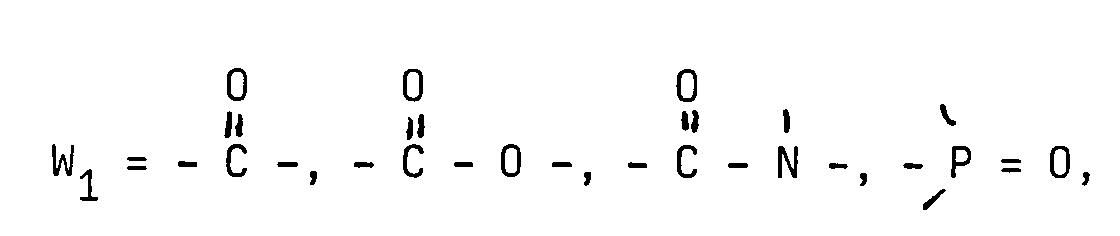
- CN oder -NO₂
Alkyl oder Alkylen wobei Alkyl und Alkylen bevorzugt 1 bis 6 C-Atome haben, und wobei die vorstehend für die Reste W₁, W₂ und W₃ definierten Carboxyl- oder Carbonamid-Gruppen jeweils über das Kohlenstoffatom an die Gruppe CR gebunden sind und die Gruppe CR über mindestens einen der Reste W₁, W₂ und/oder W₃ an eine polymere oder oligomere Einheit gebunden ist. Die Funktionalität der Komponente 3c) beträgt im Mittel über 2 pro Molekül. - Wie vorstehend erwähnt, beträgt die Funktionalität der Komponente 3c) im Mittel über 2. Dies bedeutet, daß im Gemisch mit höherfunktionellen Molekülen auch monofunktionelle Moleküle verwendet werden können.
- Die vorstehend beschriebenen Vernetzerkomponenten 3c) enthalten mit W₂ mindestens eine Estergruppe, die mit hydroxylgruppenhaltigen Verbindungen im Sinne einer Umesterungsaktion vernetzen kann.
- Bevorzugt sind die Vernetzerverbindungen im wesentlichen frei von primären, sekundären oder tertiären Aminogruppen, da diese die Lagerstabilität und die Lichtbeständigkeit negativ beeinflussen können.
- Im Folgenden sind Beispiele für umesterungsfähige Vernetzerkomponenten 3c) aufgeführt, die unter die vorstehende bevorzugte allgemeine Formel fallen. Diese Beispiele werden im Folgenden in drei Gruppen A1, A2 und A3 unterteilt.
- In der Gruppe A1 sind im Molekül im Mittel mindestens zwei Gruppen enthalten, die sich von Methantricarbonsäuremonoamideinheiten oder Acetessigsäureester-2-carbonsäureamiden ableiten.
- Geeignete Verbindungen A1 sind beispielsweise Umsetzungsprodukte von Malonsäurediester wie Malonsäuredimethyl-, diethyl-, dibutyl-, dipentylester oder Acetessigsäureester wie Acetessigsäuremethyl-, ethyl-, -butyl--pentylester mit Polyisocyanaten.
- Beispiele für derartige erfindungsgemäß einsetzbare Isocyanate sind cycloaliphatische, aliphatische oder aromatische Polyisocyanate wie Tetramethylen-diisocyanat, Hexamethylendiisocyanat, 2,2,4-Trimethylendiisocyanat, 1,12-Dodecandiisocyanat, Cyclohexan-1,3- und 1,4-diisocyanat, 1-Isocyanato-3,3,5-trimethyl-5-isocyanato-methylcylohexan (=Isophorondiisocyanat IPDI), Perhydro-2,4'- und/oder -4,4'-diphenylmethandiisocyanat, 1,3- und 1,4-Phenylendiisocyanat, 2,4- und 2,6-Toluylendiisocyanat, Diphenylmethan-2,4'- und/oder -4,4'-diisocyanat, 3,2'- und/oder 3,4-Diisocyanato-4-methyl-diphenylmethan, Naphthylen-1,5-diisocyanat, Triphenylmethan-4,4'-triisocyanat, Tetramethylxylylendiisocyanat oder Gemische dieser Verbindungen.
- Neben diesen einfachen Isocyanaten sind auch solche geeignet, die Heteroatome in dem die Isocyanatgruppen verknüpfenden Rest enthalten. Beispiele hierfür sind Carbodiimidgruppen, Allophanatgruppen, Isocyanuratgruppen, Urethangruppen, acylierte Harnstoffgruppen und Biuretgruppen aufweisende Polyisocyanate.
- Besonders gut für die Erfindung geeignet sind die bekannten Polyisocyanate, die hauptsächlich bei der Herstellung von Lacken eingesetzt werden, z.B. Biuret-, Isocyanurat- oder Urethangruppen aufweisende Modifizierungsprodukte der oben genannten einfachen Polyisocyanate, insbesondere Tris-(6-Isocyanatohexyl)-biuret oder niedermolekulare, Urethangruppen aufweisende Polyisocyanate, wie sie durch Umsetzung von im Überschuß eingesetzten IPDI mit einfachen mehrwertigen Alkoholen des Molekulargewichtsbereiches 62 - 300, insbesondere mit Trimethylolpropan erhalten werden können. Selbstverständlich können auch beliebige Gemische der genannten Polyisocyanate zur Herstellung der erfindungsgemäßen Produkte eingesetzt werden.
- Geeignete Polyisocyanate sind ferner die bekannten, endständige Isocyanatgruppen aufweisende Prepolymere, wie sie insbesondere durch Umsetzung der oben genannten einfachen Polyisocyanate, vor allem Diisocyanate, mit unterschüssigen Mengen an organischen Verbindungen mit mindestens zwei gegenüber Isocyanatgruppen reaktionsfähigen Gruppen zugänglich sind. Als solche kommen bevorzugt insgesamt mindestens zwei Aminogruppen und/oder Hydroxylgruppen aufweisende Verbindungen mit einem Zahlenmittel der Molmasse von 300 bis 10000, vorzugsweise 400 bis 6000, zur Anwendung. Bevorzugt werden die entsprechenden Polyhydroxylverbindungen, z.B. die in der Polyurethanchemie an sich bekannten Hydroxypolyester, Hydroxypolyether und/oder hydroxylgruppenhaltigen Acrylatharze verwendet.
- In diesen bekannten Prepolymeren entspricht das Verhältnis von Isocyanatgruppen zu gegenüber NCO reaktiven Wasserstoffatomen 1,05 bis 10 : 1, vorzugsweise 1,1 bis 3 : 1, wobei die Wasserstoffatome vorzugsweise aus Hydroxylgruppen stammen.
- Die Art und Mengenverhältnisse der bei der Herstellung der NCO-Prepolymeren eingesetzten Ausgangsmaterialien werden im übrigen vorzugsweise so gewählt, daß die NCO-Prepolymeren a) eine mittlere NCO-Funktionalität von 2 bis 4, vorzugsweise von 2 bis 3 und b) ein Zahlenmittel der Molmasse von 500 - 10000, vorzugsweise von 800 bis 4000 aufweisen.
- Als Verbindung A1 eignen sich aber auch Umsetzungsprodukte von Estern und Teilestern mehrwertiger Alkohole der Malonsäure mit Monoisocyanaten. Mehrwertige Alkohole sind z.B. zwei- bis fünf-wertige Alkohole wie Ethandiol, die verschiedenen Propan-, Butan-, Pentan- und Hexandiole, Polyethylen- und Polypropylendiole, Glycerin, Trimethylolethan und - propan, Pentaerythrit, Hexantriol und Sorbit. Geeignete Monoisocyanate sind z.B. aliphatische Isocyanate wie n-Butylisocyanat, Octadecylisocyanat, cycloaliphatische Isocyanate wie Cyclohexylisocyanat, araliphatische Isocyanate wie Benzylisocyanat oder aromatische Isocyanate wie Phenylisocyanat.
- Geeignet sind auch die entsprechenden Malonester von OH-Gruppen enthaltenden Acrylharzen, Polyester, Polyurethanen, Polyethern, Polyesteramiden und -imiden und/oder Umsetzungsprodukte von Malonsäurehalbestern wie Malonsäuremonoethylester mit aliphatischen und aromatischen Epoxidharzen, z.B. epoxidgruppenhaltigen Acrylatharzen, Glycidylethern von Polyolen wie Hexandiol, Neopentylglykol, Diphenylolpropan und -methan und Glycidylgruppen enthaltenden Hydantoinen, ferner Gemische dieser Verbindungen.
- Die Beispiele der folgenden Gruppe A2 zeigen eine geeignete Härtungskomponente, die mindestens zwei Gruppen der Formel (II)

oder Struktureinheiten der Formel (II')
enthält, in der bedeuten:
wobei die letztere Gruppe über das C-Atom an die CH-Gruppe gebunden ist;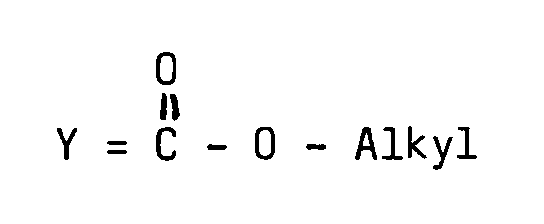
X =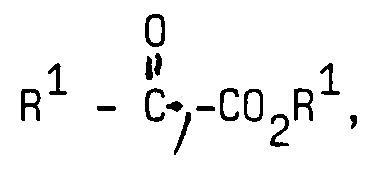
-CN, -NO₂, -CONH₂, -CONR¹H, -CONR¹R¹, wobei die Reste R¹ gleich oder verschieden sein können und für einen Kohlenwasserstoffrest, vorzugsweise einen Alkylrest mit 1 bis 12, vorzugsweise 1 bis 6 C-Atomen stehen, der auch durch Sauerstoff oder einen N-Alkylrest unterbrochen sein kann.
wobei letztere Gruppe über das C-Atom an die CR-Gruppe gebunden ist,
- Die Zahl der Gruppe (II) in dem verwendbaren Härter beträgt vorzugsweise 2 bis 20 und insbesondere 2 bis 10, wobei sich die größeren Zahlenwerte auf oligomere oder polymere Produkte beziehen und hier Mittelwerte darstellen.
- Vorzugsweise besitzt die erfindungsgemäß verwendbare Härtungskomponente A2 die Formel (III)

in der X, Y und K die obige Bedeutung haben, R² den Rest eines Polyols
oder den Rest R² einer Polycarbonsäure
darstellt und n mindestens 2, vorzugsweise 2 bis 20, insbesondere 2 bis 10 bedeutet. Im Falle von oligomeren oder polymeren Härtungskomponenten handelt es sich bei diesen Zahlenangaben wiederum um Mittelwerte. - Weiterhin bevorzugt sind Härtungskomponenten, die unter die Gruppe A2 fallen, die man durch nicht quantitative erfolgende Umesterung von Verbindungen der Formel (IV) oder der Formel (V)

mit Polyolen R² (OH)n erhält, wobei Y, K und R¹ die obige Bedeutung haben, und die Reste R¹ gleich oder verschieden sein können. - Bei den vorstehend genannten Polyolen R²(OH)n kann es sich um einen mehrwertigen Alkohol handeln, der vorzugsweise 2 bis 12, insbesondere 2 bis 6 C-Atome enthält. Beispiele hierfür sind: Ethylenglykol, Propylenglykol-(1,2) und -(1,3), Butylenglykol-(1,4) und -(2,3), Di-β-hydroxyethylbutandiol, Hexandiol-(1,6), Octandiol-(1,8), Neopentylglykol, Cyclohexandiol-(1,6), 1,4-Bis-(hydroxymethyl)-cyclohexan, 2,2-Bis-(4-hydroxycylohexyl)-propan, 2,2-Bis-(4-(β-hydroxyethoxy)phenyl)-propan, 2-Methyl-1,3-propandiol, Glycerin, Trimethylolpropan, Hexantriol-(1,2,6), Butantriol-(1,2,4), Tris-(β-hydroxyethyl)-isocyanurat, Trimethylolethan, Pentaerythrit und deren Hydroxyalkylierungsprodukten, ferner Fiethylenglykol, Triethylenglykol, Tetraethylenglykol, Polyethylenglykole, Dipropylenglykol, Tripropylenglykol, Polypropylenglykole, Dibutylenglykol, Polybutylenglykole und Xylylenglykol. Auch Polyester, die aus oder mit Lactonen, z.B. ε-Caprolacton oder Hydroxycarbonsäuren, wie z.B. Hydroxypivalinsäure, γ-Hydroxydecansäure, γ-Hydroxycapronsäure, Thioglykolsäure erhalten werden, können eingesetzt werden. Der Index n in obiger Formel (III) steht im Falle derartiger mehrwertiger Alkohole vorzugsweise für 2 bis 4.
- Alternativ kann das Polyol eine oligomere oder polymere Polyolverbindung (Polyolharz) darstellen, deren Zahlenmittel des Molekulargewichts, Mn, (bestimmt mittels Gelchromatographie; Polystyrolstandard), üblicherweise im Bereich von etwa 170 bis 10000, vorzugsweise etwa 500 bis etwa 5000 liegt. In Sonderfällen kann Mn jedoch 10000 g/mol und mehr betragen. Als Oligomere/Polymere kommen dabei Polymerisate, Polykondensate oder Polyadditionsverbindungen in Betracht. Die Hydroxylzahl beträgt im allgemeinen 30 bis 250, vorzugsweise 45 bis 200 und insbesondere 50 bis 180 mg KOH/g. Diese OH-gruppenhaltigen Verbindungen können gegebenenfalls noch andere funktionelle Gruppen enthalten, wie Carboxylgruppen.
- Beispiele für derartige Polyole sind Polyetherpolyole, Polyacetalpolyole, Polyesteramidpolyole, Polyamidpolyole, Epoxidharzpolyole oder deren Umsetzungsprodukte mit CO₂, Phenolharzpolyole, Polyharnstoffpolyole, Polyurethanpolyole, Celluloseester und -etherpolyole, teilweise verseifte Homo- und Copolymerisate von Vinylestern, teilweise acetalisierte Polyvinylalkohole, Polycarbonatpolyole, Polyesterpolyole oder Acrylatharzpolyole. Bevorzugt sind Polyetherpolyole, Polyesterpolyole, Acrylatharze und Polyurethanpolyole. Derartige Polyole, die auch in Mischung eingesetzt werden können, sind beispielsweise in der DE-OS 31 24 784 beschrieben.
- Beispiele für Polyurethanpolyole ergeben sich aus der Umsetzung von Di-und Polyisocyanaten mit einem Überschuß an Di- und/oder Polyolen. Geeignete Isocyanate sind z.B. Hexamethylendiisocyanat, Isophorondiisocyanat, Toluylendiisocyanat als auch Isocyanate, gebildet aus drei Molen eines Diisocyanats wie Hexamethylendiisocyanat oder Isophorondiisocyanat, und Biurete, die aus der Reaktion von drei Molen eines Diisocyanates mit einem Mol Wasser hervorgehen. Geeignete Polyharnstoffpolyole können in ähnlicher Weise durch Umsetzen von Di- und Polyisocyanaten mit äquimolaren Mengen von Aminoalkoholen, z.B. Ethanolamin oder Diethanolamin, erhalten werden.
- Beispiele für Polyesterpolyole sind die bekannten Polykondensate aus Di-oder Polycarbonsäuren oder deren Anhydriden, wie Phthalsäureanhydrid, Adipinsäure usw., und Polyolen wie Ethylenglykol, Trimethylolpropan, Glycerin usw.
- Geeignete Polyamidpolyole können in ähnlicher Weise wie die Polyester erhalten werden, in dem man die Polyole zumindest teilweise durch Polyamine, wie Isophorondiamin, Hexamethylendiamin, Diethylentriamin usw. ersetzt.
- Beispiele für Polyacrylatpolyole oder OH-gruppenhaltige Polyvinylverbindungen sind die bekannten Copolymerisate aus hydroxylgruppenhaltigen (Meth)Acrylsäureestern oder Vinylakohol und anderen Vinylverbindungen, wie z.B. Styrol oder (Meth)Acrylsäureestern.
- Die obigen Polycarbonsäuren R²(CO₂H)n, wobei n hier bevorzugt 2 bis 4 ist, können aliphatischer, cycloaliphatischer, aromatischer und/oder heterocyclischer Natur sein und gegebenenfalls, z.B. durch Halogenatome, substituiert und/oder gesättigt sein. Als Beispiele für solche Carbonsäuren und deren Derivate seien genannt: Bernsteinsäure, Adipinsäure, Korksäure, Azelainsäure, Sebacinsäure, Phthalsäure, Terephthalsäure, Isophthalsäure, Trimellithsäure, Pyromellithsäure, Tetrahydrophthalsäure, Hexahydrophthalsäure, 1,3- und 1,4-Cyclohexandicarbonsäure und Tetrachlorphthalsäure, Endomethylentetrahydrophthalsäure und ihr Hexachlorderivat, Glutarsäure, Maleinsäure, Fumarsäure, dimere und trimere Fettsäuren, wie Ölsäure, gegebenenfalls in Mischung mit monomeren Fettsäuren oder cyclischen Monocarbonsäuren, wie Benzoesäure, p-tert-Butylbenzoesäure oder Hexahydrobenzoesäure. Weiterhin die Umsetzungsprodukte der oben genannten Polyole R²(OH)n mit cyclischen Carbonsäureanhydriden.
- Bei der erfindungsgemäß verwendbaren Härtungskomponente A2 handelt es sich, je nach Art der Polyol- bzw. Polycarbonsäurekomponente, um mehr oder weniger viskose Flüssigkeiten oder um Feststoffe, die zumindest in den üblichen Lacklösemitteln weitgehend löslich sind und vorzugsweise weniger als 5 Gew.-%, insbesondere weniger als 1 Gew.-% an vernetzen Anteilen enthalten. Das Umesterungs-Äquivalentgewicht, das ein Maß für die Menge an Gruppen (II) bzw. Struktureinheiten (II') in (A2) ist, liegt im allgemeinen zwischen 100 und 5000, vorzugsweise 200 und 2000 und das Zahlenmittel des Molekulargewichts Mn in der Regel zwischen 200 und 10000, vorzugsweise zwischen 500 und 5000 (gelchromatographisch bestimmt; Polystyrolstandard). Verfahren zur Herstellung solcher Verbindungen sind in der EP-A-0 310 011 näher beschrieben.
- Weitere Beispiele für die erfindungsgemäß verwendbare Härterkomponente sind solche vom Typ A3, bei dem sich die umesterungsfähige Gruppierung ableitet von einer Verbindung mit der Gruppierung -CO-CRR³-COOR⁴, worin R³ C₁-C₈-Alkyl, H, vorzugsweise Wasserstoff und R⁴ = Alkyl wie z.B. Methyl, Ethyl, Butyl, t-Butyl ist.
- Die vorstehenden Gruppierungen von A3 können an mindestens eine mehrwertige monomere oder polymere Verbindung gebunden sein. Sie können beispielsweise an mindestens eine Verbindung der Gruppe ein- oder mehrwertige Alkohole, OH-Gruppen enthaltende Polymere, Polyamine und Polymercaptane gebunden sein. Sie sind, bezogen auf die Umesterungsfunktion, mehrwertig. So können sie beispielsweise durch Veresterung eines Polyepoxids mit einem die Gruppierung bildenden Dicarbonsäuremonoester, z.B. Malonsäuremonoester, hergestellt worden sein. Man erhält so eine Komponente A3 mit einer umesterungsfähigen Gruppe je Epoxidgruppe. Hierbei lassen sich aromatische oder aliphatische Polyepoxide einsetzen.
- Weitere Beispiele für geeignete Dicarbonsäuremonoester sind Malonsäuremonoalkylester, Acetondicarbonsäuremonoalkylester wobei der Alkylrest geradkettig oder verzweigt mit 1 bis 6-Atomen, z.B. Methyl, Ethyl, n-Butyl oder t-Butyl sein kann.
- Die Härterkomponenten 3c) können in üblichen Lösemitteln hergestellt werden. Es ist günstig, solche Lösemittel zu verwenden, die später bei der Herstellung des Überzugsmittels nicht stören. Es ist auch günstig, den Gehalt an organischen Lösemitteln möglichst gering zu halten. Wenn die Härterkomponente 3c) polare Gruppen enthält, z.B. Amid- oder Urethan-Gruppierungen, so ist eine leichte Dispergierung in Wasser möglich. Dies kann gegebenenfalls auch dadurch unterstützt werden, daß die Vernetzerkomponenten neutralisierbare ionische Gruppen, z.B. Carboxylgruppen, im Oligomer- oder Polymergerüst enthalten. Solche Vernetzer mit ionischen Gruppen können gut in Wasser dispergiert werden. Dabei kann der Gehalt an organischen Lösemitteln auf niedrige Werte gesenkt werden, ohne die Viskosität der Vernetzerlösung wesentlich zu erhöhen.
- Das Verhältnis zwischen 3) und 3c) wird bevorzugt so gewählt, daß das Verhältnis der OH-Funktionen 3), erhalten durch die Anlagerungsreaktion der α,β-ungesättigten Säuren an die Glycidylgruppen und der zur Umesterung fähigen Gruppen zwischen 1 : 1,5 und 1,5 : 1, bevorzugt zwischen 1 : 1,2 und 1,2 : 1 liegt. Zusätzlich können die im Harz 3) enthaltenen ungesättigten Bindungen auch in Gegenwart von Radikalinitiatoren polymerisiert werden, wodurch ein weiterer Vernetzungseffekt erzielt wird. Als Radikalinitiatoren können beispielsweise die vorstehend zur Polymerisation der Monomeren beschriebenen Initiatoren verwendet werden.
- Die erfindungsgemäßen Bindemittelzusammensetzungen können in üblicher weise zu Überzugsmitteln formuliert werden. Dies erfolgt im allgemeinen durch Zusatz von Lösemitteln oder Wasser.
- Geeignete organische Lösemittel für die Herstellung von Überzugsmitteln, beispielsweise Lacken, sind solche, wie sie auch bei der Herstellung der Einzelkomponenten 1), 1a) - 1c), 2), 2a) - 2c, 3), 3a) - 3c) verwendet werden können. Beispiele für derartige Lösemittel sind organische Lösemittel, wie aliphatische und aromatische Kohlenwasserstoffe, beispielsweise Toluol, Xylol, Gemische aliphatischer und/oder aromtischer Kohlenwasserstoffe, Ester, Ether und Alkohole. Es sind dies lackübliche Lösemittel. Zur Herstellung der Überzugsmittel aus den erfindungsgemäßen Bindemitteln können auch wäßrige Lösungen bereitet werden. Hierzu können gegebenenfalls geeignete Emulgatoren verwendet werden, wie sie auf dem Lacksektor üblich sind.
- Zur Herstellung der Überzugsmittel können übliche Additive zugesetzt werden, wie sie beispielsweise auf dem Lacksektor üblich sind. Beispiele für solche Additive sind Pigmente, beispielsweise transparente oder deckende farbgebende Pigmente wie Titandioxid oder Ruß und Effektpigmente, wie Metallschuppenpigmente und/oder Perlglanzpigmente.
- Die erfindungsgemäßen Bindemittelzusammensetzungen eignen sich besonders günstig für Überzugsmittel, die eine schmutzabweisende Wirkung haben sollen.
- Weitere Beispiele für Additive sind Füllstoffe, wie z.B. Talkum und Silikate; Weichmacher, Lichtschutzmittel, Stabilisatoren und Verlaufsmittel, wie Silikonöle.
- Die aus den erfindungsgemäßen Bindemitteln hergestellten Überzugsmittel können auf die gewünschte Applikationsviskosität durch entsprechende Regelung des Zusatzes von Lösemitteln und/oder Wasser und/oder Additiven eingestellt werden.
- Die Aushärtung von aus den Überzugsmitteln erstellten Überzügen kann in einem weiten Temperaturbereich von beispielsweise -10°C bis 200°C erfolgen und ist abhängig von der jeweiligen Art der Vernetzungsreaktionen.
- Die aus den erfindungsgemäßen Bindemitteln hergestellten Überzugsmittel sind für Überzüge geeignet, die auf einer Vielzahl von Substraten haften, wie beispielsweise Holz, Textilien, Kunststoff, Glas, Keramik, Putz, Zement und insbesondere Metall. Die Überzugsmittel können auch im Mehrschichtverfahren eingesetzt werden. So können sie beispielsweise auf übliche Grundierungen, Basislacke, Füller oder auf bereits vorhandene Decklacke aufgetragen werden.
- Ein besonders bevorzugtes Anwendungsgebiet für die erfindungsgemäßen Bindemittel stellt die Bereitstellung von Überzugsmittel für Lackierungen, die eine hohe schmutzabweisende Wirkung besitzen sollen.
- Die vorliegende Erfindung betrifft somit auch Verfahren zur Herstellung von Überzügen auf verschiedenen Substraten, bei denen auf das Substrat ein aus den erfindungsgemäßen Bindemitteln hergestelltes Überzugsmittel appliziert wird, worauf getrocknet und gehärtet wird. Die Erfindung betrifft auch die Verwendung der erfindungsgemäßen Bindemittelzusammensetzungen in Decklacken oder Klarlacken.
- In jedem Falle erhält man mit den aus den erfindungsgemäßen Bindemitteln hergestellten Überzugsmitteln Filme mit guter Härte und guter Wasser- und Lösemittelbeständigkeit, insbesondere hoher schmutzabweisender Wirkung, wobei die schmutzabweisende Wirkung, z.B. die Antigraffiti-Wirkung über lange Zeiträume selbst unter ungünstigen Bewitterungsbedingungen erhalten bleibt.
- Die Applikation der erfindungsgemäßen Überzugsmittel kann in üblicher Weise erfolgen, beispielsweise durch Tauchen, Spritzen, Streichen oder auf elektrostatischem Wege.
- Die folgenden Beispiele dienen zur Erläuterung der Erfindung. Alle Teile (T) beziehen sich auf das Gewicht.
- In einem 4-Liter-Dreihalskolben, der mit Rührer, Tropftrichter und Rückflußkühler versehen ist, werden
220 T des α,ω-hydroxyfunktionellen Polydimethylsiloxans I mit
170,5 T Xylol
vorgelegt und zum Sieden erhitzt. Anschließend wird ein Gemisch aus
5,5 T Acrylsäure
56 T Butylmethacrylat
97 T Ethylhexylacrylat
144 T Styrol
176 T Methylmethacrylat
30 T Butylacrylat
620,4 T Hydroxypropylmethacrylat
31,9 T tert. Butylperbenzoat
innerhalb von 5 Stunden kontinuierlich zudosiert. Danach werden nochmals 60,5 T Xylol und 2,9 T Butylperbenzoat zugegeben und unter Rückfluß weitere zwei Stunden gerührt. Das Gemisch wird dann mit 565 T Butylacetat auf einen Festkörper von 55,1 % eingestellt. -

n = angenähert 10
m = 2 - In einem 4-Liter-Dreihalskolben, der mit Rührer, Tropftrichter und Rückflußkühler versehen ist, werden
400 T des α,ω-hydroxyfunktionellen Polydimethylsiloxans (I)
600 T Butylacetat
auf 142°C erhitzt. Anschließend wird ein Gemisch aus
5 T Acrylsäure
48,2 T Butylmethacrylat
88,2 T Ethylhexylacrylat
131 T Styrol
160 T Methylmethacrylat
40 T Butylacrylat
564 T Hydroxypropylmethacrylat
29 T tert. Butylperbenzoat
innerhalb von 5 Stunden kontinuierlich zudosiert. Danach werden nochmals 48,6 T Butylacetat und 2,6 T tert. Butylperbenzoat zugegeben und unter Rückfluß weitere zwei Stunden gerührt. Das Gemischwird dann mit 498,3 T Butylacetat auf einen Festkörper von 56,0 % eingestellt. - Es wird wie in Beispiel 1 und 2 verfahren, jedoch auf das Polysiloxan verzichtet und durch die entsprechende Menge Solvesso 100 (Gemisch aromatischer Kohlenwasserstoffe) ersetzt.
- In einem 4-Liter-Dreihalskolben, der mit Rührer, Tropftrichter und Rückflußkühler versehen ist, werden
320 T Solvesso 100
169,5 T Butylacetat
auf 142°C erhitzt. Anschließend wird ein Gemisch aus
4,8 T Acrylsäure
59,1 T Butylmethacrylat
91 T Ethylhexylacrylat
161 T Styrol
171 T Methylmethacrylat
32 T Butylacrylat
555 T Hydroxypropylmethacrylat
30,1 T tert. Butylperbenzoat
innerhalb von 5 Stunden kontinuierlich zudosiert. Danach werden nochmals 53,4 T Butylacetat und 2,6 T tert. Butylperbenzoat zugegeben und unter Rückfluß weitere zwei Stunden gerührt. Das Gemisch wird dann mit 348,9 T Butylacetat auf einen Festkörper von 54,5 % eingestellt. -
- 56 T des Bindemittels von Beispiel 1
4 T Butylglykolacetat
0,6 T eines Benzotriazolderivates (UV-Stabilisator)
0,6 T einer Lösung eines sterisch gehinderten Amins
0,1 T eines handelsüblichen silikonhaltigen Verlaufsmittels
18,7 T eines Gemisches niedermolekularer Ester
20 T eines Biurets eines aliphatischen Isocyanats
wurden homogen miteinander vermischt. Anschließend wurde auf einem handelsüblichen Decklack auf der Basis organischer Lösemittel naß-in-naß in zwei bis drei Spritzgängen mit einer Trockenfilmdicke von 30 - 100 µm appliziert. Der Lack wurde anschließend 16 Stunden bei Raumtemperatur gehärtet. - Es wurde wie bei Lackbeispiel 3a) verfahren, wobei das Bindemittel von Beispiel 1 durch das Bindemittel von Beispiel 2 ersetzt wurde.
- Es wurde wie bei Lackbeispiel 3a) verfahren, wobei Bindemittel von Beispiel 1 durch das Bindemittel von Vergleichsversuch A ersetzt wurde.
- Es wurde wie bei Lackbeispiel 3a) verfahren, wobei das Bindemittel von Beispiel 1 durch eine homogene Mischung aus 52 T des Bindemittels von Vergleichsversuch A und 4 T des Polysiloxans aus der Beschreibung der Beispiele 1 und 2 ersetzt wurde.
- Es wurden folgende Untersuchungen vorgenommen.
- Oberflächenspannung
- : Zur Messung der Haftung von Farben auf Oberflächen kann die Oberflächenspannung als Meßkriterium dienen. Die Messung erfolgte mit standardisierten Testtinten, die sich bei einer definierten Oberflächenspannung nach der Auftragung auf das Objekt zusammenzieht.
Testtinte der Fa. ARCOTEC. - nach 100 WOM
- : Die Oberflächenspannungsmessung sowie die Enthaftungsprüfung wurde nach 24 Stunden und 100 Stunden, bei dem das Blech einer Weatherometer (WOM)-sunshine-Prüfung unterzogen wurde, geprüft.
- Enthaftung
- : Das Objekt wurde nach der Lackaushärtung mit handelsüblichen Spraydosenlacken besprüht. Nach Trocknen dieser Lackschicht wurden diese Flächen mit Klebeband versehen. Wurde beim Abreißen des Bandes die Spraydosenlackschicht mit entfernt, war die gewünschte Enthaftung vorhanden (Beurteilung i.O.); verblieb der Lack auf dem Blech, war der Test n.i.O.
- Chemikalienbeständigkeit
- : Die Chemikalientests erfolgten mit dem Lösemittel Xylol, Ethylglykol und Methoxypropylacetat nach DIN 53 168.
- In einem 1 Liter-Kolben werden 84 T einer 20 %igen wäßrigen Lösung eines Emulgators auf der Basis eines Polyoxypropylenpolyoxyethylensorbitansäurediesters bei 60°C vorgelegt. Das Gemisch wird mit einem Rührer, der mit einer Geschwindigkeit von ca. 8500 Umdrehungen/min. rotiert, gerührt. Innerhalb von 3 Minuten werden 256 T des im Beispiel 1 hergestellten Polyacrylates sowie 66 T vollentsalztes Wasser zugegeben. Die erhaltene milchig-weiße Emulsion hat einen Festkörpergehalt von 39,5 %.
- 85,1 T Emulsion aus Beispiel 4a)
15,1 T Cymel 327 (handelsübliches wasserlösliches Melaminharz)
Der wäßrige Klarlack wird mit Hilfe einer Rakel in einer Trockenfilmschichtdicke von ca. 30 µm auf eine Glasplatte appliziert und nach einer 20-minütigen Ablüftphase (10 min. Raumtemperatur, 10 min. 80°C) 20 Minuten bei 140°C eingebrannt. - Es resultiert ein klarer Film mit hoher Härte und niedriger Oberflächenspannung.

aus dem Acrylsäureestercopolymergerüst stammt.

wie vorstehend definiert ist.
| Lackbeispiel | Oberflächenspannung | Enthaftung | Chemikalienbeständigkeit | ||
| 24 h | nach 1000 h WOM | 24 h | nach 1000 h WOM | ||
| 3a | < 30 mN/m | < 30 mN/m | i.O. | i.O. | i.O. |
| 3b | < 30 mN/m | < 30 mN/m | i.O. | i.O. | i.O. |
| 3c (Vergleich) | 38-40 mN/m | 38-40 mN/m | n.i.O. | n.i.O. | i.O. |
| Vergleichsversuch B | < 30 mN/m | 38-40 mN/m | i.O. | n.i.O. | i.O. |
Claims (15)
- Für Überzugsmittel geeignete polysiloxanhaltige Bindemittel, erhältlich durch radikalisch initiierte Polymerisation von
97 bis 60 Gew.-% eines oder mehrerer (Meth)acrylmonomerer und gegebenenfalls zusätzlich eines oder mehrerer davon unterschiedlicher, radikalisch polymerisierbarer Monomerer, in Gegenwart von
3 bis 40 Gew.-% eines oder mehrerer α,ω-hydroxy-, carboxy- und/oder epoxyfunktioneller Polysiloxane, der allgemeinen Formel (I)
- Alk - OH
- Alk - (OAlk)p - OH


worin Alk und Alk' Alkylengruppen mit 1 bis 6 Kohlenstoffatomen sind und mehrere in einem Molekül enthaltene Alkylengruppen gleich oder verschieden sein können,
n = 8 bis 40,
m = 2 bis 30 und
p = 1 bis 20.
wobei sich die Gew.-% auf die Summe der Festkörpergewichte der eingesetzten Monomeren und Polysiloxane beziehen. - Bindemittel nach Anspruch 1, dadurch gekennzeichnet, daß im Polysiloxan der allgemeinen Formel I alle Reste R' gleich sind und die Bedeutung von Methylgruppen haben.
- Bindemittel nach Anspruch 1 oder 2, dadurch gekennzeichnet, daß Alk in der allgemeinen Formel (I) eine Alkylengruppe mit 2 oder 3 Kohlenstoffatomen und Alk' eine Alkylengruppe mit 5 Kohlenstoffatomen ist.
- Bindemittel nach Anspruch 1,2 oder 3, worin die Reste R gleich oder verschieden sein können und
- (CH₂)₃ - OH,
- (CH₂)₃ - (O CH₂ CH₂)₁₀ - OH

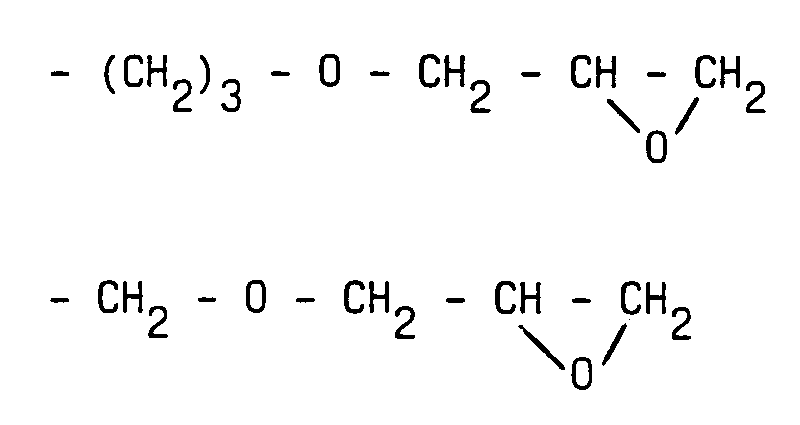

n = 8 bis 40. - Bindemittel nach einem der Ansprüche 1 bis 4, dadurch gekennzeichnet, daß die (Meth)acrylmonomeren Alkyl(meth)acrylate mit 1 bis 18 Kohlenstoffatomen im Alkylteil sind.
- Bindemittel nach Anspruch 5, dadurch gekennzeichnet, daß zumindest ein Teil der Alkyl(meth)acrylate eine oder mehrere primäre oder sekundäre Hydroxyfunktionen oder eine Epoxyfunktion im Alkylteil aufweist.
- Bindemittel nach einem der vorhergehenden Ansprüche, dadurch gekennzeichnet, daß zumindest ein Teil der (Meth)acrylmonomeren eine Carboxylgruppe aufweist und/oder daß bei der Herstellung der Bindemittel ein oder mehrere radikalisch copolymerisierbare Monomere mitverwendet wurden, die eine oder mehrere Carboxylgruppen aufweisen.
- Verfahren zur Herstellung der Bindemittel nach einem der Ansprüche 1 bis 7, dadurch gekennzeichnet, daß man
3 bis 40 Gew.-% eines oder mehrerer α,ω-hydroxy-, carboxy-und/oder epoxyfunktioneller Polysiloxane, wie in einem der Ansprüche 1 bis 4 definiert, in flüssiger, gegebenenfalls in einem Lösemittel, gelöster Form, vorlegt und darin
97 bis 60 Gew.-% eines oder mehrerer (Meth)acrylmonomerer und gegebenenfalls zusätzlich eines oder mehrere davon unterschiedlicher, radikalisch polymerisierbarer Monomerer, wie in einem der Ansprüche 1 und 5 bis 7 definiert, in Anwesenheit eines Radikalinitiators polymerisiert, wobei sich die Gew.-% auf die Summe der Festkörpergehalte der eingesetzten Monomeren und der Polysiloxane beziehen. - Überzugsmittel zur Herstellung schmutzabweisender Überzüge, enthaltend ein oder mehrere Bindemittel gemäß einem der Ansprüche 1 bis 7, oder hergestellt nach dem Verfahren von Anspruch 8, neben einem oder mehreren Vernetzern und lacküblichen Additiven und gegebenenfalls Pigmenten und/oder Füllstoffen.
- Überzugsmittel nach Anspruch 9, dadurch gekennzeichnet, daß es ein oder mehrere lackübliche Lösemittel enthält.
- Überzugsmittel nach Anspruch 9, dadurch gekennzeichnet, daß es sich um ein wäßriges Überzugsmittel handelt, das ein oder mehrere organische Lösemittel enthalten kann.
- Überzugsmittel nach einem der Ansprüche 9 bis 11, dadurch gekennzeichnet, daß die Bindemittel hydroxy- und/oder carboxyfunktionalisiert sind und als Vernetzer ein oder mehrere Polyisocyanate, die verkappt sein können und/oder Melaminharze, oder ein oder mehrere Polyepoxide enthalten sind.
- Überzugsmittel nach einem der Ansprüche 9 bis 11, dadurch gekennzeichnet, daß die Bindemittel epoxyfunktionalisiert und zusätzlich gegebenenfalls hydroxyfunktionalisiert sind und als Vernetzer eine oder mehrere carboxyfunktionalisierte Verbindungen und gegebenenfalls ein oder mehrere Melaminharze oder ein oder mehrere Polyamine, die verkappt sein können, enthalten sind.
- Überzugsmittel nach einem der Ansprüche 9 bis 11, dadurch gekennzeichnet, daß die Bindemittel epoxid- und acryloyl-funktionalisiert sind und als Vernetzer ein oder mehrere Polyamine, die verkappt sein können, eine oder mehrere Verbindungen mit mehreren CH-aciden Gruppen im Molekül oder ein oder mehrere Vernetzer mit mehreren umesterungsfähigen Gruppen pro Molekül enthalten sind.
- Verwendung der Bindemittel nach einem der Ansprüche 1 bis 7, oder hergestellt nach dem Verfahren von Anspruch 8, zur Herstellung von Überzügen mit schmutzabweisenden Eigenschaften, insbesondere zur Herstellung von Antigraffiti-Schutzüberzügen.
Applications Claiming Priority (2)
| Application Number | Priority Date | Filing Date | Title |
|---|---|---|---|
| DE4240108 | 1992-11-28 | ||
| DE4240108A DE4240108A1 (de) | 1992-11-28 | 1992-11-28 | Polysiloxanhaltige Bindemittel, deren Herstellung, diese enthaltende Überzugsmittel und deren Verwendung |
Publications (2)
| Publication Number | Publication Date |
|---|---|
| EP0603561A1 true EP0603561A1 (de) | 1994-06-29 |
| EP0603561B1 EP0603561B1 (de) | 1998-08-05 |
Family
ID=6473934
Family Applications (1)
| Application Number | Title | Priority Date | Filing Date |
|---|---|---|---|
| EP93118850A Expired - Lifetime EP0603561B1 (de) | 1992-11-28 | 1993-11-24 | Polysiloxanhaltige Bindemittel, deren Herstellung, diese enthaltende Überzugsmittel und deren Verwendung |
Country Status (8)
| Country | Link |
|---|---|
| US (1) | US5426151A (de) |
| EP (1) | EP0603561B1 (de) |
| JP (1) | JPH06207145A (de) |
| AT (1) | ATE169311T1 (de) |
| CA (1) | CA2103235A1 (de) |
| DE (2) | DE4240108A1 (de) |
| DK (1) | DK0603561T3 (de) |
| ES (1) | ES2119851T3 (de) |
Cited By (2)
| Publication number | Priority date | Publication date | Assignee | Title |
|---|---|---|---|---|
| US6054534A (en) * | 1996-10-11 | 2000-04-25 | R Th. Goldschmidt Ag | Silicone poly(meth) acrylates, their preparation and their use in coatings |
| US6113988A (en) * | 1995-09-25 | 2000-09-05 | Basf Coatings Ag | 3-component coating composition of high solvent resistance and high masking resistance |
Families Citing this family (27)
| Publication number | Priority date | Publication date | Assignee | Title |
|---|---|---|---|---|
| CA2164994A1 (en) * | 1994-12-24 | 1996-06-25 | Heinz Dietholf Becker | Binder composition, coating agents containing it, and use thereof |
| FR2729406B1 (fr) * | 1995-01-16 | 1997-04-18 | Rhone Poulenc Chimie | Utilisation a titre d'antiadherent et/ou d'hydrofugeant de polyorganosiloxanes fonctionnalises, greffes |
| DE19502413B4 (de) * | 1995-01-26 | 2009-06-10 | Sicpa Holding S.A. | Pigment mit vom Betrachtungswinkel abhängiger Farbigkeit, dessen Herstellung sowie Verwendung in einem Lack, insbesondere für Kraftfahrzeuge |
| US5620825A (en) * | 1995-03-23 | 1997-04-15 | Agfa-Gevaert, N.V. | Polysiloxane modified resins for toner |
| US5902847A (en) * | 1995-07-31 | 1999-05-11 | Kansai Paint Co., Ltd. | Coating composition |
| US5631042A (en) * | 1995-10-06 | 1997-05-20 | Foster S. Becker | Graffiti-resistant barriers, related compositions and methods24m |
| JP3413707B2 (ja) * | 1996-07-04 | 2003-06-09 | 信越化学工業株式会社 | シート状接着剤 |
| US5939491A (en) * | 1997-08-01 | 1999-08-17 | Ppg Industries Ohio, Inc. | Curable compositions based on functional polysiloxanes |
| JPH11131022A (ja) * | 1997-10-31 | 1999-05-18 | Sho Bond Constr Co Ltd | 落書き除去方法 |
| US6387997B1 (en) * | 1999-11-10 | 2002-05-14 | Ppg Industries Ohio, Inc. | Solvent-free film-forming compositions, coated substrates and method related thereto |
| JP2002097235A (ja) * | 2000-09-26 | 2002-04-02 | Jsr Corp | 液状硬化性樹脂組成物およびその硬化物 |
| EP1432857A1 (de) * | 2001-09-07 | 2004-06-30 | Borden Chemical, Inc. | Beschichtete lichtleiter mit haftvermittlern, deren herstellung und verwendung |
| DE10163118A1 (de) | 2001-12-21 | 2003-07-03 | Basf Ag | Verfahren zur Herstellung von Polymerisaten |
| DE10301975A1 (de) | 2003-01-20 | 2004-07-29 | Wacker Polymer Systems Gmbh & Co. Kg | Verfahren zur Herstellung von mit Silikon modifizierten Polymerisaten |
| JP2008510860A (ja) * | 2004-08-27 | 2008-04-10 | ヴァーサマトリックス・アクティーゼルスカブ | 高負荷官能性樹脂 |
| DE102006037272A1 (de) * | 2006-08-09 | 2008-02-14 | Wacker Chemie Ag | Hochfeststoffhaltige Lösungen von Silikonorganocopolymeren mit hohem Silikongehalt und hohem Feststoffgehalt und Verfahren zu deren Herstellung und deren Verwendung |
| DE102006054158A1 (de) * | 2006-11-16 | 2008-05-21 | Wacker Chemie Ag | Ultrahydrophobe Beschichtungen |
| US20080255318A1 (en) | 2006-11-21 | 2008-10-16 | Momentive Performance Materials Inc. | Organosilicone compositions and methods for preparing them |
| EP1942124A1 (de) * | 2006-12-22 | 2008-07-09 | DuPont Powder Coatings Ibérica, S.L. | Anti-Graffiti-Beschichtungspulverzusammensetzung |
| KR101521643B1 (ko) * | 2007-11-21 | 2015-05-19 | 모멘티브 퍼포먼스 머티리얼즈 인크. | 유기실리콘 조성물들 및 그 제조 방법 |
| CN102924993B (zh) * | 2012-11-06 | 2016-05-25 | 长兴(中国)投资有限公司 | 丙烯酸酯基团改性的聚硅氧烷用途及其组合物 |
| WO2014099579A1 (en) | 2012-12-17 | 2014-06-26 | Axalta Coating Systems IP Co. LLC | Process for the preparation of a powder coating composition |
| KR101492251B1 (ko) | 2013-05-31 | 2015-02-16 | 이근수 | 개질된 폴리실록산계 공중합체, 이 공중합체를 포함하는 코팅 조성물, 이를 이용하여 얻을 수 있는 코팅 플라스틱 기판과 이의 제조 방법, 및 상기 개질된 폴리실록산계 공중합체의 제조방법 |
| KR101574249B1 (ko) | 2014-06-25 | 2015-12-04 | 이근수 | 유-무기 하이브리드 공중합체, 그 제조 방법, 이를 제조하기 위한 조성물 및 이의 응용 |
| CN108359046A (zh) * | 2018-02-01 | 2018-08-03 | 广州市斯洛柯高分子聚合物有限公司 | 一种有机硅改性丙烯酸乳液及其制备方法 |
| CN111019069B (zh) * | 2019-12-17 | 2022-11-11 | 上海树脂厂有限公司 | 一种水性环氧有机硅丙烯酸酯复合树脂及其制备方法 |
| WO2021154501A1 (en) * | 2020-01-27 | 2021-08-05 | Momentive Performance Materials Inc. | Hydrophobic coating compositions based on organic binders |
Citations (4)
| Publication number | Priority date | Publication date | Assignee | Title |
|---|---|---|---|---|
| FR2023437A1 (de) * | 1968-11-15 | 1970-08-21 | Stauffer Wacker Silicone Corp | |
| FR2072178A5 (en) * | 1969-12-24 | 1971-09-24 | Ford France | Siloxane-modified acrylic lacquer coatings - prodn |
| EP0191237A1 (de) * | 1984-12-18 | 1986-08-20 | Dow Corning Corporation | Wässrige Emulsionen auf Basis hydrophyler Siliconorganocopolymeren |
| EP0278259A2 (de) * | 1987-01-29 | 1988-08-17 | Bayer Ag | Pfropfpolymerisate aus (Meth)Acrylsäurederivaten und Siliconharzen |
Family Cites Families (6)
| Publication number | Priority date | Publication date | Assignee | Title |
|---|---|---|---|---|
| DE2641201A1 (de) * | 1976-09-14 | 1978-03-16 | Consortium Elektrochem Ind | Diorganopolysiloxane enthaltende gemische und verfahren zu ihrer herstellung |
| US4558082A (en) * | 1984-05-10 | 1985-12-10 | General Electric Company | Acrylated polymers |
| US4624998A (en) * | 1985-12-30 | 1986-11-25 | Dow Corning Corporation | Silicone-modified epoxy resins having improved impact resistance |
| US5077354A (en) * | 1987-01-28 | 1991-12-31 | The Glidden Company | Acrylic modified silicone resin |
| DE3922521A1 (de) * | 1989-07-08 | 1991-01-17 | Bayer Ag | Mittel zur verfestigung von textilen gebilden |
| AU663967B2 (en) * | 1992-09-09 | 1995-10-26 | Nippon Paint Co., Ltd. | A curable resin composition, a coating composition and a process for forming a coating film |
-
1992
- 1992-11-28 DE DE4240108A patent/DE4240108A1/de not_active Withdrawn
-
1993
- 1993-11-16 CA CA002103235A patent/CA2103235A1/en not_active Abandoned
- 1993-11-17 US US08/153,938 patent/US5426151A/en not_active Expired - Lifetime
- 1993-11-24 EP EP93118850A patent/EP0603561B1/de not_active Expired - Lifetime
- 1993-11-24 DK DK93118850T patent/DK0603561T3/da active
- 1993-11-24 ES ES93118850T patent/ES2119851T3/es not_active Expired - Lifetime
- 1993-11-24 AT AT93118850T patent/ATE169311T1/de not_active IP Right Cessation
- 1993-11-24 DE DE59308843T patent/DE59308843D1/de not_active Expired - Fee Related
- 1993-11-26 JP JP5296974A patent/JPH06207145A/ja active Pending
Patent Citations (4)
| Publication number | Priority date | Publication date | Assignee | Title |
|---|---|---|---|---|
| FR2023437A1 (de) * | 1968-11-15 | 1970-08-21 | Stauffer Wacker Silicone Corp | |
| FR2072178A5 (en) * | 1969-12-24 | 1971-09-24 | Ford France | Siloxane-modified acrylic lacquer coatings - prodn |
| EP0191237A1 (de) * | 1984-12-18 | 1986-08-20 | Dow Corning Corporation | Wässrige Emulsionen auf Basis hydrophyler Siliconorganocopolymeren |
| EP0278259A2 (de) * | 1987-01-29 | 1988-08-17 | Bayer Ag | Pfropfpolymerisate aus (Meth)Acrylsäurederivaten und Siliconharzen |
Cited By (2)
| Publication number | Priority date | Publication date | Assignee | Title |
|---|---|---|---|---|
| US6113988A (en) * | 1995-09-25 | 2000-09-05 | Basf Coatings Ag | 3-component coating composition of high solvent resistance and high masking resistance |
| US6054534A (en) * | 1996-10-11 | 2000-04-25 | R Th. Goldschmidt Ag | Silicone poly(meth) acrylates, their preparation and their use in coatings |
Also Published As
| Publication number | Publication date |
|---|---|
| DE59308843D1 (de) | 1998-09-10 |
| ATE169311T1 (de) | 1998-08-15 |
| ES2119851T3 (es) | 1998-10-16 |
| EP0603561B1 (de) | 1998-08-05 |
| JPH06207145A (ja) | 1994-07-26 |
| DK0603561T3 (da) | 1999-05-03 |
| DE4240108A1 (de) | 1994-06-01 |
| CA2103235A1 (en) | 1994-05-29 |
| US5426151A (en) | 1995-06-20 |
Similar Documents
| Publication | Publication Date | Title |
|---|---|---|
| EP0603561B1 (de) | Polysiloxanhaltige Bindemittel, deren Herstellung, diese enthaltende Überzugsmittel und deren Verwendung | |
| DE60129319T2 (de) | Wässrige vernetzbare bindemittelzusammensetzung und beschichtungs-, lack- oder dichtmittelzusammensetzung, die diese bindemittelzusammensetzung beinhaltet | |
| EP0596460B1 (de) | Überzugsmittel und dessen Verwendung zur Herstellung von säurebeständigen Lackierungen | |
| EP0596461B1 (de) | Wässrige Bindemittelzusammensetzung, diese enthaltende Überzugsmittel und deren Verwendung | |
| WO1995016749A1 (en) | Aqueous two-part isocyanate-free curable, polyurethane resin systems | |
| EP0598280B1 (de) | Bindemittelzusammensetzung, diese enthaltende Überzugsmittel, deren Herstellung und Verwendung | |
| EP0797643B1 (de) | Bindemittelzusammensetzung, diese enthaltende überzugsmittel, deren herstellung und verwendung | |
| EP0654055B1 (de) | Wasserverdünnbares beschichtungsmittel auf basis von polyacrylaten und polyisocyanaten | |
| DE19652144C1 (de) | Überzugsmittel und Verfahren zur Herstellung von Mehrschichtlackierungen | |
| EP0542209B1 (de) | Bindemittelzusammensetzung, diese enthaltende Überzugsmittel und deren Verwendung | |
| EP0582187B1 (de) | Überzugsmittel und dessen Verwendung bei der Herstellung von Überzügen mit rasch bearbeitbarer Oberfläche | |
| DE602004005952T2 (de) | Wässrige Zweikomponenten-Beschichtungsmittel | |
| EP0772647B1 (de) | Polyacrylatharzlösungen mit verbesserter farbzahl und verwendung in überzugsmitteln | |
| EP0718365A2 (de) | Bindemittelzusammensetzung, diese enthaltende Überzugsmittel und deren Verwendung | |
| EP0597394B1 (de) | Bindemittelzusammensetzung, diese enthaltende Überzugsmittel, deren Herstellung und Verwendung | |
| EP0944682B1 (de) | Bindemittelzusammensetzung, diese enthaltende überzugsmittel, deren herstellung und verwendung | |
| DE4344515C2 (de) | Bindemittel auf der Basis cycloolefinischer Copolymerer, deren Herstellung und deren Verwendung | |
| EP0876200A1 (de) | Nichtionische emulgatoren | |
| DE10305115B4 (de) | Beschichtungsstoffe, Verfahren zu ihrer Herstellung und ihre Verwendung | |
| EP0476388B1 (de) | Bindemittelzusammensetzung, deren Herstellung, diese enthaltende Überzugsmittel und deren Verwendung | |
| DE4344516C2 (de) | Bindemittel auf der Basis peroxigenierter cycloolefinischer Copolymerer, deren Herstellung und deren Verwendung | |
| DE4432985A1 (de) | Bindemittel auf der Basis cycloolefinischer Copolymerer deren Herstellung, diese enthaltende Überzugsmittel und deren Verwendung | |
| WO1995018161A1 (de) | Bindemittel auf der basis cycloolefinischer, gegebenenfalls peroxigenierter copolymerer, deren herstellung, diese enthaltende überzugsmittel und deren verwendung | |
| DE4317791A1 (de) | Wäßrige Bindemittelzusammensetzung, diese enthaltende Überzugsmittel und deren Verwendung | |
| EP0582188A1 (de) | Überzugsmittel und dessen Verwendung bei der Herstellung von Überzügen mit rasch bearbeitbarer Oberfläche |
Legal Events
| Date | Code | Title | Description |
|---|---|---|---|
| PUAI | Public reference made under article 153(3) epc to a published international application that has entered the european phase |
Free format text: ORIGINAL CODE: 0009012 |
|
| AK | Designated contracting states |
Kind code of ref document: A1 Designated state(s): AT BE CH DE DK ES FR GB GR IT LI NL PT SE |
|
| 17P | Request for examination filed |
Effective date: 19941217 |
|
| 17Q | First examination report despatched |
Effective date: 19960523 |
|
| GRAG | Despatch of communication of intention to grant |
Free format text: ORIGINAL CODE: EPIDOS AGRA |
|
| GRAG | Despatch of communication of intention to grant |
Free format text: ORIGINAL CODE: EPIDOS AGRA |
|
| GRAH | Despatch of communication of intention to grant a patent |
Free format text: ORIGINAL CODE: EPIDOS IGRA |
|
| GRAH | Despatch of communication of intention to grant a patent |
Free format text: ORIGINAL CODE: EPIDOS IGRA |
|
| GRAA | (expected) grant |
Free format text: ORIGINAL CODE: 0009210 |
|
| AK | Designated contracting states |
Kind code of ref document: B1 Designated state(s): AT BE CH DE DK ES FR GB GR IT LI NL PT SE |
|
| REF | Corresponds to: |
Ref document number: 169311 Country of ref document: AT Date of ref document: 19980815 Kind code of ref document: T |
|
| REG | Reference to a national code |
Ref country code: CH Ref legal event code: NV Representative=s name: DIETLIN & CIE S.A. Ref country code: CH Ref legal event code: EP |
|
| REF | Corresponds to: |
Ref document number: 59308843 Country of ref document: DE Date of ref document: 19980910 |
|
| REG | Reference to a national code |
Ref country code: ES Ref legal event code: FG2A Ref document number: 2119851 Country of ref document: ES Kind code of ref document: T3 |
|
| ET | Fr: translation filed | ||
| GBT | Gb: translation of ep patent filed (gb section 77(6)(a)/1977) |
Effective date: 19981106 |
|
| REG | Reference to a national code |
Ref country code: PT Ref legal event code: SC4A Free format text: AVAILABILITY OF NATIONAL TRANSLATION Effective date: 19981007 |
|
| REG | Reference to a national code |
Ref country code: DK Ref legal event code: T3 |
|
| PLBE | No opposition filed within time limit |
Free format text: ORIGINAL CODE: 0009261 |
|
| STAA | Information on the status of an ep patent application or granted ep patent |
Free format text: STATUS: NO OPPOSITION FILED WITHIN TIME LIMIT |
|
| 26N | No opposition filed | ||
| REG | Reference to a national code |
Ref country code: GB Ref legal event code: IF02 |
|
| PGFP | Annual fee paid to national office [announced via postgrant information from national office to epo] |
Ref country code: PT Payment date: 20050913 Year of fee payment: 13 |
|
| PGFP | Annual fee paid to national office [announced via postgrant information from national office to epo] |
Ref country code: BE Payment date: 20050915 Year of fee payment: 13 |
|
| PGFP | Annual fee paid to national office [announced via postgrant information from national office to epo] |
Ref country code: GR Payment date: 20050928 Year of fee payment: 13 |
|
| PGFP | Annual fee paid to national office [announced via postgrant information from national office to epo] |
Ref country code: NL Payment date: 20051116 Year of fee payment: 13 Ref country code: AT Payment date: 20051116 Year of fee payment: 13 |
|
| PGFP | Annual fee paid to national office [announced via postgrant information from national office to epo] |
Ref country code: SE Payment date: 20051117 Year of fee payment: 13 |
|
| PGFP | Annual fee paid to national office [announced via postgrant information from national office to epo] |
Ref country code: CH Payment date: 20051118 Year of fee payment: 13 |
|
| PG25 | Lapsed in a contracting state [announced via postgrant information from national office to epo] |
Ref country code: AT Free format text: LAPSE BECAUSE OF NON-PAYMENT OF DUE FEES Effective date: 20061124 |
|
| PG25 | Lapsed in a contracting state [announced via postgrant information from national office to epo] |
Ref country code: SE Free format text: LAPSE BECAUSE OF NON-PAYMENT OF DUE FEES Effective date: 20061125 |
|
| PG25 | Lapsed in a contracting state [announced via postgrant information from national office to epo] |
Ref country code: LI Free format text: LAPSE BECAUSE OF NON-PAYMENT OF DUE FEES Effective date: 20061130 Ref country code: CH Free format text: LAPSE BECAUSE OF NON-PAYMENT OF DUE FEES Effective date: 20061130 Ref country code: BE Free format text: LAPSE BECAUSE OF NON-PAYMENT OF DUE FEES Effective date: 20061130 |
|
| PG25 | Lapsed in a contracting state [announced via postgrant information from national office to epo] |
Ref country code: PT Free format text: LAPSE BECAUSE OF NON-PAYMENT OF DUE FEES Effective date: 20070524 |
|
| PG25 | Lapsed in a contracting state [announced via postgrant information from national office to epo] |
Ref country code: NL Free format text: LAPSE BECAUSE OF NON-PAYMENT OF DUE FEES Effective date: 20070601 |
|
| REG | Reference to a national code |
Ref country code: PT Ref legal event code: MM4A Free format text: LAPSE DUE TO NON-PAYMENT OF FEES Effective date: 20070524 |
|
| REG | Reference to a national code |
Ref country code: CH Ref legal event code: PL |
|
| EUG | Se: european patent has lapsed | ||
| NLV4 | Nl: lapsed or anulled due to non-payment of the annual fee |
Effective date: 20070601 |
|
| BERE | Be: lapsed |
Owner name: *HERBERTS G.M.B.H. Effective date: 20061130 |
|
| PGFP | Annual fee paid to national office [announced via postgrant information from national office to epo] |
Ref country code: ES Payment date: 20071219 Year of fee payment: 15 Ref country code: DK Payment date: 20071115 Year of fee payment: 15 Ref country code: DE Payment date: 20071122 Year of fee payment: 15 |
|
| PGFP | Annual fee paid to national office [announced via postgrant information from national office to epo] |
Ref country code: IT Payment date: 20071127 Year of fee payment: 15 |
|
| PGFP | Annual fee paid to national office [announced via postgrant information from national office to epo] |
Ref country code: GB Payment date: 20071121 Year of fee payment: 15 Ref country code: FR Payment date: 20071108 Year of fee payment: 15 |
|
| PG25 | Lapsed in a contracting state [announced via postgrant information from national office to epo] |
Ref country code: GR Free format text: LAPSE BECAUSE OF NON-PAYMENT OF DUE FEES Effective date: 20070604 |
|
| REG | Reference to a national code |
Ref country code: DK Ref legal event code: EBP |
|
| GBPC | Gb: european patent ceased through non-payment of renewal fee |
Effective date: 20081124 |
|
| PG25 | Lapsed in a contracting state [announced via postgrant information from national office to epo] |
Ref country code: IT Free format text: LAPSE BECAUSE OF NON-PAYMENT OF DUE FEES Effective date: 20081124 |
|
| REG | Reference to a national code |
Ref country code: FR Ref legal event code: ST Effective date: 20090731 |
|
| PG25 | Lapsed in a contracting state [announced via postgrant information from national office to epo] |
Ref country code: DK Free format text: LAPSE BECAUSE OF NON-PAYMENT OF DUE FEES Effective date: 20081130 Ref country code: DE Free format text: LAPSE BECAUSE OF NON-PAYMENT OF DUE FEES Effective date: 20090603 |
|
| PG25 | Lapsed in a contracting state [announced via postgrant information from national office to epo] |
Ref country code: GB Free format text: LAPSE BECAUSE OF NON-PAYMENT OF DUE FEES Effective date: 20081124 |
|
| REG | Reference to a national code |
Ref country code: ES Ref legal event code: FD2A Effective date: 20081125 |
|
| PG25 | Lapsed in a contracting state [announced via postgrant information from national office to epo] |
Ref country code: ES Free format text: LAPSE BECAUSE OF NON-PAYMENT OF DUE FEES Effective date: 20081125 |
|
| PG25 | Lapsed in a contracting state [announced via postgrant information from national office to epo] |
Ref country code: FR Free format text: LAPSE BECAUSE OF NON-PAYMENT OF DUE FEES Effective date: 20081130 |