EP0603633A1 - Stratifié de trois composants - Google Patents
Stratifié de trois composants Download PDFInfo
- Publication number
- EP0603633A1 EP0603633A1 EP93119714A EP93119714A EP0603633A1 EP 0603633 A1 EP0603633 A1 EP 0603633A1 EP 93119714 A EP93119714 A EP 93119714A EP 93119714 A EP93119714 A EP 93119714A EP 0603633 A1 EP0603633 A1 EP 0603633A1
- Authority
- EP
- European Patent Office
- Prior art keywords
- laminate
- layer
- layers
- metal foil
- spunbonded
- Prior art date
- Legal status (The legal status is an assumption and is not a legal conclusion. Google has not performed a legal analysis and makes no representation as to the accuracy of the status listed.)
- Granted
Links
Images

Classifications
-
- B—PERFORMING OPERATIONS; TRANSPORTING
- B32—LAYERED PRODUCTS
- B32B—LAYERED PRODUCTS, i.e. PRODUCTS BUILT-UP OF STRATA OF FLAT OR NON-FLAT, e.g. CELLULAR OR HONEYCOMB, FORM
- B32B15/00—Layered products comprising a layer of metal
- B32B15/14—Layered products comprising a layer of metal next to a fibrous or filamentary layer
-
- B—PERFORMING OPERATIONS; TRANSPORTING
- B32—LAYERED PRODUCTS
- B32B—LAYERED PRODUCTS, i.e. PRODUCTS BUILT-UP OF STRATA OF FLAT OR NON-FLAT, e.g. CELLULAR OR HONEYCOMB, FORM
- B32B5/00—Layered products characterised by the non- homogeneity or physical structure, i.e. comprising a fibrous, filamentary, particulate or foam layer; Layered products characterised by having a layer differing constitutionally or physically in different parts
- B32B5/02—Layered products characterised by the non- homogeneity or physical structure, i.e. comprising a fibrous, filamentary, particulate or foam layer; Layered products characterised by having a layer differing constitutionally or physically in different parts characterised by structural features of a fibrous or filamentary layer
- B32B5/06—Layered products characterised by the non- homogeneity or physical structure, i.e. comprising a fibrous, filamentary, particulate or foam layer; Layered products characterised by having a layer differing constitutionally or physically in different parts characterised by structural features of a fibrous or filamentary layer characterised by a fibrous or filamentary layer mechanically connected, e.g. by needling to another layer, e.g. of fibres, of paper
-
- B—PERFORMING OPERATIONS; TRANSPORTING
- B32—LAYERED PRODUCTS
- B32B—LAYERED PRODUCTS, i.e. PRODUCTS BUILT-UP OF STRATA OF FLAT OR NON-FLAT, e.g. CELLULAR OR HONEYCOMB, FORM
- B32B7/00—Layered products characterised by the relation between layers; Layered products characterised by the relative orientation of features between layers, or by the relative values of a measurable parameter between layers, i.e. products comprising layers having different physical, chemical or physicochemical properties; Layered products characterised by the interconnection of layers
- B32B7/04—Interconnection of layers
- B32B7/12—Interconnection of layers using interposed adhesives or interposed materials with bonding properties
-
- D—TEXTILES; PAPER
- D06—TREATMENT OF TEXTILES OR THE LIKE; LAUNDERING; FLEXIBLE MATERIALS NOT OTHERWISE PROVIDED FOR
- D06N—WALL, FLOOR, OR LIKE COVERING MATERIALS, e.g. LINOLEUM, OILCLOTH, ARTIFICIAL LEATHER, ROOFING FELT, CONSISTING OF A FIBROUS WEB COATED WITH A LAYER OF MACROMOLECULAR MATERIAL; FLEXIBLE SHEET MATERIAL NOT OTHERWISE PROVIDED FOR
- D06N5/00—Roofing materials comprising a fibrous web coated with bitumen or another polymer, e.g. pitch
-
- E—FIXED CONSTRUCTIONS
- E04—BUILDING
- E04D—ROOF COVERINGS; SKY-LIGHTS; GUTTERS; ROOF-WORKING TOOLS
- E04D12/00—Non-structural supports for roofing materials, e.g. battens, boards
- E04D12/002—Sheets of flexible material, e.g. roofing tile underlay
-
- E—FIXED CONSTRUCTIONS
- E04—BUILDING
- E04D—ROOF COVERINGS; SKY-LIGHTS; GUTTERS; ROOF-WORKING TOOLS
- E04D5/00—Roof covering by making use of flexible material, e.g. supplied in roll form
- E04D5/10—Roof covering by making use of flexible material, e.g. supplied in roll form by making use of compounded or laminated materials, e.g. metal foils or plastic films coated with bitumen
-
- B—PERFORMING OPERATIONS; TRANSPORTING
- B32—LAYERED PRODUCTS
- B32B—LAYERED PRODUCTS, i.e. PRODUCTS BUILT-UP OF STRATA OF FLAT OR NON-FLAT, e.g. CELLULAR OR HONEYCOMB, FORM
- B32B38/00—Ancillary operations in connection with laminating processes
- B32B2038/0052—Other operations not otherwise provided for
- B32B2038/008—Sewing, stitching
-
- B—PERFORMING OPERATIONS; TRANSPORTING
- B32—LAYERED PRODUCTS
- B32B—LAYERED PRODUCTS, i.e. PRODUCTS BUILT-UP OF STRATA OF FLAT OR NON-FLAT, e.g. CELLULAR OR HONEYCOMB, FORM
- B32B2262/00—Composition or structural features of fibres which form a fibrous or filamentary layer or are present as additives
- B32B2262/02—Synthetic macromolecular fibres
- B32B2262/0276—Polyester fibres
-
- B—PERFORMING OPERATIONS; TRANSPORTING
- B32—LAYERED PRODUCTS
- B32B—LAYERED PRODUCTS, i.e. PRODUCTS BUILT-UP OF STRATA OF FLAT OR NON-FLAT, e.g. CELLULAR OR HONEYCOMB, FORM
- B32B2262/00—Composition or structural features of fibres which form a fibrous or filamentary layer or are present as additives
- B32B2262/10—Inorganic fibres
- B32B2262/101—Glass fibres
-
- B—PERFORMING OPERATIONS; TRANSPORTING
- B32—LAYERED PRODUCTS
- B32B—LAYERED PRODUCTS, i.e. PRODUCTS BUILT-UP OF STRATA OF FLAT OR NON-FLAT, e.g. CELLULAR OR HONEYCOMB, FORM
- B32B2307/00—Properties of the layers or laminate
- B32B2307/30—Properties of the layers or laminate having particular thermal properties
- B32B2307/306—Resistant to heat
- B32B2307/3065—Flame resistant or retardant, fire resistant or retardant
-
- D—TEXTILES; PAPER
- D06—TREATMENT OF TEXTILES OR THE LIKE; LAUNDERING; FLEXIBLE MATERIALS NOT OTHERWISE PROVIDED FOR
- D06N—WALL, FLOOR, OR LIKE COVERING MATERIALS, e.g. LINOLEUM, OILCLOTH, ARTIFICIAL LEATHER, ROOFING FELT, CONSISTING OF A FIBROUS WEB COATED WITH A LAYER OF MACROMOLECULAR MATERIAL; FLEXIBLE SHEET MATERIAL NOT OTHERWISE PROVIDED FOR
- D06N2203/00—Macromolecular materials of the coating layers
- D06N2203/08—Bituminous material, e.g. asphalt, tar, bitumen
-
- D—TEXTILES; PAPER
- D06—TREATMENT OF TEXTILES OR THE LIKE; LAUNDERING; FLEXIBLE MATERIALS NOT OTHERWISE PROVIDED FOR
- D06N—WALL, FLOOR, OR LIKE COVERING MATERIALS, e.g. LINOLEUM, OILCLOTH, ARTIFICIAL LEATHER, ROOFING FELT, CONSISTING OF A FIBROUS WEB COATED WITH A LAYER OF MACROMOLECULAR MATERIAL; FLEXIBLE SHEET MATERIAL NOT OTHERWISE PROVIDED FOR
- D06N2209/00—Properties of the materials
- D06N2209/06—Properties of the materials having thermal properties
- D06N2209/067—Flame resistant, fire resistant
Definitions
- the present invention relates to a flame-retardant laminate composed of at least one non-woven layer, a scrim layer and a metal foil, which serves in particular as an insert for polymer and bitumen sheets.
- a similar material is known in which a scrim made of glass fibers is incorporated into a nonwoven made of organic fibers and the structure thus obtained is then solidified by applying an acrylate binder.
- a laminate with at least 3 layers is also known from EP-B-110 039, which is composed of fleece and scrim layers.
- this known laminate contains two non-woven layers made of organic fibers, between which a scrim made of mineral fibers, for example glass fibers, is enclosed.
- the bond between the fleece layers and the scrim is made by a hot melt adhesive.
- a filter material which consists of a nonwoven fabric onto which a fabric or scrim is needled in such a way that a fibrous web is formed on the side of the fabric or scrim facing away from the nonwoven fabric.
- An object of the present invention is a flame-retardant laminate composed of at least one layer of a consolidated spunbonded nonwoven, preferably of two layers of consolidated spunbonded nonwovens, an optionally consolidated layer of glass fibers and a metal foil, the layer having a thread density of more than 0.5 threads / cm , preferably has 0.5 to 5 threads / cm and spunbonded nonwovens, scrims and metal foil are connected to one another by needling of approximately 20-70 stitches / cm2, preferably 20-50 stitches / cm2.
- the fleece layers and, if the scrim does not consist only of sheets of parallel glass threads, if necessary also the scrim layer are consolidated, i.e. the filaments of these sheet-like materials are fixed to one another at their crossing points.
- the consolidation can either only be effective within one layer, so that there is no bond between the touching filaments of nonwovens and glass fiber scrim, or it can act across layers, i.e. that in this case there is also a bond between filaments of the nonwoven and the glass scrim.
- the separate consolidation of the fleece layers can either be mechanical, e.g. by needles or hydrodynamically, i.e. by fluid jets, e.g. Water jets, which are injected into the nonwoven material under increased pressure, or else are carried out by saturating the layers with conventional binders, with the filament crossing points becoming bonded.
- fluid jets e.g. Water jets
- the laminates according to the invention can contain, for example, the customary polymers which are applied in the form of dispersions as binders. These are expediently dispersions of polyvinyl alcohol (PVA) or butadiene-styrene copolymers. However, flame-retardant binders such as are described, for example, in DE-A-39 01 152 are preferred.
- the solidification is preferably carried out by melt binders. Modified polyesters with a melting point which is lowered by 10-50 ° C., preferably by 30-50 ° C., compared to the nonwoven raw material, are particularly suitable as melt binders.
- melt binders are preferably introduced into the nonwovens in fiber form, it being possible for them to be present as separate binding fibers or as a component of a bicomponent fiber of the side-by-side type or of the core-sheath type with the binder as a sheath.
- the binding of the individual layers to the multilayer structure according to the invention takes place through the final needling process, by means of which the metal foil is fixed on the fiber material.
- the laminate can also be additionally solidified with a binder, preferably a melt binder.
- the layers of the laminate according to the invention can also be solidified across layers.
- the bonding of the nonwoven layers can either be mechanical, e.g. by needles or hydrodynamically, with conventional binders.
- the consolidation operation takes place here after the individual layers of the laminate have been brought together, either before or after the metal foil has been applied.
- the substances mentioned above for the separate solidification of the individual layers are suitable as binders, and melt binders are also preferred here.
- melt binders are also preferred here.
- these are advantageously introduced into the nonwovens in the form of binding fibers and are preferably enriched here in the nonwoven layers which face the laid layers.
- the metal foil can be needled either on the side of the spunbonded layer or, preferably, on the side of the glass scrim.
- the lay-up layer being arranged between the two spunbonded layers.
- Figure 1 shows schematically a section through such a preferred laminate (1) with the two non-woven layers (2,2 '), the interposed scrim layer (3), the metal foil (4), the filaments (5), which differ from the extend the outer fleece layer through the layer structure and bring about a firm connection of the layers and with the glass threads (6) from which the scrim layer (3) consists.
- the weight per unit area of the laminates according to the invention is 80 to 400 g / m2, preferably 100 to 300 g / m2. 3 to 30, preferably 5 to 15 g / m2 and 10 to 100 g / m2, preferably 20 to 60 g / m2, of the metal foil account for the scrim.
- the metal foil consists of a metal that is resistant to air, has good thermal conductivity and has a melting point above 600 ° C.
- the metal foil is preferably made of aluminum.
- the spunbonded fabrics are preferably so-called spunbonds, which were produced by randomly depositing freshly melt-spun filaments.
- polystyrene resin consist of continuous synthetic fibers made of melt-spinnable polymer materials.
- Suitable polymer materials are, for example, polyamides, such as e.g. Polyhexamethylene diadipamide, poly-caprolactam, aromatic or partially aromatic polyamides ("aramids"), partially aromatic or fully aromatic polyesters, polyphenylene sulfide (PPS), polymers with ether and keto groups, e.g. Polyether ketones (PEK) and poly ether ketones (PEEK), or polybenzimidazoles.
- polyamides such as e.g. Polyhexamethylene diadipamide, poly-caprolactam, aromatic or partially aromatic polyamides (“aramids”), partially aromatic or fully aromatic polyesters, polyphenylene sulfide (PPS), polymers with ether and keto groups, e.g. Polyether ketones (PEK) and poly ether ketones (PEEK), or polybenzimidazoles.
- the spunbonded fabrics preferably consist of melt-spinnable polyesters.
- polyester material consist predominantly of building blocks which are derived from aromatic dicarboxylic acids and from aliphatic diols.
- Common aromatic dicarboxylic acid building blocks are the divalent residues of benzenedicarboxylic acids, especially terephthalic acid and isophthalic acid;
- Common diols have 2-4 carbon atoms, with ethylene glycol being particularly suitable.
- Laminate webs according to the invention are particularly advantageous, the nonwovens of which consist of a polyester material which consists of at least 85 mol% of polyethylene terephthalate.
- dicarboxylic acid units are residues of isophthalic acid or of aliphatic dicarboxylic acid such as, for example, glutaric acid, adipic acid, sebacic acid;
- diol residues with a modifying action are those of longer-chain diols, for example of propanediol or butanediol, of di- or tri-ethylene glycol or, if present in small amounts, of polyglycol with a molecular weight of approximately 500-2000.
- Polyesters which are particularly preferred are contain at least 95 mol% polyethylene terephthalate, especially those made from unmodified PET.
- flame-retardant effect can be further enhanced by the use of spunbonded fabrics spun from flame-retardant modified polyesters.
- flame-retardant modified polyesters are known. They contain additions of halogen compounds, in particular bromine compounds, or, which is particularly advantageous, they contain phosphorus compounds which are condensed into the polyester chain.
- flame-retardant laminates according to the invention contain spunbonded nonwovens made of polyesters, which in the chain are components of the formula wherein R is alkylene or polymethylene with 2 to 6 C atoms or phenyl and R1 is alkyl with 1 to 6 C atoms, aryl or aralkyl, contained in condensed form.
- ethylene and R 1 are preferably methyl, ethyl, phenyl, or o-, m- or p-methylphenyl, in particular methyl.
- spunbonded fabrics are described, for example, in DE-A-39 40 713.
- polyesters contained in the nonwovens according to the invention expediently have a molecular weight corresponding to an intrinsic viscosity (IV), measured in a solution of 1 g of polymer in 100 ml of dichloroacetic acid at 25 ° C., from 0.5 to 1.4.
- IV intrinsic viscosity
- layers are made of glass threads, which are preferably oriented at least in part in the longitudinal direction of the web, for example thread sheets, which are in a parallel position (similar to a fabric chain) and, if appropriate, by spaced transverse threads, with which they pass through a fabric-like Loops or are firmly connected by gluing at the intersection points, are fixed in their parallel position, or thread grids, which are formed from sets of parallel yarns lying at an angle to one another, the threads being fixed to one another at their intersection points.
- the angle at which the sheets of thread cross is usually between 10 ° and 90 °.
- a clutch can of course contain more than two sets of threads. The number and direction of the thread coulters depends on any special requirements.
- Non-woven fabrics are very suitable, which consist of two sets of threads crossing at an angle of preferably 90 °. If particularly high mechanical stability is required in one direction, e.g. the longitudinal direction of the laminate, it is advisable to install a scrim that has a row of yarns with a smaller yarn spacing in the longitudinal direction, e.g. by means of a transverse row of yarns or two rows of yarns that match the form the first angle of approx. + 40 ° to + 70 ° or - 40 ° to - 70 °, is stabilized.
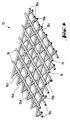
- Figures 2 and 3 show, for example, the arrangement of the glass filament threads (6) in such fabrics (3) and (3 '). A thread arrangement is shown in FIG.
- FIG. 3 shows a scrim that consists of parallel coulters of thick glass filament bundles (6), which are separated by a larger distance , the coulter of the thick bundles crossing thinner holding threads (6 ') are fixed in their parallel position.
- Special requirements for stability in all directions can be met by a scrim with 4 or 5 sets of threads, which lie on top of each other in different directions and are connected to each other at the thread crossing points.
- the thread density specified above is measured perpendicular to the respective thread running direction. As already stated, the thread density can be the same for all existing thread groups or, depending on the expected load, different thread densities can be selected within the scope of these limit values.
- the intersecting glass threads can be fixed at the crossing points by autogenous melting at elevated temperature and, if necessary, using pressure.
- the fixation can be achieved using commercially available chemical binders, e.g. Polyvinyl alcohol or butadiene-styrene copolymers or by hot melt adhesive.
- binders e.g. Polyvinyl alcohol or butadiene-styrene copolymers or by hot melt adhesive.
- fixation by a flame-retardant binder e.g. through a polyester containing phosphoric acid or phosphonic acid groups, which is used as a hot melt adhesive.
- Commercially available fabrics that correspond to the above description can of course also be used.
- glass threads are multifilament threads which have a protective twist to improve the thread closure, but also untwisted filament bundles. Conveniently, they have a total titer of 30 to 130 tex. Their fineness-related strength is approx. 40 to 50 cN / tex. In special cases, where a lower or a particularly high mechanical strength is desired, a lower or higher titer of the reinforcing yarns can of course also be indicated.
- Laminates according to the invention are preferred, whose spunbonded fabrics consist of polyester fibers, in particular of polyethylene terephthalate, and whose metal foil consists of aluminum. Furthermore, such a laminate is particularly preferred if it has two nonwoven layers and an interposed layer.
- a laminate according to the invention is also particularly preferred, which is composed of two nonwoven layers and an interposed interlayer, wherein both nonwoven layers have approximately the same basis weight.
- a laminate according to the invention which is made up of two nonwoven layers and an interposed interlayer, one of the nonwoven layers being at least 20% stronger than the other.
- the metal foil is additionally covered with a polyester fleece with a basis weight of 10 to 50 g / m2.
- the laminates according to the invention and the interlaid scrim can also be consolidated by a chemical binder in addition to mechanical consolidation, for example for needling.
- the laminates according to the invention can contain, for example, the usual polymers which are applied in the form of dispersions as additional binders.
- the binder is preferably a melt binder.
- Modified polyesters with a melting point which is 10 to 50 ° C., preferably 30 to 50 ° C., lower than the nonwoven raw material are particularly suitable as melt binders.
- a binder are polybutylene terephthalate or polyethylene terephthalate modified by condensing longer-chain diols and / or isophthalic acid or aliphatic dicarboxylic acids, but in particular a polyethylene terephthalate modified by incorporating chain links of the formula I given above.
- the melt binders are preferably introduced into the nonwovens in the form of fibers and are then preferably enriched in the nonwoven layers which face the laid layers.
- the laminates according to the invention are produced by depositing the fibrous material forming the nonwoven layers on a moving storage surface.
- Spinning beams are expediently used to deposit the continuous fibers which a fiber curtain is spun into a spinning and drawing shaft, in which the fibers are simultaneously cooled and accelerated and thus stretched by a fluid flow.
- the glass yarns or scrims are placed on the spunbond fabric produced in this way and, as described further below, solidified together. If the glass scrim is to be enclosed between two fleece layers, the glass scrim is expediently introduced by a delivery member from which the glass yarns or scrim run in between two fleece layers, which are deposited on the same tray by two rows of storage organs one behind the other in the direction of transport will. The layer structure is then solidified. Finally, the metal foil is placed on the layers of fiber material and all layers are needled with about 20-70 stitches / cm2.
- the selection of the scrims used for the production of the filament-reinforced nonwovens according to the invention is based on the criteria specified above.
- the fiber material layers are solidified in a manner known per se either by application, for example spraying on binder solutions or dispersions and evaporation of the solvent or dispersant or, preferably, by introducing melt binders and subsequent heat treatment at a temperature at which melts the melt binder and connects the load-bearing filaments of the nonwoven fabric at their crossing points.
- the melt binder is particularly advantageously introduced into the nonwoven in the form of binding filaments. These can be present as separate filaments if, for. B.
- spun out of separate openings of the spinning beams and evenly distributed in the draining fiber curtain or they can be present as a jacket or side of the supporting filaments or part of the supporting filaments if appropriate nozzle openings for spinning core-jacket filaments or side-on Side two-component filaments are provided in the spinning beam.
- the metal foil is placed on the ensemble.
- the entire laminate is solidified by needling the deposited nonwoven and laid layers and the metal foil with the number of stitches given above. If desired, a final additional consolidation can also be carried out in a manner known per se by means of binders, as described above, even after needling.
- the flame-retardant laminate webs according to the invention show no tendency to delamination and no formation of waves and cracks, even under high thermal mechanical stress.
- the laminate webs according to the invention show a surprisingly small increase in width, which is usually only 0 to 4 mm for a web about 1000 mm wide, compared to about 12 mm for conventional webs. It also shows that the laminate according to the invention gives flat, area-stable, bubble-free bitumen sheets even under unfavorable bituminizing conditions. This results in significantly improved workability and increased work safety, e.g. when laying a bituminized roofing membrane on the roof.
- the good flame retardancy combined with very good dimensional stability is surprisingly the result of the combination of the nonwoven layers with the scrim and the metal foil.
- the glass scrim is covered by the two layers of polyester spunbond. This proves to be very advantageous when needling the laminate and when bituminizing.
- Another object of the present invention is a polymer or bitumen sheet, in particular a bituminized roofing sheet and a bituminized roofing underlay, which contains a layer-reinforced laminate sheet according to the invention as a carrier.
- polymer webs are, for example, plastic or rubber webs;
- Bitumen membranes in the sense of this invention are included Bitumen or polymer bitumen impregnated sheets, in particular bituminized roofing sheets or roofing underlay.
- These polymer or bitumen sheets are produced by impregnating and / or coating the reinforcing sheets according to the invention with the indicated molten polymer masses, in particular molten bitumen, in a manner known per se.
Landscapes
- Engineering & Computer Science (AREA)
- Architecture (AREA)
- Civil Engineering (AREA)
- Structural Engineering (AREA)
- Textile Engineering (AREA)
- Laminated Bodies (AREA)
- Nonwoven Fabrics (AREA)
Applications Claiming Priority (2)
| Application Number | Priority Date | Filing Date | Title |
|---|---|---|---|
| DE9217045U DE9217045U1 (de) | 1992-12-15 | 1992-12-15 | Dreikomponenten-Schichtstoff |
| DE9217045U | 1992-12-15 |
Publications (2)
| Publication Number | Publication Date |
|---|---|
| EP0603633A1 true EP0603633A1 (fr) | 1994-06-29 |
| EP0603633B1 EP0603633B1 (fr) | 1997-04-09 |
Family
ID=6887142
Family Applications (1)
| Application Number | Title | Priority Date | Filing Date |
|---|---|---|---|
| EP93119714A Revoked EP0603633B1 (fr) | 1992-12-15 | 1993-12-07 | Stratifié de trois composants |
Country Status (5)
| Country | Link |
|---|---|
| EP (1) | EP0603633B1 (fr) |
| DE (2) | DE9217045U1 (fr) |
| DK (1) | DK0603633T3 (fr) |
| FI (1) | FI935580L (fr) |
| NO (1) | NO934607L (fr) |
Cited By (10)
| Publication number | Priority date | Publication date | Assignee | Title |
|---|---|---|---|---|
| EP1046760A1 (fr) * | 1999-04-20 | 2000-10-25 | Soprema S.A. | Membrane pare-vapeur et complexe isolant et étanchéifiant comprenant notamment une telle membrane |
| NL1012733C2 (nl) * | 1999-07-29 | 2001-02-05 | Esha Holding B V | Vlamwerende dakbaan. |
| WO2001008882A3 (fr) * | 1999-07-30 | 2001-12-27 | Johns Manville Int Inc | Composite lamine non-tisse avec liant |
| WO2002070246A1 (fr) * | 2001-03-08 | 2002-09-12 | Freudenberg Politex S.R.L. | Support composite resistant au feu pour revetements de toiture bitumineux |
| WO2002074530A1 (fr) * | 2001-03-15 | 2002-09-26 | Freudenberg Politex S.R.L. | Support textile synthetique pour gaines de toiture en bitume |
| FR2845754A1 (fr) * | 2002-10-11 | 2004-04-16 | Materiaux Composites Ind Mci | Nappe isolante thermique et acoustique |
| EP1714772A1 (fr) * | 2005-04-20 | 2006-10-25 | Quadrant Plastic Composites AG | Produit intermédiaire composite thermoplastique |
| CN102261081A (zh) * | 2011-04-25 | 2011-11-30 | 上海名呈无纺布有限公司 | 一种用于建筑体表面缝隙防渗漏土工布及其制作方法 |
| EP3611017A1 (fr) | 2018-08-17 | 2020-02-19 | BMI Group Management UK Limited | Feuille de protection résistante au feu |
| EP3323607B1 (fr) | 2016-11-17 | 2021-04-28 | CQLT SaarGummi Technologies S.à.r.l. | Matière en bande destinée à la formation de couvertures de toits |
Families Citing this family (4)
| Publication number | Priority date | Publication date | Assignee | Title |
|---|---|---|---|---|
| DE4344707A1 (de) * | 1993-12-27 | 1995-06-29 | Hoechst Ag | Wurzelfeste Trägereinlage |
| DE19952432B4 (de) * | 1999-10-30 | 2004-10-07 | Johns Manville International, Inc., Denver | Schichtstoff |
| DE19935408B4 (de) * | 1999-07-30 | 2004-04-22 | Johns Manville International, Inc., Denver | Mehrlagenschichtstoff |
| DE10232269A1 (de) | 2002-07-16 | 2004-02-05 | Hänsel Textil GmbH | Flexibler textiler Verstärkungsverbundstoff |
Citations (10)
| Publication number | Priority date | Publication date | Assignee | Title |
|---|---|---|---|---|
| GB1496197A (en) * | 1974-03-05 | 1977-12-30 | Basf Ag | Laminates comprising sheeting of mixtures of bitumen and ethylene copolymers |
| EP0006189A1 (fr) * | 1978-06-21 | 1980-01-09 | Hoechst Aktiengesellschaft | Procédé de fabrication d'une bande bituminée pour toits |
| EP0110039A2 (fr) * | 1982-11-24 | 1984-06-13 | Bay Mills Limited | Produit composite de renforcement de membrane de toiture et procédé de fabrication de ce produit |
| EP0269989A1 (fr) * | 1986-12-05 | 1988-06-08 | Roland-Werke Dachbaustoffe und Bauchemie GmbH & Co. KG | Bande d'étanchéité en bitume |
| EP0347795A2 (fr) * | 1988-06-22 | 1989-12-27 | Hoechst Aktiengesellschaft | Feuille multicouche |
| DE3941189A1 (de) * | 1988-12-13 | 1990-06-21 | Rhone Poulenc Fibres | Traeger auf basis von nichtgewebtem vlies aus chemischer textilfaser und sein herstellungsverfahren |
| DE3901152A1 (de) * | 1989-01-17 | 1990-07-19 | Hoechst Ag | Flammfeste traegerbahn fuer bitumenbahnen und verfahren zu ihrer herstellung |
| EP0400711A1 (fr) * | 1989-05-31 | 1990-12-05 | "PERFORMANCE ROOF SYSTEMS" en abrégé "P.R.S." | Membrane d'étanchéité bitumineuse |
| DE3940713A1 (de) * | 1989-12-09 | 1991-06-13 | Hoechst Ag | Flammhemmendes vlies mit bindefilamenten |
| EP0497338A2 (fr) * | 1991-01-31 | 1992-08-05 | Hoechst Aktiengesellschaft | Matériau multicouche de garnissage pour fixation sur un substrat |
-
1992
- 1992-12-15 DE DE9217045U patent/DE9217045U1/de not_active Expired - Lifetime
-
1993
- 1993-12-07 DE DE59306109T patent/DE59306109D1/de not_active Revoked
- 1993-12-07 EP EP93119714A patent/EP0603633B1/fr not_active Revoked
- 1993-12-07 DK DK93119714.9T patent/DK0603633T3/da active
- 1993-12-13 FI FI935580A patent/FI935580L/fi unknown
- 1993-12-14 NO NO934607A patent/NO934607L/no unknown
Patent Citations (10)
| Publication number | Priority date | Publication date | Assignee | Title |
|---|---|---|---|---|
| GB1496197A (en) * | 1974-03-05 | 1977-12-30 | Basf Ag | Laminates comprising sheeting of mixtures of bitumen and ethylene copolymers |
| EP0006189A1 (fr) * | 1978-06-21 | 1980-01-09 | Hoechst Aktiengesellschaft | Procédé de fabrication d'une bande bituminée pour toits |
| EP0110039A2 (fr) * | 1982-11-24 | 1984-06-13 | Bay Mills Limited | Produit composite de renforcement de membrane de toiture et procédé de fabrication de ce produit |
| EP0269989A1 (fr) * | 1986-12-05 | 1988-06-08 | Roland-Werke Dachbaustoffe und Bauchemie GmbH & Co. KG | Bande d'étanchéité en bitume |
| EP0347795A2 (fr) * | 1988-06-22 | 1989-12-27 | Hoechst Aktiengesellschaft | Feuille multicouche |
| DE3941189A1 (de) * | 1988-12-13 | 1990-06-21 | Rhone Poulenc Fibres | Traeger auf basis von nichtgewebtem vlies aus chemischer textilfaser und sein herstellungsverfahren |
| DE3901152A1 (de) * | 1989-01-17 | 1990-07-19 | Hoechst Ag | Flammfeste traegerbahn fuer bitumenbahnen und verfahren zu ihrer herstellung |
| EP0400711A1 (fr) * | 1989-05-31 | 1990-12-05 | "PERFORMANCE ROOF SYSTEMS" en abrégé "P.R.S." | Membrane d'étanchéité bitumineuse |
| DE3940713A1 (de) * | 1989-12-09 | 1991-06-13 | Hoechst Ag | Flammhemmendes vlies mit bindefilamenten |
| EP0497338A2 (fr) * | 1991-01-31 | 1992-08-05 | Hoechst Aktiengesellschaft | Matériau multicouche de garnissage pour fixation sur un substrat |
Cited By (13)
| Publication number | Priority date | Publication date | Assignee | Title |
|---|---|---|---|---|
| FR2792671A1 (fr) * | 1999-04-20 | 2000-10-27 | Soprema | Membrane pare-vapeur et complexe isolant et etancheifiant comprenant notamment une telle membrane |
| EP1046760A1 (fr) * | 1999-04-20 | 2000-10-25 | Soprema S.A. | Membrane pare-vapeur et complexe isolant et étanchéifiant comprenant notamment une telle membrane |
| NL1012733C2 (nl) * | 1999-07-29 | 2001-02-05 | Esha Holding B V | Vlamwerende dakbaan. |
| WO2001008882A3 (fr) * | 1999-07-30 | 2001-12-27 | Johns Manville Int Inc | Composite lamine non-tisse avec liant |
| RU2271279C2 (ru) * | 2001-03-08 | 2006-03-10 | Фройденберг Политекс С.Р.Л. | Огнестойкая композитная основа для битумных кровельных листов |
| WO2002070246A1 (fr) * | 2001-03-08 | 2002-09-12 | Freudenberg Politex S.R.L. | Support composite resistant au feu pour revetements de toiture bitumineux |
| WO2002074530A1 (fr) * | 2001-03-15 | 2002-09-26 | Freudenberg Politex S.R.L. | Support textile synthetique pour gaines de toiture en bitume |
| FR2845754A1 (fr) * | 2002-10-11 | 2004-04-16 | Materiaux Composites Ind Mci | Nappe isolante thermique et acoustique |
| EP1714772A1 (fr) * | 2005-04-20 | 2006-10-25 | Quadrant Plastic Composites AG | Produit intermédiaire composite thermoplastique |
| WO2006111037A1 (fr) | 2005-04-20 | 2006-10-26 | Quadrant Plastic Composites Ag | Materiau composite pouvant etre traite de façon thermoplastique |
| CN102261081A (zh) * | 2011-04-25 | 2011-11-30 | 上海名呈无纺布有限公司 | 一种用于建筑体表面缝隙防渗漏土工布及其制作方法 |
| EP3323607B1 (fr) | 2016-11-17 | 2021-04-28 | CQLT SaarGummi Technologies S.à.r.l. | Matière en bande destinée à la formation de couvertures de toits |
| EP3611017A1 (fr) | 2018-08-17 | 2020-02-19 | BMI Group Management UK Limited | Feuille de protection résistante au feu |
Also Published As
| Publication number | Publication date |
|---|---|
| DE59306109D1 (de) | 1997-05-15 |
| NO934607D0 (no) | 1993-12-14 |
| EP0603633B1 (fr) | 1997-04-09 |
| DE9217045U1 (de) | 1993-05-13 |
| DK0603633T3 (da) | 1997-10-20 |
| FI935580A7 (fi) | 1994-06-16 |
| FI935580L (fi) | 1994-06-16 |
| FI935580A0 (fi) | 1993-12-13 |
| NO934607L (no) | 1994-06-16 |
Similar Documents
| Publication | Publication Date | Title |
|---|---|---|
| EP0572891B1 (fr) | Couche non-tissée et grille | |
| EP0761859B1 (fr) | Matériau textile laminé, procédé pour sa fabrication, son usage et nappe contenant des fils hybride | |
| EP0806509B2 (fr) | Matériau de garnissage, procédé pour sa fabrication et son utilisation | |
| DE60031546T2 (de) | Verbundvliesmaterial | |
| EP1939342B1 (fr) | Garniture de support, son procédé de fabrication et d'utilisation | |
| EP0176847B1 (fr) | Etoffe multicouche | |
| EP0435001B1 (fr) | Laminé | |
| EP0603633B1 (fr) | Stratifié de trois composants | |
| EP0530769A1 (fr) | Procédé et produit intermédiaire pour la production d'un stratifié thermofusionné et l'utilisation de ce produit | |
| DE19620361C2 (de) | Trägereinlage und deren Verwendung | |
| DE202008010258U1 (de) | Trägereinlage und beschichtete Dachbahnen | |
| DE19521838A1 (de) | Textiler Kompakt-Verbundstoff, Verfahren zu dessen Herstellung und dessen Verwendung | |
| EP0506051A1 (fr) | Support renforcé avec des filaments de polyester | |
| DE60005527T2 (de) | Hydrodynamisch verfestigte trägerbahnen und deren verwendung | |
| EP0661153B1 (fr) | Matériau de garnissage résistant au percement des racines pour fixation sur un substrat | |
| DE19950057B4 (de) | Zwei- oder Mehrlagenschichtstoffe aus Polyesterfilamentvliesen und Glasfasergeweben oder -gelegen | |
| DE19935408B4 (de) | Mehrlagenschichtstoff | |
| DE19935531C2 (de) | Zweilagenschichtstoff | |
| DE19952432B4 (de) | Schichtstoff | |
| DE3821011A1 (de) | Mehrschichtige traegerbahn | |
| EP0053198B1 (fr) | Tapis tufté | |
| DE9207368U1 (de) | Schichtstoff aus Vlies und Gelege | |
| DE202006021073U1 (de) | Trägereinlage und deren Verwendung | |
| DE29608372U1 (de) | Trägereinlage | |
| DE29609098U1 (de) | Trägereinlage |
Legal Events
| Date | Code | Title | Description |
|---|---|---|---|
| PUAI | Public reference made under article 153(3) epc to a published international application that has entered the european phase |
Free format text: ORIGINAL CODE: 0009012 |
|
| AK | Designated contracting states |
Kind code of ref document: A1 Designated state(s): BE CH DE DK FR GB IE LI MC NL SE |
|
| 17P | Request for examination filed |
Effective date: 19940530 |
|
| 17Q | First examination report despatched |
Effective date: 19940811 |
|
| GRAG | Despatch of communication of intention to grant |
Free format text: ORIGINAL CODE: EPIDOS AGRA |
|
| GRAH | Despatch of communication of intention to grant a patent |
Free format text: ORIGINAL CODE: EPIDOS IGRA |
|
| GRAH | Despatch of communication of intention to grant a patent |
Free format text: ORIGINAL CODE: EPIDOS IGRA |
|
| GRAA | (expected) grant |
Free format text: ORIGINAL CODE: 0009210 |
|
| RBV | Designated contracting states (corrected) |
Designated state(s): BE CH DE DK FR GB IE LI MC NL SE |
|
| AK | Designated contracting states |
Kind code of ref document: B1 Designated state(s): BE CH DE DK FR GB IE LI MC NL SE |
|
| REG | Reference to a national code |
Ref country code: CH Ref legal event code: EP |
|
| REF | Corresponds to: |
Ref document number: 59306109 Country of ref document: DE Date of ref document: 19970515 |
|
| GBT | Gb: translation of ep patent filed (gb section 77(6)(a)/1977) |
Effective date: 19970619 |
|
| ET | Fr: translation filed | ||
| REG | Reference to a national code |
Ref country code: IE Ref legal event code: FG4D Free format text: 73104 |
|
| REG | Reference to a national code |
Ref country code: DK Ref legal event code: T3 |
|
| PGFP | Annual fee paid to national office [announced via postgrant information from national office to epo] |
Ref country code: NL Payment date: 19971130 Year of fee payment: 5 |
|
| PGFP | Annual fee paid to national office [announced via postgrant information from national office to epo] |
Ref country code: MC Payment date: 19971201 Year of fee payment: 5 |
|
| PGFP | Annual fee paid to national office [announced via postgrant information from national office to epo] |
Ref country code: GB Payment date: 19971204 Year of fee payment: 5 |
|
| PGFP | Annual fee paid to national office [announced via postgrant information from national office to epo] |
Ref country code: BE Payment date: 19971230 Year of fee payment: 5 |
|
| PLBQ | Unpublished change to opponent data |
Free format text: ORIGINAL CODE: EPIDOS OPPO |
|
| PLBI | Opposition filed |
Free format text: ORIGINAL CODE: 0009260 |
|
| PLBQ | Unpublished change to opponent data |
Free format text: ORIGINAL CODE: EPIDOS OPPO |
|
| PLAB | Opposition data, opponent's data or that of the opponent's representative modified |
Free format text: ORIGINAL CODE: 0009299OPPO |
|
| PLBF | Reply of patent proprietor to notice(s) of opposition |
Free format text: ORIGINAL CODE: EPIDOS OBSO |
|
| 26 | Opposition filed |
Opponent name: FIRMA CARL FREUDENBERG Effective date: 19980104 |
|
| R26 | Opposition filed (corrected) |
Opponent name: FIRMA CARL FREUDENBERG Effective date: 19980104 |
|
| NLR1 | Nl: opposition has been filed with the epo |
Opponent name: FIRMA CARL FREUDENBERG |
|
| PLBF | Reply of patent proprietor to notice(s) of opposition |
Free format text: ORIGINAL CODE: EPIDOS OBSO |
|
| PG25 | Lapsed in a contracting state [announced via postgrant information from national office to epo] |
Ref country code: GB Free format text: LAPSE BECAUSE OF NON-PAYMENT OF DUE FEES Effective date: 19981207 |
|
| PG25 | Lapsed in a contracting state [announced via postgrant information from national office to epo] |
Ref country code: BE Free format text: LAPSE BECAUSE OF NON-PAYMENT OF DUE FEES Effective date: 19981231 |
|
| PGFP | Annual fee paid to national office [announced via postgrant information from national office to epo] |
Ref country code: IE Payment date: 19990108 Year of fee payment: 6 |
|
| BERE | Be: lapsed |
Owner name: HOECHST A.G. Effective date: 19981231 |
|
| PG25 | Lapsed in a contracting state [announced via postgrant information from national office to epo] |
Ref country code: MC Free format text: LAPSE BECAUSE OF NON-PAYMENT OF DUE FEES Effective date: 19990630 |
|
| PG25 | Lapsed in a contracting state [announced via postgrant information from national office to epo] |
Ref country code: NL Free format text: LAPSE BECAUSE OF NON-PAYMENT OF DUE FEES Effective date: 19990701 |
|
| GBPC | Gb: european patent ceased through non-payment of renewal fee |
Effective date: 19981207 |
|
| RDAH | Patent revoked |
Free format text: ORIGINAL CODE: EPIDOS REVO |
|
| NLV4 | Nl: lapsed or anulled due to non-payment of the annual fee |
Effective date: 19990701 |
|
| APAC | Appeal dossier modified |
Free format text: ORIGINAL CODE: EPIDOS NOAPO |
|
| APAE | Appeal reference modified |
Free format text: ORIGINAL CODE: EPIDOS REFNO |
|
| RAP2 | Party data changed (patent owner data changed or rights of a patent transferred) |
Owner name: JOHNS MANVILLE CORPORATION |
|
| RAP2 | Party data changed (patent owner data changed or rights of a patent transferred) |
Owner name: JOHNS MANVILLE INTERNATIONAL, INC. |
|
| PG25 | Lapsed in a contracting state [announced via postgrant information from national office to epo] |
Ref country code: IE Free format text: LAPSE BECAUSE OF NON-PAYMENT OF DUE FEES Effective date: 19991207 |
|
| APAE | Appeal reference modified |
Free format text: ORIGINAL CODE: EPIDOS REFNO |
|
| APAC | Appeal dossier modified |
Free format text: ORIGINAL CODE: EPIDOS NOAPO |
|
| APAE | Appeal reference modified |
Free format text: ORIGINAL CODE: EPIDOS REFNO |
|
| REG | Reference to a national code |
Ref country code: CH Ref legal event code: PUE Owner name: HOECHST AKTIENGESELLSCHAFT TRANSFER- JOHNS MANVILL Ref country code: CH Ref legal event code: NV Representative=s name: DIPL.-ING. ETH H. R. WERFFELI PATENTANWALT |
|
| REG | Reference to a national code |
Ref country code: IE Ref legal event code: MM4A |
|
| APAE | Appeal reference modified |
Free format text: ORIGINAL CODE: EPIDOS REFNO |
|
| REG | Reference to a national code |
Ref country code: FR Ref legal event code: TP |
|
| PGFP | Annual fee paid to national office [announced via postgrant information from national office to epo] |
Ref country code: FR Payment date: 20041217 Year of fee payment: 12 |
|
| PGFP | Annual fee paid to national office [announced via postgrant information from national office to epo] |
Ref country code: SE Payment date: 20041221 Year of fee payment: 12 |
|
| PGFP | Annual fee paid to national office [announced via postgrant information from national office to epo] |
Ref country code: CH Payment date: 20041222 Year of fee payment: 12 |
|
| PGFP | Annual fee paid to national office [announced via postgrant information from national office to epo] |
Ref country code: DK Payment date: 20041228 Year of fee payment: 12 |
|
| PGFP | Annual fee paid to national office [announced via postgrant information from national office to epo] |
Ref country code: DE Payment date: 20050131 Year of fee payment: 12 |
|
| APBU | Appeal procedure closed |
Free format text: ORIGINAL CODE: EPIDOSNNOA9O |
|
| RDAG | Patent revoked |
Free format text: ORIGINAL CODE: 0009271 |
|
| STAA | Information on the status of an ep patent application or granted ep patent |
Free format text: STATUS: PATENT REVOKED |
|
| REG | Reference to a national code |
Ref country code: CH Ref legal event code: PL |
|
| 27W | Patent revoked |
Effective date: 20050609 |
|
| APAH | Appeal reference modified |
Free format text: ORIGINAL CODE: EPIDOSCREFNO |
|
| REG | Reference to a national code |
Ref country code: SE Ref legal event code: ECNC |