EP0603692B1 - Verfahren zum automatischen Prüfen von Vermittlungs-und Uebertragungsvorgängen in einem Fernmeldenetz sowie eine Antwortstation zur Durchführung des Verfahrens - Google Patents
Verfahren zum automatischen Prüfen von Vermittlungs-und Uebertragungsvorgängen in einem Fernmeldenetz sowie eine Antwortstation zur Durchführung des Verfahrens Download PDFInfo
- Publication number
- EP0603692B1 EP0603692B1 EP93120032A EP93120032A EP0603692B1 EP 0603692 B1 EP0603692 B1 EP 0603692B1 EP 93120032 A EP93120032 A EP 93120032A EP 93120032 A EP93120032 A EP 93120032A EP 0603692 B1 EP0603692 B1 EP 0603692B1
- Authority
- EP
- European Patent Office
- Prior art keywords
- asi
- ttn
- terminal
- telecommunications network
- response
- Prior art date
- Legal status (The legal status is an assumption and is not a legal conclusion. Google has not performed a legal analysis and makes no representation as to the accuracy of the status listed.)
- Expired - Lifetime
Links
- 238000012360 testing method Methods 0.000 title claims abstract description 27
- 238000000034 method Methods 0.000 title claims description 16
- 230000005540 biological transmission Effects 0.000 title description 9
- 230000004044 response Effects 0.000 claims description 24
- 230000006870 function Effects 0.000 abstract description 10
- 238000011065 in-situ storage Methods 0.000 abstract 1
- 238000004891 communication Methods 0.000 description 4
- 230000008901 benefit Effects 0.000 description 3
- 230000001960 triggered effect Effects 0.000 description 3
- 238000013461 design Methods 0.000 description 2
- 238000012423 maintenance Methods 0.000 description 2
- 230000006978 adaptation Effects 0.000 description 1
- 238000004590 computer program Methods 0.000 description 1
- 238000010276 construction Methods 0.000 description 1
- 230000007423 decrease Effects 0.000 description 1
- 238000001514 detection method Methods 0.000 description 1
- 238000000802 evaporation-induced self-assembly Methods 0.000 description 1
- 238000011990 functional testing Methods 0.000 description 1
- 230000007257 malfunction Effects 0.000 description 1
- 238000012545 processing Methods 0.000 description 1
- 230000011664 signaling Effects 0.000 description 1
- 238000004088 simulation Methods 0.000 description 1
- 238000010972 statistical evaluation Methods 0.000 description 1
- 238000012795 verification Methods 0.000 description 1
Images

Classifications
-
- H—ELECTRICITY
- H04—ELECTRIC COMMUNICATION TECHNIQUE
- H04M—TELEPHONIC COMMUNICATION
- H04M3/00—Automatic or semi-automatic exchanges
- H04M3/22—Arrangements for supervision, monitoring or testing
- H04M3/26—Arrangements for supervision, monitoring or testing with means for applying test signals or for measuring
- H04M3/28—Automatic routine testing ; Fault testing; Installation testing; Test methods, test equipment or test arrangements therefor
- H04M3/30—Automatic routine testing ; Fault testing; Installation testing; Test methods, test equipment or test arrangements therefor for subscriber's lines, for the local loop
-
- H—ELECTRICITY
- H04—ELECTRIC COMMUNICATION TECHNIQUE
- H04Q—SELECTING
- H04Q11/00—Selecting arrangements for multiplex systems
- H04Q11/04—Selecting arrangements for multiplex systems for time-division multiplexing
- H04Q11/0428—Integrated services digital network, i.e. systems for transmission of different types of digitised signals, e.g. speech, data, telecentral, television signals
- H04Q11/0435—Details
- H04Q11/045—Selection or connection testing arrangements
-
- H—ELECTRICITY
- H04—ELECTRIC COMMUNICATION TECHNIQUE
- H04Q—SELECTING
- H04Q2213/00—Indexing scheme relating to selecting arrangements in general and for multiplex systems
- H04Q2213/056—Software routines, e.g. finite state machines
-
- H—ELECTRICITY
- H04—ELECTRIC COMMUNICATION TECHNIQUE
- H04Q—SELECTING
- H04Q2213/00—Indexing scheme relating to selecting arrangements in general and for multiplex systems
- H04Q2213/109—Initialising; Downloading of parameters or program routines
Definitions
- the present invention relates to a method according to the preamble of claim 1 and a response station for performing the method.
- connections to other terminals of the telecommunications network must be established.
- the functions and features to be checked include, in particular, the sending and receiving of voice, data and image information as well as the associated identification of the end devices or end device types concerned.
- the types of terminal devices most frequently used in the telecommunications network are, in addition to a telephone, for example facsimile devices or a computer provided with a line connection for the transmission of data.
- a known solution is that a connection is established from the terminal to be tested to a terminal of the same device type connected to the same telecommunications network and that all the performance features are checked manually in succession.
- test module CEM-Customer Emulation Module
- ISDN Integrated Services Digital Network
- EP 0 475 749 A2 describes an ISDN terminal adapter with a diagnostic function which enables data and information stored in terminal adapters to be read from remote subscriber connections, checked and changed as required. For this purpose, a connection is established via the ISDN to the remote terminal adapter, via which data and commands are then exchanged.
- the present invention is based on the object of specifying a simple method for the comprehensive testing of switching and transmission processes in a telecommunications network and of terminals connected to the telecommunications network.
- the invention has the following advantages: By automatically answering and processing calls originating from terminals connected to the telecommunications network and to be tested, the required test sequences can be generated at any time and with a high degree of reproducibility.
- the answering station automatically recognizes the device type of the calling device and controls the test sequence accordingly. In addition to identifying the device type, the calling subscriber is also identified automatically. Connections can also be established or triggered automatically from answering stations, for example periodically, or manually. When a connection is established with a terminal device, tests are carried out in accordance with the existing terminal device type, which provide information about the functionality of the performance features provided in the terminal device. After the tests have been completed, the results can be communicated to the calling subscriber or displayed and / or recorded in the answering station.
- the automatic detection of the device type of the calling or connected device and the independent execution of test sequences after the connection has been established can save costs for operating personnel.
- the availability of the answering station for the user can be increased significantly.
- the compact and modular design of the answering station results in simple operation, inexpensive maintenance and the possibility of integrating extensions and improvements into the existing solution with little effort.
- several answering stations according to the invention can be connected to the same telecommunications network, the others being able to be configured and / or controlled via the telecommunications network with at least one of these answering stations. This means that the entire test system can be monitored from one station. This is particularly advantageous if malfunctions that have been recorded in a decentralized answering station are transmitted to another answering station for further checking.
- the modular design already mentioned should also be emphasized in this context, since in particular the decentralized answering stations do not have to be equipped with all components. For example, input and output devices and the associated computer programs can be omitted from such answering stations.
- FIG. 1 a shows a hardware structure of a response station AS according to the invention in the fully developed version for operation as a test station in a telecommunications network constructed, for example, according to ISDN (Integrated Services Digital Network) standards.
- the answering station AS can be connected to the telecommunications network from the outside via an interface S, the interface S in the present exemplary embodiment being recommended by the CCITT (ComInstituttatif International Télégraphique et Téléphonique) recommendation Q.931 (CCITT: Recommendation Q.931: Blue Book, Vol. VI.11, Geneva: ITU 1988) is implemented as a basic connection.
- the answering station AS itself consists of an interface module BG, a computer R and two optional inputs and / or. units KB or BS.
- the interface module BG carries out an actual interface adaptation between the ISDN-typical interface S and an internal interface SR of the computer R.
- the computer R is also connected to the input and output units KB and BS via two further interfaces SBS and SKB. If a common standard - such as EISA, AT-Bus or Future-Bus - is used for the SR interface and the SBS and SKB interfaces are selected in accordance with the interfaces used in standard input and output devices, individual components of the AS answering station can be replaced without adjustments.
- a common standard - such as EISA, AT-Bus or Future-Bus - is used for the SR interface and the SBS and SKB interfaces are selected in accordance with the interfaces used in standard input and output devices, individual components of the AS answering station can be replaced without adjustments.
- This also applies in particular to the BG interface module, which are commercially available from various manufacturers, for example under the name "ISDN cards for basic connections".
- the hardware structure of the answering station consists only of the computer R and the interface module BG.
- FIG. 1b shows a software concept for the hardware explained with reference to FIG. 1a, wherein this software concept is also suitable for a hardware structure which differs from that described with reference to FIG. 1a.
- Corresponding software interfaces SS and SSR are provided for the hardware-specified interfaces S and SR (FIG. 1a), which are controlled by an auxiliary program HP which runs in the interface module BG (FIG. 1a) and controls it.
- the auxiliary program HP thus primarily controls the functions present in the special hardware, namely the BG interface module (FIG. 1a), and the protocols used for the standards of the SS and SSR interface.
- a system program OS communicating via the interface SSR with the auxiliary program HP takes on a similar function in the computer R as the auxiliary program HP in the interface module BG: the system program OS controls the hardware-related components of the computer R and operates a further standardized interface to one at an increased level of abstraction lying driver program TP.
- This driver program TP contains all functions or messages required for communication with the telecommunications network or with other terminals of the telecommunications network, such as, for example, a request for data transmission, signaling, displaying errors, etc., without the user of the driver program TP knowing all the associated details have to be.
- the entirety of these functions and messages forms the basis for interfaces SA1 to SAn to application programs AP1 to APn, which represent a further and last level of abstraction.
- the application programs AP1 to APn also include, for example, the logging of test sequences, statistical evaluations, auxiliary programs for setting the parameters of the answering station AS, remote control of answering stations connected to the same telecommunications network, etc.
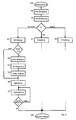
- FIG. 2 shows possible test sequences running in the answering station AS (FIG. 1) after the arrival of a call from a terminal using a flowchart.
- the answering station AS registers the receipt of a call and changes from a waiting state WS to a call input AE state in which the connection to the terminal is confirmed with messages characteristic of the telecommunications network.
- the device type and the phone number of the end device are determined in an identification ID state. It would also be conceivable at this point to check the permissibility of the connection by comparing the telephone number of the terminal with the permissible telephone numbers stored in the computer R (FIG. 1a) or by requesting a password to identify the person operating the terminal.
- the answering station AS changes to a status message M1 and communicates the call number recognized in the identification ID state to the subscriber using the terminals by assembling predetermined speech elements.
- connection termination VB, delay VZ and connection establishment VA can, however, also be bridged if this is indicated to the answering station AS accordingly.
- the answering station AS changes directly from the message M1 state to the message M2 state, in which a speech mirroring carried out in a subsequent state mirroring SP is displayed.
- Speech mirroring is an essential further form of use of the answering station AS and enables the simulation of the situation occurring by the connection of two telephone sets that information is exchanged between these devices simultaneously in both directions. This is achieved in that the information provided by the terminal is stored in the answering station AS during a predetermined but adjustable interval and is sent back to the terminal with a delay. The operator of the terminal device is thus able to assess the transmission quality of the line, if only on a subjective scale, in addition to checking the transmission functions required in both directions.
- the answering station AS (FIG. 1) remains in the mirroring state SP until the connection to the terminal is triggered.
- the response station AS then again changes to the waiting state WS.
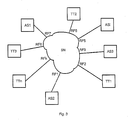
- FIG. 3 shows a telecommunications network consisting of a network SN and various terminals TT1 to TTn and response stations connected to the network SN via reference points RF1 to RFk AS1 to ASi.
- the network SN is, for example, a telecommunications network constructed according to ISDN standards, to which basic devices such as telephone sets, terminal adapters, facsimile devices of group 3 or 4, etc. can be connected at the reference points RF1 to RFk.
- the response stations AS1 to ASi which are also preferably connected to the network SN via base connections, can, as already indicated, be equipped differently. It is conceivable that the response stations AS2 to ASi are only equipped with the minimally required hardware components computer R and interface module BG (FIG. 1a) and with the necessary application programs AP1 to APe (FIG. 1b) and that only the response station AS1 is equipped with Input and output units KB and BS (Fig. 1a) and additional application programs APe + 1 to APn are provided.
- the configuration and control of the answering stations AS2 to ASi is carried out in this case by the central answering station AS1, which can control and monitor the answering stations AS2 to ASi with the aid of a remote control.
- the answering stations AS2 to ASi can be installed anywhere, since they can be controlled via the network SN itself. This results in a further, already indicated advantage of the modular construction of the answering stations AS1 to ASi, because costs and maintenance expenditure can be minimized in a targeted manner by the hardware components (FIG. 1a) and application programs AP1 to APn (FIG. 1b) required depending on the requirement .
- the use of several answering stations AS1 to ASi connected to the same network SN has, in addition to the greater capacity for handling simultaneous calls, also the advantage that the probability of encountering an occupied answering station AS1 to ASi decreases significantly with increasing number i.
- the reliability of the system also increases, since a system failure becomes less likely the more response stations AS1 to ASi are present in a network SN.
- Different answering stations AS1 to ASi can also be combined into so-called multiple connections.
- the phone numbers of the same multiple connection summarized answering stations AS1 to ASi are not permanently assigned to one of these answering stations AS1 to ASi. Rather, an incoming call is assigned according to the availability of one of the answering stations AS1 to ASi that are free at the respective time. This results in greater availability and thus increased system security for the entire test system.
Landscapes
- Engineering & Computer Science (AREA)
- Signal Processing (AREA)
- Computer Networks & Wireless Communication (AREA)
- Monitoring And Testing Of Exchanges (AREA)
- Monitoring And Testing Of Transmission In General (AREA)
- Data Exchanges In Wide-Area Networks (AREA)
- Exchange Systems With Centralized Control (AREA)
- Manufacturing Of Electric Cables (AREA)
- Control Of Steam Boilers And Waste-Gas Boilers (AREA)
Applications Claiming Priority (2)
| Application Number | Priority Date | Filing Date | Title |
|---|---|---|---|
| CH386892A CH685899A5 (de) | 1992-12-18 | 1992-12-18 | Antwortstation zur automatischen Pruefung von an ein Fernmeldenetz angeschlossenen Endgeraeten |
| CH3868/92 | 1992-12-18 |
Publications (2)
| Publication Number | Publication Date |
|---|---|
| EP0603692A1 EP0603692A1 (de) | 1994-06-29 |
| EP0603692B1 true EP0603692B1 (de) | 1997-09-17 |
Family
ID=4265217
Family Applications (1)
| Application Number | Title | Priority Date | Filing Date |
|---|---|---|---|
| EP93120032A Expired - Lifetime EP0603692B1 (de) | 1992-12-18 | 1993-12-11 | Verfahren zum automatischen Prüfen von Vermittlungs-und Uebertragungsvorgängen in einem Fernmeldenetz sowie eine Antwortstation zur Durchführung des Verfahrens |
Country Status (9)
| Country | Link |
|---|---|
| EP (1) | EP0603692B1 (da) |
| AT (1) | ATE158462T1 (da) |
| CH (1) | CH685899A5 (da) |
| DE (1) | DE59307390D1 (da) |
| DK (1) | DK0603692T3 (da) |
| ES (1) | ES2106945T3 (da) |
| FI (1) | FI935615A7 (da) |
| GR (1) | GR3024934T3 (da) |
| NO (1) | NO308570B1 (da) |
Families Citing this family (6)
| Publication number | Priority date | Publication date | Assignee | Title |
|---|---|---|---|---|
| US6370122B1 (en) | 1996-08-27 | 2002-04-09 | Siemens Schweiz Ag | Method for monitoring and checking subscriber connections to ISDN |
| DE19807532A1 (de) * | 1998-02-21 | 1999-08-26 | Schneider | Verfahren zur automatischen Überwachung einer ISDN-Telefonleitung |
| DE10033302A1 (de) * | 2000-07-05 | 2002-02-21 | Deutsche Telekom Ag | Verfahren zum Abbilden einer SO-Schnittstelle an einem entfernten Anschluss |
| DE10132784B4 (de) * | 2001-07-06 | 2005-06-02 | Serviceforce Gmbh | Verfahren und Testanordnung zum Testen eines Telekommunikationssystems |
| CN100382624C (zh) * | 2004-07-08 | 2008-04-16 | 中兴通讯股份有限公司 | 一种cdma手机软件自动测试的方法及装置 |
| CN100469171C (zh) * | 2006-11-28 | 2009-03-11 | 青岛海信移动通信技术股份有限公司 | 多种制式移动终端的测试系统及其测试方法 |
Family Cites Families (5)
| Publication number | Priority date | Publication date | Assignee | Title |
|---|---|---|---|---|
| US4138599A (en) * | 1977-10-31 | 1979-02-06 | Northern Telecom Limited | Modular communication system having self-identifying modules |
| JPS6148266A (ja) * | 1984-08-15 | 1986-03-08 | Fujitsu Ltd | 時分割多重回線折返試験方法 |
| JPS61146053A (ja) * | 1984-12-20 | 1986-07-03 | Fujitsu Ltd | Isdn端末自動試験方式 |
| DE3907237A1 (de) * | 1989-03-07 | 1990-09-13 | Rutenbeck Wilhelm Gmbh & Co | Geraet zur simulation, analyse und zum monitoring von nach dem isdn-system arbeitenden isdn-endgeraeten |
| EP0475749B1 (en) * | 1990-09-12 | 1996-04-24 | Nec Corporation | ISDN terminal having diagnostic function |
-
1992
- 1992-12-18 CH CH386892A patent/CH685899A5/de not_active IP Right Cessation
-
1993
- 1993-12-11 ES ES93120032T patent/ES2106945T3/es not_active Expired - Lifetime
- 1993-12-11 DK DK93120032.3T patent/DK0603692T3/da active
- 1993-12-11 DE DE59307390T patent/DE59307390D1/de not_active Expired - Fee Related
- 1993-12-11 EP EP93120032A patent/EP0603692B1/de not_active Expired - Lifetime
- 1993-12-11 AT AT93120032T patent/ATE158462T1/de not_active IP Right Cessation
- 1993-12-14 FI FI935615A patent/FI935615A7/fi unknown
- 1993-12-17 NO NO934686A patent/NO308570B1/no not_active IP Right Cessation
-
1997
- 1997-10-03 GR GR970402575T patent/GR3024934T3/el unknown
Non-Patent Citations (1)
| Title |
|---|
| CCITT Recommendation E434; 1992; Geneva CH; Seiten 1-8 * |
Also Published As
| Publication number | Publication date |
|---|---|
| DE59307390D1 (de) | 1997-10-23 |
| FI935615A0 (fi) | 1993-12-14 |
| ES2106945T3 (es) | 1997-11-16 |
| DK0603692T3 (da) | 1998-05-11 |
| NO934686L (no) | 1994-06-20 |
| CH685899A5 (de) | 1995-10-31 |
| ATE158462T1 (de) | 1997-10-15 |
| EP0603692A1 (de) | 1994-06-29 |
| NO308570B1 (no) | 2000-09-25 |
| NO934686D0 (no) | 1993-12-17 |
| GR3024934T3 (en) | 1998-01-30 |
| FI935615A7 (fi) | 1994-06-19 |
Similar Documents
| Publication | Publication Date | Title |
|---|---|---|
| EP0731618B1 (de) | Verfahren zum Steuern eines Zugangsnetzes sowie Vermittlungsstelle und Zugangsnetz damit | |
| DE3903257C2 (da) | ||
| EP0923835B1 (de) | Verfahren zum überwachen und prüfen von anschlüssen eines isdn-fernmeldenetzes | |
| EP0603692B1 (de) | Verfahren zum automatischen Prüfen von Vermittlungs-und Uebertragungsvorgängen in einem Fernmeldenetz sowie eine Antwortstation zur Durchführung des Verfahrens | |
| EP1487226A1 (de) | Verfahren zum Überprüfen der Leitweglenkung und Gebührenerfassung in einem Mobilkommunikationsnetz | |
| EP0581087A1 (de) | Verfahren zum Darstellen teilnehmerindividueller Daten beim Übertragen von Signalisierungssignalen und Nachrichtensignalen zwischen Schmalbandnetzen und ATM- Netzen | |
| EP0631448B1 (de) | Verfahren zur Unterstützung von Testroutinen | |
| DE19744412A1 (de) | Verfahren und System zum kollaborativen Testen einer Verbindungsleitung | |
| DE19937675C2 (de) | Verfahren und Vorrichtung zur Erhöhung der Ausfallsicherheit von an Vermittlungsstellen angeschlossenen Auskunftsstellen | |
| DE102007008463A1 (de) | Verfahren und breitbandiges Zugangssystem zur ferngesteuerten Sprachschnittstellensteuerung eines Zugangsknoten | |
| EP0477627B1 (de) | Verfahren zum Verbinden von Kommunikationsendgeräten in diensteintegrierenden Kommunikationsnetzen | |
| EP0710045B1 (de) | Verfahren zum Prüfen von Verbindungen in Fernmeldenetzen | |
| DE19831168C2 (de) | Verfahren zum automatischen Erfassen von Leistungsmerkmalen einer Kommunikations-Endeinrichung | |
| EP0332977A2 (de) | Verfahren zum Steuern des Aufbaus von Datenübertragungsverbindungen in Telekommunikationsanlagen | |
| EP1189415A2 (de) | Verfahren und Anordnung zum Verifizieren einer Verbindung zwischen einer einen Zugriff auf eine Kommunikationseinrichtung durchführenden Applikation und einer den Zugriff steuernden Einrichtung | |
| DE19758380C2 (de) | Verfahren zur Signalisierung zwischen einem Endgerät eines ISDN-Anschlusses und einer Vermittlungsstelle sowie Anordnung und Vorrichtung zur Durchführung des Verfahrens | |
| EP0888696B1 (de) | Verfahren zum übertragen von informationen von einer informationsquelle zu informationsempfängern | |
| DE19741770C1 (de) | Kommunikationssystem und entsprechendes Verfahren | |
| DE10138151A1 (de) | Telefonkonferenzsystem und Verfahren zum Authentifizieren eines Teilnehmers einer Telefonkonferenz | |
| EP0673142A2 (de) | Telekommunikationsendgerät | |
| DE102011102745B4 (de) | Verfahren zum Freischalten eines in einem Netzknoten eingerichteten DSL-Anschlusses | |
| DE19906808C2 (de) | Verfahren und Anordnung zum Aufbau einer Kommunikationsverbindung über eine Nebenstellenanlage | |
| EP1067751A2 (de) | Verfahren und Testanordnung zum Testen von Leistungsmerkmalen von Kommunikationsanlagen | |
| EP1404096A1 (de) | Verfahren und Kommunikationsanordnung zum Sammeln von Informationen in über mehrere Vermittlungen eines Kommunikationsnetzes verteilten Callcentern | |
| DE19943170A1 (de) | Verfahren zur Überwachung der Signalisierung in einem Telekommunikationsnetz |
Legal Events
| Date | Code | Title | Description |
|---|---|---|---|
| PUAI | Public reference made under article 153(3) epc to a published international application that has entered the european phase |
Free format text: ORIGINAL CODE: 0009012 |
|
| 17P | Request for examination filed |
Effective date: 19931220 |
|
| AK | Designated contracting states |
Kind code of ref document: A1 Designated state(s): AT BE CH DE DK ES GB GR IE IT LI LU NL PT SE |
|
| 17Q | First examination report despatched |
Effective date: 19941209 |
|
| RAP1 | Party data changed (applicant data changed or rights of an application transferred) |
Owner name: SIEMENS AKTIENGESELLSCHAFT Owner name: SIEMENS SCHWEIZ AG |
|
| GRAG | Despatch of communication of intention to grant |
Free format text: ORIGINAL CODE: EPIDOS AGRA |
|
| GRAG | Despatch of communication of intention to grant |
Free format text: ORIGINAL CODE: EPIDOS AGRA |
|
| GRAH | Despatch of communication of intention to grant a patent |
Free format text: ORIGINAL CODE: EPIDOS IGRA |
|
| GRAH | Despatch of communication of intention to grant a patent |
Free format text: ORIGINAL CODE: EPIDOS IGRA |
|
| GRAA | (expected) grant |
Free format text: ORIGINAL CODE: 0009210 |
|
| AK | Designated contracting states |
Kind code of ref document: B1 Designated state(s): AT BE CH DE DK ES GB GR IE IT LI LU NL PT SE |
|
| REF | Corresponds to: |
Ref document number: 158462 Country of ref document: AT Date of ref document: 19971015 Kind code of ref document: T |
|
| REG | Reference to a national code |
Ref country code: CH Ref legal event code: EP |
|
| GBT | Gb: translation of ep patent filed (gb section 77(6)(a)/1977) |
Effective date: 19970916 |
|
| REF | Corresponds to: |
Ref document number: 59307390 Country of ref document: DE Date of ref document: 19971023 |
|
| REG | Reference to a national code |
Ref country code: ES Ref legal event code: FG2A Ref document number: 2106945 Country of ref document: ES Kind code of ref document: T3 |
|
| ITF | It: translation for a ep patent filed | ||
| REG | Reference to a national code |
Ref country code: PT Ref legal event code: SC4A Free format text: AVAILABILITY OF NATIONAL TRANSLATION Effective date: 19970917 Ref country code: GR Ref legal event code: FG4A Free format text: 3024934 |
|
| REG | Reference to a national code |
Ref country code: IE Ref legal event code: FG4D Free format text: 76501 |
|
| REG | Reference to a national code |
Ref country code: DK Ref legal event code: T3 |
|
| PLBE | No opposition filed within time limit |
Free format text: ORIGINAL CODE: 0009261 |
|
| STAA | Information on the status of an ep patent application or granted ep patent |
Free format text: STATUS: NO OPPOSITION FILED WITHIN TIME LIMIT |
|
| 26N | No opposition filed | ||
| PGFP | Annual fee paid to national office [announced via postgrant information from national office to epo] |
Ref country code: IE Payment date: 20001114 Year of fee payment: 8 |
|
| PGFP | Annual fee paid to national office [announced via postgrant information from national office to epo] |
Ref country code: PT Payment date: 20001115 Year of fee payment: 8 Ref country code: AT Payment date: 20001115 Year of fee payment: 8 |
|
| PGFP | Annual fee paid to national office [announced via postgrant information from national office to epo] |
Ref country code: BE Payment date: 20001206 Year of fee payment: 8 |
|
| PGFP | Annual fee paid to national office [announced via postgrant information from national office to epo] |
Ref country code: GB Payment date: 20001212 Year of fee payment: 8 |
|
| PGFP | Annual fee paid to national office [announced via postgrant information from national office to epo] |
Ref country code: DK Payment date: 20001214 Year of fee payment: 8 |
|
| PGFP | Annual fee paid to national office [announced via postgrant information from national office to epo] |
Ref country code: GR Payment date: 20001215 Year of fee payment: 8 |
|
| PGFP | Annual fee paid to national office [announced via postgrant information from national office to epo] |
Ref country code: NL Payment date: 20001218 Year of fee payment: 8 |
|
| PGFP | Annual fee paid to national office [announced via postgrant information from national office to epo] |
Ref country code: LU Payment date: 20001219 Year of fee payment: 8 Ref country code: SE Payment date: 20001219 Year of fee payment: 8 |
|
| PGFP | Annual fee paid to national office [announced via postgrant information from national office to epo] |
Ref country code: ES Payment date: 20001227 Year of fee payment: 8 |
|
| PGFP | Annual fee paid to national office [announced via postgrant information from national office to epo] |
Ref country code: DE Payment date: 20010219 Year of fee payment: 8 |
|
| PGFP | Annual fee paid to national office [announced via postgrant information from national office to epo] |
Ref country code: CH Payment date: 20010312 Year of fee payment: 8 |
|
| PG25 | Lapsed in a contracting state [announced via postgrant information from national office to epo] |
Ref country code: LU Free format text: LAPSE BECAUSE OF NON-PAYMENT OF DUE FEES Effective date: 20011211 Ref country code: IE Free format text: LAPSE BECAUSE OF FAILURE TO SUBMIT A TRANSLATION OF THE DESCRIPTION OR TO PAY THE FEE WITHIN THE PRESCRIBED TIME-LIMIT Effective date: 20011211 Ref country code: GB Free format text: LAPSE BECAUSE OF NON-PAYMENT OF DUE FEES Effective date: 20011211 Ref country code: DK Free format text: LAPSE BECAUSE OF NON-PAYMENT OF DUE FEES Effective date: 20011211 Ref country code: AT Free format text: LAPSE BECAUSE OF NON-PAYMENT OF DUE FEES Effective date: 20011211 |
|
| PG25 | Lapsed in a contracting state [announced via postgrant information from national office to epo] |
Ref country code: SE Free format text: LAPSE BECAUSE OF NON-PAYMENT OF DUE FEES Effective date: 20011212 |
|
| PG25 | Lapsed in a contracting state [announced via postgrant information from national office to epo] |
Ref country code: LI Free format text: LAPSE BECAUSE OF NON-PAYMENT OF DUE FEES Effective date: 20011231 Ref country code: GR Free format text: LAPSE BECAUSE OF NON-PAYMENT OF DUE FEES Effective date: 20011231 Ref country code: CH Free format text: LAPSE BECAUSE OF NON-PAYMENT OF DUE FEES Effective date: 20011231 Ref country code: BE Free format text: LAPSE BECAUSE OF NON-PAYMENT OF DUE FEES Effective date: 20011231 |
|
| REG | Reference to a national code |
Ref country code: GB Ref legal event code: IF02 |
|
| BERE | Be: lapsed |
Owner name: SIEMENS A.G. Effective date: 20011231 Owner name: SIEMENS SCHWEIZ A.G. Effective date: 20011231 |
|
| PG25 | Lapsed in a contracting state [announced via postgrant information from national office to epo] |
Ref country code: PT Free format text: LAPSE BECAUSE OF NON-PAYMENT OF DUE FEES Effective date: 20020630 |
|
| PG25 | Lapsed in a contracting state [announced via postgrant information from national office to epo] |
Ref country code: NL Free format text: LAPSE BECAUSE OF NON-PAYMENT OF DUE FEES Effective date: 20020701 |
|
| PG25 | Lapsed in a contracting state [announced via postgrant information from national office to epo] |
Ref country code: DE Free format text: LAPSE BECAUSE OF NON-PAYMENT OF DUE FEES Effective date: 20020702 |
|
| EUG | Se: european patent has lapsed |
Ref document number: 93120032.3 |
|
| GBPC | Gb: european patent ceased through non-payment of renewal fee |
Effective date: 20011211 |
|
| REG | Reference to a national code |
Ref country code: CH Ref legal event code: PL |
|
| NLV4 | Nl: lapsed or anulled due to non-payment of the annual fee |
Effective date: 20020701 |
|
| REG | Reference to a national code |
Ref country code: DK Ref legal event code: EBP |
|
| REG | Reference to a national code |
Ref country code: PT Ref legal event code: MM4A Free format text: LAPSE DUE TO NON-PAYMENT OF FEES Effective date: 20020630 |
|
| REG | Reference to a national code |
Ref country code: IE Ref legal event code: MM4A |
|
| PG25 | Lapsed in a contracting state [announced via postgrant information from national office to epo] |
Ref country code: ES Free format text: LAPSE BECAUSE OF NON-PAYMENT OF DUE FEES Effective date: 20021212 |
|
| REG | Reference to a national code |
Ref country code: ES Ref legal event code: FD2A Effective date: 20030113 |
|
| PG25 | Lapsed in a contracting state [announced via postgrant information from national office to epo] |
Ref country code: IT Free format text: LAPSE BECAUSE OF NON-PAYMENT OF DUE FEES Effective date: 20051211 |