EP0603824A2 - Verfahren und Vorrichtung zur Synchronisationsdetektierung in einem Viterbi-Dekoder - Google Patents
Verfahren und Vorrichtung zur Synchronisationsdetektierung in einem Viterbi-Dekoder Download PDFInfo
- Publication number
- EP0603824A2 EP0603824A2 EP93120616A EP93120616A EP0603824A2 EP 0603824 A2 EP0603824 A2 EP 0603824A2 EP 93120616 A EP93120616 A EP 93120616A EP 93120616 A EP93120616 A EP 93120616A EP 0603824 A2 EP0603824 A2 EP 0603824A2
- Authority
- EP
- European Patent Office
- Prior art keywords
- received data
- circuit
- interval
- synchronism
- viterbi decoder
- Prior art date
- Legal status (The legal status is an assumption and is not a legal conclusion. Google has not performed a legal analysis and makes no representation as to the accuracy of the status listed.)
- Granted
Links
Images



Classifications
-
- H—ELECTRICITY
- H04—ELECTRIC COMMUNICATION TECHNIQUE
- H04L—TRANSMISSION OF DIGITAL INFORMATION, e.g. TELEGRAPHIC COMMUNICATION
- H04L7/00—Arrangements for synchronising receiver with transmitter
- H04L7/04—Speed or phase control by synchronisation signals
- H04L7/048—Speed or phase control by synchronisation signals using the properties of error detecting or error correcting codes, e.g. parity as synchronisation signal
-
- H—ELECTRICITY
- H03—ELECTRONIC CIRCUITRY
- H03M—CODING; DECODING; CODE CONVERSION IN GENERAL
- H03M13/00—Coding, decoding or code conversion, for error detection or error correction; Coding theory basic assumptions; Coding bounds; Error probability evaluation methods; Channel models; Simulation or testing of codes
- H03M13/33—Synchronisation based on error coding or decoding
Definitions
- the present invention relates to a Viterbi decoder for use in satellite communication systems, and more particularly to a method of and a circuit for detecting synchronism and asynchronism in a Viterbi decoder.
- a convolutional encoder is characterized by an information rate R and a constraint length K of a code.
- the information rate R of a code is given as k/n. For example, if one information bit of an information series is expressed by two code bits of a code series, then the information rate R is 1/2.
- the information rate R of a code is also called a coded ratio.
- a convolutional code is a code where information is encoded in blocks and information in past blocks affects a present block. Blocks that are encoded are called code blocks.
- a convolutional encoder can take a plurality of internal states. Specifically, if the number of delay elements contained in a convolutional encoder is d, then since each of the delay elements can take a logic "1" or "0," the convolutional encoder can take 2 d internal states.
- the convolutional encoder undergoes a transition from one internal state to another each time it is supplied with k information bits of an information series.
- the manner in which the internal states of the convolutional encoder change is represented by a trellis transition diagram which is well known in the art.
- the trellis transition diagram is a representation of internal states as they change and outputs plotted against a horizontal axis indicative of time.
- the present invention is concerned with a method of detecting synchronism in a Viterbi decoder which receives through a transmission path code data that are encoded from an information series by a convolutional encoder and decodes the received code data using a Viterbi algorithm.
- an error-correcting code to information transmitted in a satellite communication requires that a receiver decode received data while correctly recognizing the division of code blocks at a transmitter.
- a condition in which the division of code blocks at a transmitter and the division of code blocks at a receiver do not agree with each other is referred to as an asynchronous condition.
- the receiver cannot properly decode received data in an asynchronous condition. It is therefore necessary to detect an asynchronous condition with an error-correcting coder and control the phase of the received data supplied to a decoder so that the decoder can decode the received data in proper code blocks at all times.
- synchronous information which clearly distinguishes between the synchronous and asynchronous conditions should be extracted from the decoder.
- a Viterbi decoder For decoding a series of data (received data) encoded at a coded ratio of 1/2 by a convolutional encoder in a transmitter, there is generally employed a Viterbi decoder which decodes the received data using a Viterbi algorithm.
- Various synchronism detecting methods have therefore been proposed for effecting Viterbi decoding on received data in proper code blocks (see, for example, Japanese laid-open patent publications Nos. 62-193323, 63-232650, 1-296716, 2-237334, and 3-13025).
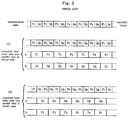
- Fig. 1 shows, by way of example, a circuit arrangement disclosed in an article entitled "Analysis of a Code Synchronizing Process in Viterbi Decoding" written by Yutaka Yasuda, et al. pages 17 - 24, Technical Research Report (CS82 - 43), Electronic Communications Society.
- Soft-decided received data are supplied to an input terminal 110.
- a received signal that has been sent through analog transmission contains noise.
- the soft-decided received data are data that are not immediately put back into a logic level “0” or a logic level “1,” but are handled as analog data.
- Hard-decided received data are data that are restored from soft-decided received data to a logic level "0” or a logic level “1.”
- the soft-decided received data supplied to the input terminal 110 are then supplied to a serial-to-parallel converter 118, which supplies data a, b to a phase converter 111.
- the phase converter 111 keeps the data a, b in the same phase until it is supplied with a phase control signal from a synchronism/asynchronism decision circuit 116.
- the phase converter 111 In response to a phase control signal from the synchronism/asynchronism decision circuit 116, the phase converter 111 generates phase-converted soft-decided received data c, d and hard-decided received data.
- the phase converter 111 supplies the phase-converted soft-decided received data c, d to a Viterbi decoder 112, and also supplies the hard-decided received data to a delay circuit 115.
- the Viterbi decoder 112 decodes the supplied phase-converted soft-decided received data c, d using a known Viterbi algorithm.
- the decoded data are outputted from an output terminal 117 and also supplied to a convolutional encoder 113.
- the convolutional encoder 113 encodes the decoded data into convolutional coded data, which are supplied to a correlator 114.
- the correlator 114 is also supplied with the hard-decided received data that have been delayed by the delay circuit 115.
- the delay circuit 115 serves to time the hard-decided received data to the convolutional coded data.
- the correlator 114 detects a correlation between the convolutional coded data and the delayed hard-decided received data in each interval, and outputs a correlative value indicative of the detected correlation in each interval.
- the correlative value thus produced tends to be small in an asynchronous condition.
- the correlative value in each interval is supplied to the synchronism/asynchronism decision circuit 116.
- the synchronism/asynchronism decision circuit 116 compares the supplied correlative value in each interval with a predetermined threshold, and determines whether the received data are in the synchronous condition or asynchronous condition based on the result of the comparison. If the received data are in an asynchronous condition, then the synchronism/asynchronism decision circuit 116 supplies the phase control signal to the phase converter 111. In response to the phase control signal, the phase converter 111 changes the phase of the soft-decided received data.
- the conventional method of detecting synchronism in a Viterbi decoder requires an extra period of time for a decoding delay caused by the Viterbi decoder and an encoding delay caused by the convolutional encoder for the extraction of synchronous information.
- the decoding and encoding processes need the delay circuit and the convolutional encoder.
- a method of detecting synchronism in a Viterbi decoder for decoding convolutionally encoded received data using a Viterbi algorithm comprising the steps of checking a preceding state to which a maximum path metric state determined in a Viterbi decoding process by the Viterbi decoder has transited, using said maximum path metric state, and determining a branch value between transitions, determining a correlation in each interval between said branch value and the received data and outputting a correlative value representing said correlation in each interval, determining whether the received data are in a synchronous or asynchronous condition based on said correlative value in each interval, and changing the phase of the received data if the received data are determined as being in an asynchronous condition.
- a circuit for detecting synchronism in a Viterbi decoder for decoding convolutionally encoded received data using a Viterbi algorithm comprising a branch value output circuit for checking a preceding state to which a maximum path metric state determined in a Viterbi decoding process by the Viterbi decoder has transited, using said maximum path metric state, and determining a branch value between transitions; a correlator for determining a correlation in each interval between said branch value and the received data and outputting a correlative value representing said correlation in each interval; a synchronism/asynchronism determining circuit for determining whether the received data are in a synchronous or asynchronous condition based on said correlative value in each interval; and a phase converter for changing the phase of the received data if the received data are determined as being in an asynchronous condition by said synchronism/asynchronism determining circuit.
- the received data may comprise soft-decided received data.
- a convolutional encoder which is used in a transmitter with a Viterbi decoder according to the present invention has an input terminal 18, first and second registers 19, 20, and first and second adders 21, 22.
- the first and second registers 19, 20 are holding respective information bits S k+1 , S k .
- the first and second adders 21, 22 output first and second sums P t , Q t , respectively, where t represents time.
- the set (P t , Q t ) of first and second sums P t , Q t represents a code block that is transmitted at the time t.
- the contents of the first and second adders 21, 22 vary as shown in Fig. 3(b), i.e., first and second adders 21, 22 hold respective information bits S k+2 , S k+1 .
- Fig. 3(c) illustrates how the contents of the first and second registers 19, 20 vary and what code block (P t , Q t ) is outputted depending on the values held by the first and second registers 19, 20 and the information bit supplied to the input terminal 18. It is assumed that the condition in which the first and second registers 19, 20 hold respective values (0, 0) is referred to as a state 0, the condition in which the first and second registers 19, 20 hold respective values (1, 0) is referred to as a state 1, the condition in which the first and second registers 19, 20 hold respective values (0, 1) is referred to as a state 2, and the condition in which the first and second registers 19, 20 hold respective values (1, 1) is referred to as a state 3.
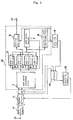
- Fig. 4 shows in block form a circuit for detecting synchronism in a Viterbi decoder according to the present invention.
- soft-decided received data supplied from an input terminal 10 are supplied through a serial-to-parallel converter 18 and a phase converter 11 successively as sets (P t , Q t ) (synchronous condition) or sets (Q t , P t+1 ) (asynchronous condition) to a Viterbi decoder 12, with each code block as one unit (c, d).
- the Viterbi decoder 12 comprises a path metric calculating circuit 1, a state-0 adding, comparing, and selecting (ACS) circuit 2, a state-1 ACS circuit 3, a state-2 ACS circuit 4, a state-3 ACS circuit 5, a surviving path memory 6, a path metric memory 7, and a maximum path metric state detecting circuit 8.
- ACS comparing, and selecting
- the path metric calculating circuit 1 calculates branch metrics with respect to the branches (c, d) shown in Fig. 3(c) based on input data in each decoding step.
- the path metric memory 7 stores path metric information of surviving paths in a preceding decoding step with respect to the states 0, 1, 2, 3 of the information bit set (S k+1 , S k+2 ) shown in Fig. 3(c).
- the state-0 ACS circuit 2, state-1 ACS circuit 3, state-2 ACS circuit 4, and state-3 ACS circuit 5 select new surviving paths of the states 0, 1, 2, 3 based on the branch metrics calculated by the path metric calculating circuit 1 and the path metric information stored in the path metric memory 7.
- the metrics of the selected surviving paths and the contents (the information bit S k+2 shown in Fig. 3(c)) of an encoder input data series with respect to the paths are stored in the surviving path memory 6.
- the data bit inputted at the most distant past time through the surviving path with respect to the condition that has been determined by the maximum path metric state detecting circuit 8 is outputted as decoded data from an output terminal 17.
- synchronous information is extracted from the output signal of the maximum path metric state detecting circuit 8 which is produced in a Viterbi decoding process that is a repetition of the above operation.
- Fig. 5 shows a trellis transition diagram by way of example.
- the thick lines in Fig. 5 indicate a surviving path having a maximum path metric in the surviving path memory 6 at a time t0 in the synchronous condition.
- state 2 has a maximum path metric at the time t0 and can be determined by the maximum path metric state detecting circuit 8.
- the branch value output circuit 9 determines where the determined state with the maximum path metric has transited from, and outputs a branch value (P t , Q t ) between transitions. It can be seen from Fig. 5 that state 2, which has the maximum path metric at time t0, has transited from state 3. Therefore, the branch value output circuit 9 outputs (0, 1) as the branch value (P t , Q t ).
- a series obtained from the branch value output circuit 9 is not a complete coded series, but a series close to the complete coded series. A series in an asynchronous condition is random.
- the branch value outputted from the branch value output circuit 9 is supplied to a correlator 14.
- the correlator 14 detects a correlation between the branch value and the hard-decided received data in each interval, and outputs a correlative value indicative of the detected correlation in each interval.
- the correlative value thus produced in each interval is supplied to a synchronism/asynchronism decision circuit 16.
- the synchronism/asynchronism decision circuit 16 compares the supplied correlative value in each interval with a predetermined threshold and determines whether the received data are in the synchronous condition or asynchronous condition based on the result of the comparison. If the received data are in an asynchronous condition, then the synchronism/asynchronism decision circuit 16 supplies the phase control signal to the phase converter 11. In response to the phase control signal, the phase converter 11 changes the phase of the soft-decided received data.
- the circuit for detecting synchronism and asynchronism in a Viterbi decoder may therefore be reduced in size because there is no need for the delay circuit or convolutional encoder which would otherwise be necessary in the conventional synchronism detecting circuit.
Landscapes
- Engineering & Computer Science (AREA)
- Computer Networks & Wireless Communication (AREA)
- Signal Processing (AREA)
- Physics & Mathematics (AREA)
- Probability & Statistics with Applications (AREA)
- Theoretical Computer Science (AREA)
- Error Detection And Correction (AREA)
- Dc Digital Transmission (AREA)
- Synchronisation In Digital Transmission Systems (AREA)
Applications Claiming Priority (2)
| Application Number | Priority Date | Filing Date | Title |
|---|---|---|---|
| JP34585892A JP2522142B2 (ja) | 1992-12-25 | 1992-12-25 | ビタビ復号器の同期検出方式 |
| JP345858/92 | 1992-12-25 |
Publications (3)
| Publication Number | Publication Date |
|---|---|
| EP0603824A2 true EP0603824A2 (de) | 1994-06-29 |
| EP0603824A3 EP0603824A3 (de) | 1995-11-15 |
| EP0603824B1 EP0603824B1 (de) | 1999-04-21 |
Family
ID=18379472
Family Applications (1)
| Application Number | Title | Priority Date | Filing Date |
|---|---|---|---|
| EP93120616A Expired - Lifetime EP0603824B1 (de) | 1992-12-25 | 1993-12-21 | Verfahren und Vorrichtung zur Synchronisationsdetektierung in einem Viterbi-Dekoder |
Country Status (5)
| Country | Link |
|---|---|
| US (1) | US5809044A (de) |
| EP (1) | EP0603824B1 (de) |
| JP (1) | JP2522142B2 (de) |
| CN (1) | CN1044757C (de) |
| DE (1) | DE69324554T2 (de) |
Cited By (3)
| Publication number | Priority date | Publication date | Assignee | Title |
|---|---|---|---|---|
| DE19610163A1 (de) * | 1996-03-15 | 1997-10-09 | Suedwestfunk Anstalt Des Oeffe | Verfahren zum Synchronisieren eines Faltungsdecoders |
| GB2315000A (en) * | 1996-06-29 | 1998-01-14 | Hyundai Electronics Ind | Detecting sync./async. states of Viterbi decoded data using trace-back |
| US6590939B1 (en) | 1997-02-28 | 2003-07-08 | Nokia Telecommunications Oy | Reception method and a receiver |
Families Citing this family (8)
| Publication number | Priority date | Publication date | Assignee | Title |
|---|---|---|---|---|
| JP3241210B2 (ja) * | 1994-06-23 | 2001-12-25 | 沖電気工業株式会社 | ビタビ復号方法及びビタビ復号回路 |
| EP0771080B1 (de) * | 1995-10-25 | 1999-01-13 | Nec Corporation | Maximalwahrscheinlichkeitsdekodierung mit weichen Entscheidungen |
| JP3336836B2 (ja) * | 1995-11-28 | 2002-10-21 | 三菱電機株式会社 | 同期判定回路、復調器及び通信システム |
| CN1201479C (zh) * | 1997-10-08 | 2005-05-11 | 西加特技术有限责任公司 | 在使用判定反馈的磁记录中检测数据的方法和设备 |
| JP3316744B2 (ja) | 1997-10-30 | 2002-08-19 | 三菱電機株式会社 | Afc回路、それを備えた受信機、及び自動周波数制御通信システム |
| JP3700818B2 (ja) * | 1999-01-21 | 2005-09-28 | Necエンジニアリング株式会社 | 誤り訂正回路 |
| JP3340403B2 (ja) * | 1999-06-29 | 2002-11-05 | 松下電器産業株式会社 | 符号化率検出方法及び符号化率検出装置 |
| CN104639180B (zh) * | 2013-11-11 | 2018-01-02 | 北京邮电大学 | 一种译码方法及装置 |
Family Cites Families (9)
| Publication number | Priority date | Publication date | Assignee | Title |
|---|---|---|---|---|
| US4527279A (en) * | 1982-07-12 | 1985-07-02 | Kokusai Denshin Denwa Co. | Synchronization circuit for a Viterbi decoder |
| GB8327084D0 (en) * | 1983-10-11 | 1983-11-09 | Gordon J | Error correction decoder apparatus |
| US4802174A (en) * | 1986-02-19 | 1989-01-31 | Sony Corporation | Viterbi decoder with detection of synchronous or asynchronous states |
| JPS62193323A (ja) * | 1986-02-19 | 1987-08-25 | Sony Corp | ヴイタビ復号装置 |
| US4837766A (en) * | 1986-03-24 | 1989-06-06 | Nec Corporation | Frame step-out detecting system |
| JPS6490621A (en) * | 1987-09-30 | 1989-04-07 | Nec Corp | Decoder |
| US5208816A (en) * | 1989-08-18 | 1993-05-04 | At&T Bell Laboratories | Generalized viterbi decoding algorithms |
| US5050191A (en) * | 1989-10-24 | 1991-09-17 | Hughes Aircraft Company | Synchronization detector using path metric and branch metric values of a Viterbi decoder |
| JP2876497B2 (ja) * | 1991-08-23 | 1999-03-31 | 松下電器産業株式会社 | 誤り訂正符復号化方法およびその装置 |
-
1992
- 1992-12-25 JP JP34585892A patent/JP2522142B2/ja not_active Expired - Fee Related
-
1993
- 1993-12-21 DE DE69324554T patent/DE69324554T2/de not_active Expired - Fee Related
- 1993-12-21 EP EP93120616A patent/EP0603824B1/de not_active Expired - Lifetime
- 1993-12-24 CN CN93119980A patent/CN1044757C/zh not_active Expired - Fee Related
-
1996
- 1996-06-27 US US08/675,517 patent/US5809044A/en not_active Expired - Fee Related
Cited By (7)
| Publication number | Priority date | Publication date | Assignee | Title |
|---|---|---|---|---|
| DE19610163A1 (de) * | 1996-03-15 | 1997-10-09 | Suedwestfunk Anstalt Des Oeffe | Verfahren zum Synchronisieren eines Faltungsdecoders |
| DE19610163B4 (de) * | 1996-03-15 | 2004-04-08 | Südwestrundfunk -Anstalt des öffentlichen Rechts- | Verfahren zum Synchronisieren eines Faltungsdecoders |
| GB2315000A (en) * | 1996-06-29 | 1998-01-14 | Hyundai Electronics Ind | Detecting sync./async. states of Viterbi decoded data using trace-back |
| US6084925A (en) * | 1996-06-29 | 2000-07-04 | Hyundai Electronics Industries Co., Ltd. | Method and apparatus for discriminating synchronous or asynchronous states of Viterbi decoded data |
| GB2315000B (en) * | 1996-06-29 | 2000-12-20 | Hyundai Electronics Ind | A method and apparatus for discriminating synchronous or asynchronous states of viterbi decoded data |
| DE19727431C2 (de) * | 1996-06-29 | 2003-11-20 | Hyundai Electronics Ind | Verfahren und Vorrichtung zur Unterscheidung synchroner und asynchroner Zustände von Viterbi-dekodierten Daten |
| US6590939B1 (en) | 1997-02-28 | 2003-07-08 | Nokia Telecommunications Oy | Reception method and a receiver |
Also Published As
| Publication number | Publication date |
|---|---|
| US5809044A (en) | 1998-09-15 |
| DE69324554T2 (de) | 1999-08-26 |
| CN1044757C (zh) | 1999-08-18 |
| CN1093844A (zh) | 1994-10-19 |
| DE69324554D1 (de) | 1999-05-27 |
| EP0603824A3 (de) | 1995-11-15 |
| JPH06276107A (ja) | 1994-09-30 |
| JP2522142B2 (ja) | 1996-08-07 |
| EP0603824B1 (de) | 1999-04-21 |
Similar Documents
| Publication | Publication Date | Title |
|---|---|---|
| US4506372A (en) | Method and apparatus for recognizing in a receiver the start of a telegram signal consisting of a bit impulse sequence | |
| KR100297594B1 (ko) | 데이터 계열 발생기, 송신기, 정보 데이터 복호기, 수신기, 송수신기, 데이터 계열 발생방법, 정보 데이터 복호방법, 및 기록매체 | |
| US4805174A (en) | Error correcting coder/decoder | |
| EP2053750A1 (de) | Viterbi-Dekodiervorrichtung und Viterbi-Decodierverfahren | |
| KR960705437A (ko) | 코드 분할 다중 접속 시스템 어플리케이션용 다중속도 직렬 비터비 디코더(multirate serial viterbi decoder for code division multiple access system applications) | |
| US4158748A (en) | Apparatus for digital data synchronization | |
| RU96107771A (ru) | Многоскоростной последовательный декодер витерби для использования в системе многостанционного доступа с кодовым разделением | |
| US5809044A (en) | Method of and circuit for detecting synchronism in viterbi decoder | |
| US6408420B1 (en) | Viterbi decoding method and apparatus thereof | |
| EP0700182B1 (de) | Gerät zur Dekodierung mit Fehlerkorrektur in digitalen Datenübertragungssystemen | |
| US5944849A (en) | Method and system capable of correcting an error without an increase of hardware | |
| EP0748057A1 (de) | Bitfehler zählverfahren und zähler | |
| JPWO1995001008A1 (ja) | 誤り検出方法、装置ならびに識別方法 | |
| GB2315000A (en) | Detecting sync./async. states of Viterbi decoded data using trace-back | |
| US7231586B2 (en) | Multi-rate viterbi decoder | |
| JPH0738626B2 (ja) | ワード同期検出回路 | |
| US5488637A (en) | Decoding method and apparatus having optimum decoding paths | |
| KR100335146B1 (ko) | 비터비 디코더의 트레이스 백 장치 | |
| JPH07226688A (ja) | 誤り訂正復号装置 | |
| US5666380A (en) | Digital communication system and method of compressing information | |
| KR0170199B1 (ko) | 순환길쌈부호의 복호방법 | |
| KR0144846B1 (ko) | 콘벌루션부호화기 및 복호화방법 | |
| JP3120342B2 (ja) | ビタビ復号器 | |
| JPS60142627A (ja) | 復号装置 | |
| KR20010054733A (ko) | 비터비 복호기 |
Legal Events
| Date | Code | Title | Description |
|---|---|---|---|
| PUAI | Public reference made under article 153(3) epc to a published international application that has entered the european phase |
Free format text: ORIGINAL CODE: 0009012 |
|
| AK | Designated contracting states |
Kind code of ref document: A2 Designated state(s): DE FR GB IT |
|
| PUAL | Search report despatched |
Free format text: ORIGINAL CODE: 0009013 |
|
| AK | Designated contracting states |
Kind code of ref document: A3 Designated state(s): DE FR GB IT |
|
| 17P | Request for examination filed |
Effective date: 19951004 |
|
| GRAG | Despatch of communication of intention to grant |
Free format text: ORIGINAL CODE: EPIDOS AGRA |
|
| 17Q | First examination report despatched |
Effective date: 19980318 |
|
| GRAG | Despatch of communication of intention to grant |
Free format text: ORIGINAL CODE: EPIDOS AGRA |
|
| GRAG | Despatch of communication of intention to grant |
Free format text: ORIGINAL CODE: EPIDOS AGRA |
|
| GRAH | Despatch of communication of intention to grant a patent |
Free format text: ORIGINAL CODE: EPIDOS IGRA |
|
| GRAH | Despatch of communication of intention to grant a patent |
Free format text: ORIGINAL CODE: EPIDOS IGRA |
|
| GRAA | (expected) grant |
Free format text: ORIGINAL CODE: 0009210 |
|
| AK | Designated contracting states |
Kind code of ref document: B1 Designated state(s): DE FR GB IT |
|
| REF | Corresponds to: |
Ref document number: 69324554 Country of ref document: DE Date of ref document: 19990527 |
|
| ET | Fr: translation filed | ||
| PLBE | No opposition filed within time limit |
Free format text: ORIGINAL CODE: 0009261 |
|
| STAA | Information on the status of an ep patent application or granted ep patent |
Free format text: STATUS: NO OPPOSITION FILED WITHIN TIME LIMIT |
|
| 26N | No opposition filed | ||
| REG | Reference to a national code |
Ref country code: GB Ref legal event code: IF02 |
|
| PGFP | Annual fee paid to national office [announced via postgrant information from national office to epo] |
Ref country code: FR Payment date: 20041208 Year of fee payment: 12 |
|
| PGFP | Annual fee paid to national office [announced via postgrant information from national office to epo] |
Ref country code: GB Payment date: 20041215 Year of fee payment: 12 |
|
| PGFP | Annual fee paid to national office [announced via postgrant information from national office to epo] |
Ref country code: DE Payment date: 20041216 Year of fee payment: 12 |
|
| PG25 | Lapsed in a contracting state [announced via postgrant information from national office to epo] |
Ref country code: IT Free format text: LAPSE BECAUSE OF NON-PAYMENT OF DUE FEES;WARNING: LAPSES OF ITALIAN PATENTS WITH EFFECTIVE DATE BEFORE 2007 MAY HAVE OCCURRED AT ANY TIME BEFORE 2007. THE CORRECT EFFECTIVE DATE MAY BE DIFFERENT FROM THE ONE RECORDED. Effective date: 20051221 Ref country code: GB Free format text: LAPSE BECAUSE OF NON-PAYMENT OF DUE FEES Effective date: 20051221 |
|
| PG25 | Lapsed in a contracting state [announced via postgrant information from national office to epo] |
Ref country code: DE Free format text: LAPSE BECAUSE OF NON-PAYMENT OF DUE FEES Effective date: 20060701 |
|
| GBPC | Gb: european patent ceased through non-payment of renewal fee |
Effective date: 20051221 |
|
| PG25 | Lapsed in a contracting state [announced via postgrant information from national office to epo] |
Ref country code: FR Free format text: LAPSE BECAUSE OF NON-PAYMENT OF DUE FEES Effective date: 20060831 |
|
| REG | Reference to a national code |
Ref country code: FR Ref legal event code: ST Effective date: 20060831 |