EP0604013A2 - Procédé et dispositif pour un serveur de fichier d'antémémorisation - Google Patents
Procédé et dispositif pour un serveur de fichier d'antémémorisation Download PDFInfo
- Publication number
- EP0604013A2 EP0604013A2 EP93309111A EP93309111A EP0604013A2 EP 0604013 A2 EP0604013 A2 EP 0604013A2 EP 93309111 A EP93309111 A EP 93309111A EP 93309111 A EP93309111 A EP 93309111A EP 0604013 A2 EP0604013 A2 EP 0604013A2
- Authority
- EP
- European Patent Office
- Prior art keywords
- file
- cfs
- cache
- program
- vmm
- Prior art date
- Legal status (The legal status is an assumption and is not a legal conclusion. Google has not performed a legal analysis and makes no representation as to the accuracy of the status listed.)
- Granted
Links
Images




Classifications
-
- G—PHYSICS
- G06—COMPUTING OR CALCULATING; COUNTING
- G06F—ELECTRIC DIGITAL DATA PROCESSING
- G06F12/00—Accessing, addressing or allocating within memory systems or architectures
- G06F12/02—Addressing or allocation; Relocation
- G06F12/08—Addressing or allocation; Relocation in hierarchically structured memory systems, e.g. virtual memory systems
- G06F12/0802—Addressing of a memory level in which the access to the desired data or data block requires associative addressing means, e.g. caches
- G06F12/0806—Multiuser, multiprocessor or multiprocessing cache systems
-
- G—PHYSICS
- G06—COMPUTING OR CALCULATING; COUNTING
- G06F—ELECTRIC DIGITAL DATA PROCESSING
- G06F12/00—Accessing, addressing or allocating within memory systems or architectures
- G06F12/02—Addressing or allocation; Relocation
- G06F12/08—Addressing or allocation; Relocation in hierarchically structured memory systems, e.g. virtual memory systems
-
- G—PHYSICS
- G06—COMPUTING OR CALCULATING; COUNTING
- G06F—ELECTRIC DIGITAL DATA PROCESSING
- G06F16/00—Information retrieval; Database structures therefor; File system structures therefor
- G06F16/10—File systems; File servers
- G06F16/17—Details of further file system functions
- G06F16/172—Caching, prefetching or hoarding of files
-
- G—PHYSICS
- G06—COMPUTING OR CALCULATING; COUNTING
- G06F—ELECTRIC DIGITAL DATA PROCESSING
- G06F16/00—Information retrieval; Database structures therefor; File system structures therefor
- G06F16/10—File systems; File servers
- G06F16/18—File system types
- G06F16/182—Distributed file systems
-
- Y—GENERAL TAGGING OF NEW TECHNOLOGICAL DEVELOPMENTS; GENERAL TAGGING OF CROSS-SECTIONAL TECHNOLOGIES SPANNING OVER SEVERAL SECTIONS OF THE IPC; TECHNICAL SUBJECTS COVERED BY FORMER USPC CROSS-REFERENCE ART COLLECTIONS [XRACs] AND DIGESTS
- Y10—TECHNICAL SUBJECTS COVERED BY FORMER USPC
- Y10S—TECHNICAL SUBJECTS COVERED BY FORMER USPC CROSS-REFERENCE ART COLLECTIONS [XRACs] AND DIGESTS
- Y10S707/00—Data processing: database and file management or data structures
- Y10S707/99951—File or database maintenance
- Y10S707/99956—File allocation
Definitions
- This invention relates in general to the fields of Computer Operating Systems, Multi-processor Hardware Systems, Object Oriented Programming, and Virtual Memory Systems.
- the invention relates to improved techniques for establishing and efficiently handling relationship between a client program, a file system server and a virtual memory manager (“VMM").
- VMM virtual memory manager
- Object oriented operating systems with microkernels which permit client level implementation of file systems, create complexities in memory management which clients have not had to deal with in the past.
- clients are not prepared to handle the fact that file accesses may produce unnecessary network communications traffic.
- the role of the operating system in a computer has traditionally been to efficiently manage the hardware resources (the central processing unit (“CPU”), memory and input/output devices).
- This management function has included the role of managing the file system, which comprises data and programs stored generally on a disk drive or magnetic tape system. In modem systems, this management function has included the use of a virtual memory subsystem. More specifically, the operating system has traditionally been responsible for: creating and deleting files and directories; providing support for primitive program routines for manipulating files and directories; mapping files onto disk storage; and general protection of the files by limiting access of programs, processes and users to the files.
- DFS distributed file systems
- a DFS the time to satisfy a client's request is a function of: disk access time and a small amount of associated CPU time; the time needed to deliver the request to a server; the time for getting the response back across the network to the client; the actual data transfer time; and the related CPU overhead for running the communications protocol software.
- Access times for DFSs have been shortened by the use of caching techniques on local machines to minimize the overall remote file accessing times. Nevertheless, minimization of the access times for retrieval of data from remote files remains a major goal of computer hardware and software designers.
- file systems are being implemented outside of the kernel in user level servers. These new file systems must solve a new set of problems to provide efficient performance. For example, the following describes a number of areas where caching of file data and file attributes would provide significant efficiency improvements in either memory usage or in network accesses in such user level file system implementations.
- the MACH operating system developed by Carnegie Mellon University is an object oriented operating system, with a minimum sized extensible kernel, based upon communications facilities. All requests to the kernel, and all data movement among processes are handled through one communications mechanism.
- MACH many traditionally kernel-based functions, such as file services, can be implemented as user-level servers. Other modem operating systems like MACH are being developed.
- MACH presently implements virtual memory techniques in an object oriented system.
- the use of a memory object to both encapsulate the mapping and attributes of a memory space and to control the communications to a memory cache object and the related paging operations can result in an inefficient use of the physical memory space used by the cache as well as related unnecessary paging operations where two or more programs or tasks or processes or threads (hereinafter "pro-grams") with each having different access rights, are using the same memory space.
- programs two or more programs or tasks or processes or threads
- MACH creates a memory object and related cache and communications port to accept messages for the memory object to get data from and write data to the file.
- MACH sets up a second memory object, related data cache and communications port.
- Access time could be saved if the VMM could access the remote file directly, and could cache the data and attributes for all local clients that wanted access to the file.
- the present invention provides a method and apparatus for solving these problems.
- Network communications overhead is reduced and redundant data caching for files is eliminated.
- CFS Caching File Server
- the CFS becomes the implementor of the file object and establishes a cache for the file attributes as well as a private communications channel to the remote file server to retrieve or set attributes whenever required.
- the CFS also establishes a memory mapping for the file data which makes use of the VMM on that machine and its caching abilities for the data.
- the VMM establishes its own memory object link to a pager object on the remote node containing the file server for doing its page-in/page-out operations.
- This also improves the efficiency of paged data space usage and correspondingly reduces the processing time needed to support paged data operations by allowing the VMM and end user clients to share the same pages of data via different CFS file objects, even through each CFS file object may have different access rights to the data.
- the present invention elegantly minimizes the overall network overhead for file operations in a DFS by allowing some operations to go remote (the normal VMM controlled page-in/page-outs) and some operations to go local (the get attributes and bind operations).
- this is accomplished by establishing in a local computer node a caching file server ("CFS”) which provides caching services for remote files, and by creating in this CFS a CFS file program which can recognize requests from a local client to read/write data to a remote file and can coordinate the caching of the remote file data with a virtual memory manager (“VMM”) in the local computer, and which can recognize requests to query/set attributes of the remote file and can cache these file attributes in the CFS, whereby the caching services provided by the CFS and the VMM for the remote file are not duplicated and related network communications traffic between the local and remote computers is minimized.
- CFS caching file server
- VMM virtual memory manager
- the CFS has the ability to accommodate a second local client which wishes to access the same remote file, providing a CFS file program to service this second client which can share the read/write data cache in the VMM and share the file attribute data in a common CFS cache, so that again there is no redundant data caching and network traffic is minimized.
- the CFS has the ability to cache the result of "bind" operations which establish the VMM-Pager linkage, in order to further reduce network accesses when a subsequent request for an already established linkage appears.
- the invention also provides mechanisms for maintaining coherent data in the file attribute cache while minimizing the related network traffic.
- a procedure is here, and generally, conceived to be a self-consistent sequence of steps leading to a desired result. These steps are those requiring physical manipulations of physical quantities. Usually, though not necessarily, these quantities take the form of electrical or magnetic signals capable of being stored, transferred, combined, compared, and otherwise manipulated. It proves convenient at times, principally for reasons of common usage, to refer to these signals as bits, values, elements, symbols, characters, terms, numbers, or the like. It should be noted, however, that all of these and similar terms are to be associated with the appropriate physical quantities and are merely convenient labels applied to these quantities.
- the manipulations performed are often referred to in terms, such as adding or comparing, which are commonly associated with mental operations performed by a human operator. No such capability of a human operator is necessary, or desirable in most cases, in any of the operations described herein which form part of the present invention; the operations are machine operations.
- Useful machines for performing the operations of the present invention include general purpose digital computers or similar devices.
- the present invention also relates to apparatus for performing these operations.
- This apparatus may be specially constructed for the required purposes or it may comprise a general purpose computer as selectively activated or reconfigured by a computer program stored in the computer.
- the procedures presented herein are not inherently related to a particular computer or other apparatus.
- Various general purpose machines may be used with programs written in accordance with the teachings herein, or it may prove more convenient to construct more specialized apparatus to perform the required method steps. The required structure for a variety of these machines will appear from the description given.
- Caching File Server Caching File Server
- client programs to have the ability to access file systems in a distributed computer system, using caching techniques, and using virtual memory management techniques in an efficient way and in a trusted environment, which is especially adapted for systems using object oriented programs.
- CFS Caching File Server
- specific data and configurations are set forth in order to provide a thorough understanding of the present invention.
- the preferred embodiment described herein is implemented as a portion of the SPRING Object-Oriented Operating System created by Sun Microsystems®,Inc. (Sun Microsystems is a registered trademark of Sun Microsystems, Inc.).
- SPRING SPRING operating system
- OMG Object Management Group
- a client application program can request the creation of an object, invoke methods from the interface of an object, and pass an object as a parameter to other invocations, without regard to the location of the object's implementation. Invocations of methods on an object are made via client-side stubs that perform remote procedure calls, if necessary, to the server-side implementation.
- the stubs are compiled independently of any application and can be dynamically linked to any client that needs them. Accordingly, in this environment, a file system may be physically located on any one of a number of distributed machines and a given client program would have no prior knowledge of the location of the file or efficient ways to perform data reads/writes or to query/set attributes.
- a SPRING object is an abstraction that contains state and provides a set of methods to manipulate that state.
- the description of the object and its methods is an interface that is specified in the interface definition language .
- the interface is a strongly-typed contract between the implementor ( server ) and the client of the object.
- a SPRING domain is an address space with a collection of threads .
- a given domain may act as the server of some objects and the clients of other objects.
- the implementor and the client can be in the same domain or in a different domain.
- SPRING is object-oriented it supports the notion of interface inheritance.
- Spring supports both notions of single and multiple interface inheritance.
- An interface that accepts an object of type "foo" will also accept an instance of a subclass of "foo".
- the address_space object has a method that takes a memory_object and maps it in the address space. The same method will also accept file and frame_buffer objects as long as they inherit from the memory_object interface.
- the SPRING kernel supports basic cross domain invocations and threads, low-level machine-dependent handling, as well as basic virtual memory support for memory mapping and physical memory management.
- a SPRING kernel does not know about other SPRING kernels-all remote invocations are handled by a net-workproxy server.
- the virtual memory system depends on external pagers to handle storage and network coherency.
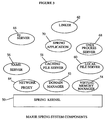
- a typical SPRING node runs several servers in addition to the kernel 50 . These include the domain manager 52 ; the virtual memory manager (“VMM”) 54 ; a name server 56 ; the CFS file server 58 described in this disclosure; a local file server 60 ; a linker domain 62 that is responsible for managing and caching dynamically linked libraries; a network proxy 64 that handles remote invocations; and a tty server 66 that provides basic terminal handling as well as frame-buffer and mouse support.
- Other major SPRING system components which might be present are a UNIX process server 68 and any number of SPRING applications 70 .
- the CFS is a per-machine caching file server that uses the virtual memory system to provide caching of data for read and write operations on files, and that has its own private protocol with the remote file servers to cache file attributes.
- the CFS starts up on a machine it registers itself with the naming server on that machine.
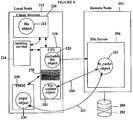
- the local node 222 contains at least a client domain 220 , a naming service 224 , a virtual memory manager (“VMM”) 230 and a caching file server (“CFS”) 218 .
- the remote node 204 is shown with a file server 206 and an attached disk unit 202 containing at least one file 200 .
- the client domain 220 is shown containing a file object 211 which was created by the file server 206 for operations on file 200 .
- the CFS 218 is shown containing a cachable_file object 229 used to forward methods invoked on the file object 211 to the file server 206
- the CFS 218 contains caches 270 for attributes and bind results , and a file_cacher object 241 / fs_cache object 251 connection 244 for keeping the caches 270 coherent.
- the direct pager object 234 to fs_cache object 251 connection 253 whereby the VMM 230 in the local node 222 maintains its file data cache for page-in/page-out operations on the file 200 .
- the CFS permits end user client programs on a local node of a distributed computer system, to issue requests to read/write data to a remote file and to query/set attributes of the remote file, and to have these requests serviced by the CFS in a way which minimizes the caching resources used as well as minimizes the related network communications.
- the CFS establishes CFS file objects to interface with the client programs, and sets up a common CFS cache for the file attributes, which cache is kept current via a communications link to a file program in a file server at the remote node containing the file, wherein the file program in the File Server at the remote node and the file attributes in the common CFS cache are maintained coherent.
- the CFS coordinates all client program requests for read/write data with a virtual memory manager ("VMM") on the local node, servicing all client programs from a single data cache in the VMM, if possible.
- VMM virtual memory manager
- a cache of the results of previous bind() operations is maintained by the CFS to facilitate this use of a single data cache for multiple clients. In this manner, network communications and related processing overhead as well as memory resources are minimized by use of the VMM for caching file data and the Common CFS cache for caching file attributes.
- the CFS can service several client programs which request information from the same file without creating duplicate caches or using redundant network overhead.
- two client programs wishing to access the same remote file can either use the same CFS file object or they can use different CFS file objects. If two client programs independently ask the CFS to cache a remote file, then the two client programs will have different CFS file objects implemented by the CFS. However, if one client program sets up the cached file with the CFS and then passes the CFS file object to another client, the two client programs will use the same CFS file object. In either case, the two client programs will share the same remote file object because the CFS will make sure the clients' CFS file objects point to the same underlying cached state.
- a first client program 102 asks the CFS 218 to cache remote file 200 .
- the CFS 218 provides first CFS file object 108 for the first client 102 to use in processing requests on the file.
- the CFS 218 establishes a communications link 244 to die file server 206 located on the remote node 204 to obtain the file attributes which the CFS 218 caches in the CFS attribute cache 239 .
- the CFS 218 also establishes the communications between the CFS file object manager 221 and the VMM 230 which caches the file data in the data cache 231 by means of the pager_object 234 /fs_cache_object 232 pipeline. This pipeline results from the map and bind operations previously described.
- Pager object 234 is connected to fs_cache object 232 in the pager object manager 247 ,and also connected via the link between the fs_cache object 232 and the cache object 223 in the fs_cache object manager 243 in the CFS 218 .
- the CFS 218 When a second client program 118 asks the CFS 218 to cache the same remote file 200 , the CFS 218 implements a second CFS file object 122 . However, since the CFS 218 has already set up a CFS attribute cache 239 to handle file attributes for the remote file 200 , the second CFS file object 122 is merely directed to the existing CFS attribute cache 239 . Similarly, when the second CFS file object 122 wishes to read or write data to the file 200 , the file object manager 221 again invokes an operation to map die file in the CFS address_space using its address_space object 225 .
- the first client program 102 may pass the first CFS file object 108 to the second client program 118 .
- both client programs 102 & 118 would use the same CFS file object 108 , and as before both client programs would be serviced by the CFS 218 with only one set of caches.
- SPRING files contain data and attributes and support authentication and file locking.
- the file object interface provides access to die file's data through two mechanisms. One way is through read and write methods; these methods are inherited from the SPRING io interface. The other way is by mapping the file object into an address space; this ability comes by making a file object inherit from the memory_object interface.
- the file object interface also provides a write_back method to force die data safely to disk.
- SPRING files have three attributes: the length of the file, its access time, and its modify time.
- the file interface provides get_length and set_length methods to access the file length; these methods are inherited from the memory_object interface. All three of the attributes can be retrieved via the stat method; there are no methods to directly modify the access or modify time.
- SPRING files support SPRING authentication by inheriting from the authenticated interface.
- the authenticated interface also contains access , and acl interfaces.
- the acl interface provides access to the file's access list.
- the access interface provides access to a file's encapsulated rights and principal owner.
- the authenticated interface allows new file objects to be created that reference the same underlying file data and attributes as the current file, yet contain different encapsulated rights.
- SPRING files also support file locking. Files support single writer multiple reader semantics.
- the read_lock method will succeed if the file is not write locked. Once a read lock is granted all writes will fail.
- the write_lock method will succeed if the file is open for writing and no one has either a read or a write lock on the file. Once a write lock is granted, all reads and writes by other equivalent file objects will fail.
- the unlock method will release any lock previously granted by the read_lock and write_lock methods.
- the SPRING file interface does not have a close method. When file objects are no longer needed, then, just like any other SPRING object, they are consumed. This will cause the file system to be called with an unreferenced call on the file object when the last reference to the file object goes away.
- SPRING file objects inherit from the io , memory_object , and authenticated interfaces.
- the files support methods for locking, getting attributes, and forcing a file's data to disk.
- the CFS implements file objects and the file objects use the singleton subcontract. (Subcontracts are described below).
- SPRING and the preferred embodiment of the present invention makes use of cachable_file objects.
- the cachable_file object inherits from the file object and from the cachable object interfaces.
- Cachable_file objects are implemented by the remote file-server and use the caching subcontract.
- the interface definition of the cachable _ file object is as follows: While these interface definitions describe the presently preferred embodiment of the file and cachable_file objects as used in the present invention, those skilled in die art will recognize that alternative definitions can be used in the present invention.
- the initial processing steps are performed through use of the caching subcontract mechanism. These steps include finding whether a local eaching server (the CFS of the present invention) is present, identifying it and easily interposing the CFS on the received file objects so that caching can occur.
- the following is a brief description of the use of subcontracts in the preferred embodiment of the present invention. Subcontracts are more fully described in co-pending application Ser. No. 07/ 995,863 filed by Graham Hamilton, Michael L. Powell,James G. Mitchell and Jonathan J.Gibbons for A Method and Apparatus for Subcontracts in Distributed Processing Systems, filed on the same date as this present application and which is incorporated herein by reference. Moreover, while these details are provided for completeness, those skilled in the art will understand that they are not essential to the practice of the CFS invention.
- Every SPRING object has a subcontract associated with it.
- Subcontract is responsible for many things including marshaling, unmarshaling, and invoking on the object.
- Subcontract also defines the representation for each object that appears in a client domain's address space.
- the standard SPRING subcontract is called singleton .
- the representation of a singleton object includes a nucleus door (or handle ) that identifies the server domain. When a client invokes on an object that uses singleton, this handle is used to send the invocation to the server domain.
- File objects acquired from a remote fileserver are actually cachable_file objects and use a different subcontract called the caching subcontract.
- the representation for an object that uses the caching subcontract contains several things, including an extended cachable handle that identifies the server domain that can cache the type of object which contains this handle, identifies the file server that created the file object (called the back handle), and identifies an object (called the cached _ object ) that is implemented by a domain that caches the original object (located in the front handle).
- This cached_object will be null if there is no cacher or the file server is not remote. Whenever an invocation occurs on an object that uses the caching subcontract, the invocation is done on the front handle (the cached_object ) instead of the back handle (the file server's handle) unless the cached_object is null.
- the cached_object is obtained when the cachable_file object is unmarshaled. This is done by the subcontract unmarshalling code, using the other two parts of the caching subcontract representation which include a name of the cacher to use and a flag saying whether to try to cache the object.
- the unmarshaling code resolves the cacher name to see if there is a cacher object present.
- the cacher domain receives the copy of the file object, it creates a new object that it implements (called the CFS file object 236 in Figure 5 ) and returns this to the client domain.
- the object returned from the cacher is stored as the cache_object in the front handle of the original file object's extended cachable handle .
- the subcontract of the object which is returned and stored as the cached_object is set to the singleton type subcontract to avoid any endless loop when the cached_object is next invoked on the CFS.
- the CFS uses the copy of the cachable_file object ( 229 in Figure 5 ) which is the same as the original file object but with the front handle of the extended cachable handle of the cachable_file object set to null so that invocations of methods on it will go directly to the file server (pointed to in the black handle).
- the cachable_file object 229 is implemented by the cachable_file object manager 245 in the remote file server.
- both the handle and the cached_object are marshaled. This is necessary to allow cachable objects to be efficiently between domains in the same machine.
- the caching subcontract allows cachers to get at the cached_object in the representation.
- a cacher receives an object to cache, it extracts the cached_object and sees if it implements it. If it does, then it just returns the current cached_object as the result from the cached_obj call.
- the CFS implements a cacher object (referred to above as the CFS object 219 in Figure 5 ), which it exports in a public place (in the name sever) under a known name.
- a cacher object referred to above as the CFS object 219 in Figure 5
- the storage fileserver creates a file object, it sets the cacher name in the file object's extended cachable handle representation to be the name of the CFS.
- the CFS's cacher object will be found and the get_cached_obj method will be invoked on the cacher object.
- the CFS will then return a file object (identified above as the CFS file object 236 in Figure 5 ) that is implments.
- the CFS When the CFS receives a get_cached_obj call it must determine two things. First, it has to determine if it implements the cached_object ; if so it returns it. Second, it has to determine if it already catches the given file object. If so it needs to make sure that the file object that it returns uses the already existing cache state. In order to determine if it already caches a file object, the CFS must see if the file object is equivalent to file objects that it already caches. This is done by using the file object that was passed in the get_cached_obj call.
- cachable file objects The type of the file objects that re implemented by the storage fileservers are actually a subclass of file called cachable file objects. Thus whenever the CFS is passed a file to cache from the get_cached_obj call, the type of this object is actually cachable_file.
- a cachable_file has additional methods that are used by the CFS to enable it to cache files.
- One of the cachable_file methods is get_cache_stuff .
- the CFS invokes this method on the file objects that are received from the get_cached_obj call.
- This method returns a comparator object, a hash value, the encapsulated rights, and whether the file is a temporary file or not.
- the comparator object and the hash value are used to determine equivalence, the use of the rights will be explained below, and the temporary file flag is used in determining the writing policy.
- the CFS maintains a hash table of cachable_file objects that it caches.
- the key into this table is the hash value returned by the get_cache_stuff call and the comparator object; the value is a pointer to internal cache state.
- Two cachable file objects are equivalent if the hash values are the same and both comparators agree that the two objects are equivalent.
- the CFS determines if it caches the file already, it can construct a CFS file object that it implements and return it to the client. If it doesn't cache the file, then it will create internal caching data structures and put an entry into the hash table. The CFS file object that it returns will have as part of its server side representation the rights returned from the get_cache_stuff call and the cachable_file object.
- the CFS uses cachable_file comparators to determine if two cachable_file objects are equivalent.
- the object equivalence algorithm employed by the CFS is different than the standard one that is used by other parts of Spring.
- the CFS retains a cachable_file_comparator object that is implemented by the storage fileserver and is associated with the original cachable file object.
- the server side state of this comparator object contain enough information such that it can determine if other cachable_file objects are equivalent to the one to which the comparator corresponds. Thus in future comparisons, the comparator can be used instead of the cachable_file.
- the CFS When the CFS receives a file F to cache it invokes the get_cache_stuff method to get the comparator. Once this comparator is obtained it is used to compare its file object to other objects in the cache. If there are no other to compare to, this comparator is stored in a CFS cache. However, because this comparator is going to be used for future comparisons in place of F, this comparator must be verified for security reasons.
- the CFS file server is trusted by client domains to cache their files.
- the CFS needs to ensure that it doesn't accidently allow some client to attain greater access to some cached file than they are allowed.
- the first step towards ensuring security is the object equivalence algorithm given in the previous section. Using this algorithm the CFS can be confident that files are truly equivalent and it isn't being fooled.
- the other security step taken by the CFS is to fetch the rights from the cachable_file that it presented with and encapsulate these in the file object that it implements. It checks these rights on every operation on the file object implemented by the CFS to ensure that the client is allowed the desired access.
- the cachable_file object provides part but not all of CFS to remote fileserver connection needed for caching.
- the cachable_file interface provides methods to determine file equivalence and to set up the rest of the caching connection.
- the cachable_file object by itself isn't sufficient for two reasons:
- the fs_cache object also acts as a call back object, used by the file server to keep coherent, the attribute and data cached in the CFS.
- the storage fileservers implement an object of type file_cacher ( 241 in Figure 5 ). Since the fs-cache object is a sub-class of a cache object, both of these objects support methods for attribute and data cache coherency.
- a two way connection ( 244 in Figure 4 ) between the CFS and file server using the fs_cache object and the file_cacher object, is initialized when the CFS invokes the first operation that requires it to cache information from a remote fileserver.
- the fs_cache object used by the CFS and the storage fileservers is a subclass of the VM cache object to make the implementation of the storage fileservers easier.
- the storage fileservers have to deal directly with VM systems and with caching file servers.
- the coherency code in the storage fileservers may be unaware of whether it was dealing with a VM system or a CFS.
- the interface of the fs_cache object and the file_cacher object are as follows:
- One of the important jobs of the CFS is to cache the results of binds since they occur on every map call.
- the CFS will first check to see if the client has the desired rights. If so the CFS then checks to see if it already has a VM cache object with the desired rights cached for the file object. If it does than the CFS can merely return the cache object to the VMM thereby eliminating a network access.
- the CFS finds that it doesn't have an appropriate cache object to return to the VMM, it must get one. In order to do this, it must talk to the remote fileserver to get a pager object that the VMM can use since it is desired that all page-ins and page-outs go directly to the file server. Having these transmissions go through the CFS would provide no added value.
- the CFS talks to the file server using one of two methods. If it already has set up the fs_cache_object/file_cacher connection with the remote file server, it will invoke the bind method on the file_cacher object ( 241 in Figure 5 ). Otherwise it will invoke the bind_init method on the cachable_file object 229 , passing it an fs_cache_object that the CFS implements. Both of these methods will perform an access check and then return a pager object. These methods also return the attributes for the file such as length and modify time, and flags indicating whether these attributes can be cached; this is done so that subsequent remote calls to get attributes can be avoided.
- the CFS Once the CFS has contacted the remote fileserver and obtained a pager object, it calls the local VMM with the pager object to create a VM cache-object. Once it has this cache object, the CFS keeps a copy of the cache object which it stores in its cache of bind results , and then returns the cache object to the caller of bind (the VMM by way of the file object 211 ).
- FIG. 6 The configuration that results after a successful cached bind operation is shown in Figure 6 .
- the VMM 230 has a direct pager connection 253 to the remote fileserver 206 and the remote fileserver's cache object 232 is actually implemented by the CFS 243 .
- all cache coherency operations on the cache object 232 will indirect through the CFS 218 . This does not slow things down much since it is just one extra local call being added to two remote calls (the coherency call and the page-out operation) and all of the data is being transferred using the direct pager object connection 253 .
- the advantage is that the CFS can interpose if it wishes and the remote file server only has to have one cache object instead of two.
- the CFS caches data for reads and writes by mapping the file that is being read or written into its own address space. Once the file is mapped, then the data can be copied into or out of the mapped region as appropriate. Since file mapping is used, all of the issues of data caching are handled by the virtual memory system and the remote file servers.
- the file object implemented by the CFS is used rather than the cachable file object implemented by the remote fileserver. This is to take advantage of the bind caching that was described in the last section. This is important because the CFS only maps in a fixed size region of the file so that the entire address space of the CFS doesn't get occupied by a couple of big files. If a file is larger then this region, then it will take multiple map operations, and hence multiple bind operations, to access the entire file.
- the file length In order to implement read and write, the file length must be available locally. In particular, for writes that append data to a file, the CFS must have the ability to modify the length locally. Therefore the ability to cache the file length is essential to providing good read and write performance.
- the SPRING file system ensures that if a page is writable, then the page will only be in a single cache. If a page is only being read, then copies of the page may be present in any number of caches. The file system can guarantee this because it gets all page-in requests.
- Each request indicates whether the page is desired in read-only or read-write mode.
- Any page-in request can cause a page to go from read-only to writable or from writable to read-only.
- the file server must take action to ensure that coherency is maintained before returning a page to the requesting client. It does this by invoking methods on the cache objects that are associated with each file object. If a page transitions from read-only to writable, then the file server invokes the flush_back method on all cache objects that currently possess the page; if the client that requests the page writable already has the page readable, then the page is not flushed from the requesting clients cache.
- the file system invokes the deny-writes method on the cache object that possesses the page; deny-writes will force a cache to write the page back if it is dirty and then make the page read-only.
- Getting the file length involves invoking the get_length method on the file object; since there are no side-effects of the get_length method, it has no impact on file data coherency.
- Setting the length involves invoking the set_length method on a memory object. There are two interesting cases with set_length : the length is made shorter and the length is made longer.
- the pages at the end of the file need to be eliminated from the file and from all caches of the file. If the pages aren't removed from the caches, then clients won't see a consistent view of the file because some clients may be able to access parts of the file that no longer exist. Pages are deleted from caches by invoking the delete-range method with the appropriate data range on all cache objects that possess deleted pages. If a files's length is increased, then nothing has to be done in order to insure coherency.
- the storage fileservers allow multiple read-only cached copies of the size, but only one read-write copy. If a CFS requests a copy of the length and it is being cached read-write, then the remote fileserver retrieves the length from the caching client before giving a copy of the length to the requesting client. If a CFS requests permission to modify the size of a file, the remote fileserver invalidates the length from all caches after retrieving any cached read-write copy.
- the file length also has to be retrieved by the storage fileservers on page faults. Whenever a fault happens on a file object, the fileserver must know the current size of the file to determine if the page fault is legal. Thus, if on a page fault the length is being cached read-write, the fileserver will fetch the length back from the CFS and revoke write permission.
- the storage fileservers keep the length coherent by using the fs_cache object that is provided by the CFS. This object has operations to get the cached length and to invalidate the length.
- a CFS still has to call through to the file server when a file is truncated for two reasons.
- the file server needs to take coherency action and flush the truncated data from all other caches; this reason isn't valid if the file is only cached by the CFS that is doing the truncate.
- the file server will get confused if it isn't told about truncations. If a page fault occurs on the file after a truncation of the file, the remote fileserver won't know whether the data on disk is valid or not since it doesn't know if the file has been truncated.
- the length is retrieved by a CFS using one of two methods. If it already has set up the fs_cache_object/file_cacher connection with the remote file server, it will invoke the cached_stat method on the file_cacher object. Otherwise, it will invoke the cached_stat_init method on the cachable_file object passing it an fs_cache_object that the CFS implements. Both of these methods will return all of the file's attributes including an indication of whether the length and the time can be cached writable; this is done so that subsequent remote calls to get attributes can be avoided.
- the storage fileservers have to keep track of pages that are being zero-filled by VMMs. Whenever the storage fileservers discover that the length of the file has been extended by a CFS, they assume that all new pages between the old length and the new length are being zero-filled by the local VMM.
- the storage fileservers can discover that a CFS has lengthened a file in three ways:
- this zero_filling optimization for file objects could be implemented by the storage fileservers as well; that is, they could call the zero_fill method on the appropriate cache object.
- the only problem is that it may not know which cache object to do the zero filling on since a file object could be mapped by multiple VMM systems.
- the storage fileservers will know which VMM to talk to. Having the storage fileservers implement the zero-fill operation is not done in the preferred embodiment because most clients get their files through the CFS.
- Both the access time and the modify time are cached by a CFS.
- the modify time may be cached writable under certain conditions and a coherency algorithm is used for the modify time.
- the access time is not kept coherent in the presently preferred embodiment.
- the modify time is kept coherent so that programs such as the UNIX program make can properly function.
- a CFS is allowed to cache the modify time for a file under two circumstances:
- the CFS is allowed to change the modify time.
- the modify time is kept coherent using the dont_cache_time method on the fs_cache_object.
- the time is retrieved by the cached_stat and cached_stat_init methods. When these methods are invoked, one of the return parameters is an indication of whether the modify time can be cached and if so if it can be cached writable.
- the one file attribute that isn't returned from the stat call is the access control list .
- This list is currently no cached by the CFS in the presently preferred embodiment.
- Modified data is cached by the VMM for files that are cached by the CFS. If the machine that the data is cached on crashes, this data will be lost.
- the storage fileservers employ a 30 second write back policy for writing back this cached data.
- the CFS employs its own write back policy: when the last reference to a cached file object is gone, the CFS will write back all modified data for the file. Data is not written back for temporary or anonymous files.
- the storage fileservers implicitly lengthen the file when pageouts past the end-of-file occur. Since pageouts are in page-size quantities, the file length is set to include the whole page. Thus the size has to be written back after the data is written back so the file server can know the true size of the file. When a storage fileserver gets the length from a CFS that is caching the size writable, it will truncate the file to that length.
- the data and the length are actually written back by a set of write-back daemons.
- the CFS will append a write-back request to the queue if the file is writable. If the length is also writable, then the write-back request will indicate that the length should be written back as well after the data.
- the CFS caches anonymous files.
- the CFS implements its own VM swap pager.
- This swap pager implementation uses a special swap-pager interface with the storage fileservers.
- These fileservers actually implement a subclass of the VM swap_pager class called cachable_swap_pager .
- This class adds the additional method get_anon_files that allows the CFS and the storage fileservers to set up the fs_cache_object/file_cacher connection for each anonymous memory object.
- the get_amon files method returns the comparator and hash values for each object so that they can be entered into the hash table in the CFS.
- the CFS only registers its swap pager object with the VMM if there is no local file server ("LFS"). If there is an LFS all swapping will happen to the LFS, so there is no need for the CFS to register its swap pager.
- LFS local file server
- wrapper object For security reasons, objects that are stored in name servers are not unmarshaled by the name server. To allow objects to be passed to a name server and not be unmarshaled the objects are enclosed in a wrapper object. The object inside the wrapper is not unmarshaled until the wrapper is returned to the client that did the resolve. In addition to an object, the wrapper also contains the object type id.
- the cacher object has a method in addition to the get_cached_obj method.
- the new method is get_named_cached_obj and is used in the following manner.
- a name cacher gets an object to cache, it gets the object type id out of the wrapper and tries to find a cacher object stored under the object type id. If it finds one, it passes in the wrapped object to the get_named_cached_obj method. This method returns a new wrapped object that the name cacher will use to return from cache hits.
- the CFS uses the get_named_cached_obj method to avoid the object equivalence calls.
- the CFS receives a wrapped object in the get_named_cached_obj call, it unwraps the object to get the cachable_file object stored inside. It then does the same thing as the implementation of the get_cached_obj described above. However, instead of just returning a file object it does the following:
- the client When the name cache returns an object to the client, the client will unmarshall the file object and invoke the get_cached_obj method on the cacher object implemented by the CFS. This time when the CFS gets the file object it will notice that it implements it and it is inactive. The CFS will then mark the object as active and return it to the client.
Landscapes
- Engineering & Computer Science (AREA)
- Theoretical Computer Science (AREA)
- Physics & Mathematics (AREA)
- General Engineering & Computer Science (AREA)
- General Physics & Mathematics (AREA)
- Data Mining & Analysis (AREA)
- Databases & Information Systems (AREA)
- Information Retrieval, Db Structures And Fs Structures Therefor (AREA)
- Memory System Of A Hierarchy Structure (AREA)
- Information Transfer Between Computers (AREA)
- Computer And Data Communications (AREA)
Applications Claiming Priority (2)
| Application Number | Priority Date | Filing Date | Title |
|---|---|---|---|
| US995423 | 1992-12-21 | ||
| US07/995,423 US5452447A (en) | 1992-12-21 | 1992-12-21 | Method and apparatus for a caching file server |
Publications (3)
| Publication Number | Publication Date |
|---|---|
| EP0604013A2 true EP0604013A2 (fr) | 1994-06-29 |
| EP0604013A3 EP0604013A3 (fr) | 1995-05-10 |
| EP0604013B1 EP0604013B1 (fr) | 2002-02-20 |
Family
ID=25541767
Family Applications (1)
| Application Number | Title | Priority Date | Filing Date |
|---|---|---|---|
| EP93309111A Expired - Lifetime EP0604013B1 (fr) | 1992-12-21 | 1993-11-15 | Procédé et dispositif pour un serveur de fichier d'antémémorisation |
Country Status (4)
| Country | Link |
|---|---|
| US (1) | US5452447A (fr) |
| EP (1) | EP0604013B1 (fr) |
| JP (1) | JPH06231029A (fr) |
| DE (1) | DE69331599T2 (fr) |
Cited By (5)
| Publication number | Priority date | Publication date | Assignee | Title |
|---|---|---|---|---|
| GB2317723A (en) * | 1996-09-30 | 1998-04-01 | Viewinn Plc | Caching system for information retrieval |
| GB2328535A (en) * | 1997-08-01 | 1999-02-24 | Ibm | Determining how changes to underlying data affect cached objects |
| GB2330433A (en) * | 1997-10-20 | 1999-04-21 | Fujitsu Ltd | Data caching in a client/server database system |
| US6216212B1 (en) | 1997-08-01 | 2001-04-10 | International Business Machines Corporation | Scaleable method for maintaining and making consistent updates to caches |
| CN113655962A (zh) * | 2021-08-18 | 2021-11-16 | 天津津航计算技术研究所 | 一种缩短VxWorks7嵌入式操作系统下写文件时间的方法 |
Families Citing this family (220)
| Publication number | Priority date | Publication date | Assignee | Title |
|---|---|---|---|---|
| US6044205A (en) * | 1996-02-29 | 2000-03-28 | Intermind Corporation | Communications system for transferring information between memories according to processes transferred with the information |
| US5517618A (en) * | 1992-02-10 | 1996-05-14 | Matsushita Electric Industrial Co., Ltd. | Mobile migration communications control device |
| US6026452A (en) * | 1997-02-26 | 2000-02-15 | Pitts; William Michael | Network distributed site cache RAM claimed as up/down stream request/reply channel for storing anticipated data and meta data |
| US6157961A (en) * | 1992-12-21 | 2000-12-05 | Sun Microsystems, Inc. | Client-side stub interpreter |
| US6230211B1 (en) * | 1993-01-19 | 2001-05-08 | Canon Kabushiki Kaisha | Container-based method for exchanging information between computer processes |
| JP3365576B2 (ja) * | 1993-06-14 | 2003-01-14 | インターナショナル・ビジネス・マシーンズ・コーポレーション | オブジェクトの実行方法および装置 |
| DE69424597T2 (de) * | 1993-06-17 | 2001-03-01 | Sun Microsystems, Inc. | Erweiterbares Dateiensystem |
| JP3140621B2 (ja) * | 1993-09-28 | 2001-03-05 | 株式会社日立製作所 | 分散ファイルシステム |
| US6345104B1 (en) * | 1994-03-17 | 2002-02-05 | Digimarc Corporation | Digital watermarks and methods for security documents |
| US5577226A (en) * | 1994-05-06 | 1996-11-19 | Eec Systems, Inc. | Method and system for coherently caching I/O devices across a network |
| US5694546A (en) | 1994-05-31 | 1997-12-02 | Reisman; Richard R. | System for automatic unattended electronic information transport between a server and a client by a vendor provided transport software with a manifest list |
| JP2507235B2 (ja) * | 1994-06-24 | 1996-06-12 | インターナショナル・ビジネス・マシーンズ・コーポレイション | クライアント・サ―バ・コンピュ―タ・システム、及びそのクライアント・コンピュ―タ、サ―バ・コンピュ―タ、並びにオブジェクト更新方法 |
| JP3696901B2 (ja) * | 1994-07-19 | 2005-09-21 | キヤノン株式会社 | 負荷分散方法 |
| US5884028A (en) * | 1994-07-29 | 1999-03-16 | International Business Machines Corporation | System for the management of multiple time-critical data streams |
| JPH0863382A (ja) * | 1994-08-19 | 1996-03-08 | Fujitsu Ltd | 分散システムにおけるデータ整合性確認方法及びデータ整合性確認装置 |
| JPH0883232A (ja) * | 1994-09-09 | 1996-03-26 | Fujitsu Ltd | ファイルサーバシステム |
| US5845061A (en) * | 1994-10-31 | 1998-12-01 | Hitachi, Ltd. | Redundant client server system |
| US6128648A (en) * | 1994-11-23 | 2000-10-03 | International Business Machines Corporation | Information handling system and method for maintaining coherency between network servers and mobile terminals |
| US5771383A (en) * | 1994-12-27 | 1998-06-23 | International Business Machines Corp. | Shared memory support method and apparatus for a microkernel data processing system |
| US5832231A (en) * | 1995-01-13 | 1998-11-03 | U S West, Inc. | Method and system for preloading interactive multimedia applications |
| US5727203A (en) * | 1995-03-31 | 1998-03-10 | Sun Microsystems, Inc. | Methods and apparatus for managing a database in a distributed object operating environment using persistent and transient cache |
| JP3865775B2 (ja) * | 1995-04-11 | 2007-01-10 | キネテック インコーポレイテッド | データ処理システムにおけるデータの識別 |
| US5805809A (en) * | 1995-04-26 | 1998-09-08 | Shiva Corporation | Installable performance accelerator for maintaining a local cache storing data residing on a server computer |
| US5628005A (en) * | 1995-06-07 | 1997-05-06 | Microsoft Corporation | System and method for providing opportunistic file access in a network environment |
| US6023711A (en) * | 1995-06-08 | 2000-02-08 | International Business Machines Corporation | System and method for flexible file encapsulation through latent levels of isolation |
| JP2000514212A (ja) * | 1995-06-26 | 2000-10-24 | ノベル,インコーポレイテッド | 冗長な書き込みを除去する装置および方法 |
| US5594863A (en) * | 1995-06-26 | 1997-01-14 | Novell, Inc. | Method and apparatus for network file recovery |
| US5781226A (en) * | 1995-11-13 | 1998-07-14 | General Instrument Corporation Of Delaware | Network virtual memory for a cable television settop terminal |
| US5682514A (en) * | 1995-11-30 | 1997-10-28 | Stampede Technologies, Inc. | Apparatus and method for increased data access in a network file oriented caching system |
| US6012085A (en) * | 1995-11-30 | 2000-01-04 | Stampede Technolgies, Inc. | Apparatus and method for increased data access in a network file object oriented caching system |
| US6122637A (en) * | 1995-11-30 | 2000-09-19 | Yohe; Thomas Patrick | Apparatus and method for increased data access in an object oriented caching system |
| US5835943A (en) * | 1995-11-30 | 1998-11-10 | Stampede Technologies, Inc. | Apparatus and method for increased data access in a network file oriented caching system |
| US6625617B2 (en) | 1996-01-02 | 2003-09-23 | Timeline, Inc. | Modularized data retrieval method and apparatus with multiple source capability |
| US5848241A (en) * | 1996-01-11 | 1998-12-08 | Openframe Corporation Ltd. | Resource sharing facility functions as a controller for secondary storage device and is accessible to all computers via inter system links |
| EP0882266A1 (fr) | 1996-02-20 | 1998-12-09 | Intergraph Corporation | Super serveur haute disponibilite |
| US5862325A (en) * | 1996-02-29 | 1999-01-19 | Intermind Corporation | Computer-based communication system and method using metadata defining a control structure |
| US5737523A (en) * | 1996-03-04 | 1998-04-07 | Sun Microsystems, Inc. | Methods and apparatus for providing dynamic network file system client authentication |
| US5740370A (en) * | 1996-03-27 | 1998-04-14 | Clinton Battersby | System for opening cache file associated with designated file of file server only if the file is not subject to being modified by different program |
| US5999946A (en) | 1996-04-10 | 1999-12-07 | Harris Corporation | Databases in telecommunications |
| US5778430A (en) * | 1996-04-19 | 1998-07-07 | Eccs, Inc. | Method and apparatus for computer disk cache management |
| WO1997040441A1 (fr) * | 1996-04-23 | 1997-10-30 | Asante Technologies, Inc. | Systeme d'acceleration du transfert de donnees dans un reseau |
| US5864852A (en) * | 1996-04-26 | 1999-01-26 | Netscape Communications Corporation | Proxy server caching mechanism that provides a file directory structure and a mapping mechanism within the file directory structure |
| US6625641B1 (en) * | 1996-06-03 | 2003-09-23 | Sun Microsystems, Inc. | Method and apparatus for providing client support without installation of server software |
| US8229844B2 (en) | 1996-06-05 | 2012-07-24 | Fraud Control Systems.Com Corporation | Method of billing a purchase made over a computer network |
| US20030195848A1 (en) | 1996-06-05 | 2003-10-16 | David Felger | Method of billing a purchase made over a computer network |
| US7555458B1 (en) | 1996-06-05 | 2009-06-30 | Fraud Control System.Com Corporation | Method of billing a purchase made over a computer network |
| US5930513A (en) * | 1996-06-06 | 1999-07-27 | Sun Microsystems, Inc. | Reference based software installation |
| US6151643A (en) | 1996-06-07 | 2000-11-21 | Networks Associates, Inc. | Automatic updating of diverse software products on multiple client computer systems by downloading scanning application to client computer and generating software list on client computer |
| US5758087A (en) * | 1996-06-14 | 1998-05-26 | International Business Machines Corporation | Apparatus and method for predicted response generation |
| US5781733A (en) * | 1996-06-20 | 1998-07-14 | Novell, Inc. | Apparatus and method for redundant write removal |
| US6424991B1 (en) | 1996-07-01 | 2002-07-23 | Sun Microsystems, Inc. | Object-oriented system, method and article of manufacture for a client-server communication framework |
| US6038590A (en) | 1996-07-01 | 2000-03-14 | Sun Microsystems, Inc. | Object-oriented system, method and article of manufacture for a client-server state machine in an interprise computing framework system |
| US6253282B1 (en) * | 1996-07-01 | 2001-06-26 | Sun Microsystems, Inc. | Object-oriented system, method and article of manufacture for a client-server with a client program cache |
| US6304893B1 (en) | 1996-07-01 | 2001-10-16 | Sun Microsystems, Inc. | Object-oriented system, method and article of manufacture for a client-server event driven message framework in an interprise computing framework system |
| US5987245A (en) | 1996-07-01 | 1999-11-16 | Sun Microsystems, Inc. | Object-oriented system, method and article of manufacture (#12) for a client-server state machine framework |
| US6434598B1 (en) | 1996-07-01 | 2002-08-13 | Sun Microsystems, Inc. | Object-oriented system, method and article of manufacture for a client-server graphical user interface (#9) framework in an interprise computing framework system |
| US5999972A (en) | 1996-07-01 | 1999-12-07 | Sun Microsystems, Inc. | System, method and article of manufacture for a distributed computer system framework |
| US5848246A (en) | 1996-07-01 | 1998-12-08 | Sun Microsystems, Inc. | Object-oriented system, method and article of manufacture for a client-server session manager in an interprise computing framework system |
| US6272555B1 (en) | 1996-07-01 | 2001-08-07 | Sun Microsystems, Inc. | Object-oriented system, method and article of manufacture for a client-server-centric interprise computing framework system |
| US6266709B1 (en) | 1996-07-01 | 2001-07-24 | Sun Microsystems, Inc. | Object-oriented system, method and article of manufacture for a client-server failure reporting process |
| US5774660A (en) * | 1996-08-05 | 1998-06-30 | Resonate, Inc. | World-wide-web server with delayed resource-binding for resource-based load balancing on a distributed resource multi-node network |
| US5784459A (en) * | 1996-08-15 | 1998-07-21 | International Business Machines Corporation | Method and apparatus for secure, remote swapping of memory resident active entities |
| US6195691B1 (en) * | 1996-09-17 | 2001-02-27 | National Systems Corporation | Method and apparatus for creating and using dynamic universal resource locators |
| US6662205B1 (en) | 1996-10-01 | 2003-12-09 | International Business Machines Corporation | Scaleable and extensible system management architecture with dataless endpoints |
| US5787470A (en) * | 1996-10-18 | 1998-07-28 | At&T Corp | Inter-cache protocol for improved WEB performance |
| US6065100A (en) * | 1996-11-12 | 2000-05-16 | Micro-Design International | Caching apparatus and method for enhancing retrieval of data from an optical storage device |
| US5884316A (en) * | 1996-11-19 | 1999-03-16 | Microsoft Corporation | Implicit session context system with object state cache |
| US20060129627A1 (en) * | 1996-11-22 | 2006-06-15 | Mangosoft Corp. | Internet-based shared file service with native PC client access and semantics and distributed version control |
| US5909540A (en) * | 1996-11-22 | 1999-06-01 | Mangosoft Corporation | System and method for providing highly available data storage using globally addressable memory |
| US5987506A (en) * | 1996-11-22 | 1999-11-16 | Mangosoft Corporation | Remote access and geographically distributed computers in a globally addressable storage environment |
| US6148377A (en) * | 1996-11-22 | 2000-11-14 | Mangosoft Corporation | Shared memory computer networks |
| US6647393B1 (en) | 1996-11-22 | 2003-11-11 | Mangosoft Corporation | Dynamic directory service |
| US7136903B1 (en) | 1996-11-22 | 2006-11-14 | Mangosoft Intellectual Property, Inc. | Internet-based shared file service with native PC client access and semantics and distributed access control |
| US6026474A (en) * | 1996-11-22 | 2000-02-15 | Mangosoft Corporation | Shared client-side web caching using globally addressable memory |
| US6098096A (en) * | 1996-12-09 | 2000-08-01 | Sun Microsystems, Inc. | Method and apparatus for dynamic cache preloading across a network |
| US5913033A (en) * | 1996-12-20 | 1999-06-15 | International Business Machines Corporation | Apparatus and method for retrieving information using standard objects |
| US5807449A (en) * | 1997-01-08 | 1998-09-15 | Hooker; Jeffrey A. | Workpiece treating apparatus and method of treating same |
| US6021470A (en) * | 1997-03-17 | 2000-02-01 | Oracle Corporation | Method and apparatus for selective data caching implemented with noncacheable and cacheable data for improved cache performance in a computer networking system |
| US6182122B1 (en) | 1997-03-26 | 2001-01-30 | International Business Machines Corporation | Precaching data at an intermediate server based on historical data requests by users of the intermediate server |
| US5933849A (en) * | 1997-04-10 | 1999-08-03 | At&T Corp | Scalable distributed caching system and method |
| US5991795A (en) * | 1997-04-18 | 1999-11-23 | Emware, Inc. | Communication system and methods using dynamic expansion for computer networks |
| US6041384A (en) * | 1997-05-30 | 2000-03-21 | Oracle Corporation | Method for managing shared resources in a multiprocessing computer system |
| US7103794B2 (en) | 1998-06-08 | 2006-09-05 | Cacheflow, Inc. | Network object cache engine |
| US6044438A (en) * | 1997-07-10 | 2000-03-28 | International Business Machiness Corporation | Memory controller for controlling memory accesses across networks in distributed shared memory processing systems |
| US6092155A (en) | 1997-07-10 | 2000-07-18 | International Business Machines Corporation | Cache coherent network adapter for scalable shared memory processing systems |
| US6240461B1 (en) * | 1997-09-25 | 2001-05-29 | Cisco Technology, Inc. | Methods and apparatus for caching network data traffic |
| US6247149B1 (en) * | 1997-10-28 | 2001-06-12 | Novell, Inc. | Distributed diagnostic logging system |
| US6128701A (en) * | 1997-10-28 | 2000-10-03 | Cache Flow, Inc. | Adaptive and predictive cache refresh policy |
| US6393526B1 (en) | 1997-10-28 | 2002-05-21 | Cache Plan, Inc. | Shared cache parsing and pre-fetch |
| US5931919A (en) * | 1997-11-07 | 1999-08-03 | Xerox Corporation | State-based object transition control and attribute-based locking |
| US6490625B1 (en) * | 1997-11-26 | 2002-12-03 | International Business Machines Corporation | Powerful and flexible server architecture |
| US6457130B2 (en) * | 1998-03-03 | 2002-09-24 | Network Appliance, Inc. | File access control in a multi-protocol file server |
| US6330565B1 (en) * | 1998-04-28 | 2001-12-11 | Xerox Corporation | Database management system and method for storing persistent and non-persistent attributes |
| US6473840B2 (en) | 1998-06-19 | 2002-10-29 | International Business Machines Corporation | Data processing system having a network and method for managing memory by storing discardable pages in a local paging device |
| US6609159B1 (en) | 1998-11-30 | 2003-08-19 | Semyon Dukach | Methods, systems, and machine readable programming for interposing front end servers between servers and clients |
| US6266774B1 (en) | 1998-12-08 | 2001-07-24 | Mcafee.Com Corporation | Method and system for securing, managing or optimizing a personal computer |
| US6442592B1 (en) | 1998-12-11 | 2002-08-27 | Micro Computer Systems, Inc. | Message center system |
| US6363396B1 (en) | 1998-12-21 | 2002-03-26 | Oracle Corporation | Object hashing with incremental changes |
| US6502106B1 (en) | 1999-03-25 | 2002-12-31 | International Business Machines Corporation | System, method, and program for accessing secondary storage in a network system |
| US6442601B1 (en) | 1999-03-25 | 2002-08-27 | International Business Machines Corporation | System, method and program for migrating files retrieved from over a network to secondary storage |
| US6219676B1 (en) | 1999-03-29 | 2001-04-17 | Novell, Inc. | Methodology for cache coherency of web server data |
| US6591337B1 (en) | 1999-04-05 | 2003-07-08 | Lsi Logic Corporation | Method and apparatus for caching objects in a disparate management environment |
| US6513062B1 (en) * | 1999-05-25 | 2003-01-28 | Grischa Corporation | Method, apparatus, and computer program product for efficient server response generation using intermediate state caching |
| US6751191B1 (en) | 1999-06-29 | 2004-06-15 | Cisco Technology, Inc. | Load sharing and redundancy scheme |
| US6259519B1 (en) | 1999-08-31 | 2001-07-10 | Intelligent Machine Concepts, L.L.C. | Method of determining the planar inclination of a surface |
| US6327520B1 (en) | 1999-08-31 | 2001-12-04 | Intelligent Machine Concepts, L.L.C. | Planar normality sensor |
| US6516344B1 (en) * | 1999-11-08 | 2003-02-04 | Sun Microsystems, Inc. | Reducing network traffic for remote file system accesses by keeping track of unallocated regions in files |
| US7137116B2 (en) * | 1999-11-09 | 2006-11-14 | Microsoft Corporation | Method and system for performing a task on a computer |
| US6973650B1 (en) * | 1999-11-09 | 2005-12-06 | Microsoft Corporation | Method of pipelined processing of program data |
| US7082454B1 (en) * | 1999-11-15 | 2006-07-25 | Trilogy Development Group, Inc. | Dynamic content caching framework |
| US7349979B1 (en) * | 1999-12-02 | 2008-03-25 | Cisco Technology, Inc. | Method and apparatus for redirecting network traffic |
| US6839829B1 (en) | 2000-01-18 | 2005-01-04 | Cisco Technology, Inc. | Routing protocol based redundancy design for shared-access networks |
| US7058007B1 (en) | 2000-01-18 | 2006-06-06 | Cisco Technology, Inc. | Method for a cable modem to rapidly switch to a backup CMTS |
| US7379962B1 (en) * | 2000-01-19 | 2008-05-27 | Computer Associates Think, Inc. | Spatialized audio in a three-dimensional computer-based scene |
| US6529906B1 (en) | 2000-01-28 | 2003-03-04 | Oracle Corporation | Techniques for DLM optimization with re-mastering events |
| US7246120B2 (en) | 2000-01-28 | 2007-07-17 | Oracle International Corporation | Techniques for achieving higher availability of resources during reconfiguration of a cluster |
| US6751616B1 (en) | 2000-01-28 | 2004-06-15 | Oracle International Corp. | Techniques for DLM optimization with re-mapping responsibility for lock management |
| US6920454B1 (en) | 2000-01-28 | 2005-07-19 | Oracle International Corporation | Techniques for DLM optimization with transferring lock information |
| US6542893B1 (en) * | 2000-02-29 | 2003-04-01 | Unisys Corporation | Database sizer for preemptive multitasking operating system |
| US6965924B1 (en) * | 2000-04-26 | 2005-11-15 | Hewlett-Packard Development Company, L.P. | Method and system for transparent file proxying |
| US6742044B1 (en) | 2000-05-10 | 2004-05-25 | Cisco Technology, Inc. | Distributed network traffic load balancing technique implemented without gateway router |
| US6961726B1 (en) | 2000-05-25 | 2005-11-01 | International Business Machines Corporation | Method of, system for, and computer program product for storing, retrieving, and using remote host file attributes on a local file system |
| US6839809B1 (en) | 2000-05-31 | 2005-01-04 | Cisco Technology, Inc. | Methods and apparatus for improving content quality in web caching systems |
| US7395348B1 (en) | 2000-06-05 | 2008-07-01 | Cisco Technology, Inc. | Network cache-based content routing |
| US7072979B1 (en) | 2000-06-28 | 2006-07-04 | Cisco Technology, Inc. | Wide area load balancing of web traffic |
| US8566849B2 (en) * | 2000-12-14 | 2013-10-22 | Borland Software Corporation | Name service object clustering |
| US6611898B1 (en) | 2000-12-22 | 2003-08-26 | Convergys Customer Management Group, Inc. | Object-oriented cache management system and method |
| US7047420B2 (en) * | 2001-01-17 | 2006-05-16 | Microsoft Corporation | Exclusive encryption |
| WO2002065342A1 (fr) * | 2001-02-10 | 2002-08-22 | Pitts William M | Procede facilitant l'acces a des fichiers distants |
| US8244864B1 (en) | 2001-03-20 | 2012-08-14 | Microsoft Corporation | Transparent migration of TCP based connections within a network load balancing system |
| US7043637B2 (en) * | 2001-03-21 | 2006-05-09 | Microsoft Corporation | On-disk file format for a serverless distributed file system |
| US7478243B2 (en) * | 2001-03-21 | 2009-01-13 | Microsoft Corporation | On-disk file format for serverless distributed file system with signed manifest of file modifications |
| US7062490B2 (en) | 2001-03-26 | 2006-06-13 | Microsoft Corporation | Serverless distributed file system |
| US6981138B2 (en) * | 2001-03-26 | 2005-12-27 | Microsoft Corporation | Encrypted key cache |
| US6988124B2 (en) * | 2001-06-06 | 2006-01-17 | Microsoft Corporation | Locating potentially identical objects across multiple computers based on stochastic partitioning of workload |
| US7310644B2 (en) * | 2001-06-06 | 2007-12-18 | Microsoft Corporation | Locating potentially identical objects across multiple computers |
| US7881208B1 (en) | 2001-06-18 | 2011-02-01 | Cisco Technology, Inc. | Gateway load balancing protocol |
| US20030115402A1 (en) * | 2001-11-16 | 2003-06-19 | Fredrik Dahlgren | Multiprocessor system |
| US20030097582A1 (en) * | 2001-11-19 | 2003-05-22 | Yves Audebert | Method and system for reducing personal security device latency |
| US7529778B1 (en) | 2001-12-12 | 2009-05-05 | Microsoft Corporation | System and method for providing access to consistent point-in-time file versions |
| US7720997B1 (en) | 2001-12-19 | 2010-05-18 | Cisco Technology, Inc. | Path selection system |
| JP2003215880A (ja) * | 2002-01-23 | 2003-07-30 | Oki Data Corp | カラー画像記録装置 |
| US7409396B2 (en) * | 2002-02-08 | 2008-08-05 | Pitts William M | Method for creating an extensible content distribution framework |
| US20060168145A1 (en) * | 2002-02-08 | 2006-07-27 | Pitts William M | Method for creating a secure and reliable content distribution framework |
| US7043738B2 (en) * | 2002-03-05 | 2006-05-09 | Sun Microsystems, Inc. | Method and apparatus for managing a data imaging system using CIM providers in a distributed computer system |
| US7020665B2 (en) * | 2002-03-07 | 2006-03-28 | Microsoft Corporation | File availability in distributed file storage systems |
| US20030212761A1 (en) * | 2002-05-10 | 2003-11-13 | Microsoft Corporation | Process kernel |
| US6996584B2 (en) * | 2002-05-14 | 2006-02-07 | Pervasive Software, Inc. | System and method of maintaining functional client side data cache coherence |
| US7155501B2 (en) | 2002-05-16 | 2006-12-26 | Sun Microsystems, Inc. | Method and apparatus for managing host-based data services using CIM providers |
| US7448077B2 (en) * | 2002-05-23 | 2008-11-04 | International Business Machines Corporation | File level security for a metadata controller in a storage area network |
| US7290045B2 (en) * | 2002-07-01 | 2007-10-30 | Sun Microsystems, Inc. | Method and apparatus for managing a storage area network including a self-contained storage system |
| US8320241B2 (en) * | 2002-07-30 | 2012-11-27 | Brocade Communications System, Inc. | Fibre channel network employing registered state change notifications with enhanced payload |
| US8612404B2 (en) * | 2002-07-30 | 2013-12-17 | Stored Iq, Inc. | Harvesting file system metsdata |
| US7801894B1 (en) | 2004-10-28 | 2010-09-21 | Stored IQ | Method and apparatus for harvesting file system metadata |
| US7610329B2 (en) * | 2002-07-30 | 2009-10-27 | Storediq, Inc. | Method and apparatus for managing file systems and file-based data storage |
| US8417678B2 (en) * | 2002-07-30 | 2013-04-09 | Storediq, Inc. | System, method and apparatus for enterprise policy management |
| US20040025142A1 (en) * | 2002-08-05 | 2004-02-05 | Sun Microsystems, Inc. | Method and apparatus for managing objects in a CIM environment |
| US6928526B1 (en) * | 2002-12-20 | 2005-08-09 | Datadomain, Inc. | Efficient data storage system |
| US7035860B2 (en) * | 2003-01-17 | 2006-04-25 | International Business Machines Corporation | Trusted access by an extendible framework method, system, article of manufacture, and computer program product |
| CA2513503A1 (fr) * | 2003-01-17 | 2004-08-12 | Tacit Networks, Inc. | Procede et systeme de mise en memoire cache avec systeme de fichiers repartis |
| JP4252828B2 (ja) * | 2003-03-19 | 2009-04-08 | 株式会社日立製作所 | キャッシュ制御方法、ノード装置、プログラム |
| US7574423B2 (en) * | 2003-03-20 | 2009-08-11 | International Business Machines Corporation | Partial data model exposure through client side caching |
| US7505958B2 (en) * | 2004-09-30 | 2009-03-17 | International Business Machines Corporation | Metadata management for a data abstraction model |
| US7447786B2 (en) * | 2003-05-09 | 2008-11-04 | Oracle International Corporation | Efficient locking of shared data that is accessed for reads in a cluster database |
| US9678967B2 (en) * | 2003-05-22 | 2017-06-13 | Callahan Cellular L.L.C. | Information source agent systems and methods for distributed data storage and management using content signatures |
| US7593346B2 (en) | 2003-07-31 | 2009-09-22 | Cisco Technology, Inc. | Distributing and balancing traffic flow in a virtual gateway |
| US20050091226A1 (en) * | 2003-10-23 | 2005-04-28 | Yun Lin | Persistent caching directory level support |
| US20050125486A1 (en) * | 2003-11-20 | 2005-06-09 | Microsoft Corporation | Decentralized operating system |
| US7379952B2 (en) * | 2004-01-30 | 2008-05-27 | Oracle International Corporation | Techniques for multiple window resource remastering among nodes of a cluster |
| US7814131B1 (en) | 2004-02-02 | 2010-10-12 | Network Appliance, Inc. | Aliasing of exported paths in a storage system |
| US7594052B2 (en) * | 2004-03-17 | 2009-09-22 | Koninklijke Philips Electronics N.V. | Integrated circuit and method of communication service mapping |
| US7617256B2 (en) * | 2004-07-19 | 2009-11-10 | Microsoft Corporation | Remote file updates through remote protocol |
| US7831642B1 (en) * | 2004-09-30 | 2010-11-09 | Symantec Operating Corporation | Page cache management for a shared file |
| JP4448005B2 (ja) * | 2004-10-22 | 2010-04-07 | 株式会社日立製作所 | 記憶システム |
| US7844582B1 (en) | 2004-10-28 | 2010-11-30 | Stored IQ | System and method for involving users in object management |
| US8510331B1 (en) | 2004-10-28 | 2013-08-13 | Storediq, Inc. | System and method for a desktop agent for use in managing file systems |
| US7549151B2 (en) * | 2005-02-14 | 2009-06-16 | Qnx Software Systems | Fast and memory protected asynchronous message scheme in a multi-process and multi-thread environment |
| US20060200469A1 (en) * | 2005-03-02 | 2006-09-07 | Lakshminarayanan Chidambaran | Global session identifiers in a multi-node system |
| US7734471B2 (en) * | 2005-03-08 | 2010-06-08 | Microsoft Corporation | Online learning for dialog systems |
| US7885817B2 (en) * | 2005-03-08 | 2011-02-08 | Microsoft Corporation | Easy generation and automatic training of spoken dialog systems using text-to-speech |
| US7707131B2 (en) * | 2005-03-08 | 2010-04-27 | Microsoft Corporation | Thompson strategy based online reinforcement learning system for action selection |
| US7209990B2 (en) * | 2005-04-05 | 2007-04-24 | Oracle International Corporation | Maintain fairness of resource allocation in a multi-node environment |
| US8316129B2 (en) | 2005-05-25 | 2012-11-20 | Microsoft Corporation | Data communication coordination with sequence numbers |
| US8667184B2 (en) * | 2005-06-03 | 2014-03-04 | Qnx Software Systems Limited | Distributed kernel operating system |
| US7840682B2 (en) | 2005-06-03 | 2010-11-23 | QNX Software Systems, GmbH & Co. KG | Distributed kernel operating system |
| US7882089B1 (en) * | 2005-07-13 | 2011-02-01 | Adobe Systems Incorporated | Caching database information |
| US20070061699A1 (en) * | 2005-09-09 | 2007-03-15 | Microsoft Corporation | Named object view of electronic data report |
| US7680096B2 (en) * | 2005-10-28 | 2010-03-16 | Qnx Software Systems Gmbh & Co. Kg | System for configuring switches in a network |
| US20070143242A1 (en) * | 2005-12-15 | 2007-06-21 | Microsoft Corporation | Disk-based cache |
| US8572495B2 (en) | 2005-12-15 | 2013-10-29 | Microsoft Corporation | Providing electronic distribution of filtered calendars |
| US8185576B2 (en) | 2006-03-14 | 2012-05-22 | Altnet, Inc. | Filter for a distributed network |
| US7571594B2 (en) * | 2006-07-28 | 2009-08-11 | Milliken & Company | Composite yarn and process for producing the same |
| US7734733B1 (en) | 2007-06-15 | 2010-06-08 | Packeteer, Inc. | WAFS disconnected-mode read-write access |
| US8028106B2 (en) | 2007-07-06 | 2011-09-27 | Proster Systems, Inc. | Hardware acceleration of commonality factoring with removable media |
| US8346966B1 (en) | 2007-07-19 | 2013-01-01 | Blue Coat Systems, Inc. | Transparent file system access for wide area network file system acceleration |
| CN101217449B (zh) * | 2008-01-09 | 2011-01-12 | 金蝶软件(中国)有限公司 | 远程调用管理方法 |
| US9135284B1 (en) | 2008-03-13 | 2015-09-15 | Blue Coat Systems, Inc. | Composite execution of rename operations in wide area file systems |
| US8667175B2 (en) * | 2008-03-13 | 2014-03-04 | Cisco Technology, Inc. | Server selection for routing content to a client using application layer redirection |
| US9442850B1 (en) | 2008-03-25 | 2016-09-13 | Blue Coat Systems, Inc. | Efficient directory refresh operations in wide area file systems |
| US9747340B2 (en) * | 2008-06-19 | 2017-08-29 | Microsoft Technology Licensing, Llc | Method and system of using a local hosted cache and cryptographic hash functions to reduce network traffic |
| US9286293B2 (en) * | 2008-07-30 | 2016-03-15 | Microsoft Technology Licensing, Llc | Populating and using caches in client-side caching |
| US8706878B1 (en) | 2008-08-21 | 2014-04-22 | United Services Automobile Association | Preferential loading in data centers |
| US8074049B2 (en) * | 2008-08-26 | 2011-12-06 | Nine Technology, Llc | Online backup system with global two staged deduplication without using an indexing database |
| US9575786B2 (en) * | 2009-01-06 | 2017-02-21 | Dell Products L.P. | System and method for raw device mapping in traditional NAS subsystems |
| US9747270B2 (en) | 2011-01-07 | 2017-08-29 | Microsoft Technology Licensing, Llc | Natural input for spreadsheet actions |
| US8631277B2 (en) | 2010-12-10 | 2014-01-14 | Microsoft Corporation | Providing transparent failover in a file system |
| US9331955B2 (en) | 2011-06-29 | 2016-05-03 | Microsoft Technology Licensing, Llc | Transporting operations of arbitrary size over remote direct memory access |
| US8856582B2 (en) | 2011-06-30 | 2014-10-07 | Microsoft Corporation | Transparent failover |
| US8984617B1 (en) | 2011-08-04 | 2015-03-17 | Wyse Technology L.L.C. | Client proxy operating in conjunction with server proxy |
| US20130067095A1 (en) | 2011-09-09 | 2013-03-14 | Microsoft Corporation | Smb2 scaleout |
| US8788579B2 (en) | 2011-09-09 | 2014-07-22 | Microsoft Corporation | Clustered client failover |
| US9053083B2 (en) | 2011-11-04 | 2015-06-09 | Microsoft Technology Licensing, Llc | Interaction between web gadgets and spreadsheets |
| US10372688B2 (en) * | 2011-11-07 | 2019-08-06 | Sap Se | Moving data within a distributed data storage system using virtual file links |
| US9171099B2 (en) | 2012-01-26 | 2015-10-27 | Microsoft Technology Licensing, Llc | System and method for providing calculation web services for online documents |
| US10664652B2 (en) | 2013-06-15 | 2020-05-26 | Microsoft Technology Licensing, Llc | Seamless grid and canvas integration in a spreadsheet application |
| US20170228173A9 (en) * | 2014-05-02 | 2017-08-10 | Cavium, Inc. | Systems and methods for enabling local caching for remote storage devices over a network via nvme controller |
| US10459810B2 (en) | 2017-07-06 | 2019-10-29 | Oracle International Corporation | Technique for higher availability in a multi-node system using replicated lock information to determine a set of data blocks for recovery |
| CN112948336B (zh) * | 2021-03-30 | 2023-01-03 | 联想凌拓科技有限公司 | 数据加速方法及缓存单元、电子设备及存储介质 |
| CN114218469B (zh) * | 2021-12-15 | 2022-09-02 | 掌阅科技股份有限公司 | 资源策略处理方法、计算设备及存储介质 |
| CN114942727B (zh) * | 2022-05-30 | 2024-10-25 | 上海交通大学 | 微内核文件系统可扩展页面缓存系统及方法 |
Family Cites Families (4)
| Publication number | Priority date | Publication date | Assignee | Title |
|---|---|---|---|---|
| US5175852A (en) * | 1987-02-13 | 1992-12-29 | International Business Machines Corporation | Distributed file access structure lock |
| US5113519A (en) * | 1989-05-15 | 1992-05-12 | International Business Machines Corporation | Maintenance of file attributes in a distributed data processing system |
| US5187790A (en) * | 1989-06-29 | 1993-02-16 | Digital Equipment Corporation | Server impersonation of client processes in an object based computer operating system |
| US5263157A (en) * | 1990-02-15 | 1993-11-16 | International Business Machines Corporation | Method and system for providing user access control within a distributed data processing system by the exchange of access control profiles |
-
1992
- 1992-12-21 US US07/995,423 patent/US5452447A/en not_active Expired - Lifetime
-
1993
- 1993-11-15 EP EP93309111A patent/EP0604013B1/fr not_active Expired - Lifetime
- 1993-11-15 DE DE69331599T patent/DE69331599T2/de not_active Expired - Fee Related
- 1993-12-21 JP JP5344652A patent/JPH06231029A/ja active Pending
Non-Patent Citations (4)
| Title |
|---|
| COMPUTER, vol. 21, no.2, February 1988 LONG BEACH US, pages 23-36, XP 000111082 J. OUSTERHOUT ET AL 'The Sprite Network Operating System' * |
| OPERATING SYSTEMS REVIEW (SIGOPS), vol. 25, no.5, 1991 NEW YORK US, pages 56-67, XP 000288302 K. MULLER ET AL 'A High Performance Multi-Structured File System Design' * |
| PROCEEDINGS OF THE USENIX SYMPOSIUM ON EXPERIENCES WITH DISTRIBUTED AND MULTIPROCESSOR SYSTEMS, 22 September 1993 SAN DIEGO, USA, pages 123-141, M. NELSON ET AL 'Experience building a file system on a highly modular operating system' * |
| SOFTWARE ENGINEERING JOURNAL, vol. 7, no.1, January 1992 LONDON GB, pages 65-80, XP 000331533 P. AUSTIN ET AL 'File system caching in large point-to-point networks' * |
Cited By (9)
| Publication number | Priority date | Publication date | Assignee | Title |
|---|---|---|---|---|
| GB2317723A (en) * | 1996-09-30 | 1998-04-01 | Viewinn Plc | Caching system for information retrieval |
| GB2328535A (en) * | 1997-08-01 | 1999-02-24 | Ibm | Determining how changes to underlying data affect cached objects |
| US6026413A (en) * | 1997-08-01 | 2000-02-15 | International Business Machines Corporation | Determining how changes to underlying data affect cached objects |
| US6216212B1 (en) | 1997-08-01 | 2001-04-10 | International Business Machines Corporation | Scaleable method for maintaining and making consistent updates to caches |
| GB2328535B (en) * | 1997-08-01 | 2002-08-14 | Ibm | Determining how changes to underlying data affect cached objects |
| GB2330433A (en) * | 1997-10-20 | 1999-04-21 | Fujitsu Ltd | Data caching in a client/server database system |
| US6243719B1 (en) | 1997-10-20 | 2001-06-05 | Fujitsu Limited | Data caching apparatus, data caching method and medium recorded with data caching program in client/server distributed system |
| GB2330433B (en) * | 1997-10-20 | 2002-11-27 | Fujitsu Ltd | Data caching apparatus and method in client/server distributed system |
| CN113655962A (zh) * | 2021-08-18 | 2021-11-16 | 天津津航计算技术研究所 | 一种缩短VxWorks7嵌入式操作系统下写文件时间的方法 |
Also Published As
| Publication number | Publication date |
|---|---|
| EP0604013B1 (fr) | 2002-02-20 |
| DE69331599D1 (de) | 2002-03-28 |
| US5452447A (en) | 1995-09-19 |
| EP0604013A3 (fr) | 1995-05-10 |
| JPH06231029A (ja) | 1994-08-19 |
| DE69331599T2 (de) | 2002-11-21 |
Similar Documents
| Publication | Publication Date | Title |
|---|---|---|
| EP0604013B1 (fr) | Procédé et dispositif pour un serveur de fichier d'antémémorisation | |
| US5396614A (en) | Method and apparatus for a secure protocol for virtual memory managers that use memory objects | |
| EP0604010B1 (fr) | Procédé et dispositif pour sous-contrats dans un système de traitement distribué | |
| US6298390B1 (en) | Method and apparatus for extending traditional operating systems file systems | |
| Mitchell et al. | An overview of the Spring system | |
| US6119118A (en) | Method and system for extending file system metadata | |
| US5729710A (en) | Method and apparatus for management of mapped and unmapped regions of memory in a microkernel data processing system | |
| US5566302A (en) | Method for executing operation call from client application using shared memory region and establishing shared memory region when the shared memory region does not exist | |
| US5561799A (en) | Extensible file system which layers a new file system with an old file system to provide coherent file data | |
| US5574903A (en) | Method and apparatus for handling request regarding information stored in a file system | |
| US6493816B1 (en) | Method and apparatus for encapsulating address translation for shared persistent virtual storage | |
| US6301582B1 (en) | System and method for storage of shared persistent objects | |
| US6792606B2 (en) | Method and apparatus for object persistence | |
| JP2007503658A (ja) | 共有読み出し専用ファイルシステムにおけるウイルス検出及び警報 | |
| Ananthanarayanan et al. | Experiences in integrating distributed shared memory with virtual memory management | |
| Abrosimov et al. | A Distributed Consistency Server for the CHORUS system | |
| Campbell et al. | Considerations of persistence and security in choices, an object-oriented operating system | |
| Dechamboux et al. | The Arias distributed shared memory: An overview | |
| Wilkinson et al. | Evaluation of a distributed single address space operating system | |
| Bryant et al. | An Introduction to Mach 3.0's XMM Subsystem | |
| Henskens et al. | Coarse and fine grain objects in a distributed persistent store | |
| Anderson et al. | The DASH virtual memory system | |
| Khalidi et al. | Spring File System, The | |
| Olson | Distributed Consistency Management in Sombrero, a Single Address Space Distributed Operating System | |
| Madany | Considerations of Persistence and Security in Choices, an Object-Oriented Operating System3 |
Legal Events
| Date | Code | Title | Description |
|---|---|---|---|
| PUAI | Public reference made under article 153(3) epc to a published international application that has entered the european phase |
Free format text: ORIGINAL CODE: 0009012 |
|
| AK | Designated contracting states |
Kind code of ref document: A2 Designated state(s): DE FR IT NL SE |
|
| PUAL | Search report despatched |
Free format text: ORIGINAL CODE: 0009013 |
|
| AK | Designated contracting states |
Kind code of ref document: A3 Designated state(s): DE FR IT NL SE |
|
| 17P | Request for examination filed |
Effective date: 19951102 |
|
| 17Q | First examination report despatched |
Effective date: 19980701 |
|
| RIC1 | Information provided on ipc code assigned before grant |
Free format text: 7G 06F 12/08 A, 7G 06F 17/30 B |
|
| GRAG | Despatch of communication of intention to grant |
Free format text: ORIGINAL CODE: EPIDOS AGRA |
|
| RIC1 | Information provided on ipc code assigned before grant |
Free format text: 7G 06F 12/08 A, 7G 06F 17/30 B |
|
| GRAG | Despatch of communication of intention to grant |
Free format text: ORIGINAL CODE: EPIDOS AGRA |
|
| GRAH | Despatch of communication of intention to grant a patent |
Free format text: ORIGINAL CODE: EPIDOS IGRA |
|
| GRAH | Despatch of communication of intention to grant a patent |
Free format text: ORIGINAL CODE: EPIDOS IGRA |
|
| GRAA | (expected) grant |
Free format text: ORIGINAL CODE: 0009210 |
|
| AK | Designated contracting states |
Kind code of ref document: B1 Designated state(s): DE FR IT NL SE |
|
| REF | Corresponds to: |
Ref document number: 69331599 Country of ref document: DE Date of ref document: 20020328 |
|
| ET | Fr: translation filed | ||
| PLBE | No opposition filed within time limit |
Free format text: ORIGINAL CODE: 0009261 |
|
| 26N | No opposition filed |
Effective date: 20021121 |
|
| PGFP | Annual fee paid to national office [announced via postgrant information from national office to epo] |
Ref country code: SE Payment date: 20031105 Year of fee payment: 11 Ref country code: NL Payment date: 20031105 Year of fee payment: 11 |
|
| PGFP | Annual fee paid to national office [announced via postgrant information from national office to epo] |
Ref country code: FR Payment date: 20031110 Year of fee payment: 11 |
|
| PGFP | Annual fee paid to national office [announced via postgrant information from national office to epo] |
Ref country code: DE Payment date: 20031127 Year of fee payment: 11 |
|
| PG25 | Lapsed in a contracting state [announced via postgrant information from national office to epo] |
Ref country code: SE Free format text: LAPSE BECAUSE OF NON-PAYMENT OF DUE FEES Effective date: 20041116 |
|
| PG25 | Lapsed in a contracting state [announced via postgrant information from national office to epo] |
Ref country code: NL Free format text: LAPSE BECAUSE OF NON-PAYMENT OF DUE FEES Effective date: 20050601 Ref country code: DE Free format text: LAPSE BECAUSE OF NON-PAYMENT OF DUE FEES Effective date: 20050601 |
|
| EUG | Se: european patent has lapsed | ||
| PG25 | Lapsed in a contracting state [announced via postgrant information from national office to epo] |
Ref country code: FR Free format text: LAPSE BECAUSE OF NON-PAYMENT OF DUE FEES Effective date: 20050729 |
|
| NLV4 | Nl: lapsed or anulled due to non-payment of the annual fee |
Effective date: 20050601 |
|
| REG | Reference to a national code |
Ref country code: FR Ref legal event code: ST |
|
| PG25 | Lapsed in a contracting state [announced via postgrant information from national office to epo] |
Ref country code: IT Free format text: LAPSE BECAUSE OF NON-PAYMENT OF DUE FEES Effective date: 20051115 |