EP0604060B1 - A process for producing riboflavin - Google Patents
A process for producing riboflavin Download PDFInfo
- Publication number
- EP0604060B1 EP0604060B1 EP93309837A EP93309837A EP0604060B1 EP 0604060 B1 EP0604060 B1 EP 0604060B1 EP 93309837 A EP93309837 A EP 93309837A EP 93309837 A EP93309837 A EP 93309837A EP 0604060 B1 EP0604060 B1 EP 0604060B1
- Authority
- EP
- European Patent Office
- Prior art keywords
- dna
- riboflavin
- microorganism
- vector
- corynebacterium
- Prior art date
- Legal status (The legal status is an assumption and is not a legal conclusion. Google has not performed a legal analysis and makes no representation as to the accuracy of the status listed.)
- Expired - Lifetime
Links
Images
Classifications
-
- C—CHEMISTRY; METALLURGY
- C12—BIOCHEMISTRY; BEER; SPIRITS; WINE; VINEGAR; MICROBIOLOGY; ENZYMOLOGY; MUTATION OR GENETIC ENGINEERING
- C12N—MICROORGANISMS OR ENZYMES; COMPOSITIONS THEREOF; PROPAGATING, PRESERVING, OR MAINTAINING MICROORGANISMS; MUTATION OR GENETIC ENGINEERING; CULTURE MEDIA
- C12N15/00—Mutation or genetic engineering; DNA or RNA concerning genetic engineering, vectors, e.g. plasmids, or their isolation, preparation or purification; Use of hosts therefor
- C12N15/09—Recombinant DNA-technology
- C12N15/11—DNA or RNA fragments; Modified forms thereof; Non-coding nucleic acids having a biological activity
- C12N15/52—Genes encoding for enzymes or proenzymes
-
- C—CHEMISTRY; METALLURGY
- C12—BIOCHEMISTRY; BEER; SPIRITS; WINE; VINEGAR; MICROBIOLOGY; ENZYMOLOGY; MUTATION OR GENETIC ENGINEERING
- C12P—FERMENTATION OR ENZYME-USING PROCESSES TO SYNTHESISE A DESIRED CHEMICAL COMPOUND OR COMPOSITION OR TO SEPARATE OPTICAL ISOMERS FROM A RACEMIC MIXTURE
- C12P25/00—Preparation of compounds containing alloxazine or isoalloxazine nucleus, e.g. riboflavin
Definitions
- the present invention relates to a process for producing riboflavin (vitamin B2).
- Riboflavin is an important vitamin which is useful in medicaments, feed additives, coloring agents for food, etc.
- Patent Abstracts of Japan Vol. 14 no. 377 August 15 1990 No. 2-138-988 discloses the production of flavin mononucleotide and flavin adenine dincleotide from a precursor thereof by reaction of the precursor with adenosine 5' triphosphate in the presence of a microorganism of the genus Corynebacterium or Brevibacterium holding a recombinant DNA coding for the enzymes involved with the biosynthesis of flavin mononucleotide or flavin adenine dinucleotide.
- European Publication No. 405,370 describes that genetically engineered microorganisms belonging to the genus Bacillus in which Bacillus -derived genes encoding enzymes involved in the biosynthesis of riboflavin are introduced, are used for riboflavin production.
- the publication contains a description of Bacillus -derived genes encoding enzymes involved in the biosynthesis of riboflavin, but there is no specific description of a DNA which is derived from a microorganism belonging to the genus Corynebacterium or Brevibacterium and which, upon introduction into a riboflavin-requiring microorganism, confers on the microorganism the ability to complement its riboflavin requirement.
- the object of the present invention is to provide a process for producing riboflavin efficiently at a lower cost.
- the present invention is directed to a DNA which is derived from a microorganism belonging to the genus Corynebacterium and which, upon introduction into a riboflavin-requiring microorganism, confers on the microorganism the ability to complement its riboflavin requirement.
- an isolated DNA which is derivable from a microorganism belonging to the genus Corynebacterium and which, upon introduction into a riboflavin-requiring host microorganism is capable of conferring on the microorganism the ability to complement its riboflavin requirement, the DNA encoding at least guanosine triphosphate cyclohydrolase and riboflavin synthase.
- the invention also provides a recombinant DNA comprising said DNA and a vector DNA; a microorganism carrying said recombinant DNA, and a process for producing riboflavin by culturing said microorganism in a medium until riboflavin has accumulated in the culture, and recovering the riboflavin therefrom.
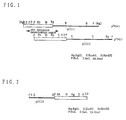
- FIG. 1 shows restriction enzyme maps for plasmids pFM21 and pFM41.
- FIG. 2 shows a restriction enzyme map for plasmid pFM201.
- any DNA is appropriate so long as it is derived from a microorganism belonging to the genus Corynebacterium and which, upon introduction into a riboflavin-requiring microorganism, confers on the microorganism the ability to complement, its riboflavin requirement.
- the DNA is presumed to bear genetic information on enzymes involved in the biosynthesis of riboflavin, because the DNA, upon introduction into a riboflavin-requiring microorganism lacking the enzyme activity involved in the biosynthesis of riboflavin, confers on the microorganism the ability to grow in a riboflavin-free medium.
- the DNA of the present invention is a DNA having the nucleotide sequence set forth in SEQ. ID No. 1.
- DNAs having a partial sequence thereof or having a partially replaced sequence by another nucleotide sequence can be used as the DNA of the present invention as long as it confers on a riboflavin-requiring microorganism the ability to complement its riboflavin requirement.
- a 2.7 kb DNA fragment having the nucleotide sequence from position 1476 to position 4164 in SEQ. ID No. 1 is mentioned.
- the DNA fragment contains the genes encoding at least two enzymes involved in the biosynthesis of riboflavin, guanosine triphosphate cyclohydrolase and riboflavin synthase.
- Corynebacterium ammoniagenes As the donor source of the DNA of the present invention, a microorganism belonging to the genus Corynebacterium preferably Corynebacterium ammoniagenes , is mentioned. Paticularly, Corynebacterium ammoniagenes KY13313 (Amino acid Nucleic acid, 22, 15 (1970)) is the most preferred.
- a chromosomal DNA (a donnor DNA) is obtained from the donor microorganism in a conventional manner, for example by extraction of a chromosomal DNA with phenol [Biochem. Biophys. Acta., 72, 619 (1963)].
- any of the phage vectors, plasmid vectors, etc. is suitable so long as it is autonomously replicable in a microorganism belonging to the genus Corynebacterium, Brevibacterium or Escherichia.
- Preferable examples are pCG1, pCG2, pCG4, pCG11, pCE52, pCE53 and pCE54 (U.S. Patent Nos. 4,617,267, 4,500,640 and 4,710,471).
- a recombinant DNA comprising a vector DNA and the DNA which is derived from a microorganism belonging to the genus Corynebacterium and which, upon introduction into a riboflavin-requiring microorganism, confers on the microorganism the ability to complement its riboflavin requirement, can be obtained together with a variety of recombinant DNAs by cleaving a donor DNA and a vector DNA with suitable restriction enzymes e.g. Pst I and Bgl II and then ligating both DNAs by the action of DNA ligase. The mixture of ligated DNAs thus obtained is used for transform a recipient.
- suitable restriction enzymes e.g. Pst I and Bgl II
- riboflavin-requiring microorganism belonging to the genus Corynebacterium or Brevibacterium and lacking the enzyme activity involved in the biosynthesis of riboflavin can be used as the recipient.
- Corynebacterium ammoniagenes RK122 (Example 4) can be used as the recipient.
- the recipient is transfarmed with the variety of recombinant DNAs thus obtained in a conventional method, such as the protoplast method (Japanese Published Unexamined Patent Application No. 248,394/88), the electroporation method [W. J. Dower et al., Nucleic Acids Research, 16, 6127 (1988)] and the method of Cohen et al. [Proc. Natl. Acad. Sci., USA, 69, 2110 (1979)].
- a conventional method such as the protoplast method (Japanese Published Unexamined Patent Application No. 248,394/88), the electroporation method [W. J. Dower et al., Nucleic Acids Research, 16, 6127 (1988)] and the method of Cohen et al. [Proc. Natl. Acad. Sci., USA, 69, 2110 (1979)].
- a transformant having the desired enzyme activity involved in the biosynthesis of riboflavin can be obtained by selecting a transformant capable of growing in a riboflavin-free medium from the transformants thus obtained.
- the vector DNA contains a selective marker e.g. a resistance to an antibiotic
- the desired transformant can be more easily be selected by addition of the antibiotic to the selective medium.
- the desired recombinant DNA can be isolated from the thus selected transformant and then introduced into another microorganism belonging to the genus Corynebacterium or Brevibacterium in a conventional method.
- the inserted DNA may be excised from the recombinant DNA and ligated to another vector DNA, and then the DNA can be introduced into a microorganism belonging to the genus Corynebacterium or Brevibacterium .
- Such microorganism includes, for example, Corynebacterium ammoniagenes , KY13313, etc.
- the DNA of the present invention can also be introduced into another bacterial species.
- Any of known host-vector systems such as those of the genus Escherichia , Bacillus , etc. can be used. Specifically, Escherichia coli JM105 [GENE, 33 , 103 (1985)] is mentioned for this purpose.
- Corynebacterium ammoniagenes KY13313/pFM21 and KY13313/pFM41 As the transformant having the desired enzyme activity, mention may be made of Corynebacterium ammoniagenes KY13313/pFM21 and KY13313/pFM41.
- KY13313/pFM21 and KY13313/pFM41 carry the recombinant DNAs pFM41, respectively.
- pFM21 and pFM41 contain the DNA of the present invention.
- Corynebacterium ammoniagenes KY13313/pFM41 has been deposited as Corynebacterium ammoniagenes FM41 (FERM BP-4003) with the National Institute of Bioscience and Human-Technology, Agency of Industrial Science and Technology, Japan, as from September 9, 1992, under the Budapest Treaty.
- Riboflavin can efficiently be produced at a lower cost by culturing a microorganism belonging to the genus Corynebacterium , Brevibacterium or Escherichia and carrying a recombinant DNA comprising a vector DNA and a DNA which is derived from a microorganism belonging to the genus Corynebacterium or Brevibacterium and which, upon introduction into a riboflavin-requiring microorganism, comfers on the microorganism the ability to complement its riboflavin requirement.
- the microorganism is cultured according to a conventional method for culturing of usual microorganisms. That is, the microorganism is cultured under the control of temperature and pH under aerobic conditions in a usual medium containing carbon sources, nitrogen sources, inorganic substances, amino acids, and vitamins.
- Any carbon source used may be used so long as the microorganism can assimilate it.
- carbohydrates such as glucose, fructose, sucrose, molasses, starch, starch hydrolysates etc.
- organic acids such as gluconic acid, pyruvic acid, lactic acid, acetic acid etc.
- amino acids such as glycine, glutamic acid, alanine, aspartic acid etc are mentioned.
- the carbon source is used preferably in a concentration of 5-40 %.
- ammonia As the nitrogen source, mention may be made of ammonia; various inorganic and organic ammonium salts, such as ammonium chloride, ammonium sulfate, ammonium phosphate, ammonium nitrate, ammonium carbonate, ammonium acetate etc.; nitrogen-containing organic substance, such as urea, peptone, NZ amine, meat extract, yeast extract, corn steep liquor, casein hydrolysates, fish meal or its digested product; and various amino acid, such as glycine, glutamic acid etc. These substances are employed usually in a concentration of 0.1-10 %.
- the inorganic compound mention may be made of potassium dihydrogen phosphate, dipotassium hydrogen phosphate, magnesium sulfate, magnesium phosphate, sodium chloride, ferrous sulfate, manganese sulfate, zinc sulfate, calcium carbonate, etc. If required by the microorganisms for their growth, nutrients such as amino acids, nucleic acids, vitamins, etc., are added in a suitable amount. Where these substances are contained in other nutrients as enumerated above, their addition is not particularly required.
- Culturing is carried out under aerobic conditions, for example by shaking culture or by aeration-stirring culture, preferably at 20-40 °C for 24-144 hours.
- the pH of the medium is preferably maintained around neutrality by addition of aqueous ammonia, a urea solution, a sodium hydroxide solution, etc.
- the riboflavin thus formed can be quantitatively determined by high performance liquid chromatography using a reverse phase column [e.g., RP-18 (a product of Merck)] with its fluorescence intensity monitored at an emission wavelength of 530 nm and an excitation wavelength of 450 nm.
- RP-18 a product of Merck
- Riboflavin can be recovered from the culture by a conventional purification means such as precipitation, chromatography e.g. by use of an ion-exchange resin, etc.
- riboflavin can be efficiently produced by fermentation.
- Corynebacterium ammoniagenes KY13313 was inoculated into an AIII AG medium [10 g/l polypeptone, 10 g/l meat extract, 5 g/l yeast extract, 3 g/l sodium chloride, 30 ⁇ g/l biotin, 20 mg/l adenine and 10 g/l glycine, pH 7.2] and cultured by shaking at 30 °C for 10 hours.
- AIII AG medium 10 g/l polypeptone, 10 g/l meat extract, 5 g/l yeast extract, 3 g/l sodium chloride, 30 ⁇ g/l biotin, 20 mg/l adenine and 10 g/l glycine, pH 7.2
- 0.6 g of the cultured cells was suspended in 18 ml of P-4 buffer [25mM N-tris(hydroxymethyl)methyl-2-aminoethasulfonic acid, (pH 7.6), 70 mM sodium chloride, 5 mM magnesium chloride, 5 mM calcium chloride and 1.6 M D-sorbitol], followed by addition of 2 ml of P-4 buffer containing 12 mg/ml lysozyme and 3 mg/ml acromopeptidase. The cell suspension was allowed to stand at 30 °C for 20 hours, thus giving a protoplast.
- P-4 buffer 25mM N-tris(hydroxymethyl)methyl-2-aminoethasulfonic acid, (pH 7.6), 70 mM sodium chloride, 5 mM magnesium chloride, 5 mM calcium chloride and 1.6 M D-sorbitol
- the protoplast was collected by centrifugation, then suspended in TSMC buffer [50 mM Tris-HCl buffer(pH 7.5), 0.6 M sodium succinate, 10 mM magnesium chloride and 10 mM calcium chloride] and centrifuged again.
- the protoplast obtained as a precipitate was suspended in 12 ml of TES buffer [10 mM Tris-HCl buffer (pH 8.0), 1 mM disodium ethylenediaminetetraacetate (EDTA) and 10 mM sodium chloride] and allowed to stand at 4 °C for 30 minutes.
- chromosomal DNA and vector DNA were purified by phenol extraction and ethanol precipitation in the same manner as described above.
- 10 ⁇ g of chromosomal DNA and 20 ⁇ g of vector DNA thus treated were ligated at 16 °C for 16 hours in the presence of 700 units of T4 DNA ligase (product of Takara Shuzo Co., Ltd.) in a T4 ligase buffer [66 mM Tris-HCl buffer (pH 7.6), 6.6 mM magnesium chloride, 10 mM dithiothreitol and 0.1 mM ATP].
- restriction enzyme Bgl II (product of Takara Shuzo Co., Ltd.) was added to a solution containing 50 ⁇ g of the above chromosomal DNA, and the DNA was digested at 37°C for 3 hours in the same manner as described above.
- 40 units of restriction enzyme Bgl II was added to a solution containing 50 ⁇ g of the vector pCG11 DNA, and then the vector was digested at 37 °C for 3 hours. After addition of 5 units of alkaline phosphatase, the mixture was dephosphorylated at 65 °C for one hour. From the resulting two reaction solutions chromosomal DNA and vector DNA were purified by phenol extraction and ethanol precipitation in the same manner as described above.
- Riboflavin-requiring strain RK122 was obtained from Corynebacterium ammoniagenes KY13313 in the following manner.
- Corynebacterium ammoniagenes KY13313 was cultured at 30 °C for 7 hours in a medium having the same composition as AIII AG medium except that glycine is not contained, and then mutated at 30 °C for 90 min. with 100 ⁇ g/ml N-methyl-N'-nitro-nitrosoguanidine.
- the cells were collected, washed, and inoculated into a riboflavin-free minimum liquid medium [20 g/l glucose, 0.1 g/l KH2PO4, 0.3 g/l K2HPO4, 0.3 g/l MgSO4.7H2O, 0.01 g/l CaCl2.2H2O, 10 mg/l FeSO4.7H2O, 1 mg/l ZnSO4.7H2O, 4 mg/l MnSO4.4-6H2O, 0.2 mg/l CuSO4.5H2O, 40 mg/l L-cysteine, 10 mg/l vitamin Bl, 20 mg/l Ca-D-pantothenic acid, 60 ⁇ g/l biotin, 3 g/l NH4Cl, 2 g/l urea, 50 mg/l adenine, pH 7.2], followed by culturing at 30°C.
- a riboflavin-free minimum liquid medium [20 g/l glucose, 0.1 g/l KH2PO4,
- Riboflavin-requiring strain RK122 capable of growing only in a riboflavin-containing minimum medium was obtained by replica plating on a minimum agar medium with a without 5 mg/l riboflavin [a minimum liquid medium containing 2 % agar].
- Corynebacterium ammoniagenes RK122 was cultured at 30 °C for 5 hours in an AIII AG medium, then washed with 15 % glycerol solution (cooled on ice) containing 272 mM sucrose, and suspended in the same solution as mentioned above. The resulting cell suspension was mixed with a solution of the Pst I-digested recombinant DNA obtained in Example 2, and transformation was carried out with a gene pulser (Bio-Rad Laboratories, Richmond, CA, USA) according to the electroporation method (a voltage of 2.5 kV, capacity of 25 ⁇ F, and resistance of 200 ⁇ ).
- the cell suspension was plates onto a minimum agar medium containing 150 ⁇ g/l spectinomycin, and cultured at 30 °C for 3days.
- Corynebacterium ammoniagenes RK122/pFM21 being resistant to spectinomycin and requiring no riboflavin was related from colonies occurring on the agar plate medium.
- transformant RK122/pFM41 was obtained using the Bgl II-digested recombinant DNA obtained in Example 2.
- the transformants RK122/pFM21 and RK122/pFM41 were cultured respectively in 250 ml of AIII AG medium containing spectinomycin. According to the method as described in Example 2, plasmid DNAs, each about 100 ⁇ g, were obtained respectively from the culture of RK122/pFM21 and RK122/pFM41, and these plasmids were designated pFM21 and pFM41, respectively.
- FIG. 1 shows restriction enzyme maps for the recombinant plasmids pFM21 and pFM41 where the inserted fragments are 4.7 and 4.2 kb, respectively. In pFM41 set forth in FIG.
- the Bgl II site in the parenthesis could not be cleaved with Bgl II owing to some possible reasons such as microorganism upon the cleavage of the chromosomal DNA or the treatment of the vector DNA with phosphatase.
- the transformants KY13313/pCG11, KY13313/pFM21, and KY13313/pFM41 were measured for their riboflavin synthase activity.
- the transformants KY13313/pCG11, KY13313/pFM21 and KY13313/pFM41 were measured for their guanosine triphosphate cyclohydrolase activity.
- Example 8 Analysis of the DNA capable of conferring on the riboflavin-requiring strain the ability to complement its riboflavin requirement
- the 5.6 kb Sal I- Sal I fragment (containing the 2.7 kb fragment in common) inserted into plasmid pFM21 and pFM41 was determined for its DNA nucleotide sequence by the dideoxy method [Messing, J., Method in Enzymology, 101 , 20 (1983)]. The result is set out in SEQ. ID No. 1.
- a solution containing 1 ⁇ g of plasmid pFM21 DNA obtained in Example 5 was digested at 37 °C for 1 hour with 2 units of restriction enzyme Pst I. Then, a 4.7 kb fragment was isolated from the digested product by agarose gel electrophoresis. Separately, 0.5 ⁇ g of vector pUC19 (product of Takara Shuzo Co., Ltd.) was digested at 37 °C for 1 hour with 2 units of Pst I and then dephosphorylated with alkaline phosphatase in the same manner as described in Example 2. The vector DNA thus obtained was then subjected to phenol extraction and ethanol precipitation.
- the above pFM21-derived DNA fragment 100 ng was mixed with 50 ng of the above vector DNA.
- the mixture was ligated at 16 °C for 2 hours in the presence of 100 units of T4 ligase in the T4 ligase buffer.
- the resulting recombinant DNA was used for transformation of E. coli JM105 according to the method as described by Cohen et al. [Proc. Natl. Acad.
- LB agar medium a medium prepared by adding 1.5 % agar to an LB liquid medium (10 g/l bactotrypton, 5 g/l yeast extract, 5 g/l sodium chloride, pH 7.2)) containing 100 mg/l of ampicillin, 0.1 mM isopropylthiogalactoside and 0.004 % of 5-bromo-4-chloto-3-indoyl- ⁇ -D-galactopyranoside.
- plasmid DNA was isolated and purified according to the method of Maniatis et al. [Molecular Cloning A Laboratory Manual, Cold Spring Harbor Laboratory (1982)]. This plasmid DNA was analyzed for its structure by a digestion with various restriction enzymes. As a result, the plasmid DNA was found to have the structure set forth in FIG. 2 where a pFM21-derived DNA fragment containing the genes encoding the enzymes involved in the synthesis of riboflavin has been inserted downstream of pUC19 lac promoter, and this plasmid DNA was designated pFM201.
- a transformant, Escherichia coli JM105/pFM201 obtained in Example 9 was inoculated into 8 ml of LB liquid medium containing 100 mg/l ampicillin, followed by culturing at 30 °C for 16 hours.
- the culture solution thus obtained was inoculated into 8 ml of minimum medium containing 100 mg/l ampicillin (3 g/l KH2PO4, 5 g/l NaCl, 1 g/l NH4Cl, 6 g/l NaHPO4, 0.25 g/l MgSO4.7H2O, 4 mg/l vitamin B1 and 3 g/l glucose) and cultured at 30 °C for 24 hours.
- the amount of riboflavin accumulated in the culture solution was 14.4 mg/l.
- 0.3 mg/l of riboflavin was accumulated in the culture obtained under the same conditions with respect of E . coli JM105/pUC19 carrying only the vector plasmid pUC19.
- Corynebacterium ammoniagenes KY13313 was transformed in the method described in Example 4 with the pFM41 DNA obtained in Example 5.
- a suspension of the cells was plated on a medium containing 150 ⁇ g/ml of spectinomycin and cultured at 30 °C for 3 days.
- a spectinomycin-resistant transformant, Corynebacterium ammoniagenes FM41 (FERM BP-4003), was obtained from the growing colonies.
- Corynebacterium ammoniagenes FM41 was inoculated into 8 ml of seed medium [10 g/l polypeptone, 10 g/l meat extract, 5 g/l yeast extract, 3 g/l sodium chloride, 30 ⁇ g/l biotin, 20 mg/l adenine and 150 mg/l spectinomycin, pH 7.2] in a test tube. The cells were then cultured at 30 °C for 24 days by shaking. 1.5 ml of the culture was inoculated into 30 ml of fermentation medium (Table 1) put in a 300 ml Erlenmeyer flask. After 72 hours of shaking culture at 30 °C, riboflavin was accumulated in an amount of 620 mg/l in the culture.
- seed medium 10 g/l polypeptone, 10 g/l meat extract, 5 g/l yeast extract, 3 g/l sodium chloride, 30 ⁇ g/l biotin, 20 mg/l adenine and 150 mg/l spect
- riboflavin was accumulated in an amount of 35 mg/l in the culture obtained under the same conditions with respect of Corynebacterium ammoniagenes KY13313 carrying only the vector plasmid pCG11.
- component content polypeptone 10 g/l glucose 80 g/l KH2PO4 1 g/l K2HPO4 3 g/l MgSO4.7H2O 1 g/l CaCl2.2H2O 0.1 g/l FeSO4.7H2O 10 mg/l ZnSO4.7H2O 1 mg/l MnSO4.4-6H2O 4 mg/l CuSO4.5H2O 0.2 mg/l L-cysteine 40 mg/l vitamin B1 10 mg/l Ca-D-pantothenic acid 20 mg/l biotin 60 ⁇ g/l (NH4)2SO4 5 g/l urea 5 g/l adenine 100 mg/l spectinomycin 150 mg/l CaCO3 20 g/l pH 7.2
- ORGANISM Corynebacterium ammoniagenes
Landscapes
- Genetics & Genomics (AREA)
- Engineering & Computer Science (AREA)
- Health & Medical Sciences (AREA)
- Life Sciences & Earth Sciences (AREA)
- Organic Chemistry (AREA)
- Chemical & Material Sciences (AREA)
- Zoology (AREA)
- Wood Science & Technology (AREA)
- Biomedical Technology (AREA)
- Biotechnology (AREA)
- Bioinformatics & Cheminformatics (AREA)
- General Engineering & Computer Science (AREA)
- Microbiology (AREA)
- Molecular Biology (AREA)
- General Health & Medical Sciences (AREA)
- Biochemistry (AREA)
- Chemical Kinetics & Catalysis (AREA)
- General Chemical & Material Sciences (AREA)
- Physics & Mathematics (AREA)
- Biophysics (AREA)
- Plant Pathology (AREA)
- Preparation Of Compounds By Using Micro-Organisms (AREA)
- Micro-Organisms Or Cultivation Processes Thereof (AREA)
Applications Claiming Priority (2)
| Application Number | Priority Date | Filing Date | Title |
|---|---|---|---|
| JP326578/92 | 1992-12-07 | ||
| JP32657892 | 1992-12-07 |
Publications (2)
| Publication Number | Publication Date |
|---|---|
| EP0604060A1 EP0604060A1 (en) | 1994-06-29 |
| EP0604060B1 true EP0604060B1 (en) | 1999-03-24 |
Family
ID=18189382
Family Applications (1)
| Application Number | Title | Priority Date | Filing Date |
|---|---|---|---|
| EP93309837A Expired - Lifetime EP0604060B1 (en) | 1992-12-07 | 1993-12-07 | A process for producing riboflavin |
Country Status (8)
| Country | Link |
|---|---|
| US (1) | US5589355A (da) |
| EP (1) | EP0604060B1 (da) |
| JP (1) | JPH06225776A (da) |
| AU (1) | AU673387B2 (da) |
| CA (1) | CA2110759A1 (da) |
| DE (1) | DE69324118T2 (da) |
| DK (1) | DK0604060T3 (da) |
| NZ (1) | NZ250369A (da) |
Families Citing this family (10)
| Publication number | Priority date | Publication date | Assignee | Title |
|---|---|---|---|---|
| US6350597B1 (en) | 1994-01-13 | 2002-02-26 | E. I. Du Pont De Nemours & Company | Riboflavin synthase genes and enzymes and methods of use |
| JPH1084978A (ja) | 1996-07-24 | 1998-04-07 | F Hoffmann La Roche Ag | 改良されたリボフラビン生産 |
| US6682891B2 (en) | 1997-08-15 | 2004-01-27 | E. I. Du Pont De Nemours And Company | Methods of identifying nucleic acid sequences encoding plant riboflavin synthase enzymes |
| US6323013B1 (en) | 1998-10-28 | 2001-11-27 | E. I. Du Pont De Nemours And Company | Lumazine synthase and riboflavin synthase |
| US6146866A (en) * | 1997-08-15 | 2000-11-14 | E.I. Du Pont De Nemours And Company | Lumazine synthase and riboflavin synthase |
| US6074830A (en) * | 1998-06-09 | 2000-06-13 | E. I. Du Pont De Nemours & Company | 3,4-dihydroxy-2-butanone 4-phosphate synthase |
| JP4294123B2 (ja) * | 1998-07-03 | 2009-07-08 | 協和発酵バイオ株式会社 | ホスホリボシルピロリン酸を経由して生合成される代謝産物の製造法 |
| US7009045B2 (en) * | 2000-07-14 | 2006-03-07 | Archer-Daniels-Midland Company | Transformation systems for flavinogenic yeast |
| KR101335853B1 (ko) | 2011-12-01 | 2013-12-02 | 씨제이제일제당 (주) | L-아미노산 및 리보플라빈을 동시에 생산하는 미생물 및 이를 이용한 l-아미노산 및 리보플라빈을 생산하는 방법 |
| DK2989897T3 (da) * | 2014-08-30 | 2018-05-07 | Dmk Deutsches Milchkontor Gmbh | Fremgangsmåde til fremstilling af farveløs ostemælk |
Family Cites Families (6)
| Publication number | Priority date | Publication date | Assignee | Title |
|---|---|---|---|---|
| JPS57134500A (en) * | 1981-02-12 | 1982-08-19 | Kyowa Hakko Kogyo Co Ltd | Plasmid pcg1 |
| JPS57183799A (en) * | 1981-04-17 | 1982-11-12 | Kyowa Hakko Kogyo Co Ltd | Novel plasmid |
| IL67510A (en) * | 1981-12-17 | 1988-08-31 | Kyowa Hakko Kogyo Kk | Recombinant vector plasmids autonomously replicable in microorganisms belonging to the genus corynebacterium or brevibacterium and process for the production thereof |
| US5164303A (en) * | 1985-12-20 | 1992-11-17 | Zeagen, Inc. | Method for producing riboflavin with Candida famata |
| JPS63112996A (ja) * | 1986-10-31 | 1988-05-18 | Daicel Chem Ind Ltd | リボフラビンの製造方法 |
| CN1066486C (zh) * | 1989-06-22 | 2001-05-30 | 霍夫曼-拉罗奇有限公司 | 高产核黄素的细菌菌株 |
-
1993
- 1993-12-03 JP JP5303815A patent/JPH06225776A/ja active Pending
- 1993-12-06 CA CA002110759A patent/CA2110759A1/en not_active Abandoned
- 1993-12-06 NZ NZ250369A patent/NZ250369A/en unknown
- 1993-12-07 AU AU52214/93A patent/AU673387B2/en not_active Ceased
- 1993-12-07 DK DK93309837T patent/DK0604060T3/da active
- 1993-12-07 DE DE69324118T patent/DE69324118T2/de not_active Expired - Lifetime
- 1993-12-07 EP EP93309837A patent/EP0604060B1/en not_active Expired - Lifetime
-
1995
- 1995-06-06 US US08/465,795 patent/US5589355A/en not_active Expired - Lifetime
Non-Patent Citations (1)
| Title |
|---|
| Translation of the abstract from the specification of Patent Abstracts of Japan, vol. 14, n° 377, August 15, 1990, N° 2-138-998 * |
Also Published As
| Publication number | Publication date |
|---|---|
| DE69324118T2 (de) | 1999-11-18 |
| CA2110759A1 (en) | 1994-06-08 |
| JPH06225776A (ja) | 1994-08-16 |
| US5589355A (en) | 1996-12-31 |
| DK0604060T3 (da) | 2000-06-05 |
| AU5221493A (en) | 1994-06-16 |
| DE69324118D1 (de) | 1999-04-29 |
| NZ250369A (en) | 1995-03-28 |
| EP0604060A1 (en) | 1994-06-29 |
| AU673387B2 (en) | 1996-11-07 |
Similar Documents
| Publication | Publication Date | Title |
|---|---|---|
| EP0136359B1 (en) | Process for preparing l-histidine | |
| EP0143195B1 (en) | Recombinant dna having a phosphoenol pyruvate carboxylase gene inserted therein, bacteria carrying said recombinant dna and a process for producing amino acids using said bacteria | |
| Alexander et al. | Mutants of Salmonella typhimurium with an altered leucyl-transfer ribonucleic acid synthetase | |
| JP2763119B2 (ja) | 低い酢酸産生能を有する微生物、及びこれを用いる有用物質の製造方法 | |
| KR100882418B1 (ko) | 이노신을 생산하는 미생물 및 그를 이용한 이노신 제조방법 | |
| EP0604060B1 (en) | A process for producing riboflavin | |
| CN116745412A (zh) | 组氨酸导致的反馈抑制得到减少的atp-prt变体及表达该变体的组氨酸生产菌株 | |
| CN116783290A (zh) | 组氨酸导致的反馈抑制得到减少的atp-prt变体及表达该变体的组氨酸生产菌株 | |
| KR970001238B1 (ko) | L-트립토판의 제조방법 | |
| EP0092709B1 (en) | Process for producing l-hystidine by fermentation and microorganisms therefor | |
| ES2311289T3 (es) | Procedimiento para producir acidos nucleicos. | |
| US5374542A (en) | Process for producing 4-hydroxy-L-proline | |
| US4927758A (en) | Process for producing histidine | |
| KR900004424B1 (ko) | 아미노산의 제조방법 | |
| KR940005580B1 (ko) | 미생물 배양에 의한 물질의 제조방법 | |
| EP0458971A1 (en) | Inosine guanosine kinase | |
| EP0080378A2 (en) | L-tryptophan-producing microorganisms | |
| KR102230151B1 (ko) | 이산화탄소 환원 활성이 증가된 포메이트 탈수소화 효소 스크리닝 시스템과 이의 용도 | |
| JP3117707B2 (ja) | 5´―イノシン酸の製造法 | |
| KR940005598B1 (ko) | 아스코르빈산-2-인산의 제조법 | |
| JPS62186795A (ja) | アミノ酸の製造法 | |
| KR100237091B1 (ko) | 플라빈 뉴클레오타이드의 제조방법 | |
| EP0180192B1 (en) | Novel plasmids | |
| JP2656329B2 (ja) | フラビンヌクレオチド類の製造法 | |
| US5693504A (en) | Microorganism resistant to nicotinic acid analogue and production of biotin |
Legal Events
| Date | Code | Title | Description |
|---|---|---|---|
| PUAI | Public reference made under article 153(3) epc to a published international application that has entered the european phase |
Free format text: ORIGINAL CODE: 0009012 |
|
| AK | Designated contracting states |
Kind code of ref document: A1 Designated state(s): CH DE DK FR GB IT LI |
|
| 17P | Request for examination filed |
Effective date: 19941019 |
|
| 17Q | First examination report despatched |
Effective date: 19970304 |
|
| GRAG | Despatch of communication of intention to grant |
Free format text: ORIGINAL CODE: EPIDOS AGRA |
|
| GRAG | Despatch of communication of intention to grant |
Free format text: ORIGINAL CODE: EPIDOS AGRA |
|
| GRAG | Despatch of communication of intention to grant |
Free format text: ORIGINAL CODE: EPIDOS AGRA |
|
| GRAH | Despatch of communication of intention to grant a patent |
Free format text: ORIGINAL CODE: EPIDOS IGRA |
|
| GRAH | Despatch of communication of intention to grant a patent |
Free format text: ORIGINAL CODE: EPIDOS IGRA |
|
| GRAA | (expected) grant |
Free format text: ORIGINAL CODE: 0009210 |
|
| AK | Designated contracting states |
Kind code of ref document: B1 Designated state(s): CH DE DK FR GB IT LI |
|
| REG | Reference to a national code |
Ref country code: CH Ref legal event code: NV Representative=s name: BRAUN & PARTNER PATENT-, MARKEN-, RECHTSANWAELTE Ref country code: CH Ref legal event code: EP |
|
| REF | Corresponds to: |
Ref document number: 69324118 Country of ref document: DE Date of ref document: 19990429 |
|
| ET | Fr: translation filed | ||
| PLBE | No opposition filed within time limit |
Free format text: ORIGINAL CODE: 0009261 |
|
| 26N | No opposition filed | ||
| REG | Reference to a national code |
Ref country code: DK Ref legal event code: T3 |
|
| REG | Reference to a national code |
Ref country code: GB Ref legal event code: IF02 |
|
| PGFP | Annual fee paid to national office [announced via postgrant information from national office to epo] |
Ref country code: GB Payment date: 20061206 Year of fee payment: 14 |
|
| PGFP | Annual fee paid to national office [announced via postgrant information from national office to epo] |
Ref country code: CH Payment date: 20061213 Year of fee payment: 14 |
|
| PGFP | Annual fee paid to national office [announced via postgrant information from national office to epo] |
Ref country code: DK Payment date: 20061227 Year of fee payment: 14 |
|
| REG | Reference to a national code |
Ref country code: CH Ref legal event code: PL |
|
| REG | Reference to a national code |
Ref country code: DK Ref legal event code: EBP |
|
| GBPC | Gb: european patent ceased through non-payment of renewal fee |
Effective date: 20071207 |
|
| PG25 | Lapsed in a contracting state [announced via postgrant information from national office to epo] |
Ref country code: LI Free format text: LAPSE BECAUSE OF NON-PAYMENT OF DUE FEES Effective date: 20071231 Ref country code: CH Free format text: LAPSE BECAUSE OF NON-PAYMENT OF DUE FEES Effective date: 20071231 |
|
| PG25 | Lapsed in a contracting state [announced via postgrant information from national office to epo] |
Ref country code: GB Free format text: LAPSE BECAUSE OF NON-PAYMENT OF DUE FEES Effective date: 20071207 |
|
| PG25 | Lapsed in a contracting state [announced via postgrant information from national office to epo] |
Ref country code: DK Free format text: LAPSE BECAUSE OF NON-PAYMENT OF DUE FEES Effective date: 20080102 |
|
| PGFP | Annual fee paid to national office [announced via postgrant information from national office to epo] |
Ref country code: FR Payment date: 20101224 Year of fee payment: 18 |
|
| PGFP | Annual fee paid to national office [announced via postgrant information from national office to epo] |
Ref country code: IT Payment date: 20101218 Year of fee payment: 18 |
|
| PGFP | Annual fee paid to national office [announced via postgrant information from national office to epo] |
Ref country code: DE Payment date: 20101130 Year of fee payment: 18 |
|
| REG | Reference to a national code |
Ref country code: FR Ref legal event code: ST Effective date: 20120831 |
|
| REG | Reference to a national code |
Ref country code: DE Ref legal event code: R119 Ref document number: 69324118 Country of ref document: DE Effective date: 20120703 |
|
| PG25 | Lapsed in a contracting state [announced via postgrant information from national office to epo] |
Ref country code: DE Free format text: LAPSE BECAUSE OF NON-PAYMENT OF DUE FEES Effective date: 20120703 |
|
| PG25 | Lapsed in a contracting state [announced via postgrant information from national office to epo] |
Ref country code: IT Free format text: LAPSE BECAUSE OF NON-PAYMENT OF DUE FEES Effective date: 20111207 |
|
| PG25 | Lapsed in a contracting state [announced via postgrant information from national office to epo] |
Ref country code: FR Free format text: LAPSE BECAUSE OF NON-PAYMENT OF DUE FEES Effective date: 20120102 |