EP0604101A1 - Zylindrischer Wundverband für tiefe Wunden - Google Patents
Zylindrischer Wundverband für tiefe Wunden Download PDFInfo
- Publication number
- EP0604101A1 EP0604101A1 EP93310058A EP93310058A EP0604101A1 EP 0604101 A1 EP0604101 A1 EP 0604101A1 EP 93310058 A EP93310058 A EP 93310058A EP 93310058 A EP93310058 A EP 93310058A EP 0604101 A1 EP0604101 A1 EP 0604101A1
- Authority
- EP
- European Patent Office
- Prior art keywords
- wound
- wound dressing
- hydrogel material
- product
- weight
- Prior art date
- Legal status (The legal status is an assumption and is not a legal conclusion. Google has not performed a legal analysis and makes no representation as to the accuracy of the status listed.)
- Ceased
Links
Images

Classifications
-
- A—HUMAN NECESSITIES
- A61—MEDICAL OR VETERINARY SCIENCE; HYGIENE
- A61F—FILTERS IMPLANTABLE INTO BLOOD VESSELS; PROSTHESES; DEVICES PROVIDING PATENCY TO, OR PREVENTING COLLAPSING OF, TUBULAR STRUCTURES OF THE BODY, e.g. STENTS; ORTHOPAEDIC, NURSING OR CONTRACEPTIVE DEVICES; FOMENTATION; TREATMENT OR PROTECTION OF EYES OR EARS; BANDAGES, DRESSINGS OR ABSORBENT PADS; FIRST-AID KITS
- A61F15/00—Auxiliary appliances for wound dressings; Dispensing containers for dressings or bandages
- A61F15/005—Bandage applicators
-
- A—HUMAN NECESSITIES
- A61—MEDICAL OR VETERINARY SCIENCE; HYGIENE
- A61F—FILTERS IMPLANTABLE INTO BLOOD VESSELS; PROSTHESES; DEVICES PROVIDING PATENCY TO, OR PREVENTING COLLAPSING OF, TUBULAR STRUCTURES OF THE BODY, e.g. STENTS; ORTHOPAEDIC, NURSING OR CONTRACEPTIVE DEVICES; FOMENTATION; TREATMENT OR PROTECTION OF EYES OR EARS; BANDAGES, DRESSINGS OR ABSORBENT PADS; FIRST-AID KITS
- A61F13/00—Bandages or dressings; Absorbent pads
- A61F13/15—Absorbent pads, e.g. sanitary towels, swabs or tampons for external or internal application to the body; Supporting or fastening means therefor; Tampon applicators
- A61F13/20—Tampons, e.g. catamenial tampons; Accessories therefor
- A61F13/26—Means for inserting tampons, i.e. applicators
-
- A—HUMAN NECESSITIES
- A61—MEDICAL OR VETERINARY SCIENCE; HYGIENE
- A61F—FILTERS IMPLANTABLE INTO BLOOD VESSELS; PROSTHESES; DEVICES PROVIDING PATENCY TO, OR PREVENTING COLLAPSING OF, TUBULAR STRUCTURES OF THE BODY, e.g. STENTS; ORTHOPAEDIC, NURSING OR CONTRACEPTIVE DEVICES; FOMENTATION; TREATMENT OR PROTECTION OF EYES OR EARS; BANDAGES, DRESSINGS OR ABSORBENT PADS; FIRST-AID KITS
- A61F13/00—Bandages or dressings; Absorbent pads
- A61F13/15—Absorbent pads, e.g. sanitary towels, swabs or tampons for external or internal application to the body; Supporting or fastening means therefor; Tampon applicators
- A61F13/36—Surgical swabs, e.g. for absorbency or packing body cavities during surgery
-
- A—HUMAN NECESSITIES
- A61—MEDICAL OR VETERINARY SCIENCE; HYGIENE
- A61L—METHODS OR APPARATUS FOR STERILISING MATERIALS OR OBJECTS IN GENERAL; DISINFECTION, STERILISATION OR DEODORISATION OF AIR; CHEMICAL ASPECTS OF BANDAGES, DRESSINGS, ABSORBENT PADS OR SURGICAL ARTICLES; MATERIALS FOR BANDAGES, DRESSINGS, ABSORBENT PADS OR SURGICAL ARTICLES
- A61L15/00—Chemical aspects of, or use of materials for, bandages, dressings or absorbent pads
- A61L15/16—Bandages, dressings or absorbent pads for physiological fluids such as urine or blood, e.g. sanitary towels, tampons
- A61L15/42—Use of materials characterised by their function or physical properties
- A61L15/60—Liquid-swellable gel-forming materials, e.g. super-absorbents
-
- A—HUMAN NECESSITIES
- A61—MEDICAL OR VETERINARY SCIENCE; HYGIENE
- A61F—FILTERS IMPLANTABLE INTO BLOOD VESSELS; PROSTHESES; DEVICES PROVIDING PATENCY TO, OR PREVENTING COLLAPSING OF, TUBULAR STRUCTURES OF THE BODY, e.g. STENTS; ORTHOPAEDIC, NURSING OR CONTRACEPTIVE DEVICES; FOMENTATION; TREATMENT OR PROTECTION OF EYES OR EARS; BANDAGES, DRESSINGS OR ABSORBENT PADS; FIRST-AID KITS
- A61F13/00—Bandages or dressings; Absorbent pads
- A61F13/15—Absorbent pads, e.g. sanitary towels, swabs or tampons for external or internal application to the body; Supporting or fastening means therefor; Tampon applicators
- A61F13/551—Packaging before or after use
-
- A—HUMAN NECESSITIES
- A61—MEDICAL OR VETERINARY SCIENCE; HYGIENE
- A61F—FILTERS IMPLANTABLE INTO BLOOD VESSELS; PROSTHESES; DEVICES PROVIDING PATENCY TO, OR PREVENTING COLLAPSING OF, TUBULAR STRUCTURES OF THE BODY, e.g. STENTS; ORTHOPAEDIC, NURSING OR CONTRACEPTIVE DEVICES; FOMENTATION; TREATMENT OR PROTECTION OF EYES OR EARS; BANDAGES, DRESSINGS OR ABSORBENT PADS; FIRST-AID KITS
- A61F13/00—Bandages or dressings; Absorbent pads
- A61F2013/00089—Wound bandages
- A61F2013/00093—Wound bandages tubular
-
- A—HUMAN NECESSITIES
- A61—MEDICAL OR VETERINARY SCIENCE; HYGIENE
- A61F—FILTERS IMPLANTABLE INTO BLOOD VESSELS; PROSTHESES; DEVICES PROVIDING PATENCY TO, OR PREVENTING COLLAPSING OF, TUBULAR STRUCTURES OF THE BODY, e.g. STENTS; ORTHOPAEDIC, NURSING OR CONTRACEPTIVE DEVICES; FOMENTATION; TREATMENT OR PROTECTION OF EYES OR EARS; BANDAGES, DRESSINGS OR ABSORBENT PADS; FIRST-AID KITS
- A61F13/00—Bandages or dressings; Absorbent pads
- A61F2013/00089—Wound bandages
- A61F2013/00217—Wound bandages not adhering to the wound
-
- A—HUMAN NECESSITIES
- A61—MEDICAL OR VETERINARY SCIENCE; HYGIENE
- A61F—FILTERS IMPLANTABLE INTO BLOOD VESSELS; PROSTHESES; DEVICES PROVIDING PATENCY TO, OR PREVENTING COLLAPSING OF, TUBULAR STRUCTURES OF THE BODY, e.g. STENTS; ORTHOPAEDIC, NURSING OR CONTRACEPTIVE DEVICES; FOMENTATION; TREATMENT OR PROTECTION OF EYES OR EARS; BANDAGES, DRESSINGS OR ABSORBENT PADS; FIRST-AID KITS
- A61F13/00—Bandages or dressings; Absorbent pads
- A61F2013/00361—Plasters
- A61F2013/00365—Plasters use
- A61F2013/00519—Plasters use for treating burn
- A61F2013/00523—Plasters use for treating burn with hydrogel
-
- A—HUMAN NECESSITIES
- A61—MEDICAL OR VETERINARY SCIENCE; HYGIENE
- A61F—FILTERS IMPLANTABLE INTO BLOOD VESSELS; PROSTHESES; DEVICES PROVIDING PATENCY TO, OR PREVENTING COLLAPSING OF, TUBULAR STRUCTURES OF THE BODY, e.g. STENTS; ORTHOPAEDIC, NURSING OR CONTRACEPTIVE DEVICES; FOMENTATION; TREATMENT OR PROTECTION OF EYES OR EARS; BANDAGES, DRESSINGS OR ABSORBENT PADS; FIRST-AID KITS
- A61F13/00—Bandages or dressings; Absorbent pads
- A61F2013/00361—Plasters
- A61F2013/00544—Plasters form or structure
- A61F2013/00604—Multilayer
- A61F2013/00608—Multilayer with reinforcing layers
-
- A—HUMAN NECESSITIES
- A61—MEDICAL OR VETERINARY SCIENCE; HYGIENE
- A61F—FILTERS IMPLANTABLE INTO BLOOD VESSELS; PROSTHESES; DEVICES PROVIDING PATENCY TO, OR PREVENTING COLLAPSING OF, TUBULAR STRUCTURES OF THE BODY, e.g. STENTS; ORTHOPAEDIC, NURSING OR CONTRACEPTIVE DEVICES; FOMENTATION; TREATMENT OR PROTECTION OF EYES OR EARS; BANDAGES, DRESSINGS OR ABSORBENT PADS; FIRST-AID KITS
- A61F13/00—Bandages or dressings; Absorbent pads
- A61F13/15—Absorbent pads, e.g. sanitary towels, swabs or tampons for external or internal application to the body; Supporting or fastening means therefor; Tampon applicators
- A61F13/53—Absorbent pads, e.g. sanitary towels, swabs or tampons for external or internal application to the body; Supporting or fastening means therefor; Tampon applicators characterised by the absorbing medium
- A61F2013/530481—Absorbent pads, e.g. sanitary towels, swabs or tampons for external or internal application to the body; Supporting or fastening means therefor; Tampon applicators characterised by the absorbing medium having superabsorbent materials, i.e. highly absorbent polymer gel materials
-
- Y—GENERAL TAGGING OF NEW TECHNOLOGICAL DEVELOPMENTS; GENERAL TAGGING OF CROSS-SECTIONAL TECHNOLOGIES SPANNING OVER SEVERAL SECTIONS OF THE IPC; TECHNICAL SUBJECTS COVERED BY FORMER USPC CROSS-REFERENCE ART COLLECTIONS [XRACs] AND DIGESTS
- Y10—TECHNICAL SUBJECTS COVERED BY FORMER USPC
- Y10S—TECHNICAL SUBJECTS COVERED BY FORMER USPC CROSS-REFERENCE ART COLLECTIONS [XRACs] AND DIGESTS
- Y10S604/00—Surgery
- Y10S604/904—Tampons
Definitions
- the present invention generally relates to a wound dressing and, more particularly, to a wound dressing comprising a hydrogel material substantially in the form of a cylinder for insertion and removal from a deep wound.
- Aqueous moisture absorbing materials such as a hydrogel material with a polyethylene glycol liquid curing agent as disclosed in Spence, U.S. Patent No. 4,226,232, are easier to remove from the wound site, but cannot be sterilized by irradiation due to the formation of free radicals within the aqueous material.
- Another aqueous absorbing material used to absorb wound exudate is an hydrophilic polymer as disclosed in Rawlings et al, U.S. Patent No. 4,657,006.
- Rawlings et al disclose a wound dressing which comprises a hydrophilic polymer having moisture and vapor permeability characteristics.
- stage 4 wounds Nor are existing wound dressings conducive for healing extremely deep wounds. It is not uncommon for certain deep wounds to extend down to the bones or tendons, most of which are typically characterized as stage 3 or stage 4 wounds. The most severe wounds in terms of depth are characterized as stage 4 wounds, and oftentimes have a shape resembling a cylinder or the like. For example, such a wound may be caused by a bullet or a puncture from large equipment or glass.
- known wound dressings do not facilitate the healing of such deep wounds as exemplified by the wound dressings in Mason, Jr. et al, Spence, and Rawlings et al which are designed for treating surface wounds.
- a wound dressing which is especially conducive for deep wounds.
- a wound dressing for a deep wound which may be inserted and removed from a draining wound having a cylindrical shape and which contains an exudate absorbing composition.
- a wound dressing for a deep wound which may be removed neatly as a single piece without adhering to the new cell tissue of the wound.
- the present invention meets the above-identified needs by providing a wound dressing especially adapted for deep wounds.
- deep wound as referenced herein, is defined as those wounds which extend down below the surface of the skin and, in some instances, to the bones or tendons. Those types of wounds extending to the bones and tendons are typically characterized as stage 3 or stage 4 wounds, of which the most severe wounds in terms of depth are characterized as stage 4 wounds.
- stage 3 or stage 4 wounds of which the most severe wounds in terms of depth are characterized as stage 4 wounds.
- the materials and design of the present wound dressing facilitates the healing of such deep wounds.
- a wound dressing adapted to be inserted into a deep wound found on a patient.
- the wound dressing comprises a hydrogel material capable of absorbing wound exudate emitted by the deep wound in which it is disposed.
- the hydrogel material is substantially in the form of a cylinder.
- the term "cylinder" as used herein is meant to encompass annular and oblong shapes having very small cross-sectional areas to very large cross-sectional areas depending upon the type of wound for which the dressing is applicable.
- a support layer is mounted within the cylinder for purposes of providing support for the hydrogel material in the wound dressing.
- the support layer may extend outwardly from an end of the cylinder of hydrogel material so as to provide a pull tab by which the wound dressing can be removed from the deep wound.
- the support layer can extend through the entire length of the cylinder as well as outwardly from an end thereof so as to provide a pull tab by which the wound dressing can be removed from the deep wound.
- a wound dressing product comprises a wound dressing adapted to be inserted into a deep wound found on a patient.
- the wound dressing includes a hydrogel material capable of absorbing wound exudate emitted by the wound and the hydrogel material is substantially in the form of a cylinder.
- a support layer is mounted within the cylinder for purposes of providing support for the hydrogel material in the wound dressing.
- the wound dressing product comprises means for inserting and removing the wound dressing from the deep wound without inhibiting the healing thereof.
- the preferred inserting/removing means comprises a syringe adapted to inject and withdraw the cylinder of the hydrogel material into and from the deep wound.
- a wound dressing especially conducive for deep wounds; it is also a feature of the invention to provide a wound dressing for a deep wound which may be inserted and removed from a draining wound having a cylindrical shape and which contains an exudate absorbing composition; and, it is also a feature of the present invention to provide a wound dressing for a deep wound which may be removed neatly as a single piece without adhering to the new cell tissue of the wound.
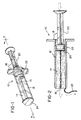
- a wound dressing product generally designated by reference numeral 10 is depicted.
- the wound dressing product 10 is adapted to be inserted into a deep wound W (Fig. 3) found on a patient P in a hospital environment.
- the wound dressing product 10 comprises a wound dressing, generally designated by reference numeral 12, which is adapted to be inserted into the deep wound W found on the patient P.
- the size of the wound dressing 12 may be varied as required by end users.
- the wound dressing 12 can be made to have a wide variety of cross-sectional areas and lengths without departing from the scope of the invention.
- the wound dressing 12 preferably includes a hydrogel material 14 capable of absorbing wound exudate emitted by wounds typically found on patients.
- the preferred hydrogel material 14 is substantially in the form of a cylinder.
- the cylinder shape as used herein, is meant to encompass annular and oblong shapes having very small cross-sectional areas to very large cross-sectional areas depending upon the type of wound for which the dressing is applicable.
- the wound dressing 12 also comprises a support layer 16 mounted within the cylinder of hydrogel material 14 for purposes of providing support for hydrogel material 14 in the wound dressing 12. More specifically, the hydrogel material 14 remains intact more readily when the support layer 16 is included in the wound dressing 14.
- the wound dressing product 10 preferably includes means for inserting and removing the wound dressing 12 from the deep wound W without inhibiting the healing thereof.
- the inserting/removing means comprises a syringe device collectively designated as 18 and individually by its components hereinafter. While Figs. 1 and 2 depict the syringe 18 for inserting and removing the wound dressing 12 into and from the deep wound W, those skilled in the art should understand that other devices capable of inserting and/or removing the wound dressing 12 may be used without departing from the scope of the invention. Additionally, a user, such as a nurse, may manually insert the wound dressing 12 into the deep wound W and thereafter, manually remove it from the patient's body when desired.
- the syringe 18 includes a plunger 20 and corresponding housing 22 together which provide the wound dressing 12 with a sterile package and means by which it can be inserted and withdrawn in and from the deep wound W.
- the wound dressing product 10 comprises a release liner 24 which covers the exposed end of the wound dressing 12 as it is stored in the housing 22 of the syringe 18.
- the release liner 24 is peeled away by the user prior to insertion of the wound dressing 12 into the deep wound W. The inclusion of the release liner 24 ensures sterility of the wound dressing 12 prior to use.
- Figs. 3 and 4 illustrate the wound dressing product 10 as the wound dressing 12 is being inserted into the deep wound W.
- the user pushes against the plunger 20 of the syringe 18, thereby inserting the wound dressing 12 into the deep wound W on the patient P.
- the wound dressing 12 it is preferable for the wound dressing 12 to completely fill the void created by the deep wound W so as to promote effective healing and to absorb a substantial amount of the wound exudate emitted by the deep wound W.
- Fig. 4 which is taken along view line 4--4 in Fig. 3, illustrates such a wound dressing.
- the wound dressing 12 can be tailored to the size and depth of the deep wound W, either at the manufacturing stage or by slicing and/or carving the manufactured wound dressing 12 prior to insertion.
- Fig. 5 illustrates the wound dressing 12 comprising the hydrogel material 14 in the form of a cylinder as it appears mounted within the deep wound W in the patient P.
- the wound dressing 12 is provided with the support layer 16 which extends outwardly from an end of said cylinder so as to provide means by which the wound dressing 12 can be removed from the deep wound W.
- Such means is depicted in the form of a pull tab 26 which can be grasped by the user to remove the wound dressing 12 from the body of the patient P.
- the support layer 16 extends through the entire length of the cylinder of the hydrogel material 14 in addition to outwardly from an end thereof so as to provide maximum support for the hydrogel material 14 and to provide the pull tab 26 for easy removal of the wound dressing 12.
- a procedure by which the wound dressing 12 can be removed from the deep wound W using the syringe 18 is illustrated.
- the housing 22 of the syringe 18 is mounted over the exposed wound dressing 12 so as to allow the plunger 20 to withdraw the wound dressing 12 by means of the suction or vacuum created by the plunger 20 in the housing 22.
- Such an operation is very typical of syringes and other similar devices which are used to withdraw fluids and gels from reservoirs.
- the hydrogel material 14 will not swell, thus allowing the housing 22 of the syringe 18 to fit over at least that portion of the wound dressing 12. It should be understood that the hydrogel material disposed in the deep wound W may swell upon absorption of wound exudate to a point at which suction by the syringe 18 into its housing 22 is precluded. That portion, however, which is drawn into the syringe 18 is sufficient to pull the remaining portion of the wound dressing 12 from the deep wound W.
- the support layer 16 of the present invention is preferably in the form of a thin, flexible gauze-like structure suitable for use in the treatment of wounds on a patient.
- the hydrogel material 14 of the wound dressing 12 is impregnated in the support layer 16 to provide support therefor. While those skilled in the art will appreciate the difficulty in illustrating the presence of the hydrogel material 14 in the support layer 16, it should be understood that the hydrogel material 14 is preferably completely impregnated in the interstices of the support layer 16. To that end, it is preferable for the support layer 16 to be formed of any material capable of supporting the hydrogel material 14. Those skilled in the art will appreciate that materials having interstices within which materials may be impregnated are particularly suitable for such purposes.
- the support layer 16 is preferably formed from a material selected from the group consisting of fabrics, natural fibers, synthetic fibers, cellulose derivatives and combinations thereof. These preferred materials provide a sufficient support matrix for impregnation of the hydrogel material 14. Most preferably, the support layer 16 is comprises a gauze material.
- the wound dressing 12 can be removed from the wound in which it is disposed in a non-destructive manner in that the wound dressing 12 does not adhere to the new cell tissue forming in the healing deep wound W.
- the wound dressing 12 also does not break apart into fragments or lumps, but rather, can be removed substantially as a single piece.
- Such features have not been present in past wound dressings. These features are largely attributed to the hydrogel material 14 from which the wound dressing 12 is substantially formed. More particularly, the preferred hydrogel material 14 is formed from an aqueous mixture of polyhydric alcohol, an aliphatic diisocyanate terminated prepolymer, polyethylene oxide based diamine and sodium chloride.
- the polyhydric alcohol is selected from the group consisting of polypropylene glycol, polyethylene glycol and glycerine.
- the resulting hydrogel material 14 is a highly absorbent material capable of retaining large amounts of wound exudate, thereby rendering it very suitable for use in wound dressings.
- the wound dressing 12 remains intact as it absorbs wound exudate from the wound.
- the hydrogel material 14 does not adhere or stick to the wound thereby allowing for easy removal of the wound dressing 12 substantially as a single piece.
- the biocompatibility of the hydrogel material 14 within the wound is extremely favorable.
- the hydrogel material 14 provides a bio-compatible, non-irritating, fluid absorbing, bacterial protective, cushioning, skin-like media in and over the wound site.
- aliphatic diisocyanates may be used in accordance with the invention including but not limited to hexamethylene diisocyanate, isophoronediisocyanate, tetramethylene diisocyanate and decamethylene diisocyanate.
- the preferred aliphatic diisocyanate terminated prepolymer is an isophoronediisocyanate terminated prepolymer based on polyols containing more than about 40% polyethylene oxide and having an isocyanate content of about 3% by weight.
- the molecular weight of the isophoronediisocyanate terminated prepolymer is preferably in a range from about 1500 to about 8000 and most preferably, from about 4000 to about 5000.
- the polyethylene oxide based polyamine is preferably a polyethylene oxide based diamine having a molecular weight in a range from about 200 to about 6000 and most preferably, about 2000. It is also preferable that the aliphatic diisocyanate terminated prepolymer and the polyethylene oxide based polyamine have a stoichiometric ratio of about 1:1.
- a more preferred hydrogel material 14 is formed from an aqueous mixture including from about 0% to about 90% by weight polyhydric alcohol; from about 6% to about 60% by weight aliphatic diisocyanate terminated prepolymer; from about 4% to about 40% by weight polyethylene oxide based polyamine; up to about 2% by weight sodium chloride; and the balance water.
- a more preferred hydrogel composition for forming the hydrogel material 30 is formed from a mixture comprising from about 15% to about 30% by weight polypropylene glycol; from about 8% to about 14% by weight isophoronediisocyanate terminated prepolymer; from about 5% to about 10% by weight polyethylene oxide based diamine; and up to about 1% by weight sodium chloride; and the balance water.
- the hydrogel material 14 is formed from a mixture comprising: (a) from about 16% to 17% by weight polypropylene glycol; (b) from about 10% to 12% by weight isophoronediisocyanate terminated prepolymer; (c) from about 7% to 9% by weight polyethylene oxide based diamine; (d) about .5% to 1% by weight sodium chloride; and (e) the balance water.
- the aforementioned preferred hydrogel compositions provide a wound dressing 12 having the desired properties of excellent biocompatibility and exudate absorption properties without adhering to the wound.
- other materials having such characteristics including but not limited to the aforementioned hydrogel compositions, may be used to form the hydrogel material 14 in accordance with the present invention.
- the wound dressing 12 of the invention may be formed in a variety of ways including but not limited to pouring the uncured hydrogel material 14 into a mold having the cylindrical shape and disposing the support layer 16 therein as desired. Thereafter, the hydrogel material 14 is allowed to cure to a gel form, after which it is packaged in the syringe 18 as depicted in Fig.s 1 and 2. Those skilled in the art will appreciate that other process techniques may be used to form the wound dressing 12 without departing from the scope of the invention.
- a wound dressing especially conducive for deep wounds which can be inserted and removed from a draining wound having a cylindrical shape or a shape in which a cylindrical wound dressing can be disposed is provided. Further, the invention provides wound dressing capable of absorbing large amounts of wound exudate while also having the ability to be removed neatly as a single piece without adhering to the new cell tissue of the wound. Such features provide significant advantages over those wound dressings used for similar purposes in the past.
Landscapes
- Health & Medical Sciences (AREA)
- Life Sciences & Earth Sciences (AREA)
- General Health & Medical Sciences (AREA)
- Epidemiology (AREA)
- Engineering & Computer Science (AREA)
- Veterinary Medicine (AREA)
- Public Health (AREA)
- Animal Behavior & Ethology (AREA)
- Heart & Thoracic Surgery (AREA)
- Vascular Medicine (AREA)
- Biomedical Technology (AREA)
- Surgery (AREA)
- Nuclear Medicine, Radiotherapy & Molecular Imaging (AREA)
- Chemical & Material Sciences (AREA)
- Dispersion Chemistry (AREA)
- Hematology (AREA)
- Materials Engineering (AREA)
- Materials For Medical Uses (AREA)
Applications Claiming Priority (2)
| Application Number | Priority Date | Filing Date | Title |
|---|---|---|---|
| US99601392A | 1992-12-23 | 1992-12-23 | |
| US996013 | 1992-12-23 |
Publications (1)
| Publication Number | Publication Date |
|---|---|
| EP0604101A1 true EP0604101A1 (de) | 1994-06-29 |
Family
ID=25542418
Family Applications (1)
| Application Number | Title | Priority Date | Filing Date |
|---|---|---|---|
| EP93310058A Ceased EP0604101A1 (de) | 1992-12-23 | 1993-12-14 | Zylindrischer Wundverband für tiefe Wunden |
Country Status (7)
| Country | Link |
|---|---|
| US (1) | US5447499A (de) |
| EP (1) | EP0604101A1 (de) |
| JP (1) | JPH06233810A (de) |
| AU (1) | AU651286B1 (de) |
| CA (1) | CA2109981C (de) |
| NZ (1) | NZ250214A (de) |
| ZA (1) | ZA938595B (de) |
Cited By (5)
| Publication number | Priority date | Publication date | Assignee | Title |
|---|---|---|---|---|
| US6872384B1 (en) | 1998-02-23 | 2005-03-29 | Life Medical Sciences, Inc. | Treatment of trauma |
| US6943211B1 (en) | 1999-02-23 | 2005-09-13 | Life Medical Sciences, Inc. | Polymer compounds |
| EP2231092A4 (de) * | 2007-11-27 | 2012-04-11 | Boehringer Technologies Lp | Tunnelverband zur verwendung in der vakuum-wundtherapie |
| WO2014058992A1 (en) * | 2012-10-09 | 2014-04-17 | University Of Cincinnati | Devices and methods for directing a medical fabric into a portion of the body |
| WO2014137824A1 (en) * | 2013-03-07 | 2014-09-12 | Life Sciences Llc | Apparatus & method for wound infection prevention |
Families Citing this family (39)
| Publication number | Priority date | Publication date | Assignee | Title |
|---|---|---|---|---|
| WO1996022123A1 (en) * | 1995-01-18 | 1996-07-25 | Medchem Products, Inc. | Apparatus and method for applying a hemostatic agent onto a tissue |
| FR2764514B1 (fr) * | 1997-06-13 | 1999-09-03 | Biopharmex Holding Sa | Implant injectable en sous-cutane ou intradermique a bioresorbabilite controlee pour la chirurgie reparatrice ou plastique et la dermatologie esthetique |
| US6591838B2 (en) * | 1998-07-06 | 2003-07-15 | Scimed Life Systems, Inc. | Implant system and method for bulking tissue |
| US6416488B1 (en) * | 1998-08-12 | 2002-07-09 | Playtex Products, Inc. | Tampon applicator with taped finger grip |
| US6605294B2 (en) * | 1998-08-14 | 2003-08-12 | Incept Llc | Methods of using in situ hydration of hydrogel articles for sealing or augmentation of tissue or vessels |
| USD445176S1 (en) | 2000-04-14 | 2001-07-17 | Milton E. Landers | Medicated cream and ointment dispenser with a ruled piston |
| DE20113761U1 (de) * | 2001-08-20 | 2001-12-20 | Lohmann & Rauscher GmbH & Co. KG, 56567 Neuwied | Wundversorgungsprodukt |
| US6899700B2 (en) * | 2001-08-29 | 2005-05-31 | Kimberly-Clark Worldwide, Inc. | Therapeutic agent delivery tampon |
| GB2382989B (en) * | 2001-12-14 | 2005-03-16 | Johnson & Johnson Medical Ltd | Polyurethane foam cavity wound dressings |
| US6888043B2 (en) | 2001-12-21 | 2005-05-03 | Kimberly-Clark Worldwide, Inc. | Feminine care products for the delivery of therapeutic substances |
| US20030120225A1 (en) * | 2001-12-21 | 2003-06-26 | Kimberly-Clark Worldwide, Inc. | Therapeutic agent delivery labial pad |
| US6998510B2 (en) * | 2002-02-04 | 2006-02-14 | Damage Control Surgical Technologies, Inc. | Method and apparatus for improved hemostasis and damage control operations |
| US7943810B2 (en) | 2003-02-04 | 2011-05-17 | Buckman Robert F | Method and apparatus for hemostasis |
| IT1343133B (it) * | 2003-12-03 | 2007-11-29 | Microtech S R L | Dispositivo per l'inserimento ed il recupero di un tampone emostatico nel campo operatorio utilizzabile in chirurgia endoscopica. |
| US7044928B2 (en) * | 2003-04-04 | 2006-05-16 | Platex Products, Inc. | Tampon applicator assembly having an improved plunger and methods of making |
| USD572362S1 (en) | 2003-04-04 | 2008-07-01 | Playtex Products, Inc. | Tampon applicator with finger grip |
| USD492033S1 (en) | 2003-04-04 | 2004-06-22 | Playtex Products, Inc. | Tampon applicator assembly |
| US20050085853A1 (en) * | 2003-10-15 | 2005-04-21 | Forsberg Andrew T. | Collagen delivery assembly with blood perfusion holes |
| WO2009137438A2 (en) | 2008-05-06 | 2009-11-12 | Wilson-Cook Medical Inc. | Apparatus and methods for delivering therapeutic agents |
| AU2009309002B2 (en) * | 2008-10-27 | 2015-05-07 | Sessions Pharmaceuticals Inc. | Fluid extracting wound dressing |
| AU2009330505A1 (en) | 2008-12-23 | 2011-06-30 | Cook Medical Technologies Llc | Apparatus and methods for containing and delivering therapeutic agents |
| USD636881S1 (en) | 2009-02-10 | 2011-04-26 | Sessions Pharmaceuticals Inc. | Wound dressing |
| US8118777B2 (en) | 2009-05-29 | 2012-02-21 | Cook Medical Technologies Llc | Systems and methods for delivering therapeutic agents |
| US9101744B2 (en) | 2009-05-29 | 2015-08-11 | Cook Medical Technologies Llc | Systems and methods for delivering therapeutic agents |
| USD618347S1 (en) * | 2009-06-04 | 2010-06-22 | Cynthia Bradshaw | Applicator suppository injector |
| US20100324516A1 (en) * | 2009-06-18 | 2010-12-23 | Tyco Healthcare Group Lp | Apparatus for Vacuum Bridging and/or Exudate Collection |
| US20110029011A1 (en) * | 2009-08-03 | 2011-02-03 | Ashish Awasthi | Clotting method for the repair of vascular defects and malformations |
| CN102695501A (zh) | 2009-11-09 | 2012-09-26 | 聚光灯技术合伙有限责任公司 | 碎裂水凝胶 |
| CN106913902A (zh) | 2009-11-09 | 2017-07-04 | 聚光灯技术合伙有限责任公司 | 多糖基水凝胶 |
| JP5851094B2 (ja) * | 2010-12-27 | 2016-02-03 | ユニ・チャーム株式会社 | タンポン用アプリケータ |
| JP5996170B2 (ja) * | 2011-07-29 | 2016-09-21 | ユニ・チャーム株式会社 | タンポン用アプリケータ |
| US9867931B2 (en) | 2013-10-02 | 2018-01-16 | Cook Medical Technologies Llc | Therapeutic agents for delivery using a catheter and pressure source |
| US11931227B2 (en) | 2013-03-15 | 2024-03-19 | Cook Medical Technologies Llc | Bimodal treatment methods and compositions for gastrointestinal lesions with active bleeding |
| GB2558942A (en) * | 2017-01-23 | 2018-07-25 | Roger Deas Alexander | Layered hydrogel surgical dressing |
| US10744313B2 (en) | 2017-07-27 | 2020-08-18 | University Of Utah Research Foundation | Therapeutic delivery device |
| CN115697176A (zh) | 2020-06-05 | 2023-02-03 | 库克医学技术有限责任公司 | 用于递送治疗剂的医疗窥镜 |
| WO2023287654A1 (en) | 2021-07-14 | 2023-01-19 | Cook Medical Technologies, LLC | Systems and methods for preventing clogging of a delivery system |
| US12496429B2 (en) | 2022-10-18 | 2025-12-16 | Cook Medical Technologies Llc | Systems and methods for delivering pressurized fluid to a target site alone or in conjunction with therapeutic agents |
| CN117138140A (zh) * | 2023-10-16 | 2023-12-01 | 苏州元禾医疗器械有限公司 | 一种自救互救用伤口应急医疗处理装置 |
Citations (4)
| Publication number | Priority date | Publication date | Assignee | Title |
|---|---|---|---|---|
| FR2080061A5 (en) * | 1970-02-23 | 1971-11-12 | Perrin Jacques | Vaginal tampon - contg particles of gelling material such as cellulose derivs |
| WO1992006639A2 (en) * | 1990-10-11 | 1992-04-30 | Mark Allen Eberbach | Surgical plug ans surgical patch and insertion devices |
| US5154706A (en) * | 1991-08-07 | 1992-10-13 | Ndm Acquisition Corp. | Wound dressing for deep wounds |
| EP0547833A1 (de) * | 1991-12-19 | 1993-06-23 | Paul Hartmann Aktiengesellschaft | Seilartiger Wundverband |
Family Cites Families (21)
| Publication number | Priority date | Publication date | Assignee | Title |
|---|---|---|---|---|
| US2603213A (en) * | 1952-07-15 | Post-operative bandage | ||
| CA788651A (en) * | 1968-07-02 | L. Jones John | Compressed catamenial tampon of regenerated cellulose | |
| US2579403A (en) * | 1950-06-01 | 1951-12-18 | Slomowitz Julius | Medical bandage |
| US3220413A (en) * | 1961-04-03 | 1965-11-30 | Sunnen Joseph | Applicator |
| US3783868A (en) * | 1971-05-06 | 1974-01-08 | Gulf Oil Corp | Percutaneous implant |
| US3921632A (en) * | 1974-08-16 | 1975-11-25 | Frank M Bardani | Implant device |
| US3941125A (en) * | 1975-02-28 | 1976-03-02 | Arvel Drake | Tubular gauze bandage applicator |
| US4209605A (en) * | 1978-10-19 | 1980-06-24 | Union Carbide Corporation | Process for producing shaped polyurethane hydrogel articles |
| US4226232A (en) * | 1979-04-09 | 1980-10-07 | Spenco Medical Corporation | Wound dressing |
| US4278088A (en) * | 1979-10-22 | 1981-07-14 | Kimberly-Clark Corporation | Bag tampon containing discrete pieces of absorbent |
| US4393048A (en) * | 1980-02-15 | 1983-07-12 | The United States Of America As Represented By The Secretary Of The Army | Protective gel composition for wounds |
| AU562370B2 (en) * | 1982-10-02 | 1987-06-11 | Smith & Nephew Associated Companies Plc | Moisture vapour permeable adhesive surgical dressing |
| US4581028A (en) * | 1984-04-30 | 1986-04-08 | The Trustees Of Columbia University In The City Of New York | Infection-resistant materials and method of making same through use of sulfonamides |
| US4697622A (en) * | 1984-06-01 | 1987-10-06 | Parker Hannifin Corporation | Passive filling device |
| DE3506288A1 (de) * | 1984-09-06 | 1986-03-13 | Johannes 7900 Ulm Reinmüller | Vorrichtung zum einlegen in wunden und wundhoehlen |
| CA1245931A (en) * | 1984-09-21 | 1988-12-06 | Sophia Pesotchinsky | Positionable tissue interfacing device for the management of percutaneous conduits |
| US4705709A (en) * | 1985-09-25 | 1987-11-10 | Sherwood Medical Company | Lubricant composition, method of coating and a coated intubation device |
| US4792326A (en) * | 1987-03-30 | 1988-12-20 | Kimberly-Clark Corporation | Rapidly disintegrating paper tubes |
| US4787895A (en) * | 1987-05-29 | 1988-11-29 | Kimberly-Clark Corporation | Adhesively held spiral wound tampon and method of its formation |
| US4755171A (en) * | 1987-05-29 | 1988-07-05 | Tennant Jerald L | Tubular surgical device |
| US4979944A (en) * | 1989-08-21 | 1990-12-25 | The Pullman Company | Surgical vacuum evacuation device |
-
1993
- 1993-11-17 NZ NZ250214A patent/NZ250214A/en unknown
- 1993-11-17 ZA ZA938595A patent/ZA938595B/xx unknown
- 1993-11-23 AU AU51822/93A patent/AU651286B1/en not_active Ceased
- 1993-11-25 CA CA002109981A patent/CA2109981C/en not_active Expired - Fee Related
- 1993-12-06 US US08/161,860 patent/US5447499A/en not_active Expired - Lifetime
- 1993-12-14 EP EP93310058A patent/EP0604101A1/de not_active Ceased
- 1993-12-22 JP JP5324207A patent/JPH06233810A/ja active Pending
Patent Citations (4)
| Publication number | Priority date | Publication date | Assignee | Title |
|---|---|---|---|---|
| FR2080061A5 (en) * | 1970-02-23 | 1971-11-12 | Perrin Jacques | Vaginal tampon - contg particles of gelling material such as cellulose derivs |
| WO1992006639A2 (en) * | 1990-10-11 | 1992-04-30 | Mark Allen Eberbach | Surgical plug ans surgical patch and insertion devices |
| US5154706A (en) * | 1991-08-07 | 1992-10-13 | Ndm Acquisition Corp. | Wound dressing for deep wounds |
| EP0547833A1 (de) * | 1991-12-19 | 1993-06-23 | Paul Hartmann Aktiengesellschaft | Seilartiger Wundverband |
Cited By (9)
| Publication number | Priority date | Publication date | Assignee | Title |
|---|---|---|---|---|
| US6872384B1 (en) | 1998-02-23 | 2005-03-29 | Life Medical Sciences, Inc. | Treatment of trauma |
| US6943211B1 (en) | 1999-02-23 | 2005-09-13 | Life Medical Sciences, Inc. | Polymer compounds |
| EP2231092A4 (de) * | 2007-11-27 | 2012-04-11 | Boehringer Technologies Lp | Tunnelverband zur verwendung in der vakuum-wundtherapie |
| WO2014058992A1 (en) * | 2012-10-09 | 2014-04-17 | University Of Cincinnati | Devices and methods for directing a medical fabric into a portion of the body |
| CN104981226A (zh) * | 2012-10-09 | 2015-10-14 | 辛辛那提大学 | 用于将医用织物引导到身体一部分内的装置和方法 |
| US10945894B2 (en) | 2012-10-09 | 2021-03-16 | University Of Cincinnati | Devices and methods for directing a medical fabric into a portion of the body |
| WO2014137824A1 (en) * | 2013-03-07 | 2014-09-12 | Life Sciences Llc | Apparatus & method for wound infection prevention |
| US10085892B2 (en) | 2013-03-07 | 2018-10-02 | Life Sciences Llc | Apparatus and method for wound infection prevention |
| US11311420B1 (en) | 2013-03-07 | 2022-04-26 | Life Sciences, Llc | Apparatus for wound infection prevention |
Also Published As
| Publication number | Publication date |
|---|---|
| ZA938595B (en) | 1994-08-05 |
| AU651286B1 (en) | 1994-07-14 |
| US5447499A (en) | 1995-09-05 |
| CA2109981C (en) | 2000-07-25 |
| JPH06233810A (ja) | 1994-08-23 |
| CA2109981A1 (en) | 1994-06-24 |
| NZ250214A (en) | 1995-10-26 |
Similar Documents
| Publication | Publication Date | Title |
|---|---|---|
| US5447499A (en) | Wound dressing having a cylindrical shape for deep wounds | |
| EP0528091B1 (de) | Wundverband auf Rolle | |
| EP0530982B1 (de) | Verband für tiefe Wunden | |
| CA2080497C (en) | Hydrogel gauze | |
| US5423736A (en) | Wound dressing with dehydrated hydrogel gauze | |
| US5478308A (en) | Wound packing and package therefor | |
| US5695456A (en) | Wound packing and package therefor | |
| US5531999A (en) | Rope-shaped wound dressing | |
| US5674523A (en) | Self-adhesive hydrogel wound dressing | |
| CN107854737B (zh) | 减压治疗与清创系统以及方法 | |
| EP0424165A1 (de) | Transparenter Wundverband | |
| US20050251082A1 (en) | Removable cavity wound dressings | |
| KR100748348B1 (ko) | 방사선 조사기술을 이용한 상처 치료용 수화겔의 제조방법 | |
| EP0650713B1 (de) | Wundverband und seine Verpackung | |
| Morris | Celebrating 25 years of Sorbsan and its contribution to advanced wound management |
Legal Events
| Date | Code | Title | Description |
|---|---|---|---|
| PUAI | Public reference made under article 153(3) epc to a published international application that has entered the european phase |
Free format text: ORIGINAL CODE: 0009012 |
|
| AK | Designated contracting states |
Kind code of ref document: A1 Designated state(s): AT BE CH DE DK FR GB IT LI LU NL SE |
|
| 17P | Request for examination filed |
Effective date: 19941229 |
|
| 17Q | First examination report despatched |
Effective date: 19960306 |
|
| RAP1 | Party data changed (applicant data changed or rights of an application transferred) |
Owner name: PAUL HARTMANN AKTIENGESELLSCHAFT |
|
| GRAG | Despatch of communication of intention to grant |
Free format text: ORIGINAL CODE: EPIDOS AGRA |
|
| STAA | Information on the status of an ep patent application or granted ep patent |
Free format text: STATUS: THE APPLICATION HAS BEEN REFUSED |
|
| 18R | Application refused |
Effective date: 19970727 |