EP0604776A1 - Boîtier de logement pour sac à air - Google Patents
Boîtier de logement pour sac à air Download PDFInfo
- Publication number
- EP0604776A1 EP0604776A1 EP19930119295 EP93119295A EP0604776A1 EP 0604776 A1 EP0604776 A1 EP 0604776A1 EP 19930119295 EP19930119295 EP 19930119295 EP 93119295 A EP93119295 A EP 93119295A EP 0604776 A1 EP0604776 A1 EP 0604776A1
- Authority
- EP
- European Patent Office
- Prior art keywords
- weight
- parts
- casing
- airbag
- resin
- Prior art date
- Legal status (The legal status is an assumption and is not a legal conclusion. Google has not performed a legal analysis and makes no representation as to the accuracy of the status listed.)
- Granted
Links
Images

Classifications
-
- B—PERFORMING OPERATIONS; TRANSPORTING
- B60—VEHICLES IN GENERAL
- B60R—VEHICLES, VEHICLE FITTINGS, OR VEHICLE PARTS, NOT OTHERWISE PROVIDED FOR
- B60R21/00—Arrangements or fittings on vehicles for protecting or preventing injuries to occupants or pedestrians in case of accidents or other traffic risks
- B60R21/02—Occupant safety arrangements or fittings, e.g. crash pads
- B60R21/16—Inflatable occupant restraints or confinements designed to inflate upon impact or impending impact, e.g. air bags
- B60R21/20—Arrangements for storing inflatable members in their non-use or deflated condition; Arrangement or mounting of air bag modules or components
- B60R21/215—Arrangements for storing inflatable members in their non-use or deflated condition; Arrangement or mounting of air bag modules or components characterised by the covers for the inflatable member
- B60R21/2165—Arrangements for storing inflatable members in their non-use or deflated condition; Arrangement or mounting of air bag modules or components characterised by the covers for the inflatable member characterised by a tear line for defining a deployment opening
- B60R21/21656—Steering wheel covers or similar cup-shaped covers
-
- C—CHEMISTRY; METALLURGY
- C08—ORGANIC MACROMOLECULAR COMPOUNDS; THEIR PREPARATION OR CHEMICAL WORKING-UP; COMPOSITIONS BASED THEREON
- C08L—COMPOSITIONS OF MACROMOLECULAR COMPOUNDS
- C08L23/00—Compositions of homopolymers or copolymers of unsaturated aliphatic hydrocarbons having only one carbon-to-carbon double bond; Compositions of derivatives of such polymers
- C08L23/02—Compositions of homopolymers or copolymers of unsaturated aliphatic hydrocarbons having only one carbon-to-carbon double bond; Compositions of derivatives of such polymers not modified by chemical after-treatment
- C08L23/16—Ethylene-propylene or ethylene-propylene-diene copolymers
-
- C—CHEMISTRY; METALLURGY
- C08—ORGANIC MACROMOLECULAR COMPOUNDS; THEIR PREPARATION OR CHEMICAL WORKING-UP; COMPOSITIONS BASED THEREON
- C08L—COMPOSITIONS OF MACROMOLECULAR COMPOUNDS
- C08L23/00—Compositions of homopolymers or copolymers of unsaturated aliphatic hydrocarbons having only one carbon-to-carbon double bond; Compositions of derivatives of such polymers
- C08L23/02—Compositions of homopolymers or copolymers of unsaturated aliphatic hydrocarbons having only one carbon-to-carbon double bond; Compositions of derivatives of such polymers not modified by chemical after-treatment
- C08L23/10—Homopolymers or copolymers of propene
-
- C—CHEMISTRY; METALLURGY
- C08—ORGANIC MACROMOLECULAR COMPOUNDS; THEIR PREPARATION OR CHEMICAL WORKING-UP; COMPOSITIONS BASED THEREON
- C08L—COMPOSITIONS OF MACROMOLECULAR COMPOUNDS
- C08L23/00—Compositions of homopolymers or copolymers of unsaturated aliphatic hydrocarbons having only one carbon-to-carbon double bond; Compositions of derivatives of such polymers
- C08L23/26—Compositions of homopolymers or copolymers of unsaturated aliphatic hydrocarbons having only one carbon-to-carbon double bond; Compositions of derivatives of such polymers modified by chemical after-treatment
- C08L23/28—Compositions of homopolymers or copolymers of unsaturated aliphatic hydrocarbons having only one carbon-to-carbon double bond; Compositions of derivatives of such polymers modified by chemical after-treatment by reaction with halogens or halogen-containing compounds
-
- Y—GENERAL TAGGING OF NEW TECHNOLOGICAL DEVELOPMENTS; GENERAL TAGGING OF CROSS-SECTIONAL TECHNOLOGIES SPANNING OVER SEVERAL SECTIONS OF THE IPC; TECHNICAL SUBJECTS COVERED BY FORMER USPC CROSS-REFERENCE ART COLLECTIONS [XRACs] AND DIGESTS
- Y10—TECHNICAL SUBJECTS COVERED BY FORMER USPC
- Y10T—TECHNICAL SUBJECTS COVERED BY FORMER US CLASSIFICATION
- Y10T428/00—Stock material or miscellaneous articles
- Y10T428/13—Hollow or container type article [e.g., tube, vase, etc.]
-
- Y—GENERAL TAGGING OF NEW TECHNOLOGICAL DEVELOPMENTS; GENERAL TAGGING OF CROSS-SECTIONAL TECHNOLOGIES SPANNING OVER SEVERAL SECTIONS OF THE IPC; TECHNICAL SUBJECTS COVERED BY FORMER USPC CROSS-REFERENCE ART COLLECTIONS [XRACs] AND DIGESTS
- Y10—TECHNICAL SUBJECTS COVERED BY FORMER USPC
- Y10T—TECHNICAL SUBJECTS COVERED BY FORMER US CLASSIFICATION
- Y10T428/00—Stock material or miscellaneous articles
- Y10T428/13—Hollow or container type article [e.g., tube, vase, etc.]
- Y10T428/1352—Polymer or resin containing [i.e., natural or synthetic]
-
- Y—GENERAL TAGGING OF NEW TECHNOLOGICAL DEVELOPMENTS; GENERAL TAGGING OF CROSS-SECTIONAL TECHNOLOGIES SPANNING OVER SEVERAL SECTIONS OF THE IPC; TECHNICAL SUBJECTS COVERED BY FORMER USPC CROSS-REFERENCE ART COLLECTIONS [XRACs] AND DIGESTS
- Y10—TECHNICAL SUBJECTS COVERED BY FORMER USPC
- Y10T—TECHNICAL SUBJECTS COVERED BY FORMER US CLASSIFICATION
- Y10T428/00—Stock material or miscellaneous articles
- Y10T428/31504—Composite [nonstructural laminate]
- Y10T428/31551—Of polyamidoester [polyurethane, polyisocyanate, polycarbamate, etc.]
- Y10T428/31573—Next to addition polymer of ethylenically unsaturated monomer
-
- Y—GENERAL TAGGING OF NEW TECHNOLOGICAL DEVELOPMENTS; GENERAL TAGGING OF CROSS-SECTIONAL TECHNOLOGIES SPANNING OVER SEVERAL SECTIONS OF THE IPC; TECHNICAL SUBJECTS COVERED BY FORMER USPC CROSS-REFERENCE ART COLLECTIONS [XRACs] AND DIGESTS
- Y10—TECHNICAL SUBJECTS COVERED BY FORMER USPC
- Y10T—TECHNICAL SUBJECTS COVERED BY FORMER US CLASSIFICATION
- Y10T428/00—Stock material or miscellaneous articles
- Y10T428/31504—Composite [nonstructural laminate]
- Y10T428/31855—Of addition polymer from unsaturated monomers
- Y10T428/31909—Next to second addition polymer from unsaturated monomers
- Y10T428/31913—Monoolefin polymer
Definitions
- This invention relates to improvements in a casing for storing an airbag of an airbag restraint system which casing is adapted to be developed under the influence of high pressure gas from an inflator which is operated in response to impact at a vehicle collision or the like.
- casings for storing an airbag in which polyurethane foam is used as its material in order to provide a softness feeling to the skin layer part of the casing which part constitutes an interior part of a vehicle.
- a hard resin material or a net-like fibrous reinforcing material is used as a core layer in the casing in order that the casing tears only along a predetermined tearing line (a thin wall part) when the airbag operates and in order to prevent fine broken pieces from scattering at that time, as disclosed, for example, in Japanese Patent Laid-Open No. 63-232025.
- the casing in which the fibrous reinforcing material is inserted therein has a problem that the fibrous reinforcing material tends to shift in location during fabrication because of a low rigidity of the fibrous reinforcing material. From viewpoints of solving this problem and lowering a production cost, it has been proposed to produce the airbag storing casing of a thermoplastic elastomer by an injection molding without using the above-mentioned insert, as disclosed, for example, in Japanese Patent Laid-Open No. 2-171364.
- the thus produced casing has a thin wall section at its tearing portion of a lid member.
- the casing is in a structure in which the wall thickness continuously increases from the thin wall section of the tearing portion, so that the area of a thin wall is large. As a result, this thin wall section tends to be affected by heat and light inside the vehicle, and therefore the external appearance of the casing is deteriorated.
- a so-called two-coat and two-bake manner or a so-called two-coat and one-bake manner are necessary to rigidly bond the coating film to the surface of the casing, thus increasing a production cost.
- a primer is first coated and dried, and thereafter a paint is coated and dried.
- a primer is coated, and then a paint is coated and dried.
- Another object of the present invention is to provide an improved airbag storing casing which can suitably functions so as to securely store an airbag therein and to effectively tear along predetermined lines when the airbag is inflated to protect a vehicle occupant.
- a further object of the present invention is to provide an improved airbag storing casing which is of a single layer structure, and excellent in external appearance and low in production cost.
- a still further object of the present invention is to provide an improved airbag storing casing which is coated with a surface layer high in rigidity and in adherence characteristics, under a one-coat and one-bake manner.
- the first aspect of the present invention resides in an airbag storing casing formed of a material comprising: (a) a thermoplastic elastomer composition in an amount of 100 parts by weight, the thermoplastic elastomer composition being prepared by a process including mixing 10 to 50 parts by weight of a polyolefine resin with 100 parts by weight of an olefine copolymer rubber to obtain a mixture, dynamically heat-treating the mixture in the presence of an organic peroxide, and then adding 5 to 50 parts by weight of a mineral oil relative to 100 parts by weight of the dynamically heat-treated mixture, the olefine copolymer rubber having a Mooney viscosity (ML1+4, 100 °C) ranging from 50 to 100; (b) a random copolymer resin in an amount of 20 to 50 parts by weight, containing propylene and at least one kind of 1-olefine other than propylene and having a Melt Flow Rate (230 °C) ranging from 30 to 100; and (c) a modified
- the second aspect of the present invention resides in a combination of the above-mentioned airbag storing casing and a paint coated on the surface of the airbag storing casing, in which the paint contains a resin component including chlorinated polyolefine resin, and polycaprolactone polyol resin; a modifier including alcohol-modified silicone; and a hardener including a mixture of an addition product of hexamethylene diisocyanate, isophorone diisocyanate and polyol and an addition product of hexamethylene diisocyanate and polyester polyol.
- the paint contains a resin component including chlorinated polyolefine resin, and polycaprolactone polyol resin; a modifier including alcohol-modified silicone; and a hardener including a mixture of an addition product of hexamethylene diisocyanate, isophorone diisocyanate and polyol and an addition product of hexamethylene diisocyanate and polyester polyol.
- the airbag storing casing effectively functions so as to tear only along predetermined tearing lines when the airbag operates thereby allowing the airbag to smoothly inflate in a predetermined direction, though the airbag is of the single layer structure.
- a paint coated film high in adherence characteristics at a wide temperature range from low to high temperatures can be formed by virtue of the compatible combination of the airbag storing casing material and the specified paint. Accordingly, it is made possible to facilitate a painting operation and to provide the airbag storing casing which is excellent in safety and external appearance.
- a casing for storing an airbag is formed of a material comprising:
- the material itself constituting the casing is essential and therefore the structure and the like other than the material are particularly not limited.
- the airbag storing casing of the present invention constitutes part of an airbag restraint system which is arranged to inflate the airbag automatically at any time a front-end collision occurs in order to protect a vehicle occupant from coming into direct contact with, for example, a steering wheel and/or a windshield.
- the material used for the airbag storing casing of the present invention will be discussed.
- the olefine copolymer rubber has a Mooney viscosity (ML1+4, 100 °C) ranging from 50 to 100.
- the Mooney viscosity was measured according to ASTM-D927.
- Examples of the olefine copolymer rubber are amorphous and random elastic copolymers mainly composed of olefins such as ethylene-propylene copolymer rubber, ethylene-1-butene copolymer rubber, ethylene-propylene-nonconjugated diene terpolymer rubber, enthylene-butene-nonconjugated diene terpolymer rubber, and propylene-butadiene copolymer rubber.
- ethylene-propylene-nonconjugated diene terpolymer rubber is preferable.
- nonconjugated diene examples include dicyclopentadiene, 1, 4-hexadiene, cyclooctadiene, methylene norbornene, ethylidene norbornene, and the like. Of these, dicyclopentadiene and ethylidene norbornene are particularly preferable.
- olefin copolymer rubber examples include ethylene-propylene-dicyclopentadiene copolymer rubber (refereed hereinafter to "EPDM”) and ethylidene norbornene copolymer rubber.
- EPDM ethylene-propylene-dicyclopentadiene copolymer rubber
- ethylidene norbornene copolymer rubber examples include ethylene-propylene-dicyclopentadiene copolymer rubber (refereed hereinafter to "EPDM”) and ethylidene norbornene copolymer rubber.
- Examples of the polyolefine resin used in the present invention are polypropylene and copolymers of propylene and ⁇ -olefin having two or more carbons.
- Examples of the ⁇ -olefin having two or more carbons are ethylene, 1-butene, 1-pentene, 3-methyl-1-butene, 1-hexene, 1-decene, 3-methyl-1-pentene, 4-methyl-1-pentene, 1-octane, and the like.
- the Melt Flow Rate is a flow rate (g/10 min.) of a resin (kept at 230 °C) flowing through a hole (diameter: 2.0955 mm, axial length: 8 mm) formed in a die under a load of 2.16 kg.
- This Melt Flow Rate is according to JIS (Japanese Industrial Standard)-K 7210.
- This polyolefine resin is mixed or blended in an amount ranging from 10 to 50 parts by weight with 100 parts by weight of the above-mentioned olefin copolymer rubber. If the blended amount is smaller than 10 part by weight, the flowability of the material is lowered. If the blended amount exceeds 50 parts by weight, the rigidity of the material is high and therefore an impact strength of the material at a low temperature is lowered.
- the mixture including the above-mentioned olefine copolymer rubber and the polyolefine resin is subjected to a dynamic heat-treatment so that the components of the mixture are partially cross-linked, thereby obtaining the thermoplastic elastomer composition.
- the dynamic heat-treatment will be discussed hereinafter.
- the olefin copolymer rubber, the polyolefine resin, the organic peroxide and a cross-linking coagent if necessary are mixed with each other and then are dynamically heat-treated. In other words, these components are molten and kneaded.
- a conventional and known closed type Banbury mixer, twin screw kneader or the like is used as a kneading apparatus for kneading the components. It is preferable that the kneading is carried out at a temperature ranging from 150 °C to 300 °C and for a time ranging from about 1 to 30 minutes.
- thermoplastic elastomer composition auxiliary materials such as an inorganic filler(s), an antioxidant(s), a weathering agent(s), an antistatic agent(s), and a coloring pigment(s) may be mixed with the main compoments.
- auxiliary materials such as an inorganic filler(s), an antioxidant(s), a weathering agent(s), an antistatic agent(s), and a coloring pigment(s) may be mixed with the main compoments.
- Examples of the organic peroxide for partially cross-linking the components of the mixture including the olefin copolymer rubber and the polyolefine resin are 2, 5-dimethyl-2, 5-di(t-butylperoxy) hexane, 2,5-dimethyl-2, 5-di(t-butylperoxy) hexyne-3, 1, 3-bis(t-butylperoxyisopropyl) benzene, 1, 1-di(t-butylperoxy) 3, 5, 5-trimethylcyclohexane, 2, 5-dimethyl-2, 5-di(peroxybenzoyl) hexyne-3, dicumyl peroxide, and the like.
- 2, 5-dimethyl-2, 5-di(t-butylperoxy) hexane is preferable particularly from the view points of odor characteristics and scorching characteristics.
- the added amount of the organic peroxide is selected preferably within a range of from 0.005 to 2.0 parts by weight, more preferably within a range of from 0.01 to 0.6, relative to 100 parts by weight of total of the olefine copolymer rubber and the polyolefine resin. If the added amount is less than 0.005 part by weight, the effect of cross-linking reaction is low. If the added amount exceeds 2.0 parts by weight, controlling the reaction is difficult and besides providing economical disadvantages.
- a peroxide cross-linking coagent or a polyfunctional vinyl monomer may be mixed as the cross-linking aids to promote the formation of the partial cross-linking or bridge structure under the action of the organic peroxide.
- the peroxide cross-linking coagent are N, N'-m-phenylene bismaleimide, toluylene bismaleimide, P-quinone dioxime, nitrobenzene, diphenyl guanidine, trimethylol propane, and the like.
- the polyfunctional vinyl monomer are divinylbenzene, ethylene glycol dimethacrylate, polyethylene glycol dimethacrylate, trimethylol propane trimethacrylate, allyl metacrylate, and the like.
- the mineral oil softener is a high boiling point petroleum fraction which is mixed for the purpose of improving a processing characteristics and a mechanical properties mainly to get softer characteristics.
- Examples of the mineral oil are of paraffin, naphthene and aromatic, in which the paraffinic oil is preferably used. If the amount of aromatic component is large, a staining occurs much and this restricts the uses for obtaining transparent or light-colored products, while light stability and heat resistance of the product or casing is lowered.
- the mineral oil is added in an amount ranging from 5 to 50 parts by weight relative to 100 parts by weight of the mixture (including the olefine copolymer rubber and the polyolefine resin) which has been dynamically heat-treated.
- the added amount of the mineral oil is less than 5 parts by weight, the flowability of the material in an injection molding is lowered. If the added amount is more than 50 parts by weight, the mineral oil will bleed out at the surface of a molded product during a heat-resistance test for the molded product, thereby degrading the external appearance of the molded product.
- Addition of the mineral oil is may be made in the same apparatus used for the dynamic heat-treatment under the action of the organic peroxide, or a separate apparatus, successively to the dynamic heat-treatment.
- Examples of the apparatus to be used in addition of the mineral oil are a Banbury mixer, a twin screw kneader and the like, as same as the apparatus used in the dynamic heat-treatment.
- thermoplastic elastomer composition 20 to 50 parts by weight of the random copolymer resin including propylene and at least one kind of 1-olefine other than propylene and 1 to 5 parts by weight of the modified polypropylene oligomer are further added or blended.
- Examples of the 1-olefine are ethylene, 1-butene, 1-pentene, 3-methyl-1-butene, 1-hexene, 1-decene, 3-methyl-1-pentene, 4-methyl-1-pentene, 1-octene, and the like.
- the content of the 1-olefine in the random copolymer is not less than 1% by weight. If the content is less than 1% by weight, the product is insufficient in softness or flexibility. Additionally, the random copolymer has a Melt Flow Rate ranging from 30 to 100 g/10 min. If the Melt Flow Rate is lower than 30, the flowability of the material during injection molding is degraded. If the Melt Flow Rate is higher than 100, the mechanical properties of the product is degraded.
- this random copolymer resin one produced by a known method can be used.
- the random copolymer resin may be obtained directly under copolymerization or otherwise obtained by decomposing a resin having a low Melt Flow Rate in the presence of organic peroxide or the like. If the blended amount of this random copolymer resin is less than 20 parts by weight, the processing characteristics of the material is insufficient. If the blended amount exceeds 50 parts by weight, the impact strength of the product at a low temperature is lowered.
- the above-mentioned modified propylene oligomer must contain hydroxyl group.
- the polypropylene oligomer having no hydroxyl group is inferior in adhesion characteristics of a coated film to the product thus causing the coated film to be peeled off.
- polypropylene oligomer contains, for example, carboxyl group, epoxy group, or amino group, the adhesion characteristics of the coated film to the product is insufficient, in which peeling-off of the coated film will arise at a high temperature even if an initial adhesion of the coated film is sufficient.
- the modified polypropylene oligomer containing hydroxyl group, used in the material of the present invention is prepared by introducing hydroxyl group into polypropylene oligomer.
- the modified polypropylene oligomer suitable for use has a number average molecular weight ranging from about 2000 to 15000 and a hydroxyl value ranging about 10 to 50.
- Such a modified polypropylene oligomer is available on the market under the trade name "Umex 1201H" of Sanyo Chemical Industries, Ltd.
- the material of the airbag storing casing of the present invention is improved in a point that slippage hardly occurs between the surface of the product (casing) and a coated film formed on the product surface by using a specified paint discussed after even under a wide thermal cycle ranging from a high temperature to a low temperature of the inside of a vehicle.
- the slippage depends on expansion and contraction of the material. Accordingly, the airbag storing casing of the present invention does not produce micro-cracks due to the slippage depending upon the expansion and contraction of the material, and therefore the product is high in safety and reliability.
- this modified polypropylene oligomer is less than 1 part by weight, the above-mentioned sufficient adhesion characteristics of the coated film cannot be obtained. If the blended amount exceeds 5 parts by weight, the adhesion characteristics is improved; however, bleed will occur at a high temperature thereby increasing production cost.
- the material or resin composition comprising the above-mentioned components is high in so-called toughness and excellent in weather resistance, and has a characteristics that a variety of physical properties including the above properties substantially do not deteriorate throughout a wide temperature range from high to low temperatures. Accordingly, the airbag storing casing of the present invention formed by fabricating this composition can allow the airbag storing casing to tear only along predetermined tearing lines to develop so as to cause an airbag to smoothly inflate in a direction predetermined according to a design when the airbag is operated, although the airbag storing casing is of the single layer structure. Thus, the most basic required performance for an airbag storing casing can be satisfied by the airbag storing casing formed of the material.
- Table 1 qualitatively shows evaluation of physical properties important as the material of the airbag storing casing on the material of the present invention and a variety of materials for an airbag storing casing. Table 1 reveals that the material of the present invention is very suitable for the airbag storing casing.
- antioxidant ultraviolet ray absorbing agent
- light stabilizing agent antistatic agent
- lubricant dye, pigment, plasticizer, flame retarder, softener and/or the like
- the fabrication method of the airbag storing casing of the above-mentioned single layer structure is not particularly limited, and therefore usual or general fabrication methods can be used for the airbag storing casing, in which injection molding is particularly preferable.
- the paint to be used for the airbag storing cover of the present invention contain at least chlorinated polyolefine resin and polycaprolactone polyol resin as resin components. It is preferable that the chlorinated polyolefine resin is in an amount ranging from 30 to 60% by weight relative to the total resin components, and polycaprolactone polyol resin is in an amount ranging from 15 to 40% by weight relative to the total resin components.
- the paint to be used for the airbag storing cover of the present invention may contain other resin components. Examples of these resin components are acrylpolyol resin and alkyd resin, in which acrylpolyol resin is preferable.
- a hardener of the paint to be used for the airbag storing casing of the present invention is a mixture of a first addition compound of hexamethylene diisocyanate, isophorone diisocyanate and polyol, and a second addition compound of hexamethylene diisocyanate and polyester polyol. It is preferable to use the former or first addition compound in an amount ranging from 45 to 60% by weight relative to the mixture of the first and second addition compound, and the latter or second addition compound in an amount ranging from 40 to 55% by weight relative to the mixture. Additionally, the paint to be used for the airbag storing casing of the present invention contains alcohol-modified silicone in an amount ranging from 3 to 12% by weight as a modifier, relative to a resin component.
- the paint contains the above-mentioned components, the paint can be effectively bonded or adhered to the surface of the molded product of the airbag storing casing and can form a rigid coated film on the surface of the casing under drying at a temperature ranging from 60 to 80 °C and for a time ranging from 30 to 40 minutes by using a so-called one-coat and one-bake manner.
- the thus obtained airbag storing casing of the present invention can meets its required performance throughout a wide temperature range of low to high temperatures within a compartment of a vehicle actually equipped with the casing.
- the coated film of the paint can maintain a sufficient bond strength to the main body of the casing even under a wide thermal cycle from low to high temperatures inside the vehicle, without production of micro-cracks. Additionally, the paint coated film is sufficient in impact strength, moisture resistance and heat resistance, providing an excellent external appearance to the airbag storing casing.
- Melting and mixing were made in a Banbury mixer for 12 minutes to dynamically heat-treat a mixture of 100 parts by weight of ethylene-propylene-dicyclopentadiene terpolymer rubber having a Mooney viscosity (ML1+4, 100 °C) of 85 and a propylene content of 50% by weight and a dicyclopentadiene content of 4% by weight, 25 parts by weight of homogenized polypropylene having a Melt Flow Rate of 10 g/10min. and 0.32 part by weight of 2, 5-dimethyl-2, 5-di(tertiary butyl peroxide) hexane.
- paraffinic process oil (the trade name "Diana Process Oil PW380" produced by Idemitu Kosan Co., Ltd.) was added to the dynamically treated mixture and mixed for 5 minutes. Then, the mixture was subjected to pelletization by using a monoaxial pelletizing apparatus thereby obtaining pellet-like thermoplastic elastomers.
- the temperature of the mixture or material at the time of finishing the dynamic heat-treatment was about 180 °C.
- thermoplastic elastomer 38.6 parts by weight of propylene-ethylene random copolymer having a Melt Flow Rate of 60 g/10min. and an ethylene content of 3.2% by weight, and 4.3 parts by weight of "Umex 1201H" produced by Sanyo Chemical Industries, Ltd., by using the Banbury mixer.
- "Umex 1201H" produced by Sanyo Chemical Industries, Ltd.
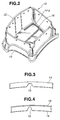
- the raw material resin pellets obtained above were subjected to injection molding at a molding temperature of 180 to 220 °C, at an injection pressure of 50 to 100 MPa, at a metallic die temperature of 20 to 50 °C, for a cooling time of 30 to 50 sec., and for an injection time of 7 to 12 sec. thereby forming an airbag storing casing as shown in Figs. 1 to 3.
- the airbag storing casing 10 is generally cup-shaped and usually installed to a base member (not shown) within a passenger compartment of an automotive vehicle, in the state of Fig. 1. More specifically, the airbag storing casing 10 comprises a tube-like section 12 having a generally rectangular cross-section. The tube-like section 12 is fixedly attached to the base member of a vehicle body.
- a top lid-like section 14 is integral with the tube-like section 12 and has a top flat surface 14a which faces a vehicle occupant (not shown). It will be understood that an inflatable airbag (not shown) is stored in its folded state inside the airbag storing casing 10. As shown in Fig. 2, the lid-like section 14 is formed at its inner surface 14b with grooves 16 to form thin wall portions in the lid-like section 14. It will be appreciated that the airbag storing casing 10 tears along the grooves 16 to allow the airbag projects toward the vehicle occupant when the airbag is inflated under operation of an airbag restraint system including the airbag storing casing 10.
- a paint of EXAMPLE 2 was prepared in a method as set forth below.
- a main resinous ingredient was prepared by mixing the following components: [Resin components:] Chlorinated polyolefine resin (the trade name "Superchlon 224H” produced by Sanyo Kokusaku Palupu or Nippon Paper Ind.) 13.5 wt% Polycaprolactone polyol resin (the trade name "Placcel L208AL” produced by Daicel Kagaku) 8.0 wt% Acrylpolyol resin (the trade name "Desmophen A-160” produced by Sumitomo Byer Urethane) 6.0 wt% [Solvent components:] toluene 44.5 wt% Ethyl acetate 8.0 wt% Xylene 4.5 wt% [Pigment:] Carbon black 3.0 wt% [Gloss adjusting agent:] Silica fine powder 8.0 wt% [Modifier:] Alcohol-modified silicone (
- the hardener consisted of 50% by weight of an addition polymer (the trade name "Z4370” produced by Sumitomo Byer Urethane) of hexamethylene diisocyanate, isophorone diisocyanate and polyol and 45% by weight of addition product (the trade name "E405-90T” produced by Asahi chemical) of hexamethylene diisocyanate and polyester polyol, and 5% by weight of toluene.
- an addition polymer the trade name "Z4370” produced by Sumitomo Byer Urethane
- E405-90T produced by Asahi chemical
- This paint was coated on the surface of the airbag storing casing which had been fabricated as mentioned above. Then, the paint was dried at 80 °C for 30 minutes thereby to form a coated film 18 having a thickness of 25 ⁇ in a dried state, as shown in Fig. 4. The performance of this coated film was evaluated to provide a result which is shown in Table 2.
- a paint was prepared according to a method as set forth below, in which polycaprolactone polyol resin as the resin component and the modifier were not used, in which the hardener was different from that in EXAMPLE 1.
- a main resinous ingredient was prepared by mixing the following components: [Resin components:] Chlorinated polyolefine resin (the trade name "Superchlon 822” produced by Sanyo Kokusaku Palupu or Nippon Paper Ind.) 15.0 wt% Acrylpolyol resin (the trade name "Desmophen A365” produced by Sumitomo Byer Urethane) 10.0 wt% [Solvent components:] toluene 45.0 wt% Ethyl acetate 5.0 wt% Xylene 4.0 wt% Butyl acetate 8.0 wt% [Pigment:] Carbon black 3.0 wt% [Gloss adjusting agent:] Silica fine powder 8.0 wt% [Stabil
- the hardener consisted of 60% by weight of hexamethylene diisocyanate (the trade name "Desmodur N-75" produced by Sumitomo Chemical Co., Ltd.), 20% by weight of toluene, and 20 parts by weight of cellosolve acetate. Furthermore, 60 parts by weight of a diluent consisting 30% by weight of methyl ethyl ketone, 25% by weight of toluene, 30% by weight of xylene and 15% by weight of butyl acetate was added. Thus, the paint of COMPARATIVE EXAMPLE 1 was obtained. By using this paint, the airbag storing casing was painted in the same as that in EXAMPLE 1. The performance of a coated film formed was evaluated to obtain a result which is shown in Table 2.
- a paint was prepared according to a method as set forth below, in which the modifier was not used, in which the hardener was different in kind from that in EXAMPLE 1.
- a main resinous ingredient was prepared by mixing the following components: [Resin components:] Chlorinated polyolefine resin (the trade name "Superchlon 822" produced by Sanyo Kokusaku Palupu or Nippon Paper Ind.) 15.0 wt% Polycaprolactone polyol resin (the trade name "Placcel L220AL” produced by Daisel Chemical Industries Ltd.) 10.0 wt% [Solvent components:] toluene 45.0 wt% Ethyl acetate 5.0 wt% Xylene 4.0 wt% Butyl acetate 8.0 wt% [Pigment:] Carbon black 3.0 wt% [Gloss adjusting agent:] Silica fine powder 8.0 wt% [Stabilizer:] Epoxy resin 1.0 wt% [L
- the hardener consisted of 50% by weight of a mixture of hexamethylene diisocyanate (the trade name "Desmodur N-75” produced by Sumitomo Chemical Co., Ltd.) and an addition product (the trade name "E402-90T” produced by Asahi Chemical) of hexamethylene diisocyanate and polyester polyol, 25% by weight of toluene, and 25% by weight of ethyl acetate.
- a paint of COMPARATIVE EXAMPLE 3 was prepared according to a method as set forth below, in which s modifier was not used, in which the hardener was different in kind from that in EXAMPLE 1.
- a main resinous ingredient was prepared by mixing the following components: [Resin components:] Chlorinated polyolefine resin (the trade name "Superchlon 822” produced by Sanyo Kokusaku Palupu or Nippon Paper Ind.) 15.0 wt% Polycaprolactone polyol resin (the trade name "Placcel L220AL” produced by Daisel Chemical Industries Ltd.) 7.5 wt% Cellulose acetate butyrate resin (the trade name "CAB551-0.2" produced by Eastman Chemical) 2.5 wt% [Solvent components:] toluene 40.0 wt% Ethyl acetate 5.0 wt% Xylene 10.0 wt% Butyl acetate 7.0 wt% [Pigment:] Carbon
- the hardener consisted of 60% by weight of hexamethylene diisocyanate (the trade name "Desmodur N-75" produced by Sumitomo Chemical Co., Ltd.), 20% by weight of toluene, and 20% by weight of cellosolve acetate. Furthermore, 60 parts by weight of a diluent consisting of 30% by weight of methyl ethyl ketone, 30% by weight of toluene, 25% by weight of xylene and 15% by weight of butyl acetate was mixed. Thus, the paint of COMPARATIVE EXAMPLE 3 was obtained. By using this paint, the airbag storing casing was painted in the same manner as that in EXAMPLE 1. The performance of a coated film formed was evaluated to obtain a result which is shown in Table 2.
- the cross-cut test was carried out as follows: A plurality of straight liner cuts were parallely made on the surface of the coated film with a distance of 2 mm between the adjacent lines. Then, a plurality of straight linear cuts were parallely made on the surface of the coated film in a manner to cross the former straight linear cuts thereby to form a plurality of square cut pieces. All the straight linear cuts reached the surface of the airbag storing casing. An adhesive tape was applied on the surface of 25 square cut pieces. Then, the adhesive tape was peeled off from the surface of the paint film at a stretch, and the peeled-off condition of 25 square cut pieces of the coated film was observed to evaluate the adherence characteristics of the coated film. If all 25 square cut pieces remained not peeled off, the evaluation was "Good”. If any of 25 square cut pieces was peeled off, the evaluation was "Bad".
- the test of Du Pont Impact Tester is according to JIS (Japanese Industrial Standard) K-5400 and was made by dropping a weight of 500g onto an impact member in contact with the surface of the paint coated film from a height of 50 cm, in which a tip end of the impact member had a diameter of 12.7 mm.
Landscapes
- Chemical & Material Sciences (AREA)
- Engineering & Computer Science (AREA)
- Mechanical Engineering (AREA)
- Health & Medical Sciences (AREA)
- Chemical Kinetics & Catalysis (AREA)
- Medicinal Chemistry (AREA)
- Polymers & Plastics (AREA)
- Organic Chemistry (AREA)
- Air Bags (AREA)
- Compositions Of Macromolecular Compounds (AREA)
Applications Claiming Priority (2)
| Application Number | Priority Date | Filing Date | Title |
|---|---|---|---|
| JP320027/92 | 1992-11-30 | ||
| JP32002792A JP3345686B2 (ja) | 1992-11-30 | 1992-11-30 | エアバッグ収納用ケ−ス |
Publications (2)
| Publication Number | Publication Date |
|---|---|
| EP0604776A1 true EP0604776A1 (fr) | 1994-07-06 |
| EP0604776B1 EP0604776B1 (fr) | 1999-02-03 |
Family
ID=18116936
Family Applications (1)
| Application Number | Title | Priority Date | Filing Date |
|---|---|---|---|
| EP19930119295 Expired - Lifetime EP0604776B1 (fr) | 1992-11-30 | 1993-11-30 | Boítier de logement pour sac à air |
Country Status (4)
| Country | Link |
|---|---|
| US (1) | US5691017A (fr) |
| EP (1) | EP0604776B1 (fr) |
| JP (1) | JP3345686B2 (fr) |
| DE (1) | DE69323408T2 (fr) |
Cited By (2)
| Publication number | Priority date | Publication date | Assignee | Title |
|---|---|---|---|---|
| EP0694443A1 (fr) * | 1994-07-25 | 1996-01-31 | TRW Occupant Restraint Systems GmbH | Couvercle pour airbag |
| EP0887378A4 (fr) * | 1996-03-15 | 1999-07-14 | Sumitomo Chemical Co | Composition et poudre d'elastomere thermoplastique et article moule obtenu |
Families Citing this family (10)
| Publication number | Priority date | Publication date | Assignee | Title |
|---|---|---|---|---|
| JP3020807B2 (ja) * | 1994-07-22 | 2000-03-15 | 三菱化学株式会社 | エアーバッグ収納用カバー |
| JP3071380B2 (ja) * | 1995-05-30 | 2000-07-31 | 日本プラスト株式会社 | エアバッグ収納用ケース |
| US6017989A (en) * | 1997-04-01 | 2000-01-25 | The Standard Products Company | Exterior automotive component of an elastomeric modified polyolefin material having pleasing appearance |
| US6316068B1 (en) * | 1997-09-10 | 2001-11-13 | Asahi Kasei Kabushiki Kaisha | Elastomer composition |
| JP3476355B2 (ja) * | 1998-01-21 | 2003-12-10 | 日本プラスト株式会社 | エアバッグ収納用ケース |
| JP3434698B2 (ja) | 1998-01-21 | 2003-08-11 | 日本プラスト株式会社 | エアバッグ収納用ケース |
| DE10142559B4 (de) * | 2001-08-30 | 2015-04-16 | Volkswagen Ag | Innenverkleidungsteil für ein Kraftfahrzeug |
| US20050100692A1 (en) * | 2003-11-06 | 2005-05-12 | Parker Richard H. | Textile products and silicone-based copolymeric coating compositions for textile products |
| US20190264014A1 (en) | 2016-06-08 | 2019-08-29 | Mitsui Chemicals, Inc. | Thermoplastic elastomer composition, method for producing same and molded body |
| EP4140827A1 (fr) * | 2021-08-26 | 2023-03-01 | Sumitomo Chemical Company, Limited | Procede de fabrication d'une composition elastomere thermoplastique |
Citations (4)
| Publication number | Priority date | Publication date | Assignee | Title |
|---|---|---|---|---|
| JPS61108638A (ja) * | 1984-11-02 | 1986-05-27 | Kinugawa Rubber Ind Co Ltd | 高分子弾性体の表面処理用塗料組成物 |
| US4735988A (en) * | 1985-05-28 | 1988-04-05 | Showa Denko Kabushiki Kaisha | Propylene polymer composition |
| EP0429236A2 (fr) * | 1989-11-14 | 1991-05-29 | Mitsubishi Chemical Corporation | Moulages en résine portant un revêtement |
| GB2254618A (en) * | 1991-04-11 | 1992-10-14 | Takata Corp | Air bag cover |
Family Cites Families (5)
| Publication number | Priority date | Publication date | Assignee | Title |
|---|---|---|---|---|
| DE3707370A1 (de) * | 1987-03-07 | 1988-09-15 | Kolbenschmidt Ag | Sicherheitslenkrad |
| DE3837085A1 (de) * | 1988-11-01 | 1990-05-03 | Kolbenschmidt Ag | Gassack-aufprallschutzvorrichtung |
| JP2803311B2 (ja) * | 1990-04-09 | 1998-09-24 | 住友化学工業株式会社 | 熱可塑性エラストマー組成物 |
| US5308699A (en) * | 1990-10-03 | 1994-05-03 | Sumitomo Chemical Company Limited | Thermoplastic elastomer powder for powder slush molding powder slush molding method using the same and molded article thereof |
| JP3071380B2 (ja) * | 1995-05-30 | 2000-07-31 | 日本プラスト株式会社 | エアバッグ収納用ケース |
-
1992
- 1992-11-30 JP JP32002792A patent/JP3345686B2/ja not_active Expired - Fee Related
-
1993
- 1993-11-30 DE DE69323408T patent/DE69323408T2/de not_active Expired - Lifetime
- 1993-11-30 EP EP19930119295 patent/EP0604776B1/fr not_active Expired - Lifetime
-
1996
- 1996-06-05 US US08/655,217 patent/US5691017A/en not_active Expired - Lifetime
Patent Citations (4)
| Publication number | Priority date | Publication date | Assignee | Title |
|---|---|---|---|---|
| JPS61108638A (ja) * | 1984-11-02 | 1986-05-27 | Kinugawa Rubber Ind Co Ltd | 高分子弾性体の表面処理用塗料組成物 |
| US4735988A (en) * | 1985-05-28 | 1988-04-05 | Showa Denko Kabushiki Kaisha | Propylene polymer composition |
| EP0429236A2 (fr) * | 1989-11-14 | 1991-05-29 | Mitsubishi Chemical Corporation | Moulages en résine portant un revêtement |
| GB2254618A (en) * | 1991-04-11 | 1992-10-14 | Takata Corp | Air bag cover |
Non-Patent Citations (1)
| Title |
|---|
| DATABASE WPI Section Ch Week 8627, Derwent World Patents Index; Class A82, AN 86-174325 * |
Cited By (4)
| Publication number | Priority date | Publication date | Assignee | Title |
|---|---|---|---|---|
| EP0694443A1 (fr) * | 1994-07-25 | 1996-01-31 | TRW Occupant Restraint Systems GmbH | Couvercle pour airbag |
| US5786049A (en) * | 1994-07-25 | 1998-07-28 | Trw Occupant Restraint Systems Gmbh | Cover for a gas bag module |
| EP0887378A4 (fr) * | 1996-03-15 | 1999-07-14 | Sumitomo Chemical Co | Composition et poudre d'elastomere thermoplastique et article moule obtenu |
| US6331360B1 (en) | 1996-03-15 | 2001-12-18 | Sumitomo Chemical Company, Limited | Thermoplastic elastomer composition and powder and molded article thereof |
Also Published As
| Publication number | Publication date |
|---|---|
| US5691017A (en) | 1997-11-25 |
| DE69323408D1 (de) | 1999-03-18 |
| DE69323408T2 (de) | 1999-06-10 |
| JPH06156178A (ja) | 1994-06-03 |
| EP0604776B1 (fr) | 1999-02-03 |
| JP3345686B2 (ja) | 2002-11-18 |
Similar Documents
| Publication | Publication Date | Title |
|---|---|---|
| US5611565A (en) | Airbag storing casing | |
| EP0604776B1 (fr) | Boítier de logement pour sac à air | |
| US6153680A (en) | Thermoplastic polymer alloy compositions and in-line compounding process for direct sheet extrusion of sheets prepared from the thermoplastic polymer alloy compositions | |
| CN114126855B (zh) | 用于气囊盖的复合结构 | |
| US6210797B1 (en) | Airbag storing casing | |
| JP2022527954A (ja) | 全tpoエアバッグ組み立て体 | |
| US6176510B1 (en) | Air bag cover containing a block copolymer polypropylene resin blend | |
| CA2110502C (fr) | Feuille ou piece moulee en matiere thermoplastique a base d'un copolymere a sequence de polypropylene | |
| US5376461A (en) | Pad for air bag apparatus | |
| US5248532A (en) | Air bag-containing cover | |
| KR20210126280A (ko) | 도장 보호 필름용 조성물 및 이를 이용하여 제조된 도장 보호 필름 | |
| KR102745400B1 (ko) | 차량 내장 스킨용 조성물, 이의 제조방법 및 이를 이용하여 제조된 차량 내장 스킨 | |
| GB2241665A (en) | Cover for air bag | |
| CA2064276A1 (fr) | Couvercle de logement de coussin de securite gonflable | |
| US5945206A (en) | Interior molded article for automobiles | |
| JP3476355B2 (ja) | エアバッグ収納用ケース | |
| EP0603580B1 (fr) | Composition à base de résiue oléfineque | |
| US20090088530A1 (en) | Novel polymer compound and uses thereof | |
| JP2885124B2 (ja) | エアバッグ装置用パッド | |
| US6644684B2 (en) | Air bag cover for vehicles | |
| KR20190088431A (ko) | 분말 슬러쉬 몰딩용 열가소성 폴리우레탄 조성물 및 이를 이용하여 제조된 자동차 내장재용 표피재 | |
| JP7643122B2 (ja) | 熱可塑性エラストマー組成物、成形体およびエアバッグ収納カバー | |
| US20100190915A1 (en) | Novel Polymer Compound and Uses Thereof | |
| JPH0834304A (ja) | エアーバッグ収納用カバー | |
| JPH1067890A (ja) | エアバッグ収納カバー用熱可塑性エラストマー組成物 |
Legal Events
| Date | Code | Title | Description |
|---|---|---|---|
| PUAI | Public reference made under article 153(3) epc to a published international application that has entered the european phase |
Free format text: ORIGINAL CODE: 0009012 |
|
| 17P | Request for examination filed |
Effective date: 19931130 |
|
| AK | Designated contracting states |
Kind code of ref document: A1 Designated state(s): DE GB |
|
| 17Q | First examination report despatched |
Effective date: 19960215 |
|
| GRAG | Despatch of communication of intention to grant |
Free format text: ORIGINAL CODE: EPIDOS AGRA |
|
| GRAG | Despatch of communication of intention to grant |
Free format text: ORIGINAL CODE: EPIDOS AGRA |
|
| GRAH | Despatch of communication of intention to grant a patent |
Free format text: ORIGINAL CODE: EPIDOS IGRA |
|
| GRAH | Despatch of communication of intention to grant a patent |
Free format text: ORIGINAL CODE: EPIDOS IGRA |
|
| GRAA | (expected) grant |
Free format text: ORIGINAL CODE: 0009210 |
|
| AK | Designated contracting states |
Kind code of ref document: B1 Designated state(s): DE GB |
|
| REF | Corresponds to: |
Ref document number: 69323408 Country of ref document: DE Date of ref document: 19990318 |
|
| PLBE | No opposition filed within time limit |
Free format text: ORIGINAL CODE: 0009261 |
|
| STAA | Information on the status of an ep patent application or granted ep patent |
Free format text: STATUS: NO OPPOSITION FILED WITHIN TIME LIMIT |
|
| 26N | No opposition filed | ||
| REG | Reference to a national code |
Ref country code: GB Ref legal event code: IF02 |
|
| REG | Reference to a national code |
Ref country code: GB Ref legal event code: 732E |
|
| PGFP | Annual fee paid to national office [announced via postgrant information from national office to epo] |
Ref country code: DE Payment date: 20121128 Year of fee payment: 20 |
|
| PGFP | Annual fee paid to national office [announced via postgrant information from national office to epo] |
Ref country code: GB Payment date: 20121126 Year of fee payment: 20 |
|
| REG | Reference to a national code |
Ref country code: DE Ref legal event code: R071 Ref document number: 69323408 Country of ref document: DE |
|
| REG | Reference to a national code |
Ref country code: DE Ref legal event code: R071 Ref document number: 69323408 Country of ref document: DE |
|
| REG | Reference to a national code |
Ref country code: GB Ref legal event code: PE20 Expiry date: 20131129 |
|
| PG25 | Lapsed in a contracting state [announced via postgrant information from national office to epo] |
Ref country code: DE Free format text: LAPSE BECAUSE OF EXPIRATION OF PROTECTION Effective date: 20131203 Ref country code: GB Free format text: LAPSE BECAUSE OF EXPIRATION OF PROTECTION Effective date: 20131129 |